Badger Baiting
We want you to have a greater ability to learn about some of the unpleasant animal issues in our world.
Wrestling and Wrestlers
Jacob Robinson and Sidney Gilpin
BADGERS AND BADGER BAITING.
Baiting the badger differed from bull baiting in one respect, inasmuch as the former was generally practised in some room or yard, mostly attached to a public house. It was often a private affair, got up by some sporting landlord, for the purpose of drawing customers to his hostelry, as well as to have an opportunity of seeing the badger drawn; while bull baiting, except on great state occasions, was always a public affair.
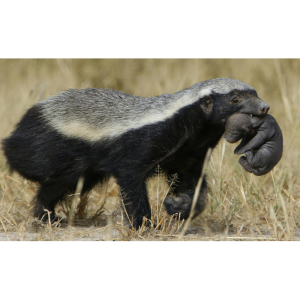
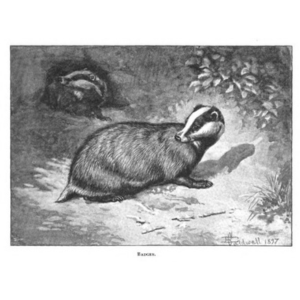
The badger, in former times called the “Grey,” is a small animal, which at no remote period was, comparatively speaking, plentiful in Cumberland and Westmorland, and in various parts of the north of England. It abounded, too, in Scotland, and its cured skin was used in making the Highlander’s hanging pouch. It measured about three feet from the snout to the end of the tail, and weighed from seventeen to thirty pounds. Few animals are better able to defend themselves, and fewer still of their own weight and size dare attack them, in their native haunts. When in good case, they are remarkably strong, fight with great resolution if brought to bay, can bite extremely hard, and inflict very severe wounds. It is strange that it should have been so persistently and ruthlessly hunted and destroyed, so as to lead to the almost entire extermination of the herd in this country.
In Reminiscences of West Cumberland, (printed for private circulation, in 1882,) William Dickinson gives the following account of the capture of some of these animals: — “On March 29, 1867, a badger was captured in a wood adjoining the river Derwent, by Mr. Stirling’s gamekeeper. It was a full grown animal, in prime condition, and was secured without sustaining any injury. A few years before that a badger was caught near St. Bees. It was supposed to have escaped from captivity. Within my recollection, a badger was taken by a shepherd and his dogs, on Birker moor, and believed to be a wild one; and none had been known for many miles around by any one living. They are not now known to breed in Cumberland; but the late Mr. John Peel of Eskat, told me the brock or badger had a strong hold in Eskat woods, and that he once came so suddenly on a brock asleep, as it basked in the sun, that he struck it with his bill hook, and wounded it in the hind quarter. Its hole was so near that it crawled in and was lost. The place is still called the Brock-holes.”
An interesting experiment has been tried on the Naworth Castle estate, the Border residence of Mr. George Howard, a dozen miles or so from Carlisle, About the year 1877 or 1878, four healthy and well developed badgers were let off, some two miles eastward trom the castle, near the side of the river Irthing, which flows through a wide sweep of charmingly diversified scenery. The place occupied by them is a piece of rough, woodland, “banky” ground, quiet and secluded, the soil being of a dry sandy nature. The badgers, in the first instance, were lodged in an old fox earth “bield,” part of which they have held in undisturbed possession ever since. They appeared to fall in naturally with their new quarters, and soon took to digging and making the hole, and its various ramifications, much larger and more capacious.
Curiously enough, after the lapse of some years, the foxes returned to their old retreat, and for two successive seasons there has been a breed of young cubs reared in the same burrow with the badgers. Each species of animal has taken up a separate part or side-branch of the hole for its own particular use and abode; and, so far as appearance goes, the two families have lived together happy and contented for the time being. A similar illustration of foxes fraternising with badgers is amply borne out in a valuable communication to The Times, of October 24th, 1877, by Mr. Alfred Ellis of Loughborough, who, after some difficulty, introduced a breed of badgers, in semi-wild state, to a covert within fifty yards of his own residence. Mr. Ellis says, “The fox and the badger are not unfriendly, and last spring a litter of cubs was brought forth very near the badgers; but their mother removed them after they had grown familiar, as she probably thought they were showing themselves more than was prudent”
The neighbouring dogs are not known to have molested the Navvorth badgers in any way, and it is now supposed the estate can number about a dozen in numerical strength. The nocturnal habits, natural to badgers, make it very difficult to study their actions and mode of life, with any amount of close observancy, as they rarely leave their holes till near nightfall, and are back again generally by daybreak.
There is not much which properly comes under the game laws near the badgers’ place of rendezvous, but Mr. Brown, the head keeper, is under the impression that they are destructive to some kinds of game; in fact, he says, they take anything they can lay hold of in the shape of eggs or young birds. They dig a good deal for fern roots, and feed upon them, turning up the ground in the same way that a pig does. It would appear also that they are very fond of moles. Any of these animals left dead by the keepers or foresters, in the vicinity of their haunts, invariably disappear quickly and are no more seen.
Shy, reserved, and alert as the badgers are, they may be come upon sometimes, by chance or accident, on the banks of the Irthing; and when seen in the dusky twilight of a summer evening, “scufterin”‘ along through the long grass or “bracken” beds, they might be easily mistaken for a litter of young pigs.
In addition to the food incidentally mentioned, the badger lives upon frogs, insects, wasps’ nests, fruit, grass, and a great variety of other things. Its habits are perfectly harmless in a wild state; and yet few animals have suffered so much cruel torture, in consequence of vulgar prejudice. The hams, as food, were esteemed superior in delicacy of flavour to the domestic pig or wild hog. In this country, the hind quarters only were used for food; while in some parts of Europe and in China, the whole carcass was held in high esteem, and considered to be very nutritious.
In hunting and capturing them, the usual plan was to dig a hole in the ground, across some path which they were known to frequent, covering the pit lightly over with sticks and leaves. Another mode of catching them was by means of a sack being carefully fitted to the entrance of their burrows. When supposed to be out feeding, two or three dogs were set to hunt the adjoining grounds, and the badger was thus driven home-wards, and safely secured in the sack.
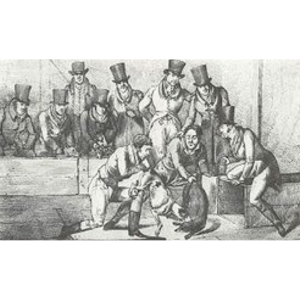
The mode of baiting was generally pursued as follows. Sometimes, according to choice, the animal was put into a barrel; while at other times, a trench was dug in the ground, fourteen inches deep and of the same width, and covered over with a board. But the plan most frequently adopted was to have a square drain-like box constructed, in the form of a capital letter L. The longer part measured something like six feet in length, and the shorter part four feet. The box was throughout thirteen or fourteen inches square, with only one entrance way. When a baiting display took place, the badger was placed inside the box at the far end of the shorter compartment. It will be apparent, from being so placed, that it had some advantage over any dog attacking in front. The dog had to proceed up the longer leg of the box, and then turning sharp round, found the object of its search cautiously crouching, and on the watch for any advancing foe.
A strong fresh badger was never unprepared for fight, and, by being thus on the alert, had the opportunity of inflicting a fearful bite at the outset; so severe, indeed, that any currish inclined dog at once made the best of his way out, howling with pain, and thoroughly discomfited. And no coaxing, no inducement in the world, could make the craven-hearted brute attempt a second attack.
On the contrary, one of the right sort rushed immediately into close quarters, seized the badger with as little delay as might be, and endeavoured to drag it forth into open daylight. It required a dog of rare pluck and courage, however, to accomplish this feat — one, in fact, insensible to punishment; and few could be found willing to face and endure hard biting, and force the badger from its lair. Pure bred bull dogs will naturally go in and face anything, but it is in very few instances that they make any attempt to draw.
Long experience showed that the best and truest that could be produced, were a cross between a well bred bull dog and a terrier, commonly known as bull terriers. Sufficiently powerful and courageous dogs were, also, to some extent, to be found amongst rough wiry haired terriers — the Charlieshope Pepper and Mustard breed of Dandie Dinmonts — which “fear naething that ever cam wi’ a hairy skin on’t;” and the handsome, smooth, glossy-coated black and tan dog, “fell chield at the varmin,” which would buckle either “tods or brocks.” Bedlington terriers, — a distinct breed of Northumbrian origin, long known and esteemed in Cumberland and other northern counties have frequently proved themselves admirable adepts at drawing the badger. These dogs, properly speaking, are more “fluffy” coated than wiry — have greater length of leg than the Dandie Dinmonts — are full of spirit and stamina remarkably active and alert — and very fierce and resolute when called into action.
The badger is not often much hurt in the drawing, the thickness of their skin being sufficient to prevent them from taking any great harm. The looseness of the skin is such that they can turn easily, and, moreover, they are so quick in moving about, that the dogs are often desperately wounded in the first assault, and compelled to give up the contest.
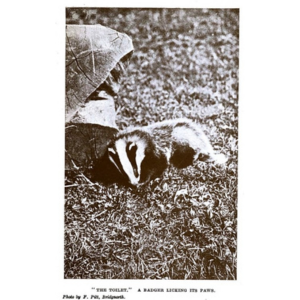
To give an idea of the extreme sensitiveness for cleanliness which characterize the habits of the badger, let the following example be taken. On being drawn from its barrel by the dog, it not unfrequently happens in the scuffle which ensues, that the animal is rolled over and over, among the mire of the road, or the dirt of some neighbouring dunghill. Should the badger, however, be able to escape to its place of refuge in the barrel, even for a minute or two, the onlooker is surprised to find it turn out again as “snod” and clean, as if the dragging process through the dirt had never been undergone.
Several proverbial sayings are current, which have been drawn from the nature and habits of this animal. For instance, a man of much and long continued endurance, is said to be “as hard as a brock;” and any one, upon whom age is creeping, and whose hair has lost a good deal of its original brightness, is said to be “as grey as a badger.” Relph of Sebergham, in detailing in his native patois, the woes of a young and lusty love-sick swain, gives an illustration of one of the modes of hunting the animal: —
Nae mair i’ th’ neets thro’ woods he leads,
To treace the wand’rin’ brock;
But sits i’ th’ nuik, an’ nowt else heeds,
But Jenny an’ her rock.
In addition to the haunts of the badger incidentally mentioned,Brock-stones, in Kentmere, Brock-holes, at the foot of Tebay Fells; Graythwaite woods, in Furness Fells; Greystoke forest, near Penrith; Brockley-moor, in Inglewood forest; Brock-hills, near Hesket Newmarket; and Brockle-bank, on the east side of Derwentwater; — these and many other like coverts in the Lake Country, (as their names indicate,) were all strongholds and places of much resort for these animals, in the olden time.
Within the memory of living man, badgers have burrowed in the sand hills on Brocklebank, where it was not uncustomary for the tag-rag and bob-tail fraternity of Keswick, to hunt and capture them for the purpose of baiting.
About the year 1823, Tom Wilson, a shoemaker — reared at The Woodman inn, Keswick — remembers one being caught in a sack at the foot of Brockle-beck, when a novel but extremely foolish experiment was tried in the way of hunting it. It was let off in the midst of a gang of rough men, half-grown lads, and dogs, in deep water, near Lord’s Island on Derwent Lake, and the chances are that the poor animal perished by drowning. At all events, it soon disappeared under the surface, and was never seen again by man or dog.
A husbandman, named Jonathan Gill, captured another on Great How, a steep wooded mountain which rises on the east side of Thirlmere lake. These are the two last badgers in the Keswick locality, of which we have any tidings. It is more than probable that the Brocklebank herd became dispersed or extinct about this period.
Jacob Robinson and Sidney Gilpin, Wrestling and Wrestlers: Biographical Sketches of Celebrated Athletes of the Northern Ring; To Which is Added Notes on Bull and Badger Baiting (London: Bemrose & Sons, 1893), pp. 235-243.
See: https://babel.hathitrust.org/cgi/pt?id=uc2.ark:/13960/t4xg9gp9m&seq=1
Games, Gaming, and Gamester’s Law
Frederick Brandt
I may bring this chapter to a conclusion by alluding very shortly to badger-baiting, for even this harmless and somewhat interesting animal has not escaped the brutality of man, and was formerly baited as savagely and with as much cruelty as were bulls and bears. I fear the “pastime” is scarcely extinct even now — under the comparatively humane form of what is called “drawing a badger” (out of a tub or barrel). In former days I find that, in order to give better effect to this diversion, a hole was dug in the ground for the retreat of the animal; and, says Strutt, “the dogs run at him singly in succession, for it is not usual, I believe, to permit any more than one of them to attack him at once, and the dog which approaches him with the least timidity, and fastens upon him the most firmly, and brings him the soonest from his hole, is accounted the best.” How it is managed in these days I really do not know, neither do I think that if I could give my readers any information on the subject they would care much to have it imparted to them; unless, indeed, they should share the opinion attributed to certain Puritans who thought that in baiting animals the sin consisted mainly “in that the pastime gives pleasure to the ” beholder.”
Frederick Brandt, Games, Gaming, and Gamester’s Law (London: Henry Sweet, 1873), pp. 222.
See: https://babel.hathitrust.org/cgi/pt?id=uc2.ark:/13960/t7kp8350d&seq=1
Old English Sports
Frederick W. Hackwood
Badger-baiting could only be a popular sport when badgers were more abundant in the land than they are now. With the great increase of the population and the encroachments of humanity upon those solitudes which once formed the domain of the larger English beasts, the badger has become comparatively rare. It may surprise many to learn that the supply of badgers for the Birmingham baitings was regularly kept up as late as 1830 from Sutton Wood, not more than seven miles away from that populous city. One old sportsman recounts that on the night George IV. died he was engaged in Sutton Woods catching badgers; he remembers the occasion so well because of the terrific thunderstorm which marked the date, and which the folk afterward said was the manifestation of the imps below making merry at having captured the redoubtable George at last. Storm notwithstanding, a fine thirty-six pound badger was caught that night and exhibited next day at the Boar’s Head Tavern, Perry Barr.
If the repeated employment of a captive badger necessitated the cutting away of a portion of its lower jaw, as has been asserted, it is perhaps as well there are now fewer badgers to maltreat.
One of the last reported cases of Badger-baiting occurred at Preston in 1897, when a prosecution took place for the offence.
The badger was kept in a box in a loft. When the dog was introduced, a lamp was fixed in such a manner that both the dog and the badger would be enabled to see each other in their encounter.
The box was about two feet square, covered at the top with wire netting. Attached to the box was a tunnel two or three yards long. When the dog was brought in, it made straight for the tunnel, and got into the cage where the badger was. Then began a desperate fight, the dog yelping, and the badger giving mouth too. Presently the dog succeeded in drawing the badger about half the length of the tunnel, when another severe tussle ensued. This resulted in the badger’s getting a better hold, and dragging the dog back into the square box. Here the contest was resumed with redoubled fury, the dog yelping and the badger screaming. At last the owner of the dog, afraid for the life of his animal, opened the lid of the box, and lifted it out by the tail. The dog, however, would not loosen his hold of the badger till its mouth had been prised open with a poker. Both animals were shockingly bitten.
Other cases brought into court have disclosed the fact that some dogs are really quite expert in their badger-drawing. And it also appears to be not an uncommon thing for surreptitious Badger-baiting to be carried on under cover of ostensibly “trying dogs on a few rats.”
Towards the end of the period in which Badger-drawing and Bull-baiting were looked upon as quite legitimate sports, a special breed of long-faced bull-terriers was developed for these purposes by a Birmingham fancier named Hinks. Among some of the champions of this class was the celebrated dog named “Madman,” to which allusion has been made previously, which was ultimately sent abroad to provide sport for the officers of a certain British regiment on foreign service.
Frederick W. Hackwood, Old English Sports (London: T. Fisher Unwin, 1907), p. 351-352. See: https://babel.hathitrust.org/cgi/pt?id=coo1.ark:/13960/t2w38bc4g&seq=1
The National Sports of Great Britain
Henry Alken
BADGER-BAITING
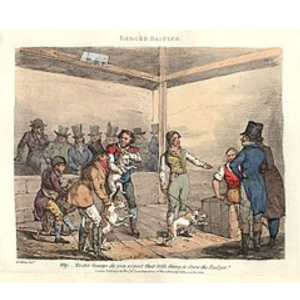
This most quiet and harmless animal, at the same time possessing invincible and endless courage, has the misfortune to be selected with the bull, for the pious national English purpose of baiting. Badger-baiting is even yet customary throughout the country, at fairs and races, and in the outskirts of the metropolis at all seasons, as a standing dish of amusement for the dissipated and vulgar of all descriptions, noble, gentle, or simple. These relics of ancient barbarism are chiefly preserved in existence by a low and disreputable class of publicans, who find an interest in it, and whose houses are frequently the resort of bad characters.
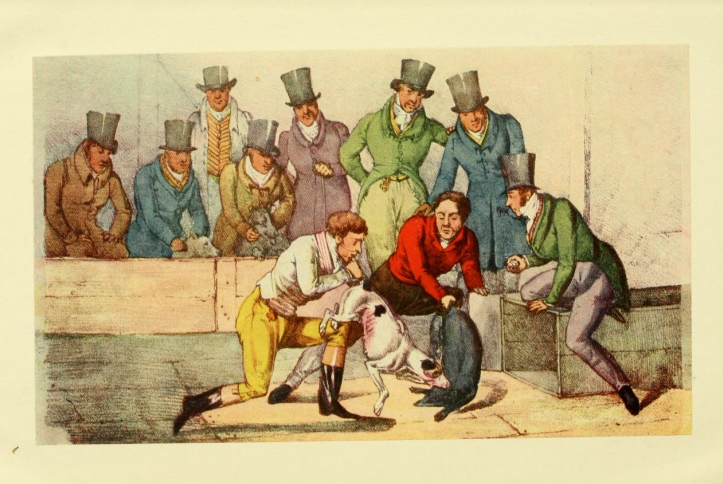
The artist, we think, in this Plate [see belwo], has evinced both knowledge and genius in depicting the countenances of his heroes. Never were coldness of heart, and a mean, grasping disposition better pourtrayed in a round and jolly youthful phiz, than in that of the upright-shaped gemman with his hand upon his hip. Granting it a portrait.we call upon the original to look upon it and bless himself!
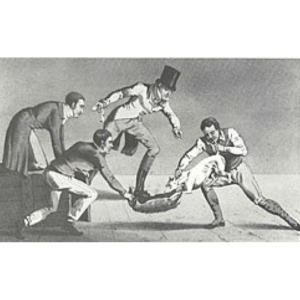
The instant of opening the door of the Badger’s kennel, the dog being loosed, darts forward with the rapidity of a shot, into the box, the attendant still retaining hold of his tail. The Badger being drawn, one attendant, upon a level with him in sharpness and strength of teeth, and true unadulterated beastliness, seizes either the tail or leg of the dog, which he bites with a true vermin gripe, (smoke his phiz!) in order, by the extreme excitement of pain of a superior degree to that afforded by the bite of the Badger himself, the fixer may be induced to let go his hold; in the meantime the Badger’s ward lays hold of the tail, while his gemman, keeping an exact account of the time expended by his brother brutes in their contention, prepares to assist in returning the Badger to his box, by taking him by the tail or pole.
Re-kennelled, the poor devil of animal, which, if he possess the power of wonderment, must indeed wonder what he has done to bring upon himself this repeated torture, is very soon exposed to a fresh attack, and is again drawn and replaced; and thus he suffers, until the beastly inclinations or cupidity of his torturers and murderers are satiated!
Whilst we decry, and denounce at the bar of humanity, these infamous and torturing propensities, we have not one word to urge against fairly hunting the Badger in the field, and witnessing those natural antipathies and consequent combats between him and the vermin-dogs. It is a dispensation of nature and these natural antagonists would fight, did they meet in a desart, unaccompanied by man. It is then a lawful, and may be a useful sport; and, finally, we have not one drop of puritanical, mixed with our sporting blood.
The metropolitan Badger-ward, if we may be allowed to adopt that ancient phrase of the bear-garden, keeps his Badger in a box, and for the preservation of the animal, which is of more worth, and not so easily obtained as in the country; in other words, for the prolongation of his tortures, watches over his combat with the dogs, and secures to him fair play, according to the established rules of Badger-law. The dogs in the highest repute for this Sport, are bull-terriers or fixers.
The jist of the match, and object of betting are, the number of times the dog will draw the badger from his box, within a given space of time, determined by the stop-watch. It is almost incredible, considering the strength and powers of offence, with the sharp teeth of the Badger, how often he will be drawn within the usual time, by a well-bred and thoroughly-trained dog. As an illustrious example, it is recorded that, within these few years the dog of a gemman, homo generosus, no doubt;, who had possessed the valuable breed during thirty years, drew a fresh, strong, and game Badger, seventy-four times in ten minutes!!!
Henry Alken, The National Sports of Great Britain (New York: D. Appleton & Co., 1903), no pagination.
See: https://babel.hathitrust.org/cgi/pt?id=mmet.ark:/13960/t43r14k1j&seq=1
Encyclopaedia of Sport
Charles Howard, Hedley Peek and F. G. Aflalo 388-390
OBSOLETE-BADGER BAITING
Many animals, the fox, for instance, have to pay a price for their existence, and just a century ago this is what the badger had to pay for his. — “They dig a place in the earth about a yard long, so that one end is four feet deep. At this end a strong stake is driven down. Then the badger’s tail is split, a chain put through it, and fastened to the stake with such ability that the badger can come up to the other end of the place. The dogs are brought and set upon the poor animal, who sometimes destroys several dogs before it is killed.” — This is a friendly description, and conveys but little idea of the barbarities actually practised. That the badger was not alone the victim of this fiendish cruelty is evident from the concluding sentence of the above quotation. Often half-a-dozen dogs were maimed for life in the contest, a jaw torn away being a common result.
A glance at a badger’s armed cranium suggests a good deal in this connection, the interlocking teeth — the “holders,” and the way in which the lower jaw is articulated with the upper, explaining the hold which the badger is able to take and keep.
It may at once be stated that the older barbarous methods of badger baiting had nothing in common with badger hunting proper, or “digging the badger.” If fairly pursued, this is a legitimate sport to every one concerned — including the badger. The method of hunting him nowadays is to wait quietly until he has left his “earth” on his nightly foray, then to insert a sack with a running noose in each of the principal entrances to his abode. Having given him a fair start, a scratch pack — and it matters little how this is constituted so long as the members composing it will give mouth — is laid on his trail, and Meles taxus is hustled unceremoniously homeward. If the plans have been properly laid, his reception is often of an undignified character, for he suddenly finds himself hopelessly involved in a sack — that is, unless he has gone clean through it. Once taken, he may be transferred to a new country to establish a new earth, may be conveyed home as an interesting pet, or, best of all, turned loose so as to afford another (or a series) of moonlight runs. Only those who have taken part can appreciate the fun to be derived from rushing the “brock” back to his dark retreat.
The above is one method of hunting. Badger digging proper is another. Here men, tools, and terriers are brought into requisition; and the badger is fairly (always laboriously) dug out of his rocky fastness. One of a team of reliable terriers marks the game — which has then to be dug up to. This may take two hours, but more often takes twelve — and I have known it to take twenty-four. The business of the terrier is to mark and bay the game, but unless compelled he should not tackle it. If, as occasionally happens, the badger charges home, the dog is compelled to act on the defensive.
Then the war becomes desperate. I have seen the jaw of a hard-haired terrier wrenched off and an eye torn out, but this, fortunately, very rarely happens. The dog or dogs having fixed their game, and its locale having been reached by digging, the badger is drawn by hand or with badger tongs. A badger’s teeth can splinter iron, so that considerable care has to be exercised in handling him, especially as at this time his temper is considerably ruffled. I may mention a third method of hunting — that employed by a Cambridge undergraduate and his staff. This consisted of a badger, a beagle, and a bull-terrier. — “The badger was turned out, the beagle laid on after a certain amount of law, and the bull-terrier held in reserve to recover the badger should he go to ground. This sporting quartet thoroughly understood each other, and, as a rule, each kept to his own special department.
The Badger was expected, at least, to give a two or three miles run over a country, the beagle to speak to him all the way and to account for him, the man to keep the beagle in view, and the terrier to facilitate the operation of bagging the badger at the finish.”
Even to-day there might be legitimate and illegitimate methods of badger baiting — only the former is never practised. For instance, but few terriers could “draw” a badger from a properly constructed badger-box. In this case the conditions would be something like equal. In the old badger baiting, however, the badger was often half-starved and maimed; the conditions under which the drawing was practised did not give it a chance, and after being placed in a tub, every dog in the neighbourhood was “tried” upon it.
The poor imprisoned brute generally managed to leave its mark upon each of the snarling crew, and often had to be knocked on the head in the end. Public-houses in town and country were generally the scene of these barbarisms, and the week-end the chosen time for the “sport.” The sickening scenes which were the sequels to these encounters did much to form public opinion against them, and in time the brutal exhibitions were proscribed. Subsequently the number of badgers rapidly declined, but now, thanks to the intervention of several landowners and country gentlemen, the species is again establishing a fairly firm footing. The badger is a harmless, unoffending creature, extremely interesting to watch and study, and long may it survive in the peace to which it is entitled. J. W.
Charles Howard, Hedley Peek and F. G. Aflalo, eds., Encyclopaedia of Sport, vol. 2 (London: Lawrence & Bullen, 1900), pp. 388-390.
See: https://babel.hathitrust.org/cgi/pt?id=wu.89090039298&seq=1
The Badger Afield and Underground
H. Mortimer Batten
CHAPTER II
FOLKLORE AND FABLE
Baiting and Abuse
So much has already been written upon the indignities and cruelties to which the badger has been subjected from earliest times that I do not intend to devote too much space to this chapter of his unfortunate history. In the past, baiting has been the price of his existence. He has been, and is to-day, the most abused and misunderstood of British wild beasts, and I quote the following from Nicholas Cox as a 16th century method of obtaining sport from fox or badger. It might be added that until comparatively recently it was customary to break off the fangs of the badger before baiting him with terriers. Thus Nicholas Cox: “Cut away the nether jaw, but meddle not with the other, leaving the other to show the fury of the beast, although it can do no harm therewith. Then dig an earth in some convenient place, cover the hole with boards and turf, putting the fox or badger first therein, and after you put in your terriers, both young and old.”
Apparently the more terriers the merrier, but it was evidently not usual for the terriers to kill the mutilated badger, for, proceeding, Mr. Cox recommends removing him with the pincers and killing him before the dogs, finally allowing them to worry the carcass. Cox, however, was a humanitarian in his day, for he adds: “Instead of cutting away the jaw it may be every whit as well to break away all the teeth,” etc.
It is almost inconceivable that an animal, after being mutilated in so horrible a manner, would yet turn to fight, and cutting away the lower jaw of the badger must have been a specially complicated operation.
An amusing anecdote is told in the locality of Hutton-le-Hole concerning a badger drawing test which took place some years ago, and which, as usual, smelt of beer and pigsties. The badger was in the ordinary type of rectangle wooden box, and the owner of it offered bets of two to one that no dog present could get it out. With becoming bashfulness a ruddy-faced farm labourer, the owner of a long-bodied, long-haired sheep dog whelp stepped up and accepted the bet. It goes without saying that the badger was not new to the game, and that his owner’s confidence was the result of many similar meetings.
The ground was cleared, and the farm labourer introduced his cur to the mouth of the hole, “ticing” him on with befitting sounds. The cur was not interested, so the man got hold of him and shoved him down the hole, tail first. A howl from the dog signified that the badger had obtained a good grip, whereupon the youth let go, and the dog shot out of the artificial earth with the badger still fast to his hind-quarters! So the youth won his bet.
It may be added that rather than dispute the point a much harassed badger will allow himself to be drawn without much argument.
To anyone conversant with the habits and history of this beast, he stands out as rather a pathetic figure; but, as already stated, little is to be gained by dwelling upon this unhappy phase of his life. The badger is a friendly and lovable beast. That he is not usually pictured as such is because he is most generally seen under unhappy conditions — perhaps as a cornered and terrified victim, filled with suspicion at his surroundings, and dreading attack. Fortunately, the badger never realises that his case is hopeless. I have known a starving and broken-hearted beast, after days of captivity and misery, to fight as gamely for its life as when first taken from its home, and so long as a badger lives, its tenacity never wavers no matter how dark the prospects.
The following is typical of the kind of treatment badgers have received at the hands of village “sports-men” for centuries past. A keeper tracked down a pair of adult badgers and their three cubs when the family moved quarters, and took up their abode on a sandy hillside, in the month of April. The dam and three cubs were killed, but the dog was tailed, and dropped into a bag. Some difficulty in bagging him was caused by one of the terriers leaping when the badger was drawn from the earth, fixing itself to the captive’s throat, and inflicting a very sore wound ere it could be removed.
Next the badger was placed in a barrel, just large enough for it to lie down in, curled up, and here the creature was kept for a matter of three weeks. During that time it drank a little water, but ate nothing, owing to the fact that it was constantly harassed and worried by its captors. It was kept in the stables at the back of a country inn, and several callers per day would ask to see the badger. The heavy flag was then removed from the barrel, and a hooked stick, kept handy for the purpose, was used to grasp the animal’s neck — still sore from the encounter with the terrier — in order to raise its head. Every time this happened the animal put up a most stubborn resistance, guarding its throat from the crook of the stick as best it could.
Almost every evening Brock was turned into a loose box, and terriers were tried at him.¹ He would amble round the box, placing his forefeet on the walls and looking upwards in search of a possible way of escape. When the terrier or terriers were shown in he would back into a corner and lie there, his nose hidden between his forepaws. So far as I know, none of the dogs introduced actually tried conclusions with him.
At the end of three weeks of this kind of thing I was invited to introduce a specially game terrier of my own, which knew a good deal about hill foxes, but was new to badgers — except those she had stumbled across in the cairns of Perthshire. I refused, naturally, and next morning the badger was found dead in his box — a mere heap of skin and bone. This incident — typical I say of the kind of treatment Brock receives and has always received when he falls into the keeping of a certain class of gamekeeper, hand in glove with the local publican — occurred in North Yorkshire at no great distance from Whitby during the year 1921.
Drawing the badger was rendered illegal by Act of Parliament in 1850, but there is no law to forbid the trying of terriers on a captive badger. This is commonly done. — H. M. B.
Mortimer Batten, The Badger: Afield and Underground (London: H.F. & G. Witherby, 1923), pp. 25-30. The lead picture appears on page 276 in Alken, The National Sports of Great Britain. The black and white picture with one badger appears on page 288 in this citation. The black and white picture of two badgers can be seen on page 389 in Howard, et al., Encyclopaedia of Sport. The remaining three pictures are from:
https://en.wikipedia.org/wiki/Badger-baiting.
See: https://babel.hathitrust.org/cgi/pt?id=uc1.31175000907363&seq=1&q1=