Quagga
We want you to have a greater ability to learn about some of the unpleasant animal issues in our world.
Natural History Essays
Graham Renshaw
THE TRUE QUAGGA
“Alas! in the colony of the Cape of Storms, how have the wild sports dwindled from their former prosperity. . . . . . Before the strides of civilization, together with the rugged aborigines, have receded also the scarcely more savage quadrupeds; and saving certain diminutive antelopes, which will hereafter be noticed as frequenting the sea coast, the springbok now affords the only four-footed game that occurs in any abundance.” — Sir W. Cornwallis Harris (1840).
We have already seen, when considering the white rhinoceros, how the advance of civilization in South Africa resulted in a terrible diminution of the numbers of the indigenous game animals: the eloquent lament of Sir Cornwallis Harris but foreshadowed a greater devastation, which has continued almost to the present day.
Happily at last there are indications that this waste of life is being checked.
In 1899 an International Conference for the preservation of the African game animals was held in London, and delegates representing the various Powers now colonising Africa met to discuss the best methods of procedure: the regulations then drawn up have been published, and may be studied by consulting the Parliamentary papers for 1899. The British Government has declared considerable areas of land in various parts of the continent to be game reserves, and the animals which inhabit these sanctuaries receive either partial or total protection.
Thus the whole of the Soudan lying south of the Sobat and Bahr-el-Ghazal Rivers, together with the greater part of Darfur and Kordofan, has been declared closed for the present — a vast area of some 400,000 square miles being set aside for the benefit of the game. In Uganda the Sugota reserve has been for several years an accomplished fact; in British East Africa the Kenia sanctuary has not only been established, but has since undergone a careful investigation, resulting in a prompt rectifying of several defects, while a large area to the north of Mount Kenia has also been declared closed. In British Central Africa there are the Elephant Marsh reserve, (established 1896) and the Lake Shirwa reserve. Even in devastated South Africa it appears that it is not yet too late to save some of the animals: the Sabi sanctuary promises to be of real service, and contains many rare species (such as the southern giraffe),1 while a refuge for the gemsbok and Cape hartebeest is to be established near Warmbaths.
Eminently satisfactory as this new state of things must be to all naturalists, it is sad to reflect that had such steps been taken earlier, far more might have been done. Perhaps it would have been too much to expect the early settlers of 1652-1800 to have prevented the extinction of the blaauwbok; at first, indeed, they seem to have been afraid that the wild beasts would exterminate them!2 It seems, however, regrettable that the once abundant white rhinoceros should have been almost utterly exterminated south of the Zambesi during the last fifty years, while the loss of the beautiful true quagga of Cape Colony, the Orange River Colony, and Griqualand West is even more to be deplored, for it seems that with a little protection it could easily have been saved, and might even have become a domestic animal.
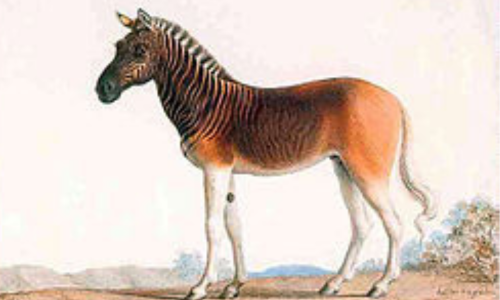
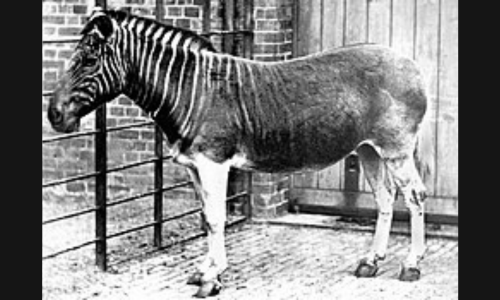
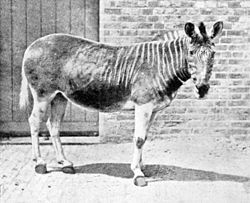
The true Quagga (Equus quagga) stood about 4 ft. 6 in. high at the withers. In general proportions it resembled a stout pony, and the mane, and tail and hoofs were semi-equine. The body colour was rufous brown, becoming fulvous posteriorly, and fading to white on the abdomen, legs, and tail. The head was of a bay colour, striped with brown, in zebra fashion. The neck was ornamented with broad bands of dark brown, alternating with narrower white ones; these markings began to fade at the withers, but were continued more or less indistinctly as far as the haunches, which bore a few indefinite dark lines and spots. The upstanding mane was banded with brown and white: the tail reached to the hocks, and was pure white without any admixture of brown. The iris was orange brown in Lord Derby’s female quagga, as figured from life by Waterhouse Hawkins.
The Quagga was first mentioned by Tachard about the middle of the seventeenth century, under the name of “wilde esel” (wild ass), though the absurd creature he describes, blazing with tints of pyrotechnic brilliance, has little resemblance either to the original or to anything else. Some years later Dr. Allamand published a description received from Col. Gordon of a quagga foal: this account being reprinted by Buffon. Gordon’s description was accompanied by a sketch, and to him rightly belongs the credit of introducing the animal to the notice of scientific Europe. Edwards supposed the quagga to be the female of the mountain zebra, but this error was corrected by Dr. Sparrman towards the end of the eighteenth century. The doctor further states, in his book of travels, that the quagga was sometimes kept alive by the colonists to protect their flocks from the attacks of wild dogs3 and hyaenas, and also mentions the specimen now in the Stockholm Museum. Le Vaillant seems to have seen the animal in the wild state about 1781, though he did not obtain any specimens. In those early days it was remarkably abundant, ranging the spreading plains in vast herds of many hundreds, often mixed with black wildebeest and ostriches.
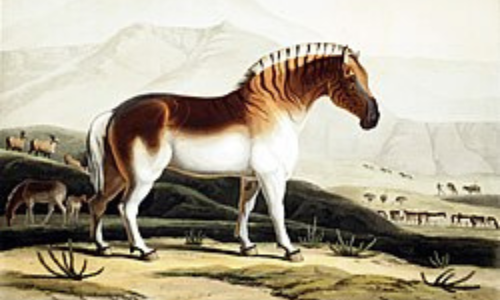
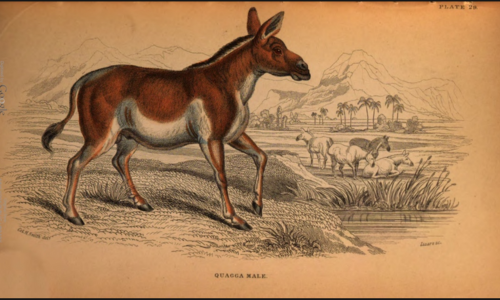
The quaggas probably grazed stretched out in a great semi-circle, like other wild asses, and it must have been a beautiful sight to see hundreds of these animals spread over the flower-bespangled veldt, their handsome striped heads closely applied to the fresh green grass, and their snowy tails whisking to and fro, while eagles, hawks, and other birds floated above them in the cloudless azure. Harris’ famous “Portraits of the Game and Wild Animals of Southern Africa” includes an interesting sketch of several quaggas drawn from life on their native veldt. The nearest animal stands on the edge of a little pool fringed with graceful rushes: close by are three or four others — apparently basking, after drinking, in the early rays of the morning sun. In the middle distance is seen a troop of springbok, the prominent chestnut line ornamenting their flanks being excellently rendered: two of these buck are rejoining the herd after drinking. Further away are seen more quaggas, the main troop being dimly recognisable, spreading out in characteristic crescent formation as its component members begin to graze. A single rocky hill rises in the ocean-like expanse, its outlines swimming in hazy perspective on the boundless horizon.
The quagga like many other animals had the curious habit of swarming at the salt pans to lick the salt. These pans are vast depressions, gleaming with crystallized efflorescence, and curiously recalling the salt lakes of Algeria. Harris has left a clever sketch of one of these saline tracts, the impression of free boundless space and sparkling atmosphere being capitally rendered. In the foreground are seen a couple of small pools, whose moisture encourages a scanty growth of trees and shrubs: a few antelopes are resting near the water or careering over the plain, whose parched condition is well shown by the cloud of dust thrown up by their flying hoofs: the horizon is blurred in the shimmering heat-haze, through which loom indistinctly the grotesque forms of some three or four ostriches.
My own picture reproduced in this book represents the Chott Tinsilt, a salt lake on the route to the Sahara: seen in the early morning, with the sunlight on its blue waters and the purple mountains behind, it is a sight to be remembered.
The pace of the quagga was said to be fleet, though laboured: wounded animals bit and kicked severely and even inflicted fatal injuries on incautious hunters. According to Sir John Barrow it was often taken alive by lassoing, just as the Boers of to-day take Burchell’s zebra with the fangstock or noosed stick.
Extending as far south as the Albany district in Cape Colony, the range of the quagga was limited to the north by the Vaal River, beyond which it was replaced by Burchell’s zebra, its faithful comrade the black wildebeest being similarly replaced by the blue wildebeest. The quagga seems to have shown some tendency to variation in the different portions of its habitat, some individuals having the ground colour of the head, neck, and chest chocolate brown, while in others it was chestnut, and portions of the example preserved at Vienna are creamy buff. In 1817 Dr. Burchell presented the skin of a young quagga to the British Museum, and this specimen was thought so remarkable that Hamilton Smith considered it a new species, under the name of “Isabella quagga,” an error afterwards corrected by Dr. Gray. Darwin, in his “Origin of Species,” mentions a figure of a quagga, in which the legs (usually pure white) were distinctly barred above the hocks. There is, however, very little material left on which to base any conclusions regarding the variations of Equus quagga. Careful examination of several museum specimens has, however, convinced me that the mane of the female quagga was longer than that of the male.
During the last ten years it has become the fashion amongst naturalists to describe the quagga as little more than an extreme southern variety of Burchell’s zebra. They point out that beyond the Vaal River the quagga was replaced by a subspecies of burchellii which in its white legs and abdomen approximated to the half-striped condition of the quagga. This variety of zebra is itself almost, if not quite, extinct: one, however, is preserved in the Derby Museum at Liverpool, and I have had the good fortune to see and photograph a young burchellii in the Amsterdam Zoo having the legs almost free from stripes. Intermediate varieties between the partially and the fully striped condition may be seen in the menageries at Antwerp and Berlin. These facts notwithstanding the quagga is a perfectly distinct species, recognisable from burchellii, as I have recently found, by differences in the skull.
The history of the decline and fall of the quagga is as follows:
Thunberg in 1773 met with it on the flats adjacent to the Zwartkops River, near the present site of Port Elizabeth. It then enjoyed a practically undiminished range, living out its life as it had previously existed — harmless and unharmed — for centuries. The first sign of the recession of the true quagga may be recognised in an observation made by Thomas Pringle in 1820. Pringle was not only an intimate friend of Sir Walter Scott, but was also himself a poet of considerable distinction: with the true regret of an educated man he laments the almost total disappearance of the quaggas and hartebeests from the open pastures of the Albany district, which they had formerly enlivened with their presence.
Some twelve years afterwards the Cape farmers, according to Lieutenant Moodie, were employing meal sacks made of quagga skin, this custom persisting till at least fifty years later: Harris also mentions Boer shoes, home-made from the skin covering the hocks of this animal. By 1836 the quagga had become rarer, though still found on the great Karroo Desert and on the outskirts of Cape Colony: in the far interior it yet roamed in immense numbers.
The hide-hunting Boers of 1850-70, however, attacked even the remoter herds, whose legions began to diminish year by year, but little respite being given to the unfortunate animals, who were massacred both in season and out of season without any close time being afforded them.4 According to Mr. H. A. Bryden the last two quaggas of the Great Karroo were shot in 1865, near the Tigerberg Mountain: and the once teeming myriads of the Orange River Colony only held out a few years longer, for when the late Mr. T. E. Buckley passed through their haunts in 1873, the true quaggas had already become “apparently unknown.”
According to Mr. Layard, however, dilapidated quagga skins, unfit for stuffing, were still obtainable in Capetown as late as 1875:6 but by 1879, at latest, the true quagga had become quite extinct, and had gone to join the blaauwbok and the northern seacow in the melancholy list of departed species. So rapidly indeed was the true quagga exterminated that naturalists seem to have been utterly unaware of its impending fate till it was too late to try to save it: the Burchell zebra or bonte quagga also being called “quagga” in South Africa for the sake of brevity, has led some persons to suppose that Equus quagga is not after all extinct.6 Unfortunately all reports of the existence of “that rare animal the quagga,” published in later years, turn out on investigation to refer to some species of zebra: the subject of this essay is as extinct as the dodo.7
The extermination of the quagga is all the more to be regretted because it seems possible that it might have been systematically broken in to bit and harness like a horse, or indeed like its near relative the Burchell zebra during the last ten years. The first example which Sparrman noticed was a very tame specimen, pleased when anyone stroked its sleek sides and delighting to be caressed. On a subsequent occasion the doctor actually saw a quagga driven in the street harnessed with five horses: and with a rare foresight far in advance of his age he urged the domestication of the species, pointing out that in his day it could be even more easily obtained than the horse, that it would of course eat the harsh grass of the country — its natural food — and that it would probably be immune from the horse-sickness. This excellent advice has been seconded by subsequent writers. Almost in Sparrman’s own words, Harris says : “Doubtless it might readily be subdued by bit and bridle, and if not capable of universal distribution, would in its native regions at least, where food and climate are congenial, reward fourfold by its services, the trouble attendant upon its education.”
Would that his counsel had been heeded! The relations of white men with the true quagga during the long years that have elapsed between 1772 and 1879 are summed up in one word — extermination!
A few half tame specimens have been brought to Europe. The list is as follows :
- A quagga was kept at Windsor during the eighteenth century: it was the property of the then Prince of Wales probably Frederick, son of George II. As this individual is said to have been striped with black (not brown), it has been thought that the animal may have been a Burchell zebra.
- The Royal collection of the Palais de Versailles once contained a quagga: after the Revolutionary mob attacked the palace, the quagga, together with a hartebeest, a crested pigeon, a rhinoceros and a lion was sent to the Jardin des Plantes, these being the only specimens which escaped destruction.
- In 1821 Frederic Cuvier described another quagga in his “Histoire Naturelle des Mammiferes.” This animal also lived in the Jardin des Plantes menagerie, and died when about eighteen or twenty years old. Cuvier says that it was not inherently vicious, but inclined to be tiresome and obstinate, and ready on occasion with teeth and heels; thus being no more intractable than a spirited horse.
- About 1815 Lord Morton obtained a quagga stallion and endeavoured also to secure a quagga mare. He tells us that he intended to domesticate the species, and it is unfortunate that the attempt should have failed, a female proving unobtainable. Lord Morton, however, by means of his quagga and a mare of 7/8 Arab blood, bred a curious female hybrid of a dun or chestnut colour, having faint stripes on the neck and shoulders and more pronounced ones on the knees and hocks. The mane of this hybrid was short and stiff: the tail though but semi-equine (being haired in the lower half only), was dark coloured, and not white like that of the quagga. The hybrid was apparently a vigorous and sturdy animal, and is known to have lived for at least five years afterwards.
- Lord Mostyn had a quagga stallion which he crossed with a chestnut mare: the resulting hybrid is mentioned by Charles Darwin, but nothing more is known about it.
- At some time previous to 1826 Sheriff Parkins used to drive two male quaggas (not a pair as is usually stated) through the streets of London harnessed to a light phaeton: these beautiful steeds were often seen in Hyde Park and other fashionable places, and Agasse’s portrait of one of them still hangs in the Royal College of Surgeons’ Museum in Lincoln’s Inn Fields. These quaggas unfortunately died while still in the prime of life; their bodies were presented to Mr. Joshua Brookes, a celebrated naturalist, whose museum was second only to the famous collection of John Hunter. The skulls are preserved in the Royal College of Surgeons’ Museum, while Agasse’s portrait has been perpetuated as a woodcut in the Encyclopaedia Britannica, being employed to illustrate the article “Quagga,” by the late Sir Wm. Flower.
- Three quaggas (not two as is usually stated) have been exhibited in the London Zoological Gardens. The first specimen was purchased in 1831, and was probably one of the parents of the quagga hybrids said to have been driven in harness between the Zoo and Covent Garden Market, early in the last century. It was also probably the animal drawn from life by Hamilton Smith, and figured in his work on the Equidae, published in 1841. This animal died at some time previous to 1838, and its skin may be that referred to by Sir Cornwallis Harris in 1840, as being exhibited by the Zoological Society. The second quagga was purchased in 1851, and died in the summer of 1872. This individual — a female — was twice photographed in the last year of its life by Mr. York, and it has been stated by several naturalists that these photographs are the only sun pictures of a living quagga extant. Such, however, is not the case, as Captain Hayes’ work on the “Points of the Horse” contains a reproduction of a photograph of the same individual taken by Mr. Frank Haes. A copy of this photograph, presented to the Society by Mr. Haes, was exhibited by the Secretary at a meeting held on May 3rd, 1904. The third quagga was a male, which was presented to the Zoological Society in 1858 by the late Sir George Grey, and had to be slaughtered in 1864, it having injured itself by breaking down some boarding. It may be the animal specially drawn by Zwecker for the figure of the quagga in the Rev. J. G. Wood’s Illustrated Natural History, published during 1861-63: at anv rate the individual represented is obviously a male, from the richness and extent of the markings, which differ materially from the paler ornamentations of the female, as shown in York’s photograph. Zwecker has drawn the animal well enough, but the surrounding bush seems far too luxuriant, and the water scene does not suggest a pool on the open veldt, as delineated by Harris. An enlarged copy of one of York’s photographs of the female now hangs in the new zebra house at the Zoo.
- The thirteenth Earl of Derby had a pair of quaggas living in his famous menagerie at Knowsley Hall. The male seems to have been the individual mentioned by Darwin as being striped about the hocks — a unique occurrence in this species, indicating an approach to the zebra type of ornamentation. It appears to have died at Knowsley, for on the sale of the menagerie after the death of Lord Derby in 1851, only the female animal is mentioned in the catalogue which was issued by Mr. J. C. Stevens. This quagga mare was purchased for £50 by the late Dr. G. F. Westerman, and was sent to the Amsterdam Zoological Gardens, where she gave birth to an equine hybrid (Asiatic wild ass x quagga).
- The Berlin Zoological Gardens once possessed a quagga, but I have no information about the animal.
- “Several” quaggas — apparently the last of their race to be sent alive to Europe were obtained about 1870 by Mr. Bols, the Belgian consul at Port Elizabeth, and forwarded to the Antwerp Zoo: about the same time a very fine individual, which had lived several years at Antwerp, was purchased by Dr. Westerman for the Amsterdam Gardens. Had the impending extermination of the species been realised at the time, a last effort might have been made to save the race by breeding from the Antwerp animals, and so founding a menagerie stock: the wild quaggas then left in Africa were already in a parlous state, and probably all but exterminated. This last opportunity, however, was unwittingly lost: indeed I find that these animals have never bred anywhere in captivity, and the last of the imported specimens will by now have died from sheer old age.9 It was probably the fine Amsterdam specimen of 1870 which, on its death, passed as a “duplicate specimen from a Continental Museum” into the hands of Heer Franks — himself resident in Amsterdam.
#The Dutch Zoological Society already possessed another stuffed quagga — that purchased at the Knowsley sale — so that the 1870 animal would in any case be a “duplicate specimen” — a valuable asset to be profitably disposed of in the best market.
So much for the quagga in captivity. After laborious enquiry, it appears that the animal has never been exhibited in the Zoological Gardens of Bristol, Cologne, Dublin, Frankfort-on-Main, Hamburg, Hanover, Lisbon, Marseilles, or Rotterdam: therefore, on adding the few odd individuals formerly taken young by the colonists as curiosities (and not by wild beast merchants for export), the list is completed. It has not seemed worth while to compile a census — probably imperfect at best — of the few seen in Africa about the homesteads of their captors by Sparrman, Burchell, and others. The following is a list of specimens in museums, compiled after a lengthy correspondence with various scientific gentlemen in Europe, South Africa, and the United States, and I hasten to express my thanks to them all in this place. The tale of quagga relics is as follows:
- A newly-mounted old skin of a quagga stallion has been placed in the Mammal Gallery of the Natural History Museum at South Kensington. It has been stated to have belonged to the male quagga presented to the Zoological Gardens by Sir George Grey in 1858, but a careful examination of the skull (1”) belonging to the skeleton of the same animal showed me that it was labelled “Eqiius quagga, the specimen mentioned in Waterhouse’s Mam. of Mus. Zool. Soc. 1838, p. 37.” It was purchased with the skin for the British Museum in 1864. The teeth are much worn. The specimen is doubtless the first quagga purchased for the Zoo in 1831. Sir George Grey’s animal was a beast in the prime of life, slaughtered through grim necessity, owing, as we have already seen, to its self-inflicted injuries. The quagga skin which Sir Cornwallis Harris states to have been exhibited previous to 1840 by the Zoological Society, cannot have been that of Sir Geo. Grey’s specimen: it probably belonged to the 1838 quagga above mentioned, or was perhaps a trophy brought home by Harris himself.
- 3. I have examined the skulls of Sheriff Parkins’ famous quaggas in the Royal College of Surgeons’ Museum. Both are the skulls of young adult males, with the sutures unobliterated, and without any trace of the first premolar teeth. They were purchased for the College at the sale of the greater part of the Brookes collection, in 1828.
- The Tring Museum contains a beautiful stuffed quagga mare: the markings are particularly distinct, and even the hind quarters are ornamented with definite stripes passing downwards and forwards from the croup. I am informed that this quagga was originally sold mounted by Franks, but has since been re-stuffed for the Tring Museum. Perhaps it is the duplicate from the Amsterdam Zoo already mentioned.
- The Science and Art Museum at Edinburgh possesses a stuffed quagga of unknown sex and locality, obtained in 1879 from a London dealer. I applied to its former owner, and as he kindly informed me that one of the Zoo quaggas had been purchased by him after its death, it is probable that the Edinburgh specimen is the quagga mare photographed in 1872 by York. The photograph represents a much duller coloured animal than the one at Tring; the stripes disappear completely on reaching the middle of the body, and the hind quarters are absolutely without markings.
- The Museum of the Yorkshire Philosophical Society at York contains an articulated quagga skeleton, which is one of the first natural history specimens which I ever remember seeing: unfortunately no data relating to it have been preserved.
- The Medical Museum of the Owens College, Manchester, contains an equine skeleton alleged to be that of a quagga. I have carefully examined this specimen, and think it is authentic: the skull shows the stout nasal bones and squarish diastema which occur in the true quagga and thus differentiate it from the elongated nasals and oblong diastema seen in the skull of Burchell’s zebra, the only species with which it is likely to be confounded.10 Unfortunately no history is obtainable, though the Medical Museum collection appears to have been founded by the union of specimens from the old Manchester Natural History Society’s Museum with others formerly kept at the Pine Street Medical School, near the Manchester Infirmary. Horns of other African animals — Cape hartebeest, blesbok, etc. — in the same series, as far as they go, seem to support the authenticity of this skeleton: but all further inquiry appears useless owing to the death in 1885 of Professor Morison Watson, M.D., F.R.S., in whose time the collection of the Medical Museum was arranged in its present situation.
- The late Professor Cope formerly possessed a roughly-cleaned quagga skeleton, which he presented to the Academy of Natural Sciences at Philadelphia, where it still remains. No data are known.
- A half or three-quarters grown quagga stallion is preserved in the Natural History Museum of the Jardin des Plantes at Paris, and the late M. Alphonse Milne Edwards informed me that he thought it had been brought home from the Cape by MM. Peron and Leseur. This would fix 1804 as the date of acquisition by the Museum. It seems probable, however, that this is the Versailles specimen (No. 2 on the list of menagerie animals given above). It is evidently of great post mortem age, as it has been provided with the old-fashioned circular glass eyes used by taxidermists in the first half of the last century. This example was mentioned by Frederic Cuvier in 1821 (“Histoire Naturelle des Mammiferes”), and is probably the individual delineated in Cassell’s Natural History: at any rate, though well nigh a century old, it is in excellent condition, and well worth figuring in any standard work. The fully adult quagga described by Cuvier, which lived 18 or 20 years in the Jardin des Plantes menagerie, is not now in the collection. “Le Museum ne possede qu’un seul individu d’Equus quagga.”
- The Leyden collection contains a quagga stallion obtained in 1826 on the borders of Cape Colony, probably by Dr. Von Horstock: the perfect skeleton (IOA) of the same individual is also in the Museum, and by the kindness of the museum authorities I have been enabled to photograph these very interesting relics.
- The quagga mare, formerly in the Knowsley Menagerie, and afterwards purchased for the Amsterdam Zoological Gardens, is now preserved in the zoological museum attached to the latter institution. It has been very well mounted, the modelling being very good, while even the colour of the iris has been carefully reproduced, as shown in Waterhouse Hawkins’ plate of the same individual during life. The hemione-quagga hybrid,11 to which this Amsterdam specimen gave birth, does not seem to be in the museum: perhaps it died young, and the skin was not preserved.
- A stuffed quagga is preserved in the Berne Natural History Museum. The Swiss authorities are apparently unaware of the great value of their specimen, and it is the only example I know which is not protected by glass from dust and injury.
- The Zoological Museum at Turin contains a stuffed quagga and its skull (13A), obtained at the Cape in 1827. Probably this was collected by Dr. Von Horstock, who is known to have obtained a quagga at Steenbergen, on June 15th of that year. During the first half of the last century many European collections were enriched by the industry of Von Horstock, the British Museum being similarly indebted to Burchell and Sir Andrew Smith.
- The stuffed skin and skeleton (14A) of the quagga formerly living in the Berlin Zoological Gardens, are now in the Natural History Museum of that city: and Dr. Mobius kindly informs me that the Berlin collection includes further specimens, namely, (15) a quagga skeleton, received in exchange from the Leyden Museum, and (16) a skull obtained by Mr. Krebs, in the Orange River Colony, or near the Liqua (= Vaal) River. No. 17 is a skull also at Berlin, and probably obtained by Krebs in or near the Orange River Colony. The old name of “Liqua River” being employed to indicate the locality would seem to show that the Berlin specimens were obtained previous to 1844, by which date the term ” Vaal River” had come into general use.
- There is a stuffed quagga, and its skull (I8A) at Munich, purchased by Ecklon about 1835.
- A stuffed quagga is also preserved at Mainz.
- The Senckenbergian Museum at Frankfort-on-Main contains a stuffed #quagga, and its cranium (20A) collected in 1831 in South Africa — perhaps by Dr. Smuts, whose dissertation on the Cape mammalia was published a year later.
- The female quagga, which the authorities of the Vienna Museum purchased in 1836, is a very remarkable example, the ground colour of the head being clay-brown, while the rest of the upper parts are creamy buff. The dark stripes are relatively broader than usual, and seem to extend further towards the hind quarters. This specimen is also larger than the other quaggas now in preservation. Unfortunately there is no skeleton preserved with it. A photo-engraving of the Vienna quagga appeared in the Proceedings of the Zoological Society for 1902.
- Equally interesting is the Stockholm quagga — the only fœtal specimen known! This somewhat battered example is also the most venerable of all the quagga relics, having been brought home by Dr. Sparrman in 1776. A photograph kindly forwarded to me by Mr. F. A. Smit shows that the coloration is much the same as that of an adult quagga: the mane appears to have been lost. Measurements as published by Dr. Sparrman: ears to tail, 31 inches; height at loins, 22 inches.
- At some time previous to 1862 Mr. A. Dale of Beaufort West presented a quagga foal — probably one of the last quaggas of the Great Karroo Desert to the South African Museum at Capetown. This animal is also of special interest, being the only foal now in preservation! Young quaggas, like young zebras, were rough coated: this point is well brought out in a photograph of this specimen, kindly sent to me by Mr. W. L. Sclater: a figure of the same individual was published some two years ago in the Cape Times. The mane of the Capetown quagga seems to be of an almost uniform brown, with only scanty indications of the usual white bands: otherwise the markings are much the same as in adults.
- A quagga skin, brought home by Mr. T. Cooper with other curios in 1860, was sent by him to be sold at Stevens’ Rooms about eighteen years later, and Mr. Cooper suggests that this may have been the skin purchased in 1879 for the Edinburgh Museum: but, as has already been seen, the Edinburgh specimen was probably an animal which died in the Zoo.
- On August 22nd, 1899, a “skin of quagga now extinct” appeared as lot 240 of a series of natural history specimens sold on that date at Stevens’ Rooms. On inquiry I learnt that the skin had been sent to be sold by a dealer who had purchased it with some other curios from a gentleman returned from abroad, so that it had probably been imported direct from South Africa. I have not been able to examine or authenticate this skin, nor do I know who purchased it at the sale.
The above completes the census of known remains of Equus quagga.12 This extinct species is not represented in the museums of Aberdeen, Brussels, Breslau, Chicago, Copenhagen, Dresden, Dublin, Durban, Florence, Geneva, Grahamstown, Hamburg, New York, Oxford, Prague, Pretoria, Pietermaritzburg, and Washington. Save for the few specimens just enumerated, and perhaps some odd meal sacks of tattered hide yet remaining in remote Dutch homesteads, it has passed away for ever.
A miserable history of extermination has been herein narrated: now for the application thereof. Immense enthusiasm marked the commencement of ostrich-farming at the Cape in 1865-70: had similar zeal been exerted, even at that late hour, to save the true quagga, it might have been profitably domesticated, and surely a Colony which has saved the ostrich for the sake of its feathers — mere ornaments at best — might have bestirred herself to preserve the quagga for far more practical purposes. To enumerate the possible virtues of a domesticated race of quaggas would be but slaying the slain; but it is sad to reflect that the repeated recommendations of naturalist after naturalist were allowed to pass practically unheeded. Sparrman’s advocacy of the domestication of the species has already been noticed: in 1801 Sir John Barrow observed of the quagga “It is . . . . well shaped and strong limbed, not in the least vicious, but on the contrary is soon rendered by domestication mild and tractable: yet, abundant as they are in the country, few have given themselves the trouble of turning them to any kind of use.”
Burchell’s vivid description of a quagga foal which voluntarily followed a horse into Klaarwater, allowing itself to be freely handled, demonstrates clearly enough that taken young the species might easily have been domesticated. Cuvier expressed the hope — nay, the expectation — that it would soon be regularly broken to harness. He justly observed, “when we consider that this species is capable of highly beneficial services in a domesticated condition. . . . we may naturally be surprised that the Couagga has been suffered by us to retain its liberty so long.” His hopes were not realised. Harris in recommending the subjection of the quagga remarked on the indolence of the colonists in not essaying so tempting a task. And so on to the end of the chapter: save for the laudable but isolated efforts of Lord Morton, Sheriff Parkins, and one or two others, no attempt was made to utilize the splendid capabilities of the animal. Immune alike from the tse-tse disease and the horse sickness, the quagga might have served as an efficient substitute for the horse in unhealthy localities, as suggested for Grevy’s zebra in a previous chapter: now it is too late. Truly indeed:
“The evil that men do lives after them,
The good is oft interred with their bones.”
It only remains to express the hope that the fate of the quagga may serve as an object lesson, and that the recent efforts to protect the remnant of the South African fauna, as indicated by the new Government regulations and by the formation of a Game Preservation Committee at Pretoria, may meet with lasting success. But if not: Ex uno disce omnes!
- Measures for the protection of this beast appear to have been taken only just in time: indeed it appears doubtful whether the typical Cape race is not already extinct. The southern giraffes now obtained are said to differ considerably in coloration from the tawny, dark-blotched specimen presented to the National Collection by Lord Derby many years ago. This example was long exhibited to the public in the British Museum, and many persons will well remember it.
- Governor Tulbagh records in his diary that on one occasion it almost seemed as if the lions would take the fort by storm Hippopotami were common on the present site of Capetown, and the abundant (black) rhinoceroses made hay of the settlers’ crops.
- The Cape hunting dog (Lycaon pictus) is a long-legged, parti-coloured brute, which hunts in regular packs. These ferocious hounds, formerly preying on antelopes, became the terror of the Cape farmers, whose sheep they would massacre in sheer bloodthirstiness. If the old stories are true, the quagga showed a high degree of courage in facing animals able to conquer the lion. Bay horses, however, are noted usually for their spirit: and this tint entered largely into the coloration of the quagga!
- Wasteful though they were of animal life, these tough old souls are said to have been quaintly economical of powder and lead, carefully cutting the bullets out of their slain quarry to serve again.
- I have been informed that in this year some “half-striped” quaggas were still surviving — the last of their race — on a farm in the Hanover district of Cape Colony. A special inquiry which I made in 1900 greatly facilitated by the extreme courtesy and kindness of the Commissioner of Hanover showed that neither in Hanover — nor in Cradock can the true quagga now be found.
- One gentleman, writing as late as some five years ago to the scientific papers, to “correct” the assertion that the true quagga had been exterminated, observed that at the moment of writing a dead quagga (or its freshly stripped hide) lay outside the house. After the Boer custom of calling zebras “quaggas” had been pointed out to him, nothing more was heard of this “proof” of survival. Even in August, 1900, a tradition was current at Port Elizabeth that the true quagga was still preserved on a single farm in the north-west of Cape Colony: perhaps the animal had been confused with the black wildebeest under private protection in Victoria West. Any enthusiast wishing to investigate the truth of this rumour is welcome to attempt it: one can prophesy the result beforehand!
- See also my letter to the Field of June 11, 1904. It may be mentioned that the name”quagga” being derived from the cry of the animal, should be pronounced kwa-ha (Boer fashion), not “kwagger,” as is invariably done by naturalists in this country. I remember, when inquiring some three years ago for the specimen of this animal preserved in the Museum of the Amsterdam Zoological Society, the Dutch attendant did not recognise the name as rendered in English fashion. On my pointing out the specimen in its glass case, he at once recognised it, and pronounced its name “Kwa-ha.”
- This photograph has been published as a lantern slide, and was included in the series of lantern photographs illustrating my lecture on the ” Vanishing African Fauna,” before the Selborne Society in 1899. The animal is in a standing position, apparently basking in the sun, and the characteristic half-striping is well shown.
- This importation of 1870 is here emphasised, as I have seen it stated in a recent work by a well known naturalist that in 1864 the last specimen ever exhibited was received by the Zoological Society. 1864, however, was the year in which the skin and skeleton of the quagga of 1831 was purchased for the British Museum.
- A few years ago I devoted some time in endeavouring to separate Equus quagga and E. burchellii by their osteological characters. The diastema or space between the canine and molar teeth (through which horse drivers insert the bit) is, when the jaws are closed, squarish in the quagga and oblong in burchellii. In the quagga the aperture of the posterior nares is wider and also more rounded than in Burchell’s zebra, as seen in a photograph now before me showing the two skulls placed side by side. The three quagga skulls in London, together with that of the male specimen at Leyden, were examined in connection with this research. Naturalists of course have long been aware of the interest which attaches to the skeleton of the quagga, the nearest of all recent equines to the extinct Pliocene horses Equus quaggoides and E. stenonis of — Europe.
- The hemione (Equus hemionus) is the Asiatic wild ass — the onager of Xenophon.
- It appears that the young quagga (” Isabella quagga ” of Hamilton Smith) presented by Burchell to the British Museum, is no longer in the National Collection, and has probably been destroyed. Dr. Gray tells us that it was nothing more than a young specimen, with nearly all the fur rubbed off. This individual was probably the male of the pair shot by Burchell’s Hottentot attendant, Speelman, at Groote Fontein, on November 14th, 1811. It was figured in 1841 by Hamilton Smith in his work on the Equidae.
Graham Renshaw, Natural History Essays (London: Sherratt & Hughes, 1904), pp. 169-197. Footnote numeration has been altered.
See: https://babel.hathitrust.org/cgi/pt?id=uc2.ark:/13960/t6zw1bc0j&seq=1
The Natural History of Horses
Charles H. Smith
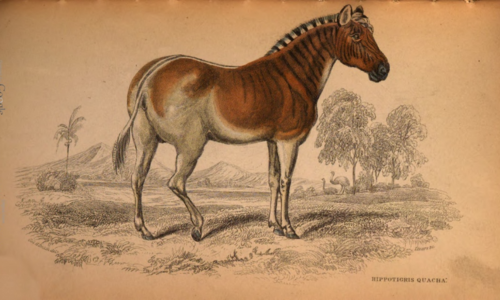
THE QUAGGA OF THE CAPE COLONISTS.
Hippotigris quacha.
PLATE XXIV.
This species, equal or superior in size to the former, is still more robust in structure, with more girth, wider across the hips, more like a true horse, the hoofs considerably broader than in the zebra, and the neck full, the ears rather small, twice barred with black, the head somewhat heavy, and the muzzle black; the head, neck, and body are reddish brown; the mane, edges of the dorsal streak, and the tail, as well as the colour of the under parts and limbs white, like the dauw; head and neck banded likewise in the same manner, but on the shoulder the bars become pale and on the side gradually indistinct, till they are totally lost on the croup, and there are no intermediate brown bands. The name of this species is derived from its voice, which is a kind of cry somewhat resembling the sounds qua-cha! It is unquestionably best calculated for domestication, both as regards strength and docility. The late Mr. Sheriff Parkins used to drive a pair of them in his phaeton about London, and we have ourselves been drawn by one in a gig, the animal showing as much temper and delicacy of mouth as any domestic horse.
Quaggas are still found within the boundaries of the Cape of Good Hope, but on the open plains, south of the Vaal river, they occur in immense herds, associating with the gnu, Catoblepas gnu. It is this species that is reputed to be the boldest of all Equine animals, attacking hyæna and wild dog without hesitation, and therefore not unfrequently domesticated by the Dutch boors for the purpose of protecting their horses at night while both are turned out to grass.
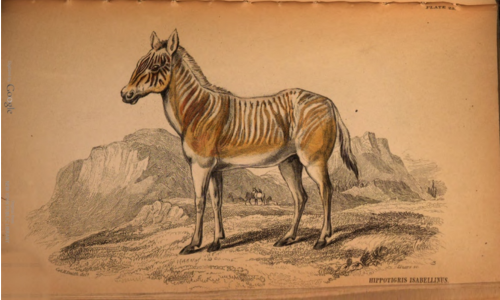
THE ISABELLA QUAGGA.
Hippotigris isabellinus.
PLATE XXV.
We separated this animal from the foregoing, because with characters most nearly allied to the last, such as the equine head, ears, body, croup, tail, and even shoulders, it still differs in size from all, being scarcely ten hands high, and still more in the colours and forms of the cross bands upon its livery.
The specimen is in the British Museum, and our drawing of it was taken when it had been recently set up; it struck us then as representing the zebre, or Ane isabelle of Le Vaillant, and found afterwards that Mr. Temminck, on seeing it, made the same observation.1 At that time there was, however, an opinion that it was the skin of a colt whose dark streaks were not as yet apparent; but as we now know that even in the fœtus the black marks are very distinctly visible, the objection is not valid, and there are besides other indications which prove the skin to have belonged to an adult.2 We therefore shall describe the specimen under the above name, in order to attract the attention of naturalists, and leave to future information the final determination of its locality as a species or accidental variety.
The Isabella Quagga is, as before remarked, much below the stature of the others, and in a stuffed form proportionably longer; the specimen is a male, and, compared with the quagga, has a different coloured nose, ears, and mane, -all being white; the general tone of the head, neck, body, and croup is yellowish buff, with brownish streaks on the face and cheeks, but more undefined, and not extending the usual length; on the neck, shoulder, body, and croup there is a series of bands more numerous than in the dauw, some few are branched, but instead of a dark colour, while the specimen was recent, they were all pure white, and those on the croup particularly numerous and interwoven; the belly and limbs are white, but, as if to prove that these marks were not the result of albinism, the anterior pasterns and rings above the hoofs of the posterior feet were sooty black and the hoofs dark. These marks do not occur in any known species.
- Monsieur Le Vaillant was a travelling naturalist in the employ of Mr. Temminck’s father, who held a high official situation in the Dutch East India Company’s government at home. From the context of what Le Vaillant says about this animal, it is clear that he saw, but did not possess it. Buffon’s figure of the young Quacha is copied from Allemand, of which we have seen an original drawing with black streaks, and therefore is not like the Isabella. For these reasons we cannot assent to the opinion of Mr. Gray, nor agree with the writer of the article Horse in the Penny Cyclopædia, vol. xii. p. 313.
- In the whole group there is a greater tendency to lose the marks with age than to increase them. When we last saw the specimen, the original colour was much changed.
Charles H. Smith, The Natural History of Horses: The Equidae or Genus Equus of Authors (Edinburgh: W.H. Lizars, 1841), pp. 330-334. Footnote numeration has been altered.
See: https://babel.hathitrust.org/cgi/pt?id=nyp.33433011493487&seq=11
The Species and Subspecies of Zebra
Reginald I. Pocock
PART II.-Descriptions of the Species.
(2) Equus quagga, Gmelin. Equus quagga, Gmelin’s edition of Linné’s Syst. Nat. i., Mammalia, p. 213 (1788).
? Equus isabellinus, H. Smith, Naturalist’s Library, Horses, p. 332, pl. xxv. (1841).
For the type of this species may be selected the specimen, belonging to the then Prince of Wales, which was figured and described as the female of the mountain zebra by Edwards in his ‘Gleanings of Natural History,’ v. pl. ccxxiii. The other references cited by Gmelin are to a description given by Pennant in his ‘History,’ p. 14. no. 3, to the mention of the species by Masson (Phil. Trans. (Acta Angl.) lxvi. p. 297), and to a figure published by Buffon (Hist. Nat. xii. p. 1, pl. ii.) which unmistakably represents an example of E. zebra, Linn.
Edwards’s figure and description make perfectly clear the essential characters of the type of this now extinct species. The ground-colour of the body and head were a pale chest- nut, the belly, legs, and tail, including the tuft, being white. The muzzle was darker than the face, being of a brownish hue, but not so black as in Burchell’s zebra; the head, neck, and fore part of the body, however, were strongly marked with black stripes, apparently exactly as in that species. Moreover, on the hinder part of the flanks and upper part of the quarters the stripes dorsally take a backward bend assuming an obliquely longitudinal direction, but, instead of being continuous, they were broken up into a series of blotches or large spots; and a row of similar spots was observable on each side of the spinal stripe between the withers and rump, these spots representing the upper ends of the flank-stripes. The spinal stripe was continued on to the tail, and there was a median ventral stripe, the rest of the belly, like the whole of the lower part of the quarters and legs, being free from stripes.
The specimen figured and described by H. Smith as E. isabellinus is said by Gray to be the young of E. quagga. Unfortunately the type, once in the British Museum, appears to be no longer in existence. It differed from all known zebras, and resembled the asses, in having the muzzle white and the mane unstriped.
The example identified as the quagga contained in the collection of the British Museum differs strikingly from the specimen figured by Edwards in the indistinctness and indefiniteness of the stripes not only on the body, but also on the head and neck. Instead of the well-defined black stripes noticeable in the original figure, all the stripes are reddish brown, and on the head are only distinct on the area that lies between the eyes and ears, on the cheek, and on the nose to a point halfway between the eye and the nostril. The neck is marked with irregular broad brown double stripes separated by narrow yellowish-white interspaces; the withers are striped, but the shoulder is practically unstriped. Along the sides of the spinal stripe dark brown patches representing the dorsal extremities of the flank-stripes are traceable as far as the rump; but the posterior part of the flanks is very indis- tinctly banded, presenting a mottled appearance. It is evident, however, that towards the quarters the stripes were arranged in an obliquely longitudinal direction. It may be added that the specimen under notice is certainly faded; but, taking these facts into consideration, there is no doubt that it was originally very different from the example seen by Edwards.
The figure of this species published by Gray in the ‘Knowsley Menagerie,’ from which those given by Noack (Zool. Garten, xxxiv. p. 290) have been adapted, show the backward extension of the stripes as far as the quarters and their breaking up into spots, as in the type; whereas in the coloured drawing of the species in Harris’s ‘Game Animals of South Africa,’ as well as in Hamilton Smith’s volume on the horse, the dark stripes, though black and well defined over the head and neck, scarcely extend past the withers. According to Matschie, too (Zool. Garten, xxxv. p. 38), the ground-colour, possibly from exposure to light, varies from dark brown to a much paler tint.
It is sometimes stated that the tail of the quagga is more thickly hairy than in the other zebras, and approaches that of domestic horses. No evidence of this fact, however, is supplied by Edwards’s figure nor by the specimen in the British Museum, nor by the specimen of which there is a photogravure in Sir William Flower’s book on the horse (see p. 90). It is noticeable, however, that in the Museum example the hair on the fetlocks is longer than in any zebra that I have seen.
This species was formerly abundant on the flats of Cape Colony to the south of the Orange River.
Reginald I. Pocock, “The Species and Subspecies of Zebras,” The Annals and Magazine of Natural History (Series 6, Vol. XX; July, 1897), pp. 37-39. The lead picture appears in: https://en.wikipedia.org/wiki/Quagga as does the other black and white and two color pictures with the light backgrounds. The three color pictures with dark backgrounds appear on pages 391, 407, and 411 in Smith, The Natural History of Horses (see above).
See: https://babel.hathitrust.org/cgi/pt?id=hvd.32044107348831&seq=1&q1=