Tigers
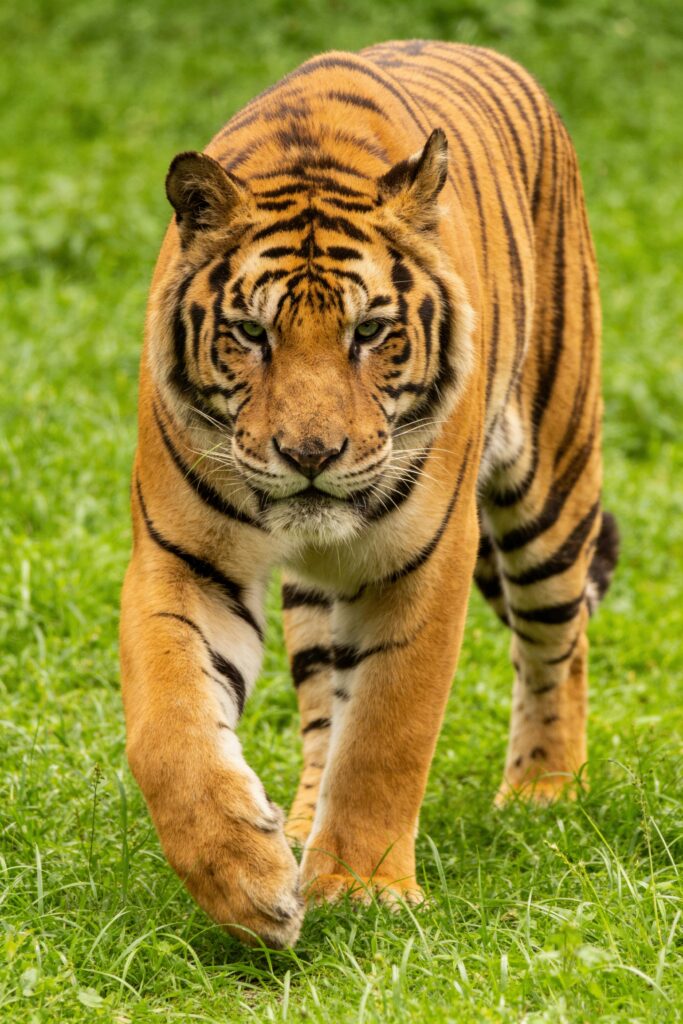
We want you to have a greater ability to learn about some of the unpleasant animal issues in our world.
Tiger Trails in Southern Asia
Richard L. Sutton
Tigers
Tiger shooting is hard work. Aside from the wear and tear on the nervous system, careful planning, and plentiful amounts of good bait are essential. Defosse’s formula for a tiger is “Patience, a bait and a rifle,” and after a two month’s course under his distinguished tutelage, I must agree with the master.
In Indo-China, tigers are shot over dead baits, in the daytime, from bomas located on the ground.Tree nests, or machans, seldom prove successful, and the number of the brutes that are killed by ordinary stalking is infinitesimally small.
A very good and true story is told of four American Army officers who came over from Manila after tiger. They had never before hunted the big cats, and of their ways and manners they were as blissfully ignorant as a bunch of kindergartners. They selected Cambodia, the poorest field of all, and each day they would shoulder their rifles, in true infantry style, and go out and walk, and walk, and walk. Three of them were long and skinny, and excellent pedestrians, but the fourth was a plump little Major (I can sympathize with that man).
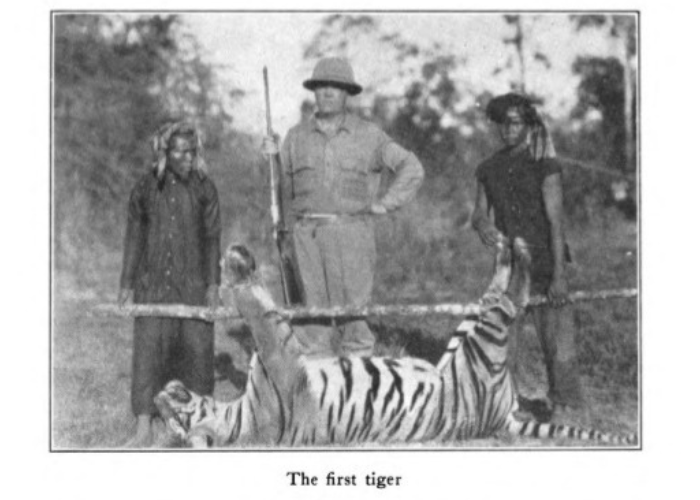
The Major was not strong on this foot-racing business, and, besides, he simply could not keep up with the procession. They never saw any tigers, so stimulation was lacking, and finally the skinny men got sore. So on the fifth day they gave the plump little Major a lecture on the error of his ways, and left him to vegetate in camp. For a time he was terribly depressed, but finally he took a Moi tracker, and wandered out into the jungle. It was coolest in the dongas, so, subconsciously, he stuck to the ravines. About nine o’clock he sat down on a log to catch up with his respiration, when suddenly two little tigers dashed up within twenty yards of him and began toplay. He was a trifle slow on his feet but not on trigger, and he promptly massacred both of them. They were not large, but they at least had stripes and were real tigers, so his joy can be imagined.
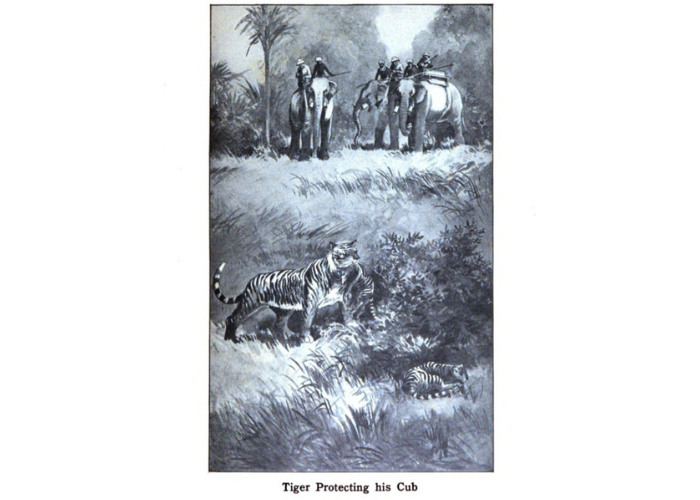
He promptly shouldered one kitten, his bearer the other, and they hiked back to camp. It probably is well that they did, for I imagine the mother was a trifle upset when she failed to locate her offspring, and I had rather play tag with a packing case full of hungry rattlesnakes than shake hands with a nervous and irritable mother tiger under those circumstances. The party remained in Cambodia three weeks, and the two little felines were the only ones they ever saw!
I shall never forget my first impromptu date with one of the great cats. We had been stringing out dead sambhur along the bait line on the Song-Gieng River, and had left a bullock cart containing two of the big deer at a fork in the main trail.
When we returned an hour later, we found that a tiger with pugs the diameter of a soup plate had walked twice around the cart and then, probably frightened by our noise, had stolen away. Defosse was almost excited.
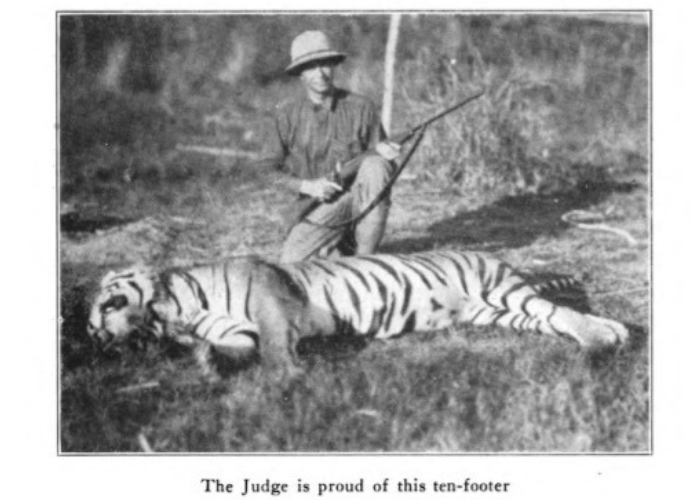
“Who wants to kill a tiger?” he asked. What a foolish question! Both of us promptly volunteered, but as the Judge is slow and conservative, I beat him to it by at least fourteen seconds. But he is as generous and magnanimous as he is handsome and brave, and he promptly said, “Yes, let Doc do it. He is the boy for the job.” So they removed the biggest and deadest sambhur, and dumped it in the middle of the road. It had been dead two days, and was a trifle misshapen, in fact the body reminded me of a Sante Fe water tank. They rolled it over on its back, with all four legs sticking straight up into the air, like those of an inverted saw buck, and the flies, temporarily disturbed, settled back to their work. They made a noise like an Electric Park orchestra.
There was a big Go tree near the animal’s head, and at the side of the well-worn game trail. De fosse stationed me behind the trunk of this tree, and the boys, who were simply a-thrill with joyous anticipation, proceeded to festoon me with vines and green branches. My canteen was hung near my nose, so I wouldn’t make a noise when I got thirsty, and my rifle arranged for prompt and immediate use. After the porters had piled a hayrack full of shrubbery around me, our white hunter stepped back and viewed his work. Undoubtedly he was an artist. “Ah!” he exclaimed, and snapped an order, in Annamite, to his assistants. It seemed that my shiny bald head still showed! They placed a leafy chaplet on my polished brow, and it was not until the next morning, when I vainly tried to open my eyes, that I discovered they had inadvertently included a handful of poison ivy leaves in the tribute. At last, all was finished. The tiger, if he did his duty, would be within at least. twelve feet of me, and if I failed to hit him in the eye I would have nobody but myself to blame. Then I suddenly remembered that I had left my six-shooter hanging on the bedpost. If the Judge had had his with him, I know that he would have fathomed my dilemma, and proffered the loan, but his was hanging on the bedpost, too. And I simply couldn’t ask Defosse for one. He was too blasé. When a man has killed forty-three tigers himself, and assisted, in a semi-official capacity, at the demise of a hundred more, how can he appreciate the feelings of an unsophisticated Missourian who has never even seen one of the animals on the hoof, only a few tracks? So I said nothing, but stood, like Pinkham’s immortal Georgian, while the cavalcade rattled off toward camp, the boys singing at the top of their voices. This is always done, to convince the tiger that everybody has departed, and the coast is now clear for a hearty breakfast.
I settled myself for an hour’s rest. The brute probably wouldn’t show up much before nine-thirty, and it was then eight. Now and then I would look at the bait. This was not really necessary, for something told me that it was there all of the time, but I am a careful man, and I wanted to take no chances. Finally, I began to have my doubts. You know that state of mind. The leaves had begun to dry and shrivel up, and every time I wriggled it made a noise like a cyclone in a tree top. that I had to wriggle a lot. And it seemed to me And it seemed to me that I had to wriggle a lot. The dear little leeches and bugs and ants and other insects were constantly investigating me, and I had never itched in so many different places at once since I donned my first suit of red flannel underwear. Every time I stretched my legs the joints would pop like pistol shots. To me it seemed that they could be heard for blocks. In the jungle it is usually the smallest creatures that make the most noise, and the locusts and lizards and the nuthatches and woodpeckers all were busy. Huge, dry elephant’s-ear leaves would become detached, and zigzag their way downward, through the tree tops and shrubbery, like small circular saws.
The ants, long, lank, lean, hungry, red devils, with sharp claws and pincer-like jaws, treated me the worst. It seemed as if they had been born without hearts, for they did not appear to know the meaning of the word mercy. And other worries harassed me. What if my bullet failed to find a fatal spot, and the tiger should spring? There was only one way he could jump, and that was toward me!
The beasts feed on putrid meat, and both teeth and claws are loaded with bacteria which are absolutely deadly. Men have been known to die, and die promptly, following even a slight scratch. And here I was, five miles from camp, thirty-six hours from a hospital, and twelve thousand miles from Home and Mother, deliberately courting this sort of thing! Suddenly, I felt a bump on my forehead, and then I realized that I had actually dozed off, and struck my head against the tree. The heat, and the monotony, and the drowsy hum of the flies had proved too much for me. I took a sip of lukewarm tea from the canteen, braced myself, and resolved that I wouldn’t do it again.
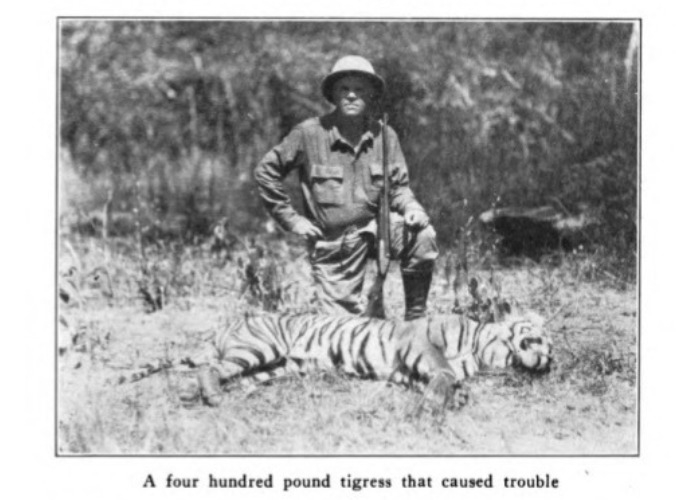
Finally I thought the tiger came. In reality it was a tigress, long and slender and sinuous and graceful. She did not appear large, but she would grow, with distance and the years, and her skin, well stretched, would make an admirable trophy. I slipped the barrel of the .375 Hoffman up alongside the protecting trunk, hesitated a second as to whether I should try for a mouth or an ear shot — no need to spoil a beautiful, perfect skin like that! — and crooked my trigger finger. But there was no trigger to press! What on earth had happened to that gun? It had never failed me before! Then I heard a thundering noise, as if the roof of the Rialto Building was falling in, and I dodged, and rubbed my eyes. And there stood Thong, my chauffeur, with the bullock cart, waiting to take me home! And there hadn’t been any tiger, and my rifle was in perfect condition, trigger and all!
Two days later, I played a return engagement, fifty yards down the road, with that same brute. He had dragged the remains of the deer into the jungle, where we had retrieved what was left of it, and I spent another nine hours over the bait. Time and again I got whiffs of his royal tigership, they have a strong, musky odor which is both distinctive and lasting, and once I heard him cough, directly back of me, but I never caught a glimpse of him. That afternoon, when the boys came for me, we investigated the near-by dry water course, and found that he had scratched out a big hole in the wet sand, and spent the day there, seventy-five feet from where I waited to welcome him.
In many respects the tiger differs from his cousin, the leopard. The tiger loves water, and will spend hours in a pool, with nothing but his head sticking out. He never hesitates to cross even a large stream. The leopard, on the other hand, has very little use for water, and, like a growing boy, avoids it whenever possible. But he is fond of frogs, and you may find his tracks in the sand, along a water course, where he has been searching for this delicacy. Defosse told me that he once saw a leopard catching frogs, and that the animal would first strike them with its front paw, then bite off the heads of the amphibians, and place the bodies in a neat pile at the edge of the pond. Finally, when the spotted gentleman had secured a dozen or more, he would stop work, and eat the whole bunch, then go forth in search of more!
Tigers stick closely to the trails, and follow the game from one feeding ground to another. They never take to the jungle if they can avoid it. As a rule, the first trail is made by the elephant. They wedge and push their way through brush which is so thick as to be practically impenetrable to everything else. Other animals, buffalo and banting, and especially deer, follow, and soon there is a well-defined though tortuous track where formerly the jungle reigned supreme.
Often one finds trees the trunks of which have been scratched and clawed for a distance of eight or ten feet from the ground. These are “tiger trees,” upon which the great brutes clean and polish their nails, just as a house cat sometimes does. Freshly marked tiger trees are always good sign, as are also “rolls,” in the grass, and, of course, recently made tracks. At our first camp, we frequently found where as many as five different tigers had patrolled the village during the night.
It has been suggested that dogs might profitably be employed in hunting the monster felines, as Rainey, Lewis, and others have used them for lions, in Africa. But pursuing tigers is not healthful exercise for a dog. Lions appear to fear them, but tigers don’t. In fact, they simply love them, and the bigger the better. In some way the dog seems to know this, and just the smell of a tiger will cause the average canine to seek refuge between his master’s legs, and no amount of persuasion, verbal or physical, will drive him away. Apparently he appreciates the fact that he occupies a favored place on his enemy’s diet list.
Unless they are females with kittens, these tigers appear to have no regular place of abode. We often found their temporary bedding places in the tall grass. The stalks were always bent in one direction, like this ////////. Deer, on the other hand, push the grass both ways,….
The usual, and most successful, method of hunting the felines is to search until fresh tracks are found, and then decoy them by means of bait. The beasts haunt the game areas, and as fast as the water holes dry up, they follow the deer and antelope to new fields.
One or more baits are put out, a chain of from four to ten giving the best results. Buffalo and bullocks are to be preferred. A likely spot, always in the jungle, where the bait will be safe from vultures, is selected, and the decoy animal killed, and securely fastened, by means of a steel cable, to a tree. A small grass boma or hiding place is then built, about fifteen or twenty feet away, and all arrangements made. Nothing must be disturbed after these preliminaries are completed. Every morning, between the hours of six and eight, the baits are visited. Occasionally the tiger is feeding at the time, but as a rule he is not. If the bait has been disturbed during the night, the animal will probably return, either in the morning or the afternoon, and so his pursuer promptly secretes himself in the boma, and the porters and gun boys cover him up, and go noisily away.
Tigers seldom charge a boma, and there is practically no danger involved. You sit and wait, as quietly as possible, and if you are fortunate you may get a shot within a few days, or even a few hours. The quarry does not always approach the bait in the same way. Generally you do not even know when it arrives, and the first intimation is a growl, or the noise made by the crunching of a bone. I have had experience with all sorts of big game, elephant, lion, rhino, buffalo, and bear, and I must acknowledge that none of them gives you the thrill that a tiger does. At fifteen feet, they look as big as a bungalow, and anything but kindly and gentle. They are not dainty feeders, and while they probably prefer fresh meat, when hungry they will take it in practically any state, high or low.
The surrounding jungle is thick and dark, and a wounded beast is almost certain to escape, consequently a head or a spine shot is essential. Inasmuch as the head is as large as a bushel basket, a head shot is not nearly so difficult as it sounds.
Defosse always advised us not to shoot when the brute was directly facing the boma, because the death spring might land him right on top of the blind, and as the walls are so thin that a two year old child could throw a peanut through them, this might prove detrimental to the health and welfare of the occupant. But when a heavy rifle is used, and I prefer a double .465, the tiger doesn’t spring, he is anchored right there, for eternity. Another advantage of the large missile is the lessened liability to deflection. An ounce bullet will cut through a twig the size of a slate pencil and still find its mark, while one of less than two hundred grains, and particularly one of very high velocity, will either fly to pieces, or go spinning harmlessly off into space.
The tiger’s sense of smell is comparatively poor, but both his sight and hearing are extraordinarily good. When hunting, or being hunted, the color of his coat enables him to take advantage of every bit of cover. Unfortunately for him, he is a cat after all, and he has not complete control of his tail. Very often, it is the involuntary waving of this graceful but unruly appendage that proves his undoing.
Their method of attack varies. As a rule, an Indo-Chinese tiger runs alongside his prey and if it be small or of moderate size, seizes it by the back of the neck and breaks its neck. Buffalo it attacks from behind, and drags down, taking no chances with the animal’s horns. It is extremely doubtful if they ever try to carry an animal over their shoulders, picture-book style. Of course when they are running, with their prey in tow, their heads are turned to one side, but in dragging large buffalo, or heavy pieces of elephant carcass, the tracks often indicate that the tiger first gets a good grip on the bait with his teeth, and then walks backward, dragging it as he goes. The enormous strength of a seven hundred pound tiger is almost unbelievable. They strike with their front paws, and the amount of power exerted can be appreciated only by experience, or by a careful examination of the shoulder muscles after the overlying integument has been removed.
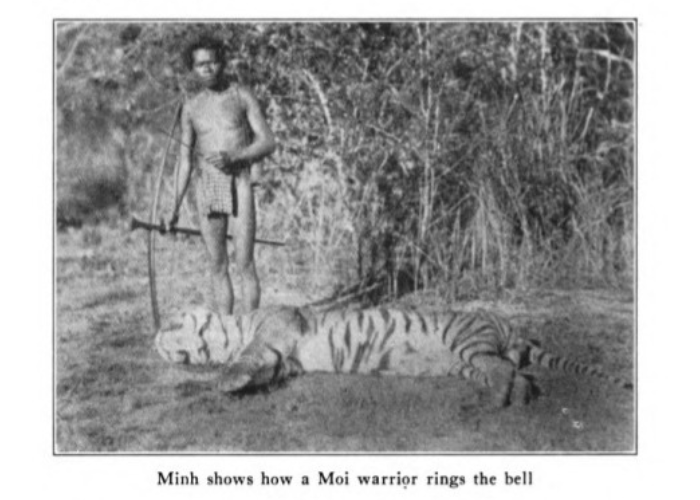
Man-eating tigers are rare, but a few do exist. We saw one Moi village which had been deserted because of depredations from this source. They very seldom attack man in the daytime, but will kill and drag off live stock, right in the heart of a village.
The Mois do not possess firearms, and the tigers are probably aware of the fact, for the brutes are canny.
It is very difficult to successfully stalk a tiger in the open. One occasionally encounters them by accident, but seldom by design. Unlike their leonine brethren, they never give the hunter any chronological leeway. The instant they see or hear anything unusual they are off, and the way they hike for a safety zone would make the average pedestrian on Michigan Avenue look like a terrapin with a wooden leg. They do not stop to investigate or to enquire, they simply vanish. A streak of lightning would require spiked shoes and running pants to keep within gunshot of one for longer than seven seconds.
I have already spoken of the use of machans, or tree platforms. I never had recourse to one but once, and the experience will not soon be forgotten.
At Mr. Poulet’s farewell dinner party in Saigon, Mrs. Dickinson had asked me where we planned to shoot. I told her that we would try a series of camps on the Camy, Song-Gieng and Lagna rivers, north and east of Gia Huynh. “Oh, I hope you will see the man-eater of Song-Gieng,” she exclaimed, and she then told me of a huge tiger with a crooked foot which had caused much trouble in the Moi settlements along this beautiful little river.
Three weeks later, we were hiking along a game trail, four miles east of camp. “What a peculiar looking track,” I heard some one say, and I turned to find the Judge, who is a born shikari, carefully examining some footprints in the wet sand. Apparently the left front foot was a trifle deformed, but it was the right rear one which had excited the curiosity of my shooting partner. The long axis of the print was almost at right angles to those of the other three. Defosse lounged back for a look, and I thought I saw him start, and change color when he saw the abnormal print. In a flash, I recalled Mrs. Dickinson’s remark. I spoke of it to M. Defosse. He was irritated. “I have told you that there are practically no man-eaters in this country,” he said, and then added, “Just because a tiger steals a few bullocks from a village and occasionally, and probably by accident, mauls a coolie. or two, it doesn’t necessarily make him a man-eater.”
For ten days, we bent every energy to the capture of that brute. But he refused to be captured. He would visit, and half devour, a bait one night, then desert it for thirty-six hours, to return and finish it the third night. He was the most uncertain and undependable tiger you ever heard of. I never knew an animal to keep such irregular hours.
Finally we decided on a tree nest, the Judge and I to do alternate watches from 6 A.M. to 9 P.M. Fifteen hours is not a long stretch, to a fisherman or a bridge fiend, but when you are perched up in a tall tree, with nothing to keep you company but a host of auburn headed, and very hungry ants, it is quite some vigil.
We had just about abandoned hope when I told the boys that I would try it one more day. In order to “change my luck,” I took with me the little .30-’06 Hoffman carbine, a miniature but wonderfully efficient little rifle, instead of the double Holland. The hours dragged wearily by. Twelve o’clock came, and I ate a piece of venison, and took a swig of tea from my canteen. At four, a big peacock called on me, and as he strutted around the bait, and pecked at the cocky little jungle fowl that were enjoying the unwonted feast, I longed to operate on him. But higher ideals triumphed. At five, a keen-nosed, bush tailed brown stoat appeared on the scene.
Twilight fell, and I was glad, for it gave me a chance to safely and surreptitiously swat a few blood-thirsty mosquitoes. I had just rearranged my aching bones on the hardwood slats when I heard a low growl, and some ponderous body moving about on the ground, ten feet below me. Could my long hoped-for guest have arrived? Only the day before, I had killed a large, reddish-brown wolf at a neighboring bait, having mistaken it for a young tiger. The increase in size I ascribed to the magnification of my shooting glasses, but I have never been able to account for the stripes. Possibly I had drunk too much coffee for breakfast that morning.
I did not want to make another mistake. But the huge, shadowy body that was snuffling around my pet buffalo could admit of no diagnostic error. It MUST be a tiger. So I poked the slender barrel of the little Hoffman down between the slats of the machan (how I wished it had been my reliable old Ithaca ten-bore goose gun, loaded with slugs, or spike nails!), and opened the ball. You never saw a more surprised tiger in your life! He had no more idea than a rabbit that there was a fat white man roosting up in that tree. And the more he bounced, the more I shot. I would take no chances with one hundred and fifty grain bullets, and it was too dark to see where I was hitting him, anyhow. Defosse said that from camp it sounded like the second battle of the Marne. I had but seventeen cartridges with me, and as we afterward found eighteen holes in the hide, I think that I did pretty well for an amateur, although it did seem to me that he should have died sooner.
The Judge intimated that the extra wound was where the tiger had bitten himself, in his disgust at being killed by such a rotten shot.
When we had succeeded in bagging a tiger, we always waited a few moments, and then fired two notification shots, which meant that the brute was dead, and all was well. Three shots meant that the tiger was wounded and to approach carefully if at all, and four, that somebody was in trouble, and that things were far from well. Consequently you can imagine the consternation at the base camp when they heard my fusillade. Defosse, the Judge and Louis arrived at about the same time, all stuffing extra cartridges into their guns as they ran, then a queue of Mois and Annamites, armed with coupe-coupes, axes, spears and clubs, and finally, old Peter, who was always late, with a bullock cart.
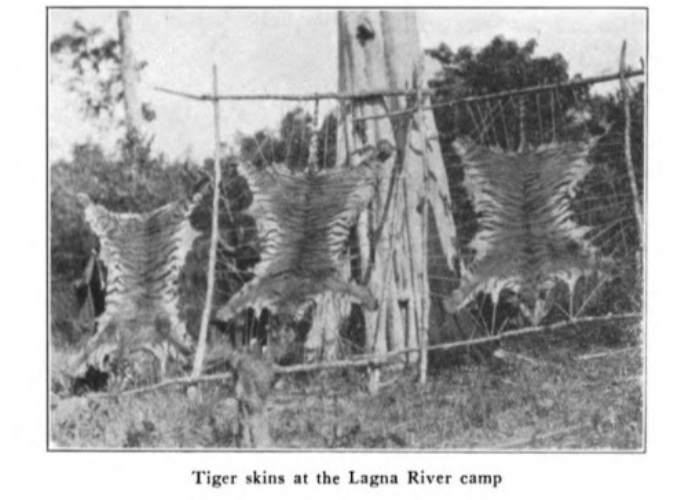
The pelt was so full of holes that it was practically worthless, but I saved it, anyway, and now my dear little wife uses it in place of a crocheted table cover. Our last tiger camp was located at the junction of the Lagna and Mosquito Rivers, and the place, which is very like the Lorian Swamp, in Northern Kenya, fairly swarmed with game..
But it was very damp and cold at night, and it fairly swarmed with mosquitoes, too, and sooner or later all of us had fever. We took quinine until each felt as if he had permanently adopted a fife and drum corps. Every morning, when we put in our supplication for good hunting we always added a postscript, praying that the tiger and the chill would not arrive at the same time. There is a popular little Moi camp song which is fairly descriptive:
If you love the cold, and the dew and the damp,
Spend a few weeks in a tiger camp.
The husky mosquitoes’ siren song
Will vie with the quinine’s, all night long.
At half-past four, it will seem but three,
You will hear the cook sound reveille,
And you crawl from your blankets, by ones and twos,
To chase the scorpions out of your shoes.
Your shirt is mildewed, your socks are wet,
And you haven’t seen a tiger yet!
But the Red Gods will smile on your efforts at last,
Just as they always have smiled in the past: A
nd you’ll laugh at the cold, and the dew and the damp
When you shoulder your kitten, and start for camp.
Of all big game shooting, that of tiger, under proper conditions, is undoubtedly the most interest ing and fascinating. For real thrills, nothing else on earth can touch it.
Richard L. Sutton, Tiger Trails in Southern Asia (St. Louis: The C.V. Mosby Co., 1926), pp. 59-83.
See: https://babel.hathitrust.org/cgi/pt?id=uc1.$b25374&seq=1&q1=
Wild Sports of Burma and Assam
Fitz William T. Pollok
CHAPTER III
THE CARNIVORE THE TIGER
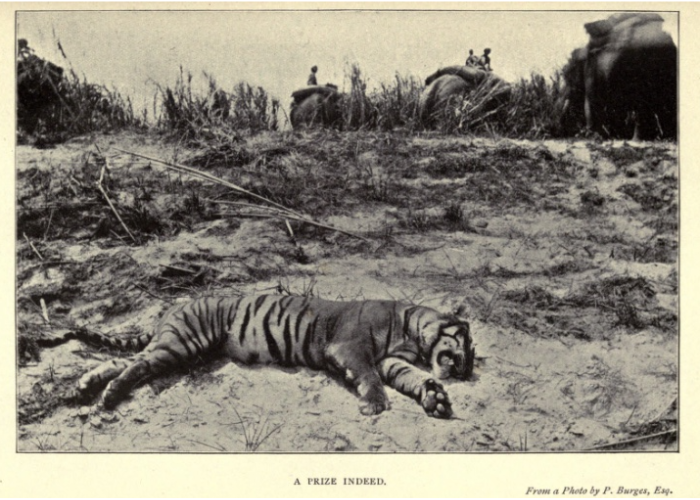
The Burmese assert that there are two varieties of tiger: those of the plains that live on the village cattle being much the larger, and with a longer tail; those that roam over the hills and live principally on such game as they can outwit, being much smaller and with shorter tails; but, if anything, more fierce than the former. Tigers are plentiful all over the country, but very difficult to find; and where cattle and game abound they do little or no harm to human life. But in the remoter districts, especially in the Yonzaleen, man-eaters are very plentiful. Captain Watson of the Artillery, Assistant Commissioner of Yonzaleen, assured me he seldom crossed over the Hills to get to Kyoukee in the plains without losing one or more men. In Assam they are more plentiful than in Burma and more get-at-able. Generally each tiger has his beat, and will tolerate no other male on his preserves. If an intruder puts in an appearance a battle-royal takes place, and if one is killed, he is often eaten by the survivor. The length of tigers has been greatly exaggerated. I have never seen one more than 10 feet 2 inches as he lay dead, and the largest I ever heard of from a reliable authority was 10 feet 4 inches.
I here give an instance. A tiger we shot measured as he lay dead 10 feet 1 inch; when the skin was taken off it was 12 feet 6 inches; when pegged out and dried it became 13 feet 4 inches — these measurements having been noted at the time in my note-book. He was an unusually big brute, with a very loose skin on him.
The size of a tiger of course depends a great deal on the quantity of food available. Where cattle abound they are very destructive. I have known one tiger to kill five bullocks off the reel, to drag them into the dense bush where vultures would not get a sight of them, and there to leave them and partake of them when he was so disposed. If anything, I think they prefer their game high. I read when a boy that a tiger never condescended to partake of anything not killed by himself, but there cannot be a greater fallacy; they drag away and eat the cattle that have died of murrain, and which are thrown to a distance from the village. There is not a surer bait than a buffalo or a gaur or even an elephant or rhinoceros that has been shot and left; but generally he won’t go for them until putrefaction has well set in. I heard of one officer who had shot three tigers one night by sitting up over the body of an elephant he had shot five days before. And as for the legend that man-eaters are old mangy brutes who take to homicidal practices when they are unable to pull down game or cattle, and that they are sans teeth, sans vigour, sans everything but hunger, it is ‘a myth. I have known them shot as sleek as a well-cared-for cat, young, active, and vicious, and as portions of the cloth of the victim slain were taken out of him, there could be no mistake as to his identity.
Occasionally white tigers are met with — I saw a magnificent skin of one at Edwin Ward’s in Wimpole Street; and Mr. Shadwell, Assistant Commissioner in the Cossyah and Jynteah hills, also had two skins quite white. I have also heard of one black tiger having been killed. Some have coats far more fulvous than others; a few, greatly prized for their rarity, have double stripes, or very nearly double.
Tigers have a wonderful knack of hiding themselves. I have known one to be in a bush which we passed quite close and unseen, although it was so bare that one would have thought a hare could not have been in it unobserved. Man-eaters, as a rule, are probably more cowardly than the cattle-lifters, but occasionally they are the very reverse. Witness the following, as related by Colonel McMaster, who was at that time Adjutant of his regiment, and a bold, successful sportsman, and good naturalist, whether with the rifle or the spear or pen: —
“The 36th Regiment was en route from Samulcottah to Berhampore in the Northern Sircars, and was approaching Tonee. An officer’s servant, who with the men’s kit had, as is often the case, preceded the corps to the next encamping ground, was — just at dusk and close to the mess-guard — carried off the high-road by a tiger; an infant, then about eighteen months old, which he had in his arms when he was seized, was quite unhurt in the awful rush that took place. It would be interesting to know what effect the recollection of the scene may have had on the child in after life. On hearing of the tragedy next day, when we reached our encamping ground, three of us went back to the spot, about three miles off, to try and recover the body. Except that we made our way in Indian file through thick thorny bushes, under which we had to creep sometimes on hands and knees, the trail — marked with fragments of clothes, the cap, keys, purse, blood and hair of the victim — was an easy one. The body was very little mangled, so it was determined to wait for the return of the tiger, and in the meanwhile to put up a small platform in the only tree near.
I had office work to attend to in camp, so left my two comrades, who took breakfast and shelter from the sun (it was then near mid-day) under a bush close to, but not within sight of the body, which was not a pleasant spectacle during their meal; their gun-carriers were about the spot, collecting the rough materials at hand for the Machan. While all were thus employed, the tiger carried off the body from their midst in open day and through not very thick brushwood, without being observed by any one. I returned to them soon after, as they were trying to follow the trail, this time without success, for the body had now neither blood nor rags to mark the path, and the ground was hard. It is difficult to conceive how the beast could have outwitted them, but so it was. I still think, from the trail as we had it first, that this was a small tiger probably a tigress.”
The peculiar cry of the jackal (which is generally called the ” pheal “), so unlike its usual unearthly howl, has caused much discussion. It is only the frightened cry of a jackal. As the yelp of a dog undergoing chastisement, or under sudden fright is totally different from its bark, so when the jackal is attempting to poach on the preserve of his master, the tiger, and the latter puts in a sudden appearance, the “provider,” as he is called the purloiner would be a truer title goes off with his tail between his legs, uttering the cry of a “pheal.” Of this I am sure, as it once occurred before me, when a leopard made a spring at a jackal; and once when General Blake and Mr. Barry were watching over a dead bullock, near Rungeah.
Tigers are chary of attacking wild buffaloes, but they often kill isolated tame ones; but if the herd be near, they will charge en masse, and I once saw a tiger so killed.
Nor does a tiger care to tackle a wild boar in the open — the bodies of the two have been found near each other dead. Scott of my regiment, when with Peyton, 9th Regiment, the crack shot, on the Bison Hill up the Godavery, saw a boar trotting up the hill-side champing his tushes and looking round every moment — so he stepped behind a tree to see what was up; as soon as the boar had reached the crest of the hill, which was quite flat and open, then he turned round and halted. In a few seconds up came a large tiger, but the pig would not move; as the tiger walked round him, so the pig turned, presenting a bold front. Scott was so absorbed in the spectacle, wishing to see its denoûment that he never thought of firing; but whether the tiger funked or whether he got a taint of the biped, he suddenly sprang down the hill-side, and the boar galloped off on that opposite. Before Scott could raise his gun to fire, both animals had disappeared. I here relate a story of a tussle we had with a tigress.
On May 11 we moved to Myetquin from Banlong on the Sittang, Burma.
Madden and Osmer of the 69th went out to try and secure one or two of the numerous deer we could see scattered over the plain, whilst Boyle and I stayed at home.
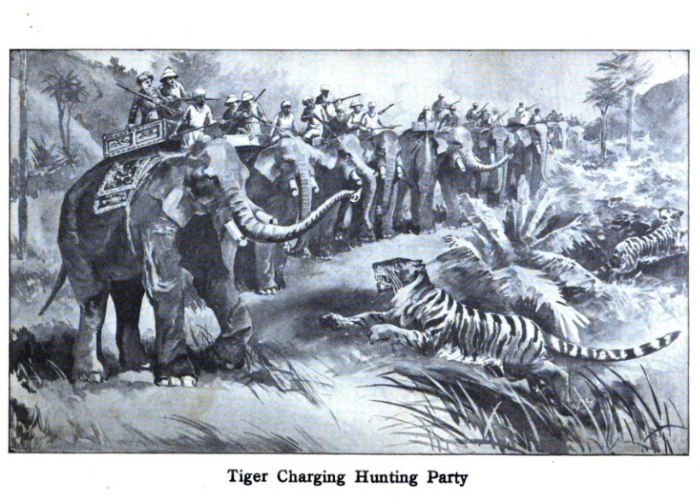
Between 3 and 4 p.m., just as we were thinking of having our daily bath, a mahout on a small elephant hurried up, saying his confrères on the other elephants had surrounded a tiger close by. We could see them grouped in a circle not more than a quarter of a mile away. We had no time to spare, as the sun sets about 6 p.m. There is no twilight in the east, and it would be dark at 6.30. Boyle, brother of the defender of Arrah, had not undressed, but I had on only my pyjama suit and no socks, and a pair of slipshod slippers.
Seizing a couple of guns each, we mounted the elephant without changing, and in a few minutes were at the scene of action. Boyle got on to a large commissariat tusker — on a pad. I got on to my own elephant, and sat on the charah, or green fodder, which was piled on his back ready to be taken to camp. No sooner did we advance than I saw the tigress creeping along in front of us, but she saw us as soon as we spotted her, and before we could fire, with a short half-roar, half-growl, came at us open-mouthed. I think her object was to frighten our steeds, and in this she fully succeeded, as every beast we had turned tail and bolted; but both Boyle and I fired, and one of our shots went through her foot. She then took refuge in a patch of long grass.
As soon as we got control over the elephants, we formed line and again advanced, but although my elevated position gave me a great advantage as far as seeing was concerned, yet my seat was very insecure — the charah wobbled about, and I had two weapons to look after. We had my howdah in camp, but there was no time left to send for it. We had great difficulty in inducing our elephants to advance; they kept trumpeting, shuffling their feet along the ground, knocking the tips of their trunks on the hard earth or against their feet showing, in fact, all the symptoms of being in a blue funk. The tigress had shown good generalship in her tactics, for she had succeeded in thoroughly demoralizing our steeds, and had rendered the task of slaying her a most difficult one.
However, we forced them into the long grass and started her again. No sooner was her rush heard than all the hathees except mine formed a close phalanx and ran for their lives, taking Boyle with them. Mine did not retreat, but he was very unsteady, swaying about and kicking up the earth with his fore-foot To shoot accurately off his back was impossible; he was a fine young tusker of the very highest caste, but had not been broken in for shooting. I told my mahout, a Mussalman, to force his steed into a patch of grass into which the tigress retired. Before I reached it, Boyle, with the other elephants, joined me. I could see the grass moving as the tigress swayed her tail to and fro, and I knew she meant mischief. Shoayjah, a Burman shikarie, had come up, and mounted one of the leading elephants; he urged me to fire at the moving grass. I did so, and as the movement ceased I thought I had made a lucky shot and slain the tigress. I told the mahout to push his elephant in; we had not gone above 10 yards, when the tusker began to protest by sundry shakings of his body and pitiful cries, but still his head was towards the foe.
She rushed out like a shot from a catapult, and although I fired and hit her, she closed, and seized the elephant by the right foot; but he, with a mighty effort, jerked her off, and threw her to a distance of some 10 or 12 feet. As she lit on her back, close to Boyle, whose steed was in full flight, he fired and shot her through the stomach. I too, fired, and hit her somewhere. But she picked herself up and went into a thicket close by. By this time I was getting riled, and repented of having got on to the charah, but there was no time for delay, if we wanted to bag the tigress.
I stood where we were until I saw the other elephants coming back, though at a snail’s pace, protesting the whole time. My mahout had been punishing my beast, and I think he got his pecker up, as he did not hesitate to push his way into the thicket. No sooner had his head entered than the tigress sprang clean off the ground, lighted between his tusks and, clinging to the trunk and forehead with her claws, she set to work to maul him about the jaws. I had hit her as she sprang, but she seemed to bear a charmed life, and to be still full of fight. Those who are familiar with elephants will realize the row mine kicked up at this mark of affection on the part of the feline.
He suddenly threw himself on his knees, and began to drive his long tusks into the ground, imagining, no doubt, that he was pounding the tigress to death; but she was perfectly safe where she was, and was mauling him dreadfully. As the tusker dropped on his knees, the charah toppled over and I was sent flying. I lit on the broad of my back, holding on like grim death to my gun — the rifle had fallen off with the charah. I had half-cocked the weapon as I felt falling off, but re-cocked it directly I embraced mother earth. When I picked myself up I was about four feet in front of the infuriated elephant and the equally enraged tigress. To shoot was impossible, so rapid were the movements and so intricately mixed were the two — and I might perhaps shoot the mahout or the elephant — so I thought discretion the better part of valour, and retreated backwards.
Boyle had seen me disappear, and thought I was in the clutches of the tigress; he was thrashing his mahout to come to the rescue, but not a beast would budge an inch in the required direction. I expected every moment the tigress would leave the elephant and attack me, so I kept my eyes steadily on the combatants and my gun at the ready. I had no shoes or socks on — my slipshods had disappeared — the ground was hard and lumpy and covered with the stalks of the grass which had just then been burnt a short time back. The stumps were sticking out of the ground like panjies, and cruelly lacerated my feet; there were thousands of trailing creepers with hook-like thorns, and these kept tripping me up, and every few paces I went a cropper backwards. Every time I fell, Boyle thought the tigress had me, but could do nothing to help me; after about as nasty a hundred yards’ trudge as I ever wish to undergo, I got to where the elephants were congregated; the soles of my feet and my legs (pretty well denuded of my pyjamas) were torn and bleeding.
Fortunately just then a large commissariat tusker, who had been with Madden and Osmer, came upon the scene. I jumped on to the pad on his back, and he not having been in the scrimmage — advanced pretty rapidly towards where the elephant and tigress were still fighting. Before I had gone 50 yards I saw my elephant, who had shaken off the tigress, coming towards me at his best pace, dragging the charah along the ground and the mahout hanging on to his hind-quarters, instead of being seated on the neck as usual. As he passed me he called out —
“She has bitten me!”
I of course hurried to the front; no sooner had I got within about 20 yards, than without waiting to be shot at, she charged. I hit her and stopped her for a second; had the elephant stood, I might have killed her, but he spun round like a teetotum. She rushed on and seized him high up on the inside of the thigh, and hung on like a bulldog.
Using the gun like a pistol, with one hand, whilst I held on with the other to the ropes of the pad, I tried to shoot her; but her body swayed about so that I missed; and she fell off and went into another patch of grass. As soon as I could get this elephant — who was nearly 10 feet in height — round, I again returned to the charge, but it was already getting dusk; she did not allow us to get very close, but rushed at me with short, coughing roars that sent the steed flying.
To make a long story short, this vixen mauled my second mount several times, receiving herself a bullet each time; but no great damage was done either way. I was as savage as the tigress, and would have advanced on foot had it been practicable; but the grass, though burnt here and there, was too long in her vicinity, for she did not throw a chance away for a man to have had any chance. My elephant at last refused to budge — it was all but dark — so we judged it better to leave her and look her up in the morning.
My poor mahout’s foot was fearfully bitten almost crunched to bits. He bore his wounds like a Spartan, and all he said was that it was his “nuseeb” — preordained luck. He hoped I’d get the tigress on the morrow. Madden was afraid at first that he would have to amputate the leg, but the man begged him to spare it, even if so doing cost him his life. So Madden, who was as good a doctor as he was a companion, took out as many of the broken bones as he could, and bandaged up the foot, but he had no medicines, instruments, or appliances with him. I sent off a man at once to Tongho; he went all night and reached the station next day — getting all he was told to bring. He got into a dug-out, and after an absence of only thirty-six hours he was back again, having covered one hundred and some twenty miles in that time, and was fully satisfied with the reward, 20 rupees, which I gave him.
Thanks to our medico’s skill and kindness, the man recovered, but his foot was never very sound, for every now and then a sore would break out and pieces of bone come away; but he remained with me whilst I was employed in the Provinces.
The elephant’s wounds caused by the tigress were bad enough, but the worst were where he had been cut by the ropes of the charah. I have been in many scrimmages afterwards, and he behaved fairly, but was never a very good shooting elephant, as he would not remain perfectly still.
At daylight next morning we were back at the scene of combat. There lay the plucky tigress on her back dead. She must have died soon after she drove us off, for the body was quite offensive; but I have known this to happen a few hours after death.
She had thirteen wounds; we took out eleven bullets two had gone right through. I recovered my double rifle, but never saw my slipshod slippers again.
The tigress was only 9 feet long as she lay dead, but her tail was very short, and the Burmese said she was a hill tigress, who had probably wandered into the plains after game; and that those of her caste were all more savage than the tigers of the plain, who fatten upon the kine of the people.
Thus ended as pretty a scrimmage as one cares to be in.
Charlie Hill’s escape from a man-eater has been told by me too often to bear repetition here in extenso but I give a brief summary of it.
He was with a party of Burmese Police in chase of our Shan levies who had mutinied and absconded with their arms. One morning, just after daybreak, he was marching along ahead of his men with only a stout stick in his hand, and his boy and an orderly carrying his gun and rifle, with orders to keep close: of course they loitered.
He was following a narrow path along a hill-side fringed with grass which much resembles bamboo when young, and thought he heard a slight noise, and thinking it might be a yit or a jungle fowl, he turned round and told his lugalay to hand him his gun. Before the lad could do so, out came the head of a tigress almost within striking distance; and unfortunately not only he, but his detachment and his boys saw it too, and halted, crying out — “A tiger! a tiger! — he will be killed!” — without coming to his assistance. Seeing that he could get neither his weapons nor help from those behind him, he pretended to hit the brute a back-handed blow, yelling at her the same time. So far from intimidating her, she rushed in, and Hill — who was then in the zenith of his manhood and stood 6 feet 2 — gave her a crack on the side of her head which either felled or turned her, and then he turned round and said —
“Give me the gun.”
Hardly were the words out of his mouth when his stick was knocked out of his hand, his right arm pinioned to his side, and the brute was standing over him with her paws on his shoulders, growling like the very devil. He bent his back, and hit at her with his left arm over his right shoulder; but with a whoop, she came down on his back and he fell as if shot, the tigress going a complete somersault over him. He lost no time in picking himself up — on all-fours; the blood was pouring down his face and beard from two holes in his neck. As the tigress and he got up, they were facing one another; she did not care two pins for a man, but she suddenly found him transformed into a four-footed beast, more uncanny-looking than herself — put her tail between her legs and ran for her life and escaped, but was eventually killed by some Karens, after killing a great many people, and being for the time the terror of the hills.
Here was a case of a man-eater showing no fear of even a detachment of troops, who, as they were all armed and loaded, might have killed her when she first appeared, had they possessed an atom of pluck. Hill was carried in to Shoayghein and eventually recovered, but he had a more than fortunate escape, for only the upper fangs penetrated his neck, actually grazing the jugular. Had not Hill fallen so suddenly and she had made good her grip, the artery would have been severed, and he must have died in a few minutes.
When a tiger kills a beast he never goes far off, so if it is intended to sit up for him, great circumspection should be used in erecting the machan to avoid noise; it is best to take a native charpoy or couch, which is light and fairly strong, and either sling it on to a tree or to fasten it to the branches. When moving the carcase of the kill, care must be taken not to allow human hands to pull it about — not that a really hungry tiger would care, but if he has had a good meal lately he will be dainty, and smell the carcase all over, and if he detect the least taint of a human being he will go away and perhaps not return for several days.
Sitting over a fresh kill is bad enough, but to do the same over a putrid corpse is sickening, and more than most men can stand. So if there be no suitable place for sitting up where the garah lies, and you have to move to a more favourable locality, throw a noose over the horns and drag it to where your mart has been erected. In my young days I did a good deal of machan and mart work, but with little success, and I strongly advise no man to sit up unless the moon be very bright; and to use luminous paint for his foresight. It seems ridiculous you can see the smallest objects moving at a distance by moon-light, yet you can’t see the foresight of your rifle. I tried many dodges — all failed — but the best was luminous paint. With everything most carefully worked out the chances are greatly in favour of the tiger getting off, and you have had all your worry and annoyance from mosquitoes not to say of the risks you run from malaria fever for nothing.
However careful a man may be, however cool and collected and a crack shot, the chances are not equal when he meets a tiger on foot. Many tigers, notably in the Madras and Bombay Presidencies and in Central India, are killed yearly in this way, but scarcely a year passes without some fatal accident. Enough has been said of the stealthy nature of the animal to prove that he can hide in an inconceivably small space; and once within springing distance, in at all thick jungle, one pat of a tiger’s paw or one grip of his tremendous jaws are sufficient to kill an ox. Then what chance has a puny man? Such is the vitality of one of these cats, that though shot through the heart, he is still capable of killing half-a-dozen men before giving up the ghost himself. At times tigers will, like every other animal, seem ridiculously easy to kill; but at other times the more balls he gets into him, the more lively he seems to be. I look upon shells as very effective for tigers and soft-skinned beasts, but useless for pachyderms.
Tigers were at one time very numerous at Pegu. An officer of the Commission, Dangerfield, had a large powerful bulldog — which at night was chained to the foot of his bed — killed under the bed and carried off by a tiger; and Dr. Le Presle, Assistant-Surgeon of H.M.’s 84th Regt, baited a trap with a duck and caught a large tiger!
The two Hamiltons, brothers, Richard and Douglas, were second to none as shikaries. One of them, writing to the South of India Observer, says: “Some years back, at Pykara, not far from the bungalow, a tiger took a fancy to a Todah in preference to the buffaloes he was tending. Two of the Todah’s comrades were witnesses of the affair, and they described how the tiger behaved like a cat with a mouse. Having caught the man, he amused himself for some time by letting him go, and then dodging him as the poor victim tried to escape, before killing him out-right, notwithstanding the shouts and yells of the lookers-on.
It is a moot question concerning man-eating tigers as to what induces them to take to preying on human beings: some affirm that it is only when age overtakes the animal, and he finds himself unable to cope with his ordinary victims, deer or cattle, that he falls upon man; and it is stated in support of these views, that these man-eaters are mangy and decrepit beasts without possessing a single point that makes the tiger the formidable creature he is in his prime. This is partially true, but man-eaters have also constantly been found to be sleek, lusty, and at their full strength and vigour, quite as often as the reverse; it is not therefore entirely dependent on age and concomitant weakness that the tiger takes to this habit.
I think the argument advanced by many observers and naturalists, that the animal either accidentally or by press of hunger — having once seized a man and found out what an easy capture he had made, and, in addition, that the flesh is palatable, takes advantage of this acquired knowledge, and thenceforth becomes that dreaded monster, a man-eater is equally reasonable, and may be accepted, perhaps, as the more probable of the two.
“There are divers opinions as to the exact mode by which a tiger takes its prey. Popularly he is supposed to lie in ambush and spring on his victim as it passes his lair; or watching by a pool, awaits the arrival of animals in quest of water. These would offer but precarious chances even to so cunning and stealthy a foe as the tiger, as all wild animals are so wonderfully cautious in their approach to such resorts. The tiger, too, betrays his presence to them by that peculiar smell attaching to him, so that the odds are greatly against our striped friend’s success: though of course he occasionally is rewarded by catching some unwary, over-thirsty animal that rushes to the water heedless of the consequences. But this will not apply to the tiger on the hills, where no paucity of water ever occurs to such an extent as to drive the game to any one spot to drink. That the tiger’s principal food in certain localities is game there can be little question, but how he takes it is not well known, and perhaps may never have been witnessed by any one.
“I have a theory of my own upon this point — let us ventilate it. In the first place, the tiger must have room to spring on his victims: in the sholas many are sufficiently clear to allow this; and no doubt he takes advantage of such spots when a chance offers in them, but in general the woods are dense with undergrowth interspersed with trees so close together that the spring of the tiger and the force of his blow must, I should say, be greatly interfered with. Then again, his presence — as before said — is so liable to detection by the deer that his chances of capture are remote; but at night the deer are out in the open, and then, perhaps, the wind being by chance in his favour, he may succeed; and I am disposed to believe that this is the most likely time for him to do so, though he is in no way restricted as to time or place, for he slays buffaloes oftener during the day than the night, and at times close to their habitations. All deer possess an acute sense of smell, and against it a tiger has to contend before he can provide his larder with game; but how does he manage it? We cannot give him the credit of the intellect of man, who in pursuit of game is well aware nothing can be done down wind; and also, not a sambur or deer would be left alive — the tiger would bag them all, just as he pleased: in fact, he would then be able to kill any deer when he wanted it.
“We have so far considered the acuteness on the part of the game to ensure them against total destruction, and I have only one further observation to record, and that is, how often the presence of a tiger is indicated by the actions of the sambur and other deer; if disturbed by him in a shola during the intense heat of the day, the deer immediately resort to the open, watching with eagerness the wood they have quitted, and generally warning the neighbourhood with loud consecutive bells.
“That the tiger is stealthy and quiet in his movements we all know; that velvet paw of his, so soft, yet so formidable, enables him to tread the woods and forests so noiselessly that even the sharp-eared deer may often be taken by surprise and fall a victim to its blows.
“There is also another mode of craftiness adopted by a tiger in approaching game, and that is, the tiger often replies to the bell of a sambur or the call of a deer, and he does so with a short, impatient grunt, at the same time quietly stealing on towards the sound of the deer’s call. This answer of his seems to elicit a reply from the deer, and so the tiger, ascertaining with tolerable precision the position of his prey, is guided accordingly, stops his growling, and perchance secures a victim.
“There is a peculiar and singular distinction in regard to the mode of breaking up their prey between the tiger and the panther, the former invariably commencing on the hind-quarter of the animal slain, and the latter at the fore-quarters or chest. There is no known reason for this strange difference, but it is a well-established fact, and perfectly recognized by all sportsmen, Europeans as well as natives.
“An officer thus describes the striking down of a cow which he and others saw: —
“We were walking along the northern bank on our way to our posts when we were stopped by the cry of ‘Bagh hai!’ and looking down to the bed of the river we saw what apparently was a very large tiger, stalking a herd of cattle that had come down to water. We crouched down and had the luck to see the whole affair. The tigress, as she proved to be, when first seen was stealthily stalking a white cow, which was some little way off from the main body of the herd, and, taking advantage of. the slightly undulating bed of the river, had probably approached across an open space of perhaps 500 yards before this cow had seen her; the rest of the herd were behind one of the islands and could not yet see the feline. The white cow allowed the tigress to approach to within about 80 yards before she appeared to notice her danger, and at first seemed to be fascinated by the appearance of the brute creeping towards her, and it was only when the tigress commenced to increase her pace to a trot that the cow made off; the trot increased immediately to a lumbering gallop, as the tigress had now got on to the firmer ground that surrounded the islands, and in a very short time she skirted over a small ridge into close proximity of the herd, which was then commencing to scatter, on the news received from the white cow. The gallop turned into a charge, and in a few seconds the tigress had picked out a fine young cow, on whose back she sprang, and they both rolled over together in a heap. When the two animals were still again, we could distinctly see the cow standing up with her neck embraced by the tigress, who was evidently sucking her jugular; the poor cow made a few feeble efforts to release herself, which the tigress resented by breaking her neck. The remainder of the herd, after rushing wildly away, now returned to within 50 yards of the tigress, who was silently slaking her thirst off the cow. Finding, after a few minutes’ survey, that the animal embracing the cow was probably a dangerous one, they scuttled up the south bank and commenced grazing again.”
Fitz William T. Pollok, Wild Sports of Burma and Assam (London: Hurst & Blackett, Ltd., 1900), pp.59-83. Images are found in Pollok on page 55 and the above-cited Sutton book on pages 60, 62, 67, 69, and 75 The last two images are found in Sarath K. Ghosh, The Wonders of the Jungle, Vol 2 (Boston: D.C. Heath & Co., 1918). (See: https://babel.hathitrust.org/cgi/pt?id=uva.x001984494&seq=1) on pages 107 and 121
See: https://babel.hathitrust.org/cgi/pt?id=uc1.$b25374&seq=1&q1=