Japan
We want you to have a greater ability to learn about some of the unpleasant animal issues in our world.
JAPANESE FUR SEALING
Oliver L. Austin Jr and Ford Wilke
SUMMARY
1. Although the Japanese hunted the fur seal on a small scale in earlier times, the animal did not assume economic importance in Japan until the end of the 19th century. Then the example of the foreign pelagic sealers, who were reaping a rich harvest in seals in waters right up to Japan’s shores, awakened the Japanese to the possibilities for great profits from pelagic fur sealing.
2. The Japanese began intensive sealing operations in the mid-1890’s. They could of course operate far more cheaply than foreign ships in western Pacific waters, especially after seals became increasingly scarce, and within a few years foreign competition in Japanese waters ceased. However, the decrease in the number of seals wintering near Japan, as a result of the intensive sealing operations, also forced the Japanese sealing fleet to hunt farther from home. The richest hunting grounds were on the high seas close to the Pribilof and Commander island rookeries, especially after the rapid decimation of seals from the Robben Island seal colony closer to Japan. Japan protected the Robben Island herd after 1905 but continued to expand pelagic sealing elsewhere. By 1910 the Japanese were operating 53 pelagic sealing vessels.
3. Japan was not a party to earlier international agreements to conserve the dwindling fur seal resources but did join in the 1911 four-power conference which drew up the Fur Seal Convention. This treaty banned pelagic sealing and set up a system of distribution among the signatories of the income from the annual harvest from the Pribilof, Commander, and Robben island seal colonies. The Japanese Government paid indemnities to the Japanese pelagic sealers who were deprived of their livelihood under the new restrictions. However, almost immediately Japanese sealers began to take seals illegally, especially among the herds wintering in waters off Japan.
4. Hoping to resume pelagic sealing openly in order to obtain a greater portion of the profits from the seal resources, Japan opened negotiations to revise the treaty, without success, in 1926 and again in 1936. The chief argument they advanced was that the seals had increased to such numbers that they were damaging the fisheries vital to Japan. The fact that in 1929-30 three seals which had been tagged in the Pribilofs were taken in Japanese waters was used to substantiate the claim that a large proportion of the Pribilof seals wintered off Japan. Japan finally gave official notice in October 1940 of her intention to abrogate the Fur Seal Convention and completed that action in October 1941.
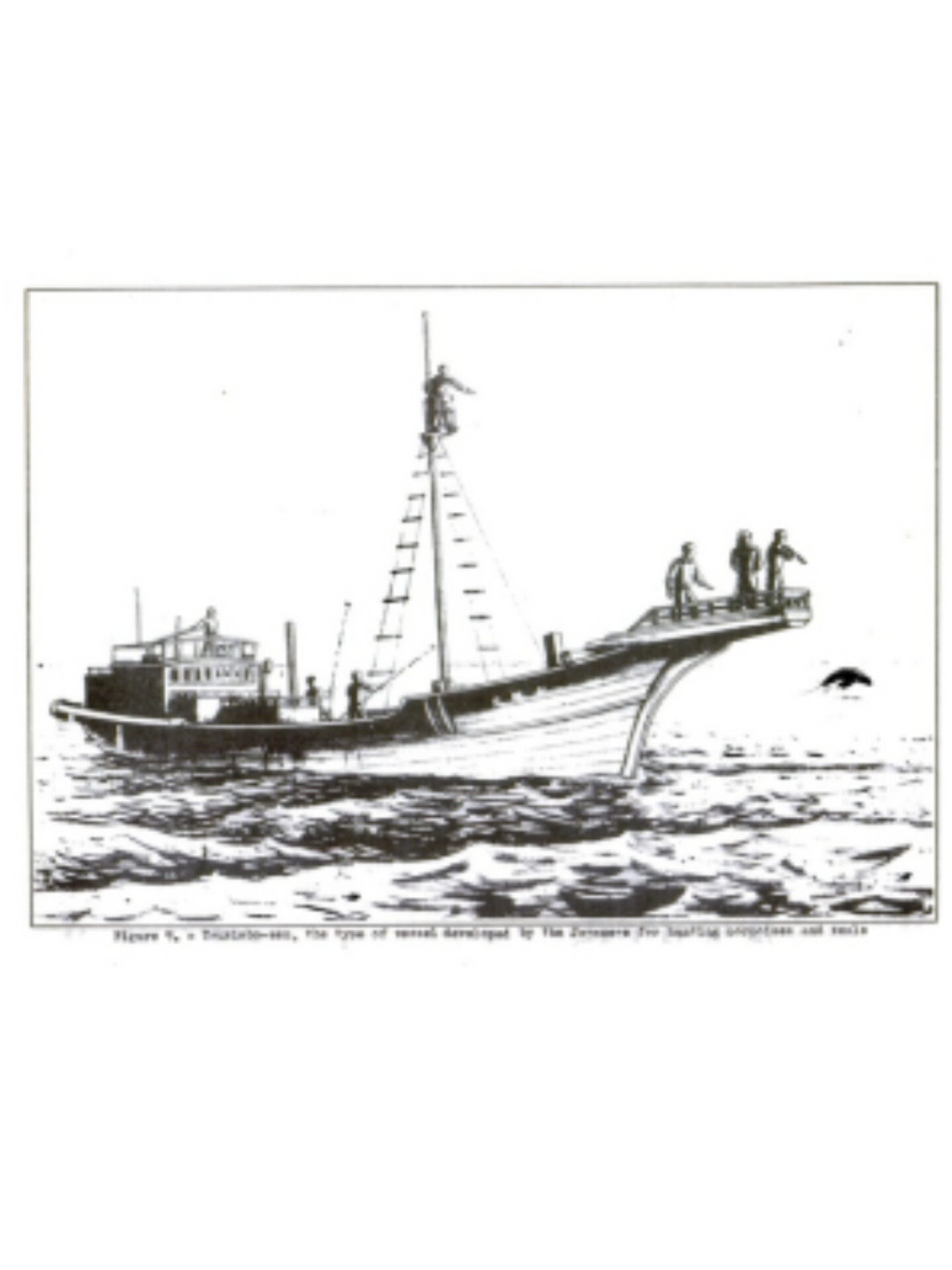
5. Following the resumption of open pelagic sealing in 1942, Japan used an efficient new technique which could hardly have been perfected overnight. This method made use of a single sealing vessel, the tsukimbo-sen, instead of the mother ship and small boats previously used for sealing. The fur seal catch during 1942-45 cannot be estimated with any accuracy but was undoubtedly substantial. Operations in 1944-45 were greatly hampered by wartime conditions. Pelagic sealing by the Japanese was forbidden by Occupation authorities although some illegal sealing probably is continuing.
6. A limited study and compilation of available data on the distribution, abundance, and food habits of fur seals in Japanese waters were undertaken in 1947-49 to obtain information of importance to management of the international fur seal resources. This study did not indicate that the seals inflict any significant damage on important Japanese fisheries. Further indication of some migration from the Pribilof herds into Japanese waters was obtained through recovery of four more seals which had been tagged in the Pribilofs.
7. The paucity of the available data reveals that more intensive research is needed to determine the fur seal’s status. in Asiatic waters. Such information is necessary as a basis for future conferences among the nations concerned so that a fair and equitable agreement can be reached on the management of the north Pacific fur seal resources.
INTRODUCTION
The history of fur sealing in the north Pacific is an unsavory tale Of its earliest stages, in the late 18th and first half of the 19th centuries, but little is known. The heyday of pelagic sealing, which began shortly after the American Civil War and continued through the first decade of the 20th century, is well documented in occidental writings. Its course of uncontrolled slaughter embellished by hardship, cruelty, murder, shipwreck, blood, and gore was finally ended by international legislation, which became possible only because the seals had decreased so markedly that pelagic sealing was no longer profitable.
The four-power Fur Seal Convention signed in 1911 was, during its 30-year life span, one of the most successful of all international conservation treaties. The excellent results obtained under it´s tenets with the Pribilof Island herds are the finest of object lessons, demonstrating how a vanishing species can be saved from extermination by rigid protection, and developed into a lucrative industry by wise management. Similar results, but on a smaller scale, were obtained by the Russians on the Commander Islands and by the Japanese on Robben Island off Sakhalin.
Today fur seals have become so abundant, thanks to this protection, and the profits to be made from them are so large that once again they are a subject of international concern. The 1911 treaty was abrogated by Japan in 1941, and subsequent international disharmony has prevented the resumption of negotiations among the four powers concerned. Once again open pelagic sealing is a possibility which, unless curbed, threatens to destroy valuable natural resource in the western and northern Pacific and may have even farther reaching effects.
This report has been prepared primarily to clarify the issues involved, by assembling the available data on the distribution, abundance, and ecology of the fur seal in Japanese waters, with special reference to the species’ importance to the Japanese economy. It is based on investigations conducted in the field in 1948-49 by the staff of the Wildlife Branch, Fisheries Division, Natural Resources Section, on unpublished records and statistics from the formerly secret files of the Japanese Bureau of Fisheries, and on a thorough review of the available Japanese literature on the subject.
The Japanese literature is of special importance. Because of language difficulties, most of it has heretofore been unavailable to western scientists and legislators. In addition to its contributions to knowledge of the movements and habits of the fur seal and the history of the fur seal industry, it is of special value here because it mirrors the Japanese thinking and viewpoint on the subject.
This report will serve another useful purpose if its exposition of the paucity of the available data stimulates the more intensive researches needed to determine the fur seal’s status in Asiatic waters. Future conferences among the nations concerned may then be enabled to reach a fair and equitable agreement on the management of the north Pacific fur seal resources….
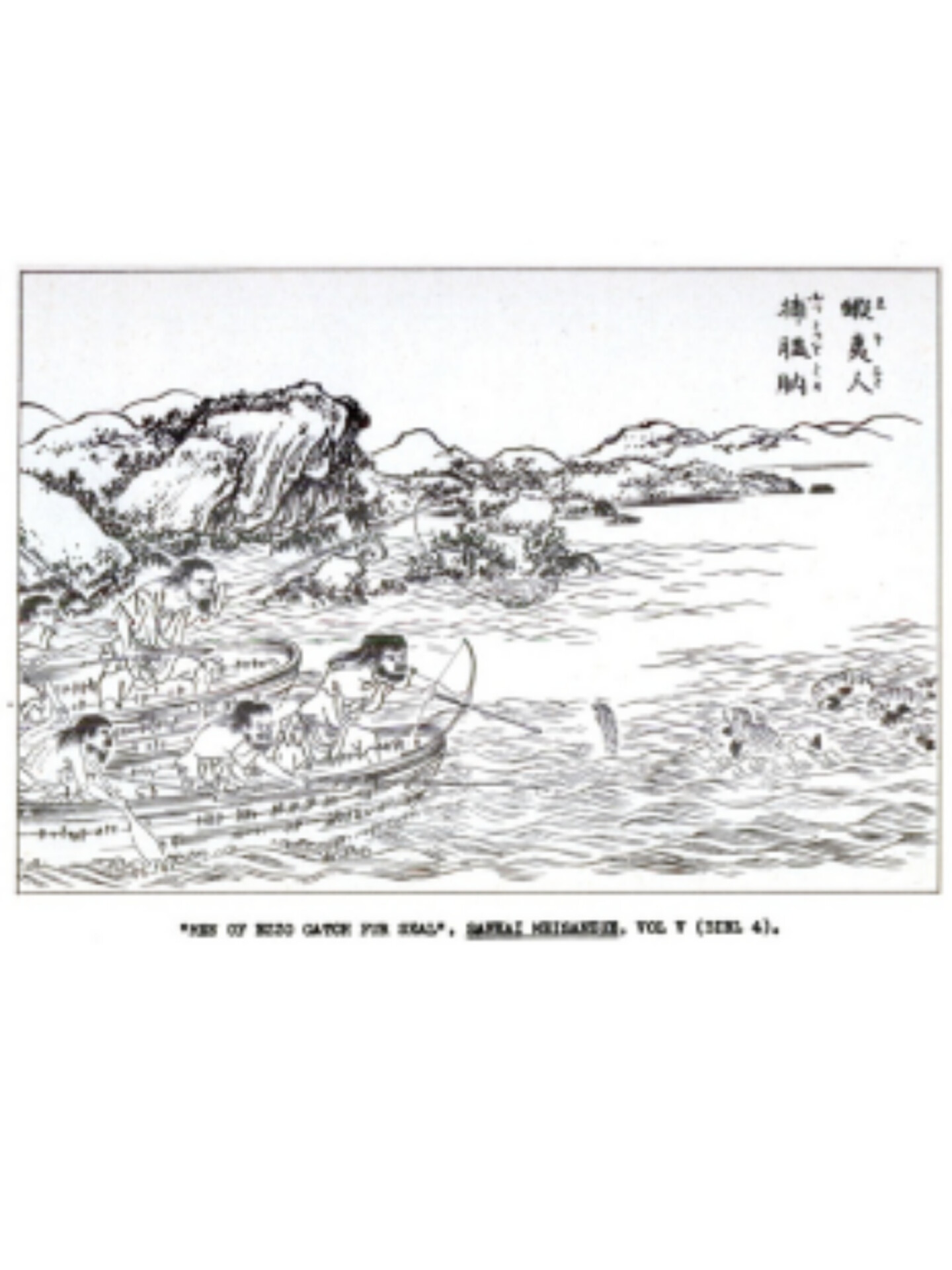
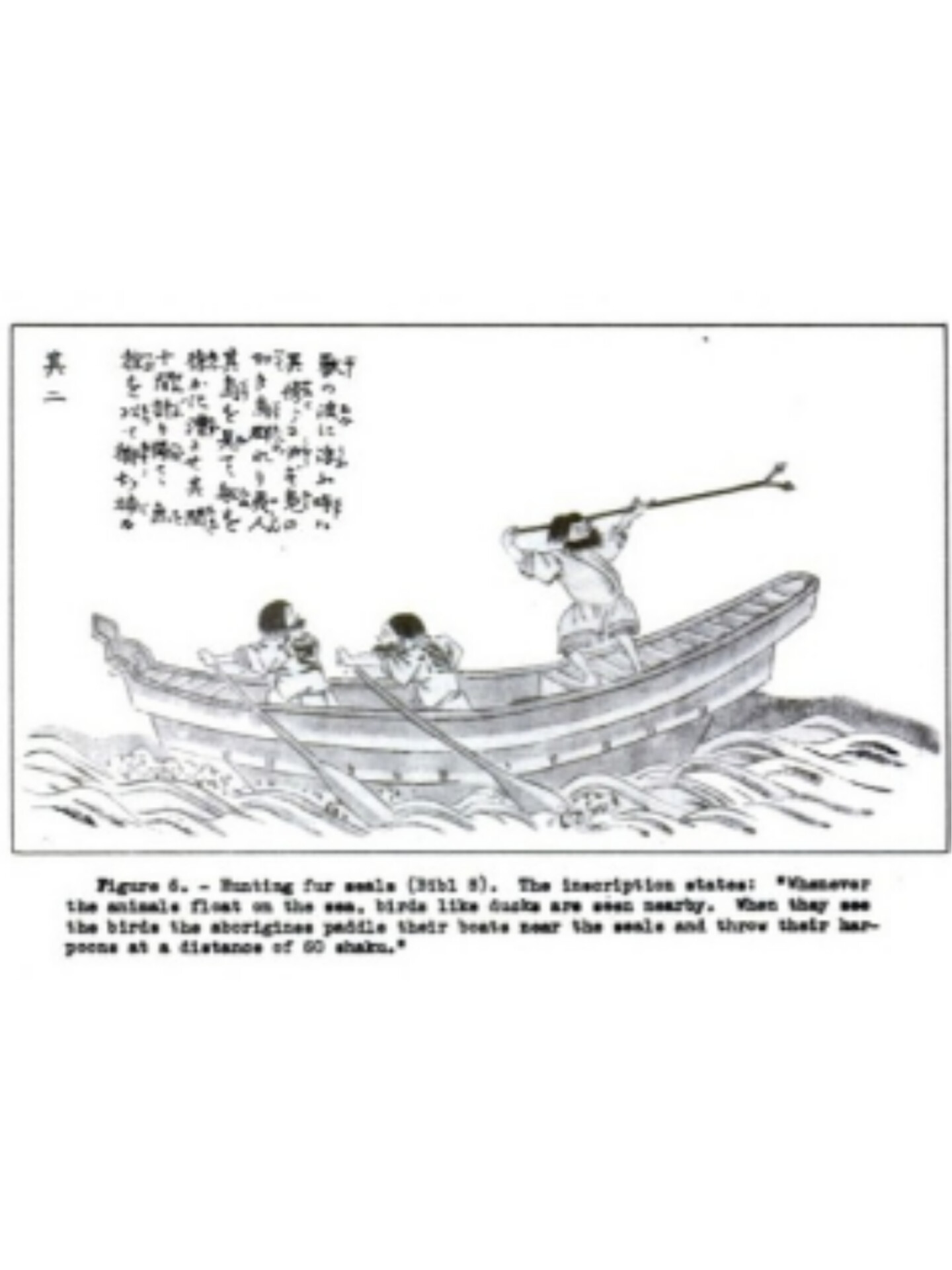
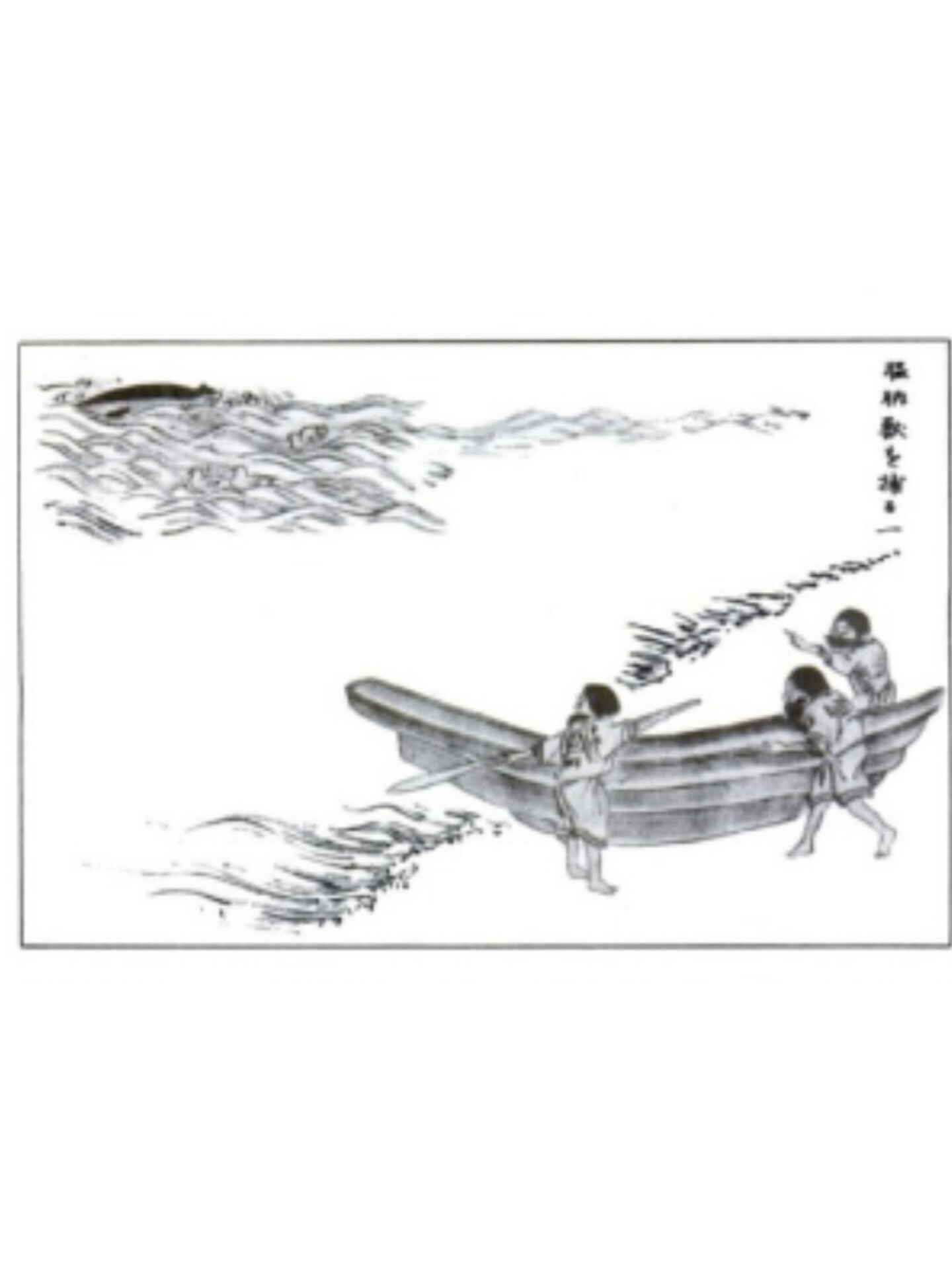
This aboriginal hunting was hardly sufficient to make any impression on the large herds of seals traveling past the Hokkaido coast in those days. Nor did the Japanese fishermen farther south off the Honshu coast, where seals must have been equally abundant, pay much attention to them. Not infrequently, the animals were caught in tuna nets, but the fishermen regarded them only as a nuisance and threw them away. Not until late in the 19th century did they become aware of the seals’ value, when it was demonstrated to them by the example of the foreign pelagic sealers.
JAPANESE SEALING FROM 1890 TO 1910
The Japanese did not start sealing actively until the American and Canadian sealers who set them the example had skimmed the cream. Once started, however, they soon surpassed their teachers and became the most notorious and efficient poachers ever known.
The first foreign vessel to hunt in Japanese waters was the American schooner Cygnet, which brought a valuable cargo of sea otter hides from the Kurils into the newly opened port of Hakodate in 1872. Word of her find spread quickly, and within the next few years a dozen vessels, most of them owned and operated by adventuresome foreign residents of Japan, ventured into these dangerous waters to share in the quick profits. So thorough and unrelenting was their exploitation of the Kuril sea otters that the stock declined very rapidly, and yearly it became more and more difficult to make a profit on a voyage. So the vessels made occasional forays on the not too distant fur seal rookeries on Robben and the Commander Islands. This was risky business, for these rookeries were protected by the Russians, who seized many over-daring schooners and imprisoned their crews. Then in 1879 or 1880 one of the otter hunters discovered a seal rookery in the central Kurils. The news spread quickly among the hunters, and within the next few years the three small colonies, on Mushir, Srednoi, and Raikoke islands respectively, were wiped out, practically before news of their existence reached the Japanese Government, which had received the Kurils from Russia in exchange for southern Sakhalin in 1875.
The Japanese Government did make a belated and half-hearted attempt to preserve these rookeries, though it is doubtful that the government authorities at the time recognized any difference between the sea otter and the fur seal. Three sets of regulations were promulgated, two by the imperial government in 1884 and 1886 and the third by the Hokkaido local government in 1888…. The first prohibited hunting seals and sea otters in Hokkaido (which included the Kurils) except under license by the Bureau of Fisheries of the Ministry of Agriculture and Commerce. The second required all licensed hunters to produce their permits on demand, to announce their arrival in Hokkaido to the local authorities, and to have all their raw skins stamped by the authorities before selling, and prohibited the entry of skins from American and Russian waters unless accompanied by a certificate issued by the governments of those countries. The third established an open season from 15 April to 31 October, divided the Kurils into three areas with each to be hunted alternately every third year, required a special flag to be flown by licensed vessels, and provided that all skins must be entered for stamping at Shikotan.
However, as Stejneger… pointed out, not only were these regulations utterly unsuitable for the protection of the seals but they were never enforced. They could not be made effective against the foreign vessels, and the government was not overly concerned in the matter at the time. After all, seal and seal otter hunting had not yet become “big business”. Most of it was conducted on what then were distant shores in which Japan did not have much interest, and the few vessels so engaged, though largely manned by Japanese crews, were owned and captained by local resident foreigners who “knew all the angles” and how best to evade any restrictive regulation. Nor was local public sentiment much concerned, as can be seen from the dearth of titles in the bibliography previous to 1891.
The situation changed abruptly in 1892, and events thereafter developed very rapidly. The immediate cause was the Paris Tribunal arbitration of the United States- Canadian dispute, which temporarily closed the eastern Bering Sea to pelagic sealing and forced the entire American and Canadian sealing fleets to seek better hunting grounds to the westward. Some of these vessels operated near Robben and the Commander Islands, but most of them eventually visited the comparatively unworked waters off Japan.
The first pelagic sealer to operate in Japanese waters was apparently the C. G. White which, having no competition, made good catches off Honshu and Hokkaido in 1890 and 1891. The White was joined by at least a dozen more vessels in 1892, but the real influx began in 1893. In that year 42 English and American ships brought 38,000 seal skins into Hakodate harbor alone, and probably at least half as many more vessels sailed after the season directly to Yokohama, the Bonins, or straight across the Pacific to American and Canadian ports without reporting their catches in Japan. As this sealing was right in their own back yard, the Japanese could not help but take note of it.
Their reaction was immediate and vigorous, for they found much that was objectionable in the activities of the Canadians and Americans who used their ports and hunted seals in the waters immediately off their shores. The behavior of the foreign crews ashore, which undoubtedly was not strictly up to accepted standards either American, European, or Japanese, caused some criticism and antagonism, but the Japanese mainly resented the foreign exploitation of a native aquatic resource which they themselves had been unable to develop because of lack of knowledge and equipment. Knowing that the seal supply was not inexhaustible and that the foreign exploitation was at Japan’s expense, they regarded the foreign sealers as poachers. The sealers justifiably resented this term of opprobrium because they were in truth breaking no laws in Japanese waters. They could be considered poachers only when they raided land colonies, of which none remained in Japan, the Kuril colonies having long since disappeared. The sealers’ only operations near Japan were on the high seas beyond the three-mile limit, where Japanese law had no jurisdiction. As they had no recourse to law without an international agreement of some sort, the only way the Japanese could discourage the hardy opportunists who were exploiting their seals was to beat them at their own game. This they did, starting from scratch, in a scant five years.
A review of the literature from 1892 to 1896 shows the trend of events. A petition was presented to the Diet for subsidies to enable Japanese pelagic fisheries to compete with foreign vessels…. But governments make haste slowly, and not until five years later, in 1897 when the need was almost over, were these subsidies granted…. Meanwhile the Bureau of Fisheries of the Ministry of Agriculture and Commerce was delegated to make a study of the sealing industry. Its first major publication on the subject… gave all details available from foreign literature, mostly American and English, and delineated the history of seal legislation up to and including the results of the Paris Tribunal arbitration. It also included a little information gathered from the local pelagic sealers themselves.
More practical steps were taken by the Dai Nippon Suisan Kaisha (Imperial Fisheries Co), the leading Japanese commercial fisheries concern. Early in 1893 this company outfitted two of its vessels, the Chishima Maru No 1 and the Chishima Maru No 3, to try pelagic sealing experimentally. The Ministry sent as official observers on these first cruises young men with some scientific training in fisheries, and their detailed reports of the operations… proved most instructive. Other similar studies were made on successive voyages the following year…, which established the pattern for subsequent Japanese pelagic sealing operations, based on the methods introduced by the American and Canadian vessels.
Up to this time pelagic sealing operations out of Japanese ports were governed by the laws of 1888. These statutes, as was pointed out by the Japanese themselves…, hampered the operations of the Japanese who had to abide by them but had no effect whatever on the foreign sealers who could not be forced to obey them. On the basis of its investigations the government promulgated a new set of regulations 2 March 1895… which were further implemented by Ministry of Agriculture and Commerce regulations issued 6 December 1895…. The regulations were not designed to conserve the resource and did not attempt in any way to regulate the method of hunting or the amount of catch. They imposed practically no restrictions whatever on either Japanese or foreign vessels. They simply provided for the registration of all vessels engaged in the trade and required them to fly a special flag, to report their arrivals and departures, and to furnish detailed statistics on their crews and catches within a specified period after their return.
Even before this loosening of the controls the Japanese sealing fleet began to expand, and as it expanded the foreign fleet declined. [Table deleted.]
The marked decline of the foreign vessels received its first impetus from the disastrous 1894 season. Although the vessels made good catches, the American and Canadian skippers’ lack of familiarity with weather and other conditions off the Japanese coast brought many of them to grief. As Stejneger… pointed out, “nearly ten per cent of the vessels sealing off Japan and over ten per cent of their crews were lost that year”. More important reasons for their steady decline after 1895, however, were the increasing scarcity of the seals, which made catches so small no profit could be made after a voyage across the Pacific, and the expanding competition from the Japanese vessels which could operate infinitely more cheaply than foreign ships in these waters. The trend also was accelerated by a drop in the price of seal pelts in the London market, then the major wholesale outlet for the fur seal catch.
The American pelagic sealing fleet received its death blow in 1897 when the United States imposed import restrictions on fur seal and sea otter skins taken in foreign waters…. This measure prohibited entry into any American port or the sale on the American market of seals and otters taken outside of American territory. A few American sealers managed to operate surreptitiously under other flags for a number of years…, but to all intents and purposes pelagic sealing by Americans was thereafter a thing of the past. The Canadian sealing fleet, although still active, was unable to meet Japanese competition in the western Pacific, and its operations in the first decade of the 20th century were limited to the northern and eastern Pacific waters nearer home.
The Japanese now were free to enjoy pelagic sealing in their own waters without foreign competition. After the promulgation of the Deep Sea Fishing Encouragement Law on 31 March 1897… the Japanese sealing fleet expanded even more rapidly. For a short time the vessels prospered, but the results of the continued relentless persecution of the seals were already becoming apparent…. As the seals wintering off Japan declined in numbers, the still increasing Japanese sealing fleet began to hunt farther and farther from home. Pelagic sealing was forbidden within a radius of 60 miles of the Pribilof Islands by a cooperative agreement between the United States and Great Britain, drawn up shortly after the Paris Tribunal award of August 1893. Also a 30-mile restricted zone had been established around the Commander Islands by a similar agreement between Great Britain and Russia. As Japan had not signed either of these agreements (in fact her cooperation had not even been invited) she was not obligated in any way by them. Under international law her nationals consequently had just as much right to hunt seals on the high seas beyond the three-mile territorial limit of these islands as the American and Canadian vessels had to operate off Japan’s coast in the 1890’s. Japanese sealers were not long in taking advantage of their position.
The American and Russian seal colonies were given a temporary respite from Japanese attention by the discovery in 1901 of the seal migration into the Japan Sea. The Japanese fleet concentrated on the new find immediately and exploited it to the maximum…. Twenty Japanese vessels operated there during the 1902 season, taking a total of 5,712 seals…. The animals in this hitherto overlooked fishery originated apparently in the rapidly dwindling Robben Island rookery, though some of them may have come from the equally declining Commander Island herds…. These seals were so rapidly decimated, however, that within two years pelagic sealing in the Japan Sea was no longer profitable and the Japanese vessels had to seek more lucrative waters to the northward.
The most profitable pelagic sealing areas were now the feeding grounds off the Commander and Pribilof rookeries. While nursing their pups, female seals may feed as far as 150 miles from the rookeries, in waters where they were then completely unprotected. The Japanese first centered their efforts on the waters near the Commander Islands, but as this herd declined they soon expanded their operations eastward to the vicinity of the Pribilofs as well. Their distant operations were assisted in 1905 by the revision of the Deep Sea Fisheries Encouragement Law… which increased the subsidies and allowed the fleet to operate more profitably farther from home.
The Japanese sealing fleet now became a scourge to the northern sea islands. easy pickings of land sealing on the guarded rookeries themselves were always a temptation to vessels operating off shore. As the sealers worked closer and closer to land they grew bolder and even made armed raids in force on the nurseries, where they came into conflict with both the Russian and American rookery guards. The seriousness of these clashes is not reflected in the Japanese literature, for the Japanese were evidently quite aware of the ethics of the situation and made no written comment on cases where the poachers were in the wrong. However, they seldom failed to comment when they had some right on their side, such as when their vessels were overhauled, searched, and seized on the high seas without sufficient evidence to prove illicit operations within the legal territorial limits.
The attitude of the Japanese Government throughout this period is difficult to understand, as the available evidence is quite contradictory. The record shows that the government cooperated fully in all international efforts towards the protection of fur seals. As early as 1887, when the United States first attempted to obtain such cooperation, Japan signified her willingness to join the negotiations, but her advances were rebuffed. The United States treated Japan rather summarily,… [according to Stejneger] that she “had better wait until the other powers had come to an agreement”, something which never happened because the negotiations broke down suddenly after Great Britain’s refusal to compromise. Japan also accepted the United States invitation to join a four-power conference in 1897, which also was never held because Great Britain was opposed to it. Finally, Japan cooperated fully in the four-power convention in 1911.
Yet Japan had no impelling reason to cooperate in efforts to protect seals on land during the greater part of this period, for she had no rookeries of her own worth protecting until 1905. The seals which foreign hunters had extirpated from her Kuril rookeries in the early 1880’s have never returned, undoubtedly because sufficient protection to enable them to do so has never materialized. But when the 1905 treaty of Portsmouth terminating the Russo-Japanese War gave southern Sakhalin to Japan, she joined the ranks of the “have” nations with the acquisition thereby of the fur seal rookeries on Robben Island.
Steps were taken immediately to protect this newly acquired resource. The national law of 1895 controlling sea otter and fur seal hunting was extended to be effective in Sakhalin 25 April 1907, and all land killing of seals on Robben Island was prohibited for an indefinite period….
But at the same time pelagic operations in other waters apparently were encouraged, and the Japanese sealing fleet continued to expand. By 1910 Japan had 53 pelagic sealing vessels in operation. Their uncontrolled activities were instrumental in stimulating the United States to try once again to obtain international cooperation for the protection of the rapidly vanishing fur seals, this time successfully.
The 1911 four-power convention in Washington for the protection and preservation of fur seals accomplished its purpose after so many previous failures largely because of the sudden change in the attitude of Great Britain. This may have had political overtones, but undoubtedly the most important reason for Britain’s change of policy was the failure of the Canadian sealing fleet, which by 1909 had been driven completely from the seas by the Japanese competition. At any rate, British policy swung into line with the American and Russian proposals to outlaw this evil. Its abolition was made the first and most important article in the resulting treaty.
The Japanese Government representative, Mr Doke, presented his nation’s official position, which was in essence that Japan was perfectly willing to give up pelagic sealing but must have some compensation therefor. Local opinion at home in Japan, as revealed by editorial comments at the time, was somewhat divided. The pelagic sealing interests naturally were violently opposed to any curtailment of their activities…. All local sympathy, however, was not entirely in accord with them, for calmer heads realized drastic steps were needed if the industry were not to vanish. Likewise the moral question was raised, indicating a realization of the adverse effect Japanese poaching activities were creating on the good will of other nations toward Japan…. However, concern for the questionable ethics of poaching was probably of minor importance compared to the political expediency of placating other nations, and to the economic considerations which are frequently the most persuasive of all arguments in such matters.
In the light of subsequent developments the absence of more active Japanese opposition to the treaty is quite understandable. Although the recent acquisition of Robben Island undoubtedly was instrumental in influencing Japan’s decision to sign, of greater importance was the fact that Japan stood to gain far more economically than she was giving up. Her 15 percent share of the annual Pribilof catch awarded by the treaty promised a greater monetary return than her pelagic sealing operations could anticipate. But also in the minds of the diplomats and the leaders of the influential large fishing interests may have been the philosophy, so incomprehensible and repulsive to democratic idealism, that international treaties are only scraps of paper and future obedience to their tenets can always be tempered by political or economic expediency.
JAPANESE SEALING UNDER THE TREATY, 1911-41
For all that can be shown by the available Japanese literature, the Japanese abided by the tenets of the Fur Seal Convention from 1911 until they abrogated it in 1941. According to the published records the official government attitude was one of complete cooperation and accord. Measures were taken to manage and protect the Robben Island herd, and the required percentage of the annual Robben Island harvest was distributed meticulously among the other signers. However, Japanese pelagic sealing probably never ceased entirely, for the government apparently never made more than a token effort to prevent its nationals from violating this first and most essential of the convention’s precepts except in home waters, and even there poaching activities were more or less openly condoned after the early 1930’s. Unfortunately, no complete record of this duplicity is available, as most of the official government files were destroyed, it is claimed, during World War II. So, for all that other governments can prove to the contrary, the Japanese Government acted in good faith and lived up to the spirit and the letter of the 1911 treaty.
Shortly after the return of the Japanese delegates from the Washington conference in 1911 the Diet ratified the treaty and passed the required enabling legislation. Law No 21, of 22 April 1912, prohibited all pelagic sealing and sea otter hunting in all waters north of 30°N latitude, restricted land sealing as monopoly of the government, prohibited the importation of otter and seal skins unless legally taken, and empowered officials to take necessary action to enforce these regulations…. How strictly these laws were enforced cannot be ascertained; no records remain of any arrests made or cases prosecuted.
Simultaneously with the treaty legislation the Diet granted indemnities to the Japanese pelagic sealers who were thrown out of work by the new restrictions…. Under Law No 22 of 20 April 1912, the pelagic sealers were paid ¥957,477. The government expected this amount to be equalled almost immediately by the receipts from the United States, hence the latter’s decision to harvest no seals for a five-year period caused the Japanese government some embarrassment…. Nevertheless, there was evidently very little activity among the illicit pelagic sealers at this time. The government was anxious to build international amity and good will. Besides, seals were not sufficiently abundant in nearby waters to make operations profitable and the richer sealing grounds near the Pribilof and Commander Islands were very well guarded.
Nevertheless the Japanese pelagic sealers did not remain idle for long. The first indication to the outside world that they were engaged in fairly large scale poaching operations was Stejneger’s report on their activities in the Commander Islands from 1917 to 1922. The erstwhile poaching ships had been designed for operations in northern waters. After receiving the government indemnities, they continued to operate in the same areas, ostensibly fishing for salmon and crab. Thus they were at hand to poach whenever opportunity offered, and the opportunity was not long in coming. When the Russian sea patrol was relaxed following the 1917 revolution the Japanese took immediate advantage of it to resume their rookery raids…. In the absence of any authority in the area their piratical activities increased steadily and did not cease until the new Soviet government re-established armed protection of the islands.
As Stejneger pointed out… obtaining correct and reliable data on illegally taken seals is next to impossible. The markets of the four powers which signed the treaty were, theoretically at least, closed to all traffic in unlawfully procured seal skins. But the disposal of contraband has never posed any insurmountable problem in the East. Long before “black market” became a common English term during World War II, shady transactions of all possible hues flourished along the eastern Asiatic coasts. Some western authorities have questioned the existence of large-scale seal poaching in the Orient, because no extra skins have appeared in European and American markets. But the markets of [missing text] an excellent source of furs and fat, both vitally needed by a war machine, the treaty restrictions had somehow to be overcome. They could not be ignored entirely without endangering international amity, which still had to be maintained. And as pelagic sealing operations pursued on a large enough scale to be worthwhile could not be hidden entirely, they had somehow to be legalized without incurring the undue suspicion and enmity of the United States and Great Britain. This necessitated finding a logical and justifiable excuse for abrogating the treaty.
The detailed balance sheet of the Japanese fur seal account under the treaty kept by the Bureau of Fisheries… still showed a deficit at this time. This account was handicapped at its start in 1912 by the tremendous initial outlay for the indemnities paid to the pelagic sealers. The annual balance between expenditures for patrolling the sealing waters and managing Robben Island on the one hand, and the revenue from Robben Island and the land sealing receipts from Russia and the United States under the treaty on the other, had not yet overcome this initial debit. But the trend was favorable, and the steadily increasing receipts from the Pribilofs foretold the eventual solvency which was finally attained in 1937.
The most promising gambit in the campaign to nullify the treaty was to develop the fishermen’s complaint that seals are injurious to other fisheries in which Japan had a greater interest. Fishermen the world around regard all fish eating mammals and birds as unwelcome competitors, with very few exceptions. The very presence of fur seals in the fishermen’s nets was considered sufficient evidence against them, and politicians are always prone to accept the complaints of their constituents on such matters without further verification of the facts. No detailed studies of the food habits of fur seals in the western Pacific have ever been made, but American researches had already shown the fur seal’s diet to consist mainly of squid, pollack, and other species of little or no importance to American fisheries. However, it is difficult to conceive of any catchable fish or other marine product which is not of at least some consequence to the Japanese economy.
Gradually Japan built up her case. The Robben Island herd was prospering, and so apparently were the Commander herds now that protection was once again afforded them. Quite naturally seals wintering in the waters off Japan showed a corresponding rise in numbers. However, neither the Robben nor the Commander herds had increased in proportion to the phenomenal multiplication of the Pribilof herds in the same period. The increase in the seals wintering off Japan seemed far greater than could be accounted for by the number of seals known to breed on the Asiatic rookeries, and the claim was now made that the apparent surplus could come only from the Pribilofs….
That some Pribilof seals might winter in Japanese waters had long been suspected. The possibility was first noted in 1894…, but the thesis was unsupported by concrete evidence and was ignored by all western authorities. The American management of the Pribilof herd was and still is based on the premise that the northern fur seals are divided into two groups, possibly three. Animals from the three respective rookeries were described originally as specifically distinct, and most systematists still consider them as at least racially separate. As the Japanese suggested in 1933…, re-examination of the morphological criteria separating these supposedly different subspecies now seems advisable. Recent discoveries, to be discussed later, suggest that the constancy of their reportedly distinctive characteristics may be open to question.
At any rate, western authorities still contend that all the Pribilof seals migrate down the eastern side of the Pacific to winter in waters off Canada and the United States, that the Robben and Commander herds migrate southward to waters off Japan, and that no extensive intermingling occurs on the wintering grounds between the two groups. This theory. if true, would greatly simplify the management of the Pribilof herds by allowing any Japanese or Russian activities east of the date line to be disregarded as of no consequence to the Pribilof herds….
In the summer of 1925 Mr Keishi Ishino, the scientist in charge of fur seal work for the Japanese Bureau of Fisheries, while investigating breeding conditions on the Commander Islands noted in the Hugo Statine rookery on Medney Island three male seals bearing brand marks on their backs. With permission one of them was killed for closer examination and was found also to have been sheared on the head. These marks were identical to branding and shearing done the previous season on the Pribilofs. The following summer Mr Ishino discovered a similarly sheared seal on Robben Island. The watchmen on the island reported observing three other marked animals there during the summers of 1927, 1928, and 1929, one of which was collected in 1929.
In 1929 a Hokkaido salmon fisherman sent to the Japanese Bureau of Fisheries a numbered metal tag which he found on a seal taken accidentally in his nets off Muroran. The Bureau sent photographs of the tag to the United States Bureau of Fisheries, which verified it as one attached to a seal in the Pribilofs in 1928. In the spring of 1930 Japanese Fisheries officials recovered two more 1928 Pribilof tags taken similarly the preceding season by drift-net fishermen off the east coast of Honshu…. The officials also unearthed reports of 25 more tagged seals taken by poachers off Honshu and Hokkaido between 1928 and 1930. These reports could not be verified further because the tags either had been discarded by the fishermen who did not realize or care about their scientific value, or else had been purposely thrown overboard to destroy incriminating evidence of poaching. The Bureau of Fisheries published these data in 1933 in a very interesting pamphlet, apparently written to justify the Japanese request for a revision of the treaty. Two identical editions were printed simultaneously, one in English, the other in Japanese…, but neither was given any circulation outside Japan, although the English edition could have been issued only for foreign consumption. American authorities apparently knew nothing of this publication until a copy of the English version obtained from the Japanese Bureau of Fisheries was forwarded by Natural Resources Section to the Department of State in Washington 6 June 1946.
The failure of the Japanese to circulate this report to bolster their case is difficult to rationalize. Of course, as Japanese foreign policy was changing from one of cooperation to a militant aggressiveness, the government was becoming extremely secretive with all information, especially with any data of possible military significance. Another possibility is that this brief was meant to be sprung on a future convention suddenly, to prevent the opposition from amassing evidence to contradict it. More probably, however, the Japanese realized just how weak their case was scientifically. About all this paper proves beyond question is that some Pribilof seals do visit Japanese coastal waters. Its suggestion that Commander and Robben Island animals migrate to and land on the Pribilofs is not warranted by the available evidence; even more important, the implication that one-half of the Pribilof seals visit Japanese waters is not a valid conclusion, although it was to be used later to estimate the number of seals preying on the Japanese fisheries.
The paper has other glaring faults. Its anonymity, even though it is published under the imprint of the Bureau of Fisheries, is always suspect, and scientific accuracy is notably lacking in the reporting of the basic data. No mention is made of the size, age, sex, or other distinguishing characteristics of the marked animals observed that might eliminate the possibility of the same seal being listed on several different occasions. The dates of capture of at least two marked seals are given incorrectly. Tag No 14479 is stated as being recovered on 20 May 1928, whereas this animal was not tagged until 21 July 1928. A seal with a sheared patch on the head is reported to have been taken off Muroran in May 1926, but no seals were marked by shearing in the Pribilofs in 1926 until June, and any evidence of shearing done in 1925 would have disappeared by the following February of March. The first error is clerical, a misprint for 21 May 1929. The second is probably misinformation from the fur company in whose possession the sheared skin was found. All seals tagged in the Pribilofs in 1927, 1928, and 1929 were branded across the back with a hot iron. It is strange that this branding is not mentioned in connection with the tagged seals recovered, especially as such marking ruins the market value of the skin.
The most serious omission in the paper is its failure to produce evidence of the number of Pribilof seals visiting Japanese waters. The sole, unrepeated occurrence in one season of three seals all tagged the same year can well be regarded as accidental. The evidence of poachers taking some 25 more tagged seals, although probably true, is of course insufficiently verified to be admitted as scientific proof. But as only 200 seals were tagged in 1928 on the Pribilofs, the Japanese might well have claimed these 28 animals to be a fair sample, indicating a strong possibility that at least 14 percent of the Pribilof seals visited Japanese waters. A more logical scientific approach to prove their case would have been to make an estimate of the number of seals wintering off Japan by actual observations and sample counts. Such an estimate, no matter how crude, when compared with the known figures for the Robben and Commander populations, would have been of considerable significance. But as far as can be learned the Japanese made no effort to obtain irrefutable scientific evidence and made no use of the quasi-scientific material which they did have.
In 1936 the Japanese Government again requested an international convention to revise the 1911 treaty, in preparation for which the Ministry of Agriculture and Forestry submitted to the Ministry of Foreign Affairs an “explanatory statement” for the revision of the Fur Seal Convention…. This remarkable document, which was found in the Ministry files in 1946, shows the Japanese actually had no scientific data to prove their contentions as they pretended. They built their whole case on the unproved assumption that the wintering seal population off Japan is composed of most of the Commander and Robben Island seals, plus one-half the Pribilof herds. From published United States figures for the Pribilofs, plus their own estimate for the Asiatic colonies, they guessed that wintering population to be about 820,000. They then assumed that all these seals spend 180 days in Japanese waters and that each seal consumes or “playfully bites” about five pounds of fish per day. Simple multiplication of all of these assumed factors, each of which is subject to a wide margin of error either way, gave them a total of 730,000,000 pounds, or 333,610,000 kilograms of fish. At the current wholesale rate of ¥.083 per kilo, this amount of fish was worth ¥27,689,630, then equal roughly to $7,000,000. Thus the Japanese proved to their own satisfaction that the seals migrating into Japanese waters in 1935 did some ¥27,600,000 worth of damage to their fisheries, whereas their total revenue from the seals was only ¥3,600,000. Therefore, it was high time the treaty was revised, Q.E.D.
Perhaps fortunately for them, they never had the opportunity to present these ridiculous figures to the scrutiny of an international convention. The United States was willing to discuss the matter with Japan but could see no reason to drag Great Britain and the Soviet Union into it, and the convention was never called, which probably suited the Japanese foreign policy makers perfectly.
Japan finally gave official notice on 23 October 1940 of her intention to abrogate the Treaty and, as provided by Article XVI of the Treaty, terminated the Convention on 23 October 1941. The United States tried in vain to forestall the final abrogation, but the Japanese were obdurate in refusing to yield their position, or to submit further evidence though it was requested repeatedly. The two other parties to the convention, Great Britain and the USSR, were already embroiled in World War II, and as Japan and the United States were rapidly heading the same way, the matter of what happened to the fur seals was of comparatively little concern to anyone but the United States, the major stakeholder.
Although it cannot be proved by the official record, available evidence indicates that Japan openly countenanced, if she did not in fact actually encourage, pelagic sealing by her nationals for almost a decade before abrogating the treaty. Inquiries among former Bureau of Fisheries and other government officials have met with emphatic denials that any pelagic sealing was done by Japan until after the treaty was abrogated. A former sealing captain, however, has stated to the authors that he was engaged in pelagic sealing for the Nippon Kaiju Kaisha (Japan Sea Animal Co) from 1932 to 1945. This company, according to his story, had exclusive rights from the government to all sealing in the Kurils and operated its six sealing ships off northern Honshu and Hokkaido as well. The informant states that other companies and private individuals were engaged in the business, a total of 62 vessels hunting fur seals as well as porpoises… in Japanese coastal waters during this period. The entire catch of skins supposedly was turned over to the Japanese army, which sent on to Manchuria for resale all pelts that did not pass its rigid inspection. Repeated questioning failed to alter his story, which has been corroborated in many details by other Hokkaido and Honshu fishermen. Interrogation of former officials of the Nippon Kaiju Kaisha has brought forth either denials or protestations of complete ignorance of the matter. However, this company’s activities since 1945 have not been above suspicion, for it is rumored to have fostered seal poaching during the Occupation by furnishing scarce ammunition to the hunters and by providing a ready outlet for their pelts in the local black market. Furthermore, the Asiatic representative of a large New York fur house, an American who formerly operated his business out of Shanghai and spent the war years in a Japanese concentration camp, has corroborated the fact that the Japanese army sold both fur seal pelts and sea otter skins in Manchuria in 1939 and 1940. In fact, he was asked by the Japanese army to act as its agent in disposing of some of these furs, a commission he took pleasure in declining.
Also of considerable significance in refuting the Japanese protestations of innocence is the fact that Japan had a pelagic sealing fleet ready to operate the winter of 1941-42, employing a radically different technique that must have been perfected over a considerable time, as will be described in a later chapter.
If these allegations be true, one wonders why Japan bothered to abrogate the treaty, especially as she was then preparing to enter a major war against the other signers, provoking it by a breach of international law far more serious than the killing of a few seals. The only possible conclusion seems to be that, in such minor matters at least, Japan was determined to have as clear an international record as possible. Otherwise why, when actually at war with the other powers, did the government bother to amend the old sealing law and establish a new set of statutes to regulate pelagic sealing? At any rate, for all that the official record shows, the Japanese Government’s actions in the fur seal dispute are above reproach.
JAPANESE SEALING FROM 1942 TO 1945
According to the scant available record Japan did not engage openly in pelagic sealing until the spring of 1942. Although the Fur Seal Convention became ineffective in October 1941, the Japanese statutes prohibiting sea otter and fur seal hunting were not altered until 20 February 1942…, when the Diet passed Law No 41 legalizing pelagic sealing under license by the Ministry of Agriculture and Forestry. The Ministry issued a set of corroborative regulations on 20 May 1942, to which minor amendments were made in 1943 and 1944, and which in effect are very similar to the old 1895 statutes. They stipulate strict licensing of all pelagic sealing operations and require the reporting of complete statistics of vessels, crews, areas hunted, and catches, but make no restrictions to limit the catch or to conserve and maintain the resource….
The pelagic sealing operations on which the Japanese now embarked in their coastal waters employed a radically new technique, so different from the old method and so well perfected that it does not seem likely it was developed overnight. In the old days of pelagic sealing, it will be remembered, the Japanese had religiously copied the Canadian and American techniques, whereby seals were hunted from small boats which operated from a mother ship capable of making long cruises far from the home port. The Japanese had made no essential changes in this method up to the time pelagic sealing was outlawed in 1911 and apparently used the same type of equipment in their Commander Island raids during and immediately after World War I. The new technique which so miraculously blossomed full-fledged in 1942 eliminates both the mother ship and the small hand-propelled hunting boats and substitutes for them a single vessel which is far more practical and efficient for operations in coastal waters where sealers need not remain at sea for more than two or three days at a time. The Japanese had a suitable craft ready at hand in the so-called “tsukimbo-sen” which they had developed for coastal porpoise hunting early in the 20th century….
The Bureau of Fisheries estimates some 300 tsukimbo-sen were in operation in 1941-42. probably one-half of them being based in ports adjacent to the sealing grounds. How many seals these vessels captured under the new regulations is uncertain because their reporting was faulty at best and, as previously noted, most of the records of the Bureau of Fisheries were supposedly destroyed in 1944-45. The only fairly complete official figures unearthed for pelagic sealing during the war years were those for 1943. In that year 60 vessels were licensed for pelagic sealing, 37 of which reported a total of 3,659 fur seals…. [Table deleted.]
The fishermen themselves admit that only part of the actual catch was ever reported officially, because all the seals reported had to be sold to the government for army use at prices considerably lower than they were bringing in the ever-present black market. Hence the reporting was quite desultory, especially by the smaller privately owned and operated hunting boats. The fishermen state that on the vessels operated by the large companies it was standard practice for the poorly paid crews to “appropriate” part of the catch each trip to sell locally for themselves while the captain closed his eyes. The sealers claim that most vessels actually averaged almost 500 seals per season. Hence the wartime pelagic take was probably 6,000 or more seals annually.
Pelagic sealing operations in 1944 and the spring of 1945 were considerably hampered, as were all the commercial fisheries, by the scarcity of fuel and lack of manpower which were engendered by the war and became progressively more and more critical as the conflict went against Japan. The end of hostilities found only a small portion of the coastal fleet still operable and both porpoise hunting and pelagic sealing practically at a standstill.
The Ministry of Agriculture and Forestry has no data whatever on the status of the Robben Island herd during the war years. Whether or not the usual statistics were ever collected or forwarded to Tokyo cannot be learned, and, of course, it has been impossible since the surrender to search for them in Sakhalin. The Ministry does have complete statistics covering the period from 1911 to 1941…. These were analyzed in 1942 by Professor H. Aikawa of Kyushu Imperial University to determine the maximum exploitation possible on a sustained yield basis, and the probable effects on the herd of the prospective pelagic sealing operations…. Professor Aikawa noted that the Robben Island increase curve, instead of being healthily linear as in the Pribilofs, showed sigmoid characteristics indicating a rapid approach to its upper limits. Apparently unaware of the steady drain on the herd from pelagic sealing off the Japanese coast, he assumed this indicated the Robben herd had about reached its limit of expansion on the available rookery space. He estimated the optimum permissible harvest to be 2,500 seals and warned that, other factors remaining equal, a yearly kill of 3,000 animals would extirpate the colony in 10 years, and a kill of 10,000 might wipe it out in four.
From photographs of the Robben Island colony taken in 1942, Professor T. Inukai of Hokkaido Imperial University made an unpublished estimate that the herd then numbered about 50,000 animals, a marked increase over the official 1941 figures. He also estimated, by calculating the seemingly unoccupied suitable rookery space, that the island would support a maximum of about 120,000 seals.
These forecasts and estimates are most interesting in the light of the only subsequent information available on the herd. Mr Tayashiro Hodate, who was employed by the Japanese Government on Robben Island during 1943-45, states the annual kill there to have been: 1942, 9,000; 1943, 10,000; 1944, 20,000; 1945, 30,000.
From all the available previous data such a kill is obviously excessively high and, if true, indicates the disregard for the future of the colony engendered by the desperate need for resources in the latter years of the war. Even a much lower kill than this must have made inroads on the herd which could not fail to be noticed by even the most casual observer. Yet Mr Hodate claims that, as he remembers it, during the 1945 season all the beaches were occupied and the herd showed no apparent decline from the heavy kill the preceding year! This overly optimistic opinion must be disregarded as typical of that of many professional hunters and fishermen who are reluctant to concede that heavy killing by man has much influence on animal populations.
Mr Hodate also admitted to having made three trips back to Sakhalin surreptitiously in 1946, when the only Russian patrol was a large warship which was easy to evade. Further visits the following summer were impossible because the patrol work was taken over by small fast boats and planes. During his 1946 visits Mr Hodate heard reports that the Russians were employing Japanese labor to harvest the Robben Island seals that season, and that their plan called for a kill of 10,000 seals. Approximately the same number of skins was brought from the Commander Islands to the South Sakhalin tanning factory for processing, which suggests that the Commander and Robben herds are probably nearly equal in size.
The authors ascribe no reliability to any of these statements or data. The most official of all Japanese statistics have proved consistently unreliable, and none of these is authoritative. Mr Hodate’s estimates were of questionable origin and based solely on his memory. Taken together, however, these statements appear to justify the conclusion that the Japanese increased the Robben Island kill greatly during the war years. Such over-exploitation could not fail to make sizable inroads on the colony. Therefore, it is unlikely that the Robben Island herd has increased, and even doubtful that its 1941 population level has been maintained.
THE FUR SEAL PROBLEM IN POST-SURRENDER JAPAN
Very little thought was given to fur seals in the early days of the Occupation. Other far more pressing problems engaged the attention of the Allied Forces. Their first mission was the demilitarization of Japan, which was directed by General Order No 1, dated 2 September 1945. Paragraph XI of this document states: “The Japanese Imperial General Headquarters and appropriate Japanese Officials shall be prepared, on instructions from Allied Occupation Commanders, to collect and deliver all arms in the possession of the Japanese Civilian Population.” The confiscation of all firearms, including shotguns and small bore rifles in the hands of civilian hunters and sportsmen, is standard practice in military occupations. The Japanese themselves had enforced a similar policy rigidly in their own occupations of conquered lands.
The Japanese Government protested this clause through the Central Liaison Office in Letter No 73, dated 15 September 1945, which requested that “private hunting guns be retained in the hands of the civilian population” for the following reasons:
#a. Such hunting guns have so inferior projectile power that they have no military significance whatever.
b. They are used mainly for the destruction of harmful birds and beasts and by persons who make their living by acquiring meat and birds and skins.
c. They are used only by persons who have been granted license under the regulations and who are allotted a prescribed number of shots purchasable only from officially designated merchants.
d. The damage done to the crops in this country by harmful birds and beasts amounts in value to about ¥84,000,000 a year, while the increase in the yield realized by the destruction of harmful birds and beasts is valued at about ¥9,000,000 a year.
#”In view of the present food situation, the extermination of such birds and beasts is of the utmost importance.”
The favorable consideration of this request by the Occupation authorities is readily understandable. Operations were still in the military stage, and wise use of wildlife resources has never been a primary military objective. Furthermore no accurate information was available on wildlife conditions in Japan. Natural Resources Section was not activated until General Order No 6 was published 2 October 1945, and its Wildlife Branch did not begin operations until a year later on 4 September 1946. In the absence of data on which to evaluate the validity of the Japanese contentions, the Occupation authorities had to judge the Japanese request on its military significance alone. They were acutely conscious of the need of supplying food to prevent discontent and unrest in a food-short Japan. This proposal promised hope of alleviating food shortages to some extent, and the weapons involved constituted no serious threat to military safety. Hence, unaware of its possible consequences to wildlife resources, they granted the request by the publication of SCAPIN 50 on 24 September 1945, which provided that “license of retention of hunting guns shall be granted by the proper authorities only to persons who actually require such guns in order to acquire meat, hides, or skins, or to destroy harmful birds and beasts”.
Following the success of this first request, the Ministry of Agriculture and Forestry next formally petitioned the Naval Shipping Control Authority on 10 October 1945 to permit firearms to be carried by “sea animal hunting vessels”. As this request also seemed quite reasonable, it was granted immediately by SCAJAP, serial 38, of 12 October 1945, which allowed each such vessel to carry four 10- or 12-gauge shotguns, plus 50 rounds of ammunition. Ostensibly these guns were supposed to be used for hunting porpoises, which usually are killed or crippled with buckshot before being harpooned for retrieving. But the possibility that the porpoise hunters might also have pelagic sealing in mind did not escape the Naval Shipping Control Authority entirely, for it quickly amended the first directive with SCAJAP 879, serial 84, of 23 October 1945, which contains the first recorded mention of pelagic sealing by the Occupation. SCAJAP S79 not only directed the submission of a complete list of all types of sea animals which were to be or had been hunted by these vessels, it also called the attention of the Ministry of Agriculture and Forestry to the provision of the Fur Seal Convention of 1911 and warned that “no hunting or other activity prohibited by the convention is authorized”. Thus the Japanese were advised early in the Occupation that pelagic sealing would not be countenanced. exists, however, of compliance to these directives or of active enforcement of their terms. No record exists, however, of compliance to these directives or of active enforcement of their terms.
Over-all policy for the management of fishing and other aquatic resources in Japan was established by the State-War-Navy Coordinating Committee for the Far East in a directive published 7 November 1945. Among other provisions this directive ordered that Japan fishing operations should conform strictly to:
a. The provisions of agreements relating to whaling and other agreements relating to conservation to which the United States is a party.
b. The policy or rules governing specific fisheries announced by the United States or by other governments in conformity with the policy announced by the United States with respect to coastal fisheries.
c. The Japanese national and local regulations for the conservation of fisheries.
This so-called “SWNCC” directive calls specific attention to the fur seal situation in paragraph 13 of its discussion, which notes the Japanese abrogation of the fur seal treaty and the subsequent interim agreements signed by Canada and the United States governing the northeast Pacific area. It states further, “Until the facts as to the condition of the Robben and Kuril Island herds are established, any sealing which may be authorized by the government during the occupation period should be undertaken in conformity with sound conservation principles. All pelagic sealing should be prohibited.”
No directive was ever given to the Japanese Government to take positive steps to prevent pelagic sealing because it was not considered necessary. Japanese law, as has already been seen, prohibited any sealing operations except by license of the Ministry of Agriculture and Forestry, and the provisions of SCAJAP S79 forbade the issuance of such licenses. It must be remembered that no one outside of Japan at this time, nor any Occupation personnel in Japan, had any knowledge whatever of the pelagic sealing operations in which the Japanese had engaged as described in the previous sections. The Occupation was unaware until the winter of 1948-49 that illicit pelagic sealing was still being conducted surreptitiously by the Japanese.
The first information on the status of fur seals in post-surrender Japan was obtained in June 1947 when the Wildlife Branch, Natural Resources Section, made a preliminary survey of the fur resources in Hokkaido and inspected the stocks on hand of the major wholesale fur buyers in Hakodate. Eight hundred fur seal pelts were found at one establishment and 500 at another. The proprietors of these establishments claimed that these pelts came from Robben Island and had been in their stocks since before the war. They denied that any pelagic sealing had been conducted since the surrender but admitted they received annually about 25 pelts taken accidentally by fishermen in driftnet operations for tuna and shark off the coast. They also volunteered the information that a few fur seal pelts were still being smuggled down from Sakhalin by refugees, who reported incidentally that the Russians took 13,000 pelts from the Robben Island herd in 1946.
Occupation officials recognized that, if the necessary information on the fur seal in Asiatic waters was to be obtained, an intensive study of the fur seal would have to be made in Japan. The limited personnel of the Wildlife Branch precluded making such an investigation without additional help. Realizing that the Occupation offered an excellent opportunity to obtain information of possible importance to the management of the Pribilof herds, the Fish and Wildlife Service of the Department of the Interior cooperated by assigning the junior author of this report to assist in this research for a limited time.
Two lines of inquiry were considered of paramount importance: (a) the size of the population and the points, of origin of the fur seals wintering off the Japanese coast and (b) the kinds and quantities of food organisms consumed by these seals. Adequate information on these points can be obtained in only one way, by collecting seals in the waters off Japan for scientific study. Unfortunately circumstances over which the authors had no control prevented the collection of extensive data. During the single sealing season the junior author remained in Japan, he was able to spend less than three months actually in the field, most of which, from 21 January-24 March, was spent observing conditions on the sealing grounds off the east coasts of Hokkaido and Honshu between Muroran and Onahama. He was allowed to collect only for a 10-day period, 15-24 March, when he obtained 22 seals….
Their other figures [observational report deleted] used in obtaining their estimate of damages were all greatly exaggerated. As shown previously, their estimate of the number of seals in Japanese waters was far too high, and by no stretch of the imagination can all the seals’ food be considered of economic importance. Their third postulate, that each seal spends 180 days in Japanese waters, is equally questionable. While some seals may be found in the area constantly from November to May, the bulk of them spend the first part of this period several hundred miles off the coast, beyond the range of the Japanese fishing vessels.
The paucity and contradictory nature of these data emphasize the futility of attempting to estimate the deleterious effect of fur seals on the Japanese fisheries. That they do some damage is undeniable, but the amount can be expressed only in vague generalities which can be weighted and slanted to favor either side of the controversy. Much more investigation is needed to determine the number of seals wintering in the area and to gain a clearer conception of their food habits before any valid conclusions can be drawn.
MODERN JAPANESE PELAGIC SEALING
1. Hunting Procedures:
As described previously, a decade or more ago the Japanese began hunting seals in their coastal waters using a new method based on their porpoise hunting techniques. Porpoise hunting is a unique Japanese type of whaling which has no counterpart in the United States where labor is too expensive, other meat too abundant, and operating costs too high to make it profitable to capture and process these small cetaceans. The vessel developed for this particular whaling in Japan, called a “tsukimbo-sen”, can be used for hunting either porpoises or fur seals with no alteration of equipment. In fact, the two animals were frequently hunted at the same time, especially in spring when the porpoise run coincided with the northward seal migration along the Honshu coast. One of these vessels, manned by an experienced Japanese crew, was used for the Natural Resources Section investigations from January to March 1949. This expedition provided an unparalleled opportunity to observe the technique.
The tsukimbo-sen… are small, stout craft of about 20 gross tons, from 70 to 80 feet in over-all length, with a 50-foot keel, a 12- to 15-foot beam, and a draft of about 5 feet. They usually are tiller-steered, which makes them extremely maneuverable as well as steady on course, and are powered with 60- to 70-horsepower, semi-diesel, hot-bulb engines which give them a speed of seven to eight knots. They have a small crow’s nest perched, on the single mast for a lookout station, and a precarious pulpit built over the bowsprit for a harpooning and shooting platform. They carry no radio, nor any navigation equipment other than a doubtful compass, and are piloted by the captain’s local knowledge of the coast. Their normal complement is a crew of 8 to 10 men, comprised of a captain who serves as chief gunner, two engineers, four to six deck hands, and a boy who acts as roustabout and cook.
For armament the vessels carry 8, 10-, and 12-gauge shotguns, usually single or double-barrel weapons of Japanese manufacture, although the sealers prefer Browning automatics when obtainable. The hunters load their own shells with black powder and with either 0 or 00 buckshot. The latter size, because of its greater shocking power and penetration, is preferred for porpoises which, incidentally, the Japanese consider much more difficult to take than seals, and which often are shot before being harpooned. They prefer 0 buckshot for seals because it makes smaller holes in the pelts.
Shooting from the pulpit of a tsukimbo-sen is very difficult, and even a good marksman must practice to develop the peculiar knack and skill it requires. The constant pitching and tossing of the vessel even in a fairly calm sea is accentuated out on the tip of the bowsprit, and the gunner is hampered as well by the vibration of the hot-bulb engines, which shake the pulpit so violently it can be only partly compensated for by standing on the toes and relaxing the knees. In addition the gunner must be very sure-footed, for the little shin-high railing affords neither brace nor security and is just the right height to trip him overboard if the vessel swerves unexpectedly and throws him off balance. A fleeing seal or porpoise swimming under water breaches so briefly that the target is in sight for only a few seconds, barely affording time for a quick snap shot. The hunter must anticipate where the seal will emerge, train on the spot, and be ready to fire the moment the animal appears. The percentage of misses in such shooting is high, and one animal for every ten shells fired is a phenomenally good average.
Finding seals is essentially a matter of operating in areas where experience has shown the most seals to congregate. The tsukimbo-sen which concentrated on fur seals rather than porpoises during the war years followed the fur seal migrations as previously delineated…, operating successively out of the ports nearest the best waters at each particular season…. [Table deleted].
Once in the predetermined area, the sealers pay strict attention to the water temperature, and until they find seals test it with a thermometer hourly or oftener. The optimum temperature is considered to be between 43°-45° (6°-7°c) in February and March but increases in April and May to 47°-52°. The first Japanese investigators found this true in 1893 and 1894…, and the seals apparently have not changed their preferences. During last spring’s observations 83 percent of the seals were encountered in waters within this optimum range, 16 percent in colder currents (41°F), and only 1 percent in warmer areas (47°F). Thus the vessel looking for seals tries to find and remain within water of the proper temperature. Otherwise, finding them is simply a matter of going where they have occurred before, or where other vessels in the vicinity report having seen them recently.
Unless the sea is very calm the tsukimbo-sen enter harbor every night. This confines their operating area to within 50 miles of the coast, because their normal speed of 8 knots limits the day’s run to about 100 miles. Hence most of their hunting is done from 10 to 40 miles off shore. They usually leave their harbor early enough in the morning to reach the hunting grounds by dawn, hunt as long as conditions remain favorable, and then return to shelter at night, although in periods of steady, calm, favorable weather they may remain at sea for two or three days at a time.
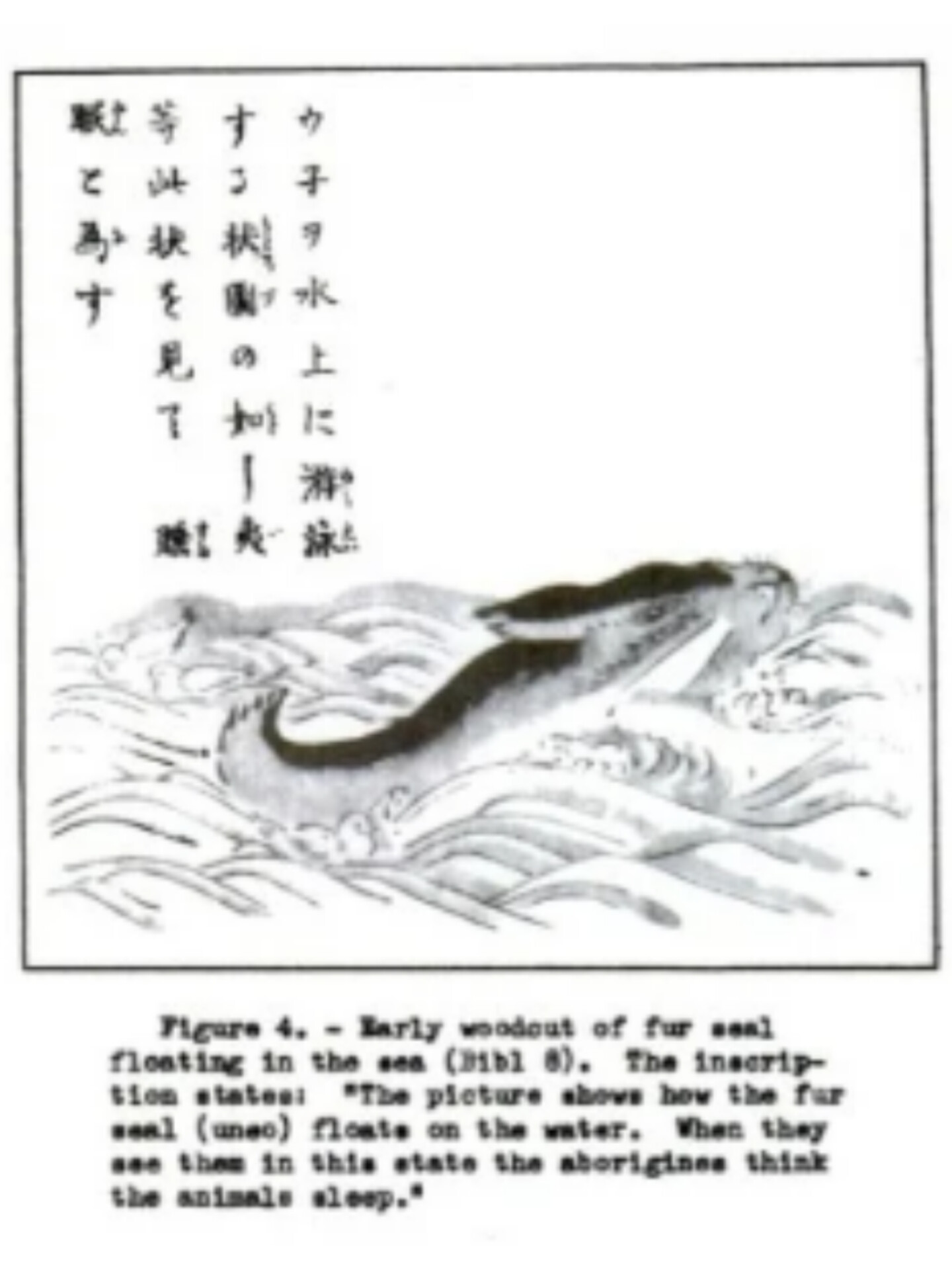
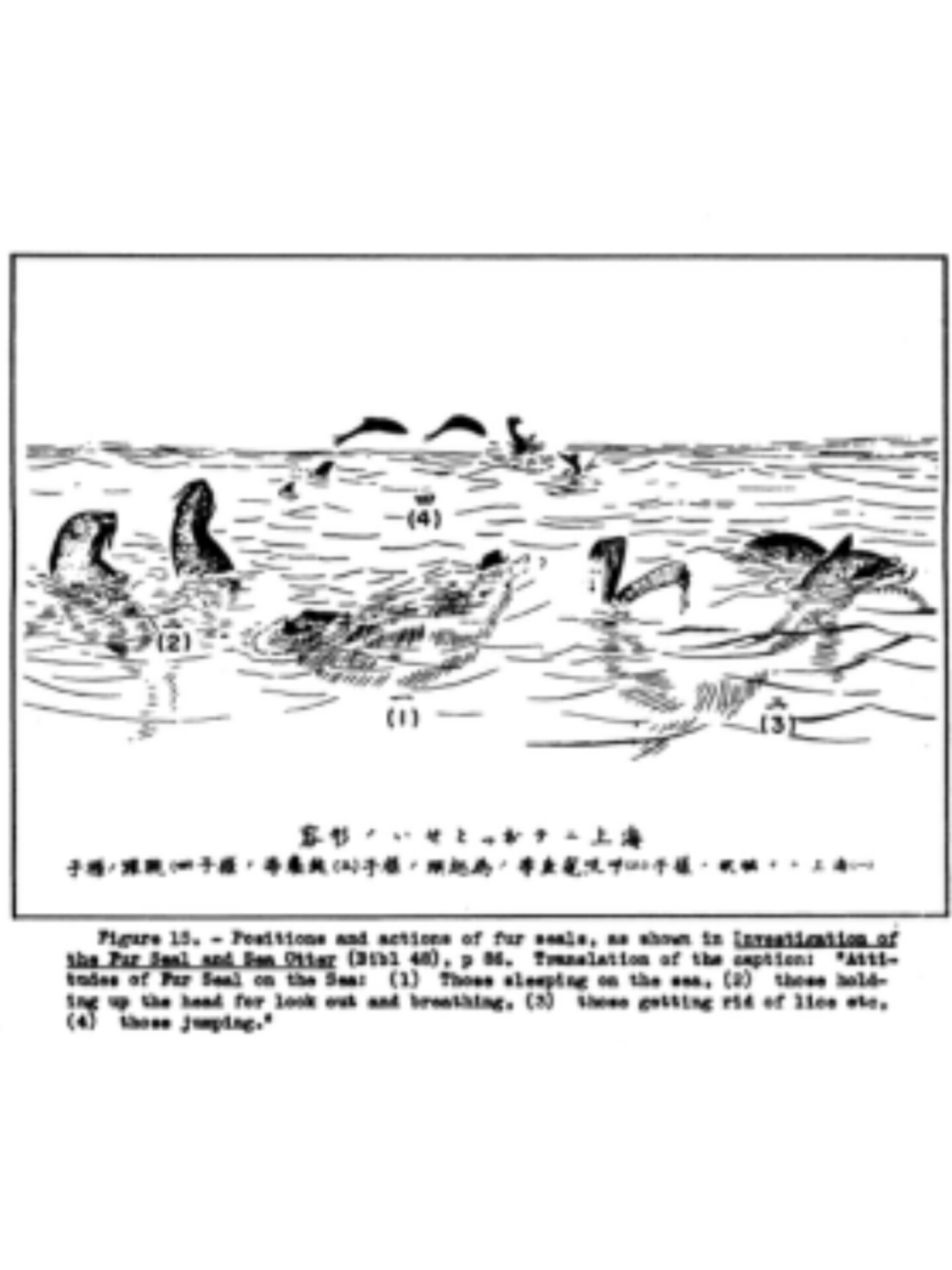
Pelagic sealing is so difficult in rough weather that if the day is certain to be windy the ships usually remain in port. In addition to the physical discomfort of bouncing around on a 20-ton craft, shooting from the bow platform is almost impossible in heavy seas. Likewise, surface visibility is so limited in choppy waters that it is difficult to find the seals or to follow them when found. On calm days, however, the seals frequently sleep quietly on the surface, and on an oily, slick sea are visible at some distance, especially when they hold up their hind-flippers with their mitten-like digits or turn on their sides and raise a blade-shaped fore-flipper straight upward, which they often do. A seal sleeping with flippers folded has been described aptly as resembling a short charred log drifting on the sea….
In the old days of hand-propelled hunting boats, sleeping seals were easily stalked and shot or harpooned before they waked, but a tsukimbo-sen seldom gets within shooting range without rousing them. The throbbing of the noisy engines disturbs them at some distance, even when approached from leeward. They usually appear confused at first as to the source of the noise and raise their heads to look around the horizon in search of it. As soon as the intruder is located the animal dives and flees in the opposite direction. When pressed the seals may swim 50 to 100 yards under water, appearing only for an instant on the surface to snatch a breath, often making little more than a swirl in the water. Or they may progress in a series of rapid, looping, porpoise-like dives, with the entire body clearing the water. Usually they flee straight away or at a tangent, but occasionally one doubles back, diving under the vessel and reappearing astern. As a seal’s top speed of seven to eight knots can be maintained for only a short time, the tsukimbo-sen have little trouble in running them down. When the sea is When the sea is smooth the seals can be On calm, sunny days they can often be seen swimming under water when close to the ship. Under such conditions a high percentage of the animals sighted and pursued are taken.
Most seals are killed at ranges of from 25 to 50 yards. They breach so rapidly when trying to escape that the head is submerged before the shot can be fired, and most of them are struck in the body. Experienced hunters claim less than one percent of the seals killed will sink before they can be recovered, especially in the autumn, winter, and early spring. In late spring the animals are more likely to sink, particularly gravid females heavy with young. During the 10 days of collecting operations in March 1949, one badly shot female was the only wounded animal to escape. The other 22 animals hit all were killed outright, and all floated with the back uppermost and little more than awash until retrieved. A wounded seal can be detected at once by the blood stains in the water immediately following the shot. They usually die easily and quickly when hit, and float to the surface. They then are retrieved as speedily as possible with a four-pronged gaff on a 12-foot bamboo pole, with which the seal is hooked in the flipper to avoid making unnecessary tears in the skin.
In the old days of pelagic sealing the catch had to be skinned at sea. The valuable hides were packed in salt, and the rest of the carcasses were dumped overboard. This wastefulness has been eliminated by the tsukimbo-sen, which always bring their catch ashore for processing where the entire animal can be utilized. The meat is sold for human food, the blubber yields oil, and the bones and entrails make fertilizer.
2. Present-Day Poaching:
Early in the course of Natural Resources Section field investigations it became apparent that pelagic sealing in Japan had by no means ceased despite the Occupation orders forbidding it. Frequently tsukimbo-sen were observed operating in waters where porpoises were scarce but fur seals relatively abundant. On the morning of 18 March 1949 for instance, several porpoise vessels were observed maneuvering actively on the horizon, their movements duplicating those of the research vessel which was hunting fur seals (11 seals were taken from 0800 to 1200 on that day). Overhauling these vessels to inspect their catches was not feasible at the time, but it is extremely unlikely that they were hunting porpoises.
Also most suggestive are the many articles made of fur seal fur offered for sale by Japanese stores in the cities and large coastal towns of northeastern Honshu and Hokkaido. These articles range from fur collars, caps, and vests to briefcases, boot tops, thongs for wooden clogs, and sundry other small items. Such articles are seen in quantity only in the towns near the coasts where fur seals winter, practically never elsewhere, and all the fur of which they are made retains the long guard hairs which would have been removed in large-scale tanning operations. No records exist of any carryover of seal skins taken legally on Robben Island, or by lawful pelagic sealing prior to the Occupation. The only conclusion that can be reached is that this is a local business, with the articles being made in the vicinity from skins locally and currently procured.
In April 1949 the Supreme Commander for the Allied Powers informed the Bureau of Fisheries of these suspicions of continued fur seal poaching and requested that investigative and corrective action be taken immediately. The Bureau previously had instructed both the Maritime Safety Board (in charge of law enforcement in coastal waters) and the prefectural governors concerned that the killing of fur seals was prohibited, and had requested them to take necessary action through the local police to prevent it. However, apparently no such action had been taken, so the Bureau of Fisheries assigned one of its own research vessels to patrol duties in the sealing waters during 2 May-15 June 1949. As anticipated, this vessel found poaching to be common off the coasts of Miyagi, Iwate, and Aomori prefectures, and two arrests were made, both at Kamaishi in Miyagi Prefecture on 17 May. The 11-ton porpoise vessel Benten Maru was found landing the skins and meat of six fur seals wrapped in straw matting, and the owner and captain of the 9-ton Tomo Maru was found in possession of four fur seals.
As nearly as can be determined the tsukimbo-sen now do not make an exclusive practice of pelagic sealing such as flourished before the surrender, but they do not hesitate to take those fur seals they encounter while hunting porpoises. How many seals are still being killed cannot be estimated exactly, but the total must be considerable. With the gradual economic recovery of Japan since the surrender, more and more porpoise vessels are being put back into commission. Today one or more tsukimbo-sen are based in almost every harbor between Choshi in Honshu and Muroran in Hokkaido, and the number of vessels is believed almost to have reached its prewar level of about 300. Judging from the number of boats, from their probable average unit catches, and from the amount of seal fur observed in the local markets, a reasonable guess places the total 1948-1949 season’s kill at between 2,000 and 3,000 seals.
Unrestricted sealing by the porpoise vessels the Japanese now have available could exhaust the Asiatic seal resources in a few years. This report already has shown what happened back in the 1890’s, and the modern techniques are much more effective than the old. Today a tsukimbo-sen would not find it difficult to take 200 seals in a season, and 250 such vessels might, theoretically at least, take 50,000 seals annually while the supply lasts. Such a drain would be immediately disastrous to the Robben and Commander Island herds now under Russian jurisdiction. Its effect on the Pribilof herds probably would not be too serious as long as the operations remained within the present authorized fishing area, which is visited by only a small percentage of the Pribilof seals. But this area eventually may be expanded, and the stage would then be set for sealing history to repeat itself unless Japanese pelagic sealing is curbed.
It is doubtful if Occupation officials ever can suppress the current poaching entirely, except by such drastic measures as curtailing all fishing operations in the sealing waters, which would be neither feasible nor economically desirable. The area is too large to be patrolled adequately except at enormous expense. The only other possible immediate remedy, that of eliminating the profits from sealing by confiscating all fur seal products in the markets, is equally impractical because the market is so widely dissipated. Even if trained personnel were available for surveillance and enforcement, prosecution would be difficult, and the probable results would be only to drive the business further underground.
However, the Japanese themselves are capable of stopping the practice, as they demonstrated back in the halcyon days of the treaty, from 1911 to 1917. But the problem is more than one of enforcement alone. Enforcing laws with which people are not in sympathy is very difficult to do, as the United States learned during Prohibition. By and large the Japanese are a law-abiding people, particularly in their home islands, but they are as yet far from convinced of the desirability or the necessity of stopping pelagic sealing. They see nothing basically immoral in the practice, and from their individual, local viewpoint they have every possible economic reason to continue it at present. The solution will require educational measures as much as political and supervisional ones.
Surveillance during the remainder of the Occupation, to the fullest extent possible, will keep unlawful pelagic sealing at a minimum. But the practice will never be stamped out until the Japanese themselves are convinced that such action is economically as well as politically desirable. Even then it can be done only by the full cooperation of all those concerned — fishermen, government officials, police, and the buying public as well.
Oliver L. Austin, Jr. and Ford Wilke, Japanese Fur Sealing, Special Scientific Report – Wildlife, No. 6 (reprint; Washington, DC: U.S. Department of the Interior, Fish and Wildlife Service, 1950); 6-8, 14-32, and 40-46. N.B.: Some footnotes have been deleted.
This report was prepared by Dr Oliver L. Austin Jr, head, Wildlife Branch, Fisheries Division, and Mr Ford Wilke, on temporary assignment to Natural Resources Section from the Fish and Wildlife Service, Department of the Interior. Translations and summaries of all Japanese material were furnished by Messrs Nagahisa Kuroda, Shoju Kurozawa, and Taizo Hasegawa of the Wildlife Branch staff.
See: https://babel.hathitrust.org/cgi/pt?id=mdp.39015077581117&seq=1