India
We want you to have a greater ability to learn about some of the unpleasant animal issues in our world.
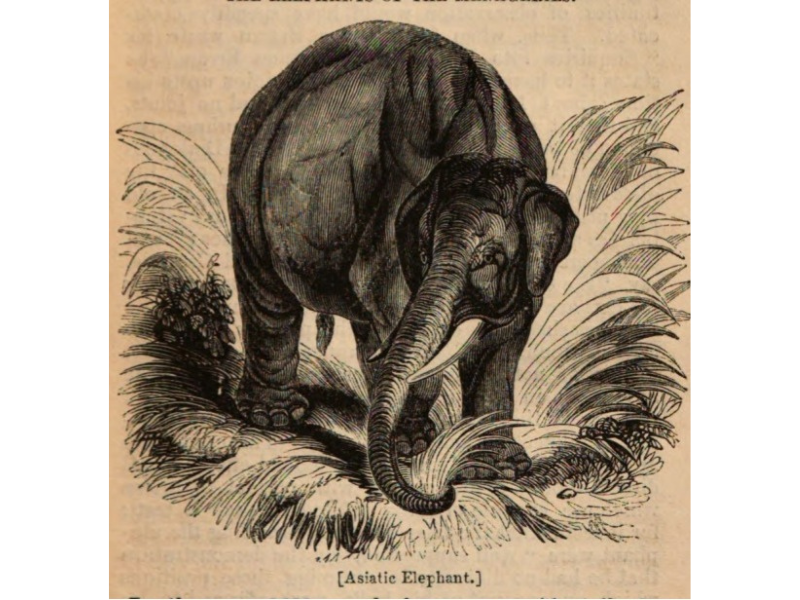
The Elephant:
Principally Viewed in Relation to Man
Charles Knight
CHAPTER IV.
THE INDIAN ELEPHANT — FERTILITY IN A STATE OF CONFINEMENT —
GROWTH — MODES OF TAKING WILD ELEPHANTS IN ASIA.
…The young elephants which are reared in our Indian settlements are principally produced by the females that are taken wild at the time they are in calf. It does not appear that there is any difficulty in the education of these little ones, who are accustomed to a domestic state from their birth; but that they are gradually accustomed to bear burthens, and to become obedient to the commands of their keepers. In the kingdom of Ava, where the female elephants belonging to the king are in a state of half wildness, there is considerable trouble in reducing the young ones to submission. Mr. Crawfurd, who was the British envoy to the court of Ava in 1827, has given an account of this curious operation: —
“The young male elephants are weaned at three years old, that is to say, they are then separated from their dams, and broken in, — a process which appears to be nearly as tedious and difficult as that of breaking in a full-grown elephant taken in the forest. A singular ceremony was performed before this process commenced, which deserves mention: — it consisted of an invocation to the Nat Udin-main-so, the genius of elephant-hunting. Between the walls of the town and an artificial mount planted with trees, and raised upon a ledge of rocks, jetting into the Irawadi, there is a small elephant paddock, consisting of a single square palisade having no gates. The king sat under a little pavillion on the side of the mount, and directed in person the ceremony to which I allude. A banana tree had been planted in the middle of the paddock, which was removed with great ceremony; and on the spot where it stood, five elderly persons came forward, with a solemn strut and dance, holding in their hands branches of a species of eugenia or jambu, and carrying offerings of rice and sweetmeats to the Nat. I could not learn the exact words of the incantation; but the substance of it was, that the demi-god was informed that a glorious prince, the descendant of great kings, presided at the present ceremony; that he, the demi-god, therefore, was requested to be propitious to it, to get the elephants quietly into the pen, and generally to lend his aid throughout the whole ceremony.
“About two-and-thirty female elephants, with their young included, were now driven into the inclosure: they were shortly followed by four male elephants, the riders of which had long ropes, with a noose at the end, in their hands. After many unsuccessful efforts, they succeeded at last in entangling the young elephant that was to be weaned, by the hind leg. This was a matter of great difficulty, for he was protected by the adroitness of the herd of female elephants which crowded round him for the purpose. When taken, he was a great deal more outrageous and obstreperous than the wild elephant caught yesterday. The large mounted elephants had to beat him frequently; and I observed, once or twice, that they raised him quite off the ground with their tusks, without doing him any material injury. The cry which he emitted on these occasions differed in no way but in degree from the squeak of a hog that is in pain or fear. He was ultimately confined in a small pen beyond one of the doors of the paddock, where two of the male elephants continued to watch him. He was still very outrageous, and making violent efforts to extricate himself, but all to little purpose.”
The various modes of capturing wild elephants in India have undergone little variation for several centuries; and they are, more or less, practised in all parts of Asia where elephants are still required to maintain the splendour of Oriental luxury, — to assist in the pomp and administer to the pride of despotic monarchs; or, as is the case in our own Eastern establishments, to bear the heavy equipage of an Indian camp, or to labour in the peaceful occupations of transporting those articles of commerce, which are far too weighty to be moved by the power of the horse or the camel.
As civilization has advanced in India, the supply of wild elephants has necessarily diminished. In the time of Baber the herds were described as inhabiting “the district of Kalpi; and the higher you advance from these towards the east, the more do the wild elephants increase in number. That is the tract in which the elephant is chiefly taken. There may be thirty or forty villages in Karrah and Manikpûr that are occupied solely in this employment of taking elephants.”
The learned translators of these memoirs, Dr. Leyden and Mr. Erskine, say, in a note to this passage, “the improvement of Hindustan since Baber’s time must be prodigious. The wild elephant is now confined to the forests under Hemlâa, and to the Ghats of Malabar. A wild elephant near Karrah (Currah), Manikpûr, or Kalpi, is a thing, at the present day, totally unknown. May not their familiar existence in these countries, down to Baber’s days, be considered as rather hostile to the accounts given of the superabundant population of Hindustan in remote times?” In another passage Baber says, ” in the jungle round Chûnar there are many elephants;” — and the translators add, “no wild elephants are ever found now in that quarter, or nearer than the hills.”
As we have before stated, the herds of wild elephants must be chiefly sought for in a depopulated country. Marco Polo, speaking of the plain at the foot of the Yun-nan mountains, in China, says, “The journey” (to the city of Mien, towards the confines of India) “occupies fifteen days, through a country much depopulated, and forests abounding with elephants, rhinoceroses, and other wild beasts, where there is not the appearance of any habitation.” Thus, in the early part of the Mogul sway in India, when a dense population was collected round the courts of the native despots, while immense districts were almost exclusively possessed by the elephants, the numbers which were taken to be employed in war, or to swell the cumbrous pomp of such conquerors as Kublai Khan, and Timour, were almost incredible.
Purchas says, “William Clarke, which served the Mogul divers years in his wars, saith that he hath seen in one army twenty thousand elephants, whereof four thousand for war; the rest females for burthens, young, &c” Captain Hawkins, who was at Agra in 1607, says that Jehanghir had twelve thousand elephants. The Emperor Akbar daily gave presents of elephants. These accounts, however exaggerated they may seem, at least show that immense quantities of wild elephants must have been taken throughout India to maintain these enormous establishments.
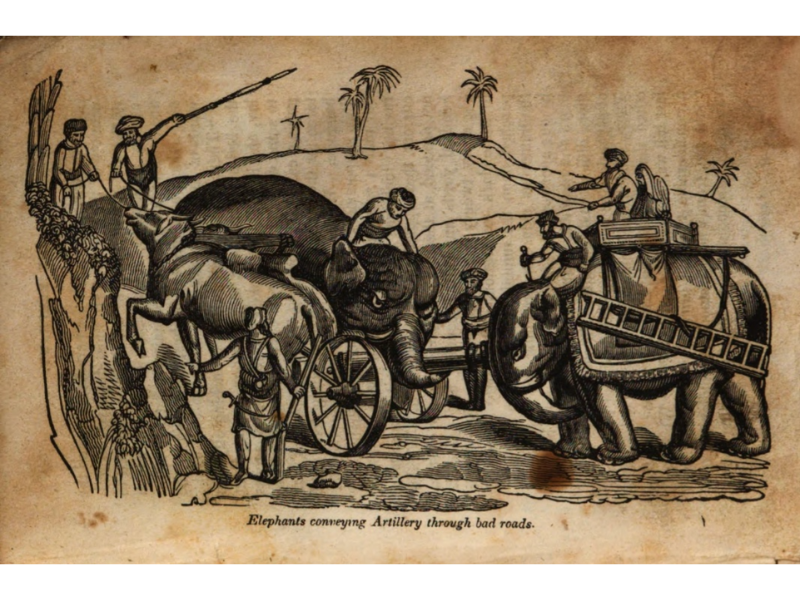
The introduction of fire-arms into warfare has rendered the elephant useless to an army, except for transporting heavy burthens; and the subjection of the most powerful of the native princes to the British dominion has overthrown much of that magnificent display in which the elephant performed so stately a part. The change, however, was not sudden, nor is it complete. The employment of the elephant is gradually ceasing, as the Oriental dynasties one by one fall before European skill, and as the manners of their courts, retaining little of the show and less of the substance of power, have yielded to the simpler forms of European authority. But even as recently as 1794 the Nabob of Oude went upon a hunting expedition with a thousand elephants; — and in our own days the glory of the Burman empire is as inseparably connected with the possession of the “white elephant,” and its pomp as much displayed in elephant-fights and elephant-processions, as it was before the period when a handful of merchants established themselves upon the coasts of India, destined in little more than a century to overthrow the greater number of the native dynasties, by bringing the compact and ever-active power of the highest civilization into conflict with the scattered and inert force of semi-barbarous tyrannies, unchanging because uninstructed, oppressed by their own weight, and feeble through their own disunion.
When we consider the enormous strength of the elephant, which enables him to break through through all ordinary means of confinement, and at the same time regard not only his ability to resist any violent attack, but his sagacity to elude any common stratagem, it must be evident that the business of his capture must be a task requiring equal courage and activity, — great skill and presence of mind in the individuals engaged in it, and, when conducted upon a large scale, a combination of human force such as is seldom used except in the more prodigal game of war. A description, therefore, of the various modes in which this powerful animal is subjected to man must necessarily embrace many interesting details connected with the economy of the quadruped; and at the same time exhibit many traits of ingenuity and perseverance, as remarkable as any which are shown by the human mind in other extraordinary situations.
Pliny, describing the manner of capturing elephants in India, says, “The hunter mounts on an elephant already tamed; — and when he meets with a wild one separated from the herd, he pursues it, and strikes it until it is so exhausted that he is able to leap from the one to the other, and thus to reduce the wild animal to obedience.” This process is as summary as that which the Roman naturalist also notices as the practice of the Troglodytes, whom Diodorus Siculus by an expressive epithet describes as warring against the elephants. These are said to suspend themselves on the branches of trees under which the wild herd passes, and, slipping down over the crupper of a particular animal, to seize his tail with the one hand and hamstring him with the other.
Although the elephant is destroyed by an experienced African marksman with much more precision than by this process of cutting his hams, he is certainly not reduced to obedience so quickly by the Indian hunters of the present day, as by those whom Pliny has described as bringing him into captivity. But the operation, however slow, is at least effective; and the discipline does not require a constant repetition, as there is no doubt that the mere process of beating must have required, even if it could have been performed without danger.
The various modes which are employed in India, and the adjacent islands, for keeping up the supply of elephants for domestic use, are much more complicated than the Roman naturalist appears to have thought necessary; and these modes are followed up by a steady application of mild coercion, which at length effectually converts the unwieldy force of the huge quadruped into a machine, nearly as precise and obedient as one of those many ingenious inventions of modern times which have so greatly dispensed with the irregular movements of animal power.
The rudest mode of taking the elephant is by digging a pit in his native forests, which is covered over with loose boards and the boughs and grass upon which he feeds. This is mentioned as the custom of Ceylon a century ago; — and the Sieur Brue describes this as the mode of taking the elephant, for his flesh, by the Africans of Senegal. Mr. Williamson states that in places where the natives find the elephants destructive neighbours, they dig a pit, covered with a slight platform of branches and grass, towards which the herd is seduced by a tame elephant, when the leading pursuer is precipitated into the trap, and the remainder retire in great alarm. This practice is evidently not very successful; and we apprehend that the instinctive caution of the elephant not to tread upon any insecure ground must render it unavailing, except when his natural prudence gives way to the more powerful impulses of terror or desire.
“The mode of getting elephants out of pits,” according to Mr. Williamson, “is somewhat curious, but extremely simple. The animal is for the most part retained until sufficiently tractable to be conducted forth; when large bundles of jungle-grass tied up into sheaves being thrown to him, he is gradually brought to the surface, at least to such an elevation as may enable him to step out.” The elephant will do the same if he is swamped in boggy ground, thrusting the bundles of grass and straw into the yielding earth with his heavy feet, and placing them so around him with his trunk that he at last obtains a firm footing….
However unfrequent may be such instances of intelligent compassion amongst elephants, it is undoubted that the sagacity of the animal enables him to perceive that he may escape from the perilous confinement of a deep pit, if he is supplied with the means of raising his enormous body nearly to the surface of the ground. A very curious anecdote, which not only illustrates this instinctive knowledge, but exemplifies the general exercise of the mental power of the “half-reasoning” animal, is given in a recent work on zoology. A very curious anecdote, which not only illustrates this instinctive knowledge, but exemplifies the general exercise of the mental power of the “half-reasoning” animal, is given in a recent work on zoology.
“At the siege of Bhurtpore, in the year 1805, an affair occurred between two elephants, which displays at once the character and mental capability, the passions, cunning, and resources of these curious animals. The British army, with its countless host of followers and attendants, and thousands of cattle, had been for a long time before the city, when, on the approach of the hot season and of the dry hot winds, the supply of water in the neighbourhood of the camps necessary for the supply of so many beings began to fail; the ponds or tanks had dried up, and no more water was left than the immense wells of the country would furnish. The multitude of men and cattle that were unceasingly at the wells, particularly the largest, occasioned no little struggle for the priority in procuring the supply for which each were there to seek, and the consequent confusion on the spot was frequently very considerable.
On one occasion, two elephant-drivers, each with his elephant, the one remarkably large and strong, and the other comparatively small and weak, were at the well together; the small elephant had been provided by his master with a bucket for the occasion, which he carried at the end of his proboscis; but the larger animal, being destitute of this necessary vessel, either spontaneously or by desire of his keeper, seized the bucket, and easily wrested it away from his less powerful fellow-servant: the latter was too sensible of his inferiority openly to resent the insult, though it is obvious that he felt it; but great squabbling and abuse ensued between the keepers. At length, the weaker animal, watching the opportunity when the other was standing with his side to the well, retired backwards a few paces in a very quiet unsuspicious manner, and then rushing forward with all his might, drove his head against the side of the other, and fairly pushed him into the well.
“It may easily be imagined that great inconvenience was immediately experienced, and serious apprehensions quickly followed, that the water in the well, on which the existence of so many seemed in a great measure to depend, would be spoiled, or at least injured, by the unwieldy brute which was precipitated into it; and as the surface of the water was nearly twenty feet below the common level, there did not appear to be any means that could be adopted to get the animal out by main force, at least without injuring him: there were many feet of water below the elephant, who floated with ease on its surface, and experiencing considerable pleasure from his cool retreat, evinced but little inclination even to exert what means he might possess in himself of escape.
“A vast number of fascines had been employed by the army in conducting the siege, and at length it occurred to the elephant-keeper that a sufficient number of these (which may be compared to bundles of wood) might be lowered into the well to make a pile, which might be raised to the top, if the animal could be instructed as to the necessary means of laying them in regular succession under his feet. Permission having been obtained from the engineer-officers to use the fascines, which were at the time put away in several piles of very considerable height, the keeper had to teach the elephant the lesson, which, by means of that extraordinary ascendancy these men attain over the elephants, joined with the intel-lectual resources of the animal itself, he was soon enabled to do, and the elephant began quickly to place each fascine, as it was lowered to him, successively under him, until in a little time he was enabled to stand upon them; by this time, however, the cunning brute, enjoying the pleasure of his situation, after the heat and partial privation of water to which he had been lately exposed (they are observed in their natural state to frequent rivers, and to swim very often), was unwilling to work any longer, and all the threats of his keeper could not induce him to place another fascine.
The man then opposed cunning to cunning, and began to caress and praise the elephant, and what he could not effect by threats he was enabled to do by the repeated promise of plenty of rack. Incited by this the animal again went to work, raised himself considerably higher, until, by a partial removal of the masonry round the top of the well, he was enabled to step out: the whole affair occupied about fourteen hours.”
In Nepaul, and in the countries bordering on the northern frontiers of India, where the elephants are of a small size, they are often captured by the natives with a phaun, or slip-knot. This practice has some analogy with the custom of taking horses with the lasso, in the Pampas. The hunter, seated on a docile elephant, round whose body the cord is fastened, singles out one from the wild herd; and, cautiously approaching, throws his pliable rope in such a manner that it rests behind the ears and over the brows of the animal pursued. He instinctively curls up his trunk, making an effort to remove the rope; which, with great adroitness on the part of the hunter, is then passed forward over the neck.
Another hunter next comes up, who repeats the process; and thus the creature is held by the two tame elephants, to whom the phauns are attached, till his strength is exhausted. It would appear quite impossible to take a large elephant in this manner; although, with those of a peculiarly small breed, the operation does not appear more difficult than that of securing the wild horse or the buffalo in the plains of South America.
It is remarkable that, in every mode of capturing the wild elephant, man avails himself of the docility of individuals of the same species, which he has already subdued. Birds may be taught to assist in ensnaring other birds; but this is simply an effect of habit. The elephant, on the contrary, has an evident desire to join its master in subduing its own race; and, in this treachery to its kind, exercises so much ingenuity, courage, and perseverance, that we cannot find a parallel instance of complete subjection to the will of him to whom it was given to “have dominion over the fish of the sea, and over the fowl of the air, and over every living thing that moveth upon the earth.”
From some peculiar circumstances, which have not been accurately explained, large male elephants are sometimes found apart from the herd. Sir Stamford Raffles says, speaking of the elephants that he met with in his journey through the southern Presidencies to Passumah, “The natives fancy that there are two kinds of elephants —the gaja berkampong, those which always go in herds, and which are seldom mischievous, and the gaja salunggal, or single elephants, which are much larger and ferocious, going about either singly or only two or three in company. It is probable the latter kind are only the full-grown males.” They probably, in many cases, separate themselves from their companions in search of fresh pastures. But as they are sometimes found in a state of considerable irritation, doing much mischief wherever they pass, it has been thought that these have been driven away by the stronger males, and that they are suffering all the agonies of unavailing jealousy.
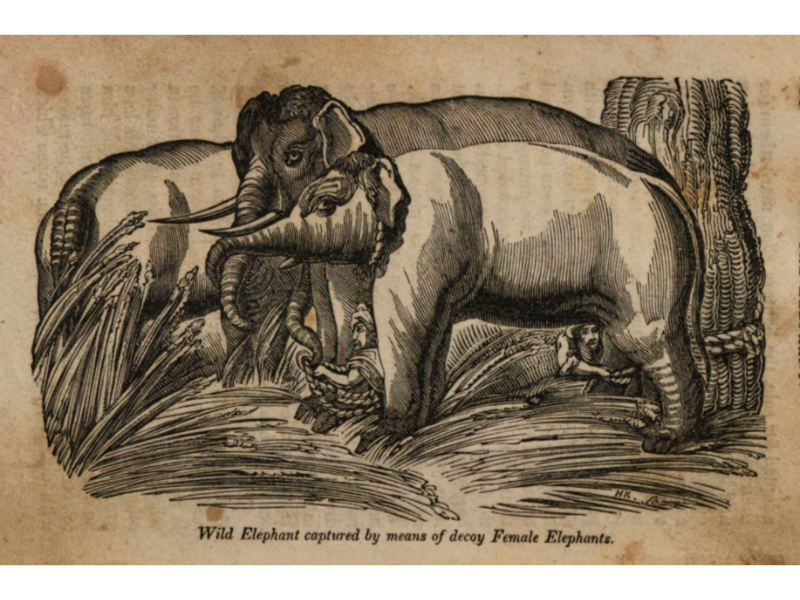
Being the finest elephants, and therefore the best adapted for sale, the hunters soon mark them for their own. They follow them cautiously, by day and by night, with two, and sometimes four, trained females, called hoomkies. If it be dark, they can hear the animal striking his food, to clean it, against his fore-legs, and they then approach tolerably close; if light, they advance more cautiously. The females gradually move towards him, apparently unconscious of his presence, grazing with great complacency, as if they were, like him, inhabitants of the wild forest. It is soon perceived by them whether he is likely to be entrapped by their arts.
The drivers remain concealed at a little distance, while the hoomkies press round the unhappy goondah, or saun (for so this sort of elephant is called). If he abandon himself to the caresses of his new companions, his capture is almost certain. The hunters cautiously creep under him, and during the intoxication of his pleasure fasten his fore-legs with a strong rope. It is said that the wily females will not only divert his attention from their mohouts, but absolutely assist them in fastening the cords. Mr. Howitt made a spirited drawing of this curious scene, from the descriptions of Captain Williamson.
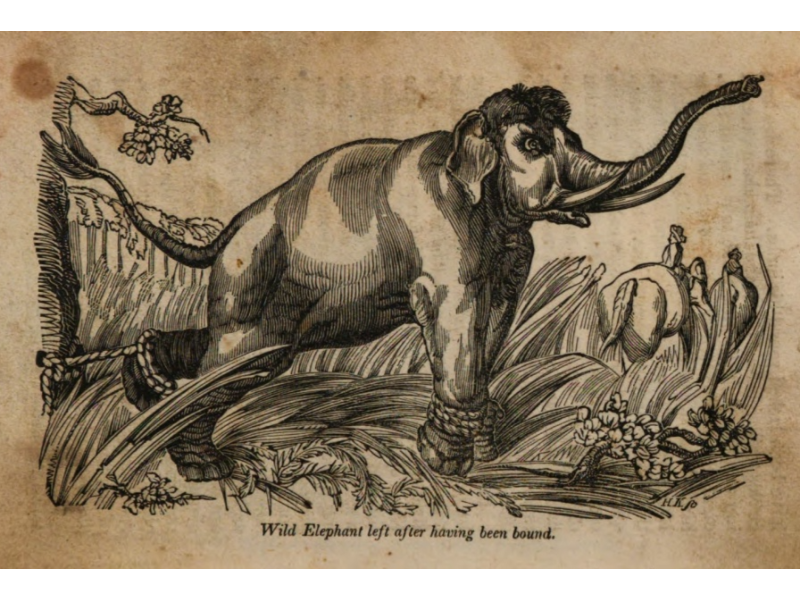
The hind-legs of the captive being secured in a similar manner, the hunters leave him to himself, and retire to a short distance. In some cases he is fastened at once to a large tree, if the situation in which he is first entrapped allows this. But under other circumstances, in the first instance his legs are only tied together. When the females quit him he discovers his ignominious condition, and attempts to retreat to the covert of the forest; but he moves with difficulty, in consequence of the ropes which have been lashed round his limbs. There are long cables trailing behind him; and the mohouts, watching an opportunity, secure these to a tree of sufficient strength. He now becomes furious, throwing himself down, and thrusting his tusks into the earth. If he break the cables and escape into the forest, the hunters dare not pursue him; but if he is adequately bound, he soon becomes exhausted with his own rage. He is then left to the further operation of hunger, till he is sufficiently subdued to be conducted, under the escort of his treacherous friends, to an appointed station, to which, after a few months’ discipline, he becomes reconciled.
In the kingdom of Ava all the elephants are caught by decoy females, though the process is somewhat different from that practised by the hoomkies of British India. Mr. Crawfurd informs us that the king of Ava “is possessed, in all, of about one thousand elephants, divided into two classes: those which are thoroughly broken in and tamed, consisting principally of males; and those that are employed as decoys, all females, and in a half-wild state.”
These decoys are generally kept in the neighbourhood of forests frequented by elephants: and when the herd is joined by a wild male they are all driven into the capital, to a place called the elephant palace, “appropriated for exhibiting, for the king’s diversion, the taming of the wild male elephant. This place is a square inclosure, surrounded everywhere by a double palisade, composed of immense beams of teak-timber, each equal in diameter to the main-mast of a four-hundred-ton ship. Between the palisades there is a stone wall, about fourteen feet high and twenty thick. On the top of this the spectators are seated to view the sport….. The inclosure has two entrances, the gates of which are composed of beams, which can be moved at the bottom by means of ropes.” We shall extract Mr. Crawfurd’s amusing description of the scene which took place in this inclosure: —
“A cloud of dust announced the approach of the elephants, about twenty in number; these, with the exception of the captive, were all females, several of them with their young following them. A few of the best broken-in only were mounted. Partly by persuasion, and partly by force, these were seen driving before them a small male elephant, not (as we were told) above thirteen years old: it required at least half an hour to induce him to enter the gate of the inclosure. A very docile female elephant led the way, conducted by her keeper; but the half-tamed females were nearly as reluctant to enter as the wild male himself; they went five or six times half-way in before they were finally entrapped; and, twice over, the male had run off to the distance of a quarter of a mile from the inclosure, but was again brought back by the females.
“The elephants having entered, we were requested to come into the king’s presence, in which situation we should have a better view of the sport. We walked round accordingly by the southern and eastern angles of the inclosure, and seats were assigned to us in the same line with and next to the princes; not only the most distinguished, but the most convenient situation. We made a bow, as before, and the sport went on. From the smallness of the elephant, there was neither much danger nor amusement in it. The females were withdrawn from the inclosure, one by one; and then the elephant-catchers, who are a distinct race, went into the square unarmed, and provoked the wild elephant to pursue them, which he did with great fury. The keepers took shelter from his pursuit within the palisade, through the apertures of which he lashed his trunk in vain. The elephant-keepers exhibited much boldness and agility; but, from what we saw, I should conceive that they ran very little risk.
Accidents, however, sometimes occur. A few years ago, one of the hunters, when pursued by the elephant, tripped and fell; he was killed on the spot by the enraged animal. The king, who was present when this happened, immediately retired, the sight of blood not being fit for him to behold, either as a sovereign or a votary of Gautama.
“Some goats were put into the square, and these were pursued by the elephant in the same way as the keepers, and with as little effect. These animals eluded his pursuit with the utmost ease; and were so little concerned at his presence that they soon began to quarrel amongst themselves. When the elephant was sufficient tired, three huge tame male elephants were brought in to secure him, each mounted by his keeper, who had in his hand a rope with a noose, which one of them, after the second or third effort, succeeded in casting round the fore-leg.
The animal made comparatively very little resistance, appearing to be quite subdued by the presence of his three powerful antagonists, who, after the noose was fixed, drove him by main force into a pen at the south side of the inclosure, from which he was afterwards withdrawn, and tied to a post by a comparatively slender rope put round his neck, through his mouth, and round his tusks. We saw him in this situation, under a shed, as we were returning home, very restless and sullen. He was so closely tied to the post that he could scarcely move, and had no power to do any mischief. We were told by the keepers, that the male elephants, when thus secured, refuse food for about five days. It takes six or seven months to tame them effectually, and occasionally as much as a whole year, for their dispositions are various.
“Knox’s account of the mode of taking elephants in Ceylon presents a great similarity to Mr. Crawfurd’s narrative of the practice in Ava. He says, “Though there be many in the woods, yet but few have teeth, and they males only. Unto these they drive some she elephants, which they bring with them for the purpose; which when once the males have got a sight of they will never leave, but follow them wheresoever they go; and the females are so used to it that they will do whatsoever is wished, either by a word or a beck, their keepers bid them: and so they delude them along through towns and countries, through the streets of the city, even to the very gates of the king’s palace; where sometimes they seize upon them by snares, and sometimes by driving them into a kind of pound they catch them.” But the present mode of catching elephants in Ceylon is upon a large scale, such as is practised in Bengal, and consists in driving whole herds of these animals into a vast inclosure, called in Hindostan a heddah.
In ancient times, according to Pliny, elephants were chased by horsemen into a narrow defile, of which one end was closed up, and here they were detained till they were subdued by hunger. The present practice of the East has been pursued, with little variation, for many centuries.
Arrian gives a minute account of the mode of taking wild elephants in his own time. The natives, he says, dig a deep ditch round a large open space, into which the herd passes over a bridge. Their escape is then prevented by the removal of the bridge; they are here kept till they are sufficiently starved and exhausted, when they are captured by tame elephants. Fourteen hundred years after, the sultan Akbar, on his return to his capital (Agra) from the kingdom of Chandez in the Deccan, “upon the way, near the village of Sipiri, fell in with a great herd of wild elephants. He ordered his cavalry to surround them, and he drove them, with great difficulty, into a fold constructed for that purpose: one of the male elephants, of a prodigious size, finding himself confined, strode over the ditch, bore down the wall and the palisadoes [sic] before him, and made his way into the plain. Three trained elephants were sent after him: he stood to fight, and before they could overcome and take him, he afforded very great diversion to the king, who was remarkably fond of the boisterous contention of those enormous animals.”
The large elephant-hunts of modern times are systematically carried on by the government; and the whole operation is conducted upon a scale of splendour which leaves all other hunting, even that of the bear in Sweden, at an immeasurable distance.
The magnificent scene of a great elephant hunt, where many thousand people are assembled to drive a herd of these superb animals, for miles, with the clang of drums and trumpets, and the din of fireworks and musketry, is depicted by Mr. Corse with great felicity: —
“When a herd is discovered, about three hundred people are employed to surround it, who divide themselves into small parties, consisting generally of three men each, at the distance of twenty or thirty yards from each other, and form an irregular circle, in which the elephants are inclosed; each party lights a fire and clears a foot-path to the station that is next him, by which a regular communication is soon formed through the whole circumference from one to the other. By this path reinforcements can immediately be brought to any place where an alarm is given; and it is also necessary for the superintendents, who are always going round to see that the people are alert upon their posts.
“The first circle being thus formed, the remaining part of the day and night is spent in keeping watch by turns, or in cooking for themselves and companions. Early next morning one man is detached from each station to form another circle in that direction where they wish the elephants to advance. When it is finished, the people stationed nearest to the new circle put out their fires, and file off to the right and left, to form the advanced party; thus leaving an opening for the herd to advance through, and by this movement both the old and new circle are joined, and form an oblong. The people from behind now begin shouting, and making a noise with their rattles, drums, &c., to cause the.elephants to advance; and, as soon as they are got within the new circle, the people close up, take their proper stations, and pass the remaining part of the day and night as before. In the morning the same process is repeated, and in this manner the herd advances slowly in that direction where they find themselves least incommoded by the noise and clamour of the hunters, feeding, as they go along, upon branches of trees, &c.
“If they suspected any snare, they could easily break through the circle; but this inoffensive animal, going merely in quest of food, and not seeing any of the people who surround him, and who are concealed by the thick jungle, advances without suspicion, and appears only to avoid being pestered by their noise. As fire is the thing elephants seem most afraid of in their wild state, and will seldom venture near it, the hunters always have a number of fires lighted, and particularly at night, to prevent the elephants coming too near, as well as to cook their victuals and to keep them warm.
The sentinels supply these fires with fuel, especially green bamboos, which are generally at hand, and which, by the crackling and loud report they make, together with the noise of the watchmen, deter the elephants from coming near; so that the herd generally remains at a distance, near the centre of the circle. Should they at any time advance, the alarm is given, and all the people immediately make a noise and use their rattles, to make them keep at a greater distance. In this manner they are gradually brought to the heddah, or place where they are to be secured.”
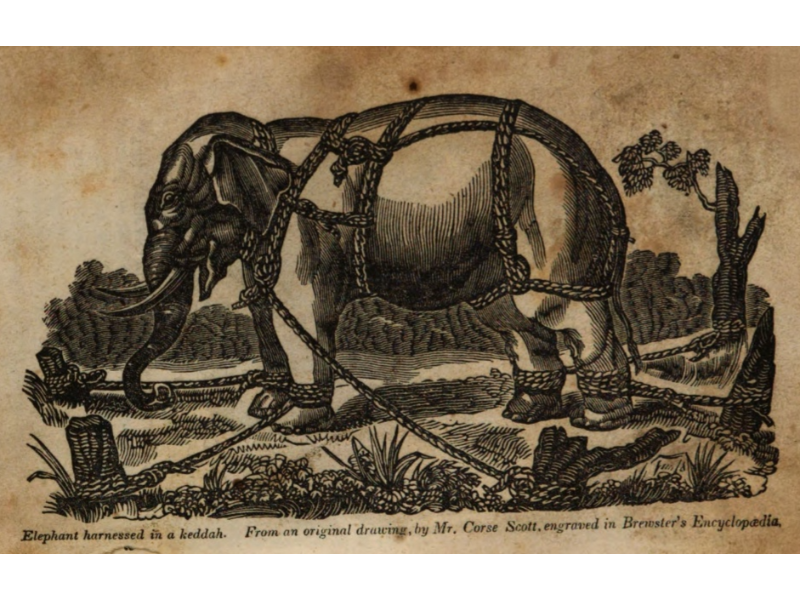
The heddah, towards which their course is thus directed, is an immense inclosure, sometimes circular and sometimes triangular, formed of huge upright and transverse beams, and terminating in a second or even a third inclosure, of smaller dimensions, but similar strength. At Tipperah, the heddah described by Mr. Corse consisted of three inclosures. Whether there be two or three of these great pens, which the mightiest force of the elephant is unable to break down, the one in which the herd is last driven has a narrow outlet, allowing room for the passage of one elephant only at a time. The principal difficulty is to persuade the herd to enter their destined prison. Although the palisade is concealed, and many precautions are taken to divest the entrance of any terrific appearance, the leader often hesitates; and the whole herd rush back upon their pursuers. If they disperse, the circles of men have again to be formed, and the tedious operation of driving them slowly onwards is necessarily repeated. If the leader, however, enter the gateway, the whole herd implicitly follows. We continue Mr. Corse’s description: —
“Immediately when they are all passed the gateway, fires are lighted round the greatest part of the inclosure, and particularly at the entries, to prevent the elephants from returning. The hunters from without then make a terrible noise, by shouting, beating of drums, firing of blank cartridges, &c., to urge the herd on to the next inclosure. The elephants, finding themselves ensnared, scream and make a noise; but seeing no opening except the entrance to the next inclosure, and which they at first generally avoid, they return to the place through which they lately passed, thinking perhaps to escape, but now find it strongly barricaded; and as there is no ditch at this place, the hunters, to prevent their coming near, and forcing their way, keep a line of fire constantly burning all along where the ditch is interrupted, and supply it with fuel from the top of the palisade; and the people from without make a noise, shouting and hallooing, to drive them away.
“Whereever they turn they find themselves opposed by burning fires, or bundles of reeds and dried grass, which are thrust through the openings of the palisades, except towards the entrance of the second inclosure. After traversing the first inclosure, and finding no chance of escaping but through the gateway into the next inclosure, the leader enters, and the rest follow; the gate is instantly shut, by people who are stationed on a small scaffold immediately above it, and strongly barricaded; fires are lighted, and the same discordant din made and continued, till the herd has passed through another gateway into the last inclosure, the gate of which is secured in the same manner as the former was.
“The elephants being now completely surrounded on all sides, and perceiving no outlet through which they can escape, appear desperate, and in their fury advance frequently to the ditch, in order to break down the palisades, inflating their trunks, screaming louder and shriller than any trumpet, sometimes grumbling like the hollow murmur of distant thunder; but wherever they make an attack they are opposed by lighted fires, and by the noise and triumphant shouts of the hunters. As they must remain some time in this inclosure, care is always taken to have part of this ditch filled with water, which is supplied by a small stream, either natural or conducted through an artificial channel from some neighbouring reservoir. The elephants have recourse to this water to quench their thirst after their fatigues, by sucking the water into their trunks and then squirting it over every part of their bodies. While they remain in this inclosure they continue sulky, and seem to meditate their escape; but the hunters build huts around them close to the palisade, watchmen are placed, and every precaution used to prevent their breaking through.
“When the herd has continued a few days in the heddah, the door of the outlet is opened, into which some one of the elephants is enticed to enter, by having food thrown first before, and then gradually further on into the passage till the elephant has advanced far enough to admit of the gates being shut. Above this wicker gate two men are stationed on a small scaffold, who throw down the food. When the elephant has passed beyond the door, they give the signal to a man, who, from without, shuts it by pulling a string, and they secure it by throwing two bars that stood perpendicular on each side, the one across the other, thus X, and then two similar bars are thrown across each other behind the door next to the heddah, so that the door is in the centre. For further security, horizontal bars are pushed across the outlet, through the openings of the palisades, both before and behind those crosses, to prevent the possibility of the doors being broken. The outlet is so narrow, that a large elephant cannot turn in it; but as soon as he hears the noise that is made in shutting the gate, he retreats backwards, and endeavours to force it; being now secured in the manner already noticed, his efforts are unavailing.
“Finding his retreat thus cut off, he advances and exerts his utmost force to break down the bars, which were previously put across a little farther on in the outlet, by running against them, screaming and roaring, and battering them like a ram, by repeated blows of his head, retreating and advancing with the utmost fury.”
In this confinement the elephant exhausts himself with fatigue. Strong ropes with nooses are spread about him; and as soon as he puts a foot within the snare, he is bound to the palisade. When all his feet have thus been made fast, his hind legs are tied together; his body is then surrounded in various directions with powerful ropes, which are secured so as to form a complete harness. A couple of large cables, with running nooses, are lastly put round his neck, and are tied to the ropes on each side. The preparations being complete, the cables are made fast to two tame elephants. The heavy door at the end of the passage is opened, the ropes that tied his legs to the palisades are loosened, and he is conducted by his powerful brothers to an open spot, where he is made fast, in a similar way, between two trees. When his subjugated brethren leave him, to conduct another to his place of captivity, his rage becomes fearful. He roars in an agony of despair; he tramples the food which is given him under his feet. He sometimes falls a victim to his paroxysm of fury; but more commonly the cravings of hunger induce him to eat, and he gradually yields to the power of gentle discipline.
CHAPTER VIII.
EMPLOYMENT OF ELEPHANTS IN THE EAST, continued —
EXHIBITIONS OF CRUELTY — PROCESSIONS AND CEREMONIALS.
The delight in brutal sports, which, in all ages and in all countries, has been felt by the multitude — that is, by the high as well as by the low vulgar — is too universal to be ascribed to particular conditions of social refinement. Sound knowledge, leading the mind to despise the coarse excitements of unintellectual curiosity, and genuine religion, which teaches us
“Never to blend our pleasure or our pride
With sorrow of the meanest thing that feels,”
must indeed greatly diminish the popular tendency towards such gratifications. Nevertheless, amongst all nations, that rude exercise of instinctive tyranny, which makes the school-boy torment a chafer, and the ferocious “children of a larger growth” assemble to witness the sufferings of a bear or a badger, still displays itself in a thousand forms of cruelty, in spite of the control of education, the chastisements of law, or the power of public opinion. In tracing the history of particular quadrupeds, it will be necessary to exhibit the infinitely various modes in which a perverse ingenuity has compelled them to administer a barbarous pleasure to the cruel propensities of man.
Such inquiries are painful and revolting, but they cannot be omitted; for they show, perhaps more forcibly than any other instances, how the sense of right and wrong is deadened by custom; and how, therefore, by the evil power of example, and the nourishment of a heartless sophistry, the most exalted in rank amongst refined nations — magistrates, statesmen, and even women, whose principal attributes should be delicacy and tenderness — have not only come to look upon public exhibitions of cruelty without abhorrence, but absolutely to rejoice and feel proud in witnessing the fierce contests of animals whose passions have been artificially excited — to be critical in their observance of the prowess of the contending victims — to mark with rapture the blazing eye and the quivering limb of the weaker in the fight — and to shout over the agonies of exhausted nature, with the glory of the savage that has sated his vengeance upon his enemy at the stake.
The elephant, although the mildest and most inoffensive of quadrupeds, has always been a sufferer from this propensity of man to cruel sports. In India, elephants are to this day baited; and the native chiefs and nobles attach great importance to these displays. When Bishop Heber was at the court of Baroda, “the rajah,” he says, “was anxious to know whether I had observed his rhinoceros and his hunting-tigers, and offered to show me a day’s sport with the last, or to bait an elephant for me — a cruel amusement which is here not uncommon…. I do not think he understood my motive for declining to be present.
A Mussulman, however, who sat near him, seemed pleased by my refusal, said it was ‘very good,’ and asked me if any of the English clergy attended such sports. I said it was a maxim with most of us to do no harm to any creature needlessly, which was, he said, the doctrine of their learned men also.” At the palace of Jyepoor, says the same humane person, “we were shown five or six elephants in training for a fight. Each was separately kept in a small paved court, with a little litter, but very dirty. They were all what is called ‘must,’ that is, fed on stimulating substances to make them furious; and all showed in their eyes, their gaping mouths, and the constant motion of their trunks, signs of fever and restlessness.
Their mohouts seemed to approach them with great caution; and on hearing a step they turned round as far as their chains would allow, and lashed fiercely with their trunks. I was moved and disgusted at the sight of so noble creatures, thus maddened and diseased by the absurd cruelty of man, in order that they might for his diversion inflict fresh pain and injuries on each other.” In the combats of elephants, according to Mr. Crawfurd, “after a rencontre, which does not last above a few seconds, one of the parties is sure to run away.”
At Ava, the elephants, bearing riders, are fought across a stout paling. They are brought up to the charge with much spirit, but often refuse to engage. They have but one mode of fighting: they butt with the forehead, and endeavour to wound each other with their tusk. Father Tachard, a French Jesuit, who visited Siam in 1685, saw elephants fight before the king of that country. The two animals were very furious; but they were so strongly bound to a stake by the hind legs, and the distance between them was so accurately measured, that they could not severely wound each other, but only twisted their tusks together in great wrath. The victor, on these occasions, was the animal that first broke his opponent’s tusk.
Elephant-fights have always been favourite diversions of the princes of India. The Emperor Akbar built an amphitheatre for these combats at Agra. Robert Covert, an Englishman who travelled in Hindostan in 1609, in his description of Agra, “tells of elephants fighting before the Mogul, parted with rockets of wild-fire, made round like hoops, which they run in their faces.” This statement would show that the animals, when infuriated, are not easily parted. On the contrary, Baldæus, a Dutch minister who lived many years in India, relates that “the elephants made to fight with one another, before the Great Mogul, manage the combat with a far greater agility and courage than one would imagine, obediently falling to and desisting according to the word given, and embracing one another lovingly with their trunks, as soon as they are commanded to end the combat.
Pliny says, that thirty elephants on a side, which king Bocchus brought to combat each other, refused to fight; and this passage offers a confirmation of Mr. Crawfurd’s assertion that they are not pugnacious. Bernier, however, who was a very careful observer, corroborates the statement of Robert Covert; and this picture of an elephant-fight, by an eye-witness of undisputed veracity, would show that the elephants of Ava, which Mr. Crawfurd saw, have not the courage of the species in other parts of Asia. The passage in Bernier is very curious: —
“The festivals generally conclude with an amusement unknown in Europe, — a combat between two elephants, which takes place in the presence of all the people, on the sandy space near the river; the king, the principal ladies of the court, and the omrahs, viewing the spectacle from different apartments in the fortress.
“A wall of earth is raised three or four French feet wide, and five or six high. The two ponderous beasts meet one another face to face, on opposite sides of the wall, each having a couple of riders, that the place of the man who sits on the shoulders, for the purpose of guiding the elephant with a large iron hook, may immediately be supplied, if he should be thrown down. The riders animate the elephants either by soothing words, or by chiding them as cowards, and urge them on with their heels, until the poor creatures approach the wall, and are brought to the attack.
“The shock is tremendous, and it appears surprising that they ever survive the dreadful wounds and blows inflicted with their teeth, their heads, and their trunks. There are frequent pauses during the fight: it is suspended and renewed; and the mud wall being at length thrown down, the stronger or more courageous elephant passes on and attacks his opponent, and putting him to flight, pursues and fastens upon him with so much obstinacy that the animals can be separated only by means of cherkys, or fire-works, which are made to explode between them; for they are naturally timid, and have a particular dread of fire, which is the reason why elephants have been used with so very little advantage in armies since the use of fire-arms. The boldest come from Ceylon, but none are employed in war which have not been regularly trained, and accustomed for years to the discharge of muskets close to their heads, and the bursting of crackers between their legs.
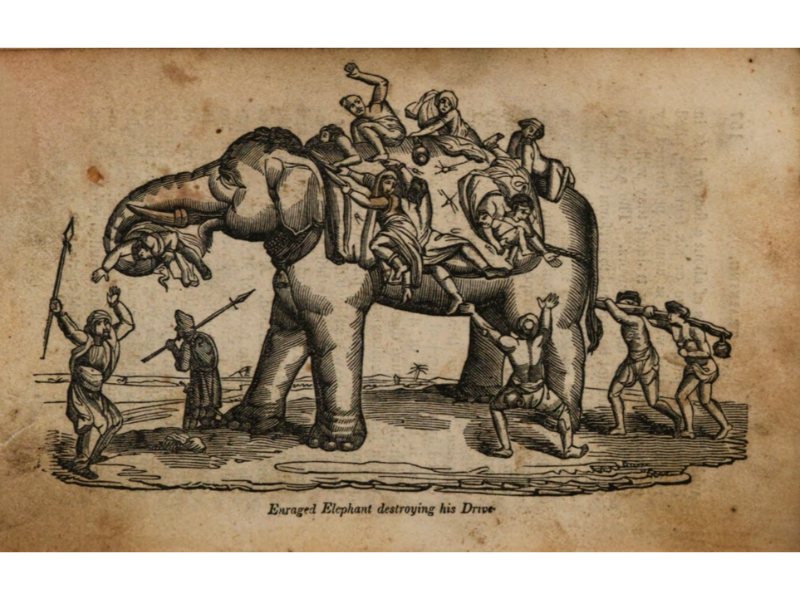
“The fight of these noble creatures is attended with much cruelty. It frequently happens that some of the riders are trodden under foot, and killed on the spot, the elephant having always cunning enough to feel the importance of dismounting the rider of his adversary, whom he therefore endeavours to strike down with his trunk. So imminent is the danger considered, that on the day of combat the unhappy men take the same formal leave of their wives and children as if condemned to death.
“They are somewhat consoled by the reflection that if their lives should be preserved, and the king be pleased with their conduct, not only will their pay be augmented, but a sack of peyssas (equal to fifty francs) will be presented to them the moment they alight from the elephant. They have also the satisfaction of knowing that, in the event of their death, the pay will be continued to the widows, and that their sons will be appointed to the same situation.
“The mischief with which this amusement is attended does not always terminate with the death of the rider. It often happens that some of the spectators are knocked down, and trampled upon by the elephants or by the crowd; for the rush is terrible when, to avoid the infuriated combatants, men and horses in confusion take to flight. The second time I witnessed this exhibition I owed my safety entirely to the goodness of my horse, and the exertions of my two servants.”
The barbarous sports of the amphitheatre appear to have furnished the chief amusements of the luxurious princes of the Mogul empire. About the middle of the seventeenth century, “the daily diversions of the Mogul, except on Fridays, were to see the lions, leopards, tigers, and elephants fight with each other.” These exhibitions were varied in every mode that an ingenious cruelty could devise. “Some elephants,” says Covert, “fight with wild horses, six horses to an elephant, which he kills with clasping his trunk about their necks, and, pulling them to him, breaks their necks with his teeth.” It is not uncommon to fight elephants with tigers. The accounts of the courage displayed by the elephant on these occasions are somewhat contradictory….
Different degrees of training may also produce considerable varieties of behaviour in the elephant when he encounters an enemy. A strange terror is always the most formidable to him. “An English dog seized an elephant by the trunk, and kept his hold so fast that the elephant, having tossed him in the air for some time, at last swung him off, but did not care to come near him a second time. This being told to the Mogul, enhanced the reputation of the English dogs: they were carried about in palankines along with his majesty, and he fed them himself with a pair of silver tongs made for that purpose.”
Pliny tells us of two remarkable dogs that were given by the king of Albania to Alexander the Great (Strabo says that they were Indian dogs), one of which vanquished a lion and afterwards an elephant. According to the naturalist, the dog was most alarmed at the largest enemy. His hair stood up, he barked in a fearful manner, but at length rushed at the enormous animal, attacking him on every side, and fairly wearing him out by the rapidity of his assaults. The elephant at length fell exhausted on the ground.
It is unnecessary to offer any further instances of the depraved taste which excites a generous and docile animal to such encounters; nor shall we discuss whether he possesses a courageous temper, because he often shrinks from contests which are evidently revolting to his nature. The elephant is a peaceful animal; his strength enables him to defend himself against ordinary enemies, but he has no disposition to attack. The reason is evident. He subsists upon vegetable food, and therefore he has neither the desire to destroy life which belongs to the carnivorous animals, nor the means of gratifying such a desire. The cruelty which forces him into such combats is, for this reason, greater than that which excites animals to fight that are naturally pugnacious; but, in either case, the principle of brutality is the same.
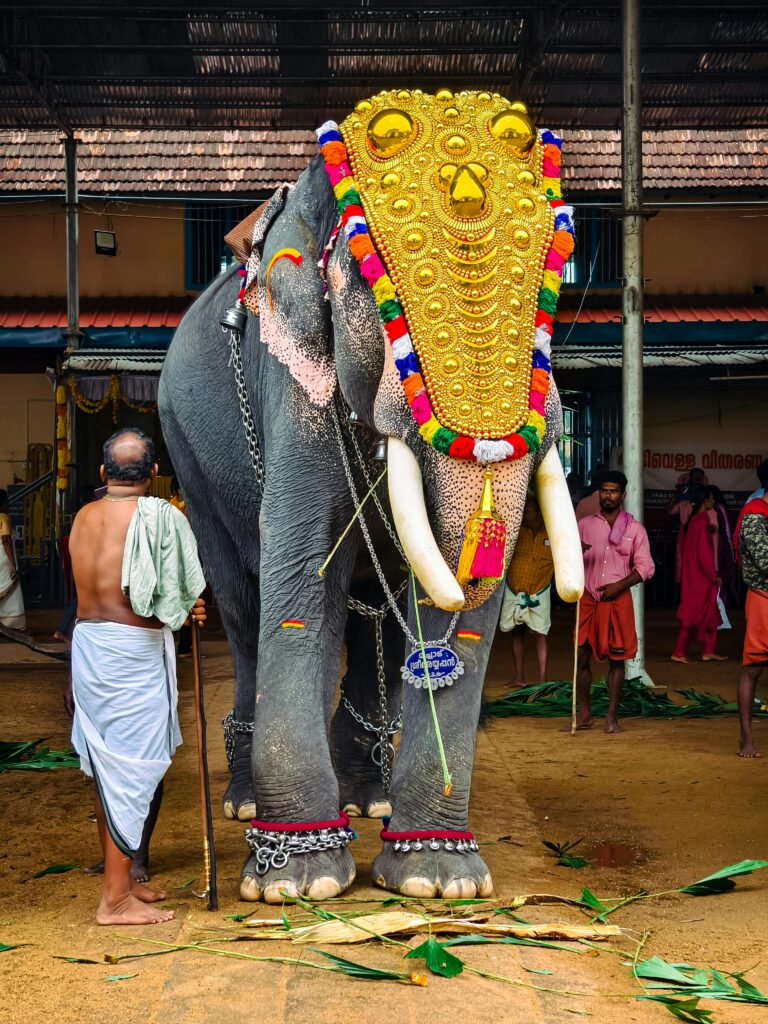
It is agreeable to turn from scenes which are hateful to the quadruped, to behold him engaged in peaceful pageants which afford him gratification. Associated with human slaves in administering to the pomp of Asiatic despotism, the elephant is not only reconciled to captivity, but is proud and satisfied. He is pampered and caressed —he has little labour to perform — his chains are gilded. He serves a tyrant, but he does not feel the tyranny; and he is happier than.the nabob whom he carries, for he has no dread of the power which obeys no law but its own caprice, when it raises to a throne or degrades to a dungeon.
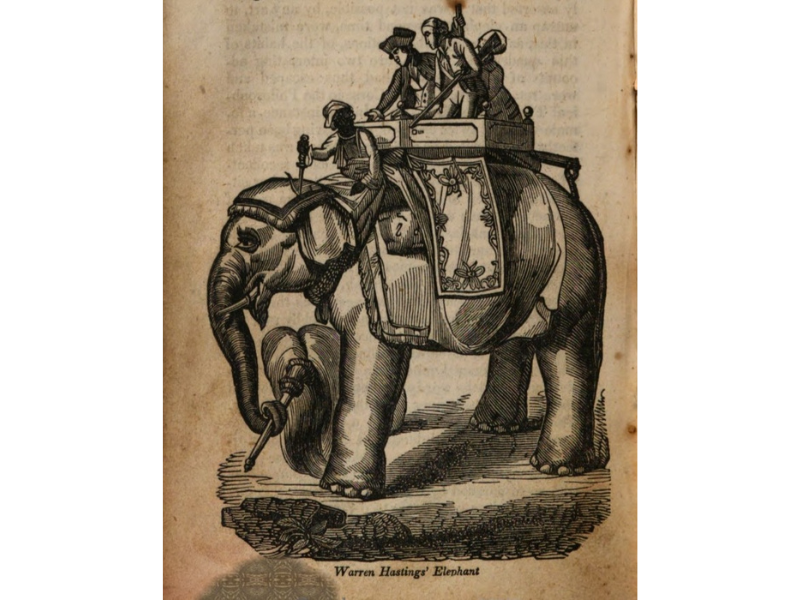
In British India the elephant is rarely seen upon occasions of ceremony, except at the courts of those native princes who still possess any independent authority. Their general use at Calcutta, or within five miles of it, is prohibited, on account of the frequent accidents which they occasion by frightening horses. In the hideous ceremonials of Juggernaut elephants are used. Five elephants precede the car of the idol, “bearing towering flags, dressed in crimson caparisons, and having bells hanging to their caparison.” When the two sons of Tippoo were received as hostages by Lord Cornwallis, they were each mounted on an elephant, richly caparisoned, and seated in a silver howdah.
At Vizier Ally’s wedding, in 1795, “the procession was grand beyond conception: it consisted of about twelve hundred elephants, richly caparisoned, drawn up in a regular line, like a regiment of soldiers. About one hundred elephants in the centre had howdahs, or castles covered with silver: in the midst of these appeared the nabob, mounted on an uncommonly large elephant, within a howdah covered with gold, richly set with precious stones.”
It was a custom with the Moguls to have their elephants and horses daily paraded before them. Bernier has described this ceremony at the court of Aurengzebe, and Sir Thomas Rowe at that of Jehanghir. “His greatest elephants were brought before him, some of which, being lord elephants, had their chains, bells, and furniture of gold and silver, attended with gilt banners and flags; and eight or ten elephants waiting on him, clothed in gold, silk, and silver. Thus passed about twelve companies, most richly furnished; the first elephant having all the plates on his head and breast set with rubies and emeralds, being a beast of a wonderful stature and beauty. They all bowed down before the king.”
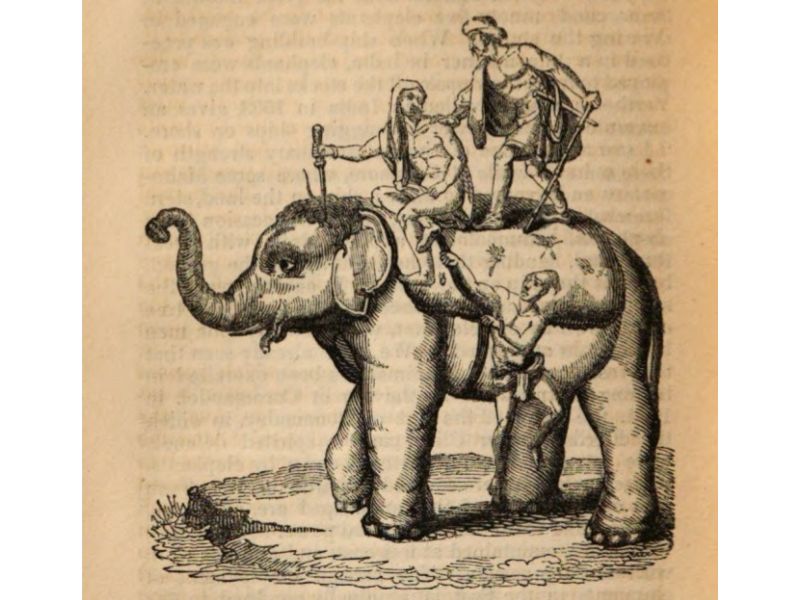
Bernier has explained the machinery which produces this reverence of the elephants for their mighty master. “When in front of the throne, the driver, who is seated on his shoulder, pricks him with a pointed iron, animates and speaks to him, until the animal bends one knee, lifts his trunk on high, and roars aloud….
Elephants are used in other idolatrous ceremonials than those of Juggernaut. Knox, describing the great annual festival at the city of Candy, mentions a procession of elephants bearing priests carrying painted sticks and umbrellas.
The elephant, in India, has usually been the minister of despotic justice. The Emperor Akbar, says Purchas, “on Tuesday, sits in judgment, and hears both parties with patience. He sometimes sees, with too much delight in blood, the executions done by his elephants.” Shah Jehan terrified the Portuguese residents at Hoogly by the daily threat of throwing them under the elephants’ feet, unless they would renounce the Christian faith.
Knox, in his account of Ceylon, says, “the king makes use of them for executioners: they will run their teeth through the body, and then tear it in pieces, and throw it limb from limb. They have sharp iron spikes with a socket with three edges, which they put on their teeth at such times; for the elephants that are kept have all the ends of their teeth cut to make them grow the better, and they do grow out again.” The custom was kept up at Ceylon till our conquest of that island.
Bishop Heber says, “I preached, administered the sacrament, and confirmed twenty-six young people in the audience-hall of the late King of Candy, which now serves as a church. Here, twelve years ago, this man, who was a dreadful tyrant, and lost his throne in consequence of a large party of his subjects applying to General Brownrigge for protection, used, as we were told, to sit in state to those whom he had condemned trodden to death, and tortured by elephants trained for the purpose.”
Whatever be the faults of our government in India, it is cheering to know that, through the greatest portion of that vast country, the decrees of an equal law are substituted for the will of tyrants, the best even of whom may be described, in the forcible language of Knox, as one who “sheds a great deal of blood, and gives no reason for it.”….
Mamood, in the eleventh century, had a white elephant, and, when mounted upon that animal during an engagement, he esteemed it as a certain pledge of victory. Travellers in the East have constantly observed the white elephants of the princes of India beyond the Ganges. The following account is by the Englishman Fitch: —
“Within the first gate of the palace is a very large court, on both sides of which are the houses for the king’s elephants, which are wonderfully large and handsome, and are trained for war and for the king’s service. Among the rest, he has four white elephants, which are so great a rarity, no other king having any but he; and were any other king to have any, he would send for it, and if refused would go to war for it, and would rather lose a great part of his kingdom than not have the elephant. When any white elephant is brought to the king, all the merchants in the city are commanded to go and visit him, on which occasion each individual makes a present of half a ducat, which amounts to a good round sum, as there are a vast many merchants, after which present you may go and see them at your pleasure, although they stand in the king’s house.
Among his titles, the king takes that of king of the white elephants. They do great honour and service to these white elephants, every one of them having a house with gold, and getting their food in vessels of gilt silver. Every day.when they go to the river to wash, each goes under a canopy of cloth of gold or silk, carried by six or eight men, and eight or ten men go before each, playing on drums, shawms, and other instruments. When each has washed and is come out of the river, he has a gentleman to wash his feet in a silver basin, which office is appointed by the king. There is no such account made of the black elephants, be they never so great, and some of them are wonderfully large and handsome, some being nine cubits high.”…
The veneration which, in the Birman empire [Southeast Asia], is paid to the white elephant, is in some degree connected with the doctrine of the Metempsychosis. Xaca sustained seventy thousand transmigrations through various animals, and rested in the white elephant. The general superstitions respecting the quadruped, which, more or less, prevail throughout Asia, have doubtless had some additional influence upon this particular homage. These superstitions have reference to the elephant’s great stature and his character for sagacity.
The Hindoo mythology teaches that the earth is supported by eight elephants. Bernier witnessed a curious dialogue between an aga at the court of Delhi, and a Pundit Brahmin, in which the latter, with the nauseous flattery that pervades all ranks in India, concluded an harangue with these words: “When, my lord, you place your foot in the stirrup, marching at the head of your cavalry, the earth trembles under your footsteps; the eight elephants, on whose heads it is borne, finding it impossible to support the extraordinary pressure.”
In the Ramayuna, one of the most celebrated of the sacred the books of the Brahmins, we have a long description of a party of men who, having penetrated into the interior of the earth, had a very satisfactory audience of these eight potentates. “The sixty thousand descended to Patala, and there renewed their digging. There, O chief of men, they saw the elephant of that quarter of the globe, in size resembling a mountain, with distorted eyes, supporting with his head this earth, with its mountains and forests, covered with various countries, and adorned with numerous cities. When, for the sake of rest, O Kakootstha! the great elephant, through distress, refreshes himself by moving his head, an earthquake is produced. Having respectfully circumambulated this mighty elephant, guardian of the quarter, they, O Rama! fearing him, penetrated into Patala.
After they had thus penetrated the east quarter, they opened their way to the south. Here they saw that great elephant Muhapudma, equal to a huge mountain, sustaining the earth with his head. Beholding him, they were filled with surprise; and after the usual circumambulation, the sixty thousand sons of the great Sugura perforated the west quarter. In this these mighty ones saw the elephant Soumanuca, of equal size. Having respectfully saluted him, and inquired respecting his health, these valiant men, digging, arrived at the north. In this quarter, O chief of Ruzhoo! they saw the snow-white elephant of Bhudra, supporting this earth with his beautiful body.” The remainder of the passage details the visits to the other four elephants, in a similar strain.
But the sagacity of the elephant, as well as his strength, has formed a prominent part of the fanciful mythology of the Hindoos. Ganesea, the God of Wisdom, is represented in the temples throughout India, with a human body and an elephant’s head….
Bayard Taylor, The Elephant: Principally Viewed in Relation to Man (London: Charles Knight & Co., 1844), pp. 86-92, 94-107, 152-170, 171-172, 173-174, ans 176-179. N.B.: Footnotes have been deleted. The first two images are found on pages 9 and 146. See: https://babel.hathitrust.org/cgi/pt?id=uc1.a0006577043&seq=1. The remaining images are from pages 116, 118, 129, 158, 172, and 203. in a later edition: Charles Knight, Natural History: The Elephant as He Exists in a Wild State, and as He has been made Subservient, in Peace and in War, to the Purposes of Man (New York: Haprer, 1848).
See: https://babel.hathitrust.org/cgi/pt?id=osu.32435050462324&seq=1