Canada
We want you to have a greater ability to learn about some of the unpleasant animal issues in our world.
VIKINGS OF THE ICE
George A. England
CHAPTER VI
BAPTISM OF BLOOD
An instant, breathlessness held us all in its vise. Then confusion burst like a shell. Cap’n, bosun, carpenter, master watches, all jumped up. The checkerboard was overturned; pieces rolled to the floor; no matter. On deck, louder yells summoned. Keen with the blood lust, all who could go on ice began heaving on their gear. Such a shouting, such a leaping to arms, such a buckling-on of sheath knives, steels, belts; such a grabbing of tow ropes and murderous gaffs you never could imagine.
Young Cyril, the Cap’n’s grandson, with flying leaps shot through the cabin, ducked into the cubicle I shared with him and Skipper Nat, snatched his gaff and nearly impaled me as I ran for my “oppers” (spyglasses) and camera.
Even though I had no purpose to imbrue my hands in blood, my heart was drumming a bit, my temperature rising. For now the kill was close upon us.
Up tumbled all hands and out upon the coal-blackened decks. Spiked boots ground the planking. Forward, streams of hunters came milling from the to’gal’n’ house, the ‘tweendecks, the dungeon. A rapid spate of cries, questions, cheers, troubled the frozen air. Grimed faces appeared at galleys, at engine-room scuttle. Sealers lined the broad rails gesticulating out toward the illimitable plain of arctic ice that blazed, dazzling white, under the March sun.
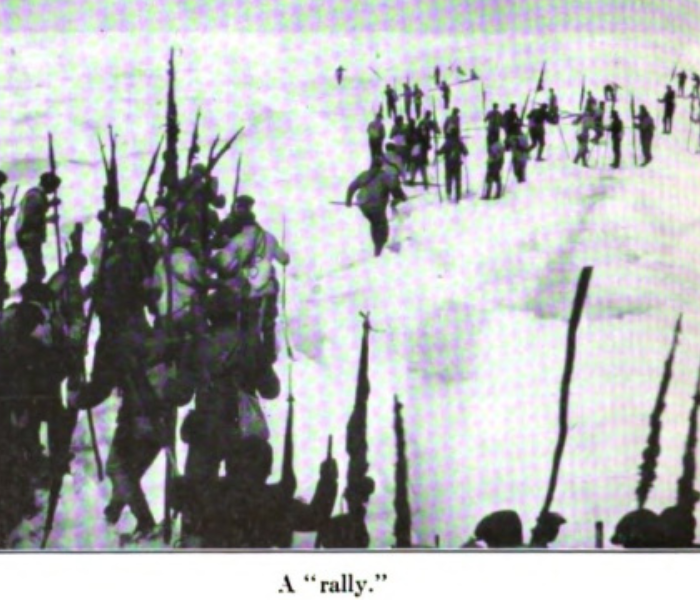
The thrill that comes but once a voyage had arrived. For now we were to have “a rally at de young fat.” We, first of all the fleet, had struck the longed-for whitecoats.
Already Cap’n Kean had gained the bridge. He seemed more like a “gert, bear-lookin’ stick of a man” than ever, as, bear-like, his furry arms waved over the weather-cloth.
“Overboard, me sons!” he shouted. “Make a pier-head jump [a quick start], an’ get into ’em! Over, me darlin’ b’ys!”
But the men needed no urging. Even before the ship had bucked and ground, rearing, into the edge of the groaning floe they had escaladed the rail — dozens, scores of them.
They seemed now to have no organization. There was no gathering of “goes,” or gangs, under command of master watches, as later in the old-fat kill. This was just a free-for-all scramble.
First of all actually to make the ice was Cyril. Not more than sixteen, he; but boys are daring in those hardy latitudes. He led the leaping, yelling crowd that jumped to the loose-broken pans; that scrambled with goat-like agility to solid floes, and in heavily spiked skinny woppers ran like mad demons, yelling, across that fantastic confusion.
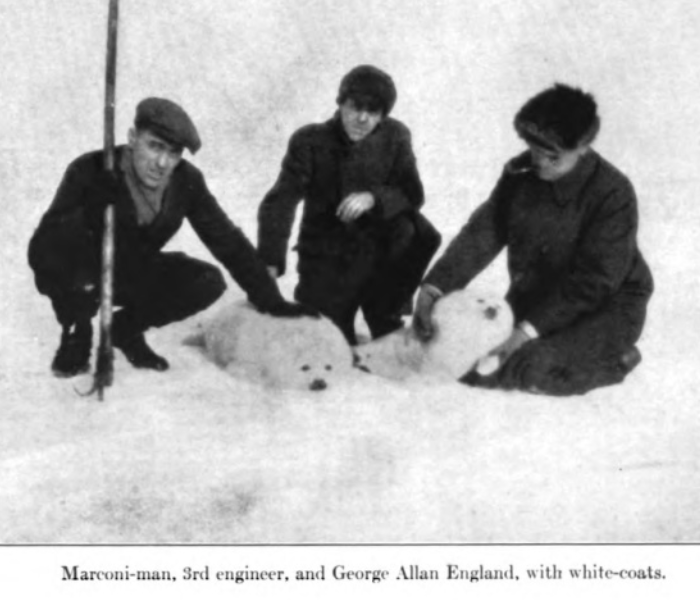
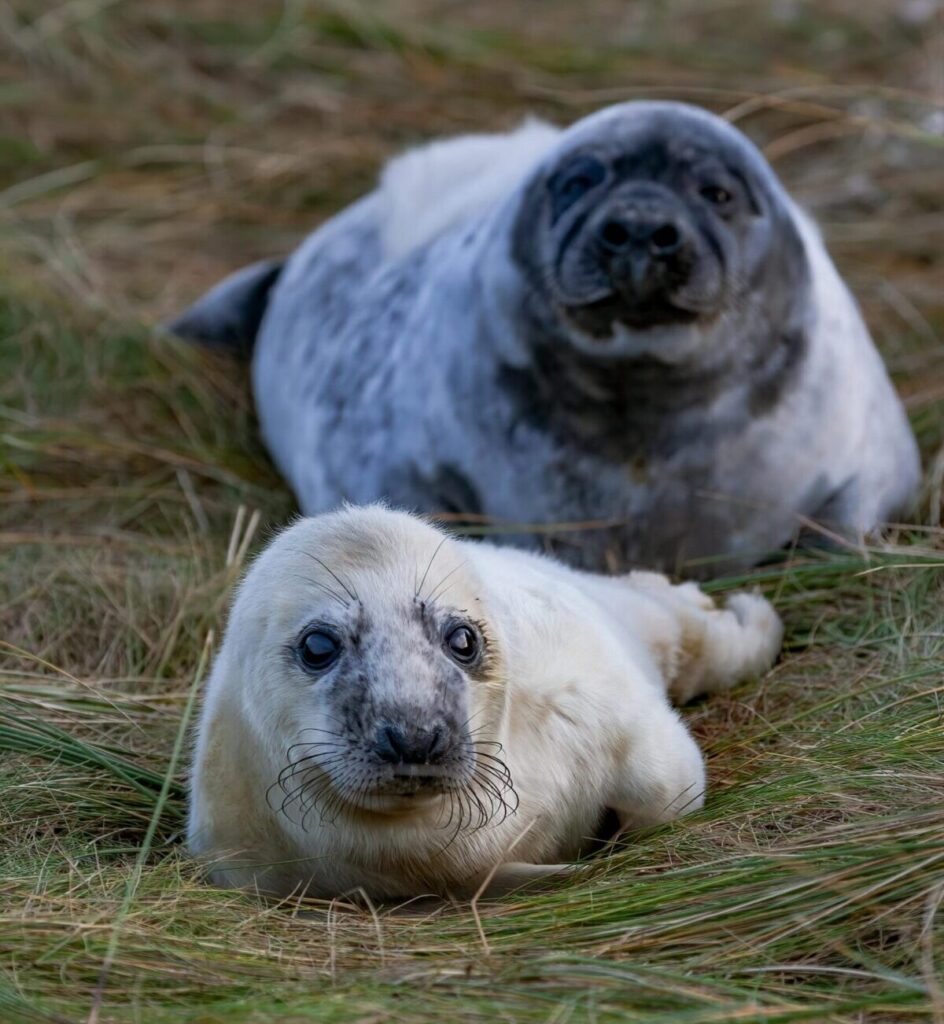
At the rail, meantime, I watched; I, who by the grace of Bowring Brothers had been permitted to go “to the ice.” My first interest was less with the hunters than the hunted. At the beginning of it all, the whitecoats looked to me like great white or whitish-yellow pincushions, woggling along, lying still, taking their blobby and full-fed ease, heaving around, blatting with a sort of puppy-like, kitten-like, lamb-like bawl, mew, bark, or what you choose to call it.
As the whitecoats passively awaited the attack, some of the old seals raised inquiring heads, began to get under way with a peculiarly sinuous motion. The dogs, to their shame be it said, were first to make for rifters and bobbing holes; for these were harps, and not the fighting hoods. Open waters thrashed with escaping seals. Up, down, and up again the old ones surged, with a startled and anxious air; glorious, sleek, brown-eyed creatures, gleaming and glistening. They seemed inquisitive, willing enough to find out what manner of thing this swift, two-legged animal might be that ran and laughed and yelled.
Some of the females lingered, but not long. They had to go, one way or the other — into the sea or under the sculping knife. I was astonished at the mother seals’ lack of maternal devotion. Perhaps half fled. With a farewell wave of the scutters, scores of them vanished. But the young, the coveted whitecoats, still remained.
“Dere’m de fat, sir!” a grizzled old Notre Dame Bay man exulted to me. “Ondly a little larry string, but dat’m a beginnin’!”
The kill was in full cry. Swiftly the men ran and leaped over rough ice. They caught seals, struck with their heavy, cruelly pointed and hooked gaffs. Cyril later boasted that he had slaughtered the first seal.
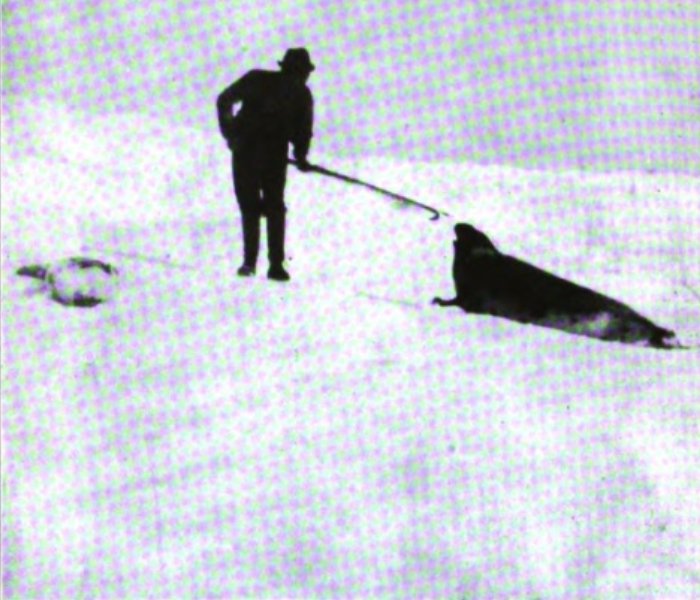
I beheld Cyril’s feat. A fat dog was his prey. The dog faced round at him, raised its head, flashed sharp teeth — the sort of teeth that sometimes work havoc on incautious hunters. It flung a throaty “Rrrrr-r-r-r-r-r!“
Whack!
The seal’s head dropped. Far from dead the seal was; still thrashing; but never mind about that! Cyril jammed his gaff into the ice, flung off his coil of tow rope, jerked out his flensing knife and whetted it, all with the correct technique of a finished sealer. He rolled the seal over; with a long gash split it from throat to scutters, and, amid perfectly incredible floods of crimson, began skinning it. Colour? The ice glowed with it!
Everywhere men were going into action. Everywhere the gaffs were rising, falling; tow ropes being cast off; sealers bending over their fat booty of both young seals and old. Everywhere the seals were being rolled over and sculped.
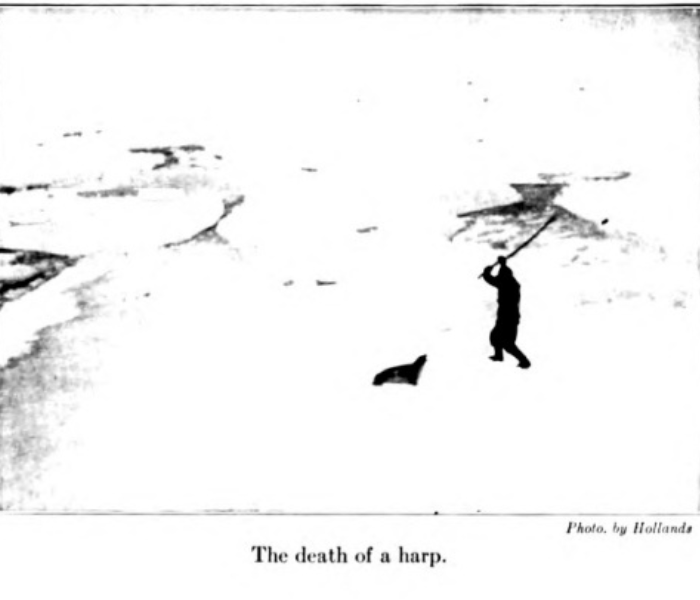
Almost invariably the seals met death head-on. They might flee at man’s approach, but once he was upon them, they would stand and show fight. Nearly always they would rear up, fling their growl, make show of biting. But one or two slashes with the long-handled gaff usually fractured the skull; the seal dropped, dying; and the knife expedited his departure to some world where perhaps polar bears, sharks, and men were not.
The actual work of blood at first — though later I grew used enough to it! — was rather shuddering to me. A seal is so extremely bloody, and that blood so extraordinarily hot. The fleshy whack-whack-whack, dully drifting in over the ice, isn’t an agreeable sound, either. Nor is it pretty to watch seals die.
All over the ice, near, far, among clumpers and pinnacles and in sheltered seal nurseries, the hunters were shucking seals out of their sculps as deftly and almost as quickly as you would shell a peanut. Every sculp — the sculp is the skin with the fat adherent — had one flipper cut out, one retained. Spots of red dotted the ice-scape. Fwitt-fwitt-fwitt sounded the whetting of blades on steels; and rather horrifically the hunters wiped their dripping knives on their sleeves. Their clothing and the ice, alike, blossomed vividly. Their hands looked like gloves of red that dripped. All about pelted carcasses sprawled, twitched, steamed in crimson pools.
Afar off men were still running. From distances beyond leads dusked by catspaws, where seals were leaping, echoed shouts of the kill. Along the rail, those who had borne no hand in the exploit were gathered and tumult arose. Men clung in rig and ratlines. Officers peered from the bridge. Gibes, cheers, laughter rang into the thin and shining air.
Somebody yelled that this was the southeast “carner” of the main patch; but in this wilderness, how could anybody know?
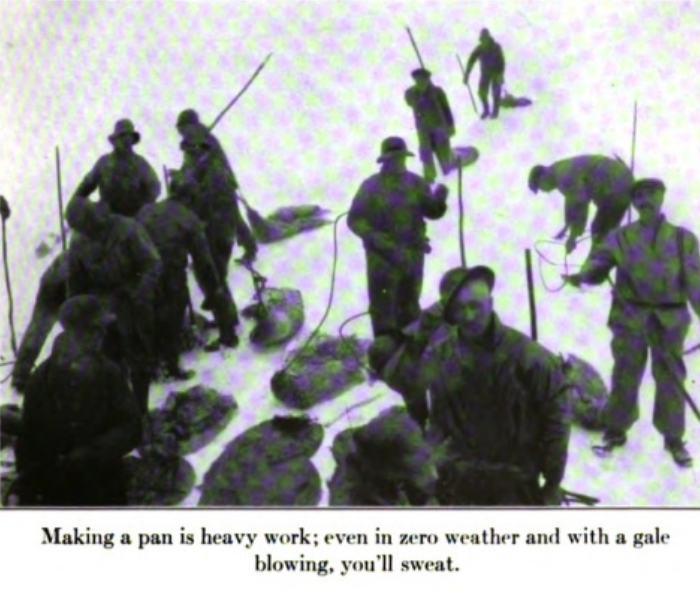
Now some of the hunters, having slain all they could make shift to get aboard, were returning. Open came the loops of the lines; swiftly the nimrods laced their “tows.” They cut holes in the edges of the sculps, passed the ropes back and forth through these, and made a peculiar, complicated knot. A turn of rope served as a grip for the left hand. The long end was passed over the right shoulder, wrapped round the arm, and firmly held by the right hand. Lacing a tow is something of a trick in itself.
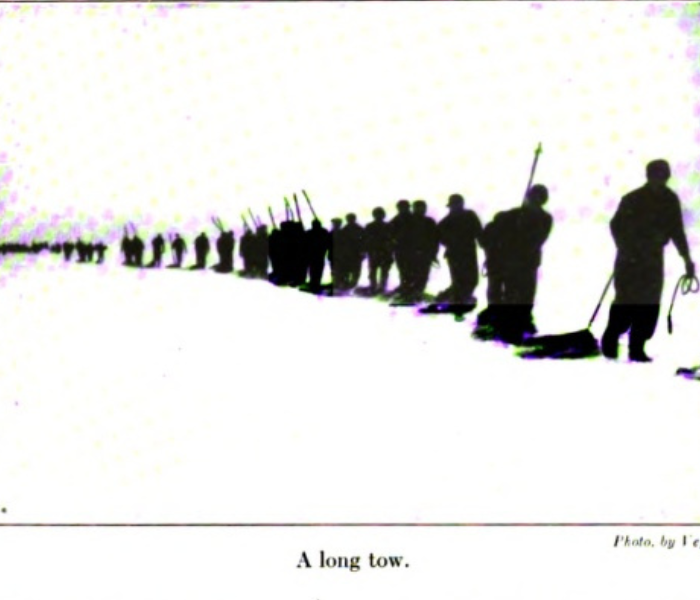
Through ice defiles and around pinnacles they toiled, each “scotin’ his tow,” bending far forward with the weight of the load. From every man’s shoulder, thus toiling, swayed and swung his gaff. Over plaques of virgin white — white no longer when they had passed! — the hunters came labouring shipward. Long, wavering lines of colour formed; they joined to broader roads, all converging on the Terra Nova. Crimson trails, these, such as no otherwhere on earth exist. Man’s mark and sign and signal in the North.
On and on, over the glazed, shining surface the red trails lengthened. A few whitecoats were still bawling, wopsing their puffy, furry bodies about, but now only a few. And even those would very presently be attended to.
The whole world lay beaten by a drenching surf of wind that paralyzed; but still I stood and watched as who would not? In came the sculps, fur side to the ice, flesh side quivering like currant jelly — quivering and smoking. The thin steams of life departing, not yet quite gone, hung tenuously. And on those sculps the flippers wagged and waved like little hands, bidding farewell for ever to the world of ice. No longer white, the whitecoat sculps had become redcoats. Red indeed! Here, there, a “round-swile,” which is to say one as yet unskinned, was trailing at the end of a gaff.
Some of the seals, appallingly vital creatures, are not at all dead as they are hauled in on gaffs. They writhe, fling, struggle. Here comes a baby with a gaff point jammed through its jaw. Here, a mother seal, bleeding in slow and thick runnels. Both, at the ship’s side, are rolled belly up and slit. They gush.
On the bridge Cap’n Kean jubilantly makes oration:
“Out with them straps, now! Look alive an’ throw out them straps. You, there, come on aburd now, b’ys. John, kill y’r seal — don’t sculp ’em alive. Now, ‘aul out y’r whipline! Stand by with that whipline, you over with it. Take ’em on the after winch. Lots of ’em there, to winnard, now. Jump overboard, some o’ you fellers! There you are, me sons; there’s a great lead. Turn to y’r left, you two! An’ you, there, don’t putt y’r gaff p’int dowa! Remember, arr hole in a skin, aft o’ the fippers, is ten cents out o’ y’r pocket. Now then, aburd with ’em. Look yary!”
Out go the straps, ropes with the ends spliced together. The gory-handed fellows on ice haul the tow lines from the sculps and run the straps through the hole in each sculp where the flipper has been cut out. Bitter cold means nothing to them. Hard work and the wine of excitement warm them; I, meanwhile, shiver in heavy overcoat and cap of fur.
The straps passed through a bunch of sculps, and the “wire” or rope from the winch dragged out from its pulley on a spar, by the whip-line, eager men hook the strap of seals to the wire.
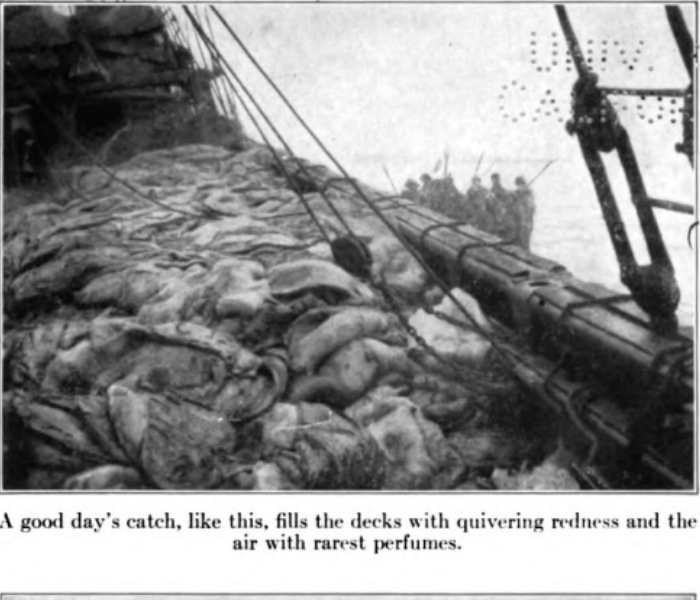
“Go ‘eed de winch!” shouts a huge-booted, thin-faced man standing precariously on top of the rail. With a roar and rattle, a hissing of steam, the winch snakes up its quivering load. Shouting men tug at the whip-line, holding back the sculps as best they can from catching on the side-sticks. Up, up the ship’s side the sculps drag and then swing free, a heavy, dripping pendulum of hair, fat, skin, blood.
“Walk back on de winch!” “Go ‘eed de winch!”
Swiftly the sculps swoop, and plop! they fall on deck. Joyous hands grab, unhook, twitch out the now bright-red whip-line and fling it all a-sprawl once more far over the rail. The ship’s first bit of wealth is “aburd o’ dis-un.”.
Again the same process. Exultation runs high. The rail reddens; so, too, the coaly deck. Lusty toilers are meantime, with “seal-dog” hooks and ropes, hauling the round-seals up and in. Once on board, the men pelt these in a jiffy.
“More in the scoppers, me sons,” warns the Cap’n. “Take ’em down in the scoppers more. Don’t get blood ahl over the deck!”
A comfortable pile of fat accumulates, smoking. Meantime, work is still under way on ice, alongside. Men are sculping there, bent double. The oppressive, sickly sweetish smell of fresh blood drifts up. Bright cascades flood the deck. Milk spurts, mingles with the blood; gutters away.
One round-seal is so big they have to winch it up; and thereat they cheer. Men on ice are jabbing their gaffs into pans, winding up their tow ropes around foot and knee; making the ends fast; heaving them, still a-drip over their shoulders. Every carcass, I see, has the scutters left on it. This gives each skinned body the appearance of wearing fur boots.
A few more round-seals come dragging on gaffs. The ice grows spotted with disjecta membra. Some of these twitch and quiver. One can see the ripple of muscles in carcasses that, dead, still protest death.
Men jostle and crowd along the rails, flecked with red snow. On the rails, blood freezes.
Those who have had no hand in the slaughter envy their more fortunate brethren. Alas, that there are not seals enough to go round; enough to warrant everybody “goin’ away!” The disappointed ones grip their gaffs, adjust their tow lines. Next time, perhaps— ?
Lest anything be left alive, the Old Man looks abroad; with loud and joyful shouting directs the tag-ends of slaughter. From high up on a step at the end of the bridge, he gesticulates, bellows:
“Go get evverythin’ with hair on it, me sons! Here, Skipper Tom, can’t you cross that lead? Jump on that piece o’ slob, man — it’ll hold — it’s broad as Paddy’s blanket! I’d like to putt on skin boots, meself, an’ try me luck! You two men, there’s a scattered one off to winnard. Get ’em! Rate behind that wad of ice — there, there! Jump out there, Moores, an’ bat that one! There, now,” as someone falls ker-splash! into the waters of an open lead, “what ye mean, makin’ a hole in the ocean that way? Look where y’re at, man! Wait, now,” as the unfortunate scrambles out on a drifting pan, “bide where y’re to. Don’t jump, yet. Now, now-ah, knew y’d make it! Go on; more seals! Go on, me lucky b’ys!”
Along the rail:
“Dey ahl deed, now, cl’ar o’ one young un, a-dere. Deed as a dick.”
“An’ dat un deed, now. Picco, ‘e bat un, ahl rate.”
“What was they, mostly, brud? Ole harps or beddamers?”
“A wonnerful fine rally, sarnly, fer de first-off!”
From the bridge I hear the Old Man again: “I hate to kill these seal, I do, indeed. It fair pains me!”
Astonishment! Has the Cap’n gone mad or turned tenderhearted? Neither. For now he adds:
“They’re so wonderful small; some of ’em ‘ardly worth the bother. If they could only have been let grow another week — “
I understand and mentally apologize to the excellent Cap’n for having misjudged him.
The kill draws to its close for lack of killable material. Odd bits and random observations: Three men running for a pan with a trio of whitecoats thereon, and one bitch. She escapes, hunching herself along with a speed truly amazing. All three whitecoats are killed and sculped in a minute. The swiftness of it amazes. Yet the technique is perfect. Two or three very swift cuts open the whole body, exposing the rich white fat. Niagaras of blood cascade. A seal appears to be merely a bag of blood and fat. The head of the skin is rapidly but perfectly dissected off. How the enormous eyeballs stare!
The body itself looks surprisingly small and thin; a mere muscular core to all that huge obesity. Yet I am told that a seal, hard put, can for limited distances swim at the rate of 100 miles an hour; and this, too, using only the scutters.
One very small whitecoat is stabbed, dying; but, after all, is overlooked. Too small, perhaps. The men leave him. Not worth bothering with, after all. He welters and dies. Wasted. Somehow this saddens one. Not so bad when used!
The cook issues from his galley with a sharp knife and begins cutting flippers from sculps.
“Fipper f’r tea,” he smiles at me. “An’ wonnerful fine meat dat is too, sir, widout ye l’ave a bit o’ fat on it. Evvery laysses’ little bit ‘ve got to be skun off. De Ole Man got to ‘ave fipper. Ah, ain’t ‘e de b’y to eat un, dough?”
I wonder if I, too, am going to eat flipper? Probably. Nothing astonishes one, here.
Now “Marky” is bidden to his labours, and the wireless begins to whine. It shoots the glad news to others, that the Terra Nova is “into the young fat.”
Men bring a “jig,” or steelyard, up on deck, and weigh four of the old-fat sculps. One tips the yard at ninety pounds. At this, all rejoice. Such heavy fat augurs a big bill.
A pandemonium of jubilation bursts forth as now the hated Thetis (she whose boat we carried off) comes crashing through ice on our port hand, and rams into the now depleted seal nursery. Too late! Dejectedly she ploughs on and away, without getting so much as a smell of young fat. Howls of derision, catcalls, gibes pursue her. Our own spirits soar in unison with the depression of those aboard the rival.
“Come ashore now, ahl hands!” orders the Cap’n; the word “ashore” in Newfoundland ship talk meaning “aboard.” “We’re goin’ on, now. Maybe goin’ to get another rally ‘fore night!”
Night is approaching. The west is beginning to flame with gold and scarlet. But still enough light may endure for a bit more slaughter. The men cheer and laugh as they swarm in. Up ropes and over side-sticks, red-painted now, they escalade with the agility of apes. They catch the rail with gaffs, haul themselves to the rail, leap over to the reeking deck.
“Easy ‘starn!” from the Old Man. The engine-room bell jangles. Out backs the Terra Nova from the bottom of the “bay” where she has lain. The archaic engines begin to thud and thump again, like a tired heart. Away the ship surges, away from that red-blotched place of desolation where, save for some few frightened survivors still surging in sunset-glinted waters, all seal life has vanished. The first “whitecoat cut” has been made. Man has passed.
Away the ship grinds, crushes, shudders through the floes, but now with how exultant a spirit! Her men are different men. For the first honours of the spring are the Terra Nova‘s. She is now, as till the end she remains, “high-liner” of the fleet.
CHAPTER XI
LABOURING ON
. . . Conditions on deck and aft were deplorable. Swill and grease, blood, fat, and gory slush make unpleasant walking. Ice was being dragged over all this filth and pitched into the top tanks; melted there and used for drink. Coal pounds on deck kept everything a black muck. Ashes blew everywhere, as the ash-cat gang tipped their long steel buckets over the red rail and pitched ashes hissing out on ice. Boxes and barrels of fipper and carcass added to the crimson drip. Seal flesh in the lifeboats made long lines of red “conkerbills” (icicles) festoon the boats’ keels with fringes of frozen blood. Incidentally, thought I, those boats must leak prettily to let blood run through like that.
We took few seals that day; but the weather bettered and the ship made fair progress.
Tea was enlivened by the Old Man’s scolding because some of his men, during a little afternoon rally, had not killed where he had sent them; and also by heart-stopping news that one of the other ships had taken more seals aboard than we had. This caused almost a panic.
I lost caste by refusing a plate of fipper. My status on the whole was steadily declining. Though I stood long hours at the wheel, dumped ashes with the ash-cat gang, and peeled innumerable potatoes for the cook, such labours could not rehabilitate me. I had not yet taken a gaff and knife.
No wonder the Cap’n sniffed:
“A man as’d prefer to chip potatoes rather ‘an go out killin’! — I got my opinion of him!”
That opinion, however, did not prevent his letting me help him take time for the ship. Every day I would note the exact minute, second, and fraction of a second; and by some magicry of mathematics the Old Man would later know our exact position. The value of such, out in that wilderness where one place was as good as any other to find seals, seemed just about nothing at all to me; but the Cap’n set great store on knowing that the ship’s position was Tweedledum instead of Tweedledee.
“Bosun,” the Cap’n that night ordered, “get the ice claw an’ hold her ‘ere to-night. An’ when you get the claw out, tell the engineers to start ahead, easy.” We often, by the way, anchored to ice with a claw, or sometimes even to a pinnacle with a “score” cut deep, casting a wire cable around it. Occasionally the cable would decapitate the pinnacle and we would go adrift, but in the ice a ship doesn’t drift far.
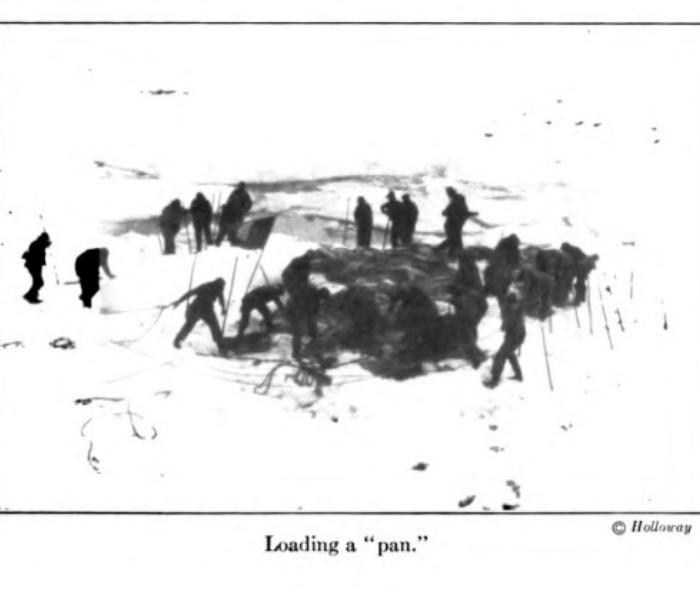
Night was filled with many labours, after the ice claw had been made fast. Big gangs fell to work, dragging in the pans of sculps and loading them. On deck at almost any time, even in the wee small hours, harsh toil always seemed going on, by raw flares of torchlights that half revealed frost-blackened faces, gleaming eyes, teeth glinting like gnomes’.
An immense and spectral vacancy ringed us round. Under the everlasting cressets of the sky, night’s limitless mystery folded us in. Black blurs of open water slowly breathed. On the horizon winked glimmers of other ships; nearer, wavering gleams flared blue as the wind tormented them. Torchlights on pans, these were, marking piles of skins that the toilers had not found time to drag in, by day. Such torches, with loose-woven wicks, will burn all night till the sunlight quenches their ineffectual flame.
Alongside the ship lay vast piles of skin and fat. Some of the men were toiling among these heaps, with “pries” or pointed sticks. Others came wearily plodding, each dragging his toilsome burden, each snicking the ice with his gaff to help himself along. As they drew near, I could see the limp bundles of laced-up skins trailing along paths that now looked black; a strange world indeed, where roads were black and all the rest gleamed white!
Beside those roads, dotted irregularly, lay seal carcasses with staring eyes and vague white ribs. From very far, a dim something advanced; took form as a kind of centipede, crawling among pallid and improbable hummocks such as fancy descries on the moon. Nearer still, I could hear the scrunch of gaffs and sparables; could make out that the centipede was composed of men, plodding shipward. The breath of toil sawed in their throats. Now, again, one unit of the centipede stopped to smear sweat with bloody hands. A gay life, my masters!
The toiling sealers piled their sculps on the edge of a little open water where we lay. Blazing torches showed them labouring, demons, a-reek with blackness. From their group, shouts beat up against the ship. Ropes whirled out. Yells echoed. The “gurdy” chattered. A dim blot of darker shadows came scuttering over ice, then plunged into water and trailed a hurried wake.
That sinister bundle slithered up the side, lagging as men hauled back on the whip-line. A shower of water starred the rail where stood a sculptural figure gesturing, with hoarse shouts.
Plog!
In the lurid gloom, the “strap o’ swiles” hit the rail mushily, flattened, swung clear. The swinging dangle of sculps slid down the quivery mass that filled the deck from rail to hatch coaming.
Shouts echoed, winches banged, steam blew. Black figures cast wavering, grotesque shadows as they dragged sculps, stooped to unstrap the pelts, wallowed in fat, and threw out the strap-lines again. On ice, others strove mightily over the black heap of skins.
“Go ‘eed de winch!”
With a rrrrr-rak-rak-rak! a roar, a gush of steam, in sagged immense weights of quivering fat; in again, over broken ice, sloshing through inky water, dripping up the side, swooping above the reek and slaver of decks not nice to picture by any light, now sheer hellish in that dancing inferno-glare of torches.
A fling of the reverse lever by a half-seen, steam-wrapped figure.
Plop!
Another mass of wealth slumped and slid upon the mounds already sloping to the rail. Fearful welters of water, ice, gurry, skins, and grease filled the scuppers, where men toiled feverishly to clear the way for more.
Everywhere sealers swarmed. When their hands got too reeking, they wiped them on stiff jumpers. They shouted, laughed, fair frolicked in their inhuman labour of stench and filth. Slog and slip and wallow, the fat landed. Torch smoke’s acrid fumes blent with stench of blood and seal fat. Waters guttered and surged.
“Eed, de winch!”
How they toiled and sweat amid that muck of slush and red rawness!
Across the rail, ice was cascading in huge chunks, pitched from hand to hand. Two or three men were chopping it fine, with axes, nigh to the forward hatch. Others were shovelling it into flat osier baskets, tossing the baskets down the yawning hatch.
Still others were “tallying down” sculps cold enough for stowage. The fresh ones, though dead enough (God wot!) are called “live seals.” But the older ones, stiff and stark, clammy and half-frozen, were ready for undiscovered depths where candle flickers wavered. Men dragged the cold sculps away, some using “gobsticks” to carry them. Into the riot of turmoil arose their warning cries to comrades under decks, who were stowing cries of:
“Hunder, below!“
Shouts blared from lower deeps:
“Ice, dere, b’ys! Come ‘eed de salt!” “Ice, dere, me lucky b’ys!”
“Salt,” they called the ice; “fresh salt.” Down it rained, to be sprinkled between the layers of sculps, laid fat-to-fat. The empty baskets flew up, spinning.
“Dat’s enough on de salt, me sons! Dat’s ice enough, b’ys!”
“Hayve ’em down dere fresh, me sons, an’ snow ’em over!” shouted a vague figure at the hatchway, tallying the sculps. He held in his hands a “tally stick” and a clasp knife, and cut a notch for every five pelts, a groove for every twenty-one, that in the final reckoning would count only as twenty. In a country of few schools, the old-fashioned tally sticks serve best. And then too, such are the filth, gloom, confusion, and cold many a time when tallying must be done, that no one could efficiently handle writing materials.
When the pan was all aboard the last hunters on ice at the ship’s side swarmed up, black-faced and red-handed in the torch glares. Others would be coming, soon; and all the turmoil would once more awaken. Meantime, the stowing down would continue.
Half the night it might be, or all of it, before the dragging in and stowing down might cease. No matter; that was “ahl in de swim o’ de day’s work,” a day that often lasts four-and-twenty hours. And on the morrow the Terra Nova‘s iron-shod prow would once more crush the floes to pick up the more distant pans, then again turn Northward Ho! along her endless trail of red.
CHAPTER XXII
A BRUSH WITH HOODS
I ran forward and reached the forepeak just in time to see a complete hood family — an enormous dog, a bitch, and pup. The ship slowed. Men began scrambling down from the barricade and from ‘midships.
Guns were rushed up; for hoods are “bad fellers to get nigh an’ ‘andy to wid de gaff.” More men jumped to ice. One plunged into water and came near being ground to bits between a pan and the ship, but others hooked him out with gaffs.
One swift gunner, Bob Noseworthy, was already leaping from pan to pan like a chamois toward the seals. He halted and fired. Another man shot from the forepeak but aimed too high. The bullet whopped into ice above the old dog.
Noseworthy, with better aim, winged the dog. Away the massive creature lumbered, while men guyed the poor shot and cheered the good.
The wounded dog meantime was undulating toward open water, “wonnerful sick,” as somebody close beside me shouted. Excitement boiled. The bitch turned, slithered away with surprising speed, and before anybody could draw a bead on her, among the pinnacles, ducked into a rifter — “drawed de ‘atch over ‘er, an’ shucked unner de pan. A rig’lar ole bitch, dat was a rig’lar ole ‘er!”
I felt astonished at her flight, for I had heard that hoods never retreated. This one partly made good such reputation by immediately surging up again with a vast clutter and splash; and on the instant Noseworthy plunked a bullet into her head.
Her probable intention to stand by her pup never materialized. She rolled over on her back in the water, with a smother of blood, and vanished. She never came up again, but sank — probably five or six hundred pounds of fat, meat, and leather. What wastage of life in a world so needful! And it was typical of all gun-hunt sealing. Impossible to calculate the thousands of tons thus lost each spring.
One of the batsmen had meantime rushed on and, out-distancing his eager competitors by some daring leaps, had with the gaff flogged life out of the pup. A final shot from Noseworthy finished the old dog.
Cheers split the frozen air.
Old dog and pup were soon dragged in by willing hands. Even the pup was so big that the hunters had to get out the “seal-dog” iron hook, jam it through the broken jaw, and hoist the pup aboard with rope and pulley. The winch had to be unlimbered, to get the dog aboard, with a great clatter and puffing. As the immense creature flattened out on deck it looked to me almost identical with a sea elephant. Its long nose, curved down like a proboscis, and its deflated skin bag on the head gave it a peculiarly formidable appearance. No wonder sealers fight shy of personal encounters with dog hoods.
Swiftly and with zest both seals were sculped. As a souvenir I plucked out one of the dog’s whiskers — “smellers,” the men call them. A peculiar, horn-like structure it was, somewhat corrugated, and of a peculiar gray-brown tint with darker brown spots.
The pup had a whitish belly, changing to slatey blue and to gray on the back. The dog looked spotted, mottled with black and gray. It showed a “last year’s burn,” or the scar of a bullet wound from the previous spring. So, then, it had already come in contact with Man. This time had been once too often. It also revealed traces of being “sunburned” as a result of riding the ice. Its skin was exceedingly soft.
Cheered by the gunplay, which presaged more soon to follow, the crew laughed, gesticulated, joked. The hunters came back aboard. The ship perked up. Now that the sun once more was blazing and the old-fat hunt, or rifle work, was approaching, spirits swiftly revived.
“Stand by on the port side!” rang the Old Man’s cry, after we had crashed on a little farther. “Young hoods!” Quickly men leaped over again, killed and hoisted a brace of young hoods aboard. One had a white belly mottled with gray, a back all gray; the other was too blood-soaked for observation. At the next kill, the Old Man shouted from the bridge:
“Hayve over the seal dog! Kill y’r seal! Turn him belly up an’ putt the seal dog through his lower jaw!” Obviously there is technique in this art! Four men were required to drag in one of the pups.
Merrily we forged ahead. Bright blazed the sun. “De moild’s over, now!” some declared, meaning the foggy spell. Spirits ran high.
And there came rivalry for the desirable hood-pup carcasses to fill the barrels —each marked with its owner’s initials — that now encumbered the barricade. I got glimpses of men carrying skinned carcasses, dragging them up the forecastle-head ladders, heaving them into lifeboats, jamming them into barrels. There came much chopping and dismembering of the bodies — grisly objects, raw-staring, but to these men choice and dainty morsels.
Our cheer and freedom did not last long, for presently the ice grew heavy again, closing up with thick sludge grinding between the pans. It raftered formidably; and before long, despite all our churning, we were jammed again.
“It’s goin’ to be a miserable evenin’ [afternoon],” judged the Cap’n. “We’re on the weather edge o’ the ice, an’ there’ll be no give-away till it moderates an’ goes abroad.” The sun gradually flickered out; the cold sharpened, and I was glad to seek refuge by the galley fire with my pail of potatoes. The seals that had promised so well “petered out” to only a few scattered white-coats — whitecoats now scruffy and active. . . .
I heard ever-growing murmurs among the men. Deprived of killing, they turned to pessimism. Some kept going out and fetching in long-dead carcasses which they chopped up and stowed in their barrels and boxes. But most congregated together, only the lucky ones smoking, for many were now out of ‘baccy. Perhaps that stimulated discontent; which after all was wonderfully slight, considering. . . .
CHAPTER XXIII
GUNNERS AND DOGS
Gunners an’ dogs get ready!”
That cry one morning electrified the ship. For now the spy master had sighted afar an immense herd of old fat, and the second stage of the hunt — rifle-work — was about to begin.
We shall say no more of whitecoats. They pass. Another phase of the vast slaughter draws our attention. The season is over when many of the young can be taken. They have gone, either into the fleet’s reeking holds or into the Atlantic. Gaff-work recedes; Winchesters come to the fore. Wary at last, beating north and ever north- ward, the vast herd — decimated but still incredibly numerous — is on the trek to the far places where men cannot pursue. Time is growing short.
The herd that we had sighted instantly put an end to all grumblings. It lay on a vast sheet which as yet the ship could not smash — miles and miles of solid, gleaming ice, against whose edge the sea beat in vain. The most furious ocean storms, be it said in passing, fail to break such masses — masses perhaps as big as a county. Only when the long swell forms can the sea conquer them.
The Terra Nova, with her shadow striding over the ice plain, laboured fruitlessly to reach the herd. On part of the floe’s edge she had already lost a lot of killed seals that had somehow broken and gone adrift never to be recovered.
The Ranger seemed to have discovered the huge herd afar, about the same time we did; and now she came fiercely straining through the “running ice.” We beat her to a rift that fortune opened in the barrier, and plunged in at top speed. Joy swept the vessel.
“Scun ‘er up to ’em, Jacob!” the Old Man shouted from the bridge. “How them bear?”
“Two p’ints on de starburd bow!”
“Good skein?”
The spy master brushed in the distances with his winking brass telescope.
“Big jag o’ fat, a nice bit off, sir. A good spurt. But us goin’ to have a hard dart to get among dat sheet. Tight ice, sir!” The shout trumpeted down exultantly as it ended: “I niver see but few better signs ‘an dat. If it ain’t a carner o’ de main patch, it’m nigh an’ handy!”
“Double full speed a’eed!” the Old Man cried. As if, indeed, the Terra Nova could do another inch an hour more than she was doing! “We’re goin’ to get a rally at the bedlamers, now. Goin’ into the t’ick of ’em. Master watches, call up ahl y’r crowds. Get ahl y’r men ready to go away. Take plenty flags. Evvery man that can drag a seal, get ready! Evvery man out o’ them castles. Get on, me darlin’ b’ys!”
A gala air swept the Terra Nova. Master watches came tumbling up; and with them, from forward, gathered their crews. The men needed no urging. Keen as whippets for a race, already they were lining the barricade and rails, whetting knives, brandishing red-pointed gaffs, buckling on belts, casting blood-stiffened ropes over the shoulders of their crimsoned jackets.
From the bridge I watched it all. Already I could see the outscouts of the herd. The ice world extended gray under immense striations of storm and wind clouds; and all across that mighty, frozen breast of ocean, the herd lay sown. In a bay of water, near at hand, a few dogs and bitches were “braychin,” but nobody now gave them any heed. They were blowing bubbles, tossing their tails, playing with no heed whatever of the ship. They flung up sheaves of foam that flashed in scattered rays of sunshine, sea diamonds all asparkle — swift, joyous forms that plunged, rolled, and dived in dashing froth; Nature’s supreme last word in vital force and loveliness and grace.
As we drew near the resting herd, boxes of ugly, soft-nosed dumdums — vicious things that would blow a seal’s head to ribbons — were tossed up from the lazarette and broken open in the runway at the top of the cabin-companion stair. The riflemen fetched out their precious guns from bunks and corners; each man with the rifle he knew and loved better perhaps than he had ever known or loved a woman. They jacked in cartridges, jostling for ammunition as Billy Richards, Mike Donovan, and Uncle Edgar served it out, filling their magazines. The dogs (gunners’ attendants) were meanwhile getting gaffs, belts, knives, and canvas nunch bags. In those bags, along with the cartridges, they stowed hard-bread; for who could tell what swift blizzard might cut off hunters miles from the ship? And in case of having to spend a night on ice, such bread helps out a meal of fipper cooked over a fire of gaff-stick shavings and strips of fat. The master watches also made sure they had their compasses.
The dogs took very good care not to sling their bags of ammunition over their shoulders, but to hold them in their hands. And there was a very good reason for that. Two hundred and fifty cartridges form a considerable weight.
“An’ wid a bag o’ cattridges fast to y’r shoulder, me son,” a gunner explained to me, “if ye fell troo a rifter ye’d make a pierhead jump fer de bottom, an’ ye’d bide dere,oo. But wid de bag in y’r hand, ye can layve un go, an’ crawl out on ice. An’ nodder t’ing, it ain’t healthy to drap one o’ dem bags. A dog done dat last spring, an’ de cattridges went off, an’ ’twas a bloody miracle nobody didn’t get shot!”
The companion alley was all a noisy seethe of men. From the cabin, below, sounded a rattle of dishes and kettles as the gunners mugged up for the hunt.
Voices jumbled:
“I’ll go dog to ye, Skipper!” — “Want to go dog to me, eh? Well, look alive, den!” “I got a gert gun, b’ys! She’ll reeve a bullet troo vifty swiles!” — “We’m on to a hundurd t’ousand, I’m bettin’!” — “Get y’r dogs ready, dere!” — “Prime-cut harps, dem is, an’ wonnerful fine!” — “De nothren patch, I’m sayin’!” — “We’m goin’ into de blood of ’em, now!”
All were inflamed with glorious anticipation as they gathered in the ship’s waist, with rifles, bags, knives, and gaffs. Here, there, the snick-snick-snick of steel marked where some zealous hunter was putting a finer edge to his weapon. Voices only murmured, for at the Cap’n’s command, none now spoke loud or shouted. Muffled now the scunner’s steering directions drifted down from the barrel; and quietly the bridge master transmitted them to the wheel. Hardly an echo wafted back, in place of the usual lusty roars. Few sounds arose from deck or barricade.
The Terra Nova was running free, pursued by the Ranger, coasting along.
A fierce wind whipped my face, but what mattered wind or cold? Nothing mattered now but the kill. The whole ship quivered for that — the berserker rage of shooting, flailing, ripping, cutting, flinging carcasses and blood about — the glory of dominance over brute creation.
“Run down the steam!” ordered the Cap’n. The funnel must not smoke, now; that might alarm the herd. “Master watches, get ahl y’r men on ice. Take plenty flags an’ tarchlights. Ahl the crowds get with their master watches, now!”
Bosun Mike served out torches. Tremendous was the enthusiasm. With luck, here was the loading of twenty ships, let alone one! From Cap’n down to lowliest stowaway, all were now co-equal in the thrill of conquest. Some of the soberer-minded put on ice-goggles or gave a final look at gaffs or guns. A few belated ones were swallowing the last of their mug-up.
“Now den, me sons,” directed the Cap’n, “let’s see how quick ye can get a bumper trip o’ fat! Dis may be an ahl-day rally. We’ll putt tarchlights on ’em. A full ship an’ ahl flagged out, that’s my motto! Evvery man in their carcass get out. They’re ahl round, to nard. Go get evveryt’ing with hair on it. My, my, my, I wish I had an old-time tearin’ crowd o’ men!” Excitedly he waved his fur-clad arms over the weather-cloth. “I’ve a mind to putt on skin boots meself an’ try me luck. I’d show ye some gunmanship! We’re on ’em again!”
Vast was the good Cap’n’s agitation, for one good day’s butchery would cram the ship — hold, decks, even cabin space. Yes, given the fat, the Terra Nova would stow it, “till ye could lay on y’r stummick an’ wash y’r hands”; stow it, even though every bunk had to be ripped out and all hands sleep on putrefying sculps.
“De gunners is gettin’ ready, an’ de dogs is gettin’ deir tails curled up over deir backs!” rejoiced Joe Stirge. “Dis is as good as arr nickel!”
The Cap’n invited me up on the bridge to get a view of the herd. My binoculars revealed in a broad bay thousands, beyond counting, of old seals splashing. These were the fringes of the monster herd encamped on ice beyond. The ocean boiled with them in broad patches, but no one gave them any heed. Farther the quarry lay.
And what a quarry! The world’s greatest hunt, indeed!
“I told ye,” smiled the Cap’n, as if he owned the herd, “told ye you’d see somethin’ few Americans has ever seen. Ain’t that fair wonnerful now, an’ beyond ahl?”
Like “the cattle upon a thousand hills” they lay resting, heaving slowly in the long swell. Under the white, streaking, staring arctic light they lay in scattered groups and patches. Some were slowly moving, their raised heads and tails making them look like fantastic, enormous birds. Some were sprawled out on mottled sides. Here, there, one hunched itself to a more comfortable resting place. Some kept lifting their noses into the wind, as if sniffing. Their labours for the year all done, now they were in the midst of their ice riding, their “enj’yin’ time.” All they asked was to be let alone.
All at once, overcome by excitement, one gunner on the barricade fired at a seal that had surged out on a pan near by.
“You, there!” the Cap’n shouted, “stop that! If you can’t use that gun right, it’ll be taken away from you! An’ you that’s hammerin’ up there, stop it, too! No nonsense now, me sons, an’ no unnecessary noise. We got great goin’, now. Evvery shot has got to get a seal!”
The batsman who had been pounding a nail into the spun-yarn seizing of his gaff stopped. Even that noise might alarm the herd; and again, betimes, nothing could frighten it. Seals are temperamental. Now they flee at a breath of disturbance. Again, you can drive a ship within fifty feet of them or less, and shower them with lumps of coal, and they will not budge. I have seen the Terra Nova crush the very ice on which they rested, yet unable to make them take to the water.
Chances were, however, that silence would now prove golden. This was to be a stalking expedition, the quieter the better. An hour’s killing might load the ship. “Stop ahl noise, now, or I’ll stop you!” the Old Man threatened. “There’s two or three hundred thousand seals out there. Evveryt’ing is lovely and the goose hangs high!”
“Dey must be wantin’ to ride de ice wonnerful bad,” judged bridge master Hillier, “when dem bides up a cold day like dat. Dem tired, I ‘spects, makin’ fifteen or twenty mile a day down narth, swimmin’ ahl night. No wonder dem wants to rest.”
“I only hopes they stays tired,” the Cap’n growled, “till we cleans ’em up!”
With the decks a bristle of gaffs and flags, and in as near silence as the engine permitted, the Terra Nova rapidly bore down on the herd. The seals lay roughly east and west, now about two miles off. Cap’n Kean swung the ship parallel to the skein and worked westward.
“Take y’r gangs, now, an’ go away!” he ordered. “John Domeney, you go first. Get away, an’ God bless ye, me son!”
All day the kill lasted. Despite the fact that most of the seals took to water, an enormous lot were butchered. The sun looked on red work, that day, as it glowed through a shining mist that blued the pinnacles with evanescent marvels of colour, and as the sun died, it gave up its ghost in a miracle of beauty that took a form not known to us of warmer seas. “Sun hounds,” the sealers call such spectacles. Sinking through mists, the sun projected itself gradually in duplicated spheres. Down from its flattened disk, and up and sideways, it flung rosy bands, so that a flaming cross glowed against the west.
The central sun was incandescent gold, fading to brass. On the up-shooting band another sun — fainter but still marvellously bright — burned redly. This sun, too, shot out streamers; and these streamers bore faint blurs of mock suns, drowned in Hesperian vapours. Once and once only on the whole journey did I see that extraordinary phenomenon.
Then night blanked out the wonder and the glory of it, closing down cruelly with many of the crew still on ice. In masts and cordage a keen wind whistled, now or then shrieking like maniacs gone free. Sudden snow flurries blanched the tremulous rawness on deck. Under the urge of mysterious currents, the vast field began to shift, grind, buckle. Still the old ship fought on, smashing along to pick up pans where torchlights wavered.
Night brought news of the final scene in the crippled Diana‘s career, a message that her crew had “manused” in good earnest, had abandoned her in a sinking condition, and burned her with all her thousands of sculps still aboard.
George A. England, Vikings of the Ice: Being the Log of a Tenderfoot on the Great Newfoundland Seal Hunt (London: Hutchinson & Co., 1924), 82-92, 13-142, 230-233, 236, and 239-246. See: https://babel.hathitrust.org/cgi/pt?id=uc1.b4500059&seq=1