Dog Fighting
We want you to have a greater ability to learn about some of the unpleasant animal issues in our world.
Old English Sports
Frederick W. Hackwood
XX
DOG-FIGHTING
The Black Country apprentice brought up with the dogs — When fighting was the order of the day — Cruelties of dog-breaking — Tasting the bitter aloes — A dog killed in a fight — Accorded funeral honours — Prevalence of Dog-fighting in Lancashire and Yorkshire — Recent police prosecutions — The dog-pit — Sir Horace Rumbold’s dog — The Dudley breed — “Madman,” the celebrated fighting dog — Dog mutilations to improve on nature — How a bull-terrier’s ears are cropped — Cruelty of the process — Cutting out the hooked denx claw — Docking dogs’ tails.
Mr. Louis Becke, the Australian novelist, has made use of the experiences of a Darlaston apprentice, in one of his novels entitled ” Old Convict Days.” From this it may be gathered that after Bull-baiting and Cock-fighting, the sport which ranked third in popular favour in those degenerate days was that of Dog-fighting.
The verisimilitude of the novelist’s description points to a narrative of facts. The spelling of unfamiliar place-names and other discrepancies of the kind, indicate most palpably that the hero of the various incidents described in the novel was a real personage whose life’s story had been taken down from dictation by the novelist.
The hero, who apparently was afterwards known in Australia as Bill Day, says he was born in the year 1819 at King’s Norton, between the Maypole and the Pack Horse Inns. He goes on to say: —
“I was apprenticed early to one Toby Duffell, a gun-lock filer, and also a publican, living on the Leas, near the Ranter’s Chapel, in Darlaston. Here my teaching was so varied that my attention to my proper work was much hindered. My master was an inveterate fancier and breeder of bull-dogs and game cocks. Bull-baiting on Monday and Cock-fighting on Tuesday was the order of the week.”
The spelling of “Leas” should be “Leys,” which is a Darlaston street-name to this day. Discrepancies of this kind are only confirmatory evidence. The public-house has been identified as the existing Dog Inn in Bilston Street.
The Darlaston apprentice continues to relate his experiences in this strain:-
“Young as I was — having to stand on a box at the vyce (sic) while using the file — these sports had a great attraction for me. I lost no opportunity of making myself acquainted with some of my master’s ‘dog-breaking’ tricks. The old story is true that, to prove the tenacity and courage of a bull slut, first one front paw and then the other would be lopped off, and after each operation the unfortunate beast would be tried to see whether it would face the charge of a bull. This barbarity was practised upon beasts incapacitated from active service by loss of teeth. If they stood the test they were nursed and tended so as to be fit for breeding purposes. The most promising of a litter of pups had more care than their owner’s children. As the pups grew up they were confined in a darkened place, and were not allowed to see anyone but my master or myself, or to be handled by any other person. So keen was Duffell about dog-fighting that before a match I have seen him run his tongue all over his opponent’s animal to make sure that no bitter aloes, or other drug, had been applied to prevent his dog seizing and holding.”
In a work published (1835) by the Birmingham schoolmaster who has been quoted previously, is to be found an anecdote which shows to what lengths the dog- fanciers of those days would go in their devotion to — their positive idolatry of — a canine hero that could prove himself invincible. The tale begins with a characteristic prelude which has nothing to do with the main story, and states that a man named Foster, of Darlaston, was killed in a quarrel over a cock-fight on the Whit Monday of 1834. Then it proceeds to say that on the following Wednesday a dog-fight took place for five pounds. After fighting an hour and a half one of the dogs dropped down dead. The other combatant survived his antagonist only half an hour, but of course that was sufficient to accredit him as the conqueror. His owner it appears, proceeded at once to bury his lost champion in his garden, when another of the dog’s admirers (doubtless a backer who had won money by the brute’s indomitable pluck) wishing to do greater honour to these obsequies, exclaimed, “Wait a while! I’ll run and fetch a Bible (sic) and read the Burial Service over him! It’s sure no Christian ever deserved a-more than he did!”
In Lancashire and Yorkshire the practice of Dog-fighting was so prevalent at the commencement of the eighteenth century that we find complaints of it in the printed chronicles of the time. The biographer of the Rev. John Lees (1700), a worthy divine and eminent schoolmaster at Saddleworth, relates how his subject was unremitting in his efforts to suppress the evil — the good man was not content to warn his youthful pupils, but we are told he constantly used his persuasive powers on the adults of his flock, to induce them to give up a practice which was then the disgrace of the County Palatine and the district of the West Riding adjacent.
Of all the old-time but now forbidden sports, Dog-fighting seems to die the hardest.
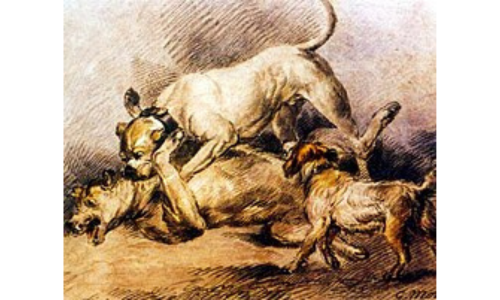
Within recent years a case of permitting premises at Darlaston to be used for a dog-fight was tried at Wednesbury Police Court. About twenty men were present in a club-room while two dogs were “played” at each other by two men who held them by their hind legs. The police found a bucket of water, two sponges, a rag, and all the other paraphernalia. One of the bulldogs had its muzzle almost torn away; and the case was one of such unmitigated barbarity that the defendant was sentenced to two months’ imprisonment with hard labour.
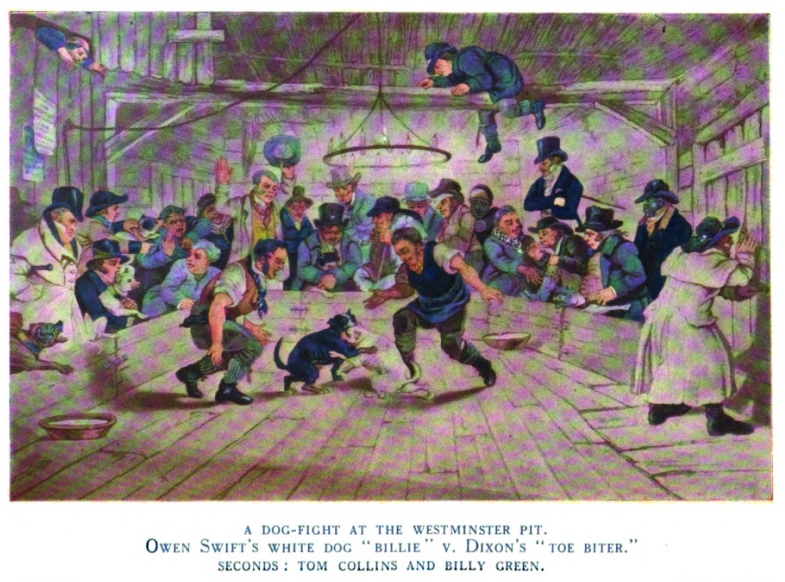
In another case tried in London, the scene of the encounter was a “pit” formed of strong boarding and fitted up in a room within the roof of a public-house. This pit was two feet deep and six feet square; it was lighted by two conveniently fixed oil lamps. In this case it proved that the defendants “handled” the two bull-terriers, during the progress of the struggle, blew in their faces to revive them, and at intervals dragged them apart to let them recover their breath. They were then set-to again. When one of the canine combatants was severely injured, the hat was handed round to make a collection on his behalf — or his master’s. A collection was also made at the outset in lieu of a charge being made for admission. There were the usual officials, as time- keepers, stake-holders, and setters-on. In fact, every formality was complied with, and the circumstances fully warranted the imposition of the heavy penalty with which the offence was visited.
The dogs used in other cases which have been brought into court under the Act forbidding cruelty to animals have been bulldogs, bull-terriers, and cross-breeds, all formidable creatures in a fight. Not a few of such encounters resulted in the death of one or both antagonists.
Although Dog-fighting has long been illegal in the mother country, it is still practised in the Transvaal; bulldogs and bull-terriers are specially bred in and around Birmingham to be sent out to Johannesburg, Kimberley, and other large centres at the Cape, for the avowed purpose of fighting.
Wednesbury, or “Wedgbury” as it was once commonly called, was noted for the breeding of these dogs. “Bulldog tenacity” has become acknowledged as one of the national characteristics of an Englishman — a fact which accounts for the high admiration in which this breed has invariably been held.
It was the tenacity of these animals in “holding on” to the bull or the bear that first brought the breed into prominence in the realms of Sport. No better illustration of this characteristic propensity can be found than in the episode of a terrific fight between an English bulldog and the half-wild wolfdog, “White Fang,” so vividly described in Mr. Jack London’s new novel of that name.
Many tales have been told of their prowess, but none so full of all-round interest for the true dog-lover as one related in the “Recollections of Sir Horace Rumbold”: —
“Among the most faithful of his friends, this young diplomatist, while at the Court of Wurtemburg, regarded a bull-terrier, ‘the flower of his species.’ Ben, as he was named, was ‘as much above the common level of dog-kind in pluck, sagacity, and devotion, as a Shakespeare or a Bayard above men.’ He was of Staffordshire breed, speckless white, all but two lovely black patches over the eyes, so evenly traced as to seem painted. He had ‘the chest of a bull, the sinews of a tiger, the heart of a lion, the gentleness of a lamb, and the most exquisite tapering tail.’ Endowed with remarkable, original, and independent traits of character, his particular passion was for fighting with other dogs and exterminating wretched tabbies. His adventures were as extraordinary as those of his master. One day he nearly worried to death the plethoric Blenheim spaniel of Analia Stubenrauch, the actress, whose influence over his Wurtemberg Majesty was as salutary as that of Lola Montes was pernicious over his Royal neighbour at Bavaria. Unlike most bull-terriers, Ben was a great swimmer, and great was the adventure he had one day with a shark. At another time on board a ship he watched the man dropping the lead for a long time, and eventually could not resist the temptation of jumping in after the lead.”
A Dudley variety of the fighting terrier had its organ of smell of a flesh colour, and not of the normal black hue; hence any dog with this light-coloured kind of snout is now spoken of as being “Dudley nosed.”
There was a Birmingham champion dog named “Madman” some sixty years ago, which became celebrated for the scientific way in which he vanquished every antagonist placed in front of him. He was a long-faced bull-terrier, and on one occasion fought for ten minutes inside a screen in front of a roaring fire, which was considered the most trying ordeal to which any fighting dog could be submitted.
This celebrated dog, and another noble brute of equal merit, named Old Victor, were the property of Mr. James Hinks, of Birmingham, who did more to improve the bull-terrier than any other breeder; in fact, all the good dogs of this breed at the present day derive their pedigree, either from Madman or from Old Victor — the latter strain being at the moment the more ” fashionable.”
While the tail of the fighting bull-terrier was allowed to grow to its natural length, its ears were generally cut to stand erect in two sharp points. This was supposed not only to smarten the appearance of the dog, but it was also a useful precaution for minimising the risk of its opponent’s seizing and holding it by the ear.
It was a matter of reproach that till a very few years ago, notwithstanding the illegality of dog-fighting, the ear-cropping of these animals was not tabooed by the Bull- terrier Club, or the yet more powerful Kennel Club.
Hear the evidence of a writer in the Pall Mall Gazette who witnessed the agonising operations a bull-terrier had to undergo in preparation for the ordeal of the judging bench: —
“The terrier is eight months old, and practically full grown. Not by accident, but by design, have its ears been left uncut so long. Your real expert among bull-terrier professionals takes care never to clip his dog until the ears are properly formed and fully grown. Of course, the longer they are left the greater the agony; but what of that? That is not the fault of the cropper, or of the owner or breeder, is it? Blame nature, if anyone. Teething should also be well over before the scissors are applied, for it has a tendency to draw the ear out of shape.
“Usually there are half a dozen croppers and assistants in the croppers’ room, who have come to take part in the operation or to enjoy the spectacle, but though between them they could, no doubt, hold down a couple of mastiffs, the victim will none the less have to be nicely bound. Observe how handy these fellows are in the work of seizing the terrier and binding him head and foot. They do it as easily as the young men at the stores tie up a parcel. First the muzzle is bound round and round with tape, then the front legs are pulled back against the sides and as much over the back as they will go, and bound; finally, the hind legs are stretched out and also tied together.
“Every possible precaution is taken against the animal writhing over much, under the shears which are immediately to be applied, because movement militates against a perfectly successful operation. The great object is to get the ears cut perfectly level, and to a fashionable shape. The jags and irregularities which may often be seen on the rims of terriers’ ears show that the cropper has begun his work too soon, or that the victim has writhed considerably under the shears. The dog is laid on his back, held by one or two of the men, and out come the shears. These are very sharp, and, from their shape, evidently made for the express purpose of ear-cropping. Clip, clip, clip! They first cut down from the tip of the ears, and then upwards, in order that no ragged bits of flesh may be left. As the work proceeds — it will take the best part of an hour — the victim quivers incessantly, but, being so securely bound and held down, not sufficiently to interfere with the neat cropping of the ear; even more pathetic than these slight movements is the low moan, which is all the sound it can utter.
“One ear finished, the second is attacked. The cropper, being hideously proficient in his work, fits the cut-off portion of the ear to the second as a guide for the shears. In this way does he insure both being cut exactly in the same shape. While the shears open and close the chief cropper and his assistants and admirers chat sociably about things canine, and are apparently quite unconscious of the awful agony which the victim is going through; nor are they in the least inconvenienced by the flow of blood. They are no more affected by trifles of this character than those who lay low the ox at the shambles.
“Utterly degraded by the work which ‘the fancy,’ in its imperious demand for terriers with cropped ears, sets them to accomplish, how can one expect any glimmering of humanity from these men who have sunk so much lower than the brutes on which they operate?
“Cropping is, of course, illegal, but the malefactors who are paid by the bull-terrier ‘fancy’ to do it, in probably nine hundred and ninety-nine cases out of a thousand are quite secure from all punishment. They take, of course, certain precautions: do not ply their horrid trade in the light of day, and as a rule see to it that no outsider shall witness the operation. It is rather a lucrative business, as much as a couple of guineas being sometimes paid for a really well-performed job. The cropper as a rule belongs to the lowest class among dog fanciers. He is a kind of hanger-on at dog-breeding establishments, ready to do any dirty work required to be done for a consideration.”
The writer’s words bear the impress of truth; but it must be confessed that many dog owners manage to perform the operation of cropping by a few dexterous cuts with an ordinary pair of scissors, and all is over in a very short time.
As the dog enters into the sports and pleasure pursuits of man more than any other creature, it may be permitted here to offer a few remarks on man’s arbitrary treatment of him. Other breeds of dogs were cropped for no possible reason beyond the mere whim of fashion. Happily the practice is beginning to die out. Black-and-tan Terriers till quite recently were cropped for show purposes; and it is still thought that nature may be improved upon in this direction in the case of several other breeds.
Pointers and Fox Terriers were often subjected to another form of mutilation, though in this case with, some show of reason. The removal of the “denx claw ” is said to be necessitated to prevent the entanglement of this, most prominent of a dog’s hooked nails, in brambles when in pursuit of game. The brindled bulldog often had a fifth claw to the hind foot — this was the old Wednesbury variety, so famous for its ferocity and obstinacy in retaining its grip. The colliers who bred these dogs always drew the incisor teeth to enable the dog to bite deeper.
While the brave fighting terrier was subjected to the horrible cruelty of “cropping,” he was more fortunate than many of his cousins in escaping the cutting of his tail, or “docking,” as it is called.
Fashion long decreed that unassisted Nature was quite incompetent to produce certain animal forms which could satisfy the ideals of the dog-fancier; hence the practice of docking the tails of certain breeds of dogs, for show and other purposes. Those most commonly docked are Fox Terriers, Irish Terriers, Airedale Terriers, and Spaniels. Two other kinds have been so regularly and persistently docked that fanciers have persuaded the public they are born tailless — these are the Dutch Schipperkes and the English Bobtail Sheepdogs. But both these breeds come into the world with the usual caudal appendages, which have to be removed artificially before it is possible to gull the public with the description “natural bobtails.”
The docking of a dog’s tail can never be necessary except in the case of that member being injured or diseased. The removal of the tail is impossible without the infliction of pain, the amount of suffering varying according to the age of the creature operated upon. If a pup is to be docked the operation should be performed at least before the dog is nine days old; while the vertebrae are cartilaginous the end joints may be removed with the infliction of very little pain, and so easily that a pinch of the finger and thumb will effect it. Old- fashioned fanciers were in the habit of biting off puppy dogs’ tails with their teeth; it is more professional nowadays to remove the superfluous length of tail with aid of special surgical instruments. However the operation may be performed there can be no doubt whatever that a cruelty is perpetrated if the pup has advanced towards maturity sufficiently for the cartilage to become ossified and the joints knitted together.
The Kennel Club and other societies for improving the breeds of dogs have at last decided to discourage all these forms of mutilation; though the Old English Sheepdog and the Schipperke, if born with tails, as they nearly always are, must still be docked for show purposes. Fox Terriers, Spaniels, and the others mentioned, are always docked; the argument in defence of the practice being that, they are such persistent tail-waggers, they would be likely to startle the game by doing this with long tails.
But no ear-cropping is now allowed; the Kennel Club rules — it is said, at the request of His Majesty Edward VII. — have made this a disqualification.
To the popularity of Dog-fighting as a sport eighty or a hundred years ago, numerous pertinent allusions will be found in Borrows’ notable work, “Lavengro.”
Frederick W. Hackwood, Old English Sports (London: T. Fisher Unwin, 1907), pp. 334- 343.
See:https://babel.hathitrust.org/cgi/ptid=coo1.ark:/13960/t2w38bc4g&seq=1
Fighting Sports
Capt. L. Fitz-Barnard
CHAPTER ONE
DOG-FIGHTING
Bravest of all, with heart that ne’er said not Fearless!
To death unfalteringly they go.
The fighting-dog is the gamest thing in the world — not even the game-cock is as game. He fights under the severest rules known, for in his turn he must cross the pit and fight, or he loses. No other animal is asked to do this. Also, he will fight anything, and when I say anything, I mean anything — a piece of wood or a man, a gnat or an elephant; and nothing stops him but death.
His courage is abnormal, and I do not think it can be explained mechanically. Courage is of the brain or mind, not of the body. As to whether this state arises out of the brain processes, or as to whether from outside it has a higher origin, is a matter of opinion. In humans it is more or less a state of mind, an ideal, an idea — seeing courage begets courage. The body is the servant that carries out the effect. With Plato and other philosophers courage was one of the cardinal virtues — the victory of soul, spirit, or mind over matter.
Heredity is inextricably mixed up with it, but whether pre-ordained in the protoplasm, or absorbed from some source of mentality from without, is uncertain; but it is certain that you cannot coerce an animal into fighting when the courage is not there.
In all animals the will is the important factor. An animal, whether man or lower animal that has no perception of nobility, generosity, or courage, may be aptly described as cur-bred.
In philosophical theories of transmigration, the soul of a human being can be reincarnated into a lower animal not yet endowed with a soul; if this be so, and the fighting-dog has not already a soul of his own, then only our very bravest and best can have entered into the form of this glorious animal.
Some, again, maintain that courage depends on the bodily health. It must be admitted that all animals are more ready to fight when in perfect health, and there are a few examples that give this theory a specious air of truth. Men have been known to disgrace themselves with cowardice on one occasion, and subsequently to perform deeds of great heroism.
This is also seen in game-fowl; a cock in moult (i.e., in bad health) has been known to run, when previously, or subsequently, he has covered himself with glory. In any case, no self-respecting man would fight fowls during the moulting season. These cases are extraordinary, but I believe it to be disease of the mind, not of the body.
Here again we get the superlative courage of the fighting-dog — whether sick or sound, whether it is well or ill with him, he is always game to the death. Men also —many a sick man has fought gallantly for his honour’s sake.
No, we must look further than the body for true courage; the heart or mind that will never own defeat, it is the gift of God, and the truest virtue we can possess.
Dog-fighting is not generally practised, and for the reason that the dog is such a faithful, loving friend that one hates to see him hurt. The reason is rotten, and worse than rotten; one does not let a brave animal fight to save one’s own feelings. The dog loves a fight, but, as usual, we think only of ourselves.
Dog-fighting is not cruel; no well-matched fight can be cruel — certainly far less cruel than plucking and trimming dogs for show, leaving out of the question altogether that most dogs would prefer to fight than be stuck for days at a time on a show bench. Nor must we confuse an equal fight with the baiting of animals, such as bulls, bears, badgers, etc., which have no option of retreat; and it appears to me that the spectacle of birds or animals equally matched, and voluntarily contending together, induces a finer lesson of high courage and unyielding determination to succeed than the spectacles often shown at the picture palaces to-day, of robbery, murder, and other crimes, which must have a demoralising effect on the spectators.
Now “dog” has been a term of insult and contempt for ages, and when one thinks of these gallant creatures one wonders how it could have originated. But the explanation is simple: there were no fighting-dogs in the days when the term first came into use, and it fits well enough with other dogs.
Unless you have owned a fighting-dog you do not know what a dog is. The poor brute that is plucked and posed for show is of no earthly use for anything but to look at and make money out of; the timid slave that assists us in our sports may claim our regard; the dangerous pest that runs and yaps at horses’ heels is not fit to live; but the fighting-dog, with his rarely given silent love, and deathless courage, claims both our love and respect. You may tire of your friends, but never of your dog; there are times when anyone will jar, and only your dog is always welcome.
This is the reason why dog-fighting at times goes against the grain.
CHAPTER TWO
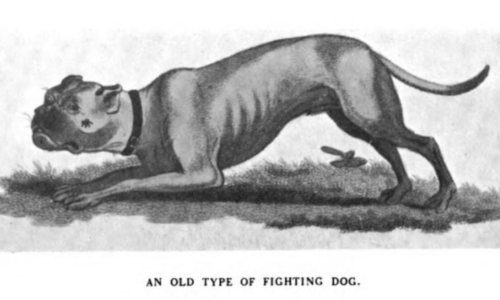
The fighting-dog was derived by crossing the bull-dog with a terrier. The terrier is not known, but it was probably the old English terrier, a white dog, and I believe the breed is now extinct.
The gameness comes from the bull-dog, which has always stood as the emblem of British courage. When I say bull-dog, I do not refer to the modern monstrosity of that name, which the show-bench has transformed into a useless cur, but the old bull-dog who was kept for use, and was a very different animal from its present namesake. He was used to catch and hold bulls for the butcher, and also for bull-baiting.
Useful as he was for these purposes, the bull-dog was too slow for fighting, although originally used for this sport. His bulky body and short face were excellent for seizing a large object and hanging on, but he could not get a mouth on quickly. Again, you must not confuse him with the modern creation, for man has so improved the short nose that these poor brutes can now hardly pick up their own food.
The bull-dog, then, was too slow and too short in the face for quick work, and some genius crossed him with a terrier, which made the produce lighter in the body and longer in the head — in short a quicker dog — and he retained the courage of the bull-dog. By selection in breeding he even overdid his ancestors in this requisite, and became the gamest thing in the world.
This cross was originally called the bull-and-terrier, which has become shortened to bull-terrier.
Again the showman has stepped in and made a breed of his own, also useless, and called it the bull-terrier. The show-ring is the death-knell of usefulness for all animals; I need only mention the show hunter, the carrier-pigeon, and the show greyhound.
The original bull-and-terrier, had, roughly, a bull-dog’s head on a terrier’s body, but the head was rather longer than the bull-dog’s; still, he was a short-faced dog. As the breed became a distinct one, the head gradually got longer and more punishing, and the dog favoured the terrier more and more, till to-day you get very long-faced fighting-dogs; but the more you resemble the terrier, the closer you get to his courage, or rather lack of it, and you can take it as a golden rule that the more you resemble the bull-dog, or, in other words, the shorter your head, and the more under-hung your jaw, the gamer the dog. To go to the other extremity — the tail: the bull-dog’s tail is short and carried low; the fighting-dog’s tail should be straight and thin, and also carried rather low. If he is a cock-tailed beggar, it’s ten to one he is a coward. This may be a crank of mine, but you can generally judge a fighting-dog by his tail.
Perhaps I had better explain what a dog-fighter means by a coward or cur. A dog may fight four or five hours, but if, even after this time, he refuses to scratch, that is, cross the pit and resume the battle, he is a cur; in short, all dogs are cowards who will not willingly take their death. It follows, then, that to the dog-fighter all dogs are curs, except game fighting-dogs.
You will notice that I always speak of fighting-dogs and not bull-terriers; the reason is that, as I have said before, the showman has appropriated this name.
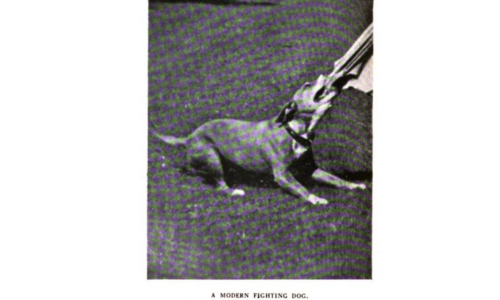
The show bull-terrier was bred from the bull-and-terrier, or fighting-dog, and it is a fine example of what breeding by selection can do. From a chubby-faced dog of all colours they have produced an animal with a face a yard long, and practically always pure white, but they have lost the courage.
The fighting-dog, or business dog, as he is sometimes called, comes all colours, red, brindle, blue, and white, and all these colours intermixed, and all sizes; 40 lbs. is a big dog, and I once had a little terror of 8 lbs. that would fight anything.
The crab about dog-fighting is the time it takes one game dog to kill another —two hours is an average fight, and often it lasts much longer; I have known fights last nearly six hours. Nothing is more exciting or enthralling than the first half-hour or so of a good battle, and some dogs are as clever as men — they will throw each other with great cleverness.
One dog I knew would take a hold, put his shoulder under the other dog, and throw him as pretty a cross-buttock as ever you saw. Many dogs have their own style of fighting; some are front of the face fighters, others fight for the legs — the forelegs generally — but one little dog I knew always went for the stifle at every opportunity, and a very dangerous place it is, too. Others favour the ears and side of the face, and one old dog of mine invariably fought for the shoulder. He would give his head like a man; often for twenty or thirty minutes he would never get a hold — he would drop his head and let the other dog worry his neck; and all the time he would be boring in for the point of the shoulder, and when he got it, it generally spelt finis for the other dog. He would get him down, and then jump into the throat.
Now many people think that when a fighting dog has got his hold, he never lets go; this is not so — he lets go as soon as he thinks he can get a better one, and sooner or later it is always the throat — hold that finishes a fight. I once heard of a dog that could get a throat-hold standing, and they say he killed his dogs on their feet. There is rather a good tale told of him.
Some fanciers discovered a retriever that could fight, and they won a lot of fights and money by backing him against fighting-dogs. The opponents naturally thought they had got a soft thing, but this dog had a trick of fighting for the fore-legs, and breaking them with his powerful jaws, and thereby beating many a good dog, as they were unable to scratch to him. Of course, the retriever was three or four times as big as his opponents, and the fights did not last long. But our friend of the throat-hold was matched against him. Aided by his opponent’s size he propped him in the throat in the first minute; in the next few minutes the retriever was howling blue murder, managed to break loose, fled the pit, and was never seen again, so that was the end of him as a fighting-dog.
Many dogs will fight gaily enough as long as they are winning, but, believe me, they know a fighting-dog, and as soon as they realise that he is not going to quit, they do. This is how the Japanese took Port Arthur. They had no business to; the Russians had plenty of food, guns, men, etc., but they were sick of killing Japanese. They said to themselves, “These fellows are not going to quit; we must chuck it,” and they did.
The business-dog is also used for rat-killing Terriers can kill rats, but they can seldom kill against a fighting-dog; moreover, very few terriers will face thirty or forty rats in a pit. Rat-killing is an art in itself, and, of course, does not require a game dog; but it requires quickness. The good killer bites once and drops his rat; the dog that wastes time in shaking would never win a competition.
The terrier shakes a rat to prevent it from biting him; the fighting-dog is indifferent as to whether it does so or not; but the good killer takes the rat by the head or shoulders so that it is incapable of biting, as that kills instantly.
A rat-killing handicap is quite amusing. Each dog usually kills as many rats as he weighs pounds, and a time-keeper and referee are appointed. The handler of the dog is allowed a small cane to help his dog. The pit should be small and circular, and made of wire. The rats are put in, and the handler picks up his dog and puts him in the pit; he generally selects his rat and puts his dog straight on it. Directly the dog touches a rat, or the bottom of the pit, the timekeeper starts his watch; as soon as the dog has the last rat in his mouth the handler snatches him up, and the time is stopped. If there is any question as to whether all the rats are dead, the referee places the suspected rat in a small circle about the size of a plate, in the middle of the pit, and gives him three smart blows on the tail with a stick. If the rat wriggles out of the circle he is deemed to be alive, and the dog is either put down again to kill it and the time added on to his previous time, or he is disqualified, whichever is arranged beforehand. Of course the dog that kills his rats in the shortest time wins.
Five seconds a rat is good work, but I once saw a 15 lbs. dog kill five rats in fifteen seconds. Some really wonderful performances have been put up by rat-killing dogs. A dog of the name of Billy, owned by Charles Dew, killed twenty rats in 1 min. 40 secs.; but his greatest performance was killing a hundred rats in 5 mins. 30 secs. It is almost incredible. Perhaps the most wonderful feat of all was that of Tiny the Wonder, who killed a hundred rats in under the hour. I am writing from memory, but I think Tiny weighed 7 lbs., and was owned by Jimmy Shaw.
In the old days I have seen men killing rats with their teeth against dogs. The man had his hands tied behind his back and killed like a dog. It was remarkable how quick some men were at this drawing-room sport, but of course they could not kill against a good dog.
Some fighting-dogs will not kill rats, I don’t know why; it may be they think them beneath them, but more probably it is just a peculiarity, and I well remember seeing a game dog looking up at his master and smiling, as dogs will, with a rat hanging on to his lip, but he would not kill them. I once knew a dog that could kill cats as fast as most dogs could kill rats. It was quite a show performance; he would be put in a pit, wired over the top, with half a dozen cats, and he would kill them all in a minute or so.
Badger-drawing, of course, is a favourite sport with some; but the fighting-dog will generally stay in the barrel and fight the badger there, instead of drawing him out. Of course, all fighting-dogs will fight a badger as long as you like, but the badger bites extremely hard, and is very difficult to kill. It is generally a safe bet that the dog won’t kill him in an hour, and I have known a badger kill a dog — that is, the dog died after the fight.
There was once a man who owned a dog and a badger, and he won a good many bets by backing his dog to draw the badger a hundred times in the hour. Of course, it was a trick; the dog and the badger knew each other very well. The badger was put in a short box, and he would drop his old head and let the dog draw him out by the scruff of his neck. The dog let go as soon as the badger appeared; back went the badger, in went the dog again, and the thing went on like clock-work. Well, if your dog is too game for badger-drawing you can have much more fun by letting them have a dust-up in the open.
I have not given you the points of a fighting-dog, because there are no points really, except courage and strength.
For breeding you must be certain there is no taint on either side, or you won’t breed game dogs; in other words, your blood must be pure, and, of course, both your parents healthy.
Remember, if you breed fighting-dogs you are not breeding toys. The puppies will snarl and scrap like other puppies, but with very little encouragement they will start fighting in dead earnest. I have seen two puppies, three months old, fight for twenty minutes — until I separated them, in fact — and with all the deadly silence of old dogs; at the same age I have known them kill cats.
The fighting-dog usually fights with the silence of the grave — maybe a savage growl or two, and then silence — but with the tendency to run to the terrier, which modern breeders unfortunately show; they may be a little mouthy to start with.
I knew an extraordinary instance. She was a bitch, and I went to see her fight for the championship of England. When she started she cried like a child. My first thought was that the man who had backed her must have gone mad; then I noticed that, though she whined, she never left off fighting. Presently she left off whining and killed the other dog. It was excitement and the terrier blood. She was a little red dog, and her name was Rachael, and a better, braver little dog never lived. Her end was sad, as I will tell you.
She had an extraordinary career. Her first owner never fought her, and she bred him three or four litters of puppies. He then fell on evil days and was tempted to sell her. She was six years old, and the man who bought her, after trying her, matched her straight away with a champion dog. She won the championship in her first fight. She won a few more fights, and was then matched at a lower weight than she had ever fought at before, and two days before the fight, whilst her trainer was out of the room, she scratched down a pair of socks, which brought down some leather leads. She ate half the socks, a lead or two, and actually swallowed two buckles (they were found inside her afterwards). She was physicked, etc., and came into the pit as weak as a robin. She never had a chance, and after two hours it was her turn to scratch. She started across the pit and fell on her side, unable to stand — she had lost. Her second went to pick her up. She looked up at him with her brave eyes, then looked at the corner where the other dog was, wagged her tail, as much as to say, I would go if I could,” and died.”
This is what breaks your heart for dog-fighting. You say, What a brute her owner must have been to fight her! No! I think he was only ignorant and over-confident, and he hardly knew the extent of the mischief until she was dead. A dog-fighter glories in the courage of his dogs; perhaps you may call him a cur with safety; but his dog never.
All dog-fighters are very fond, or at least, very proud, of their dogs; but often they forget their sympathy for the dog in the pride they feel at his fierceness and courage. Some fighting-dogs are too savage to be comfortable companions, but the majority are the best of friends, and that inestimable boon, a silent friend — they never worry you with senseless barking.
Many people think a dog will not fight a bitch; they do not know. A fighting-dog would as soon fight a bitch as anything else; so much so that you have to be very careful when you wish to breed — they are undecided between love or war, with a decided leaning towards war. . . .
CHAPTER FOUR
By the rules of dog-fighting a dead dog can win — one dog is dead; it is the other’s turn to scratch; if he is unable or unwilling to do so, he loses. It puts a premium on gameness. This sometimes happens, and I remember a remarkable case. A new dog had been brought up from the country — in those days most of the best dogs came from the Black Country or the north — and he was matched with a London dog. He killed him in an hour, and for five hours he fought a dead dog. Think of it, fighting a dead thing for five hours! Can anything equal such determination and ferocity? At the end of that time he turned away, and his second picked him up. Of course, it was his turn to scratch; he stood swaying in his corner and could not move; the dead dog had won!
This same dog fought and won many battles afterwards, and many thought him the best dog they ever saw. I have a tooth of his, and a great tooth it is, too; but do not run away with the idea that long, sharp teeth are necessary for a fighting-dog — it is the strength of the jaw that counts. As a matter of fact, most good dogs have small teeth. Here again they resemble the bull-dog — it is the terrier blood that produces the swords that some dogs carry in their mouths, useful, no doubt, if you get strength of jaw and gameness with it.
I knew of one old dog who won numberless battles, and, in fact, claimed the championship, who had only one tooth in his head. This is not referring to his molars, which are not so often used in a fight. Strange tales are told of him. One is that he was always a little bit tiddley when he fought; after the weighing his master used to give him sponge cake soaked in sherry wine till he staggered into the pit. They said he fought better like that.
Fighting-dogs are very human, and I knew of another that used to spend his days outside a pub on a country road. Habitués knew him and his little failing, and different people used to treat him all day to cakes and biscuits soaked in ale, whiskey, or anything. In the evening his master used to come down, and, when he was full up, used to upbraid his old dog, and both would stagger home together up the lane.
Perhaps the most terrible fighting-dog that ever lived was a bitch named Bridget; she was unapproachable by man or beast, but a terrific fighter. They tell me she smashed a dog’s skull in with her teeth. Her master, who went by the name of Billy the Barman, was a great sport — coursing, ratting, pigeon-shooting, boxing, dog-fighting were all one to him.
As you may guess by his name, he kept a pub, and, although it was in the heart of London, he had a duck-pond on his roof and a rabbit-warren in his cellar. When he was a little merry he would take two or three greyhounds and some ferrets down to his warren, and course the rabbits as they dashed about the cellar.
He acquired Bridget in an unusual way. He and some friends were on a picnic in the country, and, I fear, a little blotto. It was not unnatural that they should call on a sporting friend, who also kept a pub. This sportsman owned Bridget; she was kept tied up in a barn, and her food pushed to her at the end of a long stick. Being ready for a little fun, the owner offered to give Bridget to anyone who would unloose her. Billy — I fear he did not quite know what he was doing — walked straight up to her, patted her head, and let her loose. To everyone’s surprise she did not eat him; probably Bridget was as surprised as anybody else. They took to each other, and he took her home, and they remained pals to her death.
It was sad, but he could never breed from Bridget. She had several litters of pups by good dogs, but after a day or two she would chop them up and eat them. Now comes the irony of fate; she had one litter by mistake, by a little black and tan cur dog, and these were the only puppies she never ate. As they were Bridget’s puppies, in spite of the cur blood, Billy bred from them, and some people say that this is how the black and tan colour came into the breed, and that it nearly ruined the fighting-dogs of London. It is a fact that most black and tan dogs are cowards, and they were fairly numerous some years ago.
I remember Jem Smith had one; it was not a great dog, but, thank goodness, it won the only time I ever saw it fight. I could tell quite a lot of good tales about that fight, but I fear the censor would not pass them.
Another great sport I knew in those days was great in more ways than one, for he weighed twenty-nine stone; there was just room for him in a hansom-cab.
One night at my place he ate five shillings’ worth of sausage-rolls. I think this is the greatest feat I ever saw.
The same evening another dreadful thing happened. I was young then, and it was the reprehensible practice of my dear old brother and myself to invite some of the toughest nuts in London to our place after our people had gone to bed. Each brought his dog, and what with three or four turns-up of twenty minutes or so, our pet badger, and a few dozen rats, we had some pleasant little evenings. The scene of action was the kitchen — this is where the sausage-rolls disappeared — and what we called our study, of which the most prominent article of furniture was the pit. There were double doors leading out to the garden, and when one was closed there was not a lot of room.
On the night in question our old trainer had gone out for something, and whilst we were thoroughly, if illegally, enjoying ourselves, he returned, and we did not hear his knock. Being impatient, he thundered at the door in a quite unwarrantable manner. Someone said “Police!” Immediately there was a rush for the garden; a few escaped, but our big friend stuck in the door, and the frantic efforts of the prisoners to push him one way or the other was one of the drollest things imaginable. Seeing our retreat was cut off, I went to brave the police, opened the door, and there was old Deaffy. I returned and reassured the multitude, but found some of the party were missing. Now the garden terminated in a 9 ft. wall, with a mews at the back of it, and how they fled this wall causes me wonder to this day.
Unfortunately they happened to be some friends of ours who had dined with us earlier and stayed to see the fun. I had to round them up; and gentlemen strolling aimlessly about the streets in evening dress, with no hats or coats on, on a bitter cold night, caused a lot of speculation on the part of my friend, the bobby, on the corner.
He came up to me quite anxiously and asked me if there was a burglary, or what was the matter? I told him my friends were demons for fresh air; but we thought it wiser to wait till five o’clock in the morning, when the beats were changed — my old trainer was wise in the ways of coppers — then we floured the white dogs and sooted the dark ones and sent them home.
My brother and self had a big white dog then that was champion of London — we always said England; he made us quite famous, and we were known down East as “them young fellers what belongs to the big white dog.”
He got loose one day whilst we were away, and, of course, set about the first dog he saw, who was naturally tied up. A maid we had then saw them and rushed out and pulled him off; true, she pulled the other dog’s ear off as well, but I admire her to this day. I assure you few people would have gone near him at all. Afterwards he did nearly kill two people, and the wretches I gave him to had him shot.
He was a dear old dog and as game as a pebble — one of the old sort. I have trod on his toe, and wondered what I was treading on till I looked down and saw him; he never said anything.
The first night I had him I tied him up in my study. I was reading a book after having admired him for some time, and, not thinking, moved my foot suddenly; he claimed my boot in a moment. I was never so frightened in my life. I broke loose and seized an iron bar which happened to be handy, and we settled the question of superiority there and then. It wasn’t fair, for he was tied up; but we never fell out again. Dear old chap, I am often sorry I hit him with that iron bar.
I had a little bitch at the same time who was quite different; she was as kind as a Christian. What a silly expression! She was far kinder than any Christian. She would turn away from a dog in the street and never look at a cat; but take her collar off and pick her up and she would have gone through hell to get at either. When our little shows were on she would know, though I used to tie her up at the top of the house. She would cry all night if she was left out; but if I fetched her she would give one little growl, and tremble with joy in my arms till I loosed her in the pit.
What dogs they were! They are dead and I am alive; the least worthy. I do not think they breed them now, but in my declining years I had a little fighting-dog who was the light of my eyes. Thinking only of myself, I never let her fight if I could help it; but she fought when she could, anything she could get her mouth on, and she was so small she seldom met anything near her size. At a few months old she killed a fox-hound, and amongst her trophies were a pony and a pig. Horses were not too big for her, and that her leg was broken by one did not stop her. She never fought an elephant, but that was because she never had the opportunity; the utter hopelessness of it would have been as nothing to her dauntless heart; and, once she started, you might have called on the west wind to stop with as much hope of success.
For eleven years she was my pride and joy; for eleven years she slept at my feet. Even now the tears rise to my eyes. She was braver than any living thing, she was wiser than any man, and more faithful than a woman.
She is dead; but her memory lives for ever in my heart.
Nancy the Brave, the heart that knew no fear;
Courage too rich for use, for earth too dear.
Capt. L. Fitz-Barnard, Fighting Sports (London: Odhams Press, Ltd., 1921[?]), pp. 131- 141 and 150-155. The lead image appears on page 130. The two black and white images appear on pages 134 and 154. The two lower fight scenes are from: https://en.wikipedia.org/wiki/
See: https://babel.hathitrust.org/