Elephants
We want you to have a greater ability to learn about some of the unpleasant animal issues in our world.
A Wild-Animal Round-Up
William T. Hornaday
XI
THE WORLD'S ELEPHANTS TO-DAY
(1924)
The supreme thrill of civilized childhood is broadcast in one shrill and piercing cry: “The Elephants Are Coming!”
And oh, man! Never while life endures can we forget that grand and glorious feeling when we boys from the farm piled into Eddyville, Iowa, in 1861 and were electrified by that moving mountain of wrinkled gray hide, flapping ears, unbelievable trunk, and enormous white tusks known as “Old Tippoo Sahib,” of the Van Amberg show. Those tusks almost touched the ground; and by that well-remembered token we know that Tippoo really was a whaling big elephant. I am sure that his equal among Indian elephants does not now live anywhere this side of India and the Far East.
Even the largest travelling shows of to-day have no such splendid old “he-ones” as Tippoo was. The showmen are afraid to carry on with them. They are too prone to go on rampages, raise Cain, and even kill visitors. People are now much more expensive than they used to be. Damage suits are easy, and, in awarding personal damages, many juries are absolutely merciless. The travelling showmen are wise, and commendable for their caution. To-day the standardized herd of show elephants, big or small, consists chiefly of modest and inoffensive spinsters, mostly immature, who earn their bread and hay by honest labor and make no fuss about The Life.
Although the Americas now have no free wild elephants of their own, they have not always been thus bereft. The time was, and that not one day more than thirty thousand years ago, that magnificent hairy mammoths, from twelve to thirteen feet high, wandered over western Alaska, clear up to Charlie Brower’s place at Point Barrow, and were trailed by the somewhat smaller mastodons. I can prove this by a fine mammoth tusk of fossil ivory that was presented to me by Alaska’s delegate to Congress, Dan A. Sutherland, and by some huge molar teeth of both mammoth and mastodon coinage, from Charlie Brower.
From Alaska the great hairy mammoth marched down the west coast of North America to Oregon, California, and central Mexico. In the United States it split off two or three new species that ranged eastward across the United States to Indiana, Kentucky, and elsewhere. The great American mastodon also travelled south and east and finally fetched up in eastern New York, where it sank down in various bogs and safely buried skeletons of itself for the benefit of the natural history museums of to-day. The “Cohoes Mastodon” is in Albany, the “Warren” skeleton is in the American Museum of Natural History, New York.
The living wild elephants of to-day consist chiefly of fragments and remnants inhabiting shreds and patches of the interior and most remote jungles of southern, eastern, and equatorial Africa, southern India, Ceylon, Assam, Burma, Siam, French Indo-China, the Malay Peninsula, Sumatra, and British North Borneo. They have been divided by nature into two groups, Indian and African. All the elephants of Asia and Malayana are of one species only, the Indian (Elephas indicus), marked by small triangular ears, two huge domelike bumps on the two halves of the forehead, five toes on each front foot and four on the hind. The body is huge and bulky, and the legs are short and thick. The tusks average much shorter and smaller than those of the large African species. The very longest Indian tusk on record is eight feet nine inches long, seventeen and one-fourth inches in circumference, and weighs eighty-one pounds. There are only four tusks on record that exceed eight feet, and in Rowland Ward’s Records of Big Game the recorded tusks go down as low as four feet four and one-half inches.
The height of the largest male Indian elephant is involved in doubt. Presumably the finest examples of the species are those that have matured in a wild state, and therefore are not measurable on the hoof. When a big elephant is dead, probably no man on earth could measure its shoulder height as it lies and hit upon the figure representing its standing height when alive. Nor is it likely that any two men could measure a dead elephant and find their figures for height in agreement. The position of the dead fore leg is a puzzle. As that member lies prone and relaxed in death, it would be almost impossible to know how much to push it up into the shoulder in order to place it just as in life.
We know that among captive Indian elephants a male standing nine feet eight inches at the shoulder is a mighty big one. We read of dead ones that measured ten feet eight inches, and one of eleven feet, but we doubt the accuracy of the operation. As for myself, I am perfectly certain that no Indian elephant ever measured ten feet nine inches on the hoof, because that was the height of Jumbo, a very big African. The late G. P. Sanderson, a man of many elephants, never measured an Indian bull that exceeded nine feet eight inches.
The lozenge-shaped ridges of enamel on the otherwise flat grinding surface of the molar teeth, and also other characteristics, have caused zoologists to erect the African elephants into an independent group known as the genus Loxodonta. The precise number of species that exist in this group is involved in some doubt, according to the accepted author in the case, and we will not here embark on the stormy sea of classification. It is quite sufficient for the purposes of the general reader to know that in all Africa there really are at least four or five perfectly good species of elephants. Of these at least three are huge, one is just medium, and the last one is a genuine pigmy.
The whaling big African elephants, like dead Jumbo and our living Khartoum, are dotted through the Egyptian Sudan and Uganda Territory, Kenia Province (formerly British East Africa), Tanganyika Territory (née German East), and southward to Rhodesia, the Transvaal, and Natal. You must go far and hunt long to find any.
The elephants of the now famous Addo Bush represent a small species (eight feet high), and it is safe to say that no one hundred and twenty elephants on earth ever perplexed and worried a good government as much as did that particular bunch. The Addo Bush is a very small, isolated forest, quite surrounded by new farms, including numerous irrigation ditches. Pressed by shortage of food in their preserve, the elephants naturally raided the farms, seeking what they might devour. They ate much and spoiled more; and the unhappy farmers appealed to the government for relief from too much elephant in their cosmos. The government thought of relief measures. A fence all around the Bush was utterly impossible, for several reasons. Again, the elephants could not be moved without catching and crating and hauling them, which was impossible. And no one wanted elephants to work, so there were no “keddah operations.”
The one last and most lamentable resort was to destroy all but a few of the elephants who had no place to go, and trust that a preserved remnant would not become another unbearable infliction upon the farmers. Major Pretorius was engaged to do the shooting; and, because it is every-where a painful subject, the less said about it the better.
The big African elephants, measured from the White Nile and the Anglo-Egyptian Sudan clear down southward to Natal and the Orange River, are the largest of all living elephants. The longest, and the most beautiful, tusks in existence came from an elephant that was shot by an American, about twenty-five years ago, a short distance south of the Abyssinian border, and presently landed in the possession of King Menelik. By various channels they finally found their way into the ivory market of London, where they were purchased by Rowland Ward.
A very brief time thereafter they were offered to the New York Zoological Society, snapped up by cable, and, by the late Charles T. Barney, presented to the National Collection of Heads and Horns, in Bronx Park. The longest tusk measures eleven feet five and one-half inches, its greatest circumference is eighteen inches, and the weight of the pair is two hundred and ninety-two pounds. They are from the Sudan elephant species (named in Latin Loxodonta oxyotis), the colossal big-eared animal, two specimens of which have been measured (dead) in British East Africa by the two very competent American taxidermist-naturalists, Carl E. Akeley and Herbert Lang, as being eleven feet four inches standing height at the shoulders. The measurement I accept without question as being reliable.
Jumbo, of the London Zoo, and lastly of the Barnum show, was carefully measured (surreptitiously) in 1883 in the show at Madison Square Garden by George Elder, a pole jumper, and Robert Gilfort, an acrobat, and found to be precisely ten feet nine inches. The heaviest African elephant tusk of authentic record is one in the British Museum of Natural History, which is ten feet two and one-half inches long and weighs two hundred and twenty-six and one-half pounds.
In what is now Tanganyika Territory, Africa, there is found a species of elephant with much smaller and more regularly triangular ears than those of the Sudan species, which is known as Loxodonta knochenhaueri — a barbarous name to bestow upon an elephant that is too far away to put up a fight. Down in Cape Colony the Cape elephant is Loxodonta capensis. Over on the west coast of equatorial Africa is a third species of little-known character, but I never have been able to get a good line upon it.
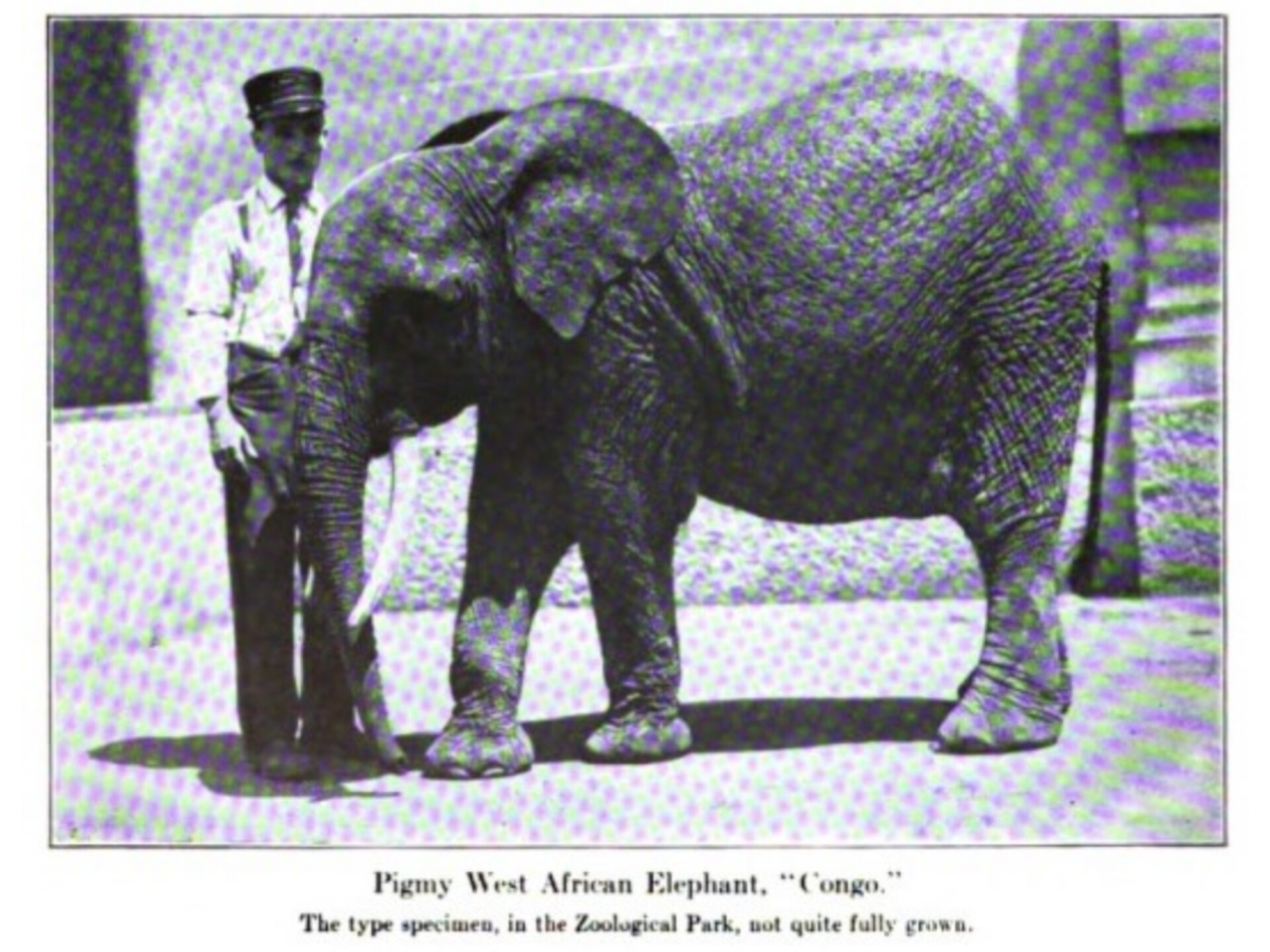
Now, however, we reach the foot of the list of African elephants, and find there a species in which I feel a thorough-going proprietary interest. It is the now-celebrated pigmy West African elephant, the most sharply differentiated of all the African elephants. Day or night, as far as you can see one, you can recognize it by its little semicircular ears, its miniature tusks, and its five front and four rear toes. Its body is short, thick, and heavy, and it totally lacks the long-legged and rangy appearance of other African elephants.
Its tusks alone are sufficient to fix this species firmly on the rock of perpetuity. Our first pigmy accession, actually the “type specimen” on which the new species was founded, was Congo, who arrived in our midst in 1905. When he appeared to be fully grown, his height was six feet one inch and his weight was twenty-seven hundred pounds. His tusks were twenty-three inches long outside the lip, and in thickness they were about the size of a lady’s wrist. Now, look at the tusks of any East African elephant of the age that Congo was then (about seventeen years), and you will find them of a totally different pattern. The equation will stand precisely as follows: East African tusks are to pigmy tusks as brogans are to satin slippers.
The pigmy elephant is celebrated for what the world doesn’t know about it. We have had Congo from the late lamented German Cameroon country. The last one, Tiny, still a frolicsome, winsome little girl, came twenty months ago from near Fernan Vaz, French West Africa. We know of two others that came from the lower Kassai River country, and there the trail ends. The ivory market of the Cameroon country once handled hundreds of pigmy elephant tusks, “none of them over three feet long,” so said my informant; but the independence of the pigmy species was not discovered and declared until in 1905!
It seems to me that the world’s elephant population of our days and times was at its maximum about 1850, or seventy-five years ago. It was then that ivory-hunting was a thriving industry at “the Cape,” in Natal, the hinterland opposite Zanzibar, and in all the Upper Nile countries. Those were the days of big-bore guns, two-ounce round balls of pure lead, and enormous expenditures of black powder.
On the plains of South Africa, Gordon-Cumming, a famous elephant-slayer, used to shoot elephants in the shoulder, then gallop alongside them, loading and firing as he rode, until the animals either succumbed or escaped. He related how he once had to fire forty two-ounce balls into a single elephant before bringing it down.
The list of Englishmen who have figured in the books of African adventure as professional tusk-hunters is a long one. A few of the outstanding figures of our time are Anderson, Gordon-Cumming, Sir Samuel Baker, F. C. Selous, Neumann, and James Sutherland. There are scores of others who might be named.
In his day and time Arthur H. Neumann was a great slaughterer of elephants. In his book he relates with pride and satisfaction, as his greatest triumph, the killing of fourteen elephants in one day! Just pause for a moment and think of it. A whole herd of great but slow-growing animals, wonderful almost beyond compare, and the patriarchs of a fast-vanishing genus, wiped out of existence in one brief day, by one sordid hunter, confessedly cruel by nature — and who a little later blew out his own brains in London, and went to meet his reward.
The slaughter of African elephants for their ivory is not by any means a dead industry. It is a going enterprise to-day. Only in 1922 the government of the Anglo- Egyptian Sudan advertised in the newspaper published at Khartoum, the capital, ivory-hunting licenses for sale in assorted sizes from ten-head permits up to one hundred! This is being done to reduce the elephant risks and damages to pioneer settlers and farmers.
Similar permits are issued for certain districts in Tanganyika Territory, wherein elephants were, and still are, unmitigated pests to the unhappy natives having shambas (cultivated fields) in their spheres of influence. When a herd of hungry elephants proceeds to raid a native village and eat up the whole year’s crop of food, it is a mighty serious thing for the natives. Mr. Don A. Baxter, an observing American traveller and sportsman who but recently returned from East Africa, states that in the Kaski District of Tanganyika there are probably about five thousand elephants, and the lot of the native inhabitants of that district is anything but a happy one. It is the cow and calf elephants that are the most industrious and persistent in clearing up native plantations.
For hunting in the elephant-ridden district, there is the “governor’s license,” which can be issued to kill any number of pest elephants from ten up to one hundred. In Kenia Province and Tanganyika Territory, the ordinary hunters’ license is for one, two, or three elephants only, as the sportsman may elect; and the fees are in proportion. Mr. Baxter says: “The governments of these two provinces, both of which I visited, have the elephant situation thoroughly in hand. No elephants can be killed, and not a tusk of ivory can be exported, without the knowledge of the government concerned; and no tusk or elephant trophy or specimen can be shipped out unless it bears the government stamp. If a tusk weighs less than thirty pounds, it cannot be exported. To me there is less of real sportsmanship and less of keen enjoyment of the chase in killing an elephant than in any other big-game hunting in Africa known to me. When I killed a big old bull elephant, I felt as if I had cut down a giant oak tree a hundred years old that no effort of mine ever could replace.”
In speaking of permits and fatalities to elephant-hunters, by way of illustration, Mr. Baxter related a harrowing bit of recent jungle history. While en route to Mombasa he was offered by a Mr. Allen Black one-half of a one-hundred-elephant permit good for use on “pest” elephants in Tanganyika, where the natives of the ravaged districts wanted him. Mr. Baxter elected to go on an old-fashioned collecting trip in Kenia Province, on a two-of-a-kind basis. Eventually Mr. Black’s permit was divided, one-half being given to a Captain Townley and the other to a Mr. Hearst. When about two weeks out, Captain Townley lost his life through the accidental discharge of the rifle carried by his gun-bearer. A few weeks later Mr. Hearst was caught and killed by a big bull elephant that he was attempting to bring down.
Mr. Baxter says that “if governor’s permits are not given out too freely, the wild elephants of East Africa will not be wiped out in the next hundred years.” Truly, this is good news.
In South Africa, only the remnants of former elephant abundance now remain. In the Belgian Congo Territory and in French West Africa, there seems to be no surplus elephant population, and no such elephant ravages as there are to cope with in the Sudan and in Tanganyika Territory. The officers and members of the admirable and active London Society for the Preservation of the Fauna of the British Empire have for years been pressing the British Government, and all other governments owning colonial real estate in Africa, to stop all systematic slaughter for ivory alone, to stop the killing and marketing of elephant tusks of small size, to make government game preserves (there are already about a dozen such), and, in short, to do everything that ought to be done to preserve properly and sensibly the greatest game of the greatest game-continent of the world.
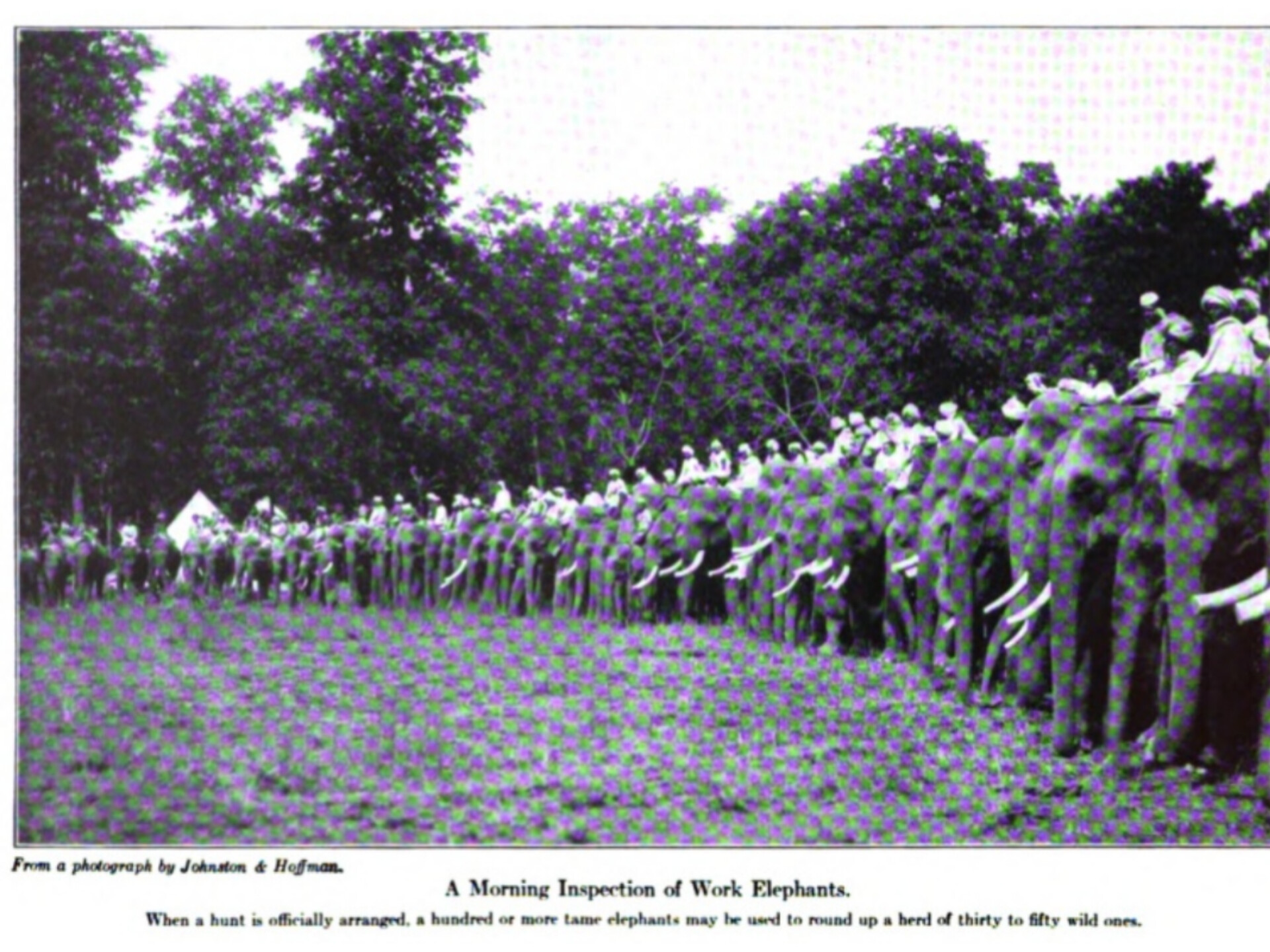
At present the excellently managed protected elephants of India — in Mysore, the Wynaad Forest, Cochin and the Animalai Hills, Ceylon, Burma, and Siam — seem to be in a good state of conservation. They are regarded as valuable state assets, and are treated accordingly. The day of the work elephant, in the timber-forest and on the rough jungle road, has by no means passed. The annual elephant fair and auction that regularly is held a short distance north of Calcutta still attracts about two thousand salable elephants each year, and makes an important event in Indian elephant history.
The training and working of elephants is one of the most fascinating chapters in the lore of wild-animal intelligence and training. Without loss of time I hasten to assure the reader that the officers of the Belgian Government, diligently working in the far interior of the Congo Territory for the past twenty years, have conclusively proved that the African elephant can be successfully caught and trained to service, along lines substantially parallel with those pursued with the Indian species. Unfortunately, however, the African blacks have not the slightest foundation of tame-elephant tradition and inherited elephant knowledge on which to build, and the Belgian officers found the Upper Congo negro as difficult to tame and train as the wild elephants of the jungle.
In India, the elephant-loving natives have for countless generations been catching wild elephants by wholesale trapping operations, breaking them, training them, and working them as regularly as horses and oxen. Elephant breeding is not pursued, for the very good reason that the process of rearing elephants from birth to adult age is too slow and too expensive. It is a hundred times more expeditious and economical to build a keddah, catch a whole herd of adult elephants in a few days, and in six weeks or so train them and put them to work earning an honest living. The shameless manner in which members of the Elephant Alumnæ Association cajole and bamboozle the newly caught wild elephants in the keddah (capture-pen) while the noosers get their ropes around the feet of the wild ones without being killed is rather shocking to the high judicial mind. Without the use of tame elephants as decoys the capture and breaking of the wild ones would indeed be a tough job.
It is at this point that the most marvellous feature of the elephant mind comes to view. Here it is:
Without any exceptions, every wild Indian elephant quickly learns that mind is superior to brute force; that it is wisest to accept the inevitable, and to become a cheerful and dependable civilized worker. This is not equally true of any other adult wild animal with which we are acquainted. Of chimpanzees, orangs, baboons, monkeys, lions, tigers, leopards, and bears, the individuals captured when fully adult are practically impossible for training. Of those species it is only the most intelligent individuals, reared from childhood in captivity, who respond to training, and are worth the effort to train them. In all those species, and also including horses and dogs, stupid individuals are common, and all such have to be discarded. Now, is it not remarkable that every elephant can become a trained performer?
The normal elephant has a sanguine and serene temperament, his nerves are not jumpy, his perceptive faculties and his memory are keen and precise, and his patience is infinite.
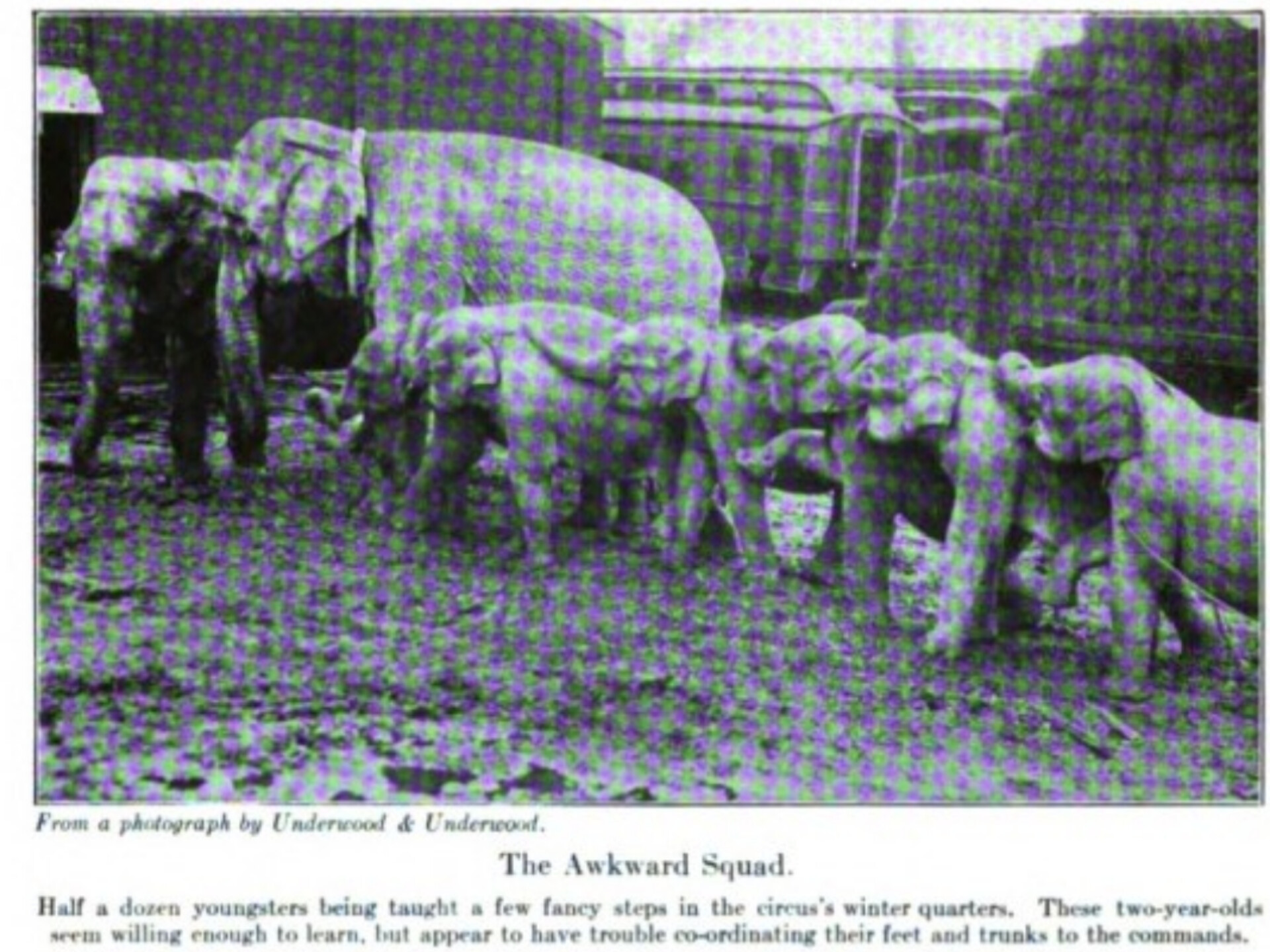
The number of things that an Indian elephant can be taught to do, and do correctly, is limited only by the mental capacity and industry of his trainer. Some of the elephant “acts” this day on the American vaudeville stage are simply marvellous. And the end is not yet. When some particularly ambitious and intelligent trainer by and by appears before the public with an elephant who can take a piece of chalk and write words upon a black-board, we will not be at all surprised. I am sure that it can be done, and in the near future will be done.
The most fascinating wild-animal sight of all India is a group of elephants at work on a busy day. Once upon a time (the time of my life!) it was my good luck to see, week after week, a lot of work elephants performing their daily tasks. Not only did I see them in the timber-forest and on the trail, but once I lived for about two weeks in a bamboo hut in a big camp of working elephants. The old white-bearded “elephant-doctor” was my best friend. Each morning the whole detachment (about thirty head) fell into line in front of the cook’s hut to receive, each one, a huge ball of boiled rice and a small lump of horrid brown sugar. Then they were marched down to the little mountain stream and permitted to drink. After that, they broke up into detachments, and each one briskly marched away into the jungle to where teak logs had been cut, hewn, and made ready for dragging.
The business of the elephants was to drag those big square logs, each with a “drag hole” cut at one end, over the moist and slippery floor of the forest to the top of a two-thousand-foot slide. There the workmen start the logs down the granite mountainside to the edge of the level plain below. I have seen some logging operations, but never anywhere else have I seen another trick turned like that.
In getting those logs in position at the top of the chute, the elephants knew as much about the business as the men. On account of the primitive manner of dragging, the elephants came into far closer touch with their mahouts than do elephants who drag by means of comfortable collars and traces. A big rope of soft bark was tied into the drag hole of a log, the elephant took the frayed-out other end between his molar teeth — crosswise, to bring all eight molars into action — and thus gripping the rope, with the head turned partly to one side, he heaved his great bulk forward, and the log had to follow or smash. But I never O.K.’d that method. It was unbusinesslike and unfair. It put a very improper strain on the neck vertebræ and muscles; and, besides, the elephant in the case could by no means exert all his potential strength.
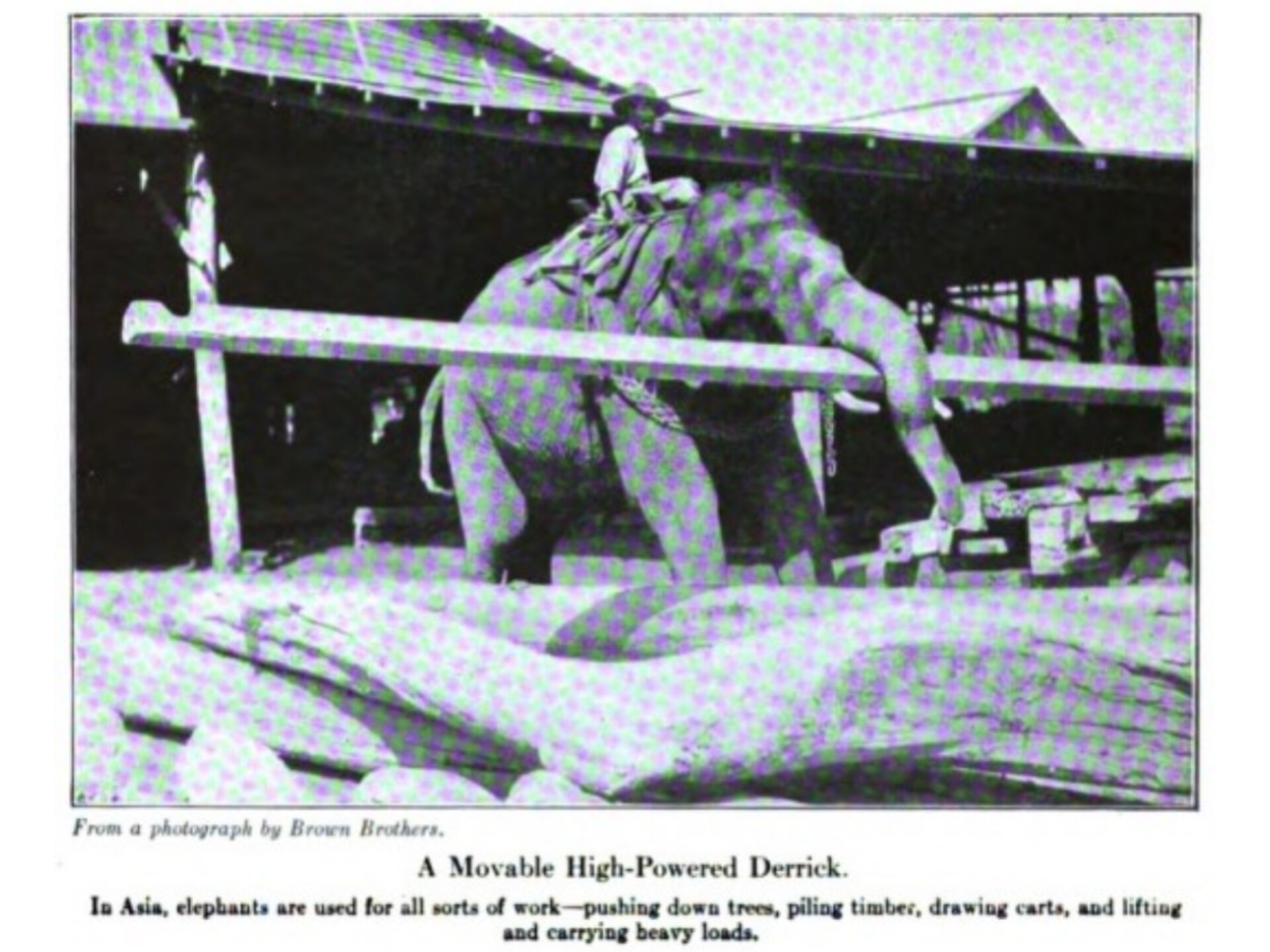
In the East Indies the work elephant and his mahout are just partners in the day’s work. The wise animal kneels to receive his pad and his load; and he rarely kicks about the classification of the freight. It may be crates of live chickens, field artillery and ammunition; food, liquors, live sahibs and memsahibs, or dead tigers; it is all the same to him. He will even take on a howdah with a green sportsman in it, and go out to hunt tigers in grass seven feet high, at the imminent risk of being shot by his own bronco sportsman or some other one.
If it is your elephant’s first tiger-hunt, and the first tiger put up is only wounded, and starts to climb up your elephant’s trunk to reach both mahout and sportsman, your elephant may lose his nerve and bolt for the rear; in which case that section of the hunt may terminate against a stout overhanging branch of an unlucky tree. The seasoned elephant, however, who has good courage and has hunted tigers before, is not stampeded by a furious tiger climbing up his head, and the hunter in the howdah then has a fair chance to shoot the tiger off his perch.
The achievements of actor-elephants on the stage and in the show-ring are well known. Some of them are marvellous exhibitions of keen and correct understanding, accurate memory, perfect obedience, and mechanical skill.
In our eighteen years of elephant maintenance and display in the New York Zoological Park, we have had few difficult cases. Gunda, a male Indian elephant who was born bad, grew up worse, and ended the worst of all elephants, is well known individually and by reputation to millions of people. For a time, while in his teens, he was amenable to reason, was ridden all about the park, and carried thousands of visitors on his back. But on reaching full maturity he became dangerous, and the last five years of his checkered life were devoted to efforts to kill certain marked victims.
When finally I sounded the depth of Gunda’s unhappiness, and measured the length and breadth of his determination to “get” his keepers, Walter Thuman and I went out for a quiet walk in the park while Mr. Carl E. Akeley, the elephant collector and sculptor-taxidermist, neatly and skilfully put poor old Gunda out of the way.
Our female Indian elephant, Alice, is erratic and hysterical whenever she is taken outside of her private park, and her specialty is wildly bolting into buildings that were not built for her. For an elephant this is in bad form; and nerves. once, when she bolted into the Reptile House, it jarred our nerves. Since that stirring event, wherein about eleven small snake cases were smashed, Alice has been officially under arrest and confined to her quarters. But she bears no malice, and seemingly has no thought of attacking any one.
A word in conclusion about the chance of the elephants of Africa to survive the present mad craze for the slaughter of big game.
Into the high, open, and healthful plateau regions of eastern Africa white settlers are going, intent upon making farms and homes. The colonial governments of Africa will not countenance interference with or injury to those pioneers by destructive wild elephants. As between elephants and settlers, the wild beasts will have to give way. But there should be no wild hysteria of elephant-killing because in a few places there is some excuse for it.
We hold that, in order to provide mounted specimens of elephants for museums the killing of a few elephants is justified. A sportsman when furnished with a permit to kill an elephant should be required to pledge himself to save its skin, skeleton, skull, or head to be mounted and placed on exhibition in a public museum.
We are assured that the Belgian Government is now considering the measures that should be taken to conserve and protect the valuable wild animals of its Congo Territory.
There is one danger of which all elephant-owning countries in Africa must beware. That is the owning and use of modern high-power rifles and fixed ammunition by natives. I speak of it here because of the new modern rifles recently obtained by the Arctic coast Eskimos, who, with them, already have exterminated the muskox of the Canadian Barren Grounds, save an estimated one hundred or less.
A hundred years from now Africa will be swarming with white people, gridironed by railroads, crowded with automobiles, and dotted all over with cities and towns. Then there will be five million rifles and pump-guns in use, and one or two of the Africanders who have no commercial interests at stake will be regretfully writing about “Our Vanished Game.”
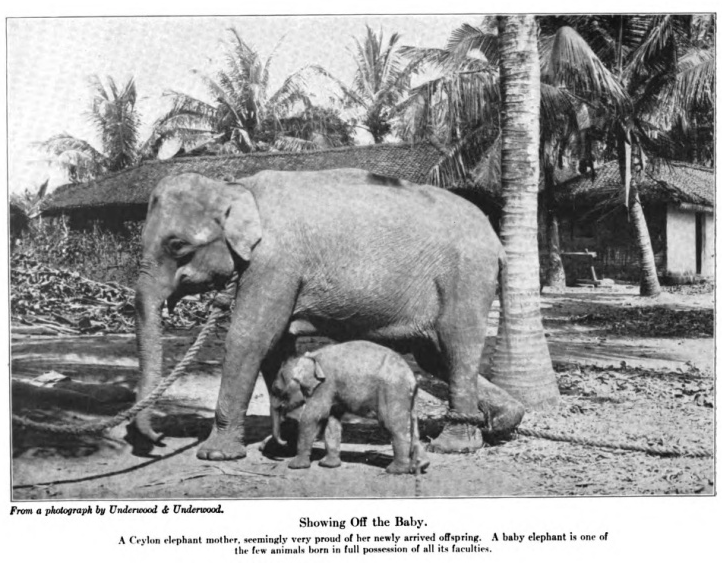
William T. Hornaday, A Wild-Animal Round-Up: Studies and Pictures from the Passing Show (New York: Charles Scribner’s Sons, 1925), pp. 189-205. Lead picture appears on page 193. Additional images appear on pages 193, 194, and 202.
See: https://babel.hathitrust.org/cgi/pt?id=mdp.39015012092428&seq=1