Italy

We want you to have a greater ability to learn about some of the unpleasant animal issues in our world.
Our Vanishing Wildlife; It’s Extermination and Preservation
William T. Hornaday
CHAPTER XI
SLAUGHTER OF SONG-BIRDS BY ITALIANS
In these days of wild-life slaughter, we hear much of death and destruction. Before our eyes there continually arise photographs of hanging masses of waterfowl, grouse, pheasants, deer and fish, usually supported in true heraldic fashion by the men who slew them and the implements of slaughter. The world has become somewhat hardened to these things, because the victims are classed as game; and in the destruction of game, one game-bag more or less “Will not count in the news of the battle.”
The slaughter of song, insectivorous and all other birds by Italians and other aliens from southern Europe has become a scourge to the bird life of this country. The devilish work of the negroes and poor whites of the South will be considered in the next chapter. In Italy, linnets and sparrows are “game”; and so is everything else that wears feathers! Italy is a continuous slaughtering-ground for the migratory birds of Europe, and as such it is an international nuisance and a pest. The way passerine birds are killed and eaten in that country is a disgrace to the government of Italy, and a standing reproach to the throne. Even kings and parliaments have no right in moral or international law to permit year after year the wholesale slaughter of birds of passage of species that no civilized man has a right to kill.
There are some tales of slaughter from which every properly-balanced Christian mind is bound to recoil with horror. One such tale has recently been given to us in the pages of the Avicultural Magazine, of London, for January, 1912, by Mr. Hubert D. Astley, F. Z. S., whose word no man will dispute. In condensing it, let us call it
THE ITALIAN SLAUGHTER OF THE INNOCENTS
This story does not concern game birds of any kind. Quite the contrary. That it should be published in America, a land now rapidly filling up with Italians, is a painful necessity in order that the people of America may be enabled accurately to measure the fatherland traditions and the fixed mental attitude of Italians generally toward our song birds. I shall now hold a mirror up to Italian nature. If the image is either hideous or grotesque, the fault will not be mine. I specially commend the picture to the notice of American game wardens and judges on the bench.
The American reader must be reminded that the Italian peninsula reaches out a long arm of land into the Mediterranean Sea for several hundred miles toward the sunny Barbary coast of North Africa. This great southward highway has been chosen by the birds of central Europe as their favorite migration route. Especially is this true of the small song-birds with weak wings and a minimum of power for long-sustained flight. Naturally, they follow the peninsula down to the Italian Land’s End before they launch forth to dare the passage of the Mediterranean.
Italy is the narrow end of a great continental funnel, into the wide northern end of which Germany, Austria, France and Switzerland annually pour their volume of migratory bird life. And what is the result? For answer let us take the testimony of two reliable witnesses, and file it for use on the day when Tony Macchewin, gun in hand and pockets bulging with cartridges, goes afield in our country and opens fire on our birds.
The linnet is one of the sweet singers of Europe. It is a small, delicately formed, weak-winged little bird, about the size of our phoebe-bird. It weighs only a trifle more than a girl’s love-letter. Where it breeds and rears its young, in Germany for example, a true sportsman would no more think of shooting a linnet than he would of killing and eating his daughter’s dearest canary.
To the migrating bird, the approach to northern Italy, either going or returning, is not through a land of plenty. The sheltering forests have mostly been swept away, and safe shelters for small birds are very rare. In the open, there are owls and hawks; and the only refuge from either is the thick-leafed grove, into which linnets and pipits can dive at the approach of danger and quickly hide.
A linnet from the North after days of dangerous travel finally reached Lake Como, southward bound. The country was much too open for safety, and its first impulse was to look about for safe shelter. The low bushes that sparsely covered the steep hillsides were too thin for refuge in times of sudden danger.
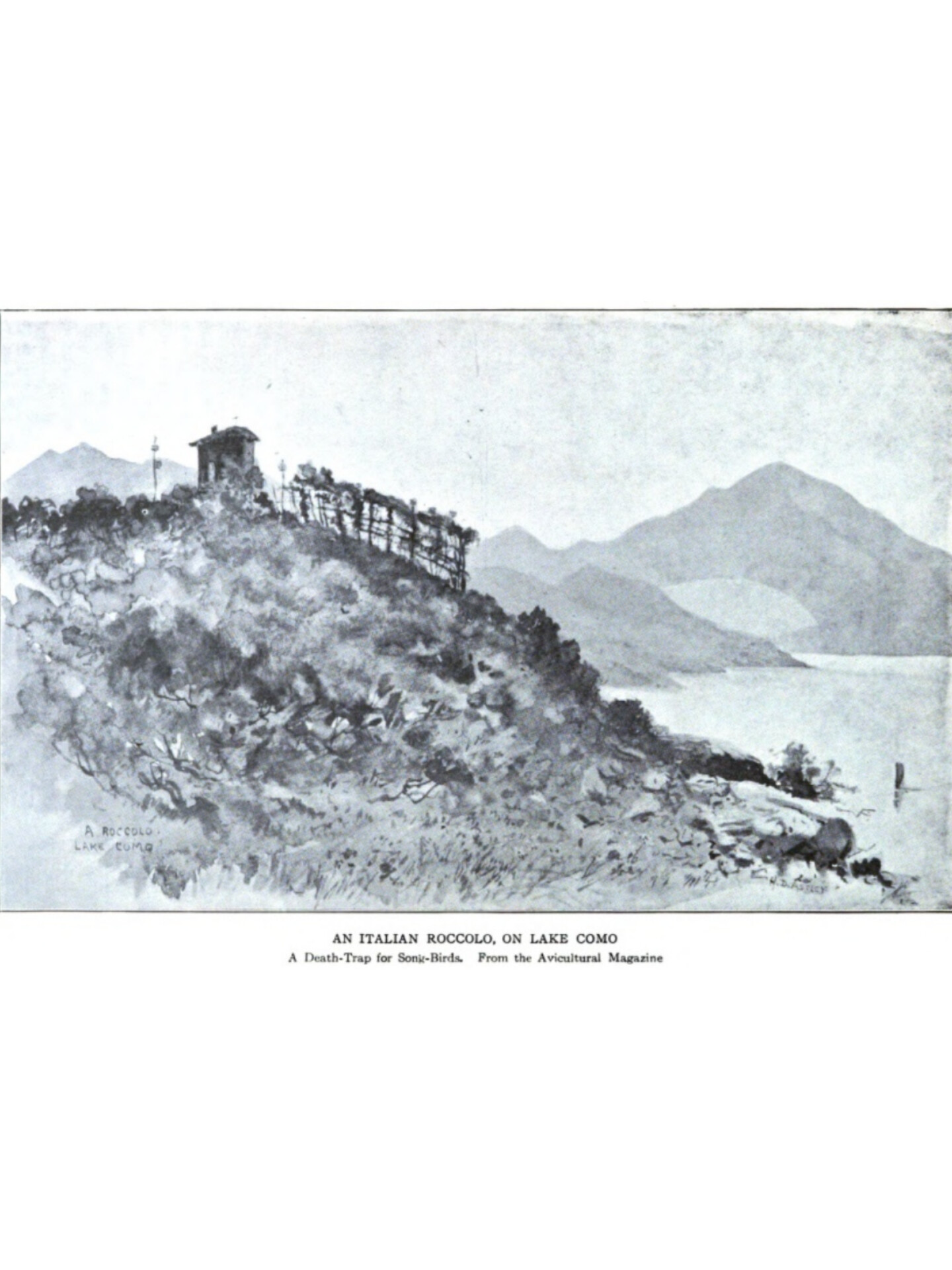
Ah! Upon a hilltop is a little grove of trees, green and inviting. In the grove a bird is calling, calling, insistently. The trees are very small; but they seem to stand thickly together, and their foliage should afford a haven from both hawk and gunner. To it joyously flits the tired linnet. As it perches aloft upon a convenient whip-like wand, it notices for the first time a queer, square brick tower of small dimensions, rising in the center of a court-yard surrounded by trees. The tower is like an old and dingy turret that has been shorn from a castle, and set on the hilltop without apparent reason. It is two stories in height, with one window, dingy and uninviting. A door opens into its base.
Several birds that seem very near, but are invisible, frequently call and chirp, as if seeking answering calls and companionship. Surely the grove must be a safe place for birds, or they would not be here.
Hark! A whirring, whistling sound fills the air, like the air tone of a flying hawk’s wings. A hawk! A hawk!
Down plunges the scared linnet, blindly, frantically, into the space sheltered by the grove!
Horrors! What is this?
Threads! Invisible, interlacing threads; tangled and full of pockets, treacherously spanning the open space. It is a fowler’s net! The linnet is entangled. It flutters frantically but helplessly, and hangs there, caught. Its alarm cry is frantically answered by the two strange, invisible bird voices that come from the top of the tower!
The grove and the tower are A ROCCOLO! A huge, permanent, merciless, deadly trap, for the wholesale capture of songbirds! The tower is the hiding place of the fowler, and the calling birds are decoy birds whose eyes have been totally blinded by red-hot wires in order that they will call more frantically than birds with eyes would do. The whistling wings that seemed a hawk were a sham, made by a racquet thrown through the air by the fowler, through a slot in his tower. He keeps by him many such racquets.
The door of the tower opens, and out comes the fowler. He is low-browed, swarthy, ill kept, and wears rings in his ears. A soiled hand seizes the struggling linnet, and drags it violently from the threads that entangled it. A sharp-pointed twig is thrust straight through the head of the helpless victim at the eyes, and after one wild, fluttering agony — it is dead.
The fowler sighs contentedly, re-enters his dirty and foul-smelling tower, tosses the feathered atom upon the pile of dead birds that lies upon the dirty floor in a dirty corner, — and is ready for the next one.
Ask him, as did Mr. Astley, and he will tell you frankly that there are about 150 dead birds in the pile, — starlings, sparrows, linnets, green finches, chaffinches, goldfinches, hawfinches, redstarts, blackcaps, robins, song thrushes, blackbirds, blue and coal tits, fieldfares and redwings. He will tell you also, that there are seven other roccolos within sight and twelve within easy walking distance. He will tell you, as he did Mr. Astley, that during that week he had taken about 500 birds, and that that number was a fair average for each of the 12 other roccolos.
This means the destruction of about 5,000 songbirds per week in that neighborhood alone! Another keeper of a roccolo told Mr. Astley that during the previous autumn he took about 10,000 birds at his small and comparatively insignificant roccolo.
And above that awful roccolo of slaughtered innocents rose a wooden cross, in memory of Christ, the Merciful, the Compassionate!
Around the interior of the entwined sapling tops that formed the fatal bower of death there hung a semicircle of tiny cages containing live decoys, chaffinches, hawfinches, titmice and several other species. “The older and staider ones call repeatedly,” says Mr. Astley, “and the chaffinches break into song. It is the only song to be heard in Italy at the time of the autum migration.”
And the King of Italy, the Queen of Italy, the Parliament of Italy and His Holiness the Pope permit these things, year in and year out. It is now said, however, that through the efforts of a recently organized bird-lovers’ society in Italy, the blinding of decoy birds for roccolos is to be stopped.
In Germany, Austria, and Switzerland, the protection of these birds during their breeding season must be very effective, for otherwise the supply for the Italian slaughter of the Innocents would long ago have fallen to nothing.
The Germans love birds, and all wild life. I wonder how they like the Italian roccolo. I wonder how France regards it; and whether the nations of Europe north of Italy will endure this situation forever.
To the American and English reader, comment on the practices recorded above is quite unnecessary, except the observation that they betoken a callousness of feeling and a depth of cruelty and destructiveness to which, so far as known, no savages ever yet have sunk. As an exhibit of the groveling pusillanimity of the human soul, the roccolo of northern Italy reveals minus qualities which can not be expressed either in words or in figures.
And what is the final exhibit of the gallant knight of the roccolo, the feudal lord of the modern castle and its retainers?
The answer is given by Dr. Louis B. Bishop, in an article on “Birds in the Markets of Southern Europe.”
In Venice, which was visited in October and November, during the fall migration, he found on sale in the markets, as food, thousands of songbirds.
“Birds were there in profusion, from ducks to kites, in the early morning, hung in great bunches above the stalls, but by 9 A. M. most of them had been sold. Ducks and shorebirds occurred in some numbers, but the vast majority were small sparrows, larks and thrushes. These were there during my visit by the thousands, if not ten thousands. To the market they were brought in large sacks, strung in fours on twigs which had been passed through the eyes and then tied. Most of these small birds had been trapped, and on skinning them I often could find no injury except at their eyes. One of these sacks which I examined on November 3, contained hundreds of birds, largely siskins, skylarks and bramblings. As a rule the small birds that were not sold in the early morning were skinned or picked, and their tiny bodies packed in regular order, breasts up, in shallow tin boxes, and exposed for sale.”
“During these visits to the Venetian markets, I identified 60 species, and procured specimens of most. As nearly as I can remember, small birds cost from two to five cents apiece. For example I paid $2.15 on Nov. 8, for
1 Woodcock, 1 Jay, 2 Starlings, 2 Spotted Crakes, 1 Song Thrush, 1 Gold-Crest, 1 Skylark, 1 Greenfinch, 1 Bullfinch, 1 Redpoll, 3 Linnets, 2 Goldfinches.
It is probable that these birds were killed by piercing the head through the eyes.
1 Long-Tailed Titmouse, 1 Great Titmouse, 1 Pipit, 1 Redstart, 6 Siskins, 3 Reed Buntings, 3 Bramblings and 5 Chaffinches.
‘On November 10, I paid $3.25 for
2 Coots, 1 Water Rail, 1 Spotted Crake, 1 Sparrow Hawk, 2 Woodcock, 1 Common Redshank, 1 Dusky Redshank, 1 European Curlew, 2 Kingfishers, 2 Greenfinches, 2 Wrens, 1 Great Titmouse, 1 Blue Titmouns, 1 Resbreast, and 2 Dunlins.”
Of course there were various species of upland game birds, shorebirds and waterfowl, — everything, in fact, that could be found and killed. In addition to the passerine birds Dr. Bishop noted the following, all in Venice alone:
Skylark (“in great numbers”), Crested Lark, Calandra, Tree Sparrow, Hawfinch, Yellow-Hammer, Blackbird, Fieldfare, Song Thrush, Crossbill, House Sparrow, Stonechat, Coal, Goldcrest, Rock Pipit, White Wagtail, Redwing.
“In Florence,” says Dr. Bishop, “I visited the central market on November 26, 28, 29, 30, December 1, 2, 3, 5, 6, 7, 8 and 9, and found birds even more plentiful than in Venice. Besides a variety of game birds, he found quantities of the species mentioned above, seen in Venice, and also the following:
Green Sandpiper, Dotterel, Magpie, Corn Buninting, Migratory Quail, Green Woodpecker, Spotted Woodpecker, Wood Lark, Brown Creeper, Nuthatch, Black-Cap Warbler, Black-Headed Warbler, Fantail Warbler, Missel Thrush, Ring Ouzel, Rock Sparrow, and Gray Wagtail.
“Here, too [at Florence] we saw often, bunches and baskets of small birds, chiefly redbreasts, hawked through the streets. . . . Every Sunday that we went into the country we met numbers of Italians out shooting, and their bags seemed to consist wholly of small birds.
“At Genoa, San Remo, Monte Carlo and Nice, between December 13 and 29, I did not visit the central markets, if such exist, but saw frequently bunches of small birds hanging outside stores. . . . A gentleman who spent the fall on an automobile trip through the west of FRANCE from Brittany to the Pyrenees, tells me he noticed these bunches of small birds on sale in every town he visited.
“That killing song-birds for food," continues Dr. Bishop, “is not confined to the poor Italians I learned on October 27, when one of the most prominent and wealthy Italian ornithologists — a delightful man — told me he had shot 180 skylarks and pipits the day before, and that his family liked them far better than other game. Our prejudice against selling game does not exist in Europe, and this same ornithologist told me he often shot 200 ducks in a day at his shooting-box, sending to the market what he could not use himself. On November 1, 1910, he shot 82 ducks, and on November 8, 103, chiefly widgeon and teal.”
An “ornithologist” indeed! A “sportsman“also, is he not? He belongs with his brother “ornithologists” of the roccolos, who net their “game” with the aid of blind birds!
Brave men, gallant “sportsman“ are these men of Italy,—and western France also if the tale is true! . . .
William T. Hornaday, Our Vanishing Wildlife; It’s Extermination and Preservation (New York: Charles Scribner’s Sons, 1913), 94-100.
See:https://babel.hathitrust.org/cgi/pt?id=mdp.39015006901212&seq=1.