Ivory Trade
We want you to have a greater ability to learn about some of the unpleasant animal issues in our world.
Ivory and the Elephant in Art, in Archaeology, and in Science
George F. Kunz
CHAPTER XII
THE COMMERCE OF IVORY
The Arab traveller Soleiman, writing in the ninth century, notes ivory among the principal articles imported into the port of Canton for distribution in China; the others were frankincense, copper, tortoise-shell, camphor, and rhinoceros horns. Three tenths of the merchandise was kept by the Chinese Government as import duty, the balance being turned over to the merchants to do as they pleased with. The same writer remarks that the Chinese women adorned their heads with a number of small combs of ivory and other materials, as many as a score of these being sometimes worn together.
Those who imported ivory into China by way of Canton in the ninth century of our era were not only forced to yield the high import dues we have noted, but were forced to sell all tusks weighing 30 catties or more (about 40 pounds or upward) in the official market, where there was commonly great undervaluation. Of course the consequent exclusion of competition must have been felt as a great hardship. To escape this restriction but one way was open: to cut up the heavier tusks so that each separate piece would weigh less than the limit set for the official market. Any attempt to evade the strict customs regulations was severely punished. Should any trader remove the smallest object from the ship’s cargo, the whole cargo was confiscated and, over and above this, the guilty trader was punished in an exemplary manner.
From Marco Polo’s accounts, the ivory market in Zanzibar flourished in the thirteenth century, for, treating of Madagascar and Zanzibar, he asserts that there were more elephants there than in any country in the world, and he adds: “The amount of traffic in elephants’ teeth in these two islands is something astonishing.” Although, from certain errors in his description of this region, he appears to have derived his facts at second hand and confused some of his data, this statement in regard to the ivory traffic of Zanzibar is almost unquestionably correct.
One of his erroneous assertions in reference to elephants here is interesting enough in itself to be cited, more especially as it was undoubtedly true for other regions. This is that the natives, when about to bring up a war elephant to the attack, would “ply him well with their wine,” until he was half drunk. In this state of semi-intoxication the animal was fiercer and bolder than when sober, and his attack was more impetuous. This can, however, scarcely refer to Zanzibar, for the trustworthy Arab writer, Mas’udi, definitely asserts that elephants were not tamed or trained there in any way, and that the natives only hunted them to kill them.
Although many of the ancient trade routes have been abandoned for one reason or another, still in a number of cases the old order of things has been maintained with but little change. In the ivory trade, for instance, the port of Aden on the coast of Arabia, at the entrance to the Red Sea and commanding the Strait of Bab-el-Mandeb, is to-day, as it was centuries ago, a centre of distribution for East African ivory. Vessels came hither in medieval times from all parts of the world, and among the innumerable articles of commerce were elephants’ tusks from Abyssinia, which land furnished an immense supply of elephant ivory.* Aden is now strongly fortified and has been called the “Gibraltar of the East.”
There can be little doubt that, as a general rule, the European supply of ivory was mainly, though perhaps not exclusively, derived from Africa. It is true there appears to be good evidence that in certain periods a considerable quantity of elephant tusks were brought from India, but in spite of the express statements to this effect made by the Venetian traveller, Marco Polo, and others, it is not unlikely that what they believed to be Indian ivory had originally come from Africa and either been transshipped from some Indian port, or shipped at some African port, or one in touch with Africa, by Indian trading vessels.
Indeed, the older writers, beginning with Cosmas Indicopleustos, insist upon the large quantity of African ivory imported into India, and as late as the sixteenth century we are told by Garcias ab Horto that the annual importation amounted to 600,000 pounds, probably an excessive estimate. Several considerations, besides the active native industry in ivory working, conspired to this end. In the first place the tusks of the African elephants are, on the average, both larger and heavier than are those of the Indian elephants, and they are present with the females as well as the males of the species; then, in medieval and later times, these animals have been domesticated and trained in a great variety of ways in India, whether as war elephants, as beasts of burden, or in hauling and carrying materials for construction, etc.
Moreover, in many parts of India and the contiguous countries in which elephants are to be found, religious superstition has sometimes invested them with a quasi-sacred character. Hence elephant hunting, not for the purpose of capturing and training the animals, but merely to kill them and cut out their tusks, while actively pursued for many centuries in Africa, has been carried on but rarely in India, the native Indian ivory coming almost invariably from animals which have died a natural death, and as the elephant is exceptionally long-lived, the supply from this source has been limited.
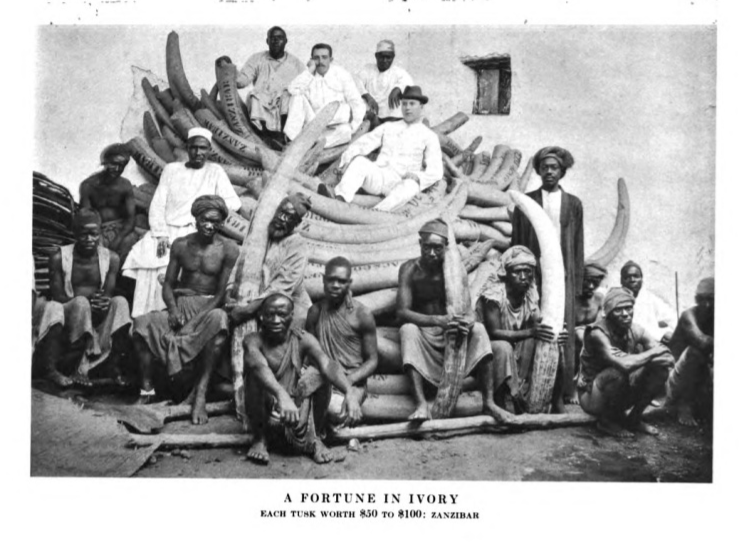
The commerce in ivory in the interior of Africa is now carried on by caravans under the conduct of Negroes or Arabs, the funds being furnished by the European or Hindu merchants, as it very rarely happens that the leader of the caravan operates with his own resources. The German product is chiefly shipped from Bagawayo, Saadani, and Pangani; the posts for British ivory are Mombasa, Lamu, and Kismayu. While Bagawayo was formerly the most important of the posts, Mombasa has recently made very rapid headway.
Statistics show that about 1830 the average imports of ivory into Great Britain totalled 462,000 pounds; of this 330,000 were retained for home consumption. Even at this time it was feared the breed of elephants was threatened with extinction, owing to the wholesale slaughter of these animals. England’s supply came from the west and east of Africa, the Cape of Good Hope, Ceylon, India, and the countries to the eastward of the Straits of Malacca.
In 1831 West Africa furnished Great Britain with 288,400 pounds of ivory, the Cape sending only 22,170 pounds; from India came 243,300 pounds. At this time the Chinese drew their supply from Malacca, Siam, and Sumatra (probably also from Ceylon). The work of Chinese ivory carvers seems to have been more highly appreciated in Europe about 1830 than it is to-day, as our authority says: “The preparation of this beautiful material is much better understood by the Chinese than by any other people.” The undoubted ingenuity and technical skill of the Chinese carvers seems to have caused many to overlook their artistic shortcomings [The price chart for 1833 has been deleted]…..
The size of the tusks of course affects the value of the material, as the larger the pieces of ivory, the wider the range of use. All tusks weighing less than 18 pounds were designated “scrivelloes.”
As with other commodities, the price of ivory has had wide fluctuations. In illustration of this we may take the average figures per hundredweight for the quarterly sales of billiard ball pieces of all grades in the London salesrooms in Mincing Lane during certain years, as follows:
1870 £155
1880 90
1890 112
1900 68
1905 167
The prices for less valuable material followed this general trend. Ivory always commands full value; for there is little or no material wasted, even the dust being available for polishing, for making India ink, or for the making of “ivory jelly.”
The progressive increase in sales in the London market is shown by the fact that toward the close of the eighteenth century they totalled something less than about 192,000 pounds annually, on an average, while in 1837 they had risen to 364,784 pounds, and had reached 1,000,000 pounds in 1864. According to the London Board of Trade figures, 1,434,900 pounds of ivory were imported in 1890; 1,091,100 pounds in 1895; while the figures declined to 988,900 pounds in 1900 and to 904,500 pounds in 1904.
Bombay secures the main part of its supply of ivory from Zanzibar, Mozambique, and Aden. The total imports for the year 1883-4 were 462,403 pounds, of which 197,866 pounds were exported again, principally to London (167,150 pounds). Of the imports Zanzibar furnished 178,278 pounds, Mozambique 109,327 pounds, and Aden 49,730 pounds; from England came 98,463 pounds.
A good average tusk weighs about two maunds, something over 57 pounds, and sells at the rate of 250 rupees ($80) per maund. Zanzibar ivory pays an import and export duty to the Sultan of the country amounting to 25 rupees ($8) per maund (about 29 pounds). On every tusk put through the custom house the Sultan’s seal is cut when the duty has been liquidated.
The ivory received in Bombay is not exported in the form of tusks, but the latter are cut up and the parts variously distributed. To Europe go the solid tips especially well adapted for the manufacture of billiard balls, and also the bases of the hollow shaft of the tusks, known as “bamboo ivory.” For home consumption the middle part of the tusk is reserved; this is called churdar, from its use in the making of churis, or bangles; China receives a small amount of an inferior material.
A somewhat curious circumstance is that those who cut up the tusks do not receive any remuneration in money, although the employer furnishes the requisite tools, but they are allowed to keep the ivory dust, for which they find purchasers among cattle raisers, who believe that milch cattle will secrete milk more abundantly if they be given a solution of ivory dust. Another use (in Northern India) is as a tonic medicine. A recent ordinance provides that in the State of Mysore all elephant tusks shall be sold at public auction by the district treasury officer, at Bangalore, once every year.
The internal commerce in ivory is mainly carried on by Marawis, who furnish the stocks for the chief markets, Palee in Jodhpur, Surat in Guzerat, and Amritsar in the Panjab. This last-named mart supplies in its turn the material for the Delhi comb makers and for the inlayers of Dera Ismail Khan, while a good part of the ivory is kept in Amritsar where the small combs worn by the Sikhs are produced in great quantity. These combs constitute an important article of masculine dress among the Sikhs, as the religious regulations do not permit the men to cut their hair, and it has to be carefully bound up and kept in place by a comb beneath the turban.
Strange to say, the Marawi traders, as they belong to the religious sect of the Jains, are not able to come into direct contact with the elephant tusks, because the touching of an animal substance constitutes a pollution. Hence the material in which they deal must be handled and weighed by Mohammedans in their employ.
The striking change in the location of the chief distributing point in Europe for ivory is exemplified by a comparison of statistics for 1908, and for a date twenty years earlier. While at the earlier date the annual sales of ivory were 373 tons in London and but 6 tons in Antwerp, in 1908 sales on the London market had fallen to 214 tons, while in Antwerp 227 tons of ivory were sold. This change in markets is of course directly due to the large exportation in recent years from the Belgian Congo.
The German territory of Cameroon in Central Africa has furnished a small, but recently a decreasing, supply of ivory. The figures for 1910, when 38 tons of the material were exported, show a decrease of 16 tons from those of the previous year, the value falling off from $219,705 to $156,395. The prohibition to shoot young elephants, rendered imperative in order to save the breed from extinction, has been often violated by the natives, who have smuggled the tusks they obtained across the French Congo. It appears that with the annexation of what is called the “New Cameroon” territory, recently ceded by France to Germany in connection with the Morocco arrangement, the export of ivory from Cameroon will increase, for a German sportsman came across many elephants on a trip lately made to this newly acquired territory, although he had failed to find any in the old Cameroon territory.
In German East Africa there has also been a falling off in ivory exports for 1910 and 1911 from the higher figures for 1909. By some it has been stated that this results from a decrease in the number of “large tuskers,” but others believe that the diminished supply is rather due to the enforcement of a new game law for the protection of elephants toward the end of 1911. The chief port for ivory exports here is now Dar-es-Salaam, Bagawayo having lost its earlier primacy in this respect. As an intermediate centre for ivory Zanzibar has not maintained its rank, the volume of trade in ivory here having fallen from £45,000 in 1909 to but £28,900 in 1910 [The price chart for German East Africa has been deleted]….
Aden, long so important as an ivory market, has lately lost much of its trade in this material. [The price chart for Aden has been deleted]….
The entire stock on hand, early in 1914, was but 8,000 pounds, and this was held in the anticipation of obtaining better prices later on. The fact that most of the ivory from the Sudan is now shipped either directly overland or by way of Jibati is cited as one of the principal causes of Aden’s loss of ivory trade. Another cause is stated to be the lapsing of a contract accorded by the late Negus of Abyssinia, giving to one of the leading ivory dealers of Aden an option upon Abyssinia’s share of the ivory secured in these regions.
In the French Asiatic colony of Laos each of the captive elephants, which are quite numerous, is provided with a duly registered card of identification, and if any owner of an elephant decides to sell the animal out of the country, he is obliged to pay half of the value into the local treasury. The price is said to vary, according to age, sex, degree of training, or length of tusks, from 600 to 1,500 piastres; ivory brings in Laos from 15 to 20 francs per kilogram.
The Governor-General of French Equatorial Africa reported recently that while at the time the French first occupied this region a considerable stock of ivory existed there, this stock has been exhausted, and the ivory exports are now comparatively stationary, amounting to about 160 tons annually. As to a prospective increase of these exports, the Governor-General was not very sanguine, in spite of the fact that herds of from eighty to one hundred elephants are still occasionally to be met with in this territory.
Ivory, as well as hippopotamus teeth and rhinoceros horns, has for years been counted among the staple products of the British East African Protectorate on the Indian Ocean. Some of the ivory goes to London and a certain quantity is sent to the United States. The total value of the ivory exports from Mombasa, the seaport of the Protectorate, for the six months ending June 30, 1909, was $170,876, of which sum $68,178 represented the value of the Congo ivory shipped by way of this port.
The strong competition of Mombasa has affected the trade of Zanzibar so unfavourably that even apart from the general demoralization due to the outbreak of war, this trade showed a falling off in 1914, and figures for the entire year, including the war period, are much lower than those for 1913. This is true of the ivory imports and exports as of those of other merchandise. Of course the imports of ivory are only made to re-export the material, Zanzibar being thus a mere port of transit [The price chart for Zanzibar has been deleted]….
Ivory merchants claim that the elephants living on opposite sides of a lake in Africa, eleven miles long, although of the same species, furnish ivory differing as much in quality as does Egyptian ivory from that of the Congo. Indeed, ivory of the same district will often vary greatly. While some Congo ivory is hard, brittle, white, and translucent, other material from the same region will be opaque, and soft in texture as that from Zanzibar; it may also be greenish tinted at the nerve-centres.
A large part of the trade in ivory imported to Europe is in the hands of two firms, Messrs. Hale & Sons of London and Messrs. Lansberger & Cie. of Antwerp, the latter house taking all the ivory from the Belgian Congo. The price of choice pieces of ivory in the London market is sometimes very high. For instance, while in 1908, $453 per cwt. represented a record figure for whole tusks, $750 per cwt. was paid for cut points especially suitable for billiard balls.
The general price-movement of ivory in the New York market during the past thirty-eight years is shown in the following figures, which note the weight of the ivory purchased at a given date in the year and the price per pound; this is only for the finest selected material, and not for an average quality: [The price chart for New York has been deleted]….
As we have already stated, these relatively high prices have been paid for ivory of superior quality, such as is constantly in demand for the manufacture of billiard balls, of the finest toilet articles, etc. This is clearly brought out by the last entry in the list, noting the purchase of 122 pounds’ weight of ivory at an average price of $3.84 a pound, while at about the same time the average value per pound of the ivory imports was a trifle over $2.50. On April 8, 1907, as high as $4 a pound was paid although the average value of the imports for that year was $3.10 a pound.
It will be noted that the price in 1912 is but 8 per cent. higher than it was in 1875, the intermediate fluctuations following, in the main, the general financial condition of the country.
As London is still recognized as a great ivory mart, although of late years the Antwerp sales of Congo ivory have attracted many buyers, English and Continental, the German ivory dealers having their main offices in Hamburg usually keep also a branch house in London. Of a total importation into Germany of 315.7 tons of ivory in 1912, 102 tons came from England.
The various grades are specially named, tusks under 20 pounds’ weight, for instance, being called scrivelloes; of these the tusks suitable for billiard balls are called “ball scrivelloes,” the smaller ones being designated as “bagatelles,” and others according to their form or quality “hollows,” “cores,’ or “defectives.” The London sales of April, 1913, were but 34 tons as against 45 tons in the same month of 1912. Importations from January 1 to March 31, 1913, amounted to 64 tons; for the same period in 1912, to 66 tons, while deliveries, 71 tons in 1913, were 85 tons in 1912. Stock in dock warehouses was greater in 1913 than in 1912, the respective figures being 72 tons and 62 tons.
As there is a constant demand for all varieties of ivory, and as the greater part of the buyers are excellent judges of form and quality, there is less tendency to violent fluctuations in the ivory market than in many others. It but rarely happens that the supply outruns the demand to any considerable extent or for any length of time. [The price chart for London sales in April, 1913 has been deleted]….
At the quarterly sale in Antwerp in May, 1913, ivory weighing 92 tons was disposed of, as against 87 tons at the same time in 1912. Of this total 53½ tons was Central African; 26 tons Angola; 4 tons Congo; 2 tons Swift-Congo; 4 tons Abyssinian; 1 ton Senegal; ½ ton Hard Egyptian, and ½ ton Soft Egyptian. Good prices were realized as there was considerable competition, the demand from America and the Continent being quite active, the London and Sheffield trades, however, only bought moderately. The increase in price amounted to £2 per cwt. for large and medium hard teeth; scrivelloes (tusks under 20 pounds) registered an advance of £2 or £3 per cwt.
The total imports of ivory into the United States according to official figures are here given for the years 1884 to 1911 inclusive, as well as the value of these imports and the average value per pound. From 1884 to 1894 this covers “animal ivory, not sawed, cut, or otherwise manufactured.” This limitation was changed in 1895 to “animal ivory, sawed or cut into logs, but not otherwise manufactured,” and still further modified in 1898 to “ivory in its natural state: tusks cut vertically across the grain only, with the bark left intact.” The advances noted above amount to from about 8 cents to 13 cents above the prices previously obtained. Of course, the New York prices have been mainly based upon those of the London and Antwerp markets, no duty having been imposed on unmanufactured ivory until October 4, 1913. Immediately after that date imports decreased notably, but would have risen again to the normal level if the great war had not ensued nine months later. [The price chart for New York has been deleted]….
As will be seen, the highest average value was in 1886 and the lowest in 1901, while that of the years 1909 and 1910 almost exactly agrees with the average for twenty-eight years. [The price chart for the years 1913 and 1914 in New York has been deleted]….
It will be noted that while the weight of ivory imported last year [1914] was much less than in either of the preceding fiscal years, the average value per pound was considerably greater and, indeed, exceeds that of any calendar year since 1896, excepting the years 1907 and 1908. Undoubtedly the imposition of an ad valorem duty of 20 per cent. after October. 4, 1913, explains in part the diminished imports, but recently the great war has been the most active cause. There can be little doubt that with the resumption of free commercial intercourse between Europe and the United States, and with the cessation of the numerous and unavoidable interruptions to trade that the war has caused, the ivory market will rapidly improve in every way.
The weight and value of the ivory imported into the United States from all parts of the world during the years 1902 to 1911, arranged according to the sources of supply, were as follows: [The price charts for the United States have been deleted]….
The corresponding figures for the fiscal year ending June 30, 1913, were $34,943.27, and for the year ending June 30, 1914, $51,697.69. To this should be added, for dice, dominoes, draughts, chessmen, and for billiard, pool, and bagatelle balls of ivory, bone, or other materials, $61,108 in 1913, and $67,789 in 1914.
The duties on unmanufactured ivory have varied less in the past fifty years than have those imposed upon some other materials, destined to be worked up into articles of luxury. From 1867 to 1871 the duty was 10 per cent. ad valorem, this impost being removed in the latter part of 1871. Until October 13, 1913, ivory (unmanufactured) remained free of duty, the impost since then, under the so-called Underwood Tariff, being 20 per cent. ad valorem. Manufactured articles, whether of ivory or bone, such as chessmen, dice, draughtsmen, etc., were dutiable from 1867 to 1913 at a rate of 50 per cent. ad valorem, other manufactured articles of vegetable ivory, bearing a duty of 35 per cent. from 1867 to 1883, 30 per cent. from 1884 to 1891, 40 per cent. from 1891 to 1895, and 35 per cent. ad valorem from August 28, 1895, to the present time. On unmanufactured vegetable ivory no duty has been imposed.
In an earlier chapter the principal ivory substitutes have been described and some details given of their use. For the cheaper toilet articles, and for a number of other objects, celluloid has been quite extensively employed, although it is not a very satisfactory substitute. The value of the manufactured, or partly manufactured, material imported has varied widely in the different years, owing to the character and quality of the workmanship, the cost of manufacture being of course the main element of value. Thus when a large quantity of fully manufactured articles are imported, the total value will be many times what it would have been if a great share of the material had been brought in only partly finished, or only prepared for working. The use of celluloid for the small front facing of piano keys has been alluded to in the chapter on the working of ivory. [The price chart for imported celluloid articles to the United States, as well as other charts have been deleted]….
Perhaps, in the interest of the ivory trade, the partial check upon ivory exports in some parts of Africa and their total cessation in others, is no unmixed evil, for this state of things operates automatically to check the destruction of the elephants even more effectively than do the special laws and regulations enacted for this purpose in the elephant regions of Africa. [Various import and export charts, including Germany, have been deleted]….
The rapid and progressive falling off in these exports is very noteworthy [up to 1913]. Owing to the intercourse with Germany resulting from England’s control of the seas, later figures are not available and of course this trade, as far as Germany is concerned, has come to a standstill. [Export chart from the Congo has been deleted]….
Perhaps, in the interest of the ivory trade, the partial check upon ivory exports in some parts of Africa and their total cessation in others, is no unmixed evil, for this state of things operates automatically to check the destruction of the elephants even more effectively than do the special laws and regulation enacted for this purpose in the elephant regions of Africa. [Various import and export charts have been deleted]….
There has been a general decrease in the average weight of the tusks imported to Antwerp. In 1889 this average was 12 1/2 kilograms and in 1890 10 9/10 kilograms; but in 1896 the average had fallen to 6 2/5 kilograms, recovering somewhat from this low point to 9 kilograms in 1900 and 8 3/8 kilograms in 1901.
Although this necessitates a repetition of the figures for the Antwerp sales, we give here the sales from 1886 at the three European ivory marts, Antwerp, London, and Liverpool, so as to exhibit in a graphic way the passage of the primacy in this trade from London to Antwerp. What the further development may be when the port of Antwerp is again opened to the world’s commerce it would not be easy to predict with any certainty, but trade routes are not often completely and radically changed in accord with temporary political vicissitudes. This is the lesson taught us by history, both ancient and modern, many of the Asiatic and African trade routes having been used for commercial intercourse from the very dawn of history; indeed, the use of some of them must considerably antedate our oldest historic records. [Sales and other charts have been deleted]….
The value per hundredweight (112 lbs.) of sound, fresh mammoth ivory in the London market is stated to have ranged, not long ago, all the way from 20 shillings to £15 or even £30 for exceptionally fine tusks. For the past year, of course, there have been no shipments of this ivory received in England. Even the highest of the prices noted is very considerably lower than those commanded by ivory from the living African elephants.
Since 1906 ivory has been exported from the Anglo-Egyptian Sudan in annually increasing quantities, the increase in the six years from 1906 to 1912 being very marked; in the first-named year only 20,354 kilos were exported, but in 1912 the weight of the exported ivory was 106,755 kilos. This would indicate the killing of 4,000 elephants in the latter year (although of course part of the ivory may have come from animals that died a natural death), if we figure on the ascertained average of about 13 kilos for each tusk. The provinces Bahr-el-Ghazal and Mongalla furnish the greater part of the supply, the balance coming from the region of the Sobat and its tributaries and the Bahr-el-Arab country. The centres for ivory trade are Khartoum and Omdurman, and most of the product finds its way to the London market. [The 1912 Sudan export chart has been deleted]….
Only a very small quantity is exported at present from Sierra Leone.
The import and export movement in the Indian ivory trade, as given for 1904-5, shows that while the value of the ivory imported was 7,439,671 rupees ($2,478,890), the exports of ivory and of manufactures thereof totalled but 585,934 rupees ($195,311); the manufactured product probably represented a considerable percentage of the whole value.
While in the first two ivory sales in the London market in 1914 prices were practically unchanged, the financial distrust due to expectation of war made itself felt at the July sales, causing a general decline, except in the case of “ball ivory,” which brought as much or even a little more than at the earlier sales. The regular October sales were indefinitely postponed, but many private transactions have taken place. In these, hard ivory has maintained its price, but the less valuable qualities, such for instance as the grades known in the trade as “soft scrivelloes” and “cut hollows,” have found little demand.
It is noteworthy, however, that in general the dealings in ivory have been less seriously interfered with than those in most other articles of luxury. The supplies of Egyptian and West Coast African ivory have been larger in 1914 than in 1913. But few walrus tusks have been received, the demand being slack and the prices lower; a limited quantity of boars’ tusks was disposed of at unchanged prices. The stock of ivory on hand in London at the close of 1914 was 188 tons, against 105 tons at the end of 1913, this notable increase being due to the transfer from Antwerp of a large quantity of Congo ivory…. [Import chart into Great Britain has been deleted]….
George F. Kunz, Ivory and the Elephant in Art, in Archaeology, and in Science (Garden City, NY: Doubleday, Page, & Co., 1916), pp. 432-445, 447-451, 453, 463, 466, 469-471. Footnotes have been deleted.
See: https://babel.hathitrust.org/cgi/pt?id=nyp.33433081869236&seq=1
The African Elephant and Its Hunters
Denis D. Lyell
CHAPTER V
THE IVORY OF THE ELEPHANT
When nature planned the elephant it was an unfortunate circumstance for the animal that its ivory should incite the cupidity of man. Man himself has suffered because of this, for who has not read the grim story of the ivory caravans, mainly composed of low-caste Arabs, who seized or bought slaves to carry the tusks to the coast, whence they never returned. In Southern Africa the early traders were usually of British blood, though there was a sprinkling of Dutch, Germans, and Jews.
These men usually brought
their ivory to the coast or nearest rail-head in ox wagons so that there was not the horrible cruelty attached to the business that there was in the more tropical parts, where, on account of the tsetse fly, animal transport was impossible. Most of the old pioneer hunters traded in ivory, and on their inward journey the wagons would be loaded up with trade goods such as cheap guns, powder, lead, beads, cloth, and copper and brass wire; all in demand by the aborigines of South Africa.
Roualeyn Gordon Cumming mentions in his well-known book, “A Hunter’s Life in South Africa,” how he used to trade with Sicomy the paramount chief of the Bechuanas at his kraal of Bamangwato. At first, Sicomy would give him three large tusks for a single musket, which Gordon Cumming says cost £16 for a case containing twenty of these inferior weapons. A gas-pipe type of gun worth 16s. was certainly not much to pay for say 120 lbs. of good ivory, as a good tusk in those days meant one of about 40 lbs. weight. The ivory was of the best quality, too, as it was probably the “soft” variety.
He remarks in his book that he felt annoyed when the price came down to two tusks for a gun; though he also mentions that he was making 3,000 per cent. on his trading, which he considered a fair profit!
It is interesting to read that ivory at that time (1850) fetched from £28 to £32 per cwt. in the London market. To-day a similar quality ivory would easily fetch 125 per cwt.
Many elephants were shot by the natives sent into elephant country by the Arabs and others, but the large native hoards were collected from animals killed in pitfalls, spear traps, by poisoned spears and arrows, and those found dead after being wounded or from old age. Elephants have to die some day, though I believe that an elephant will easily live to the age of 150 years. Doubtless when they feel that their days on earth are numbered they go to the most secluded spot they can find.
I have never believed in these so-called elephant-cemeteries,” for several reasons, which I shall attempt to explain.
The first reason is that when an elephant (or any beast) dies, the carcass is soon seen by the vultures which collect in numbers to feed on the meat. At first one bird will sight the corpse and will begin its long spiral descent which quickly attracts the other birds. The natives know this and are constantly searching the sky to notice these scavengers of the air, so that they are quickly directed to the scene to get the meat; and naturally, if the animal is an elephant, the tusks also. These belonged to the paramount chief of the territory, before Europeans took charge of the most of Africa.
If the elephant dies in thick cover the vultures are unlikely to spot it as they work almost wholly by eyesight; but other scavengers such as the lion, leopard, hyena and jackal scent it, and their grunts or howls are heard by the human inhabitants who are wonderfully adept in locating where sounds come from; so they find the meat soon afterwards and take it away. If the animal is an elephant the tusks are of course taken away.
That makes two sound reasons against elephants’ tusks being found in any number; but there is a third.
Once in Northern Rhodesia I knew a man who had shot several elephants in Portuguese Territory, which was against the law of Portugal I suppose; although it was not against the natural sporting instinct of an elephant hunter.
My friend, not being able to dispose of the ivory, buried it in a hollow near a stream. He told me about it, so I asked him how long it had been underground and he said “several months.” I replied that it was probably rotten, so we went out one evening with a hoe and a rifle, so as to make his “boys” think we were going to look for a buck for the larder.
The tusks were underground, about three feet, and when we got the eight out there was not a sound one amongst the lot. Some had gone quite spongy and could be squeezed like a bit of india-rubber. They had lost all their value and were useless for anything, which was a disappointment to the “poacher” after his adventures in shooting the animals. So much for buried ivory!
But, notwithstanding this incident, there seems little doubt that tusks will occasionally remain in sound condition after being buried for many years. Possibly certain soils contain some chemical that preserves ivory; though it certainly was not present in the case I saw in Africa.
The old chiefs often kept ivory on the mud floors of their huts, but these buildings were dry. They may have buried it under the floor where it was dry from the constant fires kept going day and night.
No native with common sense would bury such a valuable substance as ivory in the open bush, for it would inevitably be stolen. I know of a headman who buried some tusks inside a cattle kraal under a grass roof, and the soil was black and sodden with the droppings and urine of oxen. One of these tusks was blackish in colour just as if it had been dipped in wet soot. It looked rotten and valueless.
I have seen tusks which have come out of the thatch of a hut coloured a beautiful mahogany-red colour. In my big hut in a permanent hunting camp I made near the Bua River, Nyasaland, I covered the ceiling with some yellowish reeds. In a few weeks the acrid smoke of the wood fire had coloured the reeds the mahogany tone I have mentioned.
The reddish coloured tusks that reach the home market have probably been stored in this way. A heavy tusk, however, would be too weighty for storage in this manner as the light poles and thatch would break away and let it fall down.
Ivory is found to be gnawed by rats; and such tusks have likely been stored in the grass roofs of huts which often teem with the rodents, which live there, only descending to the floor at night or when there is quiet in the huts.
What disintegrates ivory most is a damp heat; and an Angoni near the Bua River told me that the deceased Mpseni, the paramount chief of the Angoni tribe in that quarter, once tried to sell some buried tusks to Carl Weise (an old trader), but the latter would not trade because they had gone bad with damp. After that Mpseni (pronounced Impasaini) used to keep his ivory, or most of it, on the floor of his large hut covered over with the skins of lions, leopards, and game. On this primitive seat he used to dispense justice to the members of his unruly race; for the Angoni were the terror of the surrounding tribes of South Central Africa.
I knew many of Mpseni’s sons and grandchildren, and his chief wife lived near my camp, and whenever I shot game used to come and ask for meat, and always got it. She was a withered old hag, who in the past was probably instrumental in causing the death of many people.
Among Mpseni’s sons I knew well Mameza, Makumbi, and Shauri. The latter used often to accompany me after game, and he told me much about life in the old days before the whites invaded the country, and brought in all sorts of irksome laws and restrictions. The natives were happier in these times when they were free to settle their quarrels in the good old way with spears or knobkerries. However, if the Angoni are given to regretting the gory past, our presence has saved many of the smaller tribes from extinction; for the Angoni (known of old as the “Mazite”), like their cousins the Matabele, were a murdering gang of ruffians.
One of the men (an Angoni) who used to carry my cartridge bag and camera, told me that when his people were raiding the Achewa, and other small communities, they used to kill children and goats, and put the body of a child at the bottom of a big pot filled on the top with goat-flesh.
After they had left, the people who had bolted into the bush would return famished to eat the goat meat seasoned by the gravy of their offspring underneath. This was considered a great joke by the narrator, who looked quite an inoffensive and kindly specimen of humanity; which proves that looks are not always an exact index to character.
I often asked natives if they had ever found a large collection of tusks together in the bush, and they always replied that they had never done so.
Occasionally a single man who was the first to find a dead elephant might secrete the ivory by burying it if he did not fancy giving it up to his chief; but not often, for he would have had an unhappy existence after such a circumstance was discovered. There are still many men walking about Africa without hands, ears, nose, and so on; these members having being cut off for theft or other native crimes
Women, too, will be seen horribly disfigured by mutilations. When the death sentence for bad crimes was pronounced by Mpseni it usually took the form of strangulation by binding the male or female to a tree with maluzi (native bark string). If death did not ensue before night, hyenas or a man-eating lion would finish the victim.
It would be unnecessary to try to describe all the uses to which ivory is put, but to mention a few, we have billiard balls, bangles, backs of brushes, napkin rings, knife handles, and so on. Even to-day, an immense amount of ivory is exported from Africa, and much of it reaches the London Docks.
There are a number of ivory merchants, and I have been fortunate in getting much information from the firm of Messrs. Lewis & Peat Ltd., of 6 Mincing Lane, London, E.C.3; about the trade terms, qualities, prices, etc., of ivory. This is naturally specialized knowledge, and few people (including the African hunter of elephants) are likely to find such information in any work known to me. It may also be interesting to future generations to know the value of ivory in these times, for pamphlets and records get lost, and such information is more likely to survive in the form of a book.
I shall therefore quote, with Messrs. Lewis & Peat’s permission, what they write in their pamphlet as follows:
“IVORY”
GENERAL INFORMATION
(Revised to April, 1923)
“For the benefit of merchants, traders, and shippers, we have the pleasure to set forth a few particulars and general information regarding ivory from a commercial point of view.
“It is always understood when referring to ivory that the tusk of the elephant is meant, as there are many inferior kinds of ivory such as the walrus, hippopotamus or sea horse, wild boar, and the narwhal or species of whale, which inhabits the Arctic Regions, and produces a long straight horn, but grown spirally. The teeth of some whales are also ivory, though of small value.
“Africa is now practically the only country from which supplies are obtained. Very little comes from India. Large quantities are produced from Central and Northern Africa and the Soudan, of both ‘hard’ and ‘soft’ variety.
“From Abyssinia only small quantities are shipped each year — it is ‘soft’ ivory and of good quality.
“Regular shipments come from the East Coast of Africa, mostly from Zanzibar and Mombasa, which are the ports of shipment and trading centres for that portion of Africa including Uganda and British East Africa, now Kenya Colony.
“Fair supplies come from Mozambique, the quality of which is good and always soft.’ Beira is the port of shipment and the ivory is procured from Rhodesia, and Portuguese East Africa.
“The greatest source of supply is, of course, West and Central Africa, embracing the Belgian Congo, French Congo, Nigeria, Gaboon, and the Cameroons, and a little from farther south — Portuguese West Africa, of which Benguela is the port.
“The bulk of the West Coast and Central African ivory is of the ‘hard’ variety, although a certain quantity of ‘soft’ is always found, the quality of which is usually coarse and not so good as that from the East Coast, nor the ‘soft’ Egyptian and Abyssinian.
“(1) It is perhaps not generally known that ivory for the most part is found dead in the jungle, and collected by natives and organized expeditions from the ‘cemeteries,’ so called because the herds of elephants which inhabit particular regions and wander round from place to place for water and food, are supposed to have chosen spots in which to die, and when these ‘cemeteries’ are discovered a good haul of ivory results. It is estimated that a larger percentage of ivory is now shot, than was the case some years ago, and may even amount to 50 per cent. [Paragraphs numbered will be referred to by the author further on.]
“(2) Although the elephants may have died many years before, the tusks remain quite sound and good, except perhaps where the ground is very damp or swampy, when the ivory would become stale.
“(3) There is a story of elephants having been bombed from the air. It happened during a lull in the military operations during the Great War in German East Africa, where some young airmen evolved the idea of bombing the elephants and afterwards collecting the tusks. They cast lots and the deed was done, the bomb falling on the leader of a herd. The result was not highly satisfactory from a commercial standpoint, for not only were a certain number of elephants blown to fragments, but the largest piece of ivory found was no bigger than one’s hand.
Mammoth Ivory. “(4) A certain quantity of Mammoth ivory is constantly being found in Northern Siberia in a more or less perished condition and of little or no value. Occasionally, however, there are a few tusks in a fair state of preservation which may be of some commercial value, or perhaps of interest as specimens. The skull of a Mammoth was recently discovered, and sold in the London auctions. It was in a perfect state of preservation, and excited keen interest.
“Soft” and “Hard” Ivory. (5) It is extremely difficult to explain the difference between ‘hard’ and ‘soft’ ivory. The colour, size, and shape do not help to determine whether a tusk is ‘hard’ or ‘soft.’ The experienced eye can tell from the general appearance, although occasionally even appearances are deceptive, and only after cutting the tusk for manufacturing purposes can the true nature be ascertained.
“The country of production is a great guide as to whether ivory is ‘hard’ or ‘soft.’ As a general rule the east coast of Africa produces ‘soft’ ivory, and that from the west coast is ‘hard,’ whilst in Central Africa, Nigeria, and Egyptian Soudan, both ‘hard’ and ‘soft’ are found.
Ivory from: “Abyssinia and Mozambique is always ‘soft.’ Gaboon and Cameroons is always ‘hard.’
Central Africa, Congo, Niger mostly ‘hard’ but sometimes ‘soft.’
Egyptian Soudan, Mombasa, and Zanzibar mostly ‘soft’ but some ‘hard.’
Very small quantities of ivory come from Siam, which is of a different nature, and cannot be described as ‘soft,’ although it is not really ‘hard’ like the African.
Male and Female. “The tusks of the male elephant are easily distinguished by the growth and length of the ‘hollow.’ The male tusk may grow to very large dimensions — over 8 feet long and up to 160 lbs. weight, which is of course exceptional, whilst the female tusk seldom exceeds 5 feet in length and about 30 lbs. in weight. The ‘hollow’ of the male tusk may extend to half or three-quarters of the whole length, and the tusk is much wider at the base in proportion as compared with the female tusk, which is ‘close grown’ with a very short hollow, besides being practically the same diameter for the greater length of the tusk and tapering very gradually to the point.
Assortment and Sizes. “Tusks may be classified as follows: —
Very large and exceptional 100 lbs. each and over
Large 50 to 100 lbs.
Medium 30 to 50,,
Bangle sizes 10 to 30,,
Scrivelloes (close and wide) 1 to 14,,
Bangle Tusks. “Are so called because they are a suitable size and shape for cutting pieces of certain dimensions for the manufacture of bangles. They must be quite sound, not cracked, diseased, or in any way defective.
Scrivelloes. “Are the small tusks under 15 lbs. average.
Close Scrivelloes. “Are the small female tusks under 15 lbs. average, and less than 2 inches in diameter at the end of the hollow. (Half close — the same with a longer hollow.)
Wide Scrivelloes. “Are the small tusks of the male elephant under 15 lbs. Average.
Billiard Ball Scrivelloes. “Are the female tusks either ‘hard’ or ‘soft’ suitable for the manufacture of billiard balls. They must be over 2 1/4 inches in diameter at the end of the hollow, and may be up to 3 1/2 inches. The average weight does not matter, but the tusk must be perfectly sound.
“Bagatelle balls are made from the same description of tusk, which is 2 to 2 1/4 inches in diameter.
Round and Flat. “These terms are applicable to any size tusks, but more especially to bangles and scrivelloes. A tusk is said to be ’round’ if the difference between the greater and lesser diameter does not exceed 20 per cent. at any one point of the tusk; therefore a tusk would be called ‘flat’ if the greater diameter is more than 20 per cent. of the lesser diameter.
Defects and Diseases. “There are many ways in which an ivory tusk may be defective apart from being cracked, and it is quite exceptional to find a perfectly sound tusk. The value naturally depends largely upon the condition, and extent of the damage. Some ivory, especially Egyptian, is more liable to become cracked than other kinds such as Congo, and this may be accounted for by a sudden and great change of temperature.
“Cracks usually occur in the hollow and may extend any distance up the inside of the tusks, without showing on the outside at all, except in the case of very bad cracks, which may extend the whole length. Minor cracks or ‘skin shakes’ are very deceptive as they may be more or less serious and go through the skin into the ivory.
“There are many forms of disease which depreciate the value of a tusk according to how far it has eaten into the ivory. The commonest, but the most difficult to detect, is a disease or growth in the point of the tusk known as ‘Beany point,’ or if bad, a ‘Diseased point.’ The growth usually has its root at the very end of the hollow and grows through the solid part of the tusk up to the point, where it shows itself in the shape of discoloured spots. It may grow straight up the heart or extend in all directions, and it is almost impossible to judge from outward appearance the extent of the growth and consequent depreciation.
“Diseases inside the hollow or on the outside of the tusk are more noticeable and of quite a different character, more in the nature of decay.
“Bullets are sometimes found embedded in a tusk without any outward sign or mark, but as a rule a bullet causes the ivory to crack or else decay. An ancient metal spear-head was once discovered firmly fixed in the centre of a fair sized tusk, and if proof were needed that there was no sign or mark on the outside indicating where or how the spear entered, it was amply provided for by the damage done to the saw when cutting the tusk in halves.
“(6) There are many other ways in which ivory may be defective; some tusks are gnawed by animals, such as the rat; whilst a more common sort of defect is ‘staleness.’ A stale tusk may only be affected on the outside skin or coat or it may be so bad as to be quite ‘perished,’ so that the value is estimated as to the degree of staleness.
Comparative Values. “There has always been a steady demand for ivory, and although prices fluctuate, the market is normally regulated by supply. Towards the end of the year 1919, and during the first few months of 1920, supplies fell off, with the result that prices were quickly forced up to abnormal heights, chiefly by what appeared to be speculative buying in addition to the general trade demand. In consequence of this it was not long before large shipments were brought forward, and ivory from unexpected and unusual sources, was soon on the spot. Prices therefore, after being forced up about 300 per cent. in less than six months, just as rapidly declined 150 per cent.
“It may be assumed that as a general rule the larger the tusk, the more valuable, i.e., taking a tusk weighing 50 lbs. at the price of say £50 per cwt., the value of a tusk weighing 100 lbs. would probably be about £65 per cwt., but this is not always the case. Likewise, the smaller the tusk, the less valuable; so that on the same basis tusks weighing 15-20 lbs. would be worth about £35-40 per cwt., and scrivelloes lower in proportion. There are two outstanding exceptions to this way of estimating relative values, viz: bangle tusks and billiard ball scrivelloes, which are governed by a special demand for these particular sizes.
Chart. “The following chart [not included] shows the movement in the market for the last 16 years as compared with the stock in London at the end of each year.
“The highest price indicated for each year (and the highest and lowest during the year 1920) are for ‘hard’ and ‘soft’ tusks respectively, of an average weight between 50 and 100 lbs.
Public Sale. “The Public Sales in London are held every three months beginning in January, and are attended regularly by buyers from America, the Continent, and Home trade.
“The ivory is landed and stored at the Ivory Floor, London Docks, and laid out for inspection before the auctions take place.
Charges, etc. “Dock charges and sale expenses amount only to a small proportion of the total value, as will be seen in the Pro forma Account Sales following.” [not included]….
In a report on the January sales in 1924 (Lewis & Peat Ltd.) is a list of the stock of ivory in all hands on the 22nd January in each of the following years:
1919 115 ½ tons
1920 88 ,,
1921 132,,
1922 99 ½,,
1923 92 ½,,
924 105
632 ¼,,
This shows that an enormous amount of ivory is still available; but it cannot go on for ever, and I should think that it might be an excellent speculation to buy up ivory with the almost certain prospect of a rise within the next one or two decades. As ivory is not an essential like food stuffs, this would be quite a legitimate way of making money for anyone who could afford a long wait for any return on his investment.
It will be noticed by the reader that when quoting from Messrs. Lewis & Peat’s pamphlet on ivory I have marked numbers against certain clauses or paragraphs. This I will say something about and will begin with
(1) “Cemeteries.” I have tried to explain before that this can only be supposition without any authentic proof whatever. As I have said, the vultures by day and nocturnal animals at night would soon attract the native’s attention to the meat of a dead elephant, and the tusks would also be taken.
(2) I cannot believe that tusks will remain sound for many years in a damp and hot tropical climate. I gave an example of seeing some dug up after being a few months in damp ground and they had gone quite rotten.
Certain types of soil may contain chemicals which act as a preservative for many years. In dry countries such as Egypt and the Soudan I believe ivory might keep sound for some time, except that it would most likely crack badly.
(3) The story of the young airmen bombing elephants is a most unsporting affair; and it is pleasant to know that the elephant’s tusks were blown to fragments, as that should be a deterrent to other experiments of this kind.
(4) Mammoth tusks from Siberia have probably lain at the bottom of a frozen crevasse or frost-bound swamp into which the animals have fallen or sunk and so have been preserved to a certain extent, though many crumble on discovery and are valueless.
(5) It would be interesting to know the causes which make the elephant produce “hard” and soft” ivory. Personally, I believe it has something to do with the food eaten, which may contain chemicals which affect the ivory. Again, it may be something in the water which they drink. There is some such reason, for no one would imagine that one variety can grow “hard” and another “soft” quality ivory. The extraordinary thing is that it is possible to get hard” tusks in the same district as “soft.” Perhaps it may have something to do with the digestive organs in different elephants. It is certainly a problem!
(6) Rats gnaw tusks when they are kept above ground and in the thatch of huts. The grass on the roofs of native huts is always infested with these rodents which come down to feed at night, or when there is quietness in the huts in the daytime.
If a carcass should lie in the bush for long, hyenas and jackals may mark the ivory to get at the nerve matter in the hollows. In two weeks or so tusks will draw out with natural decomposition of the tissues….
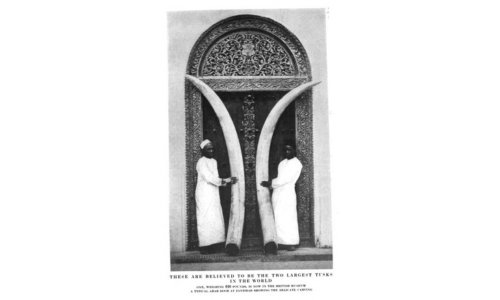
To conclude, I will give some details about the heaviest and longest tusks known. The heaviest tusk yet recorded is one in the Natural History Museum at South Kensington, which weighs 226 lbs., and measures 10 feet 2 inches on the curve, and 24 inches in circumference. It is believed to have come from British East Africa.
The longest pair of African elephant tusks went to the American National Collection, and the longest of the two measured 11 feet 5 inches on the curve, and 18 inches in circumference. The pair weighed 293 lbs., and they also came from British East Africa.
Female elephants grow much smaller tusks than the males, and the best I have read of was one which belonged to the late Arthur H. Neumann. In his book “Elephant Hunting in East Equatorial Africa” he says it was 61 feet long, 12 inches in girth, and weighed 36 lbs.
While I am writing on elephants I may note that the heaviest Indian male’s tusks are: 8 feet 9 inches on curve, 21 inches circumference, 161 lbs. weight; 8 feet 6 inches on curve, 22 inches circumference, 160 lbs. weight. They came from the Western Terai, India, and belong to H.M. the King.
These tusks are most remarkable, for the Indian species usually grows much smaller ivory than the African race. A few pairs have been recorded from 70 to 90 lbs. each, but even these are exceptional.
Besides the tusks, the tail and feet make nice trophies, and the latter can be utilized for stick stands, flower-pot holders, coal-scuttles, seats, and so on.
Probably several centuries will come and go before the African elephant is exterminated, for there are still vast tracts of country which are unlikely to be settled for a long time.
If the regulations continue to only allow the shooting of the larger bulls and go on preserving the cows, the average weight of the ivory is bound to decrease; for when nothing but immature males are left for the continuance of the animals this will affect the health of the species.
The herds of female elephants will also prove an increasing menace to the native’s crops and the plantations of white settlers on the boundaries of wild countries, where the animals exist in numbers.
Probably it will be found necessary to allow the females to be shot. If so, a smaller charge should be made for them as their ivory weighs so little, though it is more valuable pound for pound, than is that of the males.
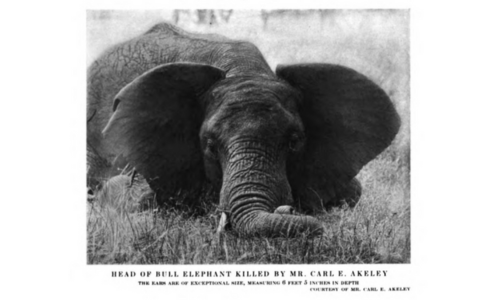
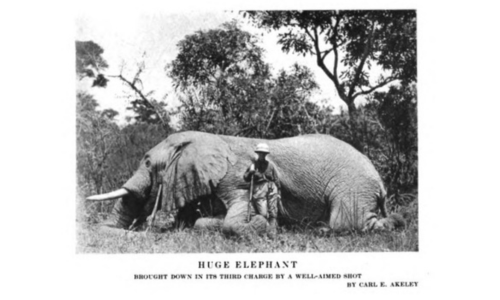
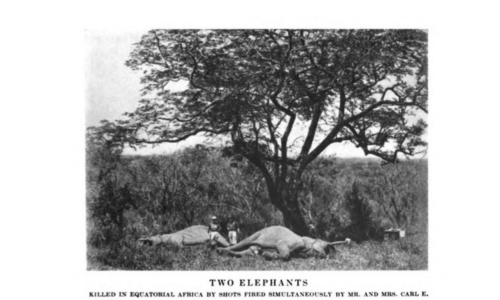
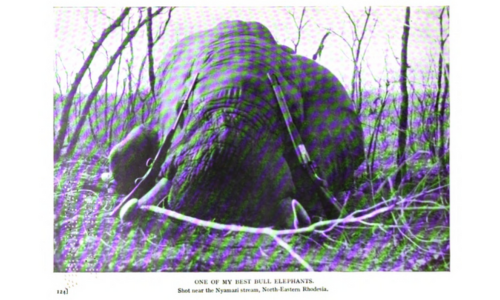
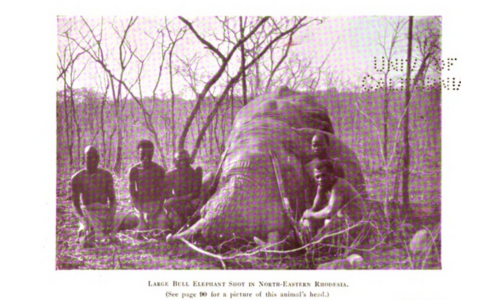
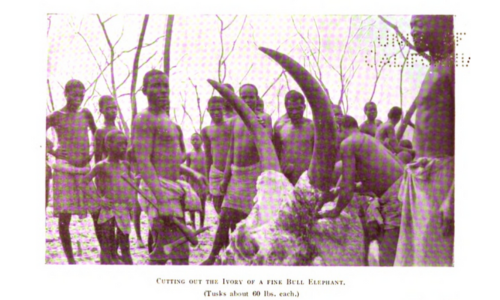
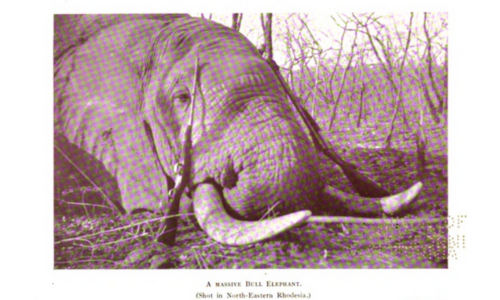
Denis D. Lyell, The African Elephant and Its Hunters (London: Heath Cranton, 1924). pp. 160-185 and 194-197. The lead image appears on page 442 in Kunz, Ivory and the Elephant in Art. The first three images on the top row appear in Kunz on page 202. The fourth image on page 171 appears in this Lyell citation as does the second, third, and fourth images on the bottom row appear on the frontispiece and pages 115 and 90. The first image appears on page 124 in Denis Lyell, Memories of an African Hunter (Boston: Small, 1923).
See: https://babel.hathitrust.org/cgi/pt?id=uc1.$b33492&seq=1