Passenger Pigeon
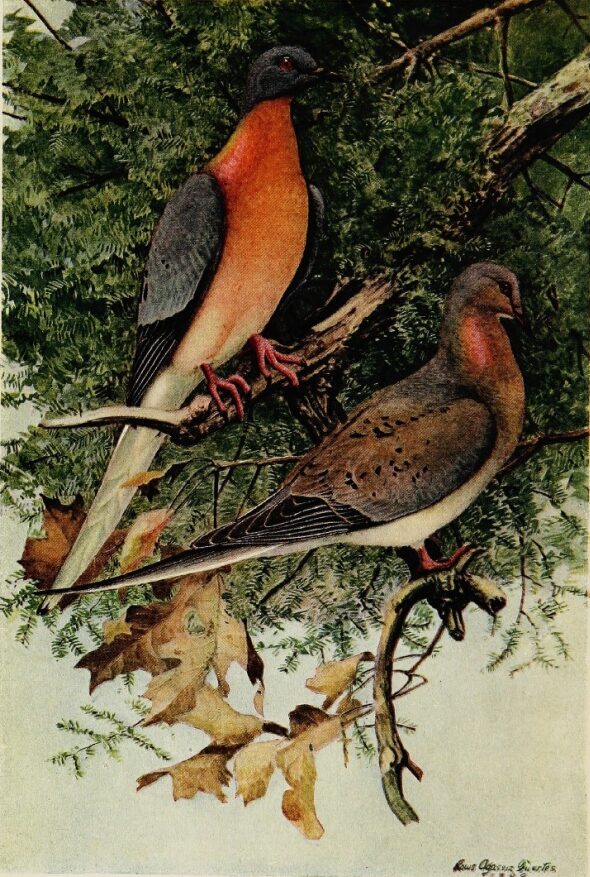
We want you to have a greater ability to learn about some of the unpleasant animal issues in our world.
The Passenger Pigeon: Its Natural History and Extinction
A. W. Schorger
CHAPTER 8:
METHODS OF CAPTURE
It cannot be said that any particularly important method of taking pigeons originated in America. Centuries of poaching in Europe had virtually exhausted man’s ingenuity. The burning of sulphur under the trees in which the pigeons roosted to suffocate them was first practiced in Louisiana; however, it was an old custom in Europe to burn sulphur under the trees in which pheasants roosted, so that the idea was probably imported. Sulphur was used also in Kentucky. It was employed in Tennessee as late as 1881. William G. Hayes informed Sutton that pigeons roosting in the Pymatuning Swamp in Pennsylvania were killed with “gas fumes.”
The use of sulphur is described by Du Pratz:
In walking among the high forest trees, it is necessary to look at the base of the trees with the most limbs and observe if a large quantity of dung is to be seen; then having found such a place as I have described, note the manner by which it can be recognized and go there a little before dark. Before setting out provide yourself with fragments of coffee pots, or in default of them, take earthen vessels to the number of five or six; add about two ounces of powdered sulphur and do not forget to provide three or four sacks and a torch. Having arrived there, distribute the sulphur in the vessels and set them equally spaced around the base of the tree. Set fire to the sulphur in the order placed and withdraw to the side from which the wind comes for fear of being annoyed by the odor of sulphur. All being arranged, it will not be long until there is heard to fall a shower of wood pigeons. These are collected when they cease to fall, this being when the sulphur is exhausted. In order to gather them easily, and with greater success, it is necessary to have ready torches of dry canes or of straw, (according to the country), to produce sufficient light to be able to carry away all the game that has fallen under the tree. This hunting is easy. Women can take part with pleasure since there is neither fatigue nor danger of being wounded.
The practice of burning sulphur was not extensive, since the method was not as effective as it might appear. The pigeons suffered little if they were roosting high or if there was any movement of the air.
An original villainy was the burning of the grass and leaves beneath the roost. Faux was told of the birds being knocked from their roost with long poles: “But the grand mode of taking them is by setting fire to the high dead grass, leaves, and shrubs underneath, in a wide blazing circle, fired at different parts, at the same time, so as soon to meet. Then down rush the pigeons in immense numbers, and indescribable confusion, to be roasted alive, and gathered up dead next day from heaps two feet deep.”
Grain soaked in alcohol was used as bait by one trapper. After eating it the pigeons fluttered, fell on their backs and sides, kicking and quivering. Pokagon helped catch about one hundred of them. The pigeons when roosting sufficiently low could at times be taken at night with the bare hands. Thomas Tanner was one of a number of persons to visit a roost in West Virginia in 1854. Each carried a meal bag for the game.
He states:
So we got there about nine o’clock at night. On nearing the place it sounded like a windy rainstorm in the woods. They were so crowded on every branch of some two or three acres of trees, that here and there, every once in a while, a branch would break, bringing to the ground most of its load of birds. These joined those yet searching for an alighting place and filled the air about our heads…. All one had to do was to reach out and grab them on the fly and stick them in the bag.
Pigeons when in flight were taken by various methods. If the large flocks flew low, considerable execution was done by throwing stones or sticks. The pigeons leaving a roost in the morning in Oklahoma flew low over the ridges where the Cherokee Indian boys assailed them with clubs. The nearest pigeons, attempting to turn aside, caused a blockade as a result of the swiftness of those following. Clubs thrown into the struggling mass brought down hundreds. Where the birds rose to skim the brow of a hill, a pole could be swung with deadly effect. Edwin Haskell wrote: “All the young pigeons seemed to leave their nests about the same time. At first their flight was quite near the ground. People would take advantage of this, and station themselves on the brow of the hill, with long flexible poles, and whip into the low-flying flocks, killing in this manner many birds.” The adult birds were killed with almost equal ease when conditions were favorable. The direction in which the pole was swung was of importance. When the pole was swung haphazardly, the flocks parted and suffered little damage. Swinging in the direction from which the flight was coming reduced the visibility of the pole so that many more could be killed.
An improved “pigeon-killer,” used at Racine, Wisconsin, is described by Stone: “They planted a long hickory pole in the ground and attached cords to it extending in opposite directions. At this point the birds generally flew low, and as they passed over the bluff the boys would vibrate the pole rapidly by pulling the cords alternately, the top of the pole knocking hundreds of them to the earth.” A pole of this type was sometimes operated by a single person who, standing at one side could, with his hands, make it to swing rapidly back and forth.
They were readily knocked from their roosts at night with poles. A family at Lynn, Massachusetts, was known to have killed in this manner more than 1,200 in one night.
Young pigeons, when just able to fly, could be caught in large numbers near a nesting in pens made of slats. Brewster wrote: “A few dozen old Pigeons are confined in the pens as decoys, and a net is thrown over the mouth of the pen when a sufficient number of young birds have entered it. Mr. Stevens has known over four hundred dozen young Pigeons to be taken at once by this method.”
Fall-traps were used to capture pigeons on farms. The simplest type was a box made of slats, one edge of which was propped with a stick to which a string was attached. When the pigeons went beneath the box to get the bait, the prop was jerked away. May used a sap-trough. At Fort Garry, Manitoba, Hind saw a trap made of a net feet wide and 20 feet long stretched on a frame and held up in front by a pole eight feet in length. When the prop was released twenty or more pigeons might be caught. A trap of this type could not close with sufficient speed to make a large catch. The figure-four trap, held in high esteem by boys, was much used. It was also in operation in Canada. The pigeons in struggling to get the bait, struck the trigger, allowing the cover to fall. Large numbers were taken in quail traps.
The trapping of pigeons in Pennsylvania in 1850 is described by Peter Yarnall as follows: “our traps are made of sticks, like partridge traps, and we take them alive…. James made a trap just 4 feet square and set it, in about two hours he went to it and found twenty-one pigeons in it, yesterday we caught one hundred and three altogether.” An unusual capture was related to Cotton Mather by a friend: “I have catched no less than Two Hundred Dozens of Pigeons, in Less than two minutes of Time & all in one Trap…. Such a Number broke into my Barn, & bin — by shutting ye Door, I had ym all at my Mercy.”
NETTING
The colonials were prompt in netting pigeons. Josselyn, following his voyages to New England in 1638 and 1663, wrote that the English took them in nets. Nets are stated to have been used around Boston by 1700, and in Hampshire County, Massachusetts, prior to 1740. Mather wrote on November 19, 1712, that it was incredible how many pigeons were taken in a net at one time; and Douglass mentions that they were taken alive in “nets or snares.”…
Writing from New York, June 21, 1770, Ashton Blackburne informed Pennant that: “They catch vast quantities of them in clap-nets, with stale [stool] pigeons. I have seen them brought to this market by sacksfull.” The netting of pigeons became such common practice that every farmer was equipped to net them. Among the items in the estate of John Mills of Needham, Massachusetts, appraised in 1763, were two pigeon nets.
Pigeons were taken in New Brunswick in 1791 in nets like those used in Germany for taking fieldfares (Turdus pilaris). Campbell thought it probable that the net was introduced from the latter country. A clap-net with two tension poles for taking fieldfares in Germany is described by Macpherson.
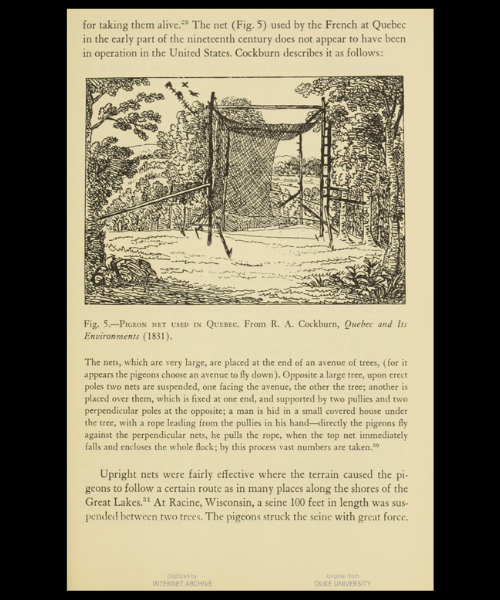
It is uncertain when the French Canadians began to net pigeons. Charlevoix wrote from Montreal, April 22, 1721, that they had means for taking them alive. The net (Fig. 5) [See below] used by the French at Quebec in the early part of the nineteenth century does not appear to have been in operation in the United States. Cockburn describes it as follows:
The nets, which are very large, are placed at the end of an avenue of trees, (for it appears the pigeons choose an avenue to fly down). Opposite a large tree, upon erect poles two nets are suspended, one facing the avenue, the other the tree; another is placed over them, which is fixed at one end, and supported by two pullies and two perpendicular poles at the opposite; a man is hid in a small covered house under the tree, with a rope leading from the pullies in his hand — directly the pigeons fly against the perpendicular nets, he pulls the rope, when the top net immediately falls and encloses the whole flock; by this process vast numbers are taken.
Upright nets were fairly effective where the terrain caused the pigeons to follow a certain route as in many places along the shores of the Great Lakes. At Racine, Wisconsin, a seine 100 feet in length was suspended between two trees. The pigeons struck the seine with great force. Some fell to the ground while others remained entangled in the meshes.
Upright and tunnel nets attached to long poles were frequently used to catch the pigeons on their roosts at night. Their use in Iowa is described as follows:
I remember at one time seeing three large farm wagons, with side boards above the usual boxes, filled to their top with wild pigeons that had been netted the night before. These nets were of two kinds, and were made especially for this work; one funnel-shaped, with wings stretched out from either side, and the other a long and wide affair fastened at each end to a long pole. Two or three men at each of these poles held them aloft as far as possible, stretching the net to its full length. Torches were lit on the opposite side of the trees from that on which the net was held and sticks and clods thrown among the birds, and thus startled they flew into the darkness away from the lights. When the pressure against the net indicated that it was well filled the men in charge hurriedly carried the poles together, and they and the nets were thrown to the ground. Lights were then brought, the birds removed from their entanglement and killed.
The use of upright nets at roosts was practiced at Madison, Wisconsin, and elsewhere. It was particularly effective in swamps where the pigeons were roosting in low trees and alders. According to the Warren Trumbull County Democrat of December 22, 1855, on the night of December 8, 1855, three men in a tamarack swamp in the township of Bloomfield, Trumbull County, Ohio, took 1,800 pigeons at one haul. In addition, 816 birds were killed by shooting.
The most pretentious trap encountered was that built by E. Osborn near a nesting in Wisconsin. A pen 100 feet long, 20 feet wide, and 4 to 5 feet high was baited for several days, as much as 40 bushels of corn being used at a time. Means were provided for springing three nets over the top whereby as many as 3,500 pigeons were caught at one time.
A net thrown over a bed by spring-poles was in general use in the United States. There are many descriptions, but only a few of them are specific as to the construction and operation. The first step in netting was the preparation of the baited “bed,” which was somewhat larger than the area of the net. The bed was of smooth bare earth. Generally it was spaded to bury the grass and leaves, then raked. Food was scattered over the bed for a few days prior to netting to get the pigeons accustomed to coming to it. Acorns, buckwheat, rye, corn, and wheat, which was particularly effective, were the chief baits used. A trapper informed Thoreau that crushed acorns of the white oak formed the best bait. The use of the seed of pigeon grass (Setarla) is mentioned by Inman. In New England, for baiting in early fall before the corn was ripe, corn shaved from the ear with a knife was used. According to J. B. Oviatt, corn could be used successfully in Pennsylvania while there was snow on the ground, but not when the ground was clear, since the pigeons preferred beechnuts and other natural foods.
The pigeon beds used in Michigan were described to Brewster by S. S. Stevens as follows: “Two kinds of beds are used, the ‘mud’ bed and the ‘dry’ bed. The former is the most killing in Michigan, but, for some unknown reason, it will not attract birds in Wisconsin. It is made of mud, kept in a moist condition and saturated with a mixture of saltpetre and anise seed…. When they are feeding on beech mast, they often will not touch grain of any kind, and the mast must then be used for bait.”
Seeds having an aromatic odor have long been considered especially attractive to pigeons. The pigeon trappers had as many superstitions regarding lures as the beaver trappers had for “scent.” Some trappers refused to divulge the composition of the lure. Moore wrote: “The Cummin Seed, which has a strong Smell in which Pigeons delight, will keep your own Pigeons at home, and allure others that are straying about, and at a Loss where to fix upon a Habitation.” Seeds of coriander, anise, and caraway were used by netters of wood pigeons in Germany. Cumin seed, or its oil, was considered best in New England; however, anise, or its oil, was preferred by some. Most netters were content with a mixture of salt and grain. One netter used two teaspoonfuls each of salt and molasses to half a bucket of grain.
Pigeons were extremely fond of common salt and it was a more effective bait than grain. Trappers took advantage of this trait by placing their nets at salt springs, which were to be found in Michigan and New York especially. Lacking a natural salt “bed,” they cleared a section of marshy ground of vegetation and scattered salt over it. Ingells added to the salty “muck” sugar, oil of “rodium,” and oil of roses; and Roney mentions sulphur. Alum on rare occasions was used in place of salt. Decoys were not necessary on salt beds.
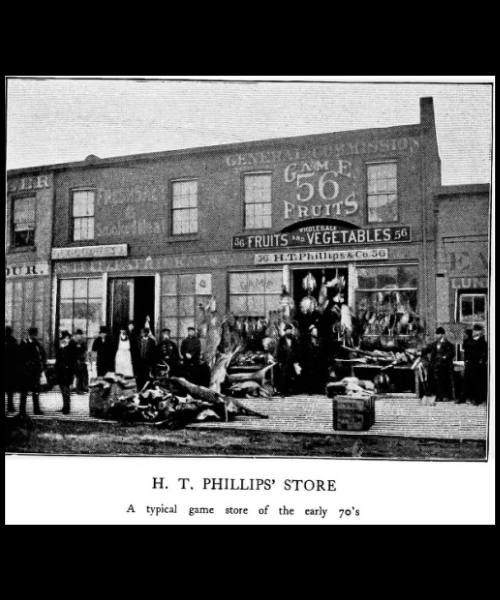
The value of salt in trapping may be gained from the information furnished by H. T. Phillips: “I knew of a man paying $300 for the privilege of netting on one salt spring near White River Michigan. It was a spring dug for oil, boarded up sixteen feet square. He cut it down a little and built a platform, and caught once or twice each week. He got 300 dozen at one haul in this house. He said they piled there three feet deep.”
Netting on a salted muck bed had a serious disadvantage aside from the impediment of the movement of the trapper by the deep mire. The captured birds became so soiled that they could not be marketed without plucking. If they were to be sold alive, it was necessary to keep them in a cage over running water until their plumage had been cleaned. The netting operation possessed nothing pleasing to the eye. Roney gives a vivid description:
On one side of the bed of a little creek was spread the net, a double one, covering an area when thrown, of about ten by twenty feet. Through its meshes were stretched the heads of the fluttering captives, vainly struggling to escape. In the midst of them stood a stalwart pigeoner up to his knees in the mire and bespattered with mud and blood from head to foot. Passing from bird to bird, with a blacksmith’s pincers he gave the neck of each a cruel grip with his remorseless weapon, causing the blood to burst from the eyes and trickle down the beak of the helpless captive, which slowly fluttered its life away, its beautiful plumage besmeared with filth and its bed dyed with its crimson blood. When all were dead, the net was raised, many still clinging to its meshes with beak and claws in their death grip and were shaken old. They were then gathered, counted, deposited behind a log with many others and covered with bushes, and the death trap set for another harvest.
An improvement over the muck bed was made by F. E. S. Around it was constructed a bait pen of notched logs 24 to 28 feet long and 4 feet high. The earth was then spaded, covered with a network of saplings, and sprinkled with salt mixed with sulphur and oil of anise. A holding pen of similar size was built adjoining it with a sliding door between. When the net was sprung over the walls of the bait pen, the trapper entered it through this door and drove the captured birds into the holding pen. By this procedure, the plumage of the pigeons was not soiled.
A water hole, under the proper conditions, made an effective “bed” for netting. This was an excavation filled with water to which salt was sometimes added. Thomas saw 67 dozen caught at one cast of the net at a water bed. On the Canadian River, Oklahoma, the water was too alkaline to draw the birds, but they were netted along the river banks where they alighted to get gravel. Baldwin placed his net at a water hole near Sparta, Wisconsin. . . .
The use of double nets was particularly effective in capturing large numbers of pigeons. When a net was sprung, the birds attempted to fly away from it. Escape was rendered difficult by using two nets which were sprung simultaneously towards each other. There was slight over¬ lapping. . . .
Important to netting was the stool pigeon. This was a passenger pigeon “blinded” to prevent it from trying to leave the stool. The operation was performed by thrusting a needle through the edge of the lower eyelid from the inside, bringing a thread over the top of the head and through the lower lid on the opposite side. Sufficient tension was applied to draw the lids over the eyes. The ends of the thread were tied on top of the head. The blinding of stool pigeons is an ancient custom. Tristram states that for taking wood pigeons the Arabs of Mount Gilead used as decoys wild birds, the eyelids of which were sewn together, and tied them to a perch. Flow of blood or soreness did not follow when the operation was properly performed. The hole became permanent after the needle had been used a few times. The thread used to “blind” the decoys was usually not removed from the eyes during the trapping season to prevent irritation by blinding anew each day.
Captured birds used for decoys were kept through the winter in pens sufficiently large that they could fly a little, but not so large that they remained wild. Some birds became so tame that it was not necessary to blind them. Others remained wild and flapped so much that they could not be used. Males were preferable to females, being larger and more brightly colored. About one-fourth of the birds used were females. Only one bird in a dozen made a good stool pigeon.
The birds were fed by hand. The great care given the stool pigeons is described by Thompson:
I spent a few evenings watching the care of the birds used in netting. At night all the birds were fed, watered and exercised. A Pigeoner would take a bird from the box or basket, the birds eyes sewed up, place it upon his knee and with one hand over the bird’s shoulders press the beak with thumb and forefinger until its mouth opened, with fingers of the other hand put kernels of corn in its mouth until the crop was filled; then the beak is pushed into a small cup of water and in less time than it takes to write this the feeding and watering is over. About the second feeding the bird is ready to do its part fully. Next the boots are put on, buckskin strings made into slip knots over the feet, and the bird transferred to the forefinger, the strings drawn taut through the hand and the exercise begins. The hand is raised slowly and dropped quickly. As the bird drops the wings are outstretched, quickly recovering as the hand stops, and this is repeated a number of times. Every motion is carefully watched and the action of the bird soon determines whether or not it will do for netting purposes. The least wrong motion or misplacing of a wing or feather on recovery condemns the bird as a Stooler. A coming flock of birds seem to be eagle-eyed as to the stool-bird, paying little or no attention to Bedders and Flyers.
The training of a young pigeon for the stool is described by John H. Chatham. The bird, after being fed, was placed on the trapper’s hand, his thumb holding the toes, then moved up and down to cause it to flutter. It had to learn to fold its wings without allowing them to droop.
The stool pigeon generally cost $5 to $10. According to Roney, a good stool pigeon, one that would stay upon the stool, was worth $5 to $25. Lincoln states that some birds would fall off the stool. The stool pigeon was always so securely tied to the stool that it could not fall off, but might lose its balance.
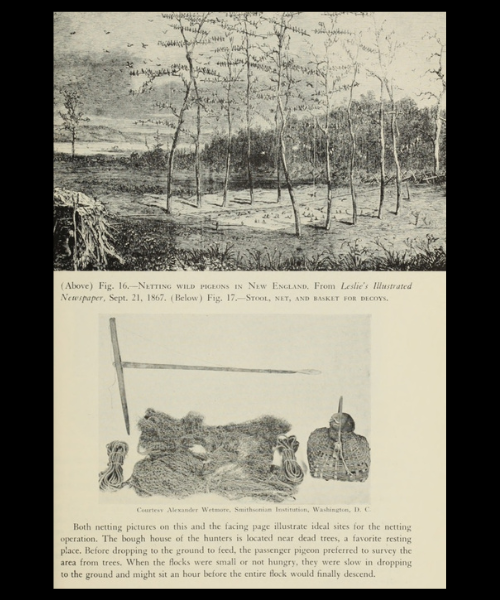
There were two types of “stools” in use. In one a broom handle was inserted in a hole in a stake about two and one-half feet in length and pinned in the middle so that the handle could work up and down. Fastened to one end of the handle was an upright piece of wood to which was attached a cord that ran back to the bough house. On the opposite end of the handle was a circular, padded platform, four inches in diameter, supported by a small stick driven into the ground. The stool customarily used … had the cord attached to the handle near the platform and run through a hole in the top of the stake. The stool was held in position by driving the stake into the ground. The pigeon was attached firmly to the stool with “boots,” which were made of material that would not abrade the feet. The boots were made by cutting slits in the ends of buckskin thongs through which the opposite ends were inserted to form loops. The feet of the bird were placed through the loops, which were drawn tight. The ends of the boots were then tied to staples at the side of the stool. Boots were also made with woolen yarn. The operator, by pulling the cord, raised the stool three to four feet, then allowed it to drop quickly. The pigeon, sensing falling, began to flutter. The illusion that the stool pigeon was alighting to feed drew the attention of a passing flock.
Additional decoys were generally used. One to six “flyers,” or “flutterers,” were employed frequently. These were generally made “blind” also. A long cord attached to the pigeon’s leg ran to the bough house. This cord was usually 50 to 60 feet in length; however, Purdy states 200 feet. When released, the flyer ascended the length of the string, then dropped to the ground. One writer claims that they flew about until exhausted, then struck the ground with a thud. In many cases the flyers were pulled down and not allowed to drop. Sometimes the flyer was placed on the ground near the bed and held there by laying a stone on the cord. At the right moment the cord was pulled from beneath the stone and the flyer released.
The use of a “hoverer” in Maine is mentioned by Sibley. A pigeon was tied to a stake in the middle of the bed by a string sufficiently long to give freedom of movement. Desiring to join a passing flock, it would flutter and call. He adds: “Although there was no bait, they would thus be decoyed. As they would not alight unless there was bait, the catcher was ready to spring the net upon the flock the moment it struck down where the hoverer was.” The only decoy used by Conyngham in Jefferson County, Wisconsin, was a wild captured pigeon used as a “hoverer.” A crotched stick was driven into the middle of the baited bed. A fishline, tied to the pigeon, ran to the bough house through the opening formed by the crotch. When a flock was sighted, a few jerks and slackening of the line sent the pigeon into the air. The bird when drawn gradually downward resembled exactly a pigeon alighting on the bed.
Dead pigeons were customarily propped up on the bed to simulate feeding; however, dead birds placed on the bed with their backs upward were just as effective. Stuffed birds were also used.
The passenger pigeon, before dropping to the ground to feed, preferred to survey the area from trees. The nets, accordingly, were usually placed near trees, preferably dead ones (Fig. 16). [See below.] In default of these, small trees were placed in the ground, or use was made of poles resting on crotched posts, called “stands.” On September 12, 1851, Thoreau wrote: “Saw a pigeon-place on George Heywood’s cleared lot, — the six dead trees set up for the pigeons to alight on, and the brush house close by to conceal the man. I was rather startled to find such a thing going on now in Concord. The pigeons on the trees looked like fabulous birds with their long tails and pointed breasts. I could hardly believe they were alive and not some wooden birds used for decoys, they sat so still; and even when they moved their necks, I thought it was the effect of art.” When the flocks were small or not hungry they were slow in dropping to the ground. Sibley mentions that they might sit an hour. One pigeon would descend, then two or three more, and soon the entire flock. When the net was sprung, the pigeons instinctively flew towards the trees or stands, so the net was placed to spring in the opposite direction for better interception.
Netting was never very successful close to a nesting, as it was a habit of the pigeons to fly several miles from the colony before stopping to feed. J. B. Oviatt considered ten miles the optimum distance from the nesting for netting. One writer states: “In the immediate vicinity of a nesting the nets may be set at any time of the day, but the catch at each cast is apt to be small, rarely exceeding six or eight dozen. Some of the most successful catches this year have not been within five miles of the nesting.”
The time of day had a big influence on the size of the catches. The largest numbers were taken at daybreak when the males (“toms”) came out to feed, the middle of the forenoon when the females (“hens”) left the nesting, and the middle of the afternoon when the males fed a second time. The result was that, depending on the time of day, the netter would get all males or all females.
The maximum distance at which a flock could be attracted by the decoys was one-half of a mile. A flock might pass this distance beyond the bed before turning back. Usually the flock was within 25 to 30 rods before the flyers were released. The pigeons on a bed became frightened with extreme ease. The snapping of a twig in the bough house, the arrival of other pigeons or a hawk would cause them to leave the bed with explosive violence. The beds were cleaned after each catch. Every feather had to be removed or the pigeons would not alight. S. S. Stevens warned against shedding blood, as its presence alarmed the birds greatly. If necessary, the bed was raked and rebaited.
All being in readiness, the trappers watch for the pigeons. When a flock is seen approaching, the flyers are tossed into air. They rise to the length of the string, sail about in circles, then drop to the ground. The stool is raised and dropped quickly. The stool pigeon, sensing falling, begins to flutter. The repeated raising and lowering soon draws the attention of the passing flock. As soon as the birds are about to touch the bed, the net is sprung, and the slaughter commences.
Pigeons, arrested in flight and alighting directly on the bed, would whirl about and descend in the shape of a funnel. The netting operation is described as follows:
Presently, a scattered flock of some two or three hundred appears. We both sally out, and when we think [it] near enough, toss our flyers into the air. They go up the length of their lines, fifty or sixty feet, and find they are anchored, and return to the ground, wherever their blinded lot may light them. Then we rush in and “play the stool” — pulling on the cord and lifting it from the ground where it rests on a small pod of grass.
We lift it about three feet and let it drop instantly. In this operation, the stool flutters on its way downward, imitating pigeons feeding on the ground, when other flocks are passing. Soon we see the flock beginning to sail, they whirl, sail over the bed, turn and sail for alighting. We never wait a second. As soon as we think we have a fair amount of them alighting and about to alight, we surge on the spring pole and spring the net, rush out and hold down the sides, to keep them in, for with their united effort, they carry the net off the ground, and the ones near the sides escape….
The trappers now went in on top of the nets, walked over them, and stooping down, placed their thumb on top of the pigeon’s head, their finger under the bill, and pressed the skull down till it crushed, and the bird’s life went out. After all the birds had been treated, the nets were reset, the dead pigeons carried into the bough house, in bags, and another “lookout” kept.
When trees were available near the bed, the pigeons first alighted in them, then dropped to the ground. The behavior of the birds in this case was as follows:
On the occasion I speak of we arrived at the bower just before daybreak. The birds were well baited, and I expected to see a fine catch, as no net had as yet been sprung over that bed. With the first streaks of light we could hear the flutter of wings as they lit in the trees about the bed. As the light increased they came faster and thicker, until soon the trees were alive with them, and the woods were filled with their calls. Soon a single pigeon dropped upon the bed, and had hardly folded its wings before others began to pour from the trees in a stream. When they seemed to be standing on each other’s backs and you could see nothing but pointed tails sticking up, and while they were still flying thickly down on the bed, we both jerked the line with all our might. There was a loud swish as the net sprang over, and the lead line knocking feathers from those still in the air and in the way of the net. We rushed from our cover, and while I stood in astonishment at the boiling mass under the meshes, the netter proceeded to fasten down the corners of the net and remove the birds to coops.
There follows a graphic description of netting:
Just then the first flock of about a dozen stragglers went through the valley to our right. I am told to keep down in the left corner under cover of the side and look out behind and see if the birds notice the flyers. The netter now buttons his coat, and taking a flyer on his hand, strokes it so as to calm it, while his eye travels every foot of the valley behind us. Suddenly I hear “Hist!” and the sound of wings as the first flyer leaves his hand, and the second follows a moment later. I at once forget the birds and look at the two flyers. Right up to the end of their lines they go, strongly and well, then round in graceful circles until they light suddenly on the ground. Then I notice that he has taken hold of the stool line, and I can hear the hover of his bird, while the flock, having seen the flyers light, evidently desire company, for after circling once they set their wings and come broadside to the bed. He holds the stool up until they are about fifty feet from the bed, when he gives the lighting hover with the stool bird and releases the stool line. His eyes tell him when the bulk of the flock strike the bed, and as their wings close, a quick pull on the spring line and a tumble out through the back speedily follow.
I note a small bunch of birds making their way to the woods, but he is at the net, pincers in hand, and wherever a head shows through it they are applied and the neck is broken. Out of breath from nervousness he says, “Eight out of fourteen; pretty good!” A pat to the stool bird, a hurried setting of the net, and with flyers gathered in we are ready once more. A flock passes out of range, but no effort is made to halt them, as he says the flocks will follow their leaders and more will come to our point. I am interested now, and only anxious to throw a flyer or do something to help. He says, “Take it easy now and we won’t be disappointed to-day. The birds you see dead and those you see flying are all toms, and the nesting is ready to commence a regular flight. We will need help before evening and won’t tire a flyer for nothing.” As he spoke he made a quick jump into the house and I lie flat on my face. I don’t know that a large flock is directly upon us. No time to throw a flyer, so under his coat it goes, and the stool birds and the bedders which were increased by the ones just killed, were used for all they were worth. I could hear him breathing hard, when suddenly he sprung the net and yelled, “Now hustle, we have something worth going out for.”
The net was sprung as soon as some of the pigeons were touching the ground and others about to do so. The correct time to spring the net was a matter of fine judgment. When the birds were wary, a fraction of a second meant the difference between success and failure. Scherer wrote: “The net was sprung just as some of the incoming pigeons were touching the ground and others almost touching, for then the birds could not turn quickly enough to escape the net. If the pigeons were allowed to settle before the net was sprung, they might see it and fly quickly from under it. Mr. Oviatt said that it was quite a trick to spring the net at the right instant to get the most birds.”
The net having been sprung, the men rushed quickly from the bough house and held down the front side of the net, or placed stones upon it, to retain as many of the pigeons as possible. The density of the birds on a bed was sometimes so great as to be an embarrassment to the netter. Under normal conditions about one-third of them were too quick for the net and escaped. When too many pigeons were covered, they raised the net and a large number recovered their liberty. Expressions such as “so thick they will stand on one another,” “a foot deep,” and “three feet deep” are encountered. Regarding the nesting at Petoskey, Michigan, in 1876, Pokagon states: “I think I am correct in saying the birds piled one upon another at least two feet deep when the net was sprung, and it seemed to me that most of them escaped the trap, but on killing and counting, there were found to be over one hundred dozen, all nesting birds.” Often as many as 2,400 would alight on a bed.
An extreme case of congestion is recorded in the New York World of July 4, 1874, for the nesting near Frankfort, Michigan: “The biggest catch of the year has been 800 birds, though it is of record that one trapper secured nearly 1,300 at one strike. This probably would have been exceeded by Mr. Fisher a few days ago when he struck into a flight so thick that the birds raised nets, stakes, and all, breaking the meshes and flying off by hundreds.”
The heads of the birds projected through the net and they were killed in three principal ways. The commonest procedure was to crush the skull between the thumb and forefinger. It was difficult to continue this method without fatigue when many birds were handled. Some trappers broke the necks with a special pair of pliers, the tips of which did not meet when closed. Others crushed the skull between their teeth. Weld mentions that old women killed wood pigeons netted in the Pyrenees by biting their necks. Not all of the pigeons were killed. Many were placed in crates to be fattened for the market or to be sold for trapshooting.
The number of pigeons taken at a throw depended on the size of the net and the behavior of the birds. At times the net was not sprung unless there was a certain number of pigeons on the bed. The requirement varied from 120 to 600.
There are many records of the number of pigeons taken at a single spring of the net. Usually there is no information on the size of the net, or whether it was single or double. Crevecoeur never caught more than 168 at once. The evening of September 8,1834, a catch of 960 was made at Chelmsford, Massachusetts, according to the Boston Evening Transcript of the following day. De Voe mentions 648 as the largest number of which he had heard. An average catch in Ohio was 240 birds, but sometimes 360 to 480 were taken with a net 15 feet by 30 feet. Two men trapping at a nesting in Potter County, Pennsylvania, in 1861, averaged 100 birds for each spring of the net during the first day. Thereafter the catch decreased rapidly. Single nets at the nesting in Benzie County, Michigan, in 1880, are stated to have taken in one haul as high as 360 to 600 birds, indicating that the average was considerably below these figures. Often only 120 to 144 were taken, and a good “strike” was 480 to 600.
Some very large single catches were made. Dr. Isaac Vorheis, Frankfort, Michigan, took 1,316 birds. H. T. Phillips, using a net 28 feet by 36 feet, once saved 1,584 pigeons, but many escaped as they were too numerous on the bed. The taking of 1,200 was rather common. The following catches were made with double nets: 1,320, 1,332, 1,528, 1,560, and 1,680.
The daily catches varied greatly. On some days not a single pigeon would go to the beds. Roney gives 720 to 1,080 pigeons as a fair average, though at natural salt licks 3,600 to 4,800 were sometimes taken. One trapper averaged 2,400 daily over a period of ten days. The large catches at the salt licks were made with double nets. Audubon knew a man in Pennsylvania who caught 6,000 in one day; and a day’s catch of 5,076 is recorded for Perry County in the same state. A catch of 360 to 480 per day was considered large, and one of 735 as exceptional. The largest daily catch by Baldwin was 1,320.
There are few data available on the number caught by a netter in one season. Luther Adams, Townsend, Massachusetts, in the fall of 1847, caught 5,028 pigeons, nearly all being taken in September; and 1,962 from May 1 to September 11, 1848. Ingells and two companions caught between 50,000 and 60,000 at Petoskey, Michigan, in 1878.
The majority of the netters operated only in the spring and then near a nesting. Fall trapping was done on a considerable scale in New England, but not elsewhere. One netter has stated: “In the fall, after they have got their winter plumage and are bound for the South, they are scarce [?] and shy, for they are well fed and the young are fully grown…. A few may be caught on bait, but it is only by the greatest care and skill aided by fortune.” S. S. Stevens informed Brewster that the young birds could be netted in autumn in the wheat stubble, but it was seldom attempted.
It is evident that nearly every conceivable method of capturing pigeons was employed. The numbers taken by the use of clubs, the burning of sulphur, and traps were inconsiderable in comparison with netting. The worst feature of netting was that it was most successful near the nestings and resulted not only in the death of the breeding birds but the young as well. The annual toll by the hundreds of netters was fearful. A constant stimulus to the decimation during the latter half of the nineteenth century was the demand for live birds for shooting tournaments. Only the netters could provide them.
SHOOTING
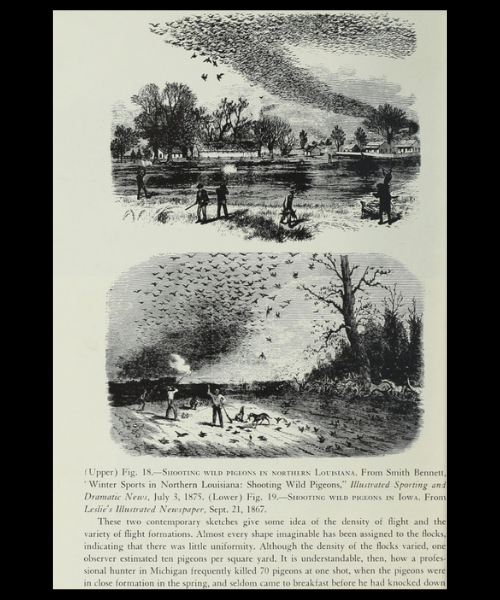
The passenger pigeon was shot so easily that up to the middle of the nineteenth century it was not even considered a game bird. Charlevoix wrote that it seemed to court death. Wherever there was a naked branch on a tree, these birds chose to sit upon it in such a manner that an amateur could not fail to bring down at least half a dozen at one shot. The people of Philadelphia and New York shot them from balconies and housetops during the flights.
The shooting of pigeons at Chambly, Quebec, in 1777, is described by Madam Riedesel:
As we were passing through a wood, I saw, all at once, something like a cloud rise up before our wagon. We were at first frightened, until we discovered that it was a flock of wild pigeons, which they call here tourtes (turtle doves), and which are found in such numbers that the Canadian lives on them for more than six weeks at a time. He goes to one of these pigeon hunts with a gun loaded with the smallest shot; and when he comes in sight of them he makes a noise. They fly up, and he fires into the midst of them, generally with considerable luck; for sometimes he wounds two or three hundred, which are afterwards beaten to death with sticks.
This pigeon preferred to rest after eating, or when tired, on the dead branches of trees. Several hunters have told me that in their boyhood it was simple to shoot them. The hunter, having found a dead tree that the pigeons frequented, concealed himself nearby, and it was only a question of time until the birds appeared and alighted in rows on the branches. In Pennsylvania they showed a preference for pine trees, and Dillin always hunted for them among these trees.
The hunter could get within range of a flock feeding in the woods by approaching behind a tree. If one bird took alarm and arose, the entire flock was certain to follow. Little caution was necessary with the young birds feeding in grain stubble in autumn. The hunter crept up on the rear of the feeding flock and fired just as the rear rank rose to take its place in front. The second barrel was fired as the flock arose. In Maine they could be secured in a similar manner while feeding in a buckwheat field. They settled on the rails of the enclosing fence so as to appear “like a chain of living birds.” By firing from the proper angle, a hunter could kill eight or ten at a shot. Decoys were sometimes placed on the rails.
Much of the shooting for the market was done near the nestings. The procedure at the nesting near Shelby, Michigan, is described by “Tom Tramp”:
Often these flights out [from the nesting] would continue without a break in the string of birds across a favored point, for an hour or two, and all one … had to do was to sit down in some small clearing and shoot until it became monotonous, as there would be no lack of birds. Shooters who put in the day, would secure twenty-five to thirty dozen to a gun. The shooting had to be done on the wing, though fine shots were presented in the woods where large lots of birds were feeding. By screening one’s-self in the direction of the birds and waiting until they worked up to you with their never ceasing roar, as they fluttered one over the other in search of nuts, stepping out you would have a solid mass of birds to fire into as far as your shot would carry. As they thundered up from the ground, two or three dozen were several times killed at a double discharge; but this was mere slaughter of the innocents.
Accounts of shooting pigeons at the nesting at Grand Haven, Michigan, in 1866, are contained in the diary of Franc B. Daniels, an enthusiastic sportsman who attended school in Grand Rapids and was seventeen years of age at the time. The diary is in the possession of Professor Farrington B. Daniels of the University of Wisconsin and through his courtesy the following extracts are quoted:
Grand Haven, May 12. Arose at 4.30 after a very poor night’s sleep as we had a poor bed and were in a room with two other men who started off at 3.00. We did not get started until after five and then went off without our breakfast which as I expected made me sick. Reached the nest[ing] about seven, going to the old one first but found but very few there; so we went over to the new one which we reached at 9.00. Here we found pigeons to our heart’s content, thousands, yes millions of them. Doc and I were completely sick of it by eleven. Always before supposed I could load & fire as long as anything showed itself but for once was beat. We went over to the wagon for a drink & some lunch which we had brought and did not begin again until one and then both our heads ached so that they seemed to crack when we fired.
They were much thicker than in the morning and we shot sixty or seventy in an hour when we had all our birds, about one hundred and sixty to carry half a mile, with all our traps. . . .
Grand Haven, May 18. Awoke and rose about five and immediately took our rods and fished out to the end of the pier…. Never before did I see so many pigeons, flock after flock swept over the village, fairly clouds of them, and continued all the time we were out. Came to breakfast at 7 and afterwards immediately went out back of the village and remained until noon. Had some good shooting at single birds mostly however, or twos or threes. Kill about fifty by noon. Fished again after dinner and Doc caught two beauties, the largest bass I think that I ever saw. As the pigeons again began to fly, came in about 3 and taking all our traps crossed the river and climbed the largest bank this way. It was the hardest tug I ever took and not a thing did we get to pay us. Followed the bank around to another about half a mile, descended from it & climbed another where we remained for some time without any shooting, when they began to come in earnest. Such a sight I never saw before nor expect to again. Thousands, yes millions swept through the valley before us, two or three feet from the ground & up the bank into our faces. As we could not shoot over us, (for they fell in the woods,) we did not get but about forty having to shoot them in the face. My gun got dirty awfully & myself as badly excited. If I had had a fish pole could have killed a hundred for they came within two feet of me.
His last shoot was on May 19. He and a companion went to the nesting three miles from the village and “back of the school house.” The colony now had young but one egg was found in a nest and three eggs on the ground. Fifty birds were shot. They returned to Grand Rapids with 160 birds, obtained during the hunt of two days’ duration.
In the Fond du Lac Commonwealth (Wis.) for May 20, 1871, there is a vivid description of shooting at the nesting at Kilbourn (Wisconsin Dells) in 1871:
The idea was to get an opportunity to rake the immense flocks of pigeons as they left the roost for the fields and feeding places throughout the State. The indescribable cooing roar produced by uncounted millions of pigeons, as arousing from their slumbers, they saluted each other and made up their foraging parties for the day, arose from every side, creating an almost bewildering effect on the senses, as it was echoed and re-echoed back by the mighty rocks and ledges of the Wisconsin [River] bank. As the first streakings of daylight began to break over the eastern horizon, small scouting parties of the monstrous army of birds to follow, every now and then darted like night spirits past our heads. Soon the skirmish line … swept past in small and irregular bodies. Our guide now told us to get into position as quick as possible as the large flocks would follow in rapid succession. We quickly ranged ourselves along the crest of a hill overlooking a cleared valley through which the birds would fly on their outward passage. It was yet a long way from being light….
And now arose a roar, compared with which all previous noises ever heard, are but lullabys, and which caused more than one of the expectant and excited party to drop their guns, and seek shelter behind and beneath the nearest trees. The sound was condensed terror. Imagine a thousand threshing machines running under full headway, accompanied by as many steamboats groaning off steam, with an equal quota of R. R. trains passing through covered bridges — imagine these massed into a single flock, and you possibly have a faint conception of the terrific roar following the monstrous black cloud of pigeons as they passed in rapid flight in the grey light of morning, a few feet before our faces. So sudden and unexpected was the shock, that nearly the entire flock passed before a shot was fired. The unearthly roar continued, and as flock after flock, in almost endless line succeeded each other, nearly on a level with the muzzle of our guns, the contents of a score of double barrels was poured into their dense midst. Hundreds, yes thousands, dropped into the open fields below. Not infrequently a hunter would discharge his piece and load and fire the third and fourth time into the same flock. The slaughter was terrible beyond any description. Our guns became so hot by the rapid discharges, we were afraid to load them. [A considerable number of breach-loaders wre in use by 1871.] Then while waiting for them to cool, lying on the damp leaves, we used … pistols, while others threw clubs, seldom if ever, failing to bring down some of the passing flock. Ere the sun was up, the flying host had ceased. It continued scarcely an hour in all. Below the scene was truly pitiable. Not less than 2,500 birds covered the ground. Many were only wounded, a wing broken or something of the kind. These were quickly caught and their necks broken. . . .
The stands were placed one to two hundred yards from trees, since if any of the the latter were near, the pigeons would alight on them. The floor or be was baited and live decoys uses as in netting. Leffingwell states: “The flocks after making two or three wide circles, would settle on the poles, and then the hunter quickly fired at them; experience had demonstrated that it would not do to wait too long before firing, but the shots must be made just after the first birds had settled on the poles, and while their companions were hovering over them.” The enfilading fire was very destructive with a ten-gauge gun with an ounce and three-quarters of shot. Sometimes thirty-six were killed with one barrel, and as high as seventy-one were killed with both barrels.
A single pole six inches in diameter and twenty feet long, from which the pigeons were swept by the discharge of an old musket, was in use in Massachusetts in 1832. A pigeon shooter, who had been following the profession for about forty-five years, attracted the pigeons by the use of “flutterers” and by “prating.” Flutterers were pigeons “blinded” with thread, placed on the tops of poles twelve feet high, and attached by strings about five feet long. Strings running from the bough house to the pigeons permitted setting them in motion at the proper time.
Prating, or imitating with the lips the call of the pigeon, was practiced more extensively in New England than elsewhere. It is clear from the above that it was in use prior to 1800. Thoreau recorded on March 29, 1853, that Dugan “saw two pigeons to-day. Prated for them; they came near and then flew away.” On September 12, 1854, he called prating the sound made by the pigeons. Fletcher Osgood described the art to F. H. Allen as follows: “Wild pigeon prating consisted of voice delivered through tightly approximated lips, with a buzz or vibration of those lips, in two somewhat prolonged, high-pitched monotones (a very brief interval of silence between the monotones, of course) followed by a somewhat more prolonged monotone on a decidedly higher pitch, this immediately followed by two scale-descending monotones, the descent approximately an octave or more, each descending monotone briefly uttered, no prolongation.” . . .
The passenger pigeon did not surrender its life easily. Regarding this trait “Snap Shot” wrote:
They are a peculiarly tenacious bird, and notwithstanding their size, they cannot be shot successfully with a bullet finer than No. 6; even with that they will fly a hundred yards and alight in a tree apparently unharmed, from which they will afterwards fall dead, from the wounds, to the ground. Always after gathering my birds after a shot on the field, I would follow the course of the retreating flock, and under the nearest tree find from one to six additional birds; and it is quite surprising to observe what a diversity of wounds and hurts one will discover in dressing a quantity of them — the scars of previous assaults. Broken and disjointed legs; bills that have been shot half away, and grown curiously out again; missing toes, or even a whole leg, and even healed-up breast wounds I have seen.
A good example of the hardiness of the pigeon is given by Kumlien: “I have seen pigeons with a considerable branch dangling beneath them. I have one specimen with a beech twig about nine inches long, that had entered the bird from beneath and pierced the femoral muscles, projecting about four inches on the back. It had undoubtedly fallen from the nest when a “squab” and been impaled on a twig. It was an old bird and as the stick was much worn, it must have been unpleasant in walking.” It is more probable that the bird, while in rapid flight, was pierced by striking the twig, as happens occasionally with the ruffed grouse.
The expenditure of ammunition in the aggregate was enormous. The usual size of shot used was No. 5 or 6. No. 8 is also mentioned. According to the Sparta Herald of May 23, 1882, J. H. Baldwin handled three tons of powder and sixteen tons of shot during the nesting at Sparta, Wisconsin, in 1871 and 75 kegs of powder and 360 sacks (9,000 pounds) of shot during that of 1882.
It has been stated by Manlove that the companions of a wounded pigeon would attempt to aid it. The speed of the bird and this aid would sometimes carry it several hundred yards after receiving a mortal wound. He adds: “It was pathetic to see the efforts of the comrades of a wounded pigeon to support him in his flight. One after another would dart under the stricken one as he began to sink, as if to buoy him with their wings. They would continue these efforts long after he had sunk below the general line of flight, and not until all hope was lost would they reluctantly leave him and rejoin the flock.” It was the habit of the passenger pigeon to follow closely every motion of the bird ahead of it. A wounded bird might be followed for a considerable distance before the follower realized that there was anything abnormal. Though the same solicitude is mentioned by Brandt, there is probably an error in the interpretation.
The sportsman had two methods for “stringing” pigeons. A slender limb, at the bottom of which a shortened twig was left to preserve a crotch, was sharpened at the tip. The tip was thrust through the soft area in the lower mandible of the pigeon. Stringing on the tail feathers was a custom of wide distribution. The four longest tail feathers were pulled from the tail and knotted together at the tips. The quill ends were thrust through the lower mandibles of the dead birds, then tied together to form compact bunches.
A flight of pigeons was the occasion for a general holiday. Mrs. Grant wrote that at Albany, New York, “This migration, as it passed by, occasioned . . . a total relaxation from all employments, and a kind of drunken gaiety, though it was rather slaughter than sport.”
So little discrimination was shown by gunners that the first legal acts were for the protection of the inhabitants rather than the pigeons. In 1720, an ordinance was passed in Philadelphia imposing a fine of five shillings for the shooting of pigeons and other fowls from the streets, gardens, or orchards within the city. . . .
The enforcing of ordinances against shooting within many incorporated communities was almost impossible up to the end of the nineteenth century. However, a spirit of intolerance was arising, for in 1853 the citizens of Madison, Wisconsin, objected to being shot in the back by quail hunters. A typical example of the holiday spirit during a flight of pigeons is given by Dunlop for York (Toronto), Canada:
Some two summers ago, a stream of them took it into their heads to fly over York; and for three or four days the town resounded with one continuous roll of firing, as if a skirmish were going on in the streets — every gun, pistol, musket, blunderbuss, and fire-arm of whatever description, was put in requisition. The constable and police magistrate were on the alert, and offenders without number were pulled up — among them were honourable members of the executive and legislative councils, crown lawyers, respectable, staid citizens, and last of all, the sheriff of the county; till at last it was found that pigeons, flying within easy shot, were a temptation too strong for human virtue to withstand; — and so the contest was given up, and a sporting jubilee proclaimed to all and sundry.
In the final analysis, shooting was most destructive to the pigeons. The number of hunters exceeded greatly that of the trappers. Pigeons were the favorite game of the small boy; and any indifferent marksman could look forward to some success if stationed on a flight-way. When the birds were plentiful, no pains were taken to search for all of the dead and fatally wounded, so that it is improbable that more than one-half of them were recovered. During the last nestings, men traveled two hundred miles or more to get the shooting. In one case a special train for gunners was run from Chicago to a nesting in Michigan. Securing the birds was at times secondary to the sport of shooting. Two men killed about 150 pigeons at a roost at Deer Park, Maryland, and left them as there were no means of transportation. The most deplorable feature was the shooting near or within a nesting. Time and again the birds were driven away before young were raised.
CHAPTER 9:
DECREASE AND EXTINCTION
No other species of bird, to the best of our knowledge, ever approached the passenger pigeon in numbers. Champlain, in 1605, encountered them in “countless numbers,” while Sagard-Theodat wrote of an “infinite number.” Lahontan thought that all the doves on earth had congregated in his locality. To Strachey, they flew in “thickened clowdes.” Wood wrote: “I have seene them fly as if the Ayerie regiment had beene Pigeons; seeing neyther beginning nor ending, length, or breadth of these Millions of Millions.” Mather adds: “I affirm to you then; That sometimes we have mighty Flocks of those Pigeons flying over us; thousands in a Flock; ye best part of a mile square occupied by a Flock; These passing along, ye. Welkin in a manner obscured & covered with ye”; & several Hours have run out, before ye appearance of these Birds thus making ye best of their way have been over.”
Their numbers were beyond belief even after the decline was well under way. Strickland wrote: “Persons unacquainted with the country and the gregarious habits of this lovely bird, are apt to doubt the accounts they have heard or read respecting their numbers: since my return to England I have repeatedly been questioned upon the subject. In answer to these queries, I can only say that in some parts of the province, early in the spring and directly after wheat-harvest, their numbers are incredible.”. . . .
EXTINCTION
Almost every conceivable cause has been given for the extinction of the pigeon. One of the most popular explanations was drowning en masse in the Gulf of Mexico or the Atlantic Ocean. Pigeons were reported as having been washed ashore even on the coast of Russia. Another theory was that, under persecution, the pigeons migrated to Chile and Peru. As late as 1939, they were thought to have been seen in Bolivia. . . .
There is now very general agreement that man was responsible for the extinction of the pigeon. Since it was once supposedly “abundant” in Montana and disappeared while the state was very thinly populated, Saunders reasoned that man could not have been responsible solely. He overlooked the fact that, as the numbers of the pigeon decreased, the eastern and western borders of its range contracted to such an extent that they contained merely stragglers. The species was never abundant in Montana.
The key to the problem of extinction lies in mass association. Stone wrote: “The pigeon like the buffalo was a species whose existence seems to have depended upon association in large numbers and once separated and scattered into small flocks and pairs its doom was sealed.”
The same view was taken by Todd, coupled with the inability of the pigeon to adapt itself to new conditions.” The shortcomings of the species are given in greater detail by Griscom.
The primary cause for the passing of the passenger pigeon was its own specialized habits and a long list of biological “defects.” Its low egg-laying capacity, flimsy nest, and herd instinct in migration are three minor ones. Its spectacular gregariousness was disastrous in two respects. The huge flocks could not be overlooked by the birds’ enemies, and no effort was made to avoid them. In a primeval wilderness their ravages were overcome by sheer weight of numbers. Every nesting automatically involved an appalling mortality of adults and young and a waste of eggs, caused by the habits of the bird itself. The final “defect” of this pigeon was its inability to learn anything new; it could not change its habits to meet the pressure of new and unfavorable conditions or dangers.
Judged from the standpoint of numbers, the pigeon was enormously successful in its way of life. Failure to change its habits cannot be laid to stupidity without assuming that most of the surviving species have a higher order of intelligence. The greater number of the passerines chanced to develop a mode of life that rendered survival fairly simple after the advent of Europeans. Very many of our game birds, shore birds, and waterfowl would today be extinct, or near extinction, were it not for coddling through refuges and protective laws.
Inbreeding of the small number of survivors has been suggested as having had fatal consequences. On the other hand, Allen thinks that a lack of synchronization of the mating cycle, when only a few males and females were left, might have led to extinction. A quite similar opinion is held by Breckenridge. Colonial nesting afforded a maximum opportunity for the pairing of males and females in a mating condition. This advantage is lost when a colony is reduced below a certain minimum number.
The greater success of large colonies of gulls was due apparently to the better synchronization of the breeding cycle throughout the colony. With herring gulls, a colony of ninety birds lost about one-half of its young, one of thirty-four about two-thirds, and that of twenty about three-fourths.
There was marked synchronization in the mating of the pigeon. Insofar as known, all the eggs in relatively small as well as in large colonies were deposited on almost the same day; and it is certain that the parents abandoned the young in a body. Apparently an assemblage of only a few hundred birds was necessary to bring nearly all of the pigeons to the same state of sexual excitement. While it was characteristic of the pigeon to nest in large colonies, single to a few colonial pairs nested commonly. It is probable that these nestings were by birds entering their second year and late in reaching sexual maturity. They occurred mainly in late May and June, hence considerably later than the large colonial nestings. Craig wrote: “If two inexperienced birds be allowed to mate, they are very slow in coming to the point of mating; and, though they go through all the processes of mating, nest-building, and brooding, yet their efforts lack something of the precision and promptness which signally characterize the work of experienced birds.” When an experienced bird took the lead, the young bird was brought to the complete exercise of its functions much more quickly.
It was recognized that the basic difficulty was the inability to raise sufficient young. When a nesting was invaded, thousands of eggs and young were accidentally thrown from the nest by the frightened adults, thereby impairing the perpetuation of the species. Mershon analyzed the problem as follows: “The old birds were netted continually, and had no chance to rear their young. The cutting off of the forests and natural feeding-grounds, and disseminating of the large flights, made it impossible for the scattered bands to adopt a new habit of living and adapt themselves to the changed conditions, and thus the birds that were left after the general extinction of the mighty host failed to reproduce their species and soon became extinct.”
Unfortunately the pigeons did not scatter appreciably and continued to nest in colonies even in the decade beginning in 1880. What was left of the former hosts nested in Wisconsin in 1885, in Pennsylvania in 1886, and again in Wisconsin in 1887.
Every species of animal is doomed to extinction when it fails to produce sufficient young to equal the inherent annual losses. This the pigeon was not permitted to do. Fischer estimated that nearly 12,000,000 brooding pigeons met their death during the decade 1866-76. This represented a high loss of nestlings. It is certain, assuming the correctness of his figures, that the loss would exceed 6,000,000 young. If both parents were taken, the young was doomed to die; and if only one adult of a pair was captured, the lone parent could not keep its young alive during the first few days after hatching. His assumption that the number of squabs taken was negligible missed the most potent cause of extinction.
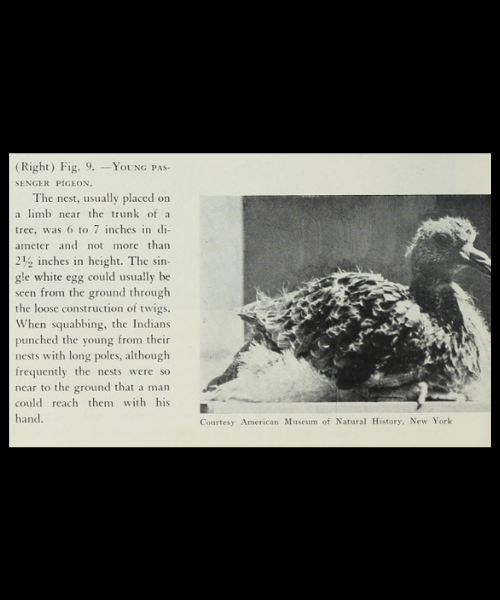
Failure to rear an adequate number of young (Fig. 9) [See below] resulted from shooting and trapping the adults, breaking up the nestings by shooting within the limits forbidden by law, and capture of the squabs. As the nestings became smaller, the competition for the squabs became all the keener. The destruction of the young at the nestings near Sparta and Kilbourn, Wisconsin, in 1882 was fearful; and it began before they were ready for the table. Squabs were a glut on the market in Milwaukee, where the retail price ranged during the season from 35 cents to $1.00 per dozen. For the first time known, they were sold “according to size.” Protests were raised against the taking of the young before they had attained sufficient growth. On May 21 nearly every team available at Sparta went to the nesting for squabs. Conditions reached the stage where a fruitless petition, received from New Lisbon, was sent to Governor Jeremiah M. Rusk to call out the militia to protect the nesting.’ As one writer from New Lisbon expressed it in the Mauston Star (Wis.) of May 25, 1882: “Some of our prominent business men (?) are busily engaged, and have been the past week in destroying thousands of poor little helpless young pigeons yet without feathers and encouraging others in the wholesale murder, and from a greedy desire to catch a few squabs to ship and sell for 30 cts. per dozen.”
The young at the Kilbourn nesting suffered as severely. On May 17, 15,600 were buried due to spoilage, the dealers having purchased more than could be preserved; and on another occasion several tons were thrown into the Wisconsin River for the same reason. According to the Milwaukee Sentinel of June 22, 1882, many, too young for consumption, were left under the trees from which they had been dislodged. Thousands of squabs were placed in crates and shipped alive to Milwaukee in an attempt to prevent spoilage during the hot June weather.
A visitor to the nesting at Kilbourn remarked on the “immense number of young birds” that were tumbled from the nests before the squabs were of any use whatsoever. Another statement in the Milwaukee Sentinel of March 15, 1883, reads:
The wholesale slaughter of these birds at their nesting place in Monroe County last spring when not half grown, and even before they were feathered, was disgracefully notorious at the time. One man shipped over 2,000,000 [?] of these birds out of the county and the ground was so strewn with the carcasses of young pigeons, too small for shipment, that for three weeks there was an area of several miles where such a stench arose as to sicken travelers.
It will be shown that persecution was unremitting until the last wild bird disappeared. In following the species to extinction, it is to be noted that the end came quite gradually and not with catastrophic suddenness as is popularly believed.
A nesting was reported to have occurred in Missouri the spring of 1883 at which all of the young were taken. One man had 60,000 and several others 10,000 young each. E. S. Bond predicted that “three years will finish them.” The following winter there was a roost near Augusta, St. Charles County, Missouri, three by five miles in dimension. A party is stated to have killed 5,415 of the birds.
There was a large flight of pigeons lasting one day over Coudersport, Pennsylvania, in the spring of 1884. Subsequently a flock of about 300 birds nested undisturbed at Cherry Springs.
A nesting, said to cover forty acres, formed in eastern Langlade County, Wisconsin, in 1885. According to information received in a letter from A. C. Weber, of Shawano, this nesting was considerably larger. He states: “This nesting was in Township 31, Range 15, being a part of Oconto County particularly in the following sections: 22-23-26- 27-34 and 35 along both sides of the two South Branches of Oconto River which flow through these sections.” No young were raised, as the birds were driven away by shooting. The fewer the pigeons the more persistently they were hunted. In the Racine Times for September 11 of this year a flock was reported at the “Springs” at Racine, Wisconsin, and within an hour 500 men with shotguns were headed for the locality.
“Millions” are said to have assembled in the mountains twenty-five miles northwest of Bedford, Pennsylvania, in the summer of 1885. Strangely, there is no record of even an attempt at colonial nesting in the East during this year. J. B. Oviatt found a few nests, his last, in McKean County, Pennsylvania, in 1885.
By 1886 only two large flocks were believed to exist, one in Pennsylvania and one in the Indian Territory (Oklahoma). Bishop has the bulk of the pigeons in Missouri. A nesting much smaller than that of 1880 was established in the Spring Creek region on the border of Forest and Warren counties, Pennsylvania. This nesting did not proceed to completion, due apparently to “thousands and tens of thousands” of the nesting birds being killed.
Several flocks of pigeons passed over Coudersport, Pennsylvania, on March 20, 1886, according to the Coudersport Potter County Journal for March 25 of that year. For two or three weeks southeastern Potter County was alive with them. For a time they were in McKean County, where it appeared that they would nest. Later they returned to Potter County and began to nest on Potato and Marvin creeks. Before the nests were completed, the birds were driven away by shooting. After these pigeons left, there was a new flight to the northeast lasting two days. This was the last time that they appeared in numbers in Potter County.122 J. B. Oviatt visited all the localities in Potter County in 1886 where the pigeons were reported to have nests, but could find none. According to French, the pigeons attempted to nest on Pine Creek, Potter County, but left on account of the shooting. A late nesting took place near Blossburg, Tioga County, Pennsylvania, from which thousands of squabs were taken.
In the spring migration of 1886 pigeons were reported numerous at Darlington, Manitowoc, and Green Bay, Wisconsin, but no nesting was reported. About 600 pairs were found nesting near Lake City, Michigan, by S. S. Stevens. In Missouri, 4,929 pigeons were killed during the year ending March 1, 1886.
Pigeons were reported quite numerous in several localities in Wisconsin in the spring of 1887. They started to nest in the swamp north of Wautoma, and a number of professional trappers arrived upon the scene. Again the pigeons left due to shooting within the nesting. The birds were reported in the Wautoma Argus (Wis.) of May 20 and 27 and June 3, 1887, to have failed to nest at Sparta, Wisconsin, for the same reason. Pigeons were found to be abundant in the Ozark Mountains, Arkansas, in 1887 by Kumlien from “December to April.”
Pigeons had now become so scarce that Brewster went to Michigan in the spring of 1888 to investigate the reported nesting of large numbers of birds. Accompanied by Jonathan Dwight, Jr., he arrived at Cadillac on May 8. They learned that large flocks had passed this place late in April and they received similar reports from nearly all the counties in the southern part of the state. The flocks reported seen varied from fifty birds to one that “covered at least eight acres.” During their stay in the state only single pairs could be found nesting. The netters believed that most of the pigeons had gone through the state to the uninhabited regions north of the Great Lakes. The numbers reported induced Brewster to express the opinion that the species was at present not on the verge of extinction, but unless effectual laws could be passed “our Passenger Pigeons are preparing to follow the Great Auk and the American Bison.”
There was a small nesting in Potter County, Pennsylvania, in the spring of 1888; and a flock of 150 to 175 birds was seen at York, Pennsylvania, September 1, 1888. In the spring of this year pigeons appeared in fourteen localities in Wisconsin. There was shooting for a week at Prairie du Chien and a “roost” was reported to exist on the Yellow River, according to accounts in the Prairie du Chien Courier for April 17 and 24, 1888. In the same year, Mershon, a resident of Michigan, considered the pigeon virtually extinct, destroyed by netting. Opinion was widespread that it had disappeared from the continent, but hope was expressed that a few flocks had taken refuge in the far West.
The population seems to have dwindled to a few thousands by 1889. White saw a “large flock” on Mackinac Island, Michigan, August 30, 1889, the only definite number given being one hundred seen September 10. Two flocks of about twenty each were seen in Kent County, Michigan, in September of this year, and a flock of sixty was reported. These data are at variance with those given by White to Mershon from memory.
Only stragglers were to be encountered at Lake Mills, Wisconsin, in 1889. On December 25 of this year a flock of three hundred was reported flying northward along the Susquehanna River at Harrisburg, Pennsylvania.
Pigeons were reported from thirteen localities in Wisconsin in the spring of 1890. The Madison Democrat of March 27 and 28 reported “thousands” seen in the woods about four miles from Madison, Wisconsin, on March 26. According to Carr, a large flock was seen near Madison in April and a few days afterwards one of twenty. A few flocks passed through Jefferson County in April, and Kumlien secured some specimens.
About one hundred dozen pigeons, said to have come from Pennsylvania and Missouri, were seen in the Boston market in February, 1891. A considerable flight took place at Prairie du Sac, Wisconsin, on April 3, 1891, and some were killed. Hough states that a man living thirty miles west of Fayetteville, Arkansas, netted 2,000 pigeons which were fed and shipped to Boston. Several birds were received at the aviary of Central Park, New York, in June, 1891, and considered rare specimens. (These pigeons may have replaced some that had died, for the American Museum of Natural History has two skeletons prepared from birds received from Central Park in January, 1891.)
According to the report in the Sparta Herald (Wis.) for April 5, 1892, the pigeons that appeared in the township of Greenfield, Monroe County, Wisconsin, in the spring of 1892 behaved as though they would nest at Wilsonville, where two large nestings had occurred in former years. In this year three flocks were seen in Potter County, Pennsylvania. Several hundred dozen pigeons, states Brewster, were received in Boston from the Indian Territory in December, 1892, and January, 1893. Fleming was in New York in November, 1892, and was informed by Rowland that he had seen recently several barrels of pigeons, shipped from the Indian Territory, that had been condemned as unfit for the table.
In 1895 Deane had a letter from the game dealers, N. W. Judy & Co., St. Louis, informing him that they had had no pigeons for two seasons and that their netters were idle. The last were received from Siloam Springs, Arkansas. The Wautoma Argus (Wis.) of April 14, 1893, reported that a few flocks had been seen that spring but that the species was nearly extinct.
A flock of 150 pigeons was seen at Whitewater, Wisconsin, on May 4, 1894. More pigeons were seen in Indiana in this year than during the preceding two or three years.”
The Manitowoc Pilot (Wis.) of September 12, 1895, stated that more pigeons had been seen than for several years; and the Prairie du Chien Courier (Wis.) of October 8 mentioned that hunters were shooting pigeons. John L. Stockton informed Deane that in June, 1895, he saw a flock of about ten pigeons for several consecutive days on the Menominee Indian Reservation in Wisconsin. A flock of about ten birds was seen at West Branch, Michigan, in this year. Two flocks, numbering twenty-five and sixty pigeons, were seen in Indiana in April, 1895.
The occurrence of a small nesting in 1896 on the headwaters of the Au Sable River, Michigan, was reported to Deane by Chief Pokagon. Pigeons were considered to be increasing at this time in Michigan. C. H. Holden, Jr., while hunting at “Altie” (Alton), Oregon County, Missouri, saw a flock of about fifty on December 17, 1896. Two birds that he shot were presented to Deane. A similar occurrence is related by Hough. William Knight, while hunting in Missouri and Arkansas in December, 1896, saw a large flock of pigeons, killed two and brought them home for mounting. It is not reported in which state the birds were taken.
Reports by residents of Oshkosh, Wisconsin, of flocks of pigeons ranging in size from ten to fifty in the fall of 1897 were sent to both Deane and Hough. On August 17, 1897, W. F. Rightmire saw a flock of seventy-five to one hundred birds in Johnson County, Nebraska.
No one will ever be satisfied as to the date when the last wild passenger pigeon was shot or seen. Since pigeons were reported seen well into the twentieth century, reliance must be placed on specimens with credible data. . . .
The year 1900 may be considered as marking the end. As late as 1899 Hollister was so optimistic as to state that the species was in no danger of total extinction, several species of American birds being in a more precarious position. Brewster in 1906 found it difficult to believe that the pigeon was extinct; but as Hegner remarked, another of our “inexhaustible resources” had disappeared.
It was thought by Job that the pigeon could have been saved from disappearance if “applied ornithology” had been in use sufficiently early, since the bird was easily propagated in confinement. The latter was not the case. It will remain a matter of opinion if the pigeon could have been saved had the last few thousands remained free from all persecution. Some of the northern states still contain sufficient mast-bearing forests to have afforded adequate subsistence during the nesting season. The substitution of the seeder for the broadcasting of grain by hand had removed the chief source of loss to agriculture. Whether or not the pigeon would have caused sufficient damage to growing crops to provoke the farmer to seek relief in the customary manner is unanswerable.
The threshold of survival of the pigeon is not determinable. This is at best a vague term and seldom can be defined statistically due to widely varying conditions. The heath hen rose from an estimated population of 120 to 200 birds in 1890 to a maximum estimate of 2,000 in 1916, then dropped to 414 in 1921, and to about 50 in 1926. The last bird disappeared in 1932. This species was in danger of extinction for over a century and it is impossible to fix upon a number that was critical.
No better example of eternal hope, so characteristic of man, can be found than the search for a living wild passenger pigeon long after it had ceased to exist. At the meeting of the American Ornithologists’ Union in New York, December 7-9, 1909, Professor A. F. Hodge reported on the problem of determining if the species was actually extinct. Plans were made for an adequate search, and awards totaling $1,220 were offered for the discovery of a nest or a colony. An original offer of $100 for a freshly killed pigeon was withdrawn due to the possibility of exterminating the few birds that might be left. The sum of $400 was contributed by Charles K. Reed and Chester A. Reed for the preparation of a leaflet on the passenger pigeon that included a colored plate. This was distributed widely.
The awards for discovery varied somewhat from time to time. . . .
The search, set to end on October 1, 1911, was finally extended to October 31, 1912. All the reports and specimens investigated confirmed the general opinion that the species was extinct. On the death of the last pigeon in captivity, Stone wrote the following sober admonition: “The reduction of this once abundant bird to absolute extermination by man’s greed should be a lesson to us all and stifle all opposition to the efforts now being made by national and state governments in behalf of the conservation of other birds threatened with a like fate. What is a little loss of sport to us compared with the extinction of a wild species — something that the hand of man can never replace?” 166
CONSERVATION AND LEGISLATION
Attempts to preserve the passenger pigeon were long in coming and were the outgrowth of pity. The sickening slaughter moved Cooper to write this protest:
If the heavens were alive with pigeons, the whole village seemed equally in motion, with men, women, and children. Every species of fire-arms from the French ducking-gun with a barrel near six feet in length, to the common horseman’s pistol, was to be seen in the hands of the men and boys; while bows and arrows, some made of the simple stick of a walnut sapling, and others in a rude imitation of the ancient cross-bows, were carried by many of the latter….
So prodigious was the number of the birds, that the scattering fire of the guns, with the hurling of missiles, and the cries of the boys, had no other effect than to break off small flocks from the immense masses that continued to dart along the valley, as if the whole of the feathered tribe were pouring through that one pass. None pretended to collect the game, which lay scattered over the fields in such profusion as to cover the very ground with the fluttering victims….
“This comes of settling a country!” he [Leather-stocking] said; “here have I known the pigeons to fly for forty long years, and, till you made your clearings, there was nobody to skear or to hurt them. I loved to see them come, into the woods, for they were company to a body; hurting nothing; being, as it was, as harmless as a garter-snake. But now it gives me sore thoughts when I hear the frighty things whizzing through the air, for I know it’s only a motion to bring out all the brats in the village. Well! The Lord won’t see the waste of his creatures for nothing, and right will be done to the pigeons, as well as others, by and by.”
An extraordinary example of sentimentality is related by Clarke. While pastor of a church at Louisville, Kentucky, he received a letter, dated January 4, 1834, from the actor J. B. Booth, requesting that he attend the burial of his friends. He adds:
Booth went to another corner of the room, where, spread out upon a large sheet, I beheld to my surprise, about a bushel of wild pigeons!
Booth knelt down by the side of the birds, and with evidence of sincere affliction began to mourn over them. He took them up in his hands tenderly, and presented them to his heart. For a few moments he seemed to forget my presence…. So I decided that it was a sincere conviction, — an idea, exaggerated perhaps to the border of monomania, of the sacredness of all life….
I also saw the motive for this particular course of action. During the week immense quantities of the wild pigeon (Passenger Pigeon, Columba migratoria) had been flying over the city, in their way to and from a roost in the neighborhood. These birds had been slaughtered by myriads, and were for sale at the corners of every street in the city. Although all the birds which could be killed by man made the smallest impression on the vast multitude contained in one of these flocks…, yet to Booth the destruction seemed wasteful, wanton, and, from his point of view, was a wilful and barbarous murder.
I heard, in a day or two, that he actually purchased a lot in the cemetery, two or three miles below the city, had a coffin made, hired a hearse and carriage, and had gone through all the solemnity of a regular funeral. For several days he continued to visit the grave of his little friends, and mourned over them with a grief which did not seem at all theatrical.
Adequate protection for the pigeon never came. . . .
The conclusion is inescapable that the passenger pigeon became extinct through such constant persecution that it was unable to raise sufficient young to perpetuate the race. Trapping and shooting were devastating. Drowning, disease if any, and all the other suggested causes of extinction must have been minor in effect. The extremely lax enforcement of the protective laws, engendered by little heed for the morrow, should have a sobering influence when attention is called to any other species that is in danger of vanishing. The sacrifice, however regrettable, was not in vain, for the passing of a bird known to millions has furnished a most poignant example of what will happen when man is heedless of his heritage.
On a bluff in Wyalusing State Park, at the junction of the Mississippi and Wisconsin rivers, stands a monument to the passenger pigeon. It was dedicated on May 11, 1947. The legend on the bronze tablet reads:
Dedicated
To The Last Wisconsin
Passenger Pigeon
Shot At Babcock, Sept. 1899
This Species Became Extinct
Through The Avarice And
Thoughtlessness Of Man
Erected By
The Wisconsin Society For Ornithology
W. Schorger, The Passenger Pigeon: Its Natural History and Extinction (Madison: The University of Wisoconsin Press, 1955), 167-230. Footnotes have been deleted. Figure 5 appears on page 171 and figures 7, 9, 13, 14, 16, 17, 18 appear between pages 178-179. The lead image for this section comes from the frontispiece in W. B. Mershon, The Passenger Pigeon (New York: The Outing Publishing Co., 1907). The Audubon plate appears on page 24 and the game store on page 104.
See: https://babel.hathitrust.org/cgi/pt?id=dul1.ark:/13960/t9h51hb0q&seq=7