Pelagic Seal Hunting
We want you to have a greater ability to learn about some of the unpleasant animal issues in our world.
The Hunting of the Silver Fleece: Epic of the Fur Seal
Frederica Martin
15. No Man’s Property
The Ten Thousand dollars the Alaska Commercial Company invested to popularize the fur seal boomeranged to destroy the source of its profits, the fur seals of the north. Once the fashionable ladies of the world adopted the smart fur seal sacque, a reign of terror struck the Pacific and Bering Seas, a holocaust known as “pelagic sealing.” Unlike the close-mouthed, prudent slayers of the bear-headed seals, the new hunting gangs, after two decades of trying to keep their business success a secret, operated boldly and openly, defying all efforts to halt their depredations.
Pelagic sealing began when the first aboriginal hunter speared a fur seal from his canoe. For hundreds — probably thousands — of years, bone- or stone-tipped spears and harpoons provided a few primitive littoral tribes with food, clothing, and oil for heat and light. Yet the fur seal ranks had never been depleted. Then almost in a single season pelagic sealing became an industry of civilized man, and desolation spread throughout the northern seal kingdom. Small schooners lined the seals’ ocean migration paths and trailed like bloodhounds the traveling animals. Firearms replaced primitive weapons. For each seal killed by a bullet and recovered from the waves, six to ten sank and were lost.
Pelagic poaching captains, fitting out in the Canadian harbor of Victoria and other West Coast ports, generally preferred to hire Indian hunters and transport them and their canoes to the sealing grounds. The captains agreed that the Indians were more skillful hunters and cheaper labor. Most important they were not quarrelsome and behaved more honorably, in all transactions, than the majority of “white” sealers. For they fulfilled their contracts scrupulously, and their general deportment aboard ship was exemplary. But as United States revenue cutters began waylaying sealing schooners, the Indians proved reluctant to risk violence and court action. More and more, the seal hunters and boat steerers and handlers were recruited from the rough, lawless flotsam of the seaports, the sea wolves whom Jack London depicted in fiction, men indifferent to hardships and dangerous toil, unafraid to clash with law officers.
The new pelagic sealing began off the coast of Washington and Vancouver Island before 1867, before the fur seals became Americans. A Canadian trader, Hugh Mackay, was persuaded by Indians from whom he bought furs, to ship them and their canoes to the seal routes to save time, labor, and the risk of long voyages in their small boats. His sloop Ino proved too small to carry more than two or three canoes; so after his trial trip in 1866 proved profitable, he had the schooner Favorite built solely for sealing. A few other fur traders, each believing himself the pioneer pelagic sealer, tried the same experiment during the next few seasons and, for some years, found the business most profitable — too profitable to divulge to others and attract competition.
Available data, incomplete because of the traders’ secrecy, indicates that only four or five schooners were sealing in that neighborhood in 1879. There may have been more. Vancouver Island Indians and some from Cape Flattery had bought their own schooners and were carrying on large-scale independent sealing. They, too, were discreetly silent. These desultory beginnings were not seriously detrimental to the Pribilof herd.
Simultaneously, whaling captains in the Bering Sea were drifting into pelagic sealing. The market for whale oil and whalebone had dwindled. Decimated by decades of hunting, each year whales were more difficult to find. The first land raids on the Pribilof Islands, between 1872 and 1879, were perpetrated by disappointed whalers returning from arctic seas with empty oil casks. Passing the unguarded rookery shores, they yielded to the temptation to recoup their losses with a few hundred seal pelts. As whales became more scarce and London offered higher prices for seal furs, the serious outfitting of ships for sealing voyages began, probably in 1879. The following summer pelagic sealing emerged from its chance beginnings and became a flourishing, profitable, established industry. Representing a large investment of capital, it provided work for shipbuilders; trade outlets for food, clothing, and other merchandise; as well as employment for mariners and hunters.
Waiting for migrating seals off the coast of Washington in February, the schooners followed them northward, killing chiefly the slower-swimming gravid females. As more ships entered the chase each spring, in order to obtain a satisfactory catch the schooners had to pursue the seals between the Aleutian passes into the Bering Sea and, eventually, even to the shores of their breeding islands. From a known total of sixteen schooners in 1879, the sealing fleet by 1883 had increased to thirty-four; and in 1889 there were 115 fur pirates harrying the fur seals from Cape Flattery to the Pribilof Islands and beyond. A catch of fifteen-thousand pelts reported in market lists of 1882 rose to sixty-thousand a year by 1895. Marked by the hole where spear or bullet had penetrated, the pelagic skins were easily distinguished from the undamaged skins of Pribilof or Asiatic seals killed on land by clubbing. London furriers referred to these torn, less valuable furs as “the Northwest Catch.”
Mortality among fur seals was far more devastating than sales totals indicated. According to the pelagic hunters’ own admissions, the fifteen-thousand furs sent to London in 1882 represented the pelts recovered from between 120,000 to 150,000 slain animals. To attempt to estimate the number of slain foetuses was futile. Since the majority of those killed at sea were pregnant females, the death rate among the unborn was catastrophic.
Impulsively defending American property, the Treasury Department ordered revenue steamers to apprehend sealers no matter what flags the schooners flew, convoy them to Alaskan ports, and hand them over to an American District Court. No precedent existed to guide revenue officers, judges, or lawyers. Nor had the State Department, which had not protested to either Great Britain or Canada before the first seizures, found previous international judicial sanction to justify American interference with ships of other countries.
As soon as seal furs become commercially valuable, the creatures’ unique habits, their amphibious nature, introduced into international politics a legal conundrum more complex and confusing than any diplomats had ever faced in settling trade animosities between nations. Had the United States sought England’s co-operation earlier, before the Canadians had invested so much capital and received such high returns, seal protection beyond territorial waters might have been arranged amicably. But no one, not even Professor Elliott, suspected the fur seals’ plight, or realized the potential destructiveness of sea hunting. So the lowly, stupid sea bears innocently and fatally emerged from obscure commercial status to market fame and into the sphere of international relations as a disruptive, malignant political force. As the owner of their birthplaces, the United States, attempting to end their persecution at sea, rashly ventured beyond traditional legality into unknown diplomatic courses.
Evidence against the pelagic sealers was easily collected. They felt no guilt. They explained every detail of their methods. Hundreds of their affidavits frankly described the place and manner of killings and commented upon the elusiveness of their swimming targets, the abrupt sinkings of wounded seals, and the consequent wastage of seal life. Shamelessly they pictured the shambles of a schooner’s deck at skinning time. Prematurely ripped from their dead or dying mothers by the skinners’ cruel blades, tremulous viable foetuses stumbled blindly in the slippery white and crimson ooze of their mothers’ milk and blood smeared thickly over the planks. These terrible living unborn cried in anguished terror until a kindly foot mercifully kicked them overboard to a sea death.
Wiser than the antarctic seal destroyers, in the beginning of majority of fur pirates candidly agreed their killings would soon exterminate the Pribilof fur seal. What of it? Their only interest was a season’s profits. Neither the conservation of seal life nor the monetary and property losses of the United States or of a single American fur company concerned them. The seas were free to men of all nations. United States interference beyond the three-mile limit was illegal, hostile, an act of war against a sister nation. Swimming fur seals belonged to no one.
“I’ve got a strong government back of me,” a Canadian sealing captain warned the American officer boarding his schooner. “I’ve got a strong government backing me,” retorted the American, “and I intend to do my duty.” Queen Victoria’s ministers agreed with the pelagic sealers….
16. Where are the Fur Seals?
… [Henry] Elliott, fearful but still holding stubbornly after his winter studies to the hope that Goff’s report had been exaggerated, went back to the Pribilofs in the spring. From available data, he had compiled a casualty list, a memorandum submitted in February to Treasury officials. His own estimate of a million and a half victims of pelagic hunting had horrified him. Vehemently he urged the passage of the bill ordering an investigation of Goff’s report, an action his enemies were later to interpret as proof of excessive self-love and disgraceful chicanery to secure a job. However, it was the Treasury’s automatic duty to determine the report’s verity. And undoubtedly Elliott must have pressed his claim to be the investigator. Who had a better right? Naturally he was anxious to see for himself the state of his fur seals. Whom else could he trust after the years of false reporting? Considering his reputation, he was the Treasury’s best and only candidate — a fact his enemies were to forget or ignore.
The spectacle of the seal beaches frightened him; former rookeries were abandoned and grass-grown; others were shrunken. Of the host which had captured his heart and imagination in 1872, a “scant million” survived. Clearly he remembered the first day he had stood on Hutchinson Hill, the little volcanic cone on Northeast Point, gazing in bewildered ecstacy at the surging tide of fur seal life, many millions strong, fecund, virile, and magnificent. It was an awful hour when he climbed again to the crest of the same peak. Small, lonely clusters of fur seals were scattered along the shore. The lava boulders, so burnished by the passage of millions of flippers of countless generations, gaped like raw welts between the huddled groups. The empty earth, the untenanted rocks, accused him of murder. Not the lessees alone. Not only the slayers of the mothers. He, the careless shepherd, was equally guilty.
Barely a hundred thousand young males remained to replace the older breeding bulls. Chiefly, the swollen-bodied, slower-coursing gravid cows had been the pelagic hunters’ targets. Elliott knew from the killers’ own confessions as well as from the acknowledged routes and time schedules of pirate schooners, that the female routes were more regularly patrolled than the other seals’ sea lanes.
Where then had the bachelors gone? So many millions of swift-coursing young could not have been destroyed at sea. Had they been slaughtered on land? He studied the islands’ logs which contained the daily records of seal drives during the preceding twenty years. From the sealers whom he cross-examined energetically — their frightened half-answers enlightened him but were worthless as public proof of malpractice, certain to be denied in the presence of their immediate superiors — he heard of barbarous tactics the first lessees had employed when bachelors became scarce.
To drive the animals permanently from the less accessible shore rims, the rocks had been strewn with broken glass and rubbish. Straggling handfuls of bachelors loafing on rocks too close to the sea to be surprised in the usual manner, had been stampeded by clamorous, shrill police whistles the sealers wore those tucked under their shirts, Elliott discovered. Then the terror-stricken animals, having lost their sense of direction had been easily rounded up. The log showed why such cruelty was devised. Until 1877 the lessee’s quota had been filled by collecting seals from only a few rookeries. Then, to secure the maximum, the hunters had invaded every strip of seal beach.
Instead of herding the bachelors to killing fields adjacent to the newer hunting territories, the young seals had been marched mercilessly along an extended, rugged, rock-strewn course to the regular killing grounds. Rejected bachelors, culled, usually because of extreme youth and small size, from the herd along the line of march or at the site of execution, had probably been driven over and over that tortuous, exhaustive passage — since there were no longer undisturbed and peaceful beaches to which they might retire. The frequently repeated violent exertions must have devitalized the future fathers of the species and destroyed their virility.
The indignant Elliott could envisage no other explanation of depleted male breeding stock. The greedy lessees had concealed the awful pelagic casualties while maltreating and abusing the poor male refugees that had run the gantlet safely. They were more guilty than the sea killers and must share, with the latter, the blame for the murder of over four million seals.
Elliott and the resident Treasury agents headed by [Charles] Goff watched the new lessees’ foremen collect small herds of males daily. By July 20th, when the harems began to disperse, only 21,000 had been executed — a third of their quota. Backed by Elliott, Goff ordered [George R.] Tingle to stop killing. The new superintendent forgot his previous fervent admiration for the expert. Forgetting, too, that Goff had recommended the terminal sealing date the previous year, Tingle held Elliott alone accountable for the stoppage. He was the villain who had perverted the judgment of sensible government officials. Fine young males were arriving daily, asserted Tingle. Elliott was not merely defrauding the lessees of their rights. He was injuring the sealers. The Company need not support the Aleuts unless its sealing income covered its expenses. Elliott was condemning the sealers to starvation.
Aleuts, Tingle might browbeat successfully. His threats failed to intimidate Elliott or Goff or, confident of the fur seal expert’s prestige and support, the assistant agents. When the authority’s report was read in Washington, Tingle and his crowd would learn that they could not continue to destroy the already decimated herd nor gamble with the lives of wandering cows by prolonging killings late into the season.
Seal killing on land and sea must be stopped immediately, Elliott not only recommended but demanded. Only complete peace could save the fur seals. A zapusk, a Russian-style holiday from clubbing, for at least seven years, must begin at once. Swiftly and jointly British and Americans must devise a peaceful, a cooperative settlement of pelagic sealing. If the Americans corrected land abuses, if they stayed their hands from seal murder, their moral example and their display of unselfish regard for the fur seals would force the British to end open-sea killing.
Compensation of the pelagic interests might be necessary. Financial problems — particularly the determination of the distribution of future profits from the seals’ furs — were of minor importance. The only issue was the preservation of the fur seals. No longer would the “seal life candle” burn at both ends — the animals be destroyed both on land and at sea. He, the expert, would extinguish the consuming flames.
But it was Ellott’s flaming accusation which, because it shocked decorous government circles, was extinguished. Affrighted officials read his emphatic words and hastily took cover, transferring Agent Goff to a Canadian customs post and excluding the “Professor” from some inner fur seal conferences. The expert had blundered and run counter to conventional opinions. He had not backed up with incontrovertible evidence the American claim to the fur seals as their exclusive property by right of purchase of their birthplace, by yearly sojourn on American territory and because of the care and attention lavished on them.
His cutting denunciations of land management were phrased in terms so much sharper than his condemnation of pelagic sealing. It was impossible to assail the first lessees without censuring the agents as civil servants either too ignorant to see the gradual diminution of seal life, or too dishonest to tell the truth. Elliott’s attitude was unpatriotic, almost treasonable. Doubtless some personal, nefarious ambition, a spiteful determination to ruin the new lessees who had ousted his friends from the Seal Islands, inspired his reckless attacks on the fair name of his country. Otherwise his recommendations were inexplicable to official circles.
For domestically his suggestions were ruinous. His seven-year holiday was Utopian folly, horrifying to the officers of the new company and their friends in office. It was an attack on the very idea of leasing sealing rights, an attempt to undermine the system of private enterprise. The madman might next propose that government control replace private commercial sealing. Furthermore all seals would be killed at sea, and the Canadians would get rich while Americans lost money.
It was preposterous to think the British would be impressed by a zapusk. The Canadians would laugh and go about their sealing with better catches for a few seasons, grateful for American folly. So favorable were his proposals to Canadian interests, that the expert must be working for pelagic sealers. He was a British agent, a hireling of the Canadian pirates. His written word must be suppressed, and while officials politely wrangled with him about its effect on public opinion, his report could be locked up. But the expert himself could not be muzzled. He had a reputation, a public who deemed his utterances about fur seals infallible. He must be discredited. Rumors, contradictory and vicious, began to spread wildly throughout Washington. He was, at one and the same moment, the tool of the Alaska Commercial Company, the agent of British statesmen, and the lobbyist for pelagic fur pirates.
The strange furred creatures of land and sea had appropriately selected a strange personality to rescue them from jeopardy. He had truly been a doomed young man when he rode into their kingdom in 1872. Camped out on the edge of Washington, he subordinated all personal interests to the defense of his fur seals. A Don Quixote jousting at many windmills, but sometimes sending his point home to the very heart of ruthless commerce and organized greed, he was to continue from that summer of 1890 to his life’s end the fur seals’ loyal, though most imperfect, knight.
Fredericka Martin, The Hunting of the Silver Fleece; Epic of the Fur Seal (New York: Greenberg Publisher, 1946), pp. 161-165 and 187-191
See: https://babel.hathitrust.org/cgi/pt?id=uc1.$b25958&seq=1
Wild Animals of North America
Edward W. Nelson
ALASKA FUR SEAL
(Callorhinus alascanus)
Several species of fur seals are known, all of them limited to the southern oceans or the coasts and islands of the North Pacific. All are strongly gregarious and formerly sought their island breeding grounds in vast numbers. At one period, soon after the purchase of Alaska, it was estimated that several million fur seals were on the Pribilof Islands in one season. During the height of their abundance the southern fur seals were equally numerous.
The value of their skins and the facility with which these animals may be slaughtered have resulted in the practical extermination of all but those which breed under governmental protection on the Russian islands off the coast of Kamchatka and on the Pribilof Islands in Alaska. Owing mainly to wasteful pelagic sealing prior to the recent international treaty, the numbers on both these groups of islands were much reduced.
The Alaska fur seal is a migratory species, wintering down the Pacific coast as far as northern California. The migrations of these seals are of remarkable interest. In spring they leave the northwest coast and many of them travel steadily across more than two thousand miles of the North Pacific. For days at a time they swim through a roaring gale-swept sea, under dense, low-hanging clouds, and with unerring certainty strike certain passages in the Aleutian Islands, through which they press to their breeding grounds, more than 100 miles beyond, on the small, fog-hidden Pribilof Islands.
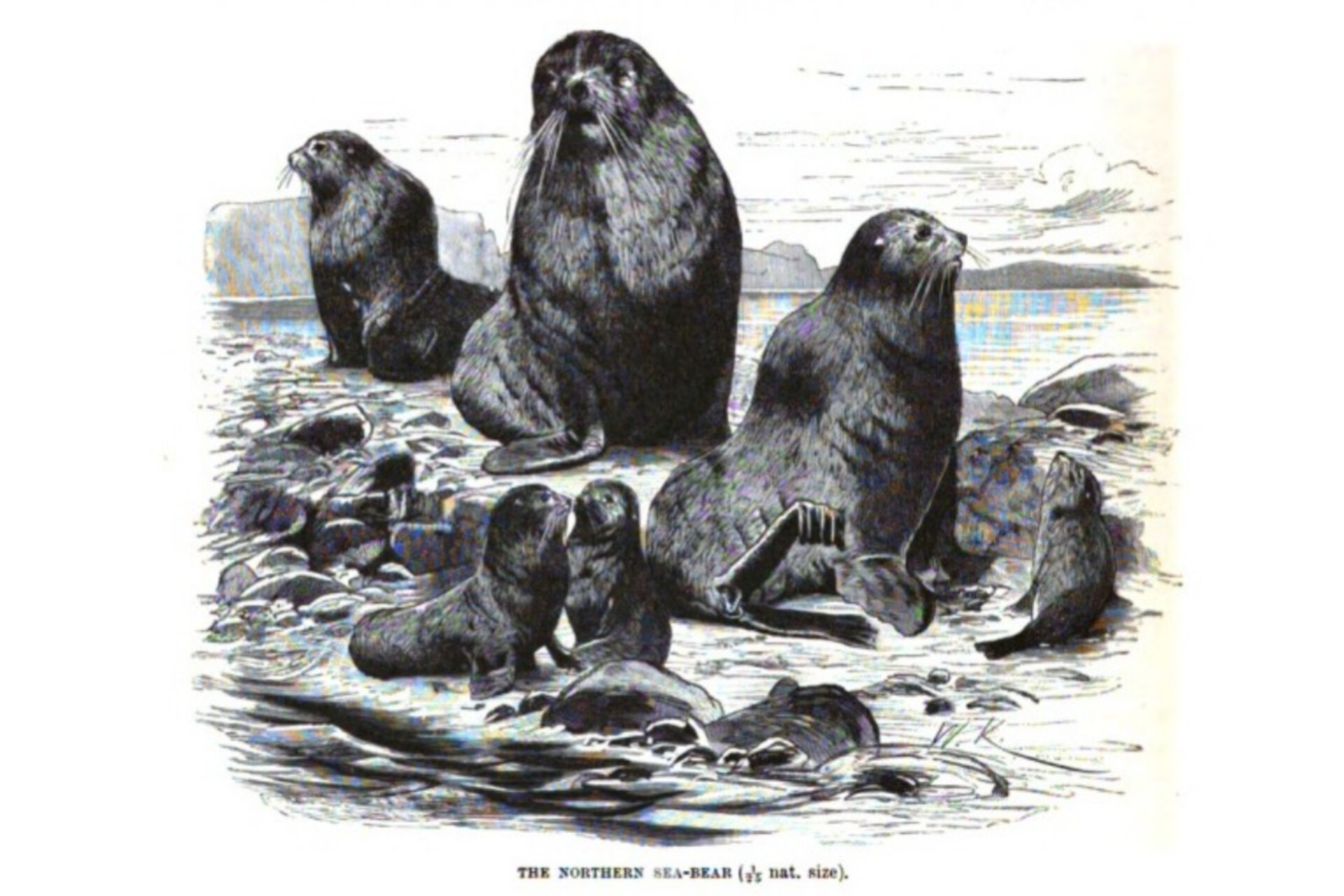
Fur seals are extremely polygamous and the old males, which weigh from 400 to 500 pounds, “haul up” first on the breeding beaches. Each bull holds a certain area, and as the females, only one-fifth his size, come ashore they are appropriated by the nearest bulls until each “beach master” gathers a harem, sometimes containing, more than 100 members.
Here the young are born, and after the mating season the seals, which have remained ashore without food from four to six weeks, return to the water. The mothers go and come, and each is able to find her young with certainty among thousands of apparently identical woolly black “pups.”
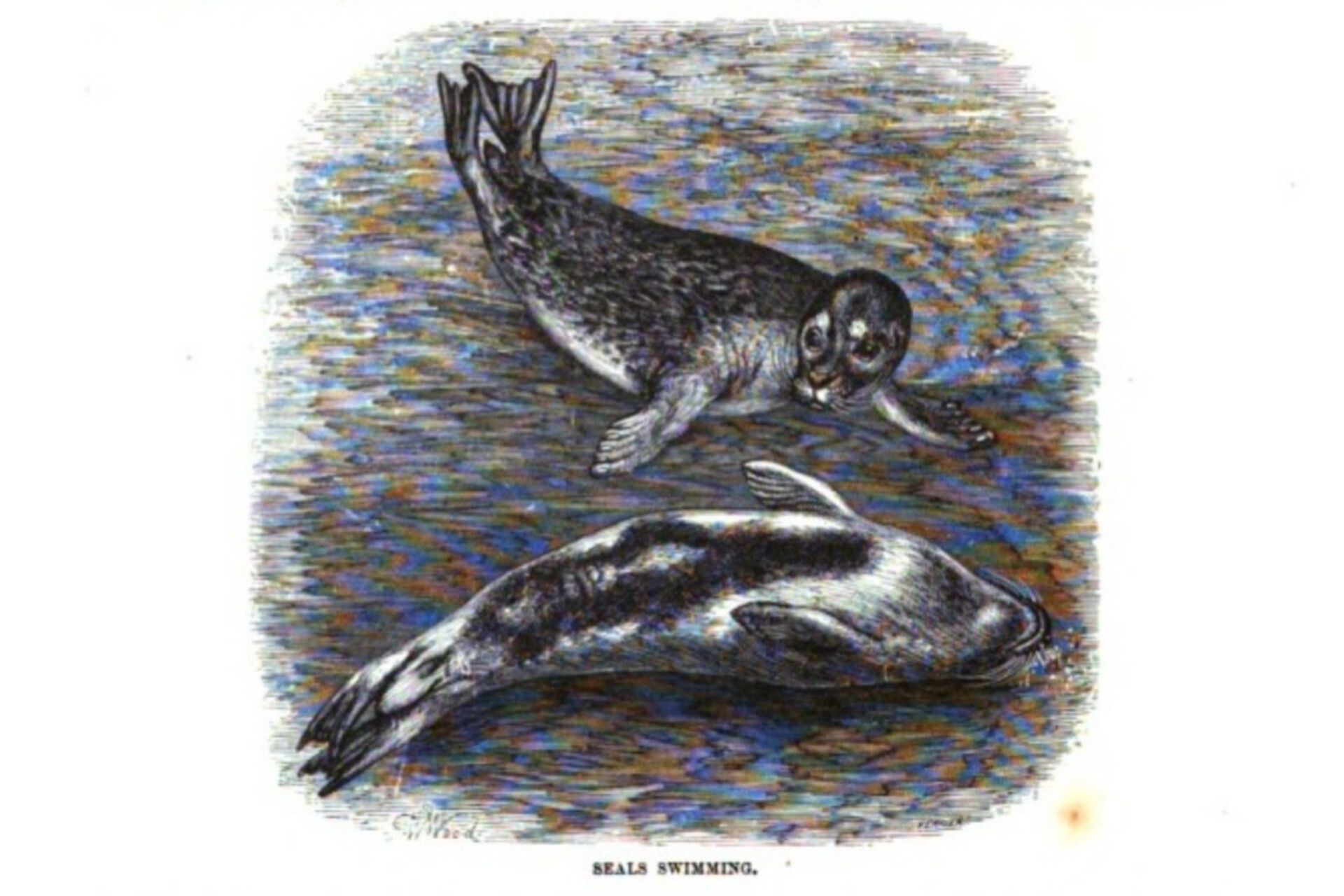
From the ages of one to four years fur seals are extremely playful. They are marvelous swimmers and frolic about in pursuit of one another, now diving deep and then, one after the other, suddenly leaping high above the surface in graceful curves, like porpoises. Squids and fish of various species are their main food. Their chief natural enemy is the killer whale, which follows their migrations and haunts the sea about their breeding grounds, taking heavy toll among them.
Since the discovery of the Pribilof Islands by the Russians the fur seal herds there have yielded more than five million recorded skins. A census of the herds in 1914 gave these islands nearly three hundred thousand seals. Now that pelagic sealing has been suppressed and the herds are being protected, there is every reason to expect that the seals will increase rapidly to something like their former numbers.
Edward W. Nelson, Wild Animals of North America: Intimate Studies of Big and Little Creatures of the Mammal Kingdom (Washington, DC: National Geographic Society, 1918), p. 429.
See: https://babel.hathitrust.org/cgi/pt?id=coo.31924022544534&seq=1&q1=
Extinct and Vanishing Mammals of the Western Hemisphere
Glover M. Allen
KURILE ISLANDS FUR SEAL
CALLORHINUS URSINUS MIMICUS (Tilesius)
Phoca mimica Tilesius, Oken’s Isis, Heft 8, p. 715, 1835 (Bay of Patience near Cape Patience, Sakhalin Island, Okhotsk Sea).
SYNONYMS: Callorhinus curilensis Jordan, Fur Seals and Fur-seal Islands of North Pacific Ocean, pt. 1, p. 45, 1898; Jordan and Clark, ibid., pt. 3, p. 3, 1899 (Robben Island, south of Cape Patience, Okhotsk Sea); Callotaria ursina mimica Stejneger, Georg Wilhelm Steller, p. 286, footnote 37, 1936; C[allotaria] curilica Stejneger, Georg Wilhelm Steller, p. 286, footnote 37, 1936.
Probably no other wild species has been so thoroughly studied and written of as the fur seal of the North Pacific. Three local forms have been named, each of which represents a supposedly circumscribed colony. The typical C. ursinus, first brought to the attention of naturalists by Steller, was found by him in 1741 on Bering Island, of the Commander group off the east coast of Kamchatka. Jordan and Clark (l.c.) overlooked the name mimicus applied by Tilesius (l.c.) to the fur seal of the Okhotsk Sea and proposed Callorhinus curilensis for the fur seal of Robben Island off Cape Patience, Sakhalin Island, in Okhotsk Sea; and at the same time distinguished that of the Pribilof Islands as Callorhinus alascanus [= Callorhinus ursinus cyocephalus].On account of their interest and value as fur bearers, these seals may be briefly included here.
The North Pacific fur seals are placed in a genus, Callorhinus, distinct from that of the southern fur seals, from which they differ in “the form of the facial portion of the skull, which in Arctocephalus is narrower, longer, and much less convex, with much longer nasals” (J. A. Allen, 1880). Otherwise, “in coloration, character of the pelage, size, general form, and dental formula” the two are much alike.
The Commander Islands animal has the head less stout and broad, the neck slenderer, while “the females and young males are sooty, rather than brown, the light and dark shades being for the most part equally without ochraceous tints; the belly is usually rather sharply paler than the back; the gray pup is more brownish and less gray than in the Pribilof animal.” The fur seal of the Kurile Islands differs from both in the whitish color of the under fur, instead of rusty brown. Probably all should rank as subspecies. Total length of an adult male from Commander Islands, 1,930 mm.; of an adult female, 1,283 mm.
At the Commander Islands the fur seals have been regularly taken for a long period of years. Stejneger (1897, 1898) has given a full account of the history of the industry there. From his figures it appears that between 1870 and 1896 a total yield of over 800,000 skins was obtained. In 1896 alone Bering Island yielded 9,526 and Copper Island 6,893 skins. In 1877 the Russian Government appointed Grebnitski as administrator of the Commander Islands, and under his wise supervision the herds of seals continued to produce an annual and well-sustained revenue. Only natives were allowed to work on the rookeries, and there were heavy fines for killing female or young seals.
In the eighties, however, poaching parties made heavy raids on the islands, so that it became necessary to station a small force of soldiers there for their protection. Later the natives were organized as armed guards. Soon it became evident that the poachers had adopted new tactics, lying offshore outside the 12-mile territorial limit and killing the seals that came and went from the rookeries to the feeding grounds. Since these were chiefly females with small pups on shore, the result was a great destruction of both the breeding females and their young.
On Stejneger’s second visit in 1896, the result of this was plainly evident in the depletion of some of the rookeries that had formerly been well populated. It was not until pelagic sealing was stopped by international agreement in 1911 that this danger was removed. At the present time the colonies are apparently in flourishing condition on the Commander Islands, although the great yields of their palmy days are no longer taken.
According to Barabash-Nikiforov (1938) the seals “spend only the summer period on the Commander Islands. They begin to arrive at the end of April or the beginning of May but are present in their greatest numbers at the beginning of August. The first new-born young appear in the middle of June, 2 or 3 days after their mothers arrive at the island. Soon after this the fertilization of mothers occurs. Moulting takes place from the middle of August until the middle of September, and about the middle of October the animals begin to leave the island. Fish is the chief food of the fur seal… Infection with endoparasites, chiefly Uncinaria, is especially great among the young fur seals.”
The fur-seal rookeries of the Kurile Islands, the home of C. ursinus mimicus, were not discovered until 1881, or 11 years after the islands were ceded to Japan by Russia in exchange for the southern half of Sakhalin Island. There were four islands on which rookeries occurred, and these totaled a population of about 22,000 seals as then estimated. They were so speedily decimated by Japanese sealers that by 1898 Stejneger on careful inquiry concluded that a possible 30 animals might still remain. The race may already be extinct.
It is believed that both the Commander Islands and the Kurile Islands fur seals at the close of the breeding season moved southward into somewhat warmer waters for the winter season, but the extent of this migration is not clear. Sowerby (1923) writes that they are said to occur off Chefoo, in northern Shantung Province, China, and even perhaps to Shanghai, but the evidence is not very definite.
ALASKAN FUR SEAL
CALLORHINUS URSINUS CYNOCEPHALUS (Walbaum)
Siren cynocephala Walbaum, Artedi, Genera Pisc., p. 560, 1792.
SYNONYMS: Trichechus ? hydropithecus Shaw, Gen. Zool., vol. 1, pt. 1, p. 247, 1800; Manatus ? simia Illiger, Abh. Akad. Wiss. Berlin, Phys. Kl., 1804–11, pp. 64, 68, Callorhinus alascanus Jordan, Fur Seals and Fur-seal Islands of North Pacific Ocean, pt. 1, p. 45, 1898; Jordan and Clark, ibid., pt. 3, p. 2, 1899; Callotaria ursina cynocephala Stejneger, Georg Wilhelm Steller, p. 285, 1936; Callorhinus ursina cynocephala Hall, California Fish and Game, vol. 26, no. 1, p. 76, Jan. 1940.
FIGS.: Allen, J. A., 1870b, pl. 2, pl. 3, figs. 1-8 (skull and teeth); Nelson, 1916, col. fig., p. 432.
The northern or Alaskan fur seal of the Pribilof Islands in Bering Sea is believed to differ from those on the Commander and Kurile Islands of the Asiatic coasts in its “stouter, broader head,” the thicker neck, the “prevalence of warm brown shades in the coloration of the female and the young males,” and in the more silvery color of the gray pups. “The fur in alascanus is also of superior quality and exhibits sufficient difference to make it possible for dealers to distinguish by this means alone whether the skins come from the Commander or Pribilof herds” (Jordan and Clark, 1899).
In their southward migrations from the breeding rookeries on the Pribilof Islands, these seals are believed to trend along the coasts of the Alaskan Peninsula and British Columbia, going as far south as the coasts of northern California to the vicinity of Point Conception. Grinnell (1933) quotes an instance of its occurrence near Monterey in 1925. The usual season of appearance on the California coast is from December 10 to April. With the coming of spring “they leave the north-west coast and many of them travel steadily across more than two thousand miles of the North Pacific. For days at a time they swim through a roaring gale-swept sea, under dense low- hanging clouds, and with unerring certainty strike certain passages in the Aleutian Islands, through which they press to their breeding grounds, more than 100 miles beyond, on the small, fog-hidden Pribilof Islands.” The extraordinary tenacity that the fur seals show in their return year by year to their traditional breeding grounds explains the preservation of slight differences in the populations of the different colonies.
The old males arrive at the islands as early as April and establish themselves on the beaches, and they are soon followed in May and June by the females. Each adult male gathers around him a harem, varying in size up to as many as 40 or even more females, and until the end of the breeding season remains at his chosen station, driving off other neighboring males, so that the groups become somewhat spaced. After the birth of the young the females are ready for mating and are occupied with the care of the pup, going and coming freely to and from the feeding grounds in the adjacent seas.
The nonbreeding immature males or “bachelors” consort by themselves in a separate part of the shore. It is from this group that killings are best made, since the polygamous habits of the species result in the production of many more males than are needed for propagation, assuming that the ratio of the sexes is approximately the same among the young pups. Parker (1917) records that in 1914, he found “the number of cows associated with one bull varied by actual count from 1 to 106,” with an average of about 60, a number probably “somewhat too high for the best condition of the herd.” In August the harems begin to break up, and the pugnacity of the adult males relaxes. By November the rookeries are nearly deserted, and the herds put to sea once more on their southward migration.
The rookeries on the Pribilof Islands were under the administration of the government of Russia until 1867, when Alaska was purchased by the United States. Up to that time the collecting of pelts was under the monopoly of the Russian-American Co. Since the discovery of the islands in 1786, more than 5,000,000 seal skins have been taken, and with proper management there is no reason why the yield should not continue indefinitely.
But the exploitation of these resources in the decades after the purchase of Alaska by the United States soon began to show in the decline of the herds. Investigations proved that the chief cause was “pelagic” sealing. For while the breeding colonies were managed with a certain degree of discretion ashore, and the poaching of sealing crews was more or less stopped, it developed during the eighties that an increasing number of sealers made a practice of lying offshore outside of territorial limits and shooting the females that came out to their feeding areas. The resulting reduction of the females thus involved the loss of their new-born young through starvation on the rookeries.
This abuse was eventually stopped by international agreement in 1911 between the United States, Great Britain, Russia, and Japan. At that time, in 1912, it was estimated that the colony of fur seals on the Pribilof Islands had been reduced to some 130,000, a number far smaller than the population that can be carried by the available area. Strict protective measures over intervening years have now built up the herds to an estimated 1,500,000 in 1935, and there is an annual revenue derived from them through the killing of a certain proportion and marketing the hides under governmental supervision.
The fur seal offers an excellent example of a species once reduced in some colonies to a mere remnant of its normal numbers, which under protection and wise management has been restored to an abundance that permits an annual harvest of pelts, bringing in an excellent return. While many persons may deplore the yearly slaughter of a proportion of these interesting seals for commercial purposes, it must nevertheless be admitted that this reasonable use of a natural resource is far better than its wanton exploitation and eventual complete destruction.
For extensive accounts of these seals the reader is referred to the four-volume report by Jordan and others, 1899; J. A. Allen, 1880. A brief and readable report on the more recent conditions is that of G. H. Parker, 1917. “No one who has seen the great seal herds will hesitate to reckon them among the chief wonders of the world, and there is no naturalist who would not think himself well repaid for a journey half around the earth by the sight of them.
Glover M. Allen, Extinct and Vanishing Mammals of the Western Hemisphere with the Marine Species of All the Oceans (New York: American Committee for International Wild Life Protection, 1942), pp. 442-447.
See: https://babel.hathitrust.org/cgi/pt?id=mdp.39015023915989&seq=1&q1=
Adventures of Carl Rydell
Elmer Green
CHAPTER X
HUNTING THE FUR SEAL
I had heard that sealing offered adventurous and profitable employment for officers and hunters, and I engaged with H. Liebes and Company, fur traders of San Francisco, to navigate one of their vessels. They assigned me to the Alexander, a schooner of only fifty-two tons, fitted out for sealing and sea-otter hunting. I was to have nothing to do with the hunting. On such vessels the head hunter usually ranked with the navigating officer; but as the hunters were a company apart from the rest of the crew and the head hunter was seldom a seaman, the navigator was in effect captain. The hunters engaged for this cruise of the Alexander were Mexicans from the border of Mexico and California. They had had long experience in their work, particularly in hunting sea otters off the coast of Southern California.
Sealing in my time was carried on principally off the Alaskan, Siberian and Japanese coasts. There was some sealing in the Southern Hemisphere also, but I never got into that.
The sealing fleet generally fitted out in January — most of the vessels at San Francisco, but some at Seattle and some at Victoria. After Christmas the officers would begin to gather their crews. There was no fixed pay, the earnings of all depending upon the number of pelts taken; but each man received a large advance note against whatever pay might become due to him. Most of the men came aboard lacking even sufficient clothing, and having to be outfitted from the slop chest.
They would come back from a nine or ten months’ cruise with their accounts overdrawn and would be paid off with a dollar, the minimum that they might be paid under the shipping law. With so little inducement to offer, we had to take whatever men we could get for our crews — generally sots that we found hanging around saloon corners near the water front. Some of these had been shoemakers, others bricklayers, and others paper-hangers. No matter what they were, we soon broke them in. We always managed to get a few sailors in a crew of from twenty to thirty men — enough for our purposes, as the vessels were small.
With such crews, the officers could not deal softly. The men were in the majority, even with the hunters against them, and they would have taken the upper hand at any show of timidity. Nevertheless, the officers had to know when to pass the bottle around as well as when to be severe. The sealing vessels always carried large stocks of liquor, and this was dealt out most freely during actual hunting. Then the work was severe and the men had to be humoured to be kept at it. The vessels, too, carried a good many firearms, but even the hunters were not entrusted with these more than was necessary or seemed safe. As it was, there often were ugly fights between members of the different groups on board, but there were few killings.
The food on most sealing vessels was all that the men could wish for. Liebes and Company were particularly liberal, telling their captains to buy any provisions that they wanted. It was partly on this account that the firm was always able to engage the most experienced hunters and got the best results from its outfits.
Herman Liebes, the president of the fur company, was an employer who believed in treating his men according to their deserts. He was a friend to his sealing captains and hunters, many of whom he helped to buy homes. When we were broke, the easiest way to get money enough to last us till the next hunting season opened was to ask Herman Liebes for it. We generally got back from our cruises in October, and our money would be gone by the middle of December at the latest. Then we skippers would meet and decide how large an advance of cash we should ask for, after which we went to Herman Liebes’ office together.
He always knew what we were after, and would speak first, saying: “Well, boys, I suppose you want money. How much do you want apiece?”
“Five hundred dollars,” we might answer.
“It takes a millionaire to keep you fellows going,” he would say; and I believed him. But he would pay cheerfully, and, into the bargain, take us round the corner for a drink.
The commander of a sealing vessel had a kind of roving commission. The only orders he had from the owners were to fit out for a year and come back with furs. The vessel cleared merely for seal and sea-otter hunting. No masters of other vessels had such loose orders. The sealer was practically free to go where he pleased and do what he pleased, so long as he came back with a catch of furs. He had, of course, to take into account the laws governing the hunting. If he broke the laws and got caught, he had to take the personal consequences, and he might cause the owners to lose their vessel through forfeiture. We did take chances with the law at times, and we had many narrow escapes from revenue cutters and warships.
Sealing on the Pribilof Islands, the great seal rookeries, has from the first been under Russian or American control. But sealing in the open waters of Bering Sea and the Pacific — pelagic sealing — was not so easily regulated. The North-western Indians had long gone out in their small boats to hunt seals far from shore; and in 1879 white men began to take seals from vessels carrying small hunting boats. In 1894, hunting seals with firearms was prohibited, the purpose being to lessen the number taken; but it was found that white men soon became as skillful as the northern natives at spearing seals. The taking of seals anywhere within sixty miles of the Pribilof Islands was also prohibited.
Yet the sealers still came back with heavy catches. Finally, after 1897, the United States Government made it unlawful for Americans in American vessels to take fur seals anywhere. The Britishers continued their sealing, mostly in vessels of Canadian registry; and in 1903 the Japanese joined them. But in 1911, under an agreement between the United States, Great Britain, Japan, and Russia, all pelagic sealing was made unlawful for a period of fifteen years.
In hunting seals in the open ocean, a vessel will locate a migrating herd and follow it up gradually. Having found a suitable place for hunting, the vessel will lie to and send out several small boats which are equipped with sails and oars. These boats, built for speed rather than safety, are sharp at bow and stern, and are known as “double-enders.” Each of them carries a hunter in the bow, a boat puller, and a steersman. The steersman, when he can, gives a lift with his paddle.
If there is wind, the boats sail until they approach a sleeping seal. The seal lies on its back in the water, snoring, and rocking with the roll of the waves. The least noise or strange odour would waken him and he would be off like a shot. The small boat lowers its sail and steals up on the seal from the leeward. The hunter stands ready with shotgun, rifle, or spear. With either of these his aim is sure, and the seal never wakens. The body of the seal is picked up quickly, as it may sink.
If there is time between the killing of one seal and another, the seals are skinned and the carcasses are thrown overboard as the small boat sails along. Otherwise, the small boat is loaded to capacity and the skinning is done on the vessel. The small boats will leave a vessel at daybreak and return at sundown. In northern latitudes, when the days become much longer than the nights, this means that the boats will be away for sixteen and sometimes twenty hours out of the twenty-four.
The men get a substantial breakfast before they leave the vessel, and each boat carries a lunch box and a water beaker. On leaving, the men have an understanding with the captain as to the direction they will take; but they may change their courses in pursuing seals. When the boats are out, the captain and the cook are generally the only men on board a sealer.
All goes well enough if the weather stays fair: the men in the boats will be careful not to go so far that they cannot return by dark. But if a storm comes up, the captain’s responsibility becomes a heavy one. He may have as many as six boats out, and he must pick up any of them that fail to come in when they should. Those that went to windward for the day he does not bother much about. They should be able to come in. But those that went to leeward he sets out to find. He cruises around, sending up rockets and firing his signal gun. If there is a fog, the difficulties are greater. Sometimes the boats will be picked up by another sealer and sent back as soon as there is opportunity, or men and boats may be kept. Boats are lost occasionally. But though mere cockle-shells, they have been known to ride out a storm for days and return to their vessels.
Again they have been picked up with their crews gone crazy with hardships. The boats would have to be cut away to release the men from the seats, their legs being so swollen from exposure to salt water. Boats have at times been overturned by whales and their occupants drowned. I have often sat up on the masthead through a whole night, looking for missing boats.
When the boats get in at the end of a day’s hunt, the men have a big supper. They need it, too, for between sundown and daybreak each small boat’s crew must finish skinning whatever carcasses it has brought aboard and salt down the hides. Skinning and salting are particular jobs. A hide is taken off the carcass coat-shaped, and it must not be cut through or its value will be lessened. It is heavily salted, being laid down flat in a pile with other seal skins for curing. Toward the end of a big day’s work, when a good deal of skinning has been done on board, the vessel and crew look like a pirate ship and her gang after action.
When seals are plentiful, the men have little time for rest. But as the pay of all depends on the catch, the bigger it is the harder the men will work. Each hunter gets a percentage of the market value of each hide that he and the men with him have taken, and this percentage amounts to from two to five dollars. The boat puller and steersman get fifty cents apiece for each hide they help to take. The hunters, in addition to their share in the work of skinning and salting, must load whatever shotgun or rifle shells they may need for each day’s hunting.
The cabin where shells are loaded is about twelve feet long by ten feet wide, and it contains a stove. As many as six hunters with a few helpers will be in the cabin loading shells. Twenty-five pound kegs of powder, some of them open, stand about the floor; the stove is going for melting lead to cast bullets; cigarettes and pipes are being smoked; and everyone is in a hurry, as there may be but a few hours for sleep at best. Under such conditions accidents will happen occasionally.
The first seizures of vessels for unlawful sealing were made in 1886, when several American and British vessels were taken by United States revenue cutters. When a seizure was made, an officer and two sailors were generally put on the vessel as a guard. The vessel was then ordered to Sitka, where the United States marshal took charge of it. Sitka was still the capital of Alaska and the seat of a United States District Court. Sometimes a seized vessel went to Sitka, and sometimes she went elsewhere.
I recall an instance during the time when hunting was allowed with spears only. An American vessel caught hunting with firearms was seized, her arms were taken away, a guard was put on board, and she was ordered to Sitka. Instead of obeying, she went to Japan and landed the guard. Then she proceeded to one of the Aleutian Islands, made spears, went hunting again, and returned to San Francisco with a big catch.
“Wolf Larson,” or rather the New Englander who was Jack London’s principal model for the character of that name in The Sea Wolf, was once seized by the Russians. He was in command of an American sealer hunting off Bering Island, in Russian waters, when a Russian man-of-war ordered him to heave to. Instead of obeying, he turned his vessel head-on toward the warship and sailed down upon her, intending to ram her. The Russian commander did not expect anything of that kind and realized his danger barely in time to get out of the way.
Wolf Larson and his outfit were captured. He himself was taken to Petropavlovsk, a naval station in Kamchatka, where he was kept in jail for four months before he found a way to escape. After many hardships, he got back to the United States and went to sealing again. The Russians showed little mercy to seal poachers. They would confiscate the vessels and put officers and men in the Siberian mines. We took particular care not to be seized by the Russians; nevertheless, a few vessels fell into their hands.
My first encounter with Wolf Larson came at the beginning of my experiences as a sealer. We left San Francisco with the Alexander in January, 1890, intending to make a year’s cruise in northern waters. It was too early to go at once to Alaska; so we hunted seals off the coast of California during January and February. A good many other vessels were hunting off the California coast at that time. Some of them had come from Seattle and a number of British vessels had come from Victoria. Drake’s Bay, thirty miles north of San Francisco, was the meeting place for all these sealing vessels, twenty or thirty of which would be at anchor there at one time. When the weather permitted, we would leave in the morning for a day’s hunt, returning to anchorage at night. It was to be expected that there would be a good deal of fraternizing within the fleet.
One rough day when we all stayed at anchor, there was more visiting and drinking than usual. Wolf Larson went to visit one of his friends, the skipper of a British vessel, and they drank together till they fell to quarrelling. Then the Britisher clipped one side of Wolf Larson’s long red moustache, in which he took great pride, and threw him overboard. Larson swam to his own vessel, got her under way, and sailed about, firing potatoes into the Britisher from his signal gun. The Britisher soon got under way and returned the fire, also using potatoes. This stirred the rest of us, and vessel after vessel joined in the firing till the whole fleet was engaged. Potatoes were flying everywhere. Some men were hit, but none were badly hurt. Finally a truce was made, Wolf Larson invited all hands to a jamboree on his schooner, and peace was declared without any indemnities.
In the beginning of March I sailed with the Alexander for Alaska. We did not stop to hunt seals on the way, and we reached Kodiak Island in two weeks. It was still very cold in this latitude; but it was usual to get a few days of calm and slightly cloudy weather in spring, when sea-otter hunting would be good, and on that account we went north so early. As it turned out, there was little good hunting weather that season, and we made a poor catch.
Carl Rydell and Elmer Green, ed. Adventures of Carl Rydell: The Autobiography of a Sea-Faring Man (London: E. Arnold & Co., 1924), pp. 69-77.
See: https://babel.hathitrust.org/cgi/pt?id=uc1.$b807199&seq=1
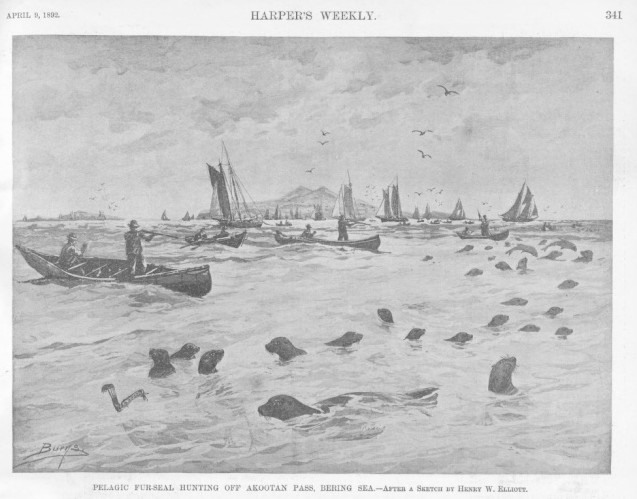
HARPER’S WEEKLY
PELAGIC FUR-SEALERS AT WORK.
SHOOTING A "FEEDER."
The coming summer season in Bering Sea and the North Pacific Ocean bids fair to be the most active and destructive one ever known in the brief history of the open-water hunters of the fur seal; a larger fleet of vessels, a larger number of hunters, and larger knowledge on the part of the hunters how and where to kill the swimming or sleeping seals, causes the operations of these pelagic sealers to be far more effective than ever before, provided they are not checked; and they should be checked before the middle of June next, or not much later at the most, if the Pribylov seal herd is to be saved from substantial ruin.
Over 100 vessels, American and British, manned by some 2000 white men and Indians, are now hunting the fur seal in the open waters of the North Pacific Ocean; and as that animal leaves the Pacific and enters Bering Sea by the end of June and the 10th of July, these sealers will, if permitted, follow it up to those islands of its birth in Bering sea known as the Pribylov Group.The methods of the open-water hunter are the methods of indiscriminate slaughter of all ages and both sexes (90 per cent. females), and they are well shown in the sketch which appears on the accompanying page. This drawing was made by an officer of the government in Bering Sea, and shows the characteristic shooting of fur seals by the white hunters as they deploy out from their schooners over the surface of the sea.A typical sealing schooner is of about 50 to 60 tons, and manned with some 15 to 20 Indians (recruited at Victoria, British Columbia, principally) and six or seven white men.
These hunters start in every year off the Strait of Fuca and the coast of Oregon by the middle of February, since the fur seals appear off there for the first time after leaving the Seal Islands, in Bering Sea, during October and November of last year; the schooners then follow the seal herd up as it travels north and west, back into Bering Sea, keeping well abreast of the movements of the animals. Were it not for severe gales and thick fogs, the seal herd would never get out of the range of these vessels. As it is, they are followed, in spite of these difficulties, very closely, and shameful destruction wrought among them.
When the wind is not fresh and the sea not over-rough, the fur seal sleeps at times by lying on its back, with its nose and heels only just projecting above the water. When thus napping, the Indians seldom fail to secure it by spearing; the Indians do all of their sealing in this manner, not taking well to the rifle or shot-gun.
But the sleeping seals are not the only class. When not sleeping, they are feeding, and then show themselves, head and neck out of water, at irregular intervals. These seals thus engaged cannot be approached for spearing, so they are shot at. The number killed and wounded by shooting is generally said to be four and five times greater than the number secured after shooting, since a peculiarity of the seal is to sink instantly after being clean shot; and also, being wounded, it will at once dive and swim away, unless wounded in the head so as to daze or derange it; then it flounders about on the surface, and is easily picked up by the hunters.
The hunters can secure and do get a number of their clean-killed seals, if they happen to be near enough to get over the wake of the settling bodies before they sink too deep for gaffing. Every boat is provided with a long pole, with hooks at one end, called a “seal gaff.” Last year these pelagic sealers secured nearly 63,000 fur seals in this manner. It is said by those who have carefully considered the question that three adult seals are lost to every one secured; therefore the 63,000 represent a loss of at least 150,000, and as most of these seals are females far advanced in pregnancy, it points with great certainty to a real loss of more than 250,000 seals.
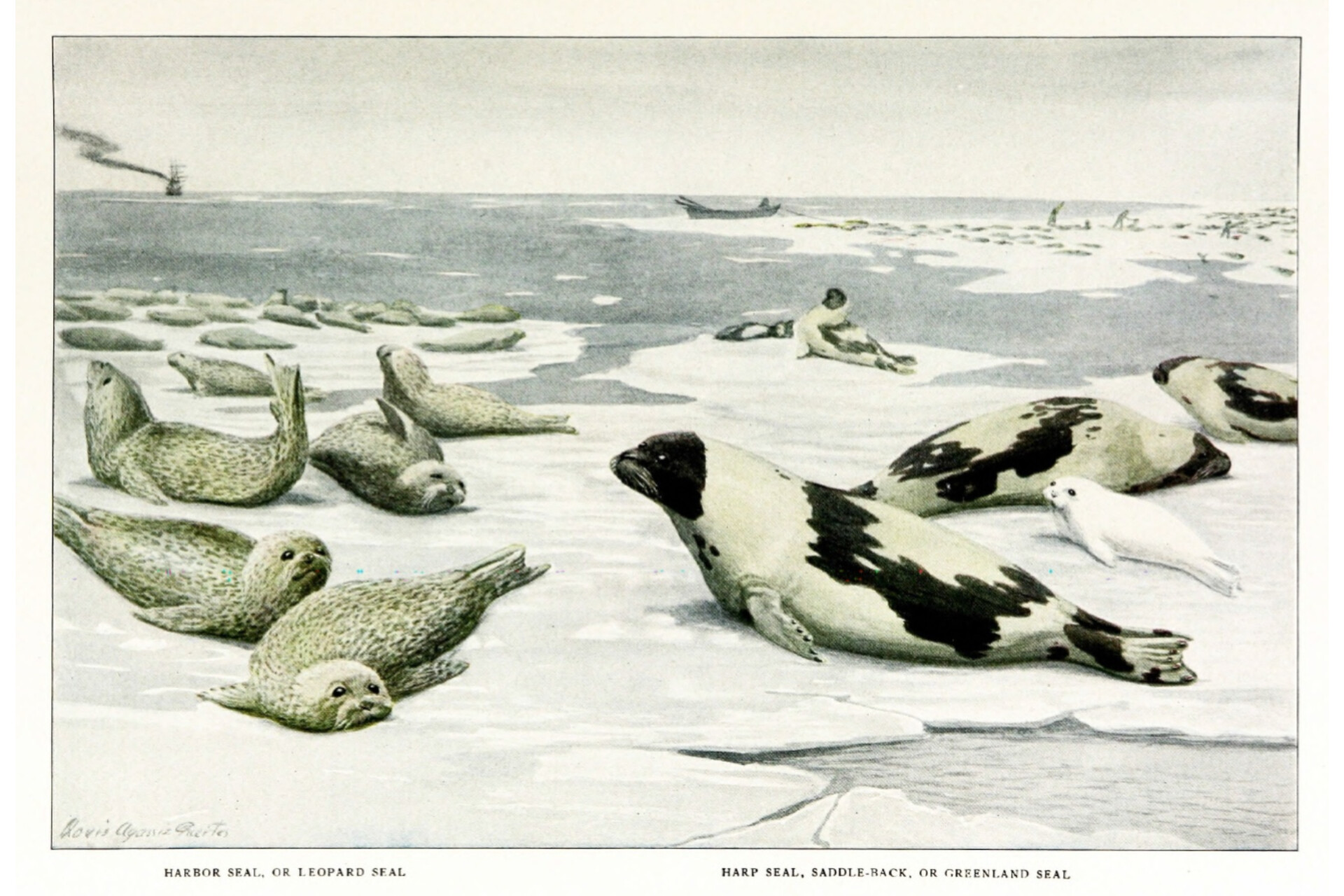
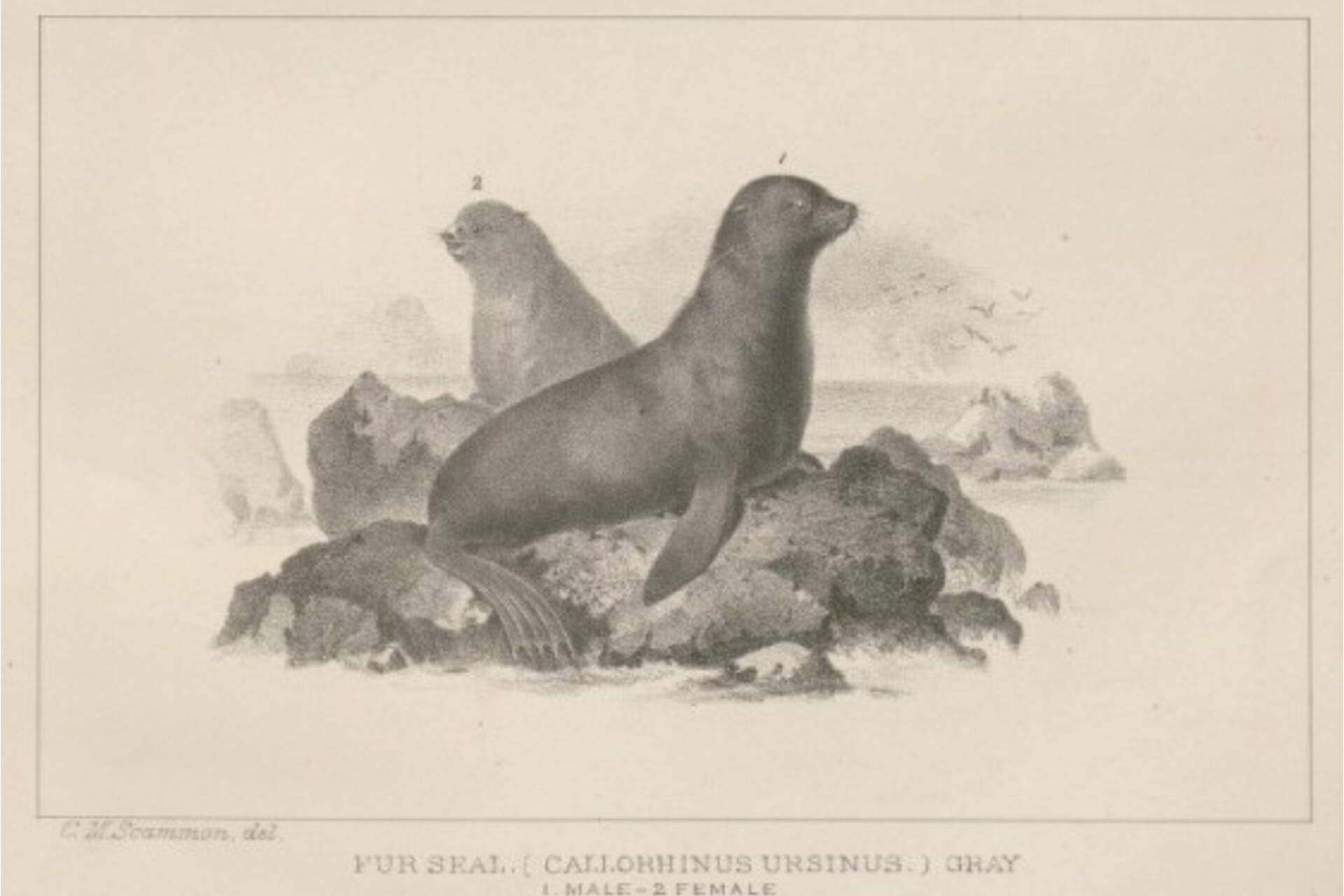
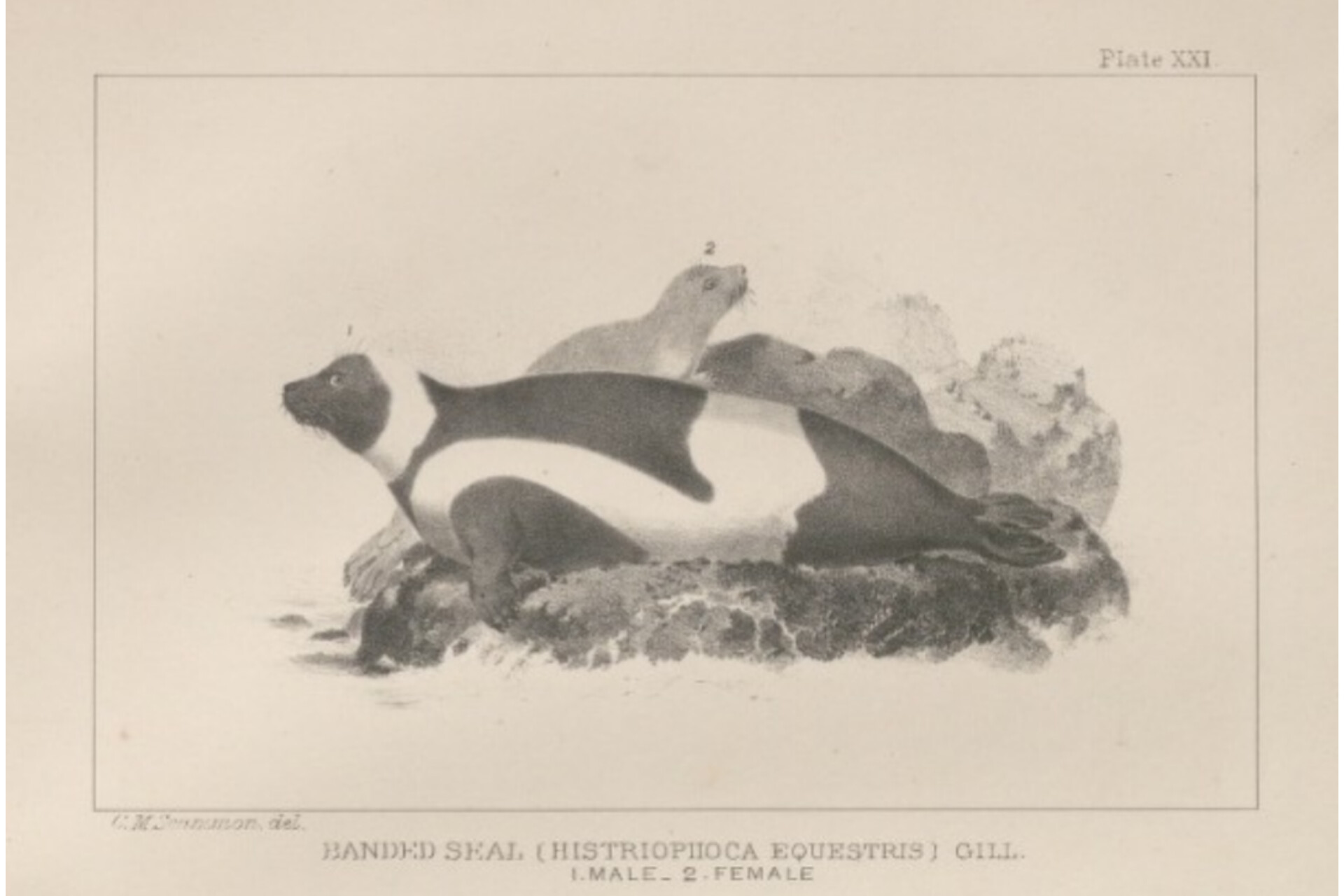
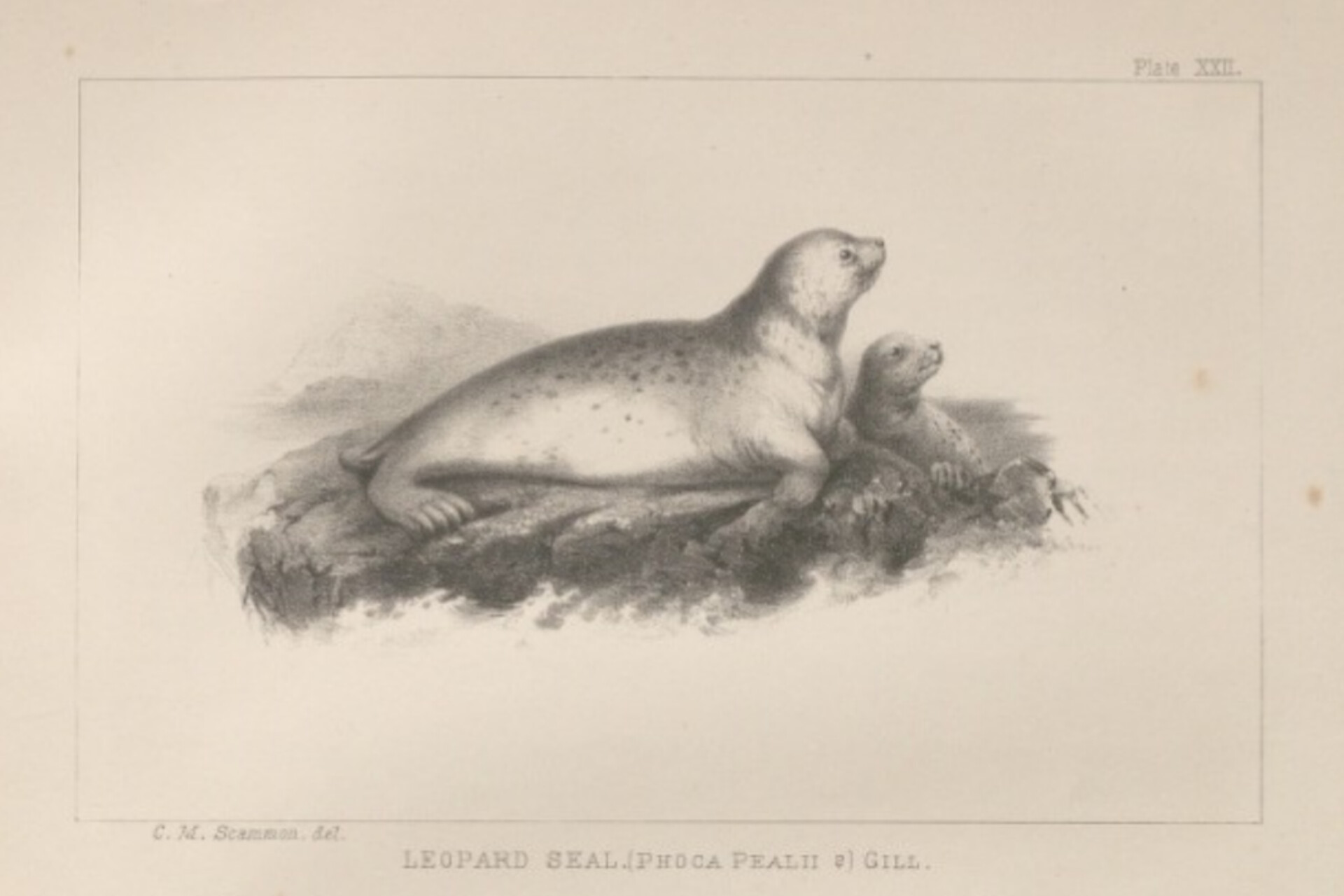
“Pelagic Fur-Sealers at Work: Shooting a ‘Feeder,’” Harper’s Weekly Vol. XXXVI, No. 1842 (April 9, 1892), p. 341. Lead image is from this article. First image on top row appears on p. 102 in Nelson,Wild Animals of North America. The next three images appear on pages 139 and 163 in Charles M. Scammon, The Marine Mammals of the North-Western Coast of North America…(San Francisco: J. H. Carmany and Co., 1874). Images from the bottom row are found on pages 116, 137, 138, and 140 in Richard Lydekker,The Royal Natural History (London: F. Warne, 1893).
See: https://babel.hathitrust.org/cgi/pt?id=mdp.39015014126026&seq=322&q1=