Rhinoceros (Africa)
We want you to have a greater ability to learn about some of the unpleasant animal issues in our world.
With Flashlight and Rifle
C. G. Schillings
XII
THE RHINOCEROS
No doubt elephants were as numerous in the Masai-Nyika, before they were hunted for their ivory, as rhinoceroses are still. These were comparatively little hunted, because the value of their horns and the danger and difficulties of hunting the animals were rather disproportionate. Now that elephants have grown scarce, the turn of the rhinoceros seems to have come. Their numbers have been woefully diminished within the last few years. During the time which I have spent in East Africa, I have seen about six hundred rhinoceroses, and have noticed the tracks of thousands. Away from the roads taken by caravans one may meet daily with a number of these animals; in the mountainous parts of the great Masai steppe, six thousand feet high or more, they are to be found in multitudes during the dry season. It is interesting to read about the good “bags” which some travellers and explorers managed to make.
Count Telekis and Mr. von Hoehnel killed ninety-nine rhinoceroses on their expedition which led to the discovery of Rudolf Lake and Stephanie Lake. The flesh of the animals furnished excellent food for the natives of the caravan. Dr. Kolb is said to have killed over one hundred and fifty rhinoceroses, until he, in his turn, was killed by a wounded “pharus.” His companion, Mr. von Bartineller, shot over one hundred and forty “pharus.” The first commandant of the German fort Moschi, near the Kilimanjaro, Mr. von Eltz, has over sixty rhinoceroses to his credit. English hunters have been equally successful. These numbers prove not only the fact that these animals are still very abundant in these parts, but they also show that the rhinoceros is hunted more extensively now than formerly and that he, too, is destined to disappear unless preserved in some systematic manner by the concerted action of the colonial governments.
Hunting the rhinoceros — by one hunter alone and in a sportsman-like manner — is a most dangerous undertaking. It is an idle question to ask which animal is most difficult to hunt — lion, leopard, buffalo, elephant, or rhinoceros? It all depends on circumstances, on time and place. There is no doubt that you take your life in your hand every time you hunt a rhinoceros. I have. often read of hunters simply jumping aside coolly when attacked by an animal, and then laying it low with a well-aimed shot. My own experience has taught me that it is foolish to talk this way. If a rhinoceros actually does charge its enemy, it is the most determined of animals, and will not rest until it has impaled its foe. It often happens that a rhinoceros rushes towards a hunter merely to escape, not noticing the enemy at all, for the eyesight of the animal is very poor. When the animal really attacks, then the hunter is doomed, unless he succeeds in killing it or in climbing a tree or an ant-hill or a big rock.
The only true way, worthy of a sportsman, to hunt the rhinoceros is to do so “unassisted.” Reckless killing should under no condition be indulged in. It often happens that a rhinoceros charges and reaches its pursuer. I once took care, for a few days, of a Sudanese Askari who had been run through by the horn of a rhinoceros, and had been repeatedly tossed high up in the air by the infuriated, wounded animal. He had been taken to my camp by an English government physician, to whose caravan he belonged. The wound was horrible to look at, and the condition of the patient appeared perfectly hopeless. Yet he lived through the night. The next day, towards evening, his pain became excruciating, and his moaning and groaning were heart-rending. He begged to be relieved, and I gave him all the opium I had, almost wishing that it might prove an overdose. But the black fellow tenaciously clung to life. After twenty-four hours he was still alive. To counteract the effects of the opium, I made him swallow a bottle of salad-oil. The day after he was transported to the nearest English station. The last I heard of him was that he had entirely recovered.
The victim is not always so fortunate. The rhinoceros, after having tossed him up in the air and left him lying on the ground, often returns to renew the attack. I had many narrow escapes, and often came within an inch of losing my life, yet always got off safely, although sometimes with a bad scare. My first meeting with the “e’munj” of the Masai occurred towards evening on the steppe. A patch of thorn-bushes had been set on fire during the day, and the ground was black with their ashes. Never shall I forget the impression made upon me by the dark form of the bulky animal standing on the black ground in the light of the setting sun. With head erect — for it had scented our approach — it stood there as if planted in the earth. I was only partially covered by a half-burned bush, and my hand was far from steady when I fired my large-caliber rifle at the rhinoceros, which was only three hundred feet away. The “pharu” answered the shot by a quick charge. I heard the grunting and snorting of the animal close in front of me. Mechanically, I fired a second shot, and the large beast turned, fortunately for me, and ran away, puffing and panting, to the left. I was completely nonplussed. That the clumsy and slow animal of our zoological gardens could develop such extraordinary agility and speed was a revelation to me; everything was so different from what I had expected it to be.
My second encounter still further enlightened me as to the nature of this massive and, except the elephant, most powerful of the terrestrial mammals. Our caravan was progressing slowly, and I was riding ahead on an ass — one of the few the tsetse-fly had not yet killed — over the steppe, armed with a shotgun. Seeing a flock of guinea-hens alighting in the distance, I dismounted and worked my way through the high grass in the direction of the birds, when an uncouth, bulky animal suddenly rose before me out of the grass. I had enough presence of mind left to throw myself flat on the ground. The animal came on in a rush, passed me at a foot’s length, broke through our caravan, and disappeared from sight wrapped in a thick cloud of dust trailing behind it.
I now fully realized that I had had what the English call “a narrow escape,” and made up my mind to be more cautious in future regarding this inscrutable animal, which is apparently subject to sudden panics, in which it is as likely to rush headlong towards the hunter as away from him.
On the same day I had an opportunity of seeing four rhinoceroses, among them a female with a young one. Shortly afterwards we crossed a well-trodden rhinoceros path which led to a drinking-place among rocks, and I determined to lie in wait for the animals. The rhinoceros is nocturnal in its habits, eating and drinking during the night and spending the day in sleep.
On the high plateaus of the steppe the nights are apt to become bitterly cold. I set out accompanied by a few men carrying woollen blankets, lanterns, etc., to watch for prey on the edge of a ravine. I had forgotten to take into account the short duration of the twilight in the tropics. The night surprised us before we had reached the ravine, and the moon would not rise before nine o’clock. I thought it best to stay where we were. The ground was strewn with rocks and covered with thorny bushes and high grass. I noticed a few locust-trees by their whitish bark.
While we were waiting for the moon to rise we heard, suddenly, a sound like a short grunt. My men dropped everything and ran for the trees. Only my rifle-carrier tarried a mo-ment, whispering to me, ” Pharu Bwana!” and then he, too, climbed the nearest tree. I must admit that my hair stood on end when I distinguished in the light of the rising moon the massive form of a rhinoceros close in front of me. The situation was anything but inviting, every step checked by huge stones, thorny bushes, and high grass, and not far away the steep ravine.
My eight carriers were perched on the trees out of the animal’s reach, and of no assistance to me. I had a large-caliber, double-barrelled rifle with me, such as is used in hunting the elephant. I took aim as well as I could and pulled the right trigger. The rebound of the rifle forced me back a step and made me sink on my knees. With my finger on the left trigger I awaited the rush of the animal. But, snorting and stumbling, it disappeared into the ravine. I did not dare move until he was out of hearing distance. Then we started on our way back towards the camp, my men singing to allay their fear and to scare away any animal that might be concealed. The animal which I had wounded, a strong bull, was found dead in the ravine next day.
As a rule the rhinoceros does not attack a man, but tries to escape, although the animal has been known to charge without any provocation. It is, however, at all times advisable not to take any chances and to be prepared for the worst.
I had many opportunities of observing the rhinoceros and its habits, particularly on the high plateaus of the watershed between the Masai district and the Victoria-Nyanza — solitary animals as well as parties of three or more, both in the primeval mountain forests and on the open plains. In time I had become so well acquainted with the habits of the rhinoceros that the danger of hunting it became greatly diminished.
I know no better way to give the reader a faithful picture of the ways and habits of the rhinoceros than by relating to him a few of my many experiences and adventures with this big animal.
One day I was hunting game in English East Africa not far from Kibwezi. I had killed a Grant gazelle buck with one extraordinarily large horn, when I saw, about seven hundred feet to my left, a strangely shaped, dark object. It appeared to be the uprooted trunk of a dead tree. When I looked again it had disappeared. Using my field-glass, I realized that the dark object was a rhinoceros which I had first seen in a sitting posture, and which now had stretched itself out on the ground. I carefully stole up to within fifty feet of the animal, against the wind, and fired from behind a small thorn-bush, aiming at the ear. The startled bull made a sudden dash in my direction, but turned about before reaching me. Hit by a second bullet, he went down like a hare in a cross-fire.
A few years later I wounded an unusually large, old bull. He first fled, but came back towards me, describing a wide curve — tactics often employed by these animals. Although I hit him several times, he collapsed only thirty feet from me. The bull had been in the company of a cow. When I fired the first shot the animals butted their heads against each other, the bull, no doubt, thinking that his mate had hurt him.
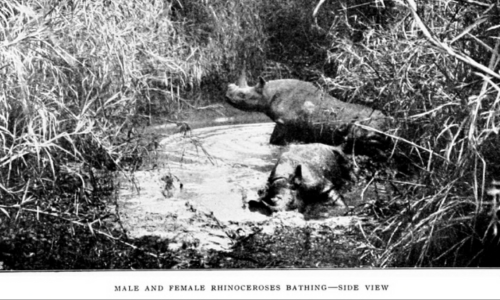
I had another unexpected encounter with a rhinoceros when I was hunting the koodoo, not far from Jipe Lake. The animal, which suddenly appeared not farther than twenty-five paces from me, was plastered all over with mud and reddish dust. It had, no doubt, taken a bath in a muddy pool and rolled around on the dusty ground. A strange apparition in the light of the setting sun! I felt instinctively that the rhinoceros meant to charge me. It moved its heavy head to and fro three times to scent my whereabouts, and started on a mad rush in my direction. In this critical moment my rifle went off accidentally; the bullet, however, hit the animal’s head, though somewhat high. The rhinoceros almost touched me as it passed. I ran under cover into a thick thorn-bush. The animal chased one of my men — I was accompanied by ten natives — twice around the gabled trunk of a big locust-tree, and then disappeared in the thorny thicket. I did not dare fire another shot at the animal, fearing that I might wound one of my men hiding in bushes and behind trees. A fever which laid me up for two days prevented my following up the animal.
It is essential in hunting the rhinoceros to observe carefully the direction of the wind. This is best done by lighting a match or dropping fine sand to the ground or holding up a wet finger. The animal depends mainly on its keen scent to warn him of the approach of an enemy. The rhinoceros, also, is almost invariably attended by the so-called rhinoceros-birds (Buphaga), which clean it from parasites, like ticks, and act as guards to warn it of danger by their shrill twitter. The lying animal will rise at this alarm signal and either flee or lie down again after a while. In the latter case the birds again alight on their host and again warn him when the hunter makes another attempt to approach his prey. This is another case of two animals combining for protection, their senses supplementing each other.
Of all the rhinoceroses which I succeeded in killing only one was without “dundos,” sore spots of the size of a quarter or even a dollar. The natives believe that these sores are caused by the rhinoceros-birds. In spite of the almost constant activity of these birds, which are frequently joined by ravens, the Rhinoceros bicornis is never found free from parasites, in particular, ticks of all kinds, some of which, like the dermacentor Rhinocerotis, depend entirely on the rhinoceros for their sustenance.
I have never seen more than four “pharus” forming a party, though I did see often as many as eight animals at the same time, but not together.
The rhinoceros has a phenomenal memory for places. Every night during the dry season they cover enormous distances on their way to the drinking-places. They have the curious habit of always depositing their excrement at the same place, scattering it with their hind legs. These manure-patches, no doubt, serve the animals as guide-posts, and also enable the hunter to identify the animals by the composition of the excrement. Their food consists entirely of the leaves, twigs, and sometimes the roots of certain bushes and shrubs, never of grass.
The horns vary considerably both in shape and size. The horns of the cows grow much longer and are, as a rule, more compressed — often swordlike — than the horns of bulls, which are shorter and conical. The common, also called the black, rhinoceros has, as a rule, two horns, but there have been found animals with as many as five. The horns are often cast and then renewed, except in very old animals. The biggest horns recorded by Rowland Ward fifty-three and half inches and sixty-two and a half inches. The former belonged to a “common,” or “black,” East African rhinoceros (Rhinoceros bicornis), the latter to a “white” South African animal (Rhinoceros sinus). I bought a horn in Zanzibar fifty-four inches long. The longest horn of a rhinoceros shot by me measured from twenty-four to thirty-four inches.
The black rhinoceros, the biggest terrestrial mammal next to the elephant, formerly abundant all over the eastern and south-central parts of the “Dark Continent” has now become comparatively rare and restricted. Fifty years ago the English hunter, Anderson, killed over sixty of these animals in the valleys of the Orange and Zambesi rivers in the course of a few months.
The rhinoceros is most dangerous in the bush thickets which cover extended districts of the lower steppe, in the thick growth of entangling plants which cover large tracts of the high plateaus, and in the clearings of the big mountain forests. Favorite haunts of the horned animal are the small mountain meadows, often six thousand feet above the sea, the brush and grass of which afford the animal splendid cover. These thickets are almost inaccessible to man, and nearly impenetrable. They are formed largely by jasmine, smilax, pterololium, Toddalia, blackberry, and other shrubs and bushes. The frequent rain-showers in these high mountain regions furnish the rhinoceros with food and water, even during the height of the dry season. They withdraw thither in large numbers when water becomes scarce in the lower country.
It is exceedingly hard to hunt the rhinoceros in its mountain haunts, for they easily scent or hear the approaching hunter when he works his way through the crackling bushes. They will rise with a great deal of noise and stumble down the mountain slopes, or they will sneak off as quietly as possible, and change their resting-places, which look like big bowls sunk into the ground. If we approach them with a favorable wind, “up wind,” then we may meet with great surprises and encounters, which may prove fatal, especially if we chance to suddenly come upon several animals.
Even the Wandorobbos and Wakamba do not like to hunt the rhinoceros in these “buenretiros.” I must confess that I, too, am not eager to repeat the experiences I had in that mountain wilderness. The very thought of many narrow escapes I had makes my flesh creep. Sportsman-like hunting, which consists in doing one’s own shooting and in sparing the females and the young ones, is out of place there, because it would be simply suicidal. Any hunter there is very glad to be “assisted” by natives, and does not hesitate to shoot down, indiscriminately, young and old animals, males and females, in mere self-defence.
Common shooting, however, without some prearranged method, is as dangerous as hunting alone. The far-off mountains of East Africa will furnish a fairly safe retreat to the rhinoceros for many years to come. It is to be hoped that the colonial governments of England and Germany will prevent the European trader, driven by the “commercial spirit” of our age, from organizing hunting expeditions.
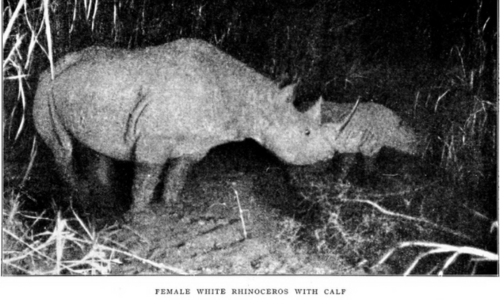
Hunting the rhinoceros is dangerous enough in itself, and it brought me many times into “close touch,” and almost contact, with the animal; but to try, in addition, to take pictures of the animal in its haunts, in the daytime and at night, demands not only courage, but also infinite patience. The animal is nocturnal in its habits, and goes about in daytime only when the sky is clouded. But then it is useless to try to take a picture. One must patiently wait until the sun penetrates the clouds, if but for a moment, and until the light strikes the animal at a certain angle. The distance, also, must not be too great. All these conditions must be fulfilled to assure success. The photographer must have a steady hand, or the picture will be spoiled.
In addition to steady nerves he must have “nerve” to brave danger and to meet sudden death, if such be his fate. Personally, I do not know of any greater risk than to photograph and to hunt the wild beasts at the same time. Just as difficult and hazardous is the taking of pictures at night-time. But when all difficulties and obstacles have been conquered, and when the development of the plate reveals the success of this magic art, then one feels repaid for all the hardships and previous disappointments.
Every time I showed my natives any of the pictures, they shook their heads in wonder and looked up to me as to a magician who had succeeded in fixing on a tiny glass plate the scene they themselves had watched. With the word “dana” (magic), the blacks explain to themselves everything that passes their understanding.
English scientists — Mr. F. C. Selous, Mr. F. J. Jackson, and others — have characterized the double-horned rhinoceros as irascible, excitable, and highly whimsical. There is no counting on what a rhinoceros may do when approached or attacked.
One of my own adventures, which I had in November, 1903, may illustrate this point. I had spent the whole forenoon trying to get a camera-shot at a troop of giraffes. I could not get near enough to the animals, which were unusually shy. Disappointed, tired, and thirsty, I was on my way back to the camp when I became aware of two rhinoceroses which, for some reason or other, were abroad on the steppe in broad daylight, and in spite of the heat. I was about four hours’ walk from the camp, and three thousand feet from the animals. A slight but unfavorable breeze was blowing, and I walked in a large circle to approach the animals against the wind. After half an hour I saw them lying under a big bush.
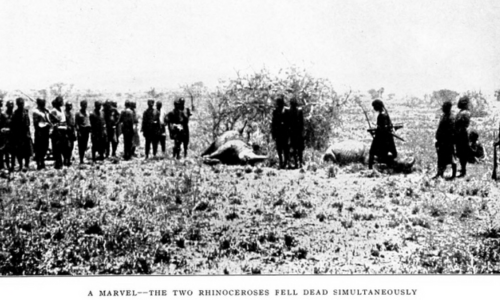
Accompanied by four of my men, I managed to get within three hundred and sixty feet of the animals. We took cover under a moderately thick thorn-bush growing on a deserted ant-hill. There were, fortunately, no rhinoceros-birds with the animals, and our presence remained, therefore, unheralded. I had taken several long-distance pictures of the resting animals, when they suddenly arose, apparently without any cause. The nearer animal, a cow rhinoceros, moved her head to and fro, scented us, and rushed, her head erect, accompanied by the bull, towards us. I quickly handed my camera to the carrier, grasped my rifle, and fired six times in quick succession. Twice the wounded animals stumbled and fell, and twice they rose again. My last bullet, fired at a distance of ten feet, lodged in the neck of the cow. Running for dear life around the thorn-bush, I was checked for a moment by one of my men, who jumped into the bush, and found myself for a second between the bull and the cow. Though mechanically running away from the animals, I felt that there was no escape possible. And yet I was saved as by a miracle. My shots took effect at the same moment on both animals. I was, perhaps, sixty feet from the thorn-bush, when I heard my man in the bush shrieking at the top of his voice.
Turning around I saw a strange sight. My Masai-El Morane was trying to push himself farther into the bush; the cow, literally touching him, stood there tottering and drenched with blood; behind her the bull had dropped, beating the ground with his mighty head in death agony. I quickly re-loaded and killed the animals. This exciting adventure and narrow escape haunted my dreams for many a night, and even now, when I think of it, I do so with a deep sigh of relief.
As a rule, the animal is rather shy at night-time, but there is no depending on his mood. One evening I was obliged to pitch my camp, for the night, in a valley covered with thorn-bushes. At night I was suddenly startled from my sleep by the subdued cry of one of my men, “Bwana, tembo!” (master, an elephant). Quickly jumping up, I seized one of my rifles. My men, too, had become aroused. Some of them, horror-stricken, pointed to a black form, about one hundred feet from my tent. There it stood, motionless, as if cut out of stone. It was a large rhinoceros standing among the small tents of my men, and wondering, no doubt, what kind of intruders had invaded its feeding-ground. My men, well- trained and obedient, did not fire, but lined up behind me. I thought it best to get the start of the still motionless animal, and fired. The rhinoceros answered by a grunt, wheeled about, and vanished into the thicket.
I had an adventure with two rhinoceroses at night when I first came to Africa, and was not yet familiar with their ways. The night was not dark, but moonlit, and we were not encamped on the path of the animals. It was a cold night, too, and I had covered myself with several woollen blankets. I was awakened by the guards who reported two rhinoceroses to be close by camp. Without dressing, I rushed in my night-gown to the edge of the camp. The animals had left in the mean time. I followed them in my primitive costume about six hundred feet. The beasts were at a safe distance, and I gave up the fruitless pursuit.
The immense African steppe harbors even to-day thousands upon thousands of rhinoceroses; but, no doubt, their days are numbered, like those of the elephant and other big game. With the last “pharu” another seemingly unconquerable race of animals will be exterminated, its haunts being claimed by modern progress and civilization.
Millions and millions of these colossal mammals have roamed over North America, Europe, and Africa, from the Oligocene time to our day. The lone remnants of a once numerous group will — perhaps within a few decades — succumb to the cunning of dwarfish bipeds, who have learned to lay low with small pieces of metal the giant children of wild nature.
XIII
CAPTURING THE RHINOCEROS
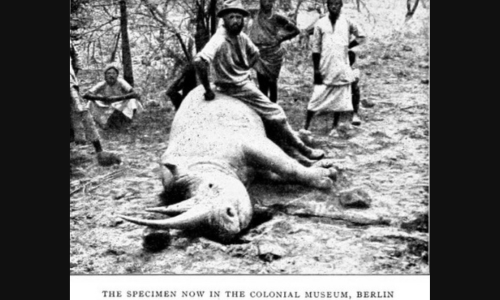
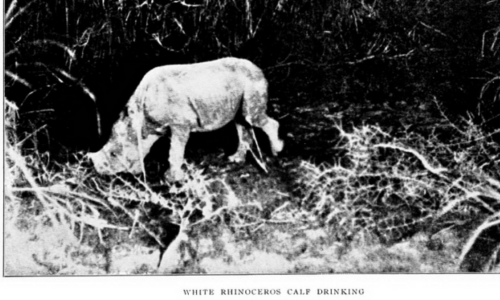
My friend Dr. L. Heck wrote in 1896, in his book The Animal Kingdom, the words, “The day will be a memorable one for our zoological gardens (in Berlin) which sees the acquisition by them of a rhinoceros from German East Africa. ” In the same year I went to East Africa for the first time. All efforts made so far to bring a young elephant or a young rhinoceros alive from British or German East Africa to Europe had been unsuccessful. I fully realized the enormous difficulty of accomplishing this task, but on mv fourth journey to the “Dark Continent” I succeeded in bringing away a young rhinoceros which, at last reports, is still disporting itself in the Berlin zoological gardens. But neither I nor any one else has so far been able to bring a young elephant alive from East Africa to Europe.
It is exceedingly difficult not only to capture a young rhinoceros, but equally hard, and even harder to raise it. For it needs a milk diet, and milk is a rare article in a country where the transportation and keeping of cattle are so precarious; for the most part they fall victims either to the rinderpest or the poisonous sting of the tsetse-fly. Moreover, this necessity of keeping the captured young animals on a milk diet during the critical period of their life also accounts for the fact that we do not find any East African elephants, giraffes, eland antelopes, oryxes, Grant gazelles, impallahs, water-bucks, wodoos, and other wild game in our zoological gardens, not to mention the smaller animals of the East African Nyika.
While I was encamped on the west side of the Kilimanjaro, in May, 1903, I decided to make another effort — many had been in vain — to raise a young rhinoceros for transportation to Europe. I acquired, therefore, a number of cows, stabled them well, and then went to look for the conditio sine qua non — namely, a young animal of still tender and docile age. The rainy season was just over, and the high grass, together with the thorn-bushes, made the steppe almost impenetrable.
After searching the neighborhood of my camp for many days, I located, at last, a female rhinoceros with her young one. The mother had become suspicious and was apparently scenting me. I did not want to lose a moment, and fired, although the position of the animal was not favorable. The beast wheeled about and disappeared with the young one into the thorny wilderness. I had wounded her but slightly. Now began an exciting and difficult pursuit through the impeding thorn-thicket. Our clothes were torn into shreds, and our hands and feet and faces and bodies were bleeding with many scratches. Every moment we might come up with the wounded and infuriated animal.
My blacks climbed on ant-hills which afforded a good look-out. At length one of my men beckoned me violently. I climbed the ant-hill and saw another rhinoceros, a bull; but I did not care for him just then, and was glad to see him running away from us. Again we followed the tracks of the fleeing cow and the young one. This was no easy matter, since their tracks were crossed by those of animals which had passed there during the night. The thick growth of bushes and plants and grasses only impeded our progress, but would not protect us against the animal which would break down bushes and young trees like bits of straw.
Noon came on; we were still fighting our way through the thicket, exhausted and thirsty. Hour after hour passed. We were on the point of giving up all hope of ever reaching the animals, when we came to a pool formed by rain-water in which the rhinoceroses had wallowed and refreshed themselves. It was anything but tempting, being muddy and malodorous, but our thirst conquered our fastidiousness. We drank and were thus enabled to continue our pursuit till nightfall, with the prospect before us of being obliged to camp on the steppe all night, frequented as it was by numerous wild beasts.
The traces left by the old animal and the young one showed that they were moving in a big curve in the direction of our camp. Suddenly, as we moved on, I spied the mother standing not far from me under a locust-tree. In an instant I took aim and killed her by a shot in the ear. The young one uttered a piercing cry, made a few steps towards us, turned about, and fled. My men and I followed in hot pursuit. As it turned and charged us, I caught it by the neck, and fell with it to the ground, while my men roped its legs. By holding a piece of the mother’s skin before it, I induced it to follow me for some distance. But then it stubbornly refused to go on, squealing and fighting by way of protest. I left four of my men with it, returned to the camp, and sent a sufficient number of carriers to fetch it. Towards evening it was brought into camp protesting at the top of its voice against its capture.
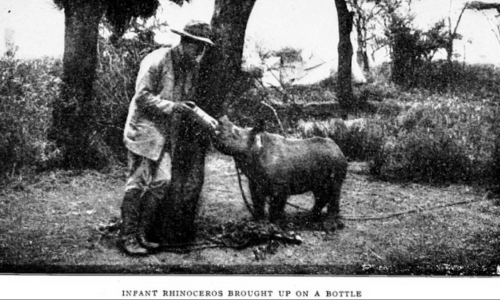
Now the difficult task of raising the animal began. My cows died one after another, and, fortunately, the rhinoceros took very kindly to a goat. I looked out for my precious captive with the utmost care, often giving it the bottle myself. When I proceeded with my caravan on my march into the steppe, I left it, with its attendants, in charge of ex-Sergeant Merkel, who took excellent care of all. When I was ready to start to the coast, I found it fairly grown-up and quite gentle, and, in fact, able to cover the whole distance on foot. To avoid the great heat of the day, we often marched at night, and I seldom let the creature out of my sight. I intrusted its welfare to no one else, as I could ill-afford to lose it after seeing it safely nursed beyond the period of lactation.
We reached Naples without accident. There the young rhinoceros, the first ever to be brought alive to Europe from German East Africa, was an object of great curiosity. Dr. Heck had come on from Germany to meet us, and had brought with him a special car for the transportation of the rare animal. We decided, however, to ship it to Hamburg by steamer. In spite of a two days’ storm in the Mediterranean it arrived hale and sound in Hamburg, where Mr. Hagenbeck made everything very comfortable for it. It has now become completely reconciled to its new home and surroundings, and still enjoys the company of its wet-nurse, the African goat.
I was not quite so lucky with the nursing of two other young rhinoceroses which it was my good fortune to capture. Once, while on a hunting expedition, I discovered the tracks of a rhinoceros with its young one near a drinking-place. I followed the animals for hours over stony, hilly ground. With me were Orgeich, my European taxidermist, and fifty natives. At last I managed to creep up to within about three hundred feet of the beasts. They were standing under a locust-tree. I fired; the bullet pierced a dry branch of the tree and had force enough left to kill the older animal. The natives stole up to me, and then ran right and left forming a circle around the young one. But it broke through the line and escaped. Next day I returned to the place with one hundred men. The young animal, too, was there, but again managed to elude us.
Another time we followed the tracks of two animals for over seven hours before we discovered them standing still in the thorny steppe in the light of the setting sun. I killed the mother, but the young one escaped, running from us more quickly than we could follow. I should not have thought of shooting the old female had it not been for the hope I had of capturing her young. I waited a long time near the dead animal, hoping it might return, but in vain. Again the labor of a whole day had been lost.
We returned the next morning and found, not the young animal for which we were looking, but hundreds of vultures and a number of marabous. I ordered my men to secure the horns and to take the most desirable pieces of the flesh to the camp. The evening before I had noticed a few rare birds flying above a ravine. I went to look for them, accompanied by three rifle-carriers.
Suddenly I was startled by the sight of the long-sought young rhinoceros, which proved to be a bull. I had not noticed him sooner because he had apparently been bathing in the reddish mud of a rain-pool, and did not stand out from the reddish ground of the steppe. He did not run away, but lowered his head and charged us without hesitation. Evading the thrust of the small horns, I threw my arms around his neck. We wrestled for quite a while, now he on top, now I, until my men, leaving the dead mother, ran to my assistance and tied the young fighter’s legs. We carried him in triumph to the camp on an improvised litter.
For a few days he thrived well; but a malignant ulcer developed on his lower jaw which soon caused his death. This was only one of many failures. The greater the efforts, the keener the disappointment. Yet a hunter must not become discouraged, but try and try again.
In East Africa he is particularly handicapped since he cannot use horses when pursuing his prey, and the unhealthy climate or the sting of the tsetse-fly may at any moment turn success into failure. Disappointments such as I have described are often aggravated by accidents and even loss of human life. In the mountainous region of the Masai-Nyika, about six thousand feet above the level of the sea.
I discovered once, towards evening, a mother rhinoceros with her young one. The animals were half hidden by shrubs and bushes. I killed the mother and ordered my men to pursue and surround the young. Too late I noticed that the young animal was already well developed and had horns of considerable size. My men were then beyond the reach of my voice. My boy Hamis, the peaceful guardian of my riding asses, was leading the rest in hot pursuit. Suddenly the animal stopped short and turned against his pursuers. Hamis, being the nearest, was in imminent danger of being transfixed by the horn of the enraged young bull. The boy ran yelling in my direction; now they were within hailing distance, the animal closely pressing the man. There was but one chance in ten that I might hit the bull and not the boy. But better that he fall by my bullet than be run through by that tusk and die in agony. I fired at the neck of the bull. He fell instantly, covering in his fall the black donkey driver, who had escaped badly scared and only slightly bruised.
A number of favorable circumstances must concur to make the capture and raising of a young rhinoceros possible. May other hunters also be fortunate enough to bring some of these rare animals alive to our zoological gardens in Europe and other continents.
All in all I met about forty female rhinoceroses with their young ones. In most cases I did not attempt to shoot the old and to capture the young, because the latter were already too big, or because I met the animals too far from my camp, or because conditions made it impossible to supply the necessary milk diet, even in case I should succeed in capturing the young animal. Under ordinary conditions the true sportsman will never kill a cow or a young one, but show his mettle and his true sporting spirit in hunting the male rhinoceros.
C.G. Schillings, With Flash-Light and Rifle; Photographing by Flash-Light at Night the Wild Animal World of Equatorial Africa, trans. Henry Zick (New York: Harper & Brothers, 1905), pp. 118-149. Images appear on pages 121, 130, 133, 137, 141, and 145.
See: https://babel.hathitrust.org/cgi/pt?id=coo1.ark:/13960/t8tb1p15d&seq=1