South Carolina Parrot
We want you to have a greater ability to learn about some of the unpleasant animal issues in our world.
The Miscellany of Natural History
Thomas D. Lauder and Thomas Brown
XI
THE CAROLINA PARROT.
PLATE 1.
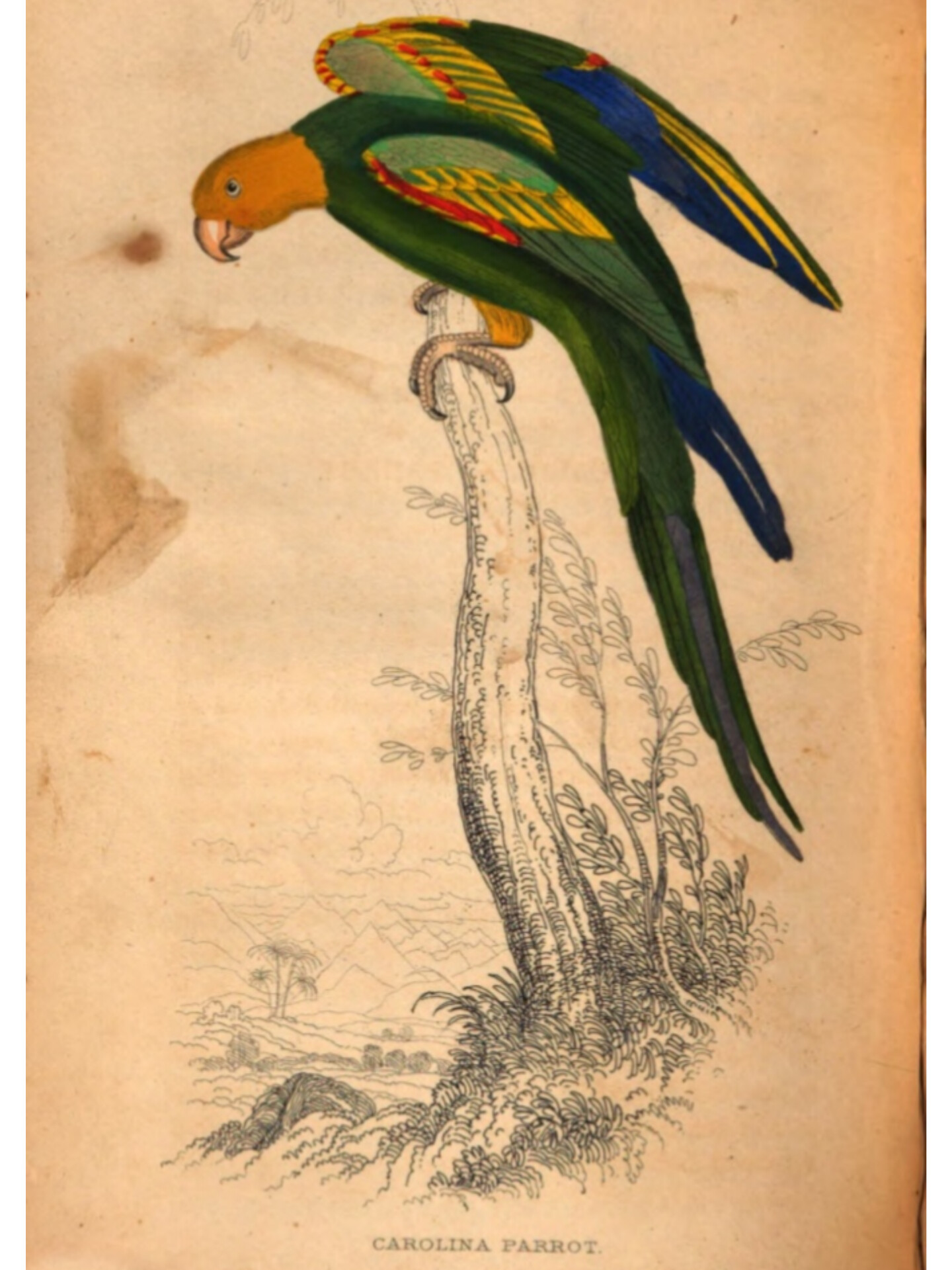
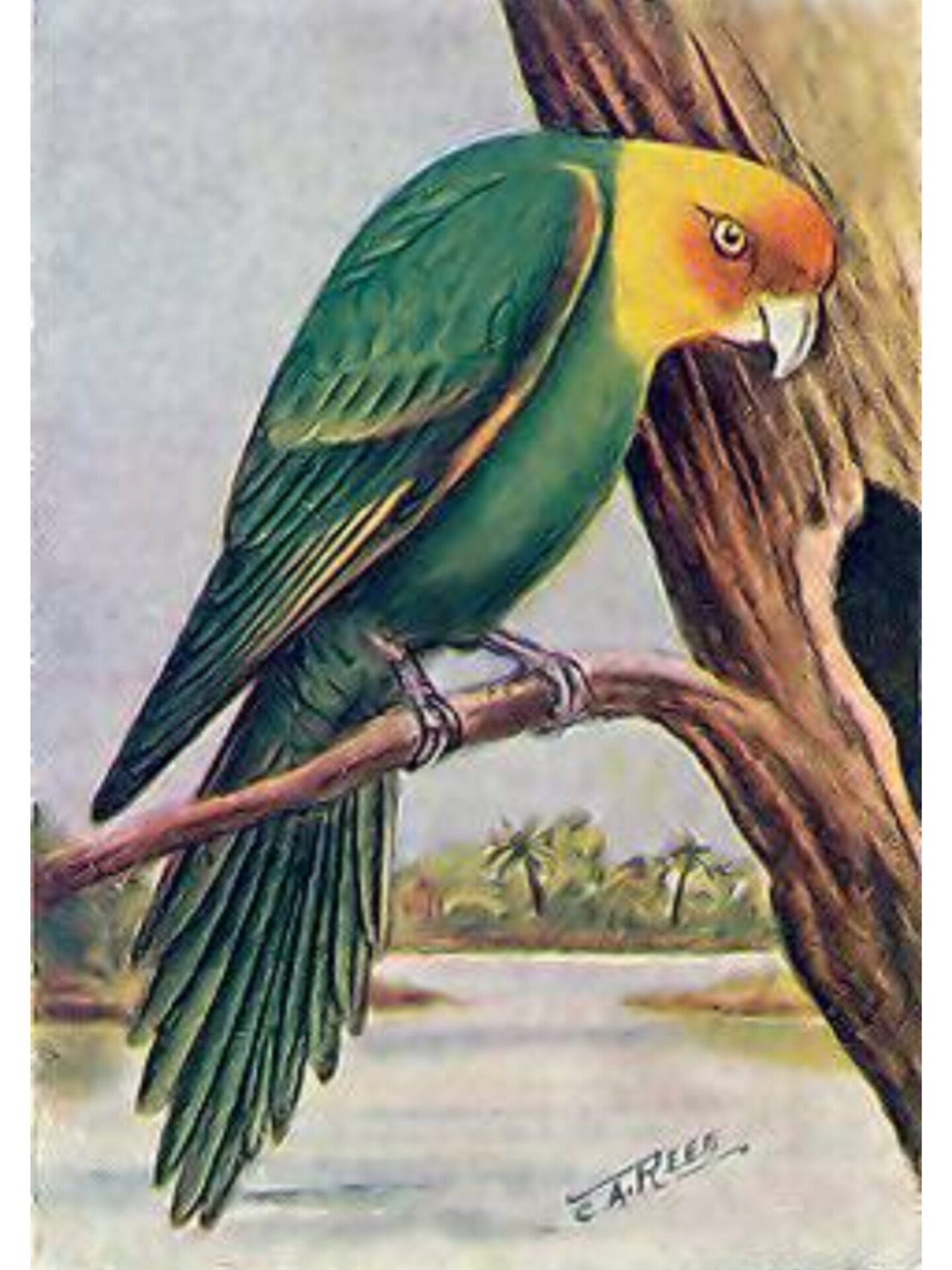
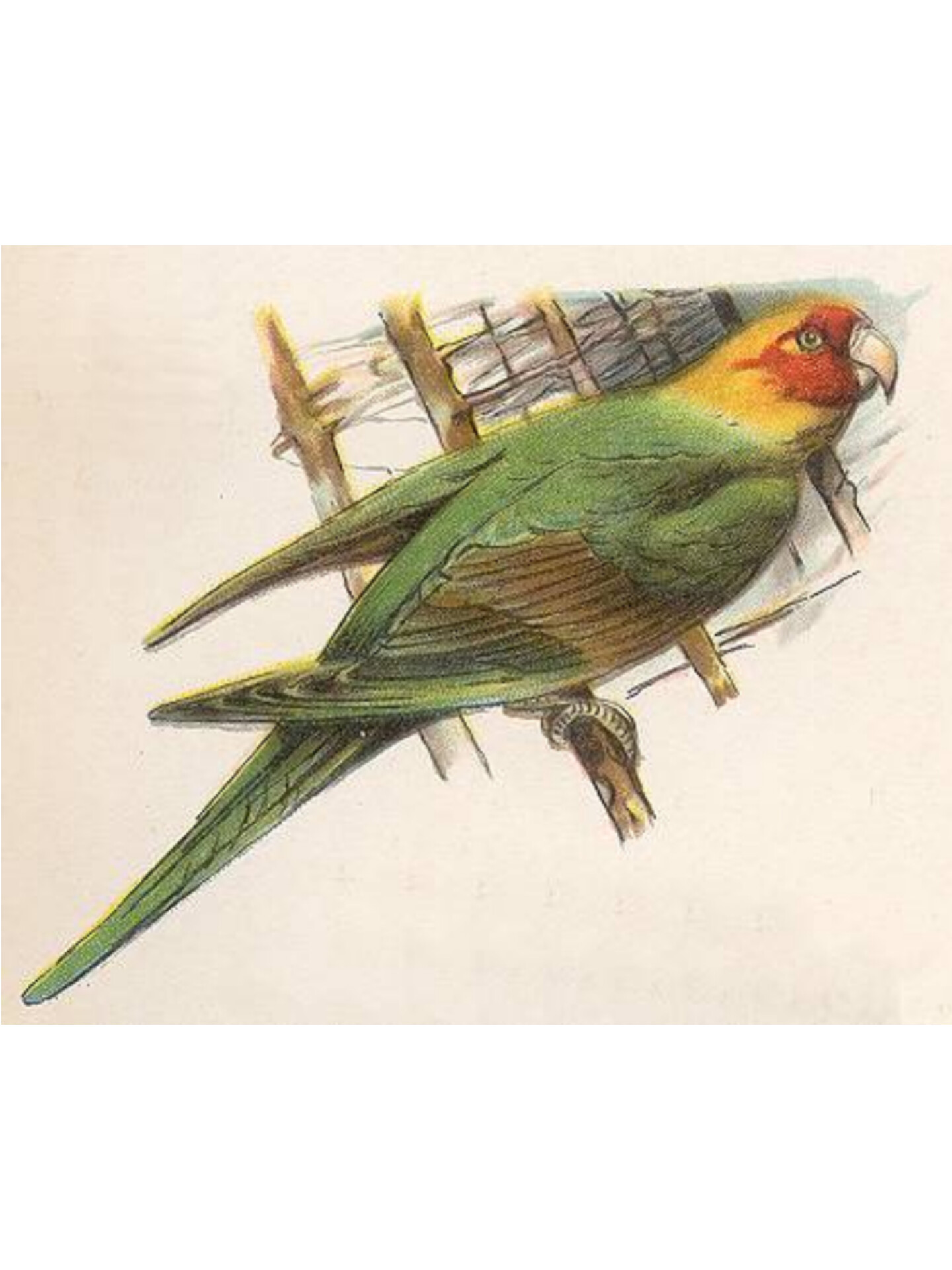
Although the plumage of this bird is not so much diversified in colour as many others of the extensive group to which it belongs, it is nevertheless one of the most beautiful and elegant of Parrots. The green suit with which it is invested, is subject to an ever varying play of colour; and the different tints which are diffused over its feathers, form the most agreeable and harmonious combinations.
Our description of this species is taken from the beautiful and interesting account of Wilson, interlaced with additional information from the graphic pen of Audubon.
“The Carolina, or Illinois Parrot,” says Wilson, “for it has been described under both these appellations, is thirteen inches long, and twenty-one in extent; forehead and cheeks, orange red; beyond this, for an inch and a half, down and round the neck, a rich and pure yellow; shoulder and bend of the wing, also edged with rich orange red.
The general colour of the rest of the plumage is a bright yellowish silky green, with light blue reflections, lightest and most diluted with yellow below; greater wing coverts and roots of the primaries, yellow, slightly tinged with green; interior webs of the primaries, deep dusky purple, almost black, exterior ones, bluish green; tail, long, cuneiform, consisting of twelve feathers, the exterior one only half the length, the others increasing to the middle ones, which are streaked along the middle with light blue; shafts of all the larger feathers, and of most part of the green plumage, black; knees and vent, orange yellow; feet, a pale whitish flesh colour; claws, black; bill, white, or slightly tinged with pale cream; iris of the eye, hazel; round the eye is a small space without feathers, covered with a whitish skin; nostrils placed in an elevated membrane at the base of the bill, and covered with feathers; chin, wholly bare of feathers, but concealed by those descending on each side; from each side of the palate hangs a lobe or skin of a blackish colour; tongue, thick and fleshy; inside of the upper mandible near the point, grooved exactly like a file, that it may hold with more security.”
According to Audubon the plumage is compact and imbricated on the back, blended on the head, neck, and under parts; the wings are long, the second and third quills longest; the body is elongated; the feet short and robust; the tarsus scaly all round; the bill, along the ridge, measures one and one-twelfth of an inch; the gap, measured from the tip of the lower mandible, one half inch; the tarsus five-sixths, the middle toe one and one quarter of an inch.
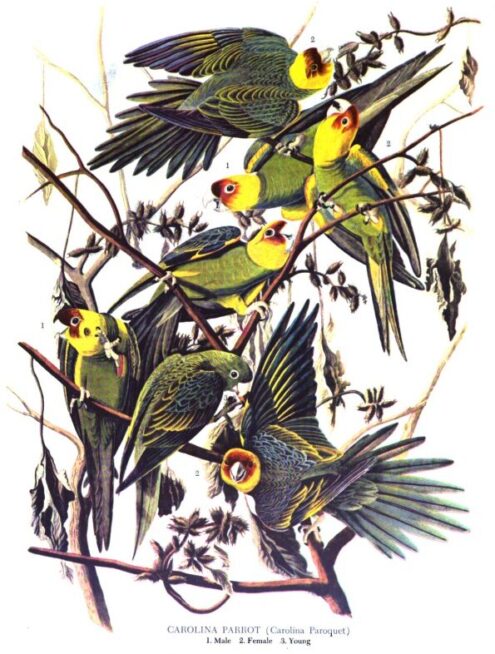
“The female differs very little in her colours and markings from the male. After examining numerous specimens, the following appear to be the principal differences. The yellow on the neck of the female does not descend quite so far; the interior vanes of the primaries are brownish, instead of black, and the orange red on the bend and edges of the wing is considerably narrower; in other respects, the colours and markings are nearly the same.
“The young birds of the preceding year, of both sexes, are generally destitute of the yellow on the head and neck, until about the beginning or middle of March, having those parts wholly green, except the front and cheeks, which are orange red in them as in the full grown birds. Towards the middle of March the yellow begins to appear, in detached feathers, interspersed among the green, varying in different individuals. In some which I killed about the last of that month, only a few green feathers remained among the yellow; and these were fast assuming the yellow tint: for the colour changes without change of plumage. A number of these birds, in all their grades of progressive change from green to yellow, have been deposited in Mr Peale’s museum.
“What is called by Europeans the Illinois Parrot, (Psittacus pertinax,) is evidently the young bird in its imperfect colours. Whether the present species be found as far south as Brazil, as these writers pretend, I am unable to say; but, from the great extent of country in which I have myself killed and examined these birds, I am satisfied that the present species, now described, is the only one inhabiting the United States.
“Of one hundred and sixty-eight kinds of Parrots, enumerated by European writers as inhabiting the various regions of the globe, this is the only species found native within the territory of the United States. The vast and luxuriant tracts lying within the torrid zone, seem to be the favourite residence of those noisy, numerous, and richly plumaged tribes. The Count de Buffon has, indeed, circumscribed the whole genus of Parrots to a space not extending more than twenty-three degrees on each side of the equator: but later discoveries have shewn this statement to be incorrect, as these birds have been found on our continent as far south as the Straits of Magellan, and even on the remote shores of Van Diemen’s Land, in Terra Australasia. The species now under consideration is also known to inhabit the interior of Louisiana, and the shores of Mississippi and Ohio, and their tributary waters, even beyond the Illinois river, to the neighbourhood of Lake Michigan, in lat. 42 deg. north; and, contrary to the generally received opinion, is chiefly resident in all these places. Eastward, however, of the great range of the Alleghany, it is seldom seen farther north than the state of Maryland; though straggling parties have been occasionally observed among the valleys of the Juniata; and, according to some, even twenty-five miles to the north-west of Albany, in the state of New York. But such accidental visits furnish no certain criteria by which to judge of their usual extent of range; those aërial voyagers, as well as others who navigate the deep, being subject to be cast away, by the violence of the elements, on distant shores and unknown countries.
“From these circumstances of the northern residence of this species, we might be justified in concluding it to be a very hardy bird, more capable of sustaining cold than nine-tenths of its tribe; and so I believe it is; having myself seen them, in the month of February, along the banks of the Ohio, in a snow storm, flying about like Pigeons, and in full cry.
“The preference, however, which this bird gives to the western countries, lying in the same parallel of latitude with those eastward of the Alleghany mountains, which it rarely or never visits, is worthy of remark; and has been adduced, by different writers, as a proof of the superior mildness of climate in the former to that of the latter. But there are other reasons for this partiality equally powerful, though hitherto overlooked, namely, certain peculiar features of country to which these birds are particularly and strongly attached: these are, low rich alluvial bottoms, along the borders of creeks, covered with a gigantic growth of sycamore trees, or button-wood; deep, and almost impenetrable swamps, where the vast and towering cypress lift their still more majestic heads; and those singular salines, or, as they are usually called, licks, so generally interspersed over that country, and which are regularly and eagerly visited by the Parrakeets. A still greater inducement is the superior abundance of their favourite fruits. That food which the Parrakeet prefers to all others, is the seeds of the cockle bur, a plant rarely found in the lower parts of Pennsylvania or New York; but which, unfortunately, grows in too great abundance along the shores of the Ohio and Mississippi, so much so, as to render the wool of those sheep that pasture where it most abounds, scarcely worth the cleaning, covering them with one solid mass of burs, wrought up and imbedded into the fleece, to the great annoyance of this valuable animal.”
Audubon says these are also very troublesome to the manes and tails of horses, and that they also stick so thickly to the clothes, as to prevent a person from walking with any kind of ease. He says the Parrakeet alights upon the bur, and plucks it from the stem with its bill, takes it from the latter with one foot, in which it turns it over until the joint is properly placed to meet the attacks of the bill, when it bursts it open, takes out the fruit, and allows the shell to drop. In this manner, a flock of these birds, having discovered a field ever so well filled with these plants, will eat or pluck off all their seeds, returning to the place day after day, until hardly any are left. The plant might thus be extirpated; but it so happens that it is reproduced from the ground, being perennial, and our farmers have too much to do in securing their crops, to attend to the pulling up of the cockle burs by the roots, the only effectual way of getting rid of them. Parrakeets are fond of sand in a surprising degree, and, on that account, are frequently seen to alight in flocks along the gravelly banks about the creeks and rivers, or in the ravines of old fields in the plantations, where they scratch with bill and claws, flutter and roll themselves in the sand, and pick up and swallow a certain quantity of it. For the same purpose they also enter the holes dug by our King-fisher. They are fond of saline earth, for which they visit the different licks interspersed in our woods.
“The seeds of the cypress tree and hackberry, as well as beech nuts, are also great favourites with these birds; the two former of which are not commonly found in Pennsylvania, and the latter by no means so general or so productive. Here, then, are several powerful reasons, more dependent on soil than climate, for the preference given by these birds to the luxuriant regions of the west. Pennsylvania, indeed, and also Maryland, abound with excellent apple orchards, on the ripe fruit of which the Parrakeets occasionally feed. But I have my doubts whether their depredations in the orchard be not as much the result of wanton play and mischief, as regard for the seeds of the fruit, which they are supposed to be in pursuit of. I have known a flock of these birds alight on an apple tree, and have myself seen them twist off the fruit, one by one, strewing it in every direction around the tree, without observing that any of the depredators descended to pick them up.”
Audubon describes the depredations of these birds, in orchards and gardens, as being very great. He says, “They alight in great numbers, and, as through mere mischief, pluck off the fruits, open them to the core, and, disappointed at the sight of the seeds, which are yet soft, and of a milky consistence, drop the apple or pear, and pluck another, passing from branch to branch, until the trees which were before so promising, are left completely stripped. They visit the mulberries, pecaw-nuts, grapes, and even the seeds of the dog-wood, before they are ripe, and on all commit similar depredations. The stacks of grain put up in the field, are resorted to by these birds, which frequently cover them so entirely, that they present to the eye the same effect as if a brilliantly coloured carpet had been thrown over them. They cling around the whole stack, pull out the straws, and destroy twice as much of the grain as would sufficiently satisfy their hunger. The maize alone never attracts their notice. During these depredations, the husband-men approach them very easily, and destroy great numbers. All the survivors rise, shriek, fly round about for a few minutes, and again alight on the very place of most imminent danger. The gun is kept at work; eight or ten, or even twenty, are killed at every discharge. The living birds, as if conscious of the death of their companions, sweep over their bodies, screaming as loud as ever, but still return to the stack to be shot at, until so few remain alive that the farmer does not consider it worth his while to spend more ammunition. I have seen several hundreds killed in this way in the course of a few hours.”
“To a Parrakeet,” continues Wilson, “which I wounded and kept for some considerable time, I very often offered apples, which it uniformly rejected; but burs, or beech nuts, never. To another very beautiful one, which I brought from New Orleans, and which is now sitting in the room beside me, I have frequently offered this fruit, and also the seeds separately, which I never knew it to taste. Their local attachments, also, prove that food, more than climate, determines their choice of country. For even in the states of Ohio, Kentucky, and the Mississippi territory, unless in the neighbourhood of such places as have been described, it is rare to see them. The inhabitants of Lexington, as many of them assured me, scarcely ever observe them in that quarter. In passing from that place to Nashville, a distance of two hundred miles, I neither heard nor saw any, but at a place called Madison’s lick. In passing on, I next met with them on the banks and rich flats of the Tennessee river: after this, I saw no more till I reached Bayo St Pierre, a distance of several hundred miles: from all which circumstances, I think we cannot, from the residence of these birds, establish with propriety any correct standard by which to judge of the comparative temperatures of different climates.
“In descending the river Ohio, by myself, in the month of February, I met with the first flock of Parrakeets, at the mouth of the Little Sioto. I had been informed, by an old and respectable inhabitant of Marietta, that they were sometimes, though rarely, seen there. I observed flocks of them, afterwards, at the mouth of the Great and Little Miami, and in the neighbourhood of numerous creeks that discharge themselves into the Ohio. At Big Bone lick, thirty miles above the mouth of Kentucky river, I saw them in great numbers. They came screaming through the woods in the morning, about an hour after sunrise, to drink the salt water, of which they, as well as the Pigeons, are remarkably fond. When they alighted on the ground, it appeared at a distance as if covered with a carpet of the richest green, orange, and yellow: they afterwards settled, in one body, on a neighbouring tree, which stood detached from any other, covering almost every twig of it, and the sun, shining strongly on their gay and glossy plumage, produced a very beautiful and splendid appearance. Here I had an opportunity of observing some very particular traits of their character: having shot down a number, some of which were only wounded, the whole flock swept repeatedly around their prostrate companions, and again settled on a low tree, within twenty yards of the spot where I stood. At each successive discharge, though showers of them fell, yet the affection of the survivors seemed rather to increase; for, after a few circuits around the place, they again alighted near me, looking down on their slaughtered companions with such manifest symptoms of sympathy and concern, as entirely disarmed me. I could not but take notice of the remarkable contrast between their elegant manner of flight, and their lame crawling gait among the branches. They fly very much like the Wild Pigeon, in close compact bodies, and with great rapidity, making a loud and outrageous screaming, not unlike that of the Red-headed Woodpecker. Their flight is sometimes in a direct line; but most usually circuitous making a great variety of elegant and easy serpentine meanders, as if for pleasure.”
Audubon remarks, “that their flight is accompanied by inclinations of the body, which enable the observer to see alternately their upper and under parts. They deviate from a direct course only when impediments occur, such as the trunks of trees or houses, in which case they glance aside in a very graceful manner, merely as much as may be necessary. On reaching a spot which affords a supply of food, instead of alighting at once, as many other birds do, the Parrakeets take a good survey of the neighbourhood, passing over it in circles of great extent, first above the trees, and then gradually lowering until they almost touch the ground, when suddenly reascending, they all settle on the tree that bears the fruit of which they are in quest, or on one close to the field in which they expect to regale themselves.”
Wilson says, “They are particularly attached to the large sycamores, in the hollow of the trunks and branches of which they generally roost, thirty or forty, and sometimes more, entering at the same hole. Here they cling close to the sides of the tree, holding fast by the claws and also by the bills. They appear to be fond of sleep, and often retire to their holes during the day, probably to take their regular siesta. They are extremely sociable with, and fond of each other, often scratching each other’s heads and necks, and always, at night, nestling as close as possible to each other, preferring, at that time, a perpendicular position, supported by their bill and claws. In the fall, when their favourite cockle burs are ripe, they swarm along the coast, or high grounds of the Mississippi, above New Orleans, for a great extent. At such times they are killed and eaten by many of the inhabitants; though, I confess, I think their flesh very indifferent. I have several times dined on it from necessity, in the woods but found it merely passable, with all the sauce of a keen appetite to recommend it.”
Audubon is of opinion, “that their flesh is tolerable food when they are young, on which account many of them are shot. The skin of their body is usually much covered with the mealy substance detached from the roots of the feathers. The head especially is infested by numerous minute insects, all of which shift from the skin to the surface of the plumage, immediately after the bird’s death.”
“A very general opinion prevails, that the brains and intestines of the Carolina Parrakeet are a sure and fatal poison to cats. I had determined, when at Big Bone, to put this to the test of experiment; and for that purpose collected the brains and bowels of more than a dozen of them. But after close search, Mistress Puss was not to be found, being engaged perhaps on more agreeable business. I left the medicine with Mr Colquhoun’s agent, to administer it by the first opportunity, and write me the result; but I have never yet heard from him. A respectable lady near the town of Natchez, and on whose word I can rely, assured me, that she herself had made the experiment, and that, whatever might be the cause, the cat had actually died either on that or the succeeding day. A French planter near Bayo Fourche pretended to account to me for this effect, by positively asserting, that the seeds of the cockle burs, on which the Parrakeets so eagerly feed, were deleterious to cats; and thus their death was produced by eating the intestines of the bird. These matters might easily have been ascertained on the spot, which, however, a combination of trifling circumstances prevented me from doing. I several times carried a dose of the first description in my pocket till it became insufferable, without meeting with a suitable patient, on whom, like other professional gentlemen, I might conveniently make a fair experiment.
“Since the foregoing was written, I have had an opportunity, by the death of a tame Carolina Parrakeet, to ascertain the fact of the poisonous effects of their head and intestines on cats. Having shut up a cat and her two kittens, (the latter only a few days old,) in a room with the head, neck, and whole intestines of the Parrakeet, I found, on the next morning, the whole eaten except a small part of the bill. The cat exhibited no symptom of sickness and, at this moment, three days after the experiment has been made, she and her kittens are in their usual health. Still, however, the effect might have been different, had the daily food of the bird been cockle burs, instead of Indian corn.”
We cannot help remarking, that this was rather a wanton and unfeeling experiment to try on so useful an animal as the cat.
“I was equally unsuccessful in my endeavours to discover the time of incubation or manner of building among these birds. All agreed that they breed in hollow trees; and several affirmed to me that they had seen their nests. Some said they carried in no materials; others that they did. Some made the eggs white; others speckled. One man assured me that he cut down a large beech tree, which was hollow, and in which he found the broken fragments of upwards of twenty Parrakeet eggs, which were of a greenish yellow colour. The nests, though destroyed in their texture by the falling of the tree, appeared, he said, to be formed of small twigs glued to each other, and to the side of the tree, in the manner of the Chimney Swallow. He added, that if it were the proper season, he could point out to me the weed from which they procured the gluey matter. From all these contradictory accounts nothing certain can be deduced, except that they build in companies, in hollow trees. That they commence incubation late in summer, or very early in spring, I think highly probable, from the numerous dissections I made in the months of March, April, May, and June; and the great variety which I found in the colour of the plumage of the head and neck of both sexes, during the two former of these months, convinces me, that the young birds do not receive their full colours until the early part of the succeeding summer.”
Respecting the habits of the Parrakeets during incubation, Audubon has been able to add but little to that given by Wilson; all he says is, that “their nest, or the place in which they deposit their eggs, is simply the bottom of such cavities in trees as those to which they usually retire at night. Many females deposit their eggs together. I am of opinion, that the number of eggs which each individual lays is two, although I have not been able absolutely to assure myself of this. They are nearly round, and of a light greenish white. The young are at first covered with soft down, such as is seen on young owls. During the first season, the whole plumage is green; but towards autumn a frontlet of carmine appears. Two years, however, are passed before the male or female are in full plumage.”
Audubon has represented in his splendid illustrations, a female with two supernumerary feathers in the tail, which he only considers an accidental variety.
“While Parrots and Parrakeets, from foreign countries, abound in almost every street of our large cities, and become such great favourites, no attention seems to have been paid to our own, which, in elegance of figure and beauty of plumage, is certainly superior to many of them. It wants, indeed, that disposition for perpetual screaming and chattering, that renders some of the former pests, not only to their keepers, but to the whole neighbourhood in which they reside. It is alike docile and sociable; soon becomes perfectly familiar; and, until equal pains be taken in its instruction, it is unfair to conclude it incapable of equal improvement in the language of man.
“As so little has hitherto been known of the disposition and manners of this species, the reader will not, I hope, be displeased at my detailing some of these, in the history of a particular favourite, my sole companion in many a lonesome day’s march.
“Anxious to try the effects of education on one of those which I procured at Big Bone lick, and which was but slightly wounded in the wing, I fixed up a place for it in the stern of my boat, and presented it with some cockle burs, which it freely fed on in less than an hour after being on board. The intermediate time between eating and sleeping was occupied in gnawing the sticks that formed its place of confinement, in order to make a practicable breach; which it repeatedly effected. When I abandoned the river, and travelled by land, I wrapt it up closely in a silk handkerchief, tying it tightly round, and carried it in my pocket.
“When I stopped for refreshment, I unbound my prisoner, and gave it its allowance, which it generally despatched with great dexterity, unhusking the seeds from the bur in a twinkling; in doing which, it always employed its left foot to hold the bur, as did several others that I kept for some time. I began to think that this might be peculiar to the whole tribe, and that they all were, if I may use the expression, left-footed; but by shooting a number afterwards while engaged in eating mulberries, I found sometimes the left, sometimes the right foot, stained with the fruit, the other always clean; from which, and the constant practice of those I kept, it appears, that like the human species in the use of their hands, they do not prefer one or the other indiscriminately, but are either left or right footed. But to return to my prisoner: In recommitting it to ‘durance vile,’ we generally had a quarrel; during which it. frequently paid me in kind for the wound I had inflicted, and for depriving it of liberty, by cutting and almost disabling several of my fingers with its sharp and powerful bill. The path through the wilderness between Nashville and Natchez, is in some places bad beyond description.
“There are dangerous creeks to swim, miles of morass to struggle through, rendered almost as gloomy as night by a prodigious growth of timber, and an underwood of canes and other evergreens; while the descent into these sluggish streams is often ten or fifteen feet perpendicular into a bed of deep clay. In some of the worst of these places, where I had, as it were, to fight my way through, the Parrakeet frequently escaped from my pocket, obliging me to dismount and pursue it through the worst of the morass before I could regain it. On these occasions I was several times tempted to abandon it, but I persisted in bringing it along. When at night I encamped in the woods, I placed it on the baggage beside me, where it usually sat, with great composure, dozing and gazing at the fire till morning. In this manner I carried it upwards of a thousand miles in my pocket, where it was exposed all day to the jolting of the horse, but regularly liberated at meal times, and in the evening, at which it always expressed great satisfaction.
“In passing through the Chickasaw and Chactaw nations, the Indians, wherever I stopped to feed, collected around me, men, women, and children, laughing and seeming wonderfully amused with the novelty of my companion. The Chickasaws called it in their language ‘Kelinky,’ but when they heard me call it Poll, they soon repeated the name; and wherever I chanced to stop among these people, we soon became familiar with each other through the medium of Poll.
“On arriving at Mr Dunbar’s, below Natchez, I procured a cage, and placed it under the piazza, where, by its call, it soon attracted the passing flocks; such is the attachment they have for each other. Numerous parties frequently alighted on the trees immediately above, keeping up a constant conversation with the prisoner. One of these I wounded slightly in the wing, and the pleasure Poll expressed on meeting with this new companion was really amusing. crept close up to it as it hung on the side of the cage, chattering to it in a low tone of voice, as if sympathizing in its misfortune, scratched about its head and neck with her bill; and both at night nestled as close as possible to each other, sometimes Poll’s head being thrust among the plumage of the other. On the death of this companion, she appeared restless and inconsolable for several days.
“On reaching New Orleans, I placed a looking glass beside the place where she usually sat, and the instant she perceived her image, all her former fondness seemed to return, so that she could scarcely absent herself from it a moment. It was evident that she was completely deceived. Always when evening drew on, and often during the day, she laid her head close to that of the image in the glass, and began to doze with great composure and satisfaction. In this short space she had learnt to know her name; to answer and come when called on; to climb up my clothes, sit on my shoulder, and eat from my mouth. I took her with me to sea, determined to persevere in her education; but, destined to another fate, poor Poll, having one morning, about daybreak, wrought her way through the cage, while I was asleep, instantly flew overboard, and perished in the Gulf of Mexico.”
Numerous as this species of Parrot is in the United States, we consider it not a little singular, that neither Wilson nor Audubon has seen one which could utter words; from which circumstance we may fairly conclude, that it is incapable of imitating articulate sounds. But this is not at all remarkable, as many of the tribe are devoid of this faculty.
“When wounded and laid hold of, the Parrakeet opens its bill, turns its head to seize and bite, and, if it succeed, is capable of inflicting a severe wound. It is easily tamed by being frequently immersed in water, and eats as soon as it is placed in confinement. Nature seems to have implanted in these birds a propensity to destroy, in consequence of which they cut to atoms pieces of wood, books, and, in short, every thing that comes in their way. On the ground, these birds walk slowly and awkwardly, as if their tail incommoded them. They do not even attempt to run off when approached by the sportsman, should he come upon them unawares; but when he is seen at a distance, they lose no time in trying to hide, or in scrambling up the trunk of the nearest tree, in doing which they are greatly aided by their bill.
“Their roosting place is in hollow trees, and in the holes excavated by the larger species of Wood-peckers, as far as these can be filled by them. At dusk, the flock of Parrakeets may be seen alighting against the trunk of a large sycamore, or any other tree, when a considerable excavation exists within it. Immediately below the entrance, the birds all cling to the bark, and crawl into the hole to pass the night. When such a hole does not prove sufficient to hold the whole flock, those around the entrance hook themselves on by their claws, and the tip of the upper mandible, and look as if hanging by the bill. I have frequently seen them in such positions by means of a glass, and am satisfied that the bill is not the only support used in such cases.”
These beautiful birds are rapidly diminishing in number in the United States, and in many places where they were once abundant, they are now rarely to be met with.
Thomas D. Lauder and Thomas Brown, The Miscellany of Natural History, vol. 1 (Edinburg: Fraser & Amp, 1833), 97-117. Image noted in lower citation.
See: https://babel.hathitrust.org/cgi/pt?id=uc1.31822038207031&seq=1
Parrots in Captivity
W.T. Greene
CAROLINA PARROT, OR CONURE.
Psittacus Carolinensis, Russ. SYNONYMS: Conurus Carolinensis, GR., Lss., etc.; Psittacus luteocapillus, VLL.; Psittacus ludovicianus, Va.; Aratinga ludoviciana, STPH.; Sittace ludoviciana, WGL.; Centurus Carolinensis, ADB.; Arara Carolinensis, SLB. et JRD. GERMAN: Der Karolina-Sittich. FRENCH: Perruche à tête aurore, BUFFON.
No Parrot inhabits so high a northern latitude as the subject of the present notice, whose place in the Psittacidæan family has been a matter of much contention with authors, some of whom rank it with the Macaws, and others with the Conures; and probably no other member of the family, with the exception perhaps of the Grey Parrot and the Budgerigar, has occupied so much of the attention of writers, and can boast of so considerable a literature devoted exclusively to itself.
Audubon and Wilson, among American ornithologists, have filled many pages of their works with descriptions of this well-known and, on the whole, popular bird; while Prince Ch. Buonaparte, Wagler and Sir William Jardine have by no means failed in paying it attention. Bechstein and Buffon, amongst many others, have given long accounts of this bird in their writings, not to forget the great Linnæus, who calls it Psittacus ludovicianus.
Jardine says: “In length it averages about fourteen inches; in extent of wings twenty-two inches; while the Rev. J. Wood alleges that “the total length of this species is twenty-one inches” — a very considerable difference; the truth lying as nearly as possible midway between the two extremes.
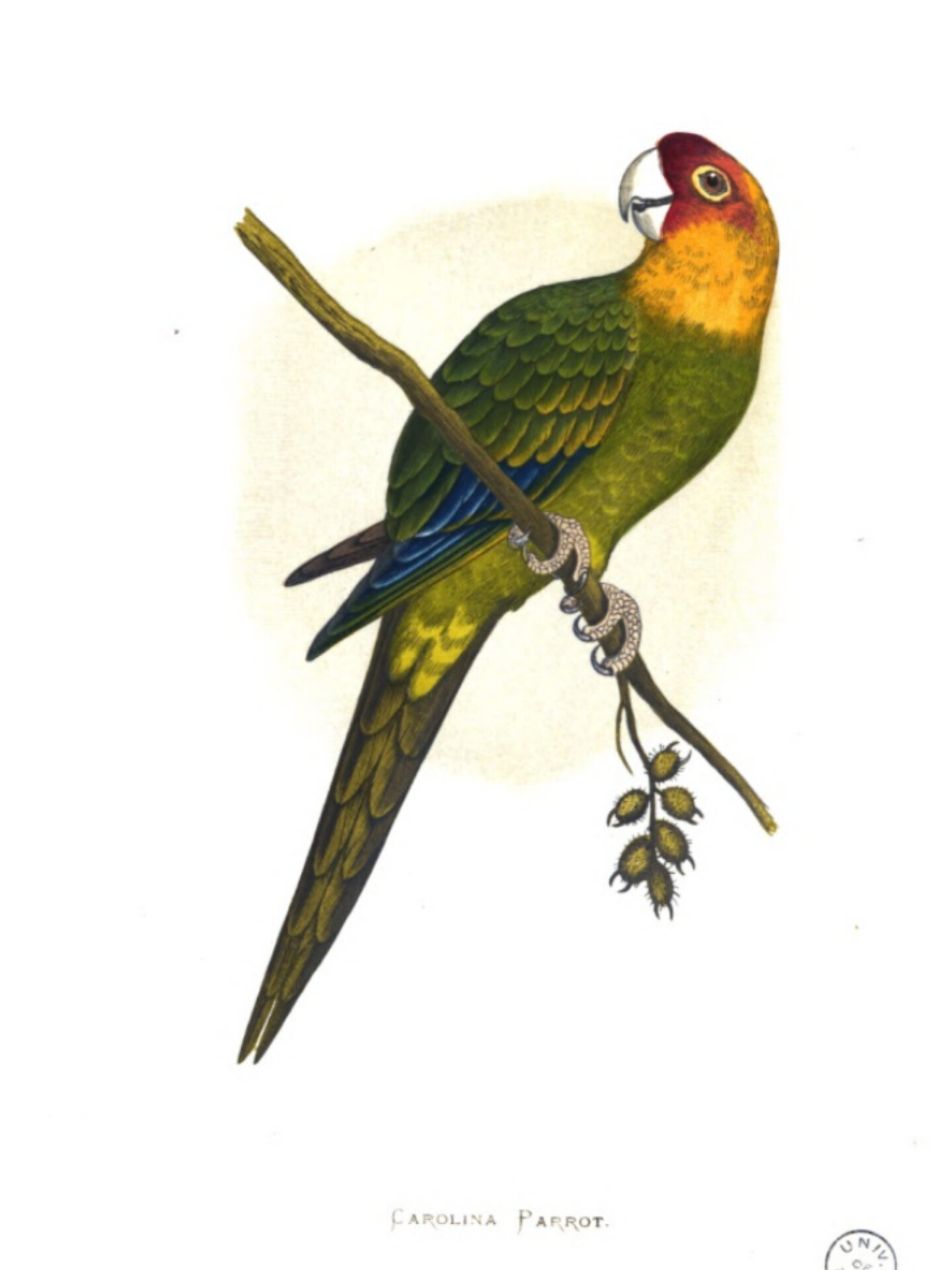
The appearance of the Carolina Conure is exceedingly pleasing, the rich emerald green of the upper plumage is relieved by the vividly orange red of the forehead and cheeks, while the rest of the head and neck are gamboge, and on the shoulder spots of orange red are inter-mixed with patches of golden yellow: the under surface of the body is yellowish green, and the outer webs of the primaries are bluish green, passing into bright yellow at the base. The inner webs are brown with green tips, the tail feathers are green with the inner webs tinged brownish red. The legs and feet are flesh colour, and the eyes light brown.
As authors disagree on the question of classification, so they are not in accord as to the merits, or demerits, of the species under consideration. Audubon observes: “the woods are best fitted for them, and there the richness of their plumage, their beautiful mode of flight, and even their screams, afford welcome intimation that our darkest forests and most sequestered swamps are not destitute of charms.”
“On account of its inability to articulate, and its loud disagreeable screams, it is seldom kept caged”, writes Selby in Jardine’s Naturalist’s Library; while Wilson delivers his verdict in favour of the bird, and, as the result of actual experiment, pronounces it to be “docile and sociable, soon becoming perfectly familiar, and capable of imitating the accents of man.”
Bechstein remarks that, “its cry is frequent, it is rather wicked, and does not speak; but it well makes up for this by its beauty, the elegance of its form, its graceful movements, and its strong and almost exclusive attachment to its mistress.”
“Towards its own kind”, says Wilson, “it displays the strongest affection, and if its companions be in danger, it hovers around the spot in loving sympathy.”
“When engaged in feeding,” continues the same author, “they are easily approached, and numbers killed by one discharge; the work of destruction, however, is not confined to a single shot, for the survivors rise, shriek, fly round for a few minutes, and again alight on the very place of the most imminent danger. The gun is kept at work; eight, ten, or even twenty are killed at every discharge; the living birds, as if conscious of the death of their companions, sweep over their bodies, screaming as loud as ever, but still return to the stack to be shot at, until so few remain alive, that the farmer does not consider it worth his while to spend more of his ammunition.”
Writing nearly half a century ago, Audubon observes, “They could be obtained as far up the tributary waters of the Ohio as the great Kesshawa, the Sioto, the heads of the Miami, the mouth of the Mauimee at its junction with lake Erie, on the Illinois river, and sometimes as far north-east as lake Ontario, and along the eastern districts as far as the boundary line between Virginia and Maryland. At the present day (about twenty-five years later) few are to be found higher than Cincinnati, nor is it until you reach the mouth of the Ohio that Parrakeets are met with in considerable numbers. I should think that along the Mississippi there is not now half the number that existed fifteen years ago.”
There is no doubt that at the present day (1883-4) their flocks are still further reduced, and that one must travel much further south to find these beautiful but, to the farmer, destructive birds. Their strong attachment to their companions leads to their destruction too, as we gather from Wilson’s experience. “Having shot down a number”, he says, “some of which were only wounded, the whole flock swept repeatedly round their prostrate companions, and again settled on a low tree within twenty yards of the spot where I stood. At each successive discharge, though showers of them fell, yet the affection of the survivors seemed rather to increase, for after a few circuits round the place they again alighted near me, looking down on their slaughtered companions with such manifest symptoms of sympathy and concern as entirely disarmed me.”
“I could not but take notice”, continues the same author, “of the remarkable contrast between their elegant manner of flight, and their lame, crawling gait, among the branches. They fly very much like the Wild Pigeon, in close, compact bodies, and with great rapidity, making a loud and outrageous screaming, not unlike that of the Red-headed Woodpecker. Their flight is sometimes in a straight line, but most usually circuitous, making a great variety of elegant and easy serpentine meanders as if for pleasure.
“They are particularly attached to the large sycamores, in the hollows of the trunks and branches of which they generally roost; thirty or forty, and sometimes more, entering at the same hole. Here they cling close to the sides of the tree, holding fast by the claws, and also by the bill. They appear to be fond of sleep, and often retire to their holes during the day, probably to take a regular siesta. They are extremely sociable with and fond of each other, often scratching each other’s heads and necks, and always at night nestling as close as possible to each other, preferring at that time a perpendicular position, supported by their beak and claws.”
There are, perhaps, few members of the family more susceptible of domestication than the Carolina Parrakeets, providing, that is to say, they have been reared from the nest, or, at least, captured when quite young adult specimens, however, will breed freely in a large aviary, or bird-room, if provided with suitable nesting accommodation. “A pair”, says Dr. Russ, “bred in a small cage in my bird-room, and brought up three, and then five, young ones.”
It is better, seeing they are such sociable birds, to keep several pairs together; the greatest difficulty being to distinguish the sexes; the female, however, has the inner webs of the first flight feathers black, and she has rather less of the orange-red markings of the head and face, that are so conspicuous a feature in the male.
The young are entirely green until after the first moult, when the head and face become yellow, and when in this immature state were supposed to belong to a different species, and are described as such by several writers. Latham supposed it to be identical with the Illinois Parrot (Psittacus pertinax, Auctorum); but this is a much smaller species found in South and Central America.
When first imported the Carolinas are generally very wild, but a little judicious handling will soon tame them, when their shrill screams will be much less frequently heard; for, like all the Psittacidae, they give free vent to their feelings when alarmed; and, as they are naturally timid, the unknown excites their apprehensions, and their outcries are a natural sequence of their alarm.
These birds are excellent parents, as might indeed be gathered from the intense affection they display for each other, and brood and feed their young with the utmost care and attention.
They are to be fed on canary seed, millet, oats, maize, and bread-crumbs; and, if they are nesting, a portion of the seed should be prepared for them by soaking in cold water for a few hours.
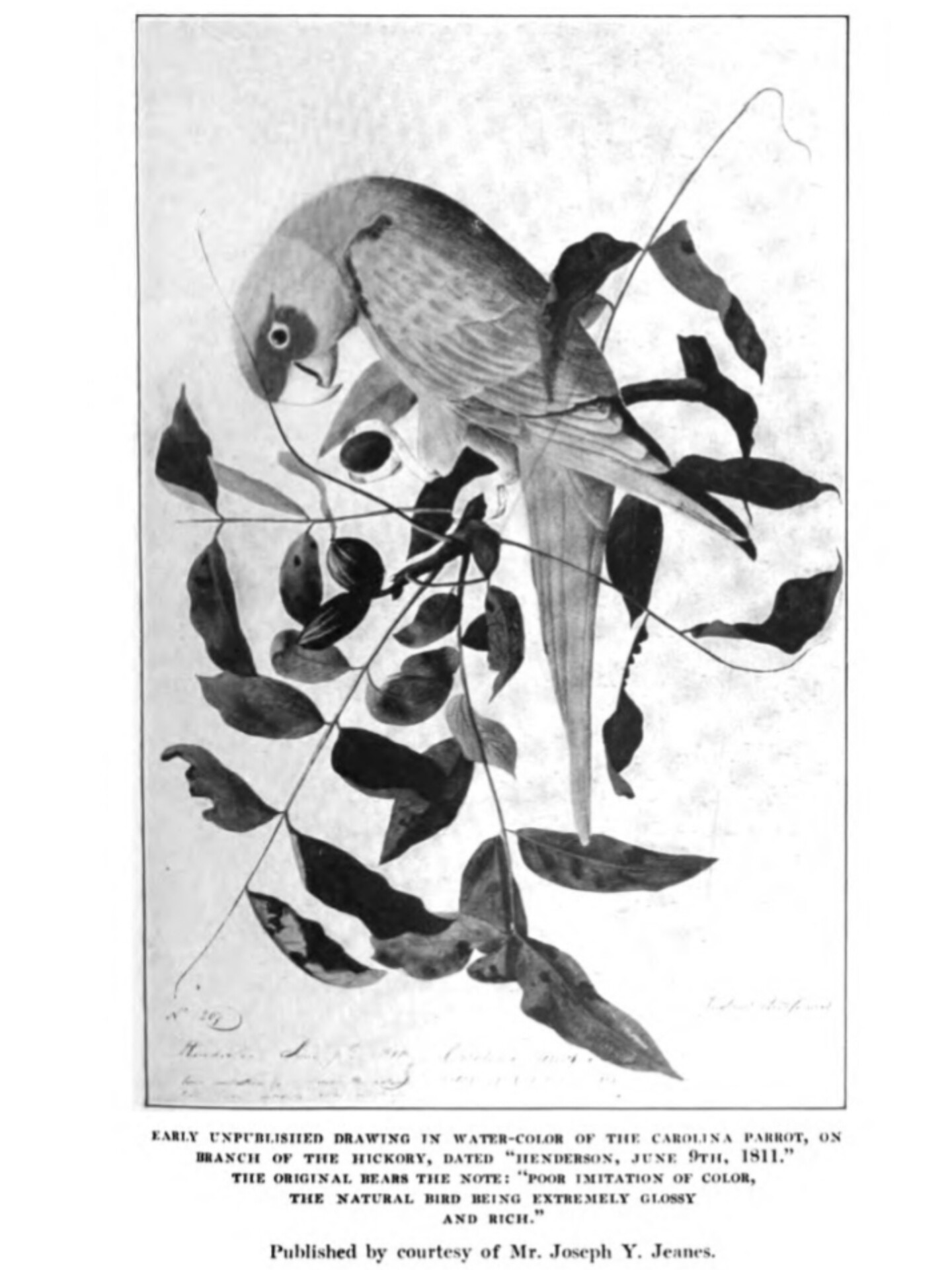
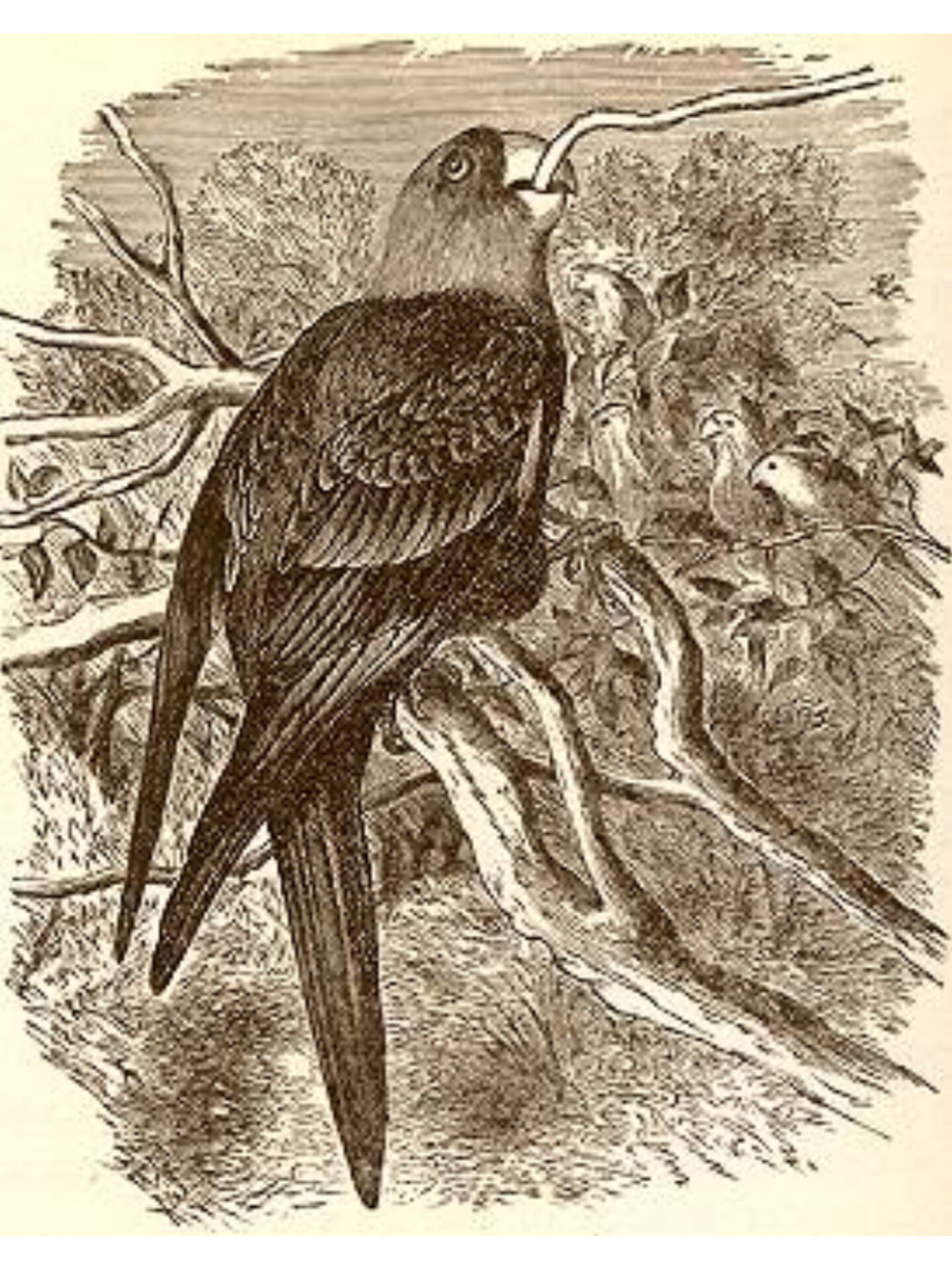
W.T. Greene, Parrots in Captivity, vol. 2 (London: George Bell & Sons, 1884), pp. Image citation below. The lead image appears on page 26 in Clyde Fisher, The Life of Audubon (New York: Harper, 1949).The color image of the parrot on a bough with berries is extracted from page 84 and the color image of the parrot facing left is extracted from page 96 in Lauder and Brown, The Miscellany of Natural History. The black and white image appears on page 20 in Francis H. Herrick, Audubon the Naturalist: A History of His Life and Time, 2 vols. (New York: D. Appleton & Co., 1917). The remaining three images appear in the following website:
https://web.archive.org/web/20100327174106/http://www.ivorybill.comgcarolinaparakeet.htm
See:https://babel.hathitrust.org/cgi/ptid=mdp.39015042531676&seq=1