Spain
We want you to have a greater ability to learn about some of the unpleasant animal issues in our world.
The Land of the Dons
Leonard Williams
CHAPTER VIII.
THE BULLFIGHT.
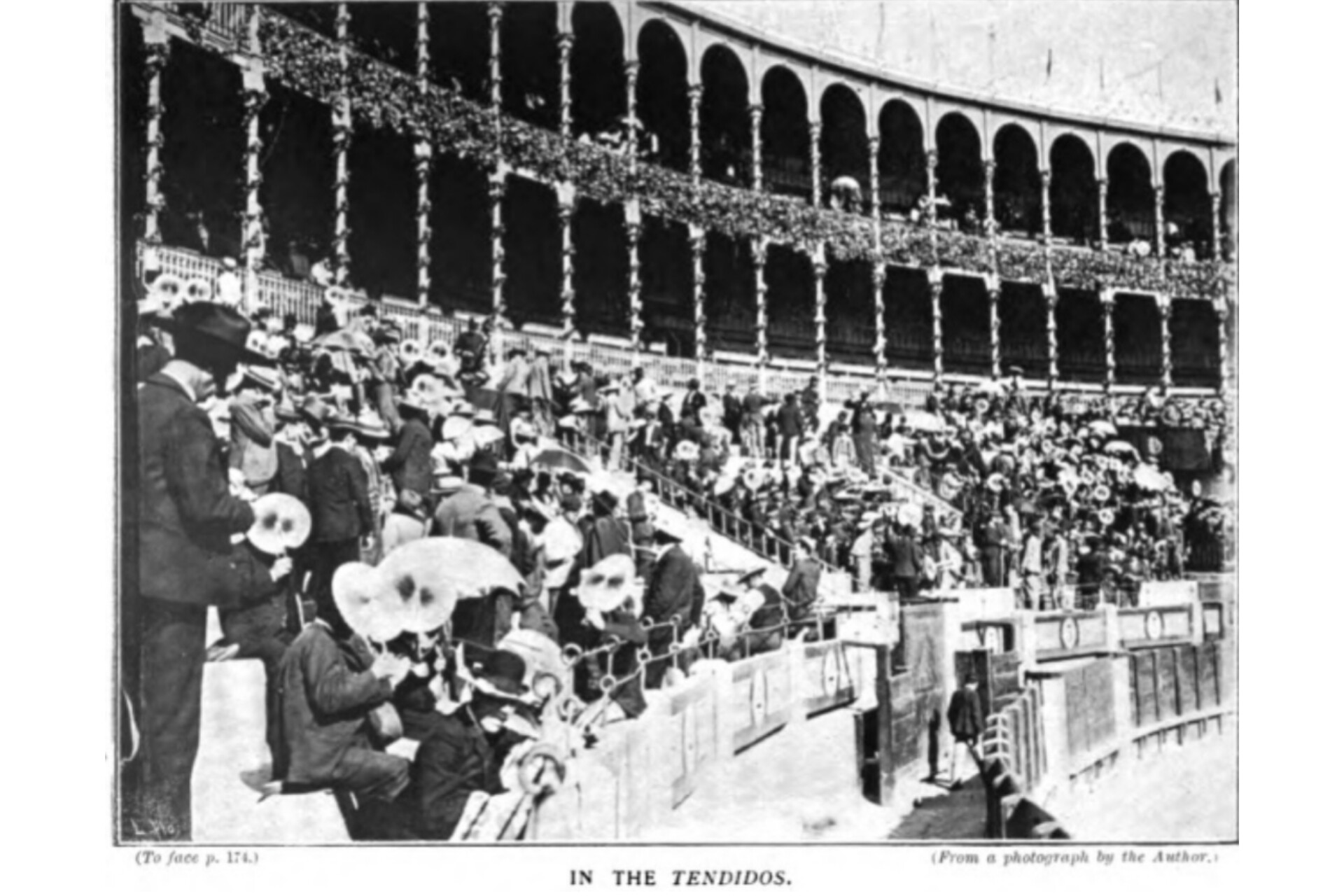
Nowhere in the world is colour so diversified and exuberant condensed into so limited a space as in a Spanish bull-ring. Unfortunately, the mere enumeration of a thousand hues conveys no valid idea of their beauty. Here, then, are from ten to twenty thousand people, bent upon enjoyment — this last a point worth noticing. La cara, says the proverb, es el espejo del alma —” the face is the mirror of the soul.” But rather would I declare that the dress is the mirror of the emotions. If all this congregation were attending a funeral, or any gathering of a momentous and sober character, they would clothe themselves accordingly, and the effect would be unutterably vast, but also unutterably dreary. But the bullfight is of all spectacles the one which is expected to claim the greatest cheerfulness on the part of the on-lookers. Numbers of the marriageable maidens who attend it care but little for the dexterity and even the valour of the brave toreros; but at least the plaza is as likely a place as any to light upon a novio — and who can even anticipate the wedded state without contentment! Therefore, oh dark-eyed damsels of the South, flirting your fans with so intuitive and pretty a grace, and exhibiting (of course by accident) those tiniest of piececitos, when were your smiles more sunny or more inviting to companionship — even though it were lifelong — than on this día de toros?
The men, too, are in their highest good-humour. Not a few are genuine aficionados, who derive a keen enjoyment from the kaleidoscopic and ever virgin incidents of the corrida. Others, it would seem, are pleasurably intoxicated by the general animation, by the simple sight of so much life in simultaneous movement, or by the glorious influence of that speckless heaven and ambrosial temperature. Others are hedonist guasones, who reverence alike a pretty woman — be she in palcos or tendidos, a bold torero, or a sip of tinto from a comrade’s bota. But one and all are prone to doff their “customary suits of solemn black,” and wear a holiday look and smart cravat, and jaunty Cordovese sombrero. None go to cavil or wear a surly face.
The corrida is a lleno completo: above me the boxes and andanadas are packed to overflowing, so are the tendidos to either side, and the barreras and contra-barreras beneath: not a seat is vacant, even among the 13,011 the plaza is stated to contain. Everything is restless, nervous, merry, excited, exuberant motion; hands and faces, dresses and fans, and black mantillas and white. Threading their way between the serried ranks, and husky with shouting “¿Quien les quiere tost-a-os?” “Quien les quiere?” [Inserted footnote: “Who wants them, toasted?” (beans). “Who wants them?”] and similar invitations, are the sellers of nuts and oranges, lemonade, and water.
The president, then, quite de rigueur in top-hat and frock coat, satisfied that the proper moment has arrived, leans forward in his chair, and waves his handkerchief. The last of the aficionados has vanished from the redondel, and the arena is as vacant as Sahara. Nevertheless, the historic custom of the despejo (“clearing”) is piously simulated; so, in order to comply with it, the two alguaciles emerge from the gate beneath the presidencia. They are excellently mounted on prancing steeds in sleek condition, and are dressed in black velvet breeches, with a short cloak of the same material, and black hats with variegated plumes. Cantering round either semi-circle of the ring, they meet at its further side and dashing spurs into their horses gallop back together, salute the president hat in hand, and disappear within the archway.
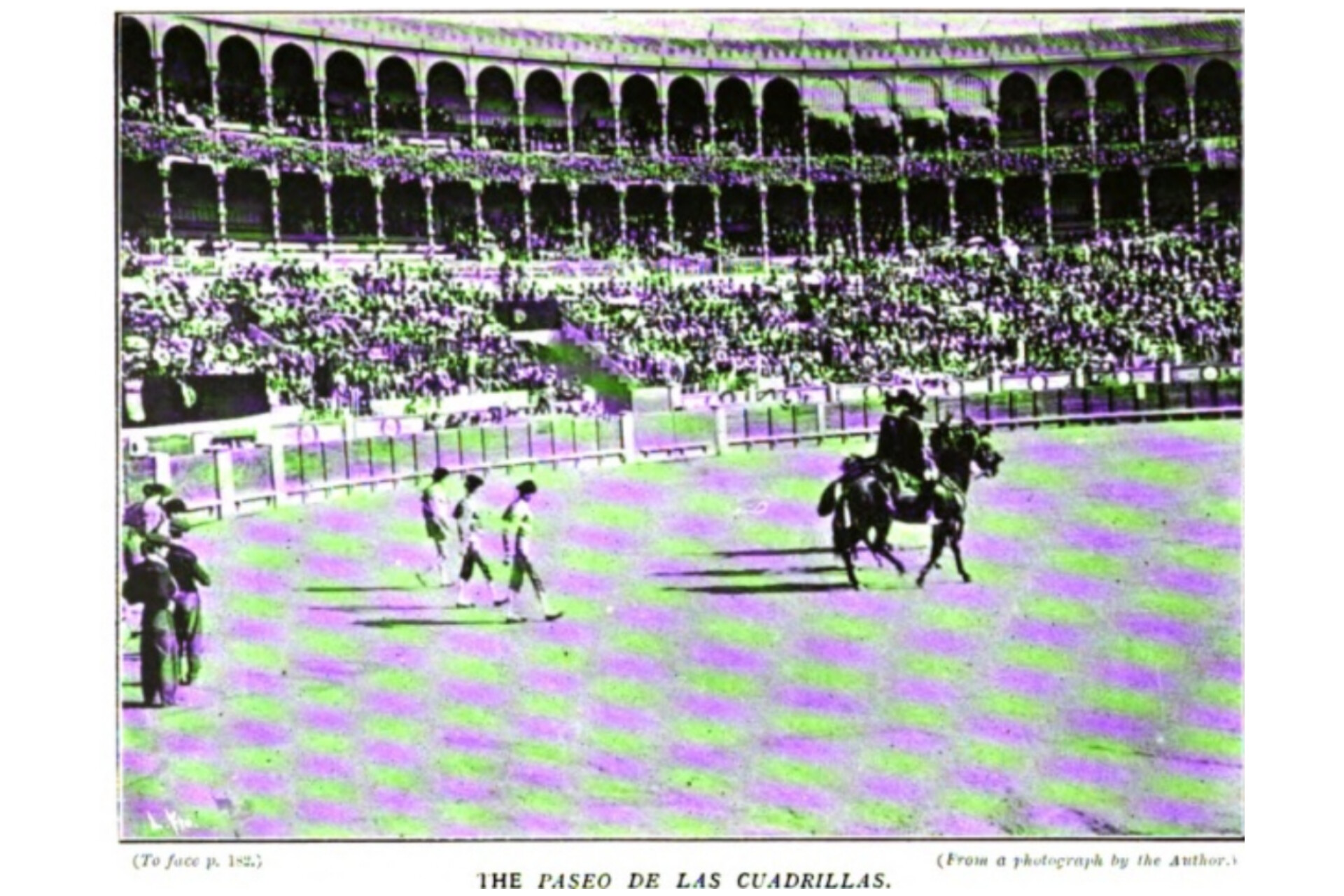
A minute later they again emerge by the opposite entrance; the band, perched aloft among the andanadas, strikes up a stirring paso-doble, and now begins the pretty and imposing spectacle known as the paseo de las cuadrillas, or march-out of the fighters. The strictest etiquette is observed. Foremost are the alguaciles on their capering stallions, the plumes in the hats nodding in time to the hoofs. Close behind come the three matadores, striding abreast, their trajes de luces flashing splendidly. By a usage which is never transgressed, the oldest to have taken the alternativa, or doctor’s degree, so to speak, of bullfighting, goes always on the left; the next oldest on the right; the latest in the middle. In the present instance, therefore, the veteran’s post is occupied by Guerrita; next him is Fuentes; and on the right Reverte. Their glittering capotes de paseo rest upon their left shoulder, but the body of the cloak, the waist from right to left, is caught up and held with the left hand over the left hip, leaving the right arm free. After the matadores come their banderilleros; then the mounted picadores; then the attendants in the ring, vulgarly known as the monos sabios (wise monkeys),1 who attend upon the horses, staunch the holes gored in them with the pellets of tow before-mentioned, and thwack them to their feet; and lastly the arrastres, or teams of mules to drag away the fallen beasts, both equine and bovine.
Arriving at a dignified, swinging stride beneath the presidential box, all the fighters lift their monteras in honour of the president, who acknowledges the courtesy by lifting his immaculate chistera; and the procession breaks up. The alguaciles and the teams of mules gallop away out of the ring, and out of sight; so do the picadores, excepting two, who grasp their garrochas or pikes, and station themselves a few yards apart, the first being some twenty yards to the left of the toril. They are then said to be de tanda; while those who await their turn outside the ring are de reserva. The toreros throw their costly capotes de paseo to their friends among the spectators, to fold and keep for them, and take instead, matadores and banderilleros alike, the well-worn capas of red and yellow percal (print), faded, as a rule, by long exposure to the sun, and smeared with ominous stains, mementoes of other corridas, that are patently other than a vegetable dye. Some throw away their cigarette; others bandy a joke with their acquaintances among the público, or make sure their running-shoes are safely on at heel, or rinse their mouths from a botijo; but all are as cool as ice. Then, capa in hand, they wait by the barrera.
All are ready, picadores, matadores, and peones; and again the president waves his handkerchief. A drum and trumpet sound the appointed call which summons the egress of the bull; and one of the alguaciles, reëmerging, catches in his hat the key of the toril, which the presiding genius also tosses down, decked with ribbons, and scours across the arena. A veteran functionary, dressed in a seedy bullfighting costume (who in Madrid is unfamiliar with El Buñolero?), waltzes in a decrepit manner round the alguacil’s horse, catches the key in his montera, and while the other escapes, moves away to the toril, where are the genuine heroes of the hour — the bulls.
The Buñolero is an old hand at his work. You can see that from the unemotional manner in which he inserts the heavy key, and retiring, as he opens, within the space ‘tween barriers, swings back the — look! It is open! With a fiery snort of rage — if you are close enough you can see him blow quite a little cloud of sand into the air — Hermit (such is his name) is in the ring, swirls round, sights or smells the two picadores de tanda; feints at them one after the other, as they lower their garrochas in self-defence; and has put the whole arena behind him in about six seconds. Everything in the semblance of a fighter, except, of course, the picadores, has lightly vaulted the barrera, and is safe in the callejón, or space, some seven feet wide, between the barriers. No!
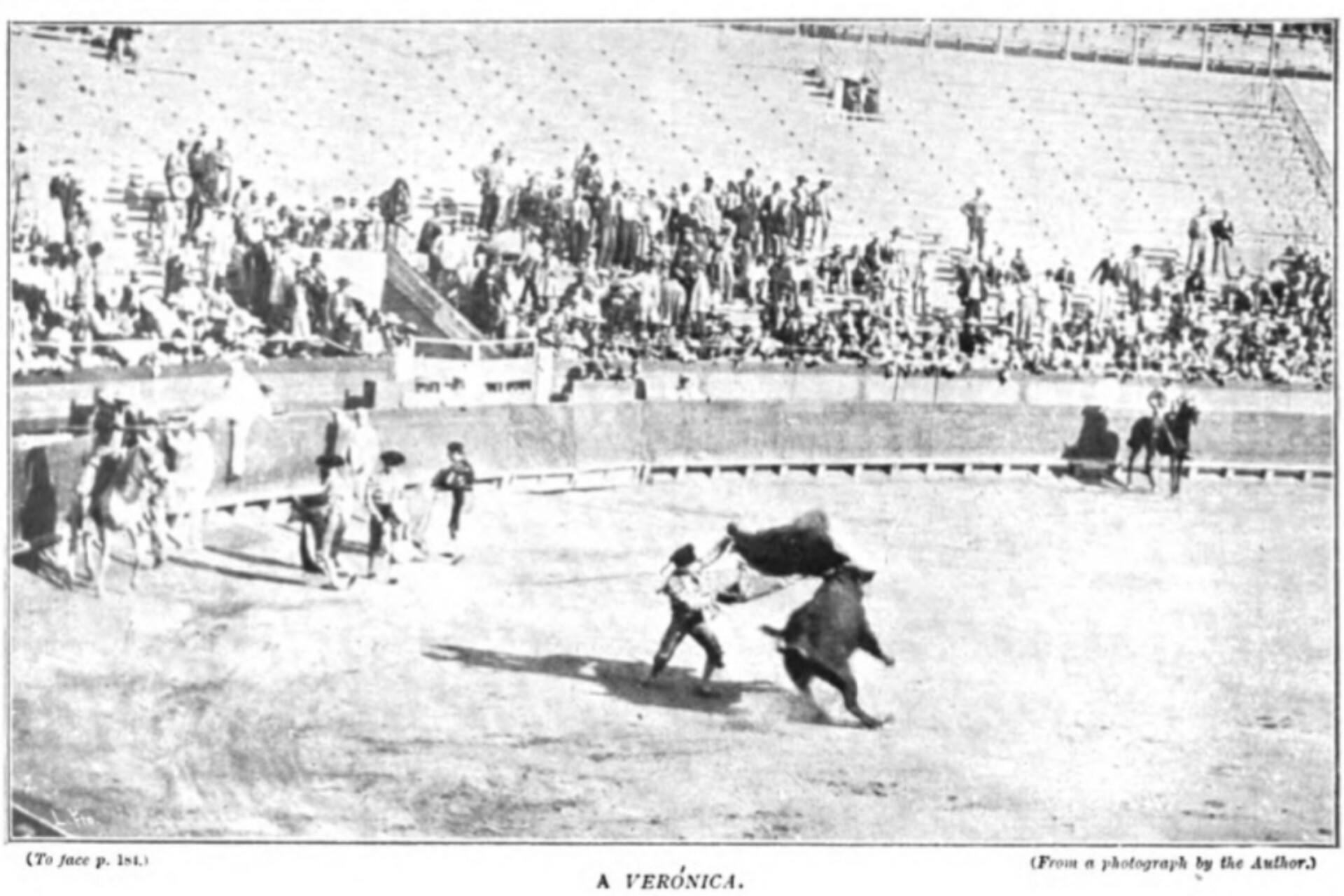
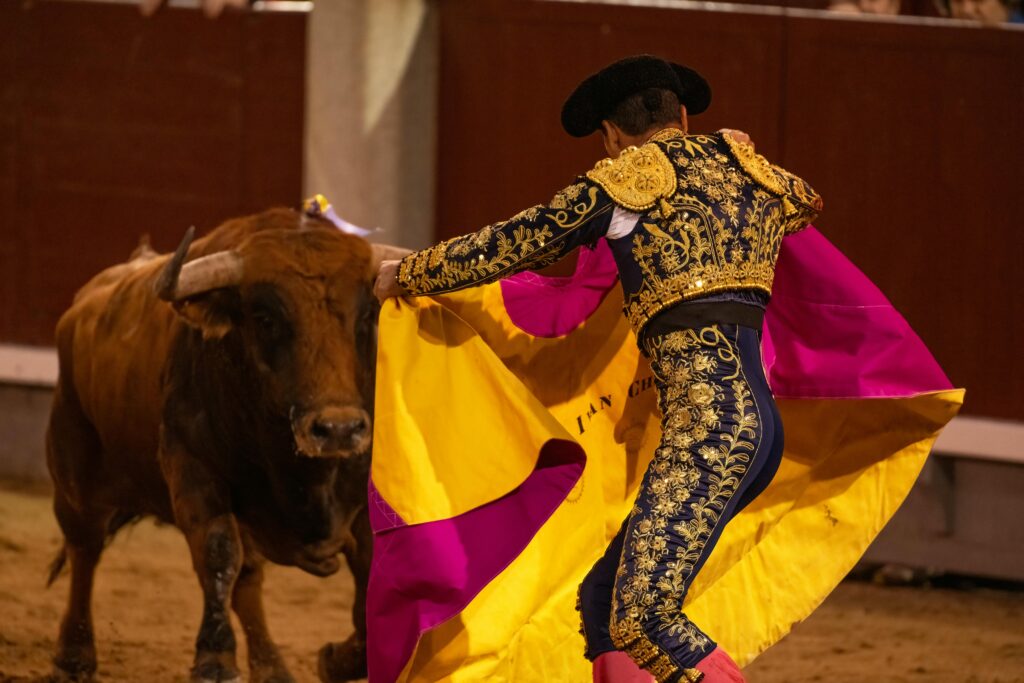
Reverte, cloak in hand, leaps back again, advances from the barrier, and calls to Hermit with a quick little cry, “Hoi! Hoi!” Hermit darts round angrily, pulls up dead, and surveys his enemy, some twenty feet away, and holding his capote in both hands, directly in front of his body. To snort and charge at the cloak and the man is the work of a swifter second than was ever told by clock. Where is the bold Reverte? In pieces? Not he. Without moving his feet so much as the literal breadth of a hair, he swings his cloak out to the right with both arms, and the deadly weapons that would transfix a three-inch oaken plank have grazed the golden bobbins on his jacket, and the danger is thirty feet away. Hermit, as soon as the violence of his onrush allows him, pulls up, turns, and repeats the charge, to pass again beneath his enemy’s arm; and again, and again, till the eye turns giddy at the lightning-like manœuvre; and at every turn the valiant fighter makes that indescribable, graceful bend of his lithe body, and swings out his capa with unerring art. The masterpiece is yet to come. On the bull’s charging for the seventh time, Reverte gives an abrupt half-turn, trails his cloak over his shoulder, and walks deliberately away, Hermit staring stupidly after him, without attempting to follow.
The victory of manly over brute intelligence is triumphantly declared, amid a rapid tempest of applause, just like the rattle of shingle on a stormy beach. “Siete verónicas y un recorte,” says my neighbour, the reviewer, scribbling in his note-book. And the hero of the ovation, with a modest wave of his hand, presses his montera to his head, and seeks new worlds to conquer.
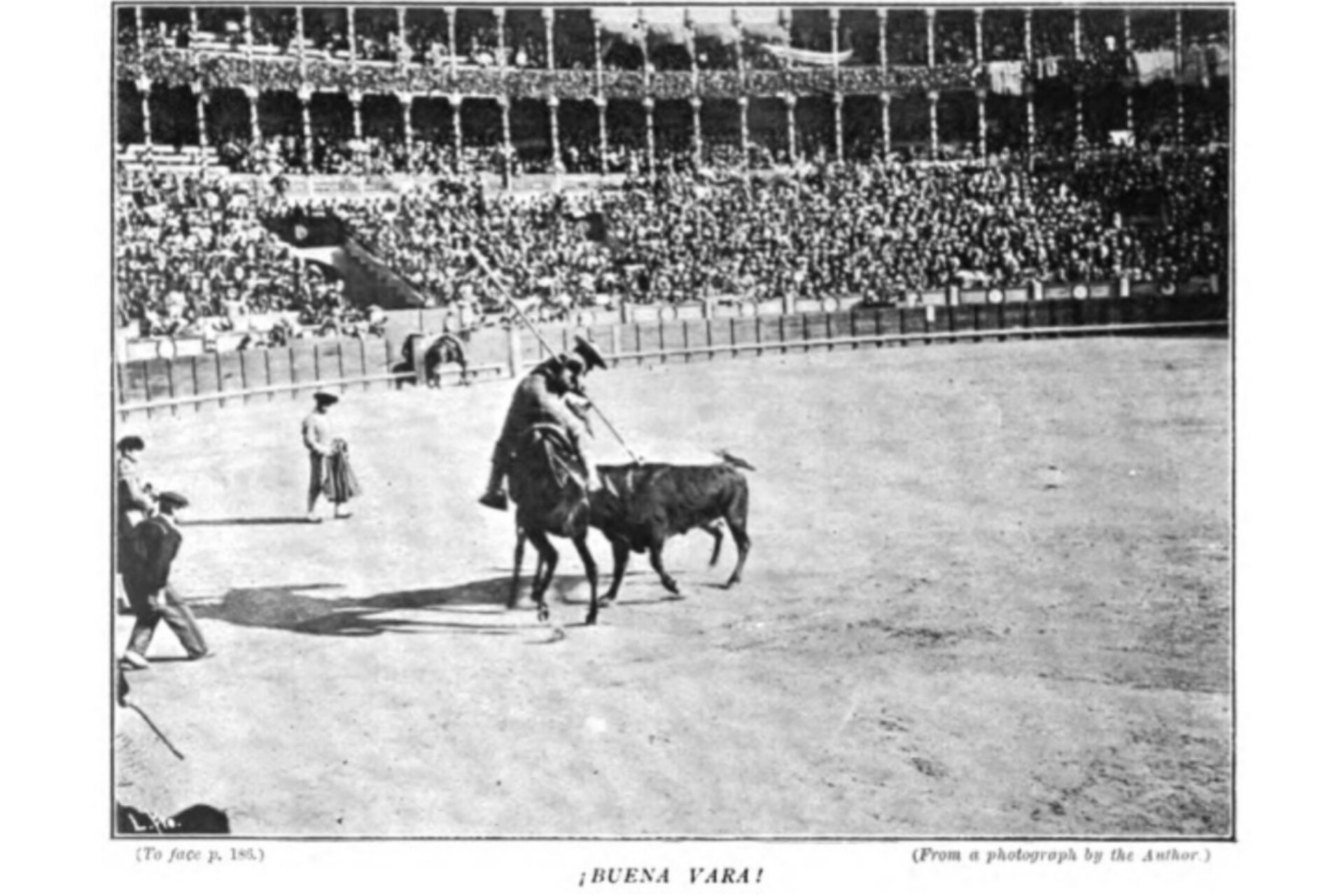
The ice is broken. Hermit, snorting and pawing the sand, is spoiling for another duel. Nor has he long to wait. The picadores, while the preceding incident was in progress, have cantered round the barrera, and pull up almost facing him. orders one of them to picar; and the man, arranging the bandage over the right eye of his nag, sets spurs to the already half-frightened beast, and resolutely advances, followed by the impatient exhortations of the multitude, who gibe and jeer without stint, if they suspect him to be funking. “Saca más vara,” they Guerrita yell, “y anda derecho! ” [Inserted footnote: “Lenghten your lance and at him!”]
The bull, three yards or so away, sniffs, drops his head, and — half a yard of horn in the horse’s chest; both animal and rider rolling over and over, the man, as safety obviously demands, keeping to the side nearer the barrera; the horse, bleeding profusely from a ghastly hole, and struggling desperately to rise to his feet, between him and the bull. The bandage has fallen off, and the penco’s eyes are wild and terror-stricken. But there is life and utility in him yet, and while Guerrita performs the quite, which consists in drawing off the res with a graceful turn of his capa, the “wise monkeys” rush valiantly out from the barrier, and flog him, trembling in every limb, to his feet. The rider curses him, prods him angrily with his garrocha, and remounts.
Again the bull is ready, as are the horse and rider. At the second pica the heart is touched — the horse’s, I mean, not the spectators’. The victim, as soon as the shock is over, and Hermit is again drawn off, this time by Fuentes, does not fall, but the picador, who ought to know what is taking place, dismounts. He, at least, has felt the death-stroke of the beast; and sure enough, from close behind the top of the fore leg the bright arterial blood begins to issue; at first in little jets, then spouting with the volume of a hose. The stricken animal rocks dully to and fro, and falls prone, twitching his ears and moving his underlip convulsively. Is there no coup de grace? Ah, yes. A mono sabio relieves him in a leisurely manner of saddle and bridle, plants his foot upon his head, and taking out a small puntilla from his shirt, drives it smartly into the base of the brain and shakes it to and fro. A desperate kick or two; the eyes grow dim; the lip drops, disclosing the grinning teeth; and all is over. R. I. P. The mono sabio extracts the puntilla, wipes it on the poor jamelgo’s hide, and attaching the halter, prepares his neck for the arrastre. Væ victis! The first of the morituri has fallen, and the populace, intoxicated with carnage, are roaring for fresh bloodshed.
The picador, hampered by the gregoriana which covers his right leg, has limped off for a remount, and while a reserva emerges, number one supplies his place. This time the suerte proves more gory still. Hermit, the blood from the previous picas trickling from his neck, and staining the fluttering divisa to a uniform maroon, is warming to his work. He dives at the belly of his prey and tears it open through a quarter of its length. The guts, dripping with blood and excrement, fall out and about the sand, and their reeling owner stamps upon them wildly. A man in front of me points pleasantly to the shining, bleeding entrails. “Todos los trastos de la cocina,” [Inserted footnote: “All the pots and pans of the kitchen.”] he remarks; the neighbours join in his laughter, and the joke passes for a good one.
A new relay of cavalry arrives, and Hermit is still game. But the picador is strong of wrist, and leaves him heavily castigado, driving the garrocha pitilessly into his shoulder, and holding it there “while men might count a score.” The horse is untouched, but Hermit, by the time Reverte practises the quite on him, is bleeding hard. “Buena vara,” shout the enraptured onlookers, and the picador, one of a class that earns more tumbles than pesetas, touches his castoreño, and rides off, grinning.
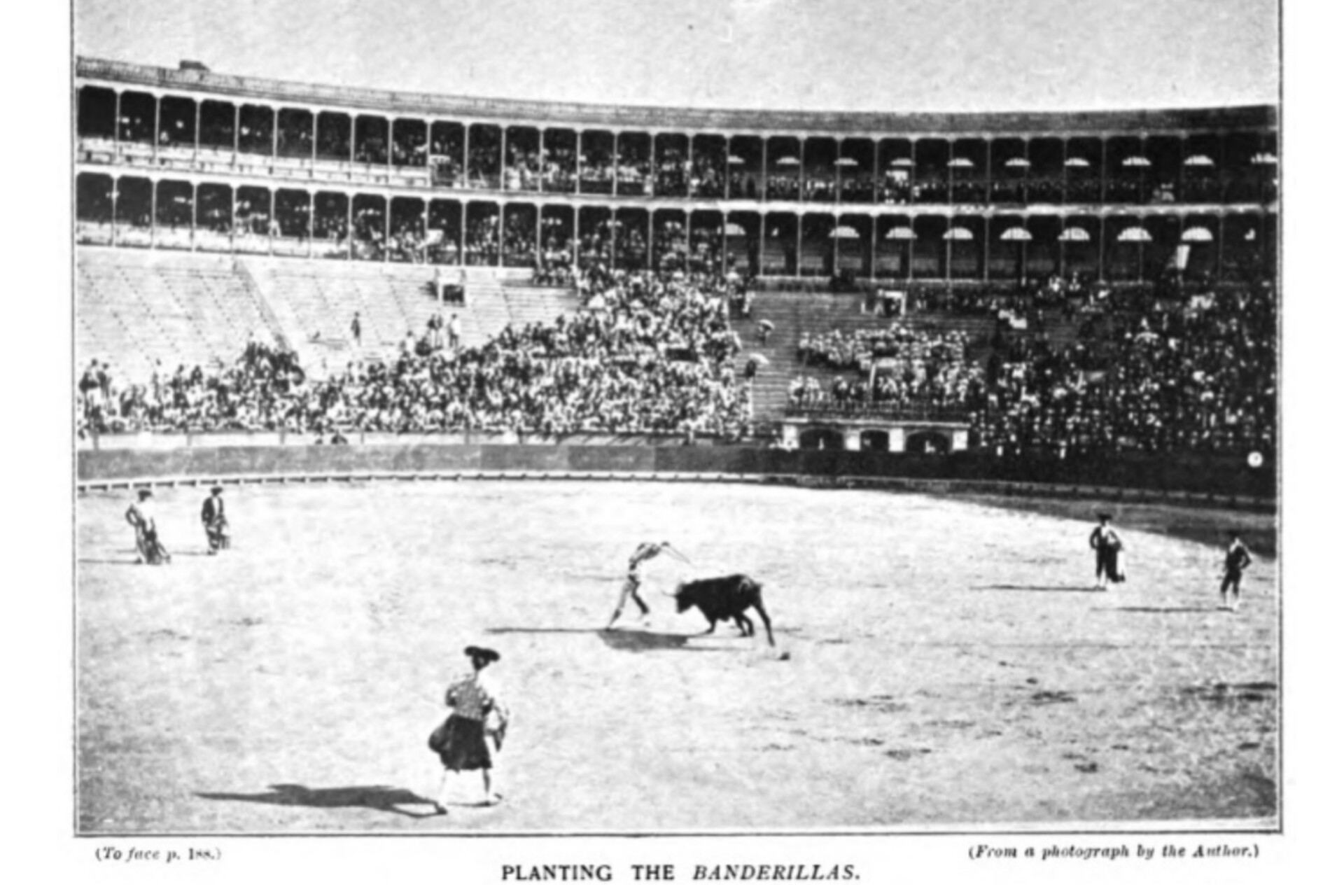
The president makes the appointed signal, the cornet sounds for the suerte de banderillas, and the cavalry retire. Guerrita, by right of antigüedad in the matter of his alternativa, is to kill the bull, and his two banderilleros, one of them his brother Antonio, hand their capotes over the barrier and grasp the banderillas, a pair apiece. These are of ash, rather over two feet in length, about two-thirds of which is decorated with coloured paper, cut in narrow strips. At the tip is a solid barb. The banderillero, then, whose turn it is, moves off to meet the res, and finds him standing motionless near the tablas, forming an angle with them. Standing some six yards away, and fully facing him, the banderillero calls to Hermit, alternately lifting the palos to arms’ length, and lowering them, and rising lightly on his toes. He is now said to be alegrando or “cheering” the bull.
Finally, when the latter’s attention is sufficiently fixed, he swoops upon him, and describing part of a circle in order to keep clear of the horns, lifts his arms, and keeping both hands close together, metiendo los brazos, drives the barbed sticks into Hermit’s neck. Our hero has clavado un buen par in the manner which is known as al sesgo, and the feat is greeted with a roar of applause. The two barbs are planted close together, and exactly as the art demands, directly behind the head, neither too far forward nor too far back; and the banderillas, as Hermit bellows and paws the ground at the receipt of this additional courtesy, fall gracefully aslant on either side of his face.
The collocation of the second pair, a task pertaining to banderillero number two, is a longer affair. Hermit is prepared for anything and everything, and as crafty as a Jew. His adversary, attempting the same device as his predecessor, hallooes to him and springs as high as heaven, then shifts his ground and repeats the experiment. At length, when the proceedings have lasted rather longer than is opportune, and the spectators are revealing unmistakable signs of boredom, he resorts to treachery. For this purpose he sidles behind his quarry, and making ready the palos and giving an abrupt cry, brings the enemy swinging round upon him, and driving in the banderillas, darts nimbly away upon the other side of Hermit’s head. This is de media vuelta —” half a turn”; and being executed como Diós manda, is met with renewed applause. Banderillero number one drives in a third pair, de frente, a trifle abierto, that is, with more space between the palos than should be, and therefore not so unimpeachably artistic as the others, and Hermit, with the six gay-coloured, blood-bespotted harpoons dangling from his withers, is ready for the supreme suerte and dissolution.
The cornet sounds again, and Guerrita, who for some little while has been resting by the barrier, advances, estoque and muleta in hand, to just beneath the presidential box. The president raises his hat, Guerrita his, and holding both sword and engaño in his left hand, and emphasizing every period with a flourish of the montera, delivers his brindis, or matadorial speech. The oration, fortunately for the impatient multitude, is not a long one; in fact, a dozen seconds will have covered it all, when Raphael, swinging his montera jauntily round him and up into the tendidos, turns on his heel and strides majestically forward to complete the doom of Ermitaño.
The executioner’s first step is to wave off all his men, “¡fuera gente!” an action that is always popular as signifying pluck, and professional pundonor. Then, liando el trapo, namely, adjusting the scarlet muleta to a small stick, from the end of which a spike projects and secures the cloth, he advances to within three yards of his opponent and sidles warily round him, gradually describing almost the complete circumference of a circle, and keenly scrutinizing his every movement.
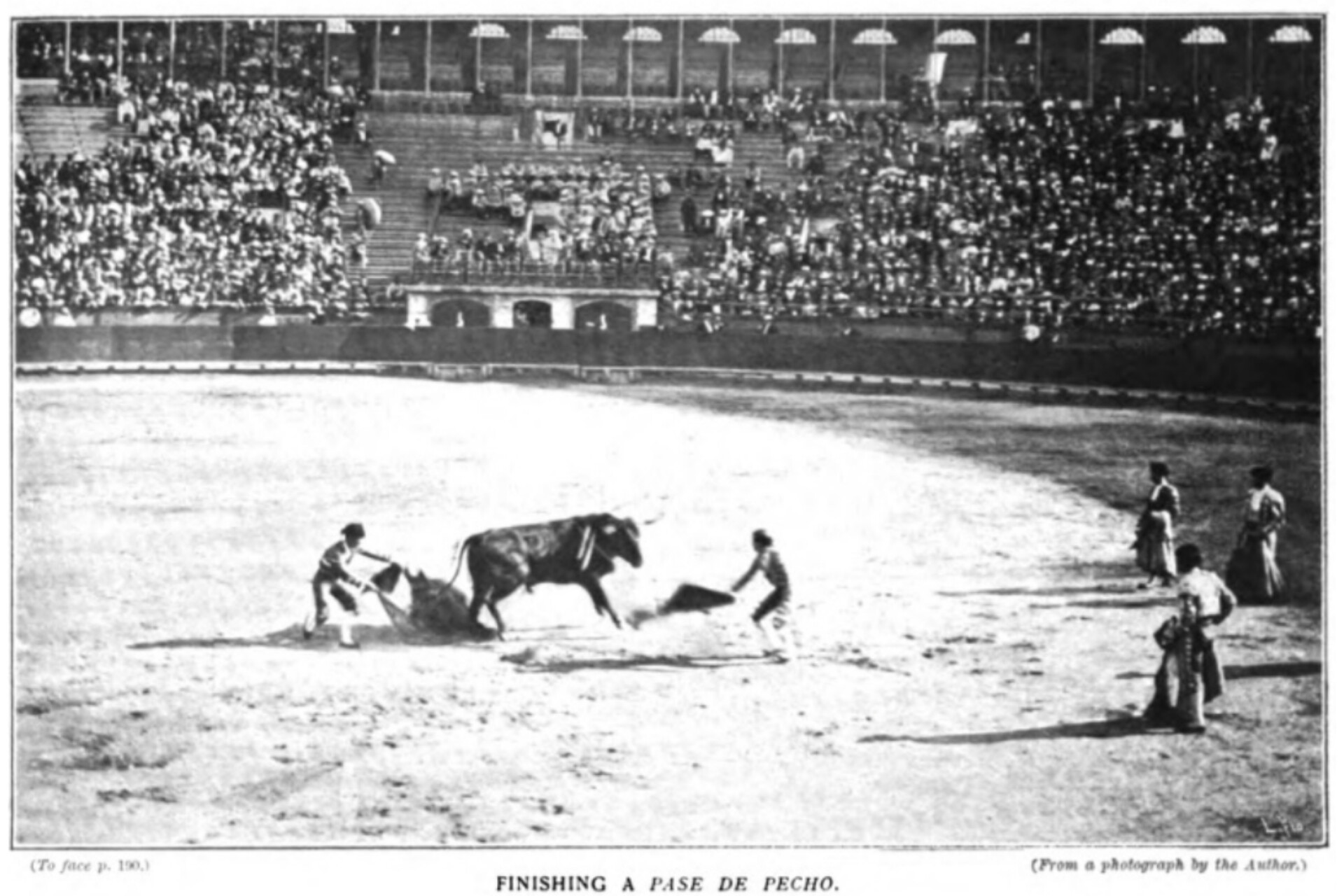
In these moments you may be sure Guerrita is deciding on the nature and even the number of the pases de muleta he means to employ. When his mind is made up, and Hermit has been suitably circumnavigated, the matador thrusts out the engaño on his left, holding it in his left hand, and almost brushing it against his victim’s nose. He is now said to be empapando, or smothering the bull’s face with the red cloth. Hermit, dropping his head, charges the muleta. To all appearances he is oblivious of the man, who, without moving his feet, raises the cloth, and sweeps it backwards, followed by the bull, both bicho and trapo describing with infinite swiftness a small portion of a circle. This manœuvre is the pase natural, and Guerrita, always with the same sure-footedness and calm, repeats it no less than seven times. The vigilant, reflexive dexterity of the human, as opposed to the blind, impetuous savagery of the brute, seems to have left the latter completely stunned and silly; but any aficionado will tell you that Hermit carries his head too low; so the diestro gives him a couple pases por alto, lifting the muleta at each sweep over and across the horns, and when he finds him to be sufficiently cuadrado, with fore and hind legs properly set together, and head at the desired elevation, prepares for the volapié.
Lifting in his right hand the gleaming estoque to the level of his shoulder, and aiming, by running his eye along the blade, for all the world as though he were sighting a rifle, at the scientific point on the top of the bull’s neck, with his left hand he extends the muleta beyond his right side, under his sword arm, and perfilándose with his body, that is, planting himself sideways in the same line with the bull’s length, delivers the thrust at the same juncture that he darts forward, smothering as he does so, Hermit’s face with the muleta, and giving the animal the salida on his right, at the identical instant that he himself escapes to his left. The estocada, in the hands of so consummate a classic, is naturally perfection’s self, and the only visible vestige of the weapon is the cruz, or hilt, peeping from the flesh, deluged with welling crimson, of the victim.
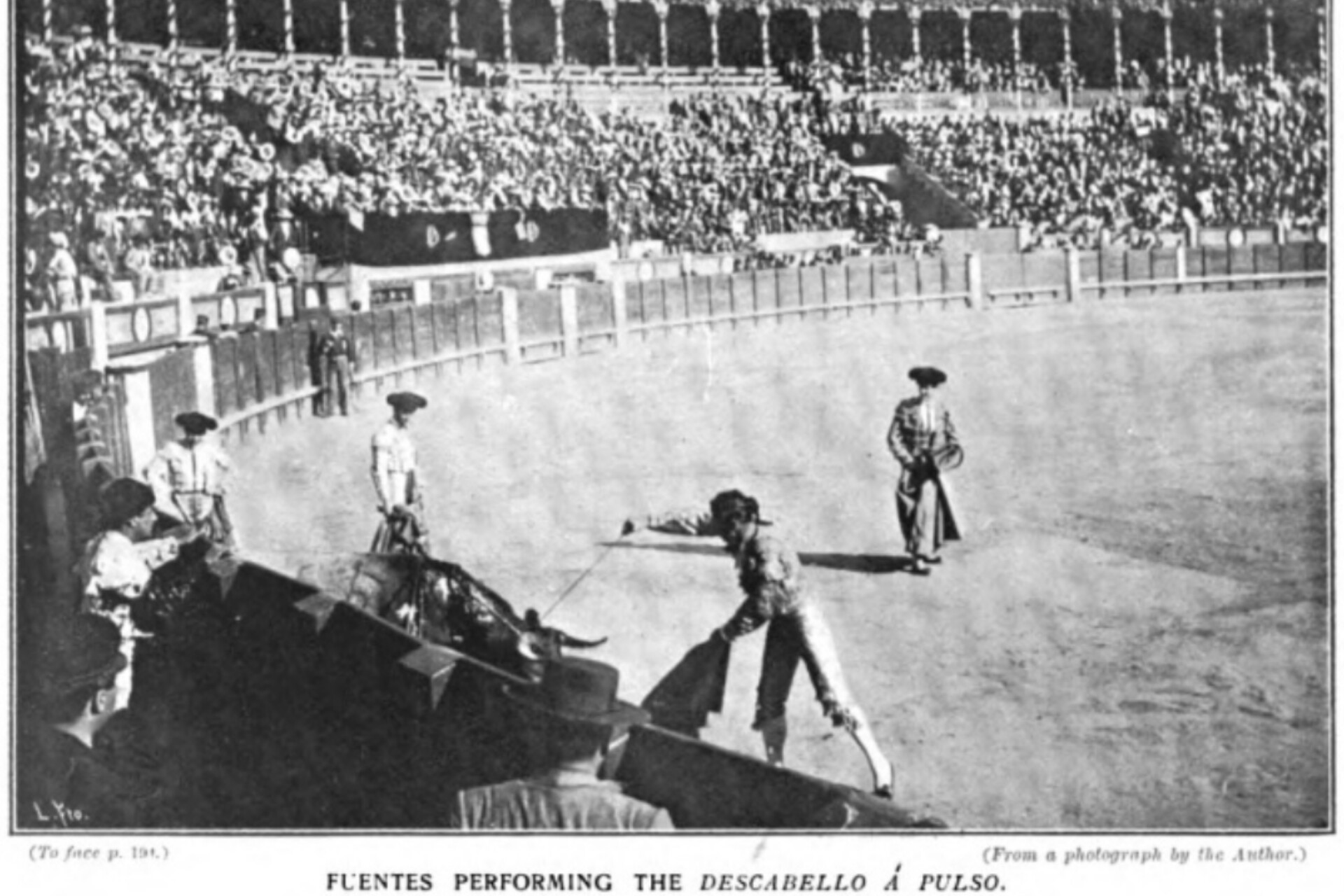
Yet even thus it is a matter of a good many moments before the vanquished falls to earth — se echa. First of all the peones dash forward, and throwing out their capotes, whirl him alternately to right and left, but this is resented by the spectators as a violation of fair play, and Guerrita again steps forth to execute the descabello. Newly confronting his foe, he dazes him by a number of short sharp pases known as de pitón á pitón, and carefully taking aim, almost by feeling with the point of the estoque for the spot desired, namely, the base of the brain, delivers one vicious little dig, and over rolls the valorous but unfortunate cornúpeto.
The indispensable “wise monkeys” harness his stiffening remains for the arrastre, the banderillas are dragged out, likewise the estoque, the peones withdraw to the estribo, and the incomparable Guerrita, after repeating, this time without the rhetoric, his salute to the president, moves triumphantly round the ring to the inspiriting strains, emitted by the Hospicio Band, of a popular tango, and the frenzied acclamations of his worshippers. Quite a warehouse of hats is thrown down to him, and cigars galore. The latter he disdains to grope for, leaving them to an attendant peón; but he gathers up the headgear, sends it with his own hand spinning back to its proprietor, and even takes a quarter of a mouthful from a bota, obsequiously lowered from a tendido. If ever in this weary world a mortal be capable of unalloyed contentment, that mortal must be Rafael Guerra (Guerrita). He has achieved an estocada monumental, as well as an immaculate descabello á pulso, and for the time being he is the most conspicuous and the most applauded man in Europe.
It is a pity that Hermit, the crimson puddle on his morrillo already beginning to clot and darken, and kicking his toes nonchalantly in air, is past appreciating the dignity conferred upon him in dragging him out the last of all the victims, [Inserted Footnote: Except, of course, wherever the contingency should arise, a biped.] and after the fragments (broken meats, with a vengeance) of the horses have preceded him to glory and the desolladero. For here is a mark of distinction in exacting which the Madrid público is absolutely inflexible. There is no commiseration for Hermit while he lives; but dead — observe the delicacy of the ideal — his figure ceases to be bestial, and becomes heroic. And so the jangling teams of mules come in and gallop out, and first one penco is made fast to them, and secondly the other; and then, with never a salute or word of thanks, ungrateful Hermit is the last to disappear.
The first bull, then, is fought and killed; and the same general procedure will be adopted with the five remaining. Of course the incidents and detail vary. Now and again a peón, opening his cloak (abriendo el capote), is harder pressed than he anticipated, escapes precipitately (saliendo por piés), and vaults the barrier into the callejón. It goes without saying that some of the quites are more showy (lucidos) than others: now it is Guerrita who surpasses himself, now Fuentes, and now Reverte.
These three matadores possess characteristics which strongly distinguish them; just as no one singer’s voice, or painter’s touch, is identical with another’s. The course of the corrida includes manœuvres so many, and so variously executed by one or other of these heroes, as well as by the members of their cuadrillas, that to attempt to describe them all would be inevitably to bewilder — now a larga, now a galleo, now a pase de pecho by the matador, now a pase cambiado, now a pase de telón, now a faultless estocada up to the hilt, now a tendida almost horizontal, now a media, or half, now a pinchazo which does the beast no harm at all, now a bajonazo or stroke delivered below the proper point — an enormity which evokes the gibes and execrations of the aficionados; for however hard it may prove to be a bullfighter, it appears to be simplicity itself to damn one.
But the general outline of the programme does not vary. Each bull is first of all attacked and weakened by the picadores, then he passes on to the banderilleros, and finally to the espada. On one occasion, during a suerte de vara, the picador, through carelessness, or funk, or want of skill, leaves his garrocha sticking in the bull’s neck, and while the brute is being enticed sufficiently near to the barrier to lug away the projecting shaft, the público riddle the cowering misdemeanant with volley upon volley of oaths and ribald epithets.
Horses, fewer or more as the case may be, will fall and be thwacked again to their feet by the assiduous “wise monkeys,” and gored in every possible manner, until they are ripped to shreds, and little of their flesh and nothing of their life remains to them; and then the teams of the arrastre, to the music of their merry bells, will drag them away and out of sight; and upon the morrow, says your neighbour facetiously, the price of chorizos will be cheaper.
But the prettiest and most interesting detail of the whole corrida is when Guerrita and Fuentes, in response to the clamorous petition of the spectators, consent to banderillear the fifth bull, for each of these famous matadores is also the beau ideal of a banderillero. Guerrita, who takes the first pair, in spite of his verging upon forty years is as active as a springbuck, and glories, before actually planting the palos, in making believe that he is going to plant them; in playing, as it were, with his enemy, in exhibiting a series of salidas en falso, or feints, electrifying the aficionados by these masterly and classical adornos. But between Rafael and. Fuentes there is little if anything to choose. If one has his darling method, so has the other, and when Guerrita has clavado his par as magistralmente as is his wont, the other advances towards the bull, pulls out his handkerchief, lays it on the ground, plants both feet upon it, and then, by dint of calling and alegrando him for quite a while, induces him to charge. As he does so, and without stirring a hair’s breadth from the handkerchief, but merely swaying his body to one side, Fuentes drives in the banderillas to perfection, while the bull, sweeping impetuously onwards, grazes his very taleguilla.
“¡Vaya un par quebrando!” says my neighbour; and you may be sure that Fuentes goes down in his good books.
But the cloudless afternoon is ripening into sundown, shadows fall deeply over all the plaza, and before Fuentes has despatched the sixth and last bicho, the concourse begins to melt away. My friend the revistero eagerly gathers up his hastily scrawled cuartillas, and bidding me adieu, vanishes. As a student of human, as well as of animal nature, I prefer, for my own part, to wait until the very end, and even later; till the acomodadores have gathered up the leather cushions from the tendidos, and the tag-rag and bob-tail who vaulted feverishly into the anillo when the last blow was struck and taurus reluctantly gave up the ghost, have frolicked about him to their hearts’ content, and kicked his flanks, and poked him with sticks; and the mules have dragged him away to join his brethren.
A stream of light, as red as the blood that just now colored the arena, pours through a western doorway, striking the desolate files of empty benches. The president has left his box, and the multitude gathers about the exits, till the last and laziest find egress, and the plaza is wholly deserted. Outside, at the door of the patio de caballos, the cuadrillas are in their respective jardineras, mopping their streaming foreheads, nodding a cheery greeting to their friends, or shaking hands with the nearest. Finally the mozo de estoques, with his bag of swords under his arm, leaps on the box, the whip cracks, the horses jangle their bells and break into a gallop. A number of urchins, never absent on this occasion, dive feverishly after the vehicle and spring upon the step, the toreros good-naturedly ignoring them. The serried ranks begin to part in all directions, some on tram cars, some in carriages or cabs, a few on horseback, the greater part afoot. All are quieter by far than when they came. The animation of even the Spaniards is not perpetual. Or perhaps they are disappointed that there is nothing more to see. The fight has been a good one, but alas, until next Sunday, it is over.
CHAPTER IX.
ARCANA TAURINA
In the preceding chapter I attempted a plain relation of a corrida from start to finish. In order, however, to avoid confusion, I found it unavoidable to omit a quantity of matter more or less impertinent to the narrative proper, and yet which has to do with bullfighting. Who breeds the bulls, and where? How are they brought to the ring? What are they worth? What is the price of a corrida, or of the services of the matadores and their helpers? Many such queries must occur to the curious, and I hope the following data will answer them at least in part, before I sketch the origin and growth of Spain’s most ancient and severe recreation.
By far the greater number of the toros bravos, or fighting-bulls, are Andalusian, the property of one or other of various breeders (ganaderos), who are invariably men of wealth, and sometimes of title. Among the names of noble ganaderos, past or actual, are those of the Marquises of Gaviria, la Conquista, Salas, Sales, Gandul, Villamarta, los Castellones, Saltillo, Ruchena, Medina, Castrojuanillos, and Villavelviestre, the Counts of Patilla and Vistahermosa, and the Dukes of San Lorenzo, Osuna, and Veragua. Ladies, too, commonly by inheriting the cattle from their husbands, are and have been ganaderos, or I suppose I should say ganaderas — the Duchess of Santoña, the Marchioness of Saltillo, Doña Carmen López, Doña Dolores Zembrano, Doña Celsa Fontfrede, Doña Cecilia Montoya, Doña Carlota Sánchez, and others. And curiously enough three priests have figured in the profession — Don Diego Hidalgo Barquero, Don Francisco Mendoza, and Don Antero López. The latter, indeed, went so far as to brand his bulls with a priest’s cap or bonnet, for which reason the breed was known as the Bonetillo.
As I have said, the majority of the ganado comes from Andalusia, particularly the neighbourhood of Jerez, Seville, and Huelva, in whose whereabouts live the best-known ganaderos, excepting the Duke of Veragua. This nobleman, the direct descendant of Columbus — bearing, in fact, the very name of Cristóbal Colón — is the possessor of one of the oldest and most famous breeds of fighting cattle, though his bulls appear to be deteriorating rapidly. Their pasturage is at Colmenar la Vieja, not far from Madrid. The Andalusian cattle graze upon the plains or dehesas of San Juan de las Cabezas, and other of those thinly-populated districts.
Every year the ganadero holds his tienta, or trial of the fighting qualities of the calves, a ceremony which is intended to weed the bad becerros from the good, these to be fought throughout the plazas of the country, the faulty ones to be sold for killing or agriculture. An intermediate class are those which are fought under the name of novillos by second-rate matadores or novilleros, and not in the corridas formales, but at novilladas. These novillos belong to the desecho de tienta, the “rejected in the proof,” but it is not unusual for them to make a very respectable fight, notwithstanding. The tienta can be performed in more ways than one, but as a rule the young animals are driven singly into a yard where a horseman, preferably a picador, aided by a helper afoot with a capote, offers at them with a lance tipped with a very small goad, and considerably shorter than the garrochas employed in the ring proper. If the bull dashes at the horse, ignores the pain of the goad, and returns with spirit to the charge, he will do, and is promoted to the aprobados, or selected candidates. The heifers are also tested, since the mettle of the dam must narrowly concern her offspring, and the semental or stud-bull is sure to be a stately and expensive beast of noble presence and proven lineage.
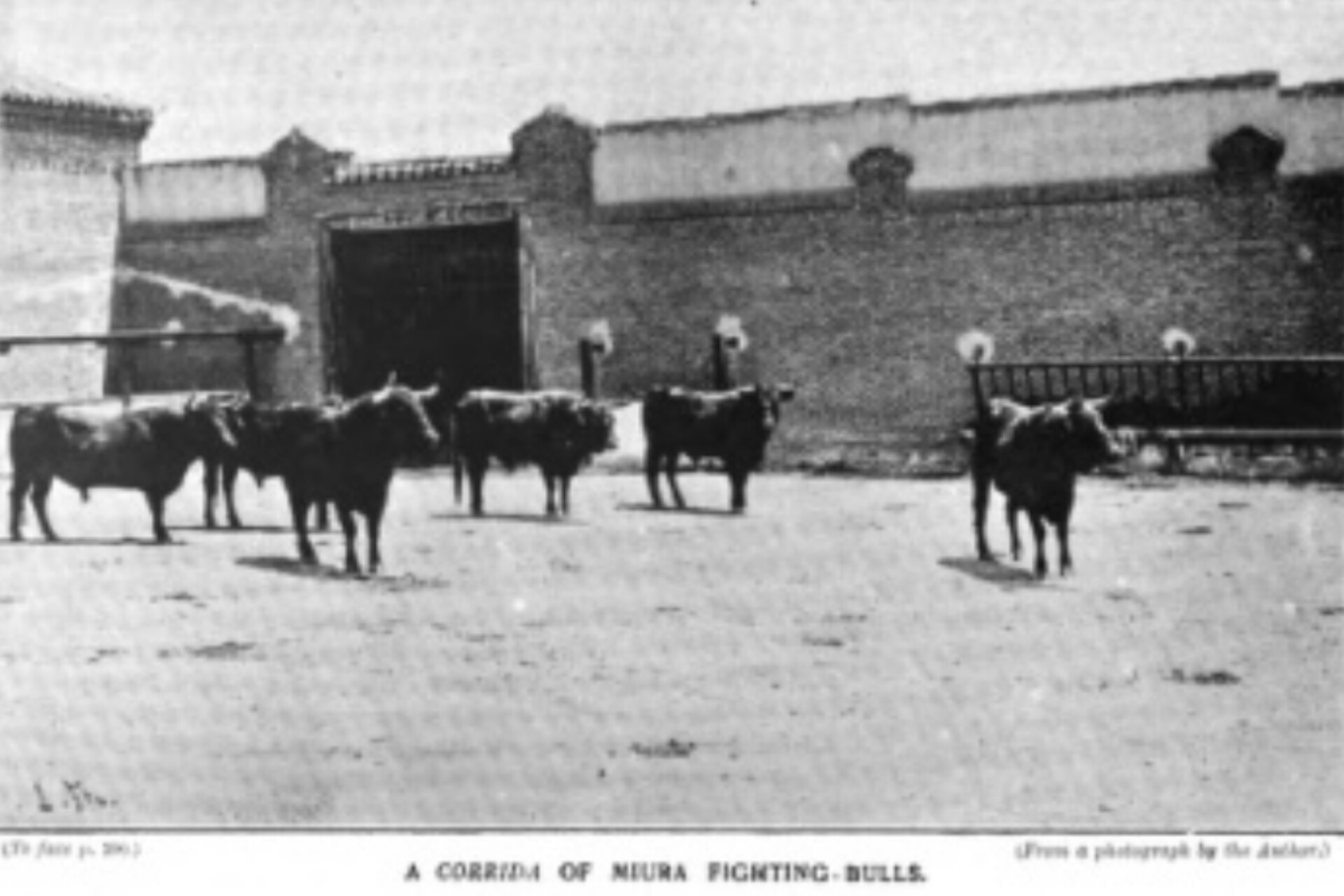
It is a matter of impossibility to determine which is the best ganadería. The best are many. Each has its record of doughty achievements, and spares no effort or expense to keep abreast of its rivals. The leading cattle at the present day are those of Cámara, Miura, Muruve, Pérez de la Concha, Conradi, Adalid, Ibarra, Saltillo, and Anastasio Martín. All of these are Andalusian. Among Castilian cattle the Duke of Veragua’s are becoming steadily worse and worse, but Don Estéban Hernández, also a vecino of Madrid, is able, at a pinch, to produce an excellent corrida.
The ganadero sells his beasts a corrida at a time, the usual number being consequently four, or six, or eight, and the price per head, in the case of the choicest cattle, ranging from four to six hundred dollars, or between sixty and one hundred pounds sterling. The conveyance of the bulls to their destination is no easy matter. Where the distance is comparatively short, as from one point of Andalusia to another, they are driven through the unfrequented parts of the country gathered in a little herd, pasturing by day and proceeding by night, surrounded by the cabestros, or tame, trained cattle with bells round their necks. These intelligent beasts keep the wild ones together and out of mischief with the same unerring watchfulness as a collie controlling a flock of sheep, and lightening to an incalculable extent the labours of the accompanying horsemen.
The entry into the town or village is made by night, the sides of the roads in the vicinity of the bull-ring being strongly barricaded, and the compact herd, headed by two riders careering one after the other, is driven at full gallop plump into the corrales of the plaza. If a moon be shining, the spectacle, viewed from the windows overlooking the corral, is indescribably picturesque and eerie; nor am I aware of any detail of Spanish life so intensely singular and original as these Andalusian encierros, such as I have witnessed, times without number, at Linea de la Concepción and elsewhere. The safe side of the barricade is packed with eager aficionados, straining their eyes and ears and speaking in a whisper; the rest of the población (imagine it to be half-past one of the morning) is profoundly silent, until the barking of dogs, suddenly impinging on the night- time air, announces that the corrida is approaching. The doors of the corral are opened wide, and presently, amid a column of dust, the clattering group of beasts and riders has galloped desperately within and all is business and tumult, the bulls bellowing and snorting with confusion at their novel durance; the bells of the cabestros tinkling furiously; the herdsmen shouting, swearing, and cajoling.
For longer distances the cattle are conveyed by rail, in ponderous boxes not unlike a small bathing-machine in shape, but with a lift-up end. It is needless to say that each bull is enclosed in separate box. On arriving at their destination, and in order to restore them after the journey, it is customary to pasture them for at least some days before the corrida takes place.
Shortly before the fight, the bulls are coaxed into the chiqueros — dark cells with massive doors that open and shut by means of ropes pulled from above. Here also each bull occupies a single cell, and passes, when his destiny arrives, into a kind of narrow tunnel, and thence into the arena. The work of coaxing the beasts, one by one, and always with the aid of the cabestros, from the corral into the chiqueros, requires great ingenuity and patience, and frequently occupies an hour or more. It is customary, in return for a small fee, to admit the public, who occupy a platform overhead, together with the herdsmen, who run from point to point, slackening or hauling the ropes that open and close the doors, and prodding with a garrocha refractory reses into the position desired.
I mentioned the register kept by the ganaderos. In spite of the scrupulous care bestowed upon the tienta, the indications then observed are by no means infallible, and it is impossible to predict with more than approximate confidence whether a given res, when the fatal moment arrives, will make a creditable fight or no. However, as a general rule, the bulls of certain ganaderías have certain peculiarities, “marks of the beast,” so to speak, or idiosyncrasies of attack and defence which the fighters are solicitous to bear in mind. Now and again a bull distinguishes himself by a more than usually heroic resistance, and (very rarely) the Spanish public, after the usage of their ancestors, the Romans, intercede for his life.
Thus, Cantarero, fought at Jerez on July 26th, 1871, accepted thirty-two varas, killing nine horses and wounding eleven. At the request of the respetable público his life was spared. Cartero, fought at Madrid in 1844, killed eleven horses in twelve varas. Centella, fought at Cádiz in 1851, accepted fifty-three varas, killing nine horses and injuring four. His life was pardoned also. And Corcito, the third bull fought at Alicante on July 31st, 1881, accepted ten varas, killing three horses. He then re-charged upon Pinto, a picador, and dashed both him and his horse through the barrera, depositing them in the callejón, killing the horse, and leaving Pinto in a very delicate situation, till the matadores, Cara-Ancha and Gordito, drew off the fiera’s attention.
There are numerous instances such as the foregoing, and they surely prove that a fighting-bull is in fact a wild beast, and as such incomparable with any domesticated taurus of the rest of Europe. Yet the inexperienced are sometimes deceived into imagining that because the Spanish res is clean of limb, long of body, rather than tall, and proportioned with graceful symmetry, he is therefore inclined to be weak and undersized. Never was a greater error. In freedom from superfluous fat the Spanish beast, I will not deny, might readily disappoint those cattle-show experts of ours who lay such paramount stress upon the aldermanic dimensions of the competitors; but infinitely dearer to the ganadero is the toro bravo’s condition; and condition, from the gladiatorial point of view, means perfect speed, perfect courage, and perfect ferocity.
Not for a moment should I elect to wander about an English meadow in company with an English bull; but although this latter might readily tackle a defenceless mortal like myself, it would astonish me greatly to see him accept a second, much less less a twenty-second puyazo from an armed and mounted picador; and after that three pairs of banderillas; and after that the sword of the matador. All, of course, is within the bounds of the possible; but, given the placid education of the British res, and the tranquillity with which he is allowed to fill his belly to overflowing, and degenerate into a cade and comfortable sleekness, the chances should be altogether in favour of my argument.
Ford was persuaded that the Spanish animal is the weaker of the two; but it does not seem to be so when at Seville, in the summer of 1898, a Muruve bull walked from the barrera to the middle of the ring with a horse and man upon his horns; nor is it unusual for any toro bravo to throw a picador’s saddle ten feet into the air; but it takes two men to carry the saddle. As to the Spanish bull’s superior agility, his, at least, is beyond all possibility of question. It is an everyday feat for them to clear the barrera at least once; and the barrier’s height averages considerably over five feet.
At Málaga, some six years ago, a bull leaped over the barrier at precisely the same spot, fourteen times in swift succession. At Madrid, in 1898, another cleared both barriers, landing with his head among the spectators, but falling back into the callejón. On April 30th, 1899, at Madrid, Ermitaño, the second bull of the corrida, cleared the barrier four times, jamming a carpenter between a pair of doors and severely injuring him. All of the above I have myself witnessed; but other feats, perfectly authenticated, are even more remarkable. At Valdepeñas, on June 15th, 1876, Totobío completely cleared both barriers, killed a child, wounded two attendants of the plaza, and committed other havoc; and only four years ago another animal repeated the same experiment and had to be shot by a guardia civil. I may say that the inner barrier or contrabarrera is two and a half feet higher than the outer. Does not this prove that, when he chooses, the Spanish bull can leap like any greyhound?
The bullfighter, then, is called upon to outwit an animal which is always strong, swift, and savage, and occasionally crafty. The course of taurine studies is therefore likely to be a long one, before the aspirant can hope to become at all proficient in the “art of Montes.” Many begin as hangers-on at plazas of small importance, with now and then a poke with the estoque at a becerrada. Others frequent the matadero or slaughterhouse, where they find abundant opportunity for scrutinizing the behaviour and movements of the cattle, and can gather hints as to how to play and kill them.
For the characters of bulls, like those of humans, vary very greatly. Some will charge the man in preference to the engaño — muleta or capote, as the case may be and are, in consequence, exceptionally troublesome to deal with. They are said to comerle el terreno or “eat the ground” from before the torero, when they invade his territory, encroaching restlessly upon the ground he occupies in order to fight them. As a general rule, the more cowardly the bull, the more dangerous and difficult he is to fight. When he faces his tormentor without flinching, charges straight, and struggles honestly to the last, he is said to be noble. But a good bull is often turned into a coward by unskilful fighting. . . .
Nevertheless, and in spite of all precautions, the list of accidents in the ring — cogidas, fatal, or otherwise — is a terribly long one. Among the deaths caused by a cornada have been those of José Cándido, 1771; Pepe-Illo, 1801; Francisco Herrera Rodríguez (Curro Guillén), 1820; Manuel Jiménez (El Cano), 1852; Manuel Parra, 1829; Pedro Párraga, 1859; José Ponce, 1872; José Rodríguez (Pepete), 1862; Antonio Romero, 1802; Gaspar Romero, 1802; Manuel García (Espartero), 1894; and Domingo del Campo (Dominguin), 1900. Among the picadores I find ten deaths recorded, though the number should undoubtedly be much larger; and among the banderilleros nine deaths.
In the bull-ring, as elsewhere, misfortunes seem prone to occur in batches. Between April 30th and May 2nd, 1899, Machaquito was badly gored at Bilbao; Segurita at Carabanchel Bajo; Minuto and Bonarillo were both cogidos, though not seriously, at Madrid; and Fabrilo was “caught” and killed at Valencia. A year before, Fabrilo’s elder brother had been also killed in the same plaza, and wearing, by a tragic coincidence, the same traje de luces.
Another dies nefastus was October 7th, 1900 — cogida and death of Dominguin at Barcelona; two cogidas of novilleros at Carabanchel; cogida of Parrao at Granada; the picador Telillas with his collar-bone broken at Madrid; and cogida of Bombita in the same plaza.
These runs of cogidas are naturally not of constant occurrence, but even a slight wound caused by a bull’s horn requires delicate treatment, and is predisposed to complications. Apart from the splintering of the asta, it is sure to be covered with grit and sand, or steeped in the blood of diseased horses. Owing, again, to the positions commonly adopted by the fighters in order to perform their work, a cogida is more often than not about the groin or thighs, jeopardizing the femoral artery, the intestines, and the kidneys, in short, the most vulnerable portions of the body.
Yet however great and however gruesome the danger, there is never a lack of aspirants to the laurels of Frascuelo and Guerrita. The Calle Sevilla swarms at almost any hour with hordes of maletas, [Inserted footnote: A slang term bestowed upon the incapable and out-of-a-job class of bullfighter.] who delude themselves into the belief that by growing a coleta à la Chinoise, and doing no work, there remains but a single step between their present condition and the pinnacle of taurine fame. They block the pavement to the prejudice of passers-by, and figure not infrequently in the registers of the police court. Yet an indulgent nation tolerates them without a murmur; for are they not devoted to the art of Montes? And is not the nation also?
And now we arrive at the ethical question — is bullfighting a cruel custom, unworthy of a polite people, and which ought to be abolished? In this respect it is not my intention to emit any opinion of a personal nature. Whether I am myself an aficionado is a detail which can hardly be of moment to my readers; and during these three chapters on the national sport of the Peninsula, I am scrupulously limiting myself to the bald narration of a group of facts, together with the points immediately deducible from them. I cannot admit an obligation to do more.
A book on Spain without a notice of the toreo would be glaringly incomplete: therefore I have included the said art, which fills the said three chapters. The allowance of space is really disproportionate; for with strict regard to the popularity of the toreo I should have filled, not three chapters, but rather thirty. Not so very many years have elapsed since his Catholic Majesty King Ferdinand the Seventh established a national bull-fighting academy.
At the present moment there are no columns in the newspapers of greater consequence than those containing the reseña of the corridas, both in Madrid and in the provinces. Without going so far as to say that the torero’s coleta is as dearly venerated an emblem as the Chinaman’s pigtail, there are many reasons why the bullfighter should think no small beer of himself, especially if he dies in harness, in the infirmary of the plaza, and surrounded by sentimental revisteros and his cuadrilla. Then, indeed, no words can illustrate the splendour of his apotheosis. His likeness, artistically festooned with crape, will be exhibited in many a photographer’s window. His funeral is sure to be the very best obtainable, and as a rule subscribed for by his admirers.
The press, avidous of sensation, is certain to omit no detail of the ceremony; how the martyr’s aged father beats his breast, and utters harrowing groans; how his mother and his “sisters and his cousins and his aunts” are seized by one sincope after another; how the multitude, breaking tumultuously into the cemetery, jostles and fights and ruthlessly tears up the tombs of other and less sainted beings in order to gaze upon the darling’s coffin to the very last; and how, by an invariable coincidence, a mysterious and anonymous female, of “distinguished carriage” and “extraordinary beauty,” though, oddly enough, with “her head and features impenetrably concealed by a veil,” falls in a fit wherever the concourse is thickest, and refuses in her most conspicuous and anguished tones to quit the camposanto, and her querido’s beneficent remains. It is assuredly worth while to battle with wild beasts for such an end as this. Believe me, in the lidia alone are glory and good works deservedly esteemed and generously rewarded; for, to cite a single instance, the tomb erected to the peerless Espartero is such as many a philanthropist might justly envy.
Not many Spaniards have been evil or short-sighted enough to exclaim against the bullfight Isabella the First, Jovellanos, the Count of Aranda, Charles the Third, Emilio Castelar, Martínez Campos — people “of no importance,” all of them; and, among the living, the editor of El Correo, Sr Ferreras.
Spain pays no heed to any of these agitators, but continues unmoved the proud traditions of the arena. The superb bull-ring inaugurated not long ago at Barcelona was consecrated by the clergy in procession, on the very day on which a novel of the naughty Tolstoi was thrust upon the list librorum expurgatorum; and even in France the afición is swiftly gaining ground.
The polemics engendered by the Spaniards themselves in favour of and against bullfighting, are a worthy match for the virulence of her political partidos; and indeed some of the arguments, however earnestly intended, are not devoid of humour. I have before me a number of polemico-taurine pamphlets, besides the criticism of Jovellanos, and the conferencia delivered by Don Luis Vidart in the Madrid Ateneo. Not the least original of Señor Vidart’s claims is the one that bullfighting has exercised a beneficent influence on literature! It is obvious, he declares, that Moratín owed his famous Fiesta de Toros en Madrid to the noble art of the toreo; unlike the misguided Ricardo de la Vega, and José Navarrete — this last “a renegade to his native land of Andalusia” — who have made it, not the altar of their inspiration, but the target for their ridicule.
Again and again these battles have been violent and lengthy. Velarde, in his Letters to Don José Navarrete, enemy of bullfighting, boldly proclaims why a corrida is only possible in Spain: because in Spain, and Spain alone, is it possible to find a man sufficiently brave to face the reses bravas of Iberia. “What,” inquires the pamphleteer, “would a foreigner do before a Miura bull? How would the graceful garments of the torero sit upon his clumsy body?”
Personally, I used to imagine that a Spaniard’s body was very much the same in shape as that of any other mortal; and I am grateful to Señor Velarde for undeceiving me. Ye countrymen of Garibaldi, and Joan of Arc, and Nelson, and Garfield, and Charles the Bold — ye are vetoed from becoming bullfighters! Remember the prohibition; weep; and tremble! Therefore your sangre torera must limit itself to admiring the fervid energy of these militant pamphleteers. Divers are the pleas put forward by the aficionados in favour of the national sport: the advancement of literature, of agriculture, of courage, of morals, and, I doubt not, of religion. The indefatigable López Martínez —not the enchanting tiple of the Eslava Theatre, but a member of ” the Superior Council of Agriculture ” — adduces in favour of the lidia some singular observations. He says that in 1878 there were in Spain thirty-seven million cattle, of which no more than twenty thousand were fighting-bulls. What loss, he infers, could the national agriculture suffer from so limited a reservation?
Again, in the space of one hundred and twenty-seven years, there were killed in the plazas of the country, thirty-eight thousand fighting-bulls, which sum, at an average cost of four thousand reales apiece, one hundred and fifty-two million reales. The same number of tame cattle would have fetched no more than fifty-seven million one hundred and fifty thousand reales: so that there is a balance in favour of the fighting-bulls of nearly ninety-five million reales. Ergo, the nation reaps a solid profit from the existence of ganado bravo. It will be seen that Señor López Martínez’ knowledge of political economy is somewhat primitive, but his good intentions are undeniable. Elsewhere he includes eloquent statistics to prove that the provinces where there is most bullfighting produce no greater number of criminals than the remainder.
I notice in the table he appends for 1863, that Madrid province, with a population of four hundred and eighty-nine thousand five hundred souls, and fifty-two bullfights per annum, produces one jail bird in thirteen hundred and fifty-two persons, whereas Zaragoza province, with three hundred and ninety thousand six hundred habitantes, and only twenty corridas, shows one per eleven hundred and seventy-three. Other figures, equally instructive, follow. The moral is obvious — the universal substitution of academies of the art of Pepe-Illo for the do-nothing atmosphere of a Spanish prison, or the treadmills of Great Britain.
Verily we must applaud Señor López Martínez to the echo; if not for the unimpeachable soundness of his economics, at least for a virtue becoming all too rare in these degenerate and selfish days — his sterling buena fé.
The argument that only the staunch aficionado á los toros is incapable of “showing the white feather,” is equally noteworthy. The same Señor López Martínez declares that “the man who is unable without trembling or shuddering to fix his eyes upon the mutilated entrails of a horse, will end by being horrified at the dying agony of a sheep, or the convulsions of a perishing fowl; and this is unworthy of the lord of creation, to whom the Almighty has subjected nature.” Another severe assertion is that of Pepe-Illo himself, who was unable to sign his name, but, according to Señor Vidart,” wrote a treatise on bullfighting. In Illo’s opinion, Isabella the Catholic, by opposing the sport, demonstrated “a cowardly and envious spirit, and a character of extreme weakness and apathy.”
But no matter what may be the language of the disputants, the fact remains that Spaniards as a race are pro-torero to the core; and the sangre torera courses in their veins as hotly and abundantly as ever. With ample reason the Madrid Heraldo recalls that “while we were losing Portugal, and all but losing Cataluña, the populace of Madrid, without heeding the situation, resorted for amusement to the vega of the Manzanares, or a royal fiesta in the Plaza Mayor or the Retiro; and a century and a half later, while the French were capturing the citadels of Barcelona and Pamplona, and the castle of Figueras, the same populace rushed enthusiastically to the bullfight, paying no regard to the invasion, and taking no offence at the excesses committed by Murat in the very streets of the city.”
I recollect myself, that when the question with the United States, only a couple of years ago, was approaching its most serious stage, the whole of Madrid flocked to the plaza to see, not a corrida formal, nor even a tolerable novillada, but a lucha (?) — which naturally never came off between a bull and the tame baby elephant of the Retiro Zoo. Let me observe, en passant, that it is not the first time I have descried, in a similar connexion, the credulity of my excellent friends the madrileños.
Every now and then there is given in the plaza de toros a struggle (so-called) between a wild beast (also so-called) and a bull. Camamas of this nature are extremely simple, and I have no doubt from the managerial point of view extremely economical. The secret consists in buying from a tamer, and at a nominal cost, a toothless and decrepit fiera (?), bred in captivity and therefore irretrievably mansa, which is to be murdered by a fresh young bull. The “fight” takes place in an iron cage in the centre of the plaza; every means is adopted that the superannuated lion or tiger shall be placed in every detail at a disadvantage; and it is seldom the work of more than a couple of seconds before the defenceless inválido is gored to pieces, and the “victory” decided in favour of the noble beast of Iberia.
I am glad that a Spaniard, Antonio Flores, has been before me in denouncing these abominable luchas de fieras. For my own part, although I am scrupulous enough not to rant against the bullfight proper, I cannot imagine any spectacle more craven and degrading than these other parodies of sport. Only a single detail is praiseworthy; the almost pathetic resignation of the Madrid público to have their pelo tomado!
To return to the popularity of the corridas de toros. We have already seen that in more instances than one the clergy have not been loth to supplement their slender emoluments by breeding and negotiating reses bravas. It could never be expected, therefore, that this venerable and venerated body should abstain from haunting the plazas in the purely passive capacity of on-lookers; and sure enough, the padre cura is frequently as intelligent an aficionado as any of his flock. “It was useless,” says López Martínez, “to call the corridas inhuman, immoral, barbarous, and anti-agricultural; priests, foreigners, the very censurers of the bullfight, transported by that species of magnetic current which thrills along the road to the plaza on any day appointed for a corrida, throng joyously to watch the entertainment. Painters portray the suertes of the torero; poets describe them with a golden pen; and blind men sing them to enrapture the multitude.”
Nor is the afición limited to merely a passive enthusiasm. I suppose there is no village in all the land, that does not celebrate, at least during the feria, a bullfight of an amateur description, such as the capeas, of one of which Vicálvaro must still retain a gory recollection. Similarly disastrous was the “entertainment” afforded to the inhabitants of Montemayor on August 31st, 1899 — one amateur gored to death, and three dangerously injured.
When, as occasionally happens, foreigners are dragged into the question of the pros and cons of bullfighting, the bulk of the onslaught is directed against the English, as I submit, unjustly. It is perfectly true that prizefighting is a British and a bloody relaxation; but I am not aware of any law in the codes of the United Kingdom which compels a citizen to become a “bruiser” against his will; whereas it is extremely possible that a penco destined for immolation in the bull-ring, if the query were put to him in answerable form, would elect to be spared, if only for decency’s sake, the ripping open of his belly in public.2
However, apart from this, I am by no means certain that the English are generally adverse to the bullfight. Far from it. The French maintain a growing number of plazas de toros in the south of France; but England, curiously enough, may be stated to maintain two plazas on Spanish territory. On the threshold of Gibraltar are two handsome little bull-rings, those of Algeciras and La Línea, capable of seating some seven or eight thousand souls apiece, and which are practically dependent for their support upon the British garrison and the semi-British population of the Rock; nor are the plaza gates sooner opened, a couple of hours before the spectacle is advertised to begin, than officers in mufti, and privates, corporals, lance corporals, and sergeants in dazzling Sunday uniform, together with their friends, families, and sweethearts, stream truculently in, as ceaseless as the Ganges. The English practical opinion of a Spanish bullfight is well expressed by the following observation. It was during Algeciras fair, when a bullfight is given on each of three successive days, that I asked the English wife of an English army captain how she had relished that afternoon’s corrida. “Oh, it is dreadful,” she replied, “horrible; but” (with a gleam of pleasurable anticipation) “I’m going again to-morrow.”
I submit that on the grounds of utility alone the bullfight should be State-protected, and even receive a generous State subvention; for think of the number of persons who earn their livelihood in or about the plazas, who, but for the corridas, would be driven to earn it in some other manner! The pensions which the Spanish Government already pays might well be increased by about a couple of thousand for the widows and orphans of toreros malogrados; and a mausoleum for bullfighters in San Francisco el Grande might well be constructed on the same lines as our Poets’ Corner in Westminster Abbey. And where would be the harm if Señor Silvela, instead of buying or building ironclads which never steam, or cannon which never go off, except at the breech, should, when next he assume office as Premier of Spain, establish a bullfighting academy in every province? For here is an evident and potent reason why the theory and practice of the lidia should enter into, not an occasional, but every education. I read in the Liberal, in July of 1899 —
“Yesterday morning, a savage cow who was being taken to the slaughterhouse, made her escape in the Ronda de Segovia, attacking an assistant at the egg-shop of Don —, inflicting a number of bruises on him, and ruining his wares.
“The animal continued her course along the Paseo of the Virgen del Puerto, dashing at everybody she met, including a lady with a child in her arms; an elderly porter carrying two glass doors, which were smashed to atoms; and a servant of the Town Council.
“The matador of novillos, Valentín Conde, who happened to be passing on his way to the Northern Railway Station, made use of a sword stick, and a blouse — which served him for muleta — handed him by a bystander, and killed the cow to the applause of the on-lookers.”
Now it is clear that a Society which, in view of contingencies such as the above, persists in denouncing the indispensable practice of the toreo, ceases to be the Society for the Prevention of Cruelty to Animals, and at once becomes the Society for the Endangering of Human Life. If the lady, and the egg-vendor, and the elderly porter had all attended bullfighting classes from their infancy upwards, and carried a neat little sword stick apiece, the vaca brava would have been brought to a full stop long before she reached the Virgen del Puerto. In the words of Robert Louis Stevenson, “a discreet and gentlemanly” (or ladylike) “fence”; and the danger would have been conjured from the very outset, “to the applause of the on-lookers.”
1. I have read that the origin of the nickname, “wise monkeys,” is as follows. Half a century ago a foreigner brought to Madrid a troupe of performing monkeys, which attracted general attention by the cleverness of their antics. Their costume consisted of a scarlet jacket, similar to the scarlet uniform worn by the attendants of the plaza de toros. Naturally enough, the coincidence was not slow in striking the wags of the city, who lost no time in transferring the title of the quadrupeds to the certainly as nimble, and possibly not more highly educated bipeds.
2. A small town near Madrid. At a capea held there in August of 1898, one amateur was gored in the stomach and killed on the spot; and twenty-seven were injured, some seriously.
Leonard Williams, Land of the Dons (London: Cassel & Co., Ltd., 1902), pp. 179-205 and 213-226. Some footnotes have been deleted. The images appear on pages: 174, 182, 184, 186, 188, 190, 194, and 200.
See: https://babel.hathitrust.org/cgi/pt?id=uc1.b4570770&seq=1