Steller’s Sea Cow
We want you to have a greater ability to learn about some of the unpleasant animal issues in our world.
THE EXTINCT NORTHERN SEA-COW, AND EARLY RUSSIAN
EXPLORATIONS IN THE NORTH PACIFIC
Dr. George M. Dawson
One object of the meetings of this club, is that of enabling its members and their friends to bring before the Society for explanation and discussion, subjects which they have been engaged in studying, or which may have came under their notice. Thus it has occurred to me that it may interest you, as naturalists, to review the main facts relating to the now extinct Manatee or Sea-Cow of the North Pacific. The collection of these facts has interested me particularly because, in 1891, I had an opportunity of visiting the former resorts of the animal and of procuring there a number of its bones. This animal is one of these — forming a very short list in all — which have disappeared completely within historic times.
The connection established in the title of my paper between the sea-cow and the early Russian explorations in the North Pacific, may appear to require explanation, but this explanation is found in the circumstance that the extermination of the animal chiefly resulted from these explorations, and in the fact thai if left to itself, the sea-cow, — though evidently in its decadence — would in all probability be still reckoned as a member of the living world.
Everyone here must be familiar with the fact that a principle motive in the exploration and occupation of the northern part of North America was the trade in furs. Missionary enterprises may have actuated many of the early explorers, but some even of the missionaries, were not averse to profitable barter; while in the case of the great fur companies, this was the object of their existence. The Hudson’s Bay Company was early in the field, and after the conquest of Canada the Montreal North-West Company superseded the older French trading companies, and first in competition with, afterwards in combination with the Hudson’s Bay Company, pushed its trading posts and stations westward to the Pacific Ocean.
Furs and pelts of many kinds were obtained by these traders, but, throughout, the skin of the beaver may be stated to have been their main pursuit, as it became their standard of value. In a manner precisely similar, the northern part of Asia was overrun by traders moving in an easterly direction. The Russian expeditions of conquest followed in the wake of the Russian fur-traders, and about the beginning of the last century, the Russians began to establish themselves on the shores of the Pacific Ocean.
For the Siberian merchants, the chief quest was that of the sable, and thus it is that the occupation of Siberia has been described as one gigantic sable hunt, beginning at the Ural Mountains and extending to the Eastern Ocean. This ocean— the Pacific — was reached by the valley of the Anadyr River, far to the north, and at Okotsk, on the sea of the same name. Between these places lay the remarkable volcanic peninsular of Kamtschatka. About 1696 its conquest began, and in some fifteen years it had been throughout rendered tributary to Russia; but the great ocean to the eastward, and what it might contain, still remained unknown.
The enormous extension which the Russian Empire had achieved in Asia, naturally attracted the special attention of its ruler, and in the last year of her [sic] reign, Peter the Great planned an expedition of explorations from the eastern Asiatic coast toward America. Before the expedition could be despatched the Czar died, but his consort, the Empress Catherine, anxious in all respects to carry out the wishes of her late husband, caused the preparations to be continued, and in 1725 Vitus Behring was despatched on this mission, in conformity with the original intention of the Emperor. Behring was a Dane, engaged in the Russian service. He left St. Petersburg provided with a corps of assistants and all the facilities which the government could furnish, to cross Siberia to Okotsk, which was to be his port of departure for the exploration of the unknown North Pacific.
It is unnecessary to follow his various journeys and the many delays which he experienced, nor is it relevant to the present subject to trace his first expedition from Okotsk by sea, in which he outlined the northern pirt of Asia toward Behring Straits. His celebrated voyage to the American continent, with which we are chiefly concerned, was not executed till the year 1741, when he left the Bay of Avacha, in Kamtschatka.with two little vessels which had been built; one specially under his own command, the other under the command of his lieutenant, Chirikof. The two vessels shortly became separated, but in the end both captains sighted what is now known to have been the American continent.
Chirikof regained Kamtschatka before winter, but Behring and his ship’s company of 70 men or more were less fortunate. The part of the coast seen by Behring was near Mount St. Elias, where his people landed on an island, now known as Kaye Island. Little time was given to exploration, for, having delayed long in searching to the south- eastward of Kamtschatka for a mythical land existing only on the maps of the day, the scarcity of provisions on board his ship began to weigh upon the commander. After taking on board some water, and without even meeting any of the inhabitants, sail was again made for the Asiatic coast. It was already past the middle of July, fogs and storms delayed the navigators, and in endeavoring to make a westerly course they encountered the great southward-bending chain of the Aleutian Islands. Short stoppages were made at several of these Islands, which it is now difficult to identify exactly, but in the end they passed clear of this archipelago and found themselves again steering westward across a trackless sea. The conditions were becoming desperate. Water was scarce and food was issued at reduced rations, while the crew were all more or less afflicted by scurvy. The commander himself had taken to his bed, and it is related that the two men necessary for the helm were led thither by two others scarcely in better condition than themselves.
Land was at length sighted, and it was assumed to be some part of the peninsula of Kamtschatka. All the difficulties of the return appeared to have pissed, and for a brief period it was a time of congratulation and general joy. The vessel was already in a deplorable condition, and at a council of the officers it was decided that is would be necessary to land on the shores in sight whatever they might prove to be. The vessel was brought to an anchor, but before the landing could be effected in any regular way, a storm sprang up in which she was cast ashore, and though none of the crew were drowned, several of those already sick succumbed to the effects of the scurvy in the process of landing.
The distressed crew were once more ashore, but as castaways on an unknown land. They finally arrived at the conclusion that it was an unpeopled region, for the only animals at first seen were foxes, and these showed a complete fearlessness of man, of such a kind as to indicate that they had never before came in contact with him. There was no wood but driftwood on the island — for such it proved to be — and that was scanty. Thus, in order to shelter themselves from the inclemency of the weather, the survivors were reduced to digging holes in the sand, which they covered with sails.
So the winter was spent, and more men died, among them Behring himself. The island which they had reached was that since known as Behring Island, situated some 90 or 100 miles from the Kamtschatkan coast to which they had hoped to return.
Adapting themselves as well as they could to the circumstances, the crew found that the sea-otter which frequented the island afforded a source of food. During the winter a whale was also washed ashore which materially assisted in their sustenance; but before the end of their stay, it was discovered that the sea-cow, which frequented the shores in herds, afforded a much more toothsome and wholesome flesh than that of any of the other animals. A method of hunting the sea-cow was established, and it is largely to the existence of this animal that the ultimate salvation of a part of Behring’s crew was due.
This brings us to the main subject of my paper, the sea-cow or manatee of the North Pacific; but before speaking further of the sea-cow itself, it will be in order to state that in the following summer — that of 1742 — a new but much smaller vessel was constructed from the wreck of the original one, in which, setting sail in August, the survivors managed in ten days to return to Avacha Bay in Kamtschatka.
With them they brought some trophies from the newly discovered lands; amongst these the skins of the sea-otter, or sea-beaver as it was called by the Russians at the time; the pursuit of which was the moving cause of the numerous Russian expeditions of following years. A new avenue for the enterprise of the fur-traders had been opened up and skins even more valuable than those of the sable allured them to embark on hazardous adventures among the islands of the Eastern Sea.
The sea-cow, which was thus in its last retreat accidentally discovered, is an animal possessed of the greatest interest to the zoologist. Nearly all we know now of its habits and appearances is derived from the descriptions of Steller, a naturalist who accompanied Behring’s expedition, and who, though he shared to the full in its hardships and distress, still found time to note and write out his observations on the natural history of the new lands discovered. Muller, quoting from Steller’s notes [Voyages from Asia to America, Multer. Jeffery’s translation, pp. 61-62], writes: —
“I return to my design, to show how useful the Manati was to our ship’s company with regard to their sustenance. Some of these animals have been caught, which from the snout to the point of the tail were from three to four fathoms long, and weighed 200 pouds, or 8,000 pounds. One was food enough to serve for a fortnight, and the flesh was very savoury like the best beef; that of the young ones was like veal. And the sick found themselves considerably better, when, instead of the hard beaver’s [sea-otter’s] flesh, they eat of the Manati, though it cost them more trouble to catch than one of the beavers. They never came on the land, but only approached the coast to eat sea-grass, which grows on the shore, or is thrown out by the sea. This good food may, perhaps, contribute a great deal to give the flesh a more agreeable taste than that of the other animals that live on fish. The young ones that weighed 1,200 pounds and upwards, remained sometimes at low water on the dry land between the rocks, which afforded a fine opportunity for killing them, but the old ones could be caught not otherwise than with harpoons, fixed to long ropes. Sometimes the ropes were broke, and the animal escaped before it could be struck a second time. This animal was seen as well in the winter as in the summer time. They melted some of the fat, with which, like hogs, they are covered from three to four inches thick, and used it as butter. Of the flesh, several casks full were pickled for ship’s provision, which did excellent service on their return.”
Steller recognized the similarity of the sea-cow of the North Pacific to certain other animals already known; but, being possessed of imperfect information, he assumed that all these belonged to a single species. We now know that this was an erroneous conclusion, that this sea-cow was specifically and generically distinct from others of the group, and it is consequently very often known as Steller’s sea-cow.
The sea-cows in fact form a peculiar group of the mammalia, which is now classed as a separate order and which shows little affinity to any other mammals, for though in its aquatic habits and in some other respects it resembles the whales and porpoises it is very different from these in anatomical structure. This is probably a very ancient group, for fossil remains referable to it are found in several geological formations in Europe, Africa and America; but in human times it appears to have dwindled, and to be verging on extinction from natural causes altogether apart from any specific attacks by man.
Within the historic period, this whole order of mammals has had but three living genera. — The Manatee proper, which inhabits the shores and estuaries of the Atlantic within the tropics. The Halicore or Dugong, found in the Red Sea, on the East Coast of Africa and in the Indian Seas as far east as Australia; and the Rhytina, of which but one species (R. Stelleri) appears to have existed. The last-mentioned is the sea-cow here specially referred to, that of the North Pacific.
It is very often the case, that ancient types of animals which have already played their part in the history of the world, are found in the last stages surviving in a few forms widely separated geographically. It is so in the present instance. The Halicore is separated by the length of the African continent from the Manatee of the Atlantic, while Steller’s sea-cow was discovered, as we have seen, on a remote island of the North Pacific.
Early navigators had observed the Halicore and Manatee as animals of a strange and problematical character, and it is supposed that the habit of these animals in carrying the young under the fore limb may have given origin to the fabled mermaid. Thus when systematic names began to be applied by naturalists, those animals belonging to this order were designated Sirenia.
In this order the hind limbs are entirely wanting and the tail is expanded to a wide fin, like that of the whale. All its representatives which have come under the observation of man, appear to be slow, and unintelligent, if not actually stupid. They are herbivarous, living on marine algae, or on aquatic plants growing in the estuaries of rivers. ‘I’hey are without means of defense, unable to escape easily by superior speed in the water, and incapable of locomotion ashore. More than this, in their search for food, they are frequently left stranded by the outgoing tide, when they are entirely helpless; while the flesh is always good for food, the fat produces an excellent oil and the skins are useful because of their thickness and strength. The inducements for their pursuit by man are thus very great.
Both the Manatee proper and the Halicore are provided with teeth, the now extinct Rhytina was toothless, the place of teeth being supplied by bony plates upon the jaws which served for the mastication of its soft food.
The discovery of the sea-cow and its utilization for food by Behring’s crew have already been referred to. The short story of its extermination must now be told.
No sooner had the survivors of Behring’s crew returned with specimens of rich furs, particularly that of the sea-otter, than Siberian traders began to build small vessels to revisit the new islands which had been discovered. These were no well equipped expeditions, for means and materials of all sorts were scarce and very primitive on the shores of the Sea of Okotsk. The craft employed at first were small and ill-constructed. Coxe writes of them:— “Most of the vessels which are equipped for these expeditions are two-masted; and commonly built without iron, and in general so badly constructed, that it is wonderful how they can weather so stormy a sea. They are called in Russian Shitki, or sewed vessels, because the planks are sewed together with thongs of leather.”
In such crazy vessels the Russians by degrees extended their wanderings till the whole of the islands of the great Aleutian chain became familiar to them. The adventurers were often absent for several years on a single cruise, wintering at some island and eventually, when in luck, returning with their accumulated furs to Kamtschatka or to Okotsk. Very frequently they were shipwrecked, and not one but several cases are known in which, like Behring’s crew, the shipwrecked men reconstructed a vessel from the poor debris of that which had been cast away and in it returned to the Siberian coast. But whole crews often sailed never to be heard of again, or to be heard of only by subsequent voyagers as having been massacred by the natives.
The adventurers were both hunters and traders. They engaged themselves in the capture of sea-otters, foxes and other valuable skins and besides obtained them by barter from the natives. Under the guise of rendering these people subsidiary to Russia, they also exacted a tribute of furs from them; taking as much as they could and giving in return merely a paper receipt to the effect that tribute had been paid for the current year.
Coxe briefly describes the method ot trade as follows:— “The Russians have for some years past been accustomed to repair to these islands, [the Aleutians,] in quest of furs, of which they have imposed a tax on the inhabitants. The manner of carrying on this trade is as follows. The Russians go in autumn to Behring’s island and there winter; they then employ themselves in catching the sea-cat, and afterwards the Seivutcha, or Sea-lion. The flesh of the otter is prepared for food and is esteemed very delicate. They carry the skins of these animals to the Eastern islands. Next summer they sail east-ward to the Fox Islands; and again lay their ships up for the winter. They then endeavor to procure, either by persuasion or force, the children of the inhabitants, particularly of the Tookoos, as hostages.
This being accomplished, they deliver to the inhabitants fox-traps, and also skins for their boats, for which they expect in return furs and provisions during the winter. After obtaining from them a certain quantity of furs, by way of tax, for which they give quittances; the Russians pay for the rest in beads, false pearls, goats wool, copper kettles, hatchets, etc. In the spring they get back their traps, and deliver up their hostages. They dare not hunt alone, nor in small numbers, on account of the hatred of the natives.”
The whole story is a very painful one and most of it has lapsed beyond the possibility of recovery. The Russian traders were scarcely less barbarous than the Aleuts whom they eventually subdued and reduced into a scarcely disguised slavery. They were, however, provided with firearms, while the natives had, whether for defence or for attack, only spears, darts, and . such like primitive weapons. We have imperfect accounts from the Russian point of view of these transactions, but none from that of the natives who were the principal sufferers. We gather and with difficulty, only the fact that the Aleutian Islands were originally occupied by a numerous population, which before many years had became reduced by slaughter and by disease, introduced by the conquerors, to very scanty proportions.
The Aleut race was decimated, but the fur trade continued, and has continued in one form or another up to the present day. Meanwhile the sea-cow became extinct, and it is to this fact particularly that I now wish to draw attention.
It soon became habitual for the Russian traders to resort in the first instance to Behring Island in order to lay up a supply of salted meat for the farther voyage to the Aleutian Islands. The good qualities of the flesh of the sea-cow rendered it the chief object of pursuit for this purpose, and thus it happened that this nearly defenceless animal, was constantly sought after and hunted. We have already seen that its range was very limited. Within historic times it appears to have been practically confined to the Commander Islands — Behring and Copper Islands. — Tradition speaks of the occurrence of the animal on the Kamtschatkan coast, and investigators have found reason to believe that it at one time frequented also the northern islands of Japan and the northern coasts of China. Its bones have been found on Attu Island, the furthest west of the Aleutian archipelago, but it is not certain that these may not represent merely carcasses which have been washed ashore there. From the accounts of Steller, it would appear that it was already maintaining itself with difficulty in its last unmolested retreat. The winter there was severe, and at that season the sea-cow became so thin that every bone was clearly visible. It appears by nature to have been intended for some less rigorous climate, but from all such places it had already been driven by man and other predaceous animals. Thus it proved easy to extinguish the survivors of this interesting and ancient but nearly effete race, and without any intention or knowledge of what they were about, this extinction was accomplished by the ignorant Russian traders.
In 1755, Jakovlev, a mining engineer who was sent to report on the occurrence of copper on Copper Island, noted that the sea-cow had already disappeared from that island, and according to the best information, the last of the race was killed on Behring Island, (which from the first knowledge had been its chief haunt) about the year 1768. Nordenskjold who visited Behring island in 1879, thought he had ascertained from enquiry among the Aleut people there that a single specimen of the sea-cow was seen on the coast as lately as 1854, but Stejnejer, who visited the island more recently and who re-examined the same men with whom Nordenskjold had spoken, has shown that this was probably a mistake.
Thus it happens, that at the present day Steller’s sea-cow, instead of browsing still upon the kelp along the shores of Behring Island, is known to science only by its bones. When Nordenskjold visited the island he made a special search for remains of the sea-cow and found that the bones were occasionally discovered by the natives along the shores, generally in a low sandy tract slightly above the present high-water mark. By prodding in this sandy ground with iron instruments the presence of the burled bones might be detected, and in this way he secured enough to make up a nearly complete skeleton. Since that time other skeletons have been collected and a certain number of detached skulls, and there can be no doubt that more will be found from time to time.
The history disclosed by geological research, apart from its purely physical aspects, is that of the progress of life upon the globe; the extinction of species after species of plants and animals and the introduction of new forms in their place. It is by means of the now ascertained stages of this process of change and replacement that the geologist is enabled to determine the age of any particular fossiliferous series of rocks which may come under his notice. But the scale of geological time is a very extended one, as compared with the progress of human events, and the number of animals which have been actually known to man and have since succumbed to process of change is very small. In almost every known case of the kind, man himself has assisted in giving the coup de grace and in completing the extermination of some animal which by reason of natural causes had already became very much restricted in its habitat.
This, as we have seen, was the case with the sea-cow. Its hour had very nearly struck before the appearance of man upon the scene.
George M. Dawson, “The Extinct Northern Sea-Cow, and Early Russian Explorations in the North Pacific,” The Ottawa Naturalist, [?] (Jan. 1894?), 151-166. Footnotes have been deleted.
See: https://babel.hathitrust.org/cgi/pt?id=aeu.ark:/13960/t8bg36715&seq=1
BERING’S VOYAGES
F. A. Golder
[The Sea Cow]
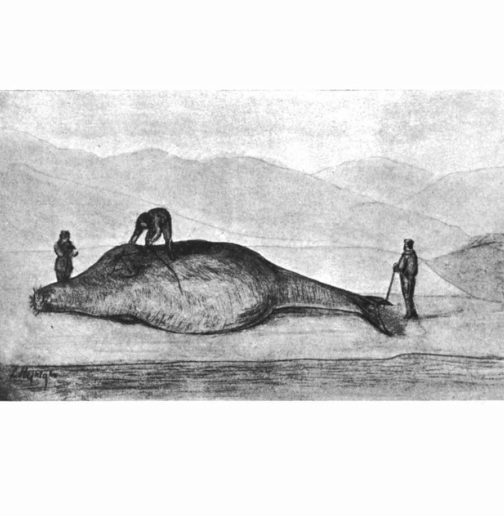
Along the whole shore of the island, especially where streams flow into the sea and all kinds of seaweed are most abundant, the sea cow (morskaya korova), so called by our Russians, occurs at all seasons of the year in great numbers and in herds. After the supplying of ourselves with provisions began to become difficult because of the frightening away of the sea otters from the northern side, we considered ways and means to secure these animals and, because they were near to us, to derive our nourishment more easily from them.
On May 21, therefore, the first attempt was made to throw a large manufactured iron hook, to which was fastened a strong and long rope, into this powerful and large sea animal and haul it ashore; but in vain, because the skin was too tough and firm and the hook was much too dull. It was changed in different ways, and several other attempts were made; but these turned out still more poorly, so that the animals escaped from us out to sea with the hook and the rope attached to it. Finally necessity forced us to make preparations for harpooning. For this purpose towards the end of June the yawl, which had been badly damaged on the rocks in the autumn, was repaired, a harpooner with a steersman and four oarsmen put into it, and a harpoon given to the first together with a very long line, coiled in proper order as in whaling, its other end being held on shore by the other forty men. We now rowed very quietly towards the animals, which were browsing in herds along the shore in the greatest security. As soon as the harpooner had struck one of them the men on shore gradually pulled it toward the beach; the men in the yawl rushed upon it and by their commotion tired it out further; when it seemed enfeebled they jabbed large knives and bayonets into its body until it had lost almost all its blood, which spouted from the wounds as from a fountain, and could thus be hauled on the beach at high tide and made fast.
As soon as the water went out again and the animal lay on the dry beach the meat and fat were cut off everywhere in pieces and carried with rejoicing to our dwellings, where the meat was kept in barrels and the fat hung up on high frames. We now soon found ourselves so abundantly supplied with food that we could continue the building of our new vessel without hindrance.
This sea animal, which became so valuable to us, was first seen by the Spaniards in America and described with many intermingled untruths by the physician [Francisco] Hernandez. The Spaniards called it manati [manatee], the English and Dutch have named it sea cow. It is found both on the eastern and on the western side of America and has been observed by [William] Dampier with sea bears and sea lions in the southern hemisphere and by me and others in the northern. The largest of these animals are 4 to 5 fathoms (28 to 35 English feet) long and 3½ fathoms thick about the region of the navel, where they are thickest. To the navel this animal resembles the seal species; from there on to the tail, a fish. The head of the skeleton is in general shape not different from the head of a horse, but when covered with skin and flesh it resembles in some measure a buffalo head, particularly as concerns the lips. In the mouth it has on each side in place of teeth two wide, longish, flat, loose bones, of which one is fastened above to the palate, the other to the inside of the lower jaw. Both are provided with many obliquely converging furrows and raised welts with which the animal grinds up the seaweeds, its usual food. The lips are provided with many strong bristles, of which those on the lower jaw are so thick that they resemble quills of fowls and clearly demonstrate by their internal hollowness the structure of the hairs. The eyes of this animal in spite of its size are not larger than sheeps’ eyes [and are] without eyelids. The ears are so small and hidden that they cannot at all be found and recognized among the many grooves and wrinkles of the skin until the skin has been taken off, when its polished blackness reveals the ear opening, which, however, is hardly large enough for the insertion of a pea. Of the external ear there is not the slightest trace. The head is connected with the rest of the body by a short neck not set off from it. On the underside the unusual forefeet and the breasts are worthy of observation.
The feet consist of two joints, the extreme end of which has a rather close resemblance to a horse’s hoof; they are furnished underneath with many short and closely set bristles like a scratch brush. With these front feet, on which neither fingers nor nails can be distinguished, the animal swims ahead, knocks the seaweeds from the rocks on the bottom, and, when lying on its back getting ready for mating, one embraces the other as with arms. Under these forefeet are found the breasts, with black, wrinkled, two-inch long teats, at the extreme end of which innumerable milk ducts open. When pulled hard these ducts give off a great amount of milk, which surpasses the milk of land animals in sweetness and richness but is otherwise not different. — The back of this animal is formed almost like that of an ox. The median crest of the backbone is raised up high. Next to this [projection] on both sides there is a flat hollow along the back. The flanks are oblongly rounded. The belly is roundish and very distended and at all times stuffed so full that at the slightest wound the entrails at once protrude with much whistling. Its relative size is like the belly of a frog. From the genitals on the body suddenly decreases greatly in circumference. The tail itself, however, becomes gradually thinner towards the flipper, which serves as hind feet; yet immediately in front of the flipper it is still two feet wide. Moreover, this animal has no other fin than the tail flipper [and none] on the back, in which it differs from the whales. The tail flipper is horizontal as in the whale and the porpoise. The organ of the male is like that of an ox in [relative] length, almost a fathom long and with the sheath fastened under the navel; in shape and nature it is like that of a horse. The female organ is [situated] immediately over or before the anus, nearly elongate quadrangular and at the anterior part provided with a strong, sinewy clitoris an inch and a half long.
These animals, like cattle, live in herds at sea, males and females going together and driving the young before them about the shore. They are occupied with nothing else but their food. The back and half the body are always seen out of the water. They eat in the same manner as the land animals, with a slow forward movement. They tear the seaweed from the rocks with the feet and chew it without cessation. However, the structure of the stomach taught me that they do not ruminate, as I had at first supposed.
During the eating they move the head and neck like an ox, and after the lapse of a few minutes they lift the head out of the water and draw fresh air with a rasping and snorting sound after the manner of horses. When the tide falls they go away from the land to sea but with the rising tide go back again to the shore, often so near that we could strike and reach them with poles from shore. They are not afraid of man in the least, nor do they seem to hear very poorly, as Hernandez asserts contrary to experience. Signs of a wonderful intelligence, whatever Hernandez may say, I could not observe, but indeed an uncommon love for one another, which even extended so far that, when one of them was hooked, all the others were intent upon saving him. Some tried to prevent the wounded comrade from [being drawn on] the beach by [forming] a closed circle [around him]; some attempted to upset the yawl; others laid themselves over the rope or tried to pull the harpoon out of [his] body, in which indeed they succeeded several times. We also noticed, not without astonishment, that a male came two days in succession to its female which was lying dead on the beach, as if he would inform himself about her condition. Nevertheless, no matter how many of them were wounded or killed, they always remained in one place.
Their mating takes place in June, after protracted preludes. The female flees slowly before the male with continual turns about, but the male pursues her without cessation. When, however, the female is finally weary of this mock coyness she turns on her back and the male completes the mating in the human manner. When these animals want to take a rest on the water they turn on their backs in a quiet place in a bay and allow themselves to drift on the water like logs.
These animals are found at all seasons of the year everywhere around the island in the greatest numbers, so that the whole population of the eastern coast of Kamchatka would always be able to keep itself more than abundantly supplied from them with fat and meat.
The hide of the sea cow has a dual nature. The outer skin or coating is black or blackish brown, an inch thick and of a consistency almost like cork, full of grooves, wrinkles, and holes about the head. It consists entirely of perpendicular fibers which lie close upon one another, as in fibrous gypsum. The bulbs of the individual fibers stand out round on the inner side of this coating and fit into delicate cavities in the skin underneath, which thereby almost looks like the surface of a thimble. This outer coating, which can easily be detached from the skin, is, in my opinion, a crust that has coalesced from juxtaposed transformed hairs, which type I have also found in whales. The inner skin is somewhat thicker than an oxhide, very strong and white in color. Under both of these the whole body of the animal is surrounded by a layer of fat or blubber four fingerbreadths thick, after which comes the meat.
The weight of this animal with skin, fat, meat, bones, and entrails I estimate at 1200 poods, or 480 long hundred-weights. The fat of this animal is not oily or flaccid, but somewhat hard and granular, snow-white and, when it has been lying a few days in the sun, as agreeably yellow as the best Holland butter. The fat itself when boiled surpasses in sweetness and taste the best beef fat; when tried out, it is like fresh olive oil in color and liquidity and like sweet almond oil in taste and is of such exceptionally good flavor and nourishment that we drank it by the cupful without experiencing the slightest nausea. In addition it has the virtue that when taken somewhat often it acts as a very mild laxative and diuretic, for which reason I consider it a good remedy against protracted constipation as well as gallstone and retention of the urine. The tail consists wholly of fat which is much more agreeable even than that found on the other parts of the body. The fat of the calves is entirely like the meat of young pigs; the meat itself, however, like veal. It is boiled through in half an hour and swells up to such an extent that it takes up twice as much space as before. The meat of the old animals is not to be distinguished from beef; but it has this remarkable property that, even in the hottest summer months and in the open air, it will keep for two full weeks and even longer without becoming offensive, in spite of its being so defiled by the blowflies as to be covered with worms all over. This property of the meat would seem to be attributable in part to the diet of the animal. It also has a much deeper red color than the meat of all other animals and almost looks as if it had been reddened by saltpeter.
All of us who had partaken of it soon found out what a salutary food it was, as we soon felt a marked improvement in strength and health; this was the experience especially of those among the sailors who until then had constant relapses of scurvy and who until that time had not been able to recover. With this sea cow meat we also provisioned our vessel for the voyage — [a problem] that we surely should not otherwise have known how to solve.
With regard to the internal structure of this wonderful creature I refer the interested reader to my elaborate description of the sea cow [Georg W. Steller, De bestiis marinis]. Here I will only note briefly that the heart of this animal is, contrary to the usual order, divided or double and that the pericardium does not surround it directly but forms a distinct cavity; furthermore, that the lungs are enclosed in a strong tendinous membrane and are situated at the back, as in birds, for which reason it [the sea cow] can remain longer under water without drawing breath. In the third place it has no gall bladder, but only a wide gall duct after the fashion of horses; also its stomach and entrails have some similarity to the intestines of a horse; and, finally, the kidneys, like those of [sea] calves and [sea] bears, are composed of very many small kidneys, each of which has its own ureter, pelvis, traps [trap door?], and papillae, and they weigh 30 pounds and are 22 feet long.
From the head of their manati the Spaniards are said to take out a stone-hard bone, which among druggists goes under the erroneous name of lapis manati. This I have vainly searched for in so many animals that I have come to think that our sea cow may be a different kind of these animals. Moreover, it has caused me no little wonder that, notwithstanding that I made careful inquiry about all animals while in Kamchatka before my voyage and never heard anything about the sea cow, nevertheless after my return I obtained the information that this animal is known from Cape Kronotski to Avacha Bay, and that it is occasionally thrown ashore dead. For lack of a special name the Kamchadals have given it the name “cabbage eater.”
F. A. Golder, Bering’s Voyages: An Account of the Efforts of the Russians to Determine the Relation of Asia and America, vol. 2, trans. Leonhard Stejneger (New York: Octagon Books, Inc., American Geographical Society Research Series No. 2, 1968), 226-237. The book was originally entitled G. W. Steller’s Journal of His Sea Voyage from the Harbor of Petropavlovsk in Kamchatka to the Western Coasts of America and the Happenings of the Return Voyage. The transposed section is from Appendix B: Steller’s Letter to Gmelin about the Voyage. Footnotes have been deleted. The image appears on page 268.