Trophy Hunting
We want you to have a greater ability to learn about some of the unpleasant animal issues in our world.
Hunting Our Biggest Game
Clyde Ormond
Foreward
The hunting of our biggest game is a post-graduate experience in the art of hunting. The objectives of, preparation for, and the techniques of such hunting differ from those involved in the pursuit of medium-sized game. Most often the hunter will discover that the skills he has developed on smaller game will not suffice in successfully hunting the really big species.
Sheer size makes our biggest game attractive to the red-blooded hunter. Size, coupled to an element of potential danger, their relatively few numbers, most rugged habitat, and difficulty of access, all add to the challenge for the true and imaginative sportsman, proportionately increasing the ultimate desirability of his quarry.
Hunting our biggest game is, basically, trophy-hunting. It is not a sport for the purely meat-hunter. As compared with the pursuit of deer-sized game, hunting for the big ones is expensive in time, preparation, physical effort, and actual cost. The hunter’s prize should be, in some way, commensurate with his anticipation, often years of waiting, and his effort.
This factor adds to the overall challenge, and is an important consideration in the hunter’s final choice of an individual animal. Beasts of the largest species did not attain their size, elusiveness, and desirability as trophies through being stupid. Rather, the most prized of each species are those animals which have survived for many years a constant battle against predators, disease, the elements common to a rugged wilderness habitat, and their mortal enemy, man.
Such animals at their physical prime represent the tantalyzing, hard-to-attain prizes of the sportsman big-game hunter. They do, and will play the hunting game for their lives, while man plays the game for its sport. They are the rewards which make his dreaming, his pursuit, and his resultant memories worthwhile.
There is, however, more of value to the hunt than just the trophy. The real opponent of the big-game hunter is not his quarry. His basic antagonist is a combination of rugged terrain, severe weather, unfamiliar equipment, altitudes and modes of wilderness travel for which the remaining fifty weeks of the year have not conditioned him, exhausting physical exertion, and the hazards of gravity. His trophy is but the reward for having successfully overcome such opposition.
Similarly, there are allied satisfactions to the hunt in addition to the taking of a noble game animal. The hunter of our biggest game travels in the company of admirable and hardy men. His experience is amid the remaining and unexploited grandeur of those areas of Nature which are largely as Creation left it. In a measure, he accepts the challenge of the unknown to determine for himself, his status as a man.
Because of this, the hunter’s greatest thrill and satisfaction will come in direct proportion to his personal code of sporting ethics when he accepts the challenge of the hunt. The hunter who sets for himself a high standard in the matters of meeting game on its own terms in its own bailiwick, with every advantage tipped in favor of the pursued, and who then outwits his quarry — this is the man for whom the real rewards of the hunt are greatest. For many, the hunting of any species of the biggest game will be a singular experience. Not all are fortunate enough to hunt year after year. Often one single trophy, from literally the trip-of-a-lifetime, must suffice.
To such hunters, especially, the memories are as vital to the overall consideration as the prize. These memories will be, and become, good to the extent that the hunter has played the game with honor and on a lofty plane of sportsmanship while he had the high privilege of being in the big-game field.
CHAPTER 3
THE GREAT THRILL
There is something highly personal and elemental about a man’s killing a grizzly. No matter how much experience he has had with other species of big-game, the question of how he will react to a grizzly encounter persists until he has actually contacted his first Ursus horribilus.
This basic uncertainty, I’ll admit, was with me on my own first grizzly-hunt. Indeed, it was one of the fundamental reasons for going. Although I’d hunted and taken other species of big-game for nearly two decades at the time, the questions still persisted. Would I get buck-fever in the face of a grizzly? If I met the beast under conditions of terrain, position, or surprise most favorable to him, would I have the guts to remain cool and shoot it out?
In discussing grizzly-hunting with numerous other hunters, I have discovered feelings to be common. Often, after mentioning certain grizzly episodes which were somewhat hair-raising, I’ve had a fellow hunter say, “Godfrey, I’d likely have turned tail and ran!” Or, “I don’t think I’d have had the nerve!”
These feelings of uncertainty are based on the fact that the grizzly bear alone, of the Continent’s big-game, is potentially dangerous. In the majority of instances where man contacts this great bruin, the bear will retreat if given a chance. Should the beast scent or sight the hunter first, it will, under normal conditions, move to avoid an encounter. By his very nature, a grizzly is shy, wary, and wants no part of a meeting with man.
This innate shyness is often misleading. There are conditions under which a grizzly is the exact reverse. Situations exist under which he’ll charge immediately, instead of disappear. Getting between a sow with cubs is almost certain to induce a charge. Contacting a grizzly previously wounded, or currently wounded, is apt to result in a charge. Cornering one of the beasts is nearly certain to produce charging. Other seemingly trivial annoyances may result in charging.
Old Pete Petersen of Muncho Lake, British Columbia, once told me, “If you suddenly come upon a grizzly in the bush, whatever you do, don’t whistle, shout, or wave your arms at him. Any sudden noise or action touches a grizzly off. They’re hair-triggered, and come uncorked terribly easy.”
We were, at the time, hunting grizzlies in heavy bush. “What is the best thing to do?” I asked him.
“Remain still. Brow-beat him, if you have the nerve, old man. I’ve come suddenly upon the beasts in a turn of the trail many a time. They’ll often snort and blow in indecision. Sometimes they’ll move towards you, hair all raised, and chomping their teeth. I once had a big one come within fifteen feet of me that way, trying to make me out. That’s too close. One step more, and I’d had to shoot him.”
Pete, incidentally, has lived a lifetime among the beasts. He is the fellow whom the military, during World War II, flew over the bush country from Fort Nelson to Fort St. John, mapping the route for the Alaska Highway. Pete knew the country more intimately than any man in the region, and could point out the route between the impassable muskeg areas. Pete learned this route the hard way. Before a road came to the country, Peterson made six different pack-horse jaunts between the two out-posts, for as many years’ trapping supplies. These were trips of six-weeks each, covering several hundred miles. What Pete says about the grizzlies common to this country is worth the bear-hunter’s attention.
He told me once of a certain grizzly which had raided one of his trapping cabins. Nothing edible, except fifty pounds of dry navy beans, was in the cabin. The bruin ate most of these. When they began to swell, obviously giving him the belly-ache, the bear had impetuously grabbed the stove-pipe. As thoroughly as one would flatten a can with a hammer, the bruin had flattened the entire length of pipe between his two great paws. Later, he’d scattered dung all over the cabin’s interior, even the ceiling.
As Pete told me, his concern still wasn’t for the destruction to his cabin or furnishings. “But how do you suppose, old man,” Pete asked soberly, “that bear could get into a position whereby he could crap on the ceiling?”
My own experience indicates that these big bruins are not always the shy, complacent beasts which many desk-authorities would have one believe. Just as a sample, an aluminum canoe, which the outfitter had flown in on a plane-pontoon for us to use on Cry Lake, had been seized within the week by a large grizzly; chewed into a poor state of seaworthiness; and the thwarts torn off and bent-all apparently because it was shiny and annoyed the wandering beast.
I know of a packer in the Dease Lake area whose packstring was scattered from hell to breakfast, even though the packer, seeing the wandering beast at a distance, had tried to circle him. This one, after the packer finally had to kill him, was discovered to be crawling with maggots and festering wounds from a previous bush-hunter’s rifle.
I talked with another Tahltan Indian boy in the same country, whose uncle was killed when he unwittingly trailed a wounded black bear into some surrounding wild-raspberry bushes. A grizzly, which he didn’t suspect was there, assumed that the abrupt noise in the bushes was an intrusion into his domain and a threat, somehow, to his being. With a swipe or two of his great paw, the bear strung the luckless man’s intestines over forty feet of bush.
As late as the fall of 1954, my hunting partner, Doc Jacobs, came within an inch of his courageous hide, from a whopping yellow grizzly which charged him for no other reason than that he’d wandered within a hundred yards of the animal, in the bush country surrounding sheep-range.
In this dual, basic aspect of grizzly-hunting — that of never being certain of the quarry’s intention or action — lies the innate danger, the big thrill, and the more-than-compensating rewards. A grizzly may be spotted at reasonable range, and hunted down like any other big, non-dangerous game. Because of his hair-triggered, unpredictable nature, he may, just as easily turn into being the hunter. Despite the knowledge slowly gained about these great bears, and in spite of the aggregate experience of numerous hunters, the fact remains that one never knows exactly what any grizzly is going to do. Neither does the hunter in the terrain peculiar to grizzly habitat, ever know with any degree of certainty, just where he is going to run into his quarry. Each grizzly hunt, every grizzly encounter, is a different, singular experience. The satisfaction of taking a great wild beast under such conditions of uncertainty, does something beyond price to the masculinity of the red-blooded man.
What is the best rifle-and-cartridge for hunting grizzlies?
There is no one “best” rifle or cartridge for any species of game. Every rifle and every cartridge is a compromise. Grizzly bears have been killed with every cartridge from a .22 to the .375 H&H Magnum and larger. Grizzlies have been lost with every one of the same list.
In the Liard River country of Canada, a youngster killed a monstrous grizzly with one shot from a .22 long rifle. While tending Tom Mould’s cabin while Tom was on the trap-line, Jimmy, the young fellow, had a big black grizzly follow him right into the cabin after Jimmy had brought a bucket of water from the spring in the bush.
In an awesome fear that one can only imagine, Jimmy was chased up into the attic, through a man-hole in the ceiling insulation, and actually wound up by poking himself through the roof. Jimmy roosted there for a day and a night, until some highway maintenance men came along. He hollered them up, finally convincing them that the big bruin still lay in the kitchen. These workmen finally took a .30-30 from the truck, and fired several shots into the cabin under the window, where Jimmy told them the big beast still lay.
As the animal ran out the rear door, Jimmy, who’d taken the .22 up into the attic as the bear came all the way inside, fired to help frighten it away. The puny bullet hit the beast in the ear. With a blood-curdling squeal, it ran fifty feet out into the clearing and fell dead.
In the fall of 1947, I stayed at Tom’s cabin. I saw the bullet-holes under the window — a sizeable “group” incidentally. I photographed the bear’s tracks where it had tried to get up the wall, after knocking over some black paint with which Tom’s partner, Bud Gallant, had been painting the floor. The splintered battens of the ceiling, which the beast bit in its failure to get at Jimmy, are still there unless Tom has remodeled his cabin. And Rod Stuart, ranger from Muskwa, B. C., told me he helped string the beast up to a tripod, and that, nose downward, it stretched ten full feet!
Such instances, and indeed the affair of the lady grizzly-hunter mentioned in the first chapter of this book, do not prove that small calibers are adequate for these big bears. They are, rather, the examples which convince the serious grizzly-hunter that he should use all the ordnance he can shoot well from the shoulder, under hunting conditions. Grizzlies may be killed with small calibers and lost with large ones, and vice versa. The majority of evidence is still in favor of powerful rifles shooting heavy bullets.
The reason for this lies not in the fact that a moderate rifle, sending a smaller bullet into a grizzly’s vitals will surely kill him. Rather, the real reasons for using powerful ordnance on these bears, are that the hunter needs a margin of safety, both for his own person and to prevent losing one of the finest game animals; the hunting conditions pertinent to grizzly habitat, terrain, and physical hunter-condition, seem never to present the quarry as an obstruction-free, ideal target, at optimum range; and that a bigger margin of rifle-power often compensates, not only for mild errors in shooting, but for obstacles pertinent to the hunting condition.
I have repeatedly read writers of wide experience on other game, and with sound judgment as regards shooting, state that bullets from such rifles as the .257 Roberts and .270 will surely kill any game on the North American continent, if well placed into the beast’s “boiler-room.” They make such observations, based upon wide hunting experience with animals of similar or greater size and weight; upon the devastating effects of such bullets; and upon the experience of other hunters, often dating back to the days when game was abundant and literally hundreds of animals had been killed.
What they maintain is entirely true. What they neglect to take into account, either because of a limited experience on grizzlies or the having taken one or two beasts of this tenacity and temperament under most optimum conditions, is the fact that the hunting conditions surrounding grizzly hunting seem never to be ideal.
For example, grizzlies are native to bush country. Being innately shy, they stay to the concealment of bush, timber, and the toughest terrain. They are hunted there, shot at in this type of country in the majority of instances. Grizzlies shot at in wide open flat country, at ideal range, and standing broadside, are in the great minority. Instead, the hunter suddenly comes upon just the brown hump of a grizzly working the bush country. The beast is quartering away, presenting an angling shot at the spine if the hunter is quick and can take immediate advantage. Or, while watching a blueberry sidehill, the hunter suddenly sees the Arctic birch bordering the shorter foilage open up; and the front end of a grizzly, with broad head eternally swinging back and forth to catch and interpret scent, looks at him head-on — with the vital boiler-room accessible only if the bullet can penetrate through thick neck and shoulder muscles.
Or, more apropos to grizzly-hunting, consider the rather common bush occurrence wherein the hunter suddenly smells rotten carrion at close range. Before he can calm his wits (knowing what the smell may well mean) a brown bounding form, ears laid back and little pig-like eyes glittering, comes at him at twenty yards, ta-lump, ta-lump, as in horse-opera. A running grizzly, incidentally, covers ground approximately four times the speed of a running man.
Or again, as often happens in bush country, suppose the hunter rounds yet another turn in the willowy trail, and his great brown rug looks him in the eye at a matter of feet?
Such instances represent actual hunting contact with grizzlies. Often such adverse opportunities are also the only chances the hunter, with two thousand dollars and a lifetime’s waiting invested, will ever have. It becomes then, not a matter of whether a certain cartridge will kill a bear. It is a matter of killing the beast with certainty, under prevailing conditions. It often becomes the vital matter of not killing the beast, but of stopping him before he reaches the hunter.
To all these considerations must be added hunter-condition and hunter-conditioning. Seldom is the big-game hunter at his best as a rifle-shot, when hunting. He is usually leg-weary, out of breath, on uncertain footing, lungs pumping fast for oxygen in high altiudes, or with sweat streaming down his glasses from sheer exertion. The opportunity comes, not after he’s had time to catch his breath, but right then. There is no time to get better footing, assume a more solid shooting position, wipe the glasses, or indeed to allow the quarry to turn into a better shooting angle. It is then or never.
Couple this factor to the fact that the excitement of most men, confronting desired big-game of any species, especially for the first time, detracts from their normal shooting skill… and you have further obstacles to the certain placement of the bullet into that boiler-room.
Lastly, grizzlies are most tenacious of life. The huge stores of vitality which make them able to lick other wild beasts become a reserve against injury and bullet-wounding. Unless a grizzly is hit somewhere along the spinal length or brain, you can assume with certainty that he won’t stay put where he is hit. Invariably a grizzly will drop when hit, even if in the leg. But he’s up again and away. In the dense foilage of grizzly country, spoor is hard to follow. The trophy, while “dead” on its feet, may escape and be lost. This is another argument for added fire-power in the rifle and cartridge. And the ability to use it.
To the argument of the novice that powerful rifles kick too much, or have to be of sufficient weight that they become burdensome, I have this answer: The big-game hunter willing and able to surmount the other real physical rigors of grizzly-hunting, surely should have, or develop the stamina necessary to the skillful shooting of a powerful rifle. Even the Big Bertha, the .375 H&H Magnum, kicks no more than duck loads in a 12-gauge shotgun — which kids the country over — shoot with pleasure. My neighbor Ike Ellis has in his battery a Magnum 3-inch 12-gauge shotgun, a .357 Magnum revolver, and similar powerful arms. Ike loves to shoot them, and considers recoil as being more of a big bad noise than a kick. He is five feet four inches tall and weighs just one hundred fifty pounds.
Here are several actual, indicative examples of grizzly bear reaction to rifle-fire:
My first silvertip was hit at the point of the shoulder with a 180-grain Silvertip bullet from a .300 H&H Magnum. The bullet entered the lung cavity at close range, pulverizing the lungs and semi-paralyzing the beast. It died soon after rolling into the Arctic birch.
Another much larger grizzly was shot from prone at close to two hundred yards as it moseyed along an opening in the bush. The first bullet, a 180-grain Silvertip from the same rifle, broke the right shoulder blade and blew up in the chest cavity. Ten minutes later the animal succeeded in getting to its feet and I sent another bullet into the left shoulder, almost identically opposite. This one broke the left shoulder, completely mincing the lungs. After waiting ten minutes longer, I approached the beast. It was still on its hind feet, trying to move, with chest on the ground and blood flowing from its mouth. I neck-shot it at thirty yards.
The smallest grizzly I ever killed was hit with the same bullet from a different rifle of the same caliber, directly through the lungs. Shock rolled the beast over on its back, at ninety steps. Two minutes later, as I thought it to be kicking its last, the animal rolled onto its feet, then galloped fast as a saddle-horse, for one hundred twenty-five paces — incidentally, not towards me.
In 1951, Doctor Jacobs, one of our party, shot a medium-sized grizzly with a standard .270 rifle shooting 130-grain factory ammunition. The bear was digging marmots in the rocks, presenting an open shot at around two hundred yards. Doc is a fine rifle-shot, and each bullet found the chest cavity. It took four perfectly placed bullets to kill the animal.
On the same trip, Gordon Fairley and Clyde Martin, two others of our party, tangled with two grizzlies in the bush at medium range. Gordy was shooting a custom-made .270, Martin a standard .300 H&H, which he’d bought for the trip on my recommendation. They literally shot all the ammunition they carried before finally killing the two beasts, though the “groups” on the hides, I’ll admit, were not minute-of-angle patterns. Neither were they all into vital areas.
On the way home, Martin was thoughtful and still scared from the affair. “You know that .300 I bought?” he asked me. “Well, when I get home I’m going to ream it out to .50-caliber. You just can’t kill them big bastards can you?”
Lastly, on my grizzly hunt of 1954, I shot a medium-sized bruin at just over a hundred yards with a .300 Weatherby Magnum, shooting 180-grain Hornady spire-points at just under maximum velocity. It took three shots, all within a hand-sized group on the rib-cage, to give that brute the quietus. It went down at each hit, but rose again, also, at each of the first two shots.
Until the hunter has actually killed a grizzly or so, there is no way of convincing him of the bear’s unbelievable tenacity, vitality, and sheer will to live. The novice hunter, abruptly discovering this after he’s hit a grizzly, often suddenly wishes that instead of presence of mind, he had absence of body.
What then, are the best rifles for grizzlies?
For the sportsman-hunter, hunting these bear in strange country under hunting conditions, I’d place the minimum in standard commercial cartridges as the .30-06 shooting 220-grain ammunition, and Winchester’s new .358 with either 200-grain or 250-grain bullets. Other suitable factory rifles are the .348 Winchester with 200- grain bullets; .300 H&H Magnum with 180- or 220-grain ammunition; and the .375 H&H Magnum with either 270- or 300-grain bullets.
Wildcat calibers and rifles which duplicate the ballistics of these standard calibers are, of course, as adequate.
Choice of the cartridge will, naturally, determine the type of rifle. Generally speaking the rifle action will be a bolt, with the exception of the .348 Winchester, since it takes a bolt action to handle the power of such cartridges and bring out the full ballistic potential.
If I had to choose but one standard cartridge and rifle for grizzly-hunting and for hunting all the other species covered by this volume, I’d personally choose the standard .300 H&H Magnum. Were I limited to but one “wildcat” rifle and cartridge for all the species of really big American big-game, I’d choose the .300 Weatherby Magnum. The Weatherby .300 will duplicate the performance of the standard .300 H&H. By taking advantage of powerful, maximum hand-loads, with the numerous bullet-weights available to this caliber, the Weatherby .300 Magnum can be made to far out-perform the standard .300.
Sights for the grizzly rifle must vary with the individual hunter. However, the full potential of the grizzly rifle and cartridge cannot be brought out, either as to accuracy or range, without the use of a scope. I have found a low-power scope sight, of good quality and from 21/½- to 4-power, to be a must on the grizzly rifle. Such a glass doubles nicely as binoculars to the hunter unused to climbing in high altitudes, and already over-burdened with weight.
A sling is necessary, both for accuracy at long ranges and while using the sitting or the prone position, and to take the sheer drudgery out of rifle-carrying.
For hunting brownies, a battery of two rifles is fine. Since the brown bear is normally found in the open tidal-flat areas, often being spotted at extreme ranges, one flat-shooting rifle of ample power and equipped with telescope sight, becomes almost a necessity. For shooting in heavier foliage and at closer ranges, a rifle with even greater knock-down power is vital. This, both for the hunter’s safety and to prevent wounding and loss of a prized game animal.
A scope-equipped .300 H&H Magnum, or comparable wild-cat rifle, and a .375 H&H Magnum make a fine combination. In as much as the law requires a guide, the hunter can carry the heavier caliber, and the guide tote the other. If a beast is spotted at long range, there is ample time to change rifles. Otherwise, the less experienced hunter habitually has with him the heavier ordnance for any possible surprise, or short-range shooting.
If any single piece of advice were to be given the grizzly-hunter, it had best be, “Make the first shot fatal.”
The grizzly-hunter naturally is concerned with the size of his trophy. For purposes of comparison, grizzlies have been killed whose skulls measure over sixteen inches in length.
Certain field measurements should be taken immediately after the animal is killed. Too, if there is any possibility that the trophy may later be entered in any kind of competition, such measurements should be witnessed and the affadavit notarized, if at all possible. Too, the entire skull of the animal, as well as the pelt — caped-out down to the last joint of all toe bones — should be saved. Occasionally trophies are injured in transit during the home trip, and measurements previously taken become invaluable.
The basic measurements for grizzly bear are:
(1) Length of hide, with animal lying on its side, from tip of snout to tip of tail.
(2) Length of hide between same two points, after hide has been laid flat, without stretching.
(3) Width across hide between tips of front claws, without moving hide from position used for measurement.
(4) Length of skull longitudinally, from occipital protuberance (medulla) to end of skull bone at the nose, but without lower jaw. (5) Width of skull across the zygomatic arches.
Clyde Ormond, Hunting Our Biggest Game (Harrisburg, PA: The Stackpole Co., 1956), pp 1-2 and 25-33.
See: https://babel.hathitrust.org/cgi/pt?id=nyp.33433044964348&seq=1
Snyder’s Book of Big Game Hunting
Harry M. Snyder
The Biggest Game
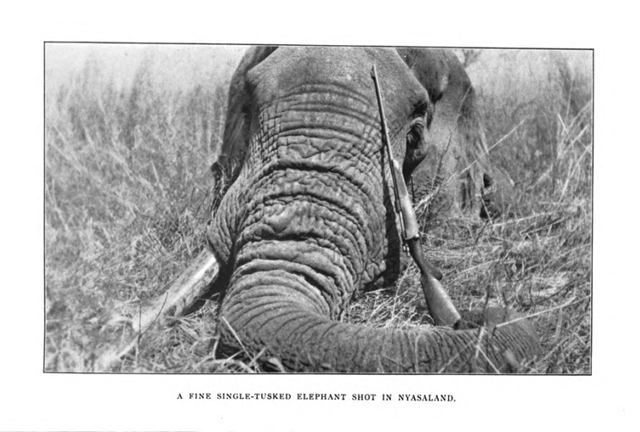
Do you seek the supreme thrill in hunting? Then the African elephant is for you. This is the biggest beast that walks this earth. He is also the cleverest and the wildest and the least tamable by man.
You can see nearly all the other great game animals in close captivity — the lion, tiger, and polar bear. But not the African elephant.
Elephas Africanus stands from 10 to 12 feet high at maturity and weighs from 6 to 8 tons. Yes, tons! When he charges, every ounce of this shattering weight is directed by a crafty and calculating brain. His feet give him traction, like that of a caterpillar tank, on any kind of surface. And he charges, as you know, with his whole family of smaller living tanks. The speed of a stampeding herd is like the speed of wild horses — and they may stampede toward and not away from the intruder.
Such, at least, was my experience with the African elephant in his jungle. It was the culmination of more than forty years of longing to hunt elephant. Every sound reporter of African big game hunting, from Frederick A. Selous to Carl Akeley to Theodore Roosevelt, speaks of African elephant as the supreme experience — the last, final, highest step on the ladder of sport. first step on your elephant hunt.
First Step on Your Elephant Hunt
This will become clear to you, I believe, when you visit the American Museum of Natural History in New York and look thoughtfully at the finest group it holds — the Carl Akeley group of African elephant. Carl shot the big bull in 1905, and two of the smaller ones were added by Col. Roosevelt and his son Kermit.
The big bull, even though safely dead and mounted, gives a real shock to any man who walks up to him. He proves at once how small you are in the scale of created beings. He has all the primitive dignity of such extinct animals as the mammoth and mastodon. Unlike them, he has had the wits to survive, although remorselessly hunted since the days of King Solomon for that specially valuable commercial product — his ivory.
The Second Book of Chronicles in the Bible records that King Solomon caused his throne to be built of ivory overlaid with gold. “Every three years came the ships of Tarshish, bringing gold and silver, ivory, apes, and peacocks.” From that day to our own, ivory has been a symbol of wealth. Unhappily, no synthetic product is as satisfactory as ivory for manufacturing billiard balls, piano and organ keys, finest brush handles, combs, cutlery handles, and for executing various works of art.
Study the 9-foot tusks on Carl Akeley’s great bull elephant in the Museum. Tusks are never shed as the animal grows to his maturity of 125 or more years. How many thousands — even millions — of African elephants must have been slaughtered to provide the genuine ivory articles so much valued in this world!
Great credit must be given to the game conservation authorities of British East Africa for stemming the extinction of a huge animal that once ranged freely over the whole 11,262,000 square miles of the Dark Continent. When I first saw Carl Akeley’s bull elephant nearly forty years ago, I knew I would have to follow Elephas Africanus into the dense, thorny jungles where he can be found. In all those years, I did my best to acquire the necessary money, marksmanship, and nerve.
Not the Indian Elephant
Mark you, we are not considering the meek Indian Elephant (Elephas Indicus) which we see at the zoo. The common Indian elephant is much smaller than his African cousin. His tusks are smaller and lighter. His nature is different. He long ago “sold out” to mankind.
Elephas Indicus is the lumbering, docile creature you see trudging along in the circus parade or into the arena carrying a howdah full of people on his back. He may even, at his driver’s command, stand cumbrously on his head. In the days before motorized equipment, he did much hauling or pushing of heavy circus wagons. Crafty men have taught him all this through the centuries. Sometimes he goes mad or sullen and must be butchered, usually by police who exhaust their ammunition before they find a vital spot. But this is a gentle, domestic and — yes, a stupid animal by contrast with his wild African cousin.
If for physical reasons you can’t see Carl Akeley’s huge bull elephant, there is a full-page plate in many editions of the Encyclopaedia Britannica which will give you at least a rough idea. To me it’s the most awe-inspiring picture in the whole set of learned volumes.
The Elephant’s Weapons
Should you have time to note nothing else closely, observe the African elephant’s trunk. He’s the only quadruped with a fifth limb, beautifully articulated and tipped with two opposed finger-like processes which make it into a veritable hand! (The Indian elephant’s trunk ends with merely a single thumb.)
The African elephant uses this hand both to pluck grasses and to wrench big hardwood branches off trees so that he can stuff the tender top leaves into his huge mouth with its highly effective grinders. The trunk itself is a vast war-club, as flexible as rubber and as thick as a fire-hose. What could it do to a man at close range, either as a war-club or a grasping weapon? Many a hunter throughout the ages has answered this question with his life. The men who respect this elephant most are the seasoned African residents who serve as game wardens or on the elephant control.
You will notice, too, that the elephant’s eyes have a wide, short range of vision to front, side, and rear. His sense of smell is so acute that you can never stalk him up-wind in even the faintest breeze. His final defensive apparatus is a pair of ears so big they baffle description. His powerful neck muscles suddenly hoist his ears — there is no other word — so that they are likely to be the first thing you see when you confront him in the brush. They loom at least 10 feet from the ground and are 10 or 11 feet wide from tip to tip! Frankly, these ears are the most terrifying jungle sight of all. They are like the great bat-wings of some prehistoric flying dragon hovering for his final swoop.
Planning and Costs
What weapons have you against the elephant? Just one. Gunsmiths forge you the heaviest rifles you can put to your shoulder and shoot — the traditional elephant guns. You gain fresh respect for the elephant when you first handle one. There is no way to cut down on its weight or to shrug off the recoil of a .465 to .600 caliber bullet propelled by a heavy powder load.
My own elephant gun was a .465 double-barrelled Holland, bought in London for 1750 dollars. At double the price, it is still a mere fraction of the cost of a selective hunt for an elephant. For Africa is, as you well know if you fought along its northern coast or served anywhere in its interior, an enormous continent. It’s a long way from home. Airline service is excellent, but getting to the African East Coast by plane or steamer is a tremendous trip. And getting around in Africa (have you any idea of the size of, say, such political divisions as Rhodesia, British East Africa, or the Belgian Congo?) puts a severe strain on your budget and time. Like a prospective yachtsman, if you even dimly feel that you can’t afford it, you surely can’t.
After several quick hunting trips to Africa, poorly planned from the time and financial angles, I arrived in 1938 with nearly all the cash and time I needed. This means that I had about 24,000 dollars to spend and could give at least three months to the hunt.
But this warning, though well meant, won’t deter any red-blooded sportsman who has set his heart on African lion and rhinoceros and — elephant! We all get to Africa, sooner or later.
Africa holds the highest lure of any continent and also offers the highest rewards. Don’t ask me why. You’ll know before you’ve been off the steamer or plane a single day. One whiff of African flowers, one glimpse of African game, one experience of British East African savvy and sportsmanship, and you are hooked for life.
The Jungle Cuts You Off
To give sound advice on elephant hunting is futile. Conditions change too much. I can warn you, of course, that you won’t get into shooting range in a sport car, that you won’t shoot from blinds, that you won’t bring the elephant down with a clean frontal shot — all the things you already know.
You will painfully track your selected elephant on foot till you come up with him or lose him. Where will you do it? Well, a perfect specimen of old African bull elephant is rare, even though the herds of young animals are increasing in several areas. You must have capable local guidance.
Just one other point: If you expect while elephant hunting to be near enough to a telegraph or post office to receive and send constant messages to your home or office, just set aside that hope before you start. You will be deep — very deep — in the primeval bush, as far from your home and office for all practical purposes as if you were hunting on Mars or the moon.
Instead of making detailed suggestions, I will merely relate one amazingly lucky elephant hunt of my own — my first real one, and for good reasons my last. It was in 1938 and followed years of correspondence with John A. Hunter of Nairobi, a professional ivory hunter in his younger days and the best-known outfitter and guide in Africa afterwards.
How did I find him? Well, since his book White Hunter hadn’t been written, it was through the grapevine which exists among sportsmen. You will grasp one tendril of it today and another tomorrow. Perhaps you know some editor of an outing magazine. He introduces you to a famous contributor who tells you about another man, and you write to him — and so on.
Sooner than it takes to tell it, you have the beginnings of friendship with successful sportsmen everywhere. You cement this as you travel. Africa may be a very big place, as noted — but the world is a surprisingly small place from the human friendship angle. Carl Akeley, as soon as I was introduced to him, gave me more information — highly personal — and more tips, leads, and introductions than I could have used in three lifetimes. So did Martin Johnson. So have James L. Clark and many others all along the line.
So may it be with you! The elephant isn’t extinct, praise Heaven, and neither are men who know where to find and how to hunt him. Just avoid the error of thinking that you can go to Africa and buy a complete, successful trip as you would buy a motor yacht for a like amount at the builder’s yard. Start humbly if you must. Start with a call at the nearest British Consulate, question a sub-assistant, and work up from there. It’s a fine way to get most of our tomfool questions out of our systems on the way.
Or start with an assistant curator of large animals at any natural history museum, or his “opposite number” in any zoological park. He’ll be glad to meet a man who seriously wants to know. Then the grapevine starts its work. If you are ardent but modest — if you are appreciative, generous, a good listener — you’ll soon be introduced to the director of the museum or park, and he’ll give you letters elsewhere.
And presto! The grapevine of information turns into a sturdy ladder with rungs forged by mutual helpfulness. On that ladder you can mount, as I did, to the very peak of sportsman’s happiness in this world. The next chapter tells the story.
World’s Record Bull Elephant
“You must put your shot on a nickel,” Hunter said. We were deep in the African bush. Jock Hunter, canniest of African guides, led our expedition. It consisted of Dr. George Goodwin, biologist of the American Museum of Natural History; Colonel Alexander J. “Sandy” McNabb, U. S. Army, retired; and myself. Sid Downey, an eminent African hunter, was to meet us at base camp for our elephant hunt.
Hunter believed, I am sure, that any man or woman with good eyesight, nerve, and a bit of experience with heavy rifles can kill lion and most other African big game. In 1938, after many years of conservation, such game abounded in Kenya. Sportsmen from outside countries flocked to this hunter’s paradise. Any good guide could provide plenty of sport.
But elephants! Elephants are something else again. I had always suspected that Hunter, after his long ivory-hunting experience, knew far more about elephants than he cared to tell. There was certainly a speculative flicker in his eye when I told him it was my dearest wish to hunt the largest bull elephant that could be found.
“You must put your shot on a nickel,” Hunter repeated. Here we were, luxuriously heading out into the bush in two fine sport-cars. These are a handy blend of old-fashioned touring car and modern pick-up truck. They have clearance enough, you would think, for a field full of New Hampshire boulders. Three trucks followed the cars.
We jounced along comfortably until Hunter remarked, “I’ve had a track chopped out to Kisigau. We meet our porters there. Forty miles to go.”
Now I realized for the first time what good planning for a selective elephant hunt entails. Forty miles seems short when considered from an easy chair. But it is actually the distance from Boston to Providence. Hunter’s crew had chopped out every yard of it for us with their pangas — long-bladed knives rather like the well-known machete. My back and arms ached in sympathy as we wound our slow way along this narrow, private track through dense thorn trees and interlaced creekers. Strange birds abounded in the deep, thick bushes that brushed our cars. Strange insects, too.
Where Game Abounds
Whenever our track wound out of deep jungle on to open plains, we were amazed by the sheer “aboundingness” of African game. I wish I had a better word. Remember how a human crowd can look, jammed in a large city square to hear an address by, for instance, His Holiness the Pope? Or think of fingerlings in a trough at the fish hatchery. That is a better comparison, because the animals we saw were never still. They included vast herds of galloping wildebeests; of oryx, impalla, and many other antelopes; of giraffe and zebra. Photography from the car was a cinch! It seemed strange not to stop and collect our quota, so easy would the shooting of selected trophies have been; but our hearts were set on elephant, and Hunter made it clear that these beasts were still far, far away.
So we jounced on toward camp. We had been told that Kisigau was virtually the exact spot reached by Sir Joseph Thompson, F.R.G.S., when he made the first English expedition into the land of the Masai in southeastern Kenya. Now Hunter informed us that we were the first sportsmen, as far as he knew, to hunt the area to which we were bound. It is dangerous to take such an assertion as the literal truth. Still, I was thrilled beyond measure by the wild, primitive beauty of the country as we approached camp under the peak of Mount Kilibasi.
“I picked this site,” Hunter said, “because it’s supposed to be near a big waterhole called Kranza.”
Under questioning, he admitted that Kranza might be mythical. But native bee-hunters had sworn to him that it did exist and was used by some of the biggest tuskers in all Africa. Whatever the bee-hunters’ authority to rate the size of these elephants, Hunter had taken it in good faith. But when we arrived at our base camp, there was no sign whatever of Kranza.
Not only had our forty-four porters chopped that long jungle road so we could ride to camp at ease; they had also lugged much of our equipment over it on their backs. They had a steaming and very good dinner awaiting us. The genius of American colored people in cookery is surely inherited from their African ancestors!
I have always wished I could have conversed freely with the natives — especially with Sasita, my gunbearer. I’d have learned much jungle lore which Hunter, preoccupied with all the problems of leading the party, had no time to teach me. If I had Africa ahead of me now, I would surely study the Swahili language (understood throughout East Africa) with diligence — perhaps a tip for you.
A New Kind of Stalk
Next morning, though Kranza waterhole could not be found, we made our first hunt. I was a complete greenhorn in elephant hunting. For years I had been sitting at the feet of Carl Akeley, Martin and Osa Johnson, and other famous elephant hunters. I thought I understood the techniques. But reality proved altogether different. That is why a detailed account may prove useful to you before your turn comes to be a greenhorn in elephant country.
Hunter was informed by his chief scout and tracker that four large elephants had been spotted near camp. Any one of them, Hunter said, would be a fitting trophy. Somehow, I felt, beginner’s luck would hold, and we would at least secure a quick shot at one or more of these elephants.
Never have I been more wrong. Swiftly I learned that there was no possible way to still-hunt this game. Nor could we bait for them and lie in ambush by the bait as one does with lions. Nor could our scouts encircle them and drive them toward our guns, as hunters do with many kinds of horned animals. We were forced to follow them through the jungle, tracing them by their footprints, droppings, and other signs.
Now this is a form of hunting I distrust, for it succeeds so seldom with most game. But when you’re a greenhorn, you take your orders as they come.
We forced the cars about three miles into the lightest jungle, at which point they refused to move another inch. There was a threat of rain, and for a morning in the tropical jungle, it was comparatively cool. The scouts deployed on a wide front, keeping 200 yards ahead of our main party.
All four of us walked, scrambled, and sometimes crawled forward. Hunter and Sid Downey led McNabb, Goodwin, and myself. Each of us was followed by his gunbearer, Goodwin’s man being burdened with a 16 mm movie camera instead.
Haven’t you noticed that every born naturalist simply loves to stroll up, unarmed, near dangerous animals, feeling no concern about what the animals may do if they don’t want their photographs taken? Goodwin is like that…. But he got his come-uppance later!
On and on we trudged or wriggled. The jungle, a clotted mass of tropical trees, vines, thorns, and underbrush, was in full bloom after the rain. Hunter had told me that in these regions the plant life has a remarkable faculty of lying dormant in droughts — sometimes for years at a time — until the rains bring it quickly to life again.
In ten minutes we found the spoor of one great elephant — an enormous mass of hot excrement. Close beyond it was another, then a third! Now you won’t credit this, but I stood and stared at those gigantic droppings as if they had been nuggets of pure gold. No, there isn’t any way to describe how I must have looked and felt. My heart pounded. Every thought of baser and easier game flew out of my mind. All I wanted was to get forward, fast, on the track of beasts mighty enough to leave such enormous evidence of their presence.
How the Elephant Hunter Feels
We walked fast. Elephants move rapidly even while feeding.
It was an hour later and I was beginning to puff hard and hope I wasn’t showing my lack of wind to the younger men too visibly, when our chief scout held up his hand. We stopped and strained our ears. Yes, we could hear somewhere ahead of us the rumbling of the elephants’ intestines and the snapping of heavy branches as they moved. This was easily the most gripping moment of my nearly forty years of all other kinds of hunting.
My eyes were playing tricks, as they can in any forest that is strange to you. Every dark clump of foliage looked to me as if it concealed a bull elephant. I reached behind me toward Sasita for my gun, not once but several times. His face was impassive. He looked like a man who had plenty of dull work yet to do.
Now came really heavy noises from the dense jungle ahead. I forced Sasita to hand over the rifle. My nerves were taut with the fiercest concentration that a man can feel. Glancing at Hunter, I saw that the moment had not nearly come.
Hunter was casting a floating cloud into the air. He had a can of talcum powder in his hand. There was no perceptible breeze. Yet the cloud did float, by inches, in the direction of the elephants ahead of us. Hunter indicated by signs that we would begin a long detour to the left in order to approach up-wind.
We would never bother about a breeze of that feebleness in American hunting. But Hunter and his scouts tested the air with talcum powder at short intervals the rest of that day. Such is the delicacy you need to avoid the African elephant’s supernaturally keen sense of smell.
The Lofty Blazed Trail
Having relaxed a bit from my first tautness, I noticed that the trackers operated largely by noticing the freshly plucked branches from the trees. They kept their eyes aloft and looked for the high gashes and breaks — almost as conspicuous in places as a blazed trail. The elephant feeds heavily as he goes.
We were quite near enough, after a long detour, to hear louder rumblings and crashings than before. Then came a perceptible breeze on the back of my neck and lo, we heard a thunderous pounding and thudding which slowly faded out into utter silence. Our elephants had stampeded!
Hunter now spoke for the first time that morning. “Luncheon,” he said.
Once again, I blessed the comforts which the British know how to bring into the wilderness. When hunting in our Rocky Mountains, you slip a sandwich into your pocket for lunch, with perhaps a handful of nuts and raisins. You quench your thirst at a mountain stream. And it is conventional to say the pure mountain air is all the appetizer you need.
But Hunter’s porters, bless them, had been following as silently as ghosts while we walked. Now they spread a clean linen table-cloth — I swear it — and laid out a toothsome assortment of cold potted meats, biscuits, sweets, and cigarettes, with cool Poland water from Maine or hot tea from thermos flasks, as preferred. In that primitive jungle we had just the sort of dainty picnic you might enjoy at Palm Springs or Newport. Honestly, I enjoyed it. Why we even had linen napkins!
We took the elephants’ trail again, very much cooled and refreshed. Before long I slipped hard into a souvenir of the passing of the herd — a footprint stamped deeply into soft ground. The jolt hurt my trick knee, but I was chiefly interested in noting how easily I could pull my foot out. The print was at least 14 inches wide.
Measure your abdomen, east to west, with a flat rule. You’ll get some notion of the diameter of an African elephant’s foot and his leg. It’s just as if he stood on four well-grown tree trunks.
Beginner’s Luck in Reverse
We plowed straight along after luncheon (British and South African for “lunch”) and found the tracks of the stampeded herd very clear. In fact, the scout’s report that they were no longer herded didn’t surprise me. I could see three distinct tracks through the heavy brush, fanning out as they went.
We picked the trail of the elephant which the scout said was the largest. He called him a 90-pound bull, referring to the weight of each tusk. Hunter, also, as I was soon to learn, evaluated all elephants by their ivory.
As I pushed on with fresh scratches showing through the iodine I had liberally administered at noon, I thought: “Snyder, what an old mug you are! (I was only 56, but I felt every year of it.) This is a young man’s sport. What right have you to be enjoying it? You’re tracking animals that stampede over the horizon if the breeze just stirs a speck of talcum. And you think you can walk up on them! On your stumpy old legs! Snyder, you’re a mug!”
Just the same, I wouldn’t have changed places with anyone. Not for a hill-farm in New Jerusalem!
Somewhere in the middle of such reflections, I walked slap into my first elephant. No, I didn’t bump into him. But he could very easily have bumped me — bumped me off, that is.
“Too Light!” says Jock Hunter
By now we had worked across many patches of quite open ground. Some of them were at least 30 yards wide. It was hard, sun-baked soil, and we walked with every precaution, tiptoeing like stage dancers.
Approaching a big gray bush on the far side of one of those flats, I heard a strange hiss from Sasita. He shoved the rifle into my hands. Emerging from the leaves not twenty short steps away was what looked like a pair of whitish telegraph poles. Over them was a pair of enormous ears stretched rigidly like sails on a boat coming downwind. Then the beast stepped slowly out of the bush. There stood a massive bull elephant.
It seemed to me that I threw my rifle to my shoulder instantly. But there must have been a time lag of a few seconds, for I heard Hunter say, “Don’t shoot. His tusks are too light!”
Such was the force of Hunter’s quiet leadership that not a man of us shot. We all stood in our rough arc with guns at the ready, staring at the bull elephant. He stared at us. Then with complete dignity he backed away into the bush and disappeared. But he made a permanent impression on my retina. I have only to shut my eyes to see him now.
My first wild elephant. And a monster! Downey admitted that he was a fine “big ‘un.” Hunter merely shrugged and said that the tusks wouldn’t weigh 80 pounds each.
We stood around in exasperation, knowing the great beast was still very near. Finally a vagrant whiff of breeze must have brought him the human scent. We heard him crashing away through the bushes under full steam.
The Luck Turns
Our cars weren’t far away, for we had been walking a circuitous course all day. After we had jolted back to camp, I said to Goodwin, “So this is elephant hunting, Jock Hunter style. If those were small tusks, what in heaven’s name does he want us to shoot?”
But Goodwin, as usual, was giving his camera a dry run, planning how to “stop” the next elephant we might meet. He had plenty of time to master this technique, and I to get over my chagrin.
Hunter consoled us no little by saying that only a few months before he had guided my friend Allan McMartin up to three bulls with tusks weighing from 260 to 300 pounds per pair. Allan had killed them all. After observing us in the field, he kindly said, he had no doubt we would do as well.
He went on to explain that the Kranza waterhole lay deeper in the jungle by many miles. After consulting the local natives, Downey would climb to the top of a nearby kopje, secure proper compass directions, and then chop us a new private track through the jungle, straight to Kranza.
“How far?”
Jock just shrugged. As events proved, it was 30 long miles, and Downey’s crew spent seven days chopping out the road. All this was a great let-down. At other times I would have thanked my lucky stars for our location in the heart of the Masai country, almost virgin hunting territory and swarming with the sort of horned animals that make superb trophies. We collected a very fine oryx and took photographs of a tribe whose members had heard of white men but never seen one. But with all such interest beckoning to us, I know I was chiefly licking my mental wounds.
All I could think of was that last elephant. It grew bigger and bigger, the more I thought of it. Would we ever find another of the same magnitude? The seven long days ended somehow, and we jounced 30 miles to Kranza. Sure enough, it was a big and well-used hole several acres in extent. It lay near a high kopje, from the top of which Downey had spotted a large herd of elephants.
“We’ll make camp on the top,” Jock Hunter decreed.
Climbing the 500-foot rock in blistering afternoon sun was quite a chore. Something waved the bushes halfway up. On arrival at the spot, we found the freshly-shed skin of a 9-foot mamba, deadly snake of the cobra family. This discovery kept us from further poking into the bushes, and we were glad to find that the top of the kopje was solid rock.
Pitching our tents with difficulty on this surface, we were by no means lulled by a stormy sunset and the furious African sleet-storm which blew down by midnight. How our poor blacks survived it in their flimsy cotton blankets, I cannot imagine. Never have I seen a more wretched group than these men in the icy downpour trying to shiver themselves warm.
But the African sun soon dries anything. And good news swiftly overcomes the miseries of the night. Downey very quickly picked up a large herd in his binoculars. We were high in the air, but we could hear angry trumpetings on the plain below.
Rushing to the edge of the rock with my glasses, I had to confess that I saw nothing in the thick jungle below us. But Downey and the chief scout both asserted that a huge bull was at that very moment being expelled from the herd.
“That’s the big fellow I’ve heard about for years,” Hunter said with decision. “We’ll go after him!”
Following the Great Bull
Scrambling down the kopje, I reflected that many horned animals expel the very old bucks from the herd. But why? Is it for loss of sexual power? Or just for plain cussedness? Is it really because the old fellow, in the long run, can’t withstand the challenge of a younger buck?
Do such wise and gregarious creatures as elephants at last turn on their leader in this way? If so, do they conduct the expulsion with dignity? Are they like humans, who finally promote a superannuated executive up and out of the company? Would they range close beside him? Would any of the discarded bull’s favorite cows follow him into exile?
At least two of these questions were resolved by this day’s hunt. We followed the trail with ease. The bull left huge footprints on damp ground and the droppings were plain for anyone to read.
The main herd of perhaps 20 young bulls, cows, and calves was off closely on our right. The old bull, who had doubtless begotten them all, was walking a parallel course, all alone. He fed as he walked, and though his footprints sank deeply into the soft ooze, we soon found that he ran briskly if our scent stampeded him. Then it took our scouts a long time to get on his regular trail again.
His footprints were from 20 to 22 inches in diameter. Hunter examined them with surprise and told me — in one of our rest periods — that they were the largest prints he had ever seen.
The Hunter’s Close In
At about eleven o’clock, after many hours of hard walking, I slipped sideways into one of his deep prints. This time I severely wrenched the knee which had been badly dislocated while mountain sheep hunting many years before. “Now or never!” I said to myself, calculating while I hobbled on that I might have just one mile left in me before the knee would demand absolute rest.
We were in a bad tactical position, at best, because we were paralleling the main herd. We might force them into a stampede at any moment. This would frighten the giant bull into a stampede of his own. The example is horrribly contagious, whether a herd runs away from its tormentor or straight through and over him.
As we moved cautiously forward, we had the bad luck to run across a bunch of giraffes. And how they ran, alarming the whole jungle. All the elephants went thundering away.
Hunter estimated that it would take our scouts a full hour to regain the trail of our giant bull, and said we would lunch meanwhile. “That’s curtains for my knee,” I thought, knowing the best chance was to keep moving as long as I could.
But I eased myself down under a bush, said that I only wanted a bit of shut-eye, and managed to doze fitfully. The news the chief scout brought to camp, nearly an hour later, brought me to my feet with a bang.
Minuet in Front of the Bull
The news was that our giant bull was standing against a tree not fifteen minutes’ walk away.
Hunter looked at me oddly. I suppose I had been hobbling like a veritable cripple before lunch. But now I got under way almost as nimbly as he did. I saw him cast a big cloud of talcum into the air. Then the surge of concentration gripped me again. Nothing mattered but to get within range of the bull.
Only fifteen minutes! There were enough steps left in me for that! Goodwin paced alongside me, carrying the 16 mm camera with color film, unlimbered and ready to shoot.
My hat is off — as I’ve intimated — to anyone with nerve enough to face the African elephant with camera in hand, but no gun. It was a short walk. The scout pointed silently to a big tree. There, with his huge, reddish rump turned to us, stood the bull! Only parts of him were visible through the bushes around the tree.
Hunter wasn’t five feet from me, on my right. He whispered, “Wait — we must see his ivory.”
The Minuet Continues
The giant bull may have heard this tiny vibration on the air. More likely, he heard the soft humming of Goodwin’s camera. We had tiptoed up to just 20 yards. That’s axiomatic, it seems, among great elephant men like Hunter and Downey.
As we tiptoed to this range, the bull awoke from his doze. He broke off a large branch and started munching it. This doubtless muffled the noise of our footsteps. But now, as Hunter whispered, “Wait — we must see his ivory!” the bull elephant dropped the branch and elevated his trunk in a strange, serpentine fashion as if testing the air for our scent.
Then he turned, very fast, and faced us. His huge ears spread out sideways. It was incredible that he should delay his mad charge.
Hunter now had a clear view of perhaps a foot of ivory on each tusk through the branches. He made the only incorrect statement I ever heard from him: “Not over 60 or 70 pounds. Do you want him?“
Nothing in the world could have stopped me then. I whispered, “Yes!“
The big rifle was at my shoulder when Hunter nudged me so hard it almost broke a rib. He was indicating that I must walk around to the elephant’s left and secure the deadly side-shot through the ear canal into the brain.
To my dying day, I shall feel a certain pride that I could understand this command and execute it. With my rifle at the ready, I took eighteen slow, mincing steps around that monstrous bull and ever closer to him.
At the eighteenth step, I could see the slot in his great ear-a hole perhaps three-quarters of an inch wide and three inches long. My whole being, as never before or since, was concentrated on that target.
With the roar of the rifle, the bull elephant came down with a tremendous crash.
Stampede and Satisfaction
Now came a strange anti-climax of danger. The herd of elephants over on our right stampeded at the shot and came thundering straight toward us. We couldn’t see them. But it was the first time I had heard an elephant stampede in crescendo. Hunter and Downey swung their rifles to the ready. But if the 20 beasts in that thundering herd ran through us, they would surely kill one or more of us.
At the very last moment, long after we had seen the bushes breaking down before them like a great wave crashing on the beach, those wild elephants altered course just enough to pass a couple of hundred yards away.
Then Goodwin looked up from his camera, brow well beaded with sweat, and said, “This hunting with a camera is hot stuff, isn’t it?”
Though I had automatically slipped a fresh solid-point cartridge into my gun, I felt that snap-shooting in that dense jungle would have been as futile with a gun as with a camera.
The Victory Dance
Our giant elephant had been paralyzed by the brain shot, which I’m sure destroyed all consciousness instantly. His trunk thrashed convulsively. But that was all we could see of him until our porters chopped away the intervening jungle with their pangas.
Soon we could see his vast bulk, and I hastened to give him the mercy shot through the heart. Immense waves of exaltation ran through me, drowning out the pain in my knee. I backed away, knowing this feeling for what it is — partly the reaction we all feel when danger ends, but chiefly a heritage that comes to every successful hunter, straight from the cave. You see that your big game is dead, and you experience an exaltation that lasts several hours. When this grips you, it is well to walk away and say nothing.
So I noticed only dimly that the natives were swarming up on the huge carcass as it rose out of the bushes. Goodwin slanted his camera for a group shot. They squealed and showed their white eyeballs in glee. Sasita and his partner Kombo began obeying some tribal ritual by hacking off the elephant’s tail.
But it all meant little to me. I was under a mimosa tree 50 yards away, in the grip of private joy. Perhaps I couldn’t altogether hide my feelings when Hunter said it was a very big elephant which had been hunted for years in vain. He added, true to his tradition, that its sheer bulk had deceived him as to the ivory — the tusks would average 90 pounds or more.
Hobbling back to camp on crutches that were whittled out for me, I was jarred — in more ways than one — when the natives all advanced in two long lines, teeth and eyeballs glittering, hoisted me on their shoulders, and performed a highly barbaric Hunting Victory Dance around the campfire. Then tropical darkness fell as suddenly as if some giant switch had shut off every last ray of the sun.
Ordering me to bed, Hunter and Goodwin said they would go out early next morning with the steel tapes necessary for exact measurements, and the saws and cleavers needed to bring home the tusks and other trophies.
World’s Record Elephant
Goodwin was gone a long time next morning, but when he came in, his eyes twinkled as he took out his notebook and spoke in his driest professional voice.
“You will possibly be interested to know,” he said, “that your elephant is the biggest of which we have any record. Precise figures — if you care to have them — are as follows:
Height at shoulders: 12 feet, 4 inches
Length, tip to tip: 27 feet, 9 inches
Ears, tip to tip: 11 feet, 2 inches.”
Then he stuck out his hand.
“Well, you photographed the world’s record elephant,” I managed to say.
“We were both just in time,” Goodwin responded. “From examination of his molars, I will conservatively estimate his age at between 150 and 175 years. And there is a big deep gash in his side where some young bull gored him. If he had tried to rejoin the herd, they’d have killed him, perhaps.”
“Not quite,” Hunter put in. “But he was a very old bull. Oh, quite capable of killing you or any of us — and doubly vicious, having been kicked out of his herd. In just a matter of months now, he’d have lain down once too often, and the hyenas would have hamstrung him. Then they would have gutted him alive. You gave him the mercy shot.”
I felt much better. For when Goodwin spoke of his vast age, perhaps 175 years, I had wondered if I, in my quest of pleasure, had killed the very oldest warm-blooded creature on this planet. But now I saw that I came to him as a friend, saving him from a long-drawn-out and agonizing death at the fangs of scavengers.
Now a Wish for You
In this brief record I am aware that I have emphasized my own feelings, ranging as they did from extreme concentration to the pinnacle of a hunter’s joy. But I warned you, didn’t I, that this couldn’t be a treatise on elephant hunting? It is merely how the man who shoots a big elephant feels during and after the hunt.
Lots of us grow hard-boiled, mask our emotions, and pretend to be matter-of-fact when we hunt ordinary game. But when I look across at the tusks in my living room — they are 7 feet and a fraction long and weigh 105 and 108 pounds respectively, I don’t need the tusks or the four sturdy tables made of his feet to remind me of the world’s record elephant. He’ll stay with me till I die, oldest and biggest of all land animals on this earth.
May his sons live long and do him honor! May one of them, at the appointed hour of his life — even bigger, even older, and even more majestic than his sire — fall to your rifle. I can wish no higher earthly happiness to you who are now reading this page. It’s a wish that comes to you from the luckiest greenhorn who ever tracked elephant in Africa.
Harry M. Snyder, Snyder’s Book of Big Game Hunting (New York: Greenberg Publisher, 1950), pp. 281-302.
See: https://babel.hathitrust.org/cgi/pt?id=mdp.39015049828653&seq=1
Blue Tiger
Harry R. Caldwell
CHAPTER I
A RIFLE AS A CALLING CARD
The Chinese are probably the most punctilious people on earth. Let no man think that he can win their confidence or friendship without careful attention to the niceties of social custom.
It has been my privilege to serve as a missionary in China for twenty-four years. During that period I have been stationed in five different cities, and have been responsible for the extension of the Christian enterprise into many previously untouched portions of the province of Fukien. It has been my effort, of course, always to conduct myself and my work in such a manner as would meet with the approval of the Chinese in those regions. But I have found, to my astonishment, that what I undertook as a means of relaxation has again and again proved my most direct passport to the confidence of these people.
It is a strange thing, this matter of being known as a hunter. I little suspected, as a boy in the mountains of Tennessee, where the squirrel-rifle is much more of a daily comrade than the slate or the arithmetic, that the time would come when that same rifle would prove a means for advancing the knowledge of the Christian God in the heart of Asia.
Still less did I dream that the interest in flowers and all manner of living things, born in those boyhood days amidst the rioting beauty of the Southern highland, would prove for me an opening sesame to the fellowship of great scientific societies and of some of the world’s noted naturalists.
Yet that is just what has happened. There are at many points in China today flourishing Christian congregations that trace directly back to the time when I went into those neighbourhoods with my Savage rifle. And much interest has been aroused in a part of China that is off the beaten routes of travel by the collections that I have made in the course of thousands of miles tramped over those hills and that now are exhibited in half a dozen museums of America.
Often, as I think back, it seems the merest chance that my work as a missionary should have developed along these unusual lines. It was a bishop who started me on what many of my friends would have called a useless side line. I had come to the East, like so many other young recruits, full of energy and with more devotion than judgment. I was strong, as any graduate of the Tennessee mountains was likely to be. I was determined, in the words of the Methodist ordination service, to “apply all diligence to frame and fashion my life according to the doctrine of Christ and to make an wholesome example.”
That meant that I was tempted for a time to refrain from such frivolities as tennis, tea parties, and other amusements in which I saw some missionaries indulging. Such a course meant that I should give all my waking hours to an intense preaching of the gospel. By so doing I felt that I was setting an example of what a good missionary should be. As a result, one day during my first year of full-time service I woke up to find myself in bed.
I was sick, mentally and physically, in a lonely place. And right here let me say that I believe that there has been much useless squandering of priceless human material by some missions through sending workers into spots where they had no contacts other than with the people with whom they were supposed to work. When young missionaries are sent from the myriad contacts of life at home to the isolation of some mission station that is supposed to contain but a single family, the mental strain becomes so great that again and again the worker either breaks under it or withdraws. This is what had happened in my case. Many mission boards now sense the inefficiency of this policy and are concentrating their workers in larger groups, but there are still cases in which men and women are sent where they must bear alone the many burdens of the mission station.
Just so I often lay in bed at my semi-isolated mission station feverishly wondering whether the end of my dream of service on the foreign field had come and, at times, even fearing that I might have reached the end of my service in any land. And then to me there came the bishop. It was the session of the Annual Conference which brought Bishop Bashford to my station and very vitally into my life. After he had talked with me long enough to discover what had really brought my troubles upon me, out of the richness of his experience he counselled me to climb back on my old Tennessee hobbies and ride them once more in China. I date any real efficiency on my part as a missionary from that day.
I have never gone out of my way to hunt tiger or other big game except when on vacations. I have never allowed my interest in flora or fauna to interfere in the slightest with my interest in the establishment of the kingdom of God in this part of the world. But these other interests came along naturally, and, as I say, have not only proved my own physical salvation, but have contributed largely to the major end I have had in view, which has always been to exalt Christ and His love.
Let me illustrate how the thing works. For years I had longed to preach the gospel in a certain strategic community. I saw that I had to crack the shell of that particular community or abandon the evangelization of an area of more than one hundred towns and villages with half a million souls. Attempt after attempt to enter this region was blocked just when it seemed that success was at hand. There was bitter prejudice against the foreigner and all his works, consequently the doors of the community had been sealed so long that the exclusion of foreigners had become a matter of pride among the elder clansmen. This condition might have remained unchanged until this day had not a man-eating tiger appeared upon the scene.
In their desperation, after many had been killed, the elders of the clans appealed to me through a dignified delegation to come and dispose of the tiger. A few months before I had shot an especially troublesome tiger in that vicinity. Of course I responded eagerly. I took with me both my Bible and my rifle, for I was bent upon a twofold mission in this long-coveted field.
Courtesy would have it that I be entertained in the home of the elder who had extended the invitation to me. This was the opportunity for which I had long waited. My host was the elder of the clan which felt that it had suffered unjustly at the hands of a missionary of a foreign church, and it was in this home years before that the feast was given sealing the covenant to block any foreign religion from gaining a foothold. If I could break down prejudice in this home, I knew that the other doors in the region would be opened wide.
As soon as I had settled in the elder’s home I pulled out my tiger gun and began to try its action. The gun itself interested the people much, but the little sharp-pointed cartridges even more. I was using a twenty-two calibre high-power Savage rifle at the time, and the people could not conceive that such a light-weight gun and such a small ball would be effective with an animal such as I was after. Excitement ran very high.
That evening conversation centred largely around a little cartridge which would bore a hole through half an inch of iron. Every male member of the family was jammed into the room, while the eyes or ears of its female members were pressed close to cracks or knot holes. I kept the conversation going at top speed, waiting for some person to express an opinion of the gun in such a way that I could use it to lead to other matters.
The following morning the opportunity came. A score or more of men from neighbouring homes had come in to see the gun. Here in this home, as in almost every home, there were farm implements, looms, and many other things. Seeing a plough in a corner, I declared that the little gun would shoot straight through the iron at a distance of one hundred yards. Accepting a challenge to make good what I had been saying, half the village followed me to the hill back of the house. In the crowd were not only young men and children reckless in their excitement, but the long-gowned literati, who followed with the slow, sedate swing characteristic of their class. When I fired, my claim was more than proven good.
Upon returning to the house many remarks were made about the rifle, but as yet nothing that would serve my purpose. Six more cartridges were jammed into the magazine and rapidly thrown out. A young scholar turned to the elders who were seated around tables, sipping tea, and exclaimed: “This is truly a strange gun as compared with our own guns, it is very much better.”
That was the comparison idea for which I had been waiting. Following that lead, I talked for a time concerning guns, pointing out how my gun excelled.
It is often difficult to suppress wholly the feeling and attitude of superiority when discussing things that have come from our own country and of which we are justly proud. But this is necessary when talking to a crowd of scholars in China, unless one wishes to alienate his hearers. With as much humility as I could summon, I began to enlarge on the excellent qualities of my gun, and then told how there were excellent qualities in other things manufactured in America. As it was harvest time, I could talk about the American reaper which does the work of several score Chinese harvest hands. It was not difficult to get my listeners to agree that such a machine was better than the sickle.
My crowd was still holding together, though restless at times. When I saw the restlessness beginning, I would play the action of my gun, throwing cartridges in and out of the magazine until they were all again close around me. Finally, at what seemed the psychological moment, I boldly said: “Friends, you agree with me that this gun is better than yours and that the American farm implement is better than those with which you cultivate your fields and harvest your grain, and when you have listened to what I have to say about the ‘Christ doctrine’ you will see that it too is better than the religions of your fathers.”
To my delight, not a foot shuffled on the floor. The next hour was given up to a friendly discussion as to the merits of Christianity. I showed that the worship of the Christian God was based upon love, while the worship of most of the popular idols my hearers knew was based upon fear. In defence of this statement I appealed to first one and then another, asking if it was not fear which prompted him to prostrate himself before the idols in the community temple or to burn incense and joss money before the home altar. My arguments were effective. Every man agreed with me, and, what is more, before leaving this village there was extended a pressing invitation to open both a preaching place and a Christian day school. Christianity had won a definite footing in a hitherto hostile community. It had been an effective teaching of the gospel of Christ with a rifle as the text.
In the same way many a fervent gospel message has been hatched out of some chrysalis or cocoon. If there is animate life in these things, so there is spiritual life in a message preached from just such a simple text. It is no difficult thing to borrow from Mother Nature a text which will get you across to a people as inquisitive as the Chinese, who are always ready to see what the foreigner has in his hand or hear what he has to say.
In April, 1910, I was passing through a community where the day before a tiger had killed a sixteen- year-old boy. I will not take the space here to tell the story of the way in which I killed the animal in its lair at very close range. It is of interest, however, to see how the killing of that beast turned almost an entire village to Christ.
The dead tiger was carried in by eight men and placed in the open court of the house belonging to the leading elder of the clans comprising the group of thriving villages. After stationing guards to protect the animal from being picked to pieces by the people, who attach great importance even to the whiskers or hairs of the tail, I retreated to the guest-room of the house and began to clean my gun. Soon the room was jammed with people eager to hear the story of the shot and to see the weapon.
The people in this community knew little about the purpose of the missionaries in China. They were bitterly prejudiced, however, on account of some wild rumours that had been spread to the effect that foreign doctors steal the eyes of Chinese dead for use in concocting some kind of medicine. I am sure that, had it not been for my position as the avenger of the death of the sixteen-year-old boy, there would have been no avenue of approach for me into the confidence of these people. I began to talk in defence of Christianity and the presence of missionaries in China, openly attacking the old system of placating the gods. I soon had the more irreligious and indifferent laughing and jeering at those who stubbornly clung to ancient ways. In this my method was one of bold attack. My frankness and the appeal to their own reason and judgment soon gained for me an inspiring hearing.
It was not until five minutes before midnight that I put my gun into its case, thus announcing that I had finished talking. A few final questions were asked as we hurriedly packed up my things preparatory to starting off, with eight strong men bearing torches and the tiger.
A few weeks later a delegation from this community waited upon me, requesting in the name of the elders of the clans that a preacher be assigned to tell them more of a God who loves people. The best that I could do for them was to open a Christian day school, and to delegate an earnest local preacher as its teacher. During the day children were taught and at night adults.
I was standing on my lawn in the upper end of the province late one evening five years later talking with the celebrated naturalist, Roy Chapman Andrews. We were watching the play of the sunset on the broad expanse of the river below us. Our conversation concerned the wonderful fauna of Fukien. Andrews and I seldom talk long about anything but the fauna of somewhere. A lot of bats scurried across the skyline, whereupon we began to talk about bats in general and this species in particular.
Our plans had been completed for starting in a few days for the Futsing region to spend a month in research work, and especially to hunt for the so-called “Blue Tiger.” Our talk about bats recalled to my mind a temple in the village where we would establish our first camp, where I had seen several genera of bats.
“I can catch you a bushel of bats,” I said to Andrews, “in less time than it takes to tell you about it, in a temple close to where we will first pitch camp.” Then I proceeded to tell him of the sport I had repeatedly enjoyed, drumming upon the pillars of the temple and watching the bats fly out in masses that almost darkened the door. There was, accordingly, included in our outfit for the expedition a lot of bat-catching paraphernalia.
On July 4th we pitched camp in an orchard close by the village where I had killed the man-eater five years before, and within one mile of the lair where on two occasions I had seen a beautiful “Blue Tiger” at very close range. On the following morning I suggested to Andrews that we make a reconnoitre for signs of tiger. But Andrews said: “What about the bats? Let’s get the bats first.”
Accordingly, we opened one of the iron-bound trunks and took out nets which were to be spread across the doors of the temple. As we walked through the grove of gum trees I declared with confidence that it would require but a few minutes to secure all the bats that the taxidermists could handle. The temple stood in a deep grove at the head of a flight of steps that had formerly always been like polished stone on account of the constant wear. Now there were weeds growing between the stones.
Upon reaching the terrace upon which the temple stood I saw only a pile of ruins and much debris. Several large idols still sat upon pedestals where once there had been an altar. The temple had disappeared. My chagrin was complete, as I confessed to Andrews that we would have to look elsewhere for our bats.
After disposing of our paraphernalia again in camp, I slipped away to the home of Elder Ding to inquire of him what had become of the village temple. At my question he looked at me in blank astonishment for a time and then merely said, “Teacher, you surely must understand.”
“Understand what?” I demanded.
“Why, teacher, can you not understand?”
I assured him that I did not understand at all what he was talking about and again asked him what had happened to the once artistic temple.
“Why, we decided that we did not need the temple after we learned the ‘Christian doctrine,’ ‘” said the elder. He then went on to enlarge upon how the people had broken away from idolatry family by family, and, pointing to the beautiful little brick church a mile away, he said: “Our people would rather seek soul happiness over there than in the temple.”
Before we ended our conversation Elder Ding remarked, “Teacher, I am afraid those people would not have heard of Christ until this day had you not killed that tiger.” Again a gun had been used to preach the first sermon in a community of villages.
Harry R.Caldwell, Blue Tiger (London: Duckworth, 1925), pp. 1-12. The lead image appears as the frontispiece in Denis D. Lyell, Wild Life in Central Africa (London: The Field & Queen [Horace Cox], Ltd., 1913). The other images are found on pages 34, 58, 74, 143, 145, 180, 184, and 202.
See: https://babel.hathitrust.org/cgi/pt?id=mdp.39015067214026&seq=1