United States
We want you to have a greater ability to learn about some of the unpleasant animal issues in our world.
Rodeo
Max Kegley
Rodeo
[Introduction]
The cattle industry of the west has always appealed to our lusty American love for action, color, romance; and the evolution of a major American sport, rodeo, from the tough work of cow-punching, is the west’s most interesting contribution toward satisfying that appetite. Rodeo was a natural result of the cowboy’s need for recreation. There were no games or amusements on the lonely range lands, so the men made their games with the things they knew best — horses, cattle and ropes. The instinct for competition is deep within us all, and a matching of the skill used in their daily work became the cowboys’ leisure pastime.
Skill they have, too, for the men who work cattle are not soft. Riding the range from before sunup ’til long after sundown, through scorching desert heat or choking prairie dust or driving mountain blizzards; battling cactus and tearing brush; taming a pitching bronc that is determined not to be ridden; roping a steer as swift and wary as a deer and vicious when cornered — these things take toughness. Even today, many of our western herds roam the open range in a comparatively wild state and never know the touch of a man’s hand except at branding time. Often ranges lie in wilderness areas as untouched as before white man came to this country — rugged mountain sides covered with spiney brush, that make swift riding and accurate roping a feat requiring extraordinary ability.
During spring and fall roundups, a cowboy’s working hours were long and hard, for every animal in a vast and scattered herd had to be caught, corralled, counted, and perhaps branded or sent to market. After roundup was over, there was time to play. It was then that several cowboys gathered together and compared their skill at roping and riding. Usually there was a small group of neighbors who rode in from nearby ranches to compete or to look on.
Soon cowboys were competing for prizes. According to old-timers, the first actual rodeo was held in Prescott, Arizona. Later, shows at Cheyenne, Pendleton, Salinas and Monte Vista and many more followed, as public interest quickened to a thrilling sport that vividly re-enacted moments of the most exciting action in a cowboy’s life. Here was a sport that contained the elements of daring, skill and courage, colored with the romance of the range.
At first, there was no organization among cowboys and less attention was paid to rules. It was possible for every contestant to win some money occasionally. Local cowboys, often with untrained horses, would enter just for the fun of competing. Later, when motor travel became popular and horse trailers came into use, more and more cowboys began to follow rodeo as a profession. Competition became increasingly keen, bringing with it the problems of unscrupulousness and exploitation by producers.
To eliminate troublesome and unjust conditions, the leaders of various organizations launched the Rodeo Association of America in 1929. This Association made rules for honest and fair competition in recognized events, penalization of cheaters, protection of stock, integrity of advertising, and assumption and payment of all just accounts. Because of the R. A. A., contestants know that the prize money will be paid at the end of a contest, and the judges will be competent and fair.
The Association endeavors to set the dates of rodeos in various parts of the country so there will be no conflict, and has established the cumulative point system of selecting the champions each year. One point is awarded for each dollar earned in purses for roping and bulldogging events, and a point and a half for each dollar in bronc and bull riding. The cowboy having the largest yearly winnings in any one event is awarded the title of Champion for that event, and the one who has the greatest number of points in all branches of competition is awarded the title of Grand Champion Cowboy, as well as a sizable cash prize. In addition, prizes and trophies are given by local or national donors at each rodeo.
It isn’t all “gravy,” however not by any means. In order to pile up points, contestants must travel thousands of miles to make shows all over America, and pay their own traveling expenses. There are no salaries, contracts or guarantees in rodeo, and each must pay an entrance fee before he can compete in any event. It is interesting to note that rodeo is one of the few sports, in which the participants pay for the privilege of contesting.
Sports like baseball and football draw their personnel from all walks of life, while few but cowboys with actual range experience ever aspire to rodeo fame and fortune. They come from California, Arizona, New Mexico, Texas, Colorado, Oklahoma, Wyoming, Idaho, Montana, Oregon, the Dakotas, Nevada, Kansas. When you watch a rodeo, you are seeing real western cowboys in action! They have formed their own organization, called the Cowboys’ Turtle Association, which now has approimately 1,500 members. The name may signify their slowness to organize, for anything similar to a union seemed against their free nature. The cowboys are true sportsmen in every sense of the word, and their Turtle Association has done much to maintain the high standards of fairness in the rodeo game.
It takes cooperation from many people to make rodeo a success. Arena directors, judges, flagmen, timers, (most of whom have been contestants themselves), as well as the stockmen and arena help who provide and care for the rodeo animals, all contribute their share. The announcer has the important job of interpreting the swift action in the arena in a language understandable to the audience. He must have a thorough knowledge of his subject. “You gotta see ’em to tell ’em, and you gotta know ’em to see ’em” is a true saying about rodeo announcers.
Clowns who furnish both laughs and thrills for the amusement of the rodeo audience, also have an important function in diverting the attention of the angry Brahma bulls from a thrown rider in the bull-riding events.
Not the least of rodeo’s lure for onlookers comes from the trick riders’ spectacular exhibits of skill and daring given between regular rodeo events. Trick riders are paid entertainers — the real showmen of rodeo. Seldom do they also compete in regular rodeo events. An exception is Dick Griffith, world’s champion bull rider, who is also an accomplished and daring trick rider. These riders and ropers, in their gorgeous costumes of brilliant hues, do much to add to the color and carnival air of the show.
Rodeo has come a long way since its modest beginning as the diversion of a community’s cowboys. Many hundreds of western towns and ranches hold amateur rodeos as an annual celebration. In August, 1941, there were 98 official Rodeo Association of America contests listed for this year, including shows at Madison Square Garden in New York; Boston, Massachusetts; Chicago, Illinois; Pittsburgh, Pennsylvania and Tall Cedars, Maryland, as well as the western contests. The Phoenix Rodeo and the Fiesta de los Vaqueros at Tucson are highlights of the winter season in Arizona. When you go to see one of these R. A. A. shows, watch it as you would a big-league baseball game, because you’ll be looking at not just a show, but a great American sport, as real as the west itself.
Bronc Riding
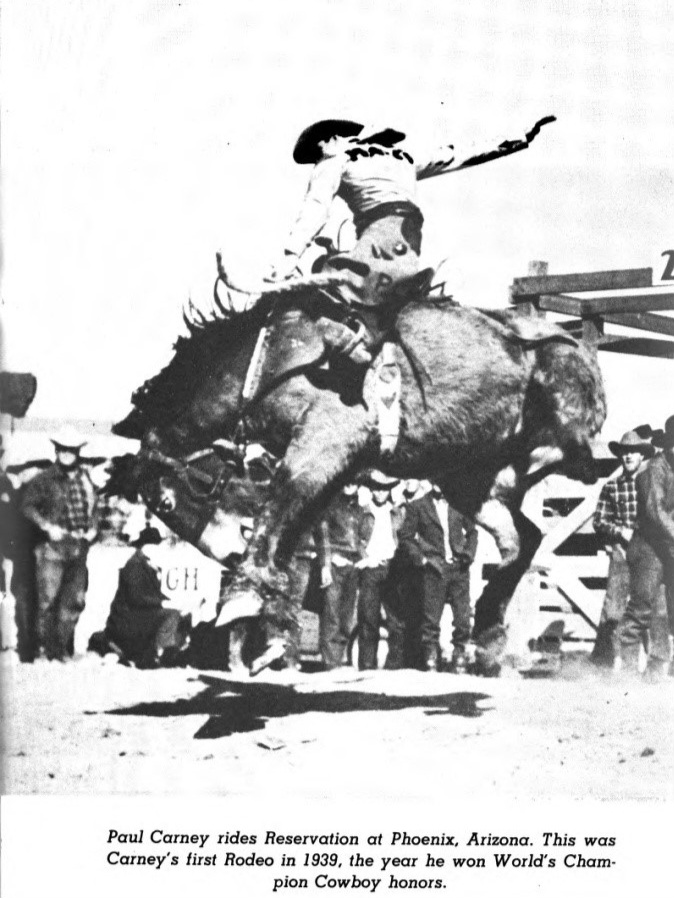
No other event is pictured as often as bronc riding to represent rodeo — perhaps because it is the most spectacular. It takes plenty of nerve to come out of the chutes aloft a plunging bundle of dynamite with hooves; and it takes plenty of riding ability to stay on for ten seconds (the required length of the ride). There’s more to it than just staying on, too. The horse must come out bucking, or the rider gets a mount that will. Rider must come out of the chutes spurring, with blunt spurs, high on the shoulders, and continue to spur from shoulders back to flank throughout the ride. Both feet must be kept in the stirrups. The rein must be held in one hand, not wrapped around, and the other hand must be kept in the air, and must not touch the bronc, the rider, or the saddle! The contestant must use a committee saddle and halter, but he furnishes his own rein, chaps and spurs.
“There never was a hoss that couldn’t be rode, and never a cowboy that couldn’t be throwed” is a saying that holds good. Most bronc riders are younger men. The older contestants prefer the less violent events such as calf roping; or maybe they just plain get tired of having broken bones. Rodeo horses, however, sometimes go on bucking for years before they give up. They are not just unbroken ponies, but real outlaws, with a blood-thirsty hate for being ridden. Horses that have been gentle in the harness have been known to turn outlaw under the saddle. Midnight, one of the greatest bucking horses of all time, is a notable example.
A thrilling variation of the bronc riding event, is a bareback bronc riding feature. Here, the contestant has nothing but a cincha around the horse’s middle for an anchor. Note the bucking strap in the bronc riding pictures a highly important element.
Roping and Bulldogging Events
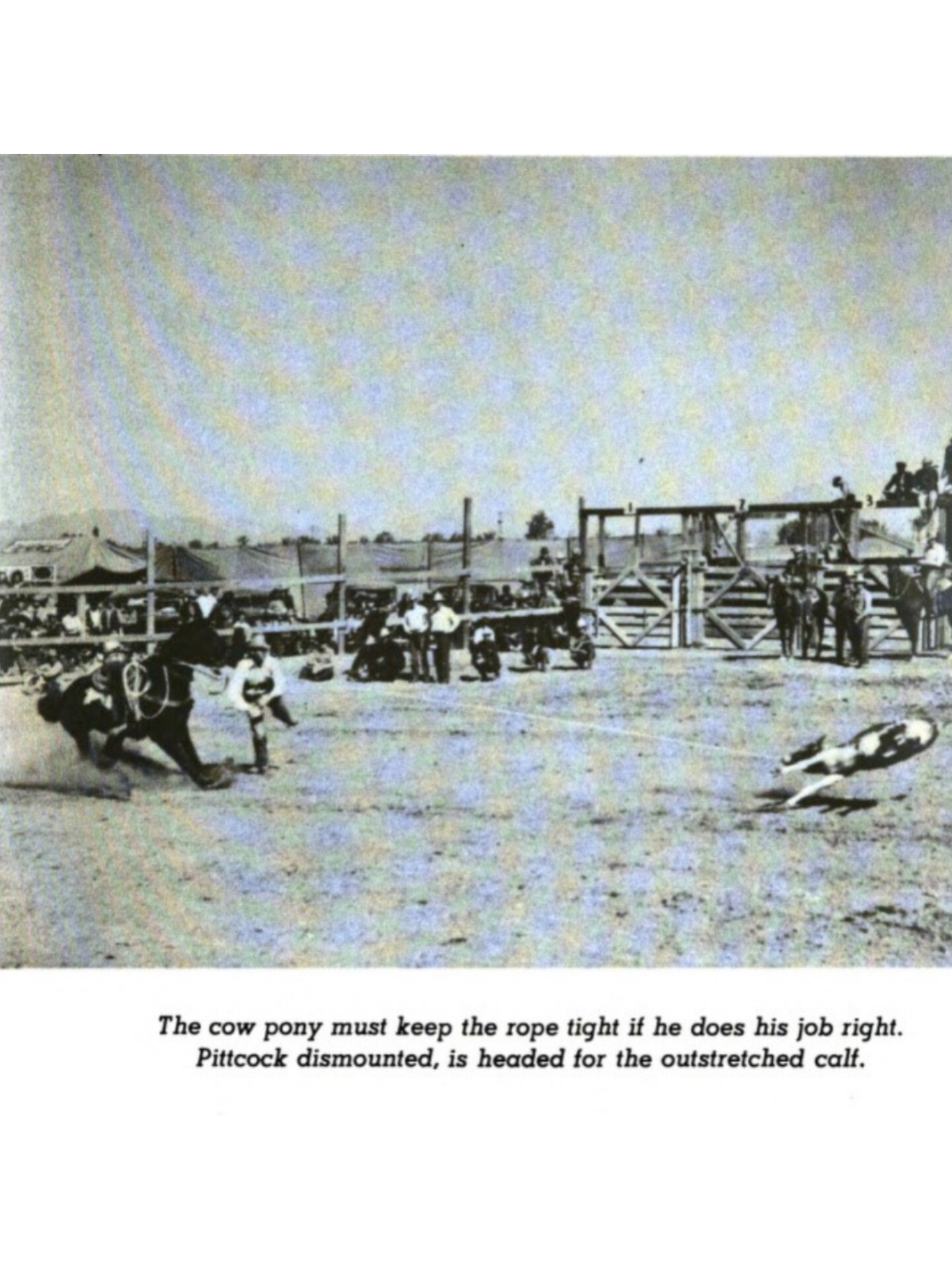
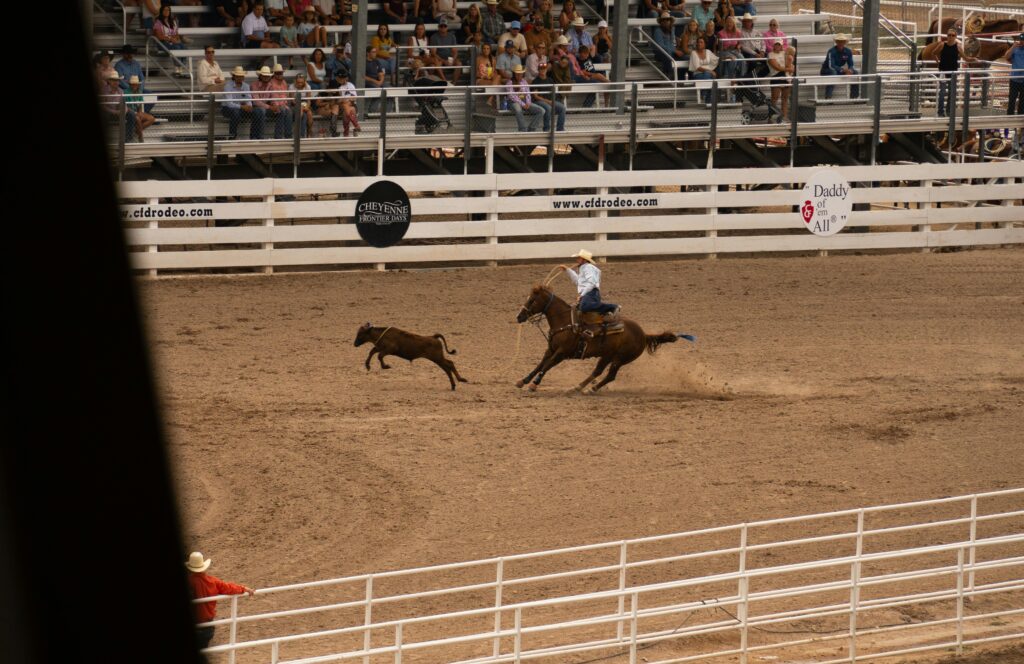
It is the roper’s horse that can really make or break a champion. Keep your eye on that cowpony when the chute opens and the calf breaks into a dead run in front of him. It’s the spectacular speed of the horse that gives the rider a chance to sling that rope out and encircle the calf’s head — and it’s the action of the horse in keeping the rope taut after the catch, that helps the rider make “time.” Two throws are allowed before the rider is disqualified. The rider dismounts the instant the catch is made, leaving the rope tied to the saddle horn. At this point, it’s the horse’s job to keep the rope just tight enough by backing away or moving forward, always facing the calf until the tie is made. Three of the calf’s feet must be securely tied with the piggin string. It’s “no time” for the cowboy if the calf can get up after it is tied.
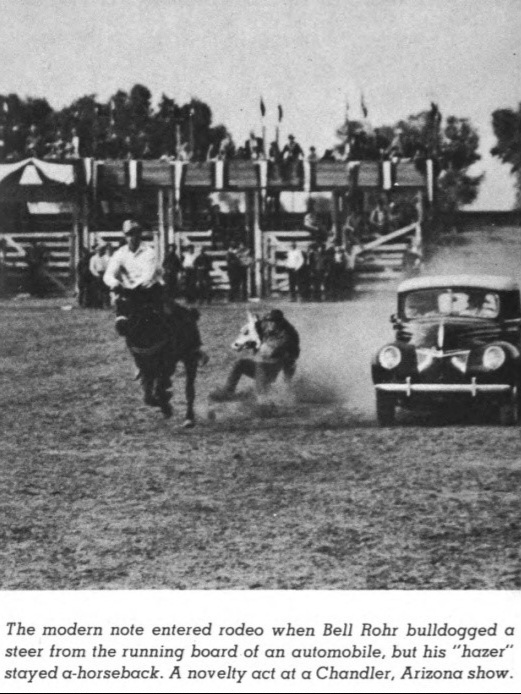
It takes two good riders and two good horses to do a job of team roping. The scared steer gets a thirty foot start, then it’s the job of the first man to lasso the racing steer around the head and to slow him down while his partner goes after the hind legs with his lariat. The steer must then be pulled down by the horses or thrown by one of the cowboys, and his hind legs must be tied together with a piggin string. The team that accomplishes this in the shortest length of time, of course, wins the event. In single steer roping, the contestant works alone, as in calf roping. Bulldogging or steer wrestling originated as a fast way of catching and throwing cattle without a rope. The contestant gives the steer a ten foot head start, goes down the arena after him amidst the thundering of three sets of hooves, and leaps from the saddle onto the steer’s neck to throw the animal flat with all feet and head straight out.
Brahma Bull Riding
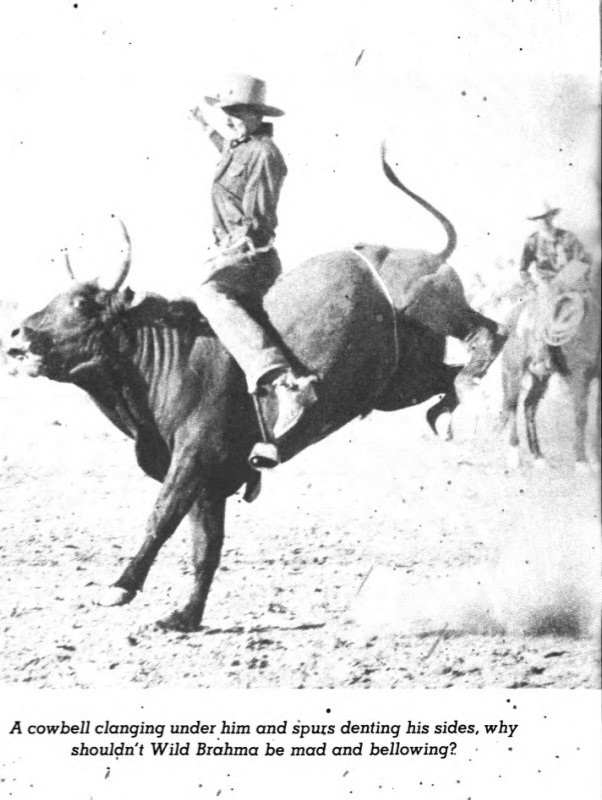
Havoc on the hoof — that’s a Brahma bull. A Texas-bred cross between the Brahma of India and the Mexican Longhorn, the Brahma is conceded to be the most dangerous animal in rodeo. He’s not content merely to buck, but usually seeks vengeance by attempting to gore his dismounted adversary. It takes real nerve to try to ride these huge, “onery” beasts. There is only a rope around the bull for the cowboy to hold onto. A cowbell dangling from this rope under the animal’s middle further infuriates him. As in bronc riding, one hand must be held free from the bull, and the cowboy must spur from shoulder to flank during the eight seconds which make a completed ride.
When the bull-riding event is called there is a general exodus of cowboys and spectators from the arena. There is good cause for such retreat, for the enraged Brahmas will charge anything in sight. A heavy wire fence is no barrier — over or through they go, according to the moment’s impulse.
The clown is always present and alert during this event, and prevents many serious accidents by diverting the bull’s attention after the ride is completed. He is frequently in far more danger than the rider, and often for protection must leap into one of the barrels he uses for props. Usually, the charging beast sends the barrel spinning, and gasps of dismay go up from the crowd.
Dummies and matador capes are extra bull-bait that bring laughs and thrills to the crowd, for the Brahma seldom fails to respond to tantalizing.
Max Kegley, Rodeo: The Sport of the Cow Country (New York: Hastings House Publishers, 1942), pp. 7-12, 14, 32, and 54. Images appear on pages 15, 35, 38, 52, and 62.
See: https://babel.hathitrust.org/cgi/pt?id=uc1.$b34120&seq=71
Man, Beast, Dust
Clifford P. Westermeier
CHAPTER XVII
GET ALONG LITTLE DOGIE
‘Get along little dogie’
You’re a gonna be roped,
Me and my cow pony
Got that all doped.
In skill and finesse, in smoothness and ability, the calf roping contest reveals the perfect coordination and understanding between man and horse. Because time is the important element in this contest, there is no opportunity for showmanship, save that which is always exhibited in the sheer beauty of natural, intense, and swift moving action. It is a revelation to see a man so confident in the training and abilities of his mount that he appears unaware of the fact that he is working at such a fast pace. The calf roper must be a skilled technician in handling the rope, but without his speedy, dashing, well-trained horse, this skill would be of little value.
The question has been raised concerning the fact why there are more first-rate ropers in the business than contestants in other events. The answer seems to lie in the fact that calf roping is fun. A man with some athletic ability, with one to three years of practice, can develop a remarkable skill to rope calves well. Many Westerners find more enjoyment in roping calves and steers than in participating in any other form of leisure or entertainment.
The majority of horses used by the calf roping contestants are Quarter Horses, bred especially for the fast and furious pace of the rodeo arena; a snappy, quick-moving and supple beast, this horse is trained in his every move. A contestant with his hands full of reins and rope, and his mouth full of dust and a “piggin’ string,” [Footnote: Piggin’ —string the cord used to tie the legs of the calf after it has been thrown.] must have confidence in the ability of his mount to bring him close enough to rope the running calf that is twenty or thirty feet ahead of him. Thus, the horse is of unquestionable value to the roper. The calf roping contestant can get nowhere in the work unless he spends years in patiently training and understanding his horse.
It is a fascinating and thrilling sight to see the roper and horse take their places; the beast prancing, sidling, and backing into position, working nervously and excitedly into a stance — like a bunch of coiled springs — in an almost sitting crouch in readiness for the first quick spurt that will carry him and his rider fast on the flying heels of the victim. The calf is released from the chute, driven forward across the deadline, followed almost immediately by the roper, and — the event begins!
With increasing speed, the horse closes the gap between himself and the running calf and draws to the right for he anticipates the moment when the rider will toss the whirling rope over the calf’s head. Still his work is not finished; when the stage is set for the final work, the horse must play his part to the finish. After the rope has ensnared the calf, the horse is trained not to stop dead in his flight, while the rider dismounts and goes down the cord to the calf. Rather he must ease up gently, in order not to “bust” [Footnote: To jerk a calf off its feet. This particular part of the calf roping rules applies only to those contests held in cities where the Humane Society objects to calf roping. The penalty of 10 seconds has the tendency to prevent contestants from being too much in a hurry to make time.] the calf, but he must keep the rope taut enough to prevent the struggling animal from running about and adding time to the score. After the calf has been thrown and tied, the horse continues to hold the rope taut enough to prevent the animal from floundering, but not taut to the extent of dragging the calf.
This remarkable performance on the part of the horse is very exciting and is one that is not often witnessed in any other sport involving horses. A calf does not run in a straight line, but he weaves from right to left, stops dead, or hurries in the opposite direction; this type of action demands a horse of stamina, trained to know when to stop, to twist on a dime, and to keep the quarry in sight. The excitement of a struggling calf on the other end of a rope, dallied or tied to a saddle, would send any other horse into a frenzy of fear or make him bolt from the scene of confusion. This is not the case of the trained calf roping horse who, after slowing down, backs away cautiously and gracefully, keeping ever tight the vibrating rope. He stands without any guiding influence until his master approaches and relieves him of the burden. Too much praise cannot be given to this horse that can be brought to such a degree of excellent behavior and understanding. This praise is reflected back on the man who has spent hours and days, weeks and months, patiently developing the hidden talents of his mount.
The outstanding calf roper is tall, fair-haired, blue-eyed, Toots Mansfield of Bandera, Texas. In his late twenties, Mansfield was the R. A. A. Calf Roping Champion for three consecutive years, 1939, 1940, and 1941. It is difficult to describe Toots Mansfield — one really must know him to appreciate his sterling character and his absolute sincerity. One is impressed with the appearance and personality of this man. Since he is almost a legendary figure in his work, in personality he might pose for Owen Wister’s “Virginian”; he is taciturn, courteous, dignified, with haunting, wistful eyes and an undeniable graciousness.
He is a Texan by birth and the exact opposite of his fellow state-man, Buck Eckols, of Liberty, Texas. Runner-up for the R. A. A. Calf Roping Championship in 1941, Buck is a roper of ability, a threat to anyone competing against him. He is, like Homer Pettigrew, among the most attractive and handsome men in rodeo. He possesses the regular masculine features associated with outdoor men; there is a certain subtle mischievous sparkle in his eyes, which is combined with a lively sense of humor; Buck is a perfect companion. From the Eckols Ranch he came to New York to the Madison Square Garden Show for the first time in 1941, where his talent for calf roping placed him among the leaders of the sport.
The rules governing the calf roping event are somewhat flexible in that the conditions of the arena determine the start and the deadline rules, and they vary according to the local situations that prevail. However, the rules must be severe enough to prevent any violation of them that would bring a decided advantage to the contestant. The event is a time event, requires three time keepers, a tie or field judge, and deadline referee; any other officials deemed necessary to conduct the contest fairly, may be appointed by the management of the contest.
The contestant is allowed two ropes; if he fails to rope his calf on a second try, he must retire from the arena and is given a rating of “no time.” After the calf is roped, the rope is tied hard and fast to the saddle, the contestant dismounts and then throws the calf by hand. If the roped calf is not on its feet, it must be made to stand and is then thrown by hand and tied. Only then is the contestant allowed to signal that his work is completed. The tie, a three-leg cross tie, must hold until inspected by the tie judge, who, after inspection, gives his approval to release the calf. If, during the inspection and before the tie can be ruled a fair one, the calf frees itself, the contestant is marked no time.
The contestant, after signaling that he has completed his work, must not approach the calf, and only those persons assisting the tie judge are allowed to remove the rope from the calf and later untie its legs.
Some of the rules which the contestant with his mount must observe in order to qualify are: the loop must be released from the hand; the rope must be on the calf when the rider reaches it; a penalty of ten seconds is imposed if the roper and his mount beat or break the barrier. The contestant is allowed no outside assistance, and, if, in the opinion of the judges, the rider has “busted” the calf intentionally, he is disqualified. In some contests “busting,” intentionally or not, is penalized ten seconds; if a horse drags a calf, the field judge may stop the horse and a penalty is imposed.
Calf roping is a fast moving contest; the time made by the cowboys is remarkable. However, no world record time can be established because every arena has different working conditions, and a standardization is impossible. However, ten or eleven seconds is considered record time anywhere. Records are kept of low time made at various arenas, and in subsequent shows there is always competition to try to lower these records.
The calves that are used in the event are from four to eight months old, weigh not more than two hundred and fifty pounds, in breed are cross-bred Brahma, White Face, Black Angus, or Longhorned Mexican. They are quick on their feet. At the present time, since the speed of the horse is being stepped up by breeding, the calf does not appear to move as rapidly as formerly. The equipment used by the contestant is his own particular saddle, which is much lighter in weight than that formerly used by the range cowboy. His rope varies in length, depending upon the speed of his horse. Ten years ago, the average length of the rope was about twenty-five feet; now it has been reduced to twenty or twenty-one feet because the horse is speedier. . . .
Roping horses are as famous in name and ability as the bucking ones; there are horses that have made a name for themselves and their masters in the sport and have brought fame to both, because of the intelligence and understanding that they have shown. The roping horse is not so spectacularly named as his more rampageous, and belligerent kin, the bucking horse; nevertheless, he has carved a niche for himself.
Some of the better-known names of the well-trained and skillfully performing horses are “Comet,” “Dogie,” “Nord,” “Roany,” “V H,” “Sadie,” “Bartender,” and “Streak.” “V H” and “Streak” died in similar accidents about four years apart; the trailers carrying them overturned or broke loose and the animals were injured so seriously that they had to be killed. The loss of a fine horse, that has been a part of a cowboy’s daily life and work, is felt as keenly as the death of a dear and close friend.
Perhaps the most famous roping horse of the arena today is “Baldy.” He was four years old in 1936, when he started his rodeo work under the tutelage of that well-known cowboy, Ike Rude. Baldy was born near Claremore, Oklahoma, on the Dawson ranch and was purchased, at the age of one year, by R. Mason of Nowata, Oklahoma. Four years of his life were spent under this master; then he was purchased by Ike Rude. Thereafter, his life was changed.
The brilliant performance of this man and his horse in 1936 was overshadowed by a most unfortunate accident. In the move from a Canadian contest to another rodeo, “Baldy’s” trailer caught fire, and before his plight was discovered, he suffered serious burns. He still has scars from this accident on his left front leg. Rude, at that time, seriously considered disposing of “Baldy,” but after he had consulted a veterinary, the horse was saved by understanding and sympathetic treatment. Although the injuries were severe and there were difficulties in handling him, “Baldy” was pronounced cured early in the following spring and carried Ike to the pot of gold sought by every cowboy of the arena. His recovery was remarkable, and the men in rodeo were amazed that he could still be useful in this high tension work.
When “Baldy” performs in the calf roping event in some of the classic contests of the country, the spectator has a thrilling moment. He was recognized as one of the most active and skilled horses in rodeo; he and his master parted company in January, 1942, when he was purchased from Rude by Clyde Burk for the sum of twenty-five hundred dollars! The spring of 1942 found “Baldy” and his new master “standing” the people in the aisles in performances on the Eastern circuit of the new Flying A Ranch Stampede. Before summer arrived, Clyde and “Baldy” made a name for themselves among the many fans of rodeo in several large Eastern cities.
Among other excellent roping horses are Juan Salinas’ “Honey Boy” and Buck Sorrell’s “Bill,” also known as “Pound.” “Pound” is a small horse and is especially good in an indoor arena, because he has a great deal of speed for a long score. He is called “Pound” because he tries so hard to catch his calf; he runs doggedly after it as fast as he can, but the calf seems to be running much faster than the horse.
Clay Carr of Visalia, California, has a fine horse known as “Jay.” He is also known as “Set-em-Up.” He is one of the few roping horses with sense of his own but does not always use it properly. Upon carrying the rider close to the calf, and, after the rider has twirled his rope a couple of times, “Set-em-Up” figures the calf is caught; then he stops hard and fast, whether the roper has caught the calf or not. Sometimes the rider has not even thrown his rope. He is a difficult horse to ride because of this thinking power; he stops so quickly that he has thrown Clay Carr and John Bowman, both Rodeo-Association- of-America All-Around Champions, and several other cowboys who have tried to ride him.
And Clay Carr! He, Everett Bowman, and Louis Brooks are the only men who, up to the present time, have won twice the R. A. A. All-Around Cowboy Championship. Clay, holder of the Jo Mora Salinas Trophy, is a strange man, difficult to meet and extremely hard to get acquainted with. He is, without a question, one of the great cowboys of the age; a man of many complexes, one of which is inferiority; yet he is one of the smartest, shrewdest, and cleverest individuals in rodeo. He has an air of indifference toward the desires and opinions of others, and appears to lead a rather lonely life, perhaps, because he has a very suspicious nature. In spite of this, Clay has the respect and admiration of everyone in the business and is regarded as a very tough customer in a business deal, fight, or a poker game.
One does not try to figure out this man of moods, but rather accepts whatever friendship he offers; one is flattered by any politeness, consideration, interest, or attention he may show. He seldom goes east to contest, but in the West and particularly at the California shows, he is a master and can “take,” in his own inimitable way, most of the boys competing against him.
Irby Mundy, one of the oldest cowboys still contesting, formerly owned a horse by the name of “Hap.” He was one of the few horses that died with “his boots on.” During a steer wrestling contest, when Irby was hazing a steer for Bill McMacken, who was riding “Hap,” the horse stumbled and fell to the ground with his rider under him. In the pile were Bill and the steer. When they were finally untangled, it was discovered that “Hap” had collapsed in the run and had died of heart failure.
“Rowdy,” another famous horse, is owned by Andy Jauregui of Newhall, California. “Honest John,” a steer wrestling and calf roping horse, carried Harry Hart to the Steer Wrestling Championship in 1939. He was hurt in an accident and died at the age of seventeen years. “Chico,” Gene Ross’ horse, carried his master three times to the coveted position of steer wrestling champion. Among the old-time contestants, Bob Crosby heads the list with two very fine animals, “Bullet,” his steer roping horse, and “Comet,” his calf roping horse. “Comet” is so well reined that Bob often shows him in exhibitions, guiding him with only a wire around his neck — no bit, no bridle.
A good roping horse is seldom used in steer wrestling, unless it be for the purpose of hazing. This does not seem to do any harm. But the very best roping horses are not, as a rule, used in any event except in roping. The steer wrestling horse must learn to carry his rider along side the steer, close enough to allow the rider to jump on the steer. A roping horse must stay right behind the calf or steer in order to give the roper every opportunity for the right kind of throw. A few horses have occasionally been used for both events, but this tends to confuse them, and spoils them for both events.
A good roping horse is very hard to find; many of the very best ropers are willing to pay a fourth of whatever they win to the man who owns a good horse and will permit them to ride him. It is said that Toots Mansfield, the World’s Champion Calf Roper for three consecutive years, hunted a long time for a roping horse that suited his needs. However, all are very glad to rent their horses to this champion, and his good fortune is theirs. In checking over the names of the many men participating in the calf roping event and in the steer and team roping contests, one finds a duplication of names.
Even more obvious is the fact that the outstanding men and the champions for the past twelve years are men from the Southwestern states of Texas, Arizona, New Mexico, Nevada, Oklahoma, and California. Roping has always been a necessity on the ranches. The contenders for this crown of modern rodeo are men from these various states. The names of Toots Mansfield, Bud Spilsbury, Bob Crosby, Dee Burk, Clyde Burk, Carl Shepard, Hub Whiteman, John Bowman, Roy Lewis, Jess Goodspeed and his brother Buck, Buck Eckols, Homer Pettigrew, Ike Rude, Dave Campbell, John Rhodes and his son, Tommy, Buckshot Sorrells, Juan and Tony Salinas, Everett Shaw, and Hugh Bennett, are very prominent in this particular phase of rodeo work.
Closely allied to the calf roping contest, but rarely seen at rodeos, are the Single Dally Steer Roping and Dally Team Roping contests. Seldom does one see both these 1946 Calf Roping Champion (I. R. A.) events on the same program with calf roping, and seldom do they appear outside of the Southwestern states. One of the above contests occasionally appears with calf roping in the Northwest and in the East, and it is always a privilege to see this type of roping. However, the calf roping contest, although not so spectacular as other roping events that use larger animals, does give the audience the opportunity of seeing the animal roped and tied, while these other two events are roping contests only.
Both the single dally and the dally team roping contests are conditioned by the arena, and this in turn determines the start and deadline rules. As in the calf roping contest, there are three timers, a deadline referee, a tie or field judge, and other officials considered necessary for conducting the event.
A contestant in the single dally steer roping is allowed one loop. If he fails to make his catch, he is retired from the arena. If the steer is roped, the contestant must dally to stop the steer, for a tied rope is an infringement on the rules. The catch must be made by placing the rope over the head or the head and one horn of the animal. Should the roper succeed in catching the head or horns and one front foot, he is penalized five seconds; any other type of catch means disqualification. Should there be any question concerning the catch, the decision of the judges determines the matter.
The event is timed from the moment the steer crosses the deadline until it has been roped and the horse has brought the animal to a stop and faces it with the rope taut. The contestant is penalized ten seconds for beating or breaking the barrier; he is disqualified, if in the opinion of the judges, he has intentionally handled the animal roughly.
In the dally team roping contest each man is permitted only one rope but is allowed two throws. When the animal crosses the deadline, he belongs to the roper, regardless of what happens. He must first be roped by the head or horns, or head and one horn. If the animal is caught by the head or horns and one front foot, the roper is penalized five seconds; other catches mean disqualification. One partner of the roping team is required to rope one or both hind feet; however, a penalty of five seconds is imposed if only one hind foot is caught. If the steer is allowed to back into a loop, the roper is penalized or disqualified. In this event, as in the former, the rope must be dallied and not tied.
Under no conditions must the steer be thrown. The timing of the event is not complete until the steer is stopped and both horses are facing the beast in line with ropes tight. Penalties and disqualifications are the same as for the single roping event.
These events need a combination of well-trained horses and fast and skilled ropers with strong ropes. The strength and weight of the steers may very quickly ruin the well-made plans of the contestants, for a broken rope almost always ends the drama. However, the strength of the animal is recognized by the judges, and if the ropes have been properly placed, under certain circumstances, allowances are made by the officials for broken ropes!
During the annual convention of the Rodeo Association of America held at Colorado Springs, Colorado, in January, 1942, it was decided to include the events of Single Steer Tying and Team Tying with those already recognized and receiving Association points. Both these contests have been long in coming about, not because of an insufficient number of interested participants for the events, but because there is much criticism if they are not carried out exactly according to rules. Steer tying is perhaps the wildest event in rodeo; only about five shows offer it as a contest — Cheyenne, Wyoming; Pendleton, Oregon; Safford, Arizona; and one or two others. Excitement reigns high when the cowboys “bust” those big steers and tie them as if they were calves! “Busting them” is done by turning the horse at an angle to the steer after the catch and by running him off fast enough so that the steer is jerked around, off his feet, and stunned slightly when he hits the ground. This is known as “taking a trip” and also as “laying it behind ’em.” The rules governing the arena and the number of officials selected for judging these two events are the same as those for other roping events.
The single steer contest allows the participants to have two ropes. If, in roping the animal, the first attempt is not a qualified catch, the second rope may be used; however, only if the first rope is free from the steer or free from the saddle, for in this event, the rope is tied to the saddle when the roper proceeds to tie the steer.
In roping the steer, the qualified catches are: around the horns, over the head or half of the head, or around the neck. The loop may include one front foot. Should the animal be caught in any other fashion, the roper must not attempt to throw the steer, for any catch other than those listed is designated as a foul, and the roper is signaled to retire from the arena, if he attempts to throw his animal under these conditions. After making a disqualified catch and releasing the rope, the contestant may use his second rope. In a qualified catch the steer is thrown and tied with a three-leg cross; then the roper signals that his work is completed. After giving the signal, he brings his horse forward to give slack to the rope, while the tie is being examined by the judge. Should the steer be able to get to his feet before the judge has determined whether or not the tie was a fair one, the roper is allowed no time on that steer.
Some confusion results in the rules governing the single steer tying event and in those governing the dally steer roping, because they are often combined. They must be carefully observed and kept separate. Any change in this procedure results in failure to conduct the contest properly; it allows criticism on the part of the contestants participating in the event, and also on the part of outside agencies that are not sympathetic towards roping contests.
Another roping contest, that of team tying, has been recognized recently by the Rodeo Association as a rodeo event. Points are given so that, eventually, the participants will be granted the championship at the end of the season.
[The] team [ is ) allowed only two loops at the head and should they miss with both loops, [the] team must retire from the arena and will receive no time; after steer is properly roped by the head, the other partner has two loops at the steer’s hind feet and should he miss both loops, team will receive no time. If either roper ropes [ the ) steer after judge’s signal “no time,” the team will be disqualified in all events for the rest of the contest.
The first catch must be made by the head, half head, or horns of the animal, while the second catch is made on one or both hind feet. Should the steer fall before the second catch is placed on the hind foot or feet, he must be allowed to stand and regain his footing. Before the tie is started, both ropes must be properly and securely placed on the animal, and no part of the catch ropes may be used to make the tie; only then may he be tied by both legs below the hocks. The steer may be thrown by means of tripping, stretching, or “tailing down.” The tie is then examined and passed on by the judge, whose decision is final. There is the usual ten seconds’ penalty for beating and breaking the barrier.
Both these events, so recently recognized by the Rodeo Association of America, will no doubt bring forth some new names in the rodeo world. It will be of interest to note whether or not this recognition as major events will make them popular and important phases of rodeo sports. Because of the similarity, it is not probable that these four roping contests will be included in one rodeo, but if there should ever be a competition of roping activities alone, it would afford a great opportunity to witness these very skillful cowboy actions. A contest of this nature with worthy purses, held in the Southwest, where roping is still the work of many of the people in the cattle country and an activity very dear to them, would bring out the finest men and create widespread interest.
An occasional roping-match is worked up between two outstanding contestants; such contests attract people from far and near. Such a match has been carried on for several years between Bob Crosby of Roswell, New Mexico, and George Weir of Monument, New Mexico. The two men, single handed — according to the rules — rope and tie ten steers for a one-thousand-dollar prize. In recent years the contest has gained importance because it has become very well known. The title of Champion Steer Roper has moved from Bob Crosby to Carl Arnold of Buckeye, Arizona, who, in turn, was challenged by King Merritt of Cheyenne, Wyoming. From five to six thousand fans attended the exhibition. These men show rare talent and ability, and the contest is looked forward to as an annual event.
Clifford P. Westermeier, Man, Beast, Dust: The Story of Rodeo (Denver: Dieter Bookbinding Co., 1947), pp. 213-218 and 221-232. Some footnotes have been deleted.
See: https://babel.hathitrust.org/cgi/pt?id=uc1.b3113545&seq=1