Whaling
We want you to have a greater ability to learn about some of the unpleasant animal issues in our world.
Whaling North and South
F. V. Morley and J. S. Hodgson
CHAPTER V
THE WHALE HUNT
Το return to Shetland. It was an easy run from the hills down to the whaling-station on the firth. The station, which plays no great part in the world’s trade, though a considerable part in the now diminishing northern industry, is an angular group of red frame buildings with corrugated iron roofs and tall black chimneys. Smell thickens in every angle of the station; to turn a corner is to meet it in new strength; and it rises from each roof, attracting gulls for miles around. But one does get used to it in time, and I shall mention it no more. The station consists of the manager’s house, the shanties where the men live, the wharf and coal hulk, the storehouses, the oil-vats, the meat-pots, and the flensing-stage. The manager’s house is on the hillside, above the factory, so placed that the manager may watch, with glasses, the return of the whale- catchers through Swarbacks Minn.
Immediately in front of the house, running into the firth below low-water mark, is the flensing-stage. On the right, looking toward the firth, are the boiler-houses and the plant for reducing blubber to oil. On the left is the shed where the meat and bone are cooked in pots (which remind one of Bessemer furnaces) and brought down by several stages to a finely mixed powder.
The oil goes to soap manufacturers. The powdered meat and bone goes to Japan, for use as fertilizer in the rice-fields. The whalebone, cleaned and cut to lengths, is stowed in sheds before shipment to brush manufacturers. So is each solid portion of the carcass prepared for use. Only the blood escapes, and flows down the flensing-stage in sheets of steaming red, to stain the tide. On fine evenings I have seen the blood-stain burning in the evening glow, a broad trail moving slowly out to sea.
Fifty yards out in the firth, in front of the flensing-stage and to the left of the crazy pier and the coal-hulk, is a red spherical buoy, eight or nine feet in diameter. The buoy has a past. It was a life-buoy, a Norwegian invention. It is hollow, with a manhole at the top, and a padded interior; a portable Black Hole of Calcutta. It was designed for use in shipwreck; passengers were to enter and float off in safety from a sinking ship. Heaven help them in a rough sea. The buoy is what enthusiasts might use for sailing down Niagara. But it has a more practical use at present. The dead whales, when towed in by the whale-catchers, are moored to it. The red sphere is no longer a life-buoy. It is a death-buoy now. There the corpses wait their turn for the flensing-stage.
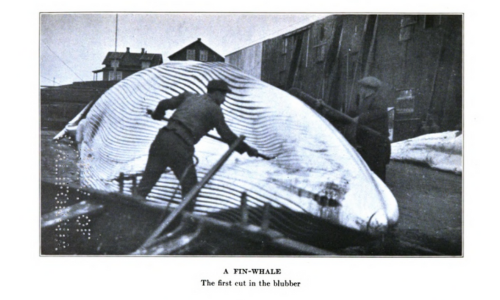
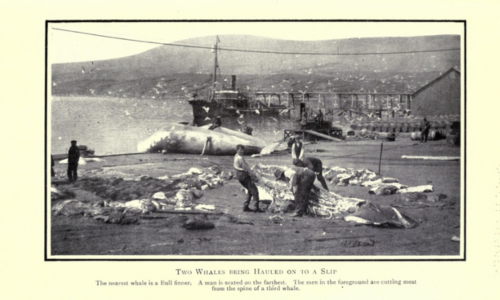
When the stage is ready, the whales are hauled inshore and up, the heavy winches straining and the tackle singing under the load. When the carcass is in position, the flensing begins. With flensing-knives the size and shape of hockey-sticks, but razor-edged, parallel cuts are made in the hard blubber, from head to tail; and the strips of white blubber — between a foot or eighteen inches wide and (for the fin-whale) four to six inches thick — are pulled off by the winch. It is not easy to cut the blubber; it is of the consistency of a hard rubber ball; it is firm, and your foot rebounds if you kick it.
When the blubber has gone, the jaws are disarticulated and dragged away by the winch. Only then is one likely to appreciate the full magnitude of the whale. The sight of whales at sea is often disappointing. They are usually distant and show but little back. They are lost in the immensity of sky and sea; if seen from a ship, they are compared to the ship and are smaller. Seen from a dory, and in fog, the whale, I have no doubt, would gain in greatness; and a breaching sperm, in those conditions, would not be forgotten. One sees the whole of a dead whale on the flensing-stage, and he dwarfs the men surrounding him; but he is fine in stream-line, splendid in proportion, and one takes him as a monument, a block of matter of fine texture and independent unity. His size is vaguely realized, but he is still compared to larger things, to buildings and to hills.
But strip him of his unifying coat of blubber, remove his shapely jaws, and in the monstrous fraction which remains, he seems larger than he did when whole. The mass of meat, the streams of blood, are compared with meat and blood as known elsewhere; and the mind, thinking in terms of platters and cut fingers, is startled at this enormity.
Although the change of scale is that which Gulliver experienced in Brobdingnag, the coarseness which he found in the Brobdingnagians is not seen in the whale. The skin, wherever gulls leave it unmutilated, is of the finest texture, made up of layers of thin tissue which are translucent and of delicate shades of coloring. In life, it is not possible to state any fixed color for the whale; light and shade and the glistening wetness of the surface give the whale as wide a range of color as the sea’s.
The dead and drying fin-whale shows a gray made up of blues and browns along the back. The sides of the head are differently shaded, the right side light, the left side dark in color. The sides of the body are fawn-colored, merging with a pure brilliant white, whiter than white lead, for the pleated under part. The pleats are delicate and firm; the skin is more lovely to look at than human skin, though repellent to the touch. Where nature has taken the greatest pains with the whale’s skin, as in the lining of the central rib of the palate, it is finer and softer in texture than crape or India silk.
Look on that vast outline once more. Never in the old days could men see the whale, as we can see him now, and say, thus was he made. As the cold naked body is drawn up slowly from the sea, we stand arraigned for all repulsiveness — for the wound, the smell, the swollen tongue and grinning mouth — above all, for the filthy setting of the flensing-stage. Marble would not be good enough to lay this corpse upon; for the sight — discard the blemishes — is wonder. This is the sordid remnant, yet the eye may even now replace what has been lost; it may replace, the while the mind stands by, incredulous. Where went that spirit, which played in this magnificence — which made this mountain leap and sport, quickened the eye, retracted that balloon of tongue, lifted that fallen jaw?
This was a lump which solved some wild equation of the elements. This monstrous form and painted shapeliness has burned its way through phosphorescent waves in summer, the black night lighted by luminous clouds of its own breathing; and sinking with an easy silence, it has spiraled to unseen depths, upon unknown desires. Akin to mine, his body was, alone among the nations of the sea. Here he lies, the wanderer, received on earth. The body rotting in its death should now be ugly. It is more lovely and more startling than the Sphinx. I would not suffer Aristotle to see its nakedness. Either a dull fellow, or Leonardo. The one could never see; the other could abide his feeling.
The corpse soon disappears. Under the long-handled flensing-knives skin and meat and all is reduced to soiled masses, which are drawn to the buckets which carry the portions up to the cooking-pots. After a few hours of steady work by the flensing- gang, nothing is left of the carcass but the vertebræ, as large as millstones. The circular saw shrieks as it bites into these vertebræ; at last they are severed and join the meat for cooking. So ends the story of the flensing-stage….
It was eight o’clock when I was roused by the steward. He said one word, and went away. “Hval!” I tumbled out, crammed my feet into boots, and ran forward after him. The clouds were parted now, and a weak sun showing through them. The steward had disappeared; I hurried up the ladder to the bridge.
After all, it was a myth. There was no whale. The mate at the wheel peered forward anxiously. The gunner was at the bow, his hand on the stock of the gun. The lookout man was hanging half outside the barrel on the mast. But there was no whale. Visibility was excellent. I searched the surface of the sea to port, ahead, and starboard of us. Here it was blue; there it was brown; but nothing anywhere alive and visible. If there was a whale surely all eyes should be focused on its whereabouts. But the mate clearly did not know where to look. The gunner did not know where to look. The lookout man was gazing from side to side, uncertainly. And the sea danced and sparkled, and was merry and clean and uninhabited. The sun was gaining strength, making for a patch of watery blue sky; behind us lay a long low bank of dark gray cloud, with the horizon a clean black line beneath it. Whale or no, it was a good day, a better day than I had seen in Shetland. The wind was brisk, but . . .
I was interrupted.
“Blaast!” cried the lookout man. His arm and rigid finger shot out to the left. The gunner swung his gun round; the mate spun the helm hard over, and rang the telegraph for full speed. The Sheba lurched into the wind, and pounded and trembled as if with excitement.
But I saw nothing. Five minutes passed, and with the others I stared and ranged the whitecaps, not knowing where to look. Then, on the starboard bow, perhaps two hundred yards away, I saw two puffs of smoke. They were thin, tenuous, and hung for a moment in the wind. I pointed. The mate saw at the same instant. “Blaast,” he shouted, tearing at the spokes to swing the helm. The gunner turned and shouted in Norwegian (“Where away?” or, “How far?”), and the mate called back to him. The gunner swung the gun, the lookout craned forward, and the steward and a stoker jabbered on the deck below. They were to stand by the winches, for the chase was really on.
“Finhval,” said the mate. “Two of them, big ones. You bring us luck. Maybe we get good shot soon.” I was pleased. I thought of telling him a Jonah was useful on a whale-catcher. A number of irrelevancies occurred to me. I was excited by the excitement of the men round me. For myself, I did not yet believe in the chase. It seemed unimportant. Nothing would really happen. The sea was blue now. There was a solitary sea-gull following us; his eye was hard as a black boot-button.
But the fin-whales — they were shy and far away. They cruised erratically, changing course below the surface. The spouts appeared, one after the other, now here, now there, now here. It was a game. After an hour we were as close, no closer, to the puffs which rose, always close together, like irresponsible play of a will-o’-the-wisp. The puffs betrayed no agitation, no hurry, no reality. We turned, we twisted, raced forward, stopped dead; the puffs appeared ahead, on either side, once or twice astern.
Sometimes they were lost. The wheel spun round. The smoke from the Sheba‘s funnel drifted now to port, now to starboard; sometimes astern, sometimes ahead. The telegraph rang, and rang again. The gunner talked to himself and to the crew in angry guttural tones. The mate cursed fitfully by my ear. The men were anxious, shifty, and determined. Cold and tiredness no longer mattered. I saw no reason why the game should not go on forever. At intervals the spouts rose from the lumpy blue sea. We backed and heeled and raced after them. The sea-gull veered and glided after us. The day was glorious. I forgot any thought of the ending of the chase. We had to catch up with the spouts. Nothing else mattered; that was the intense and vivid game, to catch up with the spouts.
4. I had lost all expectation of end, yet the end came swiftly. Several times in the second hour we had been close to the spouts; we had seen the whales themselves, within a hundred yards, within eighty, even within half that distance. But action had never followed, and I began to take this nearness as a matter of course.
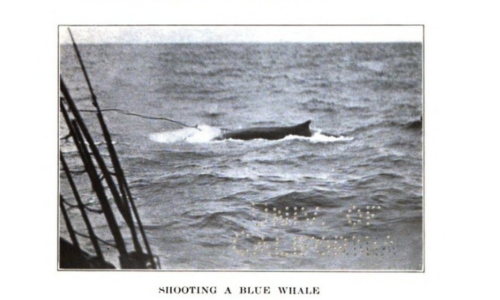
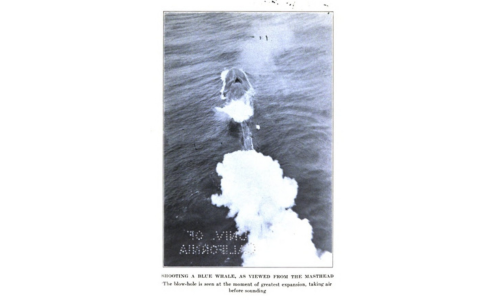
Then came the end. Thirty yards ahead the blue waves parted; the gray jet shot up with its painful powerful sigh (I knew the sound; it was the one made by the valves of the Underground lifts, when one comes to the top at Piccadilly Circus); the wet arched brown back and dorsal fin rose leisurely and prepared to sink — as it had done a score of times before. The gunner leaned forward to his gun, closer than he had leaned all morning. None breathed. The moment lengthened interminably. Still I did not take it seriously.
Suddenly came a shout from the masthead, startling, agonized in its intensity. The gunner heard, and shouted back, never rising from the gun, but waving his left arm behind him frantically. The mate heard, and rang the engines to “astern.” “There! There!” he cried; “the other one!”
I woke then. I shook with pain, for I suddenly knew. The first whale disappeared, but closer, much closer — twenty yards ahead — another clean brown body shone underneath the surface, as through glass. The white of its under side glimmered green. It was coming up; it seemed directly underneath our bows. The Sheba shivered as the screw kicked under her and we strove to avoid collision.
The motion of the whale was slowed down by the intensity of sight. I saw his closed jaws, the pleats along his under side, his long, slim, slender tail, the corkscrew movement of his flukes. His head rose, shattering a wave; his spout exploded with its sighing snore; the cloud of breath swept across the bridge, leaving an acrid smell. The rounded broad brown back arched upward in horrible ignorance. It never twitched; I thought it might have twitched. Smooth and hard and clean, shining in the sun, the living back heaved forward. The fin appeared, leisurely rolling onward. The gunner must have forgotten. Maybe the gun had jammed. In another long moment this whale too would roll under and vanish.
There was a roar, a flash of yellow flame. The Sheba reeled. From the bows sprang flying wads and whirling coils of the manila line. The smoke was driven backward by the wind; it stung my eyes.
Neither more hurriedly nor more deliberately than before, the back rolled on and disappeared. The sea boiled over it. On the disturbed green circle of the whale’s wake was a streak of red. The Sheba plunged heavily forward toward the red stain; the tackle on the mast screamed, and the blocks ran down toward the winches. The winches rattled with sudden violence. Steam spat from them; the drums revolved. The gunner flung the gun round, left the platform.
Though her engines were working astern, the Sheba continued to lurch and roll forward. On the deck all was action. Men were at the winches, two deck-hands busy with the gun, a seaman hauling heavy clanking chains across the iron deck. The gunner came up to the bridge. He took the wheel. The knuckles of his left hand were bleeding. Watching the straining yellow line, he shouted to the men below.
“He comes up,” said the mate, aside to me.
The winches clattered and raced. The blocks on the mast ran aloft. The line sagged. I looked down, saw a dim shape spiraling upward toward the surface. The shape defined itself; once more the sea parted; the head shot clear, straight up this time, the fringed jaws gaping, the jet pumping red. In the effort to rise and spend this blood upon the air, the lungs burst, and the animal fell backward on a rising sea; fell with its flippers twitching, and was dead. The gunner pushed the telegraph to “stop.”
As we lay in the trough of the sea, I looked across the empty waves. Far off was a single puff of smoke, a drifting vanishing trace of the companion whale, moving away alone. The sea-gull too had disappeared. We remained, with the dead.
“See,” said the mate, touching my arm; “he sinks.” As I turned the line was at an angle, tightening. The blurred body shone far down in the water, wan and green. The angle of the rope grew sharper. Sight of the body was lost. I searched the sea for blood; the stain had disappeared. Scarlet spirals here and there flecked the waves. They were excrement.
Down below the bows hung seventy tons of fresh meat. The Sheba‘s gun was close to the surface, her stern lifted into the air. The sea spanked her exposed flank. The winch was working slowly, the tackle creaking and squealing again. Foot by foot the body came up, twisting slowly, hidden by the bows.
The mate took the wheel. I clambered down to the deck after the gunner, who took a twenty-foot lance from its place by the ratlines. The dead whale lay at last at the surface. The winches were locked. The gunner, balancing once more on the gun-platform, plunged the lance into the firm white surface of the stomach. With another lance, he passed down the nozzle of a compressed air hose. The leaping of the sea, the awkward swaying of the carcass, made it difficult to find the previous incision. At last the nozzle was inserted and pushed home with an effort. The air was turned on. Slowly the corpse began to swell and rise. The tackle ceased to strain. The Sheba‘s bow lifted; her stern squatted down once more. twenty minutes the carcass was inflated. In another ten minutes the flukes were cut away, a chain passed through and round the stumps of tail, and the whale moored alongside for towing….
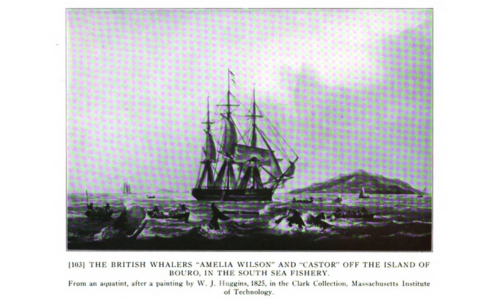
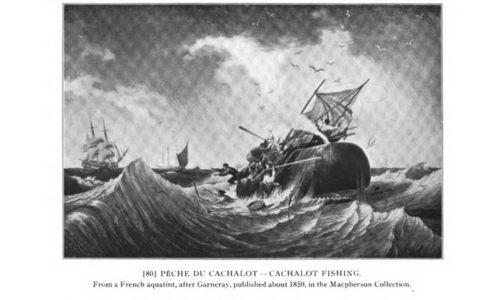
3. While we are hunting — there is plenty of time — I ought to describe the method of killing we were anxious to put into action. The industry of whaling had reached such a high state of organization that if those who hunted the sperm and right whale in their courageously primitive fashion years ago could only see the elaborate preparations and gear that are used at the present time, they would be considerably astonished.
The modern harpoon-gun is an ingenious piece of mechanism, something like an old-fashioned cannon in appearance. The method of loading by the muzzle is similar to the practice of the time of Nelson. First is inserted something like a pound of gunpowder wrapped in a linen bag; then follow a few handfuls of cotton waste and oakum. After this packing, a round flat piece of rubber, about an inch in thickness and of the same diameter as the bore of the gun, is rammed home. The cotton waste, oakum, and rubber pad serve as a shock-absorber so as to prevent the explosion from bending the shaft of the harpoon.
The harpoon has about it many points of interest. Its weight (as near as I could judge from lifting it) is about one hundred pounds. It is barbed so that when the harpoon enters the body of the whale the prongs expand laterally, making the grip of the harpoon firmer against the struggles of the leviathan to get away.
Serving as a head, a grenade with a contact detonator attached is screwed upon the front of the harpoon. These grenades, which have proved their extreme usefulness, have been increased in size, so that they now resemble, both in shape and size, the twenty- pound bombs that caused so much destruction when dropped from aëroplanes during the war.
The shaft of the harpoon is slotted to allow a strong loop of several thicknesses of piano-wire, twisted into a shape like a figure 8, to be threaded through so that it slides along the whole length from the head to the base.
Attached to the loop of piano-wire is the forerunner, a strong rope of hemp with a breaking-strain of sixty tons. The forerunner is coiled up neatly on a platform immediately below the gun, so that it may easily follow in the wake of the harpoon when fired.
At the other end of the forerunner is spliced the whale-line proper, made of the finest manila, 240 fathoms in length. With a breaking-strain of the same capacity as the forerunner, this cable runs over and under rollers beneath the gunner’s platform, up through a complicated piece of tackle called the accumulator-block, thence round the winch-rollers, and so down through the deck, where it lies neatly coiled in a locker so as to allow it to run out at great speed without chance of jamming.
The moment the harpoon strikes the whale, the animal dives, and, if it is not killed immediately, races ahead of the catcher, dragging the rope with it. The accumulator-block now comes into action. It is a pulley-block suspended about half-way up the mast on a steel cable, which in turn runs up the mast over a pulley-block, and then down the mast, and through the deck, where it is firmly fastened to a series of spiral springs. The idea of this arrangement is that the accumulator-block takes the sudden strain of the whale-line when the whale is struck by the harpoon, and in the subsequent struggles the block runs down the mast when the strain increases, pulling all the time on the springs, and goes back to its normal position when the tension slackens.
In spite of this ingenious contrivance the whale, if it is a strong animal, sometimes manages to pull the entire length of the line out of the ship, causing great anxiety lest the line should break. A further method of checking the mad career of the wounded animal is in the way the whale-line is wound round the steam winches, which have extremely powerful brakes in contact with the rope. I have seen the hard wooden brake-blocks actually smoking with the friction caused as the whale-line runs through them, for the leverage exerted on them is tremendous by reason of the tackling that is attached.
The distance at which a gunner may try his skill in shooting the whale varies considerably, and I have seen some wonderful shots made. One in particular went the full distance of the forerunner, thirty yards. The most spectacular have always been in rough weather when it was barely possible to stand on deck, much less hit a swiftly moving target, snap-shot fashion, after standing on the gunner’s platform for an hour or so, all the while drenched with icy-cold spray. Sometimes the gunner misses, but not often. When he does miss he usually gives up the chase immediately and allows the whale to get away.
I am of the opinion that there are a large number of whales in the Antarctic that will never be caught, as they have had their initiation into the playful intentions of mankind and are very loath to repeat the experience, self-preservation being, in all probability, just as strong an instinct in them, after years of the chase, as in other animals of the wild which have learned of the two-legged animal’s destructive powers. …
I had not very long to wait, for soon I saw what looked to me like the blowing of a whale, and shouting in my best Norse the signal, “Da-er-blaast,” I pointed in the direction where I had seen the quarry. The ship rapidly swung in the line indicated, and my responsibility then ended, but I had a most wonderful view of the chase. There were five whales in all, and as we got near I noticed that one in particular separated himself from the rest and was paying us more than the usual amount of attention.
It was rather a small beast and for this reason hardly worth the trouble of chasing, in view of the more profitable quarry in sight. So we kept to the hunt, incidentally allowing our too venturesome whale to exercise his curiosity to his own satisfaction, which he did, swimming along, just under the water, first on the port side, then on the starboard, and then just behind the propeller. I watched his maneuvers with great interest, for although he was below the water, I could very plainly follow his movements. Once he swam right across our bows, and I shouted what was happening immediately below to Andersen, who was standing by with his gun on the platform, but he was just too late to get a sight. So, seemingly without the smallest effort, the whale glided by the bows, to continue his examination of the ship’s hull from another angle.
After a short time, round he came again, and this time Andersen brought off one of the most remarkable shots I ever saw. Pointing the harpoon straight down, he fired, just as the whale passed underneath; and the harpoon, traveling straight through the water to its mark, ended the whale’s curiosity for all time.
It was an excellent shot, for Andersen could not have seen the whale clearly, but only a blurred mass; and even then there was the refraction of the water to be taken into account.
An air-pump was quickly inserted to blow up the carcass and so keep the whale afloat, and a pole flying the company’s flag was stuck in the thick blubber to mark our property; the custom is followed to avoid confusion and to avoid the possibility of picking up some other company’s whale. The flag also serves as a mark to enable one’s property to be spotted at a distance. This proceeding finished, off we went again after the other whales.
It was not long before we sighted them and were carefully stalking them again; and as usual, when we drew near, our pace was slowed down, and with the engines barely turning over we selected the largest whale of the group as the next victim.
From my position in the barrel I could plainly see and also hear the whale blowing great jets of steaming breath from its blow-hole. The sound I find most difficult to describe — just the sound of air and water being forced under great pressure through a small hole in a short space of time. As I watched, the great beast suddenly came up to the surface only about twenty yards from our bow, and traveling with an easy lazy motion aslant and away from us. Andersen crouched behind his gun, and for a moment an eery silence seemed to reign. The engines stopped throbbing, and still Andersen did not fire, and the whale sank down below the surface. In my ignorance I thought of a beautiful opportunity missed, but in a space of seconds up came the whale again, and still nearer. Again Andersen crouched, and everything seemed to stop still. Then with the roar of the gun a cloud of smoke hid the bow and whale from view.
When the smoke cleared the whale was not to be seen. It had gone deep down into the sea, mortally stricken, carrying the harpoon deeply embedded. The line attached to the harpoon was running out into the sea in the wake of the whale, very fast in spite of the brake-tension upon it. Orders were shouted to increase the pace of the ship, and the tension on the whale-line gradually slackened; but only just in time, as we were actually getting to the end of 240 fathoms of line.
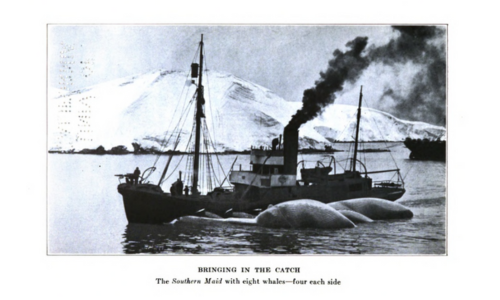
With incredible strength the whale went ahead, towing the Southern Maid after it. Then its wound began to tell, and the whale-line was hauled in, so that we gradually overhauled our quarry once more. The great brute was now blowing into the air a mixture of blood and water, a sure sign that it was nearly spent. It kept to the surface and made no further attempt to dive below in the effort to rid itself of its dreadful burden.
As the whale got weaker we gained ground till we were near enough for another shot; for a second shot was necessary to save time. The second harpoon was immediately effective; and then followed the usual process of pumping the carcass up with air, making it fast to the bows, and so away.
I was greatly surprised to find it had taken more than three hours to complete the kill from the time the first harpoon had been fired. This seems to me a striking tribute to the gigantic strength and vitality of these animals.
I now felt I might relieve myself from the cramped position in the barrel and prepared to descend. It was an easier task getting down than mounting, as by this time I had got used to the height and felt more at home. I had seen Arnold take the quickest way down to deck by sliding down the guy-rope, but although this was a speedy and spectacular route I preferred the more orthodox but laborious way. There was no difficulty in changing from the ladder to the ratlines, as the weight of the whale served to steady the ship, thus saving me from the buffeting I had received in getting up to the lookout.
Frank V. Morley and J.S. Hodgson, Whaling North and South (New York: The Century Co., 1926), pp. 80-85, 93-100, 169-172, and 183-187. Footnotes have been deleted.
See: https://babel.hathitrust.org/cgi/pt?id=uc1.$b25865&seq=1
Modern Whaling and Bear-Hunting
W.G.B. Murdoch
CHAPTER XI
The solitary finner we hunted disappeared, and we hunted for hours towards heavy purple clouds in the S.W., and the sea seemed deserted as before, till towards six o’clock we saw a blow, and soon after saw the crow’s nest of a whaler above the horizon; she appeared to be working to and fro as if hunting a whale.
In half-an-hour we were amongst great large whales! and began the most spectacular whale-hunt we have ever seen. For two and a half days we had hunted blank, lifeless ocean, then, without rhyme or reason, it was brimming with life! An indigo bank of cloud there was for background, a complete vivid rainbow against that —beneath it the swelling seas, dark green with purple lights and white foam, with here and there whales’ white blasts catching the western sun from a score or fifty enormous finners. In every direction were dolphins with yellow and white stripes, and porpoises spurting water up like cannon shots as they dived; overhead were petrels and dark skuas. The whales’ plum-coloured backs caught the western light and reflected the sky on their upper surface in tints of lavender as they rose, glittering and powerful, in green and white foaming water, thousands of pounds sterling, and millions of horse-power, in groups of three or four surging along beside each other, east and west, sending up mighty jets of steam, to be carried away in the wind.
As we went in chase of a group of these we saw the other whaler was fast to a whale, over which she apparently had no control.
The whales were feeding, but travelling so fast that we could not come up with them, so we cut across their course, and dozens of times we thought we were going to get our chance. Then other bigger whales crossed, and we gave up the first lot and went plunging after the others, throwing up grand showers of foam over our bows and oilskins. But cold and wet you do not think of, with seventy or eighty tons charging in front of you and the chance of getting in the harpoon any moment.
For several hours we chased in this wonderful piece of sea, so brimful of life, but the whales dodged about at a most unusual rate; possibly their rapidity of motion was caused by the host of dolphins and porpoises that leapt alongside them and crossed their course; and for all these hours we could occasionally descry our neighbour through the rain showers and failing light, still in tow of her prey. Not till about nine o’clock did she fire a second gun and we hoped she had got in another harpoon to finish her prolonged fight.
Often we were close to a whale but not in such a position as to be able to swing the gun towards it. For some time a huge fellow surged close alongside within one or two feet of our starboard beam and never touched us. I think they must have a sense by which they can judge their distance from a vessel’s or boat’s side or ice: one can hardly believe they judge the distance by the eye alone.
At about ten o’clock our real chance came — we crashed down from a high sea almost on top of a whale as it rose unexpectedly, but it was too close, we could not depress the gun enough to get the foresight on, but the next rise, the moment after its blast we were high in air and let drive as we came down and were fast and sure.
I do not know how to describe the grand rush of a huge whale or that fractional pause of uncertainty after the boom and smoke and flame and the whirl of great rope. It is heart-stopping, almost solemn. You watch the seething black boil where the whale has gone down, with small flecks of scarlet in it, and the great cable fading down into the depths, and the gun-wads smoking on the water. Then off goes the cable to right or left! Sixty to seventy miles an hour, cutting the water into foam, and we swing into the course of the whale.
Before going fairly in tow on this occasion, an unusual thing happened. The whale’s huge head, immediately after it sounded, suddenly shot up twenty yards in front of our bows, twenty feet in the air, and went as quickly down. We were glad it had not touched us, or we would have had quick work to get into our boat, and our little steamer would have made a deep-sea sounding.
About three hundred and sixty fathoms ran out before we saw further sign; running over the two ringing barrels of our strong steam winch, five times round each barrel with the brake such as you see on a railway engine wheel hard down and burning; then foam appeared a quarter of a mile in front, and our whale’s flippers, then the mighty flukes of its enormous tail, slowly threshing the sea into white. To right and left it travelled, towing us ahead whilst our engine reversed at eight knots but not for long. We managed to wind up some line and got the gun loaded again, thinking it might take another harpoon to stop it, for lancing from the small boat in such a heavy sea would have been too dangerous, even if possible.
It was a short fight. At ten-thirty we harpooned it; at eleven-thirty we had it alongside; a weight and line thrown over its tail; took out a heavy chain which was shackled round above the tail and hauled by the steam winch to our port bow beside the anchor davit, then with the huge body with its lovely white corded underside above water surging alongside we steamed ahead. It seemed to be about seventy feet and would probably weigh about seventy tons, and it made us lie well over to port.
To float it a little higher out of the water, we drove a pointed tube with holes in its side through the white kid skin, and blew in air and steam. We began our day’s hunting at three A.M. and wound up and started home at eleven-twenty P.M. We have to go, without waiting for another whale, for we fear the station hands may be standing idle and we have ninety miles to cover at not much more than six miles an hour, for the dead whale alongside stops our speed.
No two whale hunts are alike; one trip you come home with a “clean ship” and empty bunkers, the next you get two or even three whales in a couple of days and come home at once and give all hands, Shetlanders and Norsemen on shore, work for night and day….
In the north the largest whale we have killed was seventy-five feet in length. But in the south, in the Antarctic regions, we have fired into whales well over one hundred feet in length, and have heard from reliable observers of whales killed and measured up to one hundred and twenty feet…..
CHAPTER XI
Whaling has its seamy side. We met it outside the loch going up west of Shetland the wind had almost dropped, but the cross sea it left was as if several Mulls of Cantire had been rolled together, and neither our little whaler nor its crew liked it a bit. Rocky capes and islands were blurred in mist and spouting foam, and sometimes obscured by passing rain and hail showers. About eight or nine, morning, we were off Flugga, the most northerly point of Britain’s possessions, and the weather was simply beastly; by two in the afternoon, we were about sixty miles north-east, in an intensely blue sea, with immense silky rollers, it might have been in the N.E. Trades. It was just what I expected; thirty to forty miles north of the islands you strike sun and clear sky — we always do, then go west fifty miles and you come up against a curtain of rain.
At three-five we are sloping along half-speed north-easterly over a splendid silky swell, all our eyes sweeping the horizon. The boy beside me at the wheel is the first to spot a blow, to which we promptly swing our whaler, and immediately after, on the horizon, we discover the faintest possible suggestion of a blow, a minute cloud hardly enough to swear by, as big as the tip of a child’s little finger. It fades away and we are sure it is the blow of some kind of whale, and the boy rings up the engine-room and, grinning, shouts down the tube: “Megat Stor Nord Capper, full speed!” This to make the stokers lay on, for a Nord Capper means £1 apiece bounty money to each of our crew of ten men.At three-ten we begin the hunt; we go seven miles towards the first blow, when there is a shout from the look-out in the crow’s nest, and we find big spouts within a mile from our left. So the skipper goes forward to his beloved rusted swivel gun or cannon, in his weathered green jacket, a picturesque figure against the immense blue silky sunny swell.
Five minutes the whale stays down, then comes up to starboard. “How many were there?” says Jensen to the look-out in the crow’s nest. ” Two big and a calf.” Eight minutes they stay down and appear half-a-mile to starboard; there is the lovely silence of a sailing-ship as we wait with the engines stopped, studying fleecy clouds and the silky blue stripe our track has left on the swell. It is this rapid contrast that gives the charm to whaling this morning, in hail and black-eyed sea, a blurred sea and landscape of beaten cliffs and capes; this afternoon a wide horizon, and not a ship in sight, the colour and width of it!
But here he is! He came up half-a-mile to port appeared two or three times, at a few seconds’ interval, then “tailed up,” that slow, farewell turn over of the after part of the body as it goes down for a deep dive; and we follow its general direction. In ten minutes he appears a mile to N.W. It is four o’clock, the air S.W. and cold, and bright enough to be N.E.
“Saghte!” (Norse for softly, slowly), he ought to be up soon. . . . 4.3 P.M. There he is half-a-mile to east we hear the blast. These North-Altantic whales don’t make half such a resonant loud blast as the Antarctic whales . . . another whale blowing to E. by S. . . . Four-twelve. Within two hundred yards, a little to port we follow, a stern chase note blue sky reflected on wet plum-coloured back . . . within fifty yards when he made his last dive, Jensen had the gun swung . . . separate whale appears to the right very large . . . nearly fired. Four-twenty. Behind, to port, we swing round we are lacing the rippling swell with blue silky bands “Lord!” there it is! at the second rise under our bow BANG!
A splendid shot! — away goes the line at seventy miles the hour and we are hauled quickly round, and are taken in tow eight miles an hour and the engines going eight miles astern, if that is not exhilarating!
Jensen wipes his nose on red handkerchief — the cook and engineer are at the winch brakes — there is a thin furrow of Union Jack colours, red blood, white foam in the blue of ocean and the line still whirling out at intervals. We “fish fine,” the casting line is sixty fathoms, the rope four and a half inches in circumference, the finest Italian hemp procurable, with a backing of two thousand one hundred and sixty-six feet, five and half inches rope to port, and the same to starboard, a total of eight thousand six hundred and twenty feet.
The line passes five times round the two barrels of a sixty-five-horse-power winch. It is “fine tackle” compared to the seventy or eighty ton fighting finner that we are playing. . . . 4.25 — not much line out, only about one thousand five hundred feet now we go more slowly in tow. It was a well-placed shot … a few Mother Carey chickens come and some fulmar petrels, later a solan goose! — there is a little blood now in its feeble blast, it thrashes with its tail more line going out we go astern to drown it. The nose appears, exactly the colour of a salmon at a distance it turns over. 4.33 — White ribbed underside up now it is dead and it sinks. The line is rove over large iron snatch block up the mast and the steam winch begins to turn slowly, raising the whale from the depths; a slow, steady, funereal clank; a great chain is manoeuvred round the tail and it is hauled up to the side of the bow by the winch; getting the tail chained up to the bow is a complicated, heavy bit of seaman’s work.
A magnificent and beautiful thing is the tail in colour and form; so wide and big and yet so delicate in design and finish and plum-like colour and so immensely strong. The body swings along-side, the head reaches our stern quarters, the line is cut clear of the harpoons in its body. 4.55 Two hours after we first sighted the whale, a quick hunt, play, and kill. 5.3 — Blowing it up and off for second whale.
Blowing up, as already described, is putting a hollow lance into whale and blowing through it air and steam, which makes the body slightly more buoyant and more easy to tow.
5.30 — Sight another whale. Meantime Jensen has been cleaning out the whale gun on the bows with tow and cleaning rod and the charge is put in, and the india-rubber wad driven home on top of three hundred and eighty-five grammes of black powder. The second line from the port side of the hold is made ready, and a new harpoon, one and a half hundredweights, slung from the hold. The line is spliced to the twisted wire grummet or ring that travels in a slot in the shaft of the harpoon, which is rammed into the gun so that line and ring hang from the shaft at the muzzle of the gun.
Getting this done and putting chains and ropes in order takes time and a considerable amount of work for five men, and meanwhile we on the bridge are conscious, as we roll, of occasional whiffs from the galley of roast whale steak and onions. For merit I place caribou meat first, whale and black bear about equal, in second place, and beef third.
Five-forty-five. We have screwed on the explosive point to the harpoon (over the time fuse), swung round the gun, and are off in pursuit of the whale we sighted at five- thirty. By six-thirty he has appeared several times, made two or three handsome blasts and gone down “tail up,” and we followed, as we thought, in the direction he took, but he always appeared right off our track. I use the term “tail up” not quite accurately here; the expression really means the whole tail going into air as the whale goes down for a long dive. In the case of these northern finners it is generally only the part of the back next to the tail that is raised, not the flukes, and this rising tells you the whale intends to go down deep for twenty minutes or half-an-hour.
“A wrong vone,” the engineer says — “he be chased before.” You see the engineer, when his mate is below, joins in the sport of watching, ahead, to port, to starboard and astern, and works the winch when we are playing the fish; always there is work for all, and little enough time for meals, if any.…
Great Scott! There are whales — SPERM — as you live! At last — whales! One little blast on the calm grey ocean a mile away, then another, eight or nine. Nine times several hundred pounds sterling rolling round, each about a mile apart. Are we really in our senses — are we really to strike oil? Heaven be praised — it is not the engine it is all right.
We’re after one.
Henriksen made a bee-line down to his cabin, got out powder and had the harpoon-gun loaded and ready in two shakes.
It is difficult to write about the day now, we are tired, the work has been great and our first whale worth, say, some hundred pounds, enough to cover our outward-bound expenses; it seems hardly believable.
It is true we have only one of these sperm. We could, I believe, have killed several, but for a completely new crew l at whaling; we thought one would be enough for us. It is a bit awkward with one fish running a line, to tackle a second that perhaps goes in the opposite direction, and the flensing at sea for such a small crew is such a big work that we simply stuck to the one.
We chased it for hours; there is no good in chasing one and then rushing off to the next that appears; by a fluke you might strike across the stranger’s course and get him on the rise, but the best plan is to study the movements of the whale of your choice, and by judiciously following it learn its movements so as to cut across its course and get in your harpoon at the right time.
It is difficult to describe the intense excitement of chasing whales, and the more so when your interest in it is even more than the hunting when you have shares to make profit on, for friends interested in the bag.
At about seven-thirty we saw the whales, and by nine we had been three times almost within harpooning distance, say within forty yards, when always the whale “tailed up,” and took his final dive. A whale comes to the surface, blows and takes in breath, several times, just going below surface between each blast. After it feels refreshed it goes below on its business for a dive of, say, twenty minutes or half-an-hour, and may appear any distance from the spot it went down at. In this last dive it raises the after part of its body with a slow elevation, a sort of sad farewell to the hunter. Certain whales, such as the sperm and narwhal, and Right whales, lift the whole tail out, but others, such as the finners we hunt off Shetland, only show the ridge in front of the tail; and seldom show their tails or flukes until they are harpooned.
One thing that comforted us greatly was that we knew from this whale’s movements that though he avoided our treading on his heels, as it were, he was never scared or gallied by our engine or propeller’s beat.
It would take volumes to describe the different ways of each kind of whale. The sperm whale usually feeds in something of a circle, so you keep cruising round the inside of the circle.
For hours we chased, very seldom speaking, eating brown bread, and drinking coffee, standing on deck, sticking to the neighbourhood of our first acquaintance, balancing the prospects of our expedition’s failure or success on the way this one whale took our approach. Sceptics had told us the beat of our motor would frighten a whale more than the slower revolving screw of the steam-whaler; we play our one card that it will not, so to-day our anxiety can be understood.
There was too much at stake on this occasion for the writer to do the harpooning, so Henriksen took the gun and harpoon. The actual firing and hitting a whale any good pistol-shot can do. But manoeuvring the vessel, stalking the whale, as it were, needs a good deal of experience, and it goes without saying one must have perfect sea-legs, indeed, that is perhaps the greatest difficulty. It takes a great deal of experience to be unconscious, when there is a roll on, of any effort to balance oneself, which is, of course, absolutely essential for a successful shot.
At last the grey, blunt-headed whale rose almost in front of us a little to starboard, blew his blast and went under for a few yards and rose again dead in front of our bow; higher and higher his back rose, then Bang! — and we were fast and the line rattling out.
That was a grand boom! and a straight shot. A great surge followed as the whale went down, and out went the five-inch rope — for but a short distance, though it was a heavy rope, spun for far more powerful prey than the sperm or cachalot, and we soon began to reel in, and the writer with a long lance ended the valuable animal’s troubles.
I noticed, as the point of the lance went into the whale, that its silky grey skin was marked here and there with series of circles, something like Burmese writing magnified. I take these to be the marks from the suckers on the tentacles of the great cuttle-fish on which the sperm feeds, and here and there, over its great sides, were deeper scrawls —light-brown-coloured lines on the greyish skin which may have been made by the cuttle-fishes’ parrot-like beaks. Two of its companions came alongside it while it was still alive, and tried to help it by shouldering it away from us.
Had we only had a bay to tow these whales into we would have easily taken more, but we did not quite know how the Portuguese would have welcomed us had we towed their bodies back to Ponta Delgada after killing them, if not exactly at their own doors, still within sight of their town.
The big grey backs with their blunt noses looked intensely interesting when we first came amongst them cruising about and puffing little forward jets of spray almost without the least regard to our presence….
We have waited several months for the sight, and I am inclined to think we feel repaid — that is, looking at the matter merely as hunting.
. . . Somehow I feel at a loss here how to describe the accumulation of feelings at the end of the long waiting and planning. We feel we are right on the high road to success, our engine worked perfectly, our vessel was apparently calculated to a nicety to approach and kill whales, and to keep the sea almost indefinitely.
Big finner whaling, such as I have described in a previous chapter, is much more exciting than killing these sperm or cachalot, for which our tackle is unnecessarily powerful. But after all, in the pursuit of any kind of game, it is the hunting that counts as sport. The killing with any modern weapon of precision is nothing, it is the getting there thalf counts, and we have had many months both planning and hunting before we got this, our first bull sperm; also it is of greater value than the largest finner; and that must be our first consideration.
We found no ambergris in this one. It disgorged several cuttle-fish but they were not lost, for the sharks soon came round, and nothing comes amiss to them.
Ambergris is found sometimes in sperm’s intestine, sometimes thrown from the whale into sea. It is used as the basis of scents. At present its selling price is 100 shillings per ounce. A whaler a year ago secured some from one whale, sold it for £20,000.
All afternoon we worked, cutting up the whale first of all we made a cut round its shoulder and fin, or hand — a whale has bones like those of a hand inside the fibrous fin. In fact, the whale’s anatomy is similar to that of a land animal, not like that of fish. The hip bone and thigh are only floating rudimentary bones.
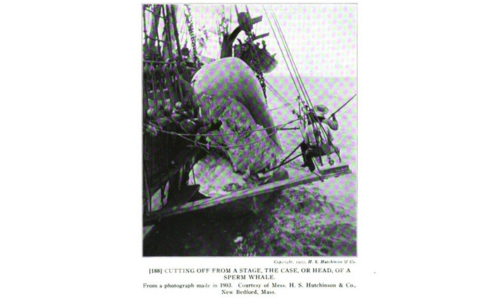
We cut a round hole through the blubber, round the fin or arm, shoved a strop or loop of rope through from the under side of the blubber and pulled that taut on to a sort of button of oak called a toggle on the outside surface of skin. Then, with the winch’s hook and chain hooked on to the strop, we pulled away, by steam power gradually raising a strip of blubber about two feet in width and of about eight inches in depth off the whale, as the body slowly revolved in the water, cutting it clear of the flesh with the flensing blades from the dory or flat-bottomed boat.
From the illustration you may form an idea of how the blubber is “made off.” The head and tail parts were treated separately. Finner whales on a landing-stage on shore are stripped or flensed from end to end with an instrument like a sabre on a long shaft, but if we have to strip or flense one at sea, we shall have to do so in the same way as this sperm whale.
We worked late and turned in, all very tired. The sharks that came round us to feed on our whale were a new experience to most of our northern sailors; they grew quite excited about them; some of them, instead of sleeping, stayed on deck to kill sharks. To kill one single-handed seemed to be the great ambition.
The first mate at breakfast to-day related how he harpooned his shark, fifteen feet long, in the morning watch, dropped a running bowline round its tail, and with a tackle got it on board by himself, and Henriksen, his elder brother, quietly described a cross with his knife’s point on our galley roof!
But it was quite true; and other men did so — a seamanlike piece of work. The harpooning is easy as shelling peas, but to make fast the line to a belaying pin and get a running bowline round the tail, and then hitch on a tackle and purchase to that and heave the shark outward single-handed needs sailorlike neatness and quickness rather than great strength.
We let the youngsters have their fill of shark-killing; when each has killed or helped to kill one, the novelty will wear off, and they will get accustomed to their company, and will not stop work to pay them more than a passing attention with the flensing blades.
At early dawn we recommence at the whale; our crew have not yet quite mastered the process, but they will do it. We have strong winches if few men, fifteen is our complement, about sixty used to tackle the job in the old style.
With practice and our captain’s ingenuity and determination we will get Case, Junk, and all on board before mid-day meal. It is a thorough bit of sailor’s work, every dodge of purchase block and pulley needed.
We have the junk now on board; it was a big hoist, and at the next port of call we will get some extra thick wire back-stays to strengthen our masts, and so heave the next head on board with greater ease.
It is a marvel this case or long forehead of spongelike spermaceti oil, only covered with thin soft blubber skin.
The mass of fibrous tissue is even fuller of liquid oil than a bath sponge could be full of water. Whilst it was still warm we pumped it out with flexible steel pipes, but it condensed and choked the pipe. But when it grew colder we could just handle it. I should think it produced about two tons of liquid oil.
Now we have the long under jaw of white leather-like quality, with its double row of ivory-white teeth, on board.
This is where our plan of campaign differs from the most recent whalers; they either tow their prey ashore or into harbour alongside great floating ship factories of several thousand tons, to be cut up and boiled down. We cut it up at sea and take the blubber on board, melt or cook it, and sail away.
Our deck is now like a marble quarry, with great white chunks of fat in the moonlight, and dusky figures cutting these into blocks of about a foot square to go into our two pots.
To-day steam was let into them at one hundred and sixty pounds’ pressure, and the cooker has to watch two taps running from these, each now pouring out beautifully fine sperm oil.
Our whale cooker is little more than a boy, but he is a bit of a chef already, having studied whale-boiling in these very remote frost-bound islands, the South Shetlands previously referred to.
He stands by the two pots on either side of our small ship amidships, one to port, one to starboard; now and then he dips a bright tin ladle into the oil that keeps running out into an open tank, and sniffs at it, and pours it back lovingly, examining its colour, which is like pale sherry.
There is no smell actually about our cooking process, till the water that is formed in the pots by the condensing steam has to be blown out of the bottoms of the pots. Then the blue sea gets a yellow scum and the atmosphere is pervaded far and near with the smell of beef-tea — the smell alone would make an invalid get up and walk for miles to windward.
At night it comes into my port under the blanket and permeates my being; we wish all whales at the bottom of the sea, but toute passe and in a minute or two the air is fresh again, and there is nothing left but a greasy feeling.
Each pot holds about fifteen barrels. I think this whale’s blubber will fill them several times and produce, say, seventy barrels, at five barrels to the ton, and the ton at £30. This whale ought to be worth moneys, so we see a fortune increasing by leaps and bounds, and we put aside all thoughts of more delays and difficulties and losses….
W.G.B. Murdoch, Modern Whaling and Bear-Hunting: A Record of Present-Day Whaling with Up-to-Date Appliances in Many Parts of the World, and of Bear and Seal Hunting in the Arctic Regions (London: Seeley, Service & Co., 1917, pp. 80-83, 84, 85-88, and 155-161. Footnotes have been deleted. See:
https://babel.hathitrust.org/cgi/pt?id=uc2.ark:/13960/t85h7d391&seq=1
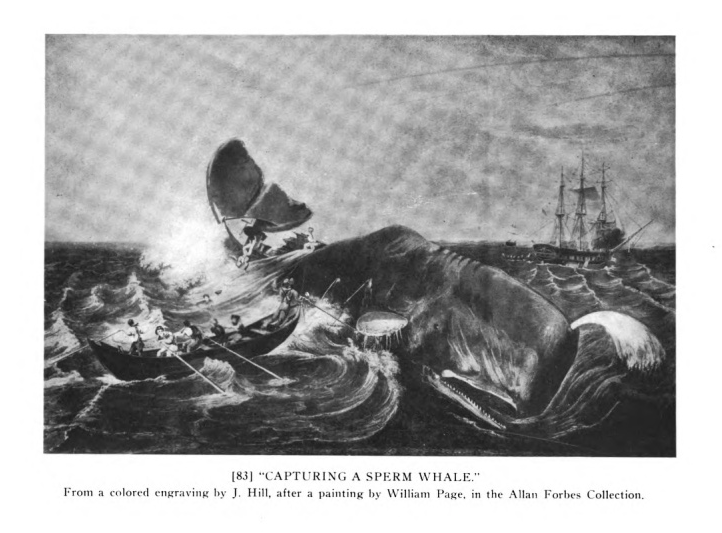
Lead picture appears on page 197 in George F. Dow, Whale Ships and Whaling: A Pictorial History of Whaling during Three Centuries, with an Account of the Whale Fishery in Colonial New England (Salem, MA: Marine Research Society, 1925). See:
https://babel.hathitrust.org/cgi/pt?id=uc1.b3126361&seq=1 as do the images “Peche du Cachalot” (p. 191), “The British Whalers” (p. 239), and “Cutting Off” (p. 405). From the transcribed Morley, Whaling North and South appear “A Fin-Whale” (p. 71), “Shooting a Blue Whale” (p. 164), “Bringing in the Catch” (p. 189), “Shooting a Blue Whale, as Viewed” (frontispiece). “Two Whales being Hauled” is found in the above cited Murdoch, Modern Whaling on page 88.