Cock Fighting
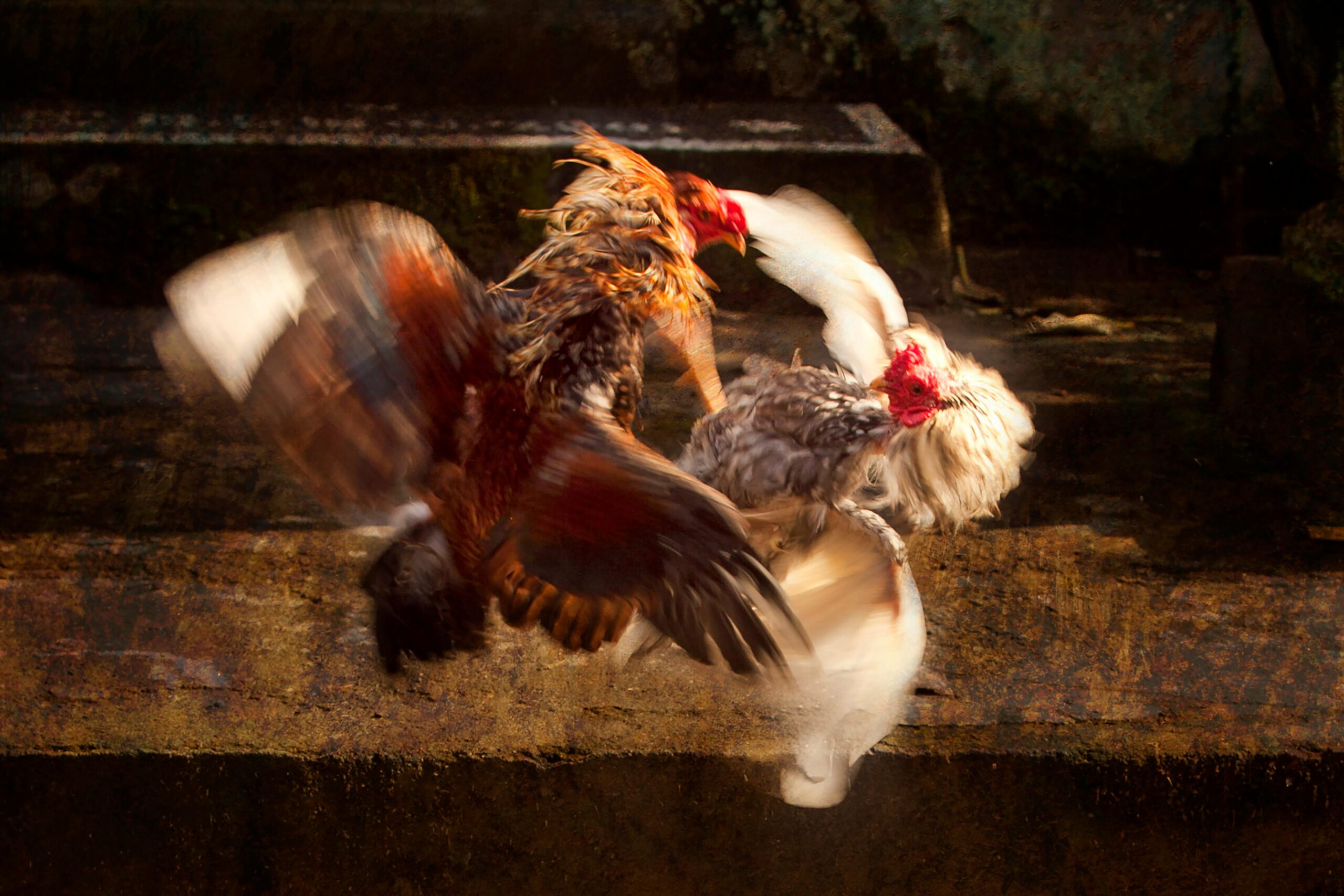
We want you to have a greater ability to learn about some of the unpleasant animal issues in our world.
Courage:
The Story of Modern Cockfighting
Tim Pridgen
CHAPTER VII
Roosters around the World
That one not yield, man has torched his courage at death games all through history. Cocks he knew first. Fascinated, he watched the little gladiators sink their Nature-given daggers into each other in contempt of death.
He watched dogs, and came to know them as throat fighters and leg fighters and gut fighters. Bulldogs became his favorite because they were game. Enthralled, he saw the jaws of one clamp upon the flesh and bone of the foreleg of another and grind until the members snapped, or saw one grip the throat of the other until the victim went limp, or even yet sink his fangs into the soft sway of the other’s belly and tear until its viscera trailed the ground.
He watched boars fight for their sows, saw their white spreading tushes bared as they lunged at each other. A boar fight was easy to understand. They had but one stroke. They ripped. They played for place, for position in which to rush by the flank and rip open the belly. It is not easy. The boar on defense threw out his shoulder and took the whole impact of the tush upon solid meat and sinew. It is a stinking, mouth-foaming, filthy fight, but a boar did have sense enough to run when he felt that he was in danger of defeat. A boar fight has no eternal pull on man’s emotions. The boar is not game.
If you’re a Spaniard, you like a bullfight. That is man in the ring with death. It is closer home even than a cockfight. Its awesome drama grasps you and you disregard the sorry trappings, the gutted, helpless horses, the signs of occasional human cowardice and lack of skill. You wait for the moment of the climax when threatened man becomes triumphant, sinks a steel blade between the shoulders of the bull and steps back the victor. The man escapes. The bull dies. The Spanish like it, but the rest of us never seem to get the point. It begs the question. It doesn’t abolish the fear of death, it merely offers a temporary escape.
No death sport has followed man through from prehistoric times except cockfighting. It had death, but also it had triumph even in death. Triumph and beauty and finesse. No dead gamecock is ever defeated, though he may be killed. One sound only, aside from the thresh of wings and the click of steel, will you hear from a cock while fighting. It is a kind of tenor squawk. It is the only time in a cockfight when the cock’s brilliant valor permits you to have sympathy. That is when the adversary lands a straight blow and the gaff goes into his lungs. You may imagine it without hearing it, the kind of gasp of surprise and terror you, yourself, would give to feel a thin knife sliding through your ribs into your lungs. But you, being a man, have the accompanying vision of running away, crying for a doctor. The gaff is pulled from the cock and none too soon, for he is desperate to be up and upon his enemy. You forget your quiver. The cock says damn a stab in the lungs and, for the moment, you say so, too.
A cockfight, therefore, offers something additional. If we grant that male man’s passion for death sports grows out of his classic desire to dominate death and, therefore, life, we begin to understand. Many things shed light on it — his pagan feasts, his medicine and surgery, his faith healers, his hospitals, his magnificent funeral processions, his great collection of religions and his large assortment of invariably eternal gods. Death is the great enemy and man has attacked it on all fronts. Let us glance at the nations: —
The United States we have seen. We know of this country’s legions of men and women who for one assumed reason or another pay homage to the cock. We do not stop now to analyze their reasons, only note that they are but a small part of a world of cockers, and pass on for a brief glimpse of other peoples.
In Canada, from Nova Scotia’s “Land of Evangeline” to Vancouver’s Pacific, where the land is old and where it is new, they have their cocking mains. The French import the giant Combattants du Nord of their motherland and fight them naked heel, as is done in Belgium — great birds of terrific stroke almost the size of turkeys. Non-Gallic Canadians take immense pride in their particular lines of cocks, the smaller ones such as are in the United States, and swear they are better. They lose, and win, a great deal of money in that belief. They fight among themselves and in the United States.
Mexico has cocking tradition that goes back to the Conquistadores. Cortez may have brought cocks with him when he squired his beautiful Indian mistress into the presence of Montezuma and piled Tenochtitlan high in human flesh. Anyway, cocks soon came to Mexico and have been there since. Mexicans like action and get it with slashers. These keen, curved knives from two to four inches long are placed on one leg. One well-driven slash will just about shear off a wing. The keeper of the great plantation has his fine studs of cocks with which to keep the tradition of Santa Anna and his famous Blues, but the peon, too, has his cocks which he values next to his life.
Go south, into Central America, and there you find your Spanish and American cocks and keen, thin slashers. You find cockpits and cocking places in the village squares. Here you find the crowded, jammed, sweating tropicals hovering over the battling birds. It is more than a recreation. It goes to the foundation of their lives.
It is here, in Honduras, they will tell you a strange story, that of Porfirio Canales who was killed by a cock in the village of La Caridad. The cock was a man-fighter and Porfirio came too close. The cock left his adversary and drove his slasher against the man’s breast. The steel entered the heart and Porfirio was dead. The rooster was arrested, taken before the village judge, and tried. He was adjudged guilty of murder and hanged.
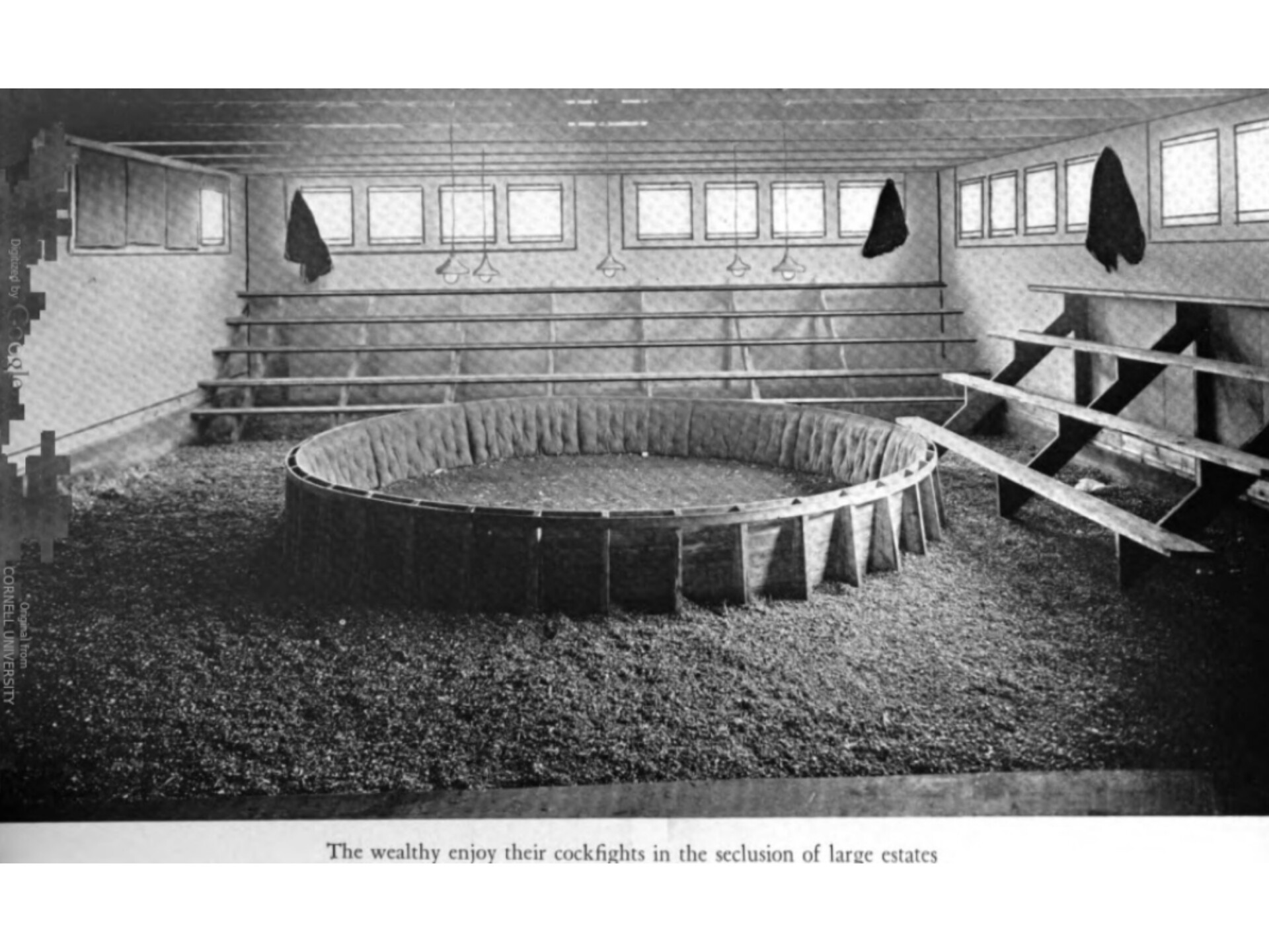
Go into Puerto Rico, America’s own principality, and see the white-clad, wealthy men of the tropics and the high society of that admirable green spot gathered, gripped in the drama of the cockfight in Senor R. Martinez Nadal’s magnificent pavilion near San Juan. Go to the less exclusive, mass-favored big pit in the city and observe the swarthy hordes howl in mighty ecstasy as the feathered gladiators clash and slash. Cockfighting once was outlawed by the United States government in Puerto Rico, but the tug was too strong upon the native heart and it was restored to full legality. Puerto Rico now claims, with real color of title, to be the cockfighting capital of the world. Señor Nadal, who is president of the Senate, has a stud farm which is world-famous. Some of his cocks are valued at more than $1000 each.
And now let us see a Puerto Rican cockfight, and what could be better than through the eyes of the inimitable Journalist Luis Progress writing for San Juan’s El Munde, concerning a special battle at the Nadal pit: —
“The combat of the day was a black-red cock from Cabo Rojo, the property of Chago Padilla and a blue-red cock, the property of Pio de Jesus.
“I never saw anything equal. The fight was for a $4,000 purse, $2,000 on each side, and there were side bets for $3,000 more. The expectation was enormous. There was a delirium in the crowd present. When they billed the cocks even then the bets were very heavy. The pitters in the center of the pit made all kinds of malabaric gestures with the cocks. The referee would ask the pitters to let the cocks go, but the pitters kept on with their gestures. They held the cocks up. They brought the cocks downward. They even gave two or three zigzags to the sides. They looked at the beaks and they even kissed the cocks, and when everybody was with the nervous system shattered, they let the cocks go. A big boisterous crowd gave up and the pit seemed pandemonium.
“’A hundred dollars to Little Soldier,’ from Cabo Rojo.
“’Five hundred,’ cried Pio de Jesus.
“’I take them,’ cried Chago Padillo.
“The two cocks engaged in the most desperate fight ever seen. They seemed to be the real gladiators. Just when it seemed that Little Soldier had won the fight, the people from Cabo Rojo began giving great odds. In the meanwhile bets of ten, fifteen and twenty dollars grew up like grass in a wet field. When the combatants were engaged in a duel to death, stab to stab, the Cabo Rojo cock Little Soldier came out blind in both eyes and to what avail? There were offers of a hundred to fifty, and the bets were doubled on Pio de Jesus’s cock. Little Soldier, blinded, was always on the attack, when he met the blue-red, when he was on again and the crowd kept on shouting. It looked as if the pit would come down. There is a pitting — and another. It seemed as if the blue- red had given up. The cocks were placed in the lines, and the blue-red quit the fight. This was a fight where the people from Cabo Rojo cleaned up. The fight was in natural heels.”
Do you get the surge of it? The tremendous yearn of that crowd for a glimpse, a mere cock’s skull full of gameness? Perhaps you are not moved. Reporter Progress indubitably is a lover of cockfighting and we, perhaps, have no sympathy for that viewpoint, and in that case, by all means, we should turn to a Puerto Rican cock-fight long ago, about the time of the Spanish-American war. Frank G. Carpenter told of it then in the Buffalo Express: —
“The sight disgusts me,” he begins. Ah! Now we’re getting the opposite viewpoint on this amazing sport. He writes:—
“They fight on and on. Now the black one is spurring. The yellow cock is down and the black one on top. Now the yellow is up . . . the cocks almost spent. The black is trembling so that he can hardly stand, but still he fights. The yellow is staggering, but he picks away almost as courageously as when he began. . . . See! The black has lost his right eye, the yellow cock knows it, and for this reason he is fighting him on his blind side. There, the plucky black has jumped up and spurred the yellow. (Author’s Note. The correspondent seems here to be on the point of losing his disgust, but hold firm. It is momentary.) He has driven his spur in under the right wing. It seems to be a mortal thrust, for the yellow falls. The crowd goes crazy. Every man is yelling. The match is over. No! It is not. . . . The cocks are again in the ring. The yellow tries to hold his feet, but he cannot. He falls to the ground and the black stands by and picks him. . . . The poor yellow dying fowl makes one struggle to rise and then lies down. He cannot move and the black cock picks out his eyes, while the human brutes look on and yell. He can struggle no more; he is dead, and the black cock has won.”
“The sight disgusts me,” wrote Mr. Carpenter, and perhaps it is a case for disgust. Perhaps Señor Progress’s enthusiasm is wrong. Let’s not pass on that yet, merely agree on the latter part of Mr. Carpenter’s sentence, which is” . . . but I cannot help admiring the courage of the chickens.”
A short way across blue water and into the lush stench of a Haitian jungle, where it is hot and foul, where you sweat and glory in the relief of it, where thousands of roaming, cock-holding natives converge with you upon an opening under the mango trees, you take Mr. Carpenter’s side of the argument violently. You wish to be away.
Then you merge in with a packed, slick, sweating, black, halitosic circle around a pit. A dozen other pits are in operation in hailing distance. You choose this one. You push and shove and try not to smell, and the roosters are set down in the ring, and crazed wails resound around the pit. The pitters crawl upon their bellies, shrilling, working witch charms, calling upon the gods of men and cocks to bring them victory. The cocks fight bloodily, whamming into each other with jabbing spurs, losing their eyes, losing their blood. The pitters lick the blood and leaking eyeballs away from the cocks’ heads with long red tongues and spit in the dirt. Bah! Mr. Carpenter was right.
But those cocks were game. They fought to the death. The fight would have disgusted Mr. Carpenter, or you, or me, but it had something deep and solid for those Haitian natives. But away with it. Let’s find a light, cool, airy pavilion where one may take a sweet breath, such as in the Coliseos de Gallos of Peru, where cockfighting is legal, regulated, and conducted under the traditions of gentlemen. Fights there are in those little pits, and for all one knows, gameness, too, but the fights are too fierce and swift for a cock ever to demonstrate it.
Proud, brilliant, he stands on the score. His lone slasher, four, five, even six inches long, stands out behind him. The crowd leans forward with drawn breath, for in another minute the cock will be dead or be a victor. The battle will be like an explosion, and over, like that. Perhaps one cock will be game, perhaps both. They never have time to show. Ability and willingness to fight they must have, but gameness for the long bout is not so essential.
Chile, too, has regulated cockfighting. Their sport is not so fast. They fight with slashers, also with naked heels. They look more to the scientific side. They experiment with Aseel crosses, but their basic cocks are the English and Irish and Spanish, as in the United States.
Across from Chile is Argentina, the Yankeeland of South America, which, like the Yankeeland of North America, piously prohibits cocking and fights them north, south, east and west. Many of the Argentine professional men, as in the United States, make cocking a hobby and give it standing. Some of the Aseel and Jap influence is noted, but Bankiva rules there, too. The mains are fought in naked heels or in puons — that is, metal spurs much the same size and shape of natural spurs which are attached by a socket to the spur. In Argentina the cockers aver that there is no chance in the pit, little, that is; that the best cock always wins. The rules are simple, there is no handling, the fights go to a finish.
It is enough. We know now that cocking flourishes from Canada to the Straits of Magellan, all over the New World. They are in Cuba, all the smaller South American states, Brazil, and the islands of the sea. Barely four hundred years ago there was not a cock this side of Europe.
We have mentioned Orientals, Japs, Aseels, but lightly. When the wave of Bankivas was flowing these twenty centuries from Persia to the American Pacific, a much slower wave was proceeding from the lower Orient eastward. Not until our own day did it make a great impression in the United States, and not even yet has it taken a sure place with the brilliant and graceful “Persian bird.” But the Oriental cannot be disposed of so summarily. It is game. It knows a gameness that is deep and awesome, and in that same slow manner in which it fights, it slowly forges eastward.
In India is the Aseel. In America we place that name on the finest Indian cocks and consider it a special breed, but in Indian they call all dead-game cocks Aseel. Again following Finsterbusch who has made a careful study of them we give attention to the Raja Murgh, which is the finest of the Indian cocks and the gamest thing alive. It is the bright jewel of the studs of the princes and few have it. A small, four-to-five-pound cock, red-black and black, it will stand a test, such as that three-day test that Sam Douglas gave his Mugwump, except that it will go nine days and still show fight. Its muscle is so dense, it is said, that when a cock is dropped to the floor it will bounce like rubber.
These are the cocks which once were priceless, and may not be had even yet from all their royal breeders. There are instances where offered prices of $4000 and $5000 for a single cock were refused. One golden-red strain, indeed, has its name, Sonatawal — “weight in gold” — from the fact that its owner refused to exchange it for gold, ounce for ounce.
India is the fountain of cocking and there are various other strains all through the land. The princes have their lines and the common people have theirs. Many of the lesser breeds are extremely game, have to be, for in India a single naked-heel cockfight may last for an hour, perhaps for a day, even for longer than a day.
The Malay bird is found, too, in Siam. It may be native in that ancient country. The cocks attain enormous size, up to fifteen and sixteen pounds. They are fought naked- heel and in slashers.
In Japan are found the Sumatra-type bird, also the Malay and the Bankiva, but from the Malay, or, as the Japanese say, the “Siamese bird,” comes the distinctive Japanese Shamo cock. This is the chief cock of the country and ranges from the great and not always game Amoku to the small aristocratic three-to-four-pound Tuzo, whose gameness is world-famed. This little cock is advertised by its commercial breeders to be “Very good, very nice, fight like hell.” The royalty of the country chose this diminutive cock as their favorite, and they raise some brilliant, beautiful cocks of purplish green-black sheen. Their larger cocks the Japanese fight blunt-heeled and their small birds sharp naked-heeled, sometimes with short steels and slashers.
The Shamo, from seven to nine pounds, is what Americans know as the Jap. These cocks are more numerous on the West Coast of our country than in the East, but are finding their way all through the country, many cockers having experimented with them in Bankiva crosses. The extreme gameness of the Jap and his ability to take incredible punishment make him a desirable cross if those qualities can be transferred without destroying other Bankiva qualities. The breeders have had varying luck in this attempt, but all pretty generally agree that the true secret of making the crossbreed has not yet been discovered.
The Nipponese cockfight is different from that in America. The cocks are pitted and let alone. A cock is not disturbed when he is down but is permitted to lie there until the other cock triumphs or he gets up again. Fights last for a long time, sometimes for hours. It is seen, therefore, that the Shamo’s stamina and gameness are qualities more necessary to his needs than speed.
Where the Bankiva followed the sun from Persia to the Pacific, and went almost around the world, the Oriental went to meet the sun, and has come from the Orient only in a thin line. There is a difference in the texture of their flesh, a disparity in disposition; their nerves are geared differently and their fighting outlook is not the same. The Oriental is the slugger, the Bankiva is the fast and furious wing-and-leg worker, mixing beauty with his vindictiveness. As long as men maintain their present cocking ideals Bankiva will continue to dominate the cocking earth.
Now — England. It isn’t pleasant to write, somehow. The mother country has given us in America a tradition, one of a sort of stiff-necked determination that we like to think of as being in England. Over here we are inclined to follow those laws we like and with youthful insouciance break those we don’t, taking the High Sheriff with us on our escapades and thus salving our consciences. Even so, it pleases us to think of England holding high the standard of law and following it religiously.
We, we tell ourselves, may want to do that ourselves some day. It isn’t a charming thought to envision grim, respectable Englishmen fleeing through the dark carrying battle cocks in their arms, skirting the paths of officers of the law who would catch them if they could. That sort of thing suits our nimbler American role better.
But, what’s an Englishman to do? Surely you don’t expect him to give up cockfighting merely because there’s a law against it? No country yet has . . . not even England. Here’s a newspaper cable from London just before King George’s coronation:—
“London, May 6 — Cock fighting, forbidden sport of a century ago, is being revived this year as an additional thrill for wealthy coronation visitors. So many promoters are getting busy that the Royal Society for the Prevention of Cruelty to Animals have had to offer $500 reward to anyone who will provide information leading to the conviction of a cocker.
“Shortage of game cocks has led promoters to make arrangements for flying birds across the English Channel from France by plane. The first principle of cock fighting is secrecy. Decoys are used to lead any suspicious policemen miles away from the actual scene of combat, while round the arena, which is generally off in the country somewhere, a cordon of watchers is stretched.”
And here is an excerpt from a letter from an English cocker to a friend in America, from which you may get the idea that the sport of Henry VIII is not altogether vanished in Merrie England: —
“Sir John — took on some Frenchmen and lost seven, won three.
“Knappe took on the Newmarket crowd and won five, lost three, drew one. He also took a poundage and won £10 on it.
“Hall-Watt took on Lowther. Thirteen caught. Watt won seven, Lowther five, one draw.
“I have an affair next month with the Birmingham crowd and will let you know the result later.”
It develops that numerous English cockers cross the channel to Calais and either “take on” the Frenchmen or, away from the restrictions of their own laws, fight among themselves. This from the Paris edition of the New York Herald-Tribune:
“Calais. Sunday.— Women and children comprise a large number of the spectators at the cock fights here this evening. There was tremendous excitement during the fights, which took place in a well-appointed building fifty feet by twenty feet, with a gallery at one side, and large sums of money changed hands in betting. British visitors were among the audience. . . . The spectacle seemed to interest the women as much as the men. They were betting enthusiastically and one, a middle-aged woman, told me ‘I do not miss one gala.’ . . . Betting is steadily increasing and I am told that British visitors are placing spectacular wagers at some of these meetings.”
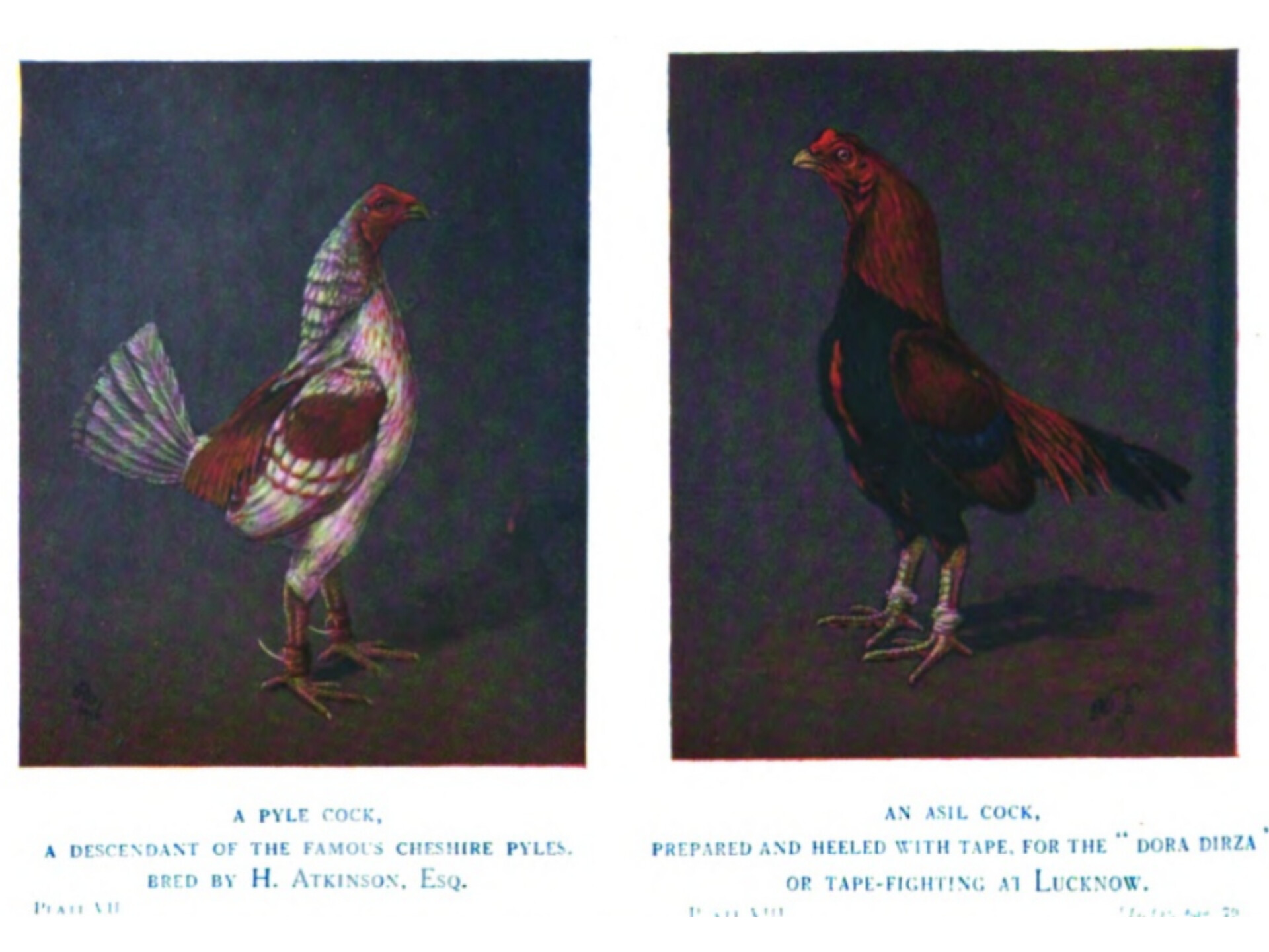
The Old English Game Fowl Club is making a determined effort to preserve some of the old fighting strains still existing, those which have not gone all “show-bird.” There are such strains in the country, preserved by the titled and other old families, and now that cocking is coming back all through the world there is a chance that these thin lines will outlast the pressure and be the fountain head for a restoration of the noble strains which made English fighting cocks supreme.
The recent death of Sir Herbert Atkinson was a blow to the movement, for he had done much to revive the sport. Even so, the work he started in the club still progresses.
Here is a brief clip from a long and interesting letter written to the Editor of the Morning Post by Rev. B. Castel De Boinville, Heyope Rectory, Radnorshire, England: —
“Sir — I was pleased to see the article you published on the ancient British sport of cocking. It will help to dispel some of the popular misconceptions. Cocking has been a British sport for a long time; Cæsar found our ancient British ancestors addicted to it. It was ever the most democratic of national pastimes: the sport of kings and the sport of ploughmen. It has brought together rich and poor, peer and peasant, in friendly personal intercourse in the past as no other sport could have done. . . . No other living creature can demonstrate as can the true game cock what indomitable, unyielding courage is. I am prepared to admit that the man who opposes all blood sports — hunting, shooting and fishing — is logical in opposing cocking, too. I am too out-of-date to oppose any of these pastimes. When England ceases to shoot and hunt and cast the fly I believe she will be, in consequence, the poorer in character. The ban on cocking has certainly not helped to increase the national grit.”
English cocks once crew over the dead bodies of French cocks, but it is not so any more. The French cocks are large, these Combattants du Nord, ranging up to twelve pounds. The French prefer them at eight to eleven pounds, which, by reason of some freak of climate or other mystery, is their normal weight, and at that poundage they fight like demons. They demonstrated their supremacy over the English “shakebags” years ago, and a Britisher considers himself lucky when he wins a fight — that is when he matches a typical English cock against a typical French rooster. It is a question of weight. The French cocks are naturally big and an English cock anywhere in his range is unnaturally big. Perhaps he lacks something in compensation for his extra size, and therefore is not equipped to match a perfectly developed adversary of his weight.
The French have smaller cocks of the same identity as their grand Du Nords and these are fought at matched weights as in America. The smaller cocks are fought by the peasants all through the country, but the traditional cock of France is the large bird and he is fought in the big mains. By reason of their size the large cocks are not fought at matched weights, but as “shakebags,” without weighing. Two-inch gaffs much after the American style are used. These, by the way, were introduced a number of years ago by America’s Dr. Clarke. The French fight lasts only fifteen minutes, but owing to the speed and strength of the warriors that is quite enough. For show purposes the Du Nord, it is said, “surpasses any other variety in elegance of stance, resplendent colors and nobility of origin.”
When one speaks of French cocking the name of the venerable Henri Cliquennois soon arises. He is to the cockers of that country what Dr. Clarke is to those in America. His collection of cock spurs (here’s an idea for those with the collecting urge) is one of the greatest.
The French “gallo-drome” or “parc de coqs” is all through the land an accepted part of community life. The pit at Roubaix with a seating capacity of two thousand is said to be the largest in the world.
Belgium, too, has an enoromus cock, large, perhaps, for the same unrevealed reason that the North of France cocks are so large. The reason is something that concerns the territory and not the breeding for when the big cocks of Belgium and France are taken elsewhere they lose their stamina after a few generations. Belgium’s dull grey Flemish cocks range up to thirteen pounds. They fight in steel and are said to be the heaviest steel fighters known. They are not so swift as the French birds but are very strong. The Belgians also have another larger and slower cock which they fight in naked heels.
The Irish cock is a shrewd, savage, fast fighter, and gathers his pitside crowds all through the country. It is supposed to average slightly lighter than the English cock in weight and slightly in advance of the Spanish cock in point of development from the wild Bankiva.
When the Spanish cocking scene is discussed much, of course, must be taken for granted. No one can say, as this is written, what will be left in Spain. Newspaper articles, however, recently have reported that bullfights are staged as usual in many places and that cockfights continue popular. The two chief types are the traditional Bankiva bird, slightly smaller than the English and the Irish cousins, with full feathers, and the “hennie,” a peculiar strain of cock described elsewhere. The pits in Bilbao, Oviedo, Madrid, Barcelona, Valencia and other Spanish centers formerly consumed from five thousand to six thousand fighting cocks a year and still other thousands were exported — many to North and South America.
In many other places of the world the seeker for rooster fights may see battle cocks in action, Sweden alone taking the distinction of having none. Russia has an extremely old cocking tradition, the sport once having had an overwhelming vogue in that country, sweeping the people to unprecedented heights of gambling. Now, however, few if any reports of cockfights come out of Russia.
Cockpits are to be found in Africa, where the sport is followed by all degrees from the savage blacks to the imported whites; in Australia, where some brilliant mains are reported from time to time; on the great Island of Madagascar, which boasts its own mysteriously old line of Malay-type cocks, and on literally hundreds of other islands. And where, to end our journey, could be more pleasant than at a cock meet in the verdant hills of the dream island of the South Seas, Bali?
It is the time of the nyepi, the religious rite which is an attempt to appease the evil spirits which thirst for blood and threaten the fields of rice. The Dutch officials, grounded in the wisdom of the enchanted land, do not interfere. There are many cocks delivered at the fighting grounds in baskets. There will be many cockfights. The gandji, the coconut-shell water-clocks, are placed in the water to time the length of the combats. The natives bring out their kepengs and their more valuable ringgits and make wagers recklessly. The cocks are fetched from their baskets, displayed before the crowds, and the battles begin. There is a period of wild enthusiasm, the spirit of sport mingling with religious fanaticism. Then the fights are ended. The bets are paid. Blood is on the soil. The ground is cured. The evil spirits are appeased. The rice will grow. So there is cause for celebration. The dead cocks are dressed and cooked and a great feast is prepared for that night. Nobody enjoys a cockfight more than the Balinese.
Tim Priden, Courage: The Story of Modern Cockfighting (Boston: Little, Brown and Co., 1938), pp. 115-136.
See: https://babel.hathitrust.org/cgi/pt?id=coo.31924052110743&seq=1
Fighting Sports
Capt. L. Fitz-Barnard
THE HUMANITY OF COCK-FIGHTING
It is unfortunate to be compelled to state the obvious, but it is often necessary. Cock-fighting is considered cruel by unthinking people. It is, however, one of the few sports that contains little, if any, of that objectionable quality. Nothing, I suppose, has not its cruel side, for the laws of Nature are cruel, from the pains of child-birth to the pains of death.
It is usually thought that cruelty was the reason why cocking was banned in England. This is not so. The reason is that, unfortunately, there is a considerable minority of hysterical persons of both sexes in the country who hate to see others enjoying themselves; and by banding together they have succeeded in imposing their will upon a careless majority.
Often have I known men and women shudder at the thought of the cruelty of cocking, and when a few plain facts have been pointed out to them have replied: “Oh, I didn’t think of that,” and all the same have soon reverted to their original attitude of disapproval, as they consider it the correct thing.
Doubtless some of these sentimentalists are honest people in their way; but while their sentiments may be good, their ignorance is colossal, and they speak and give their opinions, and even write on a sport that they have never seen, and of which they know absolutely nothing.
They ban cocking, and condone fishing, hunting, and shooting. Where you have unwilling agents there must be cruelty, and no sane person can pretend that the fish enjoys being lured to death, often with live bait; that the fox or hare likes to be hunted and torn to pieces; or that the birds and beasts prefer a lingering death from gun-shot wounds.
Where the agents are willing, there can be no cruelty; one man can put a cock in the pit, but fifty cannot make him fight. If the game-cock was not meant for fighting, why was he created? Other fowl are as good for all other purposes.
I do not condemn other sports, I love them all. Some cruelty must exist until the laws of Nature are changed, but what I do say is that cocking is the most humane of all sports.
Recently I read an article on the brutality of cock-fighting, which made me wonder at the author’s mentality.
He starts by saying that the brutality does not lie in the actual suffering of the birds themselves; states that some of the original promoters of the Society for the Prevention of Cruelty to Animals expressly exempted cock-fighting from their strictures. One of them and not himself addicted to it — points out how the game-cock is kept in comfort till the day of battle, and then he cannot be forced, but is actuated by his natural instincts, and in fact gratified. Says, further, there can be little doubt that if a game-cock (I think we might add anything) had the choice offered him of having his neck wrung, or meeting an antagonist, he would unhesitatingly prefer the latter, and is conscious of little beyond the fierce joy of the combat during all that befalls him.
Goes on to say that neither, as many suppose, can the use of metal spurs be deemed additional cruelty, as they terminate fights far more quickly. Admits that in mere suffering of the victim, cocking is more humane than shooting and some other sports which still hold their ground, but advances the callous theory that the amount of suffering involved is not the real point, but that in other sports the suffering, be it what it may, is either unnoticed or forgotten, and gives as an example that in fox-hunting most of those who participate never see the fox suffer, and that the lady who receives the brush has not seen the fox torn to pieces by the pack.
But, says he, in cock-fighting it is far otherwise, and the suffering of every bird has the riveted attention of every person engaged, who is thus habituated to disregard the constant sight of blood and pain, and that it is therefore brutalising. However, our author admits that in rough, rude times this had its uses, and helped to make men who fought the world.
Now it appears to me that, to the ordinary mind, this is a fine defence of cock-fighting; only it is necessary to point out that it is not the suffering (if there is any) of the birds that receives the riveted attention of every person engaged, but, on the contrary, the cocker fixes his admiring attention on the skill and courage, and the deathless struggle against adversity, of these truly wonderful birds, and by their example he is driven to endeavour to emulate these noble qualities.
As to the brutalising effect (which exists only in the imagination), may I remind this enlightened critic that war to-day is more bloody and brutal than ever it was, and that disregard for pain and contempt of death is what we want.
Cock-fighting is the most humane, perhaps the only humane, sport there is. The game-cock loves fighting, the joy of battle is his greatest joy; if he dies, he dies as all brave things would wish to die. As a chicken he is brought up with the tenderest care and attention; as a young cock he is kept in luxury and freedom, monarch of all he surveys; after two years he is given the joy of battle, and if he dies, what more could a brave heart ask? This is called cruelty!
Compare the life of the common cockerel; dragged up in dirt and squalor, then confined with others in a narrow pen, stuffed with food, if he is lucky, and then bled to death (a by no means pleasant ending) after a few months of miserable existence. Ask a man which life he would prefer!
Were cocking nowadays exhibited to the people, and speakers appointed, extolling the courage, skill, and constancy of these truly heroic birds, and applying it to the people present, nothing but good could come of it.
THE LAWS OF COCKING
Both, obstinate, maintain the Bloody Field,
Both can in Combat Die, but neither yield.
The rules of cocking are very old; I do not know how old they are, but at any rate those in vogue now were in use when the Merry Monarch ruled in England, and probably hundreds of years before that.
They have come down to us, but in somewhat fragmentary form. Certain clauses are very distinct and cannot be mistaken, yet very many contingencies in a battle are not provided for.
In the old days all rules seem to have been somewhat incomplete, but, as I have already pointed out, cocking was always an honourable sport, and strict rules were not necessary; moreover, everybody knew the customs, etc.
In all other sports the old rules have been revised many times, and in cocking alone are the old rules still adhered to without alteration. As cocking is equally honourable to-day, rules are scarcely necessary, and, in fact, I have known men who have fought cocks for years who know nothing about the rules.
All the same, I think it advisable to be acquainted with the laws of any sport you indulge in, and in case they should be forgotten altogether, and for the sake of those who may some day again enjoy this royal sport, I am giving the rules as observed up to a few years ago, merely observing that the old rules have been copied verbatim where they apply; that certain old rules have been omitted, as no longer applicable — for example, the old rule for weighing — and that the customs more recently in use have been added, in the hope that in the future they may again be useful.
THE RULES OF COCKING
- The masters of the match shall be considered to be the two opposing parties who are fighting the main, and if either, or both, of the opposing parties consist of more than one person, that party shall elect one of their number to be the master, and he shall be responsible for the actions and liabilities of his side.
Before the commencement of the main, the two masters shall agree upon a referee, whose decision shall be final, and subject to no appeal.
The referee shall make the match-bill, superintend the weighing of the cocks on the pit, see that they do not exceed the match-bill weights, and that the following rules are in every way adhered to.
- Each party shall produce a list with the exact weights of his cocks, on the morning of the main, and at the hour named in the articles, and the lists are to be compared and the match-bill made. All cocks within 1 oz. of each other, under 5 lbs., and all cocks within 2 oz. of each other, at 5 lbs. or over, are to be matched, unless otherwise stated in the Articles of Agreement.
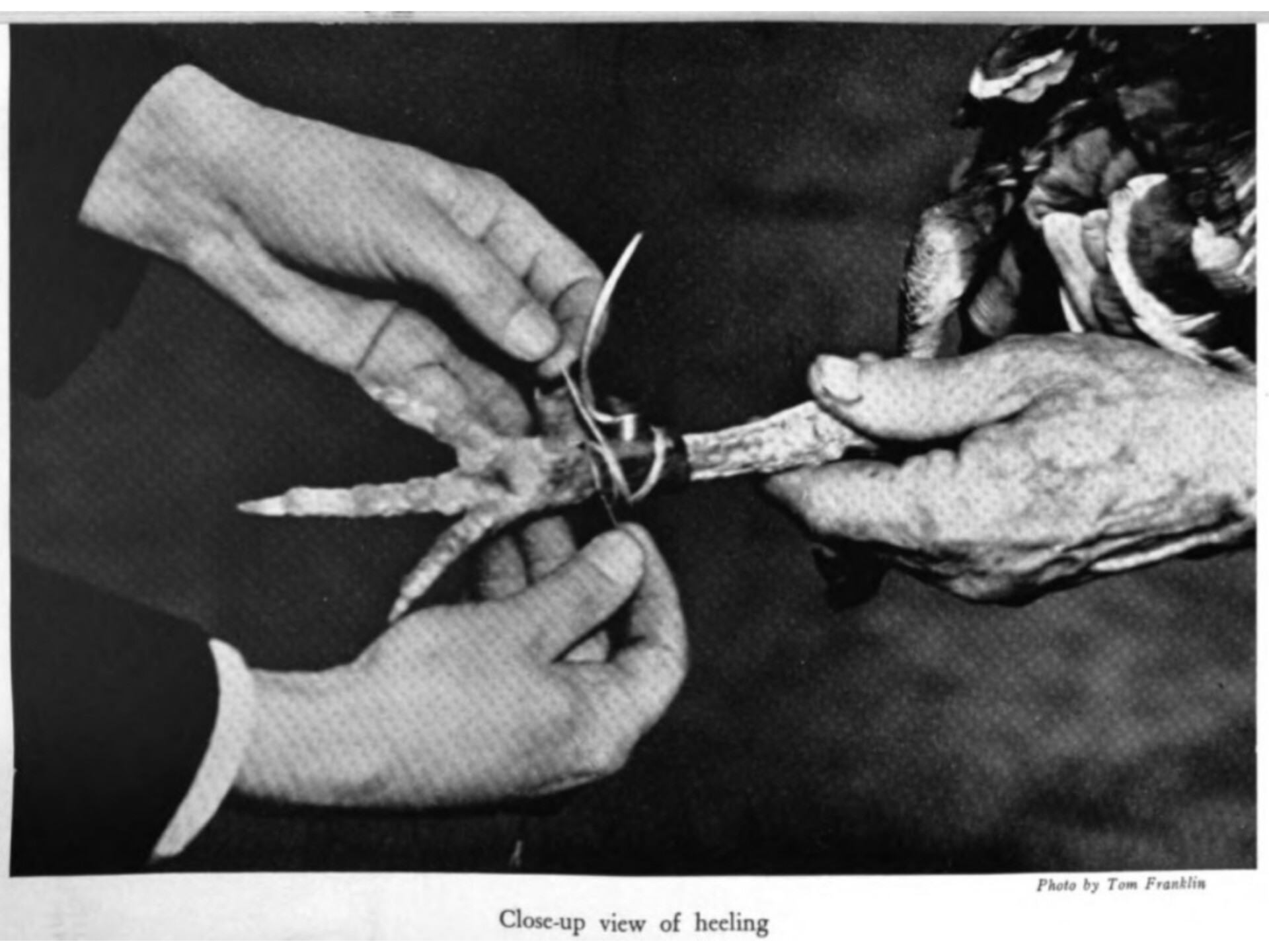
The cocks to be weighed at the pit-side, cut out, and heeled, before being put in the pit.
One ounce to be added to the match-bill weights for spurs, and half an ounce for teaser. Either party weighing in a cock heavier than the match-bill weight plus the spur and teaser allowance, shall lose the battle, which shall count against him in the main.
The main to commence by fighting the lightest pair of cocks (which fall in a match) first, proceeding upwards to the end, so that every lighter pair shall fight before those that are heavier.
- No persons to set-to but those that are appointed by the masters of the match, and no change of setters allowed during the main, except by the mutual consent of the masters of the match.
- That every person show and put his cock into the pit with a fair hackle, not too near shorn or cut, or any other fraud, and in fair spurs, i.e., round and tapering from socket to point, and no drop-sockets.
- That every cock to fight as he is first shown in the pit, and without cutting or shearing any feathers afterwards.
- To commence each battle the setters-to shall present their cocks to each other in hand, in the centre of the pit, and permit them to peck at each other several times; they shall then retire to their corners, and set their cocks on their feet in their own corners, and not to touch them again except as provided by these rules.
The setters-to are to toss for choice of corners, and to change corners after each battle, and they are not to leave their corners except to handle their cocks, when entitled to do so.
- When both cocks are set down to fight, and one of them runs away before he has struck a blow, it is adjudged no battle to the bettor, but the running cock loses the battle in the main. If, before fighting, both cocks run or refuse to fight, it shall be deemed a drawn battle.
- The setters-to must handle (i.e., pick up) their cocks, when they are hung in themselves, in the other cock, in the sod or mat, or the side of the pit, when a cock is on his back with both feet off the ground, or when either cock is touching the side of the pit. A setter may also handle his cock if it is well in its own corner.
When a cock is hung in his adversary, his handler must promptly handle him, and hold him steady on the floor of the pit, until the opposing handler withdraws the heels, which he must do by holding his opponent’s cock by the leg below the hock. Under no other circumstances may a handler touch his opponent’s cock.
- When both cocks leave off fighting until one of the setters-to can tell forty (40) gradually (this is the short law), then the setters-to are to make the nearest way to their cocks, and, as soon as they have taken them up, to carry them into the middle of the pit, and immediately deliver them on their legs, beak to beak, when if one cock fights and the other refuses, the setter-to of the fighting-cock can count (10) gradually, and call out “Once refused,” then they are to be set-to again in the same manner as before, and continue it till one cock refuses fighting ten several times, one after another (this is the long law), when it is that cock’s battle that fought within the law.
But if the cock that is being counted out fights during the count of any one of the tens, he breaks the count, and the battle continues; and the setters-to, when they are entitled to handle, must retire with their cocks to their corners, and set their cocks from their corners, and the long law must be begun afresh.
If both cocks refuse fighting until four or five, or more or less times are told, and then one cock fights, the setter-to is to continue the number on until one cock has refused ten times; for when the law is begun to be told, it is for both cocks, for if one cock fights within the ten tens, and the other not, it is a battle to the cock that fought, counting from the first setting-to.
If, after the short law (40) has been told, and when the cocks have been set-to as directed, and both cocks fight, the battle continues; but if both cocks cease fighting, until one of the setters-to can count ten gradually, they may then handle their cocks, and immediately deliver them on their legs, beak to beak, in the middle of the pit, and the long law commenced as directed before; but if the cocks are handled for any other reason, as provided by these rules, viz., hung in themselves, etc., the handlers must retire with their cocks to their corners and set them in their corners; when, if both cocks refuse fighting, either handler can count ten, and the cocks are to be picked up and set in the middle of the pit as before directed, and the long law commenced as before directed.
Be it understood that the setters-to can always handle as provided by Rule 8.
- It sometimes happens that both cocks refuse fighting whilst the long law is telling; when this happens, a fresh cock is to be hovelled and brought upon the pit as soon as possible, and the setters-to are to toss up which cock is to be set-to first, and he that gets the chance is to choose. Then the one that is to be set-to last must be taken up, but not carried off the pit, then, setting the hovelled cock down to the other five separate times, telling ten between each setting-to, and then the same to the other cock; and if one fights and the other refuses, it is a battle to the fighting-cock; but if both fight, or both refuse, it is a drawn battle.
The reason of setting-to five times to each cock is that ten times setting-to being the long law, so, on their both refusing, the law is to be equally divided between them, as they are both entitled to it alike.
- Another way of deciding a battle is: if any person offers to lay £10 to 5s. (that is, if he is a person thought capable of paying it, if he loses, or one that stakes his money on the mat), and no person takes it, until the setter-to of the cock on which the odds are laid tells forty (40) gradually, and calls out three separate times, “Is it taken? “Is it taken ?” “Is it taken?” and no one does, it is the cock’s battle the odds are laid on.
The setters-to are not to touch the cocks during the time the forty is telling, without either cock is hung in himself, etc.
If the bet is taken, the battle continues as before.
This is called pounding a cock. A cock may be pounded more than once, or a pounded cock may recover, and the other cock be pounded.
If cocks get hung during any count, they may be handled and the spurs withdrawn, but must be set down again immediately and the count continued.
- If a cock should die before the long law is told out, although he fought in the law, and the other did not, he loses his battle; for sure there cannot be a better rule for a cock winning his battle than killing his adversary in the limited time he is entitled to by cock laws. If both die, the battle goes to the longest liver.
- Pecking, or striking, whilst on the pit floor, but not during a handle, shall be considered fighting.
N.B.— Pulling a cock’s head up by the hackle, and letting it fall, is not a peck or fighting.
- When cocks are to be set-to beak to beak as directed by these rules, if one or both cocks are blind, they are to be set-to breast to breast (touching) instead of beak to beak.
- When setting a cock, the setter-to must set his cock on both legs in the pit, and not on his side; he must not push or hold his cock, but must take his hands off the cock immediately he is set on the pit, and not touch him again until he is entitled to do so by these rules
- It is permissible to remove feathers, dirt, etc., from a cock’s eyes, beak, or spurs, during a handle, but not in any way to readjust the spurs. A broken or untied spur cannot be replaced or cut off during a battle.
- All bets to go with the battle-money.
- The breaking of any of these rules by a setter-to, or any of his party, shall render their cock liable to disqualification.
- The referee shall decide (1) any question not provided for in these rules; (2) the interpretation of any of these rules.
In all cases of dispute the cocks shall not be taken from the pit, nor their spurs removed, until the referee has given his decision, which shall be final.
THE RULES OF THE WELCH MAIN
A Welch Main is when eight or sixteen persons enter a cock apiece at a specified weight for a certain sum each. The method followed is the same as in a boxing competition: the eight or sixteen cocks are matched in pairs, which consequently makes four or eight battles. The winners fight again, which makes two or four battles. If there were only eight cocks in the main originally, the two winners fight again, and the victorious bird wins the main and the stakes.
In the case of sixteen cocks originally, the four winners fight, and then the two winners meet to decide the main; so that in an eight-cock Welch Main the winner fights three times, and in the case of a sixteen-cock main, four times. Of course, in each battle the ordinary rules of cocking are observed.
All cocks must be weighed to see that they do not exceed the stipulated weight. One way of matching them is that those which fall nearest each other in weight fight together; and the same method with regard to matching those that are nearest in weight is observed every time they fight.
Another way is to put all the owners’ names in a hat, and a person draws two names, who meet in the first battle, then two more, who meet in the second battle, and so on.
Afterwards the winner of the first battle meets the winner of the second, and the winner of the third meets the winner of fourth, and so on.
RULES OF THE BATTLE ROYAL
A Battle Royal is when any number of persons each enter a cock for a specified sum. All the cocks are set in the pit simultaneously and left to fight it out, until only two are left alive, when the owners of these two cocks must enter the pit and set them as in an ordinary battle.
The winning cock of these two wins the Battle Royal, and the stakes.
A person should be appointed to remove all dead cocks from the pit and to turn any cock on to his feet that may be laying on his back; but on no other consideration may any cock be touched until only two are left alive.
It is possible that the old rules could be improved, and there are some who would do away with the “poundage,” claiming that it often prolongs a battle, as there are always people who will take it, on the chance of winning £10 at a very small outlay, and also that it causes disputes.
Now I would point out that the idea of the poundage rule was to shorten a battle when a cock had no chance of winning, and if a person offers the odds too soon he deserves to lose his money, and in any case, if there is much at stake, a man will not withdraw his cock until he is beaten.
Others again object to the rule concerning the “hovelled cock,” as they maintain it takes up too much time, and is also unnecessary, and that a draw would be the proper verdict, if both cocks refuse fighting whilst the long law is telling. There is much to be said for this point of view.
Personally I would like to see a rule by which, as soon as a cock unmistakably runs, he loses the battle, unless the other cock is also running, in which case it would be a draw.
By the present rules, if the long law is in, and a cock fights and then runs, provided the other cock does not fight he wins the battle. However, this contingency is so remote that it may not be worth while legislating for.
I would also do away with the rule that a setter may pick up his cock in his own corner. For one thing I am sure that this is a recent innovation, and it opens the way for a lot of picking up, and even sharp practice.
The setter-to could move out of his corner when the cocks are in it.
It may be interesting to add here that though for over two hundred years cocks have been matched by weight, it was apparently not always so, for the author of The Royal Pastime of Cocking, published 1709, says:
Then as for matching of cocks, ’tis now all the mode of late to weigh them, so that be they thick or thin, long or short, they take their chance, falling in according to weight, let their shape be never so different.
But in my opinion, the good old way of matching small cocks is still the best way, and most exact; to measure them by hand, and match by the eye (if the handler have any skill), will make them fall in tite [stet]: besides, a cock that is well fed shall weigh far lighter than one that is ill fed, or not fed at all.
N.B. — With all due respect to such a great authority as our old friend Robert Howlett, I do not think that he makes out a very good case for his method.
Capt. L. Fitz-Barnard, Fighting Sports (London: Odhams Press Ltd, 1921 [?]), pp. 10-20. Images appear on the frontispiece and pages 12, 36, 68, 73, 84, 188, and 228.
See: https://babel.hathitrust.org/cgi/pt?id=uva.x001219193&seq=1