Giraffes
We want you to have a greater ability to learn about some of the unpleasant animal issues in our world.
The Big Game of Africa
Richard Tjader
CHAPTER V
THE HARMLESS GIRAFFE
The tallest of all living creatures is without doubt the giraffe. When seen in the open or even in thin bush country, he reminds one very much of the curious creatures of prehistoric times, exhibited in the museums of natural history, so queer does he seem. Giraffes exist now only in Africa, although a good many discoveries of fossils show that they, like a good many other huge tropical animals of ages past, were formerly found also among the hills and valleys of southern Europe, Persia, and India. The giraffe is a kind of link between the deer family and the bovine animals, such as oxen and buffaloes, being, like the latter two, a cud-chewer.
The hairy horns of the giraffe are in young calfs easily separable from the bone of the skull, but the inside core grows in time together with the head bones, like the horns of oxen or buffaloes. The giraffe’s eyes are of a deep brown color, with large pupils and long bushy lashes, and they are wonderfully soft and beautiful. The tongue is extremely rough, a very necessary quality, as the animal feeds chiefly from the thorny desert trees, and it is unusually long, measuring from fifteen to eighteen inches. The upper, prehensile lip is also very long, tough, and covered with thick, short hair, so as to enable the giraffe to feed more easily upon the mimosa tree without getting stung by the sharp thorns.One of the most curious-looking sights in Africa is a herd of giraffes trotting off with a sort of rocking-horse, single-foot motion, with their enormous necks carried a trifle lower than the line of their backs. The animals stand much higher over the shoulders than over the pelvis. Although absolutely harmless and mild-tempered, the giraffe is, on account of its unusual height, sometimes a “menace” to civilization in British East Africa, for it has repeatedly happened that a big bull-giraffe has forgotten to “duck” when crossing the telegraph line along the Uganda Railroad, broken the wire with his lofty head, and thus disturbed communication.
The great height of the giraffe enables him to eat the young shoots and leaves off the topmost branches of the mimosa and other trees, which constitute his chief “menu”; but it makes it, on the other hand, very awkward for him to partake of the “salt licks” on the ground, or drink from a shallow water hole or stream, for he has then to spread out his front legs so far, to be able to reach the water, or the ground, that it takes him a considerable time to get up and away again if disturbed.
Fortunately for the giraffe, he seems to need but little water, and in this respect he is very much like the camel, which animal reminds one more of the giraffe than any other living creature. The natives of different districts in British East Africa have assured me that the giraffe can go for many weeks and even months without drinking, and this partly explains the fact that he is mostly found in dry and practically waterless countries.
Such favorite feeding grounds are, for instance, the Seringetti Plains, between Kilima-Njaro and Voi on the Uganda Railroad, and in the thorn and fiber plant deserts around the latter place. He is also found in the central parts of the Protectorate, to the northeast of the Athi Plains, which he occasionally crosses over to the big Southern Game Reserve. In the northern part of the Protectorate he is abundant both north of Mt. Kenia and the Guasco Narok river, in the partly waterless Samburu country, and on the Guas Ngishu Plateau, southeast of Mt. Elgon. As the dew is generally very heavy in these districts, he may get almost all the water he needs from the dew-covered leaves that he eats in the early morning.
Almost every animal makes some kind of a sound when angry, wounded, or when wanting to “communicate” with other members of its family, but the giraffe seems to be absolutely mute. I have asked several hunters, who have had opportunity to observe a great many giraffes at close quarters, about the muteness of this animal, and they have all assured me that they never heard the giraffe utter a sound of any kind, neither when pursued, scattered, cornered, wounded, or dying. This native trackers and hunters all over East Africa have also repeatedly corroborated.
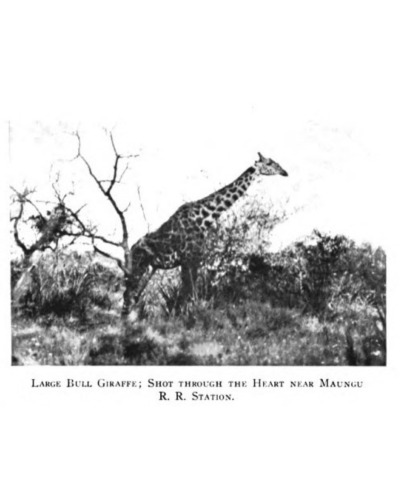
In 1906, not far from the Maungu station on the Uganda Railroad, I shot my largest giraffe, which measured over seventeen feet in height. We had started from our camp at Maungu long before daybreak in search of a big giraffe, which was reported as having been seen the previous day from the railroad. After having marched for over an hour, feeling our way in the dark, I suddenly stopped in the twilight, seeing a small object falling down from the branches of a mimosa tree. In the twinkling of an eye I saw an animal run up in the tree, only to drop down again the next second like a ball into the high grass.
My first thought was to take the shotgun and bring the animal down, but fearing that the giraffe might be in the vicinity and take alarm from the crack of the gun, I whispered to some of the natives to rush forward the next time the animal fell to the ground and throw themselves over it. They did so, far quicker than I could imagine, for the next moment one of the men rose from the grass holding between his hands a beautiful Civet cat, which had injured him considerably with its sharp claws and teeth.
I was right in my supposition about the giraffe, for we had only gone forward some fifteen minutes more, when I saw a large giraffe head towering above a good- sized mimosa tree some five hundred yards away. By this time it was light enough both to shoot and to take photographs, and, as I was very anxious to have this magnificent animal “kodaked” before it should fall, I ordered my men to throw themselves flat on the ground, and with only Mr. Lang, the expedition’s taxidermist and photographer, and one gun bearer, I approached the giraffe as carefully as possible.
When within about one hundred and fifty yards, the giraffe had caught a glimpse of us from his exalted viewpoint and started to walk away with long strides before it was possible for Mr. Lang to snap him with his camera. I then raised my .405 Winchester and fired, aiming at his heart, but the giraffe continued his walk as if nothing had happened. I fired a second and a third time, but with the same result. I knew that I must have hit the animal, and said to the gun bearer: “He must have a charmed life; give me the big gun.” This was the powerful .577 Express rifle, by the natives called “msinga” (cannon).
We had in the meantime kept pace with the giraffe, as he was still simply walking away, and at about the same distance I fired with the big gun, aiming again for his heart. Now the big bull instantly stopped and allowed us to come right up to him. This splendid opportunity was used by us to make some good pictures of the old giraffe, which tried in vain to walk away from the spot. He could evidently only lift one of his front legs a little. There he stood, without uttering a single sound, looking straight at us for a few minutes. Then his hind legs gave away, and suddenly he toppled over backwards and fell dead.
The fact was disclosed, when we were skinning the animal, that all the three “soft-nose” bullets fired from the Winchester had only penetrated his skin, which is about an inch thick, and lodged in the ribs right over the heart, not more than a few inches apart from each other, whereas the one steel-capped bullet from the .577 Express had crashed through the side of the giraffe, penetrated its heart, broken two ribs on the opposite side and almost protruded through the skin! As the wounded giraffe looked up at me with his beautiful eyes, I felt that, had it not been for the sake of the American Museum of Natural History in New York, for which I was collecting specimens of big game at the time, I would never have forgiven myself for killing this magnificent animal. I thought, however, that he was more worthy of being admired by thousands of intelligent Americans in one of the finest museums of the world, than to continue to roam around, hidden in the jungles of Africa, and one day to die of old age, or fall an easy prey to a bloodthirsty lion!
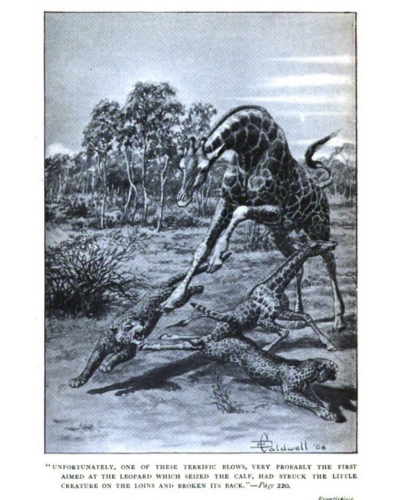
It probably very seldom happens that a full-grown, healthy giraffe is attacked, or killed by a single lion, unless suddenly overtaken, when, for instance, in a drinking position, when old and feeble, or sick. For with his powerful front feet he could well beat back and even kill a lion. A cow giraffe was once seen attacking a lion which tried to kill its calf. The furious mother drove off the lion with its forefeet, but also unfortunately hit its own baby” with one of the blows, instantly breaking its back and killing it on the spot.
A German settler from the country southwest of Kilimanjaro told me that he had succeeded in capturing a number of wild animals, which he subsequently had sold to the well-known wild animal merchant, Mr. Hagenbeck, of Hamburg, who near that city has one of the finest private zoölogical gardens in the world, which is well worth a visit. The German settler also wanted to capture young giraffes, but had, according to his own almost incredible story, repeatedly been “driven off” by their desperate mothers, as he was not allowed to shoot them, according to the game laws of German East Africa.
One day, however, he succeeded in separating a young giraffe from the herd, and with his black helpers he got hold of the “baby,” which, although probably but a few months old, stood fully nine feet high. After a hard struggle, during which two of the negroes had been rather badly hurt by kicks, but during which ordeal, to use my spokesman’s own expression, the “youngster never said a word,” the young giraffe was finally overpowered and driven into the “shamba,” or farm, where it, in a very few days, became so tame that it followed its capturers around like a dog, freely mingling with the cattle.
But, alas! a couple of days before it was to be shipped down to the coast, it quite suddenly developed some malignant disease, growing thinner and weaker every day. One evening it did not return home with the cattle, and when the people went out to look for the giraffe, it was found dead under a mimosa tree, with two leopards feasting upon its body. Whether slain by these cunning and powerful bush animals, before it had died from its disease, or whether it was found already dead by the leopards, could not be ascertained, as the big felines had already devoured too much of it. Later on I shall tell the circumstances under which these two leopards were subsequently killed.
A British sportsman and settler who keeps a regular “shooting box” in the lower Kedong valley, only a day’s march from the Kijabe Railroad station, a Mr. Barker, a great animal lover, succeeded also recently in capturing a young giraffe, which soon became very tame. Sometimes, when “just playing,” this beautiful animal hurt several of the men by “friendly kicks” from its powerful hoofs. Even this young giraffe developed some disease and soon died, in spite of the best of care. These cases show that, although it may be comparatively easy to capture and tame a “baby” giraffe, it is very difficult to bring it up on ordinary cow’s milk or artificial food until it is old enough to make its own “living” from trees and shrubs.
There is little or no real sport or excitement in giraffe hunting, for, as already remarked, the animals are absolutely harmless and will never, even when wounded or cornered, really attack a man. On the other hand, as the giraffe is exceedingly wary and has doubtlessly good scenting qualities, like almost all wild animals, and very good eyesight, he is most interesting to stalk with a view of obtaining an insight into his habits and of “taking his pictures.”
Tales about charging giraffes should not be taken very seriously, for no really authentic case can be found of giraffes actually charging a hunter. On my first trip to Africa I had shot a large bull giraffe near the little Koma Rock, on the northwestern part of the Athi Plains. As soon as the bullet hit the animal it went down, and when Mr. Lang and I ran up to the bull and had got up to within fifteen yards of him, he gathered all his last strength, got up and staggered toward us before he, hit by another bullet, went down, never to move again. We were both absolutely sure that the wounded giraffe never intended anything in the way of a charge, but that he was so bewildered from pain and excitement that he simply did not know what he did. Mr. Lang remarked to me that probably a good many “nervous hunters, with vivid enough imagination, would be able to construct out of this occurrence a “terrific charge.”
When a fresh giraffe track is found, it is generally not so difficult to follow, for the great weight of the animal impresses his large hoofs in the soil deep enough to be readily seen by any man, even with a limited experience in tracking. The imprints of the giraffe’s hoofs are very much like those made by the oxen, although considerably larger and more oval. Some of the giraffe countries are very “thick” — i.e., overgrown with thorn and mimosa trees and the strange-looking euphorbia, a cactus-like plant which grows up into large, often queer-shaped, trees, while the sharp-pointed seesal, or fiber plant — from which a superior kind of rope is made — mercilessly stings right through trousers, leggings, and even the thickest boots. If the track is quite fresh and the wind “right,” one may soon catch up with a giraffe, if he thinks himself undisturbed, and it is very interesting indeed to observe the huge animal feasting among the top branches of his favorite trees.
He may stroll from tree to tree of apparently not only the same kind, but also in the very same condition, and yet some of them he will just only sniff at, while of the others he seems greatly to enjoy the leaves and young shoots. Great care has to be taken in the stalking of the giraffe, for from his exalted position he will very quickly notice anything that moves anywhere within a radius of several hundred yards or more, if the stalker is not well hidden behind some thick cover.
The last giraffe I stalked I found on the beautiful Laikipia Plateau, not far from the upper part of the Gardomurtu River, and southwest of that stream. When I first noticed his track across our path, it ran down in the very direction from which we had come. Concluding, therefore, that we already must have been noticed by the wary animal — for I was at the time trekking along with over sixty men — I did not intend to follow this track. I then told my men to wait a few seconds and then follow at some distance, as quietly as possible, in case there would be any other giraffes in the vicinity.
Hardly had I given this order before I saw something queer-looking moving in the top of a mimosa tree, some one hundred and fifty yards away and right in front of us. At first we thought it was a marabout stork or some other big bird, but soon we discovered the two front horns and the ears of a giraffe. The caravan was now ordered to sit down on the ground behind trees and bushes and not to talk or move before I signaled to them to come on.
With only one of the gun bearers to carry my Winchester, I took my camera and began carefully to stalk the giraffe. It has often been remarked that if the coloring of animals is supposed to hide them from their enemies, or to make it easier for certain animals to catch their prey, the giraffe in that respect would be very unfortunate, with his bright and strangely checkered coat. I myself had thought so several times before, when seeing giraffes on the open prairies, where they are only found when trekking between their regular feeding grounds.
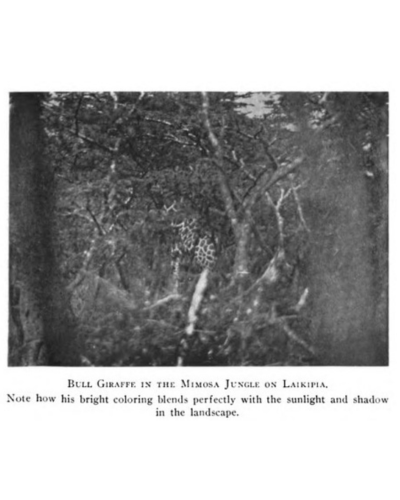
This time, however, I had to change my mind. It was just about eleven o’clock on a cloudless day when, in spite of the altitude of over 7,000 feet, the sun was very powerful, for this part of the country lies exactly on the equator. Now, as the strong, bright sunlight and the deep shadows of the branches and leaves interweaved into one wonderful “carpet,” the big bull giraffe was, even at fifty yards, hard to make out, except when moving, so perfectly did his big dark and bright spots blend with the whole sun- flooded landscape! A passing look at the picture facing page 78 [See below] will prove how protective the giraffe’s coat is under the above circumstances even at twenty-five yards, from which distance it was taken.
The tall bull now saw me, stopped eating, and looked carefully around; but as my gun bearer lay prostrated on the ground behind a tree, and I remained perfectly immovable in a kneeling position, from which I had taken the above picture, the giraffe seemed to think that he had made a mistake, and soon began to feed again from the top of the mimosa tree, every second or so looking in my direction to be on his guard. By being exceedingly careful to watch all his movements, I succeeded in creeping unnoticed still more forward, until I had taken two more photos, one at twenty and the other at fifteen yards, both of which pictures unfortunately became sunstruck in some inexplicable way, but which show how near it is possible to creep up even to a wary giraffe, if one uses but a little patience and cunning.
As my roll of films was exhausted, and it being entirely out of the question to recharge the camera unnoticed then and there, I quietly rose and walked with empty hands up toward the giraffe. Still he did not notice me — a good wind blowing steadily from the animal to me — before I had got up to within six or seven yards of the magnificent old bull! Then he made off at a heavy gallop, increasing his speed as I shouted my thanks for his “posing.”
There are in East Africa at least two distinctly different species of giraffe, which, however, in reality differ very little from each other. The only marked difference between these two species is the shape of their heads, or rather, the number of horns. The ordinary giraffe found in the central and southeastern part of the Protectorate has two horns with a rather pronounced bump in front below the horns. The other variety, the so-called five-horned giraffe, which is generally found on the Guaso Ngishu Plateau, has, behind the ordinary two horns, two smaller hornlike projections — hardly worth the name of horns — and the bump on the forehead grown out into a more hornlike projection than that of the ordinary giraffe.
The height and color of the giraffes vary greatly. The younger the giraffe is, the lighter is his skin, and it is only the old bulls that have very dark, brown spots. The height of giraffes varies a good deal. Full-grown males have been shot in Africa measuring from sixteen to seventeen feet six inches. Record bulls of South Africa have been as tall as nineteen feet and over, but in that part of the country the Boers have now almost exterminated the stately animal. The reason for this was that the white settlers coveted both the giraffe’s meat and the skin, which they use for harness, traces, and whips. The natives also kill the giraffe whenever they have a chance to, partly because they are very fond of its meat and the great amount of marrow in its big leg bones, and partly because they use the strong sinews of the animal for their bow- strings, instead of twine, and for the strings of a kind of rude musical instrument, on which they play their weary monotonous tunes.
Richard Tjader, The Big Game of Africa (New York: D. Appleton & Co., 1910), pp. 75-86. For image citations see the entry below the following text.
See: https://babel.hathitrust.org/cgi/pt?id=hvd.32044072252893&seq=1
African Notes and Reminiscences
Frederick C. Selous
CHAPTER XI
NOTES ON THE GIRAFFE
Appearance of the giraffe — Not a vanishing species — Immense range — Habitat —Native mounted hunters — Destruction of giraffes and other game by Europeans — Necessity of restraining native hunters — Discussion as to the possibility of the giraffe existing for long periods without drinking — Water — conserving tubers — Wild water-melons — Habits of elephants after much persecution — Possible explanation of the belief that giraffes can dispense with water — Giraffes seen in the act of drinking —Giraffes absolutely voiceless — Partial to open, park-like country — Difficult to approach on foot — Giraffes very keen-scented — Hunting giraffes with Bushmen trackers — Exhilarating sport — Pace of the giraffe —The easiest way to kill giraffes — Driving wounded giraffes to camp —Two curious experiences with giraffes — “Stink bulls” — Excellence of the meat of a fat giraffe cow — Height of giraffes — Giraffes only occasionally killed by lions — Young giraffe attacked by leopards.
“Ungainly” is an epithet which has often been applied to the giraffe; but “stately,” I think, would be a far more truly descriptive word, and there is certainly no animal in Africa which adds so much to the interest of the parched and waterless wastes in which it is usually found as this tallest of mammals. The sight of a herd of giraffes walking leisurely across an open piece of ground, or feeding through a park-like country of scattered trees and bush, is one which, once seen, must ever linger in the memory; for there is a something about the appearance of some few of the largest mammals still extant upon the earth which stirs the imagination as the sight of smaller but more beautiful animals can never do.
Giraffes are often spoken of as a scarce and fast vanishing species, but this I cannot believe to be really the case. There are vast areas of country, extending right across the whole width of the broadest part of Africa from Senegambia to Somaliland, and from thence southwards to the northern border of British Central Africa, throughout the whole of which one or other of the different races into which giraffes have lately been divided is to be found, often in great abundance.
Throughout the greater part of this immense range, these magnificent, strangely beautiful creatures will, in my opinion, continue to live and thrive for centuries yet to come; for the giraffe is, as a rule, an inhabitant only of countries which, owing to the extreme scarcity of water, can never be settled up by Europeans, nor support anything but a sparse and scattered population of native herdsmen. Here they will never be hunted to any great extent by Europeans on horseback, nor shot down in large numbers for the sake of their hides, whilst their keenness of sight and great range of vision will protect them very effectually from all danger of extermination at the hands of native hunters as long as these latter are only armed with primitive weapons.
Even in the countries to the south and west of the Zambesi river, though there the range of the giraffe has been sadly curtailed since the time when the emigrant Boers first crossed the Orange river in 1836, these animals are far from being a vanished species, or one which is on the verge of extermination. True, there are now no giraffes left in large areas of country where thirty years ago they were plentiful, but these animals are still to be found in Western Matabeleland, throughout the greater part of Khama’s country, as well as in the Northern Kalahari, and thence northwards to far within the boundaries of the Portuguese province of Angola. The whole of this vast extent of country is, like so much of Northern Africa to the south of the Sahara and Abyssinia, a semidesert, impossible of settlement by Europeans; for although it is covered for the most part with trees of various kinds, or thorn scrub varying in height from two or three to twelve or fifteen feet, the soil is almost everywhere deep soft sand, and for several months in the year there is little or no surface water, except in the large rivers, which are few in number and far apart.
Throughout the greater part of these arid, sun-scorched wastes, giraffes are, I think, likely to hold their own for a long time to come, if only some check can be put upon the operations of the native mounted hunters, belonging to the Bakwena, Bamangwato, and Batauwana tribes, who are now practically their only enemies.
For the extermination of the giraffe in the Transvaal, Bechwanaland, and the country immediately to the north of the Limpopo, Europeans are entirely responsible. The Boers killed most of them, of course, because up to 1890 Boer hunters were always in the proportion of at least ten to one to white hunters of any other nationality. But, man for man, English hunters were quite as destructive as Boers.
The fact is, the pioneers of all the white races of North-Western Europe in new countries are tarred with the same brush, as far as the extermination of wild animals is concerned. In North America the western frontiers-men, who were largely of British descent, exterminated in a few short years the countless herds of bison; in South Africa the Boers have exterminated or brought to the verge of extinction many species of animals which but a few decades ago were spread over the face of the land in seemingly inexhaustible numbers; and to-day the inhabitants of Newfoundland are hard at work destroying as fast as they can the great herds of seals which annually assemble in the early spring to bring forth their young on the ice floes off the coast of Labrador.
When human greed of gain is added to the old love of hunting, and both are unrestrained by legislation, the speedy extermination of any beast or bird which has any market value must necessarily follow. The errors of the past can never be retrieved, but it is to be hoped that now that every part of the world has been taken under the protection of some civilised state, no species of animal or bird which still survives in any considerable numbers will be allowed to become extinct.
The white man, whether Boer or Britain, is now effectually restrained from taking any further part in lessening the numbers of the giraffes in the countries to the west of Southern Rhodesia and to the north of the Limpopo, which are under British protection, and if only the native Bechwana hunters from Molipololi, Palapye, and Denukana — who are well-mounted and armed with breech-loading rifles were forbidden by their chiefs to kill more than a certain fixed number of giraffes annually, and severely punished for exceeding the limit allowed, I see no reason why these most interesting animals should not survive for all time, throughout all those great areas of South-Western Africa where, owing to the scarcity of water, no human beings other than a few scattered families of wandering Bushmen can ever make their home.
The belief is very general, both amongst white and native hunters in South Africa, that giraffes are capable of going for months at a time without drinking, and the fact that they are to be found during the driest season of the year in the most arid districts, far away from any place where surface water exists, lends colour to this belief. But yet it seems to me impossible that an animal of the size of the giraffe, which during the dry season is exposed day after day to a sun-heat of 165° (Fahrenheit), and which browses on leaves and twigs which at that time of year contain but little moisture, can really live for long periods without drinking.
When hunting with Bushmen in the country to the south of the Mababi river, which towards the end of the dry season is quite waterless, my savage companions would often halt suddenly on perceiving a certain thin, grass-like leaf protruding from the ground, and squatting down, commence digging vigorously with their spears in the soft sandy soil. They would presently unearth great white tubers often as big as a man’s head — white in colour and looking something like very large turnips. These tubers contained as much water as a juicy orange, and were, as the Bushmen said, “metsi hela” (that is, “nothing but water”). They told me, and I think with truth, that they were able to live and hunt in the country where these tubers grew without requiring water to drink. They also informed me that elands, gemsbucks, and other antelopes which live in the desert were in the habit of pawing away the sand from and then eating these tubers, which rendered them independent of actual drinking water.
There are probably other water-conserving tubers, known to animals which live in the waterless parts of Western South Africa; and at certain times of year a kind of small water-melon grows in the Kalahari in great profusion, which, as long as it lasts, renders all wild animals entirely independent of drinking water. Oxen and horses soon get accustomed to these wild melons and thrive on them, and human beings can make tea or coffee from their juice.
Now, the occurrence of wild melons and tubers which contain a great deal of water, probably explains the otherwise unaccountable fact that large antelopes and other animals are able to exist in the most arid portions of South-West Africa at a time of year when there is absolutely no surface water; but in the country to the south of the Mababi the Bushmen stated emphatically that giraffes never dug up the water-containing tubers of which I have spoken. My own belief is that, although they must be able to go without water for a much longer time than most animals, they must nevertheless drink periodically throughout the year.
It is possible that in the recesses of the Kalahari the giraffes may obtain the fluid they require from the wild water-melons like other animals, or in periods of prolonged drought they may migrate to the neighbourhood of the Botletlie and other rivers. To the east and north of the Botletlie, a glance at a good map will show that giraffes could never be more than fifty or sixty miles from permanent water.
When I was hunting elephants on the Chobi river, in the ‘seventies of last century, elephants were in the habit of drinking early one night in that river, and then travelling straight away into the waterless country to the west, and I am sure they got their next drink, either twenty-four or possibly forty-eight hours later, in the overflow of the Okavango, known by the natives living on the Mababi as the Machabi. These elephants, which had become excessively wary, through much hunting, I believe never quenched their thirst twice running in the same river; and as giraffes would not require to drink nearly as frequently as elephants, they would be able to range over far more extensive areas of country than those animals, drinking at intervals at points far distant one from another, and between which there was absolutely no surface water.
I cannot help thinking that the idea that giraffes can go for months together without drinking, in countries where there is but a small percentage of fluid in the food they eat, and in which the heat and dryness of the atmosphere are so intense that one’s nails become as brittle as glass and the hairs of one’s beard are constantly splitting, must be a mistaken one. It is, however, only right to say that many very experienced African hunters hold the view that giraffes are quite independent of water, and that they can and do exist for months at a time without drinking.
Giraffes certainly show no aversion to water, as I have frequently seen them drinking, and watched them as they gradually straddled their forelegs wide apart, by a series of little jerks, until they at length got their mouths down to the surface of the pool.
Many herbivorous animals are, as a rule, very silent, but all antelopes are capable of making, and do occasionally make, certain vocal sounds. But the giraffe appears to be absolutely voiceless. At any rate, I have never heard one make any kind of noise, and that was the experience of my friend the late Mr. A. H. Neumann; whilst Mr. H. A. Bryden, as well as other men who have hunted these animals, have put the same fact on record.
Although giraffes often feed through dense thickets of wait-a-bit thorns on their way from one part of a country to another, they are more partial, I think, to open park-like surroundings than to thick forest. In portions of Khama’s country — both near Lopepe and Metsi-butluku — I have upon more than one occasion seen giraffes and springbucks at the same time. In such districts, before the days of the modern long-range, small-bore rifles, it was very difficult to get within shot of the former animals on foot, as, owing to the great height of their heads above the ground and their quickness of sight, they were always able to see anything approaching them, when still a long way off. Giraffes are also very keen-scented, as any one will agree who has often followed on their spoor with Bushmen trackers.
Pointing to the ground, on which they have read as in a book that just here the giraffes have commenced to run, these quick-sighted savages will suddenly dash off along the spoor with right arms extended, crying, “Sabili; ootlili pevu” [Footnote: Literally, “They’ve heard the wind.”] (“They’ve run away; they’ve got our wind”). Running on the tracks of the disturbed animals at a pace which it requires a sharp canter to keep up with, it is seldom that these wiry sons of the desert will not bring the mounted hunter in sight of the giant quarry. “Tutla, tutla ki-o” (“The giraffes; there are the giraffes “), they cry, pointing eagerly forwards with glistening eyes. And then it is for the white man to do his part and secure a plentiful supply of meat for his savage friends.
The chase of the giraffe on horseback lacks, of course, the fierce joy and the soul-stirring excitement which accompanied elephant and lion-hunting, with the rude muzzle-loading guns used by professional African hunters some forty years ago; for the giraffe is a most harmless and inoffensive animal, in no way dangerous to human life. The same thing may, however, be said of the fox and the wild red deer of Exmoor, the pursuit of which animals, it is generally conceded, affords some of the most exhilarating sport procurable in this country.
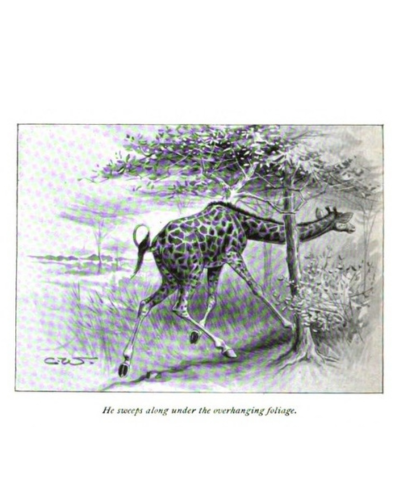
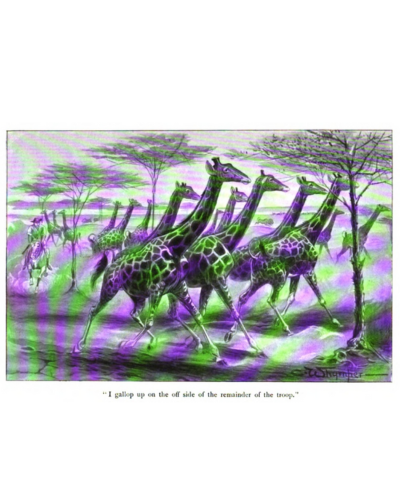
Personally, in the old days when giraffes were very plentiful, and when, with the thoughtless optimism of youth, one failed to realise that they would ever become scarce, and when, moreover, a large supply of meat was constantly required to feed one’s native followers, I always looked upon a good, reckless, breakneck gallop after a herd of giraffes as a most exhilarating experience. The giant quadrupeds looked so splendid as they dashed along at tremendous speed, with their long black tails screwed up over their backs. Nothing checked their pace, as they tore their way through dense thorn jungles, or crashed through the branches of forest trees, ever and anon dipping their lofty heads with the most unerring judgment so as just to pass beneath some horizontal limb, which almost seemed to graze their shoulders.
One took lots of chances in giraffe-hunting, and got many a heavy fall when galloping ventre à terre across open ground full of ant-bear holes, or deep sun-cracks hidden from view by thick tussocky grass, and when one saw the branches of two neighbouring wait-a-bit thorn bushes, each covered with hundreds of little hard black hooks, suddenly close together with a swish behind the disappearing stern of a giraffe, it needed considerable resolution to follow in its wake.
I have often had the greater part of my shirt — for I never wore a coat — torn off and my bare arms very severely scratched whilst chasing giraffes through thick wait-a-bit thorn scrub. I have had some heavy falls too, and once knocked one of my front teeth clean out of the socket, through galloping into an ant-eater’s hole and falling on my heavy ten-bore rifle. On another occasion my horse rolled over on me, and cracked the tibia of my right leg, so that some of the serum ran out and formed a lump on the bone.
However, I never hurt myself seriously, and the risk of such little misadventures when galloping after giraffes through thick forests and over ground where the holes were hidden by long grass always added zest to the pursuit of these animals.
The pace of the giraffe, when pressed, is very great, and in my own experience, which has been considerable, I have found that it is only an exceptionally fast South African shooting horse which can actually gallop past an unwounded giraffe in open ground. The young Boer hunters used always to think a lot of a horse which was fast enough to enable them to “brant,” i.e. “burn,” a giraffe. This meant firing into one of these animals when galloping level with it and at a distance of only a few paces. Such a practice is, however, not to be recommended, as it takes too much out of a horse, upon which one has to depend to keep one’s camp in meat throughout a long hunting season, and the easiest way of killing giraffes is not to press them too hard, but to jump off behind them whenever a suitable opportunity occurs and aim for the root of the tail. A bullet so placed, even from one of the old low velocity rifles of forty years ago, would penetrate to the heart and lungs, and soon prove fatal.
A wounded giraffe will usually, if not invariably, run against the wind, and if one’s waggon or camp is anywhere in the direction for which it is heading, it is possible, by galloping alongside and shouting, to alter its course to a certain extent, and so drive the unsuspecting animal close up to the place where it can be most conveniently killed and cut up. I have driven many giraffes quite close up to my waggons before killing them; but I have also found that if a wounded giraffe takes a course exactly opposite to that in which you want it to go, no power on earth will make it turn right round and run in the other direction. In the nature of things one cannot have an adventure with a giraffe, but I have had two somewhat curious experiences with these animals.
During 1876, when my friend George Dorehill and I were hunting in Western Matabeleland, some Bushmen one day came to our camp and asked us to shoot them a giraffe for the sake of the meat; so, on the following morning, we went out with them, and before long crossing the fresh tracks of a big old bull, followed them, and presently came up with the animal itself. After a short gallop, I wounded it, and it then very soon came to a halt and stood quite still. Wishing to drive it to our camp, I rode slowly towards it, waving my hat and shouting, but it never moved. I was sitting on my horse quite close to where the giant beast stood towering above me, when I heard the crack of my friend’s rifle close behind me. At the same instant, the whole seventeen feet of giraffe lurched over and came tumbling towards me, perfectly rigid and without bend in legs or neck.
I don’t think I had hold of my horse’s reins when my friend fired and shot the giraffe through the head from behind, and the sudden fall of the huge beast was so unexpected that my horse never moved till the great head crashed to the ground close to its forefeet. I am sure that I am not exaggerating when I say that the short thick horns of this dead giraffe only missed my horse’s neck by less than six inches. Had the giraffe only been a little taller, or had my horse and I been a little nearer to it, there would have been more than one dead animal on the ground soon after my friend’s very accurate shot.
On another occasion, during the same year, Dorehill wounded a giraffe — a good-sized but not full-grown bull — which, after running a little stopped and then knelt down, in the position of an ox or a camel at rest, and never moved when we rode up and dismounted close to it. “I’ll bet you, you won’t get on to its back,” said my friend. We were both of us very young men then, which perhaps does not excuse the thoughtless cruelty of the act; but in answer to my friend’s challenge I at once vaulted on to the giraffe’s back, and sat astride it just behind the withers. Immediately I touched it the startled animal struggled to its feet and started off at a gallop. Clasping it round the neck, I had no difficulty in retaining my seat, and my remembrance is that the motion of my tall steed was easy. I was not carried very far, however, and there were fortunately no trees, but only a low growth of scrubby bush for a good distance in front of us. After carrying me at a swinging canter for a short distance, the giraffe once more knelt gently down, and I hastily dismounted. This giraffe was not mortally wounded, but a bullet had injured its hip or pelvis, though, as far as I can remember, no bone was actually broken.
The body of an old bull giraffe gives out an excessively strong, pungent odour, which can be smelt by a human being at a considerable distance. These old bulls, which are always so dark in colour that they look almost black, used to be called by the old Boer hunters “stink bulls.” The meat of such animals was never eaten by white hunters, but every scrap of it was either consumed when fresh, or dried for future consumption, by one’s Kafir or Bushman followers. The tongue of an old bull giraffe, which is the only part of such an animal that I have ever eaten, I have, however, always found to be excellent.
During the rainy season, when giraffes are able to obtain without much exertion a plentiful supply of sweet and nourishing food, the full-grown cows get into very good condition, and are sometimes so fat in the early part of the dry season — May and June — that they probably never get into bad order for the remainder of the year. I have shot giraffe cows whose sides when the hide was peeled off them were covered with a thick layer of white fat, from half an inch to over two inches in thickness from shoulder to rump. There is no finer meat to be got in the whole world than that of a fat giraffe cow, and the soft white fat when rendered out is equal to the best lard. The tongue and marrow-bones are also great delicacies, and the hide is valuable for waggon whips, sjamboks, and the soles of boots. No wonder the South African frontiers-men, whether Boers or Britons, were always keen giraffe hunters.
It has often been stated that giraffe bulls in South Africa grow to a height of 19 feet, whilst the cows attain to a stature of from 16 to 17 feet. I unfortunately only measured the standing height of two bull giraffes; both of which, however, were old animals, and seemed to me to be fine specimens of their kind. One of these, the head of which I still have in my collection, measured, when his legs and neck had been pulled out into as straight a line as possible, just 17 feet, the measurement having been taken between two stakes, the one driven into the ground at the base of the forefoot, the other at the top of the short horns.
This giraffe was undoubtedly a very large animal, and I remember very well Mr. Rowland Ward remarking on the size of its skull, compared to one which had lately been brought from Somaliland by the late Mr. F. L. James, as they both lay side by side in Piccadilly. The other giraffe I measured — also a big bull, or, at any rate, an old one — could only have stood 16 feet 6 inches in height, in a straight line from the heel of the forefoot to the top of the horns.
The original old South African bull giraffe, too, which once used to stand in the Mammalian Gallery of the Natural History Museum at South Kensington, and which always appeared to me to be a magnificent specimen in point of size, only measured as set up 17 feet 5 inches from the ground to the top of the horns. I took this measurement myself with the aid of a ladder.
I know that in the Tring Museum the Hon. Walter Rothschild has a specimen of a giraffe from Southern Angola, which measures 18 feet 4 inches as it stands. But I am not convinced that the animal actually stood that height when alive. In modern taxidermy a framework model of an animal is first built, and the skin then stretched over it. The man who shot and preserved the skin of the giraffe now in the Tring Museum said that it stood 18 feet 4 inches, and it has been set up to that height; but if the measurement was taken carelessly, or over the curves of the animal’s body, there would be no difficulty in stretching the skin so as to obtain the height required. My esteemed friend the late Mr. A. H. Neumann, than whom there never lived a better authority upon African game, when speaking of the northern giraffe in The Great and Small Game of Africa, says: “It may possibly be somewhat smaller (than the southern species), for the height of the full-grown males I have shot averaged about 16 feet, that of the cows 14 feet.” And he further says: “And though I have not found these dimensions exceeded respectively in any of the southern specimens of either sex I have myself killed anywhere, I have read in the accounts of other hunters of considerably taller animals being obtained in parts of South Africa.”
Personally, grounding my belief on the size of the magnificent old bull giraffe which once stood in the Mammalian Gallery of the Natural History Museum at South Kensington, and the measurement I myself took, immediately it was dead, of a very fine old bull which I shot in Western Matabeleland in 1880, I should say that the average height, at any rate of giraffe bulls in South Africa, cannot be more than 17 feet, and that of the cows about 2 feet less. I have never measured a cow giraffe, but in a herd of these animals an old black bull always towers above the tallest cows. Exceptional specimens in both sexes may, of course, grow much taller than the average height of the species.
Giraffes are, I think, less troubled by lions or other carnivorous animals than any other African mammal, with the exception of the elephant, rhinoceros, and hippopotamus. That giraffes are occasionally killed by lions is, of course, a well-known fact, but my own experience leads me to believe that such cases are quite exceptional. There are two reasons, I think, for this, the first being that giraffes spend most of their time in very dry, semidesert countries, far away from water, into which lions do not often penetrate; and the second, that, owing to their great size and strength and the thickness of their hides, giraffes cannot be easy animals for even lions to pull down, and, as a matter of fact, I think they are seldom molested in parts of the country where game of other kinds, such as zebras, buffaloes, or large antelopes, are plentiful.
An instance of a young giraffe being attacked by two leopards once came within my own experience. I was riding with some Bushmen — more than thirty years ago now — near the course of the Upper Tati river in Western Matabeleland, when a single giraffe cow ran out into the open from a cluster of mimosa trees through which we were passing. Immediately I saw the giraffe, I put spurs to my horse and galloped after it, but had only just reached the edge of the mimosa grove when my horse put his foot in a hole, and not only fell, but rolled over on me, breaking the thin thong attached to my belt from a ring on the bridle.
I was not hurt, but I was unable to extricate myself and regain my feet as quickly as my horse, and he, not being a very well-trained animal, trotted away in the direction taken by the giraffe before I could get hold of the bridle. I now for the first time saw a very young giraffe calf, which I do not think could have been more than a day or two old, running between my horse and its mother, but much nearer to the former than the latter. I suppose this little calf, being so very young, had been purposely left by its mother lying hidden amongst the bushes to await her return, but that we had frightened it and caused it to jump up and run off. As we watched it we saw it run close up to my horse, and as long as it was in view it appeared to be running close behind it.
I now told two of my Bushmen to run after my horse, and try and get in front of it and then catch it and bring it back to me. This they succeeded in doing before very long, as, after having trotted away for a mile or so, my recreant steed had commenced to feed. When we met, the Bushmen told me that the giraffe cow had come round and taken off the calf before they came up with my horse.
Since this giraffe calf was evidently very young and weak, I thought it would be an easy matter to catch it alive, so I told my Bushmen to take up its spoor at once. We had been following the tracks of both the cow and the calf for perhaps a mile, when I saw the head and neck of the latter rising out of some tussocky grass in an opening in the forest. Galloping up to it, I found that the poor little creature’s hind-legs were stretched out straight behind it, as if its back were broken. It was also bleeding from a few scratches. My Bushmen were now examining the ground round the injured calf; and I heard one of them say, “Ingwi, ingwi mabele” (“Leopards, two leopards”).
They soon explained to me exactly what had happened. As the giraffe calf was following its mother, two leopards had attacked it. They must, however, have been driven from their prey very quickly, as I could only find a few claw-marks upon the body of the calf. Its mother had evidently struck at the leopards with her forefeet, as we found several freshly-made marks where her sharp hoofs had struck the hard ground. Unfortunately, one of these terrific blows, very probably the first aimed at the leopard which had attacked the calf, had struck the little creature on the loins and broken its back, or at any rate paralysed its hind-quarters. I searched all round for the leopards, but could not find them, and was obliged to kill the calf, for it could only have died a lingering death if I had not done so, or been torn to pieces sooner or later by leopards or hyænas.
I don’t think giraffes ever give birth to more than one calf at a time. The calves are born, in South-Western Africa, towards the end of the dry season or early in the rainy season, that is, during the months of September, October, November, or December.
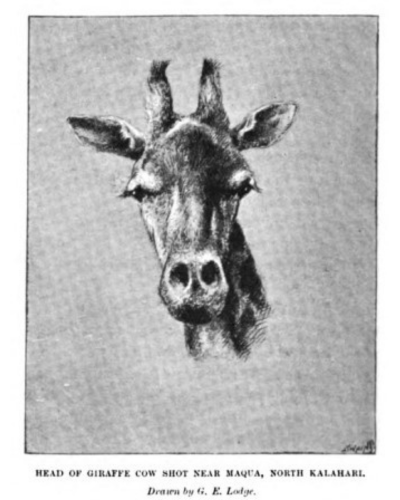
Frederick C. Selous, African Nature Notes and Reminiscences (London: Macmillan & Co., 1908), pp. 205-221. The fighting giraffe image appears as the frontispiece. The giraffe head appears on page 324 in H. Anderson Bryden, Gun and Camera in Southern Africa (London: Edward Stanford, 1893). The squatting giraffe appears on page 320 and the group of giraffes on page 354 are extracted from Frederick V. Kirby, In Haunts of Wild Game (Edinburgh: William Blackwood & Sons, 1896). The two bull giraffe images appear on page 78 in Richard Tjader, The Big Game of Africa (D. Appleton & Co., 1910).
See: https://babel.hathitrust.org/cgi/pt?id=nyp.33433066602529&seq=1