Bull Baiting
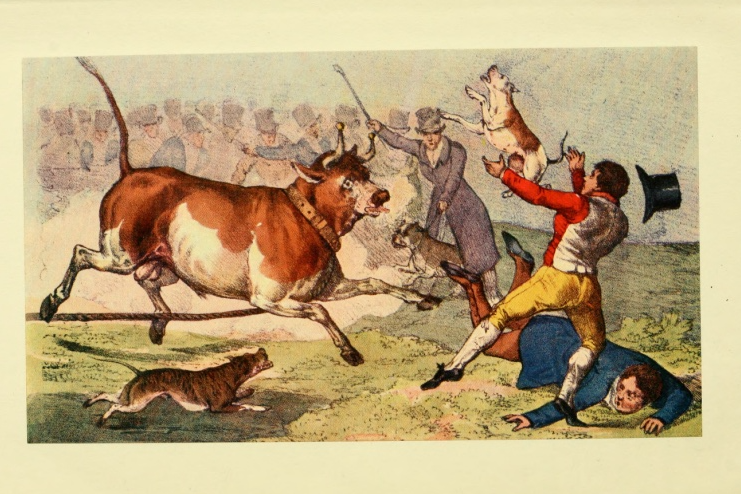
We want you to have a greater ability to learn about some of the unpleasant animal issues in our world.
Old English Sports
Frederick W. Hackwood
XVIII
BULL-BAITING
Antiquity of the sport — Mastiffs or ban-dogs used — The first use of the bulldog — A manorial custom to give a bull — The tenure of “bull pieces” — A public-house custom — Method of procedure — Preparing the bull and entering the dogs — Catching the tossed dogs as they fell — Bulldog tenacity — The cry of “Lane!” when the bull broke loose — Baited beef as a food — Illustrations and incidents from Midland records — Sedgley — Tipton — Wednesbury — Handsworth — West Bromwich — Walsall — Jack Willetts, a bullot who was a ballad hero — Bilston’s famous Wake of 1743 — Willenhall — Birmingham — Sambourn — Mimic bull-baiting played by children — Shropshire — Place-names derived from the sport — Metropolitan bull-baitings at Hockley-in-the-Hole — The “professionalism” of loafers — A reported incident at Lichfield Wake, 1828 — “Town bulls” — Parish rivalry leads to bull- stealing — The gross barbarities on record — Old wounds aggravated, forehoofs cut off — A bull baited by a man in place of a dog — Plague and pestilence no deterrent — Prophetic warnings and public protests — Early efforts at suppression — Societies formed — The Bill of 1802 thrown out — An Act of 1822 purposely excepts the bull from protection — A new Act in 1835 forbids the practice — Which, however, dies hard.
Bull-baiting and bear-baiting and the baiting of badgers were all Old English pastimes, which dated from the twelfth century. It is recorded that on several occasions Queen Elizabeth, at the reception of notable ambassadors, gave entertainments which included a grand dinner, fine music, and the baiting of bears and bulls with sturdy “English dogs.”
The dogs which at that period were commonly pitted against the strength of the bull or the cunning of the bear were a formidable variety of the English mastiff breed.
Under James I. this kind of sport was forbidden on Sundays; and under the Commonwealth it was, of course, prohibited altogether. After the Restoration the old national sports were all revived, and the bulldog then came into high favour.
The bulldog is supposed to have been first used by the butchers for catching and throwing down refractory cattle. By the massive formation of the head, and more particularly the projection of the lower jaw, this breed of dog was capable of seizing an ox by the nose, holding it perfectly still, or at its master’s command throwing the heavy beast over on to its side with apparent ease. Says O. Wendell Holmes —
“The mongrel’s hold will slip,
But only crowbars loose the bulldog’s grip;
Small though he looks, the jaw that never yields
Drags down the bellowing monarch of the fields.”
Not all bulldogs possessed the approved mettle for baiting the noble bull; but the exceptions were very few.
So fixed had Bull-baiting become as a national sport, it was customary in some manors for the lord to make a gift to his tenants, at certain specified times, of a bull to be baited. In numbers of parishes a piece of land was sometimes held by the tenure of providing a bull for the same purpose. In either case the custom was a tribute to the astuteness of the lord who by such manorial grant had contrived to reap some advantage over his tenants — simple fools ever eager to barter away their rights and privileges to any one who would thus pander to their degraded tastes in the matter of popular amusement.
The rolls of the manor of Northwich, in Cheshire show that between 1729 and 1738 a number of fines were imposed and paid for such offences as “not baiting bulls,” and “killing bulls unbaited.” It is evident from this that the tenants of certain “bull pieces” had not fulfilled the conditions of the tenure by which they held their land.
The forfeiture of “a white bull with a red nose and ears of the same colour,” for non-payment of “wroth-money ” at Knightlow, in Warwickshire, every Martinmas, is an ancient feudal tenure, not altogether unconnected with the practice of bull-baiting.
Although Bull-baiting had been a courtly entertainment under Elizabeth, her successor on the throne did all in his power to discourage it. James I. tried to regulate what one writer has called “the national jollity,” by publishing his well-known “Book of Sports”; but at the same time (1620) he issued his royal warrant for licensing houses for the playing of tennis, bowls, “dice, cards, and suchlike games — bull- baiting, however, being tabooed.
Notwithstanding this, it was a regular custom throughout the following century for “Masters of Publick Houses to keep or procure Bulls to baiten on certaine Holidays, so call’d, as well as other days, on purpose to draw Company to their houses.”
In every part of England, in the capital and in the country, the practice of bull-baiting was universally followed with more or less zest; though perhaps it nowhere attained a greater popularity than in the Birmingham Midland district.
As to the method of procedure, we have a vivid description from the pen of the French Advocate, Misson, who lived in England during William III.’s reign, of the manner of “these bull-baitings, which are so much talked of.
“They tie a rope,” he says, ” to the root of the horns of the bull, and fasten the other end of the cord to an iron ring fixed to a stake driven into the ground; so that with this cord, being about fifteen feet long, the bull is confined to a space of about thirty feet diameter.
“Several butchers, or other gentlemen, that are desirous to exercise their dogs, stand round about, each holding his own by the ears; and when the sport begins, they let loose one of the dogs. The dog runs at the bull; the bull, immovable, looks down upon the dog with an eye of scorn, and only turns a horn to him, to hinder him from coming near. The dog is not daunted at this; he runs round him, and tries to get beneath his belly.
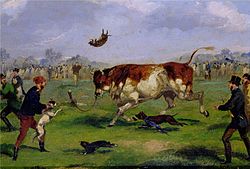
“The bull then puts himself into a posture of defence; he beats the ground winth his feet, which he joins together as closely as possible, and his chief aim is not to gore the dog with the point of his horn (which, when too sharp, is put into a kind of wooden sheath), but to slide one of them under the dog’s belly, who creeps close to the ground, to hinder it, and to throw him so high in the air that he may break his neck in the fall.
“To avoid this danger, the dog’s friends are ready beneath him, some with their backs, to give him a soft reception; and others with long poles, which they offer him slantways, to the intent that, sliding down them, it may break the force of his fall.
” Notwithstanding all this care, a toss generally makes him sing to a very scurvy tune, and draw his phiz into a pitiful grimace. But unless he is totally stunned with the fall, he is sure to crawl again towards the bull, come on’t what will.
“Sometimes a second frisk into the air disables him for ever; but sometimes, too, he fastens upon his enemy, and when once he has seized him with his eye-teeth, he sticks to him like a leech, and would sooner die than leave his hold. Then the bull bellows and bounds and kicks, all to shake off the dog.
“In the end, either the dog tears out the piece he has laid hold of, and falls, or else remains fixed to him with an obstinacy that would never end, did they not pull him off. To call him away would be in vain; to give him a hundred blows would be as much so; you might cut him to pieces, joint by joint, before he would let him loose. What is to be done, then? While some hold the bull, others thrust staves into the dog’s mouth, and open it by main force.”
Sir Richard Blackmore, the author of “King Arthur,” early in the eighteenth century wrote the following description of a country bull-bait, which is so vivid in its details that it deserves to be reproduced here. This is the passage —
“So when a generous bull for clowns’ delight
Stands, with his tine restrained, prepared for fight.
Hearing the mob’s loud clamour, and the rage
Of barking mastiffs eager to engage,
He snuffs the air, and paws the trembling ground.
Views all the ring, and proudly walks it round.
Defiance tow’ring on his brindled brows.
Around disdainful look the grisly warrior
throws His haughty head inclined with easy scorn,
Th’ invading foe high in the air is borne.
Tossed from the combatant’s victorious horn.
Raised to the clouds the sprawling mastiffs fly
And add new monsters to the frighted sky.
With disproportioned numbers pressed, at length
He breaks his chain, collecting all his strength.
Thus dogs and masters scared promiscuous fly,
And fall’n in heaps the pale spectators lie.
He walks in triumph, nods his conquering head.
And proudly views the spoils about him spread.”
Sometimes the horns of the brute were tipped with metal buttons, in the same way that fencing foils are blunted. This was done when the tines were too sharp, or when the bull was one regularly kept for repeated periodical baitings. The knobs prevented the dog’s being gored; it was the bull’s business to toss the dog, not to gore it.
In the earlier days of the sport, however, we have ample evidence that Sunday was the usual day upon which it was indulged, though it was by no means exceptional for the bull to be baited on the Saturday night for a short time, in order that “the keepers might judge of his demeanour, and that those responsible for the proceedings could form an idea whether the succeeding day’s sport would be answerable to the expectations of the mob. When the bull proved to be cowardly or mean-spirited it was sometimes changed for another, or else was subjected to torture in order to goad it into madness.
The sportsmen entered their dogs for the contest by the payment of a small fee for each “run,” generally about sixpence or a shilling, but on special occasions a higher figure might be charged. Only one dog at a time was let loose on the tethered bull.
At first the dignified beast would merely turn down a threatening horn at the dog; but when the undaunted dog would avoid the danger by trying to get round his antagonist, then the bull would assume a posture of active defence.
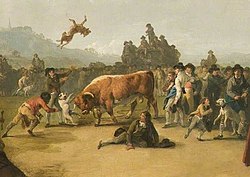
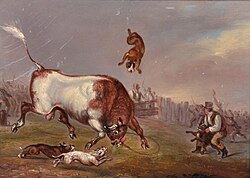
The aim of the bull, as it was expected of him by the cognoscenti, would be not so much to gore the dog as to slide one of his horns beneath his belly to “hike” him (as it was expressed in the vernacular); that is, to toss him so high into the air that the fall to the ground would break his back, or in some way disable him.
The dog’s owner, friends, and backers, however, had several methods of coming to the “hiked” one’s rescue. The readiest was for the man to run and bend down his own broad back, offering it as a cushion to his canine pet.
“The clamorous youth to aid each other call
On their broad backs to break their favourite’s fall.”
The other method, as recorded by the observant foreigner previously quoted, was to present a long, smooth pole slantwise, on which to receive the falling dog in such a way as to permit of him sliding to the ground gently. But the favourite method followed by the gunsmiths of Birmingham, and by the lock-filers of the neighbouring Nineveh (this part of Handsworth was so designated because the Methodists declared that its barbarous sports and other iniquities equalled those of the Biblical city of Nineveh) and also of Wednesbury and Darlaston, was to catch the dog in an apron. The gunlock-filers were invariably “sure catches” with their working aprons.
If the force of the fall were not broken for the poor dog he was stunned, at the least; and not infrequently the “hiked” dog would crawl away completely cowed.
A good dog, on the other hand, would show his mettle by fastening on the bull — on to the nostril for choice. With the eye-teeth of the dog’s undershut jaw the bull would be pinned as in a living vice. No matter how much the bull might rage and roar, bellow and bound, it would be impossible to shake off the bulldog. Blows, force, and violence of any kind would be unavailing — the well-bred bulldog would die rather than relinquish his hold. Sometimes the dog’s mouth was forced open by the use of a cudgel as a lever; sometimes the dog was only to be parted from his foe by the piece of flesh held in his teeth being torn out.
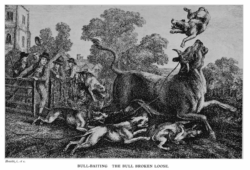
Occasionally the tortured brute would break loose; then the outcry was for “A lane! A lane! ” — that is, for an opening out of the cowardly crew to allow the infuriated bull to pass along. Such an episode is described in the ballad previously quoted: —
“With disproportioned numbers pressed, at length
He breaks his chain, collecting all his strength;
Thus dogs arid masters scared, promiscuous fly
And fall’n in heaps the pale spectators lie.”
In such incidents were found plenty of excitement, and not a few serious casualties.
It must not be forgotten that the promoters of the sport made a profit, in the end, by the sale of the bull beef, when noble Taurus, being no longer fit for the Ring, was relegated to the Shambles. The meat was eagerly bought up by the devotees of the Bull Ring; in fact such meat was highly esteemed. Is not a character in a seventeenth-century play, entitled A Rogue well Basted, made to say —
“Trust me, I have a conscience as tender as a steak from a baited bull “?
On the other hand, however, it has been asserted on the authority of the famous Wednesbury ballad that—
“The beef it was old and tough
Of a bull that was baited to death.”
But this, perhaps, was the flesh meat of a veteran beast which had toured the various Wake carnivals for a number of years.
Of the immorality of the pastime; of the cruelties incidental to both species of beasts; of dogs disembowelled; of bulls with horns horribly uprooted by their own madness, or with tongues torn out by the relentless dog; of men gored or trampled to death; of the thousand and one horrors and accidents incident to the pursuit of such a pastime, it is here impossible to write exhaustively. It must suffice to give a number of selected illustrations, culled from the local records of Birmingham, and the mining district of South Staffordshire immediately adjacent.
Here is a specimen of the way announcements of the sport were sometimes made: —
“Notice!
“On Monday next there will be a bull baited at the Bull Ring in Sedgley when a £5 wager will be laid on Mr. Wilkes’s dog Teazer of Wednesbury that he pins the bull’s nose within an hour. Entries of dogs can be made at Mr. Perry’s on or before Saturday. Fee, 5s.”
Briefly it may be added, that Teazer won this wager for his backers; and, holding on to his victim, so infuriated the bull that he broke loose, and ran as far as Coseley, only obtaining release from his enemy’s fangs when the flesh of his nostrils gave way; upon which the dog fell off, to meet retribution by being trampled to death by the bull’s hoofs. The wretched bull was then turned back by the yelling mob, and eventually sank exhausted in the porch of Sedgley Church, where it was beaten to death by the cudgels of its brutalised pursuers.
Tipton Green has been fertilised by the blood of hundreds of bovine martyrs. For, says the ballad —
“The life blood of a hundred bulls
Has flowed on Tipton Green.”
An old document of 1635 describes a parcel of land in that parish as “adjoining to the Town Green, near to, where the Bull Stake was fixed.” In the same reign (Charles I.) a number of Tipton men were prosecuted, at the instance of the church-wardens, and heavily fined by the sheriff, for holding a bull-bait on a Sunday.
A Birmingham man (Mr. John Crook) has recounted his experiences at what he mistakenly claims to have been the last exhibition of the kind in the Black Country — the Wednesbury Wake bull-baiting of 1829. He says that on that occasion a great concourse attended, and all, “with the exception of the poor bull,” seemed to thoroughly enjoy the proceedings; but that the authorities interfered, confiscated the bull, and committed the two ringleaders to Stafford gaol.
“Hundreds of bulldogs were around the inner ring (with their owners) all trying to break from their chains to get at the bull. The owners of the bull charged eightpence for each dog that baited the bull, about four or five minutes being allowed for the dog to run at him. When money got scarce with the owners of the dogs, and no baiting was going on, a few of them would go round the ring with their hats collecting pence until they had got sufficient to pay for the dogs to run at the bull. When they could not collect enough the stake was taken up and removed to another part of the town. There were three places in Wednesbury for them to pitch the stake — one in the Wednesbury Market Place, one at High Bullen, and the other at Bull Hole, near Wednesbury Church. By the time the Wake week was over the poor bull’s face was a complete running mass, the wounds of the previous days being torn open and fresh ones made.”
The same authority speaks of another bull being baited at the top of a lane fronting the “Queen’s Head,” at Handsworth, on the main road to West Bromwich, at which the stage-coach stopped so that the passengers might witness it. These sights happened every year during the four years the writer lived at Handsworth, which ended in 1822. In a more recent note he added a reminiscence which was truly characteristic of the time and place: —
“I have read somewhere that for the entertainment of the Rev. W. Gordon, the first minister at Christ Church, West Bromwich, it was intended either at the opening or consecration of the church (1829) to bait a bull. The animal was present, but the wise minister declined to support the event even by his presence. I am not sure, but I am under the impression that the bull was not baited.”
As we shall see presently, it was quite in accordance with the sentiment of the time to associate a bull-baiting with a church celebration of this special nature.
Walsall, according to Mr. J. C. Tildesley, a local historian, had its sporting prowess celebrated in song: —
“There, in the jovial days of yore.
The mad bull weltered in his gore.
And ‘bullots’ trembled at his roar,
In the old days of Walsall.
A cock, a bull, a surly bear,
A cur tossed yelping in the air,
These were the frolics of the fair,
In the old days of Walsall.”
The same writer goes on to speak of the sport as it was practised in the district, and says —
“In olden time it had its full share of bull-baiting, and in this neighbourhood it was that the renouned Jack Willets, the ‘bullot,’ who went over to Spain to finish his education in the art, used to lead forth to torture huge specimens of Taurus, gaily decked with coloured ribbons, amid the ringing cheers of an excited mob. Here, doubtless, too, as at Bilston, might be heard snatches of the rude ballad —
“Old ‘Fancy Dick’ from Wedgbury,
Came with his good dog ‘Shot,’
But ‘Billy Ball’ didn’t come at all.
For he had quite forgot.”
This Jack Willets, the “bullot,” was a notorious character who had served as a soldier in the Low Countries, and on his return to his native place had set about teaching his neighbours how to improve their methods in the ancient art of Bull-baiting. In a roving life, some of it spent in Spain, his experiences had led him to see how deficient the English were in appreciating the picturesque side of things; and he therefore determined to introduce into local Bull-baiting some of that display, some of that artistic colouring, which characterised Spanish bull-fighting.
After haranguing the people, and making active converts among his own cronies and personal associates, it was arranged to make the forthcoming Wake at Bilston, in the year of grace 1743, a red-letter festival that should long be remembered throughout the whole countryside.
Every accessory the parish possessed was pressed into service. The town crier, dressed in a new uniform, which included a well-powdered wig and a silver-laced coat, led the procession which escorted the bull, gaily decked with ribbons and garlands, to the sacrificial stake. Then, leading the noble bull, was the redoubtable Jack himself, in the remnants of his old military uniform, and begirt with a formidable Spanish sword, as marshal, master of the ceremonies, and general manager of the whole proceedings. The band consisted of a wooden-legged fiddler and an asthmatical piper, supported by the clattering staves of the village Morrice-dancers; the rear being brought up by all the rag-tag-and-bobtail attracted froin the country for miles around.
According to the local historian the scene presented to the eye was of a striking character. In the centre of the circle stood the bovine gladiator looking sulkily around him at the host of circling faces, and especially at the savage owners of scarcely more savage bulldogs, who were stationed at intervals inside the ring ready to let loose their dogs on the signal for the onslaught being given. At the entrance to the ring stood Willets with his weapon drawn, which he flourished ever and anon to keep back the spectators from intruding inside the enclosure. Round about crowded the spectators, who, from the favourable nature of the ground, rose tier above tier, giving the scene somewhat the appearance of a Spanish arena. The preliminaries being completed, a man with a stentorian voice stepped into the centre of the ring, and gave the following notice: “All persons having dogs to enter must pay a fee of five shillings for such dog. Likewise, when the dogs are withdrawn, any person armed with this club (here the ‘crier’ flourishes a cudgel) may enter the ring, and whoever brings the bull on his knees will be entitled to a quarter of the animal.”
The signal for the release of two of the dogs was then given. The bull met them with his horns, and, at the first rush, threw one of them into the air, with his bowels torn out. Another dog took his place, and the two continued to lacerate the animal until one of them met the same fate. The people eagerly caught him as he fell, as though he were a child. Willets then stepped between the combatants, and pricked the bull with the point of the sword, which infuriated the animal until the foam streamed from his nostrils. One after another the dogs were disabled until “Shot,” a dog whose fame is mentioned in local ballads of the time, was loosed, and in a few moments he had caught the bull by the nostrils. Willets, knowing that nothing would induce the dog to quit his hold, and fearful lest the sport should be too speedily ended, coolly severed the flesh with his sword, when the dog fell to the ground, still retaining between his teeth the trophy of his skill.
At this juncture the “crier” ordered the dogs to be withdrawn, and they were replaced by a noble specimen of humanity, armed with the club. Advancing towards the bull, who had regained some of his strength during the interval, the man hesitated for a time, as if undecided how to act. At last he raised his club deliberately, and then struck at the bull suddenly, in the hope of stunning him; but the animal, fully alive to his danger, swerved quickly aside and returned as quickly, and thereby escaped the blow intended for him. Before the man could recover from the force of the effort, the bull caught him with one of his horns and threw him violently against the barriers. Another man now grasped the weapon, and at a blow broke off one of the animal’s horns. He fell to the ground bellowing with pain, but rising again, gave one mighty tug in his desperate agony, which released him from the stake, and away he went, pell-mell through the crowd.
Then the air was rent by the shouts from a thousand throats.
“‘A lane! A lane!’ was all the cry.
As fast they ran away,
Leavmg Jack Willets there to die,
Or live, as best he may.”
The scene was now fearful in the extreme. Men trampled on women, women on children, and children on each other, in their frantic efforts to escape. The shouts and screams were loud and hideous; deep curses mingling freely with despairing cries. Jack Willets, of all the mob, remained cool. He leaped the barriers and waited his opportunity. The bull, however, faint with loss of blood, that streamed over his head and body, after making a few faint efforts to escape, fell to the earth, where he was soon despatched by Willets.
What need to describe the closing scenes of that day’s events? The sale of the beef provided funds for the final .revelries, an orgie of eating and drinking, such as even Bilston Wake never experienced before or has known since.
In the year 1802 a beautiful black bull was baited in Bilston, and was then sold to the Darlastonians, who, having baited it for the other days of the week, actually sold it to the Wednesbury sportsmen, who tortured it to death after a display of courage which should have earned for it a better fate.
In the neighbouring parish of Willenhall they have boasted a poetaster, one William Saunders, who has sung of the bovine battles waged there in the days of yore. The words of the ballad, it may be explained, are supposed to be those of the weathercock on the top of the church steeple, and run in this strain —
“Tho’ Willnull then was fair to see
Her beauty but hid deformity;
Sensual lust and brutal spleen,
The harmony marr’d of that fair scene.
The sun one morning fair did rise
Turning the gray into golden skies.
The tip of my tail she turned to gold,
And burnished it bright for men to behold.
Beneath me lay a rabble crowd,
Of the hopeful young, and the aged bowed;
A stake is driven in the greensward fast,
And the bull is tied secure at last.
Shouts of men, and the bull’s fierce roar,
The groans of the dog as he dies in his gore;
The shrieks of women, and the curses of men,
Beggars description by mortal pen.
What means that shriek so loud and shrill.
Turning the heart-blood cold and chill?
Why is the crowd fast flying away ?
‘The bull is loose!’ — did I hear them say?
Yes, mad with passion, away he flies,
And with lightning speed in the air he hies
One of the men who had that day
Foremost been in the fierce melee.
As he falls to the earth with a sullen sound,
Shrieks, groans, and cries are heard around;
Then gathered they round with moisten’d eye.
Silently watching their comrade die.
Gently, gently, close the scene,
Men’s natures are alike, I ween.”
At Birmingham a notable bull-baiting took place in 1798 at the rear of the Salutation Inn, Snow Hill. This was the Chapel Wake held in commemoration of the building of St. Bartholomew’s Chapel. The event was made memorable by the capture of the bull by the Birmingham Association — a voluntary militia formed of the respectable trading class during the Napoleonic scare — who marched to the attack with flags flying and drums beating. It was not till the bull had been pursued to Birmingham Heath that it was captured and brought back in triumph by the champions of law and order.
A plaintive ballad written in memory of this day’s event had for its refrain: —
“They broke up the Wake
They stole the stake
And they put the bull in the dungeon!”
— or ” dunghill,” as it was sung in the vernacular.
A remarkable incident is recorded as having occurred at a village on the other side of Birmingham. Whilst a bull-baiting was in progress at Sambourne, in Warwickshire, the bull, by some means or other, contrived to escape from the stake to which it was customary to chain the animal. Having been infuriated by the dogs, it charged furiously amongst the crowd of spectators, in which stood an elderly woman, who for many years had walked on crutches, owing to some complaint affecting her legs. In fear of injury and possible death, the people scattered in all directions, and the cripple, sharing the common terror, dropped her crutches and unconsciously joined in the flight. It was not until she had reached a place of safety that the woman realised that, by the shock, she had recovered the use of her legs. She lived for years afterwards, but never used the crutches again.
In 1828 two men were convicted at Birmingham by Mr. R. Spooner, under the Town Improvement Act, for celebrating Handsworth Wake by a bull-baiting at Little Hockley Pool. Although these culprits were sent to gaol for six weeks, no less than three bulls were at the same Wake baited in Handsworth, which was just outside the jurisdiction of the Birmingham authorities.
It is curious to note that the name of Mr. Spooner in this connection was preserved for half a century afterwards in a boys’ game which was popular throughout the Black Country till about 1870. One boy played at being a bull, another at being his master, and all the rest were baiters. The first-named knelt down on the ground, taking care to tuck in his head and all tender parts of his body beneath the protection of his clothing; he held one end of a rope, and his master the other. The fun was to buffet the poor bull with caps and knotted kerchiefs, while the master, standing close to the bull, recited a child-rhyme, and then ran the length of the rope three times; after which any one of the baiters he could manage to touch had to become the bull. Of course, while he was trying to catch one within the length of his tether, the others would run up on the unguarded side and continue to baste the poor bull. The child-rhyme in question ran thus: —
“Hooner, hooner, hooner.
My name’s Dick Spooner!
I’ve got a bull
Named John Bull —
If you won’t bait him —
Why, I wull!”
Then with right good will he set the baiters a vigorous example of how they ought to defy his own authority.
It was thus the ancient pastime died away in the Black Country — reluctantly, as it were — with a mimic imitation of it as a sort of memorial to keep up the traditions of the fathers among the children.
Doubtless the practice was just as prevalent in other parts of the kingdom; the illustrations are drawn from this particular region in the Midlands simply because the local records here have been better kept. For example, in “Shropshire Folk Lore” it is related that many savage bull-baitings took place at Madeley Wakes, which were latterly celebrated chiefly at Ironbridge, the busy little town in the parish of Madeley, named from the proud achievement of the Quaker ironmasters of Colebrook Dale, who in 1799 spanned the Severn with a single arch of iron. This Wake was also held in October — viz., five weeks before Broseley Wakes (St. Leonard, November 6th), which again fell seven weeks before Christmas. The bull was baited three times on each of the three days, Monday, Tuesday, and Wednesday — first at the Horse Inn, Lincoln Hill; then in front of the Tontine Inn, at Ironbridge; and thirdly at Madeley Wood Green.
Reminders of its universal popularity are still to be met with in the tell-tale names of certain streets in a number of the older towns, as The Bull Ring, The Bull Stake, The High Bullen, The Bull Hole, The Bull Pit, and so on; even the historic Hoe at Plymouth had its Bull-hill.
Of bull-baitings in the Metropolis the chronicles which have been preserved of them alone would fill a volume. One of the most notorious spots was Hockley-in-the- Hole, in the unsavoury region of Clerkenwell, the frequenters of which are said to have been particularly nimble, when their favourite dogs were tossed into the air, in catching them on their shoulders, although after each encounter —
“Some stretched out in field lie dead; and some,
Dragging their entrails on, run howling home.”
This is the public resort of which we read in Hudibras : —
“Just as it is in Hockley Hole
When Rose and Brindle fought the bull.
Some on the dogs will set their heart.
Some take the horrid champion’s part.
When thus disposed, the rabble rout
Soon find occasion to fall out,
Thus fools and dogs, and bulls and bears,
Fall all together by the ears,
Whilst wiser men securely sit
And overlook the wrangling pit.
Keep silent tongues, no party take,
But view the sport the puppies make.”
In those days there were certain individuals of the loafer type who followed up the baiting of bulls almost as a profession, going round from town to town with a bull, and taking care at least to miss no Monday or Tuesday — always “play days” in the good old times prior to the era of Factory Acts — without holding an exhibition in some Bull Ring or other.
Before quoting the contemporary record of this feature it may be necessary by way of preface to note, first, that Lichfield Greenhill Wake was one of the most popular and largely patronised institutions of its class; secondly, that Luke Saint was a well-known Wednesbury “character” — a sort of recognised semi-official parish jester; and thirdly, that although the ringleaders were convicted and punished, that very fact merely had the effect of elevating them into the position of heroes and martyrs, so low was the moral tone of the time. In fact the whole incident was worked up into a “ballad,” the burden of which was —
“Success unto you, Wedgbury lads.
Wherever you may be,
Who took a Bull to Greenhill Wake
To stir up mirth and glee.”
But here is the contemporary account of the affair as contained in the Lichfield Mercury of October, 1828: —
“The cruel and disgraceful scenes at Greenhill Wakes on Monday and Tuesday nights, were the subject of investigation at the Town Hall of this city yesterday; and among the gentlemen who evinced their disapprobation of these barbarities, by attending to support by their presence the enactment of the Legislatures, were the Very Rev. the Dean of Lichfield, the Rev. the Chancellor of the diocese, the Rev. B. J. Proby, the Rev. H. White, the Rev. T. G. Parr, and others of the first consideration in the city. As we stated last week, the principal promoters of this brutal exhibition were strangers to this city. They belong, as we are informed, to a gang of wretches who purchase bulls and take them from place to place to be baited, and obtain considerable sums by their inhuman vocation. Their leader is a man of respectable appearance, named John Field. The plan appears to be for him to purchase a bull, and then nominally to give the ownership to one of his infamous followers, who are paid out of the money collected from the mob. In the present case a wretched-looking object called Luke Saint, who possessed scarcely a decent covering, stood forward as the ostensible owner of the animal. Sufficient evidence, however, was fortunately at hand for the conviction of his employer. These individuals, with Thomas Marsh, Joseph Love, Cornelius Foster, and Joseph Horton, all residents of Wednesbury and its neighbourhood, were clearly proved to have taken an active share in the disgusting amusement, and were fined 30s. each, with the cost of their apprehension, making the total penalty about £2 10s. each. George Bates, a woeful sample of humanity, who distinguished himself by a cool, unblushing confession of his cruelty, was fined 40s. and costs. John Wright, Henry Webb Davis, and Joseph Bird, were fined 20s. each and costs. As none of the defendants paid the fines, or offered sureties, they were all ordered into confinement until returns could be made to distress warrants; and in case of non-payment they will have to undergo three months’ imprisonment. The Act under which the convictions took place is the General Turnpike Act 3, George IV. c. 126 by the 121st section, of which, persons baiting, or running for the purpose of baiting, any bull, &c., near the side of any highway, or in any exposed situation near thereto, to the annoyance of any passengers, &c., are liable to a penalty of not more than 40s. and costs.
It would almost appear that the parish — or at least some coterie of representative parishioners — sometimes had a proprietary interest in a bull, which would then be known as the “town bull.” Darlaston once possessed a “town bull.” An allusion to this parochial institution will be found in John Ford’s play of A Lady’s Trial, in which one of the characters named Benatzi says: ” A soldier is in peace a mockery, a very town bull for laughter.”
An anecdote is told of a famous black bull kept near Tettenhall, and which travelled a wide circuit in the Black Country. This was in the declining days of the sport, and it is said that after a tour of baiting, the canal around Wednesfield and Willenhall has been dotted for miles with dead dogs, the trophies of his prowess.
This same fierce brute was one Easter Monday announced for a baiting at Tettenhall; but the authorities seized the bull and locked it up in a stable.
In the darkness of the night, however, the owners lifted the stable door from its hinges, took the bull into Wolverhampton, intending to bait it there. Again the authorities intervened; whereupon a well-known lawyer of the town, usually known as “Tommy Wood,” discovered that though it was illegal (under the Turnpike Act previously mentioned) to bait a bull in a street or public place, it was no offence at law to bait a bull on private property.
Acting on this knowledge, the use of a field was obtained at Cann Lane, and there the bull was baited in the presence of a great concourse of people. Among those accidentally present was the late Sir Rupert Kettle, who afterwards described the exhibition as ” a loathsome and disgusting spectacle.”
The practice of bull stealing was not unfrequently incidental to the following of this old pastime — such was the zest with which it was followed, such was the rivalry in it between neighbouring parishes. Mr. G. T. Lawley relates a good story of the Bloxwich bull being stolen on the eve of Bloxwich Wake by a gang of Bilston “bullots.” When the Wake morning dawned there was no bull at Bloxwich; and the day was well worn away ere the place of its captivity was discovered. But by that time the Bilston men had had a day’s sport out of it; whereupon the Bloxwich men in their resentment and the bitter rage of their disappointment, fell upon the Bilstonians, and a desperate encounter ensued.
In 1804 the Walsall bull-baiters made a raid on the Wednesbury bull which was awaiting torture in the stables of an inn near the Wake ground. However, the design was discovered by a belated reveller going home in the early hours of the morning; a band of defenders was rapidly collected from all the night taverns; the would-be thieves were trapped, and well cudgelled for their pains. But to add to the vexation of defeat the Walsall men were handed over to the Wednesbury constable, and had the mortification of sitting in the stocks all next day, and being jeered at by the stream of holiday-makers passing gaily along on their way to the bull-bait.
Thus the practice grew up in more recent times for two of the bullots to keep careful watch and guard over the bull all the night preceding the day appointed for the baiting — a precaution rendered necessary by the many attempts at bull stealing between rival townships.
Mention must be made of a famous town bull once possessed by Darlaston. It was blind; but so acute was its hearing, that by listening intently it could manage to escape the onslaught of a dog time after time.
As will have been gathered, this typical Old English sport was conducive to innumerable cruelties. Among the many barbarities of Bull-baiting which have not only been perpetrated but placed on permanent record, the tearing out of the bull’s tongue, and the devouring of it by his canine tormentors, is but a small thing; the horrible laceration of the victim’s mouth, nose, and neck into one bloody mass of pulped flesh was of too frequent occurrence to excite any particular notice.
It was an ordinary torment for the dogs to tear open and aggravate old and half-healed wounds; and it was no rare thing to attempt to liven up, to try to irritate to fitful fury, a bull already weakened and half-cowed by previous worryings. This was sought to be effected in a variety of brutal ways. Into the suffering creature’s wounds might be poured salt, or pepper, or aquafortis; sometimes a number of “men” might be set to goad at him with sharp instruments, while a host of dogs were let loose upon him at the same time; he might be surrounded by a heap of straw which was set on fire to madden him with the flame and the smoke; or sometimes — this was invented as an ingenious novelty for one Oakengates Wake — boiling water might be poured into the ears of the wretched brute.
As examples of other and inconceivable cruelties which, though perhaps no less wanton, never received the sanction of custom, may be mentioned — the cutting off of the two fore hoofs to compel the bull to defend himself on the mangled stumps; and the hacking off of both horns in order to rivet on to the bleeding stumps an iron prong of a special form and dimension to satisfy the terms of a big wager. This last refinement of cruelty was devised to mark the celebration of one Rowley Regis Wake.
A case is on record which shows the depths of degradation into which frail humanity can descend when all the restraints, all the refining influences of education are virtually as absent as in an uncivilised community — which was practically the case among the lower orders in England prior to the establishment of the public elementary schools. A bull was to be baited at Toll End, a neglected region between Tipton and Wednesbury, and to add an element of novelty to the performance, either for a wager or by way of advertising the entertainment, one man undertook to ” bait ” and “pin” the bull himself; that is, to take the part of a dog, attack the bull, and seize the bovine muzzle between his teeth. Accordingly, he presented himself at the baiting, and faced his tethered antagonist with an undaunted front; but when this human monster rushed forward with exposed fangs to the attack, the nobler brute quickly lowered his head and gored him right through the neck. With his life’s blood streaming forth, the man could only stagger away to fall dead a few yards off. Authentication is given to this story by adding the name of an eye-witness Mr. Richard Stanton, of Horsley Heath.
As the men of ancient Lystra would have offered up “oxen with garlands” to St. Paul and St. Barnabas, so we may easily believe were the men of unregenerate Sedgley and Tipton ever prepared to sacrifice their lordly bulls to the sport they loved so well. In their devotion to this form of zoolatry, there were no lengths to which they were not prepared to go.
The fetishism of the bull-baiting cult in these two places was painfully in evidence during the cholera visitation of 1832. Though the pestilence was raging throughout the Black Country, devastating whole parishes at a time, the bull-baiters defied all the restraints of religion, all the dictates of right sentiment and good feeling; they everywhere with one consent positively declined to forego the annual Wake ceremonials at the bull-stake.
Local tradition tells how these rabid enthusiasts outraged the feelings of the bereaved and mourning inhabitants by leading through the death-haunted and half-deserted streets of a plague-stricken parish the bull they intended for the sacrificial dogs; the noble brute being decked out with ribbons and rosettes, accompanied by blaring and profane music, hailed by the wild and extravagant plaudits of half-drunken devotees. That these Bacchanalian processions were most frequently paraded on the Sabbath-day, and in one instance on the day specially set apart for prayer and humiliation, and while hundreds of other parishioners were prostrating themselves in the various places of worship, made the public indignation none the less intense.
Bearing these disgraceful facts in mind, due allowance will be made for the strong Sunday-school flavour which attaches to some of the anecdotes which have come down to us from that dire period of plague and pestilence.
It is said, for instance, that the Town Crier of Tipton, having been sent round to announce that the usual Wake carnival would not be abandoned, the cholera which had begun to subside in the parish, broke out again with redoubled virulence; and that the ringleader who had distinguished himself most in the bull-baiting orgie of the Saturday evening previous to the Wake Sunday, “before the Sabbath-day’s sun was set was in eternity.” The Rev. John Howells, in a sermon preached on the day appointed for prayer and fasting in Tipton, stated that “a man being informed that there would be no bull- baiting at Darlaston Wake, swore that he would have a bull-baiting in spite of God or the devil; but before the Wake arrived the cholera hurried him to the judgment-bar of that God whom he had so blasphemously defied.
Then a party of bull-baiters, five in number, combined together to have a baiting in opposition to the measures that had been taken to prevent it. But God frustrated their designs; the cholera attacked the whole party, and not one remained to execute their wicked purpose.” And similar tales of “judgments” falling on the principal promoters of the bloody sport in Bilston and other places have also been put into circulation for “the warning of other evil-doers.”
About 1833 a protest against the brutal sports which amused our grandparents was made in a book, the object of which is unmistakably declared by the lengthy inscription on its title-page: —
“A SCRIPTURAL and MORAL CATECHISM designed chiefly to lead the minds of the Rising Generation to the LOVE and PRACTICE OF MERCY, and to expose the horrid nature and exceeding sinfulness of CRUELTY TO DUMB CREATURES. Illustrated by examples. With an Address to Ministers of Religion, Parents, Instructors of Youth, and Christians in General. Second Edition. Inscribed by Permission to Her Royal Highness the Princess Victoria by Abraham Smith, Master of St. Bartholomew’s National School, Birmingham.”
The work was published in Birmingham but Mr. Smith lived at Tipton at the time, and all his “glaring examples” of the prevalent cruelties are taken from Tipton, Sedgley, Willenhall, Rowley, and the neighbouring parishes of the South Staffordshire colliery district. Truly all of them must have been hateful towns to live in when their public streets, their most central thorough-fares, were regularly used for bull-baitings; exhibitions of demoniacal behaviour on the part of a shouting, cursing, violent rabble, to whose din and confusion must always be added the accompaniment of the yelping of a pack of dogs, the bellowing of an infuriated bull. The imagination almost fails to paint this kind of parochial pandemonium.
It really seems that these outrages against public sentiment in 1832, when the whole countryside was writhing under the Cholera scourge, had something to do with bringing to a successful termination all the efforts at suppression which had been going steadily forwards for years previously.
One of the earliest local efforts to put down the sport occurred in Wolverhampton, for when the Bill for lighting, cleaning, and paving the town was introduced into Parliament in the year 1777, a clause was inserted imposing a penalty of £5 upon all persons found guilty of bull- or bear-baiting. A second Bill for abolishing bull-baiting was introduced into the House of Commons in the year 1802, but this shared the fate of the former one. Still the friends of humanity agitated and tried by local means to put down the sport.
In 1811 the Attorney-General was consulted, and he gave as his opinion that bull-baiting in the public highway, to the hindrance of business, was not at all tolerated by law, and that persons concerned therein were liable to indictment for a nuisance. The editor of the Birmingham Gazette, commenting upon this opinion, said: ” The friends of humanity will rejoice at this decision, which we hope may operate as a check to the continuance of this barbarous and brutal sport.”
The Wolverhampton Chronicle in December, 1827, stated —
“An association has been lately formed (November 3, 1824) called ‘The South Stafford Association for the Suppression of Bull-baiting,’ the object of which is to put in force the existing laws against the cruel and unchristian practice within 12 miles of the town of Wednesbury. The clergy and principal inhabitants of West Bromwich and adjoining parishes are active members of the society, and we trust their exertions in an endeavour so praiseworthy may be attended with success.”
But as yet the law was too weak to cope with the evil — in fact the Commons had, in 1802, thrown out a bill for the suppression of this degrading pastime, through the influence of Mr. William Windham. Mr. Windham who moved the rejection of the Bill, said he thought the poor laboured under too many restraints in their amusements. In France and other countries they might dance at will, and see plays all night; but here, if a hop or a pantomime were announced, the magistrates were instantly in arms. It was, he contended, politic and prudent to encourage athletic exercises among the lower classes; and if heads were occasionally broken in these contests, that was their affair. There was a species of glory in these conflicts, as acceptable, perhaps, to the individual as that which was courted in the higher walks of life; and it was to be remembered, in the words of the poet, “that he who subdued the world might, under different circumstances, have been only the first wrestler on the green.”
He should be sorry if the breed of bulldogs were extinct — since the days of Augustus they were the symbol of the national character. There was no more cruelty in bull-baiting than in hare-hunting or the shooting of game. Mr. Canning supported Mr. Windham’s arguments, and thought bull-baiting was a matter which should not be dealt with by the Legislature.
Sir W. Pultenay, the author of the Bill, said the object of the Bill was to promote humanity. In Shropshire, to his knowledge, persons would assemble at a bull-baiting to the number of between 1,200 and 1,400, and the scenes were disgraceful and brutal. Sir Richard Hill confirmed this statement, and added that in Staffordshire the practice was a source of perpetual disturbance and of regret to the friends of humanity. Mr. Sheridan, the celebrated statesman and M.P. for Stafford, also supported the Bill, and alluded to Mr. Canning’s remarks about bull-baiting in Spain, to which practice, he slily added, no doubt it was to be attributed that the valour of the Spaniards shone so eminently conspicuous above that of our British sailors.
But there was an essential point of distinction between the bull-fights of Madrid and the bull-baiting in this country. In the former case it was the men who fought, not dogs — men who partook of the danger as well as the sport. In England the case was directly the reverse. Here the animal was fastened to a stake, and a pack of ferocious dogs let loose upon him; the human savages were only spectators, not actors. As to Mr. Windham’s anxiety for preserving the amiable race of bulldogs, we must tell him, said Sheridan, that the bulldog was not an animal of an open and courageous nature. It was a sly, sulky animal, that bore a strong resemblance to certain political characters in this respect, that when once he fastens never lets go his hold, no more than certain placemen would let go their place while they could stick to it. After a lengthy debate the Bill was rejected. It was on this occasion that the following jeu d’esprit was written: —
“For dogs and hares
And bulls and bears
Let Pultenay still make laws,
For sure I be
That none but he
So well can plead their cause.
Of all the House,
Of man and mouse,
No one stands him before,
To represent In Parliament
The brutes, for he’s a boar (bore).”
In 1827 six men were convicted under Mr. Martin’s Act — a piece of legislation for the prevention of cruelty to certain animals (1822) — in penalties of £5 each, for baiting a bull at West Bromwich in November of that year; they were committed to Stafford gaol for non-payment of the fines. Upon the advice of Counsel a writ of Habeas Corpus was applied for in the case of John Hill, one of the prisoners, and a rule was granted by Lord Tenterden and Mr. Justice Bayley. The rule was argued in December, 1827, before Mr. Justice Bayley; and after conferring with Mr. Justice Littledale, this rule was made absolute on the ground that the omission of the bull in this Act was an intentional omission!
In 1835 Parliament at last passed an effective Act to put a stop to Bull-baiting. This enactment distinctly forbade the keeping of any “house, pit, or other place for baiting or fighting any bull, bear, dog, or other animal.”
But the practice died hard, and bull-baitings were held subsequent to this enactment; notably at Brierley Hill Wake (1835), Willenhall Wake (1836), Tipton Wake (1837), and at Bilston in 1838 — for of such were the Saturnalian celebrations that for centuries had marked the annual recurrence of these local carnivals, to the utter demoralisation of the populace, and the blunting of the public conscience.
Frederick W. Hackwood, Old English Sports (London: T. Fisher Unwin, 1907), pp. 296- 325. The lead picture appears on page 264 in Henry Alken, The National Sports of Great Britain (New York: D. Appleton & Co., 1903). The black and white image is from page 303 of this book. The three color images can be found in: https://en.wikipedia.org/wiki/Bull-baiting
See: https://babel.hathitrust.org/cgi/pt?id=coo1.ark:/13960/t2w38bc4g&seq=1