Rat Baiting
We want you to have a greater ability to learn about some of the unpleasant animal issues in our world.
Old English Sports
Frederick W. Hackwood
Rat-Killing as a sport — not the rough-and-ready al fresco worryings enjoyed by taking a sharp little terrier along a brookside, or on a purposeful visit to a rick-yard — but as a set entertainment round a rat-pit, still lingers in some parts of the Birmingham and Black Country district. Very recently the following notice was exhibited in a tavern window:—
The smaller the dog that can kill the greatest number of rats in the shortest time, the more highly prized is the canine conqueror; a tiny terrier may be worth more than its weight in gold.
The conditions of a match are generally “rats for pounds” (as it is expressed); that is to say, a dog weighing nine pounds is taken as the standard, and set the task of killing three rats within one minute. This is the time limit usually in vogue, and the dog accomplishing the task in the shortest time is adjudged the winner.
Any competitor weighing only so little as one ounce above that standard gets an extra rat to finish off; for in matching the accepted scale runs in this wise: A dog any weight up to nine pounds must have three rats to kill; one over nine and up to twelve pounds, four rats; one over twelve and up to fifteen pounds, five rats; and so on, the allowance being one rat for every three pounds weight of the dog.
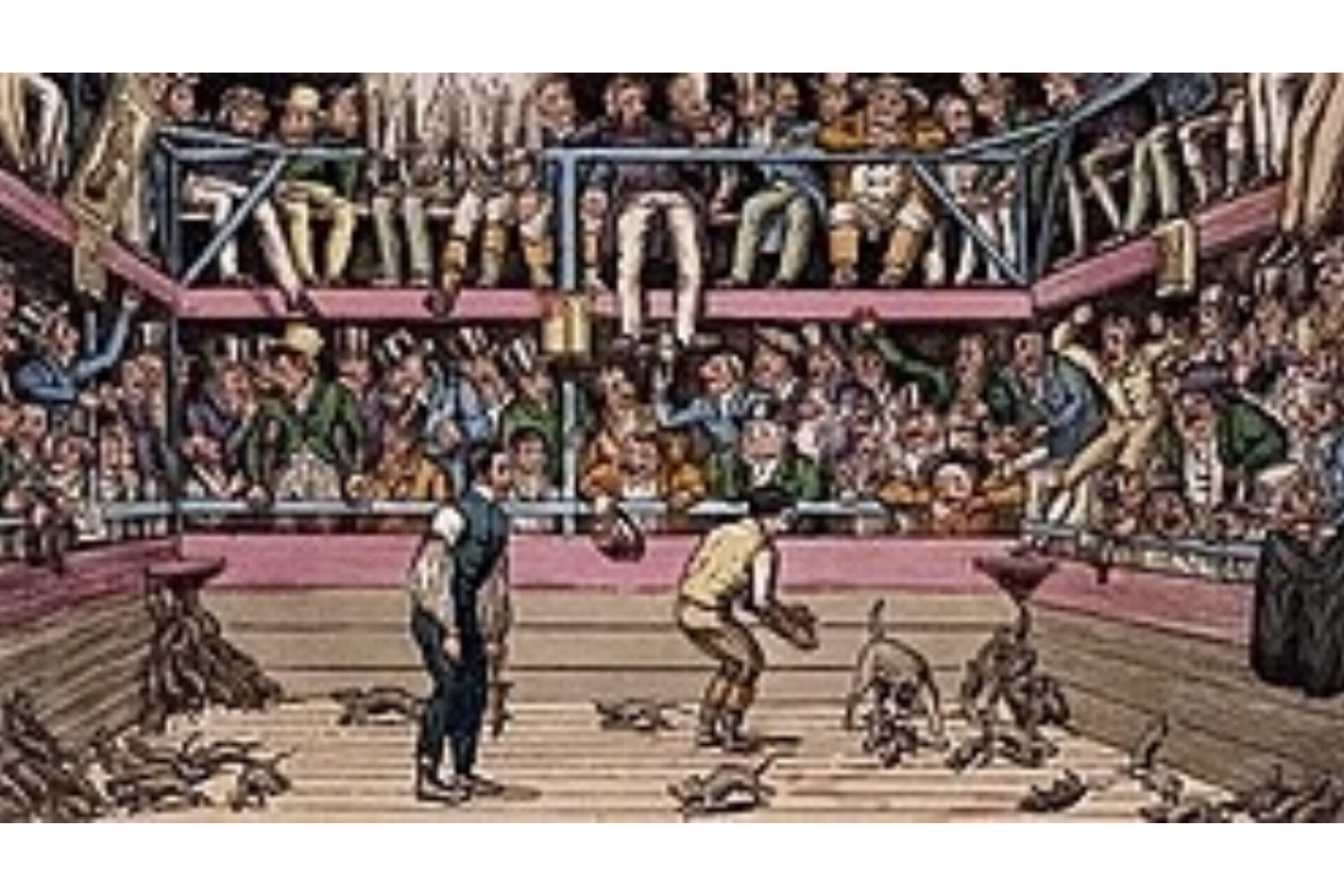
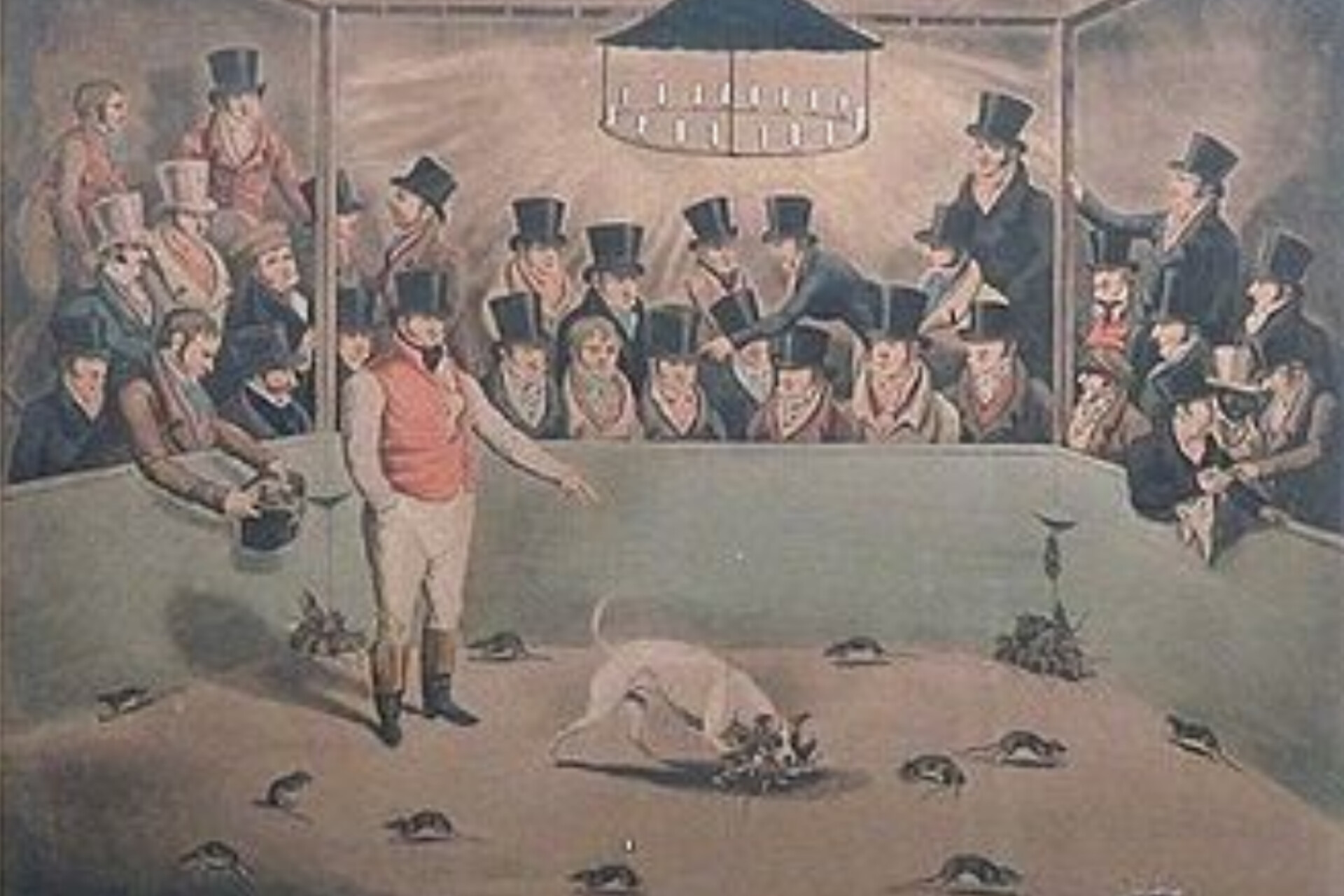
The contests take place in a rat-pit, which is a kind of circular cage without top or bottom, some three or four feet in diameter, and nearly the same in height. The pit is constructed of thin iron bars, placed vertically about an inch apart; it can be placed on the floor of any apartment in which a match is to be brought off, the spectators generally sitting or standing around, as in a circus or cock-pit.
The breed of dog most commonly employed is a cross between a Fox Terrier and a Bull Terrier — a combination which gives the alertness of the one and the determination of the other, in an animal possessing a wide mouth with strong jaws.
Some famous dogs have been pitted with as many as thirty, forty, or even a hundred rats, and matched against time to kill the lot. It is seldom that a dog escapes without a nasty bite or two from the vicious rodents. Should any of the caged victims try to escape from their furious assailant, the official in charge who “plays” the animals, is armed with a short stick with which to knock them back again as they climb the bars.
Even Rat-killing, like every other pastime into which an element of bloodthirstiness enters, and the fascination of which is contained in the spirit of the invitation “to go out and kill something,” has proved itself susceptible of degradation. Some brutalised specimens of humanity have not disdained to put themselves on the level of snapping, snarling dogs, in emulation of their inbred rat-killing propensities. Among “men” of this type was a Birmingham character called “Blewey,” who frequently backed himself to kill rats faster than a terrier dog.
The rats were tied to stakes on a table, and this worthy gained great fame for himself by seizing them with his teeth and breaking their backs. The hostelry which acquired distinction in this particular line was The Jim Crow Inn, Hill Street.
Frederick W. Hackwood, Old English Sports (London: T. Fisher Unwin, 1907), pp.352-355. See: https://babel.hathitrust.org/cgi/pt?id=coo1.ark:/13960/t2w38bc4g&seq=1
Encyclopaedia of Sport
Charles Howard, Hedley Peek, and F. G. Aflalo
RATTING
Every sportsman has probably indulged in “ratting” at some time or other. The period of this indulgence is usually that which immediately precedes his “first gun” — in fact before he would be safe with that much-desired weapon. Having the right instinct, he usually cleaves to rat-catching because the possibilities are within his grasp. If he can command a blue-blooded terrier, a ferret warranted not to “lay up,” and a cutting-tool, well and good; but if he cannot, he knows some one who has a “game,” broken-bred, broken-haired terrier as hard as nails — the village poacher is always good for a ferret — and a discarded garden spade must take the place of the more artistic implement. For these three things are the essentials in ratting. The picturesque professional rat-catcher has gone out, and the gentleman amateur must take his place. If any one retort that ratting is not sport, I can only reply that one of the best sportsmen living has told me that he would prefer being a rat-catcher to being a bishop.
They are usually found by the sides of rivers, among haystacks and in old buildings, in the rickyards, in drains, and especially on stubbles bordering streams. In summer and autumn they mainly patronise the open; but when the land is cleared, and the first frosts have cut down the cover, they make for the buildings. At least this is what the common Brown Rat (Mus decumanus) does, but the Water Vole (Arvicola amphibius), often called the Water Rat and hunted as such, sticks to its sylvan retreat the whole year round. (The Black rat — Mus rattus — is now practically extinct, so we need take no account of him.)
Ferrets are the most important part of the ratter’s outfit, and to face a big day’s ratting they should be strong and well nourished; and it is needless to say that they should not be fed on the day they are to be taken out. Always carry your ferrets in a strong canvas bag, which, for protection, may in turn be carried in an old game-bag. For rats, as opposed to rabbits, bitch ferrets are preferable to dogs. The former are only about half the size of the latter, and can follow a rat anywhere. Imitate the poacher, and never run a dark polecat ferret when you can command a white one. Besides, an indiscreet terrier is much more likely to snap up the brown animal by mistake than a white one. Never, of course, muzzle a ferret when ratting, nor handicap it by running it with a line. And a ferret bell is equally useless. It has quite enough to do to defend itself and drive the vermin.
Always have plenty of resource in ferrets. They get badly bitten, and it is unwise to allow them to get too much punished. Run them in turn, and not too long. The shorter they run, the harder they drive, and the more sport is provided. They should always be attended to when the day is done, and have their wounds dressed with sweet oil. A rat’s bite is poisonous, and dressing will prevent festering.
The best kind of spade for ratting is one that is strong and light. The blade should be of the best tempered steel, so that it will cut easily through roots. It is a convenience if the spade has a spike at one end for following holes and finding the direction of runs in soft banks.
It is unnecessary to say much about dogs. For ratting, terriers are far the best, rough-coated fox-terriers for preference. To be worthy of the name, terriers should be small, compact, quick, “game,” and have good noses. They should, of course, be able to find rats. Once a reliable dog has “marked,” it is interesting to watch how cutely the rest find and mark the bolt-holes. A good terrier may, of course, be of any colour. I have known several which were splendid ratters, of very mixed hue and lineage.
The ideal day for ratting is one we invariably get during the last week in September or the first week in October. The crops have been gathered, and, owing to a night’s frost, the bareness of the earth begins to peep through. Now that the grain has been carried, the rats have left the stubble for the hedges, and sport is to be had in plenty. As the vermin are driven, the dogs take their chance, each in its own fashion, with a nip here, a narrow escape there, until a dozen rats have been accounted for. A few hedgerow holes are found barren, but a soft bank yields enormously. A couple of bitten ferrets have been put into the bag, and “Nails” is philosophically licking the dripping blood from his nose. He took hold of a rat a little too far back, and this is the result.
Comparatively few rats have as yet taken to the stacks in the field corners, but even now these yield princely sport. They charge from the thatch like tigers, but once on the ground the dogs give none of them time to get back. They take them as they come, and every snap of the trap-like jaws accounts for a victim. In ferretting a stack or rick, it will invariably be found that the rats have made well defined runs, and unless these are stopped the sport will be poor, as the rats will not be forced to the ground. And until they are the dogs can do nothing. To compel the vermin to leave the stack, it is necessary to cut off their runs. This may be effectively done by placing pieces of board across them, and it is the only way to prevent the rats running in circles and thus baffling the ferrets.
Shooting rats on a stack is not effective, and it is not strictly “ratting.” Good sport may often be had with a single terrier along the banks of a stream or river where rats are accustomed to harbour in roots. I have had terriers, one in particular, which would bay them out, and once in the water their existence was short. In hunting rats in the water, often a good deal of time is lost in getting a dog to see the rat. When this is the case, instantly seize the dog and lift it well up. From this vantage it will immediately see the rat, and will dive after it in a moment.
Here is the record of probably the biggest bag of rats ever made. It took place in a Paris slaughter-house, several dead horses being left as bait overnight. Several workmen were employed in the assault. Having entered the yard and closed the door behind them, they commenced a general massacre. It was not necessary to take any aim, for no matter where the blow was directed, it was sure to immolate a rat; and those which endeavoured to escape by climbing up the walls were quickly knocked down. By a recurrence of this experiment at intervals of a few days, they killed in the space of a month 16,050 rats. After one night’s massacre the dead amounted to 2,640, and the result of four hunts was 9,101.
This is not the place to mention the numerous ingenious traps which are used for circumventing rats, but I cannot resist the temptation to give a recipe “To find a dead rat.” Go to the butcher’s and catch a dozen blue-bottles. Slip them into a glass jar, tying a bit of rag over the mouth. Proceed to the room where the smell is, shut the door behind you, and let loose your pack of flies. They will go buzzing round and round, but after a time will all settle on the self-same spot. Under that particular spot — to an inch — is the dead rat.
Charles Howard, Hedley Peek, and F. G. Aflalo, eds., Encyclopaedia of Sport, vol. 2 (London: Lawrence & Bullen, 1900), pp. 245-246.
See: https://babel.hathitrust.org/cgi/pt?id=hvd.hn38fs&seq=1&q1=
Full Revelations of a Rat Cathcher
Ike Matthews
PART IV.
LIFE OF THE RAT-CATCHER.
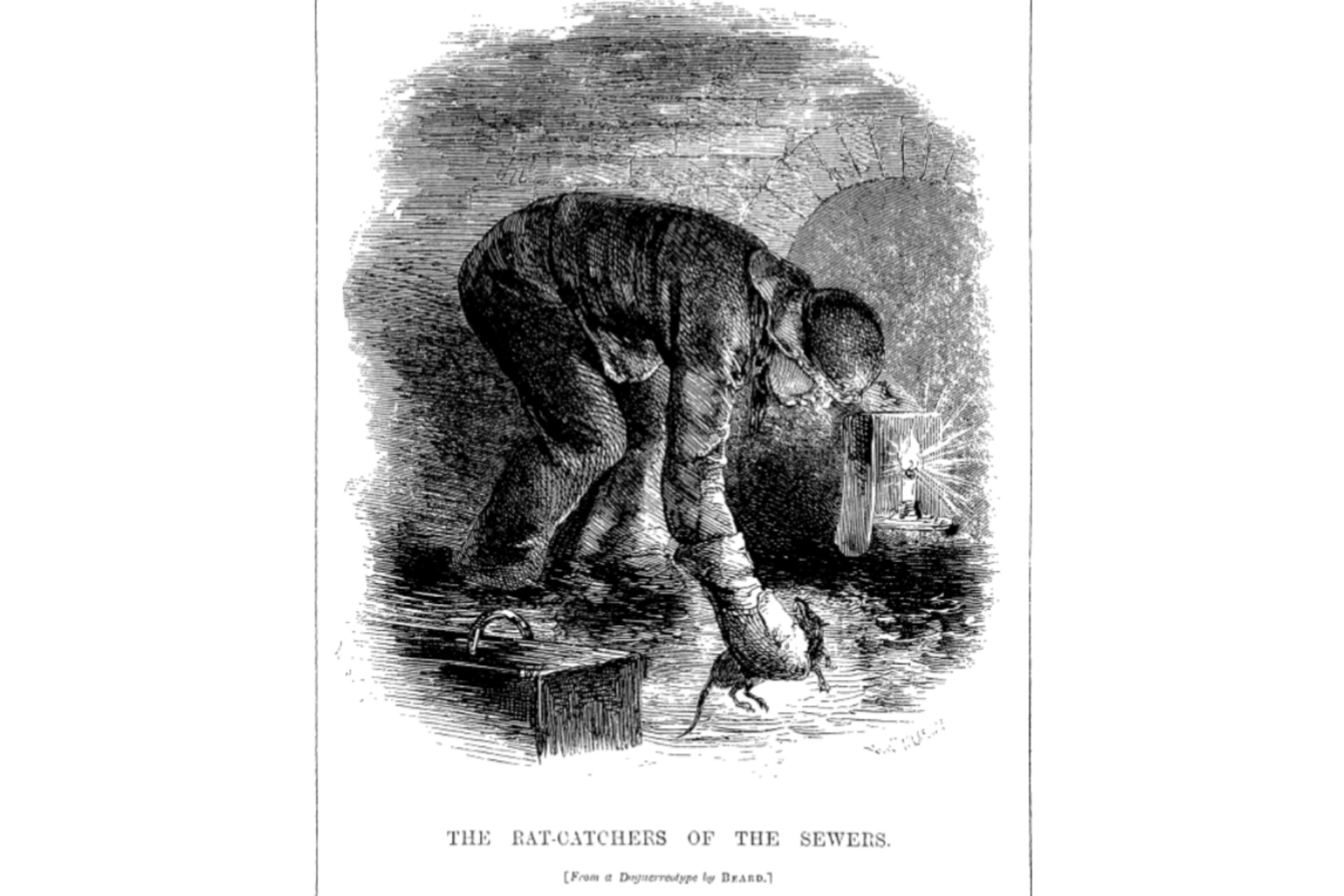
. . . Well, Rat-catchers are generally called upon to supply Rats for the Rat coursings usually held at beerhouses, &c., on Saturday afternoons, which one often sees advertised. Now, if he binds himself to supply a coursing at a certain date, the bills announcing the event are printed and posted, all of which means expense. Then you are bound to secure the live Rats, whatever be the weather. In doing this I always followed the threshing machine to the bays and stacks. (Anyone that catches Rats regularly can tell by looking at the bays or stacks whether there are many Rats in or not.)
I remember many times when the men have started threshing a bay of wheat in which were a great many Rats, and by dark they have threshed only half of the bay. At such times the Rat-catcher must not leave the remaining half, no, not for half-an-hour throughout the whole night, for if he does the Rats will run out. To stop the Rats from leaving, the Rat-catcher has to lie on the top of the bay or go about every thirty minutes and beat the bottom with sticks until daylight, in order to keep the Rats in. Then, after the machine re-starts, and the bottom of the bay is reached, the Rat-catcher will be well paid for his trouble, for he may get, say, 150 good Rats for the coursing, at six shillings per dozen. The reason I call them good coursing Rats is because they have not been handled, and that enables them to run well.
Of course, what I have just related occurred a few years ago, but when the Muzzling Order came into force, the authorities practically stopped Rat coursing, for they would not let a dog run at a Rat unless the dog was muzzled. This was about the worst thing that the authorities could do for Manchester and district, for at that time I was supplying for coursings about 100 Rats per week, and at the same time sending 50 Rats a week into Yorkshire, and all the Rats I supplied were caught within 15 miles of Manchester. This in my opinion, speaks very bad of the Muzzling Order, which I think is nothing but a farce, for at the very time I was going ratting, dogs were muzzled in some parts of the country but not in others. My opinion of dog muzzling is, muzzle all or muzzle none.
You will see by what I have said respecting these coursings, &c., that the Rat-catcher has plenty of work to supply so many live rats, and he has also to mix with company high and low. He also sometimes experiences difficulties in travelling on the railway. I have often entered an empty third-class carriage, sent my dog under the seat, and put the Rat cage there also. The carriage would fill with passengers, and upon reaching my destination I would take from under the seat my cage full of live Rats, to the amusement of some and the disgust of others.
I have also entered a railway carriage with my cage of rats when there were passengers in, one or two of whom would generally object to live Rats being in the same compartment, and on enquiring of the railway officials, I have found that any one travelling with live Rats is expected to put them in the guard’s van.
I have also had a few good customers in my business, one or two in particular. Gentlemen have often sent me post-cards instructing me to take six or twelve Rats to their residences. I would run them out on the lawn in front of the house with their dogs, and generally I have received good remuneration for my trouble. These are the customers who should be looked well after, for they are the sportsmen who do not consider expense, though of course there are others who are just the opposite.
Further, Rat-catching is a business in which one is not called upon to allow credit. It is all a ready-money trade, and as there is not much competition, the Rat-catcher can command a good price for his work. He has always one resource open to him when he has finished a job according to contract (catching say 40 or 50 Rats), should there be a dispute about the price and the people decline to pay the bill, then he has the expedient of letting the Rats at liberty again in the place where he had caught them. Most people will pay the price you send in rather than have the Rats turned loose again.
Although I am showing how the Rat-catcher can always have the advantage of stubborn payers, I may as well assure my readers that in all my experience such an occurrence as the above has never happened with me, simply because I always make my arrangements beforehand, which course I always find the best and most satisfactory all round.
Another matter I may mention. If any one could find out a sure way of catching Rats so that he could give a guarantee to clear large buildings, my opinion is that he would make a fortune in a very short time; for I know firms in Manchester alone that would pay almost any amount to be rid of the Rats; not only because of what they consume, but more for the damage they do to their goods.
I have referred to the Rat-catcher obtaining good pay. The reason he commands such a big price for his work at the present time is because there is not much sale for live Rats. The trade is not what it was some years ago when Rat-pits were allowed. I think it was one of the worst things they ever did for this country when the authorities stopped the Rat pits, for when Rat killing was allowed in pits, it was a common thing for a Rat-catcher to receive an order for 100 Rats, all to be killed at one time; then the Rat-catcher would get the Rats and wherever he got them from he was ridding that district of a nuisance.
But when the authorities stopped Rat-pits and Rat-coursing, the consequence was that the Rat-catcher left the Rats to breed in thousands. Rats being vermin, I don’t see why they should not be killed 50 or 100 at a time in the pit, but the Humane Society maintain that it is cruelty to dogs to put them in a pit with a lot of Rats. I don’t see where the cruelty comes in, but from what I have seen of Rat-pits during my time I approve of them, and I think if they were in existence again there would be a clearing of many thousands of Rats. Some 15 or 20 years since, I supplied 400 Rats in one week, all to be killed in Rat-pits.
Many of my readers may not understand what a Rat-pit is, and so I will just give an outline as well as I can.
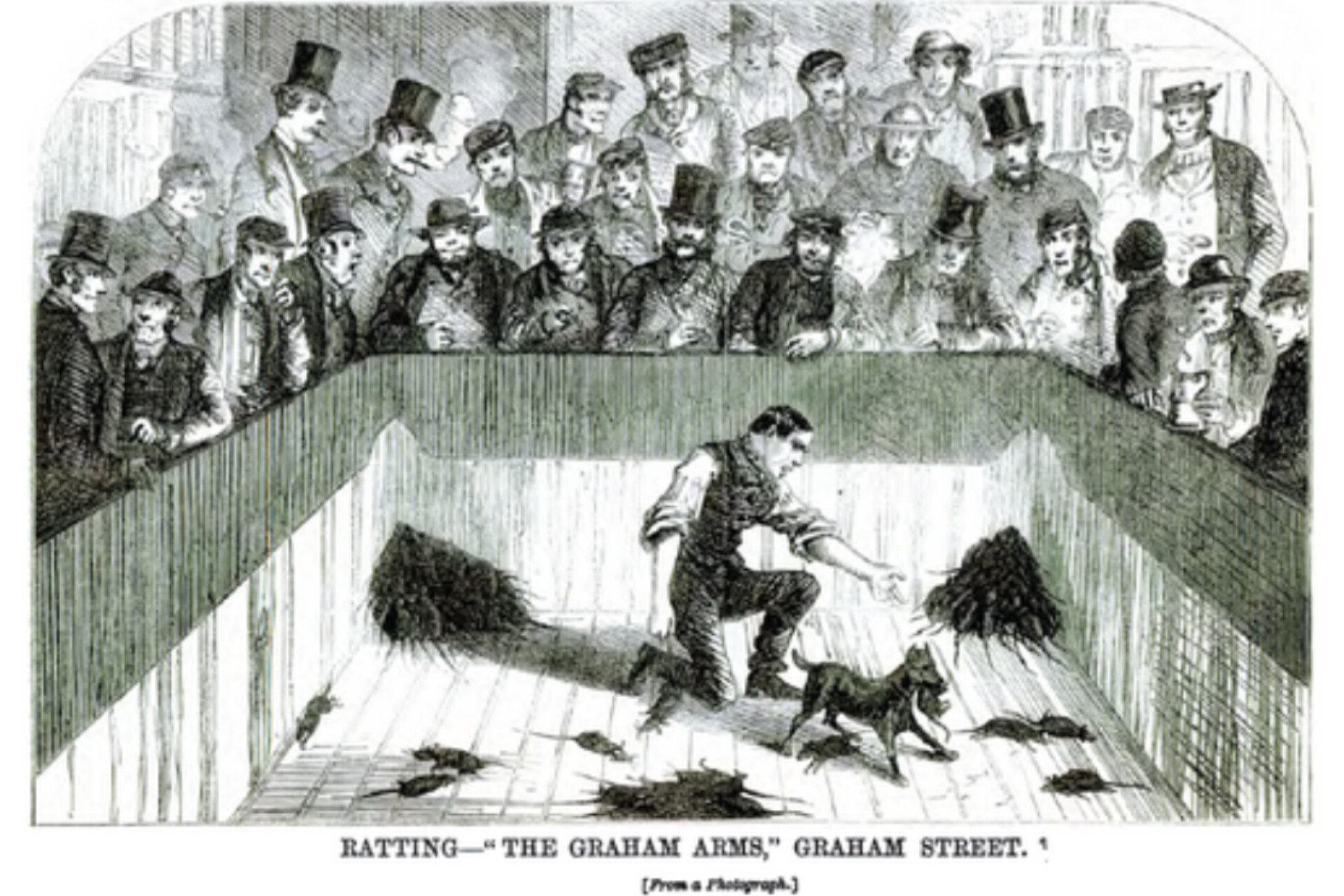
The Rat-pit is of circular construction, say ten feet diameter, and about four feet six inches deep, the sides being perfectly smooth to prevent the rats climbing up and making their escape. A certain number of Rats are placed in the pit according to the arrangements made with the owner of the dog. Then the dog is put in the pit with the Rats to kill them, which a good dog does very quickly.
The reason the pit is built circular is so that the Rats will keep running round, for if it were square they would all run in a corner, one on the other, and then the dog would have no difficulty in killing them. It is better to have the pit fairly deep; if not, the rats might escape. I think the best dog, within my recollection, that I have seen was a bull and fox terrier, which killed 40 good Rats in three minutes and 21 seconds. I have read and heard of dogs doing better feats, but I am only writing of what I have myself seen. I may say that the records for Rat-killing in Rat-pits are held by a dog called Jacko, which killed 200 Rats in 14 minutes and 37 seconds, and 1,000 Rats in less than one hour and 40 minutes. . . .
Ike Matthews, Full Revelations of a Rat Cathcher: After 25 Years’ Experience (Manchester: The Friendly Societies’ Printing Co., 1898), pp. 46-52.
See: https://babel.hathitrust.org/cgi/pt?id=uc1.$b309116&seq=1
The Rat
James Rodwell
. . . True sportsmen and rat-catchers tell us that a good dog cannot be of a bad colour; that is to say, it matters little what the colour may be, so long as the animal is a good one. A dog for sound service should be any weight between eight and eighteen pounds. But one from ten to twelve pounds is a most serviceable creature, and, if well trained, will work its way through almost any number of rats. A well-trained dog never shakes a rat, or bites it twice, but seizing it across the neck and shoulders, pins it to the ground till it is dead. In this way many of them will kill from ten to twenty rats in one minute, if in close quarters. Nor do they ever bark or scratch at a hole, unless urged to do so, but patiently wait where you place them till the ferret is put in, and the rats bolt; then they do their work as quickly as possible, and quietly wait for more.
Bull-terriers also vary very much both as to courage and quality. Even puppies of the same litter, though all taught alike, will often differ as much as so many dogs of different breeds; and sometimes not one among them will turn out worth a rush for rat-killing. Still there is this to be said, that if you have a well-bred puppy, you stand a good chance, by careful training, of having a decent killer, perhaps a good one; while, on the contrary, a mongrel, with all the training possible, never can make a good dog. But I must tell you, that an ill-tempered, surly, vicious man never yet brought up a good dog. You may give him the best puppies in the world, and his coarse, morose temper will spoil every one he has to do with. So you may take my word for it, that a kind, gentle, cheerful disposition is the first and principal qualification for a good sportsman, or trainer of young dogs.
Few of the best rat-killing dogs of London understand anything about rat-hunting, and would as soon kill the ferret as look at it, never having been trained to them; consequently, though some of them would kill any number of rats in a pit or parlour, if properly secured from escape, yet at the same time they would kill scarcely a rat a month of their own catching.
Perhaps the most extraordinary animals for rat-killing that the world ever saw, were two celebrated dogs, named Tiny and Jem, of whom I have already spoken at some length. A small account of these most wonderful creatures may not be wholly uninteresting; and therefore I will wind up the subject on dogs with “Tiny and the Baby.”
Tiny was a very slender, pretty black-tan bull-terrier, about the size of an ordinary cat, and weighed only five pounds and a half in trained condition. He was a most excitable little creature, and could not stand still for one instant. When his master brought him into the parlour to show me, I certainly never saw such a sight. I could scarce tell which was the head and which the tail; for he went round about, up and down, in and out, this way and that, with such rapidity that I could form no idea at all as to his size, shape, or colour, except that he looked like an India-rubber ball with glistening red streaks about it; or rather like a bundle of affrighted eels twisting and twining in and out of each other for the purpose of hiding. But as he grew older, he became more steady and dignified, and used to sit in state, on a crimson velvet cushion fringed with gold lace, and placed on the bar-parlour mahogany table, with large bright candlesticks and mould candles on each side, so that visitors might see him from the front of the bar. And this was Tiny, the then rat-killing wonder of the world, and conqueror in about five thousand life and death battles with rats.
I shall now give some of his wonderful performances.
When nine months old, and weighing only four pounds and a half, he won two matches at six rats each. When he weighed five pounds, he won twenty different matches at twelve rats each, and fifteen matches at twenty rats each. His next match was to kill fifty rats before he was taken out of the pit, which he won cleverly, never stopping till he had destroyed the whole. Tiny was then matched to destroy one hundred rats in thirty-five minutes, which task he accomplished in thirty-four minutes and fifty seconds, winning the match by ten seconds. He afterwards defeated the celebrated Somer’s-town dog, Crack, eight pounds weight, in a match at twelve rats each. He beat the renowned dog, Twig, six and a half pounds weight, at thirty rats each; and was matched to kill two hundred fair barn rats in three hours. This task he accomplished in fifty-four minutes and fifty seconds! thereby winning the match, with two hours, five minutes, and ten seconds to spare.
Tiny was matched to destroy twenty of the largest rats that could be produced, in ten minutes, and which task he completed in eight; thereby winning the match, with two minutes to spare. A fortnight afterwards he beat the celebrated bitch, Fan, eight pounds weight, in a match at fifty rats each. He was then matched to destroy fifty rats in twenty minutes, without any one being in the pit with him, and which task he accomplished in fifteen minutes and twenty-five seconds. He was matched to kill twelve of the largest rats they could find, in three minutes; which he won in two minutes and thirty seconds.
We next find him struggling by himself with fifty large rats, having been backed to destroy them in twenty-one minutes, but which he did in twenty minutes and ten seconds. A month afterwards he was backed to destroy one hundred rats in thirty-one minutes, and which he completed in thirty minutes and three seconds. Again, he was backed to kill another hundred in half an hour, and which he accomplished in twenty-eight minutes and five seconds.
Tiny was again pitted with two hundred rats. This match was a close run, having been backed to destroy them in one hour, and it took him fifty-nine minutes and fifty-eight seconds; thereby, winning the match by only two seconds. He was again backed to kill one hundred fair barn rats in half an hour. This match he won in twenty-nine minutes and ten seconds. He was backed to kill twenty of the largest rats they could find, in four minutes, which feat he accomplished in three minutes and seven seconds; and a few days afterwards he was again pitted with twenty of the largest rats they could produce, being again backed to destroy them in four minutes, which he completed in three minutes and fifty seconds.
To say nothing of private matches among gentlemen, Tiny, when he died, had contended in upwards of fifty public matches, all of which he won. Suffice it to say, he had never suffered a defeat, and had destroyed over five thousand, or nearly a ton and a half weight of rats. He had also been presented with numerous beautiful and valuable collars, both by gentlemen of rank and public subscription. On one occasion a nobleman offered a hundred pounds for Tiny; or rather, he offered a hundred guineas for Tiny and a lesser dog, worth only five pounds, which left a hundred pounds for Tiny; but which offer was promptly refused by his master.
His manner of killing was different from anything of the kind I ever saw. In a heavy match, when put into the pit, he would set as steadily to work as any little old man going on a journey. The rats always get into the corners, and there form pyramids, five and six layers deep, resting on each other’s backs. Sometimes, if they do not stir them about, the under ones will be suffocated. But instead of dashing in among them, as most high-bred dogs do, Tiny would stand quietly at one heap, and pick out the largest first, and then be off to the next heap; and so on, till he had disposed of all the biggest. He never bit a rat twice, or ever shook one; but after he had dropped it, it was a pound to a penny that it never rose again.
When he became tired, he would leave off, and lie down in the middle of the pit for his master to wash his mouth, and refresh him by blowing on him; but as soon as he had gathered his wind a little, he would up and at it again; and so on until every rat lay dead. On one occasion, all his front teeth fell out, except one fang, with which he finished the match victoriously. Several gentlemen begged a tooth each as a great favour, and had them mounted in silver and gold, to preserve as relics of this most wonderful little creature.
Tiny died from over excitement. Some men had a rat in the parlour, and though Tiny was chained in the bar, and could not see it, still, such was the state he had worked himself into, that they became alarmed; and though they let him kill it, he died soon after. On examination it was found that he had burst his heart in three places; at least so his master informs me. And this was the end of Tiny, the rat-killing wonder of the world. He was afterwards stuffed, and is now exhibited in a glass case. But his master tells me that for him as he is he would not take a hundred sovereigns.
Jem, the champion, was a fallow-coloured bull-terrier, about eighteen pounds weight, with a head nearly all white, and in his general appearance as plain a looking dog as you would wish to see, except that he had an unusually long, strong, square muzzle. But for steady perseverance and powers of execution he has never been equalled. His public exploits were numerous. He contended in eighty public matches: namely, 20 matches at 20 rats each, 30 matches at 50 rats each, 28 matches at 100 rats each, and 2 matches at 200 rats each; thus destroying in public 5,100 rats.
The longest time he took to destroy a single hundred was eleven minutes and twenty seconds; and the shortest was five minutes and fifty seconds. This is the quickest time in which one hundred sound rats were ever fairly destroyed by a single dog. But to add to the wonder, Jem, when he had had but ten minutes’ rest, was again pitted with a second hundred, and in six minutes and one second every one lay dead; thus destroying two hundred fair barn rats in the short time of eleven minutes and fifty-one seconds, or at the rate of seventeen each minute. This I believe to be the greatest feat in rat-killing ever performed by a dog.
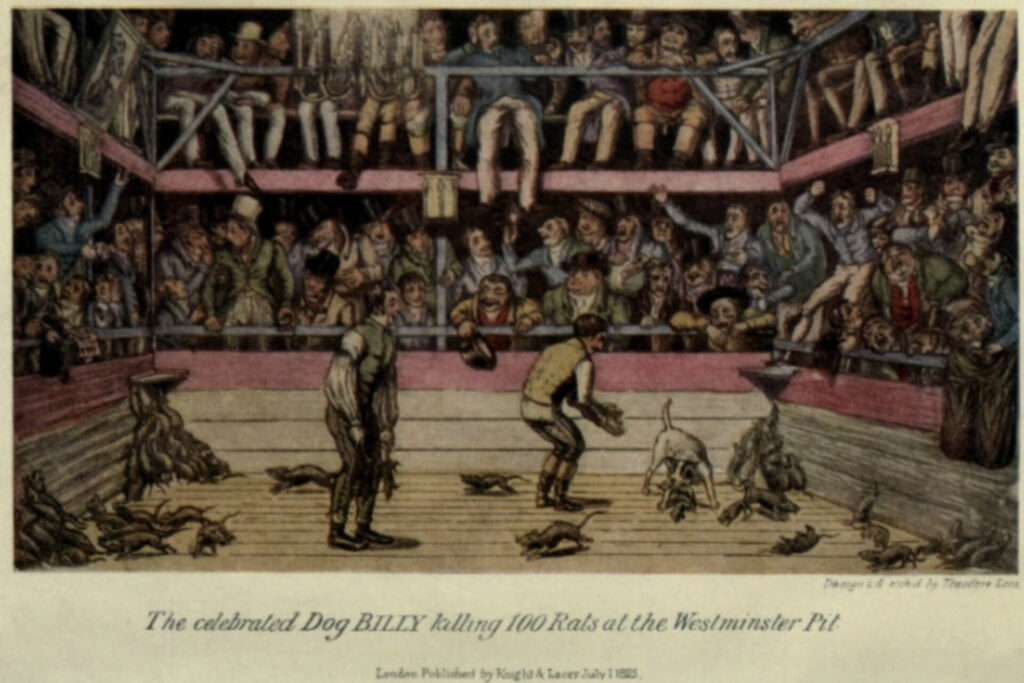
The celebrated rat-killer, Billy, who exhibited some thirty years since, did not perform anything near the feat of Jem; for though Billy’s time, in destroying a hundred rats, is stated to have been five minutes and a half, still, let it be borne in mind, and I assert it on the testimony of living witnesses, that numbers of the rats were dead before the dog commenced, and that the whole had been poisoned with nux-vomica before being put into the pit. This is the poison that rat-catchers give those rats that may sometimes be seen crawling about them in the streets. Of course they give them but little, or they would die too soon. It has the effect of partially or wholly paralysing them, according to the quantity they have eaten; and this is the supposed charm that many rat-catchers have over rats to tame them.
A gentleman, a friend of mine, who witnessed Billy’s feat, leant over and picked up two or three of the rats that were crawling about, and he declares they were perfectly harmless, and not able to see. Not only that, but the instant the dog touched them, they were taken by the tail and slung out of the pit, whether they were dead or not. But as it has been shrewdly remarked, had Billy stopped at home till the following day, the rats would have saved him the trouble, because they would all have been dead before morning.
In our day there are different rules and regulations for rat-matches; for if there be one suspicious rat put into the pit, it is instantly replaced by another, so that they are all approved rats. Then, when the dog has done his work, and his master, or second, has picked him up, should there be any rats lingering, they are placed in the centre of the pit; and if they can induce them to rise and crawl the length of their bodies, the dog has to come in a second time, and finish them; and the time thus employed is added to the rest, thus does many a furious animal lose the match. And had Billy been bound by such rules as these, I am persuaded he would have been nearer twelve minutes than five in accomplishing the task.
The truth appears to be that Billy did not destroy a hundred rats at all, for numbers were dead from poison before he commenced; and when he did commence, several were thrown out as dead that were able to crawl away. So that, taking these matters into consideration, the question is, did Billy in reality kill three-score rats in five minutes and a half, instead of five score? Not so with Tiny and Jem. They did their work to the satisfaction of every one present, both winners and losers, and never left a doubt upon the question.
The dog Tiny never suffered a defeat, but, on the contrary, Jem was twice defeated, if defeats they might be termed. In the first place, he was chained up for about three years, and not let loose except for a few minutes, for weeks together; and then only to kill a few rats, after which he was instantly chained up again. All at once he was matched against the greatest champion of the day, — Crib, of Richmond, in Surrey, — a highly-trained dog; and so prized by his master, that he spared neither pains nor expense to keep him in good condition. The match was to come off in a fortnight from the time of signing articles. A person was appointed to take Jem in hand, and see what could be done, by way of training, in so short a period. He chained him behind a vehicle for two or three days; and the dog’s feet (being naturally tender from inactivity, and the distance and the force with which he dragged him over the hard roads) were completely excoriated. Hence the poor creature had to run on the bare flesh. Added to this, the dirt and gravel were so completely ground in, that on the day of the match, instead of being, like his opponent, in first-rate condition, he could not stand, and was forced to eat and drink lying down.
However, the match was play or pay, and Jem’s master, not being willing to lose without a struggle, set his wits to work, and hence the following stratagem. He procured a number of babies’ socks, and having filled them with softened fuller’s earth and oil, thrust the dog’s feet into them, and carefully tied them. round with garters; then, when time was called, Jem was carried to the pit, and the instant he saw the rats, his courage overcame every obstacle, and, to the astonishment of every one, he set to work most gallantly, and never stopped till he had finished his task. But the pain and stiffness, and the entire want of all training, retarded his buoyancy and activity; and hence he was behind time with his powerful opponent.
But another match was instantly made, to come off in two weeks, when Master Crib had to sustain a most inglorious defeat, not having the shadow of a chance. Thus was proved the then sounder-footed Jem’s complete superiority over him as a rat-killer.
His second defeat, if it could be so called, was, if possible, more unfair than the first; for he was taken, as it were, off the chain, and backed against a full-trained dog, to kill a hundred rats to his opponent’s fifty, thus destroying at the rate of two to the other’s one; but so near did he run the struggle, that no odds in money, not even a hundred to fifty, could induce his opponents to renew the match on the same conditions. In every other match he came off victorious, and was, at the time of his death, the undisputed champion of the world.
The dog Jem was the envy of the whole rat-killing fraternity, and such was the care necessary, for fear of foul play (I mean theft and poison, from both of which his master had been more than once a sufferer), that Jem was forced to be kept in almost constant seclusión and confinement, and never went out for an airing except with his master, when business would permit.
On the last occasion he took him as far as Chelsea; and when returning through Brompton he mounted an omnibus, for the purpose of giving him a run. The poor dog was following alongside, and looking up at his master, when a rival buss shot by, and, running over him, killed him on the spot. The grief occasioned in the district, as soon as it was known what had happened, is more easily conceived than described; but suffice it to say, that a gentleman, to soothe the sorrows of his disconsolate master, presented him with a magnificent signet ring, with a miniature likeness of Jem in the act of killing rats, and encircled with the motto, “Every man has his fancy,” most exquisitely engraved on the seal. The engraving cost eight guineas, and the ring eight more, which ring Jem’s master wears in honour of the gentleman and his poor dog.
That these dogs are not the properties of the humbler classes, the following will prove most clearly. Jem’s owner informs me that it cost him scores and scores of pounds to bring Tiny and Jem to their state of perfection. This I can easily believe, from the fact that they knew so well the difference between the words, head and dead; for if they seized a rat by the hind quarters they were almost certain to be punished for their trouble. To avoid this, their master would sing out head, which summons was always responded to by seizing the next rat across the head, neck, and shoulders. Then, when he sang out dead, the rat was instantly dropped, and another as quickly seized; thus showing a great degree of perseverance and practice.
But he tells me that Jem had destroyed over 10,000 rats. Here, then, can we calculate pretty nearly the cost of training him. In public he had killed exactly 5,100 rats, and that leaves about the same number for training. Now 5,100 rats, at prime cost, namely, three shillings per dozen, amounts to £63 15s. 0d. But if an amateur purchases rats for the purpose, he has to pay the retail price, which is sixpence each, or six shillings per dozen. In that case the training of Jem would have cost £127 10s.
Now, whether the rats be bought wholesale or retail, pray what man in humble circumstances can afford the expense? No, the great majority of real rat-match dogs are the properties of persons who can not only pay the cost of training, but back them besides; and among which persons we may rank, not only publicans, but noblemen and gentlemen, both civil and military, as well as citizens of London and first-class tradesmen in Bond-street, Oxford-street, and Regent-street; besides master butchers, bakers, milkmen, and a host of others.
Still, let it not be supposed that gentlemen either train or second their dogs in such cases. They can always hire persons for such offices, while they themselves can look on as casual observers. Nor am I aware that they are less qualified to fill their various positions in life, because they feel a fancy for dogs, or an interest in the destruction of vermin.
But, after all, I must confess that rat-matches seem a good deal like hunting a bagged fox, or a Cockney sports-man filling his pockets with poultry in a farm-yard, instead of traversing over moor and mountain in quest of game. And though it is true, that in a pit Jem has destroyed two hundred rats under twelve minutes, yet, if left to hunt them in their natural runs and retreats, pray would he have killed two hundred in twelve months? or would he have caught as many rats in the year as one of those little flat-headed cats I have already spoken of? Remember, rat-matching is one thing, and rat-catching another.
But before leaving the subject, let me put my country friends on their guard against a most dishonourable practice, by which they are not only deceived, but lose their money; and that is, the practice of painting first-rate dogs, and matching them as novices. If I tell you of one celebrated animal, upon which this was often practised, that will be as good as a thousand, so far as the powers of painting are concerned.
A boxing-glove maker (of London) had a fallow and white bitch, named Rose, about fourteen or fifteen pounds weight, which was the fastest killer in England. This man told me, in the presence of a friend, that the late ex-champion was her principal backer; that he himself had not sufficient means, but that his backer always paid him handsomely for the use of her, and had won a deal of money by her both in town and country.
It did not signify who had a dog near her weight, he always had a novice on hand, on the which he would risk his money, if they would stake a good round wager. Sometimes his novice was a red and white bitch; at others, a black and white one. Then it would have a black or red patch over one eye; or, if necessary, over both eyes. On other occasions she would be all one colour; and lastly, to drown all suspicion, his novice would be black and tan; indeed, she had been painted all the natural colours you could mention, excepting white.
Thus were numbers fleeced of their money; for while they thought they had a novice to deal with, they were contending with the fastest killer of the age under the disguise of hair-dyes. Take this case then as a warning; and if gentlemen will match their dogs, let them know against whom and what, or they may rue their folly. . . .
James Rodwell, The Rat: Its History and Destructive Character (London: G. Routledge & Co., 1858), pp. 229-238. The lead picture appears as the frontispiece in Hackwood, Old English Sports. The Rat Catcher can be found on page 370 in Henry Mayhew, London Labour and the London Poor, vols. 2-3 (London: G. Woodfall & Son, 1851). The remaining images can be found at: https://en.wikipedia.org/wiki/Rat-baiting
See: https://babel.hathitrust.org/cgi/pt?id=hvd.32044107349557&seq=1&q1=