Rhinoceros (Asia)
We want you to have a greater ability to learn about some of the unpleasant animal issues in our world.
Mammals of Eastern Asia
George H.H. Tate
THE RHINOCEROSES (FAMILY RHINOCEROTIDAE)
These huge, ungainly creatures with their armor-plated hides, their massive legs, their odd-looking heads, their ears placed far back and their eyes far forward, and the bosses or horns on their noses, are sufficiently well known to need little further description.
The skin plates, very thick and relatively inflexible, work against one another along suture-like contact lines where there is much thinner, pliable connecting skin. The horns on the nose are not made of bone. They are special structures derived from the fusing or cementing together of hairs. Three broad, hoof-like toes, of which the middle one is the largest, are present on both front and hind feet. There are two nipples under the belly. Only one calf is born. The senses of smell and hearing are very acute in Rhinoceroses; sight is reputed to be weak. When attacking an enemy, Rhinos are said to bite severely with their incisor teeth, as well as to strike with the horn.
Fables have it that the Rhinoceros is the deadly enemy of the Elephant. In The Arabian Nights, the Rhinoceros, after stabbing its horn into the underparts of the elephant, carried that animal about on its head until blinded by the juices running down from the elephant’s body.
There are still several living species of Rhinoceroses. The African two-horned Rhinos are placed in the genus Diceros. The three species of Asia, the Great One-horned Rhinoceros, the Two-horned or Sumatran Rhinoceros, and the One-horned Rhinoceros are contained in Rhinoceros.
Relatively enormous prices have been paid by Chinese for all parts of Rhinoceroses, but especially for the horn and the dried blood for use as charms and medicines. This demand has led to such destructive and continuous hunting of these animals that they are verging upon extinction.
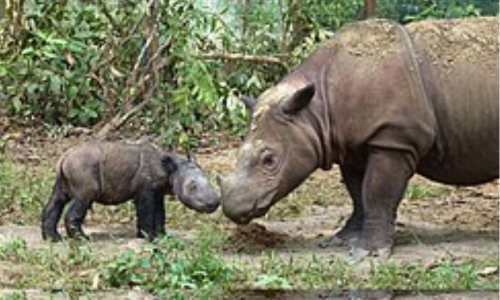
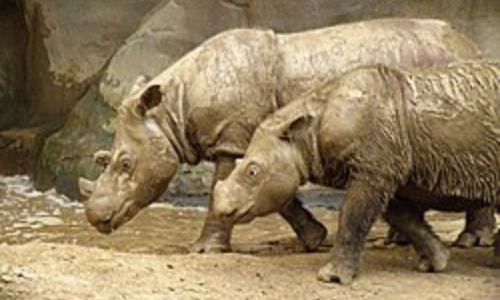
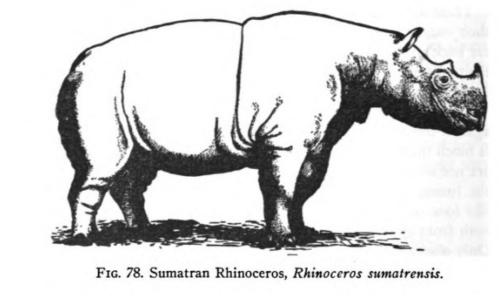
The Asiatic or Sumatran Two-horned Rhinoceros, Rhinoceros sumatrensis, is at once recognized by the two horns. The smallest and most hairy of the living Rhinos, it has the skin granular, somewhat thinner, and the skin folds less distinct than either unicornis or sondaicus. The front horn in the female is about 5 inches high, and broad at the base; the rear horn is little more than a large boss or tubercle, 2 inches high, placed between the eyes. Males, however, may have very long horns. The front one normally is 15 to 20 inches, and very rarely reaches 212 feet along the curve; the hind one is about 7 inches. The black hair fringing the ears, though usually short, may reach a length of 5 inches. The height at the shoulder scarcely ever exceeds 41/2 feet and is often less; the weight is about 1 ton. The maximum width of the forefoot in big specimens is about 9 inches; the central toe-nail occupies 31/2 inches of this.
This Rhinoceros is reputed to be much stronger and more agile than sondaicus. The period of gestation is reputed to last only about 7 months, a statement which requires checking, considering that that of unicornis is known to be nearly three times as long.
The species is found through the Malay Peninsula, to Siam and Assam up to 6000 feet. It is present on Sumatra and Borneo but not on Java. The form found in southwest Burma has been distinguished by the name lasiotis (broad-eared). It likes moist shaded hilly country, the steeper the better, and is generally solitary, or a bull and cow may be together. It frequently makes wallows in the stream beds. When enjoying its wallows, it makes a low humming or buzzing sound. The food consists of twigs and branches and a species of bamboo. In the dry season it may eat figs and mangos or other fruits also; thus, it is a good distributor of mango seeds. Formerly it was found in the lowlands as well as among the hills, but is now almost as scarce as R. sondaicus.
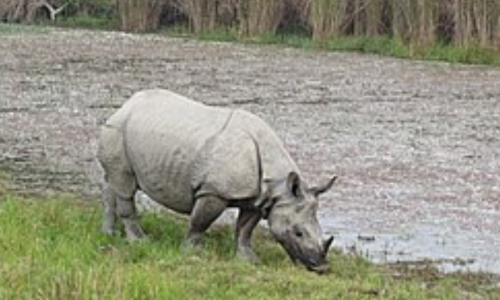
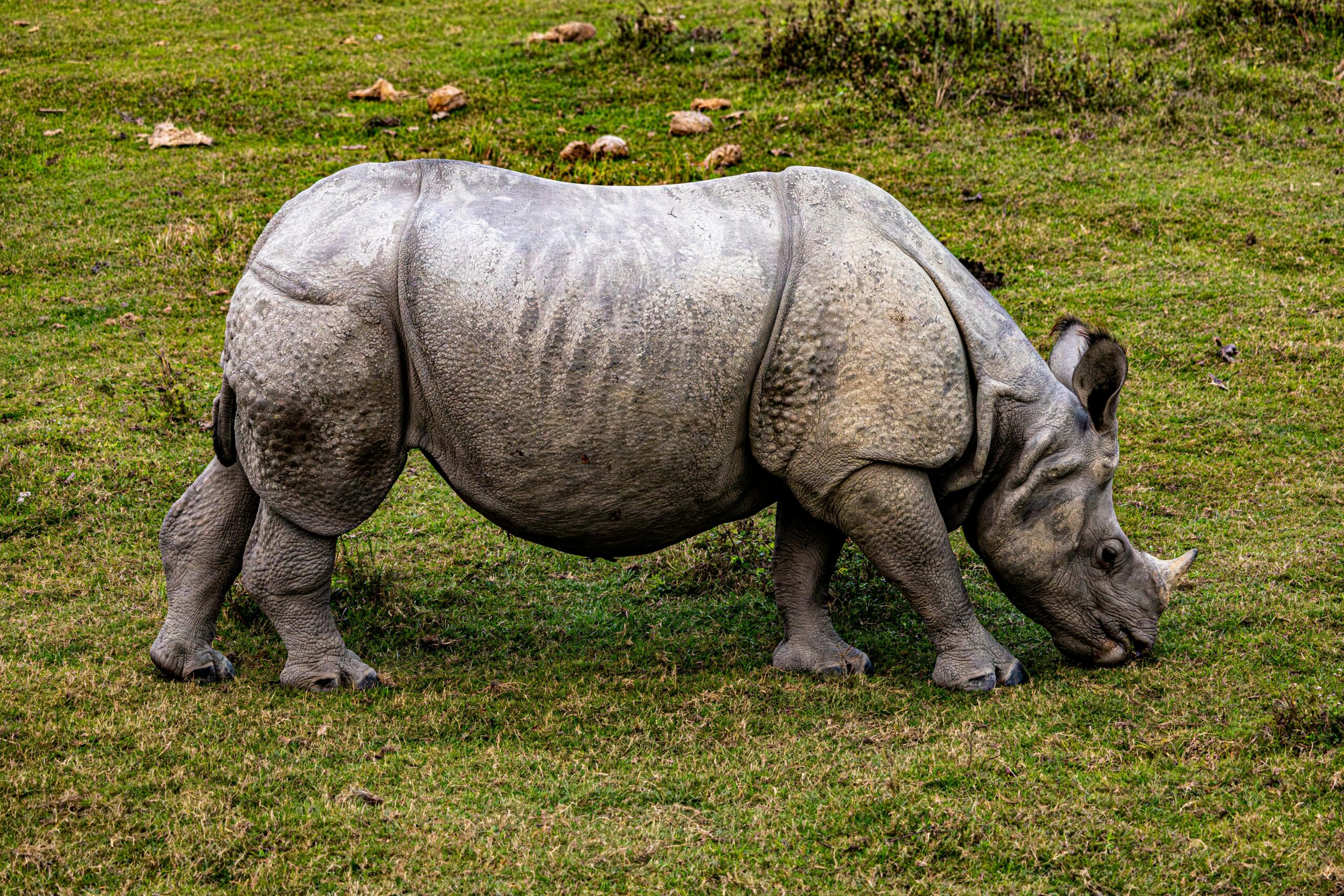
The Greater One-horned Rhinoceros, Rhinoceros unicornis, rapidly becoming extinct, enters our area only at the eastern end of its range near the southern foot of the Himalayas and eastward into Assam. Formerly it occurred over much of peninsular India. The skin of the sides is covered with rivet-like flattish tubercles, particularly on the fore and hind quarters. The heavy skin fold in front of the shoulder does not extend over the neck to meet the one on the other side, as in R. sondaicus. The horn is sharply conical and often about 6 inches high. Unusually large horns measuring 24 inches around the curve have been recorded.
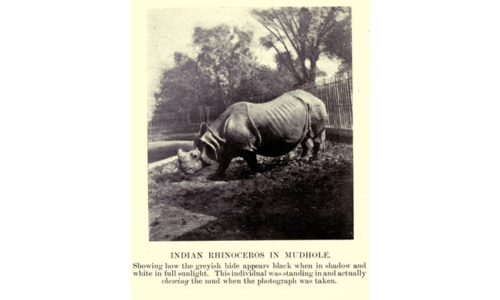
This Rhinoceros is a denizen of the vast areas of grass, growing from 8 to 20 feet high, that cover much of the uncultivated parts of the alluvial plains of northern India, including the Brahmaputra Valley. It is mainly nocturnal and prefers damp or swampy ground where it makes mud wallows. The animal lives solitary or in very small groups. The height at the shoulder is about 51/2 feet, the weight 2 tons. The animal is reputed to attain an age of 50 years. The gestation period is about 19 months. The new-born calf weighs from 75 to 120 pounds and stands about 2 feet at the shoulders.
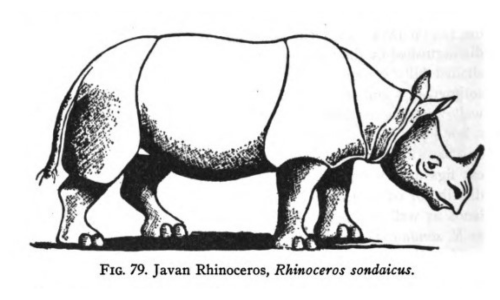
The Javan or Lesser One-horned Rhinoceros, Rhinoceros sondaicus, has the head smaller and the horn shorter than in R. unicornis. Although almost as tall, it is more lightly built. Its skin armor is lighter, and the rivet-like tubercles of unicornis are represented by many-sided scale-like disks. The folds of skin between the neck and shoulders on either side unite over the back. The horn is usually absent in females. In males it may reach a length along the curve of more than 10 inches.
The original range of this Rhino includes Assam, Burma, and Indo-China, south through the Malay Peninsula to Sumatra and Java. By 1939, it had been reduced to scattered remnants in northern Indo-China, Siam, Tenasserim, the Malay Peninsula, south Sumatra, and west Java. The remains of a specimen found in the Thaton district of Burma was reported in 1943.
George H.H. Tate, Mammals of Eastern Asia (New York: Macmillan, 1947), pp. 351-354.
See: https://babel.hathitrust.org/cgi/pt?id=mdp.39015006891520&seq=1
Incidents of Foreign Sport and Travel
Fitz W.T. Pollok
CHAPTER II.
RHINOCEROS SHOOTING (ASIATIC).
It is a current belief, that the skin of a rhinoceros will resist an ordinary bullet — that it is all but impervious. This is nonsense. A spherical ball out of a 12 smooth bore, driven by five drachms of black powder, if rightly placed, will kill a rhinoceros far easier than it would a buffalo; for though the skin is very thick, it is easily penetrated. I have seen a man of ordinary strength drive a “shikar” knife up to the hilt behind the shoulder of a prostrate rhinoceros. But still it is better to use heavy weapons, with large charges and hardened bullets; not on account of the denseness of the cuticle, but because the missile has to pass through an immense quantity of flesh, well covered with muscle, before it can reach a vital part.
Jerdon (the naturalist) recommends steel-tipped bullets and shells. The former are of course very well adapted for slaying all pachyderms, but the latter are simply useless. I tried many kinds, notably Forsyth’s, but I never succeeded in killing a rhinoceros with one, though I fired with them at over thirty. I found the belted bullets from my two grooved rifles hardened with a mixture of quicksilver, very deadly. Shooting downwards, I once put a ball right through a charging beast; it entered near the spine and made its exit through the abdomen. I have shot two rhinoceros right and left — killing them with one ball each — but they were very close and inclined to fight, so gave easy shots.
Most elephants dread these animals very much, and few will go close to them. If a ball be placed in the centre of the shield over the shoulder, rather low down, it penetrates the heart. If behind the shoulder, the lungs are perforated, and the animal subsides in a few moments. When thus shot it runs a little way, then falls down, and in its dying moments makes a peculiar noise which can be heard a long way off, and once heard can never be forgotten.
In hostilities, Indian rhinoceros do not use the horn, but their tusks, with which they can inflict fearful gashes. In Burma, the most common rhinoceros is the double horned, but two other species exist, yet are seldom come across, as they inhabit morasses that may be termed quagmires, over which a loaded elephant cannot travel:
In Assam, we have but two kinds of this genus, the larger and the lesser. They are exceedingly plentiful in the Terai, at the foot of the Bhootan and Himalaya ranges, and are also found in the swamps along the base of the Cossyah and Garrow Hills. Throughout the province there are favourite localities, as well as in many of the “churs” (islands) of the Brahmapootra river.
The larger Asiatic rhinoceros has only one horn, seldom eighteen inches long, generally a good deal less. This horn is said to be but a conglomeration of hairs, and is liable to be detached through either injury or disease, when another grows in its place. The skin, as stated, is very thick, with a deep fold at the setting on of the head, another being behind the shoulder, and a third in front of the thighs. Two large incisors are in each jaw, with two smaller intermediate ones below, and two still smaller outside the upper incisors, the last are not always present. The general colour is dusky black.
The dimensions of one I bagged were as follows: extreme length of body, twelve and a half feet; tail, two feet; height, six feet two inches; horn, fourteen inches. These animals delight in swamps and mud holes, and even in running streams, and “lie up” in them during the heat of the day. The lesser rhinoceros is found in the Soonderbunds, near Calcutta, and in all suitable localities on the left bank of the Brahmapootra river. I never came across it on the right bank, but doubtless it exists there too, as all these beasts wander about a good deal in search of food. In appearance it somewhat resembles the larger, but the folds are not so pronounced, and the shields have often tubercles on them, and it is said it is attracted by fire.
The Burmese assert it eats it! As a rule the rhinoceros is very inoffensive. It lives in such remote localities, that none but a hunter thinks of intruding upon its habitat, but if there be any grain grown within a few miles of their outlying haunts, it will march long distances during a night to feed upon it. To get these animals in fairly open ground, the sportsman must be in their preserves at daybreak, for the beasts soon retire into impenetrable forests where there are mudholes, and in them takes their siestas. It is naturally a timid animal, more anxious to escape than fight, is very easily killed, but if pushed hard or driven into a corner it turns to bay and if it can close, it will leave its marks for time and a day.
Although the horns are contemptible as trophies, the native Assamese and Mawarries prize them greatly, and will give as much as Rs.45 a seer (2 lbs.) for them. They are also greatly prized by the Chinese. Two officers, Cock (afterwards killed in the Naga campaign) and Bunbury, just before I arrived at Gowhatty, made a good bag of these beasts, and by the sale of the horns more than repaid all their expenses. They live in apparent harmony with wild elephants, and I have seen them lying down in the same mudhole with a buffalo!
Many castes of Brahmins, Hindoos, and Mawarries will not touch flesh of any kind, living on grain and vegetables alone, but they make an exception in favour of the flesh of the pachyderm I am describing. They have often asked me to dry the tongue for them. This they pulverise, bottle it, and take a pinch or two when ill. The Assamese and bigoted Hindoos follow a sportsman about like vultures, and as soon as a rhinoceros is dead they rush upon it, fight for the tit-bits, and do not leave even a piece of the skin. This they cut into long strips, roast it over embers, and eat it as we do the “crackling” of a pig. Considering the habits of the beast, for it deposits its ordure always on the same spot until a considerable mound is formed, and the value put on the flesh and horns by the natives, I am surprised there are any left alive. If native shikaries dug a pit, and sat near one of these places of deposit, they could easily shoot the animal on its nightly visits. It was in this way that I bagged the only rhinoceros I ever killed in Burma. But in Assam I killed a great many off elephants and a few on foot.
Jerdon says the height of the lesser rhinoceros is only from three to three-and-a-half feet, but I have killed them at least a foot higher. He was a very clever naturalist, but most obstinate, and occasionally quite wrong as to facts. Now, I mentioned to him that the Tucktoo, a Gecko I had heard every day and night of my life in Burma for thirteen years, was in existence in Assam. He flatly contradicted me. So the very next time I went to Burneyhat, the first stage en route to Shillong, where I often heard them uttering their cries, I got the natives to catch one for me. This they did reluctantly, for they believe them to be poisonous — but what will not a wretched Assamese do for a rupee or even a few annas! — so I took it to Jerdon, who was staying with me in Gowhatty.
Again I told him that amongst many bears I had killed in the province, one had been the ordinary Ursus labiatus. He would have it that that was impossible, but as the beast had been killed only a short time before, and I had its skin, with the skull attached so took it to him. Now the U. labiatus has only four incisors in the upper jaw, whilst the Ursus tibetanus has six. How that individual beast found its way to the foot of the Himalayas, where I shot it, I don’t know, for the ordinary bear of the country is Ursus tibetanus, though why so-called would be a puzzle to most sportsmen, as it is not found in Thibet at all!
General Sir Charles Reid, G.C.B., of Delhi fame, when shooting at Loqua Ghat with me, killed two rhinoceros in one day with one ball each, and those bullets were twenty to the pound in calibre, yet the next day he lost a large rhinoceros after repeated discharges at close quarters! Truly there is great luck in shooting! One day a man will bag all he fires at the next day, under equally favourable circumstances, he will not kill a single thing.
The two-horned rhinoceros’s habitat extends from Chittagong southwards, and it is also found in Sumatra, Java and some of the other large islands. Its skin is as smooth as a buffalo’s, but in habits and customs it much resembles the other species of its family. A curious variety of this rhinoceros was secured by Captain Hood, and is now, I believe, in the Zoological Gardens, Regent’s Park. Its ears, if I remember right, were somewhat tesselated, and I believe there is another variety called the hairy rhinoceros.
I waged war against these pachyderms, why, I don’t know — for I was not fond enough of the ungrateful Assamese to provide them with such choice food — but I can answer for it, that of the forty-seven or forty-eight which I killed, not an ounce of flesh was thrown away. I, however, lost a number of wounded.
Whenever I was out shooting in the “dooars,” I was followed secretly by “shikaries,” who retrieved my wounded beasts, sold the flesh to the natives and appropriated the horns. In this way I was robbed of a magnificent one (for Assam), fully eighteen inches long and weighing three seers or more. I should have known nothing of this larceny but that two men quarrelled about the plunder, and then one went post haste to Burpettah and reported that he and his partner had found a rhinoceros I had shot, with the above horn, which from its length was a rarity. The Commissioner sent “peelers” to have the man apprehended, but he bolted across the frontier.
The late Major Cock, finding the Assamese so eager to buy the mere stumps which most of the rhinoceros he had shot were adorned with, seeing in Calcutta lot of African rhinoceros horns for sale, several nearly three feet in length, for a trifling sum, bought the whole lot, and sent them to a tea planter to dispose of, but the Assamese would not credit that they were genuine, so would have none of them. What became of them eventually I do not know, but I often saw them lying about in the tea house in Gowhatty.
Sometimes a sportsman slays a cow rhinoceros with a calf. When such happens, by all means send for the nets which every village in Assam possesses for catching wild animals — including the immensely powerful wild buffalo — and you will have no great difficulty in securing the youngster. In my day Jamrach’s agent would give from Rs.1000 to Rs.1200 apiece for them. I had two, and was offered Rs.2000 for the brace, delivered in Calcutta or Rs.1600, delivery in Gowhatty, so I chose the latter offer, but discovered afterwards that if I had stuck out, I should have got a good deal more.
My first experiences of rhinoceros in Assam were at Loqua Ghat, in 1866 or 1867, when shooting with General Sir Charles Reid. I was unlucky, and failed to bag. But in June, 1867, I determined to visit the dooars, though it was very late in the season, and bets were offered that if I went there, and remained a week or ten days, I should be a dead man, a month afterwards from jungle fever. But I never listen to croakers.
Having to go to Burpettah where I had works in progress, I thought that I might as well try for game. I reached Tara-baree Ghat about 8 A.M. on June 10th. Although I had sent on my elephants several days before, and they had had ample time to get there, I found none had arrived. Thinking the mahouts might have gone to Burpettah, I sent a note to the Assistant Commissioner, and he very kindly sent over a “palanquin” for me, but as it and the elephants arrived almost together, I sent it back, and halted for the night where I was. The next day, June 11th, I awoke the people at 4 A.M., and being independent of Assamese coolies, who seldom put in an appearance before 8 A.M., I got off at 5 o’clock. I sent my baggage elephants with servants, &c., to Burpettah by the beaten track, whilst I, with two elephants, went across country, being anxious to ascertain whether there were tigers about, as reported by the native officials.
At starting, the country was quite open, with paddy-fields, not in use, and overgrown with short grass. In these I noticed a broad trail. Whether made by buffaloes or other heavy beasts I could not tell, but as the animals, whatever they might be, were going our way, I followed them up. Leaving the open ground, we entered a grassy savanna, in which were a few marshes, surrounded by thick bushes. The track abruptly turned off to the right, and directed for a very heavy patch of long grass. On examining the spoor, I saw that we were following rhinoceros and not buffaloes.
In addition to my old battery I had purchased a breechloading rifle, No. 10 bore, with very short barrels, a wonderfully handy weapon, and with which I killed a lot of game. We had not advanced very far when we came upon the usual mound of ordure, with fresh droppings upon it, so we knew the animal could not be far off. Our two elephants now began to show decided symptoms of funk, but the mahouts kept them straight. At last, at the edge of the “jeel,” partially covered by a bush, I distinguished the body of a rhinoceros. It was standing broadside on, but the head was turned in our direction with the ears cocked forward, listening to the noise our mounts made splashing through the grass and water.
Neither the mahout nor the elephant saw it, so I touched the man on the head, which was always a signal for him to promptly pull up the “hathee.” I could distinguish only a form; no vital part was visible, but about where I thought the shoulder should be, I let fly. On the smoke clearing away a very large animal rushed into the “jeel” and I fired the left barrel into its shoulder. On receiving this shot, which was well placed, the mammoth pulled up and faced me. I dropped the discharged weapon and had just time to seize one of the two-grooved rifles, when with a shriek the monster charged. I gave it the contents of both barrels at a distance not exceeding ten yards. This caused it to swerve, shrieking loudly, and rush away.
All this time my elephant, apparently paralysed with fear, had not moved, but the noise the pachyderm made was irresistible, so my “hathee” broke away from the mahout and ran off in a direction the very opposite of that taken by our antagonist, and went fully a quarter of a mile before it could be stopped. Whilst running away, I turned round and was under the impression that I saw a second rhinoceros retiring, and it must have been that one I afterwards followed, for I could not find it anywhere. An ominous noise from quite a contrary direction now struck my ear, so I hied back, and found a very large male, stone dead. It had a thick, massive horn, but only eight inches in length, weighing one and three quarter seers.
We got men from a village not far off to help us to cut off the head and to put it on the spare elephant, and then rode triumphantly into Burpettah. In the “dooars,” I met with great difficulties, owing to the monsoon having set in, and the nullahs and rivers being very full, but I hunted there for a week, wounded half a dozen, if not more, rhinoceros, but did not bag a single one. In returning, I got back to Gowhatty with the greatest difficulty, owing to the inundated state of the country.
As a madman I was looked upon for having entered there at that season, and my death from jungle fever was avowed, but I disappointed the prophets, and I did not suffer from the exposure I had undergone in the slightest degree. With Jackson of the 43rd, I killed thirteen rhinoceros in fourteen days, and had some narrow escapes.
Once, while following closely up a wounded bull, he came for me. “Lutchmee,” my elephant, turned tail, and just managed to keep about a foot ahead of the assailant’s snout, whose upper lip was curled up, disclosing his formidable tusks. I spun round, took a snap shot downwards, struck the junction of the head and spine, and the huge monster rolled almost heels over head. No rhinoceros has been so close to an elephant I have been riding on, as this one. If I had had a man behind me, I feel sure my animal would have been cut, for I could not have fired as I did.
In the “dooars,” Colonel Cookson and I went out on foot one afternoon to pick up jungle fowl, florikan, black partridge, or in fact anything we could get. Our elephants were tired, as they had been worked from dawn to mid-day, during which time we had bagged three rhinoceros, one male and two females. A couple of attendants carrying rifles attended us, for one never knows what may be come across in that region. At the edge of the forest we hit a marsh deer with exceptionally fine horns, and in following it up, forgot time and distance, and found ourselves in a vast plain dotted here and there with bushes, which almost deserved the names of trees. Water-fowl we could see flying about, so we knew there must be marshy ground towards which our stag had retreated. So we followed and followed.
At last we noticed that the sun was declining, so pulled up, but where we were, no one knew. We sent a man up a tree, but he could distinguish no land marks that were known to him, but he suddenly pointed to the north and said he saw three or four rhinoceros not far off. The grass was only about three to four feet high, so more favourable for tigers than for pachyderms, yet we thought we would just go a little way and try for a shot. We got to within one hundred yards of the game easily enough, then there was little or no cover, excepting a few conical white ant hills. My companion chose one, I another, and we crawled on hands and feet till we got about thirty paces of the animals, and then we opened fire. One got a ball behind the ear — a chance shot I fear — and dropped, two others were wounded and charged straight at us. We were about fifteen yards apart. My ant nest was a good six or eight feet high. I was on its summit in a moment and gave each beast a shot as he passed. They ran all abroad.
One fell an awful cropper into a mudhole, sending a deluge of water into the air, and falling almost on the top of a huge male buffalo, who, disturbed by our shots, was scrambling on to his legs and endeavouring to get out of his bath. The rhinoceros must have been mad with rage, for he gave the buffalo a gash across the thigh, and that beast resented it by giving its assailant a right and left with his horns on either side of the neck close to the jowl. A right royal fight then took place. The two were well matched and almost of a size. The thick-skinned animal endeavoured to close and rip, but the other used his horns as skilfully as a prizefighter would his fists, and showered blows upon the face, head, and neck of his adversary. Wherever he was attacked there were his long, powerful horns ready to interpose.
We were hurrying to the scene, when the buffalo made a desperate attack, fell into the mudhole, and before he could recover himself the pachyderm ripped open the whole of his stomach as cleanly as if it had been done with a knife. The next moment we fired and the rhinoceros fell dead upon his foe, all but burying him in the slimy depths of the mudhole. A bullet through the head put the poor bovine out of misery. This was a grand exhibition and seldom witnessed, therefore I mark it with a red letter in the calendar of my memory. We reached home very late, and doubt if we should have got to camp that night, had not our men lit fires, discharged guns and let off a rocket or two.
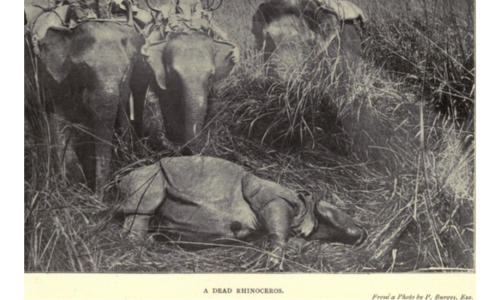
On April 20th, 1871, a companion and I took a hurried trip. I had to go to Baghdooar, where I had contractors who had been collecting limestone I had to take delivery of; to measure its cubical contents and to ascertain that amidst the stone material gathered, there was not any useless stuff for burning purposes. En route we got on to a rhinoceros trail, and on looking down into a shallow nullah there lay the brute fast asleep! He looked like a huge pig, the head being on the ground between its fore legs and feet. I was only about ten yards off, but could see no vital spot, but my mahout whistled, the sleeping beauty awoke, and I fired at its chest. Up it jumped, and came straight at us, champing its tusks, and making that peculiar cry — something between grunting and squealing — but before it could do any damage, or our elephants turn tail, our battery proved too strong and it fell dead. It possessed only a mere rudimentary horn.
I was on a huge mucknah, attached to the 43rd Regiment N.I. He was very old, very deaf and half-blind, and it was probably owing to these infirmities that he was so staunch but, oh! so slow. No amount of prodding would induce him to go faster than a steady three-miles-an-hour pace, and that was exasperating when one was in chase of a stricken beast. But again, in the midst of dangers he was immovable. Of the two I think I prefer being on a beast that has speed, even if it does occasionally run away.
We were going along, on another occasion, about a quarter of a mile from the Manass. Matagoorie, our destination, was in sight. About forty yards ahead of me was a huge rhinoceros, standing behind a very large tree. Its head and neck were invisible, but the shoulder was just exposed, and a shot from one of my two groove rifles knocked it down and it lay struggling on the ground. I fired three more barrels into it, but it got up and very slowly, went away only presenting to me its enormous stern. I told the mahout to urge his beast on, but no punishment would induce it to accelerate its pace by one inch. There I was, fifty yards behind, dense forest a hundred yards ahead, and not a prospect of our heading the brute before it got into its stronghold, where I could not follow!
But just then J., who had been loitering behind, came up on a fast elephant, ran alongside the rhinoceros, and killed it. It was an immense beast with a horn thirteen inches in length. I went on to camp, to superintend arrangements for a stay of a day or two, but J. went off to the right, came upon another rhinoceros, put seven balls into it, but lost it. When the mahouts went to bring us in the head of the slain, they came across a tiger eating a marsh deer, but as it was almost dark we could not attempt to shoot Mr. Stripes that evening.
The next morning we went to look for J’s. rhinoceros. His mahout, new to these jungles, failed to find the tangled brake into which the animal had taken refuge, so after wasting several hours in fruitlessly searching for it, we came upon fresh tracks and followed them up, but up to nine o’clock saw nothing. Shortly afterwards, when passing a strip of long elephant grass, J. caught a sight of a rhinoceros and fired. It began to spin round and round, and to emit the sounds elephants dread so much, and to our astonishment, from a patch of long grass close at hand, fully a dozen more rhinoceros joined in chorus! I never heard such a pandemonium in my life! If the inmates of a lunatic asylum and a dozen menageries had been let loose, and intermingled the row could not have been more deafening! Not an elephant with us would stir a step forward, the grass was dense and high, and so full of the brutes in a state of frenzy that I did not like to force our mounts forward. After the row ceased, they were willing to enter the cover, but I was afraid of getting them cut. We tried to set the grass on fire, but the dew was still on it, and it would not burn.
When at breakfast under a tree close by, a mahout, who had been collecting brushwood, ran up, saying that there was a rhinoceros, as big as an elephant, feeding in the open close by. We left our meal unfinished, mounted our “koonkies” and went towards the spot indicated. There was a nullah close by, and had we gone on foot along its bed (which for a wonder was free of jungle), we could have come within a few paces of the brute; but instead of following this obvious course, thinking the animal would take no notice of us, we approached it on our elephants. When we were about sixty yards off, the foe saw us, turned round quickly, rushed down the nullah bank, and though we saluted it with a couple of barrels each, it got clean off. We then returned to our meal.
Finding afterwards that we could not fire the game’s stronghold, we formed line, and pushed our way in very slowly and cautiously. We had not gone fifty yards when a cow rhinoceros, followed by a young one, charged J., whose elephant swerved, but her rider fired two shots and turned his assailant towards me. I also gave her two shots; she then ran about fifty yards and fell dead.
Going further in, I found myself in the midst of a whole herd of rhinoceros. There were probably a dozen or more in the grass, and five or six came at me open-mouthed, uttering their diabolical noises, but the old mucknah I was on never moved. I emptied my battery of five double guns and rifles, reloaded, firing first at one and then at another, always selecting the nearest. I knocked over two, but a third did not succumb until I caught her with the last barrel behind the ear. It was an exciting five minutes, and but for the steadiness of my “hathee” he must have come to grief.
My mahout, before I had reloaded, now wanted to push on after the wounded beasts and I had to threaten him with a broken head before he would desist. I have never seen, before or since, so many rhinoceros collected together, and so pugnacious. The survivors entered a tangled brake and got off till the next day, when the native shikaries picked up three dead and appropriated their flesh and horns, but none of the latter were large. Going back, a three-parts-grown rhinoceros charged and chased J’s. elephant for some way and struck it twice, but failed to inflict any but superficial wounds. J. at last dropped it dead, but he himself was a sufferer, being much cut about and bruised from the tossing that he received in the howdah.
The next day we crossed the Gatee Nullah, saw a rhinoceros, but it kept at a safe distance. Shortly afterwards we saw another, as it entered a tope of trees. We rushed round and met it face to face and killed it at the first discharge; the beast was large and had a good horn, but the base had got injured, as under the root there were hundreds of maggots. The stench from it was awful. The next day we first wounded and lost a rhinoceros. After that came upon one lying down in a running stream and had no difficulty in bagging it. I then knocked over another rhinoceros, but lost it. Our servants in moving camp also came across two rhinoceros and a wild mucknah elephant.
April 24th. To-day the heat was awful; there was not a cloud in the sky. About ten we hit off a trail and my mahout did a very clever bit of tracking. All these rhinoceros feed in circles, so the task of hunting them up to their lair is a tedious one. J. got disgusted and took refuge under the only tree near. I went on, and in about half an hour came upon one lying down in a patch of long grass, and as it jumped up I killed it easily.
We then went on for a mile or two and came to a heavy belt of jungle, and out of this ran a cow with a calf. We were anxious to catch the little one, but J. unfortunately wounded it and it had to be killed. As the mother’s udder was full of milk, our men filled two bottles with it, and said it was very good. I tasted it out of curiosity. It was very like, I should say, to a woman’s nourishment in the first stage of suckling — watery and sweet.
Going towards camp, I saw a rhinoceros lying down at the bottom of a nullah, partially covered over with long grass, and apparently with its feet raised in the air. I thought it was a dead one, and called out, “Here is one of our wounded rhinoceros, dead!” No sooner had I spoken, than the apparently defunct animal jumped on to his legs and came at me open-mouthed. Fortunately the mucknah swerved and thus escaped being cut. The next instant the rhinoceros was knocked over.
On the 27th we killed another. They are far easier to slay than buffaloes, but the elephants fear them more, and are far less steady than when after other game. This was a most successful trip. We killed thirteen rhinoceros, a tiger, a lot of buffalo, a bear, and many deer, besides wounding a gaur and over a dozen more rhinoceros, and other game of all sorts. I caught a young rhino, after slaying its mother, and it required fourteen villagers to bring it into camp. When I saw it the next morning it was mad with rage; so was securely tethered, yet the little vixen tried to get at everybody who went near. In the course of a few days it quieted down, ate plantains out of the hand of its attendant, and in a week followed the man about.
Fitz W.T. Pollok, Incidents of Foreign Sport and Travel (London: Chapman & Hall, 1894), pp. 64-81.
See: https://babel.hathitrust.org/cgi/pt?id=uc1.$b25276&seq=1
Wild Sports of Burma and Assam
Fitz W.T. Pollok and W.S. Thom
RHINOCEROS
Although I have heard it stated in Lower Burma that there are three varieties of the rhinoceros, I think it doubtful. There is certainly the lesser rhinoceros (R. sondaicus), and the (R. sumatrensis), and an allied one, which was secured by the late Captain Hood in Chittagong, and sold by him to the Zoo. The two are very similar in appearance, and both have strong incisors, like tusks. I only shot one R. sumatrensis in Burma, and that near Cape Negrais, but I have been after them several times; but the nature of the ground was such, that our animals (elephants) could not go through the quagmires, whereas the rhinoceros would half wade, half swim through them with ease: but my colleague will write about them more, as his experience with these animals is greater than mine in Burma.
I may here mention about them in Assam as I intend to give a short sketch of wild sport in that Province that I shot there forty-four to my own gun, and probably saw some sixty others slain, and lost wounded fully as many as I killed.
The first is the great Indian rhinoceros (R. indicus\ which is very plentiful in the Bhootan Dooars, but it is also found in the Churs of the Brahmapootra, and along the foot of the Garrow Hills, and also in the swamps along the base of the Cossyah and Garrow Hills. It has only one horn, seldom 18 inches long, generally a good deal less; this horn, which is said to be a conglomeration of hairs, is liable to get detached through injury or disease, when another one grows in its place. The skin is exceedingly thick, with a deep fold at the setting on of the head, another behind the shoulders, and another in front of the thighs; two large incisors in each jaw, with two smaller intermediate ones below, and two smaller outside the upper incisors, not always present. General colour, dusky black. The largest I bagged measured as follows: extreme length, 121/2 feet; tail, 2 feet; height, 6 feet 2 inches; horn, 14 inches.
All rhinoceros delight in swamps, and lie in mud-holes for the greater part of the day. In a good-sized mud-hole one day I saw a rhinoceros lying at one end, and a buffalo at the other. I have never shot the lesser rhinoceros on the right bank of the Brahmapootra, but I have no doubt it exists, as it is also found in the Soonderbunds not far from Calcutta; but it is fairly plentiful on the left bank south of Goalparah, where I have killed it.
As a rule, rhinoceros are inoffensive; they do a good deal of damage to grain if any is grown within a reasonable distance of their haunts, but generally they inhabit such remote localities that they can do no harm. It is naturally a timid animal, more anxious to escape than fight, and it is by no means difficult to kill. Of course, when a rhinoceros has been severely wounded and is closely followed up, it will turn; but so will a rat, or, as they say, even a worm; but its principal anxiety is to get away and lie in some mud-hole, where it wallows, and where it probably dies. The horn is only used for grubbing up roots; when they wish to attack they use their incisors, which with them answer much the same purpose as tushes in a boar. They can inflict a clean deep cut, and they appear at certain seasons to fight amongst themselves, for I have killed both males and females scored all over.
It used to be said that the skin of the rhinoceros will resist an ordinary ball, but that is all sheer nonsense; a spherical ball out of a smooth-bore, if rightly placed, will kill one of these animals far easier than it will a buffalo. It is not the hide, but the enormous muscles, mass of flesh and bones, that cover the vital organs, that render the use of heavy rifles and immense charges so necessary to penetration. But as Von Hohnel killed two rhinoceros in East Africa with one ball, using a Mannlicher rifle, a similar weapon should account for them in the East. Colonel Campbell, an old Assamese shikarie, had the credit of also having killed two rhinoceros with one ball; but it was not quite certain, for he did fire two shots, but at animals some way apart; whereas the two killed were standing alongside of one another. I have sent a hardened bullet right through one.
If the bullet, with a sufficiency of powder behind it, is placed in the centre of the shield over the shoulder, rather low down, the ball penetrates the heart. If behind the shoulder the lungs are perforated, and the beast succumbs after about five minutes, and can easily be recovered by its stertorous breathing, which it utters before it gives up the ghost. This noise, once heard, can never be forgotten.
Although the horns are almost useless as trophies, for many of them are but knobs, the natives prize them very much, and will buy them, giving as much as Rs. 45 a seer (2 Ibs.). The young ones are easily caught after the mother has been killed, and though very savage at first, soon get tame, and are worth a lot of money. They cost next to nothing to keep and rear. The footmarks much resemble those of an elephant; but they are a little smaller, and a little longer, and have but three toes against the elephant’s five. Although many castes in India — Brahmins and Marwaries — in particular partake of only grain, they have asked me to dry the tongue for them; this they pulverize and bottle, and take a pinch of it when ill.
The Assamese, bigoted Hindoos as they are, used to follow us about in gangs like flocks of vultures, and directly they heard shots, rush up, all fighting for certain tit-bits; not a morsel would be left; even the hide they cut into lengths and roast over embers, and eat as some people eat the crackling of a pig.
Considering the value put on the flesh and horns of this animal by the natives, I am surprised there is one left alive, as it deposits its ordure at one spot only until a mound is formed, sometimes several feet in height, and as it visits that spot night and morning, by digging a pit near, nothing could be easier than to shoot it.
Whenever I went into the dooars I was followed by native shikaries who kept out of my ken, but hovered about near; as I had seldom time to hunt up wounded beasts, they would trace them up, and either shoot them, or, if they found them dead — as was oftener the case — they would appropriate the horns and flesh. They thus stole a magnificent horn (for Assam), 18 inches long, off a beast I had severely wounded and lost, and I should have known nothing of it, had the men not quarrelled over the spoils, and one run back and told the Deputy Commissioner, but the man was over our frontier before he could be overtaken and seized.
The lesser rhinoceros is distinguished by being somewhat shorter in height and their shields being less prominent, and the skins at times are covered with square angular tubercles. This animal extends throughout Assam, down Sylhet, the Garrow Hills, Tipperah, Chittagong, Arrakan, and Burma to Malaya, and probably into Yunan and the western provinces of China. The Burmese assert that it devours fire.
The two-horned rhinoceros extends from Chittagong downwards. It is not known further north. Its skin is as smooth as a buffalo’s; the anterior horn is fairly long, the posterior generally a mere stump. I do not see why they should not be utilized, as they are easily domesticated. A dhooby in Gowhatty used to take his clothes from the wash about on one (R. indicus, R. unicornus], but I think he sold it to an Afghan, who was one of Jamrach’s agents.
The variety obtained by Mr. Hood had tasselated ears. It got bogged in trying to cross a river, and was secured by means of Keddah elephants.
Doctor Mason asserts that the larger single-horned rhinoceros (R. indicus} has been caught in Arrakan, and that he has also seen it along the banks of the Tenasserim river. The Burmese have told me the same, but Blyth declared that they had mistaken the smaller Sondaicus for the Indicus.
The bigoted Hindoos store their horns in their Namghurs, the point downwards, the base forming a kind of bowl in which they pour water and use as a charm. The Chinese also put a fictitious value on them. Knowing how valuable they were, Major Cock bought up a lot of the white African rhinoceros horns, which are at times 3 feet long, which he saw for sale in the Bazaar in Calcutta, and sent them to Becher in Assam for sale, but the natives would not look at them, not believing that they were what they professed to be!
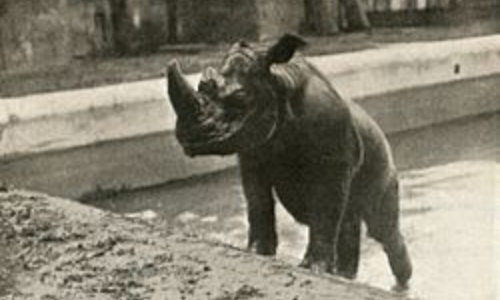
Fitz W.T. Pollok and W.S. Thom, Wild Sports of Burma and Assam (London: Hurst & Bennet, Ltd., 1900), pp. 82-87. “A Dead Rhinoceros” appears on page 83 in this book. The two drawings are found in Tate, Mammals of East Asia on pages 352 and 354. The black and white photo of an “Indian Rhinoceros in Mudhole” appears on page 130 in Graham Renshaw, Natural History Essays (London: Sherratt & Hughes, 1904). The additional photos can be found in: https://en.wikipedia.org/wiki/Sumatran_rhinoceros and https://en.wikipedia.org/wiki/Indian_rhinoceros
See: https://babel.hathitrust.org/cgi/pt?id=uc2.ark:/13960/t02z14g2b&seq=1