Pangolins
We want you to have a greater ability to learn about some of the unpleasant animal issues in our world.
Pheasant Jungles
William Beebe
Hidden deep beneath the surface of the ground in the Bornean jungles are thousands of great reptile-like creatures, some fully six feet long, covered from nose to tail-tip with a complete armature of scales; lizards in appearance, mammals in truth, orphans in relationship. The first pangolin I ever saw my Dyaks and I dug out of a burrow near camp. The name sounds more like a musical instrument than an animal, but in reality it has been twisted by Anglo-Saxon tongues from the native takjiling. Under his armor of scales the pangolin or scaly anteater conceals a bodily structure as confusing to the scientist as is his general appearance to the layman. In common with other toothless or nearly toothless devourers of ants, the pangolin has usually been classed with armadillos and hairy anteaters. But his structure is so peculiarly pangolinian, his resemblance to other living creatures so slight, and the absence of fossil relatives so complete, that he has finally been assigned to a special order of his own — Pholidota.
Throughout the days of violent sunshine or tropical downpours not one of the host of pangolins ever shows himself; but in the dusk of evening the round, shingled ball stirs in its underground chamber, unrolls, stretches, and the earth gives up its race of scaly anteaters. They come forth timidly, hesitating long at the entrance of the burrow before daring to shuffle forth on their quest for food. The lizard appearance is, as I have said, only a superficial resemblance. The helmet of the deep-sea diver recalls the helm of the medieval knight; yet one is intended as a protection against a yielding liquid, the other to withstand the blows of metal. In the unborn pangolin the scales are little more than a mass of felted hairs, which harden after birth.
The world of night into which the pangolin enters is a world of conflict and fear; there is food in abundance, fruit, berries, mice, sleeping birds at hand, or there are hosts of larger creatures to be overcome and devoured. But the scaly one asks nothing of these. Peace to go his way, a populous ant-hill and a burrow to which to return — this plumbs the depths of a pangolin’s desire. His armor is for defense alone, his muscles impel no offensive blows, his powerful claws are only his implements of trade, the picks of a sapper and miner.
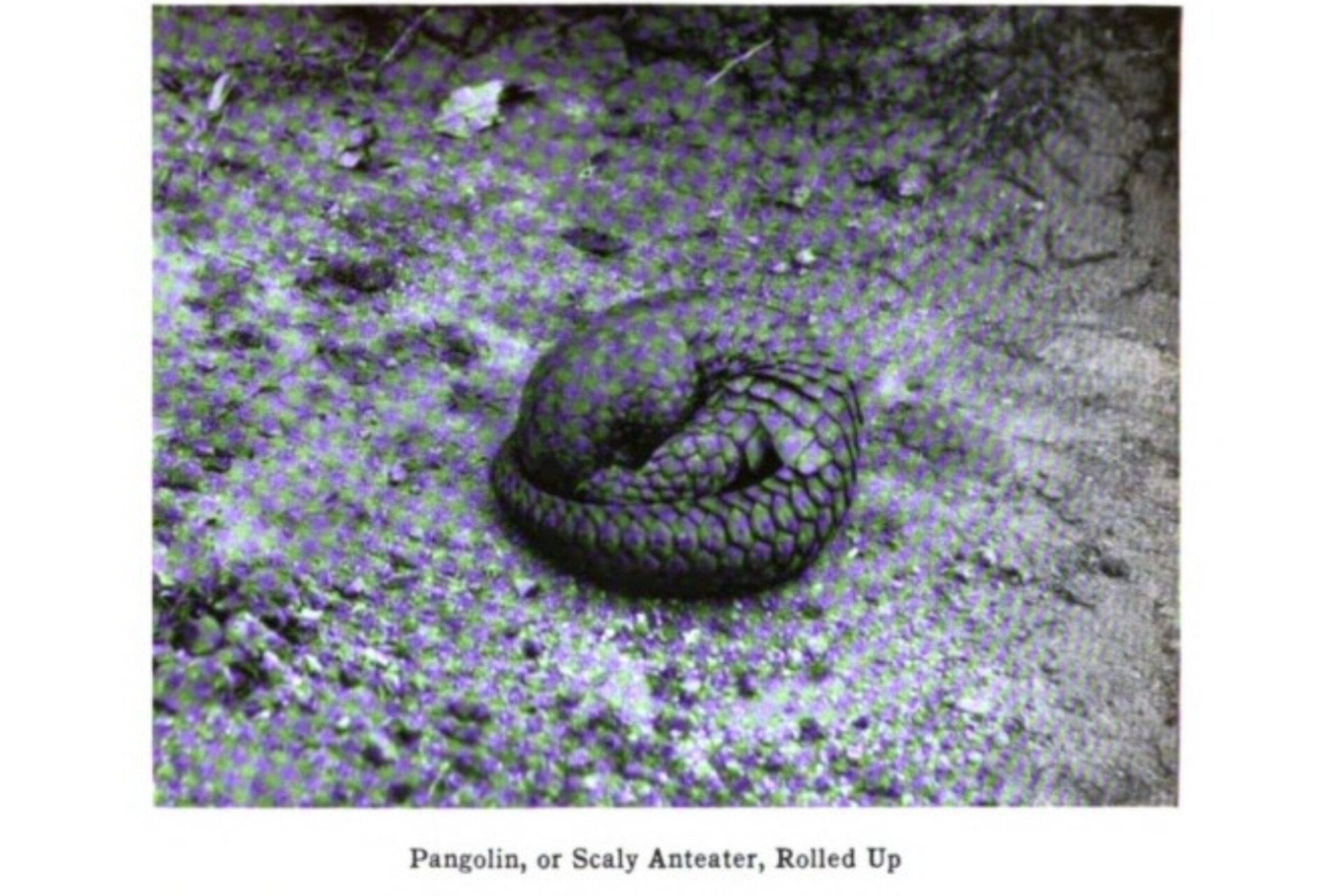
The last heave of my shovel rolled my pangolin out upon the forest floor as inanimate as a glacier-worn boulder in a New England field, or like some gigantic, malformed pine cone. There was absolutely no vulnerable point of attack. A rounded back dwindled gradually into a long tapering tail, with part of a hind leg to fill up every intervening crevice. The tail muscles were as rigid as steel. Even with the spade and a Dyak’s sword as leverage hardly an inch of the perfect circle could be disturbed. From the jaws of a leopard the scaly ball would have slipped harmlessly away.
Left quiet for five minutes, the only sign of life was the lifting of some of the leaf-like scales of the hip. One imagined that there might be eyes beneath; in such a strange creature any weird distribution of the sense of sight would be credible. This raising of the scales proved to be in the nature of a trick, an invitation to a waiting enemy. Any attempt to seize one of those temptingly lifted scales resulted in disaster; like the jaws of a steel trap they snapped down with such force as to bruise the finger cruelly, or actually to pinch off a bit of flesh. One’s enthusiasm for scientific investigation in this direction was satiated at one trial, which was also sufficient to prove Bergson’s theory of humor and laughter applicable to Dyaks as having its basis in cruel lack of sympathy.
If the second setting of the scale trap in the succeeding few minutes remained unsprung, the next sign of the evolution of the pangolin was the gradual drawing forth of his head, always with his fore-paws held tightly across his face just below his eyes, like a boy cheating at blind man’s buff. The little dull eyes looked around, then the long, mobile snout came into play with its much keener sense of smell, and the ears with their sense, the most valuable of all to this animal. If the coast seemed clear, the tail swung around, the short legs gathered themselves together and the creature ambled off.
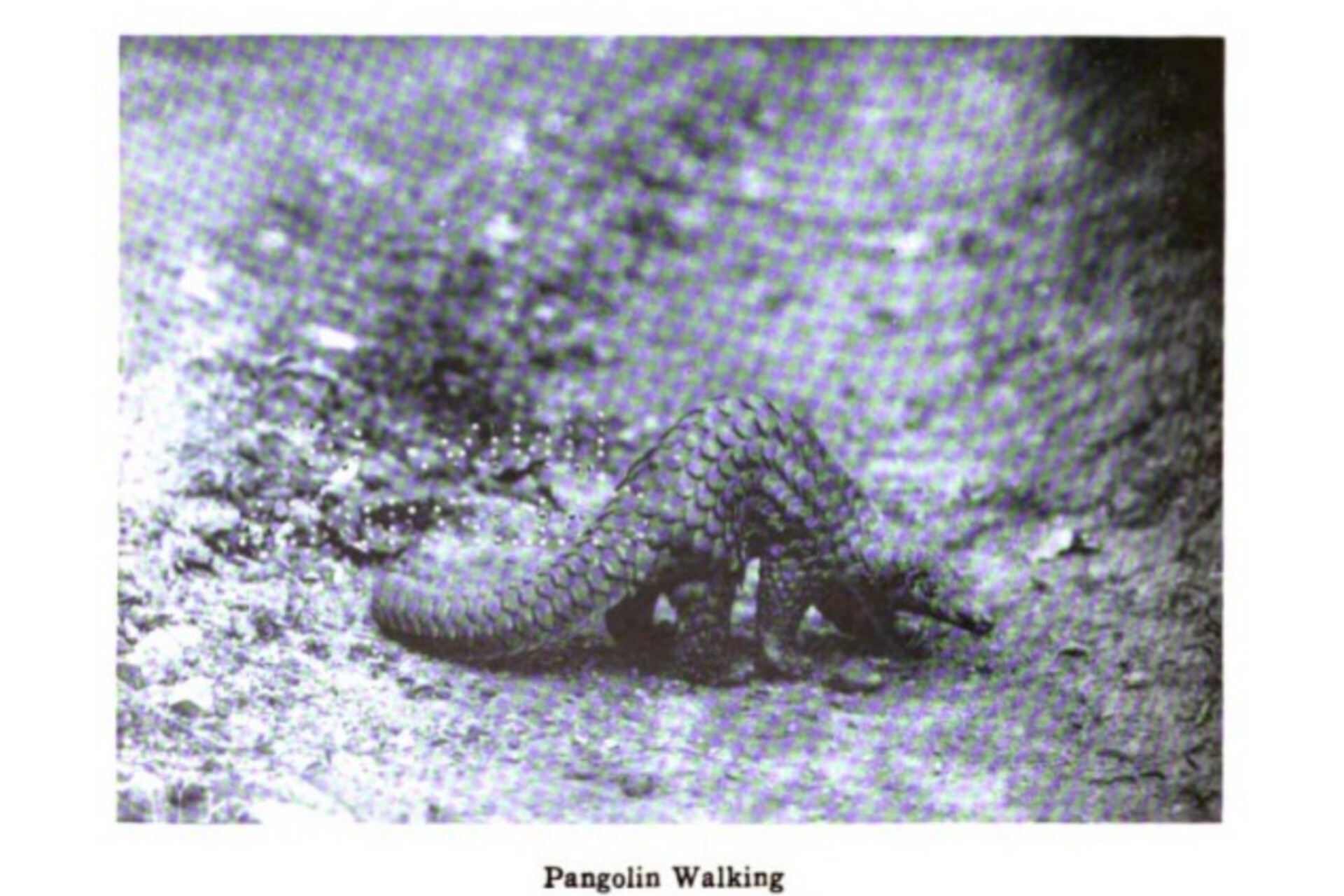
With such perfection of defense, flight is needless, so his fastest gait is a man’s slow walk. And his normal position on the march is very unlike that conceived and executed by the average museum taxidermist. His tail drags, his head is held low and his back is steeply arched, reminding one of the old Stegosaurus of Jurassic days. Swift flight is indeed as impossible as it would be for a man in full medieval armor.
The pangolin is made for ants, and ants alone; without them he would starve at once; with a goodly supply it is difficult to conceive of his dying, except from old age or overeating. The mouth is tiny, as only ants pass in, the tongue is very long, serpent-like in its mobility and covered with glutinous saliva. Why it does not englue as much earth as ants it is hard to explain.
To attempt to subsist on the ants found wandering about the forest would be like harvesting wheat grain by grain, so it is necessary for the pangolin to go to the metropolis for supplies. This is almost the most important work of its life and we find it admirably adapted for this. Twenty very strong claws, backed by muscles of immense power, suffice to tear through the ant-hills, hard almost as concrete. It can neither ensheath its claws like a cat, nor carry them raised above the ground like the screamer, so it folds them back, doubled up like jack-knives, beneath the soles of its feet, and thus walks upon them, the edges and the points being kept unblunted.
Home is a chamber at the end of an underground tunnel. Occasionally a pangolin achieves Nirvana by burrowing into a giant ant-hill and there sleeps away his days and eats away his nights, until death relieves him of the sheer monotony of living. Such an accusation may be unjust however, for in common with all organic beings, his safety and nourishment are but means to an end, and to continue his race he must find a mate.
Ants, both stinging and harmless, form his entire food, although we must extend this general term to include the neuropterous termites or white ants. I have counted five hundred fire-ants in the gizzard of a pangolin, their bites and stings powerless against the sticky, merciless tongue which played and played again amongst them, each time sweeping away scores. Lacking teeth, the pangolin swallows tiny pebbles which, as in a chicken, aid in crushing the hard bodies of the ants.
William Beebe, Pheasant Jungles (New York: G.P. Putnam’s Sons, 1927), pp. 224-229.
See: https://babel.hathitrust.org/cgi/pt?id=uc1.$b52336&seq=1
The Animal Kingdom
George Goodwin
Old World Anteaters and Aardvarks
PANGOLINS OR SCALY ANTEATERS
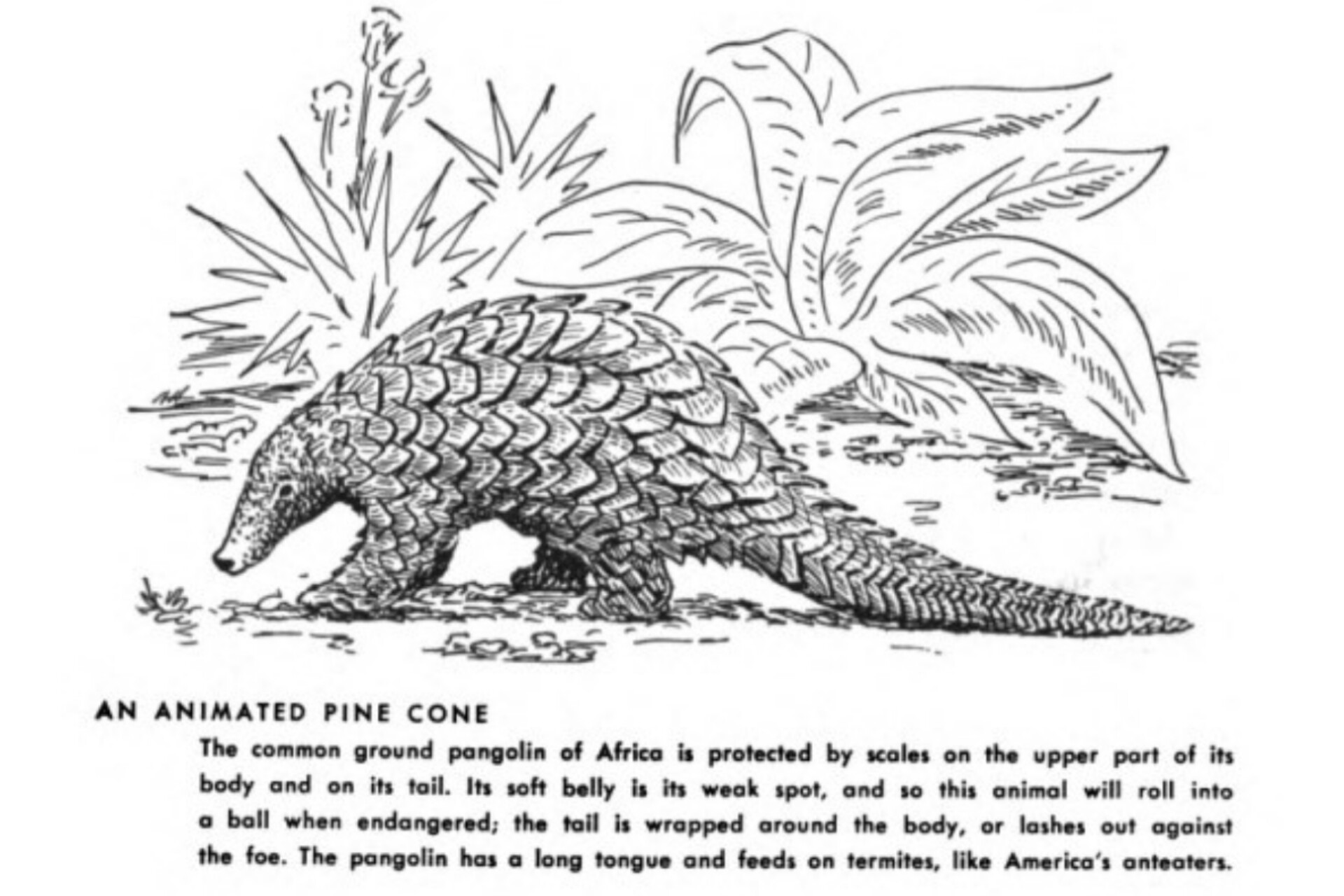
The Pangolin, or scaly anteater, is a native of Asia, Africa, and some islands in the Pacific. Superficially it bears a remarkable resemblance to a huge pine cone.
Look at the pangolin more closely, however, and you will see that its covering is not so innocent as it seems. Linked mail just about describes it.
From the head to the tip of the tail the pangolin is clad (except for the under side) in large, overlapping, and rather pointed scales. They are horny in texture and sharp at the outer edge. Not only does this coat of mail permit the creature freer body action than the plate armor of the armadillos — it can be used as a weapon of attack against an aggressor.
MASTER OF THE ART OF SELF-DEFENSE
The pangolin is a master of the art of self-defense. Its name, in Malayan, means “roller.” When the animal sees danger at hand, it assumes an on-guard position by rolling itself into a ball. This protects the naked under parts. At the same time the pangolin erects its scales, presenting an array of knife-like blades that bristle at the foe.
Should the attacker not take heed of this warning and the loud hissing that accompanies it, the pangolin will slash its tail out at him with unexpected speed, and drive the sharp blades deep through skin and flesh. If the enemy attempts to seize the pangolin by the body, the erect blades snap down with a cutting bite. Pangolins are pacifists, but, if they must fight, they will, and with singular effectiveness.
Although not closely related to the American anteater, the pangolin resembles it in some ways. It is an eater of ants and termites, and has no teeth. Its head is small and the face pointed; from the tiny mouth the long, sticky string of a tongue can be extended several inches to pick up the insects. The body is streamlined and tapered at both ends.
HOW PANGOLINS GET THEIR FOOD
Strong claws on the pangolin’s forefeet serve it well in ripping open termite nests, which it seems to detect by means of its sense of smell (it cannot see or hear very well). In feeding, it favors ants’ eggs more than the ants themselves and is especially fond of the big leafy nests of the red ants, containing millions of ants and eggs. These large red ants will bite the pangolin on the abdomen and face so that it must pause to scratch them off.
TREE AND GROUND PANGOLINS
On the ground the pangolin has a peculiar way of walking, made necessary because the third claw on the front foot is so long. The pangolin has to double the claw under, so that, as the animal moves, only the sides of the foot touch the earth.
Some of the pangolins spend their entire lives on the ground, while other kinds, particularly a number of the West African species, pass most of their time in the trees. They can and do drop down from considerable heights, using the elevated scales to break the fall.
The Asiatic pangolins, although ground-dwellers, will climb on occasion. They are the most typical of the pangolin group (there is only one family, the Manidae, making up the order Pholidota), although not so strong and heavy as the African ground pangolins nor so slender as the tree pangolins.
Slow Breeders: Pangolins are not fast breeders. One baby is about the average for a litter, and twins are quite rare. At birth, the infant’s scales are soft and flexible, but they harden in a few days. Mother pangolin soon takes it traveling with her; she carries it riding precariously on the upper surface of her tail, to which it clings with all its might. When she is alarmed, she folds her tail and head under her body, and the baby finds itself in the sheltered cavity thus formed. When taken young, the pangolin makes an interesting pet. One lived in captivity for two years, which seems to be the only known record on longevity. In the natural state the pangolin may live much longer.
Largest of all the pangolins is the Great Ground Pangolin, Smutsia gigantea, of equatorial Africa. This huge, mighty fellow measures up to six feet in length, with scales five inches across and three inches long. Too heavy to climb, it lives on the ground, with a self-dug burrow for its den.
The Common Ground Pangolin: Smutsia temminckii, is almost as large as its big cousin, and is also possessed of great strength. This ground-dweller of eastern, central, and southern Africa has enormous gripping power when it is curled up — no two men can unroll it by hand while it is still alive. The brown-scaled covering on the back will resist a .303 bullet fired point blank at one hundred yards.
A DANGEROUS TAIL:. Rolled up in a ball, the common African pangolin is by no means defenseless. It does not remain inactive in this position, but keeps slapping and grinding its tail against its body. It will try, this way, to entrap the leg or foot of an attacker — say a cat or a dog. Once it succeeds in doing this, it begins to saw back and forth with the tail; so sharp are the scales that they may completely sever the assailant’s limb.
Still, as its mighty defensive armament suggests, the pangolin is not normally a ferocious creature. It prefers to direct any aggressive inclinations it possesses against the termites on which it feeds.
SEARCHING FOR FOOD: During the day the common pangolin sleeps in a hole in the ground; it does not begin prowling until darkness sets in. Usually its movements are slow and deliberate as it travels across the open sand veldt, or through the thick bush and forests in which it lives. The heavy tail drags behind on the earth. Being cautious and timid by nature, the animal frequently pauses to raise itself up on its hind legs and survey the neighborhood for possible danger.
THE ENERGETIC COMMON PANGOLIN: Once the pangolin finds an anthill, it abandons its clumsiness and goes to work with furious energy. The speed with which its claws can drive a shaft in the heart of the ant-heap is truly astonishing. Its tongue shoots forth a full foot beyond the snout and mops up dozens of the insects at a time. This large pangolin, we have seen, is very strong. It can, as a matter of fact, raise almost anything under which it can force its nose. Although very much a ground-dweller, it has remarkable ability as a climber, should climbing be called for; it can scale the krantzes or cliffs of South Africa even when they are almost vertical. To make it a still more impressive creature, it possesses anal glands capable of ejecting jets of repulsive-smelling liquid, rather like the skunk’s.
“SUPERNATURAL POWERS” OF THE PANGOLIN: With all these strange powers, it is not surprising that Africa’s natives are inclined to regard the pangolin as having supernatural attributes. The bushmen and others use its scales as charms. In South Africa the pangolin is credited by the natives with having some strange influence over their cattle. When a pangolin is captured, the poor beast is burned at the stake in the cattle pen — a sort of sacrifice to preserve the health of the cattle and improve the fertility of the herd. This practice is perhaps one of the reasons why the pangolins are becoming increasingly rare in that part of the continent.
West Africa’s Tree Pangolins: We find two tree-dwelling pangolins in West Africa. The Soft-scaled Tree Pangolin, Phataginus, has very thin scales but they are far from soft, being more like fine-spun steel. This animal is almost all tail: out of its thirty-six inches only fifteen are head and body.
The Long-tailed Tree Pangolin, Uromanis, has an even longer tail, which is serviceable to a tree-climbing animal. While it cannot jump from one branch to another, it can reach across with the tail or else suspend itself from a bough by the tail and climb across. The scales on the underside of the tail also act as climbing irons.
Ground Pangolins of Southern Asia: The pangolins of southern Asia, though they live on the ground, can and do climb trees, chiefly with the help of the tail. The Common or Chinese Pangolin, Manis, is typical of the group; it measures eighteen or twenty inches without the twelve-inch tail, and large individuals will weigh up to seventeen pounds. The Chinese esteem it for its flesh and use its scales as “medicine.”
Tigers often eat pangolins, and the natives invade the tiger haunts for the scales. The Burmese, on the other hand, consider it unlucky to meet a pangolin.
George G. Goodwin, The Animal Kingdom; The Strange and Wonderful Ways of Mammals, Birds, Reptiles, Fishes, and Insects; A New and Authentic Natural History of the Wildlife of the World (Garden City, NY: Doubleday, 1954), pp. 223-228.
See: https://babel.hathitrust.org/cgi/pt?id=coo.31924000101844&seq=1
Mammals of East Asia
George H.H. Tate
THE PANGOLINS OR SCALY ANTEATERS
(ORDER NOMARTHRA)
(FAMILY MANIDÆ)
The scaly covering of their bodies and tails, their elongate forms and awkward gait make the living members of this order, all of which are contained in the single family Manidæ, appear almost reptile-like. If alarmed they can roll the body in a ball, wrapping their tail about it. When in that position they look a little like very large pine-cones. The scales are broad, horny plates, regularly arranged to overlap one another like the shingles on a roof; they are modified from hairs.
Pangolins (a corruption of the Malay word “Tanjiling”) are believed to be exceedingly remote relatives of the South American sloths, anteaters, and armadillos, from which, however, they differ in important ways. They have no collar bones; the joints of the hinder part of the spine have special types of articulation; the single pair of nipples lies behind the armpits; the sexual organs also are very different. The resemblances to anteaters and armadillos seen in the large digging claws, the lack of teeth, and the long, sticky, extensible tongue, possibly indicate not so much real relationship as similarity of adaptations to diets of termites (white ants) and other insects.Three subfamilies of the recent Manidæ are currently recognized, of which two, the Smutsiinæ and the Uromaninæ, are African, and the third, the Maninæ, containing the most typical of the Pangolins, is Asiatic. The three subfamilies, taken together, contain but a half dozen genera. The Asiatic Pangolins are distinguished by having a single median row of scales from the nape to the end of the tail, in contrast to the sudden change to a double row in the tail in the case of the African Pangolins; and further, by the hinder part of the “breastbone” forking into two delicate branches that connect with the hindmost ribs. The Pangolins of Asia include three fairly well-marked genera, the True or Chinese Pangolin, Manis, the Malay Pangolin, Paramanis, and the Indian Pangolin, Phatages. The first has a small but distinct flap-like outer ear; the other two have only a thickened ridge to represent the outer ear. On the other hand, the Chinese and Malay Pangolins have each a distinct, non-scaly pad of skin beneath the tip of the tail, while the Indian Pangolin bears scales there.
Pangolins walk on the knuckles of their fore feet, with the sharp, powerful claws bent upward against the palms and wrists; their hind feet are set down flat. They have been known to burrow their way to the very center of the hardest termite nests, entering through one side and hollowing out the interior. Though so fond of termites for food, they are reported also to consume quantities of true stinging ants. Besides insects, they are supposed to swallow tiny pebbles. A Pangolin (Phatages) kept in captivity in Ceylon soon learned to take milk and even became reluctant to accept termites.
The sense of smell seems strongly developed. That of sight, on the contrary, is poor. The reduction of the external ear by no means implies poor hearing but may be correlated instead with the animal’s burrowing habits.
A large fossil species of Pangolin discovered in Java was estimated to have reached a length of about 8 feet.
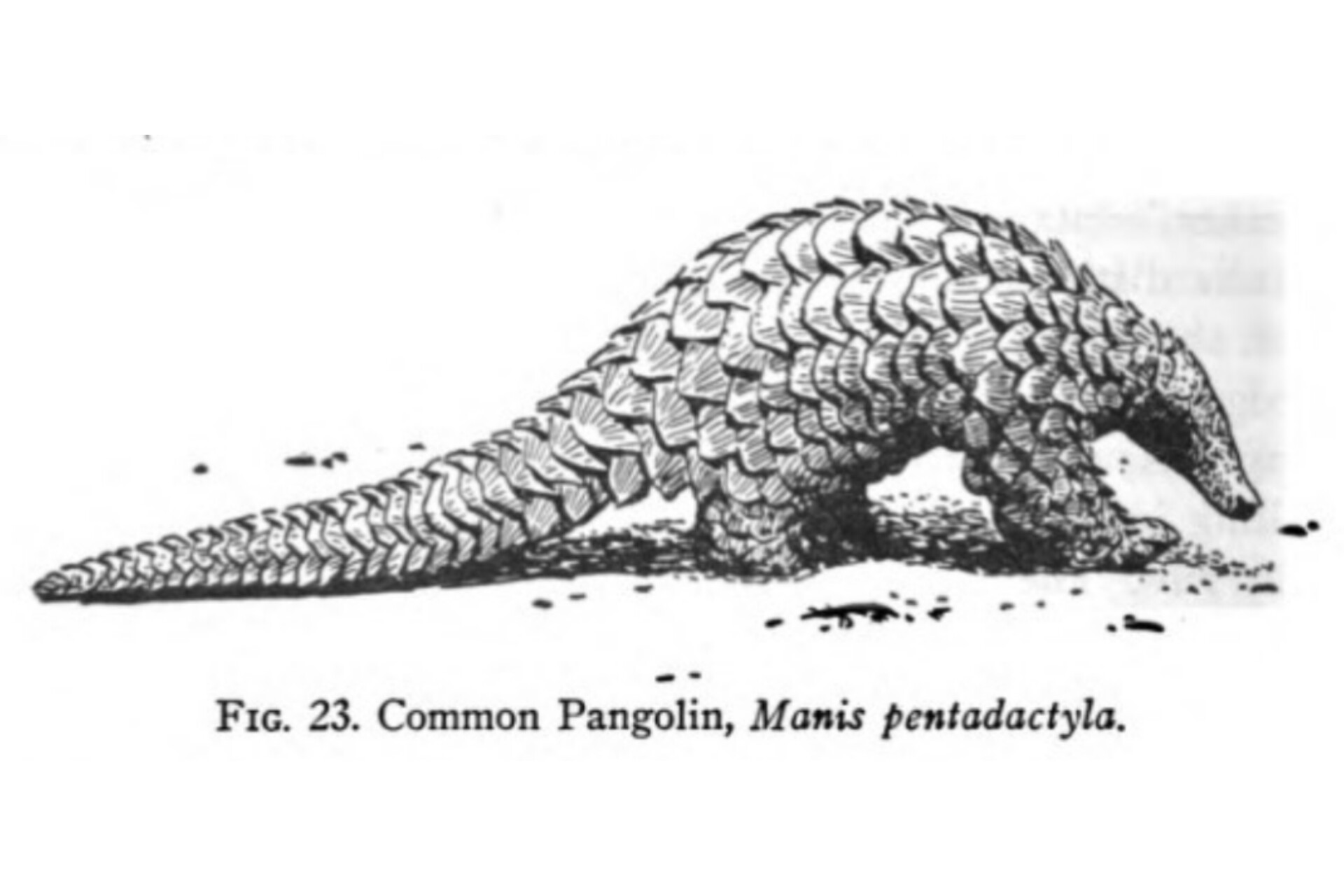
The Common or Chinese Pangolin, Manis pentadactyla, originally found in Formosa, occurs all across southern China to Hainan, Indo-China, Siam, Burma, and Assam.
The color of the scales may be dark or light gray-brown, or somewhat the color of horn; the underparts of the body, not of the tail, clad with coarse thin hair instead of scales, are grayish white or brownish white. Typically there is a membranous pad beneath the very tip of the tail. The length of the head and body in Chinese specimens is usually from 18 to 20 inches, of the tail 10 to 13 inches, the hind foot 23/4 inches. A male specimen from the Chin Hills, Burma, had the corresponding dimensions 30 and 16 inches respectively, and weighed 17 pounds. The Pangolin of the mainland, M. p. dalmanni, is slightly smaller than either the Hainan Island race pusilla or the Formosan Pangolin.
One or sometimes two young ones are produced in the spring in a brood chamber at the bottom of a burrow from 8 to 12 feet in depth. The young ride on the back of the mother. Pangolins are good climbers as well as expert diggers, and ascend high trees in order to tear open the nests of arboreal termites. The only offensive action possible is rapid switching with the tail so that the sharp edges of the scales may wound an aggressor.
In Burma the natives believe it unlucky to meet a Pangolin; in China the scales of these mammals are valued for medicine.
The Malay Pangolin, Paramanis javanica, is distinguished from the Chinese Pangolin by development of a fairly prominent ridge representing the external ear, instead of the very slight ridge seen in M. pentadactyla. It resembles the Chinese species and differs from Phatages of the Indian peninsula and Ceylon, by having a non-scaly pad beneath the tip of the tail. The length of the head and body is 20 inches, tail 15½ inches, hind foot without the claws 3 inches.
The range extends through the Malay Peninsula to Sumatra, Java, Borneo, and Philippines; to the northeast it reaches northern Siam, Laos, Annam, and Cochin-China.
In the Malay Peninsula the Malay Pangolin is often found in open sandy country making large burrows (Ridley). Flower tells a Malay story to the effect that it lies on the ground and raises its scales. Ants, believing it dead, swarm over it, whereupon it snaps down its scales, runs to a pond and drowns the ants, afterward making a meal of them.
George H.H. Tate, Mammals of Eastern Asia (New York: Macmillan, 1947), pp. 112-115.
See: https://archive.org/details/mammalsofeastern00tate
Extinct and Vanishing Mammals of the Old World
Francis Harper
Order EDENTATA: Edentates
Family MANIDAE: Pangolins
Three genera of this family, represented by four species, occur in Africa south of the Sahara, and all of them are treated in the following pages. Two other genera (Manis and Phatages), represented by five forms, occur in the Oriental region (India, China, Siam, Indo-China, Malaysia); while subjected to some persecution by reason of their supposed medicinal value, these Oriental pangolins are not included in the present report.
Giant Pangolin or Scaly Anteater.
Pangolin géant (Fr.). Riesenschuppentier (Ger.)
SMUTSIA GIGANTEA Illiger
Manis gigantea Illiger, Abhandl. K. Akad. Wissen. Berlin, physik. Kl., 1804-1811, p. 84, 1815. (Guinea = West Africa.)
FIGS.: Büttikofer, 1890, vol. 2, p. 394, fig.; Beddard, 1902, p. 190, fig. 109; Schubotz, 1912, p. 357, fig.; Bequaert, 1922, pl. 24, fig. 2, pl. 25, fig. 2; Schouteden, 1930, p. [14], fig. 3a; Hatt, 1934b, pls. 32-34, and 1934c, p. 727, upper fig., p. 729, fig.; Rosevear, 1937, p. 12, fig. 2
The various species of African pangolins do not appear to be numerous anywhere. They are in considerable demand among the natives, and active hunting keeps down their numbers. All forms are placed in Schedule B under the London Convention of 1933.
In all African pangolins “no hairs project between the scales, the median dorsal row of scales does not extend to the tail tip, and there is no external pinna of the ear.” In S. gigantea and S. temminckii “the belly is naked, the preaxial surface of the fore limb bears scales to the base of the claws, the tail is massive and bears no naked subterminal pad.” In the former “there are 12 to 15 scales in the median dorsal row of the tail… The scales of the head, neck, shoulders, arm, and hind legs are dominantly dark olive- brown. This color shades gradually into avellaneous over the dorsal region…. Over the tail a deep Roman green assumes increasing prominence in the apical part of the scale…. The species is hairless, except for a dense ring of short, circumorbital bristles and a patch of similar hairs in front of the auditory meatus.” The tail length averages a little less than half of the total length. (Hatt, 1934b, pp. 646-649.) The species attains a total length of 1,710 mm. and a tail length of 830 mm. (Allen and Coolidge, 1930, p. 606).The range appears to extend from Sierra Leone and Liberia east to the Ubangi-Shari Territory of French Equatorial Africa and northeastern Belgian Congo. It corresponds rather closely to the Upper and Lower Guinea Forest District of Chapin (1932, p. 90) and of Bowen (1933, pp. 256, 258). “M. gigantea is known from the West African Rain Forest and the adjoining wooded galleries” (Lang, in Bequaert, 1922, p. 325). Matschie (1894a, p. 5) seems to extend the range as far as Senegambia.Sierra Leone. — A species of pangolin, said to be Smutsia gigantea, is of fairly general distribution but is not commonly seen. It provides food for the natives. There is no evidence of depletion, and no protective measures are taken. (Colonial Secretary’s Office, in litt., July, 1937.)
Liberia. — This is a very rare animal in Liberia. A specimen secured by Jackson at Cape Mount had consumed a large quantity of termites and driver ants. The flesh is very tough and has a flavor of formic acid. (Büttikofer, 1890, vol. 2, pp. 395-396.)
Another specimen is recorded by Jentink (1888, p. 56) from Little Bassa.
A male of record size was obtained from natives at Paiata (Allen and Coolidge, 1930, p. 606).
Gold Coast. — This species “is found in the savannah areas of N. Ashanti and the Northern Territories.
“There is little doubt that all [the species of pangolins] are now much less common than formerly, though it is probable that their range has not decreased.
“Night hunting and the use of wire snares are the main causes of depletion. Their meat is considered one of the greatest delicacies.” (Assistant Conservator of Forests, Gold Coast, in litt., July 22, 1937.)
Nigeria. — The species is reported from Nigeria, but without a definite locality record (Rosevear, 1937, p. 13).
French Cameroons. — It occurs in the forest region and is absolutely protected except under scientific permit (Paris Agency, in litt., November, 1936).
Gabun. — The Giant Pangolin is confined to the great forest. Only a skin has come under personal observation. It was, however, abundant at Mimongo in the region of Akelai. (A. R. Maclatchy, in litt., February 5, 1937.)
Ubangi-Shari district, French Equatorial Africa. — It appears to be localized in the forested region. It is not threatened, and has been totally protected since 1929. (L. Blancou, in litt., December, 1936.)
Belgian Congo. — Schubotz (1912, p. 356) records a specimen from Angu, on the Uele River.
Lang (in Bequaert, 1922, p. 320) says of the several local species of pangolins:
“The signs of their fossorial practice are as often a cause of their discovery as is the strong odor they emit, and dogs of native hunters never fail to challenge their presence. Various highly valued talismans, which their captors obtain from the claws, scales, hairs, and other parts of some of the scaly ant-eaters, suffice to make them an always welcome prize and their meat is an additional incentive for their destruction.”
Lang also describes (p. 325) a Pygmy method of capturing the present species: “Pygmy boys, with one end of a strand of rattan fastened to the waist and the other held by friends waiting outside, entered the burrows without hesitation These boys, armed only with a knife, merely fastened the rattan around the live pangolin, which they prodded from behind while their companions pulled it out of the hole. These otherwise harmless beasts, when touched while rolled up, suddenly switch their tail sidewise with such force that, if one’s hand is caught between the rough body scales and the tail, it is seriously mutilated by the shearing action.”
Lang records (p. 325) specimens from Bafuka, Niangara, Poko, and Niapu in northeastern Belgian Congo.
“The only specimen I was ever able to obtain was dug out for me by natives, with the expenditure of much labor and time, on the Semliki side of the forest” (Christy, 1924, p. 228).
Schouteden states (1930, p. [95]) that the species ranges from the Lower to the Upper Congo. He also records (1935, p. [62]) a specimen from the Kivu region.
The several species of pangolins do not appear numerous anywhere in the Belgian Congo. The natives do not hunt them especially, and the Europeans not at all. Brush fires alone destroy a great many. (A. J. Jobaert, in litt., November 10, 1936.)
South African Pangolin; Scaly Anteater.
Ijzer Magauw; Ietermago (Boer)
SMUTSIA TEMMINCKII (Smuts)
Manis temminckü Smuts, Enumeratio Mammalium Capensium, p. 54, pl. 3, figs. 6-7, 1832. (“E regionibus, ultra Latakou sitis” = probably the region north of Litakun, British Bechuanaland.)
FIGS.: A. Smith, 1849, pl. 7; Royal Nat. Hist., vol. 3, p. 229, fig., 1894-95; Matschie, 1895, p. 143, fig.; W. L. Sclater, 1901, vol. 2, p. 217, fig. 148; Fitzsimons, 1920, vol. 4, pl. facing p. 233.
Though widely distributed in South and East Africa, this seems to be a decidedly scarce animal.
“General form somewhat elongated and lizard-like, covered everywhere, except on the lower surface of the head and body and inside the limbs, with a series of over-lapping broad scales of a dark horn-brown colour with paler edges and tips; head very small and pointed,” covered above with small scales; “no external ear…. Across the middle of the back eleven rows of scales short each with five toes and claws…. limbs Tail very broad,” covered above and below with 4-5 rows of scales. Head and body, 24 inches; tail, 18. (W. L. Sclater, 1901, vol. 2, pp. 217-218.)
“The scaly ant-eater is chiefly found to the north of the Orange River, though said to occur rarely in Prieska and the other districts just south of the river; from here it extends through the Orange Free State, the Transvaal, Bechuanaland, the Kalahari and German South-west Africa to Rhodesia; north of the Zambesi it occurs in South Angola, Nyasaland and East Africa as far as Somaliland.” (W. L. Sclater, 1901, vol. 2, p. 218.) Matschie (1894, p. 5) extends the range north to southern Kordofan (about lat. 17° N.).
“Well known in the Orange Free State (Ventersburg-Albany Museum), the Transvaal, Bechuanaland, Ngamiland, and Southern Rhodesia.” Also “recorded from Northern Rhodesia, Nyasaland, and — according to Sclater — Uganda, East Africa and Somaliland.” (Shortridge, 1934, vol. 2, p. 665.)
Cape Province and British Bechuanaland. — At Litakun, British Bechuanaland, Burchell (1824, vol. 2, pp. 423-424) observed a skin lying on the hedge of a native cattle enclosure, “placed there to preserve the cattle from the evil effects of sorcery…. Whenever a recent track is met with, the animal is traced to its hole and dug out if possible, as the flesh, which is extremely fat, is esteemed so great a delicacy that the law requires that every khaaka which is killed shall be brought to the Chief.”
Referring to this same general region, A. Smith says (1849, text to pl. 7): “Only one solitary specimen of this species was obtained by the expedition before reaching 26° south latitude, and but two more between that parallel and the tropic of Capricorn Its extreme scarcity probably arises from its having long been zealously sought after by the natives … Whenever a specimen is secured, it is immediately burned in some cattle pen, which, according to the opinion of the sacrificer, tends to increase the health and fertility of all cattle who may afterwards enter the fold. Not many years ago a specimen was captured in the northern part of the Cape colony.” …
“I have seen a dry skin from Upington” (Shortridge, 1934, vol. 2, p. 665). In Griqualand West the animal is now very scarce, and the scales are used by the natives as medicine (McGregor Museum, Kimberley, in litt., June, 1937).
South-West Africa. — In the Omaheke and the Kaukauveld it is widespread but rather rare; skins are seen occasionally among the natives. It is also reported by Bushmen in the Hukweveld. (Zukowsky, 1924, p. 68.)
“The Pangolin occurs throughout South-West Africa,” but is “never plentiful….
“It is apparently most numerous north of the Tropic of Capricorn and in the sand-plains adjoining Bechuanaland.
“Rare in the vicinity of the Orange River and in the southern parts of Great Namaqualand….
“Pangolin scales (used as charms) were not infrequently seen in the possession of Bushmen and other natives.” (Shortridge, 1934, vol. 2, p. 665.) .
Angola. — Monard (1935, p. 183) records two specimens from the region between the upper Kului and the Kubango, where the natives report the animal as rather common. Monard also mentions (p. 185) specimens recorded by Bocage from Caconda and Mossamedes.
Transvaal. — “A number of examples have been sent to the National Zoological Gardens, chiefly from the Rustenburg and Marico districts of the Transvaal” (Haagner, 1920, p. 237).
“Never very common and probably scarcer now as a result of closer settlement. There is a demand for its scales by native witch doctors for ‘medicine,’ as much as six pence per scale being paid, so that this leads to a considerable amount of destruction of the animal. Being entirely useful and harmless it should receive more protection than is actually accorded it…. (Not included in the game laws, i.e., without any special protection.)” (A. Roberts, in litt., November, 1936.)
Portuguese East Africa. — Peters (1852, p. 174) records specimens from Quitangonha, from near Cape Delgado, and from the vicinity of Quelimane. He adds that the scales are made into finger rings and worn as a protection against the “evil eye.”
Kirk states (1865, p. 654) that it occurs near Sena.
Southern Rhodesia. — Chubb (1909, p. 125) records a specimen from Wankie, Matabelelend.
The species is by no means common. Most Rhodesian natives use the skin as a charm, and for this reason the animals are in great demand. Were it not for their retiring nature and strictly nocturnal habits, they would be in danger of extermination. They will be protected in the near future. (Game Warden, Wankie Game Re- serve, in litt., March, 1937.)
Northern Rhodesia. — Pitman notes (1934, p.173) that this pangolin is “recorded from Batoka Province and Barotse.” The natives do not “seem to know of it in the areas I have toured (with the exception of the Kafue Hook).” He quotes Neave (1906) to the effect that it is not unusual to see the scales worn as charms by natives of the mid-Zambesi Valley.
Tanganyika Territory. — Holmwood (1878, p. 632) records a specimen “from the coast opposite Zanzibar, lat. 6° S.; but I have seen what I took to be the same animal, both in Somaliland under the equator and as far south as the Makna country opposite Mozambique.”
Matschie (1895, p. 143) records the animal from Wahumba, Bagamoyo, Massai Nyika, and Mandera.
The Game Preservation Department (in litt., December, 1936) reports no danger of extinction.
Kenya. — The Game Warden (in litt., November, 1936) reports no decrease, though the animal is not protected.
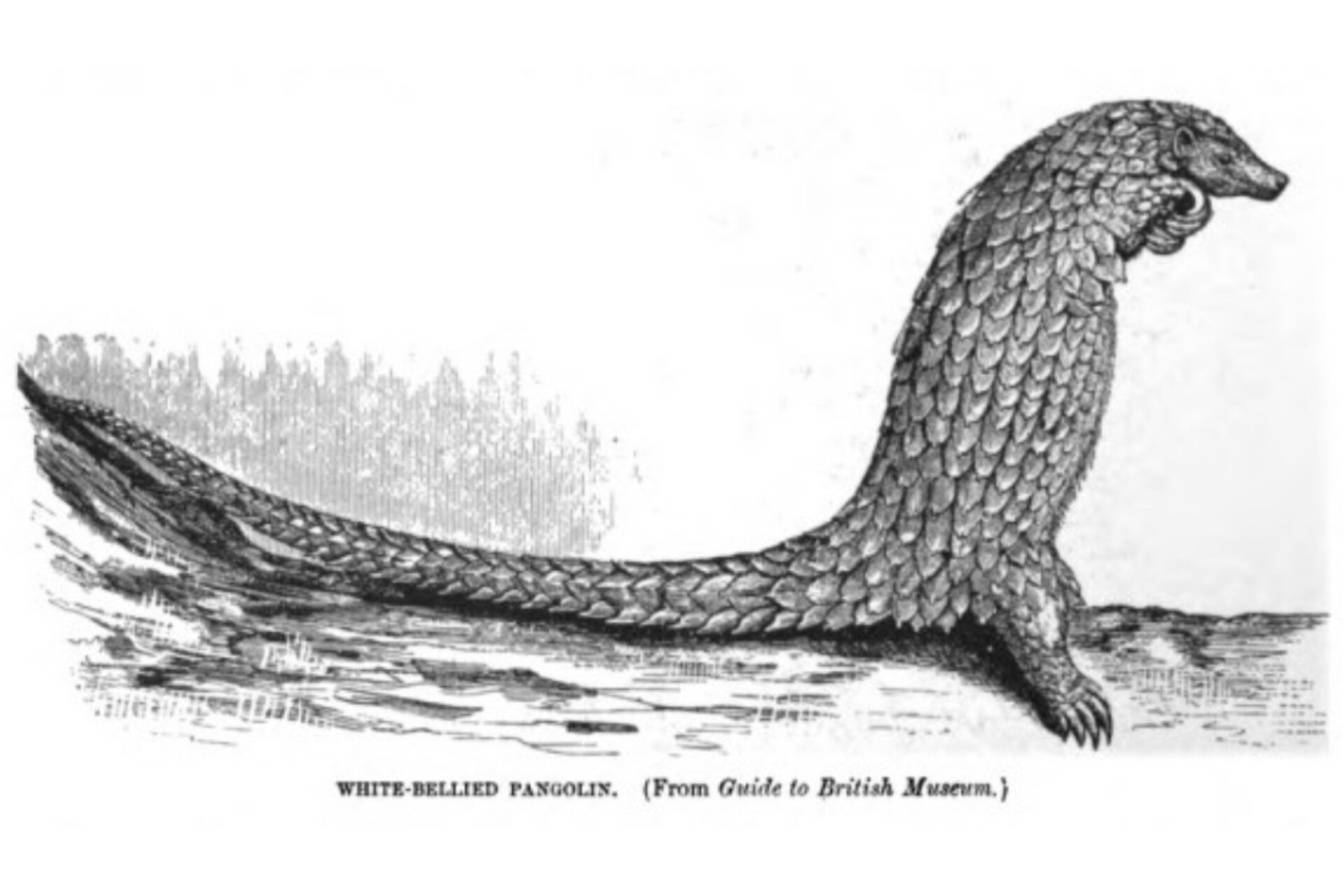
Three-cusped Pangolin; White-bellied Pangolin;
Pale-bellied Pangolin; Pointed-scaled Pangolin.
Pangolin tricuspide (Fr.). Dreizackige Schuppentier (Ger.)
PHATAGINUS TRICUSPIS (Rafinesque)
Manis tricuspis Rafinesque, Annales Gén. Sci. Physiques [Bruxelles], vol. 7, p. 215, 1821. (Type locality not stated; restricted by Allen and Coolidge (1930, vol. 2, p. 606) to “West Africa.”)
FIGS.: Royal Nat. Hist., vol. 3, p. 230, fig., 1894-95; Johnston, 1906, vol. 2, p. 749, fig. 292; Schouteden, 1930, p. [88], fig. 1; Hatt, 1934b, pls. 36-37, and 1934c, p. 727, lower fig., p. 730, upper fig., p. 731, right-hand fig.; Rosevear, 1937, p. 12, fig. 1.
This species occurs in apparently larger numbers than the other African pangolins.
It is “an arboreal species with a tail constituting over half the total length. The characters of the tail tip and the fore limbs are like those of Manis longicaudatus. The scales, however, are small and numerous, brown, and during mid-life, tricuspid. The post-scapulars are not enlarged.” Under parts grayish white. In young animals “the margins of the scales are even, but with ensuing wear the scales become sharply dentate, or, usually later, tridentate.” In old age the animals have “cuspless, worn, elongate scales.” In half-grown and mature animals the unscaled parts of the skin are covered with hair, attaining a length of 20 mm. Longitudinal rows of scales, 21-25; marginal caudal scales, 35-40. Total length, up to 1,027 mm.; tail, 607 mm. (Hatt, 1934b, pp. 655-658.)
This pangolin is not confined to the Upper and Lower Guinea Forest Districts but ranges southward into the Southern Congo Savanna District and eastward into the Uganda-Unyoro Savanna District of Chapin (1932, p. 90) and of Bowen (1933, pp. 256, 258). Hatt (19346, p. 656) records specimens from Liberia, the Ivory Coast, Cameroons, Fernando Po, Gabun, the lower Congo, Kasai district, and central Angola. According to Matschie (1894a, p. 6), the range extends west to Gambia, and Jentink (1882, p. 208) has a record from Sierra Leone.
Liberia. — The species appears to be distributed over the entire region. Specimens are recorded from Buluma, Schieffelinsville, Junk River, Hill-town, and Farmington River. The animal can be tamed and kept a long time in houses, where it runs free and preys upon ants, cockroaches, and other troublesome insects. (Büttikofer, in Jentink, 1888, p. 57.)
Allen and Coolidge (1930, vol. 2, p. 606) record “a native-made skin bought at Sinoe.”
Gold Coast. — Hayman (1936, p. 937) records specimens from Goaso and Mampong.
The species is found through much of the forest country, but is doubtless much less common now than formerly (Assistant Conservator of Forests, Gold Coast, in litt., July 22, 1937).
Fernando Po. — Fraser (1848, text to pl. 28) records the species from this island, where “the flesh is said to be exceeding good eating, and is in great request among the natives.”
Gabun. — This pangolin is confined to the great forest. Although legally protected, it is actively hunted by the forest natives, who capture great quantities. To prevent this is difficult, for the animal is taken in trigger traps set for small game. The real safeguard would be the prohibition of this type of trap; but those who know game laws, i.e., without any special protection… (A. Roberts, in litt., November, 1936).
Portuguese East Africa. — Peters (1852, p. 174) records specimens from Quitangonha, from near Cape Delgado, and from the vicinity of Quelimane. He adds that the scales are made into finger rings and worn as a protection against the “evil eye.”
Kirk states (1865, p. 654) that it occurs near Sena.
Southern Rhodesia. — Chubb (1909, p. 125) records a specimen from Wankie, Matabelelend.
The species is by no means common. Most Rhodesian natives use the skin as a charm, and for this reason the animals are in great demand. Were it not for their retiring nature and strictly nocturnal habits, they would be in danger of extermination. They will be protected in the near future. (Game Warden, Wankie Game Reserve, in litt., March, 1937.)
Northern Rhodesia. — Pitman notes (1934, p. 173) that this pangolin is “recorded from Batoka Province and Barotse.” The natives do not “seem to know of it in the areas I have toured (with the exception of the Kafue Hook).” He quotes Neave (1906) to the effect that it is not unusual to see the scales worn as charms by natives of the mid-Zambesi Valley.
Tanganyika Territory. — Holmwood (1878, p. 632) records a specimen “from the coast opposite Zanzibar, lat. 6° S.; but I have seen what I took to be the same animal, both in Somaliland under the equator and as far south as the Makna country opposite Mozambique.”
Matschie (1895, p. 143) records the animal from Wahumba, Bagamoyo, Massai Nyika, and Mandera.
The Game Preservation Department (in litt., December, 1936) reports no danger of extinction.
Kenya. — The Game Warden (in litt., November, 1936) reports no decrease, though the animal is not protected….
[French Equatorial Africa. — Matschie (1894a, p. 6) records the species from Loango.
It is common almost everywhere in the Ubangi-Shari district. It has been totally protected since 1929, and is not threatened. (L. Blancou, in litt., December, 1936.)
Angola. — Monard (1935, p. 185) quotes Bocage to the effect that this pangolin is rather common at Bembé and Malangé; he also gives records for Bimbi and Cazengo.
Belgian Congo. — Schwarz (1920b, p. 1061) records specimens from Libenge on the Ubangi, Panga on the Aruwimi, Angu on the Uele, and Avakubi on the Ituri; also from Kudurma and Kabayendi in the Niam-Niam country (not far from the Congo-Sudan boundary).
Lang (in Bequaert, 1922, pp. 320-323) remarks that tricuspis is the commonest of the African pangolins. “Being timid, they readily make use of their natural safeguard and, when even slightly annoyed, roll up in a ball When forcibly unrolled, they may succeed in driving off their tormentors by well directed jets of an ill-smelling, acrid liquid from the anal region; native dogs suffer for a considerable time from the effect of this substance, which greatly irritates their mucous membranes….
“If unmolested and placed near their favored prey, they uncoil readily One soon realizes how thoroughly they are specialized as ant-eaters, for their methods of attack and disposal of ants are as effective as their ways of guarding themselves against the defensive means of their prey. In the regions we visited, the pangolins preferred true ants, as stomach contents clearly showed, though many of our captives would plunder termitaria with great eagerness….
“One taken near a column of army ants (Dorylus) merely made good its escape, another quickly broke up the well-ordered line. Lashing its sticky tongue through the confused crowds, the ant-eater lost no time in moving back and forth along the ant column as quickly as the dense clusters vanished into its mouth. Its hunger satisfied, it at once retreated, freeing itself of the few army ants that had managed to dig their mandibles into the soft parts of its hide. M. tricuspis fed freely on many other kinds of ants. Those we had alive at Avakubi, Medje, and Niapu were particularly fond of ants of the genus Myrmicaria….
“African pangolins have helped to enrich the stores of witchcraft.”
Hatt (19346, p. 645) records 66 specimens from Akenge, Avakubi, Faradje, Gamangui, Medje, Ngayu, Niangara, Niapu, Poko, and Stanleyville.
Uganda. — An arboreal pangolin (presumably tricuspis) is reported by Johnston (1902, vol. 1, pp. 395-396).
“Two or three species occur in Uganda, the common representative being Phataginus tricuspis, a forest species. There is no reason to believe that Pangolins are any less plentiful than formerly. In the Mabira Forest P. tricuspis is abundant. All species of Pangolins are completely protected in Uganda.” (Game Warden, Uganda, in litt., December, 1936.)] [This bracketed extract appears in a repetitive section but was apparently added later; and some text was deleted.]
Long-tailed Pangolin; Black-bellied Pangolin.
Pangolin à longue queue (Fr.). Langschwanzige Schuppentier (Ger.)
UROMANIS LONGICAUDATA (Brisson)
Pholidotus longicaudatus Brisson, Règne animal, vol. 3, Quadr., p. 19, 1762. (“Probably West Africa” (Allen and Coolidge, 1930, p. 606).)
SYNONYMS: Manis tetradactyla Linnaeus (1766); Manis macroura Erxleben (1777); Manis hessi Noack (1889).
FIGS.: Noack, 1889a, pl. 1; Johnston, 1906, vol. 2, p. 753, fig. 295; Bequaert, 1922, pl. 25, fig. 1; Allen and Coolidge, 1930, pp. 603-605, figs. 447-449; Schouteden, 1930, p. [94], fig. 3a; Hatt, 1934b, pl. 35, figs. 1-2, and 1934c, pp. 726 (both figs.) and 731 (lower fig.); Rosevear, 1937, p. 12, fig. 3.
The very limited amount of information available concerning this species suggests that it is one of the rarest of the African pangolins.
This is “an arboreal species with a long prehensile tail, equaling about two-thirds of the total length…. The forearms bear no scales, but are covered with hair. The scales are large, yellow, and on the flanks are keeled. The two inferior post-scapular scales are markedly larger than those adjacent to them…. The belly hair is black in most individuals…. The whole face… dark brown, nearly black.” Total length up to 937 mm.; tail, 645. (Hatt, 1934b, pp. 651-652.) Thirteen rows of scales on the body; 44 marginal scales on the tail; two rows of 9-10 scales before the tail tip (Matschie, 1894a, p. 7).
The range appears to be more or less coextensive with the Upper and Lower Guinea Forest Districts of Chapin (1932, p. 90) and of Bowen (1933, pp. 256, 258). Jentink (1882, p. 207) records specimens from as far west as Senegal and Sierra Leone. Otherwise the species is known from Liberia to Gabun and the northeastern Belgian Congo.
Liberia. — The animal is pretty rare, though a number of living specimens were received, including one at Soforeh Place. (Büttikofer, 1890, vol. 2, pp. 393-394.)
Jentink (1888, p. 56) records additional specimens from Hill-town and Farmington River.
Live specimens were brought to Allen and Coolidge (1930, vol. 2, p. 606) at Lenga Town on the Farmington River and at Paiata.
Gold Coast.— Specimens are recorded from Dabocrom and Elmina (Jentink, 1882, p. 207); also from Goaso (Hayman, 1936, p. 937). The species is found through much of the forest country, but there is little doubt that it is now much less common than formerly (Assistant Conservator of Forests, Gold Coast, in litt., July 22, 1937).
Cameroons.— Hatt (1934b, p. 653) records the species from this country, without stating the exact locality.
Gabun.-Hatt (1934b, p. 652) records a specimen from Fernand Vaz.
Belgian Congo. — Noack (1889a, p. 100) based his name Manis hessi upon a specimen from the vicinity of Banana, at the mouth of the Congo.
Hatt (1934b, pp. 651, 653) records specimens from Bolobo and Lukolela on the Lower Congo, and from Akenge, Gamangui, Medje, and Niapu in the northeastern part of the country.
Francis Harper, Extinct and Vanishing Mammals of the Old World (New York: American Committee for International Wild Life Protection, 1945), pp. 181-186 and 188-190.
See: https://archive.org/details/extinctvanishing00harprich
ON THE PANGOLIN OF BAHAR.
SENT BY MATTHEW LESLIE, ESQ
The singular animal which M. Buffon describes by the name of Pangolin, is well-known in Europe since the publication of his “Natural History” and Goldsmith’s elegant abridgement of it, but if the figure exhibited by Buffon was accurately delineated from the three animals the spoils of which he had examined, we must consider that which has been lately brought from Caracdiah to Chitra, and sent thence to the Presidency, as a remarkable variety, if not a different species, of the Pangolin: ours has hardly any neck, and though some filaments are discernible between the scales, they cans carce be called bristles; but the principal difference is in the tail; that of Buffon’s animal being long, and tapering almost to a point, while that of ours is much shorter, ends obtusely, and resembles in form and flexibility the tail of a lobster.
In other respects, as far as we can judge from the dead subject, it has all the characters of Buffon’s Pangolin; a name derived from that by which the animal is distinguished in Java, and confequently preferable to Manis or Pholidotus, or any other appellation deduced from an European language.
As to the scaly Lizard the scaled Armadillo, and the five-nailed Ant-eater, they are manifestly improper designations of this animal; which is neither a Lizard nor an Armadillo in the common acceptation; and, though it be an Ant-eater, yet it essentially differs from the hairy quadruped usually known by that general description.
We are told, that the Malabar name of this animal is Alungu: the natives of Bahár call it Bajár-cit, or, as they explain the word, Stone-vermin; and in the stomach of the animal before us was found about a tea-cupful of small stones, which had probably been swallowed for the purpose of facilitating digestion; but the name alludes, I believe, to the hardness of the scales; for Vajracita means in Sanscrit the Diamond, or Thunderbolt, reptile, and Vajra is a common figure in the Indian poetry for any thing exceſſively hard. The Vajracita is believed by the Pandits to be the animal which gnaws their sacred stone, called Salgrá-másilà; but the Pangolin has apparently no teeth, and the Sálgrams, many of which look as if they had been worm-eaten, are perhaps only decayed in part by expoſure to the air.
This animal had a long tongue shaped like that of a cameleon; and, if it was nearly adult, as we may conclude from the young one found in it, the dimensions of it were much less than those which Buffon assigns generally to his Pangolin; for he describes its length as six, seven, or eight feet including the tail, which is almost, he says, as long as the body, when it has attained its full growth; whereas ours is but thirty-four inches long from the extremity of the tail to the point of the snout, and the length of the tail is fourteen inches; but, exclusively of the head, which is five inches long, the tail and body are, indeed, nearly of the same length; and the small difference between them may show, if Buffon be correct in this point, that the animal was young: the circumference of its body in the thickest part is twenty inches, and that of the tail only twelve.
We cannot venture to say more of this extraordinary creature, which seems to constitute the first step from the quadruped to the reptile, until we have examined it alive, and observed its different instincts; but as we are assured, that it is common in the country round Khanpur, and at Chatigam, where the native Muselmans call it the Land-carp, we shall possibly be able to give on some future occasion a fuller account of it. There are in our Indian provinces many animals, and many hundreds of medicinal plants, which have either not been described at all, or, what is worse, ill described by the naturalists of Europe; and to procure perfect descriptions of them from actual examination, with accounts of their several uses in medicine, diet, or manufactures, appears to be one of the most important objects of our institution.
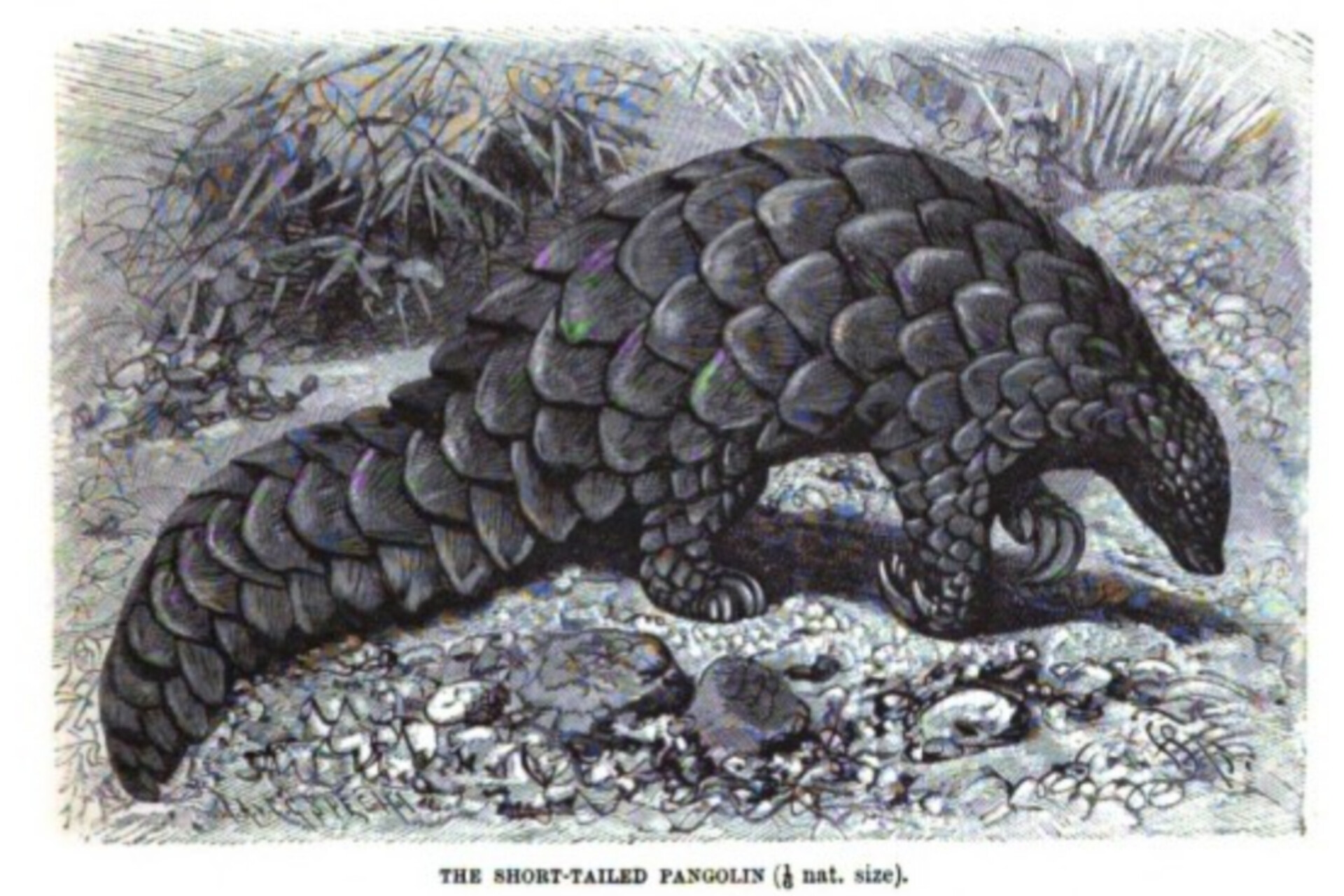
Matthew Leslie, “On the Panagolin of Bahar” in W. Jones, et al., Dissertations and Miscellaneous Pieces Relating to the History of Antiquities, the Arts, Sciences, and Literature of Asia (London: G. Nicol, 1792), pp. 288-291. Images of rolled-up and walking pangolins can be found on page 229 in Beebe, Pheasant Jungles. Fig. 23 Common Pangolin appears on page 114 in Tate, Mammals of East Asia. “An Animated Pine Cone” appears on page 226 in George Goodwin, et al., The Animal Kingdom: The Strange and Wonderful Ways of Mammals. Birds, Reptiles, Fishes, and Insects (Garden City, NY: Doubleday, 1954). The short tailed pangolin and white-bellied pangolin appear on pages 229 and 230 in Richard Lydekker, The Royal Natural History, Vol. 3 (London: F. Warne, 1893-1896).
See: https://babel.hathitrust.org/cgi/pt?id=mdp.39015058543037&seq=1