Manatees
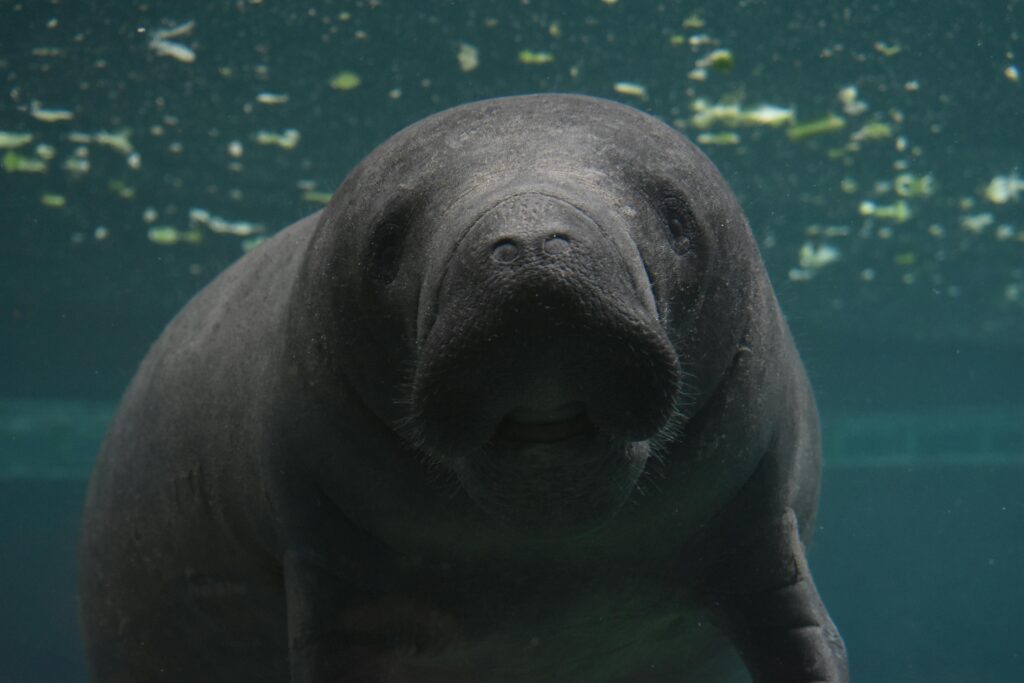
We want you to have a greater ability to learn about some of the unpleasant animal issues in our world.
Hunting and Fishing in Florida
Charles B. Cory
METHODS OF HUNTING.
During the spring the manatees enter the rivers to feed on the ‘‘manatee” grass, and, as some writers claim, the leaves of the mangrove trees. They are abundant in the bays and rivers all along the west and east coasts of Southern Florida. At one time the St. Lucie River was a noted place for them. In New River the manatee is still common, and they are numerous at times in the lower part of Biscayne Bay and on the west coast south of Charlotte Harbor. They live equally in salt or fresh water, and while with the Indians on one of their manatee hunts I have seen half a dozen rising to the surface of the ocean at one time, over a quarter of a mile from shore.
Many of these animals are killed by the Indians every year. They hunt them in canoes, sometimes in the rivers, and again in the ocean, but usually near the mouth of some river.
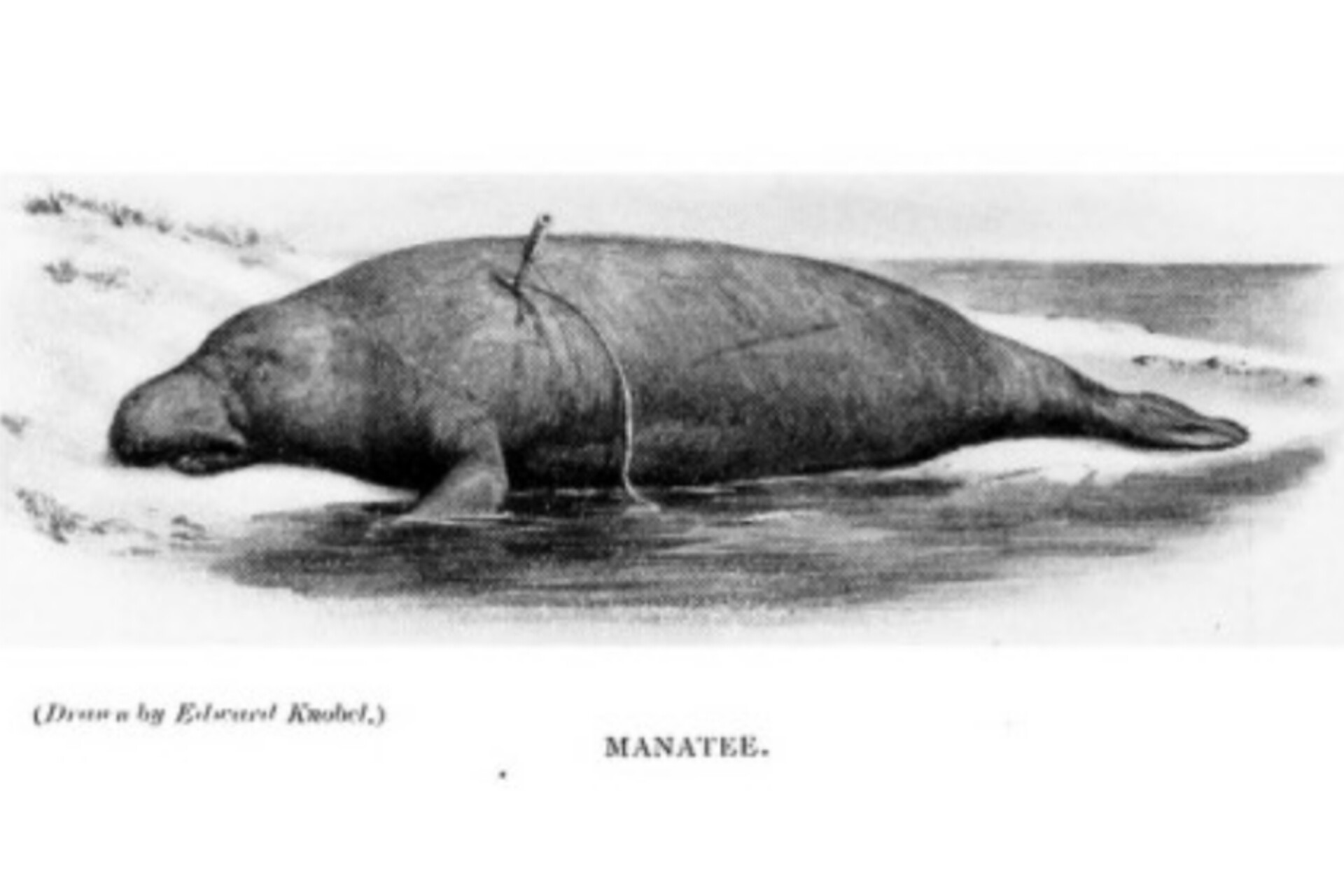
I have often accompanied Osceola and other Indians on a manatee hunt of this kind. They harpoon them as they rise to the surface, using a steel point barbed on one side, attached to the end of a long pole. To the steel point is fastened a strong cord, which in turn is attached to a float. Upon being struck the manatee sinks at once, but the direction in which he moves is indicated by the float. The .Indians follow the float as closely as possible and watch for him to rise to the surface, when they shoot him through the head, and the huge animal is then towed to the shore. It requires considerable skill as well as strength to drive the harpoon through the thick, tough hide. Many of these animals grow to a very large size, and it is claimed that some of them have been taken which exceeded twelve feet in length.
One day, while talking with Old Charlie and his squaw at his camp on the north bank of New River, he drew my attention to a long brown object which was moving slowly up the stream a few inches beneath the surface of the water. It was about twenty feet from the bank, and Old Charlie whispered to me that it was a manatee. Getting into my canoe I paddled gently after him, but as I did so an exclamation from Old. Charlie caused me to turn, and there, just below me, was another manatee larger than the first. I whispered to Pat to keep the boat as still as possible, and in another moment the huge creature passed directly under us, not two feet beneath the surface, and so clear was the water that the coarse hairs on his brown skin were distinctly visible. He appeared to be at least ten feet long, and, although I wanted that particular manatee very much, as I had no harpoon in the boat, I could only sit and watch him slowly move up the river, where he undoubtedly joined his companion who had preceded him.
The Indians are very fond of the flesh of this animal, which somewhat resembles coarse beef, and what they do not use themselves they readily sell to the white settlers.
The manatee is a very timid creature, and the least sound, such as an oar striking against the side of the boat will cause him to sink and swim away at once.
FAMILY MANATIDAE. THE MANATEES.
TRICHECHUS LATIROSTRIS Harian.
Manatee.
The manatee occurs commonly in many of the bays and rivers of South Florida. It lives equally in salt and fresh water, going into the rivers to feed on the grass, and, as some authors claim, the leaves of the mangrove trees.
They were at one time abundant in the St. Lucie River, and a number have been captured alive in that river in rope-nets made for the purpose.
Although of such great size, it is a gentle, harmless animal, very timid and shy. The flesh is much esteemed by the Indians, and also by some of the white inhabitants. The Indians kill a number of them each year in the vicinity of New River. They harpoon them in the rivers or in the ocean near the mouth of some river. The Florida manatee is very similar to that found in Central or South America, and perhaps should not be recognized as a distinct species.
The manatee grows to an immense size, sometimes attaining a length (it is claimed) of fifteen feet. The skin is very coarse and thick and is covered with scattered coarse hairs. When not frightened or suspicious it generally rises to the surface to breathe at intervals of from one to two and a half minutes.
Charles Cory, Hunting and Fishing in Florida: Including a Key to the Water Birds in the State (Boston: Estes & Lauriat, 1896), pp. 24-27 and 113-114.
See: https://babel.hathitrust.org/cgi/pt?id=coo.31924003426024&seq=1&q1=
Florida Enchantments
Anthony W. Dimock
… The harpoon was simply a pointed bit of barbed steel, only capable of penetrating one inch beyond the barb and intended merely to maintain communication with the quarry until it could be secured by other means.
As the harpoon struck a broad back, which was not that of a crocodile, the creature rose above the surface, and as it did so its big beaver like tail covered me with a deluge of water. Then as it struck and nearly swamped the skiff, I realized that I had at last found the manatee, which I had vainly hunted during many years.
For hours we chased the creature, keeping a light strain on the harpoon line, frightening him as he came up to breathe, until, exhausted, he rose more and more frequently. I then made a score of unsuccessful attempts to lasso this specimen of the wild cattle of the sea.
Finally, the manatee came to the surface to breathe, so near the skiff that I put my left arm around his neck as far as it would go, and tried to slip the noose over his head with my right. The sudden lifting of his head threw me upon his back, while a twist of his big tail sent me sprawling.
We were swamped four times while working the manatee into shallow water, where we got overboard, fastened a line around him and soon had him under control, although when the captain got astride of the creature, he was promptly made to turn a back somersault. Docile as our captive had become, he was yet eleven feet long, of massive proportions and a weight which was difficult to handle. We tore the seats out of the skiff, sunk it to the bottom and standing upon it succeeded in getting the sea cow over it. We lifted on the boat, bailed out the water and were paddling the over-laden craft out in the bay when a cataclysm left us swimming side by side while a submerged skiff was being towed gulf-ward by a rejoicing manatee.
We soon recaptured the animal and persuaded him into shallow water, where I herded him while the captain went to the big boat for an anchor and cable with which we made our captive fast, giving him two hundred feet of rope in an excellent sea cow pasture.
We were now candidates for a dungeon and liable to a big fine because of our unlawful detention of this highly protected mammal, so we sailed for Miami in pursuit of an ex post facto permit.
The authorities were good to me when convinced of the educational destiny of the manatee and in a week I returned with permits in my pocket, promises of free transportation by rail and steamer to the New York Aquarium, telegrams of congratulation from the Zoo people, and lumber for a tank for the manatee, only to find no trace of anchor, cable or captive. Our cruising boat had been struck by lightning in Miami and the shock had been serious to all of us, but it was as nothing in comparison with this. For a day we followed the zigzag trail of the anchor flukes, through a water glass, over half a mile of the bottom of the bay until we came upon the anchor, cable, and worn-through harness from which the manatee had escaped….
CHAPTER III
THE CAPTURE OF THE MANATEE
It was due to the Aquarium, and my own self-respect, that I made good to them my tender of a manatee which was lost through my own indiscretion. It was for this that the Camera-man and I, with our outfit, returned to the manatee country.
For weeks, in our efforts to capture a sea cow, we exhausted our ingenuity and used up our material. We stretched nets between the banks of rivers which had been their highways, but sophisticated manatees turned back and traveled by some other route, while what was left of our costly linen net after it had been set across the channels of a few deep rivers, with strong tides and bottoms of jagged coral rocks, was mostly tears and tangles. We built a platform on a skiff to hold a long net of large mesh amply provided with corks and sinkers, and towed it behind the launch over the bays containing the richest areas of manatee pasture.
Bits of floating grass, rising bubbles, streaks of roiled water, swirls on the surface or black dots in the distance that melted from our sight as we looked, put us on the trail. The “chug-chug” of the approaching propeller frightened the quarry which sprang half out of water, throwing barrels of it high in air, and spurted away. Then the hunter-boy with telescopic eyes got upon the bow of the launch, the sailor boy sprang into the skiff with the net, the Camera-man stood by the motor while I held the wheel, and all studied intently the surface of the water.
At first, a line of swirls rising in the water made pursuit easy, then the wheel rolled to the motion of the hand of the boy on the bow, until we overran the creature or, no signs appearing, the motor was slowed down, waiting for the cry of the first to recover the lost trail. Once in five minutes that black head rose to the surface for a second for breath, and in deep water this often proved our only guide.
If we succeeded in keeping the trail for a few hours, the manatee became tired, or flurried for want of breath, came up oftener and swam more slowly, until at a signal the boy in the towed skiff cast overboard one end of the net with its anchor, and with the launch at full speed we tried to run the net around the animal. A dozen times the bobbing corks told us that he was against the net and our hopes ran high, only to fall as he backed out and sought until he found an avenue of escape.
Leaving the boy with the skiff to take in the net, we again followed the manatee, sometimes throwing over his head a cast net, only to see it slide harmless down his back, and sometimes throwing a lasso weighted with lead over his head and getting in return a blow from his tail upon the bow of the launch that nearly swamped it and always knocked somebody overboard, while his handy flipper pushed the lasso over his nose. Whenever success seemed really near, darkness always stepped in to thwart us.
We found one day a manatee so big that we didn’t care to fool with her until some of her surplus energy had been worn down. The Camera-man struck her from the skiff, in the middle of her broad tail, with a tiny harpoon attached to three hundred feet of light line. After the first dash was over and the manatee swimming quietly, I held the skiff as near her as possible until she came up to breathe, when the Camera-man laid a noosed rope over her nose.
After we had hauled the Camera-man aboard and bailed out the boat, which had been nearly swamped, he insisted on trying again. This time he stayed under water longer and came up on the wrong side of the boat just as I was getting mighty anxious looking for him on the side he went down. He then consented to play the creature a little before tying her up. For hours the manatee towed us through a labyrinth of waterways to an unknown region which I am ready to identify as the mosquito center of the earth.
One of the boys tried to follow us with the launch, but got in trouble with the motor. I exchanged places with him and got in more trouble. As the hours rolled on and darkness settled upon us, the manatee was the only one of the party who wasn’t lost. The launch propeller choked up every few minutes with manatee grass and I had to hang overboard, half under water, to clear it.
Then I went tearing through creek after creek in search of the skiff, which I once lost for half an hour. Every quarter of a mile I stopped the motor, and blowing a horn listened for the shouts that came faintly to me across the keys, and after a few strenuous moments with an exasperating fly wheel, was again plunging through the darkness, searching for an opening that might lead in the direction of the calls I had heard. Finally the motor broke down altogether and it was only a fortunate turn in the course of the manatee, aided by a lot of poling, that reunited us.
I undertook to play the sea cow from the bow of the launch while our engineer, the Camera-man, put the motor in commission. Soon there was a sound of cranking and the machine chug-chug’d for a few strokes, after which there was silence broken only by heavy breathing. To a courteous inquiry, which I threw over my shoulder, the reply sounded like:
“Damn the engine.”
We organized the work to be done. I sat upon the bow of the launch, with the line tub between my knees and the line in my hands. The manatee was to tow us through the night, but fifty pounds was about the maximum of strain I dared put on the little harpoon. Foot by foot the line must be yielded as the animal increased her speed, and foot by foot taken back when it slackened. The Camera-man and I must share this work, to night, tomorrow night and all other nights until the end.
Our sailor boy had sprained his wrist while trying to start the engine and could hold the wheel, but not the harpoon line. The hunter boy stood by the skiff, ready for the emergencies which proved to be the most constant features of the work. He made a dash through the darkness for the near-by shore and got bits of dead wood, pieces of buttonwood and rotting black mangrove, from which a smudge made the launch, within its drawn curtains, solid with smoke. But the man in the bow, who held the harpoon line, must keep his head and arms outside. When I swept my hand across my smarting face, it became smeared with blood and mosquitoes.
The bursting upon us of a tropical thunder storm, pouring water down in masses so nearly solid that it was hard to breathe, relieved us of the insect plague. Each blaze of dazzling light, so brief as to be almost useless, was followed by the blackness of Erebus. We were carried east, west, north and south, through lagoons, bays, creeks and rivers in darkness that could be felt, knowing nothing of where we were, steering always as the line to the manatee led.
We had had a strenuous day, with nothing to eat since an early breakfast, and the hours of the night passed slowly. The storm was followed by a heavy gale from the southwest, but the stars came out and we recognized the big river we were on and knew that we were heading for the Gulf. Already we could hear the waves breaking outside and our sailor boy was nervous.
“What shall we do, we can’t live out there?” said he. I told him we could live if the manatee turned north, outside the river, and kept inside the shoals, but if she headed down the coast in the channel we would cut loose. The mouth of Broad River forms a delta and the hunter boy, by rowing ahead of the manatee in his skiff and splashing with his oars, turned her into the north channel which was shallow and full of oyster bars. Here we turned her again, just as the Gulf opened out to us, and as we passed the south channel, going back, the tide which had just turned in helped to persuade her to continue up the river. For a mile she was good and then turned into a narrow fork on the south side of the river, where roots and snags threatened us each moment. Half a mile up this stream she towed us into a narrow gully and having given the line a turn around a snag, returned to the fork.
Thirty cents would now have purchased our interest in that manatee, but our hunter boy went overboard, cleared the line, got back in the skiff and I handed him the tub just as the last coils of line were running out of it. He disappeared in the darkness down the fork, while we spent a few minutes in backing the launch out of the gully and a good many in persuading the motor to mote. When the main stream was reached we turned up the river on a chance that proved friendly, soon overtook the skiff, shut off the motor and were again in the wake of the manatee.
There was trouble to burn as the creature headed for the cut-off that leads from Broad to Rodgers River, and both boys jumped in the skiff and headed her off with splashing, thrusting, oars, for the cut-off consists of two miles of crookedness, filled with snags, roots and overhanging branches, and is quite unnavigable for manatee-towed launches.
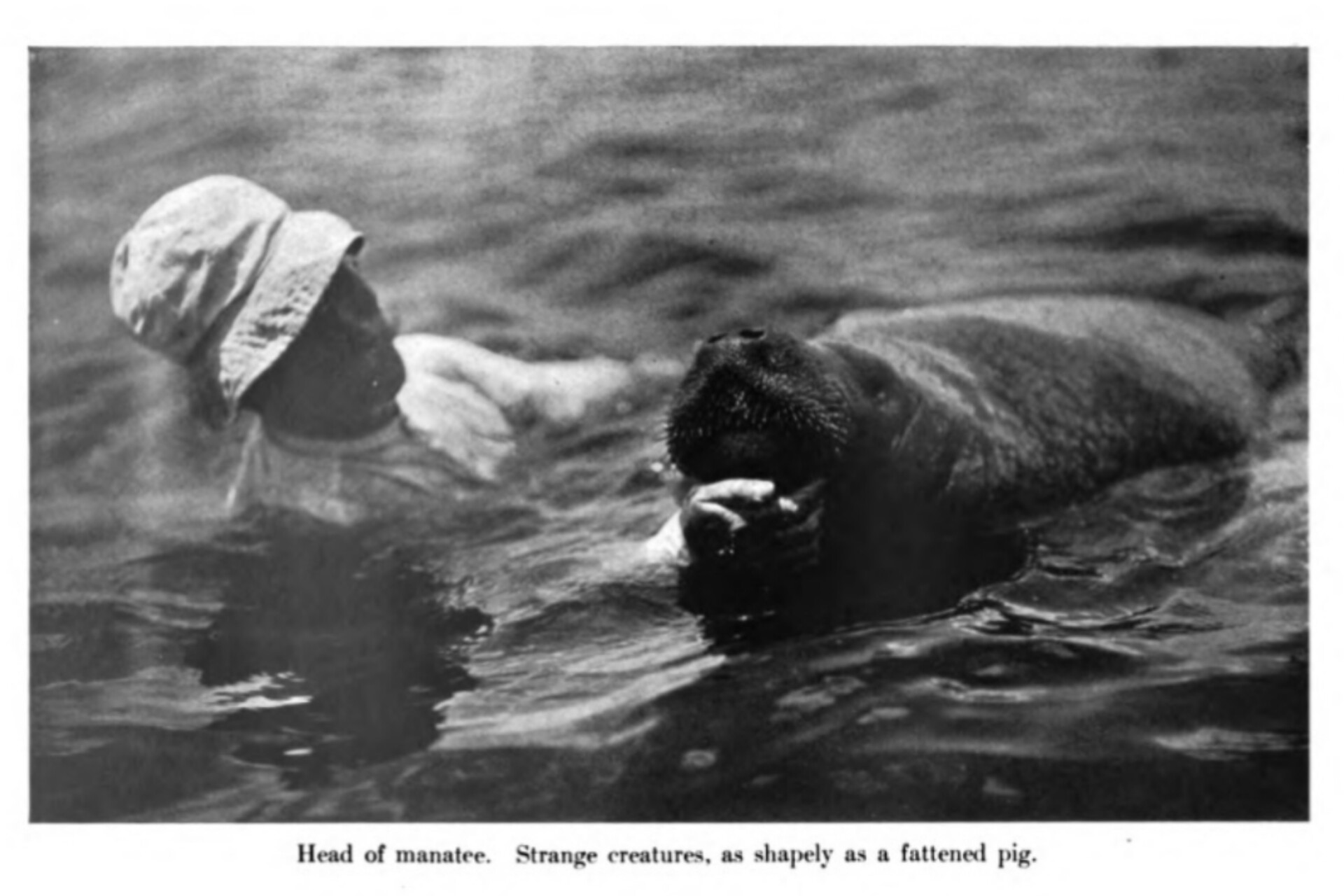
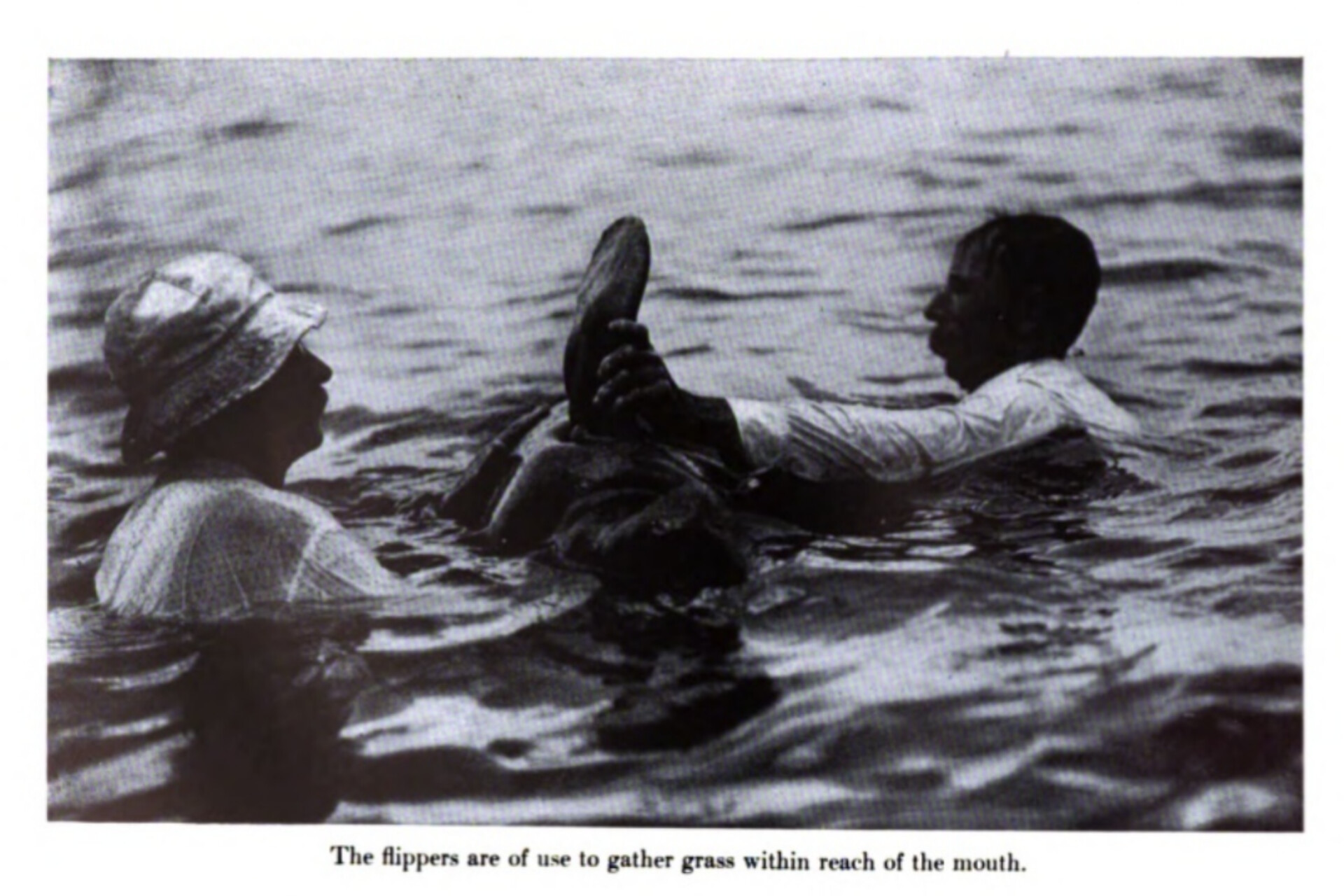
As we approached the bays at the head of Broad River a most welcome dawn rose, tinting the surroundings and the situation. Even the pessimism of the sailor boy, which had covered him like a mantle since first he heard in the night the waves of the Gulf, slid from him. The manatee became placid and even friendly, swimming slowly just in advance of us and coming up at regular intervals for long, slow breaths. Once, as she lifted her nose above the surface, the hunter boy dropped a noose of half-inch rope over her head and quickly drew it taut. A tremendous blow from the tail of the manatee nearly swamped the launch and knocked overboard the boy, who came to the surface with the line he had made fast to the sea cow twisted about his own neck. She slipped the noose over her head in less time than it took to unwind him. After that we threw the noose over the head of the creature many times, until she was almost halter-broken and so accustomed to the rope that she played with it and us. When it tightened about her, she slid her flippers under it and deftly pushed the noose over her nose. If we slid it back farther than her flippers could reach, a flirt of her tail freed her. Once it caught on her soft nose and held long enough for us to make a rope fast to her flipper.
The manatee now belonged to us and we got another line around her, after which we removed the iron, with some difficulty and more duckings, and attempted to tow her into shoal water. For a time the frightened animal tore up the water and towed us backward, but in two or three hours we had her partly stranded in a tiny cove in a big bay at the head of Broad River. After she became quiet we got in the water with her and tied her with every string we could raise from launch and skiff. A cable fastened her tail to the yielding top of a sweet bay tree, half-inch ropes led from her flippers to branches of myrtle that swayed but held, and we lashed poles, several inches in diameter by fourteen feet long, to her body with hundreds of feet of harpoon line carried around it, hoping to keep her from freeing or harming her-self until we could bring to her our cruising boat, with materials and tools for the building of a tank that would hold her.
The big boat was then thirty miles from us by the nearest navigable channels, down Broad and Rodgers Rivers to the Gulf and up Lossmans to its head. Seven miles of this course was through the open Gulf, which a storm from the southwest was then making turbulent. We decided to avoid this risk and save half the distance by hunting our way by night through the labyrinthic, grass-choked waterways lying between the rivers named and the Everglades of Florida, back to the bay where we had left our boat.
It was late in the night when we found her, the gale was increasing and the barometer stood at its lowest for six months, but minutes were important to our captive and we lost none in starting. As we worked our way down the river we broke our two-days’ fast with snatches of cold canned food. We got down the river in safety, and after twice dragging on oyster reefs at its mouth, were soon being tossed by the waves of the Gulf. We had seven miles to make down the coast against the gale, and it took nearly twice that many hours, while always one of us stood by the jib and another held the main-sheet in his hands.
It was late in the day when, under jib and jigger, the Irene swept past the tiny cove and a big burden of anxiety dropped visibly from each one of us as we saw between the mangroves the upraised head of the great manatee. Our nerves had been worn to frazzles by excitement, loss of rest and food, and all hands needed the tonic afforded by the sight once more of our capture. Jib and anchor were let go and we went ashore in the skiff and stood on the bank beside the sea cow, where I could feel the beating of my heart, for, quiet though she seemed, the manatee was substantially free.
She had broken a harness of rope, fitted to hold the cable in place on her tail, shaken the cable free, and parted every string that bound her, excepting that attached to one of her flippers. There seemed small hope of saving her, but for the moment she was quiet, and we brought our big, four-foot-wide, skiff beside her and sunk it in the five feet of water where the creature lay. By pushing the submerged skiff, on which we stood, and hauling upon head, tail and flippers of the unresisting manatee, we got her in the skiff, the gunwales of which she overtopped by more than a foot, wound and tied ropes around boat and animal until confidence returned to me and I took the first long breaths I had drawn for two days. They were few in number, however, for as we stood around the creature, in water nearly to our necks, the manatee, suddenly roaching her back until head and tail almost met, snapped the ropes that bound her.
Then throwing upward her immense tail, deluging us with great volumes of water, she brought it down upon the stern of the skiff with a pile-driving blow that converted the craft into kindling wood. Crash followed crash and when her mighty struggles ended and we had all escaped from the maelstrom of her creation, it was relief enough that there were still four of us, all uninjured.
After breaking up our skiff, the manatee again became quiet and allowed us to carry heavy ropes around her and fasten them to trees until once more her escape seemed impossible. The animal was nearly thirteen feet long and her weight, by estimate, over two thousand pounds. When we provided material for a tank in which to transport a manatee, we had no such leviathan as this in contemplation. More lumber must be had, and more help was needed. Both might be found at Everglade, forty-five miles distant.
Our hunter boy volunteered to be there by daylight if the launch motor would work. The Camera-man spent an hour over the engine, replacing parts that were weak or worn, guaranteed it for twenty-four hours, and the boy plunged into the darkness, through which for half an hour we heard his frequent stops to clear the grass and moss from the propeller blades.
Little of my lost sleep was made up that night, with my thoughts of that boy driving up the coast, alone in that little craft, through the sea made by that southwest gale, now only half abated, and my nerves racked a hundred times by the thrashing of the monster tied within a hundred feet of me, while troubled dreams disturbed my slightest nap with demands that her bondage be made less cruel.
From daylight I kept watch over her, piling wet grass upon her back as a falling tide exposed it to the burning sun. During the night we welcomed the chug-chug of the returning launch, bringing lumber, tackle and help. Working through darkness and light, it was yet noon before the big sarcophagus of a tank, thirteen feet long, four wide and four high, was built, calked, and ready for its occupant.
One end, which had been left open, was brought close to the animal and the box was lashed to trees preparatory to backing the creature in. I walked to the head of the manatee and laid my hand upon it as I had done a hundred times before. She was quiet now, but I knew she was all right. She had been struggling tremendously a few minutes before and was resting. I talked to her and told her that her troubles were over, no more ropes, just a few days in a nice box with fresh water and bunches of manatee grass, and then a big tank in a beautiful building, plenty to eat, and a million children to talk to her and pet her and hold out little hands for her to nuzzle with her soft nose. She was very quiet. I wondered if she found it hard to breathe — sometimes I did, too — but her lips would move when I laid my hand on them — No? —
The others stopped work and gathered beside her. The eyes didn’t open, the lips didn’t move she wouldn’t breathe — and when I turned away I couldn’t speak.
That afternoon she was prepared for a museum instead of an aquarium, and we learned that if only we could have got her safely to New York, the stork would have called at the Aquarium in a few days.
It was a month before we were again in the manatee country. We had put a motor in the cruising boat to help her out of tight places and taken a little skiff with a tiny engine for the shallow waters. The big tank was still anchored where we had left it and we hoped to find an occupant for it. We saw and followed many manatees without trying to capture them. Sometimes they were only calves and sometimes so far from our cruising boat that we were shy of facing the transportation problem. We were resolved never to tie another manatee until we had a tank ready for him.
One opportunity came as the sun was setting, but I couldn’t ask the boys to face with me a night of mosquitoes in an open skiff. The creatures, instead of being driven from their homes by our noisy presence, actually grew tame and we saw them swimming quietly and unafraid along the bottom of a river directly under our whirling propeller. When we finally struck one from the skiff we captured him in an hour. I held the skiff near the manatee, while the boys tossed oars over his nose whenever his head came to the surface. The Camera- man, in the power skiff, circled around us, picked up the floating oars and tossed them back to our skiff.
When the animal’s breathing was largely in arrears and he was compelled to hold his head well above water for several seconds, I placed a Brobdingagian scoop-net over his head. We had made this net of quarter-inch rope, with a two-foot mesh about six feet long, held open by two steel rings four feet in diameter, and with a puckering string of half-inch manilla. We held him tangled in this net until we could slide over him another of twelve feet in length in which we towed our captive to and into the big tank which we lashed beside our cruising boat. This tank was so much too large for him that he spent his time in getting jammed, breaking joist, and scratching the skin off his nose in his struggles to turn around.
We needed a tank about a third the size of the one we had, also a lighter in which to tow the creature to Miami. There was another night journey to Everglade, both of the boys going on this trip, while the Camera-man and I nursed the captive, held his flippers, braced ourselves against the box and pushed his nose out of jam with our bare feet when his head got caught.
When the new tank was finished and the manatee transferred he proceeded to knock the top off of his new quarters piece by piece with the roach of his back and the slam of his tail, while we spiked on new planks and joist until he quieted down. We bored holes in the lighter, sunk it under the tank, plugged the holes, bailed out the lighter and it was up to me, as the only one on board who had made the trip to Miami, to pilot a boat, with cabin so big that sea-dogs called it a house-boat, towing a square-ended lighter with a timid thousand-pound specimen sloshing around in a big tank, over a hundred and fifty miles of shallow bays which I had forgotten, and complicated channels which I never remembered, to that town.
I am not a bit of a sailor-man, but I had to pretend a lot, give courses with confidence, and no one on board worked harder than I, as I cudgeled my memory, studied the charts and tried to look wise during that little voyage. Trouble began early, for it was rough on the Gulf and the sailor boy spoke sooth when he said:
“It’s the Devil to tow a lighter.”
Forty hours later we delivered to the Florida East Coast Railway at Miami, a manatee, mad through and through, because for some stormy hours, he had been stood upon his head and tail, alternately, as the lighter banged its way over waves that were unpleasantly big for a craft of her build.
The Transfer Company took five hours to load the manatee upon a car, but the officials held the train for an hour, and as it started for the North, bearing my manatee, tagged to the New York Aquarium, I could think, for the first time in twelve months without chagrin, of my telegraphic tender a year ago of a sea cow that belonged to herself instead of to me.
The manatee left us, measuring ten feet four inches in length. His voyage of one week so agreed with him, that when he arrived at the New York Aquarium his average length, as certified to by New York journalists, was eighteen feet.
Three weeks later, on our arrival at Miami from our trip across the Glades, a telegram told me of the death in the Aquarium of the manatee, and I rashly wired to Director Townsend the promise of another.
Natural obstacles and climatic mañana had disposed of ten days when, one afternoon, we found ourselves in the manatee country, with tank and lighter, free to find the manatee we had promised. In the first hour’s cruising we saw three sea cows together, about half a mile from the tank we had just built for one of them. We kept on the trail of one until the Camera-man had put his tiny harpoon in the tail of the creature. I had mentally placed an Aquarium tag upon him, when an uplifted end of the parted line showed me where the propeller blade had cut it before the motor could be stopped.
Fortune now deserted us and for days we vainly churned with our motor every manatee haunt we knew within a hundred square miles, until we feared the animals had fled the country. I was getting low in my mind over the contract to deliver one sea cow when, as we rounded a point in the bay one morning, we saw two manatee, apparently a cow and a calf. As we lost sight of the mother, we followed the child which led us a merry chase.
The Camera-man and the captain in the power boat, and the hunter boy and I in the skiff, chased him through channels and over flats for two hours. We could have harpooned him often enough, had it not been necessary to strike him in the tail, which was elusive. When this had been accomplished we soon got a net over his head and tied him in the skiff, from which we tore out the seats and half-filled it with water. When the creature floundered, the skiff capsized, so we held it beside the power skiff for the miles and hours that lay between us and our cruising boat.
Before the trip was over he was half domesticated and always stopped throwing bucketfuls of water over us with his tail whenever we patted him gently on his head. The baby weighed about two hundred pounds and the tank we had provided called for an animal of five times that weight. We sawed the tank in two, hoisted one half on deck and fitted it up for the infant. We dispensed with the lighter and carried the tank on the stern of the cruising boat, where the man at the wheel could soothe the child when it was frightened.
It is a strain on one’s nerves and sympathies to be with wild creatures during the early days of their captivity. I have often left my bed in the night to make more comfortable a just-captured alligator, crocodile, wildcat, or otter, but when a manatee beats about its tank, rolling over and over and making a funny little squeak like a mouse calling its mamma, I generally get up and hold his flipper and talk to him until he feels better.
As we neared the end of our three days’ voyage to Miami, the infant manatee became fretful, rejected my overtures and petulantly thrust out the bits of manatee grass and other good things that I placed in his mouth. But he sucked my fingers until I fancied he was a nursling and my first purchase in Miami was a nursing-bottle outfit and a supply of milk appropriate to a six-foot baby.
The wife of the druggist kindly explained to me the proper method of applying the nursery machinery to my baby, until I asked her what I ought to do if my baby, as was his custom, just staid under water and wouldn’t come out to be fed. I was considering the construction of an apparatus proportioned to the size of the creature, from a five-gallon demijohn and a section of hose pipe, when I detected the infant privately eating chunks of raw cabbage and wisps of manatee grass as fast as he could flop them into his mouth with his flippers. I then offered him a plantain and he sat up in his tank to eat it.
An hour later, when his train was about to start, I bade him good-bye and held out my hand, to which he responded by superciliously extending to me one of his flippers while he gently rubbed his stomach with the other. For twenty months this manatee lived in his tank in the New York Aquarium and finally died of intestinal disorder, after having doubled in weight and established a record for length of life in confinement of a member of his species.
The Camera-man was low in his mind. Even the successful shipment of “Baby,” as the Aquarium christened him, failed to cheer him. He complained that his department had been ignored and instead of posing for him the captured manatees had chiefly been used to knock him overboard. He had sat up nights with the creatures, been eaten by mosquitoes, dragged all over creation, and whenever he got out his camera had been ordered to pull on a rope, or asked to hold a net.
We soothed him with promises of a manatee chase of his very own, with no net to bother him. The captain and I agreed to go overboard with the first sea cow we got a line around, or before, if necessary, and we started forthwith for the manatee country.
On the first day of the hunt the manatee won out. We found three, tackled one and went home early to patch up a broken skiff. I had a steel ring, four feet in diameter, fastened on the end of a harpoon pole, and at right angles to it. This held open the loop of a lasso and sometimes I was able to place it over or before the head of the manatee when he came up to breathe. More often, however, I went overboard when I tried it and sometimes the skiff was capsized. For when the creature’s head was within reach of the pole, the skiff was within striking distance of his tail and he always struck. That was our trouble the first day. On the second day we hunted from daylight till dark without finding a trace of the animals.
By noon of the third day we were feeling depressed. Since daylight we had hunted over fifty miles of the best sea cow pasturage that we knew. We had followed trails of floating manatee grass in vain; rising bubbles proved to come from alligators; streaks of roiled water led only to frightened sting-rays; and the black heads that had appeared for an instant above the surface had all belonged to otters or porpoises. Tiny cat’s-paws on the water had misled us and once we followed the ripple of our own wake, as it broke on a distant shore, halfway around a bay, like a pussy-cat chasing its tail.
Just as we had satisfied ourselves that the bay didn’t contain a specimen of the creatures we sought, a big manatee, frightened by the noisy churning of the approaching motor boat, leaped half out of water, just ahead of us. A moment later a series of swirls rising to the surface showed the line of the creature’s flight. These were repeated several times and thereafter a faint trail of mud in the water guided us. Then, as all signs ceased, we stopped the motor and studied the smooth surface of the bay in all directions.
Five minutes had passed when our hunter-boy saw a black nose appear for an instant two hundred yards behind us. Again we were on the trail, which we kept so closely for an hour that the quarry became flurried and out of breath. He swam back and forth, coming up to breathe every minute, and sometimes so near that we could have touched him with an oar. I was tempted to try lassoing him from the power boat but refrained, knowing the chances were even that he would sink the boat and at least ruin the camera outfit.
The captain and I got into the skiff while the hunter-boy took the wheel and the Camera-man made ready his machinery. The manatee came up beside me quite unexpectedly and when I hurriedly tried to put the ring over his head it landed on his back and I received a deluge of water in my face while the skiff barely escaped a blow from his tail that would have put it past repair. The power boat kept close upon the trail and after bailing out our skiff we took short cuts that kept us near the animal, which often rose for a second within arm’s length, but it was another hour before we got the line around him, where it held for a time, which was fortunate, since the steel ring had been torn free in the struggle and had gone to the bottom.
The Camera-man lost the first of the affray, his motor not being lively enough to compete with the sea cow. Its chug-chug frightened the creature until he dragged us under mangrove bushes that overhung a deep channel that ran beside the river bank, sending me to the bottom of the skiff and nearly dragging the captain overboard. Often he towed us at a speed that took us out of range of the Camera-man, then turning would swim directly under the skiff, playfully tossing a few barrels of water over us as he passed.
He swam for long distances near the bottom of deep channels, only coming to the surface at long intervals for breath, then carried us across banks where the water was only five feet deep and we could see his every motion. In my desire to make the manatee pose for the Camera- man I sometimes approached too closely, only to have the skiff lifted half out of water by a blow of the creature’s tail. Then the Camera-man shouted:
“Bully for you; do so some more!”
And we did so some more, till we were drenched and the skiff had been almost swamped many times.
But the insatiable Camera-man, whose plates were running low, called out:
“More action! Why don’t you go overboard as you promised?”
“Here goes,” said the captain, as he landed astride of the manatee, which just then came up beside the skiff to breathe. He was promptly bucked off by a roach of the creature’s back and a slap of his tail, but caught him by one flipper, while I tumbled overboard and grabbed the other, just as the line slipped over the nose of the manatee. Thereafter we swam around together in a friendly way while the Camera-man circled about us in the power boat changing slides in his camera like mad.
When at last he exclaimed with a sigh, “Plates all gone,” we measured the sea cow with an oar, finding his length eight feet and his weight, by estimate, five hundred pounds. Then loosing my hold of his flipper I swam beside him for a few yards until the quickening stroke of his big propeller left me behind, and as I turned and struck out for the skiff that drifted a hundred yards away, I overheard a soliloquy of the Camera-man:
“Guess I’ve got a monopoly of that subject.”
Anthony W. Dimock, Florida Enchantments (Pecamose, NY: A.W. Dimock, 1915), pp. 29-31 and 39-59.
See: https://babel.hathitrust.org/cgi/pt?id=mdp.39015027064164&seq=1
The West Indian Manatee
Sandra L. Husar
The West Indian Manatee (Trichechus manatus)
Sandra L. Husar
U.S. Fish and Wildlife Service
National Fish and Wildlife Laboratory
National Museum of Natural History
Washington, D.C. 20560
Christopher Columbus, in 1493, was the first European to record manatees in the New World. After observing a group of three off the coast of Hispaniola, he claimed that these “mermaids,” which had something like a human face, were not quite so handsome as they had been painted (True 1884).[References relate to a bibliography that is not included.] The name “manatee” is apparently rooted in the Carib language which has an old term, “manati,” meaning “woman’s breast.” Sirenian mammae indeed resemble those of humans, and are quite different from those of other mammals. Simpson (1941), therefore, concluded this was the true origin of the word.Later Spanish and Portugese explorers apparently used the same word, but took it to mean “with hands,” referring to the maneuverable flippers of manatees (W. H. L. Allsopp, personal communication).
Trichechus manatus is a member of the family Trichechidae in the order Sirenia. This family is composed of only three species of manatees, all of which are distributed within tropical latitudes along the coasts of the Atlantic Ocean and in adjacent rivers. They are closely related to the dugong (Dugong dugon) of the Indo-Pacific region, and to the now extinct Steller’s sea cow (Hydrodamalis gigas) of the Bering Sea. Two subspecies of the West Indian manatee have been described: (1) Trichechus manatus latirostris, inhabiting coastal Florida and the Gulf of Mexico, and (2) Trichechus manatus manatus, occurring in the West Indies and along the coasts and rivers of northeastern South America (Hatt 1934). Moore (1951b), however, questions this subspecific separation, as does Gunter (1954), who believes that populations mingle throughout the overall range. T. m. manatus and T. m. latirostris are indistinguishable in the field (Hatt 1934), and Hartman (1971) predicts that behavior (except for cold-spell congregations in Florida) and ecology of the manatee are uniform within the range of the species. Throughout this report, the two races will not be distinguished….
Distribution, Abundance, and Trends
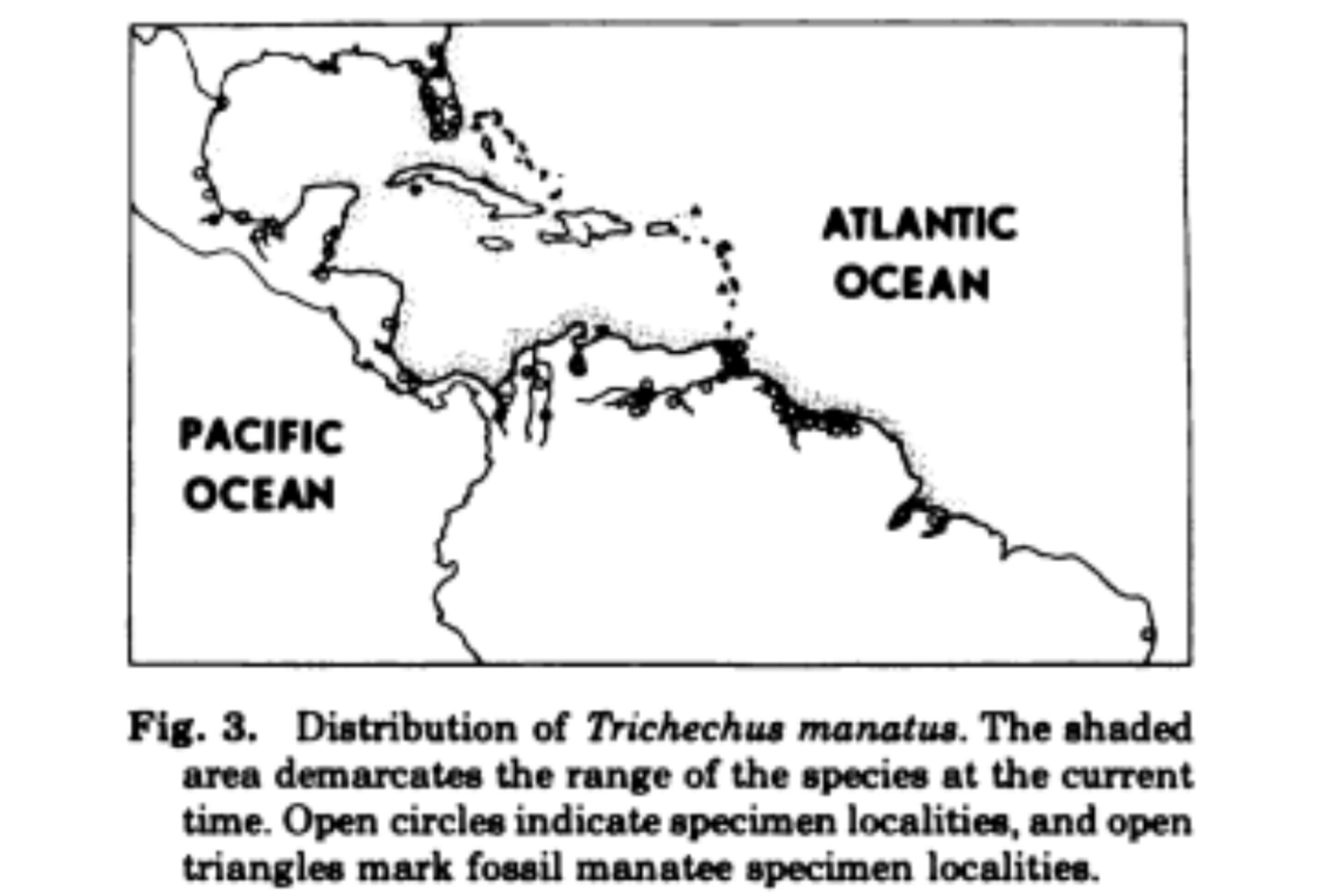
Trichechus manatus inhabits rivers, estuaries, and coastal areas of the tropical and subtropical regions of the New World Atlantic (Fig. 3). [See below.]
United States
The range of T. manatus within the United States is largely confined to peninsular Florida and the coast of Georgia (Hartman 1974). Manatees occasionally have been reported along the northern Gulf coast from Pensacola to New Orleans and records exist from Louisiana, southeastern Texas, and within the mouth of the Rio Grande River (Alvarez 1963; Gunter 1954; Lowery 1943). However, these sightings apparently represent wandering individuals and probably resident populations of manatees could not withstand the colder winters of these regions. Similarly, infrequent records of stray manatees have been reported from the Atlantic coast as far north as the Carolinas and even Currituck Sound, Virginia (Tomkins 1956; Anon. 1908; Tucker 1908; Leidy 1876).
Unless otherwise stated, the following information for the United States is from Hartman (1974), who provides an extremely detailed and well-documented distribution. Based on an aerial survey of the coasts and rivers of Florida in 1973, and hundreds of interviews with coastal residents, Hartman estimated that the Florida population was 750 to 850 animals, but more recent aerial surveys in 1976 suggest a population of 1,000-1,200 (B. Irvine, personal communication). The Suwannee River (29°55′N), in west Florida, is the northern limit of the range (Table 1) [Not include.]. Manatees occur in the lower reaches of this river in all seasons, indicating a resident population; sightings have been made up to the confluence with the Santa Fe River…. The animals are able to remain in the Suwannee River throughout the year because Manatee Springs provide enough warmth for manatees to withstand winter cold spells at that latitude (Moore 1951b). In years past Indians reportedly congregated at Manatee Springs to hunt the sea cows (Baughman 1946).
A second concentration of manatees is found south of the Suwannee River, on the coast of Citrus County. Here, the springs of the Crystal and Homosassa Rivers (constant 23.3 C) provide warm water refugia during the winter cold spells, allowing the population to reside year-round. The animals are present seasonally in the nearby Withlacoochee and Chassahowitzka rivers. Manatees found within Citrus County probably form a single semi-isolated population of more than 60 animals.
Records of manatees are rare between Citrus County and lower Tampa Bay. Manatees concentrate at the mouth of the Little Manatee River which drains into the bay, and may also be found further up the river throughout the year. The pollution of Upper Tampa Bay apparently prevents manatee dispersal northward, and both the Hillsborough and Alafia rivers joining the upper bay are without manatees. However, they occurred there in the past.
Farther south in the Manatee River, manatees are seen only occasionally, whereas they once were common (Moore 1951a). The coastal stretch from Sarasota (27°25′N) to Charlotte Harbor (26°45’N) is essentially without manatees, but a sizable population resides in this harbor and ranges south along the coast to the mouth of the Caloosahatchee River. Manatees also ascend the Peace and Myakka rivers and are known along the Caloosahatchee for as far as 80 km from the mouth (Hartman 1971; Layne 1965; Moore 1951b; Hamilton 1941; Cahn 1940; True 1884).
Manatees are not abundant along the coast from Estero Bay (26°20′N) to Naples Bay (26°05′N) and any animals seen in the area are likely to be transients. Numbers increase upon nearing Ten Thousand Islands, where large concentrations of manatees inhabit the rivers and bay areas of the Everglades National Park (Moore 1951a). These year-round residents are seen commonly in Whitewater Bay and in the adjoining rivers, the Shark, Broad, Rogers, and Harney (Hartman 1974; Moore 1951a). Moore (1951b) attributes the absence of manatees from shallow Florida Bay to hunting. The most southerly sightings from Florida were made in the Keys, near Bahia Hondo Key (24°40′N), and a possible record from the late 1960’s was in the Dry Tortugas (24°38′N). Lack of fresh water has been suggested as the cause for the limited dispersal of manatees in the Keys (Hartman 1974; Moore 1951b).
Manatee distribution along the Atlantic coast is generally uninterrupted from the upper Keys to southern Georgia. Manatees are present in numbers from Barne’s Sound (25°12′N), north along the Intracoastal Waterway, reaching a maximum abundance in the northern part of Biscayne Bay (Phillips 1964; Moore 1951b). Although often seen in the Miami, North, and New rivers (Moore 1951b, 1953), they are decreasing in numbers along the coast from Miami to Fort Lauderdale in response to the heavy boat traffic in the area (Hartman 1973).
Hartman claimed that sightings of manatees were numerous along the coast north to the Indian River (27°10′N) and that manatees were still abundant all along the Indian, Banana, and Sebastian rivers, where they have been recorded in the past (Caldwell and Caldwell 1972; Graham 1909; Bangs 1895; Maynard 1872; Allen 1871). They also occur in Mosquito Lagoon and ascend the St. Lucie River almost to Lake Okeechobee (Moore 1951b). Records from the Intracoastal Waterway and streams of the St. Augustine area are numerous and small herds have been observed in the Ponce de Leon Inlet and the Matanzas River (Layne 1965; Moore 1951b). A relatively large population inhabits the St. John’s River as far south as Blue Springs, Volusia County, where manatees congregate during cold weather (D.S. Hartman and J.A. Powell Jr., personal communication; O’Keefe 1973; Layne 1965; Ledbetter 1960; Moore 1951b).
Manatees are occasionally seen in the St. Mary’s River on the Florida-Georgia border (Stephens 1972) and summer sightings are not uncommon along the coast of southern Georgia. Overall, the manatee population in Florida appears to be increasing due to the proliferation of introduced aquatic vegetation, and to recent legislative protection afforded to the animals, but populations have not reached levels of former abundance.
Mexico
Manatees have been extirpated from the coasts of Tamaulipas, Mexico (Alvarez 1963). Farther south, in Veracruz, they have been reported in the mouths of several large rivers, though they are not common (Hall and Dalquest 1963). Fishermen claim that manatees once were abundant in the Bay of Alvarado, about 64 km southeast of the city of Veracruz, but reported no intensive hunting for them. A few records also exist from Nautla, Coatazacoalcos, and the Rio Papaloapan, all situated along the Bay of Campeche (Hall and Dalquest 1963; Shufeldt 1887), but numbers here seem to be markedly decreased because Dampier (1698) sighted manatees frequently throughout the Bay of Campeche. Gaumer (1917) reported the animals in Tabasco and Campeche, and stated that they traveled up the Grijalva River and its tributaries, the Chilapilla, Chilapa, Usumacinta, and Muscupana. Lluch (1965) asserted that this population is currently much reduced, but a sizable concentration of manatees may be found at Emiliano Zapata, Tabasco.
Manatees formerly occurred in the large rivers of northeastern Chiapas, but presently they are found only at Catazaja and in some lakes in the northern region which are connected to the Grijalva River (Alvarez del Toro, personal communication). Lluch (1965) also described a major concentration at Palenque, Chiapas. Both east and west coasts of the Yucatan Peninsula at one time supported substantial manatee populations (Allen 1942) and manatees are still reported along the coasts of Quintana Roo (Lluch 1965). A recent report states that populations in southern Mexico and Yucatan currently appear to be stable (Philip and Fisher 1970); however, from all indications, numbers are low.
Central America
Charnock-Wilson (1968) reported good-sized breeding populations of manatees from Belize (British Honduras) and claimed that they may be found in every suitable stretch of water along the 322 km of coast, with especially high numbers in Manatee Lagoon. Manatees once were brought regularly to market in the city of Belize, but by 1931 only one or two animals per year were sold (Murie 1935). Whether this was due to a decrease in hunting effort or to a reduction in the manatee population is unknown.
Little is known of manatee distribution in Guatemala (Elliott 1907), but Philip and Fisher (1970) reported that the population there was decreasing rapidly, especially in Lake Izabel.
Accounts from the late 19th century describe the manatee populations of Honduras and Nicaragua as plentiful (Baughman 1946; Allen 1910; Peary 1889; Brown 1878). Manatees were often seen in the streams of the Bluefields area of Nicaragua, and were commonly reported 120 to 128 km inland (Townsend 1904). Barrett (1935) stated that manatees were fairly common in the freshwater bayous, lagoons, and rivers along the east coast of Nicaragua. Herds were present in the Indio River and bayous just north of Greytown, and estimates of this population ranged from a few score to several hundred. Nietschmann (1971), stated that manatees still occur along the coastal area north of Bluefields, but the Indians rarely take them, for they are extremely difficult to hunt. No recent information is available on the status of the manatee in Honduras.
Manatees were formerly abundant along the shores of Costa Rica. They were commonly found in the Sarapiqui, San Juan, Colorado, and San Carlos rivers and in the Boca del Dragon of Costa Rica (Goodwin 1946; True 1884; Frantzius 1869). Currently they are rare or absent (D. E. Wilson, personal communication).
In Panama, manatees were taken by the Miskito Indians from the Chiriqui Lagoon (Frantzius 1869) and were regularly caught by the natives in the Atrato and in the Cacarica (Goldman 1920). They range within Chiriqui Bay, the Changuinola River in the province of Bocas del Toro, and possibly the Cocle River in the northern part of the province of Veraguas (Mendez 1970). Manatees also inhabit the Sixaola River in Bocas del Toro Province; unfortunately, numbers are now low in Panama, primarily due to hunting (Telegram from Panama Embassy to U.S. Dep. of State, July 1973).
South America
J. Hernandez Camacho (personal communication) has provided the following data on the distribution and status of T. manatus in Colombia. Manatees occur in western Colombia, in the lower reaches of the Atrato River and its delta, as well as in the Leon and Suriqui rivers, southwest of Turbo (8°N). They are currently rare or have been extirpated from the Sinuare currently absent (Wing et al. 1968), although their River, although at one time they were found as far/ upstream as Tierra Alta (8°20′N). The range within the Magdalena River extends at least to the juncture with the Saldana (4°N) (a distance of well over 640 km) and may possibly reach Neiva. Populations have also been reported from the following tributaries of the Magdalena: the San Jorge River, Cesar River, and the Cauca River (formerly to Caucasia 6°N). Manatees inhabit but are extremely scarce in several marigots (lakes formed by overflowed rivers): Cienaga de la Raya, Cienagas de San Marcos, Cienagas de Paturia, and San Silvestre.
Today manatees are extremely rare along the coast in the Santa Marta District and near the Buritaca and Don Diego rivers (J. Hernandez Camacho, personal communication). No longer do they occur in Taganga Bay, the Canal del Dique, or the Cienaga de Guajaro, and records from the Rancheria River (73°E) do not exist. Small numbers occur within the Parque Nacional Isla de Salamanca. Medem (1968) noted the scarcity of manatees in the Llanos of eastern Colombia, both in the upper Meta and its tributaries as well as the region around Puerto Carreno (at the junction of the Meta and Orinoco Rivers). Specimens have been taken as far up the Meta River as Puerto Lopez (about 720 km upstream) (J. Hernandez Camacho, personal communication).
At present, manatees are rare in Lake Maracaibo, a large coastal lake on the western border of Venezuela (Mondolfi 1974). Several records exist from within the Lower Orinoco Basin: the Orinoco Delta, the Apure, Arauca, Payara, Capanaparo, and the Claro rivers where this species is neither abundant nor rare (Mondolfi 1974). Confusion exists as to where, within the Orinoco, the range of T. manatus ends, and the range of T. inunguis begins. Humboldt, in 1838, reported that a manatee specimen taken in the Orinoco had no visible nails on the external surface of the flippers, but that nail rudiments were observable upon lifting up of the skin (Mondolfi 1974). This report apparently has been taken by several later authors as proof of the occurrence of T. inunguis in the Orinoco (Hershkovitz 1969; Walker 1964; Cabrera 1957-1961; Vieira 1955). However, T. manatus, by scraping of the flipper edges, can wear down its rudimentary nails to the point where they are no longer visible externally (personal observation). This fact renders Humboldt’s identification questionable.
All other records thus far reported from the lower Orinoco have been T. manatus, and although it seems likely that the rapids of Atures, just south of Puerto Ayacucho (5°30′N) on the Venezuela-Colombia border, would prevent their passage further upriver (Mondolfi 1974; Dilg 1909), P. van Bree (personal communication) has reported T. manatus from the Territory Amazonas.
Manatees have been reported from the coast of Trinidad (Crane 1881) but their current status there is unknown. In the nearby Lesser Antilles, manatees presence in historic times is evidenced by bones found on Antigua and St. Lucia, and by an early (1724) description of a specimen captured on Martinique (Wing et al. 1968; Ray 1960).
Following numerous interviews with local residents over a number of years, Bertram and Bertram (1963) estimated that some thousands but not tens of thousands of manatees remain in Guyana. They are found primarily in the rivers of the coastal plain, with the greatest concentrations occurring in the eastern region on both sides of the border with Surinam. Guyana rivers which reportedly harbor manatees are the Courantyne, Canje, Berbice, Abary, Demarara, Essequibo, Pomeroon, and the Wuini (Bertram and Bertram 1973; Beebe 1919). Manatees apparently do not ascend the Mahaica or Mahaicony Rivers (Bertram and Bertram 1973). More detailed information on local distribution may be found in Bertram and Bertram (1973). Populations are reduced in Guyana, due to hunting pressures (Bertram and Bertram 1964). The meat was once common in the markets, but in 1963 only about two manatees per month appeared for sale (Bertram 1963).
Sanderson (1949) reported manatees as exceedingly common in the Nickerie River of Surinam. They have also been reported from the Commewijne, Cosewijne, Saramacca, Courantyne, and Maroni rivers (Bertram and Bertram 1973; Sanderson 1949; Murie 1872), and are plentiful in the Nanniekrek River of the east (Bertram and Bertram 1973). Hunting has resulted in decreased numbers in Surinam (Bertram and Bertram 1963).
Dilg (1909) reported that the range of T. manatus once extended as far along the Brazilian coast as Espirito Santo (19°S), but more recent authors state Raso do Norte or Estado do Para (near the mouth of the Amazon) as the limit of the range (Cabrera 1957-1961; Vieira 1955). Da Rocha (1971) has record- ed the capture of T. manatus from Goiana, State of Pernambuco (6°30’S).
The Caribbean
Indian middens have provided evidence that manatees once occurred in the Virgin Islands (Wing et al. 1968; Miller 1918), but they are now absent (Erdman 1970). In Puerto Rico, they were fairly common in the late 1800’s (True 1884; Murie 1872; Latimer 1864), but they are now rare (Erdman 1970). Barret (1935) attributed their disappearance around Puerto Rico to the silting of rivers and hunting pressure. Manatees are found along the southwestern and the entire northern coast of the Dominican Republic, and concentrations are located in the Bay of Neiba and in the vicinity of Las Terrenas (S. Husar, unpublished data). Gundlach (1877) wrote that manatees around Cuba, though once abundant, were much reduced but not yet rare; current status there is unknown. Old accounts reported manatees in the Yasica River and at several localities along the southern coast of Jamaica (Gosse and Hill 1851). Neish (1896) described manatees as somewhat uncommon but not rare, along the Jamaican coast, and Lewis (1949) stated that the animals were not uncommon in the vicinity of Portland Bight (Manatee Bay). There is one record for the Bahama Islands: a kill in 1904 off Bimini on the western edge of the group (Allen 1942). This individual probably strayed from Florida.
Habitat Preference
Trichechus manatus occupies both fresh- and salt-water habitats within its tropical and subtropical range. It is commonly found in estuaries, rivers, and streams, and lagoons and lakes (Hartman 1971; Charnock-Wilson 1968; Lluch 1965; Bertram and Bertram 1964), but may also spend much time in coastal salt water. Bertram and Bertram (1964) suggested that manatees observed along the coast were probably transients, moving from one river to another; however, Hartman’s recent observations (personal communication) indicate that this is not so. Their behavior (feeding, cruising, playing, and resting) in salt water is like that observed in Crystal River, Florida; hence, Hartman concluded that manatees spend a considerable amount of time in salt water. This is further supported by individuals which have remained in salt water long enough to become encrusted with barnacles. Salinity in these open waters may be well over 25.0 parts per thousand, and Thalassia, one of the sea grasses eaten by manatees in the marine environment (Hartman 1974; Randall 1966), is restricted to areas with a salinity higher than this level (Phillips 1960).
Turbidity seems to have no effect on manatees, as they are found in very clear and in extremely muddy waters (Hartman 1969; Bertram 1963).
Allsopp (1961) suggested that the minimum water temperature tolerated by manatees was 21 C, but Sguros (1966) believed it to be lower, near 16 to 18 C. Hartman (1971) recorded animals cruising in 15 C water and moving toward even cooler regions in the Crystal River. Tolerance of low temperatures undoubtedly depends in part on the vigor of activities.
The usual cruising depth of manatees in Florida is 1 to 3 m below the surface and 2 m is most common (Hartman 1971). Where the water is less than 3 m deep, manatees swim midway between the surface and the bottom. The deepest dive recorded was 10 m and several animals balked at passing through channels less than 1 m in depth (Hartman 1971). Manatees channel through dense growths of submerged vegetation and regular passageways are utilized by many animals (Hartman 1971). Currents as strong as 6 km/h have no apparent influence on manatees, and flood tides provide a means by which normally inaccessible places can be explored by adventuresome individuals (Hartman 1971). Although Hartman (1971) recorded detailed observations of manatees mating in water 2.5 m deep, other authors have observed copulation in extremely shallow waters (Caldwell and Caldwell 1973; Bertram 1963). Calving in nature has not yet been reported.
Winds and heavy rains do not modify normal manatee behavior. Even severe storms do not cause animals to seek shelter on the leeward sides of the land masses (Hartman 1971) as has been reported for the dugong (Jarman 1966).
Changes in habitat, such as the pollution of Upper Tampa Bay and the silting of many large rivers in Puerto Rico, have resulted in reduced food supplies for manatees. This in turn is followed by the emigration of the animals to other areas (Hartman 1971; Barrett 1935).
Cold Weather Congregations and Seasonal Movements
Winter air temperatures of 10 to 15 C in Florida stimulate cold spell congregations of manatees at warm-water refugia (Hartman 1971; Layne 1965; Moore 1951b, 1956). As winter progresses, the manatees apparently acclimate to the cold, because in November, temperatures around 10 C induce congregating in Crystal River, whereas a drop to 5 C is necessary for similar responses in March (Hartman 1971).
Hartman (1974) reported 25 warm-water refugia used by manatees on the Atlantic and Gulf coasts of Florida and in the St. John’s watershed. Six of these sites are natural warm-water springs and the others are man-made power plants and factories which discharge heated water into the rivers, raising local water temperature from 22 to 24 C (D.S. Hartman and J.A. Powell Jr., personal communication; Hartman 1971). Numerous reports of animals succumbing to the cold indicate such refugia may be necessary for survival in Florida during protracted freezes (Layne 1965; Moore 1951a, 1956; Krumholz 1943; Hamilton 1941; Cahn 1940; Bangs 1895).
Although many animals remain for the duration of the cold season, new members enter and others depart the congregations continually (Hartman 1971). Moore (1956) concluded that the likelihood of attendance at an aggregation site was inversely related to the time and energy expended by an animal to reach the site. Furthermore, there is a maximum distance beyond which manatees do not move to the site (Moore 1956). Hartman’s (1971) records also indicate that some individuals reside seasonally within a restricted area.
All manatees north of the Florida peninsula were recorded during the warm months of the year (Hartman 1974; Layne 1965; Moore 1951b; Gunter 1942). Possibly, manatees migrate north in the spring and south in the fall, in response to changing temperatures (Hartman 1974). A similar pattern is evident in the St. John’s River where manatees occur throughout the river during the summer months, but in the fall the animals leave the river, presumably to migrate south along the coast to warmer water (Hartman 1974).
Hartman (1971) doubts that the same individuals return to the same summer ranges year after year, as the summer movements appear rather casual and unpredictable, with pauses of days, weeks, or even months at a time in suitable habitat. Manatees also occur offshore, apparently spending much time in salt water. Offshore movements have been recorded at all seasons, but distances traveled are unknown (D.S. Hartman, personal communication).
Seasonal movements within the southern portions of the range lack documentation; however, Sanderson (1949) stated that manatees in Surinam travel regularly from the Nickerie River to the Cronie Swamp in the rainy season. They commonly are found all along the coast of Guyana; Bertram (1963) contends that these animals are traveling from one river to another….
Exploitation
Throughout their range manatees have been valued by man. The meat is similar to tender veal; the ribs may be used as fine ivory; the oil is suitable for many purposes; and the thick hide makes an extremely tough leather. Hunting pressure has resulted in the local extirpation of manatees from several localities, thus producing semi-isolated populations throughout the present range (Hartman 1972; Moore 1951a, 1956; Trumbull 1949).
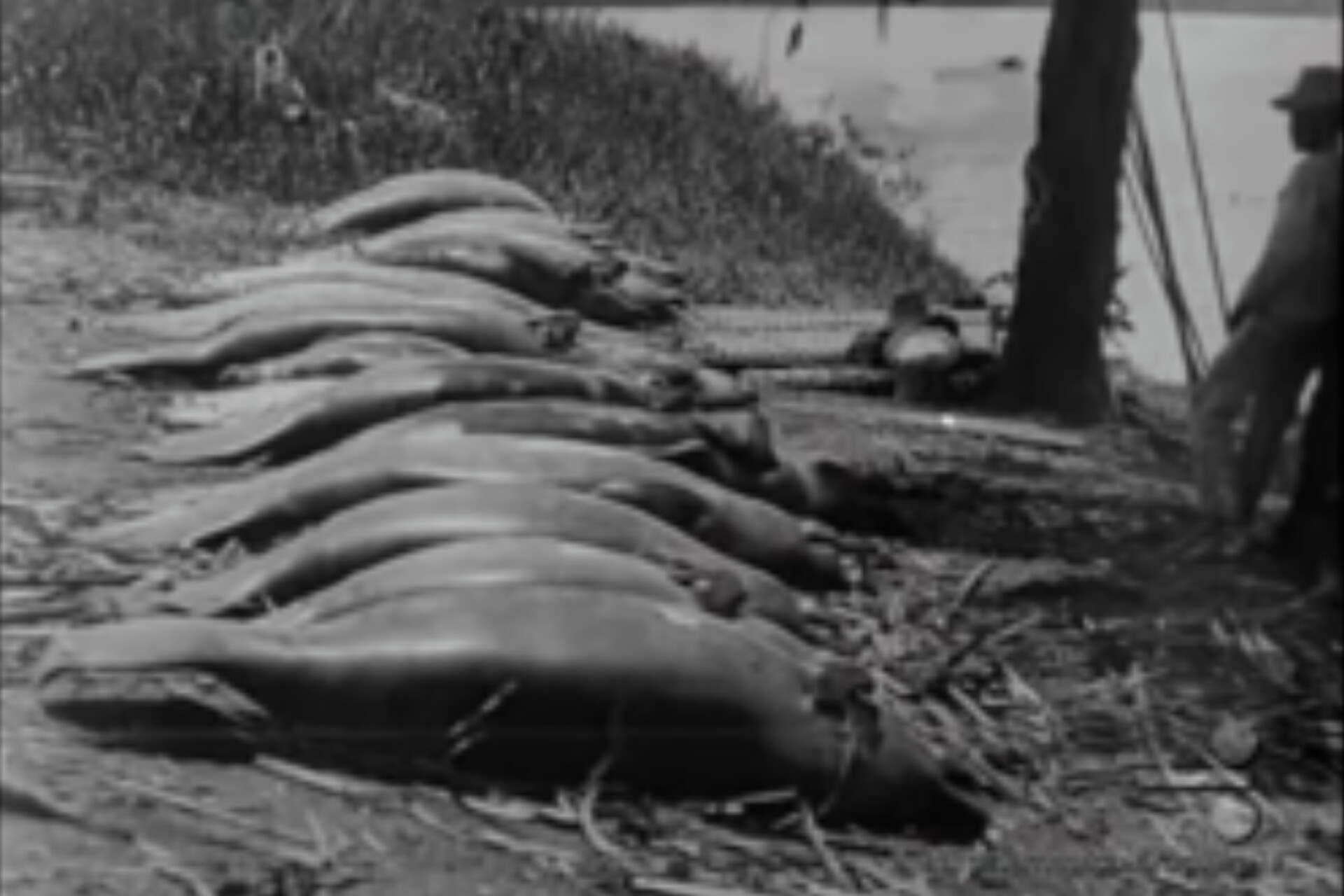
Both the Timucuan and Seminole Indians of Florida regularly hunted the manatee (“Big Beaver”), prizing the ivory as well as the meat (Lawrence 1954; Elliott 1904; Anon. 1895; Canova 1885). Even with their primitive method of harpooning the beasts from canoes, one Indian could normally kill 10 to 12 animals per season (Barber 1882), and the Seminoles sold excess manatee flesh to the Spaniards (Canova 1885). Pioneers arriving in the 19th century greatly increased the rate of slaughter by shooting animals (McClung 1969; Trumbull 1949; Williams 1837). This problem was further compounded by the demand for manatee specimens by museums. During the 1800’s, a skeleton was worth about $100 and a properly prepared skin was of comparable value (True 1884).
In Yucatan, manatees have been hunted both for meat and for hides (Allen 1942). Mayans hunted the manatee in British Honduras and Honduras, killing them with flint-headed lances, eating the meat, and utilizing hides in canoe making (Bertram and Bertram 1968; Betz 1968; Baughman 1946; Gann 1929; Brigham 1887). Miskito Indians in Honduras, Nicaragua, and Costa Rica also hunted manatees (Conzemius 1932; Townsend 1904; Frantzius 1869), and Dampier (1698) reported that two animals per week were commonly taken. However, a recent study of a typical village north of Bluefields, Nicaragua, revealed that manatees provide only 3% or less of the meat poundage of the village (Nietschmann 1971). Marked difficulty in hunting them apparently results in the limited pressure. Natives in the Atrato and Cacarica of Panama also stalked manatees for meat (Goldman 1920) but no information on present hunting pressures was found.
Netting was the technique used in Colombia and it was so effective that manatees have been extirpated from Santa Marta to Taganga (J. Hernandez Camacho, personal communication). The hides were used in making special whips for slave owners in Colombia. Today, the meat is prized throughout the country and sells for 30 to 50 Colombian pesos per pound, whereas top quality beef is about 12 to 15 Colombian pesos per pound. The oil is thought to have medicinal properties and the bones are used to attract rain during the dry season, or as a luck charm in fishing.
Mondolfi (1974) reported that Venezuelan fishermen capture manatees by use of either harpoons or a type of seine called a “chinchorro.” The meat is popular, both fresh and salted, and its sale in the markets of Ciudad Bolivar, although illegal, is not concealed. The animals are also captured live for sale to zoos and for use in weed control projects.
Guyanese Indians used the hides for making shields and armor capable of withstanding arrows (Baughman 1946). Hunting pressure in Guyana and Surinam was once extensive (Bertram and Bertram 1962, 1963; Sanderson 1949; True 1884), but today there is no systematic hunting of the species. Manatee hunting was also carried on during the 16th century in Cuba, Jamaica, St. Dominique, and Puerto Rico (Baughman 1946). Although fishermen in the Dominican Republic acknowledge the illegality of hunting manatees, they occasionally harpoon the animals for meat (S. Husar, unpublished data).
The only recorded commercial harvest of T. manatus occurred in Surinam during the 18th and 19th centuries. Several companies specialized in manatee hunting and exported the meat to Antillean islands as slave food. The records indicate a lucrative business, perhaps having a marked effect on South American populations (P. van Bree, personal communication).
Legislation and Protection
Several countries have enacted protective legislation (Table 4) [Not included.], but effective enforcement is virtually impossible. Much of the prime manatee habitat is remote, increasing the difficulties of patrol.
Manatees have been protected by Florida State law since 1893 and in May 1907, the state imposed a fine of up to $500 dollars and a 6-month prison term for molesting or killing a manatee (McClung 1969; Moore 1956; Allen 1942; Graham 1909). This law was modified in 1953, allowing the taking of manatees with a permit (D.S. Hartman, personal communication). The Marine Mammal Protection Act of 1972 declares a moratorium on taking manatees within United States waters and animals may be captured for display or research purposes only with a permit from the Secretary of the Interior. Violators of the Act may be fined up to $20,000 and receive a prison term up to 1 year.
Despite legislation in Guyana, poaching remains a problem. Communication is poor and a meat shortage exists; therefore, animals are still killed and sold in the open markets as “bush meat” (Hanif and Poonai 1968; Bertram and Bertram 1962, 1964). It is probable that similar conditions occur throughout the range of the West Indian manatee.
Suggestions for Conservation
Trichechus manatus is the most thoroughly known of all sirenians because of Hartman’s (1971) study of their behavior and ecology. Aerial surveys and interviews along the Florida coast have also provided the best population estimates available for manatees. Unfortunately, similar estimates are not available for the remainder of this species’ range along coastal Central and South America, and among the islands of the Caribbean. Estimates of numbers are of primary importance in the assessment of declining populations.
A systematic method of censusing is clearly needed. Freeze brands, laser brands, and flagging are possible methods now available that may enable identification of animals from the air or from boats. Such monitoring used in conjunction with radio transmitters would be especially beneficial in determining seasonal movements. Individually identifiable animals also provide a means of obtaining data on reproductive biology and population fluctuations under natural conditions. This information is critical for the establishment of sound conservation policies.
Although studies of the population dynamics of the West Indian Manatee are of prime importance, investigation of the general biology of the species should not be overlooked. Physiology, endocrinology, genetics, and nutrition of this animal remain virtually unknown. A workshop held in Georgetown, Guyana, in February 1974, deemed the local establishment of an international manatee research center feasible and desirable. This center would address itself to biological investigations mentioned above, and planning of the center is currently in a preliminary stage.
Investigation should also be made into the effect of man upon manatee habitat, and upon the manatees themselves. Pollution and pesticide levels are now being examined in wild Florida manatees (D. Odell, personal communication). Dredging and increased human populations which affect manatee habitat should also be investigated.
Legislative protection afforded to manatees does not prevent the molestation and wounding by motorboats. Therefore, the establishment of sanctuaries in areas supporting resident populations or wintering congregations should be considered. Such a sanctuary essentially exists at Blue Springs, Florida (O’Keefe 1973), but other U.S. national parks and wildlife refuges have not uniformly lowered speed limits of boats for the protection of manatees. Hartman (1972) suggested the entire coast of Citrus County as a National Manatee Refuge, in part because of the excellent observational opportunities in this area, and steps are now being taken toward this end (H. Campbell, personal communication).
Equally important for the conservation of T. manatus is the implementation of an educational program to inform people of the esthetic interest and potential benefits (weed clearance and possible domestic meat in the distant future) of manatees. Convincing people that the manatee is an asset to be protected can be an effective means of preventing exploitation.
Breeding programs, with experimentation aimed toward large-scale production and perhaps domestication, have been suggested as a viable method of replenishing diminished stocks and reintroducing manatees to areas where they formerly resided (National Science Research Council of Guyana and the National Academy of Sciences 1974; Walker 1973). Although immediate results could not be expected from such a program, it may eventually prove rewarding. This approach should therefore be considered as a possible means of increasing manatee numbers and insuring their continued existence….
Sandra L. Husar, The West Indian Manatee (Trichechus Manatus) (Washington, DC: U.S. Dept. of the Interior, Fish and Wildlife Service, 1977), pp. 1, 5-10, and 16-19. The map can be found on page 5 in this cited work. The harpooned manatee image is from Charles B. Cory, Hunting and Fishing in Florida. The two images of men capturing a manatee is from: Anthony W. Dimock, Florida Enchantments. The three color images and row of dead manatees appear in: https://en.wikipedia.org/wiki/Manatee.
See: https://babel.hathitrust.org/cgi/pt?id=uc1.31822011818606&seq=1