Northern Fur Seals
We want you to have a greater ability to learn about some of the unpleasant animal issues in our world.
Hunting the Fur Seal
W.G. Emery
I was enjoying an outing on the Oregon coast, when I chanced to notice a classmate who had just returned from a successful sealing cruise; and I heard so much of his experiences and adventures that finally I asked him what chance there would be for me to join with him the next season. He looked thoughtful a moment, then said: “Well, it is pretty hard for a ‘greeny’ to get a berth, but I will see what I can do for you.”
The day following my arrival at Astoria I was escorted by the captain to the office of the Shipping Commissioner, signed the ship’s papers, received $100.00 in cash as advance money, and found myself bound as hunter aboard the American schooner Louis Olsen.
Each of the ship’s hunters was provided with two high-grade hammerless, 10-gauge shot-guns, and one Winchester rifle. Ammunition was furnished us by the schooner. The load most generally used by sealers for their shot-guns is five drachms of best powder and twenty-one, or three chambers, of No. 3 chilled duckshot. The recoil from such a load would soon pound one to pieces,a boat is not noticeable.
At 3 P. M., January 1st, we hoisted our anchor, and on the 16th day out we sighted the Hawaiian Islands. Skirting around them we shortly struck the northeast trades, when we headed straight for Yokohama, Japan. All the sealing schooners take this roundabout way, avoiding the stormy weather and contrary winds, always encountered in what is known as the northern passage.
We hunters had very little to do, as we were not expected to assist in working the schooner. We drew lots for our boats, and gave them a general overhauling. Each hunter has a boat under his charge and a crew of two sailors assigned it by the captain. The boats are twenty feet in length, four feet beam and sharp at both ends, fitted for three pairs of oars and sloop-rigged.
On the 13th of March we sailed from Yokohama and headed for the sealing- grounds. Two days afterward, while we were at dinner, our cook came excitedly jumping into the cabin, exclaiming: “Sleepers! Sleepers! a whole raft of ’em, cap’n, just up to windward.”
In a moment all hands were on deck, and there, a short distance away, were half a dozen black-looking objects, which, to the experienced eye, were sleeping seal, lying on their backs, with their tail flippers curled over their bellies. The schooner was thrown up into the wind, a boat quickly lowered, and Davis and his two men started after the quarry. The rest of us had perched about in the rigging, and were greatly interested. As the boat crept closer and closer, we saw Davis level his gun, and a moment after he had killed one seal and crippled another, which he secured with his second gun, as the seal made a breach out of the water about forty yards to the left. Gathering in his two prizes he was soon alongside, when he was received with cheers.
Soon after, all the boats were out and I was off for my first seal-hunt. Each boat, lest it should get lost, is provided, before leaving the schooner, with five days’ provisions, five gallons of water, one dozen sky-rockets, a “flare,” and a compass. Every hunter has his berth to hunt in, moving down to leeward each day in rotation, the ice-boat one day being windward the next, and second from windward the next, and so on till it has the the lee-berth again. The boat-steerer takes his course by the compass, and sticks to that course both going from and returning to the schooner, which in the meantime lies hove to under the foresail, first on one tack and then on the other.
The hunter takes with him his shot-guns and about two hundred shells, and his rifle and fifty cartridges. He is supposed to stand upon the forecastle head all the time, keeping a sharp lookout for seal. This part of the business is very awkward work for one not used to it, and I got many a fall before I caught the knack of it. That afternoon the sea was very rough, and I spent most of the time hanging on to the mast or picking myself up, for I found a pitching and rolling boat to be a very uncertain thing.
After we had been out about two hours without any success, I caught a glimpse of something which was pronounced to be a “sleeper” by my men. As it was some distance from us we sailed toward it, till within a couple of hundred yards, quietly took in our sail and jib, unstepped the mast, and then the boys slowly pulled toward it. One soon took his oars in, and the boat-steerer alone pushed us along; gradually and silently, getting within gunshot. I picked up my gun and was making desperate efforts to steady myself so as to be ready to fire at the right moment, when suddenly the boat gave a quick lurch and over I went backward, heels over head, making racket enough to wake the dead. A jump and a splash, and my first seal was out of range, and the boys were having a hearty laugh at my discomfiture.
We again made sail and stood on our course till about 4 P.M., but saw nothing more. We then turned toward the schooner, which we could barely make out on the horizon. On the way back, as we were flying along before a good breeze, I suddenly saw, about fifty yards ahead, and a little to the right, a very large seal, sound asleep. I grasped my gun and gave it two shots in quick succession. I hit fairly with both loads, instantly killing it, but as we lowered sail and turned back to pick it up I saw it slowly relax its muscles and gradually sink out of sight, tail first, just out of reach of the gaff. Thoroughly disgusted I hoisted the sail and told the boys to take a bee-line for the Olsen. The other hunters had met with varying success. Copeland had three, Guillams, Lewis and the captain, two each, while Davis had only the two to his credit that have been already mentioned.
The weather for the next two days was too rough for the boats, so we stayed aboard.
The day following dawned clear and calm, so we were all out and away by sunup. I had begun to get my sea-legs, and was able to stand up much better than before, although I was almost the entire season acquiring the perfect ease with which the other boys would stand, swaying with every motion of the boat. At first thought it would seem that it ought not to require any skill or experience to kill a sleeping seal at a distance of only thirty yards, with a load of buckshot, but the conditions make it very difficult. The seal lies more than half immersed in the water, his body moving up and down, and sideways, following every motion of the sea; the boat is also moving and swaying in every direction, and the hunter must balance himself with his gun at his shoulder, his mark the head of the seal, which is constantly rolling from side to side, though sound asleep. At first I often shot over or under them as much as two feet, and I found it more difficult shooting than over the traps, or at the swiftest flying bird. When the seals are awake, ‘breaching,” or “traveling,” the difficulty is greatly increased. Take a gun some day and try your hand at a breaching salmon, and you will get some idea of seal-shooting, without the unsteady boat.
This morning, there being no wind, we used our oars, and were soon far from the vessel. After being out an hour or so, I caught sight of a “mouser” coming toward us. The term “mouser” is applied to a seal moving lazily along, keeping under water all the time, except the instant it comes to the surface for a breath. I motioned to the boys, and they ceased rowing, all of us keeping perfectly still. The seal had not noticed us, and kept on coming directly our way; his head popped up fifty yards from us, then down again, and from that on I could see him swimming under the water. I got ready, and when his nose showed up again, about twenty yards away, I fired, and he rolled over. We were not long getting him into the boat, and I exultingly examined my first capture.
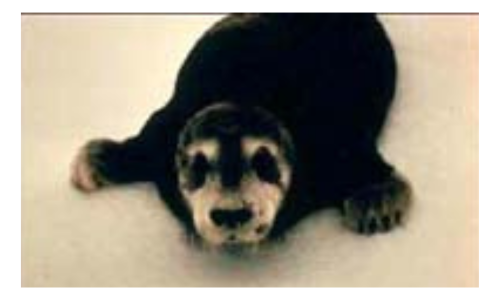
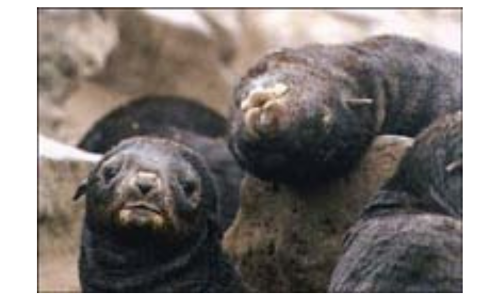
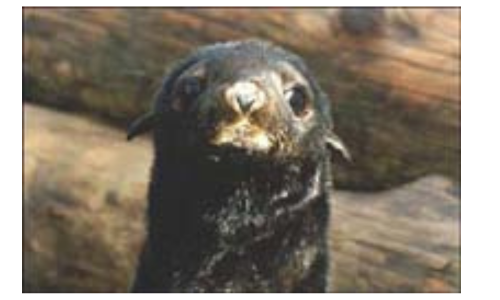
The fur seal is a beautiful creature, long and slender, and has a small, delicate head, from which its two large eyes gaze at you with an expression almost human. Its body is covered with a heavy coat of soft, brown fur, thickly sprinkled with long white hairs, which have to be pulled out before the dyeing process that changes its color to the well-known velvety black. The seal has four flippers, two in front and two behind; they are very powerful propellers, enabling it with ease to catch the fish upon which it lives.
My next seal was a “sleeper,” and as I did not want to lose him, I did not fire till we were within thirty yards. And no sport that I have ever experienced made my nerves tingle as they did while my men were slowly, an inch at a time, pushing me toward him. We could hear him snoring when fifty yards away, yet, though he was sleeping so soundly, there was an uncertainty about getting him that intensified the excitement of the moment, and caused me to draw a long breath of relief when, a few moments later, we had him safe in the boat. When sleepers detect the presence of danger, they do not lift their heads, or even blink an eye, but, quick as a flash, under they go; and if you do not catch them with a skillful snap-shot, as they make their first breach, forty or fifty yards to windward, it is good-bye seal.
A short distance further on, my boat-steerer called out again, “Sleepers!” and away off a bunch lay on the water. Before we could stop and turn back, they got a scent of us, and away they went. They cannot see very far, but their senses of hearing and smelling are very acute. They have, always, to be approached up the wind, and the slightest noise of any kind will even then betray the hunter’s presence.
Shortly after this the wind began to rise, and in less than half an hour was blowing a small gale, so we turned and started for the schooner, some eight miles away, with our sail double-reefed; and before we reached her we were shipping water at every jump, keeping two of us busy bailing out. .When alongside we had to exercise extreme care, as a mistake on the part of anyone would have swamped us. After considerable trouble the “burtons” from the schooner were fastened to each end of the boat, the mate sung out “Hoist away,” and, quicker than it takes to tell, we were safe aboard. I found all the boats in but one, and we could see that coming. In getting them aboard, one of the boys got caught as the boat swung in. He was jammed against the “fife-rail,” and he kept his bed for ten days. It is no unusual thing on the Japanese coast for a sudden gale to spring up, and the sea get so rough that a boat cannot be taken aboard the schooner. In that case the hunter runs down a short distance to leeward, heaves to, throws out a drag and waits, and it is wonderful what a stiff gale one of those little boats will ride out.
Early next morning our boats went flying before a strong breeze, that by 9 A. M. had carried us entirely out of sight of the schooner.
About 10 A. M. I saw a “traveler” crossing my bow about sixty yards away. By a lucky shot I succeeded in preventing his going faster than we could pull. We made chase, and every time he stuck his head up for a breath, I blazed away at him; and though he would be under before the load could reach him, yet I kept him from filling his lungs, and he would have to come to the surface again after a short dive. We kept gaining on him, and I continued shooting, till at last, in sheer desperation, it seemed, he turned and started for us, bellowing and snapping his teeth. By the time I got shells slipped into my empty gun he was not more than ten feet away, still coming, and was about as fierce-looking an animal as I ever tackled. I did not take time to put my gun to my shoulder, but shot from my hip, and killed him. He could have done our boat considerable damage.
The term ” traveler” is applied to a seal traveling in any direction, mostly keeping on the surface of the water, only occasionally diving. Such a seal is very wild, and it is hard to get within gunshot of him.
Shortly after starting back we saw Copeland also returning. We waited for him, and soon he was alongside, with eighteen fine skins.
We compared our bearings and decided that we were about nine miles from the schooner, and as the wind had switched we had a long three hours’ pull ahead of us. Copeland lit his flare, took the lead, and we pulled steadily till 1 1 P. M. But there was no sign of our vessel’s light, which is always run up to the mast-head if any of the boats are out after dark. If I had been alone I think I should have been badly scared, but as the others, who were experienced hunters, did not seem to mind it, I felt tolerably easy.
After an hour, neither seeing any lights nor hearing any answers to our signal shots, we decided to lash our boats together, put out a drag, and turn in for a nap, leaving one man on the lookout. We were carrying this into execution when I thought I caught a glimpse of a red light ‘way down to lee-ward. We all kept a close watch in that direction, and soon saw a rocket shoot up toward the heavens from a point about S 1/2 E from us.
We quickly made sail, winged out our jibs and went flying down before the wind in a grand race for supper and a warm berth. We were fully 11/2 hours making the schooner. It seemed that the captain had been hearing signal shots down to leeward since dark, and thinking that .somehow we had made a mistake in our bearings had run down in that direction, and in doing so had been running away from us.
When we got up next morning we found the schooner hove to under a storm-trysail, a terrific gale blowing, the seas running mountains high; and we realized how fortunate we had been in finding our vessel during the night.
That afternoon it began to breeze up, and before night we were again hove to under our storm-trysail, and during the next forty-eight hours we experienced some of the dirtiest weather of our entire trip. The wind did not blow so very hard — at times there was barely enough to keep the schooner head on; but there was a very heavy swell and a treacherous cross-sea that at times completely flooded the decks, while the barometer kept going down, down, till it hung at about 28.10, pumping backward and forward six or eight tenths each way. The wind, which at first was southeast, kept veering around till it had almost completed a circuit of the compass. Finally, the barometer quieted down, and began slowly to rise, while the swell subsided and the wind steaded till the most imminent danger was past.
The weather showing no signs of abating, sufficiently, our captain decided to run inshore and see if we would not have better luck. Here we found quite a number of the sealing fleet, and learned from the schooner Henry Dennis, of Seattle, Wash., that she had been having good luck. Gallant schooner and swift sailer as she was, commanded by one of the most experienced sealing captains in the fleet, she was wrecked later on in the season, on the treacherous coast of Northern Japan, though fortunately no lives were lost.
Here our luck changed, for, beginning with April 1st, we lowered nine days in succession leaving the schooner before daylight each morning;, and not getting in till late at night, so that by the time our guns were cleaned and shells loaded for the next day, only an hour or two was left us for sleep. But we were well repaid for our hard work, for during that time we brought aboard 320 skins.
This period of good weather was followed by several stormy days. They culminated in another fierce gale, that blew us offshore and into a latitude where seal seemed to be thicker than in any place we had yet been; so we lay hove to awaiting an opportunity to get among them, but the rough sea kept us close aboard till the afternoon of the 18th, when we persuaded the captain to let us make a trial. It is not the roughness of the sea that keeps the eager hunter aboard when seal are about, but the difficulty and danger in lowering and getting away.
It was touch and go with our first four boats, a couple of us narrowly escaping getting caught; and when it came Lewis’ turn his boat got hung on the rail and tipped over, spilling him, his crew, mast, oars, etc., into the water like so many potatoes.
We were not out over two hours, but in that time two of us got three seal each and the others two each, and I know I did not touch a hair on three others I shot at. They were all the soundest of sleepers, and I got within twenty yards of them, but it was simply impossible for me to hold anywhere near them, as our little boat would be one moment rushing down a steep incline, the next staggering up the side of a mountainous sea. It was a grand and glorious ride, with just enough danger about it to give spice to it.
The next day dawned clear and calm, and from our deck two schooners could be seen, one to the right and one to the left, each about eight miles off. A number of seal were lying about on the surface not far off, and we were all anxious to be out and away.
That day I had the windward-berth, on the extreme right, and Guilliams the lee-berth on the extreme left. Hardly a breath was stirring, and the sea rolled under us in long, lazy swells. We all pulled out ahead of the schooner in widely diverging directions, as on a quiet day the shots from one boat are liable to spoil the hunting for the others. I saw quite a lot of seal, but they were very hard to approach. In a dead calm they are uneasy even in their sleep, turning round and round in circles, seemingly hunting the wind, and they easily catch the slightest sound. This is where the rides come into use; one hunter, Lewis, got three seals that morning, at a distance of seventy-five yards and over. I tried several shots, but I was not steady enough on my feet for such fine work.
About 9 A. M. a slight breeze sprang up, but from a direction that threw me to leeward of the other boats, so I turned short off to the right, and headed away from the other boys. About the same time Guilliams, on the left, made the .same change from his course, and we came together at noon about ten miles from the schooner, which apparently bore N. E. from us. Soon after changing my course I began to have better luck, and at noon had nine seal aboard. Guilliams had eleven, and we lashed our boats side by side and took our lunch together, all laughing and joking in the best of humor.
While we ate, one of the boys exclaimed: “What in thunder has become of the Olsen?” and, sure enough, not a thing could be seen of her. In about ten minutes, though, we made her out about two points to the eastward of where she should have been, and apparently twenty or thirty feet clear of the water, for we could see all her hull, and her spars stood out with wonderful distinctness. Then slowly she faded away, only to appear again due north. It was a peculiar and startling phenomenon to me, but Guilliams understood it, and assured me that it was all the effect of a mirage. He cautioned me about taking; any new bearings that afternoon, as the schooner might be miles from where she appeared to be.
As we parted he remarked to me, “When you start back tonight, stick to your bearings and steer N. E., no matter how many schooners you may have seen in the air, and you will find the Olsen about where she ought to be. “We should have turned back tlien and verified the bearings we had, but never doubting their correctness, we kept moving away all the time, killing a sleeper here, and chasing a cripple there, engrossed in the excitement of the hunt. The last seal I got was an odd chance that sometimes comes to one, for she popped up not four feet from the boat. For one moment the astonished eyes of hunter and hunted met; then, as she whirled to dart under, my finger instinctively pressed the trigger of the gun, which, luckily, was pointed right. This made us sixteen for our day’s work, and well satisfied we turned for home. On our way back we fell in with Guillams, who had nineteen in all.
About dark we made out the schooner directly ahead and were soon alongside, but to our astonishment and dismay she was not the Louis Olsen, but the Edward E. Webster, of San Francisco, McLean, master. A more surprised set of boys than we were about that time would have been hard to find, for in some way Guilliams and I had shifted our bearings from the Olsen to this one. Captain McLean invited us aboard, telling us we had better not start out again that night as it was beginning to breeze up, but that as soon as all his boats came in, he would run down about eight miles to leeward and see if he could find our schooner; if not. he would work in the other direction and probably pick her up the next day. We accepted his offer, and all night long kept a sharp lookout for the Olsen’s signal rockets or the flash of her boom-gun. But ’twas no use; we were lost from her, and had to make the best of it till we might run across her again.
It is the rule among the sealers when a lost boat and crew come aboard, to take care of them, and consider them for the time being as part of the vessel’s crew. They hunt each day, and whatever skins they get belong to that vessel, the hunter and crew getting the same pay for them as they would have received aboard their own schooner. However, the skins we took aboard, thirty-five in all, belonged to the Olsen, and were counted and packed down in the hold and a receipt was given for them. Our captain could draw on the ship for the skins at the end of the season.
The next day we lowered with the Webster’s boats, but were driven aboard before noon by the rough weather. During the time we were out Guilliams got three seals and I six. The next two days were stormy and wet. Just before lowering on the third day, one of the hunters told us, confidentially, that if we expected to get back to our schooner soon, we had better take advantage of the first opportunity and make a run for some other vessel, for Captain McLean’s brother was somewhere near us in another schooner, the Bonanza, which was short-handed, having lost two boats and crews; and it was the intention to find her and put us aboard, when we might as well say good-bye to our schooner, for the other’s captain would take particular pains to keep out of the way of the Louis Olsen. We did not wait to verify this, but, sighting a schooner that day, out we skipped and before dark had boarded the Geneva, a Victoria sealer. Her captain was already harboring a lost crew, and could not conveniently keep us, so next morning we again struck out.
About noon we sighted another schooner, which we found was the Penelope, from Victoria, and which was the vessel Guilliams had hunted on for the two seasons previous. We received a hearty welcome and, the Penelope having only five boats with plenty of room for two more, we accepted the offer of her master, Captain McGrath, to make her our home till we might run across the Olsen.
The ”Penny” was a fair-weather schooner, for during the month we were aboard her we encountered only one gale. This, though but eight hours long, was one that will long be remembered among sealers. Two schooners were capsized and all hands lost, and several others had men washed overboard and drowned; boats were smashed and spars and rigging carried away. The gale started from the S. E., gradually increasing in force till it was blowing a hurricane, causing a terrible sea. Then with us there came an interval of about ten minutes of dead calm, during which it seemed that the “Penny” would roll her masts out. Suddenly, with a roar, the storm was on us again, from the nor’west, directly the opposite direction.
During the interval of calm, the captain had double-reefed the storm-trysail, yet, with only that small surface to act on, the force of the wind was such that the schooner was hove down till the hatch combings were under water. In that position we lay for four hours perfectly helpless, and for a time at the mercy of the heavy lee-sea that would break entirely over us. The captain had called all hands aft and battened down the hatches, and he now put us to preparing two large oil-bags, which were hung over the lee-side, one forward and the other aft. The effect of these was instant and almost magical. All the rough edge was taken off the seas, leaving the schooner only the wind to contend with. But for the oil I think it would have been all up with us.
Following this, we were treated to a long spell of fair weather, the boats being out almost every day. Every time Guilliams or I would sight a schooner, away we would chase alter it until certain it was not the Olsen, and most of our time was spent that way, instead of hunting. We boarded quite a number of vessels, making inquiries concerning her whereabouts, and soon learned that she had been disabled in the recent gale, and had put into Hakodate for repairs.
After that, Captain McGrath kept the schooner moving in that direction till the morning of the 19th of Mav, when we lowered off Yumada Head. This was a misty, foggy day, and, after being out till noon, getting but one seal and sinking another, we turned back toward the “Penny.” Just as we started, I noticed several miles down to the leeward the outlines of another schooner, but as the sea was getting rough, and a cold, drizzling rain had set in, I did not try to speak her, as had been my habit. When we got almost back. I noticed a boat towing astern of the “Penny,” that some way had a familiar look; but before we had quite made it out, we heard a cheer, and saw Davis and his men in the rigging, waving their hats to us, and we knew we were no longer “tramps of the sea,” for the Olsen coidd not be far off. A few minutes later we ran down to the Olsen. We were met by a ringing cheer, all hands crowding around us, and everything for the moment was forgotten in the joy of our reunion. A very liberal “splicing of the main-brace” ensued in honor of our return.
We found several strange faces aboard, for when the schooner was in Hakodate the captain had shipped two more hunters and their men, not knowing whether he would run across us again during the season.
About this time of the year the foggy weather sets in, which adds a new element of danger to the sealing business, for the schooner is lost sight of before the boats are out of hailing distance, and it requires extreme carefulness on the part or the boat-steerer to keep his course correctly during a long day’s hunt.
The day after we found the Olsen was one of the foggiest that we had. We all left the schooner quite early, and before we were fifty yards away could see neither her nor any of the other boats. With muffled oars, we silently pulled away, every sense alert to catch the first intimation of the presence of seal. Occasionally a splash from one side or the other told that our wary game had detected us. Suddenly there loomed up a dark body, magnified so by the uncertain light that I could not believe it to be a seal till I made out its tail flippers. The boys ceased rowing, allowing the boat to glide noiselessly forward, till I saw the seal’s head and scored a kill.
We hunted from Volcano Bay up past Cape Yerimo, almost to Cape Ishu, very few seal being brought in. Here is where I ran across my first “killer,” which is about the only thing a seal-hunter is afraid of. This is a monster fish, half shark and half whale, from twenty to forty feet in length and with enormous jaws, armed with rows of long, sharp teeth. About half-way back from its head it has an upright dorsal fin from four to six feet in height, two or three feet wide at the base, tapering to a point. The “killers” are voracious creatures, and when hungry will attack anything that comes along.
The year before, Copeland had been chased by one for nearly an hour, while he, a most expert shot with the rifle, stood in the stern of his boat pumping lead at it from his forty-five-ninety Winchester as fast as he could work the lever. When he finally drove it off and got aboard the schooner, the boys said he was as white as a sheet and completely unnerved, and he was about the most reckless daredevil I ever met. In a number of cases boats have been found torn to pieces, with marks on the wreckage of the teeth of some powerful animal such as the “killer,” and no trace of the crew has ever been discovered. A boat from a Victoria sealer was chased by an enormous “killer” to within one hundred yards of the vessel, when the fish with one snap of its huge jaws, bit off several feet of the stern of the boat, fatally injuring the steerer. It then disappeared, leaving the hunter and other men to be rescued half drowned by their comrades on the schooner.
My experience, though somewhat different from any of these, was one that I did not care to have repeated. We were pulling leisurely along when a bunch of seal came breaching and diving across our bow, apparently demoralized with fright, and paying no attention to us. As they darted by us, I put in two shots, killing one some fifty yards away; but, before we were half-way to it, a huge black fin showed close beside it, and with a rush a “killer” snapped it about as a hungry trout does a drowning gnat. He paid no further attention to us, but kept up his chase after the fleeing seal, and we let him go, ourselves taking the opposite direction; and it was not till we had gone some distance, that we paused long enough to take a breath.
June the 16th we once more got among seal, securing a fairly good catch; but that night a strong offshore wind sprang up, which developed into such a gale that the captain decided to run before it, so as to make plenty of offing in case the wind switched. Once started, we had to keep running, not daring to heave to in the wicked sea; and, when we got our bearings five days later, we found that we were six hundred miles offshore, miles and miles away from any seal, and the wind dead against us. To make matters still worse, the mate discovered on going below that one of our large water-tanks had sprung a leak, and we were left with only sufficient water to last about eight days. As it was impossible to reach the Japan coast or the Kurile Islands in that time, with the wind unfavorable, the captain headed the schooner for Attou Island, the most westerly of the Aleutian group.
On the afternoon of June 28th we sighted Iand a short distance ahead, through the thick fog, and lay anchored close inshore till morning. One of the boys, while heaving the lead, attached a large hook to the line, and on hauling in found that he had hooked a fine fish. Soon we were all fishing, and in a short time had the deck covered with flopping codfish, weighing from ten to thirty pounds.
Next morning the captain sent off a boat to find water, and by noon we had all the tanks filled, everyone working with a will, for had wee been discovered there by a man-of-war our vessel would have been seized, skins confiscated, all hands placed under arrest.
As we were coming on deck after lunch we heard the rattle of oar-locks toward shore, and saw through the fog a small boat, with a naval officer seated in the stem. As he came over the side our hearts went down into our boots. Our captain stepped forward, saying: “Well, you have caught us, and I guess it is all up with us.”
“I have not come to capture you, but to pilot you into the harbor near-by, which I supposed you were looking for,” was the smiling reply; and feeling considerably relieved, we followed him down into the cabin, where he informed us that a law had been passed allowing sealers to hunt in Behring Sea after August 1st, provided they secured a permit, kept sixty miles offshore, and hunted only with spears, no firearms of any description being allowed in the sea. He had been stationed on Attou Island to grant the necessary permits to schooners coming from the Japanese coast, and desiring to take advantage of the new law.
After a short consultation we decided to go into the sea and try our luck with spears. We were soon at anchor in the little harbor of Chichagoff, lying there while the sailors painted the schooner and gave her a general overhauling.
Attou Island is inhabited by a small tribe of natives, some forty or more, very ignorant and dirty. They live in mud houses called “ba-rab-a-ras,” and subsist principally on dried fish and mussels. The Alaska Fur Co. has a settlers store there, and trades them tobacco, sugar, cheap articles of clothing, etc., for furs. An old Roman Catholic church, thatched with straw and tied together with ropes, forms a picturesque complement to this most westerly of American villages.
July 7th we sailed for the Island of Ounalaska, some seven hundred miles further eastward, and near the mainland of Alaska, there to remain till August 1st, the opening of the hunting season in the sea. On the 15th we dropped anchor in Dutch Harbor, where we found several other schooners lying; and more kept coming in till the 1st of August, making quite a fleet of us. This island is the headquarters of the Alaska Fur Co., the North American Commercial Co., and is also a coaling station for the gunboats and men-of-war patrolling Behring Sea.
August 1st found us once more on the sea, equipped with spears, lines, gaffs and all the necessary paraphernalia for hunting seal “Siwash” fashion, and we headed for the waters about seventy-five miles nor’west of St. Paul Island, in the Pribyloff group.
Our spear-poles were tough, slender sticks, about one inch in diameter and eighteen feet long, with a hand-hold at one end and two prongs of hard wood “seized ” to the other. These were of unequal length, one being some eight inches shorter than the other, and were spread so that at the points they were six or eight inches apart. In poising the spear for a throw, it was grasped by the hand-hold with the right hand, the left hand extended forward and supporting the pole about four feet from the butt, the spear being held with the short prong underneath. On the end of each prong was tightly pushed a steel spear-point, with wide barbs, that would detach itself and toggle, i.e., turn cross-ways, upon entering the body of a seal. To these points was fastened three hundred feet of one-quarter-inch line, which was kept loosely coiled on the forecastle head.
About noon we found a sleeper, that must have been out late the night before. With the stillness of death itself we pushed in, closer and closer, till within fifty feet of him; then, carefully balancing the spear, I let drive with all my strength. Straight and true the pole went, striking the seal just back of the shoulders, and driving the point entirely through his body, toggling it on the other side.
Quick as a flash, the seal was under, diving straight down, leaving the pole floating on the surface, while the line went whizzing out, till only about one-half remained in the boat. Then upward he darted, jumping his entire length from the water, trying to free himself from the barbs. Backward and forward he surged, straining the line until it sung like a fiddle-string. Then, full of fury, he would seize it in his teeth, attempting to sever it, but the fine copper wire, with which it was wound for the first ten feet, would prevent that; so, dropping it, he would come headlong for the boat, gnashing his teeth, and looking capable of tearing us to pieces could he but reach us. A blow of the oar would start him off again in his wild struggle for liberty, till gradually we wore him out, and were able to haul him alongside, when one quick thrust of the knife ended the fight.
No salmon, in its most frantic struggles, ever caused one fraction of the intense excitement experienced during the battle with that fierce young bull.
The young bull was my only kill during that day, as I afterward missed several good chances by throwing over my sleeper. This is a very easy mistake to make, and to provide against it, the proper way, as I afterward learned, is to so throw the pole that it will strike flatly on the water about four feet short of the seal. In this way, with its momentum only slightly checked, it will go glancing along the surface, never failing to pierce its victim if thrown straight.
The week following we were kept aboard by a gale; but the next time we got out, all showed improvement in throwing, getting from four to eight apiece. Had we been favored with any kind of hunting weather, I am satisfied most of us would have become as expert with the spear as any “Siwash” trained to its use; but our bad luck still followed us, for, out of the month we were in Behring Sea, we were able to lower only five days, and only one day out of the five were we out from sunup to sundown. In spite of the little practice we had, we kept improving, till, the last day we lowered, Lewis got thirteen skins; Guilliams, twelve; Davis, ten; Copeland and Knapp, nine each; myself seven; and the captain five, which would be considered a good day’s work with guns.
Guilliams, Lewis, and Davis became so skillful that they were sure of any sleeper they could get within thirty yards of, and often said that in the future, when hunting on the Japanese coast, they would always carry a spear to use on single sleepers, as in that way they would avoid waking others.
One day Knapp speared a very large bull through one of his hind flippers, and the result was the same as when one hooks a fish in the tail, only on a much larger scale. They simply could do nothing with him at first, and were towed some eight miles at breakneck speed before they got him checked. Finally killing him, it was all the three could do to “parbuckle” him into the boat. He measured twelve feet in length and weighed over twelve hundred pounds. Copeland also fastened to another monster, and for a while he and his crew did not know whether they had the seal or the seal had them. He was very ugly and wicked, almost swamping them several times; but they hung grittily on, fighting him off with their knives and clubs, till a lucky blow from an oar stunned him.
Guilliams, one day, slipped upon two sleepers lying close together, and at one throw fastened to both of them, each spear-point piercing a seal. The fight that ensued was one that he will remember for a long time.
I once made an apparently useless throw at a traveler that had been fooling around us for some time, keeping just out of range. As the spear went swiftly skipping toward him, he darted at it, mouth open, and bit off more than he could swallow, for, one of the points entering, pinned his jaws together, drowning him in a few minutes. Another time I threw at one lying asleep, missed him, but struck another that popped up at the right moment.
One afternoon the captain speared a young bull, through the front flipper, from the schooner’s deck, and only slightly wounded him. He was hauled aboard and soon became quite gentle, affording us much amusement as he would go awkwardly flopping around the deck. He got so used to us that he would eat from our hands and follow us down into the cabin.
After standing bad weather for nearly five weeks we gave it up in despair, and on the morning of the fourth of September we turned tail to a heavy nor’west gale, and flew, homeward bound. Our season’s catch amounted to 1,372 skins, and was divided among the hunters as follows: Copeland, 273; Guilliams, 223; Lewis, 213; Davis, 195; Captain, 168; Knapp, 92; and myself, 208.
Next day we passed out through Ounimack Pass, onto the broad Pacific, and ten days later cast anchor in the harbor at Victoria, B. C, and our cruise was over.
G. Emery, “Hunting the Fur Seal,” Outing (March,1899): pp. 537-548.
See: https://babel.hathitrust.org/cgi/pt?id=aeu.ark:/13960/t8bg36b20&seq=1
The Romance of Seal Hunting
William G. FitzGerald
The average man who knows little about the seal beyond what he has to pay for his wife’s coat will, it is pretty safe to predict, be somewhat astonished by the photographs and information set forth in this article.
As far back as 1886 that well-known statesman and yachtsman, Sir George Baden-Powell, was staying on the coast of California when he heard that some American war-ships had seized three Bntish sealing schooners. Sir George at once went up along the coast interviewing the inhabitants and the American sealers at San Francisco, who were one and all very angry at the arbitrary proceedings of the United States Govemment Our own authorities, however, did not seem particularly anxious to move in the matter, and for the next two or three years the Americans still went on seizing schooners. They contended that Behring Sea belonged to them. as they had bought all rights from the Russians.
In 1891 the American Government gave notice that they were sending up several men-of-war to seize every vessel of any kind whatsoever that came into Behring Sea. Then it was that Lord Salisbury decided to act.
“Early one Sunday morning,” said Sir George Baden-Powell to the present writer, as he paced his study in Eaton Square,” I was awakened from sleep by my man, who informed me that a messenger from ‘Mr. Hatfield’ was waiting downstairs for an immediate answer to a note he had brought. I told my servant I did not know anyone of the name of Hatfield, and didn’t want to be disturbed. Noticing the word ‘Hatfiel ‘ on the envelope, I found the letter was a despatch from the Marquis of Salisbury, which I forthwith opened. The Government had decided at once to send a British Commissioner to inquire into the Behring Sea troubles. Would I go? I promptly consented, and the necessary arrangements were made so rapidly, that I sailed for New York a few days after the receipt of ‘Mr. Hatfields’ letter. On the steamer going out I had piles of papers and documents on the subject to read.”
After conferring with the British authorities in Washington, Sir George went on to Ottawa, where he met Dr. George M. Dawson, the well-known Canadian scientist, who was to be his fellow Commissioner. As everybody knows, Dr. Dawson is geologist for the Canadian Government, and so important a part has he taken in the development of British Columbia and the North-West Territories, that it is after him that Dawson City — the metropolis of the Klondike — is named.
“After consulting the Canadian Ministers in Ottawa,” pursued Sir George, “I crossed the Continent to Vancouver and Victoria, where I held pre-arranged interviews with experienced sealers. As soon as the chartered steamer Danube was ready, we sailed direct to the port of lliuliuk, in the Island of Ounalaska. Altogether, our cruise in the North Pacific occupied nearly three months, during which time, according to the log, we travelled some 9,000 miles, mostly in fogs, gales, and very invigorating cold.”
The fur seal of the North Pacific is essentially a sea animal, but for some part of the year it has to come on land at certain. breeding-places where the young are brought forth. The seals of the North Pacific travel north to the breeding-grounds in the spring and return southward in the autumn, following two main lines — one skirting the western coast of North America, and the other the Asiatic coast. The seals which take the former route for the main part breed in the Pribyloff Islands in summer, and spend the winter in that part of the ocean near the coast of British Columbia. The seals that follow the second route mainly breed on the Commander Islands and winter off the coast of Japan.
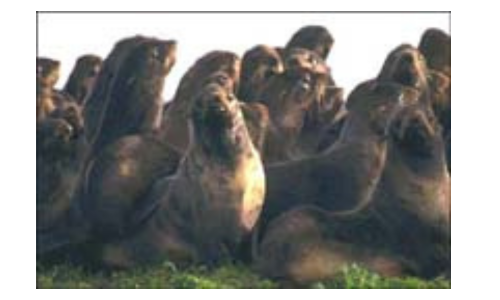
The breeding males begin to arrive on the Pribyloffs at various dates in May, and they remain continuously ashore for about three months. The females arrive nearly a month later. The “pups” are born in June and July, and commence to herd by themselves away from their mothers towards the middle or end of August. They frequent the beach in great numbers, and bathe or swim in the surf. But the photograph which is here reproduced will give one an absolutely exact idea of how the seals bask on the beach in the sunlight on Zoltoi sands in St. Paul’s Island, one of the Pribyloffs.
“The Americans had told us,” remarked Sir George Baden-Powell as he looked at this photograph, “that the seals were pretty well exterminated on the Zoltoi sands; they told us that no seals would be found here. You can see for yourself what truth there was in this assertion. Fortunately, we had a Government photographer with us to obtain this indisputable evidence. I remember that in order to get this photograph we had to creep up carefully and noiselessly to the top of the dunes overlooking the beach. Had the basking seals heard us coming they would all have taken to the water. Most of the animals you see in this photo, are ‘Holluschickie” — that is to say, half-grown males or bachelors. These and a few old bulls are the last to leave the island.”
On the Pribyloff and Commander Islands in the North Pacific, large numbers of fur seals have been regularly killed for more than 100 years since the first occupation of these islands by the Russians. In 1868 the Pribyloffs passed into the control of the United States. Then came much indiscriminate slaughter, and, although for a great number of years certain restrictions were imposed, it was not until the year 1875 that the first note of warning was sounded about the economy of seal life. In 1870 the Pribyloffs were leased by the United States to the Alaska Commercial Company, who were allowed to kill 100,000 males annually. The result of this tremendous slaughter was very quickly noticeable. Monsieur Grebnitzky, Superintendent of the Commander Islands, and himself a great seal naturalist, declared that when the proportion of females exceeded ten to each mature male, he considered that too many males were being killed, and that each “harem” should in no case contain more than twenty females.
“Now, however,” remarked Sir George, ” the harems in the Pribyloffs are yearly growing larger, so that, according to our own observations, it was no uncommon thing to find a single male seal with a harem numbering from forty to fifty, and even as many as sixty to eighty females.” By only killing males the natural proportion of the sexes has been upset, which is contrary to all successful experience on cattle ranches, sheep stations, or deer forests.
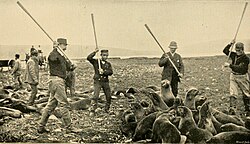
There are, it seems, two distinct ways of hunting seals — land sealing and pelagic sealing. The former is a very simple business. Men go down in gangs to the beach, and simply drive a number of seals some way inland, and there club them to death and skin them. Pelagic sealing is a phrase applied especially to the hunting of the fur seal in the open sea, schooners or other small vessels being employed as the basis of operation. This method originated, and has been practised from time immemorial, by the coast natives of British Columbia, South-East Alaska, and the State of Washington.
We asked Sir George whether the seals were in any way dangerous. “The younger seals of both sexes are harmless Enough,” was the reply, “except that they bite and even kill one another in times of excitement, such as during a ‘drive’; but I must say that the old bulls are rather unpleasant customers to deal with. Some of these actually attain the respectable age of twenty years and upwards, and are many times larger than the average female. I saw a great number of old bulls that were larger than a full-sized Polar bear, and one fellow was nearly as big as a cow. Moreover, strange as it may seem, one of these old bull seals will pursue and overtake a man in fifty yards. If, of course, a man has more start than this, he may possibly get away, as the seal cannot maintain a great speed for any distance. These old bulls, however, have been known to bite savagely at a man and hurl him backwards over their head.”
Here Sir George Baden-Powell showed us the two very interesting photographs which we reproduce. The first photo, shows an old bull asleep on one of the seal rookeries of the Pribyloff Islands.
“He was a huge, powerful fellow,” remarked Sir George; “probably weighing 700lb. or 800lb. When we first saw him he was fast asleep like this on the sands, but I fancy the movements of the photographer must have woke him up. At any rate, he did awake, and slowly raised himself up as you see in the second photo. We could not put a man by the side of him for comparison — for very obvious reasons — but I can assure you that this bull seal was nearly as big as a donkey, When he raised himself up like this, he gave vent to a hoarse roar, and made off in the direction of the sea.”
It was in 1878-7 that pelagic or sea sealing began to attract attention, and from four schooners at that time the sealing fleet in British Columbia increased, until in 1891 upwards of fifty vessels were employed in it. These were provided with 370 boats and canoes, manned by 1,083 whites and Indians. The number of skins procured by this fleet in 1891 was 49,615. In the same year the sailing fleet of the United States numbered more than forty vessels, and the value of the catch was rather more than £30,000. Since 1887 the decrease in the number of seals in the Pribyloff Islands, which had been very rapid, has ceased, and the numbers are again steadily increasing. More females are being killed at sea, and not so many males on shore.
We need hardly say that during this prolonged cruise Sir George beheld many strange spectacles; but perhaps the strangest of all is represented by the frontispiece of this Magazine, which is probably the most astounding photograph ever taken. Our frontispiece is reproduced from an instantaneous photograph of Borgosloff, the island which was thrust up from the sea in a single night slightly to the north of the Aleutian chain.
“The natives in those parts,” remarked Sir George, “told us one night about strange, weird flames that had been seen rising out of the water far out at sea. Next day we came upon this awful and mysterious island, which was composed of lava and other volcanic material. The precipice facing you in the picture was upwards of 360ft. high. Fortunately for us a strong wind was blowing, otherwise we might have been choked by the very strong sulphurous fumes which you can see for yourself are being blown away from this wonderful island.”
It must be said that avarice is the principal cause of the diminution of the seals. The Alaska Commercial Company exacted the utmost value out of their lease of the Pribyloffs. Soon the larger seals became scarce, and then the standard weight of skins was. steadily lowered, so as to include the younger seals in the “killables” Instead of skins weighing 7Ib. or 8lb., those of 6lb. and even 4lb. were taken and accepted by the Company as early as 1889. The Government, in the new 1891 lease, have increased the tax on skins from 2dols. 25 cents to 10dols. 25 cents.
But perhaps the most serious cause of waste of seal life on the Prybyloffs just now is the dying of the pups, due chiefly to the presence of “parasitic uncinaria,” and also to accidental killing by over-driving and other violence inseparable from driving and clubbing; the trampling to death of pups by the older seals in the stampede; and, lastly, poaching and raids generally. The extraordinary photograph of the Great Seal Rookery on Copper Island, which forms the subject of the full-page illustration reproduced on the next page, will enable the reader to realize that seal poaching, if it could be safely worked, is one of the most profitable kinds of theft imaginable. A glance at this wonderful photo, will show that the beach is literally alive with seals, while thousands more are seen playing in the sea. The Russian rookeries are now so carefully guarded, however, that poaching is practically impossible, but formerly it was conducted in a wholesale manner and in an abominably cruel way.
On Copper Island the killing of young seals for native food has been prohibited for the last seventeen years, and a fine of one hundred roubles is exacted in the case of each female accidentally killed. The name of this island, by the way, is due to the fact that native copper was originally found in little nuggets along the shore. Copper Island is watched by the Russians on the very best principles. A Cossack Guard is kept there with orders to shoot ruthlessly any persons found illegally killing the seals. This severe order was given on account of the wanton way in which the sealers formerly worked. In the South Seas they used to club every seal, whether male or female, big or little, that scrambled ashore, and consequently in six or seven years’ time there was hardly a seal left.
Talking about poaching raids, these were at one time very common in the Pribyloffs. On the night of June 8th, 1891, the special agent in St. Paul’s Island reported that a schooner, supposed from her suspicious movements to be on a predatory mission to these waters, was sighted off the east end of the island. This proved to be the Flying Mist, but seeing people on shore she stood out to sea again, returning, however, later in the season when the nights were longer, and killing and capturing seals during the night. In the autumn of 1889, the Allie Algar raided the Island of St. George, and procured more than 800 .skins. Certain members of this same schooner’s crew boasted that, in the same year,fifteen men had in one night in five hours killed upwards of 1,000 seals. Another poaching schooner was surprised in this very act of raiding, and she departed hastily, leaving 190 female seals dead on the beach.
One result of this policy of extermination has been to make the seal more pelagic or sea-going in its habits. Few people have any idea of the magnitude of the sealing industry, even at the present day. The buildings, plant, and equipment of the North American Company in the islands of St. Paul and St. Ceorge are estimated to be worth 130,00dols. The estimated total value of the British Columbia sailing vessels with their equipment, as they sailed in 1891, was 359,000dols. Add to this amount an estimate of the value of the United States Sailing Fleet in the same year — from 250,000dols. To 300,000dols. — and we get a total for the combined fleet of about 750,000dols. In one year (1891) the American sailing fleet took 68,000 skins at sea.
On the Pribyloff Islands, the whole native population employed in killing seals numbers about 300. At the present day the work is carried on in accordance with most rigorous regulations; and in view of the fact that the virtual extinction of the fur seal in the South Seas is entirely due to the killing having been carried out on shore during the breeding season, profitable sealing on the Pribyloffs is limited to a period of two months.
The “drives” are now made as short as possible — often not more than half a mile. There is no hurrying about this, and the “drives” are under the personal supervision and responsibility of an officer. There is, however, still room for improvement. Sir George Baden-Powell recommends that all seals not intended to be killed should be separated as soon as possible from each “drive.” The actual clubbing, too, should be performed with greater care, so as to avoid injury or death to seals not intended to be taken. As to pelagic or sea sealing the use of rifles for shooting seals should be prohibited, and spears employed instead as the method of capture.
Then, again, white hunters should have personal licenses, renewable annually. The maximum number of seals to be taken on the Pribyloffs was recommended to be fixed at 50,000 annually. A close time was also suggested, extending from September 15th to May 1st in each year. During this period it was recommended that all killing should be prohibited, with the additional provision that no sealing vessel should enter Behring Sea before July 1st of each year.
Now, as to the question of the seal’s food. The fur seal has been known to eat all kinds of fish, including cod, and even halibut. Its favourite diet, however, is small fish, of which the herring is the most important. Sir George Baden-Powell gathered some very curious facts about the animal’s habits: —
“An Aleut foreman in charge of the rookeries on Behring Island said that the young seals began to swallow pebbles when about four months old. It also seems that during the time the seals are on the islands they have a prolonged fast. Colonel J. Murray told us that he examined the stomachs of several hundred young seals killed by the natives for food, but he never found the slightest trace of food in the stomachs of the animals themselves. ‘On their arrival in the spring,’ Colonel Murray goes on to say, ‘the seals are very fat and unwieldy, but when they leave after their four months’ fast they are very often reduced to one-half their former weight.’ The habits of the animal are such as to require a safe terrestrial retreat at the season during which the young are born, and where the little ones may remain undisturbed for three or four months, until such time as they are able to assume the sea-going habits of their parents.”
In the next photograph which we reproduce we are looking down on one of the great seal rookeries of Copper Island from some distance up a precipice, whose total height is about 200ft. The view is a most extraordinary one. The sandy beach is dotted all over with seals, and our eye extends along the wild coast, whee the surf is roaring and breaking amidst the rocks.
The sea rookeries on St. Paul’s Island are the most important in the Pribyloffs. There is neither tree nor shrub worth speaking of in either St. Paul or St. George; the surface is covered with grass, moss, and lichen. It seems that the seals are not particular in their choice of a rookery. The only two things they avoid are mud and loose sand. The animals have some curious enemies. On Robben Island large numbers of young pups are killed by the burgomaster gulls, which pick out their eyes. This is so well known that a reward of five kopecks is given for each gull killed. Another danger to the pups is when the adult bull runs amuck and fights. But the most terrible cause of seal mortality is the “killer-whale.” Lieutenant Maynard speaks of a single killer-whale which was found with fourteen young seals in its stomach. Lastly, young seals die of the disease and violence already mentioned.
“At Tolstoi Rookery, in St. Paul’s Island,” said Sir Cieorge, “we ourselves observed, on July 29th, 1891 hundreds of dead pups on the smooth slope some little distance from the shore. These, on further examination, were shown to have died of an exhausting parasitic disease.
“However well regulated,” continued Sir George, “the method adopted ol driving fur seals must be cruel and destructive. The animal goes at a short shuffling run, then rests. If the weather is at all warm during the driving, individuals drop out and die; others are smothered or badly bitten by their fellows. It is a grim fact that the killing ground to which the seals are driven is always close to the salting house, so that it may be said that the seals are compelled to carry their own skin from the beach to the warehouse. The drive on St. George’s Island is about three miles in extent, the time occupied being from four to six hours, according to the weather.
During the drive the animals become very much exhausted, and quite dazed through fear. The effects of driving may be seen along the routes by the significant frequency of skeletons and bones round each rocky place that has to be passed. During the drive the seals flop about in a helpless and frightened manner, emitting hoarse cries. When the killing ground is reached the men provide themselves with wooden clubs, something like the capstan-bar of a ship in size, shape, and weight. The animals are then struck on the head; and expert killers only require to deal one blow. The animals are next skinned expeditiously, and the skins placed in piles on top of each other, with layers of salt in between.”
Experts assert that different localities produce different skins. The “Alaska” skin is supposed to come from the Pribyloff Islands, whilst the “Copper” hails from the Commander Islands. Of these, the former has the longer and finer fur. But Sir George tested this by marked skins he brought from the islands, and found the names were given to skins of a certain character, but not according to actual place of origin. The major portion of the Pribyloff catch are two or three year olds, and when the skins are placed together in bundles of two, the separate packages weigh from 12lb. to 15lb. each.
In the accompanying photograph we see a great number of the skins are rolled up together in pairs in this way, ready for shipment. In this shape they go into the hold of the coast steamer at St. Paul, and are counted out from it at San Francisco.
The process of preparing seal skins for the market — costing on the whole 18s. to 20s. per skin — is a prosperous industry in London.
After investigating affairs in all parts of Behring Sea, and consulting with the native and white pelagic sealers from Sitka down to Seattle and with the authorities at Ottawa, Sir George, with his Canadian colleague, proceeded to Washington, he having crossed to England to consult with Lord Salisbury. He was then appointed, in December, 1891, British member of the joint Commission in Washington, and assisted our Ambassador, Sir Julian Pauncefote, in obtaining the Treaty referring all matters in dispute to arbitration.
Returning to England, the two Commissioners prepared their full Report to Her Majesty, and then Lord Salisbury appointed Sir George adviser in the preparation of the British case before the Paris Arbitration, in which we achieved a victory particularly memorable, in that it is the only instance in which we have ever won an International Arbitration. And it was acknowledged on all hands that this victory was principally due to the full and exact information obtained as to all right of navigation and fishery in Behring Sea, and also as to fur seals and their habits, by the British Commissioner and his Canadian colleague, whose portraits appear on the first page of this article.
William G. FitzGerald, “The Romance of Seal Hunting, An Interview with Sir George Baden-Powell,…,” The Wide World Magazine vol I, no. 1 (April, 1898): pp. 4-11. Lead image is found in: https://en.wikipedia.org/wiki/Seal_hunting. Color images appear in: https://web.archive.org/web/20070714072938/http://nmml.afsc.noaa.gov/gallery/
See: https://babel.hathitrust.org/cgi/pt?id=aeu.ark:/13960/t7wm1sq66&seq=1