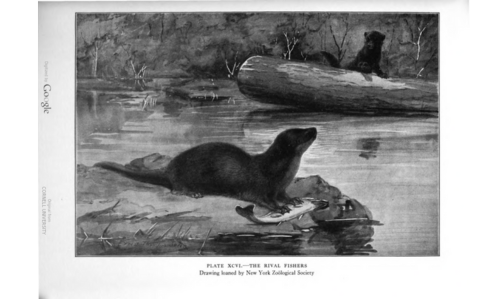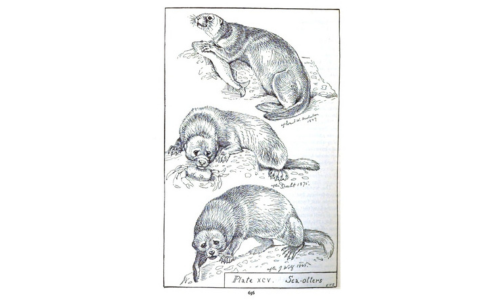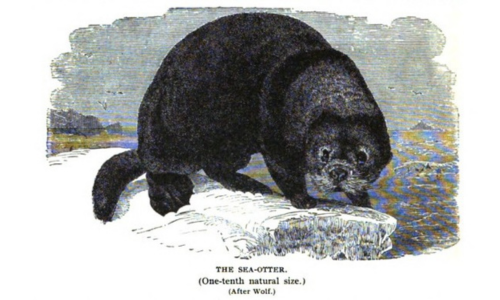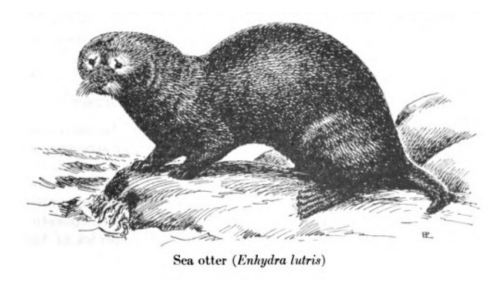
Sea Otters
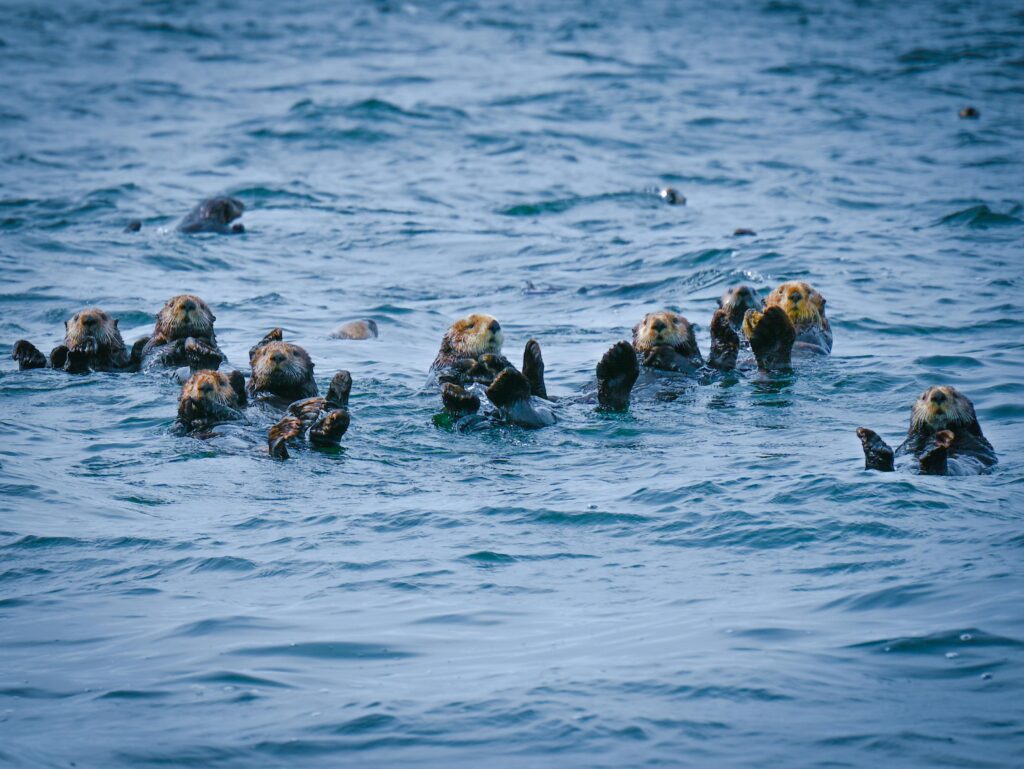
We want you to have a greater ability to learn about some of the unpleasant animal issues in our world.
Wild Animals of North America
Charles B. Cory
SEA OTTER:
Enhydra lutris and its subspecies
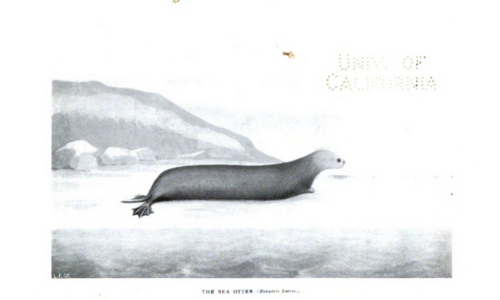
Sea otters, distant relatives of land otters, are heavy-bodied animals, about four feet long, with broad webbed hind feet. When in the water they have a general resemblance to seals, whose mode of life is similar to theirs. Their fur is extremely dense and on the skins of adult males is almost black, closely sprinkled with long, white-tipped hairs. The fur of prime skins has a silky luster, equaled in beauty by only the finest silver-tipped fox skins. For centuries sea-otter fur has been highly prized and single skins have brought more than $2,000 in the London market.
Otters are limited to the coasts of the North Pacific where formerly they were incredibly abundant all the way from the shores and islands of Lower California to the Aleutians, and thence along the Asiatic coast to the Kuril Islands. Through excessive hunting, they are now extinct along most of this extended coastline.In the days of the Russian occupation of Alaska the discovery of the abundance of sea otters led to intense activity in their pursuit. Otter-hunting expeditions were organized by the Russians along the storm-swept coast from Unalaska to Sitka, sailing vessels being used as convoys for hundreds of Aleut hunters in their skin-covered boats. The loss of life among the hunters under their brutal taskmasters was appalling and resulted in seriously and permanently reducing the native population of the Aleutian Islands. At the same time enormous numbers of sea-otter skins were taken. Afterward both English and American ships engaged in the pursuit of otters farther down the coast.
The first year after the discovery of the Pribilof Islands the records show that 5,000 sea otters were taken there. Many expeditions in other directions secured from one to several thousand skins. When sea otters were most abundant they were found all down the coast, even in San Francisco Bay, and one American trading vessel obtained 7,000 skins in a few weeks from the natives of the northern coast of Lower California.
The otters formerly frequented the shores of rocky islands and outlying reefs, but constant persecution has driven the few survivors to remain almost constantly at sea, where they seek resting places among kelp beds. They are now excessively shy and, aided by keen eyes and an acute sense of smell, are difficult to approach. When anything excites their curiosity they commonly raise the body upright, the head high above water, and gaze steadily at the object. If alarmed, they dive and reappear at a long distance.
Otter hunters report the animals very playful in pleasant weather. Sometimes they float on their backs and play with pieces of kelp. The mother is devoted to her young and is said to frolic with it in the water for hours at a time. All efforts to rear the young in captivity have failed. The food of the sea otter is mainly shellfish of various kinds, secured by them from the bottom of the sea.
Practically the only sea otters left among the hordes which once frequented the American shores of the North Pacific are now scattered along the Aleutian Islands. Government regulations prohibit their being hunted and it is hoped that enough still remain to restock the wild and stormy sea where they have their home.
Edward W. Nelson, Wild Animals of North America: Intimate Studies of Big and Little Creatures of the Mammal Kingdom (Washington, DC: National Geographic Society, 1918), pp. 76 and 78
See: https://babel.hathitrust.org/cgi/pt?id=coo.31924022544534&seq=1&q1=
Hunting the Sea Otter
Alexander Allan
We had not proceeded far when Snow, whose boat was in advance and who, it may be mentioned here, had, on account of his former experience, been unanimously elected leader in all the hunting arrangements, raised his paddle aloft as a sign that he had “viewed.” Sitting down quickly and plying his paddle so as to urge the boat onward as near as possible before the otter should take the alarm, Snow presently rose, rifle in hand, and simultaneously with the report we saw the otter’s head disappear beneath the wave about two hundred yards in advance. Quickly resuming his paddle, the boat shot forward until over the place where the otter had dived, while the skipper and I took our respective places in the rear.
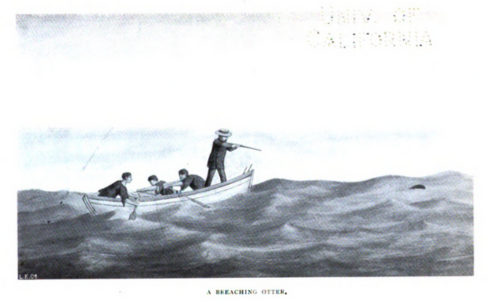
Presently the hissing sound of his escaping breath drew my attention to the otter, which had risen about fifty yards to the right. Quick as thought a bullet splashed up the water near him, as, alarmed by the close proximity of the boat and its occupants, it dived again. Pulling rapidly away, the other two boats advanced so as to bring the spot where the otter had disappeared in the middle of the triangle; another interval, and the otter rose close to Snow, but, instead of diving, it commenced “breaching,” while Snow, in full pursuit, took snapshots with his Winchester every time it left the water.
The animal tried every artifice to elude its pursuers, dodging now to the right, now to the left; but no breeze ruffled the oily smoothness of the water, and a long train of air bubbles that ascended from the pelt gave as sure an indication of its presence and direction as if it had been seen, enabling the hunter to guide the rowers accordingly. This continued for some time until the otter, finding such tactics useless, dived back, only to emerge near me and go through the same performance, then several more long dives gave opportunities for steadier shots.
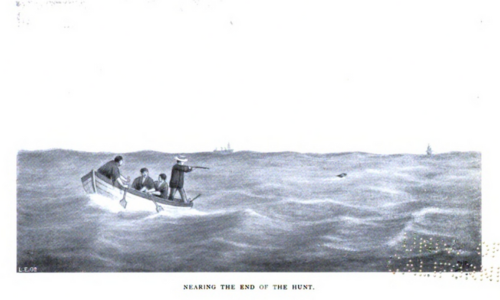
The chase lasted four hours, most of the time being occupied in breaching at a great pace, until eventually the dives became shorter, and longer time had to be taken for getting breath, until a well-directed shot in the head from Snow’s rifle put an end to his life, as well as to one of the longest and most exciting chases during the whole of our cruise. The otter, an old, white-headed bull, proved one of the largest and gamest we were destined to meet with.
The sun, which was high in the heavens, had become quite powerful, so we rested for ten minutes to give the men time for a smoke and to wipe off the perspiration that trickled down their swarthy faces. Another otter was soon sighted, which, being encumbered with a very young pup, soon succumbed; the maternal instincts aroused by its plaintive wailing prevented her from deserting or, by taking too long dives, from drowning it, until a well-aimed shot put an end to her life and anxiety. This hunt was in great contrast to the first, and was objectionable to all of us as savouring of cruelty. The feeling of a true sportsman is always strongly opposed to the destruction of any wild animal under such conditions, tigers, perhaps, excepted.
But the costly preparations and heavy outlay demanded for such work as otter hunting, the continual danger of shipwreck, and the risks run in the boats must not be lost sight of; while, further, the shortness of the hunting season, the prevalence of gales and fogs give to the sea otter an amount of protection and extent of “close” season which will, I trust, go far to extenuate, if not excuse, a practice universal among those who follow this dangerous occupation.
Alexander Allan, Hunting the Sea Otter (London: H. Cox, 1910), pp. 71-73
See: https://babel.hathitrust.org/cgi/pt?id=uc1.c027165899&seq=1
The Marine Mammals of the North-West Coast of North America
Charles M. Scammon
CHAPTER VI.
THE SEA OTTER.
The most valuable fur-bearing animals inhabiting the waters of the North-western Coast of North America are the Sea Otters. They are found as far south as twenty-eight degrees north latitude, and their northern limits include the Aleutian Islands. Although never migrating to the southern hemisphere, these peculiar amphibious animals are found around the isolated points of southern Kamschatka, and even to the western Kuriles, a chain of islands that separates the Okhotsk Sea from the north-eastern Pacific.
The mating season of the Sea Otter is not known, as the young are met with in all months of the year; hence, it is reasonable to suppose they differ from most other species of fur-bearing marine mammalia in this respect. The time of gestation is supposed to be eight or nine months.
The hind feet, or flippers, of the animal are webbed, much like the seal’s. Its fore legs are short, the fore paws resembling those of a cat, being furnished with five sharp claws, as are the posterior flippers. The oldest and most observing hunters about Point Grenville (in latitude 47° 20′) aver that the “Sea Otter is never seen on shore unless it is wounded.” Nevertheless, we have accounts of their being found on the Aleutian Islands when the Russians were first engaged in the fur trade, and the animals are still occasionally taken, while asleep upon the rocks. We quote the following from Coxe’s work on Russian Discoveries between Asia and America, and the Conquest of Siberia, published in 1780: “Of all these furs, the skins of the Sea Otters are the richest and most valuable. These animals resort in great numbers to the Aleutian and Fox islands; they are called by the Russians Boobry Morski, or sea beavers, on account of the resemblance of their fur to that of the common beaver.
They are taken four ways: struck with darts as they are sleeping upon their backs in the sea; followed by boats and hunted down until they are tired; surprised in caverns, and taken in nets.” They are possessed of much sagacity, have great powers of scent, and are exceedingly imbued with curiosity. Their home is nearly as much in the water as that of some species of whales; and as whalers have their favorite “cruising-grounds,” so, likewise, do the Otter-hunters have their favorite hunting-grounds, or points where the objects of pursuit are found in greater numbers than along the general stretch of the coast.
About the sea-board of Upper and Lower California, Cerros, San Geronimo, Guadalupe, San Nicolas, and San Miguel islands, have been regarded as choice places to pursue them; and farther northward, off Cape Blanco, on the Oregon coast, and Point Grenville and Gray’s Harbor, along the coast of Washington Territory. At the present day, considerable numbers are taken by whites and Indians about those northern grounds. Thence, to the northward and westward, come a broken coast and groups of islands, where the animals were, in times past, hunted by the employés of the Hudson’s Bay Company and Russian-American Company, and where they are still pursued by the natives inhabiting those rock-bound shores.
These interesting mammals are gregarious, and are frequently seen in bands numbering from fifty up to hundreds. When in rapid movement, they make alternate undulating leaps out of the water, plunging again, as do seals and porpoises. They are frequently seen, too, with the hind flippers extended, as if catching the breeze to sail or drift before it.
They live on clams, crabs, and various species of crustacea, and sometimes small fish. When the Otter descends and brings up any article of food, it instantly resumes its habitual attitude — on the back — to devour it. In sunny days, when looking, it sometimes shades its eyes with one fore paw, much in the same manner as a person does with the hand. The females rarely have more than a single one at a birth — never more than two — which are “brought forth upon the kelp,” say the white hunters, that abounds at nearly all points known as their favorite resorting-places. The mothers caress and suckle their offspring seemingly with much affection, fondling them with their fore paws — reclining, in their usual manner — and frequently uttering a plaintive sound, which may have given rise to the saying that “Sea Otters sing to quiet their young ones,” and gives some credence to the suggestion that the human-like actions of the animal originated the story about mermaids. But when they are startled, they rise perpendicularly half their length out of the water; and if their quick, sharp eyes discern aught to cause alarm, the cubs are seized by the mouth, and both mother and offspring instantly disappear under water. Males and females are sometimes seen curled up in such shapelessness as to present no appearance of animal form. When in this posture they are said to be sleeping.
Sea Otters are rarely seen far from shore, their home being among the thick beds of kelp near the beach, or about outlying rocky reefs and islets. Point Grenville, however, seems to be an exception, as there is no kelp in sight from the shore.
PURSUIT AND CAPTURE. — About the period of the establishment of Fort Astoria, near the mouth of the Columbia River, and for many succeeding years, the Sea Otter hunters along the coasts of California and Oregon were made up from nearly all the maritime nations of Europe and America, as well as from the different tribes of natives that dwelt near the sea-shore. Those of the former were hardy spirits, who preferred a wild life and adventurous pursuits, rather than civilized employment. The distance coasted in their lightly constructed boats, the stealthy search for the game, and when discovered, the sharp-shooting chase, gave these hunting expeditions a pleasant tinge of venture. Moreover, the taking of Sea Otters on the coasts of the Californias was prohibited by the Mexican government, and the hunters were aware that, if detected, the penalty would be severe; hence, they ever kept a watchful eye on all vessels seen, which were carefully avoided or cautiously approached.
A peculiar sort of boat is used by the hunters, called an “Otter-canoe.” It is fifteen feet long, nearly five wide, and eighteen inches deep. It is sharp at each end, with flaring sides, and but little sheer. Still, these boats are excellent “sea-goers,” and are regarded as unsurpassed for landing through the surf, their shape being peculiar. So, likewise, are the paddles for propelling them, which are short, with very broad blades —they being better adapted for use in the thick beds of kelp. The outfit, when going on a cruise, is limited to nearly the barest necessities. Three men usually go in one boat — two to paddle, and one to shoot; the latter having two or three favorite rifles, with a supply of ammunition. A little tea, coffee, sugar, flour, or ship-bread, is provided, adding pipes and tobacco, and, as a great luxury, perhaps a keg of spirits completes their equipment.
All being in readiness, they leave the quiet waters of the harbor, and put to sea, following the general trend of the land, but at times making a broad deviation, to hunt about some islands, miles from the main-land. When an Otter is seen within rifle-shot, instantly the hunter fires; and if only wounding the animal, it dives under the water, but soon re-appears, to be repeatedly shot at until killed. Sometimes, three boats will hunt together. Then they take positions, one on each side, but in advance of the third, and all three in the rear of where the animal is expected to be seen. It is only the practiced eye of the experienced men that can detect the tip of the animal’s nose peering above water, and frequently disguised by a leaf of kelp.
Occasionally, a large band is met with. Then every exertion is made to keep them within the triangle formed by the boats; and, at such times, a deal of rapid and sharp shooting ensues, and many a bullet sings through the air, or skips over the water, almost as near the pursuers as the animals pursued. However, six, eight, or a dozen Otters are sometimes secured before the main body disperses; and it is rarely any accident occurs by reckless firing.
From day to day, if the weather is pleasant, they cruise in search of the animals — landing to pass the night at different places well known to them, behind some point or rock that breaks the ocean swell. The landings are made by watching the successive rollers as they break upon the beach, and when a favorable time comes, the boat, under dexterous management, glides over the surf with safety to the shore. It is then hauled up clear of the water, and turned partially over for a shelter, or a tent is pitched. A fire is made of drift-wood, or, if this fail, the dry stalks of the cactus, or a bunch of dead chaparral, serves them; and, if their provisions should be getting short, an excursion is made up some one of the many ravines or intervals — perhaps to a stagnant water-pool, where the deer and antelope in that arid region resort to quench their parching thirst.
The unerring rifle brings one to the ground, when out comes the hunter’s knife, and cutting the choice pieces from the creature, he sallies back again to camp, and soon has the venison broiling over the coals, and, in due time, it is added to their evening meal, which is partaken of with hearty relish; then follow the pipes, which are enjoyed as only those men of free and easy life can enjoy them. Relieved from all care, these adventurers talk of past exploits or frolics, and finally roll themselves in their blankets for a night’s invigorating sleep in the open air.
At daybreak they are all awakened by the screams of sea-birds and the barking of coyotes, attracted by the scent of the encampment. The morning repast over, they again embark in their cockle-shell boats, launch through the surf, gain the open sea, and paddle or sail along the shores in search of “Otter signs.” But the scarcity of Otters on the old hunting-grounds has developed the character of these fearless hunters, who, in order to still maintain their game-life, have again reluctantly taken to their pigmy sea- craft — a small vessel of forty tons — in which they have stretched across the Pacific to the western Kuriles (the extreme geographical limit of the breeding-grounds), and now successfully pursue them around those rugged islands during summer, returning again to the California shores with their rich booty as winter approaches.
HUNTING FROM THE SHORE. — From San Francisco northward, as far as Juan de Fuca Strait, the hunting is chiefly prosecuted by shooting the animals from the shore; the most noted grounds being between Gray’s Harbor and Point Grenville — a belt of low coast, lying within the parallels of 46° and 48°, north latitude.
The white hunter builds his two log-cabins; one, near the southern limits of his beat, and the other at its northern terminus near Point Grenville. During the prevalence of the southerly winter gales he takes up his quarters at the last-named station, as the game is found there more frequently; but when the summer winds sweep down from the north he changes his habitation, and pursues the animals about the breakers of Gray’s Harbor. From early dawn until the sun sinks beneath the horizon, the hunter, with rifle in hand and ammunition slung across his shoulder, walks the beach on the lookout for “a shot.” The instant one is seen, crack goes the rifle; but it is seldom the animal is secured by one fire. A Sea Otter’s head bobbing about in the restless swell is a very uncertain mark; and if instantly killed, the receding tide or adverse wind might drift the animal seaward: so that, even if it eventually drift to shore, it may be far out of sight from the hunters by day, or be thrown on the rocks by the surge during the night, and picked up by some of the strolling Indians who run the beach in quest of any dead seal or Otter that may come in their way.
The difficulty in shooting from the shore, when the marksman stands nearly on a level with the ever-changing swell, has always been an aggravating annoyance; to avoid which, the hunters now use a sort of ladder, or, as it may be termed, two ladders, joined near the upper ends by a hinge, spreading at the lower ends, forming a triangle — when placed on the beach or in the edge of the water — on which the hunter climbs in order to gain elevation. The ladders are made of light material, so that they can be easily carried at any time, should the sea be ruffled by a local wind or waves from seaward.
When an Otter is seen, up go the ladders, and up goes the hunter to the topmost round, and fires. The shot is repeated very quickly, if the first does not take effect; and ball after ball is sent after the animal, until it is far out of reach. It is estimated that the best shooters average at least twenty-five shots to every Otter obtained, and that about one-half the number killed are secured by the rightful owners; but, when once in their possession, it is quickly fleeced of its valuable skin, which is stretched on the walls of the cabin to dry. It is no unusual occurrence for the hunter to pass a week traveling up and down the beach, and he may shoot sixty or more rounds, and, perhaps, kill several Otters; but, owing to “bad luck,” not one may be secured — the carcass either drifting to sea, or to shore, possibly, with the flowing night-tide, and the object so patiently and eagerly sought for is at last stealthily appropriated by some skulking savage.
Notwithstanding their propensity to purloin, the Indians of the North-western Coast not only occasionally shoot the Sea Otters, as do the whites, but in the months of July and August, when calm weather prevails, they capture them by night. A small canoe is chosen for the purpose, and the implement used to capture the animals is a spear of native make, composed of bone and steel, fitted to a long pole by a socket. Four chosen men make the crew for the canoe.
Near the close of day, a sharp lookout is kept for any band of the animals that may have been seen from the shore, and their position accurately defined before beginning the pursuit. All being in readiness, as the shade of evening approaches, they launch their pigmy craft upon the calm sea, and three men paddle in silence toward the place where the Otters were seen, while the fourth takes his station in the bow. He is either a chief, or some one distinguished in the chase. He watches intently for the sleeping Otters. As soon as one is descried, the canoe is headed for it, and, when within reach, the spear is launched into the unwary creature. In its efforts to escape, it draws the spear from the pole. There is a small but strong cord connecting the spear and pole, which admits them to separate a few feet, but does not free the Otter. The animal dives deeply, but with great effort, as the unwieldy pole greatly retards its progress.
The keen-eyed savage traces its course, in the blinding darkness, by the phosphorescent light caused by the animal’s transit through the water; and when it rises upon the surface to breathe, it is beset with clubs, paddles, and perhaps another spear, and is finally dispatched, after repeated blows or thrusts. The conflict arouses the whole band, which instantly disappear; so that it is seldom more than one is secured. As soon as the hunt is over, the animal is brought on shore, the skin taken off and stretched to dry, and, when ready for market, the lucky owner considers himself enriched to the value of ten or fifteen blankets, and the flesh is devoured as a choice article of food.
The mode of capturing the Sea Otters between Point Grenville and the Aleutian Islands varies with the different native tribes inhabiting that coast. The Aleutians, dressed in their water-proof garments, made from the intestines of seals, wedge themselves into their baidarkas (which are constructed with a light, wooden frame, and covered with walrus or seal skin), and, donning their hunting-caps, plunge through the surf that dashes high among the crags, and, with almost instinctive skill, reach the less turbulent ground-swell that heaves in every direction. These aquatic men are so closely confined by the narrow build of their boats, and keeping motion with them, too, that their appearance suggests the idea that some undescribed marine monster had just emerged from the depths below.
Once clear of the rocks, however, the hunters watch diligently for the Otters. The first man that gets near one darts his spear, then throws up his paddle by way of signal; all the other boats forming a circle around him, at some distance. The wounded animal dives deeply, but soon returns to the surface, near some one of the baidarkas forming the circle. Again the hunter that is near enough hurls his spear and elevates his paddle, and again the ring is formed as before. In this way the chase is continued until the capture is made. As soon as the animal is brought on shore, the two oldest hunters examine it, and the one whose spear is found nearest its head is entitled to the prize.
The number of Sea Otter skins taken annually is not definitely known, but from the most authentic information we can obtain, the aggregate for the past three years has been five thousand, one thousand of which came from the Kurile Islands; and, valuing each skin at fifty dollars, amounts to the sum of two hundred and fifty thousand dollars.
Whether these very valuable fur animals have decreased in numbers within the past few years, is questionable. The hunting of them on the coast of California is no longer profitable for more than two or three hunters, and we believe of late some seasons have passed without any one legitimately engaging in the enterprise; notwithstanding, off Point Grenville, which is an old hunting-ground, sixty Otters were taken by only three hunters during the summer of 1868 — a great annual increase over many past years. It is said the Russian-American Company restricted the number taken yearly by the Aleutian Islanders, from whom the chief supply was obtained, in order to perpetuate the stock. Furthermore, may it not be that these sagacious animals have fled from those places on the coasts of the Californias where they were so constantly pursued, to some more isolated haunt, and now remain unmolested?
Charles M. Scammon, The Marine Mammals of the North-West Coast; Described and Illustrated: Together with an Account of the American Whale-Fishery (San Francisco: J. H. Carmany and Co., 1874), pp. 168-174.
See: https://babel.hathitrust.org/cgi/pt?id=mdp.39015017483317&seq=1&q1=
The New Natural History
Richard Lydekker and R. Bowdler Sharpe
THE SEA-OTTER
Genus Latax
As we have already seen, the feline otter of South America is in the habit of frequenting the lagoons and bays of its native coasts rather than rivers, and these marine habits are still more characteristic of the animal known as the sea-otter (Latax lutris), which is regarded as forming a genus by itself.
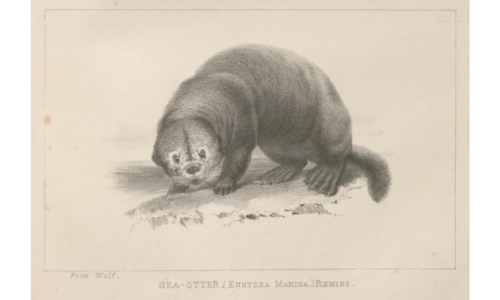
The sea-otter has a total length of about four feet, of which one foot, or rather less, is occupied by the tail. In general appearance it is compared by Dr. Coues to one of the eared seals, a resemblance which is increased by the long and flipper-like hind-feet, quite unlike those of all other members of the family to which it belongs. The body has a bolster-like form, tapering in front to join the rather small and rounded head, without any marked constriction at the neck. Both the limbs and tail are short, the latter being cylindrical, slightly tapering, and somewhat truncated at the end; while the disparity in the size of the fore and hind-feet is quite unknown in any of the Carnivores hitherto described. The skin is remarkably large and loose for the size of the animal, so that when removed from the body it can readily be stretched to a third more than its normal length. The pelage consists mainly of a fine soft woolly under-fur, among which are a small proportion of long, stiff hairs. The general color is dark, liver brown, silvered over with the grayish tips of the long hairs.
Remarkable as are the external characteristics of the sea-otter, it is not, however, solely, or even chiefly on them, that the zoologist relies in referring the animal to a genus apart from that containing the true otters. Equally noteworthy peculiarities occur in the number and structure of the teeth. In the first place, there are but two pairs of incisor teeth in the lower jaw, — a feature in which this species differs not only from other otters but likewise from every other true Carnivore. The total number of teeth is, therefore, thirty-two, as against thirty-six in the common otter; there being, as in the Indian clawless otter, but three pairs of premolar teeth in both the upper and the lower jaws. The cheek-teeth, although of the same general plan of structure as in the true otters, differ by their extremely blunted and rounded cusps. “If,” remarks Dr. Coues, “the teeth of ordinary carnivorous quadrupeds be likened to fresh-chipped, sharp, and angular bits of rock, those of the sea-otter are comparable to water-worn pebbles”; and we know of no simile which can better express the difference between the cheek-teeth of the common and the sea-otter.
Habitat. The sea-otter in an inhabitant of both coasts of the North Pacific; its chief haunts on the American side being Alaska, the Aleutian islands, the neighborhood of Sitka island on the west coast of Canada, and Vancouver island; its southern limits being the shores of Oregon. On the Asiatic side it occurs in Kamchatka, but apparently more rarely than on the eastern shores of the Pacific.
It is stated by Mr. H. W. Elliot that when the Russian traders first opened up the Aleutian islands, they found the natives commonly wearing cloaks made of the fur of the sea-otter, which they were at first willing to sell for a mere trifle, esteeming these skins much less than they did those of the fur-seals. Again, when the Pribilof islands, situated in Behring Sea to the eastward of the Aleutians, were first discovered, upward of five thousand skins of this species were taken in the first season, while in six years these animals had completely disappeared from the islands.
Nearly the same story is told in all the haunts of the sea-otter, which has now become a very rare animal indeed, and stands in sore need of protection if it is to escape total extermination. Mr. Elliot states that “over two-thirds of all the sea-otters taken in Alaska are secured in two small areas of water, little rocky islets and reefs around the islands of Sanak and Chernobours, which proves that these animals, in spite of the incessant hunting all the year round on this ground, seem to have some particular preference for it to the practical exclusion of nearly all the rest of the territory. This may be due to its better adaptation as a breeding ground.” A similar preference for a small area in the neighborhood of Gray’s harbor over the whole of the remainder of the coast of Washington and Oregon is also exhibited by these animals.
It is not the mainland of Sanak island which is frequented by the sea-otters, but the small islets and reefs lying to the southward and westward at a distance of about five miles, and thence stretching seaward, most of which are left bare at low water. Either on these islets and reefs, or, in calm weather, in the open sea around, the sea-otters are to be found.
Breeding. The female sea-otter has only two teats, and produces but a single young one at a birth, so that the increase of the species can be, at the best, but slow. The young may apparently be born at any season of the year, and do not attain maturity till four or five years old. Writing of the general habits of the species, Mr. Elliot observes that the “mother sleeps in the water on her back, with her young clasped between her fore-paws. The pup cannot live without its mother, though frequent attempts have been made by the natives to raise them, as they often capture them alive, but, like some other species of wild animals, it seems to be so deeply imbued with fear of man that it invariably dies from self-imposed starvation.”
Habits. The remarkable difference in the structure of the cheek-teeth of the sea-otter from those of the true otters, clearly indicates that there must be an equally marked difference in the food of the two; and the rounded prominences on the crowns of those of the present species would further suggest that they were adapted for pounding and crushing hard substances. As a matter of fact, Mr. Elliot tells us that the food of the sea-otters “is almost entirely composed of clams, mussels, and sea urchins, of which they are very fond, and which they break by striking the shells together, held in each fore-paw, sucking out the contents as they are fractured by these efforts; they also undoubtedly eat crabs, and the juicy tender fronds of kelp or seaweed, and fish. They are not polygamous, and more than one individual is seldom seen at a time when out at sea. The flesh is very unpalatable, highly charged with a rank smell and flavor. They are playful, it would seem, I am assured by several old hunters that they have watched the sea-otter for half an hour as it lay upon its back in the water and tossed a piece of seaweed up in the air from paw to paw, apparently taking great delight in catching it before it could fall into the water. It will also play with its young for hours. The quick hearing and acute smell possessed by the sea-otter are not equaled by any other creature in the territory. They will take alarm and leave from the effects of a small fire four or five miles to the windward of them; and the footstep of man must be washed by many tides before its trace ceases to alarm the animal, and drive it from landing.”
Hunting. In Alaska the sea-otter is often captured by shooting it in the head with a rifle bullet when the animal is sporting in the surf; the booming of the surf deadening the report of the rifle, and thus allowing successive shots to be taken till one is successful. An older plan is, however, for a party to go out in canoes when a sea-otter has been observed, and by arranging themselves in a circle around its last point of disappearance, so harass the creature on its subsequent emergence that eventually it becomes exhausted from sheer inability to breathe. The third method is by knocking the animal on the head with heavy clubs; but this can only be done during the winter at such times when strong gales are blowing from the northward.
Then, writes Mr. Elliot, the boldest of the natives set out in their canoes from Sanak, “and scud on the tail of the gale to the far outlying rocks, just sticking out above surf-wash, where they creep up from the leeward to the sea-otters found there at such times, with their heads stuck into the beds of kelp to avoid the wind. The noise of the gale is greater than that made by the stealthy movements of the hunters, who, armed each with a short, heavy wooden club, dispatch the animals one after another without alarming the whole body, and in this way two Aleuts were known to have slain seventy-eight in less than an hour and a half.”
Instead of these methods, which are employed in Unalaska island and the districts to the eastward, among the Atka Aleuts the sea-otters are caught in small coarse-meshed nets. These nets are spread out over the kelp beds upon which the otters are in the habit of sleeping. The animals getting entangled in the meshes on their arrival, appear to become almost paralyzed with fear and thus fall an easy prey to the hunters.
On the other hand, in Kamchatka, according to Dr. Guillemard, the sea-otter is always shot with a bow and arrows. “The former is a tough piece of wood five or six feet in length, which is enormously strengthened by a band of plaited hide on the outer face, so tightly fixed as to give the bow a curve in the opposite direction when unstrung. The arrows are of wood for three-quarters of their length, with feathers fitted diagonally along the shaft, so as to produce a rotatory motion. The remaining portion is of walrus ivory, provided at the end with a socket, into which a barbed copper point is inserted. This is connected to the arrow by a long string of plaited sinew wound around the shaft. When the otter is hit, the barb, which is very loose, becomes at once detached, and if the animal gain the sea, its where-abouts is indicated by the arrow floating above it.”
Pelage. The skin of the sea-otter is perhaps the most valuable of all furs, and when prepared for use has all the long hairs removed, leaving only the under-fur. In Kamchatka, Dr. Guillemard states that a good skin will bring even as much as seventy-five dollars to the native hunter, while a perfect example has been known to realize, according to Mr. Poland, as much as one thousand dollars in the European market. The average price in 1891 was two hundred and seventy-five dollars per skin.
Richard Lydekker and R. Bowdler Sharpe, et al.,The New Natural History (New York: Merrill & Baker, 189?), pp. 688-691.
See: https://babel.hathitrust.org/cgi/pt?id=mdp.39015082581177&seq=1
Lives of Game Animals
Ernest Thompson
LIFE XLI — THE SEA-OTTER
Sea-otter, Sea-beaver, or Kalan
Enhydra lutris (Linnæus)
(Gr. Enhydris, an Otter, from enhydros, living in the water; L. lutris, from Lutra, an Otter)
Mustela lutris LINNÆUS, 1785, Syst. Nat., ed. 10, I, p. 45.
Enhydra lutris GRAY, 1843, List Spec. Mamm. Brit. Mus., p. 72.
TYPE LOCALITY — Kamchatka.
RUSSIAN, Bobry morski or Sea-beaver.
FRENCH, Loutre marine.
ESKIMO, A-mi-kuk.
The genus Enhydra Fleming, 1822, belongs to the family Mustelidae or Weasels. It includes large seal-like animals, really Otters adapted for marine life. Skull as in Lutra, but with only 4 incisors in lower jaw; molars, massive with rounded cusps; mammae, 2, ventral; hind feet, large, flat, and flipper-like; fore paws, like those of the common Otter; tail, short.
Teeth. Inc. 3-3/2-2; can. 1-1/1-1; prem. 3-3/3-3; mol. 1-1/2-2 = 32
With these generic characters, the Sea-otter combines the following:
Size. Total length, 3 1/2 to 4 ft. (1,060 to 1,220 mm.); tail, about 12 in. (305 mm.); hind foot, about 6 in. (150 mm.); width of hind foot, about 4 in. (102 mm).
Colour. General colour, deep, glossy, brownish black, frosted with white-tipped hairs; head and neck, grayish white or yellowish white, especially in the young; top of head, dark brown. Sexes alike in colour, etc., but the a little smaller, and of finer fur.
RACES
Two races have been recognized:
lutris Linnæus, the typical form. T. 1., Kamchatka.
nereis Merriam, seems to be larger than the foregoing; the type was 6 ft. long in the flesh, but skull characters only are given. T.l., San Miguel Island, Calif. 6
HISTORY AND ANCIENT NUMBERS
It is not generally known that Padre Taraval, not Steller, was the first white man to see and write about the famous Sea-otter of the Pacific. The historian, Venegas, quotes Taraval’s account of the Sea-otters, which were abundant on Cedros Island, Lower California, at the time of his visit in 1737. He describes the ease with which they were killed by the Indians.
“Under Spanish rule, Sea-otter hunting and trading in their domain by foreign ships, was prohibited, but many thousands of skins were traded for by smuggling and hunting vessels, along the Pacific coast, early in the last century. One ship alone secured 1,700 Sea-otter skins from the natives during a single visit to Ensenada in 1809.”
It will be seen, however, that, although Taraval preceded Steller by four years in his discovery, his account was not given out till 1757, that is, six years after that of Steller had been published.
In 1741, when the intrepid and ill-fated Vitus Bering and his unfortunate followers landed on Bering Island, of the Commander group, they found the Sea-otters in bands on the beaches, or gambolling among the kelp and heavy swell of those rugged coasts. “They covered the shore in great droves; and as the animal is not migratory, but is born and bred there, they are so far from fearing man, that they would come up to our fires, and would not be driven away until, after many of them had been slain, they learned to know us and run away. Nevertheless, we killed upward of 800 of them and if the narrow limits of the craft we constructed had permitted, we should have killed three times as many.”
On their return to Kamchatka the following year (1742), these sailors, reduced by hardship from 78 to 44, brought with them more than 700 skins of this costly fur; and the news was spread of the Sea-otter’s haunts and numbers. Then followed a period of reckless slaughter by the rapacious Russian hunters.
Dr. G. W. Steller had been a member of the Bering Expedition. When the commander died, Steller, being an ardent naturalist, found time to collect material and write his famous “De Bestiis Marinis.” In this, he described, for the first time, the gigantic Sea-cow, or Rhytina, now extinct; the Sea-lion, another monster; the Fur-seal, now famous in commerce; and the Sea-otter, to be saved from extinction to-day only by organized national effort.
It was Steller’s description of the Sea-otter that furnished Linnæus with the basis for his formal naming of the species as Mustela lutris; for the father of scientific classification in natural history perceived promptly the kinship of the Sea-otter with the Weasels.
The next important occasion when the species appeared in history was when, on his famous voyage, Capt. James Cook met with the creature in 1777, and the following year gave a description of it in his narrative. From this time, accounts of the Sea-otter were frequently published; and travellers traced it across to America, and down the west coast, commenting on the wonders of its fur, and its abundance; for it was oftentimes seen in bands numbering from 50 up to hundreds.
Even so recently as 1880 to 1890, Littlejohn writes: “In the early days of my hunting on the Japan coast, we found the Otters in their primitive state, because they had never been hunted at sea. There we found them in ‘schools,’ and as many as 400 were sometimes seen in one.”
THE GREAT SLAUGHTER ON THE ASIATIC SHORES
The Sea-otter had for ages been a staple provider of fur and flesh for the natives of the northern Pacific coasts and islands. On the very day, in 1741, when Bering and his crew set eyes on its shining black velvet bands, gambolling and far-roving on the stormy Northern sea, thanks to the civilization that he heralded, the extermination of this wonderful creature began.
When the survivors of that ill-fated expedition returned to Kamchatka in 1742, as already related, they took with them 700 skins of the Sea-otter. Even in those days, the fur was precious; and among the traders, there was something like a rush for the Otter grounds. Then began the great slaughter on the Asiatic shores. The pursuers were so greedy, and the Otters so easily taken at first, that the shameful work was finished in a quarter the time it took us to extirpate the Buffalo.
Bering Island bands were the first attacked, and here “in 1745, Bassof and Trapeznikof secured 1,600 skins; in 1748, about 1,350 were killed. The result was that, within a very few years, the Sea-otter almost disappeared from Bering Island, for Tolstykh’s expedition obtained only 47 during the winter of 1749-50; Drushinin’s men, in 1754-55, took only 5; while in the account of Tolstykh’s second expedition, winter of 1756-57, it is expressly said that ‘no Sea-otters showed themselves that year.’ It is interesting to note that, even in those days, Copper Island offered a safer retreat for the Sea-otter, since Yugof, who also visited that island, returned home in 1754 with 790 skins.
“While not actually and literally exterminated on Bering Island — Trapeznikof’s expedition of 1762-63 secured 20 Otters there — it did not become common there again, except possibly during an alleged sudden reappearance in 1772, until after the abandonment of the island, when the Russian-American company was organized. Upon the re-colonization of the island, the Otters were found common in places; thus, it is said that in 1827, no less than 200 Otters were killed in one week at the Reef near the present Nikolski village. But the reckless slaughter of former days was resumed, and the Sea-otter long ago ceased to be a regular inhabitant of that island. Occasionally, a solitary individual strays over from Copper Island,” where a small herd exists under careful legal protection and management.
THE COPPER ISLAND BAND
Realizing that the Sea-otter must be protected and managed, or it would disappear together with the revenue it yielded, the Russian authorities took a very proper attitude. They put an end to all indiscriminate slaughter, and enacted laws to care for the remnant that still found a congenial home on Copper Island; with the result that they have “succeeded in preserving and increasing the Sea-otter to such an extent that I believe there is no other place in the world where so many Sea-otters can be seen at the present day [1897]. The condition of the herd is now such that 200 animals can be killed off yearly without detriment. The places where the Sea-otters have their rookeries are constantly guarded to keep intruders off. Shooting, making fire, or smoking, is strictly prohibited near these places. Only nets are now used to capture the Otters, and if any females or yearlings are caught alive, they must be set free. The number to be taken is determined in advance by the administration, and the hunting expeditions of the natives are undertaken in common, under the leadership of the chief; though each hunter keeps the Otter he secures. They are taken off their hands by the Russian Government at a certain fixed price.”
Thus the Otters are conserved; 249 natives are assured a living; the world’s markets still have a dribble of the much-prized skins; and the Government itself makes a comfortable clear annuity out of the plan.
“Recently,” says Townsend, in November, 1915, “the catch of Sea- otters from the Kurile Islands stretching southward from Kamchatka, has been compiled from official Japanese records by Captain Snow of Yokohama, for many years engaged in Sea-otter hunting. His figures place the total number of skins marketed from 1872 to 1909 at 12,453. [That is, an average of 336 per annum.]…. “In Asiatic waters (exclusive of the Commander Islands, where the Otter has been partially protected) the catch ranged from 1,000 to 1,500 a year.”
DISCOVERY OF THE OTTER ISLANDS OF AMERICA
The great slaughter of the Sea-otters began on the Russian side of the Pacific, but the adventurous and rapacious hunters were driven ever farther by the completion of this havoc, in search of those wonderful sea-robes; till, one by one, they discovered and exploited the Aleutian Islands and the Bering Sea. Thus, the Sea-otter was to the Alaskan coasts what the Beaver was to Canada — the immediate prize that ever lured on the hardy and enterprising; the creature whose robe was the most tangible promise of wealth held out by the new and unknown waste.
Thus, the islands were sought out; for each and all of them in that region were headquarters for a swarming band of gambolsome Sea-otters — thousands and tens of thousands there were.
In less degree, all the myriad islands of the north Pacific, swarmed with these wonderful children of the kelp and the surf.
Hitherto, the natives had taken but small toll of the Sea-otter. It was only one of several abundant robe-providers. Their needs were simple, their numbers were few.
The Otters abounded, but were lightly esteemed, for the Hair-seal and the Sea-lion offered flesh more palatable, and robes more serviceable to these northern hunters. And when the traders found a copper-coloured Aleut wearing a rich robe of Otter skins, it was easy to buy it from him for some trifle.
But soon the competitive bidding of rival greedy traders worked a change. The natives learned that one Otter skin was worth a score of other pelts, and they set about collecting them with new vigour and destructiveness. Thus the epoch of extermination on the American side was begun. “During the first few years, the numbers of these animals taken all along the Aleutian Chain, and down the whole northwest coast as far as Oregon, were very great; and compared with what are now captured, seem perfectly fabulous. For instance, when the Prybilov Islands were first discovered [1785], two sailors, Lukannon and Kaiekov, killed at St. Paul’s Island, in the first year of occupation, 5,000. The next year they got less than 1,000, and in 6 years after, not a single Sea-otter appeared; and none have appeared since.” That same year of abundance, 1786, according to Beechey, 50,000 Otter skins were collected.
Otter Island, close to St. Paul, still reminds us by its name of the primitive number of these animals. On St. George, the other big island of the Pribilofs, they were equally abundant. “They rapidly declined in numbers, and according to Veniaminoff, had become scarce by 1811, and extinct within the next 30 years.”
Thus, one by one, their favourite haunts and final refuges were ferreted out, and the same ghastly slaughter was repeated.
“When Shellikov’s party first visited Cook’s Inlet, they secured 3,000; during the second year, 2,000; in the third, only 800; the season following, they obtained 600; and finally in 1812, less than 100; and since then not a tenth of that number. The first visit made by the Russians to the Gulf of Yahkutat, in 1794, 2,000 Sea-otters were taken, but they diminished so rapidly that in 1799, less than 300 were taken. In 1798, a large party of Russians and Aleuts captured in Sitka Sound and neighbourhood 1,200 skins, besides those for which they traded with the natives there, fully as many more; and in the spring of 1800, a few American and English vessels came into Sitka Sound, anchored off the small Russian settlement there, and traded with the natives for over 2,000 skins, getting the trade of the Indians by giving fire-arms and powder, ball, etc., which the Russians did not dare to do, living then, as they were, in the country. In one of the early years of the Russian-American Company, 1804, Baranov went to the Okotsk from Alaska with 15,000 Sea-otter skins, that were worth as much then as they are now, viz., fully $1,000,000.”
Langsdorff, on his voyage (1803-07), has much to say about the Sea- otters of the Northwest coast, showing the importance of the trade. He speaks of a Boston ship arranging for a “cargo of Sea-otters…. [In San Francisco Harbor] we saw a great many Sea-otters.” “The channel which we followed to get into the [San Francisco] Bay, was full of Sea-otters and Sea-dogs…. Three Sea-otters, however, who lay sleeping almost close to our boat, presented a temptation not to be resisted, and these we did kill and carry away with us.”
As he journeyed along the coast of California, he wrote: “Sea-dogs and Sea-otters are taken in nets, though in very small numbers.”
When he reached the Island of Kodiak, he wrote: “Sea, River, and Marsh-otters were formerly taken by thousands. The Sea-otters, which were the principal source of wealth to the [Russian-American] Company, are now nearly extirpated, a few hundreds only being annually collected by the Company. The high prices given for the skins induce the Russians for the sake of momentary advantage, to kill all they meet with, both old and young, nor can they see that by such a procedure they must soon be deprived of the trade entirely.”
“The valuable Sea-otters, which were formerly taken in such abundance that in one voyage several thousands might be obtained, are now so much diminished in numbers that scarcely more than between 200 and 300 can be procured annually.” Island of Oonolaskha, 1805.
In 1805, Lewis and Clark were on the Columbia River, and wrote, November 3d, “Below Quicksand River the river is wide and contains a great number of Sea-otters.”
P. Taylor says these animals were abundant along the California coast, at least until the early part of the 19th Century. “Bryant has called attention to the fact that in the year 1801, no less than 16 ships, one English and 15 American, were on the Californian coast, engaged in the pursuit of the Sea-otter. Bancroft, the historian, asserts that 18,000 Otter skins were collected that year for the China market by the American vessels alone. In 1812, as many as 700 or 800 Sea-otters are said to have been killed in San Francisco Bay. These statements may be exaggerated, but they do indicate that the Sea-otter was an important object of pursuit.”
Beechey says (1831): “The Sea-otter (Mustela lutris) is not an infrequent visitor in the harbour of San Francisco, but very few of them are taken, notwithstanding their fur is valuable. Judging from the accounts that have been published, these animals are becoming less numerous upon the coast: in 1786, it is stated that 50,000 of them might be collected annually; whereas, at present, the number is reduced to about 2,000.”
James O. Pattie, when at the Bay of San Francisco, June 20, 1829, crossed to the Russian settlement of Bodego, accompanied by two Coriac Indians whose occupation was the killing of Sea-otters for the Russians. He described their skin-covered and decked canoes — evidently kayaks — and adds: “Great numbers are thus taken.”
Scammon, who wrote in 1874, was just in time to see the last of the great Sea-otter bands, and to write their epitaph. He says: “The number of Sea-otter skins taken annually is not definitely known; but from the most authentic information we can obtain, the aggregate for the past 3 years has been 5,000, 1,000 of which came from the Kurile Islands; and, valuing each skin at $50, amounts to the sum of $250,000.”
THE MOP-UP
”The result of this warfare upon the Sea-otters, with 10 hunters then where there is one to-day, was not long delayed,” says Elliott. “Everywhere throughout the whole coast-line frequented by them, the diminution set in, and it became difficult to get to places where 1,000 had once been as easily obtained as 25 or 30. A Russian chronicler says: ‘The numbers of several kinds of animals are growing very much less in the present as compared with past times; for instance, the company here (Ounalashka) regularly killed more than 1,000 Sea-otters annually; now (1835) from 70 to 150 are taken; and there was a time in 1826 when the returns from the whole Ounalashka district (the Aleutian Islands) were only 15 skins’….
“When the Territory came into our possession, the Russians were taking between 400 and 500 Sea-otters from the Aleutian Islands and south of the peninsula of Alaska, with perhaps 150 more from Kenai, Yahkutat, and the Sitkan district; the Hudson’s Bay Company and other traders getting about 200 more from the coast of Queen Charlotte’s and Vancouver’s Islands, and off Gray’s Harbour, Washington Territory.
“Now, during the last season, 1873, instead of less than 700 skins, as obtained by the Russians, our traders secured not much less than 4,000 skins. This immense difference is not due to the fact of there being a proportionate increase of Sea-otters, but to the organization of hunting parties in the same spirit and fashion as in the early days above mentioned. The keen competition of our traders will ruin the business in a comparatively short time, if some action is not taken by the Government; and to the credit of these traders, let it be said that, while they cannot desist, for if they do, others will step in and profit at their expense, yet they are anxious that some prohibition should be laid upon the business. This can be easily done, and in such manner as to perpetuate the Sea-otter, not only for themselves, but for the natives, who are dependent upon its hunting for a living which makes them superior to savages. “
“In 1880-1881,” says Chase Littlejohn, “because of the persistency with which the animals were hunted by both whites and natives, between 6,000 and 8,000 were taken, some of which I myself secured, and thus helped, I am ashamed to say, in the general extermination. In 1890, the use of the modern rifle and destructive nets had so reduced the income to be derived from Sea-otter hunting, that the hunters were obliged to engage in other occupations.”
Concerning the final scenes, Dr. Chas. H. Townsend supplies the following facts: “During the period from 1873 to 1888, the catch of Sea-otters in Alaskan waters ranged from 1,000 to 4,000 annually. Since 1888, the catch has been limited to a few hundreds each year, although the efforts put forth by Otter hunters were prosecuted as vigorously as ever.
“The data collected by Captain Hooper, presumably from the records of the Alaska Commercial Company, places the total number of Sea-otter skins marketed from Alaska waters from 1873 to 1896, as 58,184.
“The species still exists in the Aleutian and Commander Islands, and in isolated spots to the southward, along the coasts of North America, and Asia, to Lower California and northern Japan.” Yes, the creatures exist; but only as scattered hunted fugitives. It is doubtful if the myriad bands of Steller’s day are now represented by 1,000, on the whole 5,000 miles of range to which they are still accredited.
RESTORATION
Russia awoke to the need of protective laws and judicious management 150 years ago. She conserved her heritage in the Sea-otter by rigorously protecting and administering the herd that still frequents Copper Island of the Commander Group. Russian commerce has reaped its due reward; and it is not at all impossible that the American Government may waken up, and show itself to be as intelligent and progressive as that of Russia, before the present generation has passed away, and before the Sea-otter has gone for ever. Far-sighted men we have long had in numbers, but a far-sighted government is harder to get and maintain.
In 1874, Henry W. Elliott, appreciating the gravity of this question, warned us that the extermination of the Sea-otter was at hand; and with it, the extermination of the 5,000 natives who found in it their support. He wrote to the Treasury officials as follows:
“With a view to check this evil, and to perpetuate the life of the Sea-otter in the Territory, I offer the following suggestions to the Department:
“Ist. Prohibit the use of fire-arms of any description in the hunting of the Sea-otter in the Territory of Alaska.
“2d. Make it unlawful for any party or parties to hunt this animal during the months of June, July, and August, fixing a suitable penalty, fine or punishment.”
The practical details and question of enforcement were set forth in the rest of this letter, but no adequate action was taken; the work of extirpation went on with ever-increasing effectiveness.
On July 7, 1911, at length, an International Treaty was arranged in the attempt to save this creature from extermination. The United States, Great Britain, Japan, and Russia were the powers who signed it, and by this treaty, restrictions were placed on the killing of the Sea-otter.
This treaty has done some good, as is evidenced by the slight increase of Otters in certain regions. But a dozen years is much too short a time to undo the mischief of 150. An absolutely close time should be agreed on indefinitely, until its purpose is evidently accomplished….
NUMBERS TO-DAY
Nothing now remains of the sportive Sea-otter herds that enlivened 10,000 miles of surf-environed coast-line, but a few scared, far-scattered fugitives; not in any one region, but hiding here and there throughout the whole ancient range. Since the century began, odd ones have been reported from California round to Kamchatka.
“In 1904, 8 Sea-otters were killed [in the vicinity of Hinchinbrook and Montague Islands, [South Alaska]; in 1905, only 3. The previous years averaged from 8 to 15, the number decreasing each year.”
In 1911, the Sea-otter had become very rare, and had disappeared from all localities except Point Steele [Pr. William Sound], where one is rarely observed. The natives have, perforce, abandoned hunting the Sea-otter.
In 1914, Preble, after spending a summer investigating this and similar problems, wrote: “Although the species apparently was practically exterminated on the Pribilofs about this time [1841], small numbers remained and single individuals have been reported in a few instances, even during recent years. According to the St. Paul log, a Sea-otter, the first observed, for several years, was reported by fishermen on Sept. 23, 1889. One was found dead at Rocky Point, St. Paul, in June, 1896; and in December of the same year, a live one was reported close to shore, in Southwest Bay. Skulls or other remains, probably of animals long dead, are still occasionally found.”
The only available recent Canadian records are as follows: “I found a Sea-otter skull in a deserted cabin near Rose Spit [Queen Charlotte Ids.]. Chief Harry Wiah said that about a year before our visit, an Indian shot at a Sea-otter which was resting on kelp near North Island. He also said that about 30 years ago, his father, his wife’s father, and other Indians — a total of 19 boats — got 21 Sea-otters in a forenoon, and 6 in the afternoon.”
R. Lowther, of Victoria, B. C., writes me, Oct. 2, 1924: “The Sea-otter sometimes visits the coast of Vancouver Id. Several were observed on Saanich Arm, near Victoria, in 1913.”
In California, they seem to have made protection more effective. They have at least more Sea-otters, as is attested by the following: “Individuals and small companies are still observed in the vicinity of Point Sur, Monterey Co., and there is some evidence to indicate that since the passage in 1913 of the law giving them rigorous protection, they are increasing slightly.”
The following notes are encouraging: “Two Sea-otters were seen basking in the sun in the kelp beds off Del Monte between Seaside and Del Monte wharf, on Oct. 22, 1916. They were apparently an old and young one; and the theory is that the old one came back to look for one of her young which was caught in a sea-bass net last year.”
“On March 18, 1916, 31 Sea-otters, 2 being young ones, were seen to the south of Catalina Island. Although one has occasionally been seen in this locality before, this was the largest number, to my knowledge, counted at one time.”
“For some time after the commercial extermination of the Sea-otter on the Pribilofs, many of the animals retained a foothold among the Aleutian Islands and in other parts of the North Pacific; but the incessant persecution to which the species was subjected gradually reduced it to the verge of total extinction. Now, the pitiful remnant left is protected for a term of years in the hope that the species, which ranks among the most valuable of all fur-bearers, may gradually repopulate its former haunts.”
Ernest T. Seton, Lives of Game Animals; An Account of those Land Animals in America, North of the Mexican Border, which are Considered “Game,” Either because They have heeld the Attention of Sportsmen, or Received the Protection of Law (New York: Literary Guild of America, 1937), 642-651 and 654-655. Footnotes have been deleted. Top row of images are from the frontispiece and pages 80 and 120 in Allan, Hunting the Sea Otter and page 63 in Scammon, The Marine Mammals of the North-West Coast of North America. Bottom row of images are from pages 652 and 656 in Seton, Lives of Game Animals, page 98 in Richard Lydekker and R. Bowdler Sharpe, The Royal Natural History, and page 423 in Glover M. Allen, Extinct and Vanishing Mammals of the Western Hemisphere with the Marine Species of All the Oceans (New York: American Committee for International Wild Life Protection, 1942).
See: https://babel.hathitrust.org/cgi/pt?id=coo.31924055080133&seq=1&q1=