African Wildlife
We want you to have a greater ability to learn about some of the historical animal events in our world.
Animal Life in Africa
J. Stevenson-Hamilton
CHAPTER II
THE DESTRUCTION OF GREAT GAME
We may now consider the effects of man’s advent upon the great game in general. At first, primitive man, moving about in small family parties, armed with the rudest of stone weapons, and maintaining himself with difficulty amid hostile environment, was of little account in influencing the swarming millions of the contemporary fauna. This state of things no doubt endured undisturbed through countless ages, indigenous man all the while slowly improving his weapons and perfecting his hunting craft.
Then a time arrived when the primitive bushman was, over great areas, supplanted by more advanced races, united under tribal systems, and in possession of flocks and herds. The effect on the status of the wild animals must, as time went on, have become more and more apparent: the goats, sheep, or cattle, wherever numerous, would, no doubt, eat up the pasture, while the savages, with their organised hunts, their snares, and their pitfalls, would be active in the pursuit of the game. Continuity of species must have received a shock, as the settled habitats of the animals were disturbed by human agency, direct or indirect. Nevertheless, the rude means of destruction employed were still insufficient greatly to reduce the numbers of the herds; whilst intertribal warfare, by keeping down population, and rendering it always unsafe for any but large parties to venture far from home, was an active agent towards preservation. The natural indolence of the African, too, which causes him to prefer the ease of the village to the hardships of the field, and urges him to hunt only when necessity impels, must have been, then as now, a potent factor in favour of the game. Indeed, it seems probable that when the European first came upon the scene, the fauna generally had decreased little during many thousands of years.
The advent of the white man marked the initiation of a new, and very different, era. The gradual extirpation of the great game of Africa dates from the moment the Dutch Colonists first settled at the Cape in 1652. Thenceforth, it slowly disappeared from its more southerly haunts, either through extermination by, or flight before, the ever busy musket of the settler. The process was at first, we know, a slow one; but, early in the last century, the animals had been driven out of the more fertile districts of Cape Colony, and hunters in search of the larger species had to cross to the north of the Orange River.
The second act in the drama opens with the great Boer Trek northwards in 1836. During its continuance, and for many years afterwards, the emigrant farmers fed themselves, their families, and their dependents, almost entirely upon the flesh of the game which they shot. As the years passed, the process of destruction progressed with increasing rapidity: not only did the quality of firearms continually improve and ammunition become increasingly plentiful, but more settlers and hunters continued to arrive in south Africa.
Most fatal blow of all, hides and horns acquired a definite value in the markets of the coast towns and of Europe, and so put a certain premium on game destruction. Doubtless, during this period, game seemed so numerous that its extermination did not appear the least likely, seeing that the teeming countries to the north continued to unfold fresh hunters’ paradises to the foremost pioneers. Nevertheless, irreparable harm had taken place, even before the introduction of the breech-loader, in the complete extinction of more than one species, and the reduction almost to vanishing point of others. The herds, too, were driven from their former haunts, the natural distribution of species, even outside the regularly settled districts, was profoundly disturbed, not only by the continual war waged against the whole animal creation by man, but also by the encroachment, in ever-increasing numbers, of the settlers’ flocks and herds upon their pasturage. With the introduction of breech-loading rifles, the process of extirpation rapidly reached its climax, except in the more unhealthy and inaccessible districts of south Africa.
Many species undoubtedly to a great extent changed their environment and general mode of life. Plain living animals tended to become forest dwellers, while others, formerly found in the open by day, ventured to seek their feeding ground under cover of darkness only. Individual disposition, too, markedly altered; mere suspicion and placid curiosity, in the more systematically hunted districts, gave way to the most profound terror at sight or smell of man. The poor remnant of what was once the most glorious fauna of modern times became mere persecuted fugitives, ever living in a state of restless and pitiable agitation. At the present day there exist but few places in south Africa where it is possible to study wild animals as they would really conduct themselves, had they or their more immediate ancestors been less unmercifully harried and harassed.
As if the bad days on which the game had fallen were not enough, during the 90’s of the last century, the epidemic known as rinderpest swept through eastern Africa nearly from north to south. Originating, it is believed, in Italian Somaliland, from the importation of Asiatic cattle, among which the disease was endemic, this frightful pest, in the course of some eight years, almost exterminated some species, and greatly depleted others. It moved comparatively slowly to the Zambezi, but, south of that river, was carried rapidly through the sub-continent at the exact rate of the ox transport of the country. After it had spent itself, and it became possible to take stock of results, it was apparent that the regions through which it had passed presented a totally different aspect in regard to the presence of such species as buffalo, eland, and kudu. With the conclusion of the rinderpest epidemic, the curtain was rung down upon the second act in the process of extermination.
The third act opened with attacks on the animals of Africa from the east, west, and north, as well as from the south. Though this state of things is of relatively recent origin, the act would be but a short one, if dependent for its duration on the methods pursued by some latter-day so-called sportsmen and settlers, who, with infinitely less excuse than had the old Boer pioneers, attempt to out-Hero Herod. Indeed, the efforts of some modern gunners to emulate the ruthless massacres of the last century are tempered only by the more enlightened legislation of recent years, and by their own comparative incompetence.
In itself, this lack of skill, and frequent ignorance of the rudiments of hunting craft would not be of much assistance to the game. The small-bore repeating modern rifle is a murderous engine of destruction, and the more unskillful the hands which hold it, the greater the number of the poor wounded creatures which drag themselves away to die in torture. The worst of it is that, disregarding all thus injured, the genial shootist often energetically persists in actually killing up to the limit allowed him under the law, and, having at last satisfied this ambition, returns to vaunt the size of his bag, and to receive in perfectly good faith, and with the consciousness of good work well done, the congratulations of admiring friends: sometimes even to advertise his prowess in print.
It is no uncommon sight in British East Africa to see unhappy animals, their bodies hunched up with pain, or dragging one smashed and mutilated leg, making pathetic endeavours to keep up with the herd to which they belong. On the borders of the game reserve in the Transvaal, during the shooting season, numbers of unfortunate wounded creatures, especially reedbuck, which abound in certain places, may be seen taking sanctuary. Poor wretches, swinging one useless leg, are common enough; but the saddest sight of all is to see a ewe on the point of death, still trying to give suck to her young lamb; or to happen upon the latter standing pathetically by the body of its dead mother, which has perhaps long been wandering about in agony, sustained only by her overwhelming anxiety for her offspring.
For all this unnecessary suffering, I am strongly of opinion that the modern small bore rifle must take a very large share of the responsibility. In expert hands it may at times be a good enough weapon; though even so, I think that the temptation to fire at too long distances leads to much promiscuous wounding, and when, as often happens, no blood spoor is visible, even the most experienced and conscientious hunter may be led to believe that he has missed his mark, whereas he has actually more or less seriously injured his quarry.
The inexperienced or uneducated hunter and the hooligan gunner, however, are restrained by no considerations such as those which govern the dealings of the true sportsman with game. The repeating and long ranged small-bore rifle, with its flat trajectory, lends itself only too readily to the process known as “browning” a herd at distances which ought to be prohibitive. In the old days of the single-barrelled muzzle loader, with its short range and heavy bullet, the dismounted hunter had to stake his chance to a great extent upon the first shot, and success was a tribute not only to marksmanship, but also to his proficiency in the much more difficult art of venerie.
Indeed, had it not been for the custom of riding down the game on horseback, universal in former south African days, no doubt the high veld fauna would have maintained its existence for a much longer period than was actually the case. But, under modern conditions, the temptation to put in shot after shot in quick succession is frequently overwhelming. When dealing with a herd, it is often well nigh impossible to distinguish the wounded beast from his companions, and this is the moment when young, over eager, or reckless hunters may be induced to fire at an animal which they hastily conclude was their first mark. Some of the more heedless, indeed, will, in all probability, never waste a thought on the subject, but will go on firing until one or more fall, when, having secured their trophies, they will callously disregard any further damage which they may have chanced to inflict.
Some people are strongly of opinion that galloping game on horseback should be rigidly prohibited under all modern game regulations; albeit perhaps the most exciting and enthralling of all methods of hunting, it is a most deadly practice, as it tends to scatter herds and injure pregnant females in a most serious manner. Though this may be a counsel of perfection, and impossible of achievement under existing conditions, it would be of undeniable benefit were every person, before being admitted to the privilege of a game licence, forced to pass some test in marksmanship, and made to answer some elementary questions in hunting lore, and regarding the nature of the animals he proposes to pursue. In this Utopia, the use of any but rifles of large calibre (say nothing under a 350 bore) of pointed bullets, and of all weapons of a repeating nature, might be forbidden to any but really skillful and trustworthy hands.
Hunting parties in Africa may be classified under three heads. Those who are out for scientific purposes: those who pursue the game for sport and trophies: those who seek profit alone. The first, of course, deserve, within limits, encouragement at the hands of local administrations, and, in fact, usually obtain all facilities. Professional hunters, paid by museums or zoological gardens, to obtain specimens, or young animals, though often included under this head, nevertheless, are frequently, if not the right sort of men individually, responsible for very great destruction, especially if they combine trading in ivory and skins with their more commendable employment. The scientific gate, indeed, should be carefully guarded at all times, lest the exceptional facilities accorded should induce others than the elect to attempt entrance thereby.
Expeditions formed for sporting purposes alone are, in most parts of Africa, the sources whence the greatest pecuniary benefit to revenue is derived, and therefore indirectly do a good deal to supply arguments in favour of the continued existence of the game from a purely economic standpoint. Many, perhaps the majority, of the individuals composing these parties are animated by sportsmanlike ideas, and desire to do the right thing. Nevertheless, it is amongst them that the bulk of those who sin from ignorance, inexperience, and excitement are to be found, as well as those who, from lack of dexterity in the use of firearms, inflict much suffering upon animals. There are, too, undoubtedly, a few men who when once committed to the wilds deliberately perpetrate atrocities which, taking into consideration their social standing and education, are the more reprehensible. However, on the whole, legitimate shooting parties, out for really sporting purposes, have undoubtedly a credit balance on their side.
We now come to the mere profit hunters. Fortunately it has become more and more difficult for those who would destroy the wild fauna of Africa for the sake of mercenary greed to gratify their sordid desires. The custom dies hard in such countries as south Africa, where, up to a few years ago, a huge trade still continued in hides, horns, and biltong; and the sub-continent contains many hundreds, nay thousands, of persons, who formerly eked out a livelihood or assisted their income in this manner. Naturally to these men the new conditions are irksome, and so ingrained is the idea of merciless slaughter, if possible for profit, that even town dwellers and recently arrived settlers seem to have imbibed some of the poison.
In the present status of African game, the profit hunter must everywhere be sternly restrained, if the wild creatures are to remain available for the investigations of naturalists, the legitimate aspirations of sportsmen, and the visual gratification of the public of another generation. It is the profit hunter who primarily has been responsible for the disappearance of game from many parts of south Africa in the past. It is to him we must return thanks for the many great deserted wildernesses unbrightened by sign of mammalian life, now only too common south of the Zambezi.
Some twenty years ago a certain man used to make a speciality of killing giraffes in the Transvaal low country; the hides and tails were sources of profit, and the bones had some value as manure. Several waggon loads of giraffe shin bones were, in one season, sent down country for shipment to Durban by this single individual, and the only satisfactory point in the incident is that they did not pay for carriage.
During the construction of the Selati Railway from 1892 to 1894 many trucks were daily despatched to Komati Poort for the Johannesburg market, piled high with the carcases of impalas, kudus, and wildebeests, animals at that time very numerous all along the line. It was no uncommon thing for one rifle to account for from ten to fifteen impalas a day for weeks at a time, and there were many at work. The same baleful instincts still exist, not only in south Africa, and seek but a little weakening in legislation in order to spring into active life.
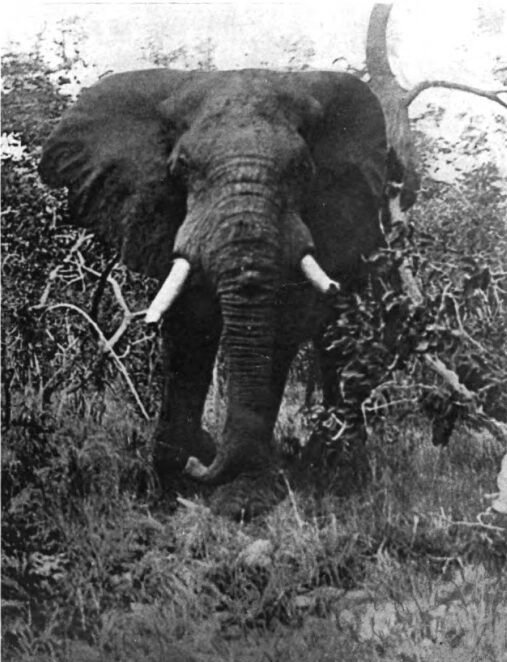
The writer has not said anything on the subject of elephants: ivory has always been a regular article of commerce from earliest times, hence the elephant, where not specially protected, has practically disappeared from all portions of Africa frequented by Europeans. Indiscriminate slaughter has been lately checked by legislation, but it cannot yet be said that the restraint is anything more than partial. The wholesale destruction some years ago of elephants in the Lado Enclave, at the hands of men hunting with neither authority nor licence, shows how difficult it is to protect animals where death implies pecuniary profit to the slayers.
Although the export of hides and heads of game animals for sale has been greatly restricted in many parts of Africa, yet within the continent itself, especially in the coast towns, there is a considerable demand for these articles. Nearly every house, and practically every saloon-bar in south Africa, is decorated with trophies of the chase; which implies a considerable annual trade. There are, too, or were, until very recently, parts of the African coast where trophies were openly sold by the natives, being brought off to the ships and snapped up by eager tourists for the purpose of gratifying some inexplicable whim. The only way to stop the killing of wild animals for gain seems to be for local administrations, each in its own jurisdiction, to place penalties on the sale or purchase of trophies of all kinds, at any rate without licences. The Transvaal Biltong Ordinance forms an excellent example of a principle which might be extended.
The cessation of intertribal warfare, and of the slave trade, consequent on the introduction of the European régime in Africa, freed the native from many of the restrictions which formerly hampered his movements. In some parts of the continent-notably in Portuguese territory — he almost invariably, at the present day, possesses a firearm of some kind, while in others, mainly under the British flag, he is especially exempted by ordinance from the provisions of the game laws governing the actions of the white man. It is true that formerly the natives were unable to effect much permanent harm to the game; but it is apparently forgotten that even where they are not in possession of firearms they have now far greater facilities for destruction than in the old days: that larger areas of country are open to them: and that they have, to a great extent, lost, through being accustomed to go long distances to work for the white man, the old fear and distrust of going far away from their own homes.
When they are in possession of the weapons of civilisation, the harm they do is greatly accentuated. Though one white hunter may possibly kill far more animals in a month than a single native would bring to bag in a year, the natives present in a country and at work hunting very greatly outnumber the white men, and, moreover, hunt throughout the year, whenever they find themselves in want of meat. There is just one argument in favour of the native from a sporting standpoint. He really hunts his animal; crawls close up; usually makes certain of his first shot, and eventually, in nine cases out of ten, secures his quarry. Where profit is to be made, he is often as keen to trade in trophies of the chase as any European; but, when he is left to himself, he kills merely for meat, and to obtain the use of the skin, tail, and sinews for domestic purposes. Thus with him nothing is wasted.
It is beyond question that in many of the districts of Portuguese East Africa, and in the neighbourhood of the lower Zambezi, game has been nearly exterminated during the last twenty years by natives alone, almost unassisted by Europeans. The writer recollects that, while camping out some three years ago in the Inhambane district, every morning and evening he heard two or three shots, and the elands there were on the point of extinction, solely at native hands. In southern and north-western Rhodesia there seems no doubt that in many parts the natives, both indigenous and from neighbouring Portuguese and other countries, are rapidly getting rid of the animals. In the Sudan, again, rumours are current of wholesale destruction both by Arabs and by Blacks in the more remote parts of the country. A study of the Blue Books will show us a very similar condition of things obtaining in the British possessions on the west coast.
Fewer statistics are available from French, German and Belgian Colonies, but there seems little reason to suppose the existence in their out-of-the-way districts of much greater restraint upon natives, or stricter enforcement of regulations as compared with Portuguese and British possessions. Even in the Transvaal, where, probably, game laws are less favourable towards, and more stringently enforced against, natives than anywhere else in Africa, we have still to contend with a very considerable amount of game destruction on their part. Nor is it difficult to infer from long experience of the guile shown by the African in avoiding detection, what must take place where he finds himself in touch with conditions more harmonious to himself.
The last but by no means the least important element which presents itself for consideration, as bearing on the destruction of the fauna, is that of the white settler. In south Africa, so far as all the high and reasonably healthy districts are concerned, the question has long been settled by the complete extirpation of the wild animals; a proceeding which no one now regrets more than the settler himself. How completely popular sentiment has altered in this respect may be seen in the care wherewith those farmers who are fortunate enough to have a few blesbuck or springbuck remaining on their land, preserve them, and how particular they are in limiting the numbers which may be annually shot. Education in the ethics of game preservation has made great strides in the provinces of the Union, and we may even see the sun rise on the day when landholders will be as anxious to see the fauna preserved on waste, and on Government land, as they now are for its safety upon their own farms.
A less progressive view, it is to be feared, is at present prevalent among a section of the new settlers in other parts of Africa. These people, for the most part, new to life in the wilderness, are astonished and obsessed by the swarming thousands of animals which they see around them, much as were the early pioneers in south Africa. Unlike the latter, however, they find themselves summarily checked in the process of reduction, by various ordinances and regulations, which forbid them alike to kill for profit or, beyond a certain point, to slay for the mere sake of slaying. It all seems very harsh and arbitrary, and sometimes the settlers have not been slow to make their voices heard in the matter. Nevertheless, they do not seem always agreed as to the exact nature of the reforms to be adopted, for while each man is firm in the expression of his desire for Government action, there is not universal agreement as to method.
In one breath a fiat may be demanded for game extermination, in order that the hides and horns may be exported for sale to the great advantage and profit of the more impecunious; in the next, that rich Americans and Europeans shall be induced to come over and rent the farms of those same impecunious ones as shooting boxes. It is, however, a sad but obvious fact that science has as yet discovered no means of eating all one’s cake and at the same time keeping it intact. It is difficult to conceive how at one and the same time the settlers could benefit, individually, by the cash they might receive as the result of the extermination of the fauna, and collectively, by the considerable sums of money which sporting parties, who would not come if there was no game, annually bring into the country. Moreover, it is surprising how frequently those who have the least to lose through feral depredations, are loudest in their complaints.
On the other hand, though the cry against game may not always be a genuine one, nor altogether uninfluenced by the desire to exploit the fauna for purely selfish ends, perhaps accompanied by the wish to have an incidental “slap at the government,” it is undeniable that a plethora of wild animals in the immediate vicinity of permanently settled and cultivated country may and does cause considerable damage, in eating up pasture, destroying crops, and breaking fences. Whether the actual harm done is not in some instances amply compensated for by the cheap meat and leather which is obtained in return is another question: but the fact remains incontestable that each man should have the right to say whether he will or will not have game preserved upon his own farm; and should be permitted, anyhow where that farm is a fenced one, and where, therefore, the animals are technically his own property, to shoot them without a licence.
In the case of unfenced land, the question is harder, for neighbours may differ in their opinions regarding the ownership of migrating game. While, speaking generally, settlers in a new country have earned the right to say whether they want wild animals to go on to their land at all, and to demand due protection, if they do not, it is still the duty of the administration to see that the existence of the fauna as a whole shall be in no way imperilled, and especially that it shall not be exploited for the benefit of a few individuals who may or may not eventually make the country their permanent home.
There is nothing to indicate that the present fauna of east Africa, for instance, is richer than that of the Transvaal was fifty years ago; and seeing to what a pitch of perfection modern weapons have attained, there would appear nothing extravagant in the prophecy that five years of free shooting for profit would see the end of it. As a matter of fact there is little room for doubt that, did the game disappear entirely, the settlers, probably of the present, and most certainly of the next generation, would be the first to lament the policy which led to this lamentable result. It is a remarkable phenomenon in human affairs how seldom the experience of others seems to turn the scale of action.
There are, I take it, very few farmers in the Cape Colony, the Orange Free State, or the Transvaal, who would not be glad to see an adequate supply of game upon their land. Indeed, the writer is constantly dealing with applications as to the possibility of reintroducing various species from the game reserves to private farms, and only the question of expense and the difficulty of transport have, up to the present, prevented this being done on a considerable scale. When, therefore, the relatively small populations of such protectorates as are still well stocked with game are heard airily discussing the advisability of getting rid of it as quickly as possible, one realises how often vain are the teachings of history, and how well nigh hopeless it is to quote the result of similar action elsewhere. It remains only to trust that things may be seen in truer perspective ere it is too late, and that those in whose temporary charge it is may not cast recklessly away one of nature’s most splendid assets, one, moreover, which, once lightly discarded, can never by any possibility, be regained.
It is idle to say that the advance of civilisation must necessarily mean the total disappearance of all wild animals. This is one of those glib fallacies which flow only too readily from unthinking lips. Civilisation in its full sense — not the advent of a few scattered pioneers of course implies their restriction, especially as regards purely grass-feeding species, within certain definite bounds, both as regards numbers and sanctuaries. But this is a very different thing from wholesale destruction, that a few more or less deserving individuals may receive some small pecuniary benefit, or gratify their taste for slaughter to the detriment of everyone else who may come after. The fauna of an empire is the property of that empire as a whole, and not of the small portion of it where the animals may happen to exist; and while full justice and encouragement must be given to the farmer and pioneer, neither should be permitted to entirely demolish for his own advantage resources which, strictly speaking, are not his own.
J. Stevenson-Hamilton, Animal Life in Africa (1912: J.P. Dutton & Co.), 15-25. Lead picture appears as the frontispiece. Additional pictures are from pages 52, 66, 100, 166, 176, and 194.
See: https://babel.hathitrust.org/cgi/pt?id=nyp.33433010954513&seq=1