
Buffalo
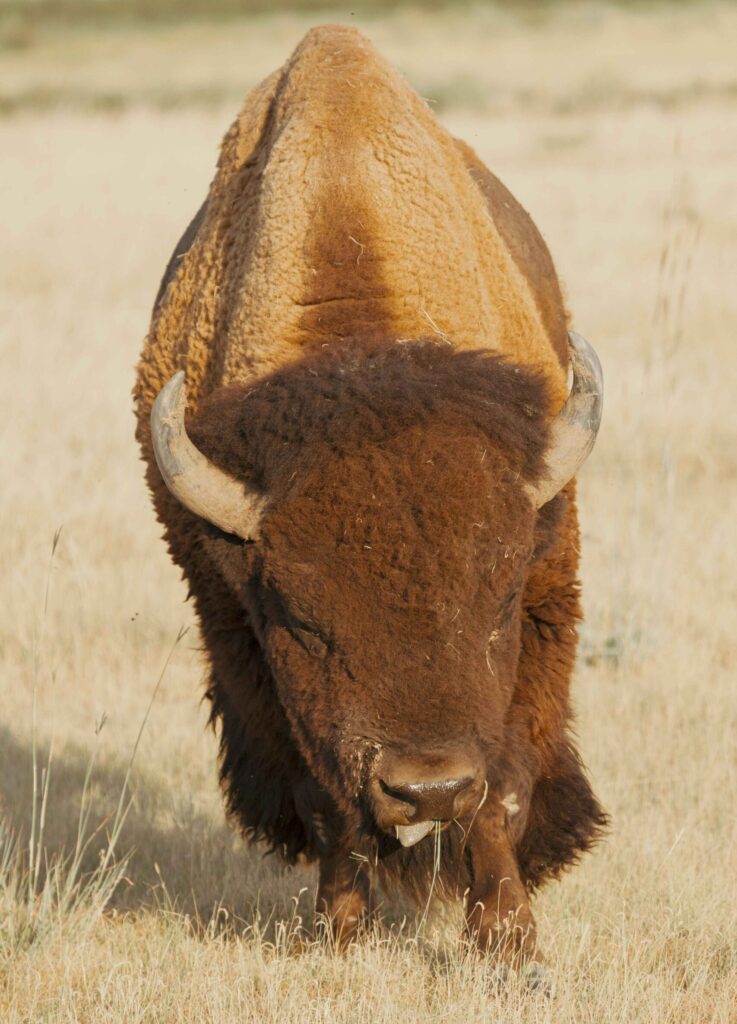
We want you to have a greater ability to learn about some of the unpleasant animal issues in our world.
Extinct and Vanishing Mammals of the Western Hemisphere
J. A. Allen
GENERAL REMARKS RESPECTING THE RAPID DIMINUTION OF THE BUFFALO,
AND ITS EVIDENT DESTINY OF SPEEDY TOTAL EXTERMINATION.
It thus appears that the buffalo has become so reduced in numbers, and so circumscribed in its range, that, instead of roaming over nearly half of the continent, as formerly, it is restricted to two small widely separated areas, the southern of which embraces portions of Texas, Colorado, and Kansas, scarcely exceeding in area the smaller of these States, while the northern embraces only the larger portion of the Territory of Montana and an adjoining area to the northward of nearly equal extent. Even as late as the beginning of the present century the buffalo occupied the whole of the region between the Mississippi and the Rocky Mountains, and extended from the Rio Grande on the south to Great Slave Lake on the north, and also over a considerable area west of the Rocky Mountains, or through thirty-five degrees of latitude and about twenty degrees of longitude. This immense habitat of almost a third of the continent has been reduced in three fourths of a century to a region not larger in the aggregate than the present Territories of Dakota and Montana.
Over a large part of the former vast region they inhabited they were as numerous as they now are in Western Kansas or Northern Texas, and ranged at different seasons over the whole. Particular portions of this area have ever formed their favorite places of resort, where they were sure to be found at almost any season of the year. There is, for instance, abundant historic evidence that over the plains of Kansas, especially near the forks of the Platte, along the Republican, the Pawnee, the Canadian, and other tributaries of the Arkansas, they were as numerous when these parts were first visited by the early explorers as they have ever been since, and that subsequent travellers have always found them in immense numbers at all these points, the plains there literally swarming with them.
In this connection two questions naturally arise, especially in the minds of those not fully conversant with the subject: Have the buffalo really decreased to the extent these statements imply? or have they simply been driven in by the “encroachments of civilization” and concentrated upon a smaller area? Not a few otherwise intelligent persons, on visiting Western Kansas or Northern Texas and seeing the herds which there recently literally blackened the plains, at once adopt the latter hypothesis, and proclaim that this vast amount of talk about the decrease of the buffalo is all “non- sense”; that they are just as numerous as ever, and are not at all decreasing; that the extermination of the wolves and the Indians more than compensates for the slaughter made by the professional hunters and by the numerous sporting parties from the East.
The hunters often adopt the same theory, from the most evident reason of self-interest, fearing that some restrictions, which will act unfavorably upon their business, may be placed upon the wholesale and indiscriminate slaughter now carried on; yet the more candid are willing to admit that, at the present rate of destruction, the buffalo can last but a few years longer. That such is the truth is evident on a moment’s reflection, when one has a full knowledge of the facts. Less than fifty years ago the buffaloes swarmed in as great- or certainly in very nearly as great — numbers as at the present time, not only over the regions they now frequent, but at the same time over the Laramie Plains, over much of the Green River Plateau, over the head-waters of the Colorado and Columbia Rivers, over the plains of the Yellowstone, and especially over the vast plains of the Red River of the North and the Grand Coteau de Missouri; throughout all of which region they have been gradually exterminated, leaving nothing to mark their former presence but their rapidly crumbling skeletal remains and their well-worn trails. Over much of this region they have been not merely driven out and pressed on to some more secure retreat, but actually exterminated, the vast majority being killed on the spot, as we have seen was the case east of the Mississippi during the last quarter of the eighteenth century.
This shows with the utmost certainty what is to be the destiny of this former “monarch of the prairies,” unless rigidly protected by legal restrictions, defining not only the seasons at which the animals may be killed, but also protecting the young and the bearing females. At the present time, as well as heretofore, those animals are most sought after on which the perpetuation of the race depends, — the young animals of both sexes and the cows. The older bulls are alike generally useless both to the Indian and the white hunter. The skins of cows are alone used by the Indians in furnishing themselves with robes; the young and middle-aged cows are regarded as especially desirable by the white hunters, since they afford the best meat for the market, although along with them are killed yearlings, and two- and three-year-olds of both sexes; but bulls older than five or six years are not generally desired, though many have of late years been killed merely for their hides. The hunting season being chiefly in the fall and winter, the cows are then with young, and thus two animals are killed in securing one.
Recent Destruction of the Buffalo in Kansas. — Some idea of the havoc recently made with the buffalo in Kansas can be formed from the following well-attested statements. At the time of the completion of the Atchison, Topeka, and Santa Fé Railroad to Dodge City, which occurred September 23, 1872, the principal trade of the town consisted in the “outfitting of hunters, and exchange for their game.” The number of hides shipped during a period of three months, beginning with this date (Sept. 23), is reported to have been 43,029, and the shipment of meat for the same time 1,436,290 pounds. The forty-three thousand hides of course represent forty-three thousand dead buffaloes, and the one million and a half pounds of meat — the saddles only being saved — represent at least six or seven thousand more, making a total of at least fifty thousand killed in three months. The same authority states that the returns for the January following exceeded those of the preceding months by over one hundred and fifty per cent, thus making the number of buffaloes killed merely “around Fort Dodge and the neighborhood,” for this period of four months, exceed one hundred thousand! This, too, is aside from those killed in “wanton cruelty, miscalled sport, and for food for the frontier residents.”
Another report of about the same date, referring to a locality about one hundred miles southeast of Fort Dodge, says: “Thousands upon thousands of buffalo hides are being brought here [Wichita, Kansas] by hunters. In places whole acres of ground are covered with their hides, spread out, with their fleshy side up, to dry. It is estimated that there are, south of the Arkansas and west of Wichita, from one to two thousand men shooting buffalo for their hides alone.”
Another account states that during the season of 1872-73 not less than two hundred thousand buffaloes were killed in Kansas merely for their hides. It is also stated that in 1874, on “the south fork of the Republican, upon one spot, were to be counted six thousand five hundred carcasses of buffaloes, from which the hides only had been stripped. The meat was not touched, but left to rot on the plains. At a short distance hundreds more of carcasses were discovered, and, in fact, the whole plains were dotted with the putrefying remains of buffaloes. It was estimated that there were at least two thousand hunters encamped along the plains hunting the buffalo. One party of sixteen stated that they had killed twenty-eight hundred during the past summer, the hides only being utilized.” The same account says that the extent of the slaughter of the buffalo for their hides was so great that the market for them became glutted to such an extent that whereas a few years before they were worth three dollars apiece at the railroad stations, skins of bulls would now bring only a dollar, and those of cows and calves sixty and forty cents respectively.
While on the plains in 1871, I had an opportunity of witnessing some of the evidences of the wholesale slaughter of buffaloes for their hides, as practised at that time along the line of the Kansas Pacific Railway in Northwestern Kansas, where sometimes several scores and even hundreds of decaying carcasses, from which nothing but the hides had been taken, could be seen from a single point of view. During the season of 1871 meat and hides representing over twenty thousand individuals were shipped over the Kansas Pacific Railway.
Mr. W. N. Byers, editor of the “Rocky Mountain News,” in referring to this wholesale slaughter (in the letter previously quoted), characterizes it as “simply inhuman and outrageous.” He adds: “The slaughter-ground is mainly in Kansas, reaching only into the edge of Colorado. Practised hunters follow the herds day after day, and shoot them down by scores. Sixty, seventy, eighty or more a day is no unusual number. A good shooter will keep five or six ‘skinners’ at work. I heard a young man say within a week past that during the winter of 1873-74 he killed over three thousand buffaloes, in one day eighty-five, in another sixty-four,” etc. –
Another writer thus refers to the same subject: “The butchery still [summer of 1875] goes on. Comparatively few buffalo are now killed, for there are comparatively few to kill. I was, in October of 1874, on a short trip to the buffalo region south of Sidney Barracks. A few buffalo were encountered, but there seemed to be more hunters than buffaloes. The country south of the South Platte is without water for many miles, and the buffaloes must satisfy their thirst at the river. The south bank was lined with hunters. Every approach of the buffaloes to water was met by rifle bullets, and one or more bit the dust. Care was taken not to permit the others to drink, for then they would not return. Tortured with thirst, the poor brutes approach again and again, always to be met by bullets, always to lose some of their number. But for the favoring protection of night the race would before now have been exterminated.
In places favorable to such action, as the south bank of the Platte, a herd of buffalo has, by shooting at it by day and by lighting fires and firing guns at night, been kept from water for four days, or until it has been entirely destroyed. In many places the valley was offensive from the stench of putrefying carcasses. At the present time the southern buffalo can hardly be said to have a range. The term expresses a voluntary act, while the unfortunate animals have no volition left. They are driven from one water-hole to meet death at another. No sooner do they stop to feed than the sharp crack of a rifle warns them to change position. Every drink of water, every mouthful of grass, is at the expense of life, and the miserable animals, continually harassed, are driven into localities far from their natural haunts, anywhere to avoid the unceasing pursuit. A few, probably some thousands, still linger about their beloved pastures in the Republican country. A few still hide in the deep cañons of the Cimarron country, but the mass of southern buffalo now living are to be found far away from the dreaded hunter, on a belt of country extending southwest across the upper tributaries of the Canadian, across the northern end of the Staked Plain to the Pecos River.
The difficulty of getting the hides to market from these remote and Indian-infested regions is some guaranty that the buffalo will not be extinct for a few years.’ “*
These facts are sufficient to show that the present decrease of the buffalo is extremely rapid, and indicate most clearly that the period of his extinction will soon be reached, unless some strong arm is interposed in his behalf. As yet no adequate game-laws for the protection of the buffalo, either by the different States and Territories included within its range, or by the general government, have been enacted. In a country so sparsely populated as is that ranged over by the buffalo, it might be difficult to enforce a proper law, yet the parties who prosecute the business of buffalo-hunting professionally are so well known that it would not be difficult to intercept them and bring them to justice, if found unlawfully destroying the buffalo. It is evident that restrictions should be made, not only in respect to season, but the young and the bearing females should be protected at all seasons. The government might even set apart certain districts within which the buffalo should be constantly exempt from persecution.
HISTORICAL AND STATISTICAL REMARKS RESPECTING
THE DESTRUCTION AND RECKLESS WASTE OF THE BUFFALO.
In addition to the statistics already given relating to the recent destruction of the buffalo in Kansas, it seems fitting in this connection to here append such additional statistical data as can be conveniently gathered concerning its destruction at large, together with a few remarks in respect to the causes and motives that have led to such a waste of life, and the agencies that have effected it.
The excitement of the chase, as is well known, seems almost universally to beget a spirit of wanton destructiveness of animal life. Wherever civilized man has met with the larger mammalia in abundance, as has often happened in the experience of explorers and pioneer settlers of newly discovered countries, the temptation to slaughter for the mere sake of killing seems rarely to be resisted. In the case of the carnivorous species an exterminating persecution is often pardonable, and to some extent necessary. The fur-bearing species, even when hunted to excess, are seldom destroyed wantonly, though often imprudently, the trapper blindly considering only his immediate profits. In the case of the harmless herbivorous species, the ungulates especially, self-interest, it would seem, would prompt an economical treatment of the game in newly settled districts.
But the history of America shows that no such principle has here been regarded, where other animals than the buffalo — as the elk, moose, deer, prong-horn, and mountain sheep — have been slaughtered with the utmost recklessness. When stress of weather, for instance, or other circumstances, have brought these animals within the hunter’s power, scores and even hundreds have often been killed by single parties already so well supplied with the products of the chase that they had no need for and could make no use of the animals thus destroyed.
The buffaloes, from their great numbers and the little tact required in their capture, have probably been the victims of indiscriminate, improvident, and wanton slaughter to a greater extent than any other North American animal. As already stated, thousands are still killed annually merely for so-called “sport,” no use whatever being made of them; thousands of others of which only the tongue or other slight morsel is saved; hundreds of thousands of others for their hides, which yield the hunter but little more than enough to pay him for the trouble of taking and selling them; while many more, though escaping from their would-be captors, die of their wounds and yield no return whatever to their murderers.
Of the hundreds of thousands that for the last few years have been annually killed, probably less than a fourth have been to any great extent utilized. While this wanton and careless waste has ever characterized the contact of the white race with the sluggish and inoffensive bison of our plains and prairies, the Indians have likewise been improvident in their slaughter of this animal, often killing hundreds or even thousands more during their grand annual hunts than they could possibly use, or from which they saved merely the tongues.
The wolves were formerly also a great check upon the increase of the buffalo, but the hunters by means of poison have reduced their number much more rapidly than even that of the buffalo, so that the influence of the wolves in hastening the extirpation of the buffalo is now but slight.
The Indians, too, have vanished before the westward advance of the white man more rapidly even than the buffalo, so that the destruction of the buffalo by the Indians is now relatively far less than formerly. Hence the opinion, as stated in the preceding pages, has been advanced, and to some extent publicly advocated, that the present rate of the decrease of the buffalo is actually less than formerly, notwithstanding the vast numbers annually killed by white hunters, in consequence of the greatly reduced numbers of the wolves and the Indians. A slight glance at the history of the decline of the buffalo, however, is sufficient to at once indicate the fallacy of such an opinion; and none are better aware of this than the most active participators in their destruction, —the professional buffalo-hunters themselves, — many of whom are candid enough to admit that, through the almost utter extermination of the buffalo, their present occupation will soon pass away, unless the general or local governments enforce the most peremptory restrictions upon their slaughter.
The Indians, prior to the discovery of the continent by Europeans, appear not to have seriously affected the number of buffaloes, their natural increase equalling the number destroyed both by the Indians and the wolves. When the Jesuit missionaries penetrated the range of the buffalo east of the Mississippi, in the seventeenth century, they found this animal the main subsistence of the Indian tribes, as it doubtless had been for centuries, its flesh serving them for food, its skins for shields, clothing, and tents, and its hair, wool, horns, hoofs, and bones for various articles of ornament and use.
No sooner, however, had Europeans made settlements within its range, than the buffaloes began to disappear, and were either wholly destroyed or driven from their favorite haunts in the short space of a very few years. The destruction increased with the increase of the white population till they were totally exterminated east of the Mississippi (at least, south of the present State of Minnesota), as already shown, prior to the beginning of the nineteenth century.
Even as late as fifty years ago they occupied a considerable area west of the Rocky Mountains, all the extensive parks and valleys within these mountains, and all the vast plains and prairies between them and the Mississippi River. The fur-hunters and trappers appear to have begun at this date to contribute appreciably toward their rapid diminution, but not until the establishment of the “overland trails,” and the constant passing of large emigrant parties across the plains, did their numbers here become very greatly diminished. Steadily pressed back on their eastern boundary by advancing settlements, they were at the same time rapidly thinned along the line of the great emigrant routes. These thoroughfares becoming from year to year more numerously travelled, especially the more northern route by way of the South Pass, the buffaloes were driven to the right and left of the line of travel, till finally by this intersection their range was divided into two essentially distinct regions.
The construction of the Union Pacific Railroad completely severed the northern from the southern herds, while the Kansas Pacific and the Atchison, Topeka, and Santa Fé Roads opened up new highways to their most populous holds. In the mean time adventurers and miners either gradually exterminated them in the parks and valleys of the mountains, or drove them eastward into the plains, while they were at the same time preyed upon by the great buffalo-hunting parties from the Red River Settlements and the United States, until they have dwindled to a few hard-pressed bands lingering chiefly in the least-frequented parts of their formerly almost undisturbed haunts.
A century ago the rapid extermination of the buffalo had begun to attract the attention of travellers, Romans, as early as 1776, alluding to the wanton destruction of “this excellent beast, for the sake of perhaps his tongue only.” As early as 1820 Major Long thought it highly desirable that some law should be enforced for the preservation of the bison from wanton destruction by the white hunters, who, he said, were accustomed to attack large herds, and from mere wantonness slaughter as many as they were able and leave the carcasses to be devoured by the wolves and birds of prey.
Gregg, in 1835, also alludes to the wanton slaughter of these animals by travellers and hunters, and the still greater havoc made among them by the Indians, who often kill them merely for their skins and tongues. Their total annihilation he regarded as only a question of time, although he believed that if they were only killed for food, their natural increase would perhaps replenish the loss. Almost every intelligent traveller who has crossed the plains or spent much time in the buffalo country has also called attention to this exterminating slaughter, and predicted their complete annihilation at no very distant date. Some writers believed twenty or thirty years ago that they would hardly survive to the present time unless protected by the government.
Dr. Leidy, in 1852, says: “The day is not far distant when it [the buffalo] will become quite extinct, unless protected by a munificent republic, as has been done by the Emperor of Russia in the case of the aurochs, or European bison.” Professor Baird, writing at about the same time, says: “Still, vast as these herds are, their numbers are much less than in earlier times, and they are diminishing with fearful rapidity. Every year sees more or less change in this respect, as well as alterations of their great line of travel, . . . . If it were possible to enforce game-laws, or any other laws on the prairies, it would be well to attach the most stringent penalties against the barbarous practice of killing buffalo merely for the sport, or perhaps for the tongues alone. Thousands are killed every year in this way. After all, however, it is perhaps the Indian himself who commits the mischief most wantonly.”
General W. F. Raynolds, in his report of his Exploration of the Yellowstone in 1859 and 1860, thus refers to this matter: “And here I would remark, that the wholesale destruction of the buffalo is a matter that should receive the attention of the proper authorities. It is due to the fact that the skin of the female is alone valuable for robes. The skin of the male over three years old is never used for that purpose, the hair on the hind quarters being not longer than that on a horse, while on the fore quarters it has a length of from four to six inches. The skin is also too thick and heavy to be used for anything but lodge coverings, while the flesh is coarse and unpalatable, and is never used for food when any other can be had. The result is that the females are always singled out by the hunter, and consequently the males in a herd always exceed the females, in the proportion of ten to one. Another, but far less important cause of their extinction is the immense number of wolves in the country, which destroy the young. The only remedy that would have the slightest effect in the case would be a prohibition of the trade of buffalo-robes, and a premium upon wolf-skins. I fear it is too late for even this remedy, and notwithstanding the immense herds that are yet to be found, I think it is more than probable that another generation will witness almost the entire extinction of this noble animal.”
During the fifteen years that have passed since this was written, the wolves have in a great measure been exterminated over much of the buffalo range, but something far more fatal to the buffalo than anything then known — the railroad — has penetrated its range, and while the females and the young are still slaughtered with the same recklessness as before, the old bulls have of late been hunted with almost equal eagerness.
Statistics relating to the Destruction of the Buffalo, based principally on the Trade in Robes. — Frémont, in 1845, published some statistics furnished him by Mr. Sanford, a partner of the American Fur Company, respecting the number of robes annually obtained from the Indians by the different fur companies. The average return for the preceding eight or ten years is given as ninety thousand annually. “In the Northwest,” says Mr. Sanford, “the Hudson’s Bay Company purchase from the Indians but a very small number — their market being Canada, to which the cost of transportation nearly equals the produce of the furs; and it is only within a very recent period that they have received buffalo robes in trade; and out of the great number of buffalo annually killed throughout the extensive regions inhabited by the Camanches and other kindred tribes [Texas, the Indian Territory, and Kansas] no robes whatever are furnished for trade. During only four months of the year (from November until March) the skins are good for dressing; those obtained in the remaining eight months being valueless to traders; and the hides of bulls are never taken off or dressed as robes at any season. Probably not more than one third of the skins are taken from the animals killed, even when they are in good season, the labor of preparing and dressing the robes being very great; and it is seldom that a lodge trades more than twenty skins in a year. It is during the summer months, and in the early part of autumn, that the greatest number of buffalo are killed, and yet at this time a skin is never taken for the purpose of trade.”
Besides the number of robes traded by the Indians, as many or a greater number were at this time annually used by the Indians themselves. This would make, at a moderate estimate, the annual number of about two hundred thousand robes, which represent, according to the competent authority above cited, only one third of the buffaloes killed during about one third of the year, and during that part of the year, too, when the smallest number are destroyed.
Taking the above data as a basis for an estimate, the whole number killed annually by the Indians must have equalled eighteen hundred thousand (1,800,000). Allowing a slight addition for the relatively greater number killed during the warmer parts of the year, we have, in round numbers; the startling total of about two millions as the average annual number destroyed by only those tribes of Indians who were accustomed to collect robes for the market. These embraced only a small portion of the tribes living within or on the borders of the great buffalo range; so that probably two millions a year is much less than half the number killed at this time by the Indians alone.
Besides this, travellers and white hunters killed annually hundreds of thousands more. When we consider that this enormous destruction continued for several decades, we need no longer be surprised at the rapid numerical decrease of the buffalo that has marked the last forty or fifty years of his history.
In 1852 Professor Baird wrote: “Mr. Picotte, an experienced partner of the American Fur Company, estimated the number of buffalo-robes sent to St. Louis in 1850 at one hundred thousand. Supposing each of the sixty thousand Indians on the Missouri to use ten robes for his wearing apparel every year, besides those for new lodges and other purposes, by the calculation of Mr. Picotte, we shall have an aggregate of four hundred thousand [sic] robes [seven hundred thousand?]. We may suppose one hundred thousand as the number killed wantonly or destroyed by fire or other casualties, and we will have the grand total of half a million [eight hundred thousand?] of buffalo destroyed every year. This, too, does not include the numbers slaughtered on Red River and other gathering points.”
In this estimate the important fact is overlooked that the robes are all taken during three months of the year, at a season too when the smallest number are killed, and that only about one third of those killed during these three months are utilized for robes. If this number should be multiplied by nine, as it evidently must be from the above-quoted statements of Mr. Sanford, and which from general considerations also seems probable, we should have the immense total of from five to seven millions as the number killed yearly by the Indians who furnished the one hundred thousand robes for the St. Louis market! Ten robes, however, seems to be a large number to be used annually by each person. If we reduce the number to three, we shall still have an annual aggregate of nearly three and a half millions as the number destroyed by the Upper Missouri tribes alone. South of this region there were at this time upwards of forty thousand Indians belonging to other tribes living within the range of the buffalo, besides the numerous populous tribes inhabiting the buffalo range north of the United States. The number that must have been killed each year by all these tribes together is a startling sum to contemplate.
In 1854 the Hon. H. H. Sibley, in his paper on the buffalo contained in Schoolcraft’s “History, Condition, and Prospects of the Indian Tribes of the United States,” gives a later estimate of their annual destruction in the Missouri region. He says: “From data which, although not mathematically correct, are sufficiently so to enable us to arrive at conclusions approximating the truth, it has been estimated that for each buffalo-robe transported from the Indian country, at least five animals are destroyed. If it be borne in mind that very few robes are manufactured of the hides of buffalo except such as, in hunter’s parlance, are killed when they are in season, that is during the months of November, December, and January, and that even of these a large proportion are not used for that purpose, and also that the skins of the cows are principally converted into robes, those of the males being too thick and heavy to be easily reduced by the ordinary process of scraping; together with the fact that many thousands are annually destroyed through sheer wantonness, by civilized as well as savage men, it will be found that the foregoing estimate is a moderate one. From the Missouri region the number of robes received varies from forty thousand to one hundred thousand, so that from a quarter to half a million of buffaloes are destroyed in the period of each twelvemonth.”
From the preceding remarks it is evident that Mr. Sibley’s estimate is far below the truth. Since as many robes are doubtless used by the Indians themselves as they sell, this number must include not more than half of the robes taken during only three or four months of the year. Hence instead of one fourth to half a million representing the number annually killed at this date in the Missouri region, probably a million to a million and a half would be a much nearer estimate.
In June, 1873, I met at Fort Abraham Lincoln, Dakota Territory, Mr. F. F. Gerard, the well-known Cree interpreter, whose twenty-five years’ experience in the Upper Missouri country, nearly every part of which he had visited, together with his having been formerly an agent of the American Fur Company, had given him much valuable information respecting not only the fur trade but the former range and the recent great decrease in numbers of many of the larger mammals of that region. From him I learned that in 1857 the trade in buffalo-robes at the principal posts on the Upper Missouri was about as follows: At Fort Benton, the number received amounted to 3,600 bales, or 36,000 robes; at Fort Union, 2,700 to 3,000 bales, or about 30,000 robes. At Forts Clarke and Berthoud, 500 bales at each post, or about 10,000 robes; at Fort Pierre, 1,900 bales, or 19,000 robes; giving a total for one year of about 75,000 robes, which he informed me was about the annual average at that period.
Allowing that the Indians retained only as many more for their own use, and estimating as before that one robe represents the destruction of three buffaloes, gives four hundred and fifty thousand as the number killed by a portion only of the Upper Missouri Indians in one third of a year, or over a million and a third annually. To this number, as already noticed, must be added the number killed by the Indians to the northward and southward of this region, as well as the great numbers destroyed by the Red River half-breeds and by white men.
Respecting the number killed by the Red River hunters, I have met with no satisfactory statistics, but that it must have been immense is evident from the number of persons engaged in their hunting expeditions. Mr. Ross, in his history of the Red River Settlement, states that the number of carts assembled for the first trip in 1820 was five hundred and forty. Subsequently the number regularly increased to one thousand two hundred and ten in 1840. In his description of the hunt of this year, he states that the number of hunters engaged was six hundred and twenty for two months, who were accompanied by six hundred and fifty women, and three hundred and sixty boys and girls, the party numbering altogether sixteen hundred and thirty souls. The party was armed with seven hundred and forty guns, and had with them eleven hundred and fifty-eight horses and five hundred and eighty-six draught oxen, with other equipments in proportion.
During the first day of the hunt no less than thirteen hundred and seventy-five buffalo tongues were brought into camp, and during the first two races not less than twenty-five hundred animals were killed. Of these he estimates that less than one third were properly utilized, as he considers that seven hundred and fifty animals, making all due allowance for waste, would have been ample for the amount of pemmican and dried meat saved from them. The rest, he says, was wasted; “and this,” he adds, “is only a fair example of the manner in which the plain business is carried on under the present system. Scarcely one third in number of the animals killed are turned to account.”
Dr. Hayden, in 1861, says that as near as he could determine, about one hundred thousand robes were then annually made by the Indians of the Upper Missouri country. Dr. Hayden also states that at this period the bulls outnumbered the cows ten to one; which personal experience led me to think was a fair estimate of the proportion of the sexes in 1871 on the plains of Kansas.
Through the kindness of E. T. Bowen, Esq., General Superintendent of the Kansas Pacific Railway, I have obtained a statement of the “estimated shipments of buffalo products over the Kansas Pacific Railway during the year 1871.” This estimate, carefully prepared by the Auditor of the Company, is as follows: Dry hides, three hundred and forty-one thousand, one hundred and fifty-one (341,151) pounds, estimated at twenty-five pounds per hide, and thus representing thirteen thousand six hundred and forty-six (13,646) buffaloes; eleven hundred and sixty-one thousand four hundred and nineteen (1,161,419) pounds of meat, estimated at two hundred pounds per saddle, and thus representing five thousand eight hundred and seven (5,807) buffaloes.
No return is here made of the large amount of salted and cured meat also sent to Eastern markets. The somewhat less than six thousand “saddles” represented by the above statement must, it appears to me, be far below the actual number, as one hunter informed me that he had himself alone killed over three thousand buffaloes a year for several years, and I met other persons who claimed to have each killed an equal number. These statistics would alone indicate a slaughter of at least twenty thousand buffaloes along the line of the Kansas Pacific Railway during the year 1871, to which must be added other thousands killed by travellers and amateur hunters, and by the officers and soldiers stationed at the different military posts in the same region.
I have been unable to obtain statistics of the shipment of buffalo products over this road since 1871, as such information, writes the present Superintendent of the road, is not in available shape, and to obtain it would involve considerable expense. There has, however, been a great falling off in the annual amounts shipped since that date, in consequence of the great decrease of the buffalo throughout the region through which this road passes.
Respecting the quantity of the products of the buffalo shipped over the Atchison, Topeka, and Santa Fé Railroad during the years 1872, 1873, and 1874, I have been favored with the following statement by the General Superintendent, Mr. C. F. Morse: —
Statement of Buffalo Products shipped over the Atchison, Topeka, and Santa Fé Railroad during a period of three years, from 1872 to 1875.
Hides, in 1872,.….. 165,721
“ in 1873, ………… 251,443
“ in 1874, ………….. 42,289
Robes, in 1872, ……No account
“ in 1873,……………. ” “
“ in 1874, ……………18,489
Meat, in 1872,……… No account
“ in 1873,……………. 1,617,600 lbs.
“ in 1874,…………….. 632,800 “
Bones, in 1872,……… 1,135,300 lbs.
“ in 1873,………………2,743,100 “
“ in 1874,………………6,914,900 “
From the above statement it appears that the number of hides shipped over this road during a period of three years was nearly half a million, while the robes, of which the number shipped in a single year only is given, would make the number exceed this sum. In addition to this number we have to add, for the number of buffaloes utilized or sold as meat, only the small number of from three to eight thousand a year more!
In answer to inquiries respecting the shipment of buffalo products over the Union Pacific Railroad, I have been kindly informed by Mr. E. P. Vining, General Freight Agent, that no large amount of buffalo products has been received by this road, and that consequently no statistics of the business have been kept, as is the case with all the important branches of their business. These statistics respecting the shipments over the railroads relate only to the Kansas range of the buffalo, and hence refer merely to a limited. district, and to the slaughter by white hunters alone.
In respect to the recent destruction of the buffalo north of the United States, Mr. J. W. Taylor, United States Consul at Winnipeg, B. N. A., whose valuable communication on the buffalo has been previously quoted, informs me that about eighteen thousand robes were sent to the Minnesota market from the Saskatchewan district alone during the year ending September 30, 1872, while as many more were either consumed in the country or sent to Europe by the way of York Factory, or about forty thousand in all. By far the larger part of the buffaloes killed in the Saskatchewan district, however, are converted into pemmican and dried meat, and, being killed in summer, do not enter at all into the above statement made by Mr. Taylor. From these data it is evident that the destruction of the buffalo in the Saskatchewan region in 1872 must have amounted to considerably more than a million, and these mainly cows.
In forming a general estimate of the annual destruction of the buffalo in recent years, it is necessary to add to the large sums already given the large number killed by the different Indian tribes still residing in or near the ranges of the two herds, as well as the thousands killed for frontier consumption, and the many thousands more of which no use is made. Even approximate data for the last-named elements of the problem of course do not exist, but the total killed between 1870 and 1875 cannot have been less than about two and a half millions annually. The effect of this destruction upon the already terribly thinned herds has been most marked, and if continued at a proportional rate will unquestionably in a few years exterminate the race.
J. A. Allen, The American Bisons, Living and Extinct (Cambridge: University Press and Welch, Bigelow, & Co., Memoirs of the Museum of Comparative Zoology, IV, 10 1876), 175-191. Footnotes have been deleted.
See: https://babel.hathitrust.org/cgi/pt?id=uc1.d0002414290&seq=1.
Extinct and Vanishing Mammals of the Western Hemisphere
Glover M. Allen
THE AMERICAN BISON
Although evidence is accumulating that at least one large species of extinct bison was contemporaneous with early man in North America, only one species was found on the continent at the time of its discovery by Europeans (see Meserve and Barbour, 1932). This species is closely related to the Old World bison, Bison bonasus, but differs in numerous details, as in the larger chest, smaller pelvus and shorter tail. In early days the “buffalo,” as it is almost universally called, was found in great numbers over a vast range in this continent, but with the westward expansion of settlements it became an object of exploitation on a tremendous scale, so that literally millions were killed, and it was wiped out in the East and later over much of its western range. The story of this decimation has been many times told, but more especially by J. A. Allen (1876a, 1876b, 1877), Hornaday (1889), and recently by Garretson (1938). Although attempts have been made to distinguish several local races, the characters of these are for the most part imperfectly known, and the respective ranges undefined. The northern form, or wood bison, however, constitutes a fairly well marked race.
PLAINS BISON; “BUFFALO”
BISON BISON BISON (Linnaeus)
[Bos] bison Linnaeus, Systema Naturae, ed. 10, vol. 1, p. 72, 1758 (Mexico).
Bos americanus Gmelin, Linnaeus’s Systema Naturae, ed. 13, vol. 1, pt. 1, p. 294, 1788.
Bison bison hanningtoni FIGGINS, Proc. Colorado Mus. Nat. Hist., vol. 12, no. 4, p. 30, pls. 8, 9, Dec. 5, 1933 (“Head of Rock Creek, northeast South Park, Park County, Colorado”). Doubtfully distinct.
Bison bison septentrionalis Figgins, op. cit., p. 28, pl. 7, Dec. 5, 1933 (“Six miles north-east of Palmer, Nebraska”). Doubtfully distinct.
FIGS.: Allen, J. A., 1876a, pls. 5, 6, 9, 10, 12, fig. 1-6 (skulls and teeth); Garretson, 1938, pls. facing title page and p. 5.
EASTERN BISON
BISON BISON PENNSYLVANICUS (Shoemaker)
Bison americanus pennsylvanicus H. W. Shoemaker, A Pennsylvania Bison Hunt (Middleburg, Pa.), p. 9, 1915 (“Pennsylvania”).