British Bear

We want you to have a greater ability to learn about some of the unpleasant animal issues in our world.
British Animals Extinct within Historic Times
James E. Harding
THE BEAR
(Ursus arctos)
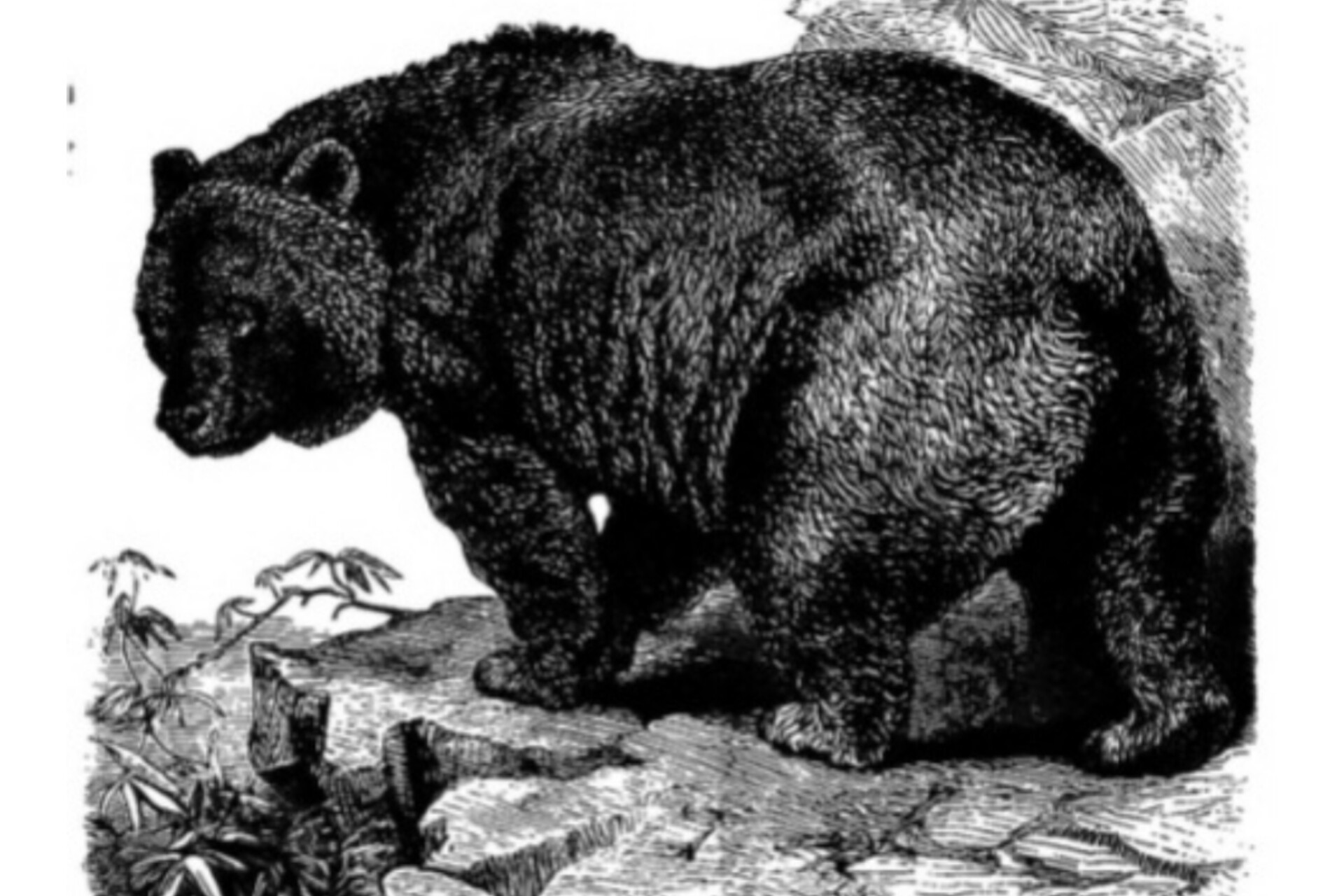
To treat first of the earliest historic species which has died out, no doubt can exist that the Brown Bear inhabited Britain in times of which history takes cognisance, the few written records which have come down to us of its former existence here being supplemented by the best of all evidence, the discovery of its remains. These have been found in the most recent formations throughout England, which can scarcely be regarded as fossil, and, if not absolutely identical with those of the Bear which still exists in many parts of the European continent at all events indicate only a variety.
In Britain, says Professor Boyd Dawkins, the Bear survived those changes which exterminated the characteristic post-glacial mammalia, and is found in the prehistoric deposits both in Great Britain and Ireland, and is of considerable interest, because it is the largest of the post-glacial carnivores which can be brought into relation with our history. A nearly perfect skull from the marl below the peat in Manea Fen, Cambridgeshire, and now in the Woodwardian Museum, Cambridge, has been described and figured by Professor Owen, who has also described portions of another skull from the same locality. In 1868 Dr. Hicks found remains of the Brown Bear in peat at St. Bride’s Bay; and numerous bones and teeth of this animal have been discovered at various times in Kent’s Cavern, Devonshire.
The exploration of the Victoria Cave, near Settle, revealed the fact that the Brown Bear afforded food to the Neolithic dwellers in the cave, who have left the relics of their feasts and a few rude implements at the lowest horizon; the broken bones and jaws of this animal lying mixed up with the remains of the Bed-deer, Horse, and Celtic Shorthorn.
Nor are we without direct testimony that the Bear was killed by the hand of man during the Roman occupation of Britain. In the collection of bones from the “refuse heaps” round Colchester made by Dr. Bree, the remains of this animal were found along with those of the Badger, Wolf, Celtic Shorthorn, and Goat. Professor Boyd Dawkins has also met with it in a similar “refuse heap” at Richmond, in Yorkshire, which is most probably of Roman origin.
Dr. J. A. Smith has described and figured the skull of a large Bear which was found with a rib of the same animal in a semi-fossil condition at Shaws, in Dumfriesshire, in peat moss lying on marl, among the most recent of all our formations, associated moreover with the Red-deer, Roe-buck, Urus, and Reindeer; the skull being that of a large adult animal of great size and strength. Strange to say, these are the only remains of the Bear which have yet been discovered in Scotland.
As regards Ireland, some doubt seems to exist in the minds of palaeontologists whether any of the ursine remains discovered there are referable to Ursus arctos. Dr. Leith Adams, writing on ‘Recent and Extinct Irish Mammals’ (“Proc. Roy. Dublin Soc,” 1878), has very fully described several skulls and other portions of ursine skeletons exhumed in Leitrim, Longford, Westmeath, King’s County, Kildare, Waterford, and Limerick, and after comparing them with similar bones of Ursus spelceus, U. fossilis, U. ferox, U. arctos, and U. maritimus, has arrived at the following conclusion: —
“A study of the osteological characters of these ursine remains which represent all the authenticated instances of discoveries hitherto recorded from Ireland, appears to me to furnish characters referable only to one species, which, on the score of dimensions and general features, is inseparable from the so-called Ursus fossilis of Goldfuss, and at all events from the smaller Spelean Bear found in English and other deposits, as distinguished from the larger congener found also in England, but more plentifully on the continent of Europe. Unless the skull from Kildare represents the Ursus arctos (and that, I think, is doubtful), all the others seem to me to belong to the Ursus fossilis, which, so far as osteological and dental characters are concerned, would appear to have been the progenitor of the recent Ursus ferox, now repelled to Western North America. In this latter view I am supported by the distinguished palaeontologist, Mr. Busk, F.R.S., whose differentiations, as regards several of the Irish crania, were made before I commenced to study them. It may be said, therefore, that Ursus ferox, as in England, belonged to the prehistoric fauna, and was a native of the island in the days of the Reindeer, Mammoth, Horse, and Wolf, with which its remains have been found associated, as also with exuvia of the Red-deer, Fox, and Variable or Alpine Hare; and although not found along with the Irish Elk, it has been generally met with in similar lacustrine beds. It seems to me that, as in “the neighbouring island, if the Brown Bear had ever been a native of Ireland, it would, as in Scotland and England, have come down to the historical period; so that the fact of no notice of its presence, and the very emphatic assertions or silence of Bede, St. Donatus, Giraldus Cambrensis, and Pennant, seem to me to bear out the results of recent disclosures. The probability is, therefore, that, like its congeners, all, excepting the Hare and Red-deer, became extinct in the island before man commenced to make records of the ferae of the country; for it is a remarkable circumstance that in all the remains of Irish extinct mammals, none present the fragmentary characters afforded by the cavern deposits of the sister island; thus showing on the one hand, that they had not been destroyed by man, nor by the bone- crunching hyaena, but that they met their deaths, for the most part, through natural causes and accidents.”
The Welsh Triads, some of which are supposed to have been compiled in the ninth century, but most of which are of a much later date, say that “the Kymry, a Celtic tribe, first inhabited Britain; before them were no men there, but only bears, wolves, beavers, and oxen with high prominences.”
Many places in “Wales, says Pennant, still retain the name of Penarth, or “the bear’s head,” another evidence of their former existence in our. country.
Our illustrious countryman, John Ray, in his “Synopsis Methodica Animalium” (a small octavo volume, published in 1693), tells us (pp. 213, 214) that his friend Mr. Edward Llwyd, in an old Welsh MS. on British laws and customs, discovered certain statutes and regulations relating to hunting, from which it appeared that the Bear was formerly reckoned amongst the beasts of chase (E novem quae venantur ferarum generibus tria tantum latrabilia esse, ursum, scandentia, et phasianum, [Of the nine that are hunted by wild breeds, only three are barking, bear, climbing, and pheasant] and its flesh was esteemed equally with that of the Hare and the Wild Boar: “Summam seu praecipuae aestimationis ferinam esse, ursi, leporis et apri.” [The sum or basic estimation of valuation is wild, bear, rabbit and boar].
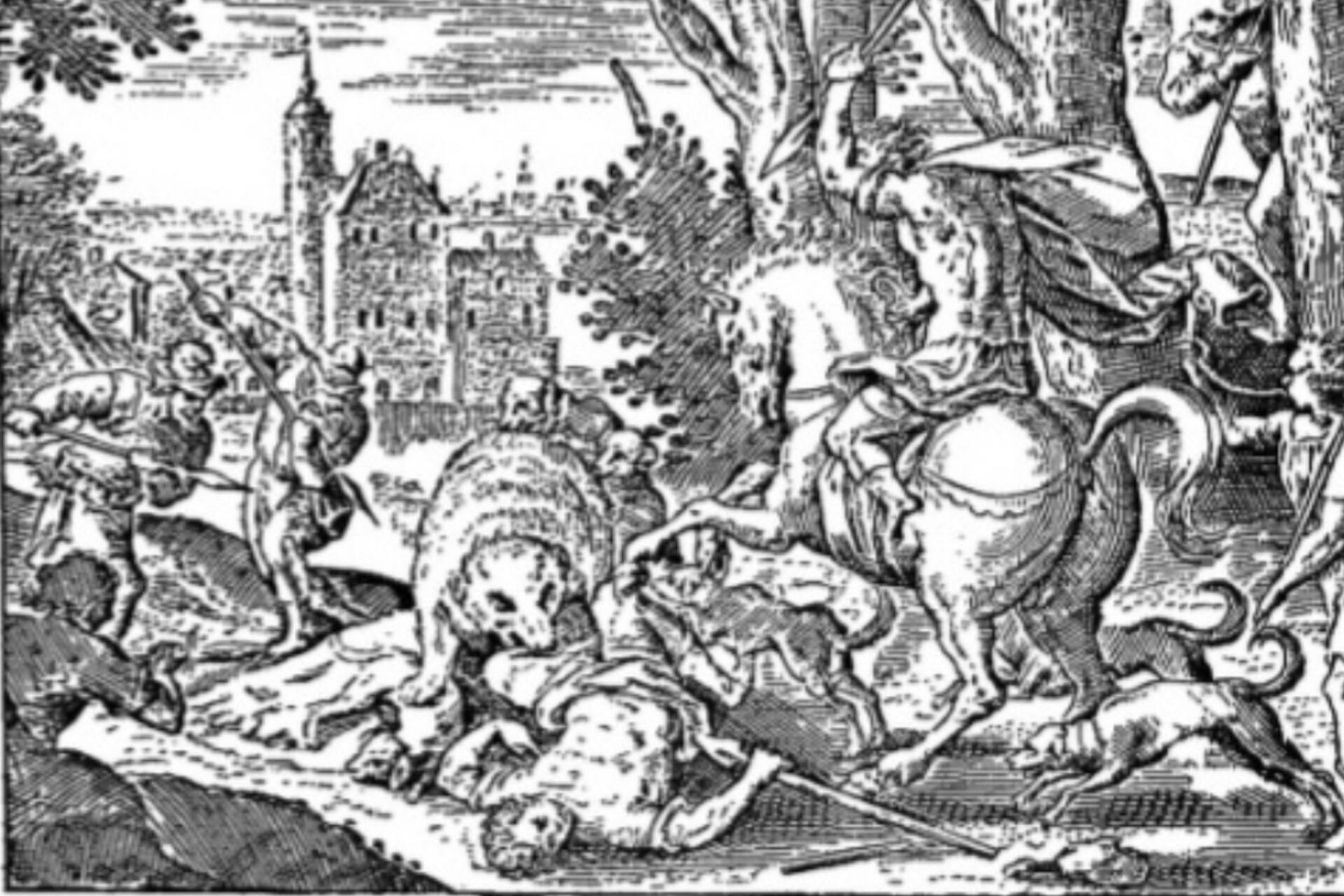
Of the ancient British methods of hunting the Bear, we are but imperfectly informed. We learn, however, from rude descriptions and ruder figurings, that he was watched to his couch, or was traced to his winter retirement, when arrows, pikes, clubs, javelins, and long knives, were used against him; he was also occasionally betrayed into a pitfall. In later times the Bear was trailed with boar-hounds, and despatched by the spear or knife of the hunter, as the animal rose to grapple with the dogs, or with their master. Bear hunting must have been always a dangerous sport, in this respect and if ever the great Cave Bear was an object of the hunters’ attack, the boar-hunt of Calydon, as described by Ovid, could alone have furnished a parallel.
That bears were to be found in Britain during the eighth century may be inferred from the fact that in the “Penitentiale” of Archbishop Egbert, drawn up about A.D. 750, it is laid down (lib. iv.) that “if any one shall hit a deer or other animal with an arrow, and it escapes and is found dead three days afterwards, and if a dog, a wolf, a fox, or a bear, or any other wild beast hath begun to feed upon it, no Christian shall touch it.”
In the time of Edward the Confessor, as we learn from “Domesday,” the town of Norwich furnished annually one Bear to the king, and six dogs for the baiting of it.
Baiting wild animals was a favourite pastime with the Romans and their imitators, the Roman Britons. And as amphitheatres were constructed of squared stone, and in a magnificent style for these exhibitions at Rome, so were others erected here in Britain in a less pretentious style of architecture, and of the humbler materials of clay, chalk, gravel, and turf. Such are the great amphitheatres at Silchester and Dorchester, once extending in several rows of seats, and still including an arena of nearly two hundred yards in circumference.
In all probability the trained bears exhibited by the Anglo-Saxon Gleemen were native animals taken young and tamed.
So far as history informs us, it would seem that Scotland, and more particularly the great Caledonian forest, was the chief stronghold of our British Bears. Bishop Leslie says that that great wood was once “refertissimam,” full of them. Camden, too, writing of Perthshire, observes: “This Athole is a country fruitful enough, having woody vallies, where once the Caledonian forest (dreadful for its dark intricate windings and for its dens of Bears, and its huge wild thick-maned bulls) extended itself far and near in these parts.”
After the occupation of Britain by the Romans, Caledonian Bears seem to have been perfectly well known in Rome. We learn from Martial that they were used for the purpose of tormenting malefactors, of which we have an instance in the fate of Laureolus:
Nuda Oaledonio sic pectora prsebuit urso,
Non falsa pendens in cruce, Laureolus.
Which may be Englished:
Tinas Laureolus, on no ideal cross suspended,
Presents his nude body to the Caledonian bear.
Camden, quoting Plutarch, assures us “that they transported Bears from Britain to Rome, where they held them in great admiration.” How these Bears were captured, and in what way they were transported to the coast and shipped on board the Roman galleys, must, we fear, forever remain matters for speculation. We do not even know the precise period at which these very hazardous consignments were made; but it may be assumed to have been probably about the same time that Wolf-dogs were being exported to Rome, which we know was about the latter end of the fourth century. A Roman consul of that day, Symmachus by name, writing to his brother Flavinus over here, thanks him for a present he made him of some dogs which he calls Canes Scotici, and which were shown at the Circensian games, to the great astonishment of the people, who could not believe it possible to bring them to Rome otherwise than in iron cages. It was no doubt in iron cages that the Bears were transported.
Some commentators have supposed that the dogs here referred to were English mastiffs; but it may be remarked that for some time before Symmachus lived, and for many centuries after, Ireland was well known by the name of Scotia, and the appellation “Canes Scotici,” while inapplicable to English mastiffs, would be appropriate to Irish wolf-hounds. Moreover, the dogs upon which the highest value was always set in former times were those which were of use for the chase of wild animals, and we know from various sources that Wolf-dogs were held in such esteem as to be considered worthy the acceptance of monarchs, and were frequently sent abroad as presents to foreign potentates.
As regards the former existence of Bears in the Highlands, a shadow of their memory, says Stuart is preserved in their Gaelic name, Magh-Ghamhainn, and the traditions of some remote districts which retain obscure allusions to a rough, dark, grisly monster, the terror of the winter’s tale, and the origin of some obsolete names, in the depths of the forest and the dens of the hill. Hence Ruigh-na-beiste, the monster’s slope, Loch-na-beiste, the monster’s lake; for beist in Gaelic signifies generally, not, as might be inferred from its similarity to the English word, a mere animal (which is beathach or ainmhidh), but something beyond an ordinary creature, a monster, a beast of prey. Thus, in the above instances, we believe it to have been derived from the mysterious and exaggerated recollection of the last solitary Bear which lingered in the deep recesses of the forest, the terror of the hunter and of the herdsman.
Thompson states that although he is not aware of any written evidence tending to show that the Brown Bear was ever indigenous to Ireland, a tradition exists of its having been so. It is associated with the Wolf as a native animal in the stories handed down through several generations to the present time. Sir William Wilde asserts that he discovered an Irish name for the Bear in an old glossary in the library of Trinity College, Dublin; and it is remark- able that the name to which he refers, “maghghamhainn” (corrupted into “math-ghamhainn,” which, as already explained, conveys a different signification), is identical with the Gaelic name for the animal still preserved in traditions of the Highlands.
When the Bear became extinct in Britain is uncertain. Prof. Boyd Dawkins thinks it must have been extirpated probably before the tenth century. The story quoted by Pennant from a history of the Gordon family, to the effect that in 1057 a Gordon, in reward for his valour in killing a fierce Bear, was directed by the king to carry three Bears’ heads. on his banner, is altogether a fallacy. Reference to a copy of the original Latin MS. from which the translation quoted by Pennant was made (preserved in the Advocates’ Library, Edinburgh) shows that the animal killed was a Boar, “immanem aprum.” Moreover, the arms of the Gordons happen to be Boars’, not Bears’ heads. The difference of one letter only in the name might easily account for a mistake which has been since blindly copied by many writers. As our ancestors, says Jamieson, called the boar bare, by a curious inversion the bear is universally denominated by the vulgar a boar.
Col. Thornton, in his “Sporting Tour through the Northern parts of England and the Highlands of Scotland” (1804), states that on the island of Inchmerin, which is the largest island in Loch Lomond, being nearly two miles in circumference, beautifully wooded and well stocked with deer, Lord Graham had turned out a few wild Bears. Whether this is a misprint for Boars, we have no means of knowing, but from the employment of the adjective “wild,” this is probable, or he may have been misled by the Scottish pronunciation referred to by Jamieson.
When native Bears no longer existed, our ancestors imported foreign ones for a purpose that does no credit to the manners and customs of the times. “Bear-baiting” in all its cruelty was a favourite pastime with our forefathers.
Fitz-Stephen, who lived in the reign of Henry II., tells us that in the forenoon of every holiday during the winter season the young Londoners were amused with Boars opposed to each other in battle, or with Bulls and full-grown Bears baited by dogs. There were several places in the vicinity of the metropolis set apart for the baiting of beasts, and especially the district of St. Saviour’s parish in Southwark, called Paris Garden, which contained two Bear-gardens, said to have been the first that were made near London. In these, according to Stow, were scaffolds for the spectators to stand upon — an indulgence for which they paid in the following manner: “Those who go to Paris Garden, the Belle Sauvage, or Theatre, to behold Bear-baiting, interludes, or fence play, must not account of any pleasant spectacle unless they first pay one pennie at the gate, another at the entrie of the scaffold, and a third for quiet standing.” The time usually chosen for the exhibition of these national barbarisms, which were sufficiently disgraceful without this additional reproach, was the after-part of the Sabbath Day. One Sunday afternoon in January, 1583, the scaffold being overcrowded with spectators, fell down during the performance, and a great number of persons were killed or maimed by the accident, which the Puritans of the time failed not to attribute to a Divine judgment.
Erasmus, who visited England in the time of Henry VIII., says there were many herds of Bears maintained in this country for the purpose of baiting. When Queen Mary visited her sister the Princess Elizabeth, during her confinement at Hatfield House, a grand exhibition of Bear-baiting took place for their amusement, with which, it is said, “their highnesses were right well content.” Queen Elizabeth, on the 25th of May, 1559, soon after her accession to the throne, gave a splendid dinner to the French Ambassadors, who were afterwards entertained with the baiting of Bulls and Bears, the Queen herself remaining to witness the pastime until six in the evening. The day following, the same ambassadors went by water to Paris Garden, where they saw some more Bear-baiting. Some years afterwards, as we learn from Holinshed, Elizabeth received the Danish Ambassador at Greenwich, and entertained him with the sight of Bear-baiting, “tempered with other merry disports.” Laneham, referring to some Bear-baiting which took place before the Queen at Kenilworth, in 1575, says that thirteen Bears were provided for the occasion and that they were baited with a great sort of ban-dogs. In these accounts we find no mention made of a ring put through the Bear’s nose, which certainly was the more modern practice; hence the expression by the Duke of Newcastle in “The Humorous Lovers,” printed in 1617: “I fear the wedlock ring more than the bear does the ring in his nose.”
The office of Chief Master of the Bears was held under the Crown, with a salary of sixteen pence a day. Whenever the Sovereign chose to be entertained with this sport, it was the duty of the Master to provide bears and dogs, and to superintend the baiting. He was invested with unlimited authority to issue commissions, and to send his officers into every county in England, who were empowered to seize arid take away any bears, bulls, or dogs that they thought suitable for the royal service. The latest record by which this diversion was publicly authorized is a grant to Sir Saunders Duncombe, dated October 11, 1561, “for the sole practice and profit of the fighting and combating of wild and domestic beasts within the realm of England, for the space of fourteen years.”
The nobility also kept their “Bear-ward,” who was paid so much a year, like a keeper, falconer, or other retainer. Twenty shillings was the payment made in 1512 to the “Bear- ward ” of the fifth Earl of Northumberland “when he comyth to my lorde in Cristmas with his lordshippes beests for makynge of his lordship’s pastyme the said xij. [12] days.”
The Prior of Durham, in 1530-1534, kept bears, and apes too, as we learn from an entry in the accounts of the bursar of the monastery, where the following entry occurs: — Et custodi ursorum et cimearum [simiarurri] domince Principis, 1 Junii . . 58. [And keep the bears and chimes [simiarurri?] of the Prince’s Lady, 1 June].
A travelling “Bear-ward” depended entirely on his patrons. In the “Household Book” kept by the steward of Squire Kitson, of Hengrave, Suffolk, and commenced in 1572, we find, under date July, 1574, the entry: “To a Bear man for bringing his Bears to Hengrave . . . . ijs vjd.” [2s 6d]
“Paul Hentzner, who, in the capacity of travelling tutor to a young German nobleman, visited England in 1598, has left a curious record of his journey in the form of an “Itinerary,” preserved to us through the instrumentality of Horace Walpole.
In this “Itinerary ” the writer, after describing the theatres (p. 269), particularly mentions another place, built in the form of a theatre, which served for the baiting of bulls and bears. ” They are fastened behind,” he says, ” and then worried by great English bulldogs ; but not without great risque to the dogs, from the horns of the one and the teeth of the other ; and it sometimes happens they are killed upon the spot : fresh ones are immediately supplied in the place of those that are wounded or tired.”
When any Bear-baiting was about to take place, it was publicly made known, and the “Bearward” previously paraded the streets with his animal, to excite the curiosity of the populace, and induce them to become spectators of the sport. On these occasions the Bear, who was usually preceded by a minstrel or two, carried a monkey or baboon on his back. In “The Humorous Lovers,” the play above referred to, “Tom of Lincoln” is mentioned as the name of a famous Bear, and one of the characters, pretending to personate a “Bearward,” says; “I’ll set up my bills, that the gamesters of London, Horslydown, Southwark, and Newmarket may come in and bait him before the ladies; but first, boy, go fetch me a bagpipe; we will walk the streets in triumph, and give the people notice of our sport.”
The two following advertisements, published in the reign of Queen Anne, will serve as specimens of the manner in which these pastimes were announced to the public: —
“At the Bear Garden in Hockley-in-the-Hole, near Clerkenwell Green, this present Monday, there is a great match to be fought, by two dogs of Smithfield Bars, against two dogs of Hampstead, at the Beading Bull, for one guinea to be spent: five let-goes out of hand; which goes fairest and furthest in wins all. Likewise there are two Bear-dogs to jump three jumps a piece at the Bear, which jumps highest for ten shillings to be spent. Also a variety of Bull-baiting arid Bear-baiting; it being a day of general sport by all the old gamesters; and a bulldog to be drawn up with fireworks. Beginning at three o’clock.”
A second advertisement runs thus: — “At William Well’s Bear-garden in Tuttle Fields, Westminster, this present Monday, there will be a green Bull baited, and twenty dogs to fight for a collar; and the dog that runs furthest and fairest wins the collar: with other diversions of Bull and Bear baiting. Beginning at two of the clock.”
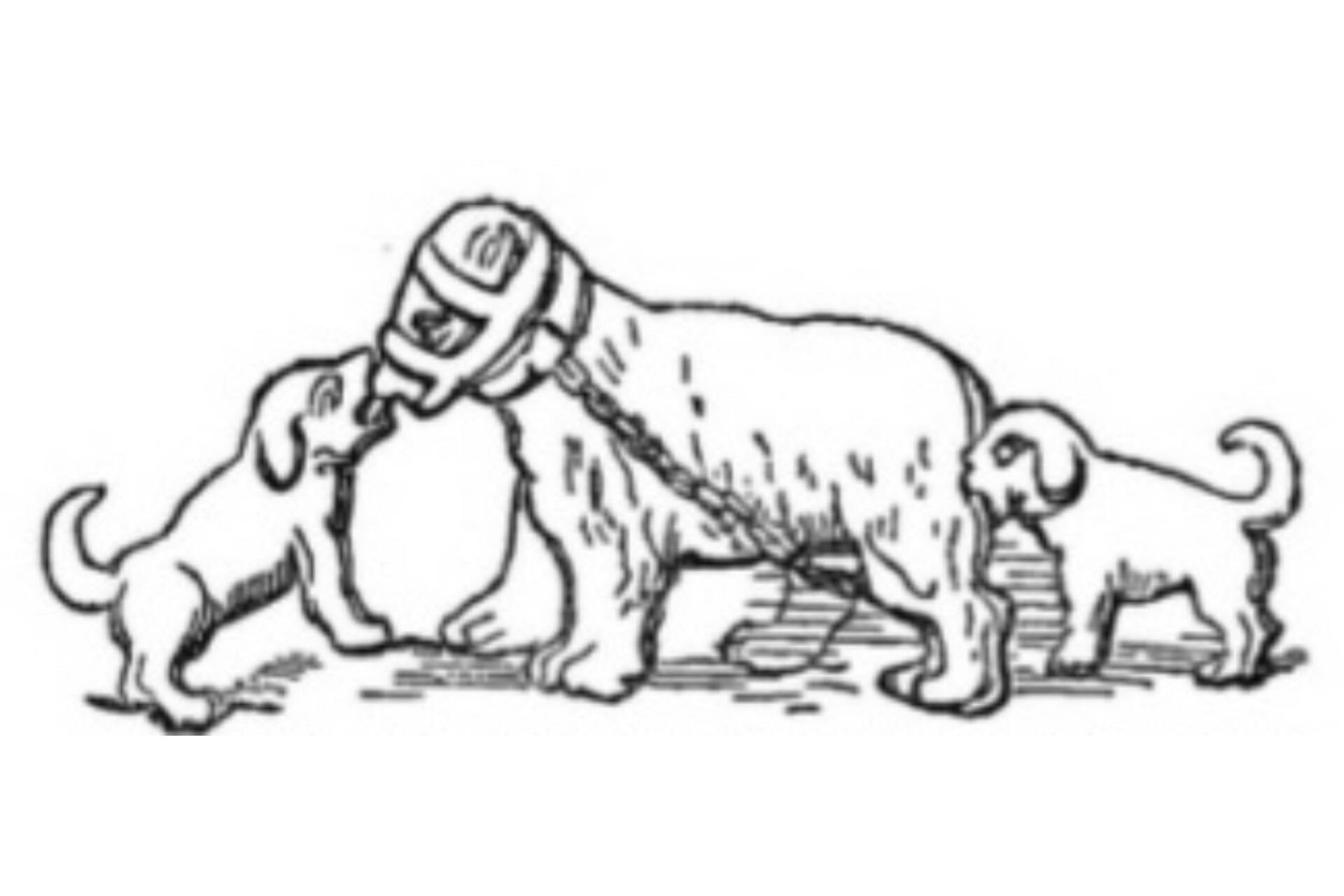
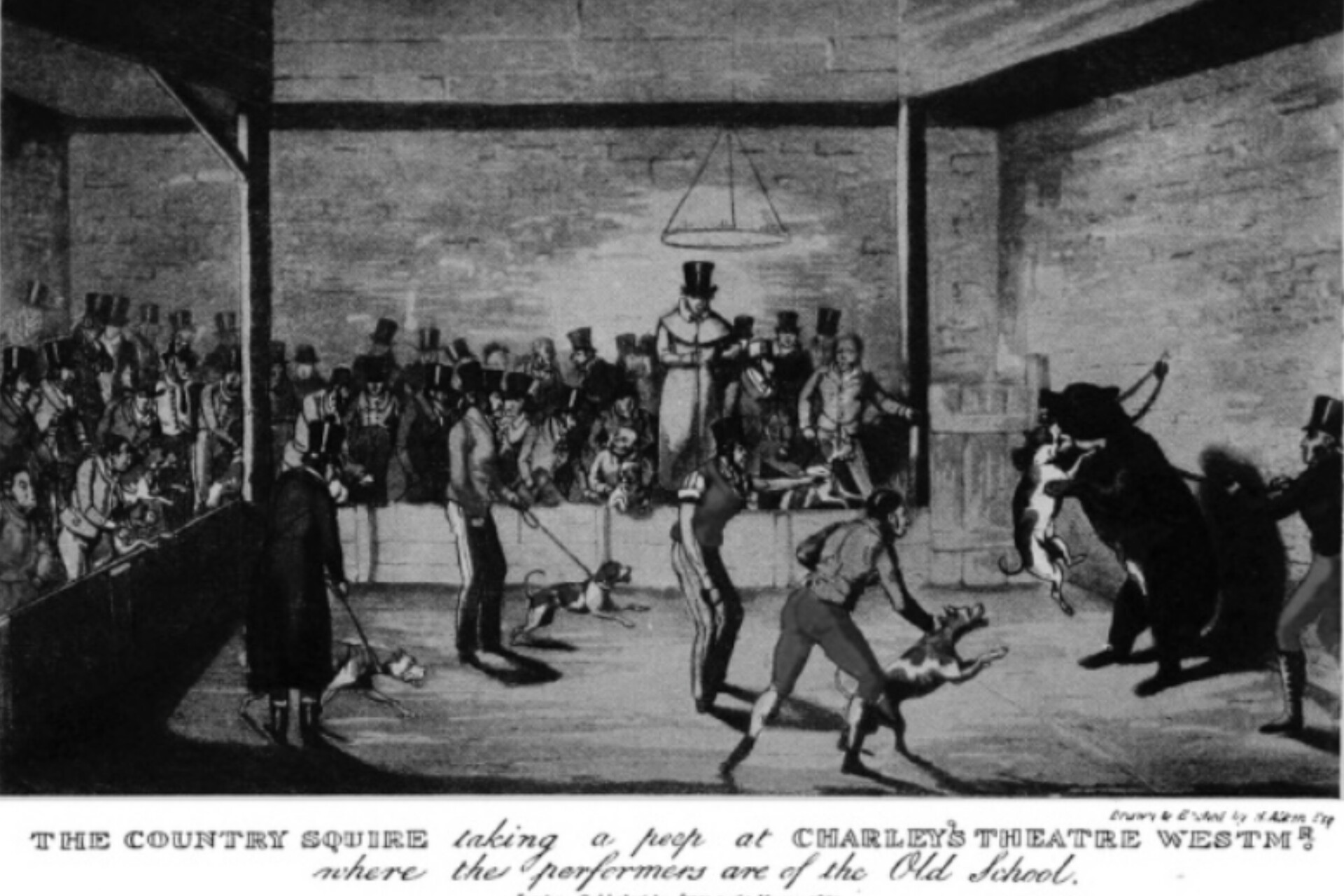
Sometimes as many as seven bears were exhibited at once, each confined by a long rope or chain, and baited with three or four large and courageous dogs, who rushed upon him with open jaws. The bears, ferocious and fretful with continued fighting, were of great strength, and not only defended themselves with their teeth, but hugged the dogs to death, or half suffocated them before their masters could release them. The bears generally bore the same names as their owners — “Hunx,” “George Stone,” “Old Harry of Tame,” and “Great Ned,” were well-known public characters, and Shakspeare alludes to one named “Sackerson.”
Sometimes the bear broke loose, to the terror of women and children. On one occasion a great blind bear broke his chain, and bit a piece out of a servingman’s leg, who died of the wound in three days. On such emergencies a daring gallant would often run up and seize the furious beast, entangled as he was with dogs, and secure him by his chain. It was to an exploit of this kind that Master Slender referred when, boasting of his prowess to Mistress Anne Page, he said: — “I have seen ‘Sackerson’ loose twenty times, and have taken him by the chain; but, I warrant you, the women have so cried and shrieked at it, that it passed: but women, indeed, cannot abide ’em; they are very ill-favoured rough things.” — Merry Wives of Windsor, act i. sc. 1.
Shakspeare has drawn not a few illustrations and metaphors from this rude sport. In another place he speaks of the bearward’s bears frightening the fell-lurking curs by the mere shaking of their chains, and describes a hot o’erweening cur running back and biting his owner, who withheld him, yet when, suffered to get within reach of the bear’s fell paw, clapped his tail between his legs and howled. — Second Part of Henry VI. act v. sc. i. .
The noise of the bear-gardens must have been well-nigh unendurable, what with the din of men eager to bet on their favourites, and the loud shouts of the respective partisans of dog and bear. At the present day the comparison of a noisy house to a “bear-garden” still perpetuates the national amusement of our forefathers.
Happily, such pastimes have long been obsolete, although the memory of these bygone days is still occasionally revived by an attempted exhibition of a tame performing bear.
James Edmund Harting, British Animals Extinct within Historic Times: with Some Account of British Wild White Cattle (Boston: J.R. Osgood and Co., 1880), 11 – 32. Footnotes have been deleted.
See: https://babel.hathitrust.org/cgi/pt?id=coo1.ark:/13960/t4sj21q42&seq=1
Old English Sports
Frederick W. Hackwood
BEAR AND BADGER-BAITING, RAT-KILLING, Etc
Bear-baiting requires a bear-pit — Antiquity of the sport — The great baiting by ban-dogs at Kenilworth in 1575 — Whipping the Blind Bear — The Bear Garden at Southwark — Popularity of the Sunday baitings there — Under royal and noble patronage — Eighteenth-century popularity — Diversions at Hockley-in-the-Hole — The bear usually the victor — Impromptu baitings — Bear-baiting at Madeley Wakes (Salop) in 1825 — Terms derived from the sport. . . .
Dog-fighting and Bull-baiting naturally led to the pitting of dogs against other beasts of fighting propensities. Hone’s “Every-day Book” (vol. i. p. 492) records in 1825 the baiting of a lion at Warwick by six mastiffs, in which the handling of the animals was performed by one Samuel Wedgbury, who is described as a London breeder of dogs.
Bear-baiting differed from Bull-baiting inasmuch as the latter was practised in the open, the victim being merely tethered to a stake; but for the baiting of a bear it was necessary to provide a large sunken pit from which the animal could not possibly break loose.
As far back as the twelfth century the baiting of bulls and bears was a favourite holiday pastime in England, and it continued to be popular for many a day.
When Queen Mary visited her sister during her confinement at Hatfield House, the royal ladies were entertained with a grand baiting of bulls and bears, with which they declared themselves ” right well contented.”
Elizabeth took especial delight in seeing the courage of her English mastiffs pitted against the cunning of Ursa and the strength of Taurus. On May 25, 1559, the French ” ambassadors were brought to court with music to dinner, and after a splendid dinner were entertained with the baiting of bears and bulls with English dogs. The queen’s grace herself and the ambassadors stood in the gallery looking on the pastime till six at night.”
The diplomatists were so gratified that her Majesty never failed to provide a similar show for any foreign visitors she wished to honour.
If Queen Elizabeth could take a womanly pleasure in the Bear-baiting provided for her in those famous festivities at Kenilworth, when on the sixth day there were turned loose no less than thirteen bears to fight indiscriminately a number of “ban dogs” (a kind of mastiff), we surely should feel no surprise in learning that such entertainments were often brought to a close by another inhuman diversion.
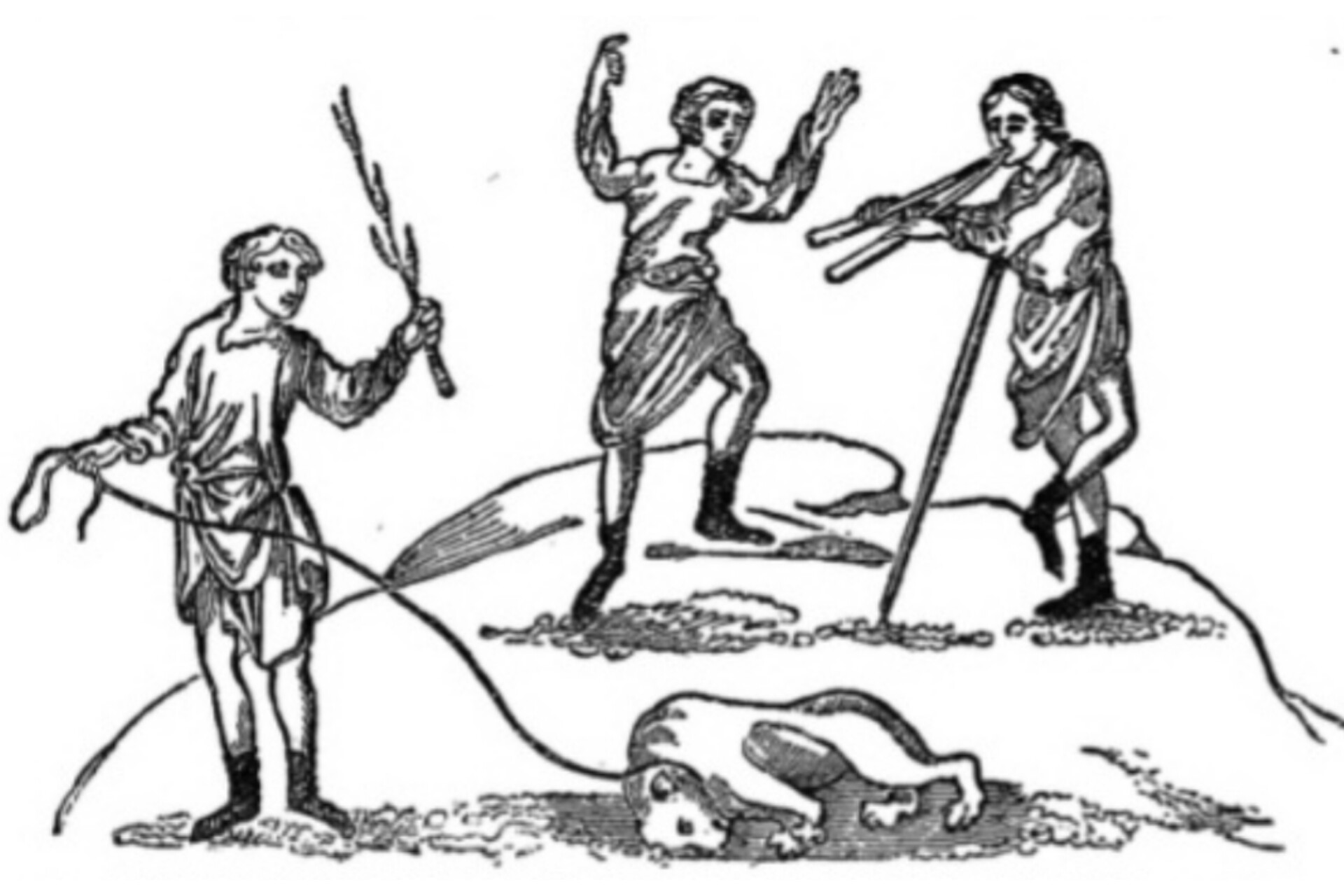
This was known as “Whipping the Blind Bear”; and as described it was “performed by five or six men standing circularly with whips, which they exercise upon him without mercy, as he cannot escape because of his chain. He defends himself with all his force and skill, throwing down all who come within the reach, and are not active enough to get out of it; on which occasions he frequently tears the whips out of their hands and breaks them.”
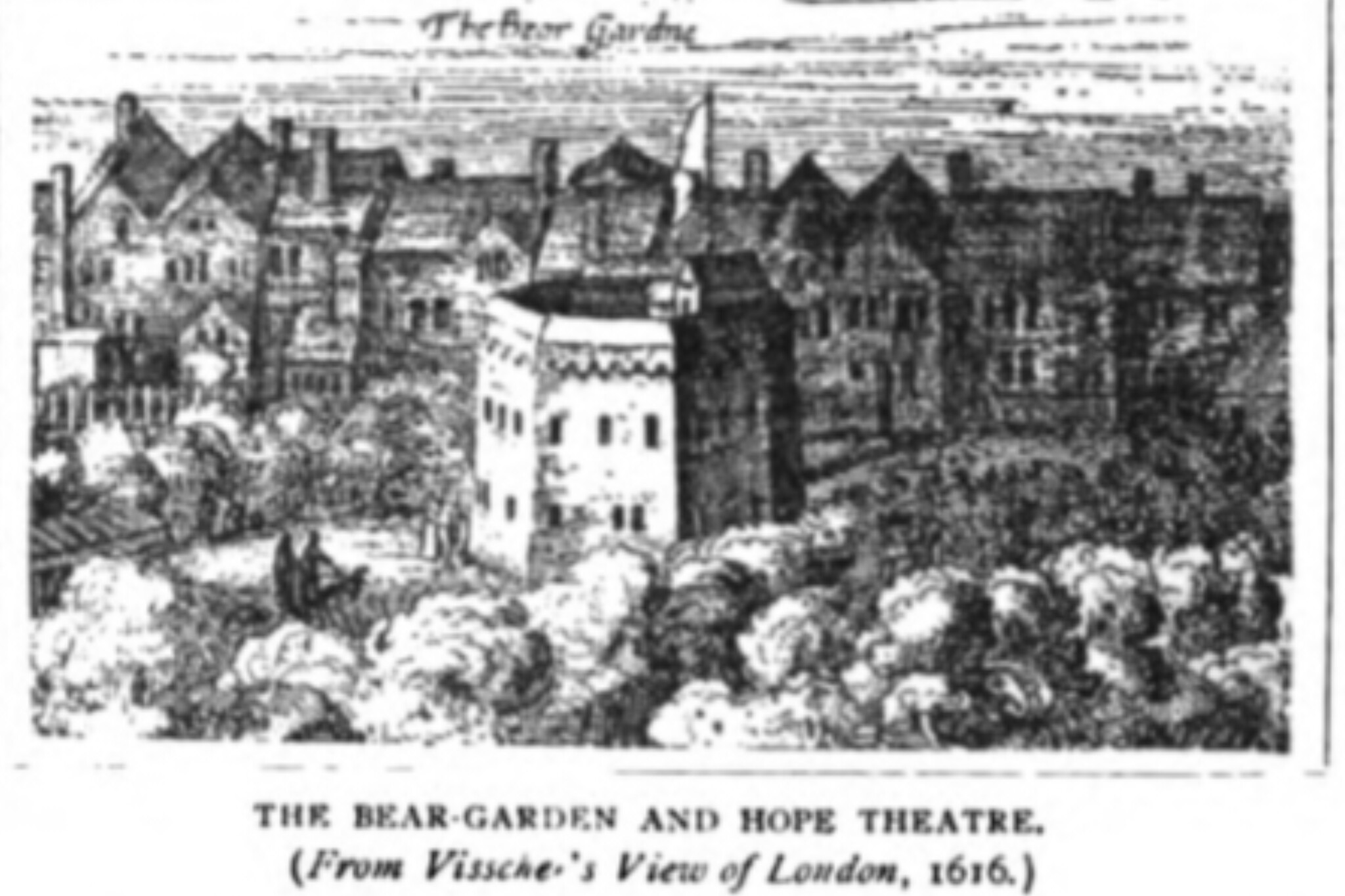
The earliest theatres in London for the exhibition of dramatic performances were preceded by the old Bear Gardens, round or octagonal buildings, the appearance of which has been made familiar to us by pictures of the Globe Theatre of Shakespeare’s time, which was actually an adaptation of one of these gardens. Pictures of the Old Bear Garden at Bankside, Southwark, as it appeared in 1574, and again as it was in 1648, are given in Hone’s “Table Book.” They are mentioned at an earlier date by Cowley, who flourished in the reign of Henry VIII.: —
“What follie is this to keep with danger
A great mastive dog and fowle ouglie bear;
And to this end — to see them two fight
With terrible tearings, a ful ouglie sight.
And methinks those men are most fools of al
Whose store of money is but very smal,
And yet every Sunday they wil surely spend
One penny or two, the bearward’s living to mend.”
Stowe tells us that on the west bank there were ” two bear gardens, the old and the new; places wherein were kept beares, bulls, and other beasts to be bayted; as also mastives in several kennels, nourished to bayt them. These bears and other beasts are kept in plots of ground, scaffolded about for the spectators to stand safe.”
The buildings were circular and unroofed, evidently in humble imitation of the ancient Roman amphitheatre, the most popular exhibitions taking place on Sundays, when the price of admission was usually one halfpenny. Sometimes the grounds included a pond, which always adjoined the cage, to enable the bear to indulge in his propensity for bathing and washing.
This Old English pastime was patronised by the nobility for centuries, was long one of the delights of the vulgar, and almost as a matter of course it formed part of the entertainment provided for Queen Elizabeth at Kenilworth in 1575, as we have just seen. In the reign of James I. the Bear Garden was under Royal protection, and the Mastership of it made a patent place. One celebrated actor held the position, and the annual profits on the Garden were very large. James did not discourage the sport beyond forbidding it on Sunday.
Evelyn in his Diary, alluding to the Games and Diversions which characterised the Court of Charles II., records that on June i6, 1670, he visited the Bear Garden “where was Cock-fighting, with Dog-fighting, Bear and Bull-baiting, it being a famous day for butcherly sports.”
In the times of the Commonwealth, however, it was a forbidden amusement. With the Restoration it revived, and Burton speaks of Bull and Bear-baiting as a pastime “in which our countrymen and citizens greatly delight and frequently use.”
Bear-baiting rose into high favour again after the Restoration, though it had been so sternly checked by Parliament in 1642, and the practice did not wholly discontinue in London till 1750.
Any attempt on the part of the present writer to describe the kind of amusement provided two centuries ago at places of popular resort in the Metropolis would pale into utter insignificance before the glaring terms of a newspaper advertisement which is dated 1710. Here is the contemporary testimony as to the state of national morality in Christian England at that period: —
“At the Bear Gardens, Hockley-in-the-Hole.
“This is to give notice to all Gentlemen Gamesters and others, that on this present Monday is a match to be fought by two dogs, one from Newgate Market against one from Hony Lane Market, at a bull, for a guinea, to be spent. Five let-goes out of hand; which goes fairest and farthest in, wins all.
“Likewise a Green bull to be baited which was never baited before, and a bull to be turned loose, with fire-works all over him, also a mad ass to be baited.
“With a variety of bull-baiting and bear-baiting, and a dog to be drawn up with fire-works.
“To begin exactly at three of the clock.”
Could the most insatiable human brute in the world wish for a greater variety of “sport” to his taste than was offered to him here? This was the place where crosses of ribbon were stuck on the foreheads of favourite bulldogs, and when these were removed and stuck on the bull’s forehead the dog was cheered on till he had recovered the treasured decoration. In 1716 a “wild bull ” was baited with fireworks, and the bears were baited to the death at this same delectable resort.
The poet Gay, in his ” Trivia,” says: —
“Experienced men, inured to city ways.
Need not the calendar to count their days.
When through the town, with slow and solemn air.
Led by the nostril walks the muzzled bear;
Behind him moves, majestically dull.
The pride of Hockley Hole, the surly bull.
Learn hence the periods of the week to name —
Mondays and Thursdays are the days of game.”
Though the encounter between the bear and the mastiffs was always a ferocious attempt to “settle their ancient grudge per duellum,” in the results the balance was usually in favour of the former. The bear had the advantage of size, superior strength, and the protection of a thickly furred skin which practically amounted to invulnerability. The contest was one of teeth against claw ; there was an immense amount of “fending and prooving, with plucking and tugging, skratting and byting, by plain tooth and nayl “; in all of which, while it was possible for a dog to be torn, lacerated, and mangled, the bear seldom got a wound which “a month’s licking would not recover.” Of course the bear could also bite as well as “pynch,” and he could “wynde” himself free while the battle raged with much “clawyng, with roring, torsing, and tumbling.”
The noise and tumult, both in the pit and amongst the excited spectators, which accompanied these encounters, has given us that common and frequently used phrase, “As noisy as a bear-garden.”
Besides the exhibitions which regularly took place in olden times in specially erected buildings, such as has been described as existing in the Metropolis, occasional Bear-baitings of an al fresco character were got up in many places till well into the nineteenth century. The main difficulty always to overcome was the provision of the bear. In a few of the larger towns a bear was kept on purpose; in other places the sport was dependent on the arrival of a travelling bear. Even a dancing bear, led about to the music of pipe and tabor, would some-times be submitted to the trial of a baiting — if a sufficient amount of consideration money were forthcoming.
Illustrative of the state of feeling with regard to. these practices, here is an extract from a collection of old Salopian lore, entitled ” Spring in a Shropshire Abbey,” by Lady Milnes Gaskell; it is a little shrivelled old man named Timothy Theobald who thus relates his Loppington experiences: —
“It war a royal do. For they had not only bulls, but bears. ‘I mind me,’ he continued, after a minute’s hesitation,’ as it war in 1825. There were great rejoicin’s. Folks druv and came in from all parts, and it war a grand celebration, and all given because the parson’s daughter war marryin’ a squire. But then parsons were parsons in those days. They rode, shot, and wrestled, besides preachin’. ‘Tis true as there war a few what objected. Now at Madeley Wakes they had grand games on too. All the colliers, I’ve heard grandam say, used to come down and bet free and easy, like gentlemen born. Many was the time, I’ve heard ’em say, folks used to see the collier folk ranged down to make a lane like for the bull or bear to pass along. My word! as old Matt. Sykes used to say. It war a mighty question which looked best, beast or dog, for when ’twas a bull they only slipt one to a time. “One dog one bull,” that war what they used to say to Madeley. Oakengates, I’ve heard say, war the last place where they baited the bull in Shropshire. And I alius say,’ said old Timothy, with a spark of enthusiasm, ‘that ’tis a mighty fine feather in the cap of that place, as it war the last as kept up the good old English sport.'”
One of the last known remnants of a Bear Cage in the Midlands disappeared at the demolition of Birchfield House, Handsworth, only a year or two ago.
To the literature of the sport we are indebted for several well-known words besides the term “bear- garden.”
In Tudor times all great nobles had their “Bear-wards,” and kept their herds of bears, which were regularly trained for the arena.
An old song entitled “The Jovial Bear Ward,” goes in this strain: —
“Tho’ it may seem rude
For me to intrude
With these my Bears by chance-a;
‘T were sport for a king If they could sing
As well as they can dance-a.”
Also one who tended, or led the brute about, was called a bear-ward, or sometimes a bear-tender. Hone, in his “Table Book ” (p. 596), tries to explain the term “Bear-tender.” He opines that a children’s game known as “Bear and Tenter,” in which a boy crawls on the ground as a bear, and is protected from the buffets of all the other boys by one who acts as his tenter, had its origin, not in imitation of Bear-baiting, but from the practice of the scions of English noble families being always sent on the grand tour of Europe under the care of tutors, or “bear leaders” This is altogether an unsatisfactory explanation, and far less feasible than the one given on p. 312.
In the Black Country and the surrounding Midlands there was in common use, till about 1825, the word “berrod,” a corruption of “bear-ward,” just as one who regularly got up bull-baitings was termed a ” bullot.”
Frederick W. Hackwood, Old English Sports (London: T. Fisher Unwin, 1907), 344-351. The picture “Country Squire” appears on page 349 and “Bear-Garden and Hope Theatre” can be found on page 216 in T. Fairman Ordish, Early London Theatres [In the Fields.] (London: Elliot Stock, 1894).
See: https://babel.hathitrust.org/cgi/pt?id=coo1.ark:/13960/t2w38bc4g&seq=1