
Great Auk
We want you to have a greater ability to learn about some of the unpleasant animal issues in our world.
Lost and Vanishing Birds
Charles Dixon
THE GREAT AUK
(ALCA IMPENNIS)
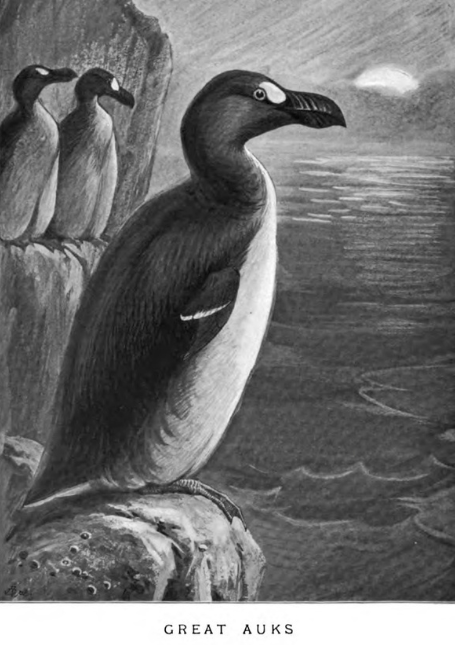
The species we have hitherto mentioned have become extinct in the British Islands only, their extermination being of a local character; but the present bird excites a wider melancholy interest, for there can be little doubt that it has ceased to exist altogether. Many erroneous opinions prevail not only respecting the geographical distribution of the Great Auk, but the cause of its extirpation. As most readers may know, the Great Auk was incapable of flight. The bird was nearly as big as an ordinary tame Goose, but closely resembled a Razorbill in general appearance, except that its short narrow wings were quite incapable of bearing it through the air. If useless for flight, these wings were used with marvellous power as oars, and the bird was a most accomplished swimmer and diver. This inability of the wings for flight was due to the abortive character of the bones of the forearm and hand, the humerus being proportionately as long as in the existing species of Auks, all of which are able to fly. As Mr. Lucas (one of the ablest historians of the Great Auk) points out, this modification of structure, however unfortunate it proved to its possessor, was correlated with the bird’s aquatic habits; the resistance of water being much greater than that of air, a wing requiring less surface and more power than one formed exclusively for aerial locomotion would be best adapted for submarine flight.
Respecting the geographical distribution of the Great Auk, the impression widely prevails that the bird was an inhabitant of the Arctic regions; and more than one naturalist has suggested that the lost species may still be found in the Polar solitudes. Vain hope, with not a shred of evidence to support it! So far as is known, the Great Auk was confined to the North Atlantic, and there is no reliable evidence whatever that the bird ranged anywhere within the Arctic Circle. On the eastern shores of the North Atlantic the bird ranged from Iceland to the Bay of Biscay, breeding certainly in the Icelandic area, and possibly on the Faroes, the Orkneys, and some of the Norwegian islands. There is little evidence to suggest that the Great Auk ever bred in any numbers, if at all, on St. Kilda, Martin’s statements notwithstanding. On the western shores of the North Atlantic its range extended from Greenland to Virginia, but the actual breeding stations were few and far between. There can be no doubt that the grand headquarters of the Great Auk were on the American side of the Atlantic, and there the most important station of which we have any evidence at present was on Funk Island, off Newfoundland, although other breeding-places were possibly located along the coasts of Labrador and South Greenland. In European waters Iceland appears to have been the principal resort of the Great Auk, and from here most of the specimens of birds and eggs now in existence were obtained. Here the colony was located on several rocky islets situated some twenty-five miles to the south-west of the main island, the birds continuing to be fairly numerous, although harassed from time to time by collectors and others. But misfortune seems to have settled upon the Great Auk, Nature herself hastening its doom in volcanic disturbances, which in March 1830 caused the principal breeding ree — the Geirfuglasker — to disappear beneath the waves, and compel the surviving birds to take up fresh quarters. Most of them appear to have selected the islet of Eldey — a very unfortunate choice, for this reef was situated much nearer to the main island, and was far more accessible to man. Here, within a period of fourteen years, every bird was killed, the last pair being captured early in June 1844, and forming the final record of the species in Europe.
Coming now to British waters, we find it stated that two centuries ago the Great Auk was a regular summer visitor to St. Kilda, although, as previously stated, we doubt if the bird ever was established there in any numbers, the islets being for the most part very precipitous, and unsuited to its requirements. A bird, however, was caught there — in autumn be it remarked — as recently as 1821 or 1822; and we ourselves in 1884 were assured by an old inhabitant of the islands that a Great Auk was stoned to death as an “evil spirit” on Stack-an-Armin about half a century previous, he himself assisting in the massacre! In 1812, Bullock saw a Great Auk at Papa Westray in the Orkneys, and tried to shoot it without success, although the poor unfortunate was killed the following year, preserved, and sent to him. This specimen is now in the British Museum. The hen bird of this pair had been killed previous to Bullock’s visit. One other British example was caught in a landing-net in Waterford harbour in May 1834, and is now preserved in Trinity College Museum, Dublin. Other evidence of the Great Auk’s former existence in Ireland is presented in its remains found in some numbers on the coast of Antrim, with those of the horse, dog, and wolf, and more recently in a “kitchen midden” in the county of Waterford. Remains of this bird have also been found in the superficial deposits in the Cleadon Hills in Durham, as well as at Oronsay and Caithness.
We now turn to the story of the Great Auk’s extirpation in America,— a record of wanton cruelty and carnage that would be hard to beat,—” countless myriads of this flightless fowl,” says Mr. Lucas, “hunted to the death with the murderous instincts and disregard for the morrow so characteristic of the white race.” Although there is evidence to suggest that the bird was formerly abundant at Penguin Islands, off the southern coast of Newfoundland, Funk Island must have been the site of the most important colony. This latter locality was specially visited by Mr. Lucas in July 1887, on board the U.S. Fish Commission steamer Grampus, and from his intensely interesting accounts we will quote the following particulars. Here, on the southern half of the island, “the Auk bred in peace, undisturbed by man, until that fateful day . . . when Cartier’s crews inaugurated the slaughter, which only terminated with the existence of the Great Auk. The history of the Great Auk in America may be said to date from 1534, when, on May 21, two boats’ crews from Cartier’s vessels landed on Funk Island, and, as we are told, ‘in lesse than halfe an hour we filled two boats full of them, as if they had been stones. So that besides them which we did eat fresh, every ship did powder and salt five or sixe barrels of them.’ The Great Auk having thus been apprised of the advent of civilisation in the regular manner, continued to be utilised by all subsequent visitors.
The French fishermen depended very largely on the Great Auks to supply them with provisions; passing ships touched at Funk Island for supplies; the early colonists barrelled them up for winter use, and the great abundance of the birds was set forth among other inducements to encourage emigration to Newfoundland. The immense numbers of the Auks may be inferred from the fact that they withstood these drains for more than two centuries, although laying but a single egg, and consequently increasing but slowly under the most favourable circumstances.
Finally someone conceived the idea of killing the Garefowl for their feathers, and this sealed its fate. When and where the scheme originated, and how long the slaughter lasted, we know not, for the matter is rather one of general report than of recorded fact, although in this instance circumstantial evidence bears witness to the truth of Cartwright’s statement, that it was customary for several crews of men to pass the summer on Funk Island solely to slay the Great Auks for their feathers. That the birds were slain by millions, that their bodies were left to moulder where they were killed, that stone pens were erected, and that for some purpose frequent and long-continued fires were built on Funk Island, is indisputable.”
The final extinction of the Great Auk in America was almost coincident with its extirpation in Europe, the work of slaughter going steadily on “until the last of the species had disappeared from the face of the earth, and the place to which it resorted for untold ages knew it no more.” Mr. Lucas obtained the most ample evidence of the bird’s former abundance. He tells us that “on the northerly slope a stroke of the hoe anywhere would bring to light at least a score of bones”; and again, “while many humeri were thrown aside while digging, the collection was found to contain over fourteen hundred specimens of this bone.” The material brought back by him was estimated to be greater than that obtained by all other expeditions combined, and to include nearly two barrels of bones, from which ten or eleven skeletons of the Great Auk have been made up. Previous to the visit of Mr. Lucas to Funk Island, but two naturalists had explored the place. Stuvitz went there in 1841, and discovered some bones; Professor Milne visited the island in 1874, and after an hour’s work brought away bones belonging to some fifty birds and the inner linings of several eggs; whilst nine years previous to the latter naturalist’s visit, an expedition sent out for guano procured three “mummies” or dried bodies of the Great Auk.
The extinction of this noble bird is all the more to be regretted when we bear in mind that it was absolutely avoidable and unnecessary, and was in no remote way due to those economic and industrial changes which have deprived so many other species of a home. Here in the present case we find no invasion by civilisation of favourite haunts, no destruction for the sake of improvement of time-honoured breeding-grounds, no increase of population to exterminate timid creatures, but simply a cruel and wanton massacre of poor helpless and defenceless birds for the sake of commercial greed and gain that really could have had very little value. The extermination that went on in Iceland in an era of greater intellectual activity has even less to defend it; for there the latest survivors of the Great Auk were captured to supply various scientific institutions in Europe, so that literally its extirpation was countenanced and approved by and was undertaken in the name of Science!
There was no reason whatever why the Great Auk should not have survived and even flourished in our own day. It is true the bird was comparatively helpless, but its inability to escape from enemies only prevailed during the nesting season, when the poor bird was engaged in duties that should have ensured for it immunity from harm. At all other times it was practically safe in its natural element the sea. Regrets are useless now; and when the few relics that are in existence have mouldered away, the Great Auk will fade from our memories, live but as a tradition, and finally perhaps as a legend or a myth!
Notwithstanding the former abundance of the Great Auk, and its comparatively recent final disappearance, but very little indeed is known respecting its habits. These, there can be little doubt, were very similar to those of its surviving allies, especially of the Razorbill, its nearest living relation. We know that it was an accomplished diver, we also know that it lived on fish; but of its notes, its nesting habits, its migrations, and the like, history is silent, and records are wanting. The breeding-places of this species were flat rocks that sloped gently to the sea, and the single egg was, it is presumed, laid nestless on the ground. This egg runs through similar variations to those of the Razorbill, but is, of course, double the size. The number of eggs at present known to exist is seventy-one. There are also seventy-seven skins of the Great Auk in various collections, together with many more or less complete skeletons and large numbers of odd bones.
The Great Auk has the general colour of the upper parts, including the wings, black; the secondaries are tipped with white; the tail is black; the throat is black; the remainder of the under parts white, as is also a large patch on each side of the face between the base of the bill and the eye. [A] Bill similar to that of the Razorbill, but the white grooves not quite so conspicuous. In winter the throat became white, as in the Razorbill. The length of the Great Auk was about twenty-five inches.
Charles Dixon, Lost and Vanishing Birds; Being a Record of Some Remarkable Extinct Species and a Plea for Some Threatened Forms (London: Charles MacQueen, 1898), 86-97. Footnotes have been deleted. The picture “Great Auks” appears on page 86.
See: https://babel.hathitrust.org/cgi/pt?id=hvd.32044066327701&seq=1