
Aurochs
We want you to have a greater ability to learn about some of the unpleasant animal issues in our world.
The Ox and Its Kindred
Richard Lydekker
CHAPTER III
THE WILD OX AND ITS EXTERMINATION
The earliest historical evidence we possess of the former existence of the wild ox or aurochs in western Europe is contained in Julius Cæsar’s De Bello Gallico, book vi. chap. xxix., where the following passage occurs:—
“Tertium est genus eorum qui uri appellantur. sunt magnitudinæ paulo infra elephantos, specio et colore et figurâ tauri. Magna vis eorum et magna velocitas; neque homini neque feræ, quam conspexerunt, parcunt. . . . Amplitudo cornuum figura et species multum à nostrorum boum cornibus differt.”
This may be freely translated as follows:—
“There is a third kind of these animals which are called uri. In size these are but little inferior to elephants, although in appearance, colour, and form they are bulls. Their strength and their speed are great. They spare neither men nor beasts when they see them. . . . In the expanse of their horns, as well as in form and appearance, they differ much from our [domesticated] oxen.”
The wild oxen referred to in this passage — which was written about the year 65 B.C.— inhabited the great Hercynian Forest, the Hercynia or Orcynia Silva, which covered at that time nearly the whole of Germany, and of which the name is still preserved in Harz and Erz. It included the modern Teuto-bergerwald, Thuringerwald, and the Schwarzwald, or Black Forest.
Another Latin writer, Seneca, alludes to the wild ox in the following lines:—
“Tibi dant variæ pectora tigres,
Tibi villosi terga bisontes,
Latisque feri cornibus uri,”
which may be rendered in English—
“To thee the striped tigers present their breasts, to thee the shaggy bisons offer their backs, and likewise the fierce aurochs with their wide-spreading horns.”
Pliny, again, distinguishes the “jubatos bisontes” (maned bisons) from the “excellentique vi et velocitate uros” (the aurochs excelling in strength and speed).
The last two extracts clearly show that the ancient Romans were perfectly well acquainted with the difference between the aurochs and the bison; and in this connection it is interesting to note that, according to a paper contributed by Professor E. Fraas, of Stuttgart, to the Fundberichte aus Schwaben for 1899, vol. vii. p. 39, their sculptors expressed this distinction by modelling statuettes of both species. Three of these statuettes were dug up in Swabia in a railway cutting embedded in clay at a considerable depth, in association with the remains of the mammoth and other extinct animals; but it is quite clear that they must have been artificially introduced into this stratum.
Reverting to Cæsar’s account, it is a matter for regret that the colour of the aurochs is referred to as being like that of domesticated cattle. Since, however, as is shown later, we have evidence that the aurochs was black in Poland, but possibly red in Germany, it will be obvious that the comparison was not made with imported pale-coloured cattle from the Roman Campagna, but, most probably, with a native dark-coloured breed. The importance of this will be noticed in the sequel.
It will further be noticed that the aurochs evidently differed from the bison by its smoother coat, by the much greater spread of its horns, and apparently also by its superior stature, strength, and speed. The large size of the horns is abundantly confirmed by that of the bony horn-cores of fossil skulls, as well as by a few specimens of the horns themselves, either dug up from the peat, or preserved to a late date as drinking-vessels in churches and castles.
It does not appear that Cæsar ever saw a living wild aurochs, his account having been derived from native German hunters, who were well acquainted with the animal. On the other hand, it is probable that he had seen and drunk from its horns, which were at an early date mounted in silver as goblets, and were supposed to bring good luck to those who drank from them.
In the year 530 the poet Fortunatus mentions that one Gogon had hunted bubali (literally buffaloes) in the Wasgenwald; but there is little doubt that the animals referred to were in reality aurochs, as the author states in a later passage that his bubalus is the same animal as the Germans call ur. Reference is also made by Gregorius, Bishop of Tours, in the year 573 to the unlawful slaughter of a so-called bubalus in the Wasgenwald, the killing of such animals being prohibited. Carl the Great is also stated to have hunted wild bulls, although no further particulars are given.
Old chronicles mention that in the middle of the sixth century wild bulls were found, although rarely, in the province of Maine, in France; and during the ninth century Charlemagne hunted aurochs in the great forests near Aix-la-Chapelle, while at the close of the following century the flesh of these animals is alluded to in the rolls of an abbey in Switzerland as an article of food. The aurochs was met with during the route taken through Germany by the first crusade, in the eleventh century; and that it still lingered in the neighbourhood of Worms during the twelfth century is indicated by the above-mentioned slaughter of four individuals by Siegfried, recorded in the “Niebelungenlied,” which was published in the year 1200.
About the same period, that is to say in the year 1170, we find Hartmann von Aue alluding to the occurrence of both aurochs and bison in the forests of the Rhine district, where they were from time to time hunted by the kings and nobles. The trophies obtained during these hunts were carefully preserved, and there is the testimony of Conrad Gesner, the great naturalist of the sixteenth century, to the effect that he had seen in the treasuries at Worms and Mayence skulls of the aurochs with horns of immense size. We are told, again, that in the second half of the sixteenth century Bishop Johann von Manderscheid discovered in his episcopal treasury a huge horn mounted as a goblet, which from its great size could only have belonged to an aurochs. This horn was deposited by the bishop in the castle of Hohenbarr, near Zabern, as the emblem of a body known as the “Bruderschaft des Hornes” (Confraternity of the Horn), whose object was to bring together the hardest drinkers in the district. What became of this trophy is unknown; and the same is the case with other aurochs-horns mounted as drinking-cups and preserved in many inns, churches, and castles, especially in South Germany and Alsace-Lorraine, till a comparatively recent date, one of which measured 6 1/2 feet in length, while another held 3 1/2 quarts.
There are likewise certain references to the aurochs and the bison, as animals then living in Europe, between the years 1240 and 1364; but much more important information is afforded with regard to the existence of the former species in eastern Prussia and Lithuania (the modern Grodno) at the close of the fourteenth century. There occur, for instance, in a kind of an account-book (“Das Marienburger Tresslerbuch der Jahre, 1399-1409″) various entries under the headings of Euwir, Uwer, Weszent, Wesent, and Wesant, of which the last three refer to the bison, and the other two to the aurochs, the bison being more frequently mentioned than the aurochs. Thus in an entry dated 2nd February 1404 it is stated that one mark and a half was given to a Prussian who brought an aurochs; while another entry relates to a reward paid to two Prussians for a second aurochs. Whether these animals were brought alive or dead is not stated; but it is quite evident that the species was at this time living in the forests around Marienburg. A third entry, dated 7th April 1400, mentions one mark (equivalent to about thirteen shillings in modern money) being paid to a Lithuanian for bringing four aurochs from Duke Witowt, of Lithuania. That these must have been young animals is certain, and it is also probable that they were tamed. They were brought with the request that they should be forwarded to Dantzic, and thence by sea to Burgundy; and there are items recording the amounts paid for freight, fodder, attendance, etc., all of which go to prove that aurochs were then regarded as valuable animals.
All this indicates that aurochs were still living in Prussia and Lithuania in 1400, and probably at least as late as 1409, although in Prussia, at any rate, they were becoming scarce. By 1400, or thereabouts, the species had, however, been exterminated in western Europe, and especially Germany, as there is no reference to its existence in literature, and its name soon became confounded with that of the bison. In fact, all tradition of its former existence in this part of the Continent seemed to have been completely lost. As it was a forest-dwelling species, the destruction of the forests, which had by this time taken place, is alone sufficient to account for its extinction. For as the forests were felled and cleared, and their sites converted into cultivated ground, the aurochs would be driven into more and more remote districts, while even there the half-wild domesticated cattle would consume much of the grass which formed their food. Hunting, too, doubtless did its share in the extermination of the aurochs, and in the driving back of the range of the bison to Lithuania and the Caucasus.
As to the date when the aurochs disappeared from eastern Prussia and Lithuania there appears to be no clue; but it is practically certain that sometime after 1409, or thereabouts, the wild ox survived only in the fastnesses of Poland, at any rate so far as Europe is concerned. Here, as previously mentioned, it was known by the name of tur or thur, while the bison was, and still is, termed the zubr or suber. One of the earliest records of the existence of the aurochs in Poland is a proclamation by Duke Boleslaus of Masovia, dated 1298, in which the hunting of the tur is prohibited for the future. In a second ancient document, dated 1359, Duke Ziemovit of Masovia grants permission to the Duchess of Wyszogród to hunt all animals on his estates with the exception of tur.
In both the above instances Masovia, or that portion of Poland situated in the west of the old kingdom, near the present German frontier, is given as the home of the wild ox. Here it survived longest, probably in much the same manner as the bison does in the Lithuanian forest of Bielowitza (pronounced Bielowish), namely, under the special protection of the Polish nobles. At that time the portion of Masovia lying about 33½ miles (55 kilometres) to the west-south-west of Warsaw, between the parishes of Bolemow, Wiskitki, and Msczezow, and northwards. nearly to Sochaczew, was covered with a great forest, known either, from the village Jaktorow, as the Jaktorowka forest, or, from the neighbouring district of Wiskitki, as the Wiskitki forest. In the description of Masovia by Andreas Swiecicki, published at Warsaw in 1634, it is, however, referred to as Hectorea Silva (the Hectorean forest). It has now completely disappeared. This forest was the last refuge of the aurochs. It was visited by Swiecicki, who was notary of the district of Narew, in Masovia; but he speaks only of bison, and these from another and distant forest, the Skwa forest, so named from the river Skwa, which lies between the rivers Pysz and Omulew, northwards of Narew.
Fortunately a full account of the tur in the Jaktorowka forest has been preserved to us in the writings of Count, or Baron, Sigismund von Herberstein or Herberstain (the name is spelt in both ways), who was a German diplomatist and historian, born at Wippach in 1486, and who died at Vienna in 1566. As an envoy from Kaiser Maximilian and his successors, Kaiser Carl v and King Ferdinand, he had occasion to pay several visits to Russia and Poland.
His first visit to Poland, to King Sigismund I, who at that time dwelt at Wilna, was undertaken from Moscow, in company with Count Wassilij Iwanow, during the years 1516, 1517, and 1518; while the second, also from Moscow, occurred in the years. 1520 and 1527. In 1542 he again had occasion to visit Cracow in connection with the marriage of the Princess Elizabeth, the daughter of his sovereign, with Sigismund August, the Crown Prince of Poland; and in the following year he accompanied the princess on her bridal journey to her new home. Finally, in 1545, he brought the young queen her dowry. During these journeys Herberstein passed through a great part of Poland, and enjoyed full opportunities of studying the country and its people.
After these journeys Herberstein occupied himself with writing up his experiences and an account of Poland, Lithuania, and Russia generally. His work was published anonymously in the year 1549, under the title Rerum Moscovitaricum Commentarii, with many illustrations. The work, which subsequently was republished with the author’s name, went through a number of editions, and was translated into various languages, with some modification of the title; a circumstance which has given rise to much confusion with regard to its real date. An Italian edition was, for instance, published by G. B. Pedrezzano at Venice in 1550. Another edition appeared in 1552, a third in 1556, and a fourth in 1557, while there were also others, the 1557 edition published at Antwerp being said to be the best, and containing a fuller account of the aurochs than is found in the earlier issues. The later editions also contain figures of the aurochs and the bison, these figures differing in size and in certain slight details in some of the editions.
In addition to giving a detailed account of the bison in Lithuania, Herberstein states that in his time the aurochs was restricted to Masovia, mentioning that it resembled black domesticated cattle, and also that the horns differed in colour from those of the bison.
After the appearance of the anonymous first edition of the Commentarii it would seem that Herberstein again visited Poland, where he had business with King Sigismund August and the Queen-Mother Bona. At the conclusion of the negotiations the king presented him with the eviscerated carcase of an aurochs, lacking the skin of the forehead, while the queen-mother gave him two girdles of tur-hide, which were regarded as of great rarity and value. These presents Herberstein took with him on his return to Vienna, keeping one of the girdles himself, and presenting the other to the consort of King Ferdinand. The hide, together with that of a bison which he had brought home from Poland on a previous occasion, he had stuffed; and the two specimens were eventually placed on exhibition in his house at Vienna. Testimony to this effect is afforded in a Latin poem of Caspar Betius Transslyvanicus, written in the year 1552, and published in Vienna in 1558. According to this poem, the two specimens were mounted in the entrance hall of Herberstein’s residence in such a manner as to show not only the body in connection with the limbs and the horns, but also that the aurochs had the broader chest and the bison the longer limbs. Such details, it has been pointed out by Dr. Nehring, could not have been made manifest if the dried and flattened skins were hung up, and it may accordingly be taken that they were mounted after the rude fashion of those days.
Considerable discussion has taken place as to whether Herberstein ever saw a living aurochs, Dr. Nehring being of opinion that he did so during his visit to Poland in 1550. From the 8th till 13th July of that year Herberstein appears to have been alone at Gomolia, and Dr. Nehring thought it probable that during this interval he made a trip to the Jaktorowka forest to see the tur. Whether he really did so must, however, remain a matter of doubt; although Conrad Gesner in the appendix to the second volume of his Historia Animalium, published at Zurich in 1554, states that Wolfgang Lazius, the publisher of an edition of the Commentarii at Basle, assured him that the pictures of the aurochs and bison in that work were drawn from life. Dr. Nehring has, however, pointed out that there would be considerable difficulty in sketching an aurochs in the Jaktorowka forest, especially if Herberstein himself was not an artist. Moreover, Professor T. Noak, from a study of the engravings themselves, has come to the conclusion that they were drawn from the stuffed skins in Herberstein’s residence at Vienna. He observes, for instance, that there are certain lines in the figure of the bison indicating the existence of cuts in the skin of the hind-quarters and hind-legs, while a piece (as was the practice at that time when animals of the chase were killed) appears to have been cut out of the shoulder of the aurochs. Again, in the bison the wooden beam or plank upon which the head was mounted seems to have been inclined at much too high an angle, thus abnormally increasing the depth of the body, and at the same time causing the front and hind limbs to be a great deal too close together. The beard, too, is quite unlike that of a living bison, thus affording further evidence in favour of the figure having been drawn from a stuffed specimen. Then, again, the heads of both animals apparently indicate that in each case the skull without the lower jaw had been sewn in the wet skin, thus giving rise to that “underhung” appearance which is speedily noticeable in the case of the bison. There is likewise a crack in the skin between the horns, which is alone practically sufficient to prove that the figure of the bison was taken from a stuffed specimen. In the case of the aurochs, in addition to the piece inserted in the shoulder, the chief defect is the incorrect curvature of the horns, as compared with those in an old representation of the aurochs from Vaphio and those of fossil skulls, to say nothing of those of allied breeds of domesticated oxen. Whether this incorrect curvature be due to bad drawing or to bad mounting is not easy to say, although the existence of a similar error in the case of the bison is in favour of the former alternative.
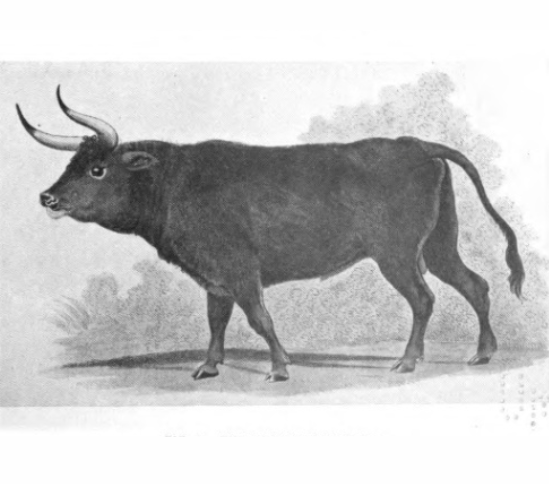
The horns of the aurochs are, however, represented in Herberstein’s figure as being wholly black, whereas it is known from the evidence of a fossil horn discovered some years ago in the peat of Pomerania that, as in the Chillingham, Pembroke, and Spanish cattle, they were really “horn-coloured” with black tips. Both pictures accordingly seem to show the animals, not as in life, but as they were mounted in Herberstein’s collection. The portrait of the aurochs is extremely valuable, more especially the one (herewith reproduced) in the German edition of Herberstein’s work published in 1557 and commonly referred to as the Moskovia.
Pictures of both the aurochs and the bison also occur in a map of the world published at Ebstorf towards the close of the thirteenth century, and therefore long antedating Herberstein’s work. This map, which appears to be preserved in Hanover, contains coloured figures of several kinds of animals, as well as of men. It has been stated to be the work of a monk named Helmot; but according to Dr. Hilzheimer, the most recent writer on the subject, its author is unknown. In this map, as illustrative of Russia (“Rucia”), is represented a tawny-red ox, with long upright and inwardly-curved horns, which bears the inscription “Urus.” In another illustration, explanatory of the products of Asia Minor, is an unmistakable portrait of the bison, bearing the inscription “Bonacus” (= Bonasus).
Dr. Mertens, in the paper already quoted, has accepted this map as evidence that the aurochs was living in Germany at the end of the thirteenth century, and likewise that in this part of Europe its colour was red. Dr. Hilzheimer, on the other hand, believes the figures of the animals to have been copied from earlier writers or chartographers, and is of opinion that the colour of the aurochs cannot be regarded as true to nature, pointing out, among other objections, that the colour of the pigment may have changed with time. In his opinion, the picture is of no value, either as evidence of the existence of the aurochs in Germany at the end of the thirteenth century, or as to the colour of the local representative of the animal.
A third picture of the aurochs was introduced by Colonel Hamilton Smith in Edward Griffiths’ English edition of Cuvier’s Règne Animal, published in London in 1827 under the title of The Animal Kingdom. The original picture from which the engraving was made was copied from an oil-painting on wood purchased by Hamilton Smith from a dealer in Augsburg, and hence known as the Augsburg portrait. This picture, which now appears to be lost, is believed to date from the first quarter of the sixteenth century, or a little earlier than Herberstein’s first visit to Poland; and there can be no doubt that it really represents an aurochs, this being confirmed by Hamilton Smith’s description of the picture, given in vol. iv. p. 415 of The Animal Kingdom, which runs as follows: “It is a profile portrait of a bull without mane, but rather rugged, with a large head, thick neck, small dewlap, entirely sooty black, the chin alone white, and the horns turning forward and then upward like the bull of Romania, pale in colour with black tips. In the corner were the remains of armorial bearings and the word Thur in golden German characters nearly effaced.”
This inscription renders it practically certain that the picture was taken from a Polish tur, or wild bull, although the opinion has been expressed that it was painted from a stuffed specimen, and not from a wild animal. With the exception of the parti-coloured horns and the absence of a light streak down the back (which might, however, have been invisible in the position from which the picture was painted), the colour agrees precisely with Herberstein’s description mentioned later on, and thereby renders it indisputable that adult Polish wild bulls were black.
Colonel Hamilton Smith adds that the Augsburg picture agrees with a sculpture on the “stone of Clunia,” which has a Celto-Iberian inscription, and represents a hunter facing a wild bull.
In addition to that of Herberstein, contemporary accounts of Polish aurochs have come down to us in the writings of Conrad Gesner derived from his friends Baron Bonarus and Dr. Schneeberger, the latter of whom was a physician resident in Cracow during part of the sixteenth century. From these accounts it appears that the breeding season of the aurochs occurred in September, and that the calves were born in the following May. Bull calves were at first blackish brown, but afterwards became black, with a light streak along the spine. It is also stated by Baron Bonarus that the bulls frequently paired with domesticated cows, the latter being very similar in colour to their wild relatives; while, on the other hand, it is expressly mentioned that no such intercourse took place between the wild bison and domesticated cattle.
The difference in the colour of the young and the adults is paralleled in the case of the Javan bantin (Bos sondaicus), where only the adult bulls are black.
The accounts of the aurochs do not, however, end with those of Herberstein, Bonarus, and Schneeberger, for in 1596 Cardinal Gaetano was dispatched by Pope Clement VII on a mission to Poland, accompanied by his private secretary, Paul Mucante, who left a diary, in which it is stated that the King of Poland presented the cardinal with the carcase of an aurochs from a royal preserve. This aurochs was grey, and its flesh, when eaten, was pronounced to be very like ordinary beef, but drier and tougher. Subsequently the cardinal paid a visit to the preserve, which was a huge enclosed forest about two miles from Warsaw, where various wild animals were kept; but although bison were seen, no aurochs made its appearance. In the diary distinction is drawn between aurochs, domesticated cattle, and bison.
This account is of importance, as indicating that the Polish sovereign possessed a private preserve, apart from the Jaktorowka Forest, where both aurochs and bison were kept. Mucante further states that aurochs were still living in the Jaktorowka Forest, and that they were in much the same condition as the bison at the present day in Bielowitza, having to be supplied by their keepers in winter with fodder.
As regards the ultimate fate of the Jaktorowka aurochs, it appears from contemporary documents quoted by Jarocki that in the year 1564 the herd still comprised thirty head, namely, twenty-two cows, three steers, and five calves, in addition to eight solitary bulls. By 1599 the number had, however, become reduced to twenty-four, and by 1602 to four, while in 1620 the sole survivor was a cow, which, according to the report of 1630, died in 1627. With the death of this cow the aurochs, as a wild animal, apparently ceased to exist.
There appears, however, to have been still a certain number of half-wild aurochs existing in enclosed parks or menageries, of which the most celebrated was that of Zamosc, in Poland. Testimony to this effect occurs in a letter from Lemberg, written by Count Johann von Ostrorog in 1610, and it is probable, although not certain, that some of these aurochs were living at least in 1627.
In summing up the general appearance of the aurochs in the 1557 Antwerp edition of his work, Herberstein observed that the adult aurochs was very like domesticated cattle, but that all were blackish, with in some cases at any rate a light line, formed by an admixture of white hairs down the back. This is confirmed, with the exception of the light line, by the Augsburg picture. The accounts of Bonarus and Schneeberger refer, however, only to the adult bulls being black, with a white dorsal line; and it is quite probable that the cows, like the bull-calves, were lighter in colour — in fact, brown instead of blackish brown. Both the latter writers refer to the forward direction of the horns, which is also shown in the Augsburg portrait. On the other hand, Mucante describes the aurochs given to Cardinal Gaetano as grey; but this, as suggested below, may have been an abnormality.
From the reddish yellow (sienna) colour of the picture on the Ebstorf map, Dr. Mertens has suggested that there may have been a red race of the aurochs in Germany; but, as stated above, Dr. Hilzheimer regards the colouring of the picture as untrustworthy. Dr. Mertens has also described a fragment of skin with the hair attached on an aurochs’ skull in the museum at Magdeburg, obtained at Shönebeck, as showing long reddish hairs at the back of the base of the horns, and of shorter whitish ones in front. And from this he infers that the general colour of the animal was red, perhaps with patches of a paler tint, although this is doubtful, as light hairs are often found at the base of the horns in ruminants which are otherwise red or dark-coloured. Dr. Mertens regarded this as further evidence in favour of the existence of a red aurochs in Germany; but if the colour in the Ebstorf map be untrustworthy, the value of the evidence of the Schönebeck skull is considerably discounted. Still, there is no reason why there should not have been local races of the aurochs; and Cæsar’s statement that the Hercynian aurochs was similar in colour to “our cattle” (nostræ boves) may possibly be an indication that the former was a red and not a black animal.
Be this as it may, the possibility of the existence of a red as well as a black race of the aurochs is countenanced by the case of the existing bantin of the Malay countries, in the typical Javan race of which, as mentioned above, the old bulls, apart from a white rump-patch and legs, are black, while younger bulls and cows at all ages are red. In Burma, however, there is a pale-coloured race (B. sondaicus birmanicus), in which the adult bulls are normally tawny or pale chestnut.
On the other hand, it is not improbable that some of the last survivors of the aurochs, more especially those kept in enclosed parks, may have shown a tendency to depart from the normal type of colour, especially if they had any strain of domesticated blood; and this may have been the case with the grey aurochs presented to Cardinal Gaetano, which, it should be noted, came from the royal preserve near Warsaw, and not from the Jaktorowka Forest, three-and-thirty miles distant. Much has been made of an illustration in some of the editions of Ulrich von Richental’s Chronik des Konstanzer Konsils, of which the text seems to have been first published in 1420, although the illustrated editions did not appear till 1433, 1463, and 1483. The illustration, which is reproduced in page 69 of Dr. Hilzheimer’s article entitled “Wie had der Ur ausgesehen?” shows two Polish peasants unloading a four-wheeled cart which they had brought from Cracow to Constance. The contents of the cart include two barrels and the carcase of a brownish black steer. From the text we learn that the King of Poland sent to the Latin King of Constance a huge aurochs, or tur, which had been captured in Lithuania. Originally three were caught, but two appear to have died on the way to Cracow, and their flesh was preserved in the aforesaid barrels, one of which seems to have been subsequently forwarded to the King of England. Judging from the illustration, it would seem that the aurochs brought to Cracow did not reach Constance alive.
That the steer shown in the illustration is intended to represent an aurochs may be considered certain; but, seeing that it does not apparently occur in the original edition, there may be a doubt as to whether it was drawn from the actual specimen. From this illustration Dr. L. Adametz has, however, suggested that the animal depicted represents a small, short-horned race of the aurochs, which was the ancestral type of the so-called Celtic shorthorn, to which fuller reference is made in the next chapter. Herberstein’s account indicates, however, that the Polish aurochs was a huge beast; and it is practically certain that there would not be two races of the species inhabiting the same area. Moreover, as Dr. Hilzheimer has pointed out, the horns of the dead animal indicate an immature animal; and, whether or no the picture was drawn direct from the actual specimen, it seems most probable that the three aurochs captured by the order of the Polish king were young steers, since it would have been a very difficult task at that date to capture and bring to Cracow three adult bulls.
Finally, reference may be made to an account of an aurochs-hunt by Gedymin, Duke of Lithuania, in the year 1320, near Swintoroh, in which an adult bull was killed, which will be found in C. Würzback’s Die Sprichtwörter der Polen, Vienna, 1852, 2nd ed. The horns of this animal were in existence as drinking-vessels in 1429.
Apart from its greatly superior size, heavy mane, throat-fringe, and the light line along the back, the Polish aurochs would seem to have approximated in general appearance to the modern black Pembroke cattle, which are known to be an ancient breed, and carry forwardly-directed horns, black at and near the tips, but elsewhere whitish horn-colour. The colour of the hair was, however, in the opinion of Dr. Hilzheimer, blackish brown rather than jet black.
Reverting to Græco-Roman times, it has to be mentioned that the accounts of conflicts with gigantic oxen to be met with in classical literature doubtless refer to the aurochs, and thus confirm the evidence afforded by skulls of the former existence of the species in Italy, and likewise indicate that its range also extended into Greece.
In this connection reference may be made to a very beautiful coloured mosaic pavement from a Roman villa brought to England about the year 1780, and now forming part of the floor of the sculpture-gallery at the Duke of Bedford’s seat at Woburn. The central panel of this pavement represents a group of animals in colours, namely, a bull on the left, a tiger on the right, a serpent in the middle, and above them a couple of red-legged partridges, the last, with the exception of the legs, being coloured fairly true to nature. From its massive build, and close resemblance in general form to the Roman statuettes referred to above, there seems every reason to believe that the bull depicted in this pavement represents a wild aurochs, although the horns are relatively short. If this be so, it is interesting to note that the colour of the animal is dark slaty grey. The value of this is, however, considerably discounted by the fact that the tiger on the right side of the panel is coloured of a nearly similar tint; possibly, however, this may have been done to make the colouring of the two sides of the picture accord.
Returning to classic literature, evidence has been brought forward by Dr. C. Keller, of Zurich, to show that the famous legend of the Cretan minotaur is founded on the aurochs. In a corner of the so-called throne-room of the palace of King Minos, at Knossus, in Crete, Dr. Keller discovered part of a skull and numerous horn-cores of oxen, which from their large size are referred to the aurochs. The skull shows unmistakable signs of burning. These relics, together with others from localities in the neighbourhood all belonging to the Minos period, have been deposited in the museum at Candia. In addition to these bones, evidence of the former existence of the aurochs in Crete is afforded by the discovery of sketches of that animal, estimated to date from about 2000 B.C. There is also the head of a bull modelled in black steatite, which is stated to be a truthful, although rude, portrait of the aurochs; and of still more importance is a marble bas-relief depicting in a lifelike manner the same animal in its entirety. In the palace of King Minos there is also a painting of the aurochs, in which the characteristic form of the horns is unmistakable; and it is interesting to note that, while the head and body of the animal are shown as sepia-brown in colour, the horns are nearly white.
In these respects the painting of the Cretan artist accords closely with the description of the aurochs given by Herberstein. Dr. Keller also records numerous other representations of the ancient wild bull of Crete, to which fuller reference is here unnecessary. Archæologists have already explained the legend of the Argonauts and the golden fleece by the discovery that in ancient times the sheep of Colchis were famed for their long and fine wool, and were accordingly imported into Greece to improve the native breed, and Dr. Keller claims that his discoveries in Crete serve to throw light on the myth of Theseus and the minotaur, that is to say, the bull of King Minos (Minos taurus). He has proved that about the year 2000 B.C., or somewhat later, wild bulls inhabited the forests of Crete, and that some of these were brought into the palace of King Minos at Knossus. That palace was destroyed by fire, so that the burnt condition of the aurochs’ skull above referred to may have been caused by that conflagration. Apart from this, archæological evidence has demonstrated that the so-called labyrinth in which the minotaur dwelt was the palace of King Minos; and Dr. Keller suggests that young wild bulls were caught and brought here to be partially tamed and then used in the arena.
The annual tribute of youths and maidens demanded from Athens for the minotaur he explains by suggesting that these were given as slaves to the best bull-fighters. Now and then a bull may have become unmanageable, and hence the need for a hero like Theseus, with Ariadne as his guide, to penetrate the recesses of the labyrinth and slay the monster. That such a monster should combine the head of a bull with the body of a man is in accordance with Greek poetic licence and fancy.
During Biblical times the range of the aurochs extended into Syria; the Hebrew word reêm, or reêym, translated in the Authorised Version of the Bible as unicorn, apparently indicating that animal. That the reêm, as I have written in Murray’s Dictionary of the Bible, was not a one-horned animal (whatever the mythical “unicorn” may have been) is evident from Deuteronomy, chap. xxxiii. v. 17, where, in the blessing of Joseph, it is stated, “His glory is like the firstling of his bullock, and his horns are like the horns of an unicorn,” not, as the text of the Authorised Version renders it, “the horns of unicorns.” The two horns of the reêm are “the ten thousands of Ephraim and the thousands of Manasseh.” Some difficulty arises from the fact that rim or rhím is the Arabic name of Loder’s gazelle (Gazella leptoceros) of North Africa. Canon Tristram indeed suggested that this name may have been transferred to the gazelles (and perhaps other ante- lopes) after the extermination of the wild ox, but this seems improbable.
The idea that the buffalo is intended is very unlikely, seeing that this animal only exists in a domesticated state in Palestine, where it appears to have been introduced at a comparatively late epoch. Little can be urged in favour of the African two-horned rhinoceros, for that animal does not exist in Syria, and even if it had been a native it would have been forbidden to be sacrificed by the law of Moses, whereas the reêm is mentioned by Isaiah as coming down with bullocks and rams to the Lord’s sacrifice. Again, the skipping of young reêm (Psalm xxix. v. 6) is incompatible with the habits of a rhinoceros. With regard to the claims of any member of the antelope group, it may be observed that all the Syrian species are harmless unless wounded or hard pressed by hunters, nor do they possess extraordinary strength. Considering, then, that the reêm is described as a two-horned animal of great strength and ferocity, that it was evidently well known and often seen by the Jews, that it is mentioned as an animal fit for sacrificial purposes, and that it is frequently associated with bulls and oxen, the inference is that a wild member of the same group is referred to. Moreover, the allusion in Psalm xcii. v. 10, “But thou shalt lift up, as a reêym, my horn,” seems to point to the mode in which oxen use their horns, lowering the head and then tossing it up. If this inference, which is very generally accepted, be true, the aurochs is doubtless the animal indicated by reêm.
Moreover, representations of the aurochs undoubtedly occur in some of the sculptures discovered by Sir H. Layard at Nineveh; and an obelisk of Tiglath-Pileser’s time (1120-1110 B.C.) depicts a young aurochs under the name of rîmi. This last instance seems to settle the question as to the identity of the reem with the aurochs. It may be added that in the opinion of Dr. Dürst the Biblical phrase, “bulls of Basan,” likewise refers to the wild bull. Some of the most striking representations of the aurochs are to be found among the sculptures of the palaces of the Assyrian kings, more especially Assurnassirpal. In one of these, which is described and figured by Dr. Dürst, the king is shown standing up in a car drawn by three horses abreast, which are at the gallop. Over the axle of the right chariot-wheel are the fore-legs of a galloping aurochs, which the king has seized in his left hand by the right horn and is about to decapitate with a sword held in his right. Beneath the horses lies a second aurochs, which has been stricken down by arrows. Armed horsemen gallop behind the chariot in case of assistance being required.
In a later work (R. Pumpelly’s Explorations in Turkestan, Washington, 1908, vol. ii. p. 361), Dr. Dürst identifies the aurochs of the Assyrian and Babylonian sculptures with the extinct Narbada ox (B. namadicus) of the Pleistocene of central India, which he terms the Asiatic aurochs; while he likewise refers to the same species certain imperfect bovine remains from the Prehistoric deposits of Turkestan. The Narbada ox is, however, probably related to the bantin and gaur of south-eastern Asia, a skull of the former, described by Professor Rütimeyer under the name of B. palæogaurus, being essentially of the bantin and gaur type, as has been already pointed out by Professor J. C. Ewart. The Narbada ox, or a closely allied species, may, in fact, have been the ultimate ancestor of the zebu, and thus of the ancient Egyptian and modern Hungarian long-horned cattle. Such an ancestry is indeed claimed for the two latter by Dr. Dürst, who includes in the same group a skull of the Hissar humped ox (op. cit. pl. lxxxii. fig. 1) without apparently recognising that it is a zebu. If the descent of the zebu from the Narbada ox be eventually established, the name B. indicus, as being much the earliest, will have to stand for the species.
The remains from Turkestan appear too imperfect to admit of definite specific determination. Another Assyrian fresco described by Sir H. Layard, whose figure is reproduced on page 83 of Dr. Hilzheimer’s oft-quoted article entitled “Wie hat der Ur ausgesehen?” shows a king and his attendant galloping alongside an aurochs bull, which exhibits signs of being nearly exhausted. The animal is depicted with a heavy mane and a throat-fringe, its tail reaching somewhat below the hocks. The forward direction of the horns is well shown, although their curvature is made too like those of a gnu.
The bull shown in the accompanying text-figure— of which the central part represents the sacred Assyrian symbolic tree— appears to be likewise an aurochs, although no mane is shown, and the tail, which is heavily tufted, reaches to the fetlocks. The animal is quite unlike the figure of the ancient Assyrian humped ox reproduced later on in the present volume, and in general contour agrees with the figure forming the second illustration on page 83 of Dr. Hilzheimer’s paper. This figure of, presumably, an aurochs bull is from the tomb of Istartor, in Babylon. In this instance a mane is depicted, and the tail is as long as in the figure here reproduced, reaching to the fetlocks, and having a large terminal tuft. The limbs are relatively long and slender, and their proportions are regarded by Dr. Hilzheimer as approximately true to nature, although this may be doubtful, since they appear stouter and shorter in the figure here reproduced.
Going back to prehistoric times (by which, it may be well to mention, is meant the period immediately preceding the historical, and not any of the antecedent geological epochs), it is curious to find that no sculptured or pictorial representations of the aurochs have been discovered among the remains of the early Stone Age. There is, however, a rude painting on the walls of the cavern of Combarelles. Apart from this, evidence is afforded that the aurochs was hunted and killed by the hunters of those days by the circumstance that skulls have been found both in England and Denmark with flint axe-heads or spear-heads embedded in the forehead. A whole skeleton from the English fens, in which the fore-head is thus pierced, is exhibited in the University Zoological Museum at Cambridge; and another skeleton from Denmark, exhibiting the marks of flint-implements on the ribs, is described and figured by Messrs. N. Hartz and H. Winge.
When the wild ox disappeared from Britain is unknown; but the skulls and bones from the English fens and the Scottish peat-bogs indicate an animal little, if at all, superior in size to the Polish aurochs. When, however, a lower geological horizon is reached, namely, that of the brick-earth at Ilford in Essex, skulls and bones of much larger size are obtained, which must have belonged to really gigantic animals, although from the more forward direction of their horn-cores their span is less than in smaller specimens from the peat-bogs and fens. In a skull of the latter type from Atholl, preserved in the British Museum, the bony horn-cores have a span of 42 inches from tip to tip, and when these were covered with the horny sheaths the span was probably at least as much as 50 inches.
If, as is probable, the huge skulls from Ilford— of which a magnificent series, collected by the late Sir Antonio Brady, is exhibited in the Natural History branch of the British Museum— are entitled to rank as a distinct race, it should bear the name of B. taurus giganteus.
Skulls and other bones of the aurochs have been obtained, as already mentioned, from England and Scotland, but are apparently unknown in Ireland. On the Continent they occur in Denmark, France, Switzerland, Italy, Scandinavia, Germany, and Austria; while it may be taken as certain that the species roamed over Russia, although its exact eastern and northern limits are not ascertained. Southwards the aurochs ranged as far as Crete and Algeria; its Algerian representative has been described as a separate race under the name of B. taurus mauretanicus. Skulls and other remains of an extinct wild ox (B. namadicus), apparently nearly related to the aurochs and of huge size, have been obtained from the gravels of the Narbada valley, in central India. In the typical form of this Narbada wild ox the bony cores of the horns were cylindrical, as in the aurochs, and likewise with a marked forward direction, but in some specimens they are more or less elliptical in section, thereby showing an approximation to the existing Indian wild ox, or gaur (B. gaurus).
As regards the habits of the aurochs, these can in the main be inferred only from those of British park-cattle, forming the subject of the next chapter, and of the European domesticated breeds, most of which are probably derivatives of the old wild ox. From Cæsar’s account, and likewise from casual remarks of later historians, the aurochs, and, no doubt, the bull in particular, was a ferocious animal, ready to charge at a moment’s notice, and endowed with great speed. The old bulls, except during the pairing season, were doubtless solitary; and as all cattle are mainly grazers, it is probable that both the solitary bulls and the herds frequented the more open parts of the forests, where there was abundance of grass in the glades. Bulls may be presumed to have possessed the roaring bellow characteristic of their European domesticated descendants, while the cows lowed in the fashion of those of the modern breeds. Both sexes may be inferred to have been in the habit of standing knee-deep in water for hours at a time in hot weather in order to escape in some degree from the torments of flies; and the cows doubtless brought forth their young— generally one at a birth— in the more secluded parts of the forest, where they would be well concealed among the bracken and other covert, just in the same way as do those of the modern white Chillingham park-cattle.
P.S.— Since the above was in type an article by Mr. K. v. d. Malsburg [Bull. Internat. Ac. Sci. Cracovie, 1911, pp. 340-348] on a dwarf form of aurochs from the superficial formations of Belgium has been received. This race, for which the name B. (urus) minutus is proposed, was contemporary with the mammoth, and is regarded as the intermediate form between the typical aurochs and many of the breeds of domesticated cattle.
Richard Lydekker, The Ox and Its Kindred (London: Methuen & Co., 1912), 37-67. Footnotes have been deleted. The picture appears on page 46.
See: https://babel.hathitrust.org/cgi/pt?id=mdp.39015007520227&seq=1