International Wildlife
We want you to have a greater ability to learn about some of the historical animal events in our world.
Extinct and Vanishing Mammals of the Old World
Francis Harper
FACTORS IN THE PROGRESSIVE DEPLETION
OF THE OLD WORLD'S MAMMALIAN FAUNAS
In the course of the present studies on the mammals that have become extinct during the Christian Era, and on others that are now threatened with the same fate, it has become convincingly evident that the process of extinction is taking place at a steadily accelerated rate. During this period of approximately 2,000 years, the world has lost, through extinction, about 106 known forms of mammals. About 28 percent of these are subspecies of still existing species, but the full species completely and irretrievably lost number approximately 77.
Between A. D. 1 and 1800, about 33 mammals are more or less definitely known to have become extinct (see list, pp. 17-18). [See below.] Each half-century period since 1800 shows a steadily increasing rate of extinction. The last 100 years have witnessed the passing of about 67 percent of the 106 extinct forms. In the past 50 years approximately 38 percent as many forms have been exterminated as in all previous recorded history. At the present time more than 600 others require consideration as vanishing or threatened forms. It is well within the bounds of possibility that during the next hundred years we may be extinguishing this group at the approximate rate of one form per year.
In seeking the causes of this world-wide tragedy, it becomes apparent that conditions vary widely over the different regions of the globe, although there is a single major underlying factor nearly throughout. For the purposes of the present inquiry, we may here pass briefly in review the major regions that are covered in this volume: Australia, the Malay Archipelago, Asia, Europe, Africa, and Madagascar.
AUSTRALIA
Conditions in Australia are peculiar and exceptional, owing to the fact that its unique native mammalian fauna is predominantly marsupial, and so lowly organized as to be quite unfitted for coping with certain exotic and aggressive species introduced by civilized man. The chief of these are the European Red Fox, the Domestic Cat, the European Rabbit, the House Rats, and the House Mouse. Further competition results from the encroachment of hosts of sheep and cattle upon the ancestral grazing grounds of the herbivorous marsupials. An apparently minor predatory role is played by the Dingo (Canis dingo), which was presumably introduced by aboriginal man.
The Fox and the Cat (which has become feral in large numbers) have long been active in the direct extermination of the smaller and comparatively helpless marsupials. The Rabbit, in millions, operates indirectly but no less effectively by overrunning the land, occupying all available burrows, and depriving the herbivorous marsupials (even such large species as the kangaroos) of the food necessary to their existence. The introduced rats and mice usurp the habitats of the native species. Even sanctuaries are not proof against such enemies as the foregoing.
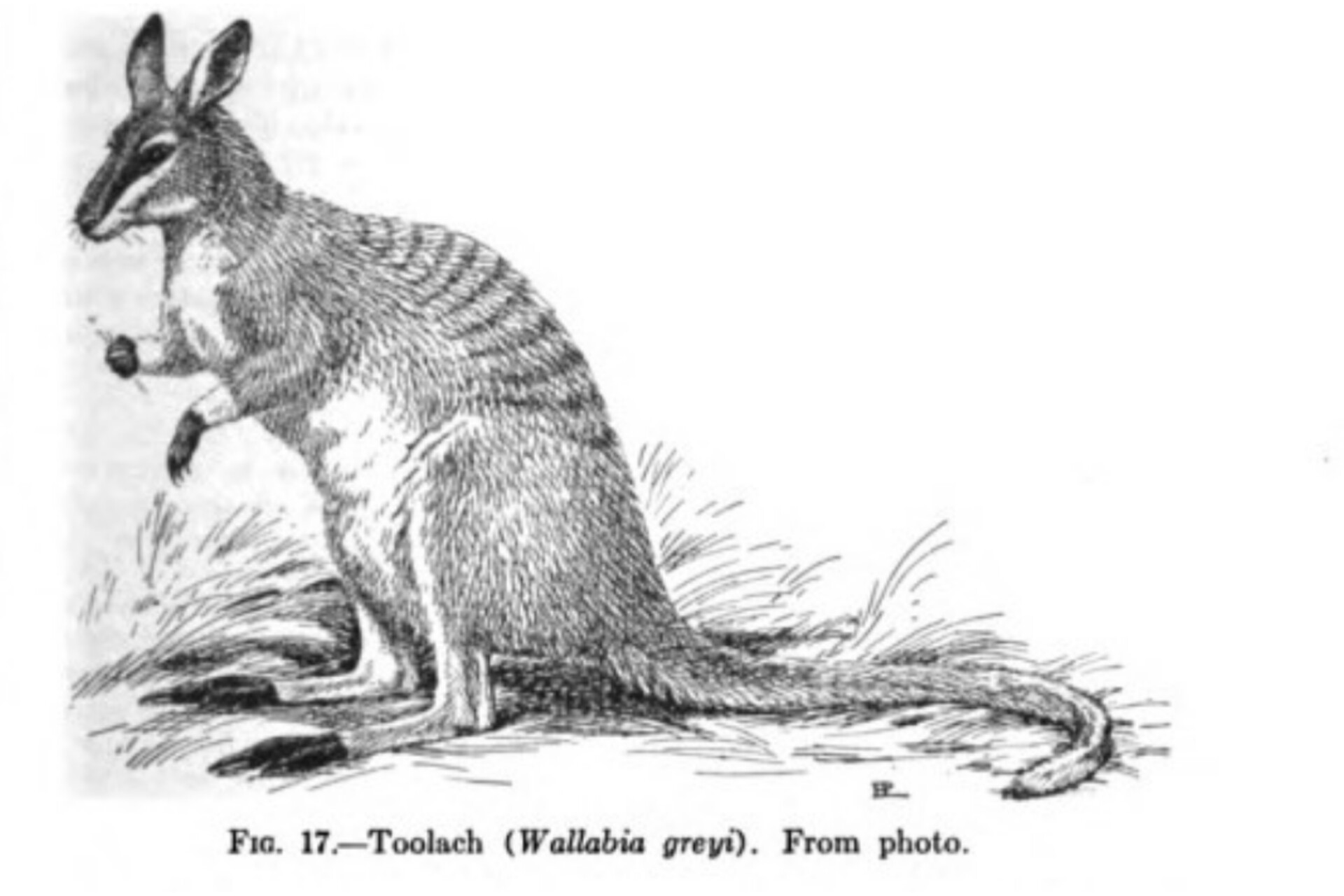
The serious depletion of the native fauna by these agencies is supplemented by widespread bush fires, by conversion of a vast acreage of wild land into crop or grazing lands, by the huge fur trade, by epizoötic disease, and by the large-scale use of poisoned bait, which takes toll of many animals besides the pests against which it is directed. Altogether, the situation in Australia has gotten largely beyond human control. The rapidly growing list of extinct forms already contains at least the following 11:
Freckled Marsupial Mouse (Antechinus apicalis)
New South Wales Barred Bandicoot (Perameles fasciata)
Western Barred Bandicoot (Perameles myosura myosura)
Nalpa Bilby (Macrotis lagotis grandis)
Leadbeater’s Opossum (Gymnobelideus leadbeateri)
Gaimard’s Rat-kangaroo (Bettongia gaimardi)
Gilbert’s Rat-kangaroo (Potorous gilbertii)
Broad-faced Rat-kangaroo (Potorous platyops)
Parma Wallaby (Thylogale parma)
Toolach Wallaby (Wallabia greyi)
White-tailed Rat (Zyzomys argurus argurus)
Dr. W. K. Gregory, of the American Museum of Natural History, says (1924, p. 11): “Late in the eighteenth century, there arrived in Australia by far the most destructive placental mammal the world has ever seen, Homo sapiens, variety europaeus, who has devastated the continent and is now completing the work of destruction.”
MALAY ARCHIPELAGO
Insular faunas are of extraordinary interest because of their tendency toward endemism and because of the light they throw upon geological history and evolutionary processes. At the same time, by reason of the more or less strictly circumscribed nature of their habitats, and by reason of a certain lack of adaptability or self-defense, they are peculiarly vulnerable to attack and extermination by enemies of foreign origin. Thus the Malay Archipelago commands the attention of the conservationist as well as of the evolutionist. Incidentally, it was in this environment, in the fertile mind of Alfred Russel Wallace, that one of the germs of the evolutionary idea developed.
So far this region, containing the richest insular faunas of the entire world, has fared moderately — or at least comparatively — well, having lost only three mammals, all from tiny Christmas Island, lying some 200 miles off the south coast of Java. These are a shrew (Crocidura fuliginosa trichura) and two species of indigenous rats (Rattus macleari and R. nativitatis), all of which have succumbed to an invasion of House Rats and Domestic Cats, either through direct attack or through some epizoötic introduced by one or both of these animals.
On the other hand, through the archipelago generally, cultivated areas and the native population show a strong tendency to increase; this is especially true of the Sunda Islands and the Philippines. Thus the native mammals are engaged in a steady retreat into the dwindling forests.
In the Netherlands Indies many good protective measures have been adopted. No less than 76 nature reserves have been created, and these may be regarded as the final refuge of the native fauna. Hunting and export of wild animals are prohibited except under special license.
In Borneo and New Guinea the native population is less dense than in the Sunda Islands, and there is apparently little use by the natives of firearms that primary factor in the extermination of wild life.
The vanishing mammals of the archipelago, for which special concern is felt, include the following:
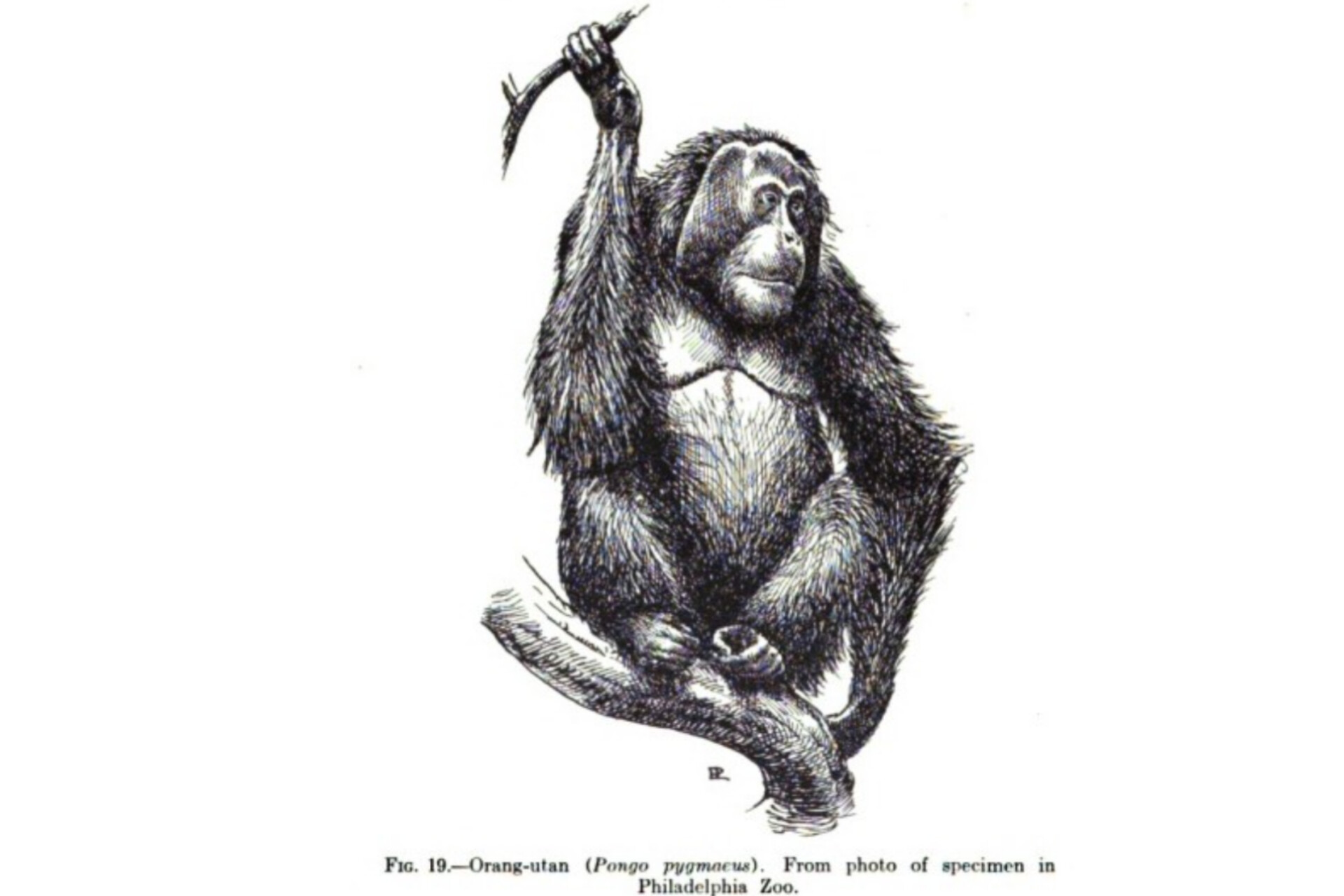
Orang-utan (Pongo pygmaeus)
Sumatran Elephant (Elephas maximus sumatranus)
Javan Rhinoceros (Rhinoceros sondaicus)
Sumatran Rhinoceros (Dicerorhinus sumatrensis sumatrensis)
Babirussa (Babirussa babyrussa)
Javan Banteng (Bibos sondaicus sondaicus)
Bornean Banteng (Bibos sondaicus lowi)
Tamarao or Dwarf Buffalo of Mindoro (Anoa mindorensis)
Common Anoa of Celebes (Anoa depressicornis)
Mountain Anoa of Celebes (Anoa fergusoni)
Sumatran Serow (Capricornis sumatraensis sumatraensis)
Of these, the Javan Rhinoceros is in the most serious condition, being reduced to perhaps two dozen individuals.
ASIA
The fauna of this greatest of the continents has been safeguarded in part by natural conditions. Chief among these is the sparsity of the human population over such vast areas as the taiga and the tundra of Siberia and the deserts of Mongolia, Chinese Turkestan, Persia, and Arabia. The great mountain masses of the Himalaya, Tian Shan, and Altai systems, as well as numerous lesser ranges, have also afforded a measure of protection to the mammals adapted to these high altitudes.
A factor in the preservation of the large mammals of Afghanistan and Tibet has been the exclusion of all but a handful of foreigners. India, despite its teeming population, has not exterminated a single mammal, thanks to the protective attitude toward game assumed both by the native rulers and by the British administration. In China, unfortunately, there seems to be little or no thought of the conservation of wild life on the part of the great mass of the population.
One of the most decisive factors in the accelerated depletion of the game resources of Asia (and of other continents likewise) during recent years has been the increasing use of modern rifles of high power and precision. This has been especially noticeable in Tibet, according to reports of recent explorers, and also in Arabia. In the deserts of Iraq and Arabia pursuit of gazelles and other animals by motor car has recently become a very serious menace to their survival.
The Asiatic rhinoceroses, the Saiga Antelope, such large horned ruminants as the Wapiti and other members of the deer family, and even the lowly pangolins, have been victimized in a peculiarly distressing way, merely because of the apparently wholly mythical value of the horns, scales, and other parts of the body in the Chinese pharmaceutical trade. This belief is so deeply rooted that probably no educational campaign would be effective in staving off the extermination of any species at the mercy of the peoples who regard powdered rhino horn, for example, as a panacea. Even in countries far beyond China’s borders, protection of rhinoceroses and other species in similar demand is made extraordinarily difficult by the fabulous prices set upon them and by the incentive for poaching under these circumstances. When the last Asiatic rhino is gone, and the fancied benefits from its powdered horn are no longer available, possibly then the tragic fallacy of the whole business will dawn upon those responsible for the extermination of this section of the world’s fauna.
Of fur-bearing animals, probably the highly prized Siberian Sables have been subjected to severest pressure, but the Soviet Government has created several great reserves for their protection, and has maintained a closed season on Sables over the whole territory of the USSR.
Despite the many-sided attack upon Asiatic mammals for the sake of their meat, hides, fur, horns, scales, and even raw body fluids — that continent has exterminated to date, as far as known, only three forms: the Japanese Wolf (Canis hodophilax), the Syrian Wild Ass (Asinus hemionus hemippus), and Schomburgk’s Deer (Rucervus schomburgki).
There are a number of others, however, for which the same fate is more or less imminent. Notable among these are the following:
Indian Cheetah (Acinonyx jubatus venaticus)
Asiatic Lion (Leo leo persicus)
Przewalski’s Horse (Equus przewalskii)
Transcaspian Wild Ass (Asinus hemionus finschi)
Indian Wild Ass (Asinus hemionus khur)
Javan Rhinoceros (Rhinoceros sondaicus)
Asiatic Two-horned Rhinoceroses (Dicerorhinus sumatrensis lasiotis and D. s. niger)
Yarkand Stag (Cervus yarkandensis)
McNeill’s Deer (Cervus macneilli)
White-lipped Deer (Cervus albirostris)
Malayan Gaur (Bibos gaurus hubbacki)
Gobi Argali (Ovis ammon darwini)
Semipalatinsk Argali (Ovis ammon collium)
Anadyr Bighorn (Ovis nivicola subsp.)
There are doubtless additional forms of Asiatic Wild Sheep whose existence is seriously threatened, but information on the present status of certain ones is scarcely sufficient to warrant a definite statement.
EUROPE
In view of the fact that the European type of culture has generally had such a devastating effect upon native faunas wherever it has spread in colonies and settlements throughout the rest of the world, it is gratifying to find that the mammalian fauna of Europe itself has retrograded no further than it has. The chief impoverishment has naturally occurred in the British Isles and other densely populated countries of Western Europe. And yet fewer recent mammals have been exterminated in Europe than in North America or Australia or Africa. They seem to number only six, as follows:
European Lion (Leo leo subsp.)European Wild Horse (Equus caballus subsp.)
Aurochs (Bos primigenius)
Caucasian Bison (Bison bonasus caucasicus)
Pyrenean Ibex (Capra pyrenaica pyrenaica)
Portuguese Ibex (Capra pyrenaica lusitanica)
The retrogression of the European fauna has no doubt been due in the first place to the widespread clearing of forests and their replacement by lands devoted to habitations, transportation systems, crops, or grazing. Hunting, however, has constituted the most important part of the direct human pressure upon the wild animals. While this sort of pressure began to be felt ages ago, it was primarily the invention and improvement of firearms that enabled man to proceed with ever-increasing rapidity on his course of extermination. Species of comparatively large size, furnishing valuable meat and hides, have been the prinicipal sufferers. Thus four of the six extinct European mammals are members of the cattle family (Bovidae).
In Europe, as contrasted with the United States, there is a far greater proportion of closely guarded private estates, and hunting of large game is chiefly restricted to the wealthy few. This condition of affairs has resulted in a much slower rate of extermination than in the United States, despite the large number of national parks and wild-life refuges in this country. Furthermore, the European attitude appears much more tolerant toward such predatory animals as Wolves and Brown Bears, which have been able to survive so far in such countries as Spain, France, Italy, Yugoslavia, Greece, Bulgaria, Rumania, Czechoslovakia, Poland, the Baltic States, Russia, and Scandinavia. Americans have been more ruthless in exterminating, or attempting to exterminate, any predatory animal conflicting, or presumed to conflict, with human interests. Unfortunately, the American method of dealing with predators by means of poison has attained a certain vogue in Bulgaria.
A few of the more important vanishing mammals of Europe may be mentioned here. The Brown Bear (Ursus arctos) and the Wolf (Canis lupus) are probably doomed to disappear almost entirely from Western Europe, although they will long survive in Russia and Siberia. The European Wildcat (Felis silvestris silvestris) has become extremely scarce in general; perhaps its greatest danger lies in extinction by dilution through interbreeding with feral Domestic Cats. The insular Wildcats (Cretan, Sardinian, Corsican, and British — Felis agrius, F. sarda, F. reyi, and F. silvestris grampia) are probably endangered in like manner.
The European Beaver (Castor fiber), persecuted for its fur, remains in only a few isolated colonies. There is some doubt as to whether any representatives of the Finland Reindeer (Rangifer tarandus fennicus) and the Novaya Zemlya Reindeer (R. t. pearsoni) still survive; the animal of Novaya Zemlya. has fallen victim to visiting ships’ crews and to Samoyed immigrants. While the stock of the Lithuanian Bison (Bison bonasus bonasus) is greatly reduced, and while there has been considerable mixture in captivity with the Caucasian Bison (B. b. caucasicus) and with the American Bison (Bison bison bison), energetic protection in sanctuaries assured its survival up to 1939, at least. Two of the four races of the Spanish Ibex (Capra pyrenaica) have been exterminated by excessive hunting, and the fate of those remaining has become uncertain during recent events in Spain. The Cyprian Mouflon (Ovis ophion ophion) has become reduced to a precariously small stock. The British Isles have long since lost the Brown Bear, the Wolf, the Beaver, the Wild Boar (Sus scrofa), and the Reindeer (Rangifer tarandus). No doubt insularity has here played a part in the early disappearance of these mammals.
AFRICA
As long as the African Continent was occupied by primitive savages, without modern weapons, animal life was, in a large sense, in a virtual state of equilibrium. When European settlement began, and firearms were introduced, the death knell of a very considerable proportion of the population of large mammals was sounded. Thus the Atlas Bear (Ursus crowtheri), the Barbary and the Cape Lions (Leo leo leo and L. l. melanochaitus), the Quagga (Hippotigris quagga), Burchell’s Zebra (Hippotigris burchellii burchellii), the Bubal Hartebeest (Alcelaphus buselaphus buselaphus), the Rufous Gazelle (Gazella rufina), and the Blaauwbok (Hippotragus leucophaeus) have departed finally and completely from the African scene. The typical subspecies of the Cape Hartebeest (Alcelaphus caama) may also be extinct, but imperfect knowledge of its distribution precludes a definite statement. A long time previously the Algerian Wild Ass (Asinus atlanticus) became extinct, from unknown causes. These losses by extinction are divided almost equally between South Africa — the region most thoroughly settled by Europeans — and the Barbary States, where the well-armed Moors long held sway.
A century ago the Boer hide-hunters decimated the remarkable antelope and zebra fauna of South Africa. In the last half-century, firearms in the hands of improvident and short-sighted natives have wrought extremely serious havoc among the dwindling herds of African game in general. As intertribal warfare has practically ceased, and as the benefits of modern medicine and sanitation have penetrated far into the jungles and deserts, the native populations have increased, and their demands for a meat diet have decimated the game. Encircling fires, a method of hunting practiced on a fairly large scale in the savanna regions, have been extremely destructive, even in the absence of firearms. Professional hunters in the employ of great industrial enterprises, as in various parts of the Belgian Congo, have simply wiped out the antelopes over large areas. Hasty and probably ill-considered campaigns for the control of the tsetse fly have too often resulted in hecatombs of the large game mammals. In recent years the animals of the desert, such as Oryx and Gazelles, have become subject to attack from motor cars.
In South Africa the Bontebok (Damaliscus dorcas), the Blesbok (Damaliscus phillipsi), and the White-tailed Gnu (Connochaetes gnou) no longer roam the free veldt, but have become restricted to enclosed farms and preserves. A remnant of the Cape Mountain Zebra (Hippotigris zebra zebra) was preserved at the eleventh hour.
Among other vanishing or threatened African mammals, the following may be mentioned in particular:
Barbary Lynx (Caracal caracal algirus)
South African Bush Elephant (Loxodonta africana africana)
African Manatee (Trichechus senegalensis)
Nubian Wild Ass (Asinus asinus africanus)
Somali Wild Ass (Asinus asinus somaliensis)
Southern White Rhinoceros (Ceratotherium simum simum)
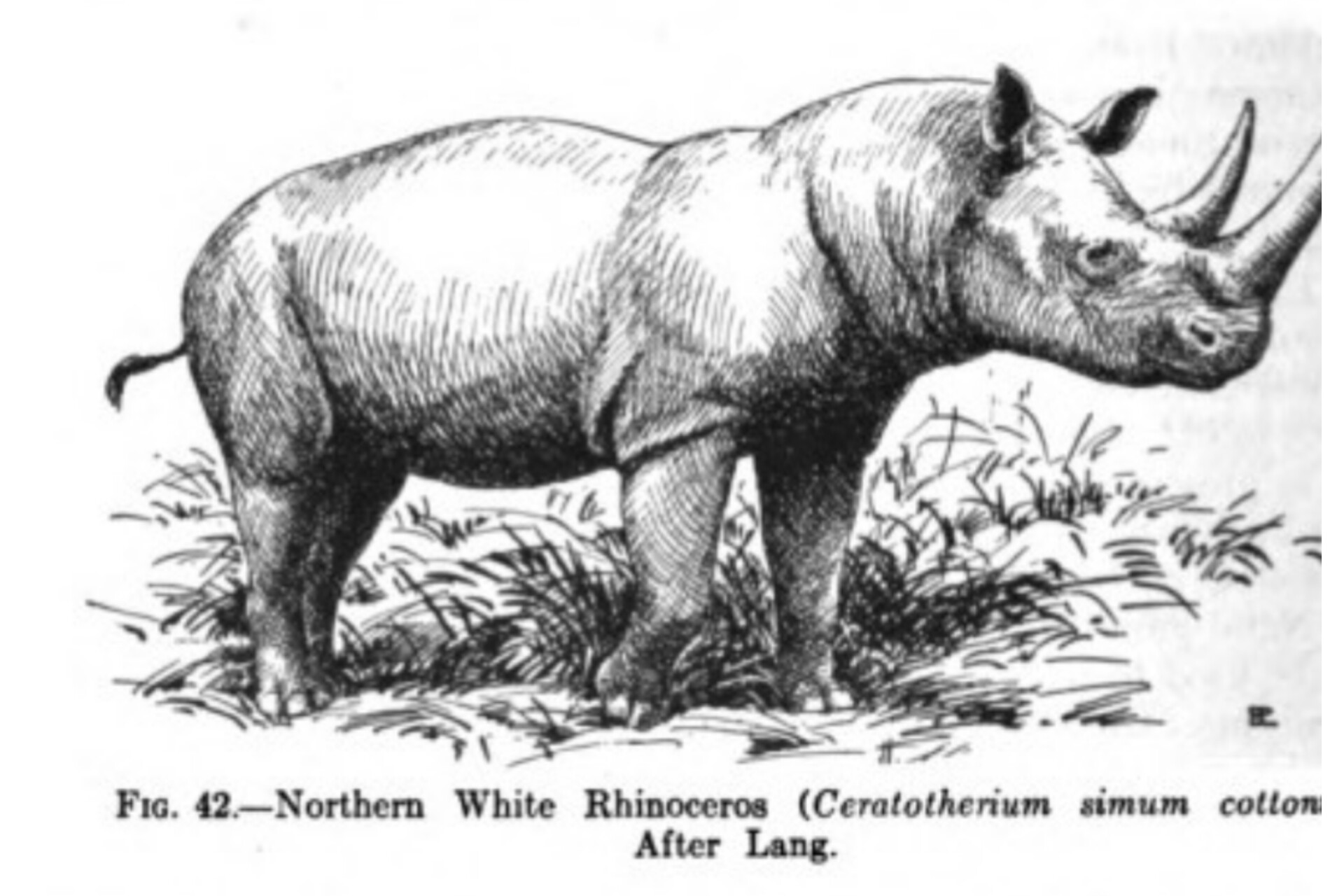
Northern White Rhinoceros (Ceratotherium simum cottoni)
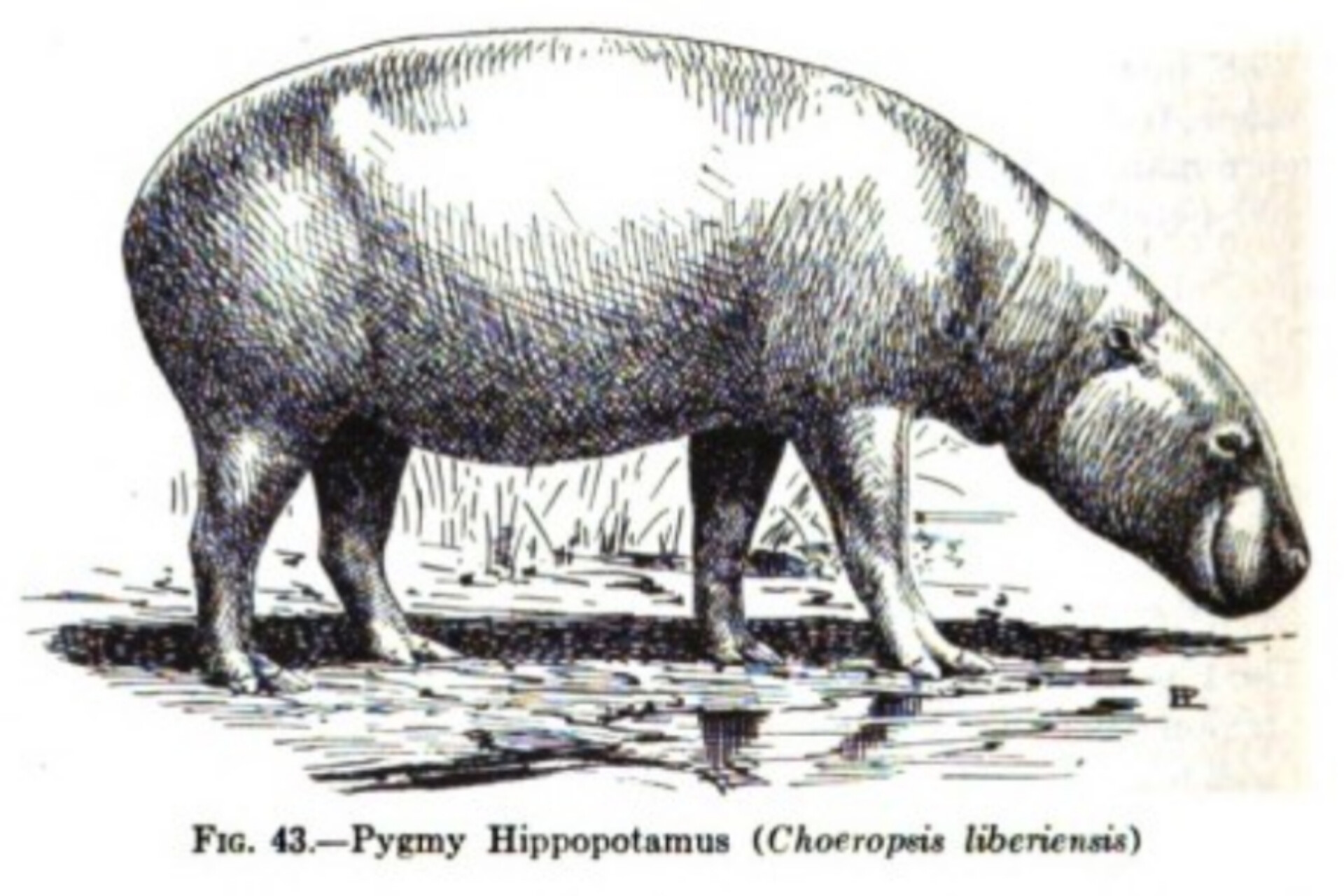
Pygmy Hippopotamus (Choeropsis liberiensis)
Barbary Stag (Cervus elaphus barbarus)
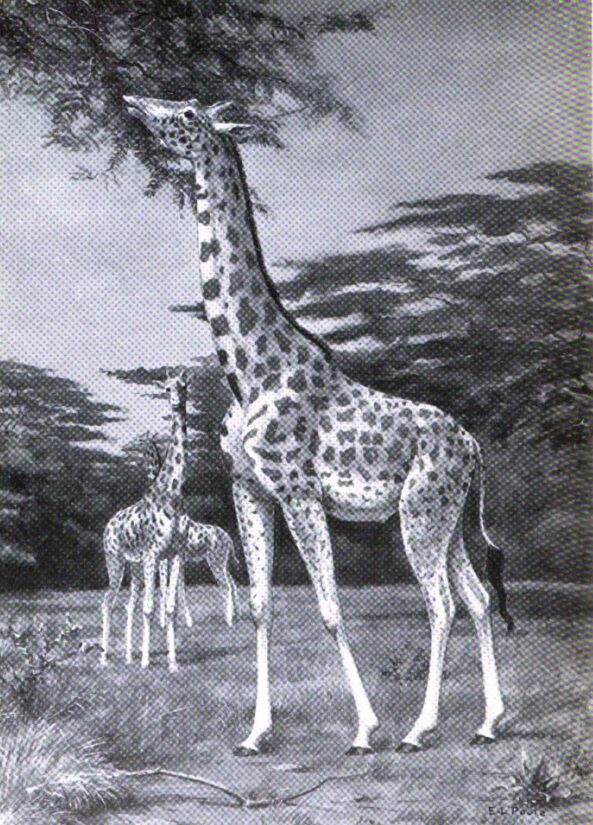
Congo Giraffe (Giraffa camelopardalis congoënsis)
Nigerian Giraffe (Giraffa camelopardalis peralta)
Angola Giraffe (Giraffa camelopardalis angolensis)
Southern Giraffe (Giraffa camelopardalis capensis)
Okapi (Okapia johnstoni)
Cape Buffalo (Syncerus caffer caffer, here restricted to the South African animal)
Egyptian Arui (Ammotragus lervia ornata)
Libyan Arui (Ammotragus lervia fassini)
Nubian Ibex (Capra nubiana nubiana)
Abyssinian Ibex (Capra walie)
Cuvier’s Gazelle (Gazella cuvieri)
Slender-horned Gazelle (Gazella leptoceros)
Mhorr Gazelle (Gazella dama mhorr)
White Oryx (Aegoryx algazel)
Giant Sable Antelope (Hippotragus variani)
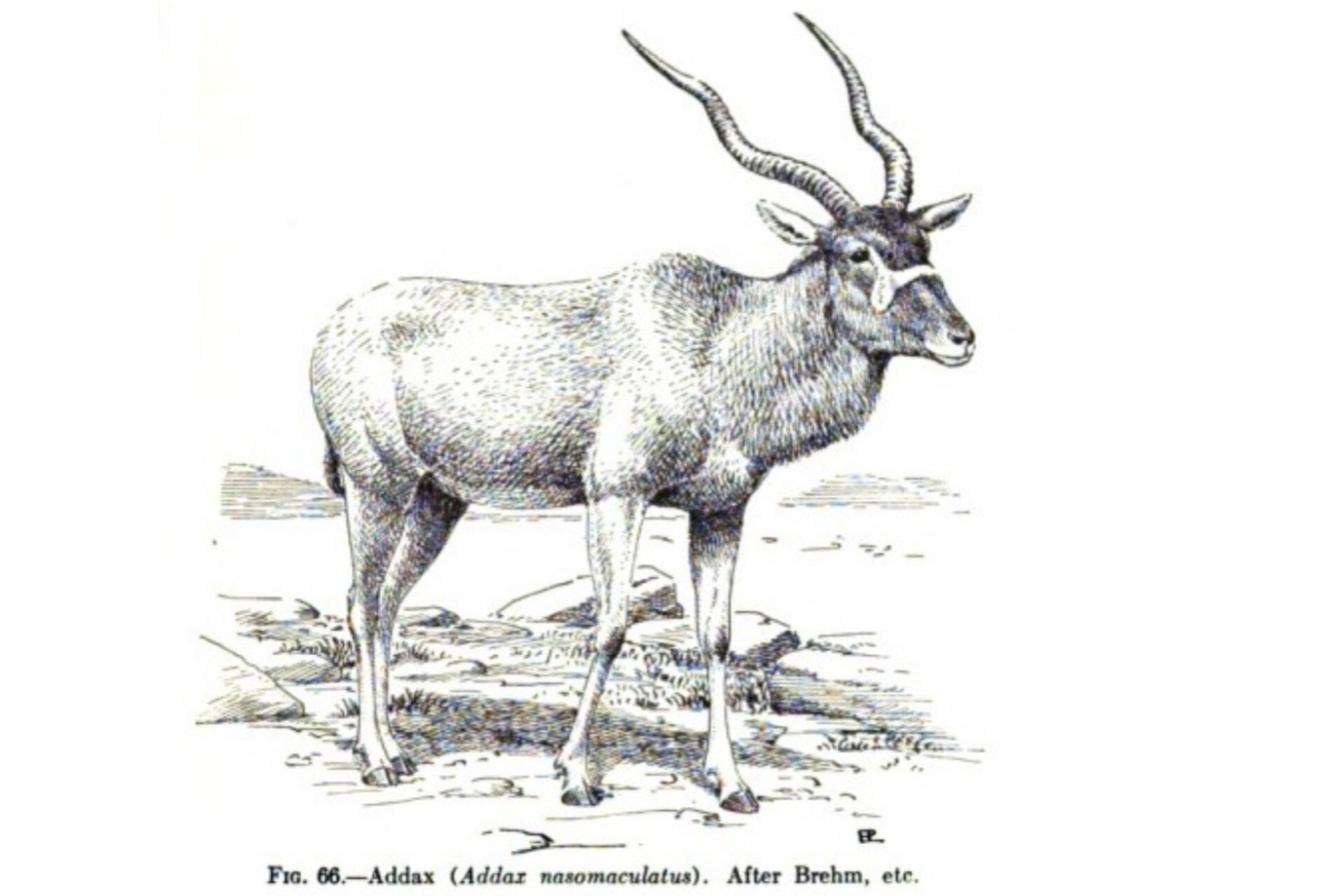
Addax (Addax nasomaculatus)
Nyala (Tragelaphus angasii)
Mountain Nyala (Tragelaphus buxtoni)
Senegambian Giant Eland (Taurotragus derbianus derbianus)
Congo Giant Eland (Taurotragus derbianus congolanus)
A very considerable number of game reserves have been established in various parts of Africa, and there should be a great many more of them, effectively supervised. Herein lies the chief hope for the survival of many of the larger African mammals.
MADAGASCAR
The mammalian fauna of this great island is particularly noteworthy for its very high degree of endemism and for the preponderance of lemurs. Madagascar and its outliers boast no less than three families and forty species and subspecies of lemurs, not one of which extends to the African mainland. Fortunately a fair proportion of these remain more or less common, being protected from persecution by native superstition. However, one species, the Hairy-eared Mouse Lemur (Cheirogaleus trichotis), is apparently extinct. The following seem to exist in very small numbers, and should be safeguarded by every possible means from further decrease:
Coquerel’s Dwarf Lemur (Microcebus coquereli)
Crossley’s Mouse Lemur (Cheirogaleus major crossleyi)
Gray Lemur (Hapalemur griseus griseus)
Broad-nosed Gentle Lemur (Hapalemur simus)
Diademed Sifaka (Propithecus diadema diadema)
Major’s Sifaka (Propithecus verreauxi majori)
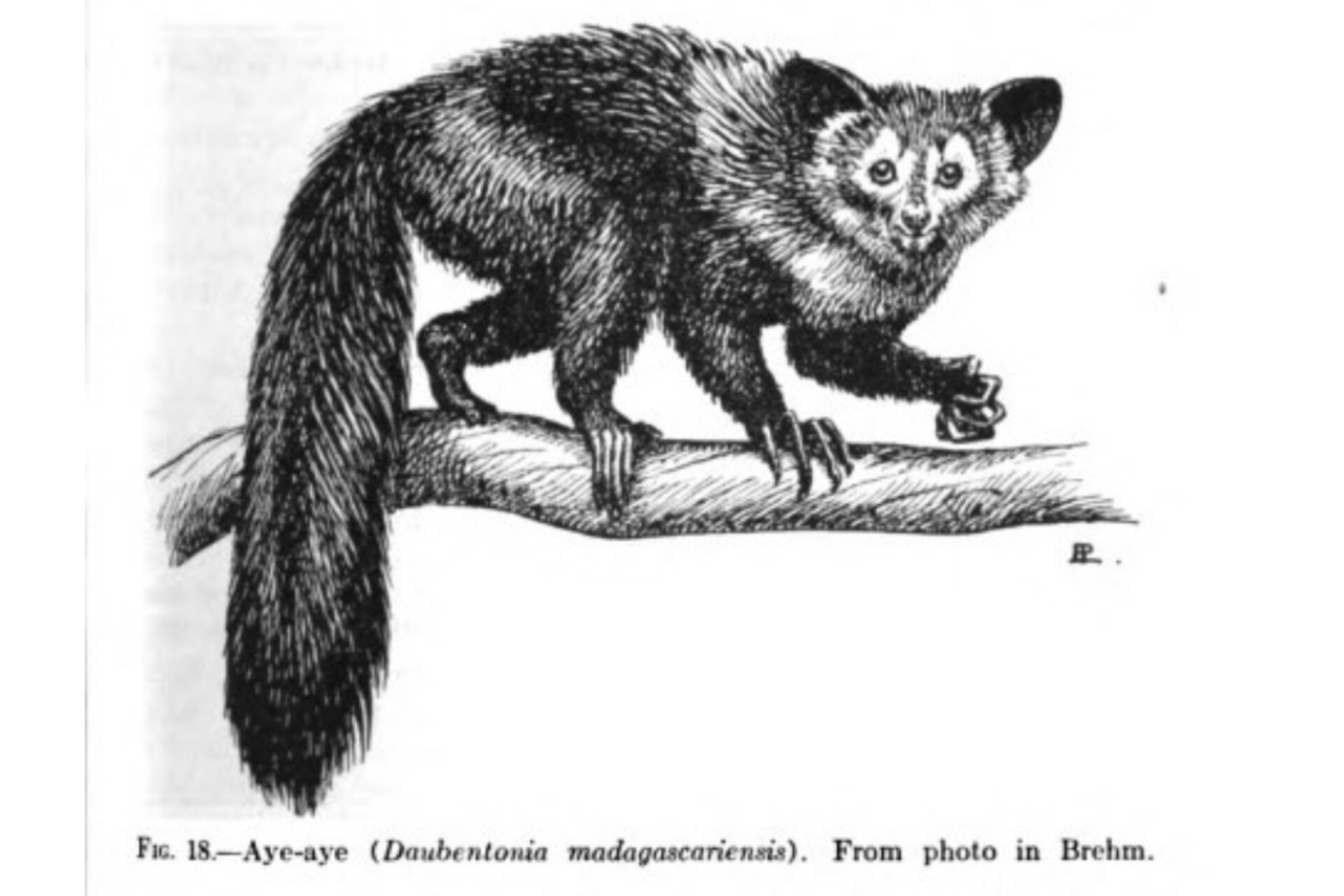
Aye-aye (Daubentonia madagascariensis)
Two peculiar carnivores, the Fossane (Fossa fossa) and the Fossa (Cryptoprocta ferox), are also endemic in Madagascar. The former is accorded protection under Schedule A of the London Convention of 1933, and probably the latter is almost equally deserving of consideration.
Perhaps the greatest danger to mammalian life in Madagascar is the steady reduction of the forest areas through burning and clearing by the natives. It is highly important from the point of view of conservation that this process should be halted.
THE CHRONOLOGY OF EXTINCTION
It may be of interest to the historian of mammalogy to list the extinct forms here in some sort of chronological order. They will be arranged chiefly by half-century periods and by regions within those periods; but those forms that passed out of existence prior to 1800 will be placed in a single group. It should be borne in mind that in most cases the date of extinction can be only roughly indicated. For this reason the sequence within the regional half-century groups will be systematic rather than chronological. In some cases, however, it is possible to add a more approximate date of extinction after the name of the species or subspecies. Certain cases of probable but unproved extinction are indicated by a question mark.
Years 1-1800 (33 forms):
EUROPE
European Lion (Leo leo subsp.), 80-100
European Wild Horse (Equus caballus subsp.)
Aurochs (Bos primigenius), 1627
AFRICA
Algerian Wild Ass (Asinus atlanticus)
Blaauwbok (Hippotragus leucophaeus), 1800
WEST INDIES
Four Antillean insectivores (Nesophontes edithae; N. micrus; N. longirostris; N. zamicrus)
Lesser Falcate-winged Bat (Phyllops vetus)
Cuban Yellow Bat (Natalus primus)
Smaller Puerto Rican Ground Sloth (Acratocnus odontrigonus)
Larger Puerto Rican Ground Sloth (Acratocnus major)
Smaller Hispaniolan Ground Sloth (Acratocnus (?) comes)
Larger Hispaniolan Ground Sloth (Parocnus serus)
Barbuda Musk-rat (Megalomys audreyae)
Hispaniolan Spiny Rat-two species (Brotomys voratus; B. contractus)
Cuban Short-tailed Hutia (Geocapromys columbianus)
Crooked Island Hutia (Geocapromys ingrahami irrectus)
Great Abaco Hutia (Geocapromys ingrahami abaconis)
Haitian Hexolobodon (Hexolobodon phenax)
Least Hispaniolan Hutia (Plagiodontia spelaeum)
Puerto Rican Isolobodon (Isolobodon portoricensis)
Haitian Isolobodon (Isolobodon levir)
Narrow-toothed Hutia (Aphaetreus montanus)
Two agoutilike rodents (Heteropsomys insularis; Homopsomys antillensis)
A Puerto Rican hystricomorph (Heptaxodon bidens)
“Quemi” of Oviedo (Quemisia gravis), about 1550?
A Puerto Rican giant rodent (Elasmodontomys obliquus)
[Retained footnote for West Indies: Possibly the extinction of the forms listed under this heading, know from bones found in cavern deposits, may have occurred more than 2,000 years ago. They are are recognized, however, as pertaining to the Recent fauna.— A.W.]
SOUTH AMERICA
Patagonian Giant Ground Sloth (Grypotherium listai)
OCEANS
Steller’s Sea-cow (Hydrodamalis gigas), 1768
Years 1801-1850 (2 forms):
NORTH AMERICA
Eastern Bison (Bison bison pennsylvanicus), 1825
WEST INDIES
Hispaniolan Hutia (Plagiodontia aedium)
Years 1851-1900 (31 forms):
AUSTRALIA
Gilbert’s Rat-kangaroo (Potorous gilbertii)
EUROPE
Portuguese Ibex (Capra pyrenaica lusitanica), about 1892
AFRICA
Atlas Bear (Ursus crowtheri)
Cape Lion (Leo leo melanochaitus), about 1865
Quagga (Hippotigris quagga), about 1878
MADAGASCAR
Hairy-eared Mouse Lemur (Cheirogaleus trichotis)
NORTH AMERICA
Gull Island Meadow Mouse (Microtus pennsylvanicus nesophilus), 1890’s
Plains Grizzly (Ursus horribilis horribilis)
California Coast Grizzly (Ursus californicus), about 1886
Sacramento Grizzly (Ursus colusus), about 1862
Navajo Grizzly (Ursus texensis navaho)
Sonora Grizzly (Ursus kennerleyi)
Mendocino Grizzly (Ursus mendocinensis), about 1875
New Mexico Grizzly (Ursus horriaeus)
Sea Mink (Mustela macrodon), about 1880
Eastern Wapiti (Cervus canadensis canadensis), about 1885
Oregon Bison (Bison bison oregonus), about 1850’s
WEST INDIES
Two Antillean insectivores (Nesophontes paramicrus; N. hypomicrus)
Puerto Rican Long-nosed Bat (Monophyllus frater)
Jamaican Long-tongued Bat (Reithronycteris aphylla)
A Puerto Rican bat (Stenoderma rufum)
Puerto Rican Long-tongued Bat (Phyllonycteris major)
Haitian Long-tongued Bat (Phyllonycteris obtusa)
Jamaican Rice Rat (Oryzomys antillarum), about 1880’s
St. Vincent Rice Rat (Oryzomys victus), about 1897
Santa Lucia Musk-rat (Megalomys luciae)
Larger Cuban Spiny Rat (Boromys offella)
Lesser Cuban Spiny Rat (Boromys torrei)
FALKLAND ISLANDS
Antarctic Wolf (Dusicyon australis), 1876
GALAPAGOS ISLANDS
Chatham Island Rice Rat (Oryzomys galapagoensis)
Years 1901-1944 (40 forms):
AUSTRALIA
Freckled Marsupial Mouse (Antechinus apicalis)
New South Wales Barred Bandicoot (Perameles fasciata)
Western Barred Bandicoot (Perameles myosura myosura)
Nalpa Bilby (Macrotis lagotis grandis)
Leadbeater’s Opossum (Gymnobelideus leadbeateri)
Gaimard’s Rat-kangaroo (Bettongia gaimardi)
Broad-faced Rat-kangaroo (Potorous platyops)
Parma Wallaby (Thylogale parma)
Toolach Wallaby (Wallabia greyi)
White-tailed Rat (Zyzomys argurus argurus)
MALAY ARCHIPELAGO
Christmas Island Shrew (Crocidura fuliginosa trichura), about 1904
Maclear’s Rat (Rattus macleari), about 1904
Bulldog Rat (Rattus nativitatis), about 1904
ASIA
Japanese Wolf (Canis hodophilax)
Syrian Wild Ass (Asinus hemionus hemippus), about 1927
Schomburgk’s Deer (Rucervus schomburgki), 1930’s
EUROPE
Caucasian Bison (Bison bonasus caucasicus), 1930’s
Pyrenean Ibex (Capra pyrenaica pyrenaica), 1910’s
AFRICA
Barbary Lion (Leo leo leo), 1922
Burchell’s Zebra (Hippotigris burchellii burchellii)
Bubal Hartebeest (Alcelaphus buselaphus buselaphus), 1920’s?
Rufous Gazelle (Gazella rufina), 1920’s?
NORTH AMERICA
Long-eared Kit Fox (Vulpes macrotis macrotis), 1900’s
Newfoundland Wolf (Canis lupus beothucus), 1910’s
Florida Wolf (Canis niger niger), 1920’s
Tejon Grizzly (Ursus tularensis), 1916
Texas Grizzly (Ursus texensis texensis), 1910’s
Mount Taylor Grizzly (Ursus perturbans)
Black Hills Grizzly (Ursus rogersi bisonophagus)
Lillooet Grizzly (Ursus pervagor)
Klamath Grizzly (Ursus klamathensis)
Southern California Grizzly (Ursus magister), 1908
Apache Grizzly (Ursus apache)
Henshaw’s Grizzly (Ursus henshawi), 1920’s
Eastern Cougar (Felis concolor couguar)
Arizona Wapiti (Cervus canadensis merriami), 1906
Badlands Bighorn (Ovis canadensis auduboni), 1900’s?
WEST INDIES
Cuban Solenodon (Solenodon cubanus), about 1910
Martinique Musk-rat (Megalomys desmarestü), 1902
GALAPAGOS ISLANDS
James Island Rice Rat (Nesoryzomys swarthi)
This record shows a steadily accelerated rate of extinction in each of the last three half-century periods. About 38 percent of the losses have been sustained since 1900. This indicates how difficult is the task of preserving native faunas in the present era of intensive modern invention and industrial expansion.
THE RECORD OF EXTINCTION BY FAMILIES
The following record indicates how these losses by extinction are divided among the various mammalian families:
Bears (Ursidae), 17
Spiny rats and their relatives (Echimyidae), 15
Cattle, sheep, goats, and antelopes (Bovidae), 10
Hamsterlike rodents (Cricetidae), 8
Antillean insectivores (Nesophontidae), 6
Leaf-nosed bats (Phyllostomidae), 6
Kangaroos and their relatives (Macropodidae), 5
Wolves and foxes (Canidae), 5
Horses, zebras, and asses (Equidae), 5
Ground sloths (Megalonychidae), 4
Cats (Felidae), 4
Bandicoots (Peramelidae), 3
Old World rats (Muridae), 3
Deer (Cervidae), 3
Giant rats (Dinomyidae), 2
Dasyures and their relatives (Dasyuridae), 1
Phalangers and their relatives (Phalangeridae), 1
Solenodons (Solenodontidae), 1
Shrews (Soricidae), 1
Long-legged bats (Natalidae), 1
Lemurs (Lemuridae), 1
Giant ground sloths (Megatheriidae), 1
Heptaxodon (Heptaxodontidae), 1
Weasels and their relatives (Mustelidae), 1
Steller’s Sea-cow (Hydrodamalidae), 1
There is the clearest sort of significance in the losses sustained by the larger predatory mammals as a group (Ursidae, Canidae, and Felidae), because of their competition with man for food in the shape of the ungulate mammals, both wild and domesticated, such as cattle, sheep, goats, antelopes, horses, asses, swine, and deer. In the case of such formidable carnivores as wolves, bears, lions, tigers, and leopards, the matter of outright self-defense on man’s part may also be involved. Moreover, it is natural that the large game species of the cattle and deer families, which require extensive feeding grounds and are eagerly sought by mankind for food, should have suffered some of the principal losses.
SUMMARY AND CONCLUSIONS
During the past 2,000 years the world has lost, through extinction, about 106 forms (species or subspecies) of mammals. They are distributed by regions as follows: Australia, 11; Malay Archipelago, 3; Asia, 3; Europe, 6; Africa, 9; Madagascar, 1; North America, 27; West Indies, 41; South America, 1; Falkland Islands, 1; Galápagos Islands, 2; oceans, 1. Approximately 67 percent of these losses have occurred during the past century, and 38 percent during the past half-century. Thus the rate of extinction is being steadily accelerated.
In addition to the mammals already extinct, more than 600 others require consideration as vanishing or threatened forms.
Insular faunas, partly by reason of their circumscribed nature and partly by reason of a certain lack of adaptability or self-defense, are particularly vulnerable to attack or competition by man and by certain mammalian pests introduced by him. There may be a further reason for the decadence of insular faunas in some cases, such as that of the West Indies, in the virtually total lack of native mammalian predators; these would doubtless have played a beneficial role by eliminating the less fit individuals, and thereby contributing to the survival of the fittest individuals, among the species preyed upon.
In general, it is fairly obvious that species of restricted distribution and specialized habits have less chance of survival than those of wide distribution and generalized habits.
The primary factor in the depletion of the world’s mammalian faunas is civilized man, operating either directly through excessive hunting and poisoning, or indirectly through invading or destroying natural habitats, placing firearms in the hands of primitive peoples, or subjecting the primitive faunas of Australia and of various islands to the introduction of aggressive foreign mammals, including fox, mongoose, cat, rat, mouse, and rabbit. Except in the West Indies, comparatively few species seem to have died out within the past 2,000 years from natural causes, such as evolutionary senility, disease, or climatic change.
The chief hope for the survival of the larger mammals of the world lies in the establishment and maintenance of a sufficient number of sanctuaries. This will avail in most parts of the world, but the matter is not so simple in Australia. Unless sanctuaries in that country can be surrounded with fences that are proof against foxes, rabbits, cats, and house rats, even they will not avail for many of the smaller Australian mammals. So perhaps the darkest picture today, as far as the future of mammals is concerned, is to be found in Australia, where many of the primitive native species cannot stand up against the highly organized introduced pests, and where conditions have gotten largely beyond human control.
Francis Harper, Extinct and Vanishing Mammals of the Old World (Baltimore: Lord Baltimore Press, American Committee for International Wild Life Protection, Special Publication, No. 12, 1945), 8-23. Lead image from frontispiece. Additional images appear on pages: 39, 117, 159, 166, 253, 408, and 420.
See: https://babel.hathitrust.org/cgi/pt?id=uc1.b4339596&seq=1