Wildlife Trapping
We want you to have a greater ability to learn about some of the unpleasant animal issues in our world.
Practical Hunter’s and Trapper’s Guide
Tony Alexander
PREFACE.
Although books on nearly every kind of sport and the nature and habits of game are numerous enough, very few of them are the work of men of actual practical experience who have made a business of hunting and trapping animals. These books, for the most part, have been prepared by gentlemen with little practice and abundant theory — theory which continues to prove fatal to the success of the earnest sportsman until he makes up his mind to rely on his own practically acquired knowledge, which generally serves him a thousand times better.
In hunting and trapping, as in every other practical business matter, it is only the man who has had continuous experience for a long time and under many and various circumstances that can be trusted to advise.Like many others, I at first studied the works of Newhouse and other theoretical sportsmen, but met with comparatively little success, until, by my own experience, I had acquired a thorough knowledge of a real sportsman’s work. I do not consider the dressing of skins and dyeing of furs to be any proper part of this, although some writers give very elaborate instructions for these processes. The hunter is nothing if not a man who loves the woods and fields and fresh air for their own sake, and cherishes a hearty hatred for factories, dye pots and tan vats. What the true sportsman needs to know is the nature and habits of the animals which he hunts, the best bait to attract them, the surest traps to hold them, the most efficient gun for his use, the proper mode of caring for game when captured, and enough about the best means of stretching and drying skins to insure their reaching market in such shape as to command the best prices.
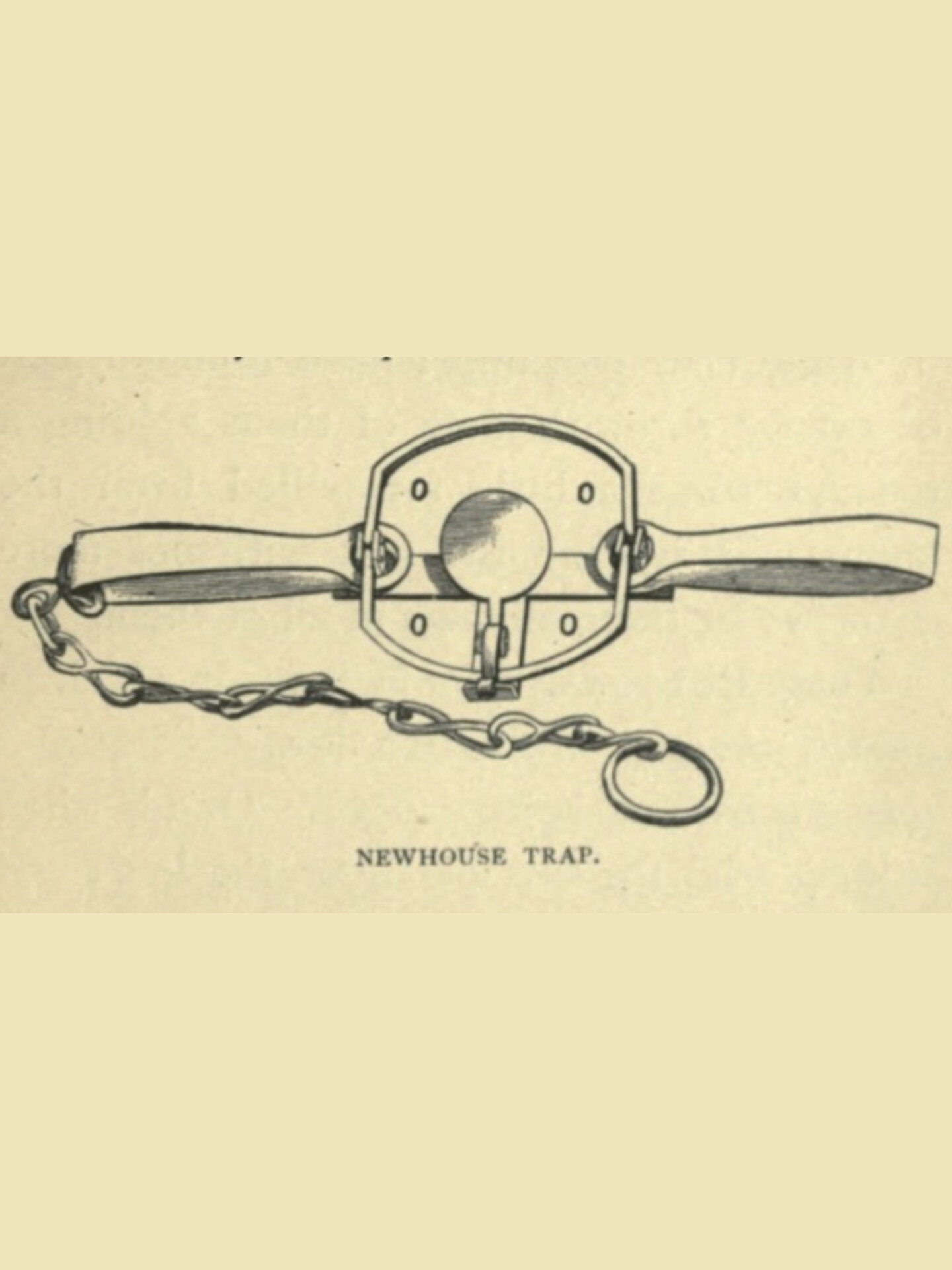
In compliance with the request of many friends, I will give to the public in the following pages the results of my experience for many years in these matters in the wildest parts of the South and West, and will ask especial attention to the most important matter of using the most effective traps. Writers are plenty who can give the name and cut of every trap and deadfall that has been used in the last century, but few have any real knowledge as to which of them will do the surest work. Undoubtedly S. Newhouse invented the best trap for all kinds of game that has been in use for many years; but it is far from perfect, and after experiencing many difficulties with it for more than eight years I have invented my “Body Trap.” This I can demonstrate to be a great improvement on the Newhouse or any other trap now in use, and perfectly adapted to capturing with certainty every variety of American game. The reader will find it carefully described in the chapter entitled ” About Traps.” T. A.
PRACTICAL HUNTER’S AND TRAPPER ‘S GUIDE.
THE HUNTER’S AND TRAPPER’S OUTFIT AND HOW TO USE IT.
I will now tell the secrets of my craft — hand over my belt in fact — to my fellow-hunters and trappers, many of whom have often worked hard to win it. Perhaps this is only fair to some of you who before now have hunted unsuccessfully over territory where I had been just one season ahead of you. But you shall not only know all that I have to tell, but I will put you in the way of having the best tools to work with something that never makes a snap and will pay well on the old trapping grounds.
Three hunters form the most suitable party for trapping together; one to pelt and stretch skins and cook, the other two to trap and hunt.
The outfit for three consists of two dozen beaver, two dozen coon, two dozen mink, and two or four bear traps; two two-pound axes, one four-pound ax, one pelting and three skinning knives, one stew-pot, one frying- pan, one bake-oven, one tea-kettle, one set tin plates and cups, one coffee-mill, one dish pan, one water and two dinner buckets, three dish rags, and one bar soap; one pair short-legged gum boots, rubber lined, to each man; one oil-skin coat to each man; one wall tent, nine by nine; one fly, ten by twelve; one tent stove; two dug-out boats; one two-oared skiff large enough to carry one thousand pounds.
In the shape of fire-arms, there would be required for each man one Winchester rifle, one breach-loading shot gun (the duck gun is the most suitable for trappers), and one improved Colt’s pistol, forty-four caliber, with belt and scabbard. Each man would also require one pocket compass and one headlight.
How to use the outfit. — After you have found the stream you want to trap, start in as near the head as you can well use your boats, and there make your camp. Let one trapper take the upper end of the swamp and the other the lower, each man trapping for three miles on his part of the swamp, and for two or three miles on each side of the stream. In this way about six miles of territory can be trapped at the first camp, and each man can make the circuit in a day, bringing his game in his boat to the camp. Always take your dinner with you on starting out, and reset your traps before you return to camp, as in this way you will lose neither your dinner nor your time in going to and fro. Always search small streams and lakes well on both sides, which will often have to be done by leaving your boat and going afoot. Unless you follow this rule you will frequently miss the principal game of your territory, such as beaver, otter, coon, mink, and other animals that live about such waters.
After the party has trapped and hunted the first camping ground until the game has become scarce, the man who has worked the upper end of the stream takes up his traps in the morning and returns to camp. Here he finds his companion, who has the care of the skins, with the boat already loaded with the camp equipage and ready to start. Together they get into their boats, go down the stream for six miles, and select a camping place. After they have pitched the tent the trapper goes below the camp and sets his traps. The other trapper, who took the lower end of the first trapping ground, now has the upper end, and on the same day takes up his traps, and sets them on new ground. By this process of work no time is lost, and each man has still his three miles of territory to work. If at any time there is a surplus of traps, let the man who has charge of the skins try his luck; but it will be found that he will have very little time to trap.
There is one other way in which I have done some very profitable trapping that is working single-handed and boarding with the farmers. All that a man needs for trapping in this way, besides a few dollars for necessary expenses, is one dozen beaver or otter traps, one dozen coon traps, one dozen mink traps, one small dug-out boat, one pair short-legged gum boots, rubber lined; one oil-skin coat, one pocket compass, one forty-four caliber Colt’s improved pistol, a valise and some old clothes.
Go to most any one of the small streams of the South or West, provided it is large enough to float your boat, find a boarding-place, and trap the stream and its tributaries for three miles each way until the game gets scarce; then leave your skins with the farmer, take your valise and traps, get in your boat, go up or down the stream for three miles or the distance you have trapped, and then commence setting your traps again until near night. This done, listen for the nearest cock that crows, get out of your boat, make it fast, go straight to where you heard the cock crow, and you will be pretty sure to find a farm-house; here call for the landlord, tell him your business and you are quite certain to find yourself a welcome guest. The farmer’s wife will be glad enough to have you catch the coons, mink and other animals that kill her fowls. The farmer himself will be no less pleased to have you trap the beaver, and will tell you how often they have cut his fences.
From him you can learn of every pond and stream they have dammed up for five miles around. Catch all the game there is within reach; then find out from your host who is the best man for you to stay with at your next stopping point, three or four miles off in the direction you are traveling. He will often give you a letter of introduction recommending you as a successful trapper who will do his neighbor a great deal of good So, leaving your skins with your friend, and having shaken hands all around with the family, say good-bye and move on to your trapping ground. First set out your traps, and when you go to your new boarding place you find yourself a welcome guest again as long as you can catch game. This will be found a very pleasant way of working.
Always leave your skins on the stretchers until you get ready to ship. Try to ship your furs once a month or oftener. When you get ready to make a shipment leave your outfit with the man with whom you are boarding, borrow a horse and saddle from him, gather your furs together from the different farmers, send them off, and then go back and get to work again.
GENERAL HINTS TO THE TRAPPERS.
The skins of animals that have been trapped are always valued more highly than those of such as have been shot, for the lead not only makes holes in the skins but injures the fur so that the manufacturer can not use them in making muffs, robes, or trimmings of any kind; he can only work them up into hats and similar goods owing to the checks and bawks [sic] which the shot holes have made in the fur. To realize the utmost for skins they must be taken care of at once, cleaned and properly prepared.
In warm weather visit your traps once a day, as otherwise the skins will taint very quickly.
As soon as the animal is dry attend to the skinning and pelting.
Be sure that your pelting-pole is perfectly smooth.
Avoid as much as possible getting grease on the fur.
Scrape off all the surplus flesh and fat and be careful not to go so deep as to cut the fibers of the skin.
If the pelt is tough always commence at the tail and pelt toward the head.
Never dry skins in the sun nor by the fire unless it is very damp weather; and in this case never let them entirely dry by the fire or sun, but just enough to glaze the pelt.
Never let your skins get wet.
Always hang your skins in the shade where the wind can fan them about. Watch them carefully, however, taking pains to remove the fly blows by scraping them off with a knife. If you neglect this the flies will blow them white. The flies will not trouble them after they are once dry.
Never use any preparation of any kind in curing or drying skins, and do not wash them in water; simply stretch and dry them as they are when taken from the pelting pole. In stretching a cased skin always turn the pelt out.
Always leave the skins on the stretchers until you are ready to ship; if taken off before they are apt to wrinkle and look damaged.
Make your shipments as often as possible, as the skins show up better when first dried.
Never hang your skins in a smoke-house, as the dampness created by the salt causes them to mold.
Never double or roll your skins, for by so doing your are sure to make rough places in the fur.
Always use your gum boots in setting traps. In this way you avoid leaving any scent.
Always feel under the treadle of your trap after setting it in order to remove the sand or anything that may keep it from falling.
In using a stake for a fastening always drive it until the top goes under the ground. In setting traps for beaver, or otter, or any water animal, make a slide or trail for it that resembles its own.
Remember that all animals can be attracted by the scent of their kind, which is their urine and musk.
Never set your traps deeper than three inches under the water.
Always keep your traps clear of rust. This may be done by washing and scrubbing them with sand, or smoking them.
Never oil or grease your traps, as many writers have advised, for animals are not accustomed to oil or grease.
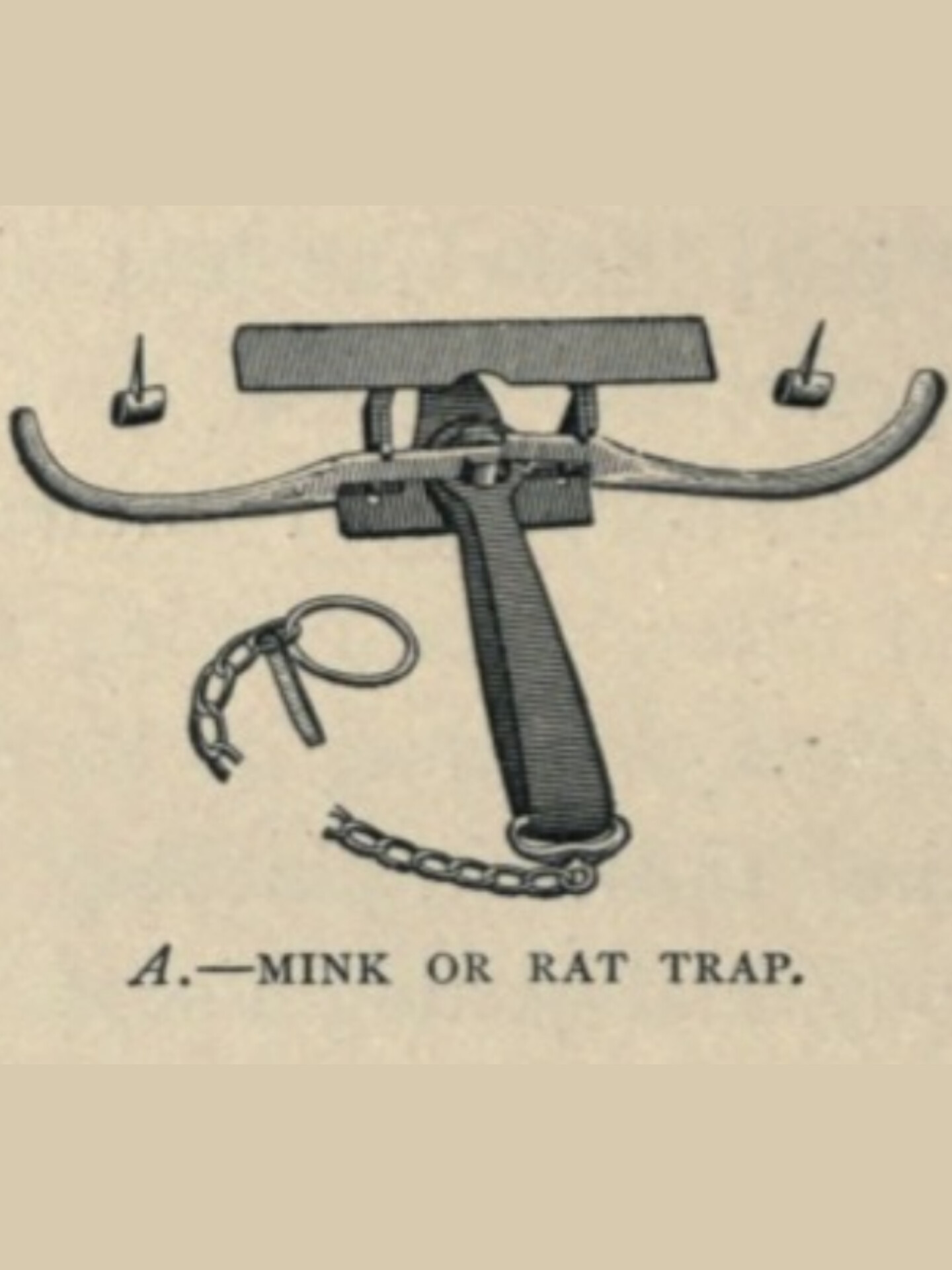
Always remove the teeth from the jaws before you throw the trap, or place anything in it that they could strike against, as otherwise the jaws are likely to be injured.
Two men must not try to trap the same ground at once, as one is always in the way of the other.
Never take your gun with you when setting your traps afoot; but you can carry it with you without much trouble when working with your boat.
Always carry your revolver from morning till night, as you will often get shots at game of different kinds.
Always conceal your traps from the sight of game and leave the ground as nearly as possible in the same condition as that in which you found it.
Always turn the treadle of your trap away from the direction in which you expect the game to come, as catching behind the shoulders gives more space in which to capture the animal.
Never bloody the ground with a dead animal where you expect to set traps.
Always notice carefully the feeding grounds of deer and antelope during the day so that you will know where to hunt with your headlight at night.
Never fire-hunt near your traps as it will disturb the game that you are attempting to capture in them.
If the bead of your rifle is not already perpendicular at the back end with the barrel take a file and make it so. This will not injure it, but will make it shine as bright from the headlight as from the sun.
Always pitch your tent on a ridge or knoll in rainy weather and ditch it on the inside.
Make up your bed every morning before breakfast, and make it a rule of your camp, that if any one lies down on the bed during the day he must be taken by the hands and feet and bumped against a stump or thrown into the creek. Be sure to enforce this law rigidly….
SETTING AND BAITING TRAPS.
In trapping there are two things that must be constantly borne in mind, viz.: first, to so set your trap that the animal will be induced to go to it; and second, to have such a trap as will both catch the game that comes to it, and hold the captive so that he cannot release himself. The steel trap comes nearest to meeting these requirements and has taken the lead over all other animal traps.
Too much preparation must not be made around your traps, and care must be taken not to leave too much scent of yourself. Everything must be left as natural as possible. Nearly every wild animal is extremely shy and is easily frightened off.
In trapping animals the skins of which are valuable, precautions must be taken to prevent injury to their fur, such as may come from their devouring themselves or being devoured by other animals.
A contrivance called a spring-pole is in general use for this purpose and is recommended by many writers (with whom I do not agree) as the best means of saving the animal from its own violence and the depredations of others. It is made as follows:
Cut a pole of required size and drive one end of it into the ground; bend it down from the top and attach the trap to it, then fasten the bent pole to a notch or hook on a small tree, or a stake driven in the ground. When the animal is caught it unhooks the pole, which flies back and lifts it up into the air. For at least two reasons this seems to me a very imperfect device. When the spring pole straightens, the chain of the trap winds around it, letting the animal swing back and forth, and giving it every possible chance to wear its skin out against the pole before morning. Suppose, too, you wanted to swing a bear or some other large animal: you would have to get a steam-engine or two good horses to pull your pole down; and then you would leave so much sign that no animal would come within one hundred yards of your trap.
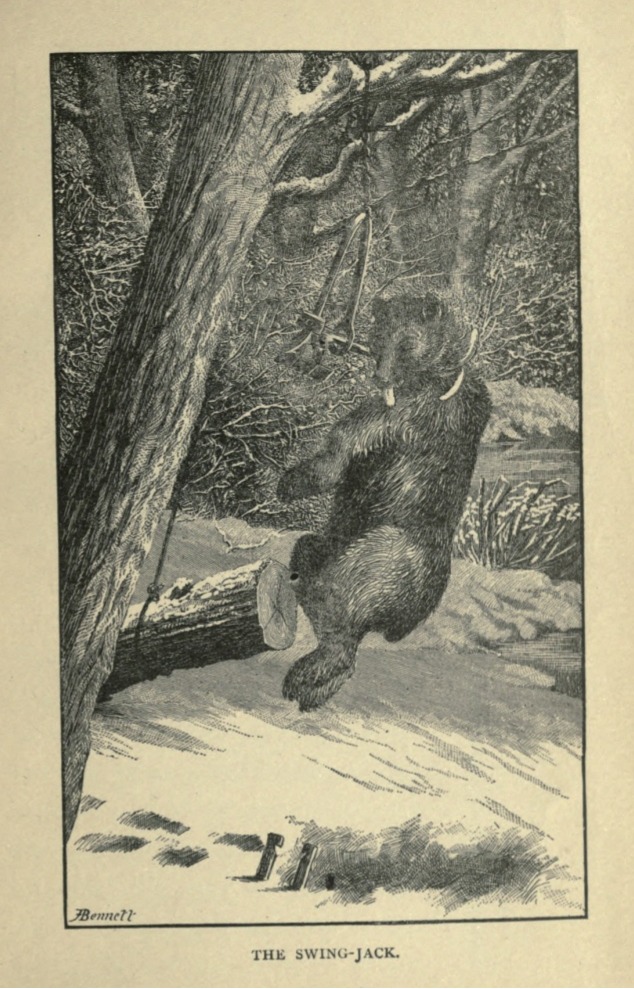
The best contrivance for swinging animals is what I call a swing-jack, which is made in this way. Take a rope of required strength and procure a stone or small log, that is, say, one-third heavier than the animal you expect to swing. Tie the rope to the center of the weight, making a slip knot in order that it may draw down tight on it; throw the other end of the rope over the two limbs of a tree that are on an angle with each other, letting it cross them some three or four feet from the trunk. Cut a stick or lever about one foot in length of sufficient strength to hold the weight, and flatten it on two sides. Cut two stakes strong enough when driven into the ground to resist the weight.
Make a notch in the large ends of the stakes one inch deep; drive them into the ground ten inches apart, with the notches facing each other, and the length of your trap-chain from where you expect to set your trap; then run the rope through the ring of the chain, pull on the rope, and hoist the weight as high as necessary; then place the lever in the notches of the stakes and make the rope fast to its center, letting the ring be above the lever. The animal when caught releases the lever by its struggles, and the weight being the heavier lifts it in the air, giving it no chance to come into contact with anything.
If there is no tree at the point where you want to set your trap, a post can be used by nailing two arms to it at right angles with each other. There should be a notch in the outer end of each arm for the rope to work in.
Animals that live in the water require a different contrivance such as the following:
Cut a pole ten or twelve feet long, leaving one branch or fork two or three feet from the small end of the pole to prevent the ring of the trap-chain from slipping off. Take your ax and hack beards on the pole from the butt end to the top. Cut a small hook, place your pole in a slanting position with the small end in the deepest part of the stream. Make the pole fast by driving it into the bed of the stream or lake with your ax; spring the upper end down until it goes under the water, slip the chain-ring over this end and be sure it is free to traverse the full length of the pole; make the latter fast at the upper end of the hook. When the animal is caught he plunges in the water toward the lower end of the pole, the ring sliding down the pole to the bottom of the stream, and the beards preventing the animal from pulling the ring up the pole and going ashore. A short chain does not permit the game to even reach the surface.
THE PROPER SEASON FOR TRAPPING.
All furs are best in the three months of December, January and February, and are very good in March if the spring is late; though trapping can be made profitable any time between the first of October and the middle of April in the Southern and Western States, and for a month later in the Northern States. All fur skins are prime in the above-named months, the pelts being white and classed prime by fur dealers; the fur is then glossy and of the richest color.
There are some variations according to the latitude as to the exact period at which furs become prime, the more northerly being a little in advance.
Trappers are liable to begin too early in the season in consequence of which much poor fur is caught; this must be sold at low prices, and is unprofitable to the trapper, the fur buyer and the manufacturer. In the spring dark or blue spots can be noticed on the pelt of the skins, and this is an indication that the animal has commenced shedding, and a sure sign that it is about time to stop trapping. It will not be long after these spots appear that the furs are worthless. All animals shed their fur once a year, commencing generally the first of April and finishing about the first of June.
Tony Alexander, Practical Hunter’s and Trapper’s Guide: The Secrets of the Art Told by an Experienced Trapper in His Own Way to the Hunters and Trappers of America (New York: H.L. Pence, 1887), pp. 5-8, 11-25, and 31-40.
See: https://babel.hathitrust.org/cgi/pt?id=uc2.ark:/13960/t6m04234n&seq=1
The Art of Trapping
Captain Frank Winch
America's Foremost Authority on Outdoor Life.
There’s one uncertain thing about hunting — the weather. Many a man has planned for months, tied up a considerable sum of money in his outfit and at no inconsiderable expense got himself to the big game destination only to find a siege of untoward climatic conditions that makes hunting impossible. The alternative of munching the cud of dissatisfaction by the cabin fire, is offered in the fact that a knowledge of trapping may turn an otherwise ruined vacation into one of fun and profit.
For Wolf: Pint of oil, one-half fish, one-half musk glands and a little oil of rhodium. Muskrat scent glands have the most musk in the spring.
Fox: To half a pint of lard add musk glands and scent bag of skunk. If possible, in place of lard use oil made from the fat of skunk or coon. (Note — if you have any value for your domestic relations, do not mix this concoction in the wife’s kitchen.) For those of you who plan to play the trapping game for the first time, borrow a gas mask when fussing with this stuff. Another suggestion: Tip off the Board of Health that nothing serious has happened in your home.
Coon, Mink, etc.: Fish oil is best. Bottle up some small fish and place in the sun for an hour or so each day until an oil forms. Pour off the oil. The process takes several days (keep the gas mask handy). Other scents used by trappers are beaver castor, made from the glands and anise oil.
Trapping with bait is more interesting from the old factory point of view and is conceded to be just as successful. For marten, wildcat, weasel, fox, skunk, opossum, coon and mink, use fresh and bloody tidbits of rabbit, fowl or fresh meat.
SETTING THE TRAP.
The proper manner of setting the traps is important. Study the animal’s haunts and set for him on a knoll, under vines, at a hollow stump, tree or hole. In the winter months experienced trappers prefer to use scent. One way of attracting animals to the trap is to take a small sponge, run a string through it, pour on the scent, then fasten the sponge to the hallow of the shoe under the instep. Ordinarily most animals will follow this scent to the traps.
Set your beaver and otter trap at the foot of their slides just under the water. If you use poison for wolves or fox make a meat ball and put the poison in the center. Mink are usually found near swamps, along streams and their waterways; skunk in open fields near small shrubbery and in winter on the high ground. Coons you will find in the dense woods. Land animals are the first to get prime in the late fall and early winter, water animals the last. Keep the skins loose and straight. Don’t roll them up. Never apply heat in drying skins. Remove all fat from the skins and always take out the bones. Never handle your traps with bare hands, clean and smoke traps and oil them to prevent rust. It is well to mark your traps with a file, and fasten them so they can’t get away.
With the exception of coon, small fur-bearers should be skinned whole, by cutting around both hind legs below the knee and straight across and around vent. The pelt is then removed mainly by peeling the hide from the legs with thumb and fingers. The tail should be split down two inches and the bone pulled out. The hide is then drawn down until fore legs are reached, where the knife is used to cut around the feet. More pulling and the pelt is worked down to the ears and then the eyes. Cut close to the skull so ear and eye holes will be as small as possible. When the nose is reached this should be cut off, leaving the gristle end of nose on hide. The pelt will now be flesh side out and should be placed on a stretcher made the same shape as the hide. Tails of opossum and muskrat should be cut off.
Trapping as a pastime or a business really requires study and much experience. In this as in all branches of outdoor life there are many elements that enter for good sportsmanship. Study the game laws, don’t clean out the entire family, and remember someone before you left these for you. Think of the good fellows to come another day. (Copyrighted by the National Sports Syndicate).
Frank Winch,”The Art of Trapping,” The Sportsment Review: A Weekly Digest of Sports. Amateur Trapshooting Association, vol. LXIII, no. 2 (1923): p. 40.
See: https://babel.hathitrust.org/cgi/pt?id=nyp.33433005002773&seq=1
Trapping Wild Animals in Malay Jungles
Charles Mayer
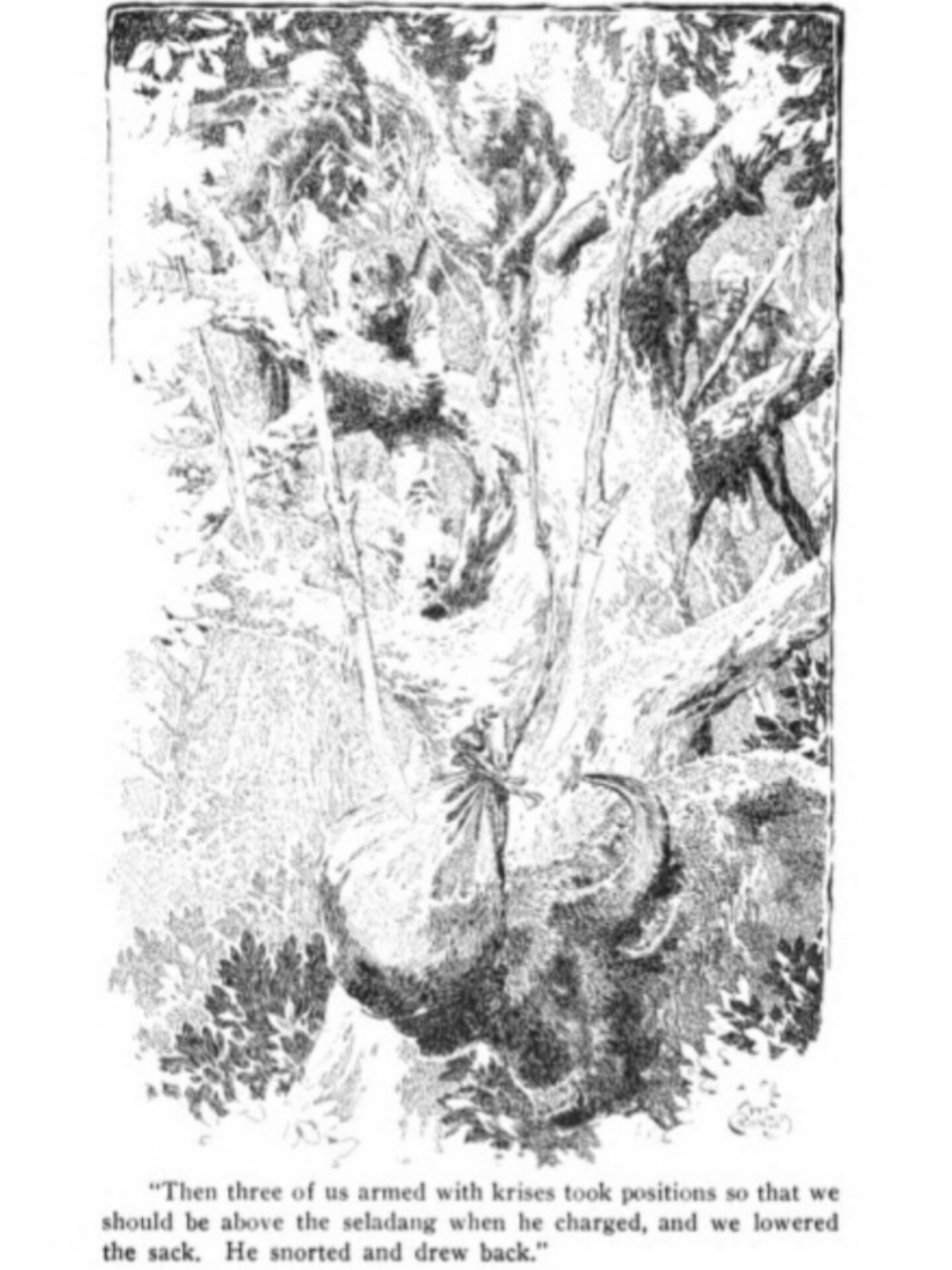
A favorite native method of hunting is with birdlime, which is a mucilage made from the gum of a tree. In catching tigers or leopards, the hunter spreads out the birdlime where they will pass and carefully covers it with leaves. Immediately after a cat animal has put his foot in the stuff, he becomes so enraged and helpless that he is easily captured. It is very much like putting butter on a house cat’s paws to keep him busy until he becomes accustomed to a new home. The tiger or leopard that steps in birdlime doesn’t step gracefully out of it and run away; he tries to bite the stuff from his feet and then he gets it on his face. When he tries to rub it off, he plasters it over his eyes. Finally, when he is thoroughly covered with it, he is so helpless that without much danger he can be put into a cage; and there he spends weeks in working patiently to remove the gum from his fur. Birds and monkeys are captured in birdlime smeared on the limbs of trees; they stay in it until some one goes up and pulls them out.
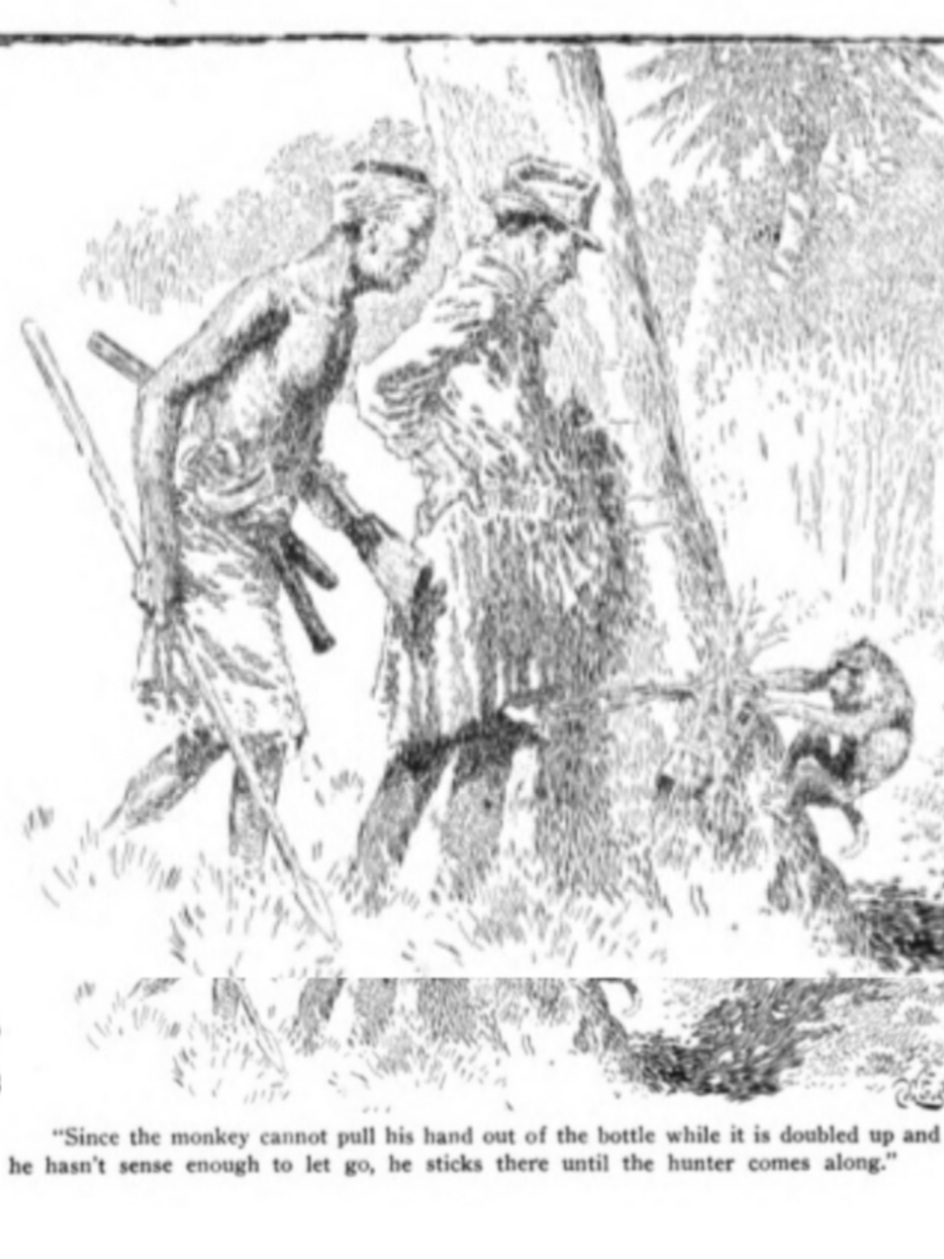
Another way of capturing small monkeys is by means of a sweetened rag in a bottle. The bottle is covered with green rattan and tied to a tree. The monkey puts his hand through the neck and grabs the rag. He cannot pull his hand out while it is doubled up with the rag in it, and he hasn’t sense enough to let go. There he sticks, fighting with the bottle, until the hunter comes along and, by pressing the nerves in his elbow, forces him to open his hand and leave the rag for the next monkey.
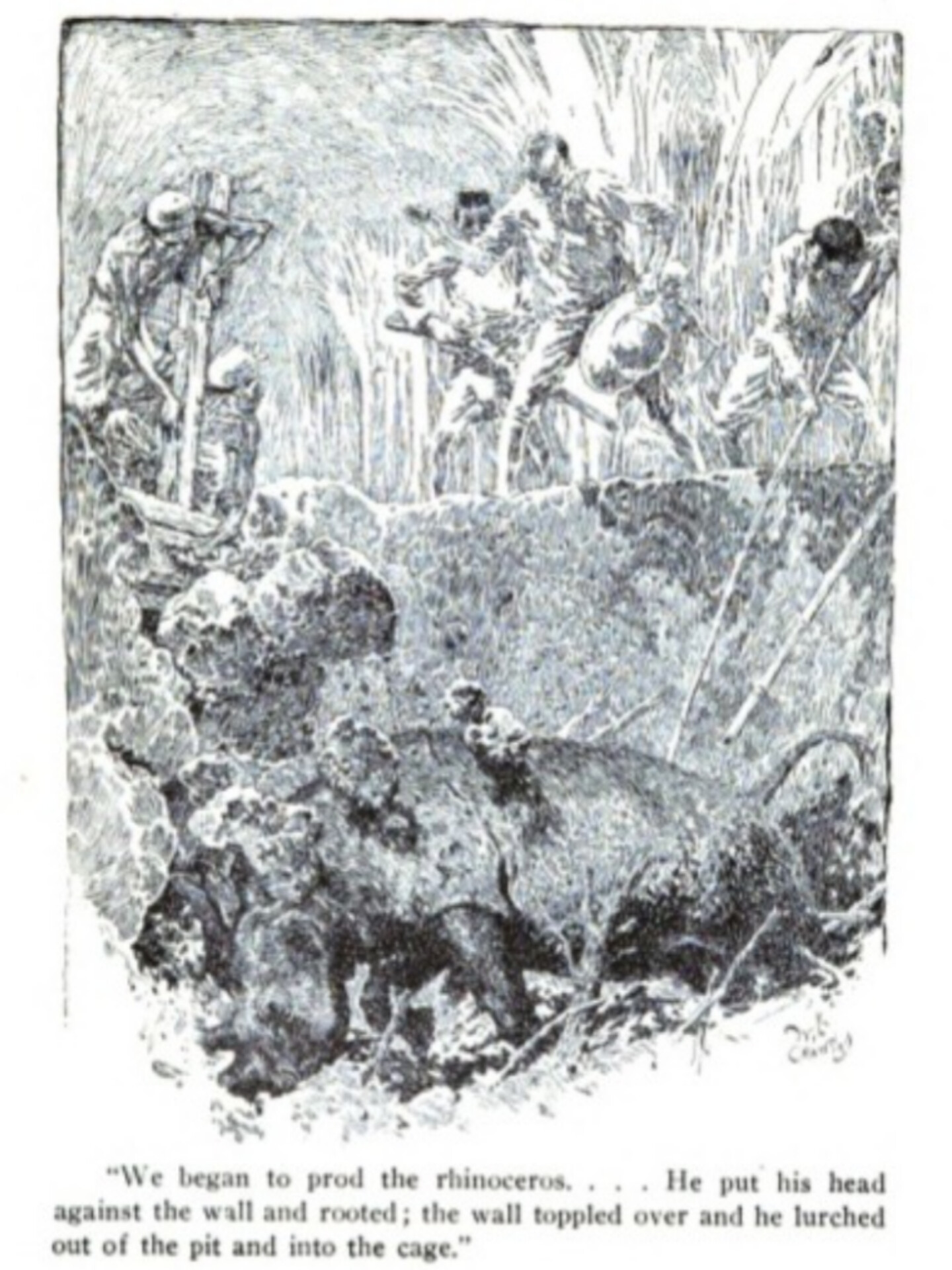
We snared and trapped many small animals and occasionally built pit-traps for tapirs. The natives sometimes used pits for marsh elephants, but I have never seen elephants captured in them without being injured. They are so heavy that they hurt themselves in falling.
The marsh elephants in Sumatra are not worth the trouble of capturing, since they are weaker, shorter lived and less intelligent than the other breeds. They bring a low price, and consequently only the babies, which can be handled and transported easily, ever reach the market. The usual procedure among the natives is to shoot the mother and take the baby. It is little like the real game of elephant hunting as I found it later in Trengganu and Siam.
Dynamiting for fish is a great sport among the Malays. It is done, of course, with the maximum chatter and excitement. The natives line the banks of the stream while the dynamite is dropped; then they rush off, some in boats and some of them swimming, to collect the fish that come to the surface.
Drugging fish is another method of capturing them wholesale without much trouble or work. For this purpose the natives use a mixture of lime and the sap from the roots of a tuba tree. They first warn the villages down-stream so that the people will not drink any of the water; then they pour out the white liquid. It spreads over the stream, making the fish mâbok (drunk), as the Malays say. They rise to the surface and are gathered into boats….
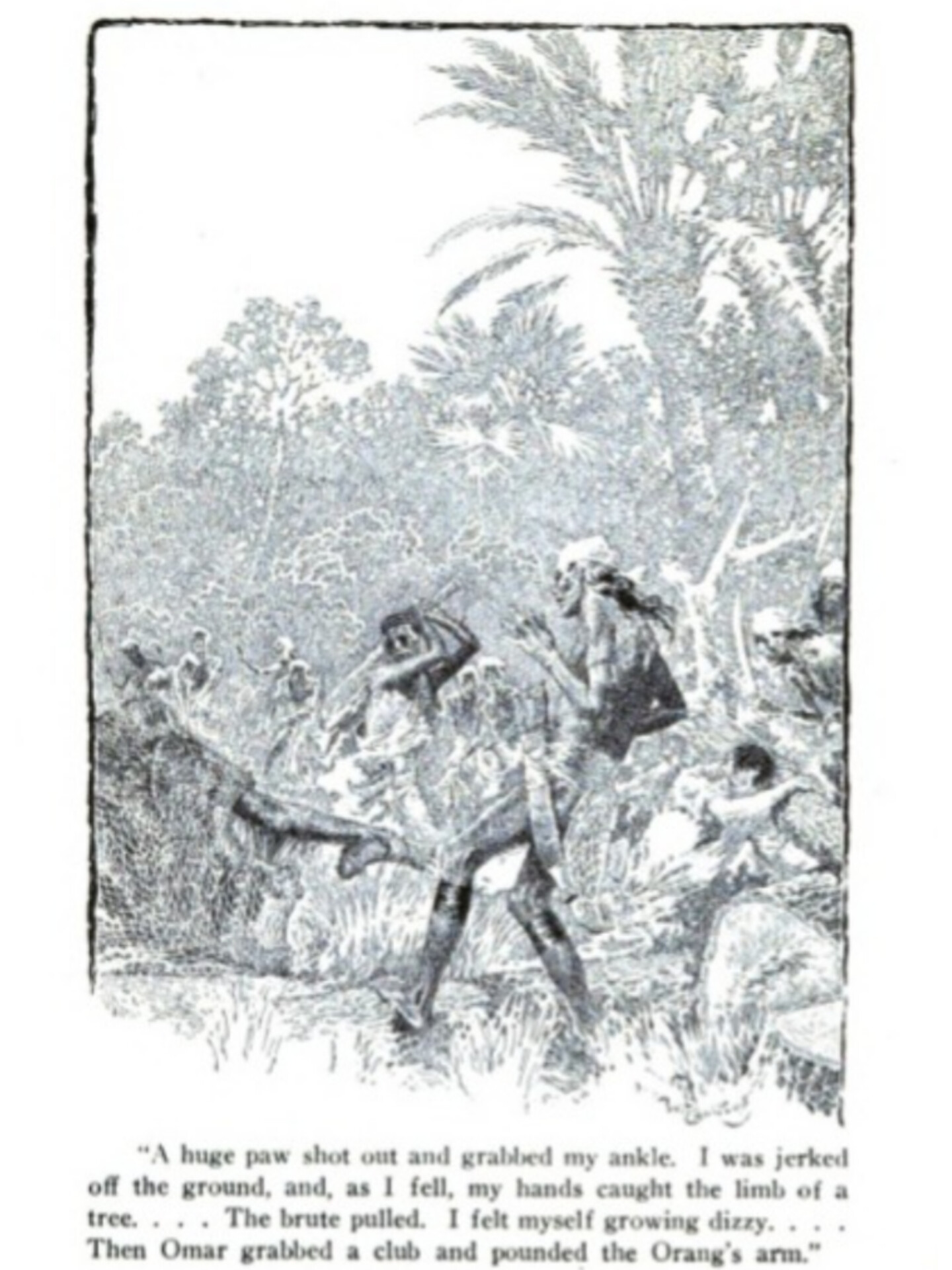
On my return to Singapore, I found a letter from the director of the Melbourne Zoological Society, suggesting that I come to Australia with a consignment of animals. A few weeks later I arrived at Melbourne with a black leopard, twenty- five small monkeys, two small orang-outangs, a pair of civet cats and numerous other animals. Mr. La Souef, the director, and his son, who had just been appointed director of the zoological gardens at Perth, met me at the dock. His son bought the entire consignment. The result of this visit was my appointment as agent of the Australian zoölogical gardens. In return for giving them first call on any animals that came into my hands, I was given a retaining fee. The most important part of the agreement was that the animals were to be shipped f.o.b. Singapore and that I was thus released from all the risks of transportation. It happened too often that animals died aboard ship, after weeks had been spent in capturing them and bringing them to port, and this loss was invariably borne by the dealer….
… The messengers had returned with the news that the herd had been seen near the Pahang River.
He asked what I proposed to do, and I drew a diagram of the trap I wanted to build. He asked if it would not be a better plan to shoot the big elephants and capture the young. I put stress on the royalty payments he would receive, and thus I won him to my way of thinking.
He assigned his nephew Omar — a tunku — to the duty of assisting me, and gave him full power to force as much labor as we might need. A few days later, Omar and I, accompanied by the Sultan, sailed down the coast to the Pahang. It was a wide, deep river, infested with crocodiles; settlements dotted the banks. At each of these we stopped and called on the headmen to conscript labor.
Since the men had to supply their own food and travel in their own boats, the cost of the expedition was reduced to nothing. We arranged that the men might be replaced by others from their villages, because they were loath to remain long away from their families.
Five days after leaving the capital, we arrived at the place where the herd had been located. We disembarked. There followed two weeks of hunting before we found the spoor that told us we had reached the elephants.
It was dense jungle; undergrowth, creepers and vines bound the trees together. The lack of sunlight and the dense atmosphere made progress slow. Sometimes the task of driving elephants on foot through such country seemed hopeless, but I kept the men at work, hacking out trails with parangs — their big knives. The insects were frightful, and we were all covered with bites. I developed fever and went about so “groggy” that I was not at all sure of myself; but huge doses of quinine and the excitement of tracking so large a herd kept me going.
The scouts reported that the herd numbered about one hundred. I assigned fifty men to surround the elephants and keep them moving in a circle within a definite area while we built the stockade.
The work of making the trap was prodigious. Trees, twenty to twenty-five feet in length and a foot and a half in diameter, were cut down and dragged through the jungle for half a mile or more to the spot I had selected. These were planted five feet in the ground and braced by three smaller trees, so that they could stand the enormous pressure of elephants trying to lunge through them. The trap was round — about seventy-five feet in diameter — with two wings, each one hundred feet long, converging to the entrance. After planting and bracing all the posts, we bound them together with heavy ropes made of twisted rattan, and then covered them with vines and leaves. For all this work the natives had no tools except their parangs. It was amazing to see the rapidity with which they cut down the big trees and slashed trails through the jungle. Omar and I were with them constantly, keeping up their enthusiasm and excitement.
In building the trap we took great care not to disturb the jungle through which the elephants were to be driven. Like all jungle animals, elephants can see at night, and there is always the danger of a stampede unless precautions are taken against arousing suspicion. The jungle leading up to the wings was untouched; and the wings and the trap could scarcely be distinguished from the dense growth that surrounded them. In the runway and in the trap the jungle was still standing without injury.
When the stockade was completed, an old Siamese priest offered to perform the ceremony that would bring the blessing of the deity of the jungle upon the drive. A white cock was found and fastened in the center of the trap. The priest selected a hundred men and stationed them near the entrance with fruits and branches of trees; then, with two natives, he withdrew into the jungle. Presently we heard them shouting. They came through the undergrowth, chanting and striking the trees with their spears and parangs. The priest rushed through the runway into the trap and seized the cock. With his knife he severed its head. Then, while the natives joined in a chorus of shouts, he ran about the trap, sprinkling the blood. Instead of coming out through the gate, he crawled between the posts. The ceremony ended, and the natives were ready to begin the hunt.
Word came from the men who were watching that the herd was four miles away. I gathered the natives around me, explained all the details of the drive and assigned men to the various tasks. Then we started in a body to get behind the herd. Every five hundred yards, I stationed a man in a tree to steer the drive.
Driving elephants at night is a slow, trying, dangerous job. It means fighting every foot of the way through dense jungle and keeping up a continual hubbub of tom-toms and shouts. The elephants wish to avoid the noise and they move slowly away from it, crashing through the trees and vines. The men who are directly behind have the easiest time, for they can follow the trails broken by the elephants; those on the side must cut trails with their parangs. No lights can be used, and care must be taken to avoid the little elephants, which roam about, investigating the noise. If they see a man and give the danger-signal, the entire herd stampedes.
When we arrived behind the herd, I spread the men out in a U formation, warning them to make no noise until the signal was given. With Ali standing near me with my express rifle, I waited until darkness came; then I gave the signal and started forward. Ali, Omar, the priest, my Chinese boy and a few others followed along behind me, shouting. The noise was taken up on each side of us, and presently we heard the elephants moving forward, throwing their great hulks against the jungle growths. The night was black, and we stumbled on, guided only by the calls of the men in the trees. Insects swarmed about us, biting until we were frantic. Sometimes the noise on either the left or the right suddenly increased, and we knew that the herd had veered in that direction and that the men were frightening them off.
Dawn came, and we found that we had driven them a mile and a half. It had been exhausting work. I posted guards to watch the herd, and we slept until late in the afternoon. Our bodies were covered with welts from insect bites and the sting of nettles and were torn and scratched by the sharp vines; and I was throbbing with the fever. When darkness came again, it seemed to me that the enterprise was all a wild nightmare.
Early the next day the stampede hit us without warning. A small elephant, straying from the herd, saw some of the men on the right; he ran back, trumpeting the danger. Then the bellowing herd came down upon us.
Ali shoved my rifle into my hands and I jumped behind a tree. The Siamese priest stumbled and fell. Before I could shoot, a big bull elephant stepped on him and tore him in two, throwing the upper portion of his body over my head. I was spattered with blood. Elephants, bellowing furiously, rushed past us; men screamed and scrambled for places of safety. The immense animals loomed up in the darkness for a second and then disappeared. In their excitement some collided with trees.
There was no need to shoot; it would have been like holding up a fan to fend off a cyclone. I hugged my tree, keeping my gun in position. I was discouraged; our efforts had been wasted and the herd was scattered. That would be a fine story to take back to the Sultan.
When the elephants had passed, I called to the men. We lighted torches and searched for the injured. Three had been killed and twelve hurt, and I was thankful there weren’t more casualties. We buried the dead. Ali brought up my medical kit and helped me dress the wounds.
After a few hours’ sleep, I found that I wasn’t quite so discouraged, and so I called the men together and lectured them on the necessity of being careful. They showed no signs of mutiny, and so we started off again in search of the herd. It was not difficult to find them, for they cut a swath in the jungle to the point where they stopped, five miles from the scene of the stampede.
Again I posted guides in the trees and spread out the drivers. Every man was alert, and, when night ended, we were considerably nearer the trap. In the minds of the elephants there seemed to be no connection between the noise that was driving them and the men they had seen the night before, and they went ahead peaceably.
Leaving scouts to watch the herd, I gathered the men together and praised them. Success rekindled the enthusiasm that had been damped by the stampede, and, when we threw ourselves down to snatch a few hours’ sleep, we were convinced that the drive would proceed without trouble. The scouts reported that the herd was slightly depleted, but, even so, it was the largest herd that any of us had ever seen, much less driven.
At nightfall, each day, the men were again in position, waiting for my signal; and, three nights later, we approached the stockade. The men went wild with delight. And above the uproar, I could hear the calls of the guides in the trees, telling us our distance from the trap.
The big beasts jammed in the runway between the wings, heaving and struggling, and forcing those ahead of them into the trap. The walls of the wings groaned as they threw their bodies against the posts. The elephants bellowed, and the natives kept up a continual pandemonium. I mounted the platform and looked down; I could see nothing but a tossing flood of black that poured slowly from the runway into the trap.
When the last elephant was inside, the ropes that held the gate were cut. The gate crashed down; bars were run through the sockets; the elephants were trapped.
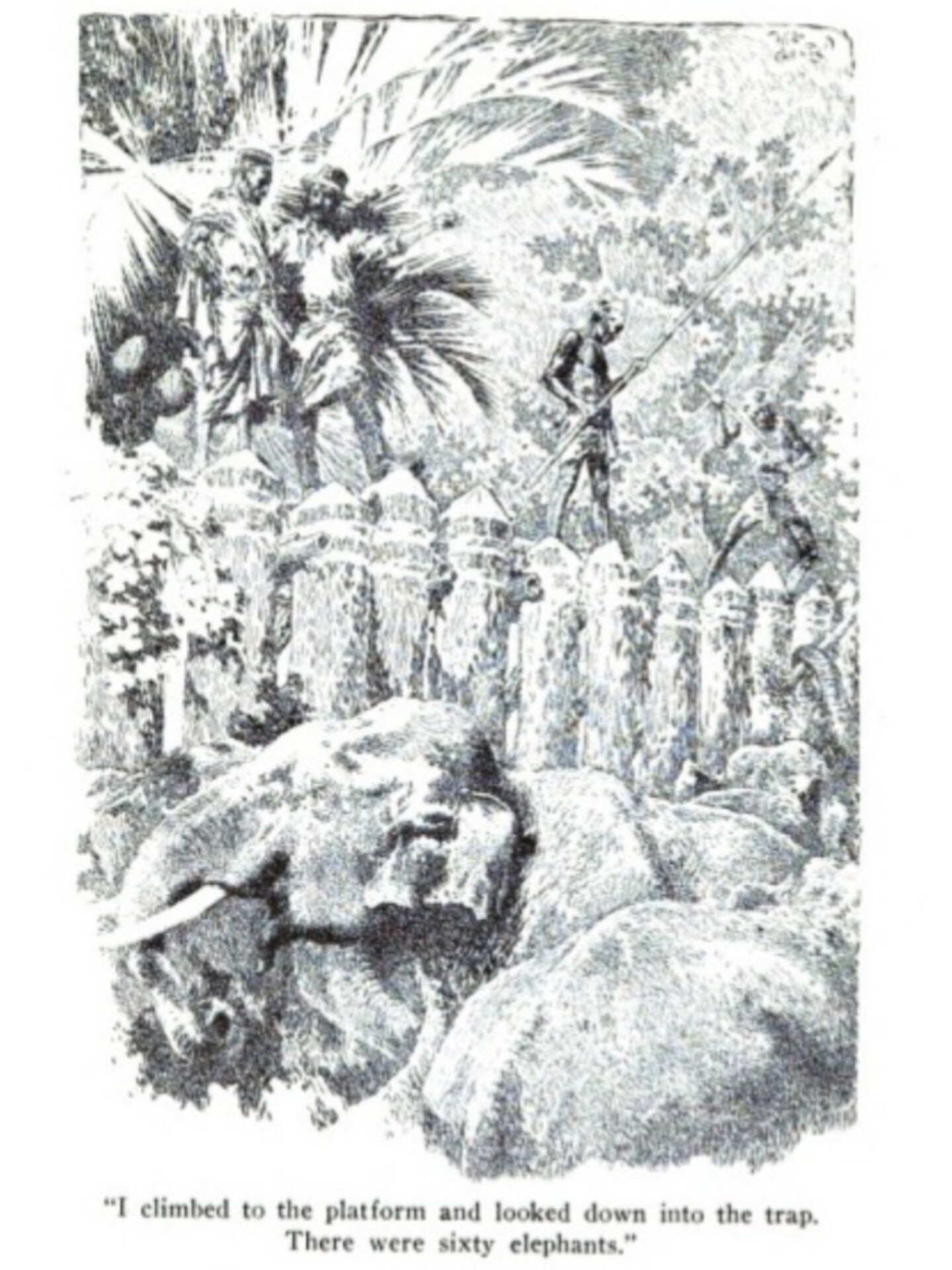
On my platform I shouted as loudly as any of the Malays. Torches were lighted and the men began dancing. I slipped to the ground and warned them against climbing up on the walls of the stockade, for I was fearful that the sight of men might enrage the elephants. If the beasts suddenly took it into their heads to charge the wall in a body, some of the posts might give way. I could hear them milling around inside the trap, bellowing and tearing up the jungle in an effort to find a way out. Through the remainder of the night the natives danced, ate and drank. Then, when dawn was beginning to light up the sky, I climbed to the platform again and looked down into the trap. There were sixty elephants!
The men, armed with long, spiked poles, mounted to the running platform on the top of the posts, and the celebration was renewed. I stood there, breathless, wondering how many of them, in their excitement, would fall off the platform into the trap. But none did fall, and they fended off the charges of the elephants by sticking them in the heads and bodies with their spikes.
Omar immediately sent a messenger to the Sultan with the good news, and the word passed from village to village. Natives poured in to inspect the catch, and the messenger returned with the news that the Sultan was on his way. It was a historic occasion in Trengganu. The Sultan had never been in the interior of his own country before, and never had there been such an elephant hunt in the state. Omar busied himself with the details of the royal reception while I cared for the catch.
We cut holes in the rattan webbing between the posts and enticed the small elephants to come out. There were several babies in the lot, and they soon became playful and affectionate. Baby elephants are just three feet high at birth and weigh about two hundred pounds. They grow an inch each month. We made pets of them and amused ourselves with weaning them. We did this by taking a pail of warm milk and dipping the babies’ trunks into it, then doubling the trunks up and putting them into their owners’ mouths, and finally squirting milk in with a squirt gun. The babies soon learned to imitate this procedure. They were mischievous little animals, full of fun and inquisitiveness. Hour after hour, I played with them and laughed until I ached….
…While they feasted and danced, I made my plans for the stocks in which the sixty elephants were to be broken.
The breaking of elephants, especially so large a herd, is a long, tedious job. I was thankful that I had Prince Omar with me to keep the natives working. The hunter, who kills and skins his animals, has a simple life compared with the collector, who must not only take the animals alive and uninjured, but convey them through miles of jungle country to a port. Months of hard labor were before us, and the success of the expedition was by no means assured, even though we had our elephants safe in the stockade….
…The elephant drive was a historic event in the country, and henceforth we had little trouble with labor.
The work of breaking wild elephants must be carried on with painstaking exactness, for one elephant can create havoc in a few seconds if the men lose control. The first task is the building of the stocks where the elephants are to be held while they become accustomed to men; then comes the work of driving into the ground, about four feet apart, two rows of heavy stakes, leading from the trap to the stocks. Also, next the trap, a small enclosure, four or five feet wide by fifteen long, is built at the end of the passageway formed by the stakes. The piles of the trap are removed from the entrance to this enclosure and bars are substituted. Since the elephants were given practically no food during the time they were kept in the trap, they were half starved when the breaking commenced. In their weakened condition they were much less dangerous to handle, and, too, they could then be fed in such a way as to impress upon them the fact that good behavior brings good treatment.
The young elephants required no breaking, and so they were lured from the trap with food. They roamed about the camp, playing and watching operations.
As soon as the tuskers were taken from the trap, they were killed for their ivory. The tusks were worth almost as much as I could get for the live animals, and tusks are far easier to handle than animals that have to be broken and fed. Also, as the animal dealers say, the elephant might “eat and die.” I did the killing with my express rifle. The explosive bullets produced instant death. Another way of killing an elephant is to strangle him by running two ropes around his neck and having elephants pull him in opposite directions.
As soon as all the equipment for breaking was ready, I instructed the natives in their work. With a select crew of men, I rehearsed all the details of what we were going to do and how we were going to do it. Finally, I ordered food placed in the enclosure and the bars drawn. The nearest elephant saw the food, sniffed, flapped his ears and walked in. Breaking commenced.
As soon as the elephant enters the small enclosure, the bars behind him are slipped. He eats the food so eagerly that he does not realize quite what is happening and the men put the knee- and foot-hobbles on him. These allow him about one quarter of his normal step. Rattan ropes are fastened to his feet and drawn out through the bars; his trunk is secured so that he can do no damage with it.
There is a great deal of misunderstanding about what an elephant can do with his trunk. It is a sensitive organ and he never uses it for heavy labor, but he can strike a terrific blow with it. I have seen many a man’s ribs and arms broken when he neglected to take the proper precautions. In approaching a dangerous elephant, a man should come up sideways, with the nearer arm folded to protect the ribs. Then, if the elephant strikes, he should try to catch the blow on the upper part of the arm, where there is the most flesh to protect the bone. Such a blow never knocks a man flat; it sends him spinning like a top until he tumbles over.
The elephant uses both his trunk and his lungs in calling, and he has a large variety of sounds and combinations of sound with which to express himself. When rushing an enemy, he trumpets shrilly; when enraged by wounds, he grumbles hoarsely from his throat; he expresses fear by a shrill, brassy trumpet and a roar; and pleasure by a continued low squeaking through the trunk. When apprehensive of danger or when attempting to intimidate an enemy, he raps the end of his trunk smartly on the ground and trumpets. The peculiar noise sounds like that produced by the rolling up of a sheet of tin.
In a moment of danger, the elephant coils his trunk to protect it from injury. When he is engaged in heavy work, such as piling lumber, he may use his trunk to balance the load he is carrying on his tusks, but never to bear part of the burden. If an unharnessed elephant must pull a rope, he holds it in his mouth, taking good care to keep his trunk out of the way. It has happened many times that an elephant-keeper — not a trainer, for a trainer knows better — has used a hook a little too freely on an elephant’s trunk. If he doesn’t get killed, he picks himself up several yards from where he was standing. A trainer is invariably pleased at such an occurrence, because it shows that the keeper was abusing the elephant and has merely received his deserts. The elephant is a good, faithful animal, and he does not attack his keeper without excuse, except when he is in what is called the “must” period, which I shall describe later.
When the elephant is secured by hobbles, foot-ropes and trunk-ropes, the bars leading from the enclosure are removed. The foot-ropes have been fastened to the stakes and are loosened as the elephant walks out. The men holding the ropes attached to the fore feet wind them around the two stakes ahead, and those holding the ropes attached to the hind feet wind them about the first stakes. In this way the animal is drawn forward, step by step, toward the stocks, while natives prod him from behind with poles. If he tries to bolt, he simply falls over. It is a difficult, trying job, because the elephant is still vicious.
The stocks are built in covered stalls, so that each elephant is separate from the others. Two large uprights are driven into the ground in the shape of a V; the elephant’s head is drawn between them, and they are pulled together at the top so that he is held securely behind the ears. At the corners are uprights, with poles to fence him in, running between them. These poles, located a trifle below his belly, support two cross-bars, one just behind his fore legs, and the other in front of his back legs. In this position it is impossible for the elephant to lie down or to move; he can wiggle his legs and wave his trunk, but that is all.
The elephant remains in the stocks for about two weeks. During that time he is fed and petted by a keeper appointed for that particular job. The keeper crawls over his back and rubs him behind the ears and gives him water, fruit and bamboo shoots. The elephant learns not to be afraid when a man is near him, and he gradually becomes more docile. During these two weeks he is fed very lightly because he must be kept in a weakened condition.
After two or three weeks, according to the disposition of the elephant, ropes are again attached to his feet, and he is led out of the stocks. This time he wears only the knee-hobbles, which allow him more play. Eight or ten men hold each of the ropes; his keeper sits on his head with a prod; another crew hold the rope attached to his trunk; and six or eight men follow with rattan whips. The men with the whips beat him continually. At first, in the excitement, he does not mind the whipping; then he finds the pain unbearable. The men on the trunk-ropes lead him about from right to left, while the men on the foot-ropes stand ready to trip him if he tries to bolt. At last he gives a bellow of pain and the whipping stops.
This one bellow marks a surprising change in the animal. His spirit is broken and he acknowledges that man is his master. The fact that he is instantly fed and petted helps him to make up his mind, of course, and to forget about the old, wild ways of the jungle. Thereafter, a keeper who does not deliberately make him angry can handle him easily. His schooling is brief and he learns readily to turn, kneel, back and pull. In return he is given plenty of food and is tied to a tree instead of being put in the stocks.
It occasionally happened that an elephant refused to bellow. In that case, I had the men lead him out to be shot, for I knew I should be wasting time in trying to break him.
The opinion is generally held by those who have had the best opportunities of observing the elephant, that the popular estimate of its intelligence is a greatly exaggerated one; that instead of being the exceptionally wise animal it is believed to be, its sagacity is of a very mediocre description. Of the truth of this opinion no one who has lived amongst elephants can entertain a doubt.
The elephant’s size and staid appearance, its gentleness, and the ease with which it performs various services with its trunk, have probably given rise to the exalted idea of its intellect. Amongst those not intimately acquainted with it, and it being but little known outside of its native countries, what is known of it justly make it a general favorite and leads to tales of intelligence being not only accepted without investigation, but welcomed with pleasure.
One of the strongest features in the domesticated elephant’s character, is its obedience. It is also readily taught, but its reasoning faculties are far below those of a dog, and possibly other animals, and in matters beyond the range of its daily experience, it evinces no special discernment; while quick at comprehending anything taught to it, it is decidedly wanting in originality.
Let us consider whether the elephant displays more intelligence in its wild state than other animals. Though possessed of a proboscis, which is capable of guarding it against such dangers, it readily falls into a pit dug for catching it, only covered with a few sticks and leaves. Its fellows make no effort to assist the fallen one, as they might easily do by kicking in the earth around the pit, but they flee in terror.
It commonly happens that a young elephant falls into a pit near which the mother will remain until the hunter comes, without doing anything to assist it, not even feeding it by throwing in a few branches. This, no doubt, is more difficult of belief to most people than if they were told that the mother supplied it with grass, brought water in her trunk, or filled up the pit with trees and effected the young one’s release.
Whole herds of elephants are driven into ill concealed enclosures which no other wild animal could be got to enter, and single ones are caught by their legs being tied together by men under cover of a couple of tame elephants. Elephants which happen to effect their escape are caught again without trouble. Even experience does not bring wisdom.
These facts are certainly against the conclusion that the elephant is an extraordinarily shrewd animal, much less one possessed of the power of reasoning in the abstract, with which he is commonly credited. I do not think I traduce the elephant, when I say it is in many things a stupid animal, and I can assert with confidence that all the stories I have heard of it, except those relating to feats of strength or docility performed under its trainer’s or keeper’s direction, are beyond its intellectual power and are but pleasant fiction.
It often happens that persons who do not understand elephants give them credit for performing actions which are suggested to them, and in which they are directed by their trainer or by the mahout on their necks. I think that all who have had to deal with elephants, will agree in saying that their good qualities cannot be exaggerated and that their vices are few, and only occur in exceptional animals. The not uncommon idea that elephants are treacherous and retentive of injury, is a groundless one.
Elephants do not push with their foreheads or the region above their eyes, but with the base of the trunk or snout, about one foot below the eyes. Elephants are poor sighted, and are so intent on being off when thoroughly started, that I have been almost brushed against without being discovered.
The rapidly advancing line of huge heads and cocked ears bobbing up and down as the elephants come rushing on, leveling everything before them, is a trying sight, and at first one requires some nerve — and the reflection they are escaping, not charging — to stand still.
If circumstances ever occur to make a run unavoidable, the pursued hunter should always take down hill and choose the steepest place at hand, as the elephants fear to trust themselves on a rapid descent at any great pace; uphill, or on the level, man would be immediately overtaken. When elephants are close at hand, standing in indecision, no one should shout to turn them; a charge by one or more of them is sure to be made if they are suddenly started at this time.
Eight months passed at breaking elephants. I was sick with fever and dysentery and I was glad when we could break camp. Riding on the head of an elephant, I led my catch through the jungle to port. Once again I paid my respects to the Sultan, who told me that I might hunt in Trengganu whenever I pleased. A year before, I should have been wildly delighted at the prospect of having Trengganu open to me under his protection, but now, with my health broken, I did not care much if I never saw the country again.
I arranged for the keeping of the animals until they could be brought by boat to Singapore, and then I caught the first coast steamer south, taking four elephants with me. At Singapore I found that the story of the big capture had been the talk of the city for months. In fact, several days after I arrived, I went to call on my former enemy, Mahommed Ariff, and he took off his turban and bowed. We had many dealings after that, and he always treated me with the greatest respect and honesty.
When I was leading one of the smaller elephants through the street on my way to the animal house I had rented in Orchard Road, I was approached by an Arab.
“Tûan mau jûal? (Sir, do you wish to sell?)” he asked.
“Of course,” I answered. I was sick and tired and I did not want to be bothered.
He persisted. “Tûan, how much?”
“All of them or just one?”
“That one,” he answered, pointing to the elephant I was leading.
I thought he was asking just out of curiosity, and so I set a price that I thought would silence him — $3,000 Mexican.
“Tûan, truly will you sell it for that?”
“Yes.”
He followed me to the animal house, and I wondered what he had on his mind. As a matter of fact, I would have sold the elephant for $450, because it was young and small. At the animal house, he again asked me if I would sell for $3,000; then he undid several of the shirts he was wearing and pulled forth an old wallet. He gave me $500 to bind the bargain and called a friend of his to act as witness. When he left to get the rest of the money, I went to the stall where I had placed the animal and examined it.
It didn’t take me long to discover why the Arab was willing to pay $3,000. The little elephant had twenty toes instead of the usual eighteen. Twenty-toed elephants are held in veneration throughout India, and are keenly sought by all the rajas and maharajas for the prosperity they are supposed to bring. They are guarded more carefully and quartered even more sumptuously than the white elephants of Siam, and the price they will bring is determined almost entirely by the amount the rajas can gather together. My little twenty-toed elephant was a faultless specimen. He was about five years old and stood four and a half feet high. His head was perfectly shaped; his back was straight and absolutely even with the top of his head.
I was naturally disgusted to think that I had let such a bargain slip out of my hands, and, when the Arab returned, I blamed him for cheating me when I was sick with the fever. I abused him and his ancestors and gave a great show of indignation. He begged me to take the money and give him the elephant; I refused the money and told him to take the elephant out of my sight.
“I have put a curse on him,” I said. “He will be dead within twenty-four hours.”
At this he burst into tears, begging me to remove the curse. He said that he was a poor man and that the elephant’s death would ruin him. Finally we reached a compromise. He would pay me an extra $500, and I would arrange transportation to India for the elephant. Then, if the sale proved profitable, he was to return to Singapore and pay me an additional $500. He swore by Allah and the Prophet that he would keep his word. So I removed the curse and took his money and he departed happily. A month later he returned and paid me the $500. He had sold the elephant to the Maharaja of Mysore for 10,000 rupees. The Arab later bought four large elephants from me.
During my nineteen years in the Malay Archipelago I captured hundreds of elephants, but none of the herds was so large as my first catch. And, though I always looked carefully at the elephant’s feet before I sold him, never again did I tag one with twenty toes.
Of all the animals I have handled in my experience as a collector, I prefer elephants. They are interesting and amusing beasts, and, once broken, they become hard-working and affectionate. They never show any inclination to go back to the jungle, even when used for the purposes of running wild elephants. In Siam all the driving of herds into the traps is done on female elephants, and their presence calms the herd. I have seen the tame elephants press in upon a wild elephant, holding him while he docilely allowed himself to be hobbled.
The hunts in Siam are for tuskers, and the females are for the most part allowed to run free again to breed. The tuskers are used in the teak forests for handling logs. The females bear young about every three years until they reach an age of from seventy to seventy-five years. The period of carrying varies from eighteen months in the case. of a female baby to twenty-one months in the case of a male. A baby elephant, as I have already written, weighs approximately two hundred pounds at birth and stands thirty-six inches high. It suckles from six to nine months.
The breasts of the female are located just back of the fore legs, and the baby runs its trunk up along its mother’s side while nursing. Its next food is fruit and the tenderest bamboo shoots. It is very fond of sugar. It grows at the rate of one inch a month up to its third year and attains its full growth, but not maturity, at about twenty-five. The age of an elephant is told largely by the ears; an old animal has ragged ears and sunken cheeks. The height of an elephant is almost exactly twice the distance around its foot.
A herd of elephants is invariably led by the females, perhaps because they are the more alert to catch the least sign of danger. If the herd is put to flight, the males take the lead, breaking through the jungle and making a trail for the females and young. An elephant never goes around things; he either pushes them to one side or goes straight through. He is very sure-footed and, on anything that looks doubtful, he will never step without first putting out a foot and trying it. For that reason, it requires some skill to build a pit-trap that will not attract attention. A pit-trap is practically useless, however, because the elephant is invariably injured in the fall; it allows the capture of the baby, in the case of females, but at the cost of the good, full-grown animal.
Wild elephants, grazing in a herd, travel rapidly if they are frightened, but usually they saunter along, sleeping during the day and feeding at night. Their food consists chiefly of grasses, bamboo shoots, cocoanuts and the bark of some trees. Lone elephants and outcasts from the herd are dangerous animals and should be killed.
There comes a period, known as “must,” when even the most reliable elephant becomes a dangerous animal. Like the Malay he “sees red” and runs âmok. A good elephant keeper can detect the madness several days before it reaches the dangerous stage, and by securing the animal with hobbles, can prevent trouble. In the cheeks of the elephant are two small holes, called “errors,” and from these holes oozes a slight secretion. One of the keeper’s duties each day is to examine the holes and run a piece of straw into them. If there is an odor of musk about the straw when he pulls it out, it is an indication that the “must” period is coming. Sometimes the keeper fails to make this test, and the elephant runs âmok, killing people and leaving a trail of wreckage behind him.
On one of my visits to Sydney with a consignment of animals for the Zoological Gardens, I found the entire crew of elephant keepers busy with the task of trying to control an animal that was in “must.” His keeper had failed to make the test, and the elephant had suddenly gone mad. Fortunately he was in his stall at the time. When I arrived, he had wrecked the stall, and the keepers were afraid that he might get loose. Another stall had been arranged, but they could figure out no way of changing him to it. The men were thoroughly frightened and absolutely refused to risk hobbling him. The director of the Gardens offered me £100 if I would do it, and, since I had Ali and several of my own men with me, I agreed to try.
With elephant hooks strapped to our wrists, we entered the stall. The elephant stood looking at us, apparently wondering which one he should knock down first. I told Ali to get behind him while I approached from the front.
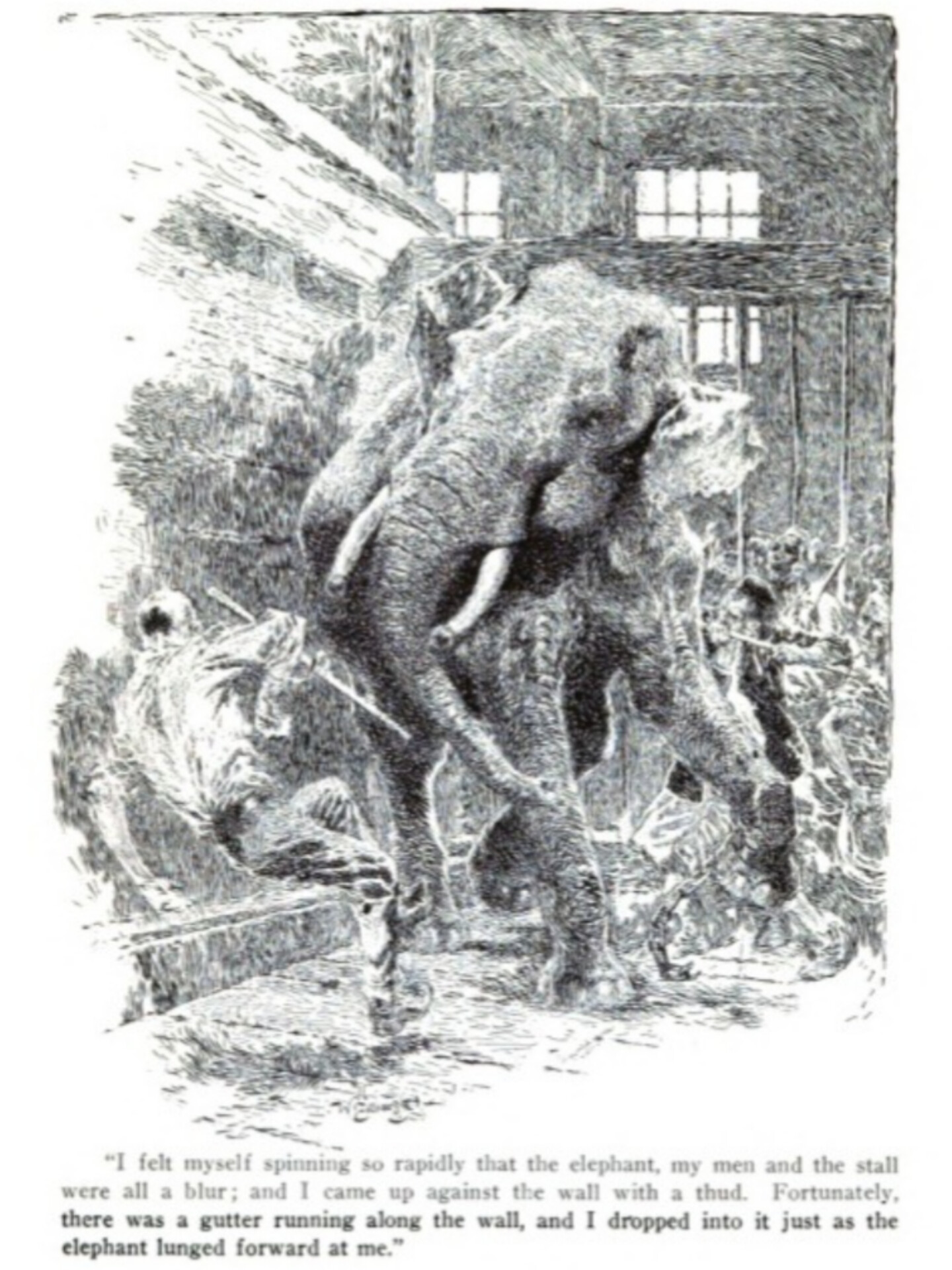
I went up to him sideways, speaking to him and offering him food. He waited quietly until I was near enough; then, before I could duck, he hit me with his trunk. I felt myself spinning so rapidly that the elephant, my men and the stall were all a blur; and I came up against the wall with a thud. Fortunately, there was a gutter running along the wall, and I dropped into it just as the elephant lunged forward at me. His big head hit the wall and the floor but couldn’t get at me. He would not risk his trunk, because he realized that I would jab him with the hook.
Ali and the other men were at his tail, jabbing him and pulling. When he turned for them, I jumped up and began running my hook into his side. It became a game of jabbing and dodging and worrying him to first one side and then the other. I took care to thrust my hook always in the same spot, tearing a raw wound in his side, while the other men caught him on the legs and on the trunk. We had to work fast to keep away from the big trunk as it cut through the air, and his feet, when he kicked. Each of us was sent sprawling several times before the fight was over.
At last I could see that the elephant was paying more attention to the wound I was making than to anything else we were doing; he favored the hurt side and tried to shield it. Then, with a bellow, he knelt down and dropped on his side to cover the wound.
While I kept him down, Ali arranged the hobbles; then we petted him and allowed him to stand. He got to his feet doubtfully, as if he weren’t sure that we were not playing a trick on him — urging him to stand up so that we could jab him again. The wound I had torn in his side was large enough for two fists, and it must have pained him terribly. He was worn out by the fight and he hobbled off to his new stall, much subdued. Several days later he came out of the “must” period, which rarely lasts for more than a week, and became again the docile elephant that took children on his back for a ride.
I went to see him several times before I returned to Singapore, and, when I entered the stall, he edged away from me, protecting his side. Years later, I went to Sydney and entered his stall. He didn’t recognize me until I put my hand on the scar; then he muttered deep down in his throat and lay down. I petted him and fed him sugar, and he seemed to harbor no resentment against me, but he did remember me in connection with a strenuous and unpleasant afternoon.
Charles Mayer, Trapping Wild Animals in Malay Jungles (New York: Duffield & Co., 1921), pp. 44-46, 50-51, 60-69, 70-71, and 73-90. The lead image is from the above-cited Alexander book on page 35 and the traps are from The sketches are found on pages 100 and 112. The sketches are from Mayer on pages 46, 68, 88, 116, and 204.
See: https://babel.hathitrust.org/cgi/pt?id=uc1.$b40805&seq=1