
Animal Crimes
We want you to have a greater ability to learn about some of the unpleasant animal issues in our world.
THE TRIAL OF ANIMALS AND INSECTS. A LITTLE KNOWN CHAPTER OF MEDIEVAL JURISPRUDENCE.
BY HAMPTON L. CARSON.
(Read April 12, 1917)
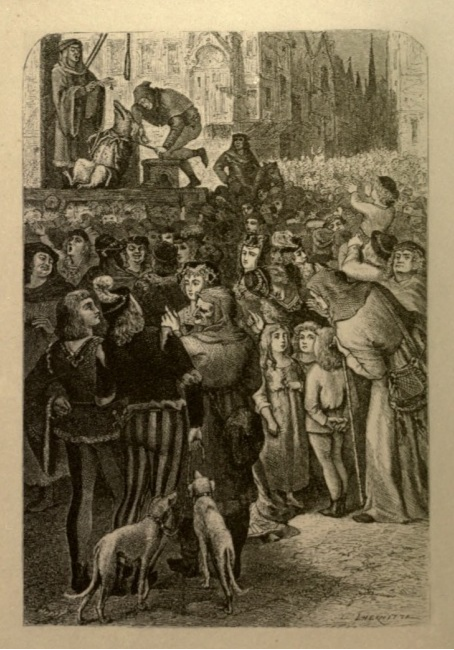
In the open square of the old Norman city of Falaise, in the year 1386, a vast and motley crowd had gathered to witness the execution of a criminal convicted of the crime of murder. Noblemen in armour, proud dames in velvet and feathers, priests in cassock and cowl, falconers with hawks upon their wrists, huntsmen with hounds in leash, aged men with their staves, withered hags with their baskets or reticules, children of all ages and even babes in arms were among the spectators. The prisoner was dressed in a new suit of man’s clothes, and was attended by armed men on horseback, while the hangman before mounting the scaffold had provided himself with new gloves and a new rope. As the prisoner had caused the death of a child by mutilating the face and arms to such an extent as to cause a fatal hemorrhage, the town tribunal, or local court, had decreed that the head and legs of the prisoner should be mangled with a knife before the hanging.
This was a mediæval application of the lex talionis, or “an eye for an eye and a tooth for a tooth.” To impress a recollection of the scene upon the memories of the bystanders an artist was employed to paint a frescoe on the west wall of the transept of the Church of the Holy Trinity in Falaise, and for more than four hundred years that picture could be seen and studied until destroyed in 1820 by the carelessness of a white washer. The criminal was not a human being, but a sow, which had indulged in the evil propensity of eating infants on the street.
Within the first ten years of the sixteenth century, Bartholomew Chassenée, then a young French avocat, who became a distinguished jurist, and president of the Parlement de Provence, a position corresponding to chief justice, won his spurs at the bar by his ingenuity in defending the Rats of the province of Autun, who were charged with the crime of having eaten the barley crop. He urged that his clients, like other defendants, were entitled to notice before condemnation. When they failed to appear in court in obedience to the proclamation published from the pulpits of all the parishes, he argued that their nonappearance was due to the vigilance of their mortal enemies, the cats, and that if a person be cited to appear at a place to which he could not come in safety the law would excuse his apparent contumacy.
Years later, at the height of his fame, in 1540, he insisted upon the same principle, in defending the persecuted Waldenses who were prosecuted for heresy, contending that as it had been established in the Rat case that even animals should not be adjudged and sentenced without a hearing, all of the safeguards of justice should be thrown around the accused.
I have cited these cases of the Sow and the Rats, not as isolated and extraordinary instances of mediæval trials, such as the celebrated Cock at Basel in 1474, but as fair examples of what was common to Continental jurisprudence from the ninth to the eighteenth century. Indeed as late as 1864 in Pleternica in Slavonia, a pig was tried and executed for having maliciously bitten off the ears of an infant one year old, and we are told by Professor Karl von Amira, who reports the case, that while the flesh of the animal was thrown to the dogs, the owner of the pig was put under a bond to provide a dowry for the mutilated girl, so that the loss of her ears might not prove an obstacle to her marriage.
Of the extent to which the Trial of Animals formed a substantial part of Mediæval Jurisprudence, the most convincing proof is found in the Report and Researches of Barriat-Saint-Prix, who gives numerous extracts from the original records of such proceedings, and also a list of the kinds of animals tried and condemned. He gives ninety-three cases from the beginning of the twelfth to the middle of the eighteenth century.
Carlo D’Addosio, a Neapolitan writer of recent times, enlarges the list to one hundred and forty-four prosecutions, resulting in the execution or excommunication of the accused, and extends the time from the year 824 to 1845; while our fellow countryman, Mr. E. P. Evans, in an exhaustive “Chronological List of the Prosecution of Animals from the Ninth to the Twentieth Century,” begins with the case of moles in the valley of Aosta in 824, and closes with that of a fierce dog who aided murderers in their crime in Switzerland and was tried as an accomplice as late as 1906.
An analysis of Mr. Evans’ list gives these results. Out of one hundred and ninety-six cases he assigns, 3 to the ninth, 3 to the twelfth, 2 to the thirteenth, 12 to the fourteenth, 36 to the fifteenth, 57 to the sixteenth, 56 to the seventeenth, 12 to the eighteenth, 9 to the nineteenth and 1 to the twentieth centuries. The scenes were laid in Belgium, Denmark, France, Germany, Italy, Portugal, Russia, Spain, Switzerland, Turkey, England, Scotland, Canada and Connecticut, the last named being in the days of Cotton Mather. This wide distribution of time and territory shows how persistent and prevalent the practice was, and corrects any notion of its being due to local passion or territorial superstition.
The most numerous cases were in France, but this is due to a more careful study of ancient records by French antiquarians than by those of other nations. The two English cases were those of a dog and a cock, the Scotch case, that of a dog, the Canadian case, that of turtle-doves, and the Connecticut cases those of a cow, two heifers, three sheep and two sows. As early as 1486, in a curious book, printed by Anthony Neyret, there is a classification of beasts or animals into those which are sweet beasts (bestes doulces) such as the hart and hind, and stenchy beasts (bestes puantes) such as pigs, foxes, wolves and goats, to which in time were added of domestic animals, such as asses, bulls, cows, dogs, horses and sheep, those of a ferocious and vicious disposition. These all fell under the jurisdiction of the civil and criminal courts, and after trial and condemnation were executed either by hanging, or burning at the stake.
Vermin such as field mice, rats, moles and weasels and pestiferous creatures, such as bugs, beetles, blooksuckers, caterpillars, cockchafers, eels, leeches, flies, grasshoppers, frogs, locusts, serpents, slugs, snails, termites, weevils and worms were disciplined by the ecclesiastical tribunals and in due time excommunicated.
This sharp distinction between the jurisdiction of the secular and ecclesiastical tribunals is explained by Professor von Amira, who says that animals, such as pigs, cows, horses and dogs, which were in the service of man and who committed crimes against mankind, could be arrested, tried, convicted and executed like any other members of his household, but rodents and insects were not the subject of human control, and could not be seized and imprisoned by the civil authorities. Hence, it was necessary to appeal to the intervention of the Church, and implore her to exercise her supernatural functions for the purpose of compelling them to desist from devastation of those fields and places devoted to the production of human food.
The explanation of the mental and moral attitude of the tribunals in those days in relation to the subject is to be traced to the belief of the ancient Greeks, who held that a murder, whether committed by a man, a beast, or an inanimate object, such as a deadly weapon, a spear, a knife, or a hammer, unless properly expiated, would arouse the furies and bring pestilence upon the land. The mediæval Church taught the same doctrine, but substituted the demons of Christian theology for the furies of classical mythology. Eminent authorities, as Mr. Evans has shown, maintained that all beasts and birds, as well as creeping things were devils in disguise, and that homicide committed by them, if it were permitted to go unpunished, would furnish an opportunity for the intervention of devils to take possession of persons and places.
The cock at Basel, suspected of laying an egg in violation of his sex, was feared as an abnormal, inauspicious and therefore diabolic creature: the fatal cockatrice might thus be hatched. While as to swine, they were peculiarly attractive to devils, and hence peculiarly liable to diabolical possession as proved by the legend by which devils left the lunatic and entered the herd of swine which pitched itself into the sea. Beelzebub was incarnate in all night beasts, especially if they happened to be black.
If Pythagoras was right in teaching, “that souls of animals infuse themselves into the trunks of men,” what wonder was it that Gratiano exclaimed to Shylock:,/div>
Govern’d a wolf, who, hanged for human slaughter,
Even from the gallows did his fell soul fleet,
And, whilst thou lay’st in thy unhallowed dam,
Infused itself in thee; for thy desires
Are wolfish, bloody, sterved and ravenous.”
In explanation of the judicial proceedings so solemnly resorted to in the trial, conviction and punishment of animals, a Swiss jurist, Edward Osenbrüggen, in 1868, advanced and maintained the thesis, that they can only be understood on the theory of the personification of animals: that as only a human being can commit crime and thus render himself liable to punishment, it is only by an act of personification that the brute can be placed in the same category as man and become subject to the same penalties; and he regarded the Basel cock as a personified heretic, and therefore properly burned at the stake.
Mr. Evans regards this as purely fanciful, and concludes that “the judicial prosecution of animals, resulting in their excommunication by the Church or their execution by the hangman, had its origin in the common superstition of the age, which has left such a tragical record of itself in the incredibly absurd and atrocious annals of witchcraft. The same ancient code that condemned a homicidal ox to be stoned, declared that a witch should not be suffered to live, and although the Jewish law giver may have regarded the former enactment chiefly as a police regulation designed to protect persons against unruly cattle, it was, like the decree of death against witches, genetically connected with the Hebrew cult and had therefore an essentially religious character. It was these two paragraphs of the Mosaic law that Christian tribunals in the Middle Ages were wont to advance as their authority for prosecuting and punishing both classes of delinquents.”
In conclusion, may we not exclaim, in the words of the poet Rogers in his Ode to Superstition,
“Hence to the realms of Night
Dire Demon hence!
Thy chain of adamant can bind
That little world, the human mind,
And sink its noblest powers T
o impotence.”
Hampton L. Carson, “The Trial of Animals: A Little Known Chapter of Mediæval Jurisprudence,” Proceedings American Philosophical Society (reprint; Vol. Lvi, 1917), pp. 410-415.
See: https://babel.hathitrust.org/cgi/pt?id=hvd.32044097546345&seq=1
THE CRIMINAL PROSECUTION AND CAPITAL
PUNISHMENT OF ANIMALS
Edward P. Payson
INTRODUCTION
The present volume is the result of the revision and expansion of two essays entitled “Bugs and Beasts before the Law,” and ” Modern and Mediaeval Punishment,” which appeared in The Atlantic Monthly, in August and September 1884. Since that date the author has collected a vast amount of additional material on the subject, which has also been discussed by other writers in several publications, the most noteworthy of which are Professor Karl von Amira’s Thierstrafen und Thierprocesse (Innsbruck, 1891), Carlo d’Addosio’s Bestie Delinquenti (Napoli, 1892), and G. Tobler’s Thierprocesse in der Schiveis (Bern, 1893), but in none of these works, except the first-mentioned, are there any important statements of facts or citations of cases in addition to those adduced in the essays already mentioned, for which the writer was indebted chiefly to the extensive and exceedingly valuable researches of Berriat-Saint-Prix and M. L. Menebrea, and the Consilium Primum of Bartholomew Chassenee, cited in the appended bibliography.
Professor Von Amira is a very distinguished and remarkably keen-sighted jurisprudent and treats the matter exclusively from a jurisprudential point of view, his main object being to discover some general principle on which to explain these strange phenomena, and thus to assign to them their proper place and true significance in the historical evolution of the idea of justice and the methods of attaining it by legal procedure.
Von Amira draws a sharp line of technical distinction between Thierstrafen and Thierprocesse; the former were capital punishments inflicted by secular tribunals upon pigs, cows, horses, and other domestic animals as a penalty for homicide; the latter were judicial proceedings instituted by ecclesiastical courts against rats, mice, locusts, weevils, and other vermin in order to prevent them from devouring the crops, and to expel them from orchards, vineyards, and cultivated fields by means of exorcism and excommunication.
Animals, which were in the service of man, could be arrested, tried, convicted and executed, like any other members of his household; it was, therefore, not necessary to summon them to appear in court at a specified time to answer for their conduct, and thus make them, in the strict sense of the term, a party to the prosecution, for the sheriff had already taken them in charge and consigned them to the custody of the jailer. Insects and rodents, on the other hand, which were not subject to human control and could not be seized and imprisoned by the civil authorities, demanded the intervention of the Church and the exercise of its supernatural functions for the purpose of compelling them to desist from their devastations and to retire from all places devoted to the production of human sustenance.
The only feasible method of staying the ravages of these swarms of noxious creatures was to resort to “metaphysical aid” and to expel or exterminate them by sacerdotal conjuring and cursing. The fact that it was customary to catch several specimens of the culprits and bring them before the seat of justice, and there solemnly put them to death while the anathema was being pronounced, proves that this summary manner of dealing would have been applied to the whole of them, had it been possible to do so. Indeed, the attempt was sometimes made to get rid of them by setting a price on their heads, as was the case with the plague of locusts at Rome in 880, when a reward was offered for their extermination, but all efforts in this direction proving futile, on account of the rapidity with which they propagated, recourse was had to exorcisms and besprinklings with holy water.
D’Addosio speaks of the actions brought against domestic animals for homicide as penal prosecutions, and those instituted against insects and vermin for injury done to the fruits of the field as civil suits (processi civili); but the latter designation is not correct in any proper sense of the term, since these actions were not suits to recover for damages to property, but had solely a preventive or prohibitive character. The judicial process was preliminary to the utterance of the malediction and essential to its efficacy. Before fulminating an excommunication the whole machinery of justice was put in motion in order to establish the guilt of the accused, who were then warned, admonished, and threatened, and, in cases of obduracy, smitten with the anathema maranatha and devoted to utter destruction.
As with all bans, charms, exorcisms, incantations, and other magical hocus-pocus, the omission of any formality would vitiate the whole procedure, and, by breaking the spell, deprive the imprecation or interdiction of its occult virtue. Ecclesiastical thunder would thus be robbed of its fatal bolt and reduced to mere empty noise, the harmless explosion of a blank cartridge.
The Church was not wholly consistent in its explanations of these phenomena. In general the swarms of devouring insects and other noxious vermin are assumed to have been sent at the instigation of Satan (instigante sathana, permaleficium diabolicum), and are denounced and deprecated as snares of the devil and his satellites (diaboli et ministrorum insidias); again they are treated as creatures of God and agents of the Almighty for the punishment of sinful man; from this latter point of view every effort to exterminate them by natural means would be regarded as a sort of sacrilege, an impious attempt to war upon the Supreme Being and to withstand His designs.
In either case, whether they were the emissaries of a wicked demon or of a wrathful Deity, the only proper and permissible way of relief was through the offices of the Church, whose bishops and other clergy were empowered to perform the adjurations and maledictions or to prescribe the penances and propitiations necessary to produce this result. If the insects were instruments of the devil, they might be driven into the sea or banished to some arid region, where they would all miserably perish; if, on the other hand, they were recognized as the ministers of God, divinely delegated to scourge mankind for the promotion of piety, it would be suitable, after they had fulfilled their mission, to cause them to withdraw from the cultivated fields and to assign them a spot, where they might live in comfort without injury to the inhabitants. The records contain instances of both kinds of treatment.
It was also as a protection against evil spirits that the penalty of death was inflicted upon domestic animals. A homicidal pig or bull was not necessarily assumed to be the incarnation of a demon, although it was maintained by eminent authorities, as we have shown in the present work, that all beasts and birds, as well as creeping things, were devils in disguise; but the homicide, if it were permitted to go unpunished, was supposed to furnish occasion for the intervention of devils, who were thereby enabled to take possession of both persons and places.
This belief was prevalent in the Middle Ages, and is still taught by the Catholic Church. In a little volume entitled Die Verwaltung des Exorcistats nach Massgabe der romischen Benediktionale, of which a revised and enlarged edition was published at Stuttgart in 1893 for the use of priests as a manual of instruction in performing exorcisms, it is expressly stated by the reverend author, Dr. Theobald Bischofberger, that a spot, where a murder or other heinous crime has been committed, if the said crime remains undetected or unexpiated, is sure to be infested by demons, and that the inmates of a house or other building erected upon such a site will be peculiarly liable to diabolical possession, however innocent they may be personally. Indeed, the more pure and pious they are, the greater will be the efforts of the demons to enter into and annoy them.
Not only human beings, but also all cattle after their kind, and even the fowls of the barnyard are subject to infernal vexations of this sort. The infestation thus produced may continue for centuries, and, although the property may pass by purchase or inheritance into other hands and be held successively by any number of rightful owners, the demons remain in possession unaffected by legal conveyances. If each proprietor imagines he has an exclusive title to the estate, he reckons without the host of devils, who exercise there the right of squatter sovereignty and can be expelled only by sacerdotal authority.
Dr. Bischofberger goes so far as to affirm that it behoves the purchaser of a piece of land to make sure that it is unencumbered by devils as well as by debts, otherwise he may have to suffer more from a demoniac lien than from a dead pledge or any other form of obligation in law. Information concerning the latter can be obtained at the registry of deeds, but it is far more difficult to ascertain whether the infernal powers have any claims upon it, since this knowledge can be derived only inferentially and indirectly from inquiries into the character of the proprietors for many generations and must always rest upon presumptive evidence rather than positive proof.
Our author does not hesitate to assert that houses which have been the abodes of pious people from time immemorial ought to have a higher market value than the habitations of notoriously wicked families. It is thus shown that “godliness is profitable” not only ” unto all things,” but also, and as mediaeval writers were wont to say, unto some things besides, which the apostle Paul in his admonitions to his “son Timothy” never dreamed of.
We are also told that the aura corrumpens resulting from diabolical infestation imparts to the dwelling a peculiar taint, which it often retains for a long time after the demons have been cast out, so that sensitive persons cannot enter such a domicile without getting nervously excited, slightly dizzy and all in a tremble. The carnal mind, which is at enmity with all supernatural explanations of natural phenomena, would seek the source of such sensations in an aura corrumpens arising from the lack of proper ventilation, and find relief by simply opening the windows instead of calling in a priest with aspergills, and censers, and benedictiones locorum.
We have a striking illustration of this truth in the frequent cases of “bewitched kine.” European peasants often confine their cattle in stalls so small and low that the beasts have not sufficient air to breathe. The result is that a short time after the stalls are closed for the night the cattle get excited and begin to fret and fume and stamp, and are found in the morning weak and exhausted and covered with sweat. The peasant attributes these phenomena to witchcraft, and calls in an exorcist, who proceeds to expel the evil spirits.
Before performing the ceremony of conjuration, he opens the doors and windows and the admission of fresh air makes it quite easy to cast out the demons. A German veterinarian, who reports several instances of this kind, tried in vain to convince the peasants that the trouble was due, not to sorcery, but to the absence of proper sanatory [sic] conditions, and finally, in despair of accomplishing his purpose in any other way, told them that if the windows were left open so that the witches could go in and out freely, the demons would not enter into the cattle. This advice was followed and the malign influence ceased.
The ancient Greeks held that a murder, whether committed by a man, a beast, or an inanimate object, unless properly expiated, would arouse the furies and bring pestilence upon the land; the mediaeval Church taught the same doctrine, and only substituted the demons of Christian theology for the furies of classical mythology. As early as 864, the Council of Worms decreed that bees, which had caused the death of a human being by stinging him, should be forthwith suffocated in the hive before they could make any more honey, otherwise the entire contents of the hive would become demoniacally tainted and thus rendered unfit for use as food; it was declared to be unclean, and this declaration of impurity implied a liability to diabolical possession on the part of those who, like Achan, “transgressed in the thing accursed.”
It was the same horror of aiding and and abetting demons and enabling them to extend their power over mankind that caused a cock, which was suspected of having laid the so-called ” basilisk-egg,” or a hen, addicted to the ominous habit of crowing, to be summarily put to death, since it was only by such expiation that the evil could be averted.
A Swiss jurist, Eduard Osenbriiggen (Studien zur deutschen und schiveiserischen Rechtsges-chichte. Schaffhausen, 1868, p. 139-149), endeavours to explain these judicial proceedings on the theory of the personification of animals. As only a human being can commit crime and thus render himself liable to punishment, he concludes that it is only by an act of personification that the brute can be placed in the same category as man and become subject to the same penalties. In support of this view he refers to the fact that in ancient and mediaeval times domestic animals were regarded as members of the household and entitled to the same legal protection as human vassals.
In the Frankish capitularies all beasts of burden or so-called juments were included in the king’s ban and enjoyed the peace guaranteed by royal authority: Ut jumenta pacem habent similiter per bannum regis. The weregild extended to them as it did to women and serfs under cover of the man as master of the house and lord of the manor. The beste covert, to use the old legal phraseology, was thus invested with human rights and inferentially endowed with human responsibilities. According to old Welsh law atonement was made for killing a cat or dog belonging to another person by suspending the animal by the tail so that its nozzle touched the ground, and then pouring wheat over it until its body was entirely covered.
Old Germanic law also recognized the competency of these animals as witnesses in certain cases, as, for example, when burglary had been committed by night, in the absence of human testimony, the householder was permitted to appear before the court and make complaint, carrying on his arm a dog, cat or cock, and holding in his hand three straws taken from the roof as symbols of the house. Symbolism and personification, as applied to animals and inanimate objects, unquestionably played an important part in primitive legislation, but this principle does not account for the excommunication and anathematization of noxious vermin or for the criminal prosecution and capital punishment of homicidal beasts, nor does it throw the faintest light upon the origin and purpose of such proceedings.
Osenbriiggen’s statement that the cock condemned to be burned at Bale was personified as a heretic (Ketzer) and therefore sentenced to the stake, is a far-fetched and wholly fanciful explanation. As we have already seen, the unfortunate fowl, suspected of laying an egg in violation of its nature, was feared as an abnormal, inauspicious, and there-and fore diabolic creature; the fatal cockatrice, which was supposed to issue from this egg when hatched, and the use which might be made of its contents for promoting intercourse with evil spirits, caused such a cock to be dreaded as a dangerous purveyor to His Satanic Majesty, but no member of the Kohlenberg Court ever thought of consigning Chanticleer to the flames as the peer of Wycliffe or of Huss in heresy.
The judicial prosecution of animals, resulting in their excommunication by the Church or their execution by the hangman, had its origin in the common superstition of the age, which has left such a tragical record of itself in the incredibly absurd and atrocious annals of witchcraft. The same ancient code that condemned a homicidal ox to be stoned, declared that a witch should not be suffered to live, and although the Jewish lawgiver may have regarded the former enactment chiefly as a police regulation designed to protect persons against unruly cattle, it was, like the decree of death against witches, genetically connected with the Hebrew cult and had therefore an essentially religious character. It was these two paragraphs of the Mosaic law that Christian tribunals in the Middle Ages were wont to adduce as their authority for prosecuting and punishing both classes of delinquents, although in the application of them they were undoubtedly incited by motives and influenced by fears wholly foreign to the mind of the Levitical legislator.
The extension of Christianity beyond the boundaries of Judaism and the conversion of Gentile nations led to its gradual but radical transformation. The propagation of the new and aggressive faith among the Greeks and Romans, and especially among the Indo-Germanic tribes of Northern Europe, necessarily deposed, degraded and demonized the ancestral deities of the proselytes, who were taught henceforth to abjure the gods of their fathers and to denounce them as devils. Thus missionary zeal and success, while saving human souls from endless perdition, served also to enlarge the realm of the Prince of Darkness and to increase the number of his subjects and satellites.
The new convert saw them with his mind’s eye skulking about in obscure places, haunting forest dells and mountain streams by day, approaching human habitations by night and waiting for opportunities to lure him back to the old worship or to take vengeance upon him for his recreancy. Every untoward event furnished an occasion for their intervention, which could be averted or repelled only by the benedictions, exorcisms or anathemas of the Church. The ecclesiastical authorities were therefore directly interested in encouraging this superstitious belief as one of the chief sources of their power, and it was for this reason that diabolical agencies were assumed to be at work in every maleficent force of nature and to be incarnate in every noxious and creature. That this docrine is still held and this policy still pursued by the bishops and other clergy of the Roman Catholic Church, no one familiar with the literature of the subject can deny.
Besides the manuals and rituals already cited, consult, for example, Die deutschen Bischofe und der Aberglaube: Eine Denkschrift von Dr. Fr. Heinrich Reusch, Professor of Theology in the University of Bonn, who vigorously protests against the countenance given by the bishops to the crassest superstitions. For specimens of the literature condemned by the German professor, but approved by the prelates and the pope, see such periodicals as Monat-Rosen zu Ehren der Unbefleckten Gottes-Mutter Maria and Der Sendbote des gottlichen Herzens Jesu, published by Jesuits at Innsbruck in the Tyrol.
It is a curious fact that the most recent and most radical theories of juridical punishment, based upon anthropological, sociological and psychiaterical investigations, would seem to obscure and even to obliterate the line of distinction between man and beast, so far as their capacity for committing crime and their moral responsibility for their misdeeds are concerned. According to Lombroso there are i delinquent! nati fra gli animali, beasts which are born criminals and wilfully and wantonly injure others of their kind, violating with perversity and premeditation the laws of the society in which they live.
Thus the modern criminologist recognizes the existence of the kind of malefactor characterized by Jocodus Damhouder, a Belgian jurist of the sixteenth century, as bestia laedens ex internet malitia; but although he might admit that the beast perpetrated the deed with malice aforethought and with the clear consciousness of wrong-doing, he would never think of bringing such a creature to trial or of applying to it the principle of retributive justice. This example illustrates the radical change which the theory of punishment has undergone in recent times and the far-reaching influence which it is beginning to exert upon penal legislation.
In the second part of the present work the writer calls attention to this important revolution in the province of criminology, discussing as concisely as possible its essential features and indicating its general scope and practical tendencies, so far as they have been determined. It must be remembered, however, that, although the savage spirit of revenge, that eagerly demands blood for blood without the slightest consideration of the anatomical, physiological or psychological conditions upon which the commission of the specific act depends, has ceased to be the controlling factor in the enactment and execution of penal codes, the new system of jurisprudence, based upon more enlightened conceptions of human responsibility, is still in an inchoate state and very far from having worked out a satisfactory solution of the intricate problem of the origin and nature of crime and its proper penalty….
CHAPTER I
BUGS AND BEASTS BEFORE THE LAW
… Properly speaking, animals cannot be excommunicated, but only anathematized; just as women, according to old English law, having no legal status of their own and not being bound in frankpledge as members of the decennary or tithable community, could not be outlawed, but only “waived” or abandoned. This form of ban, while differing theoretically from actual and outlawry, was practically the same in its effects upon the individual subjected to it.
Excommunication is, as the etymology of the word implies, the exclusion from the communion of the Church and from whatever spiritual or temporal advantages may accrue to a person from this relation. It is one of the consequences of an anathema, but is limited in its operation to members of the ecclesiastical body, to which the lower animals do not belong. This was the generally accepted view, and is the opinion maintained by Gaspard Bailly, advocate and councillor of the Sovereign Senate of Savoy, in his Traite des Monitoires, avec un Plaidoyer contre les Insects, printed at Lyons in 1668, but it has not always been held by writers on this subject, some of whom do not recognize this distinction between anathema and excommunication on the authority of many passages of Holy Writ, affirming that, as the whole creation was corrupted by the fall, so the atonement extends to all living creatures, which are represented as longing for the day of their redemption and regeneration.
One of the strong points made by the counsel for the defence in prosecutions of this kind was that these insects were sent to punish man for his sins, and should therefore be regarded as agents and emissaries of the Almighty, and that to attempt to destroy them or to drive them away would be to fight against God (s’en prendre a Dieu). Under such circumstances, the proper thing to do would be, not to seek legal redress and to treat the noxious creatures as criminals, but to repent and humbly to entreat an angry Deity to remove the scourge.
This is still the standpoint of Christian orthodoxy, Protestant as well as Catholic, and the argument applies with equal force to the impious and atheistic substitution of Paris green and the chlorate of lime for prayer and fasting as exterminators of potato-bugs. The modern, like the mediaeval horticulturist may ward off devouring vermin from his garden by the use of ashes, but he strews them on his plants instead of sprinkling them on his own head, and thus indicates to what extent scientific have superseded theological methods in the practical affairs of life.
Thomas Aquinas, the “angelic doctor,” in his Summa Theologiae raises the query, whether it is permissible to curse irrational creatures (utrum liceat irrationabiles creaturas adjurare). He states, in the first place, that curses and blessings can be pronounced only upon such things as are susceptible of receiving evil or good impressions from them, or in other words, upon sentient and rational beings, or upon irrational creatures and insentient things in their relation to rational beings, so that the latter are the objects ultimately aimed at and favourably or unfavourably affected.
Thus God cursed the earth, because it is essential to a man’s subsistence; Jesus cursed and the barren fig-tree symbolizing the Jews, who made a great show of leafage in the form of rites and ceremonies, but bore no fruits of righteousness; Job cursed the day on which he was born, because he took from his mother’s womb the taint of original sin; David cursed the rocks and mountains of Gilboa, because they were stained with the blood of “the beauty of Israel”; in like manner the Lord sends locusts and blight and mildew to destroy the harvests, because these are intimately connected with the happiness of mankind, whose sins he wishes to punish.
It is laid down as a legal maxim by mediaeval jurisprudents that no animal devoid of understanding can commit a fault (nec enim potest animal injuriam fecisse quod sensu caret). This doctrine is endorsed by the great theologian and scholastic Thomas of Aquino. If we regard the lower animals, he says, as creatures coming from the hand of God and employed by him as agents for the execution of his judgments, then to curse them would be blasphemous; if, on the other hand, we curse them secundem se, i.e. merely as brute beasts, then the malediction is odious and vain and therefore unlawful (est odiosum et vanum et per consequens illicitum).
There is, however, another ground, on which the right of excommunication or anathematization may be asserted and fully vindicated, namely, that the lower animals are satellites of Satan “instigated by the powers of hell and therefore proper to be cursed,” as the Doctor angelicus puts it. Chassenée refers to this opinion in the treatise already cited (I. §75), and adds “the anathema then is not to be pronounced against the animals as such, but should be hurled inferentially (per modum conclusionis) at the devil, who makes use of irrational creatures to our detriment.”
This notion seems to have been generally accepted in the Middle Ages, and the fact that evil spirits are often mentioned in the Bible metaphorically or symbolically as animals and assumed to be incarnate in the adder, the asp, the basilisk, the dragon, the lion, the leviathan, the serpent, the scorpion, etc., was considered confirmatory of this view.
But not all animals were regarded as diabolical incarnations; on the contrary, many were revered as embodiments and emblems of divine perfections. In a work entitled Le Liure du Roy Modus et de la Reyne Ratio (The Book of King Mode and Queen Reason), which, as the colophon records, was “printed at Chambery by Anthony Neyret in the year of grace one thousand four hundred and eighty-six on the thirtieth day of October,” King Mode discourses on falconry and venery in general. Queen Reason brings forward, in reply to these rather conventional commonplaces,” several fine moralities,” and dilates on the natural and mystic qualities of animals, which she divides into two classes, sweet beasts (bestes doulces) and stenchy and beasts (bestes puantes). Foremost among the sweet beasts stands that which Milton characterizes as
“Goodliest of all the forest, hart and hind.”
Accordinng to the Psalmist, the hart panting after the water-brooks represents the soul thirsting for the living God and is the type of religious ardour and aspiration. It plays an important part in the legends of saints, acts as their guide, shows them where holy relics are concealed, and causes St. Eustace and St. Hubert to abandon the chase and to lead lives of pious devotion by appearing to them with a luminous cross between its antlers. The ten branches of its horns symbolize the ten commandments of the Old Testament and signify in the Roman ritual the ten fingers of the outstretched hand of the priest as he works the perpetual miracle of transubstantiation of the eucharist.
Chief of the stenchy beasts is the pig. In paganism, which to the Christians was merely devil-worship, the boar was an object of peculiar adoration; for this reason the farrow of the sow is supposed to number seven shotes, corresponding to the seven deadly sins. To the same class of offensive beasts belong the wolf, typical of bad spiritual shepherds, and the fox, which is described as follows: “Reynard is a beast of small size, with red hair, a long bushy tail and an evil physiognomy, for his visage is thin and sharp, his eyes deep-set and piercing, his ears small, straight and pointed; moreover he is deceitful and tricky above all other beasts and exceedingly malicious.”
“We are all,” adds Queen Reason in a moralizing strain, “more or less of the brotherhood of Saint Fausset, whose influence is now-a-days quite extended.” Among birds the raven is preeminently a malodorous creature and imp of Satan, whereas the dove is a sweet beast and the chosen vessel for the outpouring of the Holy Spirit, the form in which the third person of the Trinity became incarnate. This division of beasts corresponds in principle to that which is given in the Avesta, and according to which all animals are regarded as belonging either to the good creation of Ahura-mazda or to the evil creation of Angro-mainyush. The world is the scene of perpetual conflict between these hostile forces summed up in the religion and ethics of Zarathushtra as the trinity of the good thought, the good word, and the good deed (humata, hukhia, huvarshta), which are to be fostered in opposition to the evil thought, the evil word, and the evil deed (dushmata, duzhukhta, duzhvarshta), which are to be constantly combated and finally suppressed….
…Not only were insects, reptiles and small mammals, such as rats and mice, legally prosecuted and formally excommunicated, but judicial penalties, including capital punishment, were also inflicted upon larger quadrupeds. In the Report and Researches on this subject, published by Berriat-Saint-Prix in the Memoirs of the Royal Society of Antiquaries of France (Paris, 1829, Tome VIII. pp. 403-50), numerous extracts from the original records of such proceedings are given, and also a list of the kinds of animals thus tried and condemned, extending from the beginning of the twelfth to the middle of the eighteenth century, and comprising in all ninety-three cases. This list has been enlarged by D’Addosio so as to cover the period from 824 to 1845, and to include one hundred and forty-four prosecutions resulting in the execution or excommunication of the accused, but even this record is by no means complete. (Vide Appendix F for a still fuller list.) [not included].
The culprits are a miscellaneous crew, consisting chiefly of caterpillars, flies, locusts, leeches, snails, slugs, worms, weevils, rats, mice, moles, turtle-doves, pigs, bulls, cows, cocks, dogs, asses, mules, mares and goats. Only those cases are reported in which the accused were found guilty; of these prosecutions, according to the above-mentioned registers, two belong to the ninth century, one to the eleventh, three to the twelfth, two to the thirteenth, six to the fourteenth, thirty-four to the fifteenth, forty-five to the sixteenth, forty-three to the seventeenth, seven to the eighteenth and one to the nineteenth century.
To this list might be added other cases, such as the prosecution and malediction of noxious insects at Glurns in the Tyrol in 1519, at Als in Jutland in 1711, at Bouranton in 1733, at Lyo in Denmark in 1805-6, and at Pozega in Slavonia in 1866. In the latter case one of the largest of the locusts was seized and tried and then put to death by being thrown into the water with anathemas on the whole species.
A few years ago swarms of locusts devastated the region near Kallipolis in Turkey, and a petition was sent by the Christian population to the monks of Mount Athos begging them to bear in solemn procession through the fields the girdle of St. Basilius, in order to expel the insects. This request was granted, and as the locusts gradually disappeared, because there was little or nothing left for them to eat, the orthodox of the Greek Church from the bishop to the humblest laymen firmly believed or at least maintained that a miracle had been wrought.
Pious Mohammedans exorcise and ostracize locusts and other harmful insects by reading the Koran aloud in the ravaged fields, as was recently done at Denislue in Asia Minor with satisfactory results. Also as late as 1864 at Pleternica in Slavonia, a pig was tried and executed for having maliciously bitten off the ears of a female infant aged one year. The flesh of the condemned animal was cut in pieces and thrown to the dogs, and the head of the family, in which the pig lived, as is the custom of pigs among the peasants of that country, was put under bonds to provide a dowry for the mutilated child, so that the loss of her ears might not prove to be an insuperable obstacle to her marriage….
It would be incorrect to infer from the tables just referred to that no judicial punishment of animals occurred in the tenth century or that the fifteenth, sixteenth, and seventeenth centuries were peculiarly addicted to such practices. It is well known that during some of the darkest periods of the Middle Ages and even in later times the registers of the courts were very imperfectly kept, and in many instances the archives have been entirely destroyed. It is highly probable, therefore, that the cases of capital prosecution and conviction of animals, which have been collected and printed by Berriat-Saint-Prix and others, however thorough their investigations may have been, constitute only a very small percentage of those which actually took place.
Beasts were often condemned to be burned alive; and strangely enough, it was in the latter half of the seventeenth century, an age of comparative enlightenment, that this cruel penalty seems to have been most frequently inflicted. Occasionally a merciful judge adhered to the letter of the law and curbed its barbarous spirit by sentencing the culprit to be slightly singed and then to be strangled before being committed to the flames. Sometimes brutes were doomed to be buried alive.
Thus we have the receipt of “Phelippart, sergeant of high justice of the city of Amiens,” for the sum of sixteen soldi, in payment for services rendered in March 1463, in “having buried in the earth two pigs, which had torn and eaten with their teeth a little child in the faubourg of Amiens, who for this cause passed from life to death (étoit allé de vie a trépas).” In 1557, on the 6th of December, a pig in the Commune of Saint-Quentin was condemned to be “buried all alive ” (enfoui tout vif), “for having devoured a little child in l’hostel de la Couronne.”
Again, a century earlier, in 1456, two pigs were subjected to this punishment, “on the vigil of the Holy Virgin,” at Oppenheim on the Rhine, for having killed a child. More than three centuries later the same means were employed for curing murrain, which in the summer of 1796 had broken out at Beutelsbach in Wiirtemberg and carried off many head of cattle. By the advice of a French veterinary doctor, who was quartered there with the army of General Moreau, the town bull was buried alive at the crossroads in the presence of several hundred persons. We are not informed whether this sacrifice proved to be a sufficiently “powerful medicine” to stay the epizootic plague; the noteworthy fact is that the superstitious rite was prescribed and performed, not by an Indian magician or an African sorcerer, but by an official of the French republic.
Animals are said to have been even put to the rack in order to extort confession. It is not to be supposed that, in such cases, the judge had the slightest expectation that any confession would be made; he wished merely to observe all forms prescribed by the law, and to set in motion the whole machinery of justice before pronouncing judgment. The statement of a French writer, Arthur Mangin (L’Homme et la Bête. Paris, 1872, p. 344), that “the cries which they uttered under torture were received as confessions of guilt,” is absurd. No such notion was ever entertained by their tormentor. ” The question,” which under the circumstances would seem to be only a wanton and superfluous act of cruelty, was nevertheless an important element in determining the final decision, since the sentence of death could be commuted into banishment, whipping, incarceration or some milder form of punishment, provided the criminal had not confessed his guilt under torture. The use of the rack might be, therefore, a merciful means of escaping the gallows.
Appeals were sometimes made to higher tribunals and the judgments of the lower courts annulled or modified. In one instance a sow and a she-ass were condemned to be hanged; on appeal, and after a new trial, they were sentenced to be simply knocked on the head. Occasionally an appeal led to the acquittal of the accused.
In 1266, at Fontenay-aux-Roses, near Paris, a pig convicted of having eaten a child was publicly burned by order of the monks of Sainte Genevieve. In 1386, the tribunal of Falaise sentenced a sow to be mangled and maimed in the head and forelegs, and then to be hanged, for having torn the face and arms of a child and thus caused its death. Here we have a strict application of the lex talionis, the primitive retributive principle of taking an eye for an eye and a tooth for a tooth. As if to make the travesty of justice complete, the sow was dressed in man’s clothes and executed on the public square near the city-hall at an expense to the state of ten sous and ten deniers, besides a pair of gloves to the hangman. The executioner was provided with new gloves in order that he might come from the discharge of his duty, metaphorically at least, with clean hands, thus indicating that, as a minister of justice, he incurred no guilt in shedding blood. He was no common pig-killer, but a public functionary, a “master of high works ” (matre des hautes ceuvres), as he was officially styled. (Vide Appendix G.) [not included].
We may add that the west wall of the south branch of the transept in the Church of the Holy Trinity (Sainte-Trinité) at Falaise in Normandy was formerly adorned with a fresco-painting of this execution, which is mentioned in Statistique de Falaise (1827, t. I. 83), and more fully described by l’Abbé Pierre-Gilles Langevin, in his Recherches Historiques sur Falaise (1814, p. 146). In a Supplement (p. 12) to this work [not included], published several years later, the Abbé states that, about the year 1820, the entire church, including the fresco, was whitewashed, so that the picture has since then been invisible, and, so far as can be ascertained, no engraving or other copy of it has ever been made. Unfortunately, too, as the same writer informs us, la châsse de la bannière (banner-holder) was fastened to the wall of the church on this very spot, thus covering and permanently destroying at least a portion of the painting.
In 1394, a pig was found guilty of “having killed and murdered a child in the parish of Roumaygne, in the county of Mortaing, for which deed the said pig was condemned to be haled and hanged by Jehan Petit, lieutenant of the bailiff.” The work was really done by the hangman (pendart), Jehan Micton, who received for his services the sum of “fifty souls tournois.” (Vide Appendix H.) [not included].
In another case the deputy bailiff of Mantes and Meullant presented a bill, dated March 15, 1403, which contained the following items of expense incurred for the incarceration and execution of an infanticide sow:
“Cost of keeping her in jail, six sols parisis.
“Item, to the master of high works, who came from Paris to Meullant to perform the said execution by comand and authority of the said bailiff, our master, and of the procurator of the king, fifty-four sols parisis.
“Item, for a carriage to take her to justice, six sols parisis.
“Item, for cords to bind and hale her, two sols eight deniers parisis.
“Item, for gloves, two deniers parisis.”
This account, which amounted in all to sixty-nine sols eight deniers parisis, was examined and approved by the auditor of the court, De Baudemont, who affixed to it his own seal with signature and paraph and “in further confirmation and approbation thereof caused it to be sealed with the seal of the Chatellany of Meullant, on the 15th day of March in the year 1403.” (See Appendix I.) [not included]. In the following year a pig was executed at Rouvres for the same offence.
Brutes and human criminals were confined in the same prison and subjected to the same treatment. Thus “Toustain Pincheon, keeper of the prisons of our lord the king in the town of Pont de Larche,” acknowledges the receipt, “through the hand of the honourable and wise man, Jehan Monnet, sheriff (vicomte) of the said town, of nineteen sous six deniers tournois for having found the king’s bread for the prisoners detained, by reason of crime, in the said prison.” The jailer gives the names of the persons in custody, and concludes the list with “Item, one pig, conducted into the said prison and kept there from the 24th of June, 1408, inclusive, till the 17th of the following July,” when it was hanged “for the crime of having murdered and killed a little child ” (pource que icellui porc avoit muldry et tue ung pettit enfant). For the pig’s board the jailer charged two deniers tournois a day, the same as for boarding a man, thus placing the porker, even in respect to its maintenance, on a footing of perfect equality with the human prisoners. He also puts into the account ” ten deniers tournois for a rope, found and furnished for the purpose of tying the said pig that it might not escape.” The correctness of the charges is certified to by “Jean Gaulvant, sworn tabellion of our lord the king in the viscounty of Pont de Larche.” (Vide Appendix J.) [not included].
Again in 1474, the official of the Bishop of Lausanne sentenced a pig to be hanged “until death ensueth,” for having devoured an infant in its cradle in the vicinity of Oron, and to remain suspended from the gallows for a certain length of time as a warning to wrong-doers. It is also expressly stated that, in 1585, the body of a pig, which had been executed for the murder of a child at Saint-Omer, at the hostelry of Mortier d’Or, was left hanging “for a long space” on a gibbet in a field near the highway. (Derheims: Histoire de Saint-Omer, p. 327.) A little later a similar spectacle met the eyes of Guy Pape, as he was going to Chalons-sur-Marne in Champagne, to pay homage to King Henry IV. In his own words: dum ibam ad civitatem Cathalani in Campania ad Re gem tune ibi existentem, vidi quemdam porcum, in furcis suspensum, qui dice- batur occidisse quemdam puerum. (Quaestio CCXXXVIII: De poena bruti delinquentis. Lugduni, MDCX.)
On the 5th of September, 1379, as two herds of swine, one belonging to the commune and the other to the priory of Saint-Marcel-le-Jeussey, were feeding together near that town, three sows of the communal herd, excited and enraged by the squealing of one of the porklings, rushed upon Perrinot Muet, the son of the swine-keeper, and before his father could come to his rescue, threw him to the ground and so severely injured him that he died soon afterwards. The three sows, after due process of law, were condemned to death; and as both the herds had hastened to the scene of the murder and by their cries and aggressive actions showed that they approved of the assault, and were ready and even eager to become participes criminis, they were arrested as accomplices and sentenced by the court to suffer the same penalty. But the prior, Friar Humbert de Poutiers, not willing to endure the loss of his swine, sent an humble petition to Philip the Bold, then Duke of Burgundy, praying that both the herds, with the exception of the three sows actually guilty of the murder, might receive a full and free pardon. The duke lent a gracious ear to this supplication and ordered that the punishment should be remitted and the swine released. (Vide Appendix K.) [not included].
A peculiar custom is referred to in the procès verbal of the prosecution of a porker for infanticide, dated May 20, 1572. The murder was committed within the jurisdiction of the monastery of Moyen-Montier, where the case was tried and the accused sentenced to be “hanged and strangled on a gibbet.” The prisoner was then bound with a cord and conducted to a cross near the cemetery, where it was formally given over to an executioner from Nancy. “From time immemorial,” we are told, “the justiciary of the Lord Abbot of Moyen-Montier has been accustomed to consign to the provost of Saint-Diez, near this cross, condemned criminals, wholly naked, that they may be executed; but inasmuch as this pig is a brute beast, he has delivered the same bound with a cord, without prejudicing or in any wise impairing the right of the Lord Abbot to deliver condemned criminals wholly naked.” The pig must not wear a rope unless the right to do without it be expressly reserved, lest some human culprit, under similar circumstances, should claim to be entitled to raiment.
“’Twill be recorded for a precedent;
And many an error, by the same example
Will rush into the state : it cannot be.”
In the case of a mule condemned to be burned alive together with a man guilty of buggery, at Montpellier, in 1565, as the quadruped was vicious and inclined to kick (vitiosus et calcitrosus), the executioner cut off its feet before consigning it to the flames. This mutilation was an arbitrary and extra-judicial act, dictated solely by considerations of personal convenience. Hangmen often indulged in capricious and supererogatory cruelty in the exercise of their patibulary functions, and mediaeval as well as later writers on criminal jurisprudence repeatedly complain of this evil and call for reform. Thus Damhouder, in his Rerum Criminalium Praxis (cap. de carnifice, p. 234), urges magistrates to be more careful in selecting persons for this important office, and not to choose evil-doers, “assiduous gamblers, public whoremongers, malicious back-biters, impious blasphemers, assassins, thieves, murderers, robbers, and other violators of the law as vindicators of justice.”
Indeed, these hardened wretches sometimes took the law into their own hands. For example, on the 9th of June, 1576, at Schweinfurt in Franconia, a sow, which had bitten off the ear and torn the hand of a carpenter’s child, was given into custody, whereupon the hangman, without legal authority, took it to the gallows-green (Schindrasen) and there “hanged it publicly to the disgrace and detriment of the city.” For this impudent usurpation of judiciary powers Jack Ketch was forced to flee and never dared return. Hence arose the proverbial phrase Schweinfurter Sauhenker (Schweinfurt sow-hangman), used to characterize a low and lawless ruffian and vile fellow of the baser sort. It was not the mere killing of the sow, but the execution without a judicial decision, the insult and contempt of the magistracy and the judicatory by arrogating their functions, that excited the public wrath and official indignation.
Buggery (offensa cujus nominatio crimen est), as it is euphemistically designated in legal documents) was uniformly punished by putting to death both parties implicated, and usually by burning them alive. The beast, too, is punished and both are burned (punitur etiam pecus et ambo comburuntur), says Guillielmus Benedictinus, a writer on law, who lived about the end of the fourteenth century. Thus, in 1546, a man and a cow were hanged and then burned by order of the parliament of Paris, the supreme courth of France In 1466, the same tribunal condemned a man and a sow to be burned at Corbeil.
Occasionally interment was substituted for incremation. Thus in 1609, at Niederrad, a man and a mare were executed and their bodies buried in the same carrion-pit. On the 12th of September, 1606, the mayor of Loens de Chartres, on complaint of the dean, canons, and chapter of the cathedral of Chartres, condemned a man named Guillaume Guyart to be ” hanged and strangled on a gibbet in reparation and punishment of sodomy, whereof the said Guyart is declared accused, attainted and convicted.” A bitch, his accomplice, was sentenced to be knocked on the head (assommée) by the executioner of high justice and “the dead bodies of both to be burned and reduced to ashes.”
It is furthermore added that if the said Guyart, who seems to have contumaciously given leg-bail, cannot be seized and apprehended in person, the sentence shall, in his case, be executed in effigy by attaching his likeness in painting to the gibbet. It was also decreed that all the property of the absconder should be confiscated and the sum of one hundred and fifty livres be adjudged to the plaintiffs, out of which the costs of the trial were to be defrayed. (Vide Appendix L.) [not included]. This disgusting crime appears to have been very common; at least Ayrault in his Ordre Judiciaire, published in 1606, states that he has many times (multoties) seen brute beasts put to death for this cause.
In his Magnalia Christi Americana (Book VI, (III), London, 1702) Cotton Mather records that “on June 6, 1662, at New Haven, there was a most unparalleled wretch, one Potter by name, about sixty years of age, executed for damnable Bestialities.” He had been a member of the Church for twenty years and was noted for his piety, ” devout in worship, gifted in prayer, forward in edifying discourse among the religious, and zealous in reforming the sins of other people.” Yet this monster, who is described as possessed by an unclean devil, “lived in most infandous Buggeries for no less than fifty years together, and now at the gallows there were killed before his eyes a cow, two heifers, three sheep and two sows, with all of which he had committed his brutalities. His wife had seen him confounding himself with a bitch ten years before; and he then excused himself as well as he could, but conjured her to keep it secret.” He afterwards hanged the bitch, probably as a sort of vicarious atonement. According to this account he must have begun to practice sodomy when he was ten years of age, a vicious precocity which the author would doubtless explain on the theory of diabolical possession.
In 1681, a habitual sodomite, who had been wont to defile himself with greyhounds, cows, swine, sheep and all manner of beasts, was brought to trial together with a mare at Wunschelburge in Silesia, where both were burned alive. In 1684, on the 3rd of May, a bugger was beheaded at Ottendorf, and the mare, his partner in crime, knocked on the head; it was expressly enjoined and that in burning the bodies the man’s should lie underneath that of the beast. In the following year, fourteen days before Christmas, a journey-man tailor, “who had committed the unnatural deed of carnal lewdness with a mare,” was burned at Striga together with the mare. For the same offence Benjamin Deschauffour was condemned, May 25, 1726, to be tied to a stake and there burned alive “together with the minutes of the trial;” his ashes were strewed to the wind and his estates seized and, after the deduction of a fine of three thousand livres, confiscated to the benefit of his Majesty.
In the case of Jacques Perron, who was taken in the act of coition with a she-ass at Vanvres in 1750, and after due process of law, sentenced to death, the animal was acquitted on the ground that she was the victim of violence and had not participated in her master’s crime of her own free-will. The prior of the convent, who also performed the duties of parish priest, and the principal inhabitants of the commune of Vanvres signed a certificate stating that they had known the said she-ass for four years, and that she had always shown herself to be virtuous and well-behaved both at home and abroad and had never given occasion of scandal to any one, and that therefore “they were willing to bear witness that she is in word and deed and in all her habits of life a most honest creature.” This document, given at Vanvres on Sept. 19, 1750, and signed by “Pintuel Prieur Curé” and the other attestors, was produced during the trial and exerted a decisive influence upon the judgment of the court. As a piece of exculpatory evidence it may be regarded as unique in the annals of criminal prosecutions.
Edward E. Paysons, The Criminal Prosecution and Capital Punishment of Animals (London: W. Heinemann, 1906), pp. 1-16, 51-60, 135-.151. References are deleted. Lead picture is from the frontispiece of this book.
See: https://babel.hathitrust.org/cgi/pt?id=uc2.ark:/13960/t7gq6tj34&seq=1