Animal Transport
We want you to have a greater ability to learn about some of the unpleasant animal issues in our world.
Protection of Animals
George T. Angell
TRANSPORTATION OF ANIMALS.
On the 16th of April, 1871, George E. Temple, a Brighton butcher, died, as appears from the verdict of the coroner’s jury, of “blood poison, inoculated in dressing for market a dead ox, one-half of the meat of which was sent into Boston for sale.” On the 20th of April a joint special committee of the aldermen and common council of Boston was appointed “to ascertain whether unwholesome meats were sold in that city.”
1st. That our Eastern markets, in both cities and towns, are largely supplied with the meats of diseased animals, and to some extent with the meats of animals that have died of disease; 2d, that the eating of these meats produces disease in those who eat them; and 3d, that it is impossible to detect these meats after they have been dressed and put into the stalls.
If there were time I might read you pages of details of the manner in which animals are transported from the plains of Texas to the Atlantic coast, but they may be all generally summed up in the statement of Dr. Derby, Secretary of the Mass. State Board of Health, in his annual report for 1874, just published, “that the transportation of animals in this country, at present, is, in the main, barbarous and infernal.”
From seven to eight millions of these animals, cattle, sheep, and swine, are thus brought annually from the West to supply, not only our cities and larger towns, but also a large portion of our smaller towns, with meat.
It is estimated that about six per cent. of cattle, and about nine per cent. of sheep and swine, nearly 600,000 in all, annually die on the passage, and a large portion of these are sold in our markets, either as meat, or rendered into cooking lard; while the cattle that get through alive, for the want of food and water, and by reason of the cruelty inflicted upon them, after losing on the average, in transportation, nearly a hundred pounds each in weight, from the most juicy and nutritious parts of the meat, come out of the cars full of fever, and many with bruises, sores, and ulcers; and these, together with smaller animals, to which the loss and suffering is, in proportion, equally great, are all sold in our markets for food.
These cruelties are not confined to Western cattle and long routes, but are inflicted, to a greater or less extent, on almost all animals transported to market; as, for instance, some time since, I read in the “Boston Journal,” that out of 125 live lambs shipped from Vermont to Boston, in a single box car, 121 were taken out dead.
EFFECTS OF CRUELTY UPON THE MEATS.
What effects have these cruelties upon the meats?
The Board of Health of Chicago, in February, 1871, reported that “nearly one-half the beef, pork, and mutton offered for sale in that city, was diseased and unfit for food.”
The Cattle Commissioners of New York, in their Report of 1869, say: “It became apparent to the Metropolitan Board of Health, in New York city, that the alarming increase of obstinate and fatal diarrhea in the metropolitan district, was caused by the use of diseased meats.” And they add, that “not only do Western cattle lose a hundred pounds or more per head in transportation, but the tissues of their entire systems are turned into a feeble, disordered, and feverish condition.”
The Massachusetts Railroad Commissioners, in their Report of 1871, say that these meats endanger the health of our people.
Professor Agassiz says: “Let me call your attention to the dangers arising from the ill-treatment of beef cattle before slaughtering them.”
Medical Inspector Hamlin, in his “Notes on the Alimentation of Armies,” says: “The flesh of mammalia undergoes great change, by reason of fasting, disturbance of sleep, and long continued suffering, resulting in its not only becoming worthless, but deleterious.”
In 1866 it was found in New York that hogs were killed by feeding upon the blood and entrails of animals diseased by transportation, although they will fatten on the same material taken from healthy animals; and on the 16th of April, 1871, as I have stated, a Brighton butcher died of “blood poison, inoculated in dressing for market a dead ox, one-half the meat of which was sent into Boston for sale.”
CAN THESE MEATS BE DETECTED IN THE MARKETS?
Professor Cameron, of Dublin, says that “the flesh of oxen in the congestive stage of pleuro-pneumonia cannot be distinguished from that of healthy oxen.”
The Board of Health of Chicago, in their Report published in 1871, speaking of the Texas cattle fever, say: “As a general rule, it was found impossible to decide by the appearance of the carcass, after the viscera had been removed, whether it was fit for market or not.”
Dr. Derby, of the Massachusetts State Board of Health, says: “There can be no approach to certainty in the recognition of the meat of animals, which had been sick at the time of killing, or which have been brought to the slaughter-house dead.”
Horace W. Jordan, member of the Brighton Board of Health, also one of the Massachusetts State Cattle Commissioners, testifies before the Boston committee that “when the meat is examined here, it is almost impossible to tell whether the animal was diseased.”
And Professor Gamgee states in the Edinburgh “Veterinary Review” of May, 1863, that he has known diseased cattle slaughtered, the beef of which had the appearance of being the best beef that a butcher can show; and yet, pigs, dogs, and ferrets died from eating it, and horses died from drinking water into which the blood of one of these animals had run.
From these facts it appears that cruelty to animals avenges itself upon the consumer, and that we shall never be secure against disease from eating poisonous meats until animals are transported without cruelty; as they can be with little loss of weight, greater profit to railroads and everybody concerned, and complete protection to public health.
It was estimated at the Social Science Convention at Albany in 1869, that Texas cattle which then sold in New York market for about $100 could, with proper transportation, be sold there for about $40.
George T. Angell, Protection of Animals (Boston: Massachusetts Society for the Prevention of Cruelty to Animals, 1887), pp. 4-6
See: https://babel.hathitrust.org/cgi/pt?id=mdp.39015029751578&seq=1
Plea for Mercy to Animals
James Macaulay
… From the field and the farm, until they are killed for the table, and in the act of killing, most of the animals used for our food are subject to much needless and therefore cruel suffering.
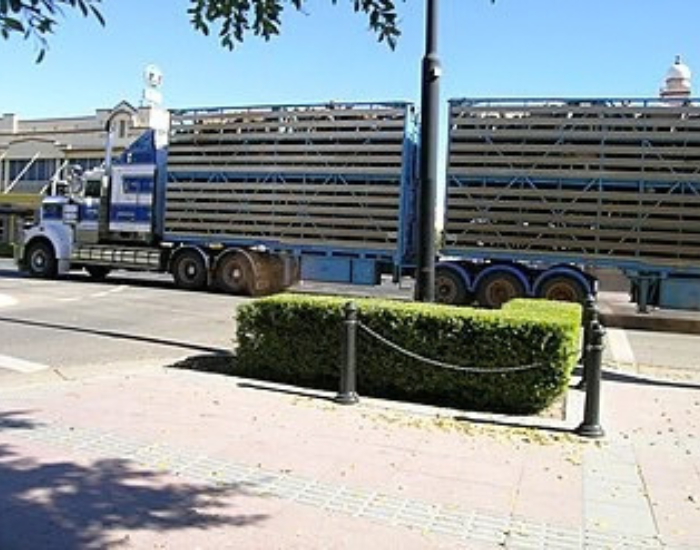
In the transit of cattle by trains there has of late years been considerable improvement, the trucks being larger and more convenient than formerly, and on some lines special provision being made for giving them water in a long journey. But still there is too much cruelty, as any one may witness who has happened to be at a station on the arrival or departure of a cattle train. A traveller described in the “Times” what he saw at Ely, and it is only a sample of the sufferings to which cattle in transit are subjected.
“My attention was attracted to the up passenger platform, alongside of which was a cattle train, by a succession of oaths, exclamations, and sounds as of blows of sticks rapidly delivered. On crossing the line to see what all this meant, I found an unfortunate ox stretched on its belly across the lowered door or gangway of one of the trucks. The poor brute lay panting, utterly exhausted, with his forelegs resting on the floor of the truck, his hind legs stretched out touching the platform. Half a dozen drovers surrounded the animal, intent on overcoming his exhaustion, and compelling him to get on his legs. The method which they adopted was this: two of the fellows dragged him by the horns, another twisted his tail, whilst one at each side belaboured his back and sides with rapidly falling blows of cudgels, only intermitted for the moment while the cudgels were used as goads.
“There lay the helpless brute, every now and then making a vain effort to rise, until, after quite fifteen minutes’ torture, he was got upon his legs and pushed in among the other animals in the truck, where it was presumed that close packing would prevent his falling on the floor of the van and being trampled to death. On inquiry I learned that these cattle came from Ireland. They generally arrive in Dublin from various parts of the country, and are immediately shipped for Liverpool, where they are trucked for various English markets, in this instance for Norwich. Fatigued by the journey in Ireland, knocked about and sickened in crossing the Channel, tired by travelling for many hours on English lines, often without food or water, one or more of the creatures frequently sink in the truck exhausted, and are trampled to death by the other animals. To meet this difficulty was the object of the proceedings I witnessed. The exhausted prostrate beast was dragged half out of the truck and tortured until he was made to stand up again and resume his place among his fellow-travellers. This process, I was told, goes on in truck load after truck load, and week after week.”
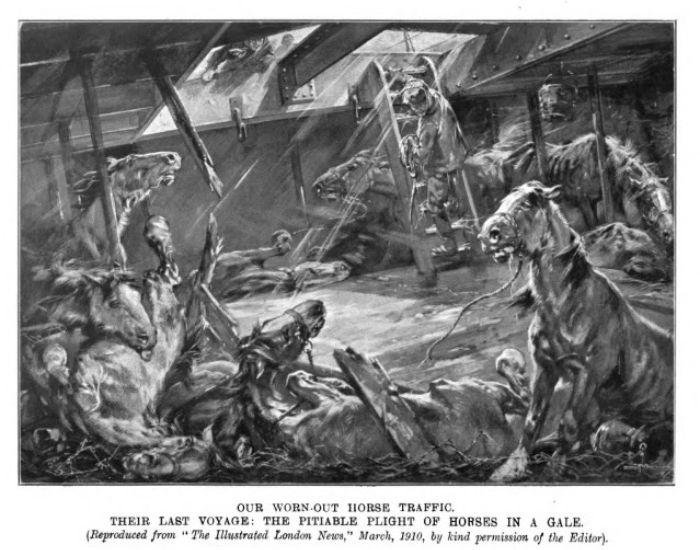
In the shipment and sea transport of cattle, sheep, and other live animals, there is often much unnecessary cruelty. Even in the shorter passages by the Channel steamers this is true, but in the traffic from the Continent, which is every year assuming greater dimensions, the horrors are like those we used to read of in the holds of the slave-trade ships. A well-known writer, a man as kind as he is brave, John MacGregor (“Rob Roy,” in his ” Canoe Cruise on the Baltic “), gives a painfully graphic account of “the horrors of the middle passage,” in the transport of cattle from Northern Europe across the German Ocean to our ports. “Our captain, and indeed the crew and the drovers,” says Mr. MacGregor, “did not appear to be heartless in the matter. It is the whole system and plan of shipping cattle which must be amended. To put suffering dying bullocks in the same steamer with passengers is utterly a mistake. The vessel cannot be used for both purposes without being unfit for either, since the two are quite incompatible.
“If a poor bullock becomes sea-sick at all, he speedily dies. If he is even weaker than his unhappy companions, and lies down, after two days and nights of balancing on sloppy, slippery boards, he is trampled under the others’ hoofs, and squeezed by their huge bodies, and suffocated by the pressure and foulness.
“Through the livelong night, while we Christians on board are sleeping in our berths, these horrid scenes are enacted, and no one to see them.
“Morning comes, and the dead must be taken from the living. A great boom is rigged up, and as we lean over the rail to look on, there is a chain let down, and the steam-winch winds and winds it tight, and straining with some strong weight below, far, far down in the lowest of the three tiers of ‘filet de bœuf,’ where no light enters, and whence a Stygian reeking comes.
“Slowly there comes up first the black, frowning head and horns and dull blue eyes and ghastly grinning face of a poor dead bullock, then his pendent legs and his huge carcase.
“To see the owner’s mark on his back they scrape away the slush and grime, then he is swung over the sea, and a stroke of the axe cuts the rope round his horns. Down with a splash falls the vast heavy carcase; and £20 worth of meat floats on a wave or two, then it is engulfed. Another and another, and twenty-two are thus hauled up and cast into the sea, and this, too, on the first day of a very calm passage. What must it be in a storm? Oh, the roast beef of old England!”
Captain Stanley, R.N., has called public attention to a scene of gross, but we should hope exceptional, cruelty, witnessed by him in the landing of a cargo of cattle, from a foreign port, at Deptford. The poor brutes, sick, bruised, and faint, were savagely urged on with goads and sticks, in a way which the writer could only characterise by an allusion to the fiends in Dore’s illustrations of Dante’s “Inferno.”
It ought to be widely known that there are two Acts of Parliament providing against cruelty during transit of animals either by railway or in steamboats: 32 and 33 Vict. c. 70, enforcing supply of food and water; and 12 and 13 Vict. c. 92, forbidding their improper conveyance. The following are examples of prosecutions taken under these statutes:
“A cattle dealer, of Edinburgh, was summoned at the Oxford Petty Sessions, for having unlawfully neglected to make any request in writing to the London and North- Western Railway Company to supply ten cows with food and water on their transit from Kilmarnock, in Scotland, to Oxford. A second summons charged the defendant with cruelty for conveying the animals as aforesaid, when they were far advanced in calf.
“Mr. Percival Walsh appeared to prosecute on behalf of the Royal Society for the Prevention of Cruelty to Animals, and said the following were the facts: The ten cows were sent by the defendant from Kilmarnock to Oxford, a distance of about 344 miles. They were started, according to the direction of the defendant, at 4 P.M. on the afternoon of Monday, the 30th of September, and did not arrive until about a quarter after seven on the following Wednesday morning. Even if these were steer animals, it would have been a most cruel thing for them to have been kept for thirty-eight hours without food and water. Between four and five o’clock on the morning of Wednesday, the 2nd of October, it was discovered by the brakesman of the train, at Bicester, that some of the animals were lying down in the truck. He drew the attention of the inspector to the fact, and endeavours were made to take them out. Eight of them suffered intensely, but recovered. The other two died. It was a case of most monstrous cruelty, and he should ask the reporters to give the details of the case as fully as they could, with the view of the attention of the Privy Council being directed to the case. He then called witnesses, who proved the facts as stated above, when the magistrates retired, and after being absent about a quarter of an hour, returned into Court. The mayor said that the decision of the Court was, that a fine of £5 be inflicted for the first offence, and £5 for the second, with costs. The costs altogether amounted to £14 8s. 6d. Total, £24 8s. 6d.”
The cattle drovers used to be a very rough and cruel set, as a class, but of late years there has been great improvement, many of them being remarkably kind as well as steady and respectable men. In the metropolitan district they require to have a licence, which is a check upon those who might otherwise show misconduct. The officers of the R.S.P.C.A. also keep a vigilant look-out. The existing law is strictly enforced in cases brought before magistrates. The following clause is in the Act 12 and 13 Vict. cap. 92: “If any person shall cruelly beat, ill-treat, over-drive, abuse, or torture, or cause or procure to be cruelly beaten, ill-treated, over-driven, abused, or tortured, any animal, every such offender shall for every offence forfeit and pay a penalty not exceeding five pounds.” The magistrates have the power of committing to prison for a period of three months, without option of a fine, for the same offences on conviction. It might be well to appeal more to the better feeling of the drovers, as well as to their fear of punishment by giving good-conduct badges, for instance, in approved cases of habitual humanity….
James Macaulay, A Plea for Mercy to Animals (London: The Religious Tract Society, 1875), pp. 52-57.
See: https://babel.hathitrust.org/cgi/pt?id=uc2.ark:/13960/t2m61d67d&seq=1
The Humane Movement in the United States
William J. Shultz
… The transportation of live stock by the railroads has been a matter of great concern to many anti-cruelty organizations located near important railroad centers. One of the first cruelties attacked used to occur within the stock yards at the terminals. There were formerly butchers who specialized in the purchase of crippled stock at a reduced rate, and although it was necessary after slaughtering to discard quantities of bruised meat, they realized big profits on each animal so purchased. When in any shipment there were few such animals, they made smaller profits. It was discovered by agents of the humane societies that they often deliberately crippled healthy animals for their own gain, entering cars at the stock yards and, unobserved, breaking the legs or otherwise injuring whatever animals they could, which they later bought very cheaply. When the humane societies discovered this practice, they brought it to the attention of the stockyard officials and with their cooperation, prosecutions were initiated and the practice checked.
The Massachusetts, Buffalo, Chicago, St. Louis and Los Angeles anti-cruelty societies among others, have long maintained an inspection service at the railroad terminals to examine and dispose of injured stock. The extent of this activity over the decade beginning 1910 may be judged by the agents’ records of stock injuries and mortality at the Buffalo yards published in the annual reports of the Erie County S.P.C.A.: … [Table deleted.]These figures indicate a decided decrease during these years in stock mortality during transportation. Although the total of dead and crippled animals is greater in the later years, this is more than counter-balanced by the increase in shipments, so that the average number of killed and injured animals to each car is actually less. This is to be explained in part by the added care that is given to the animals by the train crews because of the educational propaganda carried on among them by the humane societies, and by, the greater cooperation of yard crews.
As the result of a propaganda drive begun in 1919 by the Los Angeles S.P.C.A. among the caboose men and caretakers, and by arrangement with the railroad officials so that the office of the Society was constantly in touch with all stock shipments, the Society was able to announce a year later a fifty per cent improvement in stock-transportation conditions in its district.
Little of the improvement noted above can be credited to more progressive transportation legislation, as state legislatures have been notoriously inactive in this field, where they have not passed or attempted to pass actually retrogressive legislation. In Ohio, for example, the legislature in 1913 and 1914 tried to amend the livestock-transportation law, extending the time that stock might be confined on a train from twenty-four to thirty-six hours. It was only by the vigorous action of the Cleveland Animal Protective League that this was defeated.
All state stock transportation legislation has been moulded by the federal twenty-eight hour law of March 3, 1873 as modified by the amendment act of June 29, 1906. The modified act provides that no interstate land or water carrier shall transport cattle, sheep, swine or other animals for a period longer than twenty-eight consecutive hours without unloading the same in a humane manner, into properly equipped pens for rest, water, and feeding, for a period of at least five consecutive hours, unless prevented by storm or by other accidental or unavoidable causes which cannot be anticipated or avoided by the exercise of due diligence and fore-sight: Provided that upon the written request of the owner or person in custody of that particular shipment… the time of confinement may be extended to thirty-six hours:… Provided that it shall not be required that sheep be unloaded in the night time, but where the time expires in the night time in the case of sheep, the same may continue in transit to a suitable place for unloading subject to the aforesaid limitation of thirty-six hours.
A proposal to require all stock trains to average a speed of eighteen miles an hour, though desirable, did not become a part of the law.
A series of judicial decisions has emphasized the humane character of the act. Nevertheless, it should be remembered that the 1906 amendment gave an advantage to the shippers by providing for the extension to thirty-six hours on request and several decisions other than those cited in [the] Note — have provided for the shippers’ interest: in U.S. v. Pere Marquette Ry. Co. it was asserted that “the Act has also in view the protection of the interests of owners of animals and of the public in preventing their health and condition being injured in transit”; in U. S. v. Oregon Ry. & Nav. Co. it was stated that the Act was intended “to subserve the interests of the owner”; in two decisions, U.S. v. St. Joseph Stock Yards Co., and U.S. v. Louisville and Nashville Ry. Co. it was stated that the act was passed not more from considerations of sympathy for the cattle, than to protect the public from imposition and from unwholesome food.
The Act of 1873 had been a dead letter from its passage in spite of sporadic attempts on the part of the Department of Agriculture to enforce it, and many grave abuses had arisen out of the failure of the railroads to live up to the law. After the passage of the 1906 amendment, however, the Bureau of Animal Industry put its agents on the roads to follow the shipments of live stock and to report violations. Hundreds of cases were reported and the law was rigorously enforced. On June 30, 1918 there were 2,831 cases of violations of the act pending in the courts.
The legislation that has been passed on this matter affecting intra-state shipments has been for the most part to bring the state laws into alignment with the federal. In addition, four states have speed minimums: Colorado, ten miles per hour; Kansas, fifteen miles per hour; Nebraska, eighteen miles per hour except on branch lines where twelve miles per hour is permitted; Kansas, fifteen miles per hour; and North Dakota, twenty miles per hour.” Iowa requires animals to be carried at the “highest practical speed”; what this is to be is decided by the Board of Railway Commissioners.
Humanitarians are not satisfied with present conditions of animal transportation and numerous reforms have been projected. These were generalized by Dr. Francis H. Rowley, President of the Massachusetts S.P.C.A., at the 1921 convention of the American Humane Association:
First. We have been told, ever since the days of Bergh and Angell, that the remedy for these evils is the slaughter of food animals near the place of their rearing, and the shipping of their flesh in refrigerator cars. But the hundreds of millions of dollars invested in our present systems of slaughter houses… makes their breaking up a dream whose fulfillment lies only in the millenium.
Second. No small part of the suffering of animals in transit is due to the failure of the railroad to maintain a proper rate of speed in their transportation. A freight composed of sentient creatures should have the right of way over shipments of inanimate merchandise…. The universal opinion is that a speed should be maintained of not less than from 18 to 25 miles per hour.
Third. Much has been accomplished, chiefly through anti-cruelty organizations… to change the conditions that formerly existed at unloading stations. I have seen yards into which cattle, sheep and swine were forced from cars where they wallowed in mire half-way up to their knees, where hay pitched to them became fouled with mire before it could be a quarter eaten, and where the watering troughs were so full of filth, that, thirsty as they were, the suffering victims could not drink from them. Things have been greatly improved in recent years. Yet here is another point at which humane societies may well concentrate their forces.
Fourth. Years ago there was a hope that improved cattle cars might materially help lessen the suffering of animals in transit — cars so constructed that animals might be provided with food and water in the cars themselves. Who knows anything about the much-talked-of palace cars today, except those for horses? It was soon found that the watering troughs in these cars must be placed at a height which could be reached by the animals. But this height was just such that the troughs, though filled with water at frequent intervals, were more like sewers than drinking places.
Cattle are cattle. You can’t load them with heads all one way. You can make it possible for them to lie down and have their food and drink provided for them in cars only at an expense that the trade would denounce as prohibitive. Here, then, is another point against which humanitarians must concentrate their forces. They must seek the repeal of the amendment that extended the confinement period to thirty-six hours, and strive for something even more humane than the old twenty-eight hour law.
A special committee of the American Humane Association drew up recommendations for a model Animal Transport Act which were reported in the 1917 Convention of the American Humane Association, but as yet few state legislatures have adopted any of these recommendations….
William J. Shultz, The Humane Movement in the United States, 1910-1922 (New York: AMS Press, 1968), pp. 107-113. Footnotes have been deleted.
See: https://babel.hathitrust.org/cgi/pt?id=mdp.35112104284700&seq=1&q1=
Toronto Humane Society
V. TRANSPORTATION OF CATTLE, SHEEP, ETC.
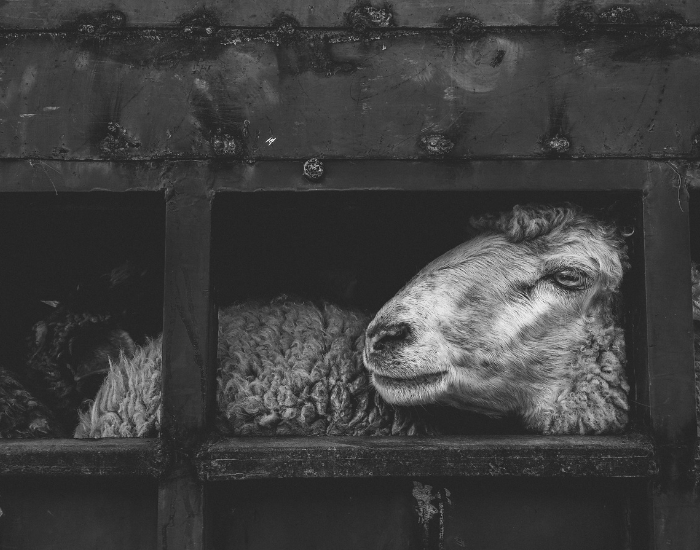
So vast has become the number of cattle, sheep, swine and poultry, nowe sent by railway to various points for transhipment, or otherwise, that in doing so, much cruelty has been carelessly or wilfully inflicted on these helpless animals. The attention of Humane Societies everywhere has been called to this practice, and effectual steps have been taken to prevent its continuance. In an addition at New Orleans on that and kindred subjects, H, Mr. G, T. Angell stated, that from seven to eight millions of animals in the great Chicago stock-yards are now annually protected from cruelty, largely through the influence of one man, whose teacher fifty years ago, away up in the mountains of New Hampshire, put into his boyish hands some verses on kindness to animals.
Extent of the Cattle Traffic.
It is estimated that from 8,000,000 to 10,000,000 of animals are annually transported by rail in the United States and Canada.
Mortality of Transported Animals.
From a careful estimate made by Mr. George T. Angell, President of the Massachusetts S.P.C.A., a competent judge in this matter, it has been found that six per cent. of cattle and nine per cent. of sheep and swine annually, or 750,000 in all, die in the transport.
Sale of Dead and Diseased Animals.
A large portion of these dead animals, Mr. Angell says, are sold in our markets, either as meat, or rendered into cooking lard; while the cattle that get through alive, for the want of food and water, and by reason of the cruelty inflicted upon them, after losing on the average, in transportation, nearly a hundred pounds each in weight, from the most juicy and nutritious parts of the meat, come out of the cars full of fever, and many with bruises, sores, and ulcers; and these, together with smaller animals, to which the loss and suffering is, in proportion, equally great, are all sold in our markets for food.
Dishorning Cattle for Transport.
On the plea that it is necessary to deprive cattle of their horns, in order that they shall not gore and injure each other in the close railway cattle vans, terrible pain is inflicted on those dumb and helpless creatures. The Illinois State Veterinarian thus points this out: —
“The bonv procosa, supporting the horn, is more or loss hollow and honey-combed. These open spaces communicate with the frontal sinuosities, or bony cavvities of the head, which are lined with a very delicate and sensitive mucous membrane. In sawing otf the horn these cavities are laid open to the free access of air, dust, chaff, etc. The operation is especially cruel during the colder seasons and in winter, when great irritation of the sensitive mucous membrane, thus laid bare, is unavoidable.”
Dishorning Cattle Punishable in England.
In the Toronto Empire of May 5th, 1888, an article on this subject appeared, as follows: —
“The interest that many Canadian farmers are taking in this subject makes it desirable to give the following information: It would seem that the work of dishorning cattle has been going on extensively in the United States. The following letters from the Country Gentleman speak of one man in Illinois who had himself removed the horns from 1,800 animals, and of professional operators who have dishorned their thousands each.
“President Morrow of the University of Illinois, says that cattle do not suffer pain in the process; but, on the other hand, there is the opinion of the London Lancet, that the operation ought to be prohibited by law, and that it is now punished in England as an offence under the laws for the prevention of cruelty to animals.”
Then follows a letter from President Morrow, of the University of Illinois. In it he says, that “it is evident there is considerable pain while the operation is being performed,”… “but there is testimony to the fact that animals will commence eating within a few minutes after the work of saw or pincers has been [used] and that milch cows, as a rule, show scarcely a perceptible shrinkage of milk.”
The President significantly adds: “Personally I have not thought it advisable to have the cattle under my charge dishorned. I am not an advocate of the practice.”
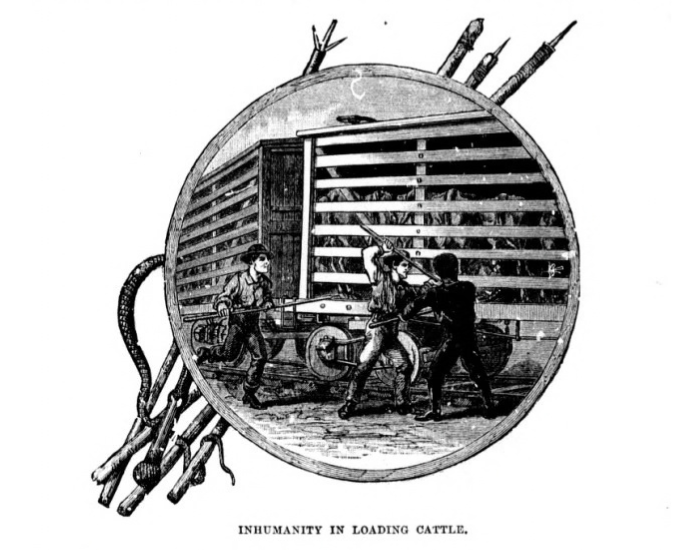
Inhumanity in Loading Cattle.
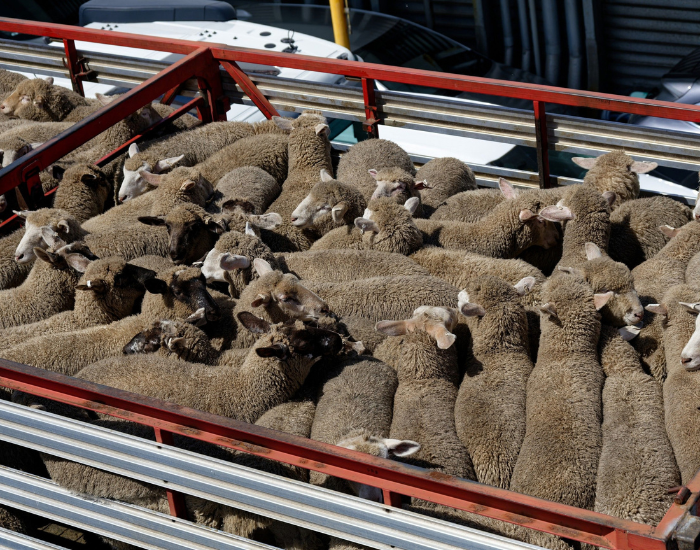
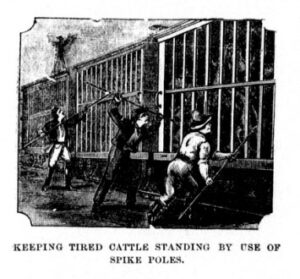
Before the cattle reach the stock-yards they experience such rough treatment that they are filled with terror, and start at everything they see. It is when the loading begins, however, that cruel treatment is rather the rule than the exception. Armed with long poles, with barbs or prods at the end, the cattle are driven and hustled into the cars with violence and shouting. Should they hesitate to enter, the long pole is freely used; and, the more timid the animal, the more it is assaulted with the goad!
Mr. Little, agent of the American Humane Association, thus describes the process of loading cattle on the cars. He says: —
“I left Chicago Nov. 2nd oi; my line of duty and arrived at Genesee same day. I went directly to the stock-yards at that place, and found them loading cattle. I think they practise great cruelty, both by overloading and torturing them. In the first place, they are expected to put the same number into each car that arrived there in a car, which, in this case, was twenty head of cattle, and, in order to do this, they claim they have first to get them excited by prodding them with poles eight or nine feet long, pointed with an iron prod about one-half inch long.
The cattle are turned out of the pens into the alley, which is arranged with plank runs, or walks on either side of the fence, on which are stationed the cow-boys or drivers, who, by giving the cattle a punch whenever they get a chance, get them to running until they get down to near the platform from which they are loaded, where the alley narrows down to the width of a car-door, and here is where the greatest cruelty is practised. A man stands on each side and gives each animal a prod as it enters the car, until there has in most cases about seventeen cattle entered, when the car appears to be full, and I think should be so considered; but the poor unlucky three cattle are still left on the platform trying to get in, and the the prod is plied and their tails rung until they are finally got inside and the door closed.”
Mr. Angell, in his essay on “Cattle Transportation,” adds:
“At Chicago animals are driven, or (if unable to walk) taken from the cars, and fed, watered and rested a few hours. They are then reloaded for the East in the following manner: ‘The men employed to drive them into the cars are armed with saplings, weighing often from eight to ten pounds, with sharp spikes or goads at the end. They rush upon the cattle, yelling, swearing and punching them with these spikes, often twenty, thirty or forty times, taking little care to avoid the eyes. Eighteen to twenty cattle are thus forced into thirty-feet cars, giving less than two feet space to the animal, and not unfrequently smaller animals — calves, sheep and swine — are crowded under them. In this way they are often carried for days without food, water, or possibility of lying down.’ And it appears from various authorities that this same system of loading and transportation prevails over the United States, as a rule; times of confinement and starvation varying of course with distances.
Transported Cattle as Food.
A Boston gentleman, who has carefully investigated the subject of cattle transportation from the West to our Eastern cities, visiting, as he says, all places of importance where he could gain information in regard to it, writes that large numbers of cattle are trampled to death in the cars; that larger numbers at the end of these long routes “come reeling and tumbling out of the cars as though blind or intoxicated”; that these dead and diseased animals are dressed and sold in the markets, the carcasses sometimes “full of dark-stained holes,” made by the goads used in loading. He saw in cold weather carloads of sheep without their fleeces, shivering with the cold. He was told by the editor of the Live Stock Journal that be had known a whole train of diseased sheep shipped to Albany and there slaughtered for the market; that largo numbers of hogs die in transportation for the want of water. This gentleman states that he found the shrinkage of cattle on long routes to vary from fifty to two hundred pounds.
So deeply impressed was the American Humane Association on this subject that they addressed a memorial to Congress, praying that steps be taken to abate this evil and prevent this dangerous state of things to longer exist. They say: —
“Statements have been received of the barbarous cruelty to live stock in transit; of the cruel crowding, the struggle of the imprisoned beasts with each other for existence, the maddening hunger, the raging thirst, the goring and trampling, the bloody prod of the attendant, the manglings, bruisings, fevers and deaths during the horrible journey. All these horrors appeal strongly to our humanity.
”But aside from the compassion aroused for the dumb brutes by a recital of these facts, we are brought to consider the grave question of the effect upon the public by the consumption of meat food in the condition described. These animals, mangled, festering with wounds, poisoned with fevers, are slaughtered and sold for food. Mr. Edwin Lee Brown, after years of observation, asserts as a well ascertained fact that considerably less than one-half of the beef consumed in the United States is unlit for a dangerous and loathsome poison, producing a. variety of terrible diseases. This grave statement, made by a highly respectable and intelligent gentleman, if sufficient to put the country upon prompt and earnest official inquiry into the facts. “
Transportation of Sheep, Swine, etc.
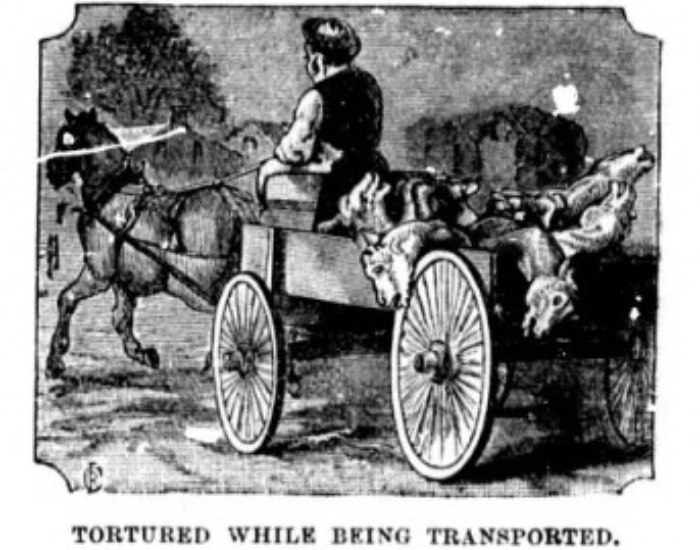
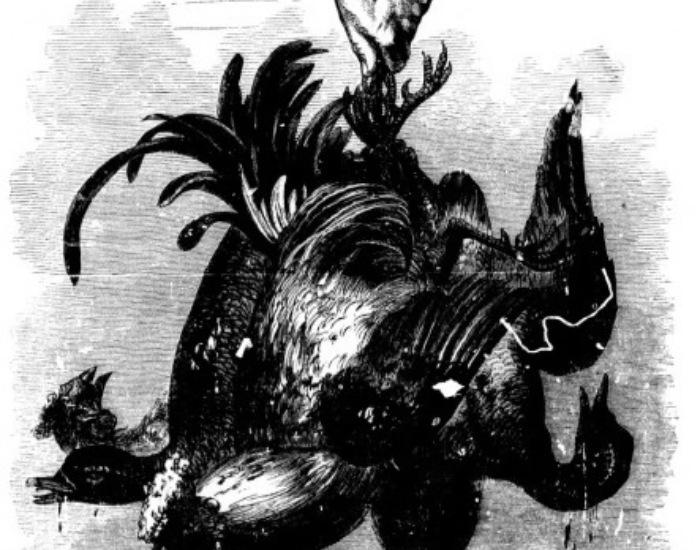
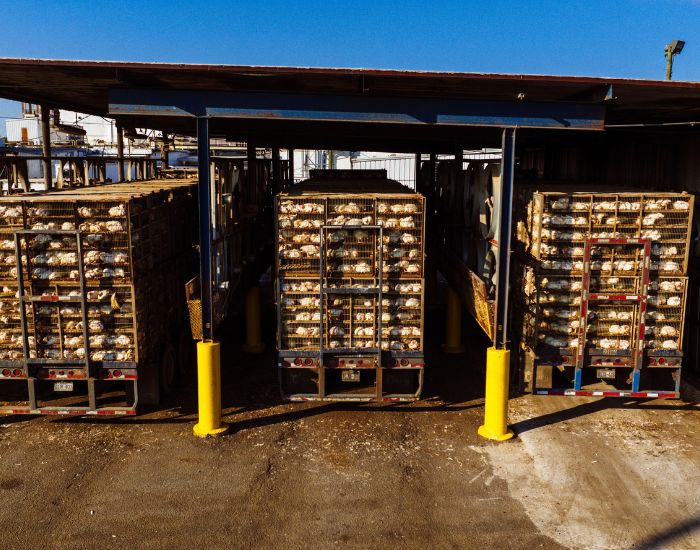
What is herein stated of cattle is equally true of sheep, swine, calves, etc. In the case of the latter, as also in the case of calves and lambs, how often are they most cruelly treated by thoughtless, careless men and boys, while being transported in waggons to the place of slaughter. So also in the case of poultry. They may be often seen with their legs tied together, and with heads hanging down, carried carelessly in the hand… — they all the while greatly suffering, and letting their misery be known only by inarticulate sounds of distress and pain. The other forms of cruelty to these poor creatures are: —
“Plucking fowls alive; packing live poultry so closely in crates that many of them die of suffocation, all of which things are not only cruel to the animals, but also injure the meat, and to a greater or lesser extent endanger the public health.
On this subject, Mr. R. D. Whitehead, Superintendent of the Wisconsin Humane Society, Milwaukee, writes: —
“The method of handling poultry now, is not at all uniform. Poultry that is destined for the market, is shipped in all sorts of store and shoe boxes, and, in fact shipped in anything but a well constructed coop, or crate of the proper size. I have seen in our own city, within the past year, full grown turkeys, forced into a box four inches high, with the cover nailed down. Another case of extreme cruelty, was a shipper forcing twenty geese into a small box, throwing in a large quantity of corn-meal, and pouring in a large quantity of water, thinking this to supply food and drink. The water and meal formed a paste, which closed all the seams, making the box water-tight. The younger and weaker fowls were trodden down and drowned.
“The mode of handling poultry thirty years ago, especially in the South, was, with few exceptions, more humane than the present method. Turkeys and geese were driven along the common highways to market. Turkeys and geese were driven along the common highways to market. They were also shipped on the decks of boats, which were ‘railed in’ for this purpose.
“The principal exception was when the wings of the fowls were locked and their legs tied, in bunches of from six to twelve, and strung on a pole, to be carried on the shoulders of two men, or, thrown across a mule’s back, behind and in front of the rider.”
The Society trusts that every reader of these pages will aid the Society in trying to put a stop to these cruel practices. The Society craves the sympathy of the citizens, and their generous aid, in the prosecution of their humane mission.
Thoughtless and Cruel Treatment of Fowls.
From the generally thoughtless manner in which persons carry fowls with their heads downwards, it clear that the act is not dictated so much from “cruel intent,” as from thoughtlessness, or convenience. Many such persons, if their attention were called to the fact that their treatment of these helpless creatures caused them great pain, often amounting to agony — as a look at their friightened and flashing eyes would show — they would at once desist from such treatment, and release the suffering fowls.
As a general rule fowls are brought to the market in Toronto either dead and plucked, or alive in crates, with slats nailed on them. The tendency is, in order to save space and secure convenience in transport, to make the crates too small. Very often, too, the fowls, even ifin roomy crates, are made to suffer from want of food and water, or from neglect.
Necessity for Enlightenment on Humane Subjects.
The numerous painful facts, detailed in these pages, make it necessary to take some steps to counteract the evils pointed out. This is one reason why the Toronto Humane Society has decided to have prepared for extensive distribution this publication.
Amelioration in Cattle Transportation,
It is gratifying to learn from the report of the President of the American Humane Association read at the Rochester meeting (1887), that a great improvement has taken place of late in the treatment of cattle in transit. He says: —
“With the exception of the case of one or two railroads, animals in transportation are rested and fed and watered in accordance with the law. In public slaughter houses, creatures destined for human food, are, as a rule, killed promptly and humanely; and in nearly all the larger fields of animal industry there is growing up a sense of responsibility to the public at large. One of the marked exceptions to this general rule is the hideous lack of care and callous indifference shown to range cattle on the cattle fields of the West and in the common cars….
“Not only have the owners of humane cars been increasing the number of cars under their different patents, and, not only are shippers using more and more of these cars in the place of the old fashioned railroad car, but the railroads east of Chicago and St. Louis have agreed to haul and are hauling thousands of cattle in humane cars at the same rate of freight as in common cars.
‘We regret to say, however, that the western roads still discriminate in this matter, backed up in their action by the Inter-State law,” etc.
Steps to Prevent Cruelty in Stock-Yards.
The American Humane Association have taken steps to prevent cruelty to animals in the process of transportation. First, by placing large printed signs on poles, forbidding it, as the law directs. Secondly, by appointing agents to see that the law on the subject is duly observed, and that no unnecessary cruelty is practised in the transportation of stock.
The Society solicits the co-operation and contributions of humane citizens for the prosecution of Its noble work, herein described and Illustrated.
Effect on Cattle of Cruelty and Neglect.
The Chicago Stock Reporter says: —
“There is great cruelty in transportation. Cars are terribly overcrowded, and animals are carried great distances without food or water. The result is, that they are taken out at Chicago with bruises and sores, and legs and horns broken; many of them dead, and more almost dead; and sometimes cattle and hogs, and sometimes cattle and sheep, are packed in the same car, which results in the smaller animals being trampled upon by the larger.”
The Toronto Cattle Market.
On the 15th March, 1S68, Mr. J. J. Kelso, Secretary to our Humane Society and a reporter of the Globe newspaper, visited the Toronto Cattle Market, in company with Constable Whitesides, the Humane Society’s officer. Mr. Kelso writes; —
“In a waiting-room a number of the drovers were having an exciting time over a dog fight, but they hastily dispersed when the constable put his head in at the window. The pens of cattle and pigs were only half-covered and, as many of the animals are often left in them for two or three days, they must have suffered a great deal from cold during the past few months. The reporter was told that one pig was frozen to death, but Caretaker Walker states that it died from other causes, and the body subsequently was frozen. In other respects the animals seemed to be as well treated as could reasonably be expected, and where cruelty is inflicted it is generally by the young fellows employed as drovers. Dealers will find that it does not pay to neglect their stock. Beef cattle have a hard life of it at best. They are taken from a farmer’s comfortable barn, driven to the station, put in poorly arranged cars, unloaded at the market with yells and goadings, left in the open stalls for about twenty-four hours, then perhaps reloaded and taken to Montreal, cold, exhausted and hungry. Mr. Walker stated to the reporter that much needless cruelty has been prevented by the frequent visits of the Humane officer, and that no drover ever attempts now to use the spiked pole that formerly was in common use.”
Hard Treatment of Cattle on Shipboard.
On the 25th April, 1888, a deputation from Toronto waited on the Hon. John Carling, Minister of Agriculture, at Ottawa. The Toronto World thus reports the interview: —
“In 1886 a departmental regulation was passed, providing that cattle on board ship were to be allowed a space not less than eight by two and a half feet This arrangement worked very satisfactorily during 1886, but in 1887, it was not carried out, and the exporters of cattle by the Canadian steamship lines complain that the mortality among animals increased from 2-5 of 1 per cent, to 3 per cent. The animals were crowded on board in a shocking manner, and besides being unable to lie down during the voyage, were often bruised and maimed to such an extent, that the value of a bullock in Liverpool often depreciated by £5 owing to his unsoundness. In addition to being jammed together, none of the projections on the sides and ends of the ship were covered, and the poor animals were often thrown against chains, beams, and even against the boilers and burned.” (Mr. Carling promised to see to it.)
“At the American ports, where cattle are shipped, the Humane Societies have taken this matter up, and, as a result, they are sent on their long sea voyage under very comfortable circumstances. “…
J. George Hodgins, ed., “Transportation of Cattle, Sheep, Etc.,” Aims and Objects of the Toronto Humane Society (Toronto: Toronto Humane Society, 1888), pp. 33-38. The lead image is found on page 47 of this cited work. The first three top lower images are found on pages 34, 35, and 36. The last image on the top row is found on page xxii in Sidney Trist, ed., The Under Dog (London: Animals’ Guardian Office, 1913). The first three images on the bottom row are found in: https://www.pexels.com/ and the photographers are: Amalabulla, Gubra, and Kelly. The last image is from: https://en.wikipedia.org/wiki/Livestock_transportation.
See: https://babel.hathitrust.org/cgi/pt?id=aeu.ark:/13960/t18k7x49c&seq=1