Animals in War
We want you to have a greater ability to learn about some of the unpleasant animal issues in our world.
THE UNDER DOG
SIDNEY TRIST, ED
ANIMALS IN WAR
By CAPT. FREDERICK WILLIAM VON HERBERT,
“Bear in mind that the children of life are the children of joy; that the lower animals are only unhappy when made so by man; that man alone, of all the creatures, has found out many inventions,’ the chief of which appears to be the art of making himself miserable, and of seeing all Nature stained with that dark and hateful colour.” W. H. HUDSON.
The comparison of the nation to the individual, of the body politic to the body human, is old and trite.
Nations, like individuals, are rich or poor; have a good, indifferent, or bad reputation; can get credit or not; can borrow cheaply or must borrow dearly; can pledge property and assets; may become insolvent and bankrupt; are choleric or apathetic, sanguine or phlegmatic, vital or comatose, as human beings are by temperament or in given conditions; can go mad, as the French did at the end of the 18th century; can become paralysed, as Prussia was between 1806 and 1813; they are young or old, rising or decadent, and betray the identical qualities which young and old individuals, the ascending and descending, display in the brute creation.
It was a German who first carried this parallel to warfare: Dr. Engel, who, between 1870 and 1890, was the Official Statistician of the General Staff of the German Army. His dictum: “war is a disease in the life of a nation” has become a classic. In other words, peace is the normal, war is a morbid, condition of the body politic. And peace, like health, like most normal conditions, is a negative quality. The healthy man does not feel his limbs, his internal organs, his body. The phrase “to feel in good health” is a paradox. The moment an individual feels his stomach, or his heart, his physical state ceases to be normal. You can “feel” health only by way of contrast, and as an effort of thought, say, after having been ill, or in the intervals of suffering.
Similarly, the sound body politic does not feel its normal condition, peace, can do so only by comparison with past experience, or by an a posteriori argument, in contemplating less fortunate neighbours. If the human race had evolved without the combative spirit, had so developed that internecine strife had remained unknown and inconceivable, we would not know the idea of peace, would not even have the word “peace”; for we could certainly not apprehend peace by any of the five senses which are the only channels of communication between exterior phenomena and our conception.
The parallel between war and disease can be carried farther than at first sight would appear possible. The illness of one organ affects other, even remote, organs, and by degrees the whole body, often the mind. A diseased liver, for instance, will affect the head, even the eyesight. Cancer is only one of many instances of a local disorder affecting the whole body and finally causing death. Certain diseases of the spine will affect the brain, and through it, the mind.
In the same manner does the disease called war of the body politic affect not only the organ immediately concerned, that is, the arms-bearing adult manhood, not only the other organs, that is, the non-combatant population, but every intellectual function and quality of that body: trade, industry, religion, morality, education, literature, art, science, thought, manners, public life. More than that: this violent displacement of functions and forces, habits and attributes affects, in most cases adversely, all natural conditions and phenomena of the country at war, including the Animal Kingdom.
It would almost appear as if Nature rebelled against this morbid condition. That warfare, and more especially modern warfare, and still more especially the acute stage, the battle (which may be compared to the abscess, or other external symptom, of an internal disease) affects atmospheric and metereological conditions and produces abnormal states and phenomena, cannot be doubted by those who, like myself, have made researches on this subject, extending, in my case, in range from the battles in Bohemia in 1866 to those in Turkey in 1912.
Again, as if Nature vehemently desired to make good the loss of life in war (as she evidently desires, and often, in the lower brute-creation, succeeds in doing, to make good the loss of limb or organ caused by accident or disease), the birth-rate always rises rapidly in the five to ten years following a war. I mentioned these, and other akin phenomena, either concomitants or consequences of warfare, some of them obscure and almost inexplicable, in two papers read at the Royal United Service Institution in 1896 and 1897, thus drawing attention to an arresting, little understood, and frequently enigmatical subject; and I am pleased to find that recently again several writers in newspapers and reviews have urged a more systematic and exhaustive examination of at least one phase, namely, the morbid psychological condition of man in the abnormal state called war.
But if the psychology of man in this state is still largely unknown, that of the non-human animal world is as a sealed book. I am not aware that any writer or scientist, of any nation, has taken the trouble even to make a few inquiries and collect a few data. That the whole brute creation, from those constant companions of man, dog and cat, from those constant frequenters of his haunts, mouse, rat, sparrow, down to the beetle and the worm, is curiously affected by the abnormal social, domestic, and economic conditions of a prolonged campaign, is clear to me from my own observations (I have seen a good deal of war) and from inquiries made among those who had opportunities to observe. The balance of Nature’s machinery has been upset, and the component parts perform their functions uncontrolled, irregularly, wildly, aimlessly, often destructively, as would the parts of an engine, if an important crank or pivot or wheel had snapt. In both cases the parts act without collaboration, as do the limbs of a man afflicted with locomotor ataxy.
The subject is large enough for a volume, and in the limited space of this paper I can but give a few indications. Neither is it possible to state chapter and verse for each fact cited; that alone would occupy treble the space at my command; but chapter and verse I have for each case, and in no instance have I ventured on conjecture or drawn on imagination.
The most curious phenomenon which I have to record is that war affects domestic animals and wild animals in different and contrasted ways. Whereas the former display a marked tendency to shake off the yoke of man and return to the natural state of freedom, the latter betray a desire for human companionship, a lessening of the love of liberty, and often the inclination to assume voluntary the condition of friendship and even serfdom to man.
I have an explanation for this. The ass, the dog, the cat, the ox, the sheep, the goat, used to obedience and discipline from infancy, see the taskmaster himself in the fetters of an iron discipline and seize the opportunity for shaking off their own. The faculty of observation and deduction is more pronounced in domestic animals than we give them credit for. On the other hand, the wild beast (for instance, the jackal, the hyena, the deer, the wild goat, the baboon, the owl — I am quoting my South African experience the wolf, the fox — I am quoting my Balkan experience, — the puma — I am quoting my South American experience — the cheetah — I am quoting a friend’s Indian experience), naturally dreading man, sees man subdued en masse to a power of which it knows nothing, which it must consider as extra-terrestrial and superhuman; man loses his terrors in its eyes, and on approach it finds him amenable to friendly intercourse and even companionship.
It must be taken into consideration that as a rule animals do not see man in actual battle; what they perceive of warfare is men on the march, in camp, in redoubts, in garrison, in besieged towns; spoliation, ruin, and destruction; the collapse of routine, the cessation of the laws of property (animals are bound to notice this), and the general loosening of bonds among the non-combatant population. The last three factors are perhaps the most potent in shaping the trend of animal conduct.
I have purposely omitted the horse from my consideration. I am not a cavalry officer and am unwilling to lay down the law with regard to the behaviour of an animal, concerning which thousands of men are more competent to speak than I am. There is scope here for an interesting study: The Psychology of the Horse in Warfare; it is a virgin-subject, and would make, to my way of thinking, a fascinating volume, if undertaken by a trained and sympathetic observer.
In besieged towns (for instance, Plevna, 1877) and in war-devastated districts (for instance, South Africa, 1899-1902), the cat is generally the first animal to abandon domestic habits and return to freedom and the savage state. The same observation was made in Strassburg and Paris, 1870 and 1871. When they have the chance, cats become arborial, and will wander miles in search of parks or woods. This is curious, considering their ancestors have not been arborial for, say, a hundred generations. They even rear litters on trees, in the angle of main branches, a thing which I have observed thrice.
The dog is slower in abandoning the habits of a lifetime; but he does so in the end, and with a thoroughness equal to that of a cat. He becomes then gregarious, whereas the cat always remains solitary. I have reasons to believe that the cat, indeed any member of the felis tribe, has a tendency to become monogamous, whereas the dog is always polygamous and often polyandrous. In the Balkan States the dog is always gregariously inclined, even in normal conditions; but the return of the fully domesticated and anti-gregarious dog to the prehistoric state of a republic-like flock was observed in Denmark 1864, Bohemia 1866, France 1870 and 1871, and Cuba 1897. The cat becomes easily omnivorous and even vegetarian; but I have no notes of the dog abandoning carnivorous habits; he may even become cannibalistic (Turkey, 1908.)
It is to be noted that after their return to freedom both dog and cat become shy of human beings, often terror-stricken, and sometimes aggressive. They evidently know, but vehemently desire to avoid, former masters and other persons with whose appearances they were familiar. Both animals offer curious exhibitions of atavism to the observer, who can reconstruct ancestral habits from present conduct.
Even the gentle draught-bullock of Turkey and Bulgaria (called buffalo by the Europeans, manda in Turkish, a word adopted by other South Eastern nations) has been known to get out of hand in long-continued war conditions.
Asses and mules do not easily abandon domestic habits and accept a free life only with reluctance and in the stress of grave circumstances. They never combine, as dogs, goats, and pigs do.
The domestic goat soon shakes off its fetters and becomes vicious and aggressive when brought into contact with men, whom it then seems to abhor. On the other hand, wild goats are easily tamed.
The pig is one of the last to abandon the restraint of civilized life; but when it does so, it does it thoroughly and con amore, becomes extremely savage, easily takes the offensive, and is dangerous to human beings and to other animals, in particular, to the dog. I think there is no such hatred in the realm of Nature as that of the emancipated pig for its former master and its master’s companion. Several cases of savage and aggressive pigs were observed by me in South Africa, 1899 to 1902. A curious case was brought to my notice in Asia Minor in 1907, during a long-continued guerilla between organised brigands and regular troops: a wild boar had become tame and fondly attached to its captor, an infantry corporal, while the domestic pigs of a destroyed hamlet had become ferocious man-killers and man-eaters.
Parasitical animals, such as the mouse, rat, swallow, sparrow, migrate long and frequently, evidently in concerted action. In the swallow, migratory by nature, this is not surprising; but whence derive non-migratory creatures the power to combine, and to arrange and carry out a wholesale exodus? The swallow has the sense of direction, which is absent from the intellectual stock of the sparrow; yet sparrows will migrate en masse and in a direct line, from devastated to inhabited villages, may be a hundred miles away, not tentatively, but with unerring certainty of aim.
Again, rats have a strong sense of direction, but mice have not; yet mice will migrate quite as successfully as the larger rodents. In parenthesis: I observed in Sofia, in 1903, during the Macedonian Rebellion and the Bulgarian mobilization, an extraordinary and evidently concerted exodus of dogs for a destination unknown to me and others; the flock, some 400 individuals, returned en masse three days later. It must be observed also that in stress of war even timid creatures, like mice, hedgehogs, moles, sparrows and other birds, may become bold and aggressive. Cases have come to my notice of mice attacking wounded or sick men (rats often do so), and of sparrows, thrushes, etc., attacking hawks, kites, dogs, and cats. Even rabbits have been known to lose their timidity in war conditions. Here again, there seems to be an enormous increase of fecundity immediately after a war. This has also been observed in regard to sheep and pigs.
A curious case noted by me is that of the South East European nightingale, called bulbul in Turkish. This bird, of which I once made a special study, is gregarious, living in flocks that count from a thousand to three thousand individuals. In war it ceases to sing. Several oriental folk songs, legends, poems, and traditional stories mention this fact. That is the first stage in its descent. The next is that flocks attack each other, a thing they never do in normal conditions, when they preserve a studied neutrality. Who knows? — perhaps mimicry may play a part in this. We know very little as yet of animal mimicry, and excepting as regards the ape, the subject is hardly mentioned in studies of Animal Nature; yet the cat, for example, possesses a marked mimicry instinct.
The third stage in deterioration is that individuals of the same flock will fight violently, whereas ordinarily the bird is peaceful and gentle. The fourth and last stage is also the most curious: the birds will no longer attack fields of growing maize, but confine their foraging to woods and thickets, for berries and fruit, and for insects, which are not a favourite food of theirs. In normal times the nightingales descend in a cloud on the maize fields, a flock to a field, hence they are the farmers’ terror, and hence a saying that in war maize thrives better than in peace.
When peaceful conditions return, inter-tribal jealousies and extra-tribal battles cease, the flocks are re-formed, and the bird then becomes so prolific for a little while as to shame its ordinary performances, which are astonishing enough even in normal times.
An old Turkish love-poem, the locale of which is destroyed village, speaks of a solitary nightingale kissing open the closed chalice of a rose. In peace-conditions a score of birds would have simultaneously descended upon that one rose!
Perhaps the most curious cases that I have to record refer to the humble creatures of the insect world. I have seen an army of cockroaches, which must have numbered a million individuals, deserting a partly devastated street and migrating, apparently according to a prearranged plan, in perfect order, by the shortest route available, to a quarter as yet untouched by the ravages of warfare. Wholesale wanderings of snails and earth-worms have also come to my notice.
Snails and slugs were clearly prompted by the lack of food; but this cannot be said of the earthworm, which feeds on roots. I have known earthworms abandon in a body a field, for no assignable reason, unless it be that the ground-water has become contaminated. I may here record my opinion that snails and slugs are not affected by tainted water and carry typhoid and cholera infection from such to vegetables and fruit, which, if eaten raw, will convey it to human beings.
Migrations of bees, wasps, and ants are of ordinary occurrence, in war. In South Africa I tracked once for several days an enormous ant-exodus; this commenced regularly and punctually at 6 in the evening and continued till sunrise; from sunrise till 6 the insects rested and quite evidently slept, thus giving the lie to such scientists as maintain that the ant needs no sleep. Here again I suspect that contaminated water was the source of the trouble, for there was no lack of food.
Some creatures, for instance, sheep, pigeons, the antbear and the meercat of South Africa, spiders, the Anatolian mosquito and the South African locust, the grey-ground-squirrel of European Turkey and a small fish of the same country, whose name I know not, have been observed by me, and by others, to have become affected by bellicose conditions in some extremely obscure and almost indefinable manner: there was a subtle change in habits and conduct, sometimes in appearance, one for the worse, clearly a deterioration; but to fix and fathom and explain it would have required a much longer period of observation than I and others could devote to it.
Warfare has affected even fabulous animals. A certain tribe of Turkish-speaking Greeks in the interior of Asia Minor with whom I came into contact, believe that the man-killing and blood sucking vampire makes its appearance only when the country is at war. Another version says that its appearance predicts war. Similar stories are told of the Yellow Cat (leopard) of Turkish folklore. Another tradition speaks of a vicious unicorn which is a regular by-product of warfare. Several other horrors in animal shape have been described to me, among them a bellicose and particularly unpleasant werwolf. The generally harmless bear of the Taurus and Antitaurus Mountains is popularly believed to develop a greed for human flesh when it sees soldiers on the march. There may be substrata of truth in these legends.
Strange stories are told, in the Orient of the camel and the dromedary, in France of the wolf of the Vosges and the Ardennes (extinct since 1871), by the Kaffirs of the Springbock, by the Gauchos of the half wild South American horse, by the Don Cossacks of their own horses, by the Basutos of their famous ponies, relating to the behaviour of these animals under warlike conditions. But space is inelastic and editors are inexorable. However exaggerated by tradition, there must be foundations of truths in many scores of popular tales.
Enough has been said to prove that the general upheaval and shifting of forces in warfare affects, in a manner often obscure, the whole Animal Kingdom. There is room here for observation, study, and the collection of data. There must be many hundreds of other soldiers in the world, besides myself, who have taken notes in war conditions on this fascinating subject.
War puts back the clock of human civilization for generations, often for centuries. It does the same with regard to the Animal Kingdom. We are only just beginning to be dimly aware of the far-reaching consequences of this unnatural state. You cannot offend Nature with impunity.
For instance: In the Journal of the Royal United Service Institution, in 1897, I proved, by a score of historic examples that an increase in political crime, particularly that which takes the form of assassination of monarchs, is always a consequence of a successful war. Since this article was commenced, the King of Greece has been assassinated.
If war is a disease in the life of a nation, it is essentially a preventable disease. The nation that wilfully contracts it is as idiotic as the individual that wilfully contracts small–pox.
How Engel’s dictum, now generally accepted, is to be reconciled to the equally accepted thesis that security means weakness, degeneration, and national gangrene, while struggle means strength, is not for me to solve in the space of a magazine article. There is room here for an exhaustive inquiry. FREDERICK WILLIAM VON HERBERT.
WOUNDED HORSES IN WAR.
Inadequate Veterinary Supervision and Wasteful Neglect.
Millions of Money Wasted. A Plea for Succour.
By SIDNEY TRIST, Editor of the Animals' Guardian.
“What dull-minded sheep we must all be, how lacking in all the elements of imagination, since we are only able to learn by personal experience of grief and suffering something about the suffering and grief of others.” BEATRICE HARRADEN.
At the commencement of the South African War, in 1899, the late Mr. Laurence Pike, J.P., of Wareham, Dorset, initiated a movement designed to succour horses wounded in war, by providing for their merciful extinction, so that they might not linger on in agony caused by wounds, disease and starvation. The result of the initiatory efforts of Mr. Pike was the arousing of a considerable amount of public feeling on the question, which was only natural, considering what a horse-loving nation the British people mainly are. Meetings were held in London, Leeds, York, and other places, communications were established with the generals commanding in the field in South Africa, and letters were received from them saying that they were doing all that could be done, but that sometimes it was impossible to help the animals, more particularly when cavalry had to retire under heavy musketry fire.
The hourly sufferings when on the march, from fatigue, improper and scanty feeding, saddle-galls, climate, and other causes, are probably inevitable to campaigning and not always avoidable, though forethought, organisation and kindly feeling can do something towards lessening these inflictions. But when the horse is wounded, perhaps dreadfully injured, there is no Red Cross Corps to come to his assistance, to either mercifully destroy him or to attend to his wounds. The following pages will also demonstrate the inadequacy of the veterinary service in the field. The sufferings of horses in war are indeed of a terrible nature and deserve instant consideration on our part. Here are some extracts from various publications which will sufficiently illustrate the need for action NOW; it ought not to be left until war is once more upon us.
In the Crimean War between Dec. 12th, 1854, and Jan. 19th, 1855, the cavalry division lost no less than 426 horses. Lord Lucan accounted for this by the fact of the horses being employed on transport duties. Really they were badly fed, most of them died of starvation, combined no doubt with the severity of the weather, fatigue and exposure. During the first six months the army was in the Crimea 2,329 transport horses and mules were landed. Of these 200 were destroyed, 689 died from sickness due to exposure, fatigue and want of sufficient forage. The distance from Balaclava to the front was not more than seven or eight miles.
In a volume, “The Franco-German War, 1870-71,” by Generals and other Officers who took part in the campaign, edited by Major-General J. Maurice, C.B., appeared the following description of the scene following the surrender of the Sedan by the French to the Germans in the war of 1870-71: —
“A success has been gained that was beyond all parallel; never yet had so large an army laid down its arms. On the 29th of October it left the dungeon in which it had held out so long and so steadfastly; it was received by the conquerors with respect and sent on to Germany. The sorrows and hardships they had endured were clearly seen in the forsaken camp. The buildings were mostly destroyed, the gardens and plantations swept away, fences and hedges had vanished. Of vegetation there was not a trace left.
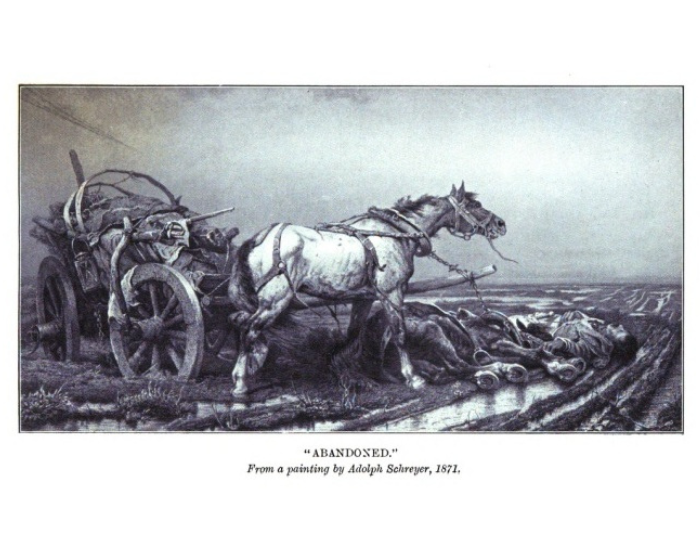
The starving horses had gnawed off everything, even the bark of the trees. Many of these animals were in a piteous condition between the houses and the walls, motionless, awaiting death by hunger; half broken down, some sat on their haunches, others licked the slime at their feet, and many had sunk down in harness by the carts. The ground of the camps formed extensive swamps, in which men, horses and carts sank ankle deep. This mud had served as a bed of rest for some time to officers and men. Of straw not a trace was to be discovered. Scarcely to be distinguished from the universal grey of the soil, carcases of horses lay in the morass. Also corpses of soldiers were found. These unfortunate men probably had died just before the surrender, and nobody had thought of burying them. It was a hell on earth that these brave defenders had quitted. Indeed, one could not but respect an enemy who, under such circumstances, had held out so long.”
“I think I pity the horses more than I do the men,” said one stalwart young fellow to a “DAILY NEWS” reporter in 1900 at Netley Hospital. “Poor beggars! You see ’em all gashed and torn and reeking with blood and staggering as though they can hardly carry their riders; but you know a man ain’t going to part with his horse while the horse can carry him and he’s under fire. Before he parts with his horse he wants to get out of range.”
In applauding Tommy Atkins up to the sky (remarked “THE ECHO,” London) the man in the street is apt to forget his dumb companion in battle. It may be mentioned that no fewer than 7,000 horses were computed up to March, 1900 (a period of four months) to have suffered death in the harnessed service of their country in South Africa.
“THE TIMES,” of January, 1901, told us that 200,000 horses and ponies were furnished as remounts. How they fared the following extract will help us to understand:
“The selection of animals for mounted work appears to have been made without reflection upon the requirements of the country, its climate, and the conditions of the service therein. Hundreds of animals have been purchased by the remount agents which have been found totally unfit for the work which they were called upon to perform. No class of animal has come under more general condemnation than those which have been purchased in the Argentine Republic. These particular animals are wanting in quality, and have neither the conformation nor sufficient pace to make cavalry or mounted infantry troop horses.
The South African-bred pony could always outpace them under every condition. Even the better class of animals supplied, English and Australian, have been very uneven. While, perhaps, 50 per cent. were serviceable animals, the balance were too light to carry 18st., [stone] and were more fitted for harness and spring-van work. The draught animals purchased for the artillery have, as a whole, been a more serviceable class than those supplied to the other arms. But it mattered little what class of animal was purchased. Deterioration set in as soon as purchase was effected. The shipment of remounts furnishes as great a scandal as the want of veterinary organisation at the front.
Horses were crowded into ships with insufficient preparation for a long voyage. In the case of many of the batches the animals’ feet were never attended to from the day they were purchased until they were delivered at the front. After landing in South Africa the animals were ‘trained’ up as far as possible in trucks totally unsuited for the work. When taken out of the train the horses were driven along in ‘mobs’ and tied in ‘heaps’ at night, so that many of them found their first opportunity of lying down since their shipment when issued to the troops and transferred to regimental lines.
During the halt at Bloemfontein it was no uncommon sight to see bunches of remounts driven through the streets, some with sore backs, others with cut heels, all with feet grown out of all natural proportions, the majority lame, simply on account of neglect and want of attention. These animals were rested until, to use a dealer’s expression, they could ‘jog sound.’ They were then issued to the troops and put at once into the hard work of cavalry campaigning. Later on in the campaign they were not even given a rest until their feet were ‘pared,’ but were issued to their units from the vert trucks.
Is it to be wondered at that such treatment resulted in an early breakdown, and that when no hospital existed for the treatment of sick horses the veldt of South Africa became strewn with what represents millions of money.”
The following is from the “MORNING POST,” of March 26th, 1900, headed “Veterinary Deficiences”: —
“The Veterinary Surgeons are everywhere overworked (at the seat of war), and absolutely incapable of attending more than a small proportion of the cases of sickness. The result is that numbers of horses have been discarded and left to perish, though a few days’ treatment might have cured them.”
The American authorities were more alive to the necessities. The following are the terms of a General Order issued by Maj.-Gen. A. Miles, U.S. Army in 1900: —
“With a view to avoid extreme suffering among wounded horses or mules on the field of battle, it is hereby ordered that a veterinary surgeon or some other person detailed by the commanding officer will accompany troops in an engagement, whose duty it will be to put an end to the agonies of all horses or mules that, in his judgment, are suffering to a degree requiring such action on his part.”
Mrs. Clara Barton, President of the American National Red Cross, wrote from Key West, Florida, in 1900: —
“I have often said, as I am sure would be recalled by the friends who have heard me speak, that among the shocking and heartrending scenes of the battle-field the screams of the wounded horses lingered more painfully in my ears, if possible, than the moans of the wounded men.
“I think you are right in the statement that the veterinary surgeon in Germany is commissioned to follow the army and put an end to the agonies of the poor wounded animals, which from their great animal vitality and strength will live long to suffer. They die slow and hard if left to themselves, and I myself have seen the vultures hovering and tearing at them while life yet remained.”
A military correspondent of one of the papers connected with the Remount Department of the Army Service sent home some heart-rending particulars of the sufferings endured by the horses during the war in South Africa. He said the army rations for the horses were “none too lavish,” but of the horses which survived the terrible ordeal of forced marches over scores of miles for many weary hours, on reduced rations or none at all, he gave the following account: —
“I will attempt no vividly drawn picture. But had you seen those bags of bones looming through the twilight, on their way to the morning feed, it would have startled you no less than it did me — and would have brought before you, more than any sight not actually in the fighting line could have done, the horrors of war. I take it for granted that you have sympathies for the horse as well as for man. The less decrepit among this awful band of skeletons has been back from the front about a month, the worst cases about a fortnight — representing, with others I was yet to see, in great part the remnant of General French’s good cavalry charger, with which he forced his way to Kimberley. How those ragged frameworks still supported life, even on the improved diet of their present quarters, was in itself a marvel. Yet most of them moved forward, some even blithefully, to their food — squeezing their gaunt projecting hips into the crush along the feeding-trough, some few still bore signs of wounds scarce healed. Their detrainment at Picquetberg-road must have been
A TERRIBLE EXPERIENCE
Several were dead in the train. Eight died at the station; a few more on their way to the farm; while on most days afterwards one or more would succumb from sheer weakness. If it be true that the convoy of 120 wagons captured by the Boers on Riet river contained the forage intended for the cavalry force, and that for upwards of fifty hours afterwards the horses of the force had to continue their march without any nourishment whatever, no wonder they fell down to die by the roadside in hundreds, or that this great deed of the relief of Kimberley was costly to a degree that makes one shudder for very pity for the poor animals that had to be sacrificed.
It was the same at the next farm, and at the third. I care not to call up the remembrance of those angular, almost transparent, frames and tottering limbs. Of the whole 600 only four could be found against whose hoof-numbers one could write fit for service.’ Of the others, not half are likely ever to do service again for her Majesty. The remainder, it is pleasing to know, are revelling amid streams of cold water, in wide if not very luxuriant pasture, and twice a day come to the troughs for what the Americans term ‘a good square meal.’
For my humble part, I should venture to consider the meal both better and squarer if its component parts were more suited to digestive organs already enfeebled by starvation. Wheat, 8lb., and straw-chaff unlimited (as per contract), are hardly calculated to coax back flesh and stamina exhausted by prolonged fatigue and hunger. But this point, I have reason to believe, has been duly represented in the proper quarter, and is likely to be remedied. For — it is satisfactory to add — out of about 150 similar cases arriving at Stellenbosh Camp a month or five weeks ago, and there fed freely upon linseed, bran, and oats, more than forty have already returned to the front in tolerable working condition. I now quit this rather sad subject.”
Mr. Julian Ralph wrote at the same time (1900) in the “Daily Mail” as follows: — “Even the blooming butterflies are the colour of khaki,’ as Tommy Atkins remarked when he saw his first swarm of locusts.
“There is an exception to the rule, as was proved by the next living thing I saw. It was a secretary bird a yard in height, as heavy as a big turkey — a stately bird holding himself proudly and stalking along with noble strides as he glanced about him for a breakfast of snakes. He was black and white. Partridges and many snipe-like birds fluttered out of our road, and, presently, I saw ahead of me a swarm of vultures soaring in as thick a cloud as if they had been moths. As I drew nearer I noticed that the bulk of each one’s body was very great. On the ground — where there were two more waddling about — they seemed even larger. We marked the outer edge of the great and horrid field of carnage. Many dead horses lay on the veldt, and these birds were eating some and perching on the backs of others.
“Foul nauseous, ugly beastly birds are these. They were to be my constant companions for three days. I was to see hundreds upon hundreds of them, and never once, by day, fail to see them. Yet there were not enough of them to make away with all the food that war had given them. Toward the end of the ride the ghoulish birds thinned out but the dead horses and oxen multiplied.
“I am told that a British officer who would not take a pin for his own use will steal like an Albanian to feed a hungry horse — and all our horses have been hungry of late, and many a gentleman has looted forage. It must be, then, that our officers feel as I do about this slaughter of horses in this war. Between battles a dozen deadly forms of disease seize them, and they have to be flung aside, and left to die in the dust. And in battle their legs are snapped off, their bodies torn, and their heads are shattered — and there is nothing to do but to leave them to the aasvogels, as the vultures are called. There is no time in battle to shoot them.
“Let the anti-cruelty people at home rave as they may, there are other things to think of besides humanity in the heat of great battles. The writer does not comprehend our position. We have asked, as a minimum, that the horses injured shall be mercifully killed AFTER the battle. — Ed., Animals’ Guardian.]
“But of all the pitiful, heart-rending sights I have ever seen, none had compared to this view of hundreds upon hundreds of dead and dying horses on this 100 miles of war’s promenade. The poor beasts had done no man any harm — in fact, each one had been a man’s reliance — and to see them shattered by shell and then ripped open by vultures, often before they were dead, was enough to snap the tenderest chords in one’s breast. They had not deserved and they could not understand their horrible ill-luck. For some reason, hundreds had dragged themselves to the main road, and then had died either in the track of the wagons or by its side.
“But the worst horror was to come when I approached close upon the last battlefield only twenty-four hours after the fight at Driefontein. On this field not nearly all the horses were yet dead. On the contrary, as I came up beside the prostrate body of a beautiful steed it would slowly and painfully lift its head and turn upon me a pair of the most pleading woe-stricken eyes, full of a hunger to know what I could do for it. And all I could do was to drive on, for I had no firearms — even for my own protection, deep in an enemy’s country, where we had put no single armed man to guard the route of our supplies and reinforcements.
“My companion used to turn and look back at these dying horses, only to find that they were still straining their sad eyes after the cart. Then he would say ‘He is looking at us yet. Oh, it makes me ill. Look! he is staring at us like a guilty conscience. What can we do? I wish we did not see such things.’
“For my part, I would not look behind. Heaven knows, it was bad enough to see ahead where horses stumbled and fell from weakness while the horrible aasvogels swept in circles over them, eager to rend their living flesh. Oxen, too, were lying everywhere, with straight, stiff legs silhouetted against the veldt. They looked like the toy animals that children make out of round potatoes with wooden matches for legs.”
Investigations into the actual state of affairs in South Africa revealed a reckless waste of animal life and disregard of sufferings quite unimaginable. Mr. Charles E. Hands, a correspondent of the “Daily Mail,” after the occupation of Bloemfontein, travelled back to Kimberley. On the 2nd of March, 1900, after describing the dead oxen and horses on the road, he goes on to say:
“More pathetic than the sight of the dead horses was the sight of the living ones. There were horses that had been hit, horses that had been broken down with overwork and underfeeding, horses with hideous saddle-sores hidden by clustering mounds of flies, horses abandoned for every conceivable defect; some horses for whom death had loosened their riders’ control, big English horses, unshod Boer ponies, most of them with hip bones that projected so far as to suggest dislocation; and all along by the side of the river where they found grazing and water, they were wandering about helpless, forlorn, abandoned creatures, who looked at you dubiously, as though they feared you were bringing them more of glorious warfare; and then, seeing you pass, turn listlessly away, and, hanging down their heads, went on with their dejected grazing. Every Kaffir kraal had a dozen horses round it. Every Kaffir you met was mounted on some sort of a horse. Horses were cheap along the Modder River.”
Mr. A. G. Hales, an Australian, one of the war correspondents of the “Daily News” (London), in his romance based on the South African War, “DRISCOLL: KING OF SCOURS,” utilised facts which came within his own knowledge. He showed plainly that even in the ordinary every-day life of campaigning great sufferings are inflicted upon the horses, who are a necessary part of the equipment of any force. He described a Boer Scout, for instance, and these are the words he uses: —
“He did not seem to hurry himself; yet he never loitered by the way. He was too good a plainsman to knock his horse to pieces by galloping wildly. He just held his horse together, and covered the ground easily but rapidly, easing the game little animal over the rough and broken ground, stretching out a bit when the rolling veldt lay like a race track in front of him, moving steadily but always strongly. At dusk his horse was beaten and staggered when it stumbled, but he rode on. His grey eyes set steadily in front of him, his hand like a vice on the bridle, his spur red with hard riding.”
The last few words convey a world of meaning, and one’s imagination suggests at once what untold misery and suffering has been inflicted upon horses alone in all the wars waged since the world began.
That it is still necessary to decide our differences by fighting and destroying each other’s property seems to be the general opinion of the world, but whether we have the right in any circumstances to inflict the awful sufferings on harmless creatures is a very serious question which does not receive enough consideration.
The War Correspondent of another London newspaper has written: —
“Do not look at the horses as you go to the front. They rarely unsaddle even a cavalry horse, but if you see one with bare back, it is invariably covered with festering sores six inches square. The Turks have no notion of horsemanship.
“Both the horses pulling the heavy artillery pieces through all sorts of impossible places, beaten, clubbed, cursed, and those dying, lacerated, dismembered, by the bursting shells, as well as the wretched survivors, ruined by the desperate service, call for infinite pity.”
Mr. Laurence Pike, in his “NINETEENTH CENTURY” Article, in 1900, put forward the following suggestions for reform: — “An Army Veterinary Reserve should be formed to expand the peace establishment, when necessary, in time of war.
“All this is something that can be done without reference to other countries or amendment of the terms of the Geneva Convention.
“The Geneva Convention is an agreement concluded at an International Conference of the Great Powers held at Geneva in 1864. In 1868 a second Conference, summoned by the Swiss Federal Government, was held. At this a supplementary Convention was drawn up. This supplementary Convention, although never yet ratified by the various Governments, was by agreement adopted provisionally by France and Germany in their war of 1870.
“The Geneva Convention relates exclusively to the relief of human suffering. Amongst other things, it enables soldiers lying wounded between opposing forces, and after engagements have been fought, to be attended to by surgeons and ambulance corps. This same protection, so afforded to persons succouring wounded men, is required for persons engaged in putting an end to the sufferings of badly-wounded animals in like situations.
“The first step to be taken with a view to making the necessary additions to the Gevena Convention is to induce the Swiss Federal Government to invite another Conference. If our own Government would let it be known that it is ready to respond favourably to such an invitation, it would go far to promote its being issued.
“The Swiss Government has for some years had under its consideration schemes for the improvement of the Convention of 1864. The abortive Hague Conference of 1899 placed upon record in its Final Act, its wish that ‘steps may shortly be taken for the assembly of a special Conference, having for its object the revision of the Geneva Convention.’ Experience of its working in the South African war makes it advisable that a revision should be undertaken. The supplementary Convention of 1868 still awaits revision and ratification. The time, therefore, appears ripe for the summoning of another Conference at which the claims to consideration of the animals wounded in warfare could be dealt with.
“One of the chief military objections to the prompt destruction of badly wounded animals is that shots fired in the rear of advancing troops are apt to produce panic fright; and, further, that shooting could not be allowed on ground between opposing forces after engagements, and while wounded men were being attended to.
“Under proper veterinary supervision, however, and by a staff of trained assistants, it is quite possible to destroy animals without having recourse to shooting.
“To summarise:
“(1) The Army Veterinary Department should be reorganised and put on the same footing as all the other departments in the Army, such as the Medical, School, Pay and Ordnance Departments.
“(2) The extension of the protection of the terms of the Geneva Convention should be obtained for those who care for wounded animals.
“(3) This protection having been obtained by international agreement, or temporarily for a campaign by agreement between commanders-in-chief of opposing forces, all badly wounded animals should be destroyed by the Veterinary Staff without avoidable delay.
“There are many members of both Houses of Parliament, of all shades of politics, who are interested in these questions. If they would take united action something might be done to induce our Government to act.”
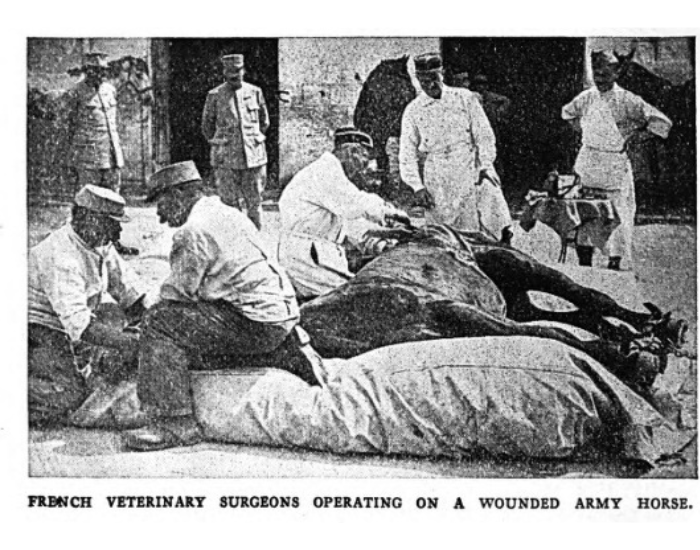
Since the South African War, it is asserted, very considerable improvements have been made in the care of horses in the military service. In 1903 the establishment was put upon a more satisfactory footing. Officers, non-commissioned officers and men are attached to the different military districts where their services are most required. A full veterinary equipment is provided for first aid, together with properly constituted hospitals. Included in the equipment are humane killers, so that any badly injured horse may be speedily and mercifully relieved of its suffering.
Regulations adapted both to peace conditions, manœuvres, and to active service, are laid down, providing a vast improvement, both for the transport of horses to the front, and for their treatment and relief in sickness, or in cases of injury. It is understood that the military authorities have everything in hand to make this service as efficient and as thorough as possible.
We can only hope that this statement is not too roseate; but we should prefer to know, in round numbers, what the extent is of the additions to the Army Veterinary Staff, which was so hopelessly inadequate in the South African War. Not only wounded, but sick, horses need treatment.
“OUR ANIMALS,” of San Francisco, published the following in its January (1913) issue: —
“Through the efforts of the Humane Societies in America all the soldiers in the American cavalry are instructed to shoot their horses at once if the animals become wounded in battle and are of no further use.”
When the war in the Balkans broke out in the autumn of 1912 the R.S.P.C.A., the Humanitarian League, and The Animals’ Guardian all brought this matter forward, and pressed it upon the attention of the responsible authorities. Arrangements were even made from England for sending out a Red Cross detachment to succour the horses wounded in the Balkan war. But we were informed at the War Office that this could not be done seeing that the persons engaged in the work would not be under the protection of the Red Cross.
The Hungarian branch of the World League for the Protection of Animals published in November, 1912, an appeal to the Sultan of Turkey and the Kings of Bulgaria, Greece, Montenegro and Servia, pointing out that while the Red Cross succours and protects the wounded soldiers on battle-fields, there is no such provision for the wounded horses, who lie groaning with crushed limbs, torn bodies and other frightful wounds, or run about till they drop and die of hunger and thirst, and urging that the merciful provisions of the Geneva Convention be speedily extended to the horses.
The appeal was headed by a [sic] Red Cross and some touching lines by the late Swabian poet, Carl Gerok, entitled: “The Horses of Gravelotte.” It was printed in Hungarian on one side and in German on the other, and signed by the President, Privy Councillor von Lukacs.
At the time of the South African War the Royal Society for the Prevention of Cruelty to Animals was advised by the Secretary of State for War to direct its efforts towards the establishment of some international convention which would extend to those who care for wounded animals the same protection the Geneva Convention provides in the case of men, and in consequence of this the late Mr. John Colam (the then Secretary), personally saw the President of the Swiss Republic (who had a mandate from the Hague Peace Conference to call a meeting of the Powers signatory to the Convention at an opportune moment), and placed in his hands a document which made out a strong case for the suggested revision.
The President cordially agreed with his views, and gave instructions for the papers left with him to be placed on the dossier of the Swiss Government referring to the Convention, so that the Swiss delegate could deal with them when the right moment arrived. Unfortunately, owing to various causes, the Swiss Government have not yet called a meeting of the Powers to reconsider the Convention, but when they do the matter will be, it is understood, officially brought forward.
At a meeting held at the Westminster Palace Hotel, London, on January 23rd, 1900, Mr. Butcher, K.C., М.Р., presiding, the following resolution was passed, on the proposition of the Hon. Mrs. Henniker: —
“That the Great Powers who have given their adhesion to the Geneva Convention be most respectfully approached and asked to consider the desirability of an international agreement extending to those on the battlefield engaged in mitigating or terminating the sufferings of wounded animals the same protection as is now accorded by the Geneva Convention to those who succour wounded men.”
At the National Peace Congress, London, in June, 1912, a resolution on “Horses in Warfare ” was introduced by Mr. Ernest Bell (Humanitarian League), who gave many facts concerning the culpable carelessness and heartless indifference with which the horses were treated during the South African War. No fewer than 669,575 horses, mules and donkeys were provided for the war. Close upon 16,000 of these were reported as “lost on voyage,” and of the others over 400,000 were expended in the war. Mr. Bell proposed:
“That this Congress, in view of the fact that the merciful provisions of the Geneva Convention at present extend only to human combatants, and that the Red Cross affords no protection to those who would visit the battlefield to relieve or put an end to the sufferings of wounded horses and other animals employed in warfare, respectfully requests the British Government to invite the other Powers so to widen the terms of the Geneva Convention as to protect the veterinary surgeon, the horse ambulance and such voluntary aid societies as may be duly recognised and authorised by the Governments.”
Further terrible facts and quotations were given on the subject of the treatment of horses during war time by Mr. H. Bailie Weaver, who seconded the resolution, which was adopted.
The following letter was subsequently addressed to Sir Edward Grey (British Foreign Minister) by the Committee of the Humanitarian League: —
“We desire to express our earnest hope that his Majesty’s Government will give favourable consideration to a resolution unanimously passed at the recent National Peace Congress to the effect that the merciful provisions of the Geneva Convention should be extended to wounded horses and other animals employed in warfare, and that protection should be accorded to the veterinary surgeon and such voluntary aid societies as may be duly authorised to visit the battlefield.
“We trust that this resolution will have the sanction of the Government, and that the British delegates will be instructed to give it their support at the meeting of the Third Hague Conference in 1914.”
A reply, dated July 11th, 1912, was received from Sir Edward Grey, stating that “the resolution will be borne in mind by the British delegates at the next Peace Conference.”
It now rests with the public to see that something is done for our equine friends and helpers who bear their full share of the tribulations and sufferings entailed by war on mankind.
Gentle and brave amid the ranks he rode,
And felt the steed beneath him proud and true;
Gentle and brave the steed beneath him strode,
And felt “My master’s hand will guide me through.”
And hour on hour, through dying and through dead,
And lashed by rain from heaven, and hail from hell,
From morn to eve, unscathed alike, they sped,
But, at the close of day, the charger fell.
He saw the shattered limb, the heaving breast,
And eyes entreating aid he could not lend,
With kiss on kiss the velvet nozzle pressed,
And longed, yet loathed, its agony to end.
And heedless for a while how trumpet blared,
Or round him roared and flashed the fiery zone,
He, who all day the battle’s worst had dared,
Now dared not brave the bivouac alone.
Then in one sob a fond farewell he spoke,
The loaded death with hand reluctant drew.
O! dear dumb friends! So patient of our yoke!
There’s many a heart, ye know not, aches for you.
JAMES RHOADES. (From the London “Daily News.”)
Sidney Trist, ed., The Under Dog: A Series of Papers by Various Authors on the Wrongs Suffered by Animals at the Hand of Man (London: Animals’ Guardian Office, 1913), pp. 43-51 and 52-70. The lead image can be found on p. 26 in: Ernest H. Baynes, Animal Heroes of the Great War (New York: The Macmillan Co., 1927). First row: Baynes, p. 14; p. 202; p. 263; and p. 272. Second Row: Baynes, p. 112; p. 193; p. 120; and p. 172. Third row: Trist, p. 57; Baynes, p. 21; Moore, p. 53; and Baynes, p. 70. Trist and Baynes are cited above and for one image in the third row the source is: John Moore, Army Veterinary Service in War (London: Brown, 1921).
See: https://babel.hathitrust.org/cgi/pt?id=uc1.31175035242372&se