Horse Transportation
We want you to have a greater ability to learn about some of the unpleasant animal issues in our world.
The Traffic of Worn-Out and Diseased Horses
A.M.F. Cole
“Open thy mouth for the dumb, in the cause of all such as are appointed to destruction.” — Prov. xxxi. 8.
In 1910 a Bill was passed in the British Parliament to regulate the Traffic in Decrepit Horses. This Bill caused improvement in the condition of exports and transport. At the same time Belgian law intervened to protect the horses on their arrival from brutal ill-treatment at the port.
For a right understanding of this traffic, it is necessary to
remember: —
- That it is in worn-out horses, old and weak.
- That the callous brutality of the dealers in the traffic, and of drovers employed by them, was only restrained by law, and is to be feared wherever that law, or its application, fails.
- That during the transport by sea, application of the law depends on the humanity and energy of the Captain ; and that during long journeys into the interior of Belgium, the old horses are without protection and entirely at the mercy of dealers and drovers.
The number of decrepit English horses exported last year for slaughter to Belgium was 24,780. The number sent to Belgium and Holland each year for slaughter is from 42,000 to 43,000.
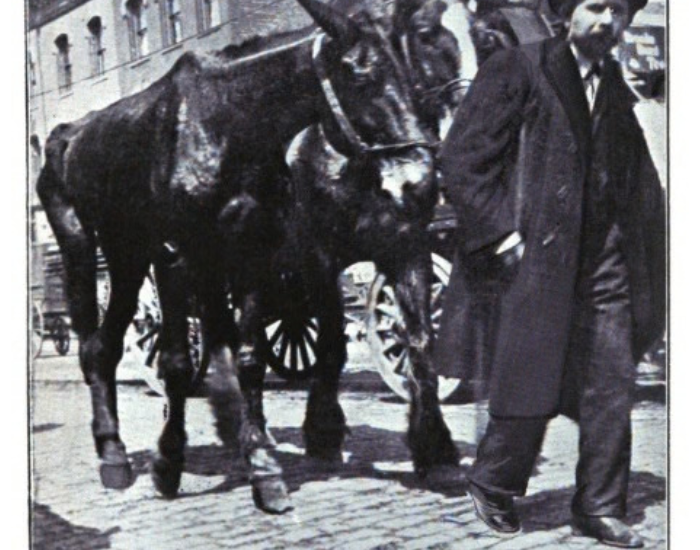
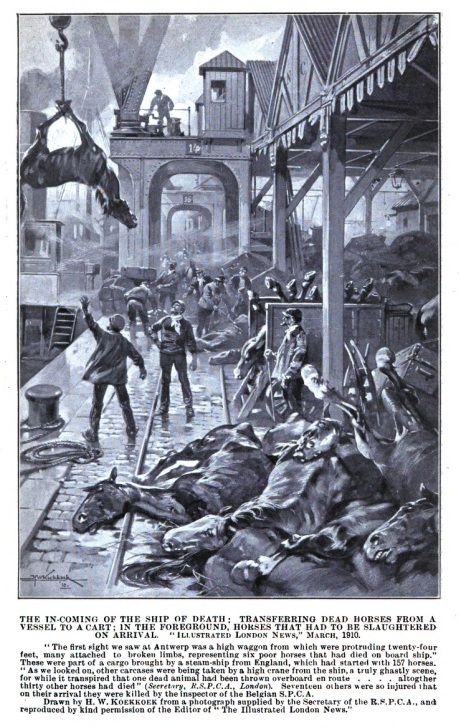
The main exportation of worn-out horses from England is to Antwerp, Ghent, Rotterdam and Amsterdam. In all these ports Inspectors of Societies for the Prevention of Cruelty to Animals are free to meet the animals at the docks. Inspectors of the English Society are not allowed at the English docks, and cruelty occurs there. The veterinary inspection at the English docks is defective. Cases of glanders and of mange have reached Antwerp. Horses get through in a terribly emaciated condition, with enormously swelled hocks, with blind eyes running with matter, and too lame to walk to the slaughter-house.
The law permits the exportation of blind horses, and every week blind horses are exported, generally from the mines. It is evident that blindness must cause much additional suffering during transport on land and on sea. Small pit ponies, often blind, are bought in Belgium for Vivisection and experiment in the Veterinary Colleges. They are cheaper than horses.
From the British Consul at Amsterdam, I hear that about 5,000 to 6,000 old horses are imported there annually for slaughter, mainly from England. The Secretary of the S.P.C.A. there refused to give me any information as to the condition of the horses on arrival.
Den Heer Van Stole, Secretary of the S.P.C.A. at Rotterdam, tells me that the average number of old English horses sent there for slaughter each year is about 13,000. Of late years they have generally arrived in good condition if the weather has been good. But the Secretary writes: —
“You can make as many regulations as you like in England about the fitness of the horses that may be shipped and about the accommodation on board the steamers, and they will all be of no avail to the poor brutes when brought over in bad weather. In that case they will arrive in the Continental ports in the same frightful condition as they have done since I can remember.”
I wrote asking for further details as to the condition of the horses after a bad passage, and whether it is true that they fall across each other and across the gangway, so that it is impossible to get at the injured to kill them where they lie? This is
the answer: —
“After a rough passage, the horses come over in such a condition that I can scarcely describe the same. If the weather has been very bad, all the boxes in which they are carried over are broken, and the animals are lying in one heap. In that case it is very difficult to have them put on shore without further cruelty. The seriously injured animals are shot where they are. Equally, our Inspectors shoot the animals coming over in good weather which have fallen down during the passage and are not able to rise.”
I call your special attention to the following clauses in these letters: —
“The best would, of course, be to have them all killed in England, as is done with those horses that may not be shipped alive because they are too weak to stand the crossing.
“Dead horses, killed in England, are brought over to our port about 1,000 a year.” In answer to my further questions: —
“The dead horses come over in boxes as dead horses simply, and on arrival the meat is inspected here and is as good as that of horses killed here. But the heads of the animals are all destroyed, because they are not worth the duty that must be paid here on meat when imported.
“Now, as horses coming over alive do not pay any duty, this is one of the chief reasons why people are so opposed to have the horses killed in England.
“Now I suppose that a great deal of this cruelty begins in your country by allowing the horses to be worked in a condition so bad that they could not do so in our country.”
On Sunday, April 6th, I went with M. Ruhl (President of the Anderlecht (Brussels) Society for the Protection of Animals) to Ghent. Before 7 a.m. on Monday morning we were at the docks, accompanied by M. Spilthoon and a constable. A great storm obliged boats conveying English horses to put back to their English harbour. We saw no decrepit horses arrive on the Monday or the Tuesday.
Little horse-flesh is eaten at Ghent, and English horses sent there for slaughter are used mainly for the manufacture of “Bologna” sausages. Blood is mixed with the flesh for the making of sausages, and that is one reason why dealers and butchers object to the slaughter of injured horses where they fall.
We visited the quarantine stables, and found the accommodation good. The Veterinary Inspector there gave us much information. We also visited the slaughter-house. The stables there have water-pipes carried along the walls with taps over the troughs — a practical and humane arrangement. The number of old English horses slaughtered there last year was 2,273. They are killed with a hammer: and the heads of English horses are hard.
In the quarantine stables and in the slaughter-house, dealers are supposed to feed their horses. It is safer to impose a charge and have the horses fed; as at Antwerp. At the Belgian ports, after veterinary inspection, horses destined for slaughter are marked by a numbered button. A hole is made in the horse’s ear, the hollow stem of the button passed through, a fastening fixed into it on the other side, and the whole clamped together. These buttons attached to the skin of the ear must be returned to the Inspector at the port of arrival within a given time. Most of the old English horses are so marked. They may be driven on foot and without food or water any distance before they are killed.
At Ghent we were told, on the one hand, that all horses taken into the interior of the country are conveyed by train; on the other, that horses marked for slaughter have been seen towing barges along the canal to Charleroi, a distance of thirty miles. As this would mean gain to the dealers, it is probably true.
The number of old English horses arriving at Ghent last year (1912) for slaughter was 6,304. They seem to arrive irregularly, and the landing to be little supervised. If a horse falls after it leaves the boat it must be conveyed to the slaughter-house to be killed, no matter how it is injured. The Society for the Protection of Animals at Ghent is badly supported and paralysed in its efforts by lack of money.
Mr. Lethbridge, Vice-Consul at Ghent, wrote, — in answer to a letter from me, that the importation of old English horses there has diminished 50 per cent., and the condition greatly improved, since the more stringent laws made by the Board of Agriculture. He wrote further: —
“You ask my opinion as to the different measures suggested to avoid all unnecessary suffering to the animals. I venture then to say that the only one that I should at all approve of is the one you mention as being used on the Rotterdam route, where you say about a thousand horses arrive dead, having been slaughtered before loading in the United Kingdom. If this was made obligatory in the case of all old and decrepit horses, there would be an end to the matter, and the whole world would see that England was sincere in her denunciation of cruelty to these poor beasts. Until the British Authorities take this course, I cannot, for my part, blame the Belgians if they express doubts on the point. I have very strong opinions on the subject of this shameful traffic, which is a disgrace to our nation, and I do not sympathise with the attempts to dictate to the foreigner the measures he should adopt to lessen the cruelty which we ourselves have initiated and made inevitable. I can conceive no reason why a traffic which cannot be carried on, under any restrictions whatever, without continued and intense suffering to such sensitive creatures, should not be absolutely prohibited, and I shall be very glad if you can see your way to support this view at the Congress. With heartiest wishes for the success of any plans which can be found possible to remedy this crying, evil, etc.”
The main Traffic is with Antwerp. Last year (1912) 18,476 decrepit English Horses, for slaughter, arrived at that port. Of that number I know that 57 were sent to one Veterinary College alone, evidently for vivisection. And only between 6,000 and 7,000 were slaughtered at Antwerp.
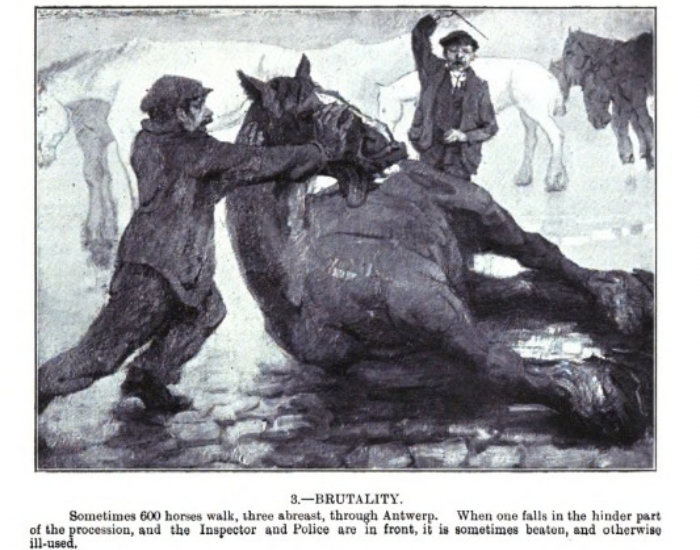
Hull, Goole, Newcastle, and Leith, send these horses every week. The boats arrive generally between Sunday night and Monday morning, and begin to land the horses at 7 a.m. on Monday. Conditions on the boat are generally good, but after rough weather the horses arrive in a terrible condition. It is sometimes impossible to get at the injured to kill them where they fall on the boat. The main traffic is in winter, because that is the season for sausage-making in Belgium, and of least work for old horses in England. Six hundred sometimes arrive at Antwerp in one week during winter, and in winter the North Sea is often rough.
Inspector Dufilou has caused tubs of water to be placed near the boats, from which the horses drink on landing, when the Inspector is near. He, alone, supervises the landing from four boats at once.
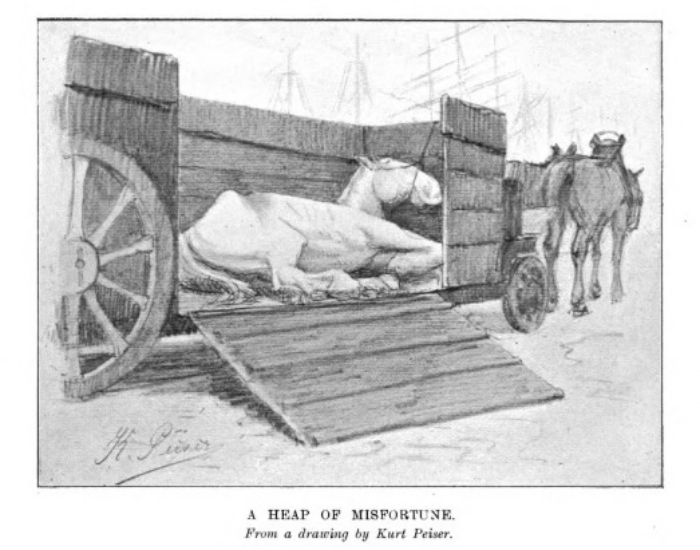
Outside the docks the horses are tied to the iron railings in a row, for inspection by the Veterinary Inspector. Those too lame or weak to walk are conveyed in floats. About two hours are spent in the walk from the docks to the quarantine stables, including two rests of ten minutes duration. Every dealer is forced to pay 1f. 70c. a head for the feeding of his horses while they are in these stables. This rule we owe to the efforts of M. Van, Peborgh, who also requested the Society, and the police, to give all help in our investigation. Horses conveyed in the floats are taken directly to the slaughter-house. The quarantine stables are also a market. Horses may stay there for three days, or may be taken to the slaughter-house, or towards the interior of the country, in the afternoon.
At the slaughter-houses a humane killer is used for oxen; but the old horses are not worth the extra expense of a cartridge. They are killed with a pointed hammer. An eye-witness tells me that the slaughterers generally aim straight, but that on Mondays many of them drink and on Tuesdays cannot aim straight. He also told me that when a horse conveyed in a float cannot stand, the back of the float is let down, the horse drawn with its head over some receptacle for blood, and its throat is cut.
About 50 horses start each Monday evening towards Brussels, on foot. It is only lately that horses have been fed at the quarantine stables, and many have died on the road of exhaustion or starvation. Many too have been goaded on, as long as they could stagger, by deliberate cruelty! Along the roads where they went the bark is gnawed off the trees. There is still time for starvation and cruelty, between the starting of the horses on Monday from Antwerp, and their slaughter on Thursday or Friday. During that interval they are wholly in the hands of drovers, dealers, and butchers. There is no limit to the distance they may be driven.
The dealers in this traffic are hostile to any watching of their trade. I went alone to the Docks, with my camera, on Monday 10th March, and happened to meet a cargo of horses which had come in in the early hours from Hull. was surrounded by dealers and drovers, shouted at, hit on the face by something thrown at me, and followed everywhere by a lad leading a horse in decent condition. This horse was thrust between me and every miserable horse that I tried to examine. It was also frequently thrust very close to me when I stood against the iron railings. The horses generally seemed to be in a worse condition than they were last year. One fell in crossing the road. Five were conveyed to the slaughter-house in floats, four standing and one lying down. From that date fewer horses arrived, and those in better condition, owing, no doubt, to the watching of the traffic at several ports.
The dealers are organised, and can afford to pay for watching and information. The movements of Government Inspectors are watched, and news of their intended visit telegraphed wherever the warning is useful. There are no surprise visits. It is also certain that what we see is no real sample of the treatment of the horses when no one is watching. A man who, dressed as a workman, sees what ordinarily happens, assures me that much cruelty occurs where dealers and drovers are un-watched.
On Monday, March 24th M. Ruhl and I went early to the docks. We watched the landing of the horses, and looked over one of the boats. After many enquiries I concluded that the horses may get water, in good weather, if the captain is humane and energetic. It must be impossible in rough weather. We talked with the Veterinary Inspector, M. Van den Heyden, a capable and humane man, who does not fear to enrage the dealers by ordering the immediate slaughter of an injured horse. He has the power to order unfit horses back on to the boats; but for humane motives he prefers to order them to be slaughtered at the dock. Since he has been in power I have not seen dying, struggling, steaming horses conveyed in floats to the slaughter-house.
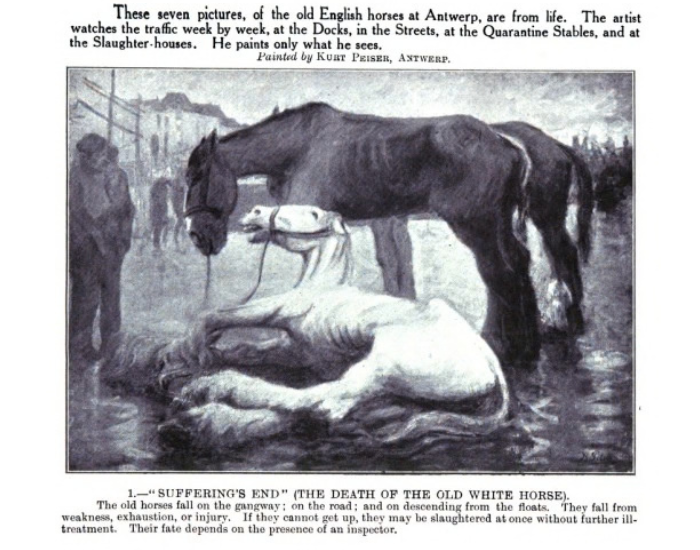
We watched the horses pass three abreast. There were several blind pit-ponies, one with a sore and discharging eye. One horse had a sore on its haunch, another a raw wound on its mouth. Six lame horses in two floats brought up the pitiful procession. Two policemen and the Inspector walked with it.
At the quarantine stables the dealers, who are forced, now, to pay, take care that they have their money’s worth. So the horses have hay, and bran in their water. The rule is that they stay there till 5 p.m., but that rule is not always kept. It was Easter Monday and the butchers were not working, so the horses in the floats were brought to the quarantine stables to be kept there apart till the next day. We waited to see how they were treated. After about an hour, a float was backed against a stable door, and the horses led down. One stumbled and fell. The inside of one hinder leg was one long wound, and the horse could not get up. Drovers and dealers crowded round it, and we knew if it were left unprotected it would be dragged inside the door by the tail and left there till the next day.
We hurried to find the Inspector; M. Ruhl sent a policeman to watch. Unsuccessful, we hurried back, and at the same time the Inspector came. Stooping over the horse he placed the humane killer against its head. There was a report, and the horse gave a shudder. Then the Inspector thrust a knife into the breast and the blood rushed out. It was the happiest sight I saw that day.
We found that the five other horses had food and water, but one had been tied so that it could not reach the water. It was a two-year-old colt with immense swellings on its legs, and evidently had been a pet. It thrust its nose against my hands, and against M. Ruhl’s head when he bent to loosen it so that it could drink.
On Easter Monday the horses left the stables several hours earlier than usual, and we went by train to Malines, half way to Brussels, to see those that pass there on foot. We waited in wayside inns, and from one of them I saw three miserable donkeys that had come with the horses, being driven to Brussels. I gave them some bread, and they ate it ravenously, snatching it out of my hands.
It was dark when about 40 horses came past, tied together like a gang of convicts, two of them ridden by drovers. Some were left at Malines or taken elsewhere; the rest went on towards Brussels. We followed them for a long way, but there was little light, and I could only see that one horse was very lame, and hear the continual cracking of whips. Lame and weak horses are tied behind the gang and pulled along by the rest.
At Brussels M. Ruhl watched for these horses till 1.30 a.m. but did not see them. It is forbidden to take horses marked for slaughter into any stable on the way to the slaughter-house where they are killed.
On Monday, March 31st, M. Ruhl and I again met the boats and visited two before the horses landed. The conditions were generally good. On the Leith boat I saw four horses in boxes covered by tarpaulin on the open deck. Leith sent last year 900 odd in 18,000 odd. But half the total of deaths during transit occurred on the Leith boats.
One horse fell on the gangway. It was pulled down by the tail on to the level, and after some vain efforts to rise, was slung up on to its feet. There was no ill-treatment. But we were looking on.
In the procession were the usual blind pit ponies. Here and there a running sore eye; a bitten, bleeding mouth; a tail or hip with hair and skin rubbed off. I noticed a grey pony with disfigured mane and tail. The procession was brought up by the usual two floats. Four live horses in one; two live and one dead in the other.
We went to the slaughter-house to see what became of the horses taken there in the floats. We did not find them. After a long search we found seven horses wandering about in a big stable without straw or food. I cannot assert that they were old English horses. A man who watches that traffic unobserved, declares that those horses may be, and are, bought and taken away immediately on arrival at the quarantine stables. Officials say that this is not true. Those horses were evidently ravenous. Some of them came towards us. One followed us about. They were a wretched sight.
We found the director of the slaughter-house, and he promised that the horses should be fed. He told us that the dealers take the horses away from the quarantine stables where they must pay for their food, and send them to the slaughter-house to avoid that payment. Sometimes the horses wait there several days for slaughter. I wrote to M. Van Peborgh, Senateur, asking for an amendment ordering that all horses, including those conveyed on the floats, shall be kept at the quarantine stables till the day when they are slaughtered.
Towards evening we saw detachments of horses start on foot for the Interior. The fate of those conveyed by train is not much better. Some of the old horses are so weak that they fall from the movement of the train and cannot get up again; sometimes they suffocate each other. Also these trains are very slow. One carrying old horses to Brussels, a distance of 28 miles, was 20 hours on the road. For these reasons, compulsory conveyance by rail from the docks, would not be a satisfactory measure, especially as the end of a journey by rail might be the beginning of another on foot.
The fate of horses taken long distances on foot depends on the degree of their weakness. The drovers are often of the lowest class; men who can get no other employment. They are paid to get the horses to a certain slaughter-house, and they can use what means they like. Alone on country roads, generally at night, blows, cords tied round the lower lip, not including the teeth, and kicks, on lame legs, are amongst the means I have heard mentioned. From the moment when our old horses are sold for slaughter they are only meat, to he conveyed and killed with the least possible expense to the dealers.
At 3.30 on Tuesday morning, M. Ruhl and I set out from Brussels, in the van used for collecting dogs for the Home. We waited outside Brussels till nearly 5. At last we saw the horses coming towards us. There were fifteen, three abreast, all tied together. One behind was dead lame, dragged along by the rest. We followed at a distance and saw a pony detached from the rest and taken down a side street. Then the gang moved on. The few people who were about stood still to stare at them. We drove past them to the slaughter-house and waited for them there.
They came in. The lame horse was wet with sweat. A right forefoot was very swollen. He kept holding it up, and flinched when M. Ruhl touched it. He had walked 28 miles in the night! Blood dripped from the tail of another; the drover said a boy had cut the end off by mistake with the hair, at the quarantine stables at Antwerp.
Some of the horses were left tied to the railings in the yard, perhaps to be sold again and taken further. Some were taken into a stable. We went in with them and found that they had neither food nor water. Mr. Ruhl spoke to several officials, and later they were fed.
It is clear that this traffic in worn-out horses involves suffering that no law can prevent, and that laws made to lessen that suffering are broken.
I beg whoever sends a horse to a knacker for slaughter to mark a hoof and insist on having it hack within a given time.
The exportation of blind horses, and of small pit ponies which are chosen for vivisection, ought to be immediately forbidden.
In Belgium, a law obliging slaughter of all decrepit horses at the port of arrival would greatly diminish suffering. I am told that the Belgian Government would make this law if England required it as a condition of the export.
I do not think that a slaughter-house and stables at the Antwerp docks would improve the conditions of this traffic unless all the horses were slaughtered there. That procession through Antwerp keeps the scandal before the public. It is generally called “The Shame of England!”
Inspectors of the R.S.P.C.A. ought to be at the docks in Great Britain where the horses are loaded.
But this traffic is in worn-out horses, feeble from age or infirmity; and the transport of these old horses over the North Sea in all weathers involves a very great deal of suffering.
The traffic cannot be stopped. But the traffic in live horses can and ought to be stopped. The Veterinary Inspector at Antwerp declares that meat conveyed in refrigerators is as good as meat freshly killed, if properly cooked. The Inspector at Rotterdam finds the flesh of horses killed before loading in England as good as the flesh of horses sent over alive.
In Holland there is a duty of six cents a kilog (about ½ d. a pound) on imported dead meat. The profits of this traffic are enormous. A worn-out horse in England is worth from £1 to 30s., but, where the flesh is used as food, it is worth from £6 to £14. This duty would slightly increase the price of horse-flesh in Holland, but the humane and enlightened Dutch Government would probably not oppose a measure for the
prevention of cruelty to animals.
In Belgium importation of dead meat is forbidden The Belgian Government can modify this law at its own discretion.* [See footnote at end of this excerpt.] At the request of the English Government, and for humane motives, I believe the Belgian Government would make an exception in the case of decrepit English horses.
If the English Government forbade the exportation of living worn-out horses, the traffic, so profitable to England, would not suffer. Horse-flesh in most Continental countries is a food of the poor, and the supply from England is necessary. It is probable that the Belgian Government could more easily grant an exception, if the alternative of that concession was a shortage of horse-flesh.
Horses, or carcases, could be inspected in England by foreign Veterinary Inspectors.
An Import Duty and change in the methods of transport would at first lessen the profits of this traffic, but if the horses were slaughtered in England and the meat exported in refrigerators, what is now a monopoly of the dealers would become an English industry.
No international, political or economic reason prevents the prohibition of this traffic in live, decrepit horses by the English Government. Humanity and national self-respect require that prohibition. A. M. F. COLE.
*I hear from M. Van Peborgh that dead horses, mules, and donkeys may now be imported, if the lungs are sent with the carcase. Belgian Veterinary inspection, in England, would make that condition unnecessary.
For the fulness of my report, I have to thank Mr. Ruhl, President of the S.P.C.A. of Anderlecht, Bruxelles, who has given days and nights to show me every detail of this traffic.
At Antwerp, I have to thank Mr. and Mrs. Ben Wood; M. Van Peborgh, Senateur; M. Van den Heyden, Veterinary Inspector; M. Poffé, Secretary, and Inspector Duflou of the S.P.C.A.; and the Director of the Slaughter-house.
At Ghent, M. Van Wesemael, Chief Commissioner of Police; M. Van den Hove, Hon. Secretary. and M. Spilthoon, Vol. Inspector of the S.P.C.A.; and the Director of the Slaughter-house.
The pictures of the Old Horse Traffic at Antwerp are from life and of what happens now. M. Kurt Peiser watches the traffic continually, dressed as a workman, and paints what he sees….
A.M.F. Cole, “The Worn-Out Horse Traffic and Diseased Horses,” in Sidney Trist, ed., The Under Dog (London: Animals’ Guardian Office, 1913), pp. 3-15. Two versions were used since there were missing pages in the first citation below.
See: https://babel.hathitrust.org/cgi/pt?id=uc1.31175035242372&seq=1 and
https://dn790006.ca.archive.org/0/items/b28052638/b28052638.pdf (https://archive.org/)
Journal of Zoöphily
Hard Winter for Animals
More suffering among the horses of the city and county this winter than has ever before been known, on account of the high cost of feed, is the prediction of the Chattanooga Humane Society. In a statement issued by the society recently, attention is called to the approach of bad weather and to the suffering that is sure to follow for the dumb animals of Chattanooga. The co-operation of the public is asked in order to lessen the burden on the society.
“With corn at $1.35 per bushel, oats at 80 cents per bushel, mixed feed at $2.25 per 100 pounds and hay at $1.35 per 100, the poor man simply cannot afford to feed his stock living rations. Conditions are growing worse each day. Stand anywhere on the traffic streets and watch the dray horses, the cab horses, the junk man’s horse, the coal peddler’s horse, the obscure grocer’s horse, the milk dealer’s horse go by — a sorry procession of lean flanks and staring ribs.
“The laws of every State in the Union have given to the horse the right of fair treatment — feed and drink and shelter. The horse cannot defend his rights; he must leave that to his next friends, the humane societies.
“We have known many good, charitable souls who have felt they were doing a generous deed, when they have given an old negro a broken-down horse or helped him to purchase one, and then expected him to go ahead and let the horse earn a living for him and his family, when as a matter of fact the man cannot earn enough to feed himself, let alone the horse. Many a horse destined to a fate of this kind has pulled faithfully between the shafts until through old age and infirmities and lack of proper nourishment he has dropped, never to rise again, often abandoned in his last hours, sometimes mercifully relieved of his miseries by a bullet through the brain.
“We believe it to be a mistaken form of philanthropy to assist a man at the expense of suffering to animals. In this age of civilization with our numerous resources for charitable purposes it is an unnecessary, if not a criminal act. One often hears the question asked: ‘If you take the man’s horse away, what will he do — how will he earn a living? We answer with another question: ‘Must this man violate the law in order to live? Is it necessary for the horse to suffer from hunger and exposure and the various ills that come from improper feed and neglect that this man may feed himself and his family? Do economic conditions demand this sacrifice? Is our moral sense of so low an order that we can see this thing going on constantly about us and not try to remedy it.
Permit us to offer a few suggestions. Interest yourself in some poor man who owns an underfed, miserable horse. If you think he can pull through the year with a little assistance in the upkeep of his horse, assist him in this manner; if not, try to get him work that will not require the services of an animal. When you want anything of a drayman do not haggle over the price of the haul with several men until the sorriest- looking one with the sorriest-looking animal offers to do the work for almost nothing. Encourage the decent-looking outfit by paying a decent wage — discourage the sorry-looking one by refusing his services.
DONT’S FOR THE PUBLIC.
“Don’t ride after a cab horse which is so street-sore and leg-weary that he can hardly pull up a short hill, and whose hanging head, strained expression and lagging gait proclaim his life of overwork and inadequate rest. Don’t buy groceries or supplies of any kind at cheap stores which employ immature boys as drivers and whose horses succumb to diseases brought on by hard driving and insufficient care. Don’t buy anything of anybody whose horse does not reflect in appearance the stability, the honesty and the humaneness of its owner.
“The Humane Society has destroyed during the month of November twenty-nine horses and mules, an unprecedented record in the history of the society. (The average per month during the past year has been seven.) Of this number, nine were down and unable to get up; four were abandoned by their owners; five were hopelessly injured —broken legs, hips, etc.; eight of them rendered unfit for service by reason of old age, debility and starvation were surrendered to the society; three were bought at an expense of $5. The explanation of this record is, that the majority of these horses have been poorly fed all summer, and now that the scant pasturage they have had about the city’s commons is gone and cold weather has come, they are succumbing to exposure and weakness superinduced by starvation.
“We have been busy all the month — warning drivers to put the feed to their horse, making others provide proper shelters and ordering stables cleaned and dried. (One horse stood in nearly a foot of water in his stall.)”
Is there any index to the character and to the moral and financial condition of the city that speaks more plainly and more eloquently than the appearance of the horses that traverse its main thoroughfares? Don’t the sleek, well-rounded bodies, the upright heads, the shining harness tell you of thrift and order and decency? Doesn’t the blind, lame, decrepit beast, its whole anatomy revealed through the unkempt coat and flabby muscles, omnipresent in so many communities, bespeak shiftlessness, indifference and lack of education?”
In conclusion she said: “The people of Chattanooga are a charitable people who give freely to all worthy causes. But in your gifts let us beseech you not to forget man’s faithful helpers, the dumb creatures who serve us so blindly and so willingly, and whose wrongs are one of the blots upon our present-day civilization. In your Christmas outpouring, remember the poor man’s horse and the society whose prerogative it is to speak for those who cannot speak for themselves.” — The Chattanooga Times.
“Hard Winter for Animals,” Journal of Zoöphily, Vol. XXVI, No. 1 (Jan., 1917), p. 5.
See: https://babel.hathitrust.org/cgi/pt?id=uc1.$c183356&seq=1&q1=
The Street Railway Journal
Stables and Care of Horses
[The annexed report is most.scholarly and practical and deserves the most careful perusal. The discussion thereon revealed wide differences of opinion and practice. We shall glve it in our next issue. We hope that our many readers will not consider the discussion by any means closed, but will continue it in our columns.]
To the American Street Railway Association.
GENTLEMEN: — The Committee on Stables and Care of Horses, submits the following:
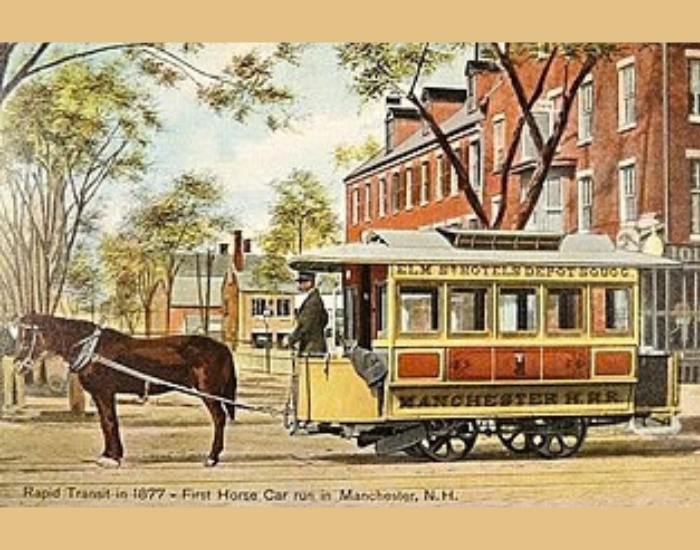
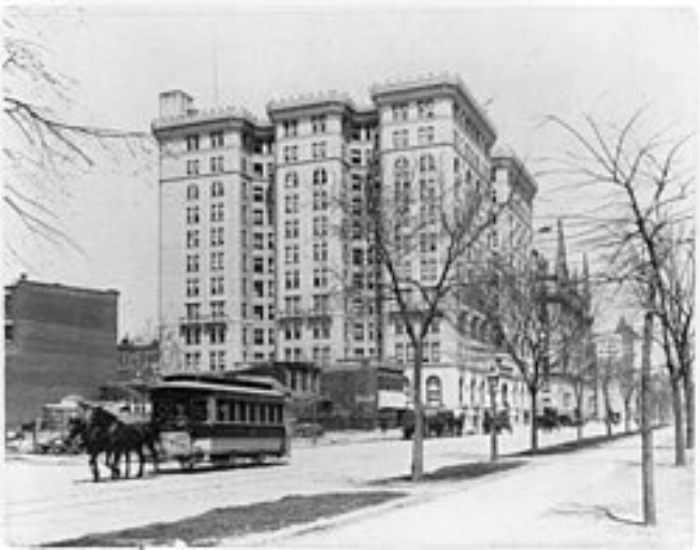
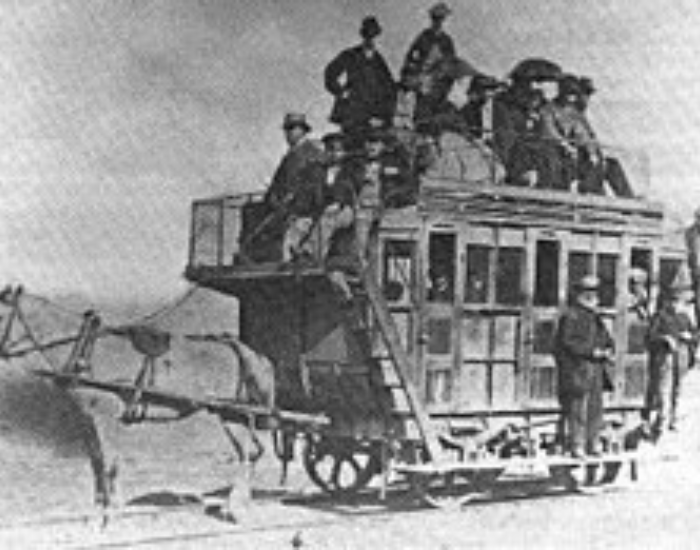
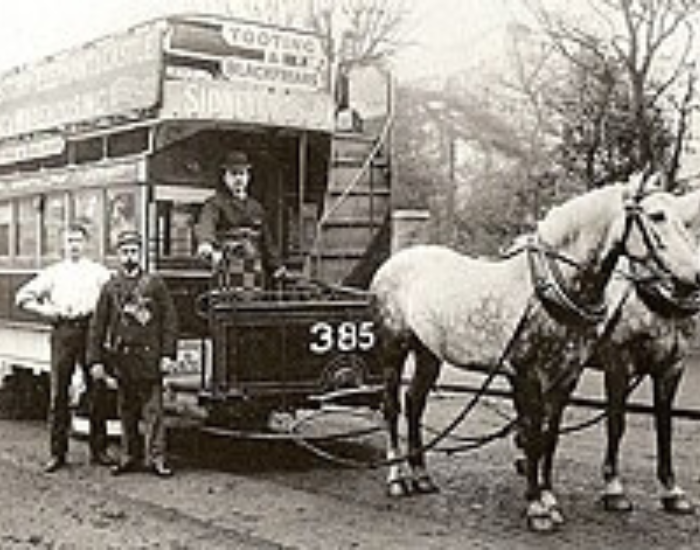
The importance of information upon this subject is shown by the fact that nearly two-fifths of the investment in street-railways is in buildings and horses; and of the expense of operating, upwards of 35 per cent. is consumed in the maintenance of stables and horses.
The care which the horse receives at the hands of the managers of street railways has much to do with the economy of operating; for it is evident that well-arranged stables, careful attendants, and skillful drivers, with wholesome and sufficient feed go a great way towards prolonging the life and usefulness of the horse in street-car service.The subject of stables naturally claims attention first, and in this connection it must be understood that, at least, eighteen and, perhaps, twenty hours out of every twenty-four, the horses in this service are confined within the stables year in and year out. Thus three-fourths of the life of the horse is spent in the stable. Considering that plenty of light and pure air are essential to the healthy condition of the horse, to furnish this should be the first object in building a stable.
In selecting material, such should be chosen as will be least likely to absorb and retain the impurities, which will always be found within such buildings. Great care should be taken to have the drainage perfect, and if underground to have the drains so inclined, trapped, and tight in the joints, as to quickly and completely take away whatever is deposited in them. Arrangements should be provided to flush them often with water, and if possible to have all traps and catch-basins well ventilated, so as to carry outside of the stable any foul gases which may accumulate there. The theory of surface drainage for stables has many supporters, and deserves careful consideration from those about to build. If surface-drains are frequently flushed or washed, this manner of draining would seem to call for no objection. The matter of drainage being settled, the next question is light and ventilation.
Arrangements should be made to admit air in sufficient quantity without creating a draught.
Roof ventilation is desirable, but not sufficient, as the air of a stable containing many horses is heavy and will not rise without a current of air from near the floor to assist. Light can be admitted from high openings in the sides of the building, but these should not be depended upon for side-ventilation as the height renders them insufficient to move the air, and the location, usually over the heads of the horses, causes them to be dangerous as means of a draught.
Doors on opposite sides of the stable connected by a passageway running behind the horses; this passageway having ventilation from the roof is a desirable means of ventilating a stable, as in case the wind blows too strongly in one direction the doors on that side of the building can be closed, while air is admitted from the opposite side.
As a matter of convenience it may be desirable to have all stalls upon the ground floor, but such an arrangement is not practical in large cities, on account of the high cost of land, and horses may be as well established on the second or third floor, provided these floors are constructed properly as regards the drainage, and provided with “runs” leading to the outside in two or more directions to be used as escapes in case of fire.
The stalls should be constructed with a view to give the horse as much freedom as possible consistent with economy in utilizing the space. Experience demonstrates that the width should not be less than four feet in the clear, or the depth less than nine feet. The height of the partition between the horses should be at least four feet, and at the heads, carried three or four feet higher in such a form, as to admit light and air without allowing the horses to bite and otherwise annoy each other.
Single stalls are preferable, although double stalls, with swing-bars between the horses, are in favor with many good stable-experts. The floor of the stall should pitch toward the gutter about one and a half inches to the nine feet. A good construction for stall-floors is to lay the surface for about four feet inward from the gutter with close- grained hard wood, like maple, in strips of four or five inches wide and two inches thick, leaving a space between, three-quarters of an inch wide, to allow the urine to pass off without being absorbed in the bedding.
The best form of manger or feed-box, is of cast iron, formed so as to have no square corners for feed to accumulate, and of sufficient depth to prevent the horse from “nosing” his feed out. No rack is needed for loose hay, this can be fed in small quantities from the floor. A passageway, say four feet wide, between the heads, or in front of the stalls for the purpose of feeding is desirable, this should be ventilated by windows or doors at each end, and a flue leading to the roof above. The loft for feed should have a tight floor, so that the steam and ammonia from the stable underneath will not contaminate the provender stored therein. It should be constructed with windows to admit light and air from the sides, and with roof-ventilation at the top. Suitable receptacles should be provided for the manure outside the stable, and all refuse and manure should be removed frequently, and before it has had time to heat and steam.
The custom of building stables with cellars to receive the manure is not recommended; and unless there is yard-room enough to pile the manure compactly outside the building, it should be removed from the premises daily. The space allowed for rear floor-way between the stalls should be sufficient to permit the removal of horses from one row without interfering with those on the other; for this purpose, ten feet is a fair allowance.
The plan of arranging stalls in sections, so as to have the horses allotted to the care of one man, stand together is a good one; also that of having a separate drinking- trough for his horses. If a common drinking-trough is used, it should be centrally located and supplied with running water.
Twelve feet in the clear is recommended as a good height for each story, although some advise more, and some are content with even less.
Arrangements outside the building to dry and air the bedding are very desirable when straw or hay is used, and if shavings or saw-dust, bins for storage should be provided. If any substance except wood is used for floors, bricks are recommended, as they are easily renewed when worn and less liable to cause the horses to slip than stone, asphalt or cement.
In coming to the subject of the “care of horses,” it is suggested that the first care should be exercised in the selection of horses to be purchased. The theory that any kind of a horse that can be had for from $100 to $150 will do for Street-Railway use, is a bad one.
The buyer of Street-Railway horses has a somewhat difficult problem to meet from the fact that the horse most desirable to him, usually commands a higher price than he, i.e., the corporation, however, he represents, is willing to pay. A good buyer, will always insist upon the necessary qualities in the horse he buys, without too much regard to price. In the first place, only sound horses should be bought. Although horses unsound in some respects, may be used to some advantage, it is never best to buy them in that condition, as every Railroad manager knows that the exacting labor they are subject to, will cause unsoundness in some form or another soon enough.
A good disposition and easy gait should be considered as absolutely necessary. The head and general appearance of the countenance will show the disposition, and a trot of fifty feet, will show the gait. Color should have nothing to do in the selection except to cheapen the price, as is the case with white, grey, buckskin, and bald-faced horses. The feet and muscles of the legs should be carefully looked at, as these are the main-stay of a railroad horse.
A flat-footed horse should never be accepted.
The age should never be less than five or over nine years, as a general rule, a horse of twelve years of age, however, if sound, may be accepted at a considerable reduction in price.
After the horse is selected and placed in the stable, the first thing to do is to accustom him to the feed, and break him to the labor. We would never think of putting on a conductor or driver without first instructing him in the duty expected of him, and place him under the direction of an old hand for practice. This rule should be followed with the horse. The first day he should be allowed to rest. After that if he takes his feed well, he may be put to half-work with a careful driver, and should be worked no more than this, for the first six or eight weeks, at least. All green horses should be given in charge of the best drivers, who will take pains to break them in to the work.
The care of the horse in the stable, includes feeding and grooming. Upon the question of feed, perhaps, the first cost or what is termed “economy” has considerable to do.
It is generally admitted that cut hay and corn meal is the cheapest at first cost, of any feed in use; but experience has shown that this feed is too hearty and fattening, and that horses fed upon it for several years without change become more subject to eruptive diseases and also to colic, inflammation of the stomach and indigestion. It is calculated that at least five cents per day can be saved in this feed on each horse, over the cost of feeding oats and long hay, and that the extra loss on horses fed with meal only, will not amount to the sum saved at the end of the five or six years’ service of a railway-horse. Το the credit of railway managers it is found that this conclusion is not accepted generally; and that while some are found to strictly adhere to what is termed the natural feed of the horse — oats and long hay — very many compromise the question by giving one such feed daily, or, at least, lighten up the corn meal by mixing bran or wheat middlings, in proportion of about half and half by measure.
The mixing or preparing of the feed should be entrusted to as few persons as possible; but the practice of each hostler dealing out the feed to the horses allotted to him, is not objectionable although many stable experts prefer to confine the hostler’s duty simply to watering and grooming the horse and the care of his stall, and to provide one man to distribute the feed to each 100 or 125 horses.
In general terms, it should be the care of the stable-master to make the horses under his charge as comfortable as possible, while keeping them in condition to do the work required of them. They should be watered frequently and fed regularly, not less than three feeds a day, and thoroughly groomed not less than twice a day. In warm weather, they should be carefully cooled off after coming in from work, and in cold weather well-blanketed. Disinfectants should be freely used; common lime, either dry or in the form of whitewash, is recommended as effective and inexpensive.
As shoeing is a matter of considerable importance of railway managers it is proper that all entrusted with the care of street-railway horses should inform themselves as to the best form of shoe, and the best manner of setting it. There is but little difference of opinion among the well-informed upon this subject, as to the desirability of a light shoe over a heavy one, and that for horses traveling over a paved street, a shoe made of soft iron is preferable to one made of steel, on account of its being less liable to slip. In all cases the shoe should be fitted to the foot and not the foot to the shoe.
On the question of hot or cold fitting, W. H. H. Murray may be quoted. He says: “The weight of authority is nearly the same in either scale. The advocates of cold-fitting declare that they can fit a shoe with rasp and file as evenly as the necessities of the case require, and that this can be done at no great cost of time or skill. They, moreover, charge that both reason and analogy are in opposition to burning a horny surface and declare that it honeycombs the wall of the foot, and prevents its natural and healthy growth.
“The disciples of hot-fitting on the other hand, declare that few men can level the foot, or so hammer and file the shoe, that the fit shall be what is required, and that only by burning can the connection between steel and horn be made sufficiently close and solid.”
It must be admitted that good arguments can be used on both sides of this question, but in the end both sides bring up with this fact, that whether by hot or cold-fitting the shoe must be fitted evenly and solidly to the foot. As a matter of interest in this connection, an estimate made by a French professor concerning the muscular fatigue resulting from the use of heavy shoes may be quoted.
“If at the termination of a day’s work, we calculate the weight represented by the mass of heavy shoes that a horse is condemned to carry at each step, we arrive at a formidable array of figures, and in this way are able to estimate the amount of force uselessly expended by the animal in raising the shoes that surcharge his feet. The calculation I have made possesses an eloquence that dispenses with very long commentaries.
“Suppose the weight of a shoe is 1,000 grams (about 2 1/2 lbs. avoirdupois). It is not excessive to admit that a horse trots at the rate of one step every second, or sixty steps a minute. In a minute then, the limb of a horse, whose foot carries one kilogram (21 lbs.) makes an effort necessary to raise kilogram after kilogram, a weight of sixty kilograms (132 lbs.) For the four limbs, this weight in a minute is represented by 60×4=240 kilograms (528 lbs.) For the four feet during an hour, the weight is 14,000 kilograms (30,800 lbs.) and for four hours the mean duration of a day’s work in these omnibuses, the total amount of weight raised has reached the respectable figure of 57,000 kilograms (125-400 lbs.)
“But the movement communicated to these 57,000 kilograms represents an expenditure of power employed by the motor, without any useful result, and as the motor is a living one, this expense of strength represents an exhaustion, or if you like it better, a degree of fatigue proportioned to the effort necessary for its manifestation.
“But to measure this intensity of action would require a mathematical aptitude, which I do not possess. I will not, therefore, dwell upon this point, notwithstanding its importance, and am content to signalize it. Otherwise the figures speak for themselves, and tell us that the diminution in the weight of horse-shoes is not an unnecessary consideration, so far as the useful application of the horse’s strength goes.”
After a careful consideration of the above calculation, [we] must not all admit that the lightest possible shoe consistent with the service, should be used upon street-railway horses.
The question of calking the shoe must be settled by the condition of the street over which the animal travels. Many believe that a calk is not necessary on paved streets, except in the winter season, when ice and snow are liable to interfere; and that if a calk is used at all it should be a low one, so as to raise the frog but slightly from contact with the street, and that care should be taken to have all calks of an even height. to allow the horse to set his foot squarely and evenly upon the ground.
Upon the question of nailing the shoe, a quotation from Fleming seems to “hit the nail on the head.” “The shoe ought to be be attached by nails to those parts of the wall where the horn is strongest and toughest. In the fore-foot, these parts are in front and along the sides to the quarters. There the horn becomes narrow and thin, and the nails find less support, and are nearer to the living textures. This is more particularly the case towards the heels, especially the inner one.
“In the hind foot the wall is generally strong toward the quarters and heel. These facts at once give us an indication as to the best position for the nail-holes. In the fore-foot, nails may be driven through the wall around the toe, as far as the inside quarter and a little nearer the heel on the outside. In the hind-foot they may be driven around the toe and even up to the heels with impunity.”
Nails should be turned out as quickly as possible, as the higher they go the less thickness of hoof is found, and extreme care should be used not to prick or press the sensitive part of the foot. Too many horses are made almost worthless from the effect of “blind stabs,” which means, driving the nail into the quick and then with drawing it, and driving it again so close to the wound as to irritate it and cause it to suppurate within the foot and work out at the top. Such cases are the result of careless nailing. and frequently terminate in what is called “foot-rot.” The difficulty in tracing the exact cause of such trouble, arises from the fact that the horse does not show lameness for one or two days.
As the feet of horses working only on paved streets and standing continuously upon wooden floors are liable to become hard and dry for lack of sufficient moisture, it is necessary that the stable-master should adopt some measure of supplying this need. A simple way and one that can be followed in any stable is to furnish each hostler with a pail and sponge, and require him to wet the fore-feet of all his horses, once or twice a day. The water should be applied particularly to the part where the hair and horn meet, and to the heel and frog. A good idea is to dissolve about a half pint of clean salt in each pailful of water used. The stable-master should inspect his horses daily, as to their fitness for work, and “lay off,” and nurse any that do not “take their feed,” or show lameness.
The next care that the horse requires at the hands of railway managers is that of furnishing suitable drivers. The best stabling, grooming, feeding and shoeing cannot counteract the effects of bad driving. Those men whose duty it is to select and educate the drivers on street cars, should be most faithful and efficient, and no man should be retained as a driver who has not the necessary patience and judgment. Many horses become vicious and balky, by ignorant and careless driving, and a quick tempered driver is liable to be a costly one.
The last care that comes to us in the treatment of the street-car horses is to select or sort out and dispose of those that have become unfit for the service. This demands good judgment, for the difference between the price obtained for a worn-out horse and a new one to take the place, is considerable, yet it is folly, and worse than bad judgment, to retain and feed horses unable to work, for it does not take them long to “eat their heads off,” as the saying goes. All horses should be disposed of as soon as it appears that their capacity for full railroad service is gone.
This report is submitted with the hope that some hint it may contain, will be useful to the members of this association. This subject is an important one, and to be treated fully, would require more space than the limits of this paper will allow, and demand more talent than this committee lays claim to….
For the Committee, J. E. RUGG, Chairman….
Sick and disabled horses are cared for by the Superintendent and his assistants, the amount paid yearly for veterinary services being insignificant. Very little trouble is had from colic, fevers or other sicknesses. The principal, and it might be said, the whole trouble met with, proceeds from strains from slipping, affecting the hind legs, back and kidneys, producing in many cases paralysis from which they rarely wholly recovers. Many, however, recover to work on light trips. Necessarily they suffer to some extent from bruises or accidental injuries, but most of such cases are successfully treated.
Some years since “Farcy” was found in the company’s barns, vigorous measures were immediately taken by the destruction of every animal showing symptoms of the disease, and a thorough fumigation of the a loss of only seven horses out of 250 in the barns affected.
The treatment of paralysis, now a common disease, has been most unsatisfactory. The best success has been by stimulating, keeping the bowels open, mustard and penetrating liniments, and rest. There is a short connecting line from the main barn to a branch road, on which weak and partially disabled horses are used while recruiting. Any horses not able to do this work are sold or sent to the boiling-house.
The average period of usefulness of the horse is found to be from six and a half to seven years. The business has increased so rapidly in the last seven years, requiring the purchase of so many new horses, that the average, without question, is lower for that reason. [John E. Brown, Superintendent of the Troy & Lansingburg Railroad]