Cruel Food
We want you to have a greater ability to learn about some of the unpleasant animal issues in our world.
The Animal Resources of Different Nations.
Peter L. Simmonds
CHAPTER III.
FLESH FOOD FROM MAMMALIA
Flesh of Monkeys Eaten in Africa, the West Indies, South America, Ceylon, and Borneo — The Lemurs in Madagascar — Bats Eaten in the East and in Australia — Insectivora — The Hedgehog — Carnivorous Plantigrades — Bears — Skunk — Badger — Sea Otter— Civet Cat— Dogs’ Flesh Eaten by North American Indians, Chinese, Africans, and other People — Foxes and Wolves Eaten — Lion’s Flesh — Jaguar — Hyæna — Lynx — Carnivorous Marsupials — Opossum — Bandicoots — Kangaroos— Wombats — Phalangers — Marmots — Squirrels — Rats — Rat Pie — Dormouse — Hares and Rabbits — Prodigious Increase of Rabbits in Australasia — Flesh of the Beaver — Porcupines — Agouti — Sloth — Anteater — Armadilloes.
I now proceed to notice some of the mammals whose flesh occasionally serves as the food of man.
Young gorillas, it is said, are eaten when they can be got, and their flesh, with that of the chimpanzee and other monkeys, forms a prominent place in the African bill of fare.
Dr. Livingstone, in his last Journal, says, “The flesh” (of the Soko, a species of Gorilla) “is yellow, and the eagerness with which the Manynema devour it, leaves the impression that eating sokos was the first stage by which they had arrived at being cannibals; they say the flesh is delicious.”
But it is in Brazil, especially in the valley of the Amazon, that they are most eaten, for the animals found in the greatest numbers there are the monkeys.
Monkeys are said to be publicly sold in the markets of Rio Janeiro.
The barrigudo {Lagothrix Humboldti, Geoff.) is much persecuted by the Indians, on account of the excellence of its flesh as food. From information given to Mr. Bates he calculated that one troop of these Indians, numbering about 200, destroyed 1,200 monkeys a year for food.
Mr. Wallace tells us that having often heard how good monkey was, he had one cut up and fried for breakfast. He found the meat somewhat resembled rabbit, without any peculiar or unpleasant flavour. My friend, the late Sir Robert Schomburgk, told me that when travelling in the interior of Guiana he had often tasted the smaller kinds of monkeys, but could never bring himself to partake of the great. spider monkey (Ateles sp.) and others eaten by the Indians, which approach so nearly to the human form.
It is a remarkable circumstance that among the South American Indians, monkeys are much more frequently used as food than among the inhabitants of the Old World, and on the Orinoco the broiled limbs of the marimonda (Ateles Belzebub, Geoffroy) was frequently seen by Humboldt in the huts of the natives; and at Emeralda he examined roasted and dried bodies in an Indian hut, which were prepared for an annual harvest fête.
Roasted monkeys, particularly those that have a round head, display a hideous resemblance to a child; the Europeans, therefore, who are obliged to feed on them, prefer separating the head and hands, and serve only the rest of the animal at their tables.
It is not at all improbable, from the close resemblance of a monkey, with the hair removed and ready to be cooked, to the human body, that with regard to some savage nations, accusations against them of cannibalism have been unjustly laid. Dr. Vidal, speaking of the mammals of Japan eaten as food (Bulletin of the Society of Acclimatation, Paris, vol. 22, p. 436), says that the flesh of the monkey is publicly sold there. A large species he has seen exposed on the butchers’ stalls of the markets, but he is not aware whether other kinds are eaten. Monkeys are, however, not very common there.
A French writer, speaking of monkeys as a dish, says, “They are excellent eating, and a ‘soupe au singes‘ will be found as good as any other, when you have conquered the aversion to the bouillon made of their heads, which look like those of little children.”
In Ceylon some of the natives feed upon them. Several species of monkeys are relished as food by the aboriginal inhabitants of the Malayan Peninsula and the Dyaks of Borneo.
The Indians and some of the negroes of Trinidad, used to eat the flesh of the great red monkey, and reported it to be delicious, and yet it is the most vociferous and untameable of the Simian tribe.
Father Labat, in 1700, mentions the existence of monkeys in the West Indies. It was on this occasion, the good Father informs us, that he first ate monkey. “It is true,” he says, “I was a opod deal shocked when I saw four heads in the soup, very much resembling infants’ heads, but when I tasted of the dish I had no difficulty in overcoming my scruples, and continued to eat with pleasure; for,” he adds, ” C’est une chair tendre, delicate, blanche, pleine d’un bon sue, et qui est egalement bonne a quelque sort de sauce qu’on la mette.”
The worthy Father feelingly dwells upon the admirable qualities of young monkey in the form of soup or otherwise. The people of St. Christopher and Nevis might benefit by the experience and example of good Father Labat. Why not try young monkey as an article of diet generally? The planters would thus receive some compensation for the destruction of their canes and provisions by this troublesome mammal.
The flesh of the red fronted lemur (Lemur rufifrons) of Madagascar, is said to be as good as that of the hare, and the flesh of a large bat in the same island is very delicate eating.
Bats as Food. — We come next to the bats, the finger-winged animals, some of which are preferred to the finest game by the natives of the Eastern Archipelago, their flesh being compared to that of hare or partridge in flavour. The large flying lemur (Galeopithecus volans), though it diffuses a rank, disagreeable odour, is eaten. Yet bats must be palatable, since one species has been specially named by naturalists “the eatable” (Pteropus edulis). Its flesh is stated to be white, delicate and remarkably tender, and hence considered a dainty. The common Indian fruit bat, or flying fox (Pteropus medius) of Ceylon is eaten; but unless great care is taken in skinning them their flesh is said to acquire a musky and unpleasant odour, which is a matter of some importance, as the larger species constitute a favourite article of food in the countries which they inhabit. It is a great stretch of fancy, however, to imagine a frightful animal like a weasel, with extended leathery wings of about two feet each, being served up at table.
Dr. Leichardt found the fruit bat in Australia (Pteropus Gouldii) an excellent article of food. After it had fed upon the flowers of the so-called tea-tree it was unusually fat and delicate.
Dr. Oxley, speaking of the kalong (Pteropus Javanicus) says, “Their flesh is eaten by the natives, but no real fox smells, to my mind, so rank as they do. Methinks a rat would be palatable food compared with these.”
The Mosaic prohibition of the bat as an article of food to the Jews, no doubt related to a species of Cynonycteris, which may have been commonly eaten in Egypt or in Syria.
InsectivoraI. — Turning from the Cheiroptera to the Insectivora, we find a few animals here applied as food for man. The mole is said to be eaten by some of those who trap them.
The Greeks devoured the flesh of the hedgehog (Erinaceus Europmus). When it has been well fed it is said to be sweet and well flavoured, and the flesh is eaten in many places on the Continent. It is during winter in his dormitory that the animal is fat and in good order. A gentleman who tried them stewed, says they reminded him a good deal of quail.
In the neighbourhood of Oxford I met an old gipsy woman, who, although squalid and dirty, was proud in being able to claim relationship with Black Jemmy, the king of the gipsies. She informed me that there were two ways of cooking a hedgehog, and seemed much surprised at my question whether her tribe ever eat them, as if there could exist a doubt on the subject. I ex-pressed a wish to know the process, the receipt for which I subjoin in her own words: — ” You cut the bristles off ’em with a sharp knife after you kills ’em fust. Sir; then you sweals them,” (Oxfordshire, burn them with straw like a bacon pig,)” and makes the rind brown, like a pig’s swealings; then you cuts ’em down the back, and spits ’em on a bit of stick pointed at both ends, and then you roasts ’em with a strong flare.”
It appears that hedgehogs are sometimes in season and sometimes out of season. My informant told me that they are nicest at Michaelmas time, when they have been eating the crabs which fall from the hedges. ” Some,” she added, ” have yellow fat, and some white fat, and we calls ’em mutton and beef hedgehogs; and very nice eating they be. Sir, when the fat is on ’em.”
The other way of cooking hedgehogs has gone out of fashion. The gipsy’s grandmother used to cook them in the following manner, but it appears they are best roasted: — The exploded fashion is to temper up a bit of common clay, and then cover up the hedgehog, bristles and all, in it — like an apple in paste, when an apple dumpling is contemplated, — then hedgehog, clay and all, is to be placed in a hole in the ground and a fire lighted over it; when the clay is found to be burning red, the hedgehog is done, and must be taken out of the hole; the clay-crust of the pie being opened, the hedgehog’s bristles are found sticking to it, and the savoury dinner is ready.
The fashion of eating hedgehogs was not, in former days confined to gipsies. There was a farmer’s family living at Long Compton, near Oxford, who were supplied with hedgehogs by our informant’s grandmother; this family used also to breed them, keep and fatten several litters,” and, “said the gipsy, “they used to eat up every litter they bred, dressing ’em just when they wanted ’em, like they did the fowls.”
Sometimes a nest of young hedgehogs is found by the gipsies: if they are too small for eating, they are preserved till fit for use, or, as it is called in Oxfordshire, “flitted,” that is, a string is tied to the hind leg, and the doomed animal is allowed to wander about the length of his tether, picking up what he can get; under this system, if well fed, he will fatten wonderfully.
Carnivora. — We next come to the animals of prey.
Bears. — Of the carnivorous Plantigrades, the flesh of our friend Bruin is occasionally devoured. The bear was eaten by the Romans, but it is clear that it was considered a rarity, and not relished by everybody. In the famous narrative which Petronius gives of the dinner at Trimalchio’s, he represents a man who had dined at another house dropping in to dessert, and describing the feast enjoyed at the house he had just left. “We had,” he said, “a joint of bear, which my wife Scintilla was rash enough to taste. On the other hand, I ate more than a pound of it, for it tasted like boar itself; and for my part, I say, that if bear eats man, man has a much greater right to eat bear.”
The liver of the American bear is a peculiar luxury when dressed on skewers, kabob fashion, with alternate slices of fat. The liver, however, of the Polar bear is said to be unwholesome and dangerous.
Liver-sausage is regarded as an exquisite delicacy throughout Germany, and it would appear from a quaint achievement recently effected in Berlin that its maximum of toothsomeness can only be attained when the material composing it is extracted from the carcass of a bear. At an Exhibition of Culinary Art lately, at Hamburg, the Berlin committee of restaurateurs, desiring to contribute thereto an edible worthy of their gastronomic renown, applied to Dr. Bodinus, the managing director of the Zoological Gardens, for leave to purchase and slay one of the Society’s bears, in order to convert the ursine liver into a sausage of paramount excellence. Having a bear to spare, the learned doctor parted with one for the moderate consideration of ten guineas, and the committee, twelve in number, proceeded to the doomed one’s den, where Herr Wiese, the proprietor of “Sommer’s Salon,” shot Bruin through the head, and afterwards narrowly escaped mutilation by venturing to stroke the luckless beast’s furry coat before it had quite given up the ghost.
The beast’s liver was duly chopped up, spiced, and manufactured into a gigantic sausage weighing twenty-five pounds; and, his remains having been artistically set up by a noted taxidermist, he was then made to occupy an honourable and rampant position at the chief entrance to the Hamburg Exhibition, supporting upon his fore-paws a silvern platter containing the dainty comestible prepared from his own body.
In Sweden the State pays for the destruction of a bear nearly £3, for a wolf or a lynx half as much, and for a glutton 12s.; and this has greatly thinned them and driven them off into the forests of Lapland and the north….
Bears are fast passing away both in Northern Europe and America. Many hundreds used to be killed in the winter in some of the American States. The mode of serving up the bear as a first course was, to roast it whole, entrails, skin, and all, as one would barbecue a hog. Most of the planters preferred bears’ flesh to all other meat. Bears’ paws were’ long reckoned a great delicacy in Germany, and after being salted and smoked were reserved for the tables of princes. The tongues and hams are still in repute when obtainable.
A species of black bear, of medium height, is common in the mountains of Japan, and is especially numerous in the island of Yeso. The flesh is much esteemed by the Japanese, who consider it an excellent game. But it is only in winter that it is chased, when the snow obliges it to descend into the valleys. It is during this season that it is found in the markets, and the price is high. The Europeans do not eat the flesh, except by way of curiosity.
The flesh of the Polar bear (Ursus maritimus) is eaten by the Esquimaux and the Danes in Greenland, and when young and cooked after the manner of beefsteak, is by no means to be despised, although rather insipid. Dr. Scoresby tells us that the muscular fat is well-flavoured and savory. ” I once,” he adds, ” treated my surgeon to a dinner of bear’s ham, and he did not know for above a month afterwards but that it was beef-steak.” Some Russian sailors who wintered at Spitzbergen found bears’ flesh to be much more agreeable to the taste than the flesh of the reindeer. The Esquimaux prefer its flesh at all times to that of the seal.
When care is taken not to soil the carcass with any of the strong-smelling fluid exuded by the animal, the meat of the skunk of America (Mephites Americana) is considered by the natives to be excellent food.
The flesh of the American badger (Meles Labradoris) is said to be not inferior to that of the bear. That of the European species (M. Taxus) is reckoned a delicacy in Italy and France, and may be cured like hams and bacon. In China the flesh is a most common food, but in Europe, the hind quarters are the only parts eaten; the hams being considered by many superior in flavour to those of the hog. In North America the flesh of the musk-rat (Fiber zibethicus, Cuv.), is occasionally eaten in winter, being out of season in summer, but it is insipid. With the Indians however, it forms a constant article of diet a their winter feasts. The animal is chiefly sought by the trappers for its fur, the carcass being mostly thrown away.
The flesh of the young sea otter (Enhydra marina) is reported to be very delicate food, not unlike lamb in flavour. I do not know that the flesh of the European land otter (Lutra vulgaris, Erkl.) is eaten, although many hundreds are killed yearly in Hanover and other States. The Muskars, a low class of woodmen in India, eat the flesh of the Asiatic civet cat (Viverra Zihetha), and the Chinese the flesh of the wild cat of Formosa {Felis viverrina, Hodgson), although it has a strong civet odour.
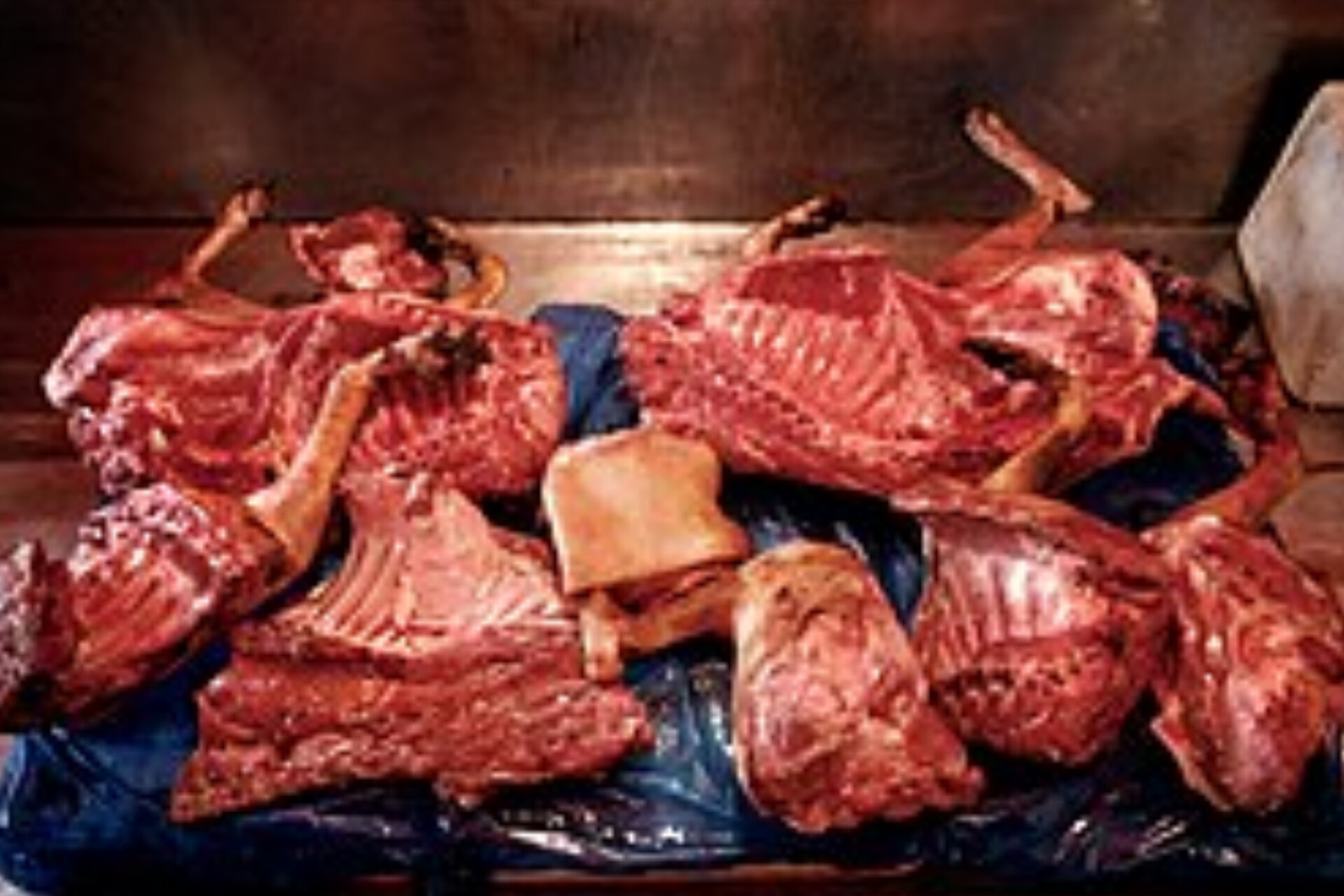
Dogs’ flesh as food.. — Arriving at the canine animals of prey we flnd that among the ancient Greeks and Romans the dog was dished up at table, and, according to Pliny, roasted puppy dogs were considered excellent. Hippocrates was convinced that it was a light and wholesome food. They were served up at sumptuous feasts and at the festivals in honour of the consecration of the pontiffs. Dogs were regularly fed by the Romans for the table, and roast dog was one of the dishes most in vogue.
Galen represents dog-meat as a highly desirable diet. M. E. Blaze, a French author, remarks: — “J’ai mangé plusieurs fois à I’armée du chien et du chat; je préfère cette viande à celle du cheval.”
Many of the North American tribes look upon an entrée of dog as the greatest possible bonne bouche they can set before a stranger. Sir Leopold McClintock relates that in the Sandwich Islands he had most profuse apologies offered to him because there was no puppy to be had for a feast to which he was invited. The Esquimaux, too, look upon a dish of young dog as a great treat; and it is related that a Danish captain provided his friends with a feast of this kind, and when they praised his mutton, sent for the skin of the beast and exhibited it to them!
Many nations still consider the flesh of the dog excellent. In the Society Islands and parts of Africa, young puppies are considered a great delicacy.
In China the poorer classes eat the flesh of all dogs, but the rich only once or twice a year, under the idea that dog’s flesh is a stimulant to the digestive functions.
“The dog mostly consumed by the Chinese is of a small size, and usually of a light brown colour, covered with a coat of soft, short hair, so thick as to look almost like wool. But the Chinese housewife refuses to cook dogs in the family pot, or in the domestic kitchen, and they are driven to the alternative of being boiled in the streets. On any morning, in certain open spaces at street corners, the execution of a certain number of unfortunate chow-chow dogs may be witnessed; after which, being skinned, they are forthwith placed in a suspended cauldron and the disjecta membra are then to be seen simmering, and inviting the passer-by to stop and dine, which they do, there and then.”
Captain Burton says the principal article of diet among the Warori is fattened dogs’ flesh, of which the chiefs are inordinately fond. Schweinfurth states the flesh of the dog is not disdained by the Mittoo tribes inhabiting the territory within the 5° and 6° northern latitude. The Niam-niam also consider dogs dainty food. Lapdogs are fattened and used as food by the Western Balonda. The Somrais of Central Africa raise dogs, their flesh forming an article of food luxury.
Bosman, in his “Description of Guinea,” says, “the negroes are great lovers of dogs’ flesh, and they will willingly give a sheep for a good-sized dog. They prefer dogs’ flesh for their eating to that of cattle, and accordingly esteem a meal of that the best treat they can take or give.” The Africans of Zanzibar hold that a stew of puppies, as amongst us in the days of Charles II., is a dish fit for a monarch.
Humboldt tells us that, though the custom of eating the dog is disused on the banks of the Orinoco, it still exists in some parts of Guiana and Mexico.
In Australia the aborigines will even eat the wild dingo when hard pressed for food.
The Chinese, it is well known, have more curious habits and customs than any other people under the sun; fattening dogs for the purpose of human food is one of them, and in which a considerable trade is done. They are small, and fed on an exclusively vegetable diet.
Mr. Cooper, who has been labouring to establish an overland route from China to India, says that one morning, as he was sitting down to breakfast at a “tea-shop” in Hung-zachien, in the country of the Upper Yang-tse-Kiang, he was informed that he was in luck, as the proprietor just then happened to have a dog-ham in cut, some slices of which he should have fried, a-delicacy reserved only for mandarins like himself. At first he was on the point of ordering away the horrid dish, but, on second thoughts, he proceeded, with “stoical fortitude to taste doggie; one taste led to another,” and, in summing up, he pronounced the dog-ham to be delicious in fiavour, well-smoked, tender, and juicy.
“It was small, not much bigger than the leg of a good-sized sucking-pig; the flesh was dark, and the hair had been carefully removed, while the paw had been left as a stamp of its genuineness, as the proprietor remarked. Dog-hams are justly considered a great delicacy in China, and as such bring a very high price, costing as much as five taels (1 tael = 6s. 6d.) per pound. They are chiefly cured in the province of Hoonan, where dogs of a peculiar breed are fattened for the purpose. Hoonan is also famous for its pigs, and possesses a large trade in bacon and ham, especially in pig-hams which have been cured in the same tubs with dog-hams, and are thereby considered to have acquired a finer flavour.” In Cochin-China also dogs and foxes are eaten.
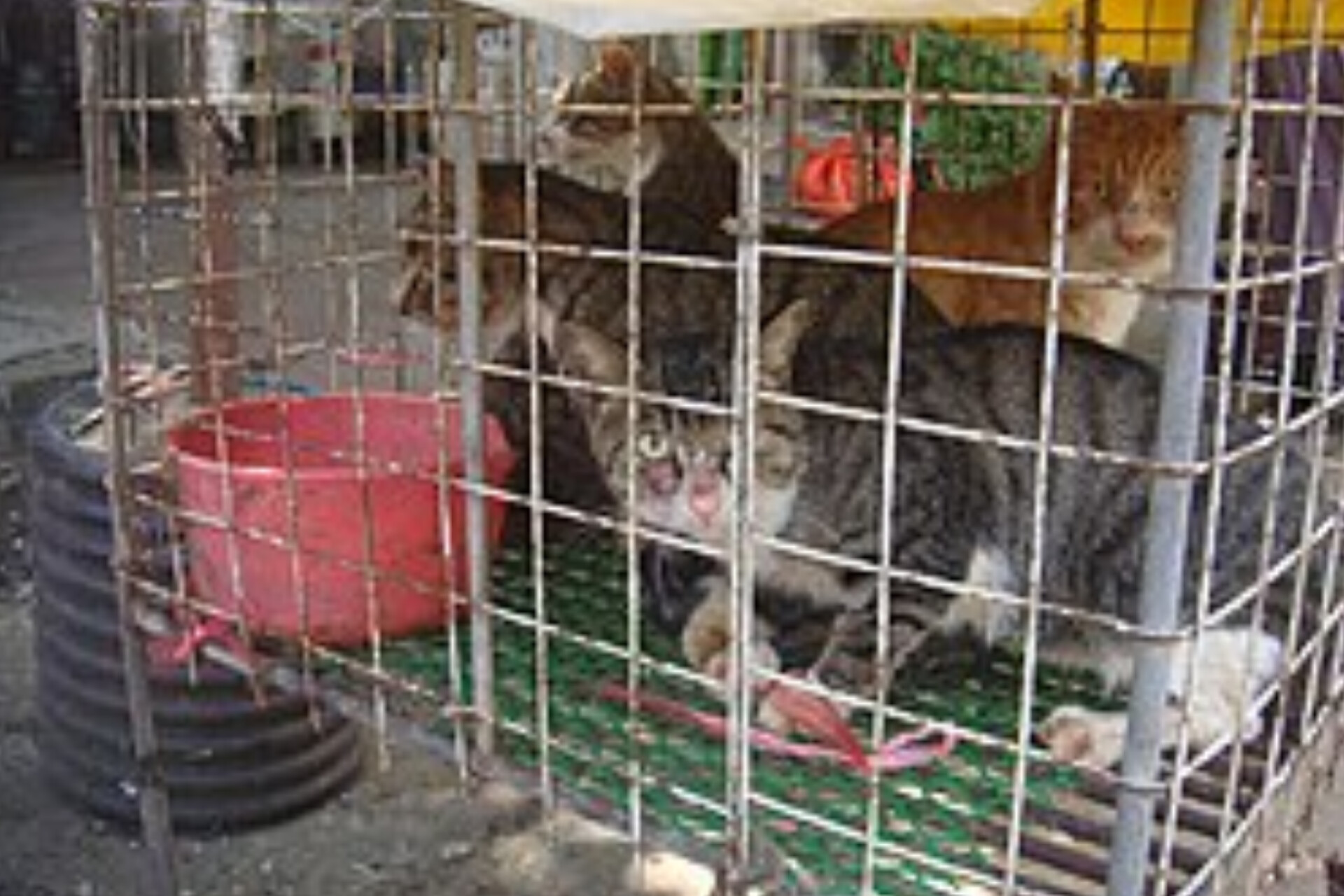
Mr. Gray, in his work “Fourteen Months in Canton,” thus speaks of cats and dogs as human food: — “The black cat is much more prized for food than any other of the feline race. We went upstairs leading to the saloon, where several small dining tables were placed. At one of these tables we saw a man with a little basin full of steaming stew. We went to him and said ‘Meau?’ (cat), and he answered ‘Yau’ (yes). It had a very dark appearance (warranted black cat, I should think), and had a most savoury smell. On the wall a bill of fare was placed, stating the cost of a repast of dog and cat. This is the correct rendering: ‘One tael of black dog’s flesh, 8 cash; one tael weight of black dog’s fat, 3 kandereens of silver; one basin of black cat’s flesh, 100 cash; one small basin of black cat’s flesh, 50 cash; and one pair of black cat’s eyes, 3 kandereens of silver.’
These restaurants are crowded at the celebration of the Hachi, or festival of the summer solstice, by men of all ranks. To eat dog’s flesh, especially black dog’s flesh, on that day is to secure the eater against sickness for the summer.”
The young dogs are brought to market in baskets made of bamboo, as also are young cats intended for the table. When delivered to the cook they are killed, scalded in boiling water, and the skin scraped with the blade of a knife to remove the hair, as is done with a pig.
When boiled, the flesh is cut up into small pieces that can be eaten with the chopsticks, each piece being dipped in soy and mixed with fish or rice. The young dogs and cats are highly esteemed as food dainties by the rich Chinese, while the poorer classes do not disdain the old animals. The Japanese eat dogs’ flesh, but only exceptionally.
Never was the ancient adage, “there is no accounting for tastes,” more quaintly illustrated than in a surprising story related in the London Daily Telegraph of March 20, 1880: — “One Peschka, an innkeeper of Neustadt, in Bohemia, was bitten some weeks ago by his own house-dog. Unwilling to slay the animal on bare suspicion of its sanity, he consigned it to the town gravedigger, enjoining that functionary to take care of it until further orders respecting its ultimate fate should be imparted to him. A few days later, however, Peschka was attacked by hydrophobia, of which horrible malady he died in excruciating agony.
The sanitary authorities of Neustadt forthwith applied to the gravedigger for the mad dog committed to his custody, intending to have it destroyed. Their astonishment may be more readily conceived than described when the sexton, in answer to their requisition, calmly observed, ‘The mad dog? I have eaten him!’ ‘You have eaten the mad dog?’ incredulously exclaimed a horror-stricken sanitary official. ‘Better that than he should eat me!’ rejoined the philosophical gravedigger. It would appear not only that this man of strange appetites had swallowed and digested the rabid animal, but that it had agreed with him; for, as the story runs, he is still in the enjoyment of robust health, and pursues his professional avocations with unabated vigour.”
In May, 1842, a butcher of Besançon was sentenced by the Tribunal of Correction to three months’ imprisonment for selling dog instead of kid to his customers.
How the tastes of men differ! Forster, in his “Voyage Round the World,” thus expresses himself: “In our cold countries, where animal food is so much used, and where to be carnivorous perhaps lies in the nature of man, or is indispensably necessary to the preservation of health and strength, it is strange that there should exist a Jewish aversion to dogs’ flesh, when hogs, the most unclean of all animals, are eaten without scruple. Nature seems to have expressly intended them for this use by making their offspring so very numerous and their increase so quick and frequent.”
Mr. Wilson, who quotes the above, adds: “There is no reason why it should not be more extensively practised in Europe. We know, for example, that Captain Cook’s recovery from a serious illness at sea, if not entirely owing to, was at least greatly ameliorated by the broth and flesh of a dog.”
“Amongst the Society Islands,” says Mr. Frederick Bennet, ” the aboriginal dog, which was formerly eaten as a delicacy by the natives, is now extinct or merged into mongrel breeds by propagation with many exotic varieties. At the Sandwich group, where the inhabitants have been more remarkable for the use of this animal as food, and where that custom is yet pertinaciously retained, the pure breed of the Poe dog has been better protected, and although becoming yearly more scarce, examples of it are yet to be met with in all the islands, but principally as a delicacy for the use of the chiefs. As late as October, 1835, I noticed in the populous and well-civilised town of Honolulu, at Oahu, a skinned dog suspended at the door of a house of entertainment for natives, to denote what sumptuous fare might be obtained within.”
Anson, in his voyage round the world, speaking of Juan Fernandez, says: “These dogs, who are masters of all the accessible parts of the island, are of various kinds, some of them very large, and are multiplied to a prodigious degree. They sometimes came down to our habitations at night and stole our provisions, and once or twice they set upon single persons; but assistance being at hand, they were driven off without doing any mischief. As at present it is rare for goats to fall in their way, we conceived that they lived principally on young seals; and indeed some of our people had the curiosity to kill dogs sometimes and dress them, and it seemed to be agreed that they had a fishy taste.”
Foxes as Food. — The flesh of the Arctic fox, particularly when young, is edible, whilst that of the red fox is ill-tasting, rank, and disagreeable, and eaten only through necessity. Sir John Franklin’s party and other Arctic voyagers agreed with Hearne in comparing the flavour of a young Arctic fox to that of the American hare. Captain Lyon considered it to resemble the flesh of a kid. In Ross’s voyage they were named lambs, from their resemblance in flavour to very young lamb.
“The flesh,” observes Sir James Ross, “of the old fox is by no means so palatable, and the water it is boiled in becomes so acrid as to excoriate the mouth and tongue. During our late expedition they constituted one of the principal luxuries of our table, and were always reserved for holidays and great occasions. We ate them boiled, or more frequently parboiled, roasted in a pitch kettle.”
Mr. Kennedy, in his “Voyage to the Arctic Regions,” speaks of the delicacy of a fox pie, which was pronounced by competent authorities in his mess to be equal to rabbit, but then he honestly admits that there were others to whom it suggested uncomfortable reminiscences of dead cats, and who generally preferred the opposite side of the table when this dish made its appearance. Tastes, however, seem to difler, and much no doubt depends on the keenness of the appetite and the choice there may be at table.
At a dinner given after a grand wolf hunt at Genis (Dordogne) by M. Piston d’Aubonne, master of the wolfhounds, a dish of cutlets was served from one of the animals killed, but they were found very tough and insipid.
At another sportsman’s dinner in the department of Correze, fillets of fox flesh were cooked and declared to be excellent eating. They eat foxes in Italy, where they are sold dear, and thought fit for the table of a cardinal.
Passing now to the feline or cat-like animals of prey — the terrible wild hunters of the forests and deserts — we find many of these are in turn devoured by man.
Lions. — The flesh of the lion is eaten by the Hottentots; and a tribe of Arabs between Tunis and Algeria, according to Blumenbach, live almost entirely upon it when they can get it. After a lion has been killed and the skin removed the flesh is divided, and the mothers take each a small piece of the animal’s heart and give it to their male children to eat, in order to render them strong and courageous.
It would seem from the Journal of the Marquis of Hastings, when Governor-General of India, that this superstition as to eating lion’s flesh is as strong in India, for it is stated: — “Anxious interest was made with our servants for a hit of the flesh, though it should he but the size of a hazel-nut. Every native in the camp, male or female, who was fortunate enough to get a morsel, dressed it and ate it. They have a strong conviction that the eating of a piece of lion’s flesh strengthens the constitution incalculably, and is a preservative against many particular distempers.
The idea that a person imbibes the characteristics of an animal which he eats is very widely distributed. The Malays at Singapore used to give a large price for the flesh of the tiger, not because they liked it, but because they believed that the man who eats tiger’s flesh will become as wise and powerful as that animal.” The Dyaks of Borneo have a prejudice against the flesh of the deer, which the men may not eat, though it is allowed to the women and children. The reason given is that if the men were to eat venison they would become as timid as deer.
The Caribs will not eat the flesh of pigs or of tortoises, lest they should get small eyes. The Dacotahs of North America eat the liver of the dog that they may become as wise and brave as that animal.
The flesh of the lion has been eaten with gusto even by Europeans; for Madame Bedichon, in her work on “Algeria,” states that at Oran a lion was killed which three days before had eaten a man, and the Préfet gave a grand dinner, the principal dish being part of the lion, which the French guests assembled ate with great relish.
More recently a magnificent quarter of a lion, shot in the neighbourhood of Philippeville, Algeria, by M. Constant Cheret, was sent to the Restaurant Magny, Paris, and served up to a party of nineteen guests, who enjoyed with gusto “Estouffade de leon à la meridionale,” and “Coeur de leon a la Castellane.”
The flesh of the American jaguar or panther is considered not bad eating, and that of the wild cat of Louisiana is also reported to be excellent. The former is eaten in Central and South America. Mr. Darwin, in his ” Journal of a Naturalist,” tells us that he supped on it, and found the meat very white and remarkably like veal in taste.
Mr. Wallace, when travelling up the Amazon, one day had some steaks of a jaguar (Felis onca) on his table, and found the meat very white and without any bad taste. “It appears evident to me,” he adds, “that the common idea of the food of an animal determining the quality of its flesh is quite erroneous. Domestic poultry and pigs are the most unclean animals in their food, yet their flesh is highly esteemed, while field rats and squirrels, which eat only vegetable food, are in general disrepute.”
Carnivorous fish are not less delicate eating than herbivorous ones, and there appears no reason why some carnivorous animals should not furnish wholesome and palatable food. The low Arabs do not object to the flesh of the hyaena, although the smell of the carcass is so rank and offensive that even dogs leave it with disgust.
The natives eat the flesh of the Canada lynx (Felis Canadensis, Geoffroy), which is white and tender but rather flavourless, much resembling that of the American hare. The European species (F. lynx) is also eaten in Switzerland and in Siberia.
Opossums and Bandicoots. — We have not quite done with the Camivora, for the flesh of some of the carnivorous marsupials, such as the opossums, bandicoots and tiger cats, are eaten by man.
The vulpine or brushtailed opossum (Phalangista vulpina) is the staff of life to the natives of Australia. Mr. Gerardt Krafft says: — “I often admired my native friends, when, after a hard day’s unsuccessful hunting, they dropped in at the camp empty-handed, how carefully they would examine the large flooded gum-trees fringing the river banks, how nimbly they would get a footing upon some’ hollow limb, and with what perseverance ‘Possum’ was dislodged and perhaps accidentally dropped into the river, whence it had to be rescued by the black fellow’s better-half; for it was the question of ‘to eat or not to eat'”
The flesh of that most malodorous marsupial, the common opossum (Didelphys Virginiana) is eaten in some of the States of North America, and is said to be white and well tasted.
In Rio Grande do Sul and other provinces of Brazil, they bury it in the earth until the flesh is free from its characteristic ofiensive smell; before cooking, the axillary glands must first be extracted.
An American named Chancey has lately started a novel business at Hawkinsville, near Savannah, for raising opossums on a farm enclosed with wire fencing. As the average piney wood opossum finds a ready sale at about 2s., a fine fat stall-fed opossum will bring double that amount.
The flesh of the Australian bandicoot (Perameles obesula) is delicious, especially when done in the native style, that is, the hair removed and the game roasted upon the coals. The native tiger cat (Dasyurus Geoffroyi), the most bloodthirsty of the marsupial animals of Australia, is eaten by the natives.
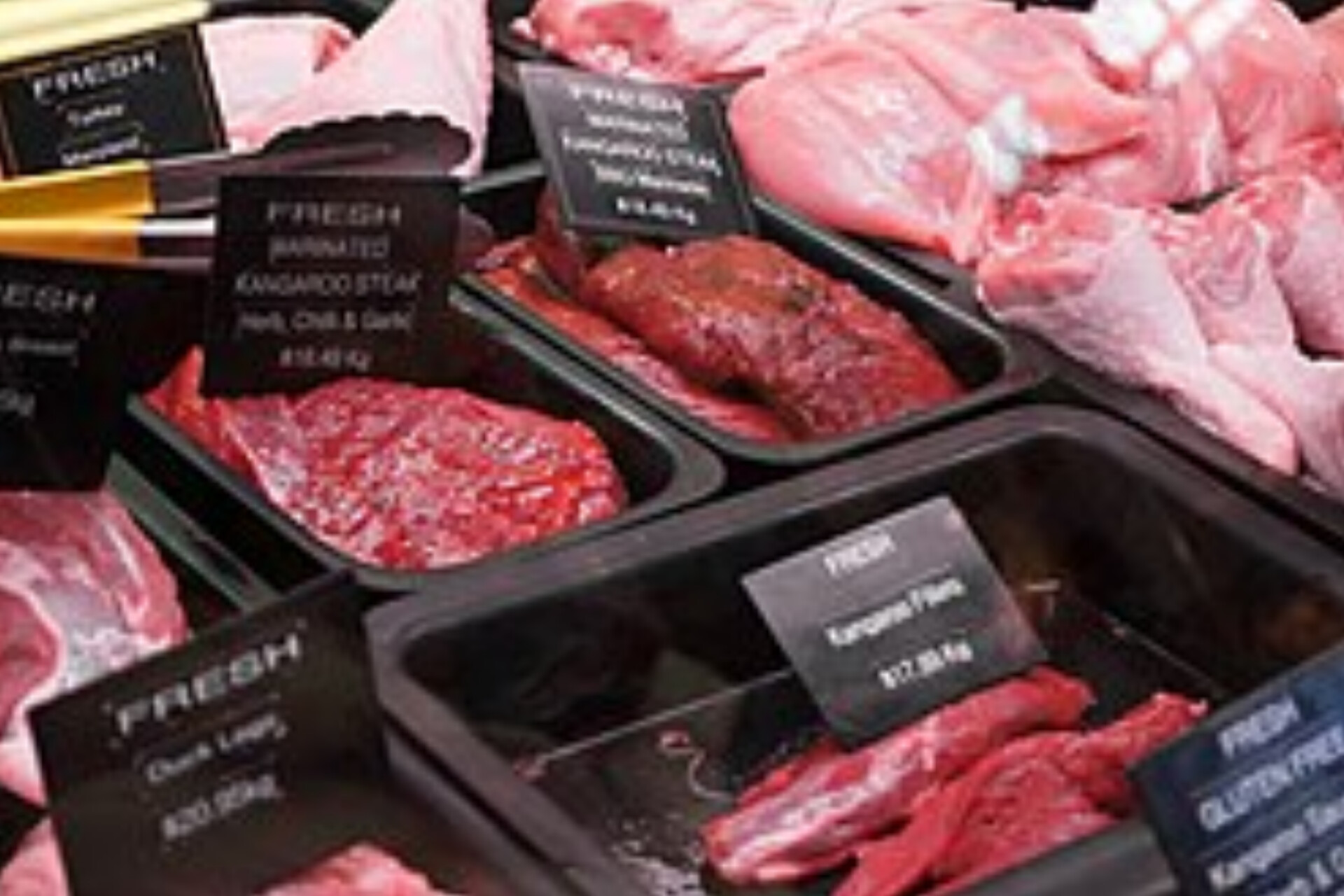
Kangaroos. — The flesh of all the herbivorous marsupials is good. The forequarters indeed of the larger kangaroos are somewhat inferior, and are usually given to the dogs; but from the hinder quarters some fine steaks may be cut. These cooked in the same manner as venison collops, are, to most palates, very little inferior to the latter. The flesh of the large kangaroo, as well as that of the wallaby, is often dressed in the shape of a hash, and in this form also it is excellent. But the most admired part of the kangaroo is his tail. This is of enormous size in proportion to the rest of the body, the tail of a full-grown forester usually weighing ten or twelve pounds. It makes a superb soup, very much superior to ox-tail.
The wallaby, too, is most commonly used for soup.
The early settlers in the Australian colonies were more driven to eat kangaroo flesh than the present ones. On the 21st April, 1806, we find the following entry in a book on Tasmania: —
“There being a necessity for making every possible saving of the salted meat remaining in His Majesty’s stores, the commissary will receive kangaroo or emu at one shilling per pound, if brought to the stores on Mondays and Fridays, taking in only the hind quarters perfectly sweet, and issuing the same at the rate of two pounds of fresh for one of salted meat.”
The forester is the largest of the kangaroo family, and is frequently found of two hundred pounds weight. The large male of the species is generally called the “old man kangaroo” by the colonists. The wallaby (Halmaturus sp.) and the pademelon (H. thetidis) are much smaller; the average weight of the wallaby is about twelve or fourteen pounds, and that of the pademelon nine or ten pounds. The pademelon when cooked like a hare affords a dish with which the most fastidious gourmand might be satisfied.
The kangaroo rat (Bettongia rufescens) seldom weighs more than three or four pounds; it is not, as its name would import, anything of the rat species, but a perfect kangaroo in miniature. The flesh of the kangaroo rat resembles that of a rabbit, and it eats best when cooked in the same manner. This small animal is but little eaten, except by thorough bushmen, owing to the prejudice excited by the unfortunate name which has been bestowed upon it; but those who have once conquered this prejudice usually become fond of it, as the flesh is very palatable.
The flesh of the great red kangaroo (Osphranter rufus) is very palatable, indeed more so than that of Macropus major. That of the bridle nail-tailed kangaroo (Onychogalea frænata) is white and well tasted.
The flesh of the hare kangaroo (Lagorchestes leporoides) is delicious; in fact Mr. Kreft says it yields some of the best meat he ever tasted. The wombat (Phascolomys wombat) is another Australian marsupial, which sometimes weighs 140 lbs. The flesh is said by some to be not unlike venison, while others compare it to lean mutton.
The flesh of the taguar or great flying phalanger (Petaurisia taguarioides), a native of Australia, is said to be very good, and as the animal is a tolerably large one, it is a favourite article of diet among the white and black inhabitants of the country. It is, however, so extremely difficult of capture, that without the assistance of native aid, the white man would seldom be able to make a dinner on this creature.
The oil which can be obtained from a fat woodchuck (Arctomys monax, Lin.) has some value, and when rightly killed the meat is relished by some as food; the Indians consider the flesh of the hoary marmot (A. pruinosus, Pennant) as delicious food.
Considerable parties of Indians have been known to subsist for a time on the tawny marmot (Arctomys Richardsonii, Sabine) when the larger game is scarce; their flesh is palatable when they are fat.
The flesh of the Hudson’s Bay squirrel, or red chickaree (Sciurus Hudsonius, Pennant), is tender and edible, but that of the male has a strong murine flavour.
Among the squirrels which are eaten are the fox squirrel (Sciurus cinereus), the gray squirrel (S. carolinensis), the California gray squirrel (S. fossor), the tuft-eared squirrel (S. aberti), and the flying squirrel (Sciuropterus volucella). In the San Francisco market squirrels sell at 3s. to 4s. the dozen, and wild rabbits at 7s. to 8s. per dozen. The flesh of the squirrel is said to taste like that of the rabbit, but more juicy.
All the rodents are eaten by the natives of Australia, but only in case of no other food being at hand, as a large number of these little creatures are wanted to satisfy the hunger of a black fellow.
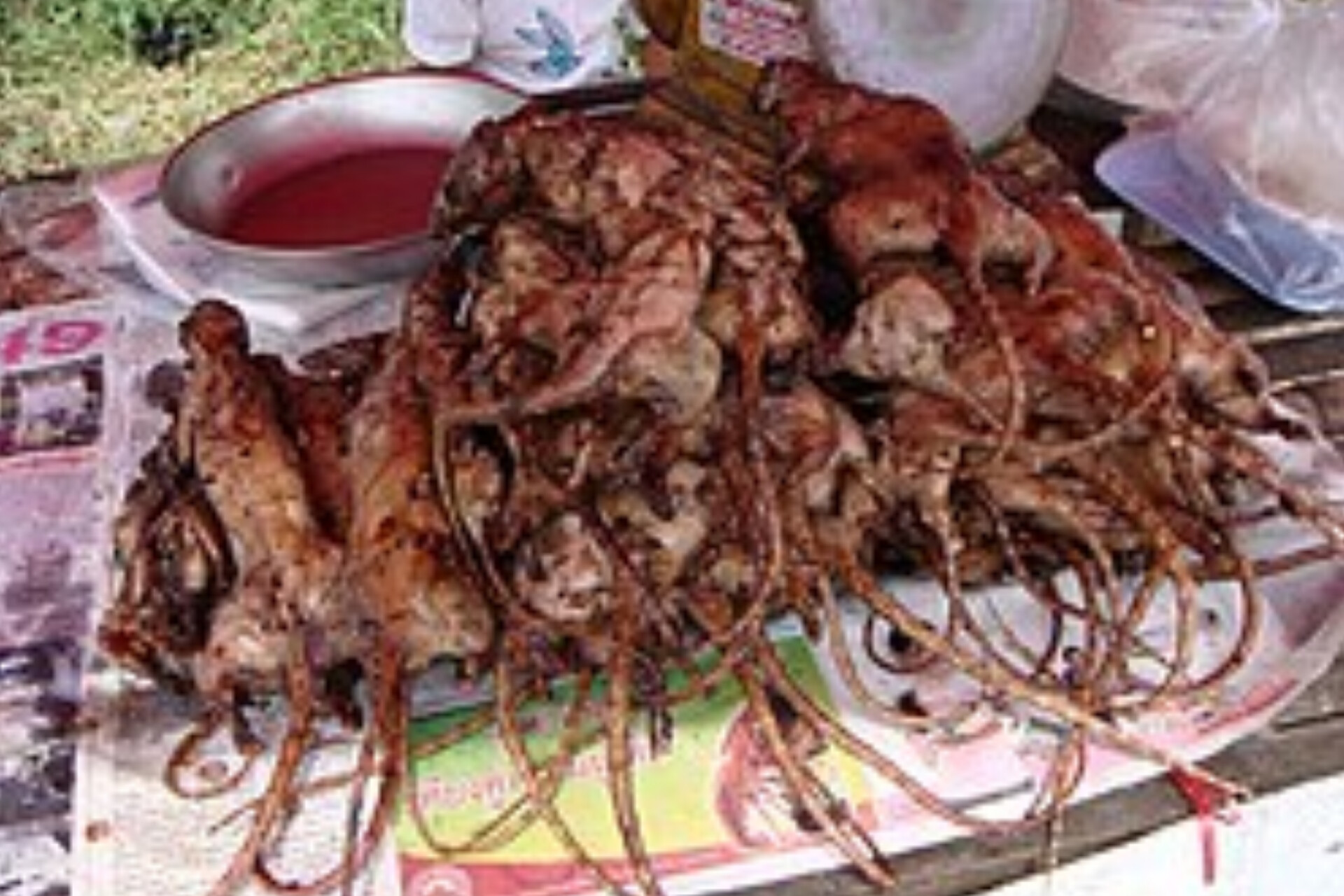
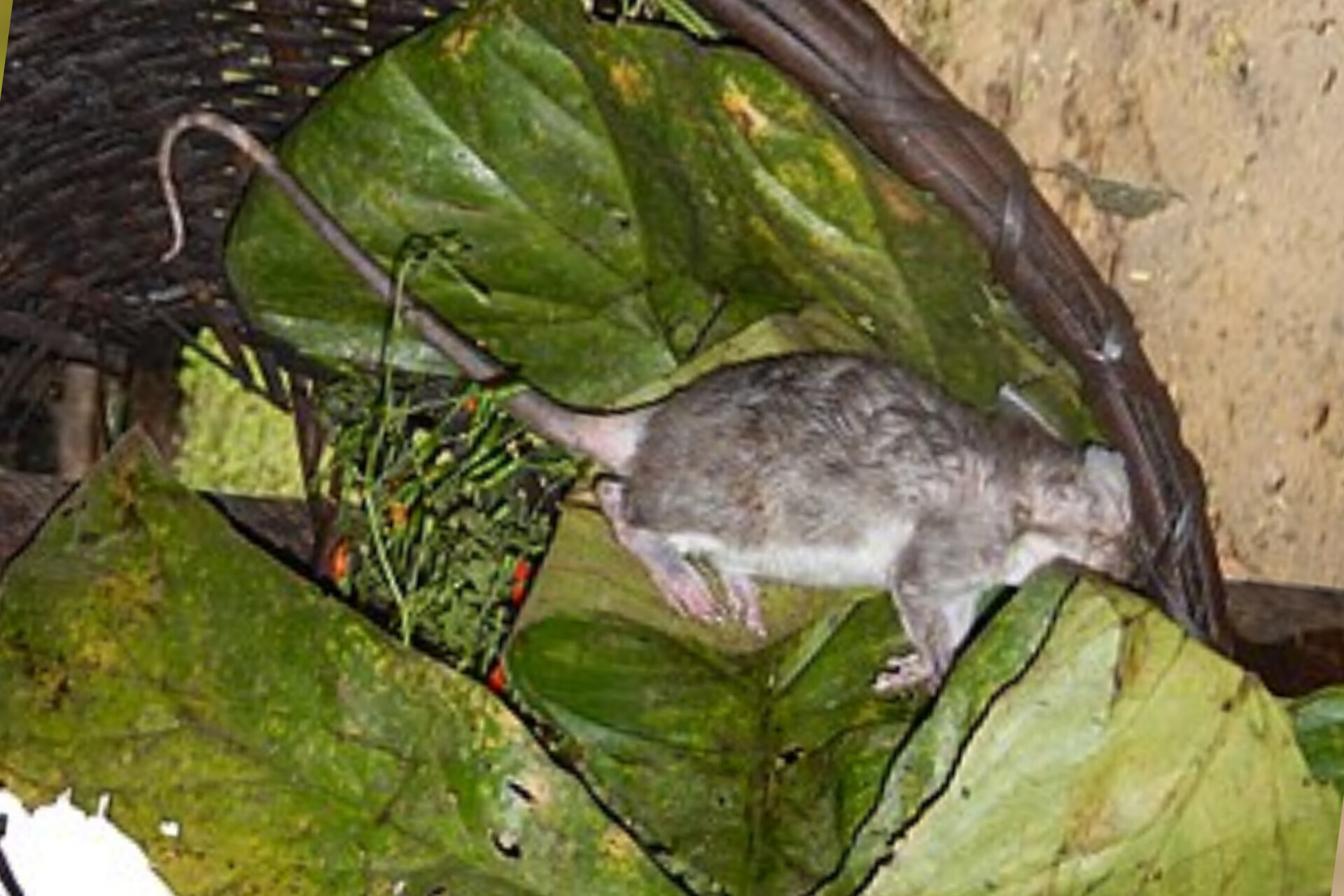
Rats. — Williams, in his Account of China, tells us that rats are very abundant, and furnish the common people with meat. Rats and mice, that shun the light of day, are not only eaten now by the Mongol races, but by other more civilised people. The Mongol fattens them like pigs, butchers them with care, and carries them on long white poles to market.
The wild cat [sic] is a very dainty dish among the West Indian negroes. The negroes in Brazil, like the aborigines in Australia, eat every rat they can catch.
It is a remarkable fact that there are no rats in the islands of the Pacific Ocean. Repeated attempts have been made to acclimatise the rodents there, as the flesh is much relished by the natives as an article of food, but the attempts thus far have failed, for they invariably die of consumption.
The mouse, to the Esquimaux epicure, is a real bonne bouche, and if he can catch half-a-dozen he runs a piece of horn or twig through them, in the same manner as the Leadenhall poulterers will larks; and, without stopping to skin or divest them of their entrails, broils them over the fire, and considers them a tit-bit.
I do not see why field rats should not be well tasted and wholesome meat, seeing that their food is entirely vegetable, and that they are clean, sleek, and plump.
The negroes on the West India plantations will often roast the cane-piece rats in the stoke-holes of the sugar-boiling houses, and those who have tasted them declare them to be very good eating.
So fat do the rats become in the West Indies, from feeding on the sugar canes, that most of the blacks esteem them highly, and, with the addition of chillies and other spiceries, make of them a delicate fricassee, not to be surpassed by a dish of frogs. As there is a rat-catcher on every estate, who is paid a reward of so much per dozen for the rats’ tails he brings in, rats are very cheap. These rats’ tails might perhaps be utilised, for a paragraph going the round of the papers tells us, that at a recent banquet at the Trois Frères, Paris, the novel feature of rats’-tail soup was introduced; but it did not come up to ox-tail by any means.
Everyone has heard of rats being eaten during the siege of Paris; but perhaps it is not known that in Belgium a society of rat-eaters has been formed.
After the siege of Paris, when rats’ flesh was at a premium and the rodents were nearly exterminated in the crusade carried on against them, these animals once more increased prodigiously, until the great sewers which run beneath the streets of the city now swarm with them, and hence frequent battues have to be made with packs of terriers by the municipal authorities.
The Rev. J. G. Wood, a well-known naturalist, lecturing recently, spoke very favourably of rat pie.
“It is made,” he says, “in precisely the same manner as rabbit pie, the only difference being that in the case of the rat pie the result is far more delicious. The cook should be careful to procure as fine rats as possible, cut off their tails, skin, dress, and wash them, then cut them into four pieces, and add a few morsels of pork fat. When cooked and cold the pie is full of the most delicious jelly.” He had often, he added, been dining with his friends when they left the most delicious viands on the table untouched, while every scrap of the rat pie had been devoured.
Dr. Bller says a native rat formerly abounded to such an extent in the wooded parts of New Zealand, that it constituted the principal animal food of the Maori tribes of that period. The introduced Norway rat (Mus decumanus) has now exterminated and supplanted its predecessor.
The loir or dormouse (Myoxus glis, Lin., Desm.) was once in great request as a dainty for the table, numbers being cooped up and artificially fattened by the Romans. It is even now eaten in Italy….
Beaver. — The flesh of the beaver is much prized by the Indian and Canadian voyageurs, especially when it is roasted in the skin, after the hair has been singed off. In some districts it requires all the influence of the fur trader to restrain the hunters from sacrificing a considerable quantity of beaver furs every year, to secure the enjoyment of this luxury; Indians of note have generally one or two feasts in a season, wherein a roasted beaver is the prime dish. The meat resembles pork in flavour, but the lean is dark-coloured, the fat oily, and it requires a strong stomach to sustain a full meal of it. The tail, which is considered a great luxury, consists of a gristly kind of fat, as rich, but not so nauseating, as the fat of the body.
Porcupines. — The Indians and hunters in the United States and about the Rocky Mountain ranges, eat the flesh of the Canadian porcupine (Hystrix pilosus, Catesby), but to a more refined taste it would be unpalatable.
The flesh of the common crested porcupine (Hystrix cristata), like that of most purely vegetable-feeding rodents, is considered very delicate food, and is often eaten at dinners in Rome, being sold at 5d. per pound, the porcupine being not uncommon in the Campagna. It is said there that they should be cooked like a hare, or with wine sauce, like a wild boar. Porcupines are common in Algeria and parts of the west coast of Africa, and their flesh is much liked. Porcupine and palaver sauce is an esteemed dish at Fernando Po.
The flesh of the young porcupine is very good eating and nutritious food. To be cooked properly it should be boiled first and roasted afterwards. This is necessary to soften the thick, gristly skin, which is the best part of the animal. The Dutch and the Hottentots in Southern Africa are very fond of it. The flesh is said to eat better when it has been hung in the smoke of a chimney a couple of days.
The flesh of the tree porcupines of South America (Synetheres prehensilis and S. villosus) is also said to be delicate and tender. If so it very much belies the odour which proceeds from the body.
There are two species of paca or agouti, the Cœlogemys fulvus and C. subniger. The flesh of the agouti is white, tender, and well-tasted, and when fat and well-dressed is by no means unpalatable food. Waterton, however, says its flesh is dry, with scarcely any fat. It has been sometimes termed the rabbit of South America. The flesh of the cavy, a smaller species, also resembles it. The paca or spotted cavy (Cælogemys paca), is one of the best game animals of Brazil. Its flesh is said to be much esteemed, and forms a staple article of food in many parts of South America.
The flesh of the guinea pig is white and savoury. It used to be served up at table as a rarity in former times. That of the wild species (Cavia caprera), common in Central America, is very delicate.
The flesh of the biscacha (Calomys bizcacha), when cooked, is very white and good, but is seldom used, other animal food being so abundant in South America.
There are a few of the toothless animals (Edentata) which are laid under contribution for food. Wallace tells us he found the flesh of the sloth tender and palatable; it is esteemed a great delicacy by the Indians, who hunt the animal for the purposes of food. The echidna, or native porcupine of Australia, which belongs to this order, is said to taste well.
The flesh of the great anteater (Myrmecophaga jubata) is esteemed a delicacy by the Indians and negroes in Brazil and Western Africa, and though black and of a strong musky flavour, is sometimes even met with at the tables of the Europeans. Feeding largely on the so-called ants’ eggs, the flesh of the anteater of Australia is delicate meat, resembling that of a young sucking pig, and is considered superior to hare.
Most of the varieties of armadillo are used for food in South America. Waterton considered their flesh strong and rank, but throughout the whole of South America roast armadillo is highly esteemed, and may be seen in all the cafes and restaurants of the cities turned on their scaly backs feet uppermost, and the interior filled with a rich sauce composed of lemons and spices.
Peludos, or armadillos (Dasypus sexcinctus), are considered a very dainty dish by the natives and colonists when roasted in their skin, and served up in their shell or case. Mulitas (D. hybridus) are almost the same as peludos, and have such powerful claws, that if once they get their heads underground it is impossible to pull them out. The flesh of another species, the tatou (Dasypus villosus), of the River Plate, is one of the most exquisite meats that can be eaten.
“Possessed of a most overpowering and unpleasant smell of musk, the taurec (Centetes ecaudatus) is not an animal which would be supposed to furnish an agreeable article of diet to any one, except to a starving man in the last extremity of hunger. Yet the natives of Madagascar esteem it among their rarest luxuries, and are so tenacious of this very powerful food, that they can hardly be induced to part with a specimen which they have captured, and which they have already dedicated in anticipation to the composition of some wonderful specimen of the cook’s art.”
They hybemate from June to December, and as they are very fat when they first burrow, they are regarded as delicacies in Madagascar and Reunion, and pursued with great avidity.
CHAPTER IV.
FLESH FOOD FROM MAMMALS. — Continued.
Pachyderms — Elephants — Hippopotami — Rhinoceros — Tapir — Peccary — Swine — Immense Numbers in North America — Our Large Imports of Bacon, Hams, etc., from the United States— Wild Boars — Statistics of Swine in Various Countries — Consumption of Pork in France — Horseflesh Eaten in China, Europe, and America — Statistics of Horses — Increase of Consumption of Horseflesh in Europe — Asses and Mules also Eaten — Quagga and Zebra — The Ruminants — Statistics of Horned Cattle over the World — Consumption in the United Kingdom — Average Weights in Different Countries — Beef Imported into England — Quantity Sold in the London Markets — Average Prices — Buffaloes — Statistics of Sheep in Various Countries — Large Imports of Carcases from New Zealand — Imports of Sheep to the London Markets and Comparative Prices — Average Weight of Different Kinds of Sheep— Groats’ Flesh — Flesh of the Camel Tribe— Alpaca — Giraffe — Venison — Reindeer — Moose or Elk — Antelopes — Eland — Bison — Marine Mammals — Whales — Seals — Sea Lion — Sea Elephant — Walrus — Dugongs — Dolphins — Porpoises.
We now have to treat of flesh food obtained from the pachyderms, ruminants and amphibious mammals. We will take first the thick-skinned quadrupeds.
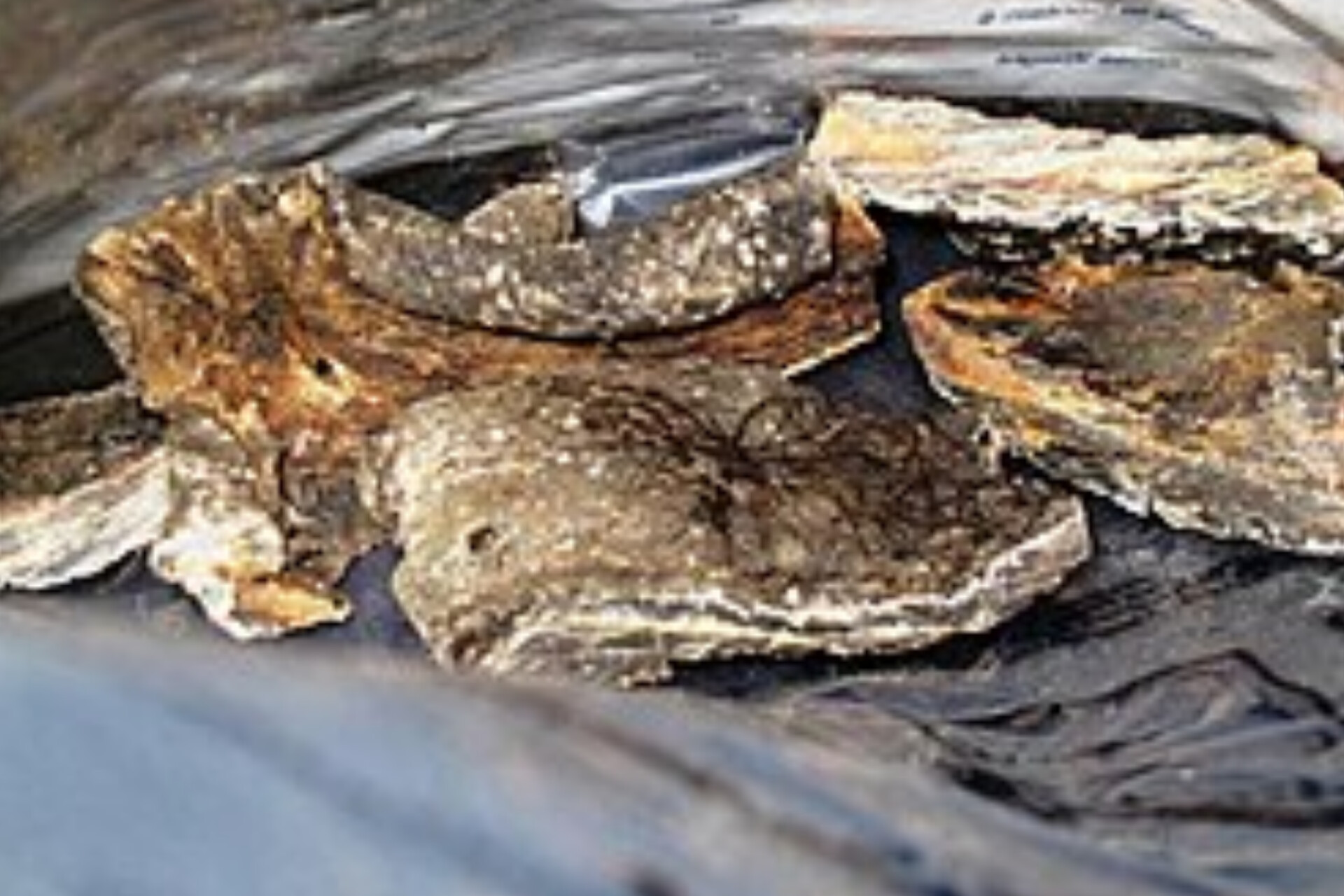
Elephants’ flesh. — The flesh of this great animal, when it cannot be eaten fresh, is in Africa, Asia and Ceylon either simply sun-dried or salted and smoked. The whole of the flesh is cut into thongs like the reins of a bridle, which are hung in festoons on the branches of trees till they become perfectly dry.
Gordon Gumming thus speaks of it: — “The flesh of the elephant is cut into strips, varying from six to twenty feet and about two inches in breadth and thickness. It is then placed on poles and allowed to dry in the sun for two or three days, after which it is packed into bundles, each man carrying off his share to his wife and family.” He then speaks of the dainty dishes of baked elephant’s feet and elephant’s trunk.
The flesh of the elephant is relished by the inhabitants of many districts of Africa and Asia. Major Denham speaks of it as being esteemed by all, and even eaten in secret by the first people about the Sheik, and he adds that though it looked coarse, it was better flavoured than any beef he found in the country.
The ancient Romans considered the trunk as the most delicious part, but others fancy the foot to be the best. What are sheep’s trotters and insipid boiled calves’ feet compared to baked elephants’ feet? Gordon Gumming thus describes the whole art and mystery of the process of preparing them: —
“The four feet are amputated at the fetlock joint, and the trunk, which at the base is about two feet in thickness, is cut into convenient lengths. Trunk and feet are then baked, preparatory to their removal to headquarters. The manner in which this is done is as follows: — A party, provided with sharp-pointed sticks, dig a hole in the ground for each foot and a portion of the trunk. These holes are about two feet deep and a yard in width; the excavated earth is embanked around the margin of the holes. This work being completed, they next collect an immense quantity of dry branches and trunks of trees, of which there is always a profusion scattered around, having been broken by the elephants in former years. These they pile above the holes to the height of eight or nine feet, and then set flre to the heap. When these strong fires have burnt down, and the whole of the wood is reduced to ashes, the holes and the surrounding earth are heated to a high degree. Ten or twelve men then stand round the pit and take out the ashes with a pole about sixteen feet in length, having a hook at the end. They relieve one another in quick succession, each man running in and raking the ashes for a few seconds, and then pitching the pole to his comrade, and retreating, since the heat is so intense that it is scarcely to be endured.”
“When all the ashes are thus raked out beyond the surrounding bank of earth, each elephant’s foot and portion of the trunk is lifted by two athletic men, standing side by side, who place it on their shoulders, and, approaching the pit together, they heave it into it. The long pole is now again resumed, and with it they shove in the heated bank of earth upon the foot, shoving and raking until it is completely buried in the earth. The hot embers, of which there is always a great supply, are then raked into a heap above the foot, and another bonfire is kindled over each, which is allowed to burn down and die a natural death; by which time the enormous foot or trunk will be found to be equally baked throughout its inmost parts. When the foot is supposed to be ready, it is taken out of the ground with pointed sticks, and is first well beaten, and then scraped with an assegai, whereby adhering particles of sand are got rid of. The outside is then pared off, and it is transfixed with a sharp stake for facility of carriage. The feet thus cooked are excellent, as is also the trunk, which very much resembles buffalo’s tongue.”
These certainly not “petit” toes when pickled in strong toddy, vinegar and cayenne pepper, are considered an Apician luxury in Ceylon.
Le Vaillant tells us that he found baked elephant’s foot was food fit for a king. “I had often heard (he adds) the feet of bears boasted of, but I could not conceive how an animal so heavy and coarse as the elephant could produce so tender and delicate flesh. ‘Never (said I to myself), never can our modern Luculli display upon their tables a dish like that which I now enjoy. In vain with their riches do they change and reverse the seasons; in vain do they boast of laying all Nature under contribution; their luxury has never yet attained to this gratification; bounds are prescribed to their sensuality.’ And I devoured without bread my elephant’s foot, while my Hottentots seated near me regaled themselves with other parts, which they found no less excellent.”
Opinions seem to differ on this head, for Captain A. Lindley, an African traveller, observes: “I cannot say much in favour of elephant’s foot, though it is the bonne bouche of all Kaffirs. The Umzielas cooked it in an oven they made in the ground and then piled up fire on top. In flavour it was more like very soft leather and glue mixed together than anything else that I can compare it to.
“Cuvier remarks that the trunk, being composed of a mixture of delicate muscular fibres and rich fat, would necessarily, when properly prepared, afford an article of food that might be very palatable. Pliny, in his ” Natural History,” having never perhaps tasted this viand, observes: — “Luxury has discovered even another recommendation in this animal, having found a particularly delicate flavour in the cartilaginous part of the trunk, for no other reason, in my belief, than because it fancies itself to be eating ivory.” But ivory is absolutely frequently eaten now, for the ivory dust collected from the ivory turners is sold at about 6d. a pound and makes excellent jellies.
Hippopotami. — The ivory hunter on the bank of an African river having killed a hippopotamus for the supper of his negro attendants, leisurely watches their proceedings in preparing the feast, and observes that the entrails, without being cleansed, are carefully preserved as the choicest morsel, and subsequently cut up and distributed in shares to the party according to rank. When slightly roasted they are devoured with unmistakable signs of enjoyment. Being disposed, philosophically, to inquire into the nature of things, the hunter tries the taste of the extraordinary food, and leaves on record that the savages are certainly not without reason for their preference.
The flesh of the hippopotamus is much eaten by the natives of Africa, and even by Europeans it is not to be despised, although travellers seem to disagree as to its merits. Cumming says the flesh is excellent eating, and Baker appears to agree with him, while Dr. Livingstone speaks o£ it as being pretty good food when one is hungry and cannot get anything better, but that it is a coarse-grained meat, having a flavour something between pork and beef.
The flesh of the hippopotamus is well esteemed, and the meat, according to Du Chaillu, does not taste unlike beef. He considers it rather coarse-grained, and not fat, but a welcome and wholesome dish.
A fine young specimen which was exhibited in the Crystal Palace was roasted alive when the eastern wing of that palace was burned, in December, 1866. The hippopotamus was a black, leathery-looking, charred mass. Upon being more closely examined, it did not at all appear so distasteful a morsel as at a first glance. True, the skin was leathery and charred, but it had split in places, like cracknel, exposing a beautifully-delicate white meat or fat underneath. Dr. Crisp secured it, and he has given an account of his dissection of it in the “Proceedings of the Zoological Society, 1867,” p. 601.
He there tells us that one side of the animal was well roasted, and that he supplied some of his friends with the meat thus cooked — gipsy fashion — and partook of it several times himself. He reports the flavour as excellent, and the colour of the flesh whiter than that of any veal he ever saw. The fat lay under the skin as in the hog, and not in the interior as in the elephant; it was about 1 1/2 inches in thickness.
In South Africa hippopotamus meat is in request both among natives and colonists, and the epicures of Cape Town do not disdain to use their influence with the country farmers to obtain a preference in the matter of “sea cow’s speck,” (as the fat which lies immediately under the skin is called,) when salted and dried.
Dr. Schweinfurth says he always found hippopotamus bacon unfit for eating, and when cut into narrow strips and roasted it was as hard and tough as so much rope. The same may be said of the tongue, which he often had smoked and salted. The meat is remarkably fibrous and is one continuous tissue of sinews.
Captain A. Lindley, in his work “After Ophir,” says: “We dined off hippopotamus steak. It was not much relished, however, and we did not care to try it again; but then the dark-coloured, coarse, and peculiarly flavoured flesh — a little more beef than fowl, and a little more fish than beef — though pretty tender and fairly succulent, could not be compared with the sweet wild-fowl and delicious venison we generally had at table.”
The flesh of the rhinoceros is devoured in Abyssinia, and by some of the Dutch settlers in the Cape Colony it is held in high esteem. So is hippopotamus meat, as we have seen, which is eaten either roasted or boiled. The fat with which these animals are covered is con-sidered delicious; it is used in making puddings instead of butter. When salted it is greatly prized not only for the table, but for its reputed medicinal qualities. The Portuguese settlers on the east coast are permitted by their priests to eat the flesh of this animal in Lent, passing it off as fish, from its amphibious habits, and hence their consciences are at ease.
The flesh of the American tapir (Tapirus Americanus) although described by Europeans as unsavoury, coarse and dry, is considered palatable by the Indians. It somewhat resembles beef. The fatty protuberance on the nape of the neck is a delicacy which would do honour to the table of a modern Lucullus. The feet and groin cooked to a jelly are also morsels for a king. Most wild swine are, however, horribly rank, but by proper feeding they become delicious. A boar’s head is, however, an appreciated delicacy of old reputation.
There are two species of peccary (Dicoteles) met with in South America. Both have on the back a fetid open gland, which must be cut out as soon as the animal is killed, for if allowed to remain the flesh would be uneatable. The peccaries are said by all those who have partaken of them to be excellent eating, and Sonnini frequently mentions his delicious repasts on them in the forest….
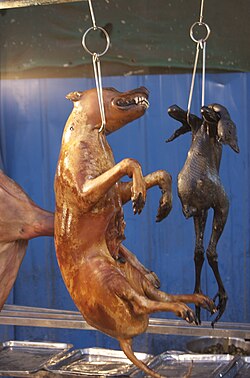
Peter L. Simmonds, The Animal Resources of Different Nations, with Mention of Some of the Special Dainties of Various People Derived from the Animal Kingdom (London: E. & F.N. Spon, 1885), pp. 54-76, 78-81, and 82-88. References and footnotes have been deleted. The lead picture of slaughtered dogs can be found in: https://en.wikipedia.org/wiki/Dog_Meat_Festival. First picture top row of rat meat: https://en.wikipedia.org/wiki/Rat_meat; second image of a dead rat: https://en.wikipedia.org/wiki/Bushmeat; third picture of dog meat: https://en.wikipedia.org/wiki/Dog_meat_consumption_in_South_Korea; and fourth picture of elephant meat: https://en.wikipedia.org/wiki/Elephant_meat. First picture bottom row of dog meat: https://en.wikipedia.org/wiki/Dog_meat; second image of kangaroo meat: https://en.wikipedia.org/wiki/Kangaroo_meat; third picture of bush meat: https://en.wikipedia.org/wiki/Bushmeat; and fourth image of caged cats in a restaurant: https://en.wikipedia.org/wiki/Cat_meat.
See: https://babel.hathitrust.org/cgi/pt?id=coo1.ark:/13960/t7xk8wm2s&seq=1&q1=