Australia
We want you to have a greater ability to learn about some of the unpleasant animal issues in our world.
Save Australia
James W. Barrett
GENERAL INTRODUCTION
BY SIR JAMES BARRETT, K.B.Ε.
Australia possesses perhaps the most distinctive Flora and Fauna to be found on any of the land divisions of the Globe. It is apparently a very old continent which was cut off at a remote period from Asia and New Zealand. Free from the competition of superior types the animals have developed as they did not, and could not have done, elsewhere. The Flora also show many peculiarities.
The evidence of early isolation is furnished by the extraordinary spread of the Eucalyptus when now introduced into other countries. On the other hand it is unlikely that lowly forms of life such as the Echidna (Porcupine or Spiny Anteater) or Platypus could have survived in many other countries. The Marsupials, freed from all competition except the menace of the Wild Dog (Dingo), have developed into a great variety of forms large and small. There are tree-climbing Kangaroos and other arboreal Marsupials, notably the Native Bear (Koala) and Possum (Phalangers). There are the Bounding Marsupials — the Kangaroo and Wallaby (Macropus), the Kangaroo Rat and the Bandicoot (Perameles). There are the Burrowing Marsupials of which the most notable is the Wombat (Phascolomys). All these are mainly herbivorous, although the Possum is under some conditions omnivorous.
On the Mainland the carnivorous Native Cat (Dasyurus) is still in evidence, whilst in Tasmania, the Devil (Sarcophilus) and the Tiger or Wolf (Thylacinus) are not quite extinct. There are also interesting Flying Marsupials, none, however, possessing true flight but capable of gliding.
All these varieties bear witness to a very long ancestry confirmed by the discovery of ancient forms of Kangaroo and Wombat of immense size, the Kangaroos being from two to three times larger than the existing forms.
The birds are very numerous, very varied, and in some respects unique. Flinders estimated that in Bass Strait he saw in four hours one hundred million mutton birds (Sooty Petrel). There are also to be seen those remarkable creatures the Mound Builders, i.e., the Mallee Hen (Lowan), the Bower Birds and the shy Lyre Bird.
All these wonderful creatures are giving way under changing conditions and the problem which lies before us and which is the purpose of this volume is to provide security against their complete extermination. We wish to so order our civilisation that every species of plant and animal indigenous to the continent is preserved in such circumstances that they may live their natural lives and reproduce their kind.
We may ask in the first place — Are they disappearing? The answer is unequivocal. Except in certain places where enlightened citizens have protected them they are all disappearing. It is difficult to-day for anyone to show a visitor in the State of Victoria the larger Marsupials or the Lyre Bird. It is quite impossible to find the smaller Marsupials except in a few favoured places and with great trouble. It is indeed feared that some varieties have been exterminated, If, however, expert evidence is required it can be obtained from the following extract from the publication of the American Museum of Natural History Annual Report, 1921: —
“Vanishing Life of Australia. — We are approaching the close of the Age of Mammals all over the world, but in no continent has the devastation been more rapid than that of Australia, owing to three causes: Deforestation, an enormous fur trade, and an increasing leather trade. In 1921, it became apparent that the American Museum must secure its representative collection now or never. Accordingly an expedition headed by Curator William K. Gregory was sent to Australia to meet representatives of leading Australian Scientific Institutions; to lecture in the various cities, and to explain the chief purposes of the Museum, which are to secure an exhibition of the wonderful and unique life of Australia, past and present, as distinguished from a research collection which belongs properly in the Australian Museums and in the great British Museum of Natural History in London.
“Accompanying Dr. Gregory was Mr. H. C. Raven, a most experienced and able collector, who has already reported a very encouraging beginning in this great undertaking. At the same time, Dr. Gregory planned a series of exchanges between America and the Australian Museums — especially of educational exhibits — which will be mutually advantageous. Scientific men, as well as the Government of Australia, have shown a cordial attitude towards the work of the expedition which has recently received a written indorsement from the British Ambassador at Washington, Sir Auckland Geddes.
“The total amount expended on this work during the year 1921 was $7,176.15.
“The location of the Australian Hall has not yet been definitely determined. An initial exhibition of the Australian collections will be displayed in the centre of the Philippine Hall.
“Australia has lately been inundated with collecting expeditions, and what is still more serious, private commercial collectors are trying to obtain specimens before extermination takes place. I am glad to say that the present Commonwealth Government has taken some action in the direction of limiting these wholesale activities. The extent of the destruction can be gauged from the following extracts from “Natural History”: —
“Figures quoted by Professor H. F. Osborn and N. E. Anthony in Natural History, 1922.
Fur Trade’s Toll during 1919-21: —
Australian Possums . . . . ..4,265,621
Ring-tailed Possums . . . . .1,321,625
Koala-Wombat” . . . . . . . . .208,677 (In the fur trade Koala is classed as wombat.)
Wallaby (Macropus Sp.) . .1,722
Total number of skins of Australian, American, and other fur bearers, for the period under review, 91,253,126. I
In no other continent has the devastation been more rapid than that of Australia.”
What then are the causes of the depletion? They are numerous. Largely the settlement of the country by man and the destruction of forests. Settlement means the removal of trees by the axe or fire, or both, and the introduction of animals of greater economic value which eat the grass and herbage. Necessarily the arboreal animals and some birds disappear and other forms are destroyed by the settler. This is inevitable and unavoidable.
There is, however, another side to the matter. The skins of many of the marsupials are valuable. Farms for their cultivation would prove profitable as the writer has frequently pointed out. There is now on the Blackwood River, in Western Australia, a successful Possum Farm, and others may appear. On such a farm the herd will be maintained, whereas in the country in general the deliberate destruction of marsupials for trading purposes by cyanide has ended in an immediate gain with the loss of the herd. We may take it that, apart from Marsupial Farms the opening up of the country will end in the extirpation of the marsupials and the alteration of Bird Life.
But what of the forests? There is no doubt that if the forests were properly protected from predatory men and that which is inseparable from such men, viz., fires, many of the Marsupials would be adequately protected, notably the Koala and the Possum. They might even become a source of revenue.
But the Forests of Australia are scanty and are not properly protected throughout. The following table [deleted] shows how sparse these Forests are relative to the total area. They are subject to constant nibbling under political pressure, and have been in the past most recklesly abused. A grazing licence is let to cattle grazers, and for the sake of a few hundred head of cattle huge areas have been destroyed by fire. The trees which survive are rendered worthless as timber, whilst the animals and birds are destroyed in the fire….
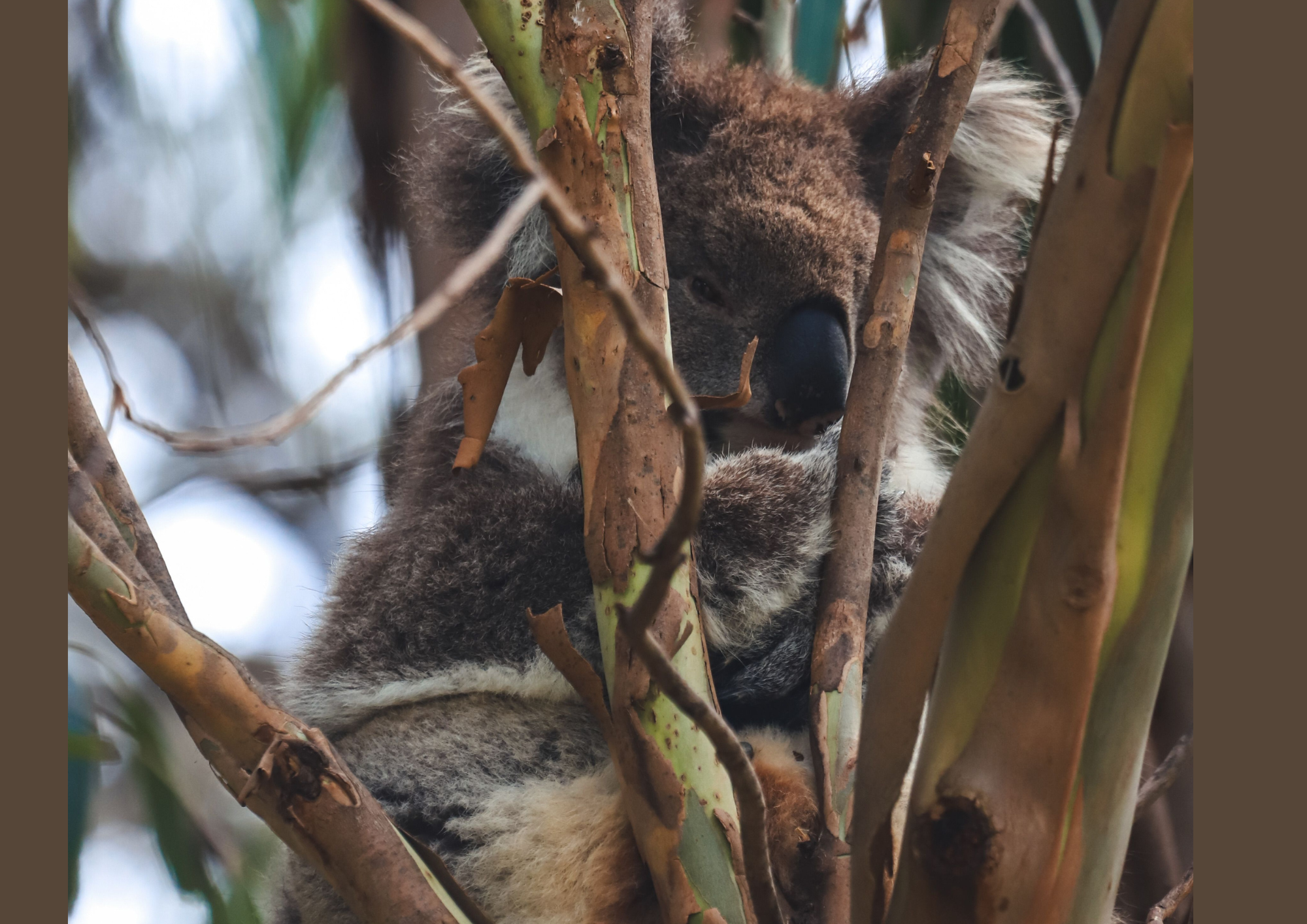
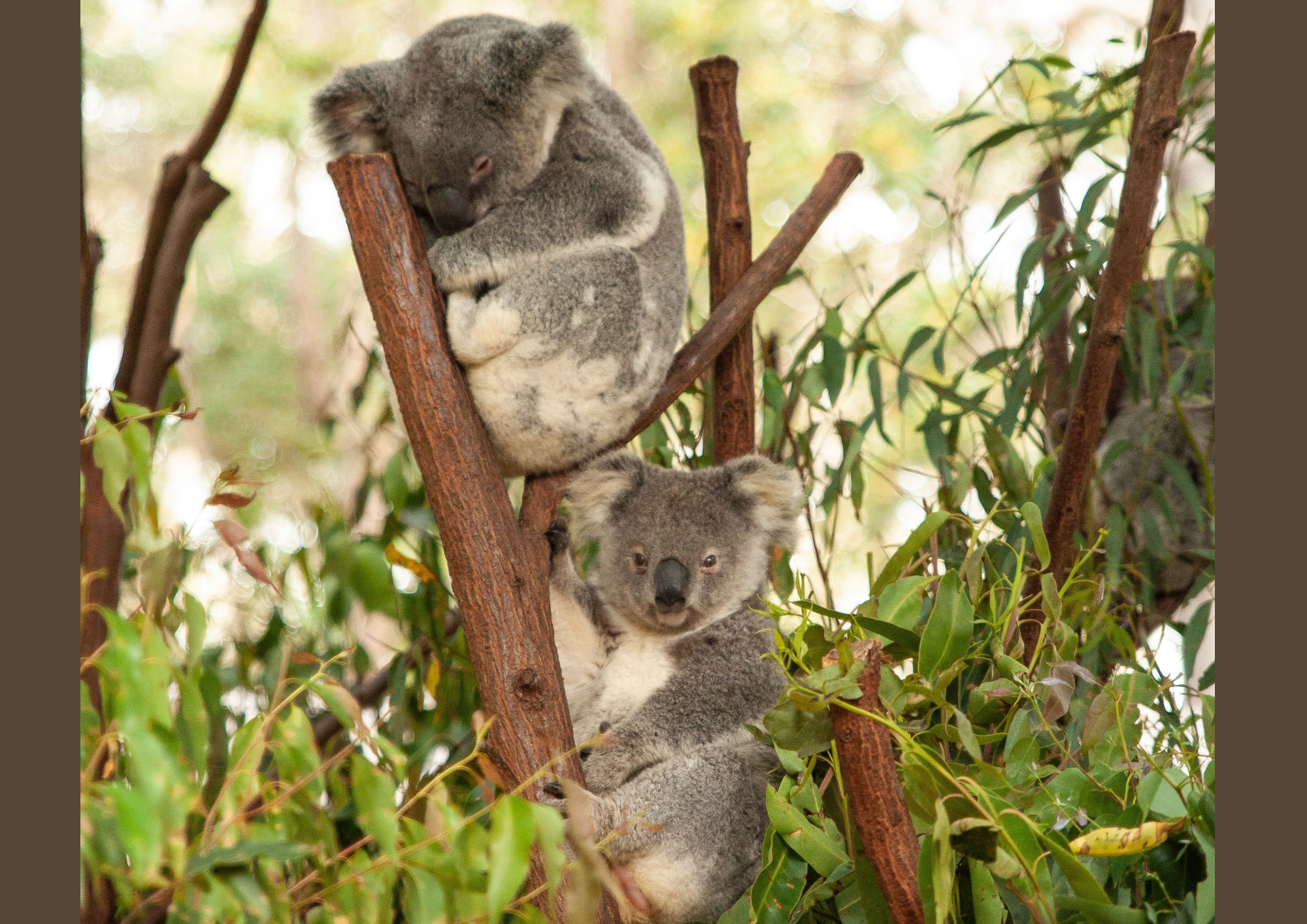
The Koala furnishes a most interesting example of the difficulty of keeping the animals in such circumstances. It is very difficult to keep in captivity. His principal food is the leaves of Eucalypts, but when he descends from the trees at night he may eat some grass. We do not know. We do know that he eats the leaves of E. Ovata, E. Viminalis, E. Stuartiana, E. Globulus, and possibly at times E. Citriodora, but he constantly changes his trees and travels great distances. He evidently cannot get all the elements of food he requires from any one tree. If the forest is fired he is destroyed. If the trees are cut down he can no longer live. Unless the necessary variety of tree can be found he disappears and with him we lose perhaps the most picturesque and popular animal on the continent.
THE INTRODUCTION OF PLANTS FROM ELSEWHERE.
From every point of view this has been a most serious matter. The Thistle, the Stink Wort (Inula Graveolens), the St. John’s Wort (Hypericum Perforatum), and numerous other plants have become menaces of the gravest character. The Prickly Pear (Opuntia), however, heads the list of noxious plants for deadliness. Its spread in Australia furnishes one of the most extraordinary instances of what may happen when a living organism is transplanted into new conditions. The Prickly Pear in Queensland alone, neglecting New South Wales, at present infests 24,000,000 acres — of these 101/2 million acres are densely infested and nearly 14 million are partially infested. In 10 years the spread has amounted to over 8,000,000 acres, i.e., 837,000 acres per annum or 2,300 acres per day. The history is exceedingly interesting. It appears that the Pear was first taken to Scone, in New South Wales, in 1839, and was thence taken to Warwick (Queensland) and other places in the Darling Downs in the early forties, but it was apparently not till the Seventies that people began to realise that there was any danger.
A Bill providing for the destruction of the Bathurst Burr and Scotch Thistle was introduced into the Legislative Assembly of Queensland in 1875, but no reference was made to the Prickly Pear in the debate which followed. But in a Bill introduced in 1880 Prickly Pear is first referred to as a noxious weed. The member who drew attention to it was laughed at, and the plant was regarded as useful fodder in time of drought. In 1886, however, the gravity of the position became obvious to those who were long-sighted, and a set of enactments were adopted, the activity culminating in the appointment of a Royal Commission by the Government of Queensland in March, 1923, which reported on the 5th of September in the same year. It is doubtful whether the densely infested land can profitably be cleared, but the commission is of opinion that the further spread of the Pear can be checked at very heavy cost.
Even worse than vegetable pests are the imported animals. One of the Australian comic papers years ago published a list of these plant and animal pests with an account of the damage done, and concluded: “And these are the silken bonds that bind us to the Motherland.” The Fox has spread throughout the greater part of Australia. He has become very prolific, and by reason of his vast numbers is a source of immense destruction. The Marsupials, ground and other birds, as well as some domesticated animals, are his prey.
Even more deadly to the native animals has been the Rabbit. This clever and ubiquitous creature has spread through the continent, ruining the pastures and expelling not only the native animals but also the domesticated creatures. Some idea of his numbers can be gauged from an instance: A property of about 8,000 acres near Seymour, Victoria, had been somewhat neglected. It was put in order and surrounded by a rabbit-proof fence. The rabbits were then attacked, and about 90,000 were destroyed, together with 80 foxes.
Against such a combination the smaller marsupial has no chance, and the larger has to fight to hold his own. people realise the far-reaching changes which men cause in the Balance of Life. The following extract from the “Outline of Science” tells the story well: —
“From one we may learn all, so we take from Dr. Ritchie’s book a single instance of the intricate interlinking of lives. It concerns a colony of black-headed gulls (Larus Ridibundus), which established itself on the White Moss, near West Linton, in Peebleshire. In 1890 the Moss was a typical heather moor, with peat and moisture underneath. In 1892 or 1893 a few pairs of gulls came to nest on the Moss and were encouraged; in 1897 there was a populous colony; in 1904 the number was estimated at 1,500 to 2,000 pairs. The vegetation round about the colony underwent a remarkable change; the heather was replaced by coarse grass, and that by rushes, and these by a orest of docks.
These changes in flora were due, of course, to the faunistic gull-invasion. The poor soil which only the symbiotic heather could make anything of, was fertilised by food-refuse and excreta from the gullery. Moreover, the puddling of the surface ground by the thousands of busy webbed feet, and the surface accumulation of crowded nests, meant a retention of superficial water. At all events the peat bed with its concealed and deep moisture was transformed into a surface marsh.
But further changes were in progress. The grouse that used to frequent the moor took their departure. Teal ducks arrived on the scene, attracted by the marsh and rushes. A single flock, when the gullery was at its height, numbered seventy. The grouse were out, the gulls and teal were in.
Fifteen years passed, and the scene was changed. Man interfered again, for he rapidly ousted the gulls from their tenancy of the White Moss. The villagers were disappointed because the coarse grass they had been wont to cut had been replaced by useless docks. The proprietor, who had been using a proportion of the gulls’ eggs as food for his young pheasants, was disappointed because the grouse had gone. So the edict went forth against gulls.
In the early summer of 1917 scarcely a gull was to be seen; the docks had almost disappeared; the rushes were giving way to rough grasses and even heather; the teal had gone and the grouse were returning. In a few years a slight imprint of man’s hand had set in motion a complicated cycle of changes. The story is like a Darwinian diagram, and Darwin might have written the sentence with which the story ends: “If the natural processes set a-rolling by a tiny and temporary interference of man be so marked, how can imagination grasp the total effects of man’s influence, impressed upon the world of Nature often with great power, and persisted in, not for a few years, but for thousands, nay, even for tens of thousands of years.” The practical moral of this and every other story of inter-relations is that man should be very careful in his interferences with the system to which he belongs.
Even so insignificant a creature as an earthworm plays a most important part as the following extract from the same work indicates: —
“Let us take three or four of Darwin’s statistics. In an acre of British soil there are on an average 53,000 earthworms, and in fine old fallow ground there may be half a million. On an average, they pass 10 tons per acre through their bodies in a year, and they have been doing this for many millions of years. With their castings they cover the surface at the rate of 3 inches in 15 years, and they are thus continually circulating the soil — an age-long ploughing field which was so thickly covered with hard flints that it was known as “the stony field” was left untouched for thirty years, after which, we are told, a horse could gallop from one end to another without striking a stone.”
Darwin sums up: “When we behold a wide turf-covered expanse, we should remember that its smoothness, on which so much of its beauty depends, is mainly due to all the inequalities having been slowly levelled by worms. It is a marvellous reflection that the whole of the superficial soil over any such expanse has passed and will pass again, every few years, through the bodies of worms. The plough is one of the most ancient and most valuable of man’s inventions; but long before he existed the land was, in fact, regularly ploughed by earthworms.
It may be doubted whether there are many other animals which have played so important a part in the history of the earth as have these lowly organised creatures.” Earthworms are thus great promoters of vegetation. They also play their part in the disintegration of rocks, letting the solvent humus-acids of the soil down to the buried surface. Their castings on the hill-slopes are carried down by wind and rain and go to swell the alluvium of the distant valleys.”
The man with the gun is another source of disaster. The cheap motor car and motor boat have rendered easily accessible the fastnesses where the wild creatures were formerly secure. The internal combustion engine give the wild animal no chance. The “sport” with the gun destroys too often for the sake of killing. He kills alike the rabbit and the fox and also the harmless Marsupial, and the useful insectivorous birds. If he would keep to vermin we might admire him, but he cannot refrain from seeing what his gun can do. What he may do is indicated in the following extract from the same work: —
“One of the risks to which the Balance of Nature is exposed is the multiplication of insects. There are so many of them and they are so prolific. Their over-population is often disastrous for a time in a limited area, as is familiar in an invasion of locusts; but this is obviated as a world-wide catastrophe by the changeable weather and by insectivorous animals. Among these the place of first importance must be given to insect-eating birds. It is not possible to make precise calculations, but some experts have said that six to ten years without birds would suffice to bring our whole system of animate nature to an inglorious end — a vast hecatomb of insects — devouring and smothering one another. This is the biological reason for opposing the destruction of insect-eating birds except under careful scrutiny. That they are irreplaceable masterpieces of beauty is another reason of a different order, but not less cogent.
“Such then are some of the principal forces of destruction. The Philistines may ask why should we care, let us cut down the forests and sell the timber, let us kill the animals and sell their skins, let us cultivate the ground and make what we can out of it. The answer is clear. On economic grounds alone the last state of such a country will be poorer than the first. Such a process represents living on capital. When the forest goes, a timber famine arises, the rivers become water courses alternately dry and flooded, droughts become serious, and the rivers and dams silt up.
The country at times becomes a dust heap. With the loss of the birds the devastating insects, which in Australia have at times stopped railway trains, have it all their own way. The fruit trees become infested with parasites. When these things happen, those who suffer curse those who permitted it. In minor ways such an attitude exists at present, and the time for action is now.
But there is another side to the problem. If the population of the world continues to increase at the rate of 1 per cent. simple interest, in 1,000 years there will be just standing room on the Globe. Some limitation will become necessary long before that stage is reached. The question arises does it suffice for men to earn a living, return to their homes in a crowded city and to spend their lives in this relatively artificial manner?
On the contrary all over the world a deep-rooted instinct drives men to seek recourse to mother nature at times. They flock to the mountain, to the ocean and the forest in increasing numbers. They find it necessary for their physical, mental and moral health. So you find men setting aside the gun and taking their sport in setting down in musical notation the song of birds; you find them in increasing numbers taking pleasure in seeing creatures live rather than in their destruction.
You find most nations setting aside huge national parks to which men can repair. Even a small crowded country like Switzerland has created a large national park in the lower Engadine. Not the least of the attractions of such parks are their animal inhabitants. Those who look into the matter become more and more interested and fascinated with the wondrous diversity of the animal mechanism.
But there is yet another reason. It is impossible to say when some animal, apparently insignificant, may become almost indispensable to mankind. Medical scientific investigation has already taught us that lesson.
Finally there is the sentimental desire to see that our globe is not rendered poorer by the elimination of something which can never be replaced, viz., some species of Plant or Animal, destroyed wilfully or from ignorance. What then can be done to secure the preservation of these plants and animals? We answer unhesitatingly. There is only one really sound safeguard, viz., an enlightened public opinion.
By legislation and reservation much may be done, but such checks are at best temporary and will ultimately give way if public opinion is adverse. Hence the objective of the National Parks Section of the Town Planning Association is educational and is aimed especially at the children in the schools. The Gould League of Bird Lovers has already done great work. Bird-nesting and other practices are much less frequent than formerly. Once children are brought up with a desire to save and not destroy, to live a full, well-ordered life and simply a wage-earning life, all these things will be preserved. To the Victorian Department of Public Instruction with its Director, Mr. Frank Tate, and some of its officers, notably Dr. Leach and Mr. C. R. Long, much is due.
When the matter is approached in the light of immediate practical difficulties there is a good deal to discuss. Reservations, i.e., Zoological Islands properly protected and patrolled, are the only means by which the desired objectives may be secured. Forests properly protected might also be of service. We have in Victoria a National Park at Wilson’s Promontory. (Fuller particulars especially relating to its history can be obtained from a work of mine, “The Twin Ideals.”). The Park has an area of almost 100,000 acres and is surrounded by ocean except at its base….
… The Minister of Trade and Customs for the Commonwealth, Mr. Austin Chapman, deserves warm thanks for his efforts to help. He has appointed Committees of Advice in the various States to assist his department in preventing export of animals and birds, dead or alive, except under license. The National Parks’ Section of the Town Planning Association asked that the following conditions be laid down:—
“1. That Australian animals should not be exported, dead or alive, except through recognised Zoological Societies.
- That such export should be under official inspection, and be accompanied by declarations from the societies.
- That certain birds and animals should not be exported in any circumstances.
- That specialists would be glad to help the inspector when requested to do so.”
Such, then, are the problems before us. The volume now produced is divided, as will be seen, into sections and chapters. Each of these has been written by an expert on the particular subject dealt with. The information given is accurate and full. Australians who love their country are asked to read them, and, in the light of the knowledge gained, play their part in the “Salvation of Australia.” For our own sakes, and for the good of those who will follow, let us do our best to preserve the wondrous features of the Continent.
To anyone possessed of imagination, the diversity of life and of form teaches us that we are looking at the outside of the problem, whilst the real significance is quite hidden from us. Even if, however, we cannot find the complete explanation of this wondrous diversity, we can at all events preserve these fascinating forms of life to stimulate our interests and those of generations to come.
THE MAMMALS OF AUSTRALIA.
By BROOKE NICHOLLS.
AUSTRALIAN ANIMALS: THE MOST WONDERFUL
IN ALL THE WORLD.
“After all, it is the wild things of a country the animals and the birds, the trees and the flowers — that really belong to it. The things of the town, the steel houses, factories, and the stores, and what are made and kept in them are all more or less copied from Europe.” — From a message by Sir Matthew Nathan (Governor) to the children of Queensland.
Of all countries, Australia-
“the last thing dredged by sailor time from space”
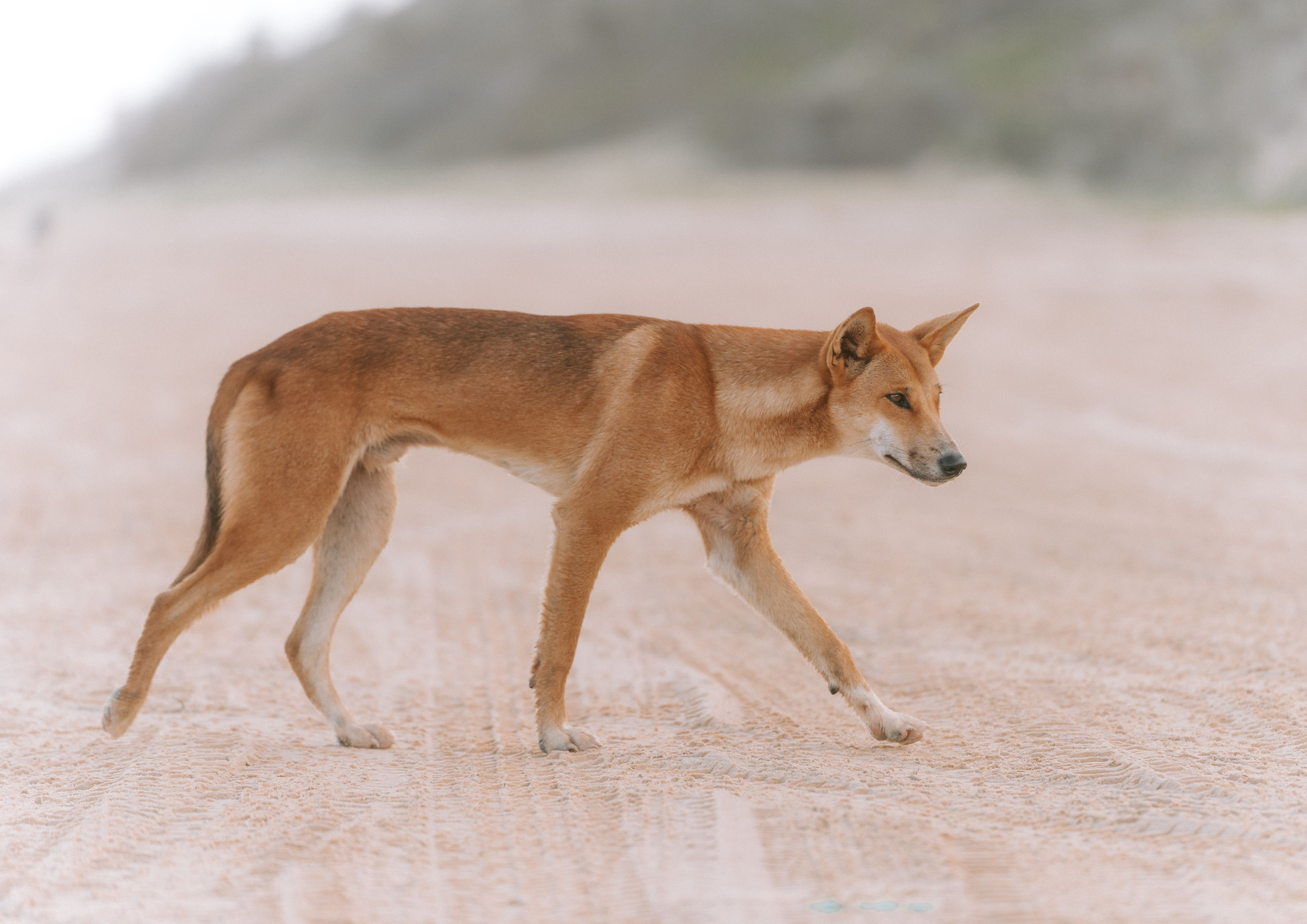
— is the oldest land surface upon the globe, and its (living) fauna and flora share its ancient lineage. Our Continent has been isolated so long from the rest of the Northern land masses, that, with the exception of the Dingo and a few small Rodents and Bats, none of the later and higher animals evolved after the marsupials have ever reached its shores. This long period of isolation and immunity from competition with other animal forms has allowed the marsupials to develop and adapt themselves in a wonderful manner to all those “modes of life” found amongst animals throughout the rest of the globe.
THE TASMANIAN TIGER.
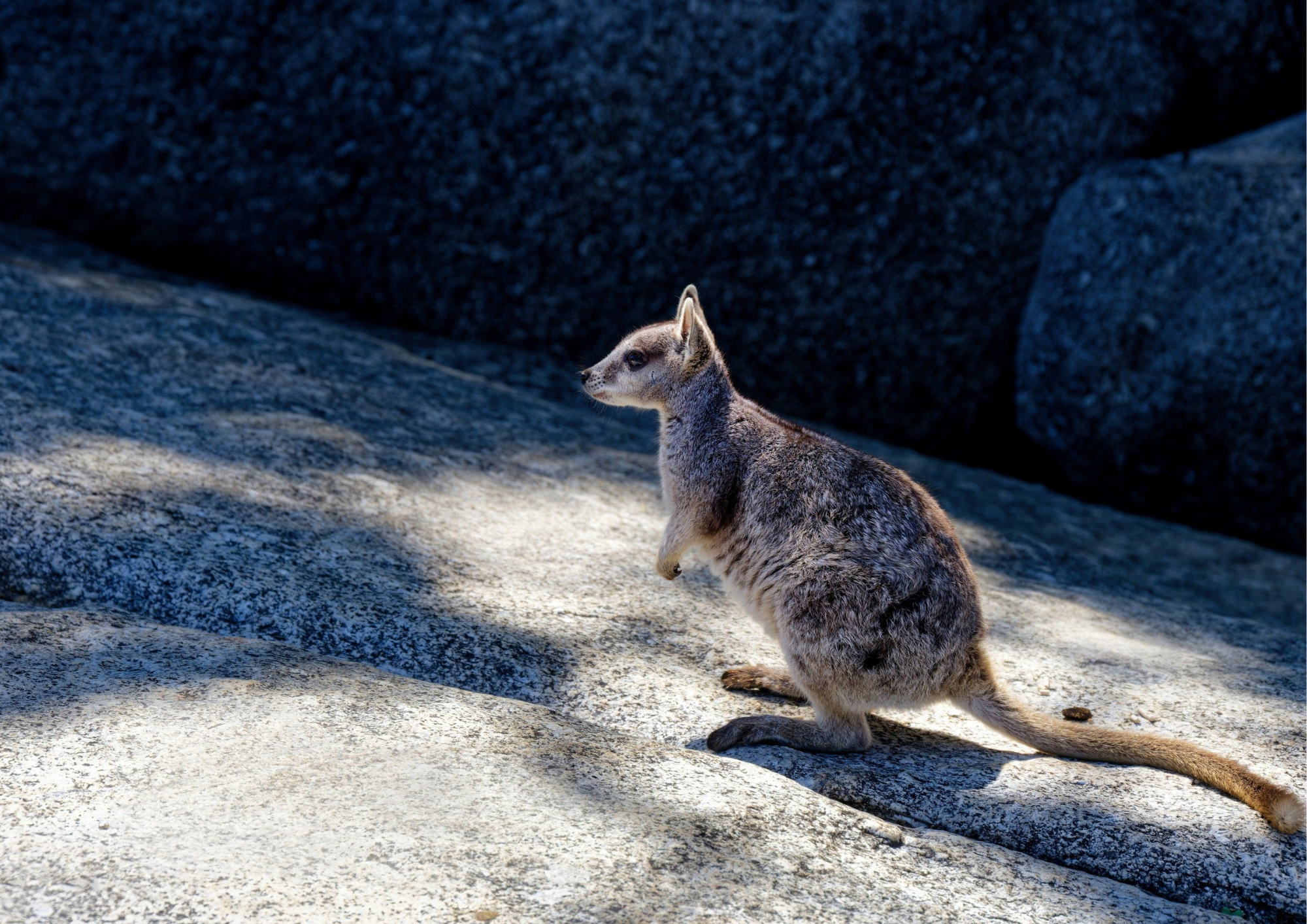
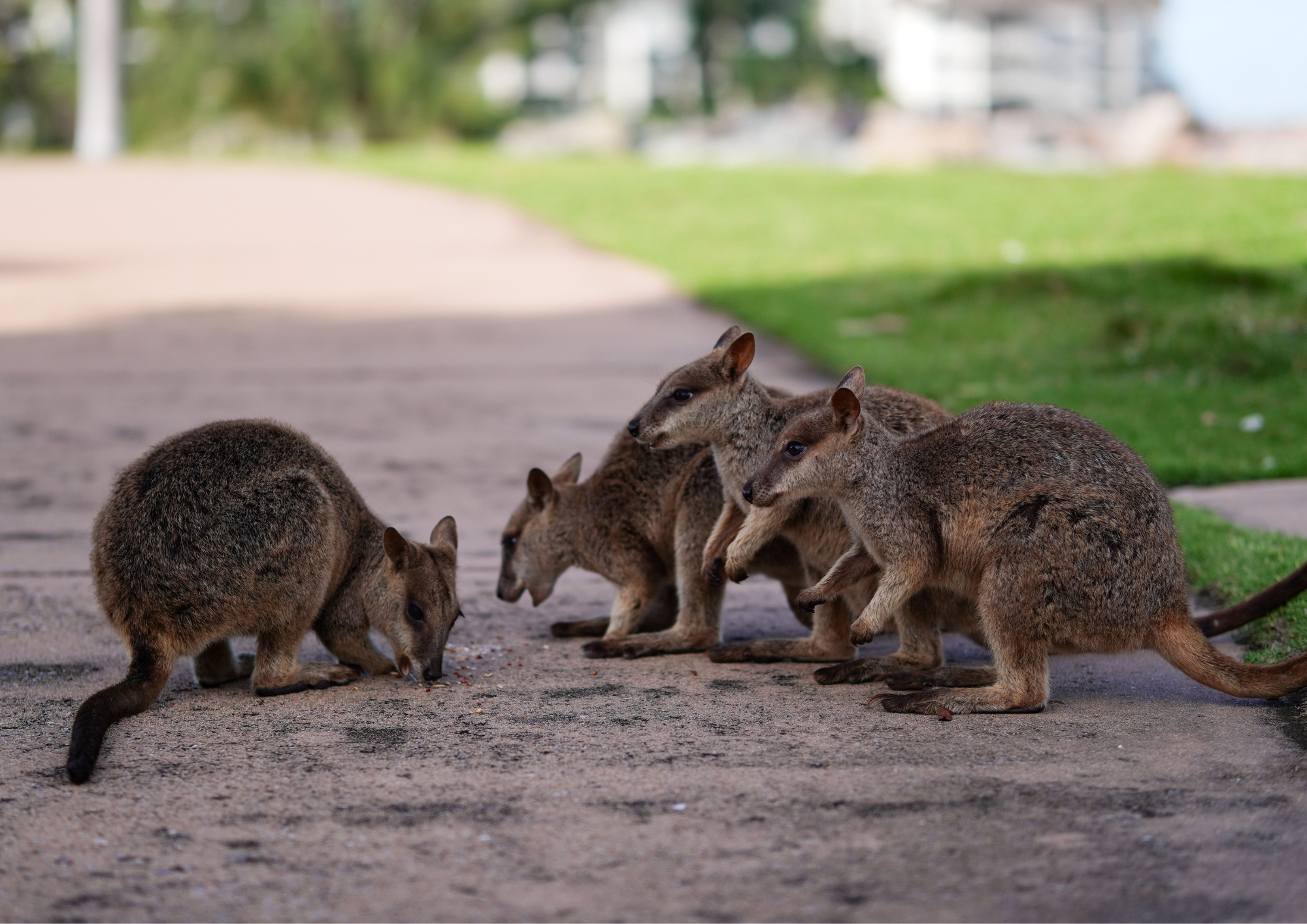
The Tasmanian Tiger (Thylacinus) and Devil (Sarcophilus) and the Native Cats (Dasyures) take the place of the Old and New World carnivores. The grass-feeding Kangaroos and Wallabies, inoffensive and swift of flight, correspond to the herbivorous Deer, Antelope, and other ruminants. The Opossums, Squirrels, Native Bears, and Tree-climbing Kangaroos are substitutes for the mischievous Lemurs and Monkeys. The ground-dwelling Bandicoots and Wombats parallel some of the true rodents of other countries, and even in the deserts of Central Australia a marsupial Mole has been discovered, quite blind, subterranean in its habits, and showing all the other characteristics of the European animal.
[A remarkable discovery concerning the birth of some of our smaller marsupials, such as the pigmy Flying Opossum (Acrobates pygmaeus), has recently come to light. The female of these small “gliding” acrobats of the bush, not so big as a mouse, have no more than four teats, but the number of young born exceeds this very considerably. At the moment of birth each tiny, immature Opossum, no larger than a pea, crawls up along the fur of its mother’s body into the pouch. Only the first four to reach the pouch can survive, for, unlike other animals, the young marsupials remain attached to the teats for many months. The rest of the litter, outdistanced in this unconscious, uncanny race for life, fall from the mother’s body and die within a few minutes.]
It is the remarkable adaptation of the marsupials (as a group) to their environment which makes Australia such a prolific field for biological study, and a veritable treasure-ground for the naturalists of other countries. At the present time the largest of our predatory marsupials, the Tasmanian Tiger and Devil, are found only in that island, and the Tiger is almost extinct. The fossil remains of these animals are found throughout the length and breadth of the mainland, where they once existed, but died out when they came into competition with the Dingo.
The latter, like the Lyre-bird, the Kookaburra, and many other of our animals and birds, never succeeded in reaching Tasmania, although a land-bridge existed between the island and the Continent up to a comparatively recent geological date. It was by this bridge that the curly-haired Tasmanian aboriginal reached the island before it was cut off from the mainland by Bass Strait. The growing scarcity of the Tiger, now only found in the wild, mountainous districts of the West Coast, is indicated by the overseas’ market value of £200 per pair; and the rarer these animals become, the more their value increases.
It is only a matter of time, and they will be lost to us for ever, like many other of our unique animals. But are there any reasons why they should not be bred under natural conditions in a state of semi-captivity on the Continent again? The once well- nigh extinct and now almost priceless Silver Fox has been successfully reared upon “farms” in Prince Edward Island, Canada. Why should the Tiger not thrive, under restraint, in the country that was once its fatherland? Now is the time to act. In another ten years it will be too late. The establishment of a Breeding and Experimental Reservation at Healesville, under the direction of Professor Colin MacKenzie, is the first step in this direction.
THE KANGAROOS AND WALLABIES.
It would appear that the grass-feeding marsupials do better in captivity, and breed more freely than the flesh-eaters. This is the case with Zoological captives, probably because they are allowed more freedom in their larger runs, and are less under restraint. But the diet of the animal seems to be a factor of importance in this particular. In this connection, it is curious to note that the eggs of the flesh-eating Eagles and Hawks laid in captivity are always infertile. These birds never breed when caged. However, such is not the case with the mammals. The herbivorous Kangaroos and Wallabies do remarkably well.
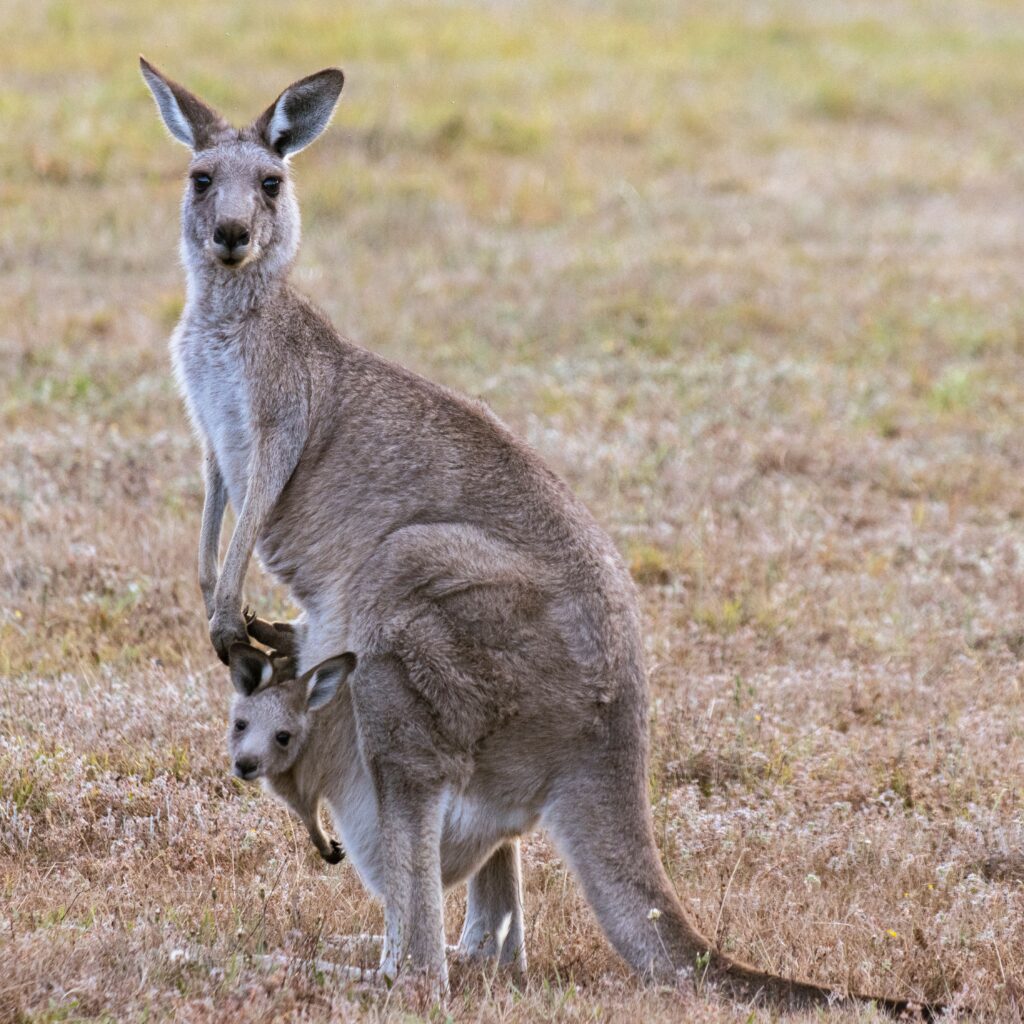
Mr. H. L. White, the well-known pastoralist, of “Belltree,” Scone, N.S.W., who is doing much for science in Australia, has a flock of some thirty Kangaroos and Wallabies under “restraint.” Thirty years ago he started by keeping a few around the house as pets; “but,” he says, in a recent article in the “Australian Zoologist,” “their end was usually caused by visiting dogs.” Ten years ago a fifteen-acre paddock was enclosed, and the stock of Wallaroos, Grey and Red Kangaroos have all done well. Mr. White’s chief trouble is to keep the number within reasonable limits. “When the paddock becomes overstocked,” he says, “I reduce the numbers by letting some of the animals loose. This would appear an easy matter, but is very far from it. Upon one occasion I liberated two very large male Grey Kangaroos by coaxing them into a lane, driving them one and a half miles along it and over a river, which they had to swim. They were both back next morning.”
THE PLATYPUS.
And what of the Platypus, the most primitive, and, in point of time, the most ancient of all the mammalian forms of life. It is found to-day only along the Eastern littoral of Australia and Tasmania. But the teeth and jaws of animals somewhat like it have been discovered in those early geological periods of Europe and America corresponding to the “Age of Reptiles.” Then, the gigantic Dinosaurs, reptilian land-monsters as uncanny in appearance as a “tank,” the swimming Ichthyosaurs (Fish Lizards), and the flying reptiles (the Pterodactyles), dominated the land, the sea, and the air, and the mammals were just in the making.
The Platypus is the only living survivor of those ancient epochs; it shows a tooth structure similar to those earliest animal forms, and as such is often spoken of as a “living fossil.” The spiny Ant-eater (the Echidna) is also a survivor from those early times; but, unlike the Platypus, it shows no tooth formation at any period. Both the Platypus and the Ant-eater lay eggs, and suckle their young upon milk — a combination of reptilian and mammalian characteristics shared by no other animal.
Although one hundred and twenty-eight years have passed since the Platypus was first discovered in Australia, little is known about it. This is due to the difficulty of observing the animals in their native haunts. They are nocturnal in their habits, feeding during the night, and lying concealed in the day in a burrow excavated in a river bank. Their nocturnalism is probably due to the continual hunting of them by the aboriginals, their only enemies.
In the early days of America, before the advent of the white trapper, the Beaver was diurnal in its habits. Nowadays, the few that remain build their dams and feed at night. Most of the life of the Platypus is spent in river pools, swimming and diving in search of food. Both fore and hind feet are webbed, and provided with strong claws. In burrowing, the front paws only are used, the web being tucked into the palm of the hand, and the claws extended. In fact, in climbing, walking, or tunnelling, the swimming membrane is always folded back out of the way. Just at dusk the Platypus leaves its burrow by an under-water exit, and, coming to the surface, quietly swims around, using its fore-paws only, and trailing the hind legs behind with the tail after the manner of a green turtle.
However, when disturbed it dives like a flash, and swims with incredible speed, using all four feet in its haste to escape. The Platypus is most shy and timid, and up to the present it has been impossible to keep it in our Zoological Gardens owing to the difficulty of supplying it with suitable food and natural surroundings. In confinement, the creature becomes positively distracted. When not racing round the enclosure, or climbing the wire-netting, it is sure to be busily engaged burying itself in a dug out: — When exhausted, it coils into a ball, and frets until it has regained sufficient energy to renew the struggle for liberty.
Mr. Harry Burrell, of Sydney, who has made a life-long study of the Platypus, discovered that six minutes was the longest time it could remain under water, and one minute was its longest interval on the surface, with point of bill and nostrils exposed in order to get a breath.
The margins of the bill of a Platypus are serrated, like those of a Duck, and the Platypus feeds like these birds, poking into the mud and weed along the edge of the stream, straining out the water and catching the small insects, beetles, freshwater prawns, and other forms of aquatic life.
It was observed that a Platypus, however hungry, will not take food unless it (the food) is in the water. They will walk over fresh shrimps placed on the grassy slopes of the river bank. Earthworms are also readily taken, and it is on record that one of these creatures devoured at a meal thirty ten-inch worms with a girth as thick as a lead pencil, and three hundred fresh prawns. It is not generally known that the Platypus has a most peculiar cry, resembling in miniature the barking of a puppy. The young one has a soft, purring note.
It is known that the Platypus lays its eggs, two, sometimes three, in number, in a nest composed of fine grass and gum-leaves, and hatches them out by sitting on them. The nesting recess, usually found at the end of the burrow, is too small to permit an adult animal to sit bird-like on the nest in comfort.
The Platypus always sleeps coiled up, and in this position could easily deposit her eggs on the broad under surface of the tail when clasped to the body. Mr. J. Kershaw, of the Melbourne Museum, secured several young ones in the embryo stage “attached to the skin of the abdomen of the female.” However, upon examination no sign of a pouch or fold of the skin was to be found in which the eggs or the young could be held. Mr. Burrell has suggested that the turning up of the broad, flat tail underneath the body (after the manner of the crayfish) while the Platypus lies coiled in the nest would make a most serviceable substitute for a pouch.
A peculiarity noted by both Burrell and Kershaw is that when the burrow is occupied it is completely blocked with earth for a foot or more of its length, and sometimes this will occur at three places in the burrow. The object is probably a precautionary one against flood water and enemies such as snakes. On more than one occasion traces of these reptiles have been found in the burrows of the Platypus and the Water-rat.
THE BANDICOOT.
Wandering anywhere across the countryside of Australia by the grass-grown banks of a shady creek, or along any old bush road, “wheel-worn and broken,” breasting the crest of the Blacks’ Spur at Narbethong, or the Gap of the Victoria Pass on the way to the Jenolan Caves, pushing through the heath-covered, low-lying coastal scrubs of Port Phillip and Port Jackson, or the boronia-scented swamp bottoms of King George’s Sound, one notices small, cone-shaped holes, five or six inches in depth, grubbed out at the roots of the native shrubs.
They are the work of the Bandicoot, and are often mistaken for the surface scratchings of the Rabbit. But the Bandicoot is neater and cleaner in its method, and its liliputian excavations, unlike those of its introduced rival, have a clean-cut outline and an absence of scattered earth. Although quite common close to the outskirts of the city, this creature is rarely seen, so quiet, and shy, and strictly nocturnal is it in its habits.
Known in the “outback” country districts as the “Bush Pig,” it is a veritable scavenger of the scrubs, and will visit the camp at night when the fire has burned low, and eat the scraps from the table. But the animal is mainly insectivorous, and it is for the unearthing of the insects and grubs which form its principal food that the little holes are excavated at the base of the shrubs and plants over the length and breadth of Australia.
It is quite a useful little creature; like the insect-eating birds, playing its part in the Economy of Nature. Of similar type to the common Bandicoot is the long-eared or Rabbit Bandicoot. This is a handsome form, with pale grey silky fur and long, delicate, translucent ears like those of a Hare. In earlier days they were eaten by the settlers, and found very palatable. They are relished by the “desert” aboriginals, and Professor Sir Baldwin Spencer, in his book, “Across Australia,” tells in a charming chapter devoted to the animal life of the “Central steppes” of the habits of this creature, and states that the natives use the long black and white tail-tips as decorative headdresses in their ceremonial rites to keep them alert and wakeful at night (the Bandicoot is nocturnal in its habits), and so protect them from the spirits of their slain enemies.
THE WOMBAT AND THE WATER-RAT.
The Bandicoot and that giant of burrowing animals, the Wombat, to some extent fill the place in Australia occupied by the rodents in other lands. Out of some 1400 known species of rodents, Australia shows not more than 40 — a very small proportion.
The largest of our true rodents is the golden-bellied Beaver or Water-rat. These are found all along the coast of Eastern and Southern Australia, frequenting the bays and estuaries, as well as in the inland rivers and water-holes. They are entirely aquatic, and also nocturnal in their habits. In a river bank they will make a burrow, tunnelling in some distance. The entrance may often be mistaken for that of the burrow of a Platypus. But there is one point of difference. The opening in the sloping surface of the bank is always oval-shaped in the case of the Platypus, or, rather, flat underneath and rounded above, like the body of the animal itself, and round or rounded in that of the Water-rat.
We were once fortunate enough to see a Water-rat and three young ones swimming in the quiet waters of a Murray River lagoon. The family forged along in single file ahead like a small fleet of destroyers nosing and poking into every patch of reeds and floating weed. Presently they came to a broken branch of a snag projecting just above the water. The parent passed it, but the first youngster hoisted itself out of the water apparently to rest or reconnoitre, but was buffeted from its coign of vantage by the second, who, in turn, was displaced by the third. The first then returned to the attack, and regained the snag, and so the game went on a mimic attack, with displays of wrestling, diving, floating, and swimming, all in riotous play, but a play fraught with significance; in fact, a preparation for a more strenuous life to come. Such is the meaning of playfulness in the young of all animals, including man himself.
SEAL LIFE AROUND OUR COASTS.
You mustn’t swim until you are six weeks old,
Or your head will be sunk by your heels.
And summer gales and killer whales
Are bad for baby seals.
Are bad for baby seals, dear rat,
As bad as bad can be,
But splash and grow strong,
And you can’t go wrong,
Child of the open sea. — Kipling.
In earlier days two species of Seals were commonly found off our coasts — the Hair-seal or Australian Seal Lion, and the Fur Seal or Australian Sea Bear. To-day, unfortunately, owing to the lust and greed of the early sealers and whalers, the Fur Seal is practically extinct. Seals are a group of carnivorous animals, specially adapted for living habitually in the water. They live on small, low-lying rocky islands exposed to the open sea. These are usually difficult of approach, and in heavy gales are untenable even for their sea-loving inhabitants, which occasionally have to seek shelter on the mainland beaches.
It is characteristic of these Seals that their rookeries are situated on the wildest and most rugged parts of the coast, adjacent to a number of pools. These are used by the young to learn to swim in before venturing into the sea. This is confirmed by Mr. James Grant, of Port Fairy, Victoria. Speaking of the Seals on Julia Percy Islands, he says: “The young are born in December and January, and are often found huddled together in groups of six or seven. They cannot swim, and if one is put into the water the only part of it visible is its nose, and in a very little time it will sink and drown. They always take to the small pools in the rocks first, and I have often noticed them in the water playing with a small piece of cuttlefish or a piece of derelict board.”
“Although the Seals spend most of their time at sea, they come ashore from November to January, when the young are born. They then lose their timidity, and will vigorously defend their pups. During this time the mothers are very ferocious, and it is sometimes difficult to get to the lighthouse structure. Often before landing the men have to be provided with club and sticks to protect themselves.” It is stated that the Fur and Hair Seals are found on the same islands, and intermingle generally.
A survey of the Seal life around the Australian coastline would reveal some interesting facts. There is no reason why the Fur Seal should not be rigidly protected here, so that they could re-establish themselves upon our shores. At the present time the true Fur Seal is found in small numbers around our Southern coast, and, under proper supervision and protection, would increase in numbers, and some day prove as valuable an asset to the Commonwealth as the rookeries of the Pribilof Island of the Bering Sea are to U.S.A. The American Fur Seal herd is increasing at the rate of 8 per cent. per annum, and at the same time giving skins to the value of a quarter of a million sterling to the American Federal Government.
What are we in Australia doing to save all these wonderful animals of ours? Last year the fur sales of the U.S.A. showed that 3,000,000 skins of Australian native animals had been exported to that country. No country can stand such a drain upon its animal population. There is only one practical method of dealing with this appalling destruction.
THE COMMONWEALTH OR EACH STATE GOVERNMENT MUST HAVE CONTROL OVER THE LOCAL FUR TRADE AND THE TRAFFIC IN SKINS.
Periodical departmental proclamations and public propaganda are of little avail unless backed by direct Commonwealth or State action. Legislation makes no difference to the number of skins taken and exported. Tasmania has this year attacked the problem in a practical way. In that State a tax has been introduced….
Now, the animals of Australia belong to the Commonwealth, and the Commonwealth Government should exercise its prerogative, and see that they are properly cared for. In the Institute of Industry and Science we have the machinery at hand to carry out this work along the lines suggested by the action of the Tasmanian Government.
If the Commonwealth or each State would follow the Tasmanian Government, and levy a small tax upon every skin leaving Australia, and APPLY ALL THE MONEY SO COLLECTED TO THE ESTABLISHMENT OF A DEPARTMENT OF ECONOMIC BIOLOGY, THE PROBLEM WOULD BE SOLVED.
At first such a tax would seem to be a direct encouragement to all and sundry to destroy the native animals. But the creation of a Deparment of Economic Biology would foster a national interest in our mammals and birds, and in the fulness of time such a department would CONTROL THE FUR EXPORT TRADE, DICTATE THE POLICY OF THE TOTAL OR PARTIAL PROTECTION OF THE VARIOUS SPECIES, AND, BY SCIENTIFIC RESEARCH, SHOW THE ECONOMIC RELATIONSHIP THAT EXISTS BETWEEN ANIMALS, BIRDS, AND AGRICULTURE. The annual programme of work for the United States Department of Agriculture includes: —
- Relation of the native animals to agriculture, in order to devise and demonstrate methods for controlling wild animals destructive to agriculture, animal-industry, range lands and forestry, to collect information of the amount of damage done, and to publish and disseminate his knowledge.
- Destruction of predatory animals in natural forests and the public domain.
- Suppressing the spreading of rabies in predatory wild animals.
- Rearing fur-bearing animals and testing methods of dressing and caring for dressed fur.
- Relation of native and introduced birds to agriculture.
THE AUSTRALIAN NATIVE ANIMALS.
HOW THEY STAND TO-DAY, AND THE CAUSE OF THE SCARCITY OF CERTAIN SPECIES.
By A. S. LE SOUEF, C.M.Z.S.
(Reprint from the “Australian Zoologist,” Vol. III., Pt. III., issued June 7th, 1923.)
The fact that some of our native animals are getting increasingly scarce is well known to those familiar with them in their native haunts. Mr. W. W. Froggatt drew attention to this matter [Proc. Linn. Soc. N.S.W., 1913], but little else of an authoritative nature has been published. Much uncertainty and misapprehension has been caused by many people writing and speaking about the matter without having any basic knowledge of the subject.
Actual facts are rather difficult to secure, as comparatively few people take sufficient interest to make observations, or can recognise any but the common species when seen. In the absence of any comprehensive survey, this resumé is only approximate.
The cause of the disappearance of some of our animals can be stated to be — (in order of importance): —
(a) Introduction of the fox, the cat, and the rabbit.
(b) Shooting and trapping for the fur market.
(c) Opening up of the country by settlement.
(d) Disease.
(a) The Marsupials are representatives of animals that appeared very early in the history of evolution; they were in process of time completely superseded by the more advanced animals that we know to-day. The isolation of Australia at a time when the Marsupials were predominant allowed them to remain unmolested, except for the later introduction of the Dingo. With no competition except among themselves, they have stayed in their primitive state — remarkably harmless and with a low instinct of self- preservation.
When animals of this class suddenly find themselves placed in competition with such advanced forms as the Fox, the Cat, and the Rabbit — types that are far ahead of them in the evolutionary scale — it is just as inevitable that they should go down before the invader as that the aboriginal should give place to the white man.
The Fox is by far the greatest menace that our wild animals are faced with. It is widespread, uncontrollable, and reaches places where man has not penetrated. Its progress towards Northern and Central Australia will be watched with interest; if it can establish itself in the dry and also in the tropical areas, then a great many of our animals — some hardly known to science — will disappear. So far, there is no evidence that it can live away from permanent water or in the tropics. It is significant that most of our animals live in the driest areas, getting their moisture from roots, bark, and insects. The Rabbit, the Cat. and the European Mouse have already spread over the Continent, the Rabbit thriving in waterless areas in good seasons, and being swept off again in dry times; but I do not think that they have any marked effect on the native animals.
Fortunately, there is a well-marked safety zone in the eastern coastal areas extending from Victoria to North Queensland. This area is the habitat of the poison tick, Ixodes holocyclus, which is fatal to canines and somewhat less harmful to cats. Tasmania and the islands off the coast are free from the Fox.
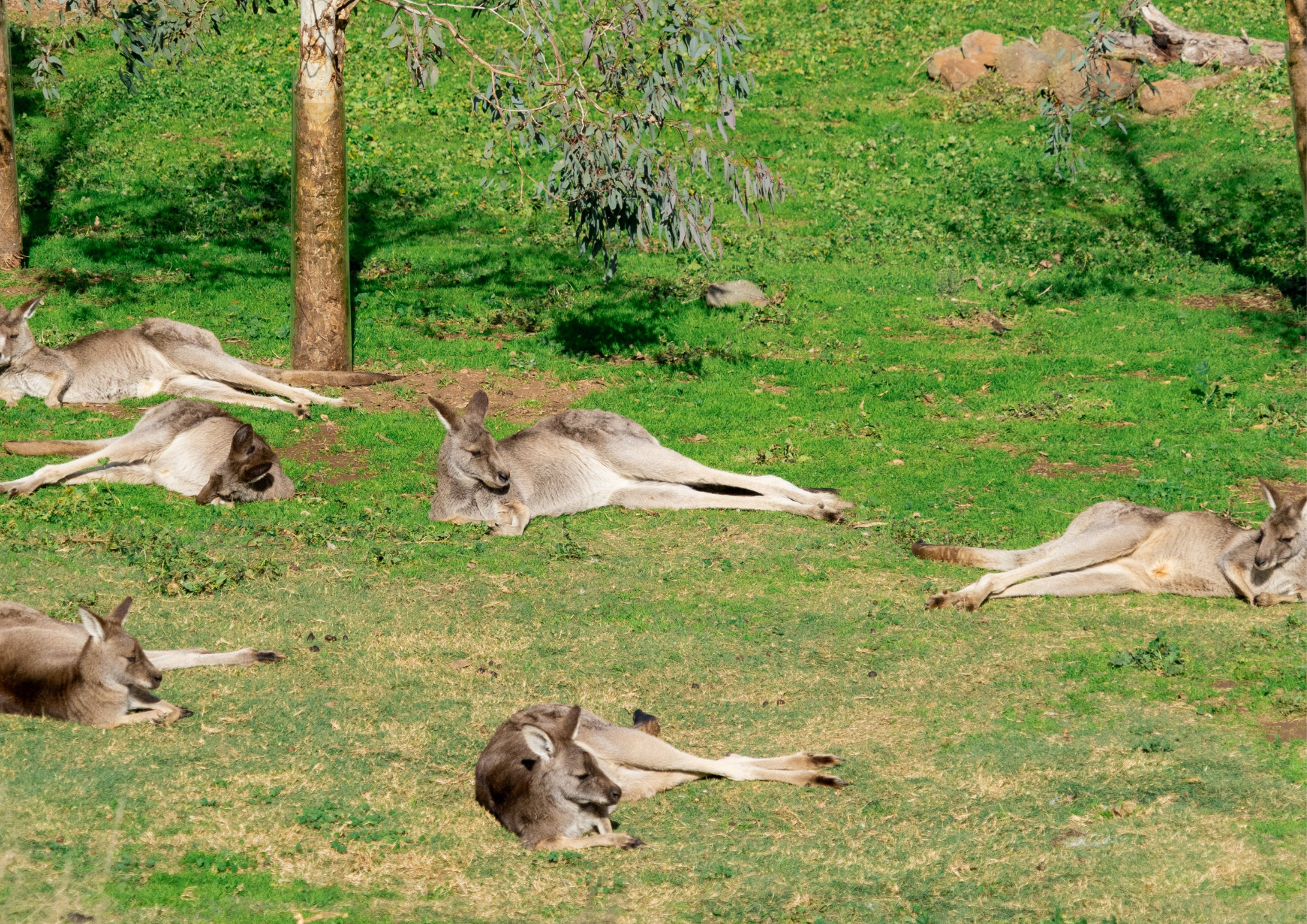
This scourge has been responsible for clearing off practically all the small ground animals outside the coastal districts in Eastern and Southern Australia. The Fox has spread along the south and reached as far north as Geraldton, in Western Australia. In New South Wales the only species that are holding their own, as far as I can judge, are the larger Kangaroos, the Wombat, and the Platypus. The Red and the Grey Kangaroos, owing to their gregarious habits and their size, are fairly safe. The Wombat is too doughty an animal for the Fox to tackle, while the Platypus is protected by its environment. A large animal that seems to be affected is the Wallaroo; this species lives singly or in pairs, or, at most, three or four together, and the female is often alone. It has been stated by observers in the Monaro district that when a Fox finds a female with young in the pouch he chases her until the “Joey” is thrown out; this is then secured and killed.
That the arboreal animals are sometimes taken when on the ground is shown by reports from the Kosciusko district. The Opossums (Trichosurus) have been killed by this animal, and that a Fox was found carrying white Flying Phalanger (Petauroides) near Gosford.
(b). The insatiable demands of the fur trade form the second heavy drain on our native animals. This trade should absorb only the natural increase, but the machinery for control is lacking, and the laws make very little difference in the number of skins taken and exported.
(c). The opening up of the country by settlement has had its effect on the native game. The first stage, after upsetting the balance of life, was an enormous increase in the Marsupials, but systematic killing and the advent of the Rabbit and the poison cart soon stopped this
(d). Under normal conditions there is a very correct balance of life among the wild animals. Occasionally, in the absence of natural enemies, a species will increase to such an extent as to overtake the food supply; then, in their weakened condition, disease is apt to break out in a virulent form and sweep them off in thousands. Well-known instances of this occurred in 1898-9 and in 1901-2-3. Koalas, Native Cats (Dasyurus viverrinus), Rabbit Bandicoots (Peragale), and certain Phascogales were almost exterminated from Central Queensland to Victoria. Native Cats in the vicinity of Sydney, being isolated, were not affected, but in other parts of the country they have never recovered lost ground. Koalas are very slowly coming back to New South Wales, and are now getting numerous again in Southern Queensland. They are very thick in the Victorian National Park on Wilson’s Promontory, where they have to be reduced owing to their killing out the food tree.
To recapitulate: — Practically all the ground animals (outside the coastal areas), with the exception of those mentioned of Eastern and Southern Australia, are threatened with extermination. The fur trade is taking a heavy and unchecked toll of the arboreal animals and certain of the coastal Wallabies.
On the other hand, most of the coastal areas, the great Central, Western and Northern parts of the Continent are teeming with wild animals; Tasmania and most of the islands off the coast are well stocked with their respective species; Red Kangaroos are very numerous on the plains of Western New South Wales and Queensland. The Grey Kangaroo and the Wombat are much in evidence in the mountains (both the Red and the Grey Kangaroos, with their wide range over the country extending throughout Central and Western Australia, must yet exist in countless numbers). The rivers of Eastern Australia and Tasmania are well stocked with Platypus, which will, in my opinion, outlast any other species in its range.
This survey does not take into account many small marsupials and rodents such as: Phascogales, Sminthopsis, Dromicia, Acrobates, Petaurus, etc., and many native Rats and Mice that are still in most places in their normal numbers, lessened only by the clearing of the forests and the occupation of the land with domestic animals in their respective areas.
REMEDIES.
There are probably only three species of animals that are entirely confined to the Fox area of Eastern Australia. These require our immediate attention if the remnants are to be saved. They are the Bridle Nail-tailed Kangaroo (Onychogale frenata), the Brush-tailed Rock Wallaby (Petrogale penicillata), and Gaimard’s Rat-Kangaroo (Bettongia gaimardi).
The only Bridle Nail-tailed Kangaroos that exist, as far as I know, are a few on Mr. Charles Baldwin’s farm, near Manilla, and some in Taronga Park. Attempts to get this species to live in a wild state in Taronga Park have failed, as they apparently cannot live in the tick area, their proper home being the foot hills of the Dividing Range of Eastern Australia. A few Brush-tailed Rock Wallabies are found round Jenolan Caves and at the head of the Murray River. I cannot locate any Gaimard’s Rat-Kangaroos; they used to live on the mountains and western plains of New South Wales.
A haven where these species can immediately be placed is Pulbah Island, in Lake Macquarie — a sanctuary set apart by the Government at the instance of the Australasian Society — for the preservation of our rare native fauna.
The basis of any work for the preservation of our fauna should be a Zoological Survey. This will, however, take time and money, and there does not seem to be any prospect of carrying it out. The Chief Secretary of New South Wales bases his actions regarding the close seasons or the exemption of any species from protection if it gets too numerous in any given district, on reports from the local official sources. This system gives good results, but does not take into account any species that are getting scarce.
The species that are in the eastern coastal areas are for the time being safe enough, but it is necessary to have more exact information concerning them. This might be done by appointing local residents Rangers under the Birds and Animals’ Protection Act, and asking them to report; by seeking the co-operation of the Forestry Department, and by investigations by naturalists.
We have in this area the Brush Wallaby (Macropus ruficollis), Black Wallaby (M. ualabatus), Black-striped Wallaby (M. dorsalis), Parma Wallaby (M. Parma), Rat-Kangaroos (Bettongia tridactylus and probably Aepyprymnus rufesaens), Opossums (Trichosurus vulpecula [and] T. caninus nigrans), Ring-tailed Phalanger (Pseudochirus), Native Cats (Dasyurus viverrinus), Flying Phalangers (Petauroides volans, Petaurus australis, P. sciureus, [and] P. breviceps), besides many smaller pouched Mice, Opossum Mice, etc. There are also a few Koalas, but these never get a chance, as the temptation to shoot or catch the defenceless litle animals as they sit exposed on a bough is more than the so-called sportsmen of the community can resist, and even in our National Parks they are destroyed.
To deal with this matter effectively, we require the whole-hearted co-operation of every naturalist and person interested in preserving native animals in the Commonwealh. Official observers should be appointed throughout Australia, and their reports sent to a central body. On the basis of these reports, together with the information obtained by the Government Departments, permits could be issued.
Exports could then fairly well be restricted to the surplus or ordinary increase of each species. Animals that were getting unduly scarce could be noted, and special arrangements made to safeguard them. The surplus of certain species is at times considerable, and must be kept in check if the man on the land is to get the full result of his labour, and the domestic stock fed. At the present time it is likely that numbers of Red Kangaroos will have to be killed off in the Riverina, owing to the shortage of grass. There are, throughout the Continent, vast areas of unoccupied land where numbers of wild animals feed, and there is no reason why, under proper restriction, these should not be turned to good account.
The asset of the fur trade has given Australia millions sterling in the past, and will, if preserved, do so in the future; but unless control is based on accurate knowledge, it may be frittered away. At present it is nobody’s business to ascertain what species of animals’ skins are leaving the country, but if a small export tax were imposed, they would have to be examined. The funds so collected could reasonably be used to preserve the asset.
Of Marine animals, we have two species — the Fur Seal and the Hair Seal; there is also the peculiar Sea Cow or Dugong.
The Seals extend frim Seal Rocks, off Port Stephens, N.S.W., to the Abrolhos Islands, in Western Australia; they are also found round Tasmania and as far south as Macquarie Island.
Unfortunately, we know very little, indeed, about the habits or distribution of the Seals. There is no map indicating the islands inhabited, or estimate of the numbers; they are at the mercy of poachers. A number was taken by a foreign raider from islands south of New Zealand, and also from Western Australia in 1921; this was probably not the first raid, nor will it be the last.
Our Fur Seals should be a very important asset. The American Fur Seal Herd is increasing at the rate of 8 per cent. per annum, and at the same time giving skins to the value of a quarter of a million sterling to the Federal Government. The American Government was induced to step in and take over the Seals, which were being rapidly exterminated, through the action of the Camp Fire Club.
The Dugong inhabits the shallow seas of Northern Australia. It was once numerous, but is now getting scarce, as, according to Mr. Banfield, it forms the principal food of the Japanese Trepang Fishers operating off our coasts. This animal should be worth preserving; its flesh is equal to the finest pork; it feeds on Sea Grass, which grows abundantly in the warm seas, a crop that is never affected by weather conditions, and is of no other economic use….
James W. Barrett, ed., Save Australia: A Plea for the Right Use of Our Flora and Fauna (Melbourne: Macmillan, 1925), pp. 1-15, 85-99, and 175-183. The lead image is by Eclipse Chasers and the lower section photos can be found in: https://www.pexels.com/. These photographers are: Gu Bra11, Line Knipst, Calvin Avancena, James Lee, Paul Pulimootil, Tkirkgoz, Moritz Feldmann, and Laarkstudio.
See: https://babel.hathitrust.org/cgi/pt?id=chi.086759344&seq=1