Human Nature
We want you to have a greater ability to learn about some of the unpleasant animal issues in our world.
The Spirit of Humanity and Essence of Morality
Albany
PREFACE.
This is emphatically a book-making age. In addition to the accumulated stores of all bygone ages, the Press literally deluges the reading public with a flood of works of every kind: — arts — sciences — letters — fictions — medleys — periodicals — without number and without end. To read even their titles would be no trifling task; to peruse the contents even of a single department would require not only years, but lives. Amid this immensity of volumes, as far as appears from an extensive examination of libraries and catalogues, no such work as the present exists. Perhaps then the novel little book now offered to the public, will not be deemed obtrusive or useless. Its theme possess an all-absorbing importance, an interest, which every sense and every nerve of man must perceive.
What is Humanity but the substance and essence of Morality, of which it is the more intelligible and expressive name? Why are Truth or Honesty, Justice, Temperance and all Virtues, admired and approved, but for their being promoters of Happiness.
The authorities here adduced, (as far as names are given,) are always respectable, and generally of the highest order. The work presents an array of the most eminent Divines, Statesmen, Philosophers, Scholars, and Poets, giving their decided and concurring testimony in favor of General Beneficence.
Will not their united opinions tend in various ways to advance this righteous cause? May not they invite the attention and the aid of the Pulpit? furnish themes for authors and materials and references for compilers, and for that popular luminary, the periodical Press? — convince the indifferent and reform the offending, where open argument and public reproof might be indelicate or ineffectual? — and form the tender minds and cherish the sympathies of the rising generation?
In the arrangement of the pieces, the order of time has been generally, but not invariably followed. In some instances, words have been omitted or altered, for the sake of brevity, perspicuity or consistency. These verbal alterations, it is believed, the authors would have sanctioned and approved. When explanatory sentences or words have been added, they are enclosed in brackets [thus]. The words in italics also, are so printed in this work only; with one or two exceptions, they were not italicised in the original authors. Repetitions of the same sentiment occur of course, the magnitude of the subject particularly requires that there should be “line upon line and precept upon precept.”
Additions might have been made from other writers or works of sympathy and sentiment, as: Madame De Genlis, Father Bougeant, Shenstone’s Pastorals, Dr. Primatt’s Sermons, Burton’s Lectures, Burger’s Poems, Cogan’s Passions, Beatties’ Moral Science, Gros’ Moral Philosophy, Darwin, Byron, Spurzheim, Buchannan’s Indian Sketches, Buck’s Theological Dict. &c., &c.
That the principle or practice of Humanity can ever be extended too far, is a moral impossibility. Men may indeed, through error of judgment, sacrifice a greater duty, to a lesser; their mistake should then be pointed out. In cruelty as in luxury, and other vices, custom and prejudice will vary our opinions of the precise limit which should be prescribed by moral rectitude.
Some sentiments contained in this book, may be deemed fastidious or whimsical by certain readers, for instance, by the sportsmen. — Is there no difference between an animal’s suffering for several hours, the extreme of terror, toil, and pain, or its being despatched at once? Or, between a sentient creature’s lingering in torture for days, and at last expiring of its wounds, its young also perishing with hunger, or its being seasonably and instantly killed by the unerring aim of the ride or fowling-piece? Are there not sufficient sources of exercise, excitement and amusement, without those refinements in cruelty, which often render sports and barbarity synonimous? —
The subsequent extracts were aimed only at abuses. If however, individuals should deem allowable, any of the practices censured in this book, it is trusted that they will still, by example and influence, discountenance those usages which they may own to be wrong; even as the man who occasionally indulges in a moderate glass, may not willingly interpose any other obstacle to the temperance cause.
Intemperance, itself, by stupifying or confounding the faculties of the gentle, and exciting the horrid passions of the brutal, is a most prolific source of cruelty. A volume would not suffice to expose the miseries and privations, which the helpless animals endure from this cause alone.
The present state of society requires a division of occupations. If the butchers, drovers, drivers, &c., are not always the dispensers of kindness and comfort to the sensitive creatures in their charge, the blame must he fully shared by their employers and the public, who are the accessories and abettors of their criminality.
Is it not sufficient for man to absorb the useful labors and lives of the inferior creation, without super-adding excessive anguish, want and misery? When his own cup of suffering is full and over-flowing, desperate resort to revolution sometimes rids him of his cruel tormentors and task-masters. But of the inferior animals, generations after generations suffer and expire without any chance of relief or redress, unless it be granted by the generosity and justice of man. In a favored land of human freedom from tyranny, the RIGHTS OF HUMANITY have a peculiar claim on his protection, and in their behalf the united voice of the people should respond to the Voice of the Deity.
Albany, The Spirit of Humanity and Essence of Morality: Extracted from the Productions of the Enlightened and Benevolent of Various Ages and Climes (London: O. Steele and D. M’Kercher, 1835), pp. vii-x.
See: https://babel.hathitrust.org/cgi/pt?id=nyp.33433091462824&seq=1
THE CURSE OF CRUELTY
Rev. Francis O. Morris
“Thou, Lord, shalt save both man and beast.” — Psalm xxxvi. 6.
It seems to me hardly possible that any one could be cruel to a dumb animal if he believed in the future existence of that creature after death. It is most likely that very few persons of those here present have ever thought of such a thing. The idea of it is now put before you, and I imagine that many would be at first disposed to deny the possibility, and many more the probability of it.
But it certainly is not impossible. On the contrary, it is probable, and there is good reason to believe that it is so. It was the opinion, among those of many others, of the great Bishop Butler one of the most profound thinkers that ever lived. He wrote: “We cannot argue from the reason of the thing, that death is the destruction of living agents.” “Neither can we find anything in the whole analogy of Nature to afford us even the slightest presumption that animals ever lose their living powers, much less, if it were possible, that they lose them by death.” He adds: “All difficulties to the contrary are so apparently, and wholly, founded in our ignorance, that it is wonderful they should be insisted on by any but such as are weak enough to think that they are acquainted with the whole system of things.” Long before his time it was the opinion of Tertullian; and Poole, in his “Synopsis Criticorum,” on the passage, says that it was so held by the Rabbins.
Thus also wrote the Rev. John Wesley: “They, too, are immortal. They themselves also shall be delivered.” “They will be restored with vast increase, being exalted and refined in a manner which we, ourselves, are not now able to comprehend.” “What if it should then please the All-wise, the All-Gracious Creator to raise them higher in the scale of beings?” “What if it should please Him, when He makes us ‘equal to the angels,’ to make them what we are now, creatures capable of God, capable of knowing, and loving, and enjoying, the author of their being?” “Ought our eye to be evil, because He is good?” “When God has ‘renewed the face of the earth,’ they shall enjoy happiness suited to their state, without alloy, without interruption, and without end.” “Their bodies, indeed, are ‘crushed before the moth’; but their souls will never die.” “Indeed, all spirits, we have reason to believe, are clothed with immortality, having no inward principle of corruption, and being liable to no external violence.” “What, then, is the barrier between man and brutes? the line which they cannot pass?” “It is not ‘reason.’ Set aside that ambiguous term; exchange it for the plain word ‘understanding,’ and who can deny that brutes have this? We may as well deny that they have sight and hearing.”
So, also, Doctor Adam Clarke, — after a long and elaborate argument, he ends, speaking of animals: “It is reasonable to conclude that as they cannot have the happiness designed for them in this state, they must have it in another.” [Thus, again, the Rev. S. Thompson: — “As Christ shall most certainly triumph over all His enemies, and as Death is one, then He shall restore life unto all which once enjoyed it.” “The last enemy that shall be destroyed, is Death.” Matthew Henry, in his commentary on Romans viii., writes, that the creatures will have “as great an advancement as the glory of the children of God will be to them.” “It should seem,” he says, “by the Scriptures, that there will be some kind of restoration of them.” Dr. Hitchcock, in his ” Religion of Geology,” points out that the passage in the Psalms, which says: “Man that is in honour and abideth not, is like the beasts that perish,” cannot mean that they will never live again, for that would be to say the same of men who are here said to be “like” them in this behalf. The great German theologian, Tholuck, is of the same opinion, as was also Martin Luther.]
“It is therefore of God” — I quote from the preface to a small book of my own “Records of Animal Sagacity,” which has been out of print for some years — “it is therefore of God, that there is something solemn in the death of every living creature. No one can watch without any emotion the eye glazing in death of a faithful dog; the mild look of a dying bird; or the expiring throb of a wounded animal! Who can avoid the thought that something is going away which he cannot bring back, nor any power of his then stay, even for a while, the departure of? And if it be some long-known and favourite companion, conspicuous, perhaps, for fidelity, affection, and sagacity, whose bodily life is ebbing away; who is there who can resist the thought that he is not parting with the dying creature for ever; but that the same Creator who gave the spirit, and now commands it to ‘return,’ will one day restore it, and bid it live again, or, rather, will never allow it really to die? It is repulsive to our natural feeling to think that anything in the nature of spiritual life can be annihilated.
The idea of the death of a body, and of its being doomed to destruction, is of itself sad and painful; the thought of the simultaneous destruction of the spirit, our own soul resists. We are forced, by a natural impulse, to ask whether the living spirit in any creature is not too much the breath of God, to cease to live, and to perish with the body? Whether it may not have been intended by the Almighty to live hereafter and for ever, restored to a renewed and ‘spiritual body,’ even as we look to be to our own? Whether it is not of too noble and excellent a nature to perish for ever, and may not, in the case of the irrational, but irresponsible and innocent part of the animal creation, be restored to a better and everlasting state.
The ways indeed of God ‘are not as our ways, nor His thoughts as our thoughts,’ but on no other supposition can we, at present, see any compensation, as there then abundantly would be, — not that He, the Sovereign Creator, ‘of His own will,’ of all, is bound to make compensation — for the sufferings and deaths of the creatures, the necessary consequence of the fall of man, and too frequently aggravated unnecessarily by him.'”
It might be thought that a church, and especially such a church as York Minster, of which all Yorkshiremen are so justly proud, is not the place for anything to be said about dumb animals; that here we have only to do with men as having souls. But how do you know that animals have not souls? Most certainly you cannot prove that they have not. Nay, you will see from what I have said, that there is much to be believed the other way, and in favour of the thought that they have. “Why should it be thought a thing incredible with you that God should raise the dead,” in the case of the animal creation, any more than in that of man? God, “in whose hand is the soul of every living thing, and the breath of all mankind.”
And this brings me to the practical part of the question. I quoted, in the earlier part of this sermon, in the words of that great and good man, John Wesley: we “cannot deny that animals have understanding, not to say reason, that, if we did, it would be as well to deny that they have sight or hearing.”
It was fortunate for John Wesley that he lived and died before Darwin was born. He was saved from seeing the wretched effects of the shallow infidelity of which that man’s preposterous and idle vagaries have been the source. Well did The Times call his “book” a continuous conjugation of the potential mood: “may,” “can,” “might,” ” would,” “could,” ” should,” ” ought,” and then ” must.”
The ” Origin of Infidelity ” would have been the proper title of his book; as, then, in turn, Infidelity of Cruelty. I do not speak without warrant.
One of his arch-priests, Huxley, who was described in The Spectator, only last month, as living in “Dreamland,” delivered himself of the following sapient remarks on occasion of the meeting of the British Association at Belfast: “There is a good deal to be said for the hypothesis that animals are mere machines, as much so as if they were mills or steam-engines, and that they have no feeling; that they do not hear, see, or smell; and that their ‘apparent states of consciousness,’ as they seem to us, are only the results of a ‘mechanical reflex process.'” This is philosophy! This is science! This is the way those who dub themselves “deep thinkers” “deceive the hearts of the simple.”
Who can wonder, after this, at the atrocious, cold-blooded, and cowardly cruelties practised by the experimenters on living animals? I could fill you a small volume with the opinions of good men and true on these practices. I will take only some out of many before me. A “Hell” (Sir Arthur Helps). “Abominable and atrocious” (Lord Shaftesbury). “Cruelty in its worst form is the ultimate result of Science.” “Cruelty in the garb and pretences of Science.”
“Now Science has become the rival of the tortures of the Inquisition, and by increase of learning has learned to torment still more ingeniously.” “Ancient Paganism may well put us to shame.” “To cut up a living horse, day after day, in order to practise students in dissection, is a crime and abomination hardly less monstrous from his not having an immortal soul.”
“An inevitable logic would in a couple of generations unteach all tenderness towards human suffering (if such horrors are endured) and carry us back into greater heartlessness than that of the worst Barbarians.” “A new oppression.” “The Scientific Torquemadas of the day.” “The inseparable companion of the vilest impurities and vices to which flesh is heir.” — Saturday Review.
These are specimens merely, out of many which, as I said, I have before me, and any number more of the opinions of able men as to the practices in question. Now, then, a word or two as to the practices themselves.
They are performed every day and every night in the year, and that in thousands upon thousands of cases, not only on the Continent, but in England and America. You know what pain a slight scald on the hand gives you, or a slight burn, or a slight cut, and, much more, a severe one, of any of these. And then how gently and tenderly they are even touched by kind and sympathising friends, especially by female friends, and “mollified with ointment.”
Now, what is told us by these men themselves, for all which I have chapter and verse before me, as to the way they deal with pet animals, monkeys even — from which they tell us they are themselves descended — dogs, our loving companions; lambs; doves even, or any other birds; in fact, living creatures of any kind or sort, which they can buy, or have stolen for them, to practise their cowardly and detestable cruelties on?
This is the end of many a favourite lost dog in London and other places at Home or abroad. They are slowly baked to death. They are slowly boiled to death. They are slowly burned to death. They are slowly frozen to death. They are slowly starved to death. They are slowly suffocated to death. Their brains are slowly cut out. Their throats are used to pour boiling water into their bodies. Their throats are also cut away so that the animal cannot swallow. They are skinned alive, and then the nerves acted on by electricity. This has been done for ten hours at a time, to see how long their nerves would remain sensitive to pain! They are drugged with a drug which paralyses them from moving, or even, I believe, from crying out to show their suffering, but leaves them to endure it helplessly in its extremest and direst forms. Worst of all, they are often, thus and then, not only not released, if, indeed, there were any chance of their recovery, but not even killed, to be put out of their misery. That would be too much trouble. They are left just as they are, nailed down on the board, for hours or days, half, or more than half, thus cut to pieces, to die, after any length of time, and to suffer till then, in addition, the agonies of thirst, which every one knows is occasioned by nothing so much as by pain.
A Frenchman of the name of Claude Bernard was the inventor of a machine — an “infernal machine” I may call it — for slowly baking animals to death, in the way I have been speaking of, so as for their dying pains to be watched by the lookers on. He died, and “went to his own place,” only the other day. And this was the man whom Huxley and his fellow-experimenters delighted to honour; set up an image to worship him, and completed his degradation and their own by bepraising his memory. But “the memory of the wicked shall rot,” Almost his last words were: “Our hands are empty.”
Huxley follows Darwin, and, therefore, claims to be descended from “a hairy animal with long pointed ears.” He either believes what he says or he does not. If he does, he is, on his own showing, an animal, and as such can have “no feeling.” Let him offer himself, then, on the shrine of science, to be experimented on ad libitum. We shall very soon see and hear whether, as an animal, he has feeling or not.
Sir William Ferguson has expressed himself as “very doubtful” whether all the experiments have done any special good to surgery. Professor Rolleston has shown that the effects of drugs on animals cannot be relied on as to their effects on men. Even Dr. Rutherford is forced to admit that at the best they would prove nothing. Sir Thomas Watson said that they “might be only misleading.” Mr. Lawson Tait, of Birmingham, one of the most eminent surgeons of the day, has lately published an able pamphlet to prove the “uselessness” of these practices.
We are often told that it is only on the Continent these most execrable cruelties are perpetrated. That is a fraud on the public. Sir William Gull says that the English experimenters would not wish to be thought more humane than their foreign brethren!
The favourite animals for “use,” as the term is, are cats, because they are more tenacious of life. A Dr. Legg thus “used” sixteen of them on one occasion, at St. Bartholomew’s Hospital. Some of them lived for eight or ten days. On one of them which had been “useless ” for this purpose another experiment was tried. One did not die until the twenty-third day. Dr. Legg was too pious to put them to death on the Sunday, so he left them just as they were. A dog was first kept without food for eighteen hours, was then cut up for half an hour, and then experimented on for eight hours more.
A dog is tortured with ever-increasing torture to see how long his love for his master, who tortures him, would last. A female dog is thus tortured to see whether her affection for her young can be overcome or not. Another and her young one both tortured together for the like object.
As to Darwin and his book, from which Huxley takes his inspiration for these practices, you would hardly believe it, but I took the trouble to go all through it to see how many times such words as “probably,” “it is likely,” “I believe,” “perhaps,” and such like, occur in it, and you will find that there are no fewer than just seven hundred in this one octavo volume! And this is your “deep thinker”! This is the book that has been belauded and bepraised usque ad nauseam, by our “philosophers” and “professors,” as if built upon the most elaborate argumentation, and perfectly unanswerable! This is the book that has been the will-o’-the-wisp that has led away the weak-minded into the Slough of Despond of a shallow and contemptible Infidelity.
Happily, his book is fast going out of date. It is given up, we are told, as inconclusive, by St. George Mivart, Wallace, Lubbock, Geikie, Gaudry, Herbert Spencer, and even Huxley himself, as well as, also, most of the French men of science: Agassiz, Hall, Dana, and, head of all, Barraude, have rejected it, as proving nothing of what it claims to prove. [As to so-called Evolution, here is what Clerk-Maxwell showed us before his lamented death. “In the heavens we discover by their light (that of molecules), and by their light alone, stars so distant from one another that no natural thing can ever have passed from one to another, and yet this light, which is the sole evidence of the existence of these distant worlds, tells us also that each of them is built up of molecules of the same kinds as those which we find on earth. No theory of Evolution can be found to allow for the similarity of molecules, for Evolution necessarily implies continuous changes, and the molecule is incapable of growth or decay, of generation or destruction. None of the processes of Nature, since the time when Nature began, have produced the slightest difference in the proportions of any molecule. We are, therefore, unable to ascribe either the existence of the molecules or the identity of their properties to any of the causes which we call natural.
On the other hand, the same quality of each molecule to all others of the same kind, ‘gives it,’ as Sir John Herschel has well said, ‘the essential character of a manufactured article’ and precludes the idea of its being eternal and self-existent.”] Only this day fortnight, the new Bishop of Manchester, Dr. Moorhouse, thus spoke in his eloquent sermon at St. Michael’s, Paddington: “I venture to say this, that those who have patience and the culture to read and understand books like Loetz’s ‘Metaphysics,’ and Green’s ‘Prolegomena in Ethics,’ are aware that the knell of the Materialistic philosophy ” — of which Darwinism has been the mainstay —” has been rung in Europe. I do not expect it, and all the suppositions that came out of it, to disappear in a day from newspapers and reviews; for a popular philosophy does not die at once because it is discredited; but not the less, I affirm its doom is pronounced, and sealed.”
Yes! Magna est Veritas, et prtxvalebit! And well may we, as Believers, proclaim it; for, as The Lancet said only last month, “A Scientist is of course an Agnostic.” Darwin’s book begins with a falsehood on the face of it — on the very title page. It professes to give an account of the “Origin of Species.” It does nothing of the sort It does not even attempt it; it begins with what Darwin calls a monad — the creature and the name alike of his own creating. But he does not say what was the origin of his “Origin”!
However, another of the wise men does. No less a person than the President of the British Association, Sir William Thomson, at the meeting at Edinburgh in 1871. This is what he tells us — I give it in words of my own — he tells us that a bit of moss, adhering, unsinged, and unscathed, to a red-hot thunderbolt, shattered off from some wrecked world in the illimitable and unknown realms of space, fell on this earth, millions upon millions, or billions upon billions of years ago, and became the “promise and potency,” in the words of another of them, of every single species of the whole of the animal and vegetable kingdoms; of body, soul, and spirit. He does not tell us what was the “Origin” of his bit of moss. He only puts the difficulty a step farther back.
This is just one instance and example of what these very wise men, who are much too “deep thinkers” to believe in the sacred Scripture, ask you to accept at their bidding. And remember, as I have shown you, that it is on such idle theories, such vain imaginations, that those take their stand, who would justify their cruelties on living animals. [Here, in York, you had, only in 1881, some specimens of the fond dreams of these Darwinian Freethinkers, from no less a person than the then President of the British Association, Sir John Lubbock, at its fiftieth anniversary. I quote them to show you that these men, who, one and all, go in for experiments on living animals, ought to be themselves inoculated with a little common sense before they set up for teachers of others, and to be wise above “that which is written.”
But, no! The stereotyped text of their “Lay Sermons” always is: “No doubt we are the people, and wisdom shall die with us.” Not a boy in your national schools but could have taught Sir John Lubbock better. Here, I say, are two or three specimens of what he told you the other day in York: — One would have thought the “force of folly could no further go” than it should have been gravely propounded to us by a President of the British Association, at the annual meeting four or five years since, that he and his friends — none but they — can “see at a glance” that the tiger is striped with reference to the jungle it lives in. He has not told us what conceivable connection there can be between the two, nor why, if it be an advantage, Natural Selection has not given the like striping to all the other animals that live in the jungle.
Next, “We,” — that is, he and his friends, and they only — “can see at a glance” that the lion is “sandy like the desert.” I suppose our grandfathers and grandmothers and every old woman knew that when they were children; but here again the President has left us in the dark as to what on earth the statement is to tell us beyond what we already were so well acquainted with.
Moreover, as a matter of fact, the lion does not live in the sandy desert, but in the dense jungle, amid an infinity of colours of the brightest and darkest hues; and when he comes out, “roaring after his prey,” into the open desert of sand — if it be sand — for it may just as often be of clay or any other earth — it is at night, when the colour of neither can have any effect whatever, one way or another.
Let Sir John Lubbock go to the grand old Bible, which I, as a naturalist, am not ashamed of, if he is, and he may learn the A B C of this matter. “Thou makest darkness that it may be night, wherein all the beasts of the forest do move. The lions roaring after their prey do seek their meat from God. The sun ariseth, and they get them away together, and lay them down in their dens.” Nay, even in the other case, if the similarity of colour could be supposed, as I can only conclude the President intended us to imagine, to be of use to the royal beast in stealing on his prey, unobserved, his roar would have given them ample notice of his approach long beforehand.
Again, thirdly, we are told that the “markings of the leopard resemble spots of sunshine gleaming through the leaves.” Well, if they did — though they do not — there positively is not the most distant resemblance between the two, so that the one could be mistaken for the other —what use would it be to the leopard if there were such resemblance? Sir John Lubbock did not enlighten us on this point. Why, the leopard, too, sleeps in its lair while the sun is shining, and prowls about in the dusk of night to seek its prey; its own roar, in its way, making itself heard by every animal within hearing of it
And these idle dreams are told us with the utmost gravity by the President of the British Association on its fiftieth anniversary at York, in proof of the superior insight of the Darwinian clique, and as establishing for ever, by such wonderful discoveries, the scientific value of the flimsy fancies and vain vagaries of their ” craze.”]
I shall not have time to-night to do more than just allude to some few of only too many other forms of cruelty to animals; but they are all as nothing in comparison with this. They arise, in great part, from want of thought more than from any intention of being cruel. I will only, then, add a very few words about such in conclusion. And let me urge upon you all to set your faces against cruelty to God’s dumb creatures in any shape or way.
Never be ashamed of doing an act of kindness to man or beast. I will give you a good example to follow in this behalf, even that of the great Duke of Wellington. A gentleman who is a great collector of autographs has a very singular one of the Duke of Wellington, which he prizes very highly, as he considers it characteristic of a noble-hearted man, The following is a faithful transcript:
Strathfieldsaye, July 27, 1837.
Field-Marshal the Duke of Wellington is happy to inform William Harris that his toad is alive and well.
An explanation of this singular letter is given in these words: — The Duke of Wellington was one day taking his usual country walk, when he heard a cry of distress. He walked to the spot, and found a chubby, rosy-faced boy lying on the ground and bending his head over a tame toad, and crying as if his little heart would break. “What’s the matter, my lad?” said the Duke. “Oh, sir, please, sir, my poor toad! I bring it something to eat every morning. But they are going to send me off ever so far away to school; nobody will bring it anything to eat when I am gone, and I am afraid it will die.” “Nevermind; don’t cry, lad. I’ll see that the toad is well fed, and you shall hear all about it when you are at school.”
The boy thanked the gentleman heartily, dried up his tears, and went home. During the time he was at school he received five letters from his Grace similar to that given above; and when he returned for his Christmas holidays the toad was, as the Duke said, “alive and well,” but, in accordance with the usual habits of these animals, he was in his winter’s sleep, in which he remained until spring and genial weather brought him from his well-guarded hole in the ground.
There are only too many opportunities in which you may do acts of kindness to God’s dumb creatures, and that also every day of your lives. The very fact that they are dumb ought, surely, to speak to us even more, if I may say so, than if they could tell us their woes and their wrongs. So, if you ask me: “What shall we do then?” You can fancy a poor dog or horse saying to you: “Give me a little water to drink, for I am thirsty.” Many a time you can thus relieve them. I do think that their mute language, if it be only imagined, will go home to the heart, and be eloquent in the way it speaks to it.
It has been thought by a most learned expositor that it was thus that Balaam’s ass spoke to him. In fact, the idea, it seems to me, is in some degree borne out by the Apostle still calling the animal “the dumb ass,” though thus speaking to his master; and this as if with a man’s voice.
But I give it merely as his thought. I can put before you another good example to follow, in an anecdote which appeared only last month in The Manchester Evening News. It was taken from an Australian paper, and speaking of the new Bishop of Manchester, Dr. Moorhouse: “On a very hot Sunday he noticed a number of cattle collected round a water-trough. He hurried out, went towards the trough, and found it empty. There was a large pump beside the trough; but the people of the district apparently wanted Providence to send them rain so as to save themselves the trouble of pumping up water for their cattle. The Bishop read them a practical lesson. He climbed up the ladder leading to the pump, and worked away vigorously at the handle until the trough was full and the thirsty cattle had water enough to drink.”
The paper adds: “It is gratifying to know that this practical lesson was not lost upon the inhabitants of the district, to whom it was given.” You may be asked if you do not think foxhunting a manly and noble pursuit? You can say that you see nothing manly or noble in fifty men, with fifty horses and fifty dogs, pursuing a frightened little animal of some three feet long, which runs away in terror for its life at the first sound. And all at an enormous waste of time and money and great risk of life. If asked the same question as to hare-hunting, you can speak even still more strongly, for the proper name of the little animal is Lepus timidus. It is of so remarkably timid a character as for that to have given it its Latin name.
I need say nothing of stag-hunting, which seems to have nobody’s good word, as to there being anything manly in it, but only the utter contrary. It ever and always reminds me of the verse in the old version of the Psalms,
As pants the hart for cooling streams,
When heated in the chase.
Is there anything manly or noble in shooting at tame pigeons a few yards off, and they even maimed beforehand, to make them the easier to be hit? — often only shot at and wounded, and just able to get away to die miserably? Gambling, too, at the root of the whole thing; and this its fruit. Then there is battue shooting. There is nothing deliberately cruel in this, and I leave the shooters to the jeers of the peasantry behind their backs.
See from the brake the whirring pheasant springs,
To mount exulting on triumphant wings;
Ah ! what avail his glossy varying dyes,
His purple crest and crimson-circled eyes;
The vivid green his shining plumes unfold;
His painted wings, and breast that flames with gold.
A wretched shambles receives a waggon load of the blood-bedabbled and quivering remains that bring to a close the day’s ignoble and paltry proceedings. You can beg a boy or man to set some poor bird at liberty which he has just caught, or even has had some time, if not born and bred in captivity. What is more wretched than to see a skylark beating against the bars of its cage, in the vain attempt to soar away to sing in the vault of heaven, where it longs and pines to be! Or a poor thrush, scarcely able to turn round in its prison, and moping itself to death in some dingy street! I often think of the starling in the cage, as told of in Sterne’s “Sentimental Journey,” with its melancholy “I can’t get out! I can’t get out!” Let me repeat to you as well as I can — I wish I could do it better — some very beautiful lines by one of our best olden English poets, Richard Crashaw, who lived between two and three hundred years ago: —
Ah me! what is this? Alas, and alas,
A sweet bird flutters upon the grass;
Flutters and struggles with quivering wing,
Tempted and snar’d — gentle, guileless thing:
Vain, vain thy struggles; for, lo, a hand
Hollow’d above makes thee captive stand.
Home hies the captor, loud singing his joy,
He has got a pet song-bird for his boy.
Now twining and twisting a cage he makes,
Wire wrought and fasten’d. Ah! my heart aches!
It is a prison, for the poor bird prepar’d,
Shut close and netted, netted and barr’d.
Comes the flutter and gleam of forest leaves,
Through the trellis’d window under the eaves;
Comes the breath and stir of the vernal wind;
Comes the goldening sunshine — to remind
Of all that is lost: comes now and again
A far-off voice from the blading grain;
Calling, still calling, the songster to come
Back — once more back — to its woodland home.
I mark eyelids rise; mark the lifting wing:
Mark the swelling throat, as if it would sing;
Mark the weary “chirp, chirp,” like an infant’s cry,
Yearning after the free and boundless sky;
And the grand old woods, once more to sit
On the swinging bough into blossom smit.
Vain, vain, poor bird! thou’rt captive still;
Thou must bend thee to thy captor’s will:
Thy wing is cut; from thy mate thou’rt taken;
All alone thou abidest, sad, forsaken.
Once more: I will only detain you a very little longer. You can tell a driver to drive you slowly, and not as fast as he can, and give him an extra fee for the one rather than the other. You can make it a rule to give your horse, or your horses, their rest on the one day in seven, which the Commandment of God has ordained for them as well as for man: and never to take them out for your own pleasure only on the Holy Day. You can feed the birds with the crumbs which fall from your table when
Over the wold the wind blows cold.
When the hoar frost is chill upon mountain and rill,
and their
Trembling steps have borne them to your door,
to ask to be fed and kept from starving of cold and hunger. But, alas! there are many, too many, more forms of cruelty to even mention or touch upon. I must leave them and come to an end. You know whose are the words I take now for a text at the end of this sermon, or, discourse, rather; as in the fifth chapter of the Holy Gospel according to St. Matthew, and the seventh verse: “Blessed are the merciful!”
They are the words of the All-Merciful Himself, even God our Saviour; and I can only add: “Hear Him!”
[The parts of this Sermon enclosed in brackets were omitted from it as preached.]
Rev. Francis O. Morris, The Curse of Cruelty: A Sermon, Preached in York Minster, at the Nave Service, Sunday Evening, May 9, 1886, Pamphlets on Cruelty and Vivisection, Vol. 2 (London: Elliot Stock, 1886), pp. 3-15.
See: https://babel.hathitrust.org/cgi/pt?id=mdp.39015037399139&seq=1
THE RIGHTS OF ANIMALS, AND MAN'S OBLIGATIONS TO TREAT THEM WITH HUMANITY
William H. Drummond.
CHAPTER I.
INTRODUCTION.
The existence of a Society in London for the “Prevention of Cruelty to Animals” argues well for the cause of humanity. Since its establishment in 1824 it has been zealously and successfully employed in promoting the benevolent design of its founders, by calling on the ministers of religion to advocate its cause both in Great Britain and Ireland, by enforcing legislative enactments, and restraining, by the arm of authority, the cruelty of those who would not listen to the persuasive voice of mercy. It has given a great and a good example, which, in due time, we hope to see extensively followed by the institution of similar societies.
Some of the most degrading species of cruelty, as that of bull-baiting, have become nearly extinct under its exertions; and let us hope that all of them will soon cease to be known except by description. The various tracts, reports, and sermons published under its auspices have also, it may be presumed, been of no small service in drawing public attention to a subject that has long been too much neglected; which legislators have deemed too unimportant to merit their consideration, and which even some preachers of the gospel have thought beneath the dignity of the pulpit; as if aught in which the interests of humanity are concerned should be deemed unworthy either of the serious attention of the legislative wisdom of the country, or of the pious labours of the ministers of that Great Being whose “tender mercies are over all his works.”There are many men of true benevolence and humanity to their fellowmen who yet seem unconscious that these virtues should be extended to the animal creation. Their compassionate feelings, which are sensibly touched by a tale of human wo[e], are never excited for the sufferings and labours of animals whose strength is wasted and life sacrificed in the service of man. This want of sympathy must be the result of inattention to a subject which formed no part of their early education, and which has at no time been properly brought before them as a theme for moral consideration.
They have never been led to reflect that many animals are as delicately constituted and as sensible to pain as themselves that all of them, as well as man, have their rights, which it is both unjust and cruel to violate or infringe — that man’s dominion over them is a delegated trust, which he is required to use with discretion and lenity —that he is responsible to a higher than an earthly tribunal for the exercise of his power, and may not with impunity subject them to unnecessary suffering, nor wantonly revel in their destruction.
Assuredly no sensible man, who will take the trouble of due reflection, can long remain under an error so egregious as to suppose it should be otherwise. He must soon learn to distinguish between being the lord and the tyrant of God’s creatures, and find that in the charter of his dominion over them, there is no clause to justify or authorize any such treatment of them as can be taxed with cruelty.
There are some men again who, from an instinctive kindliness of disposition, would not give any creature a moment’s pain, but yet would not put themselves to the slightest inconvenience to prevent its infliction. They think no harm in crushing a fly, or treading on a worm or snail in their path, when by the least effort they might spare the life of an unoffending creature, from whose death no possible good can result. Such carelessness has the appearance of positive cruelty, and the consequences are the same. The attention of such men requires to be particularly directed to the subject. They should be taught that humanity has not only man, but all animated being for its object —that to follow its dictates is a virtue — to violate them, a crime.
The Society for the “Prevention of Cruelty to Animals,” by their meritorious exertions will dissipate such apathy, and introduce reflection to the bosom of the thoughtless. May the present Essay successfully cooperate in promoting so benevolent design!
CHAPTER II.
THE OBLIGATION OF MAN TOWARDS THE INFERIOR
AND DEPENDENT CREATURES.
“Of Law no less can be acknowledged than that her seat is the bosom of God, her voice the harmony of the world. All things in heaven and earth do her homage; the very least as feeling her care, and the greatest as not exempted from her power.” — HOOKER.
“The essay required is one that shall morally illustrate and religiously enforce the obligation of man towards the inferior and dependent creatures.” To comply with this requisition shall be the author’s first endeavour. The other topics suggested in the printed proposal shall receive due attention in the sequel. Man’s obligation to practise humanity to “the inferior and dependent creatures” rests on the same basis as all other moral obligations — the will of God.* [See end of this chapter: #1] On what foundation rests the obligation to be just to speak the truth — to fulfil your promise — to pay your debts? The same voice, speaking either by nature or revelation, which says ‘do justly,’ says also, ‘love mercy.’
Humanity being founded on the divine will, has ample provision made for its exercise, in the constitution, and in the wants and necessities of man. Whence or for what end are the benevolent affections, but that we may participate in the good or ill, the pleasures or the pains of all creatures capable of suffering or enjoyment? The instinctive feelings and sympathies of our own breasts prompt us, prior to all reasoning on the subject, to assist those who are afflicted by hunger, thirst, cold, nakedness, accident, or disease. There was no invention in that part of the poet’s description of the pious pastor which says,”His pity gave ere charity began.”
Nor are these feelings limited to our own species. Man’s wants necessarily bring him into contact with various other species of creatures. Sociability produces friendship, and claims and secures protection for the weaker. Were we to restrain the sweet influences of benevolence, and prevent them, if this were possible, from flowing forth and visiting other beings besides man, we should deprive ourselves of the most delightful enjoyment; and in resisting the stimulants of a benignant nature, frustrate as far as we could the designs of a kind Providence. But where the benevolent affections exist in purity and vigor they are not to be so confined. They seek objects for their gratification not only among mankind, but in the animal creation.
Nature asserts her rights in the bosoms even of the selfish, and where philanthropy is wanting, perhaps you may find a passionate fondness for horses, lap-dogs, parrots, canary-birds, or other creatures in some degree capable of reciprocating the kindness of their benefactors. The being in whom there is no sweet sympathy either with man or beast can scarcely be placed within the pale of human nature.
Though it may seem supererogatory to confirm these observations by the testimony of philosophers, since they must find a response in the reader’s breast, yet it may not be deemed superfluous to corroborate them by the authority of the greatest, wisest of mankind.’ Bacon says, (de Augmentis Scientiarum, lib. viii. cap. 2) “There is a noble and excellent affection of mercy implanted in the mind of man by nature herself, which extends to the brute animals subjected by divine command to his dominion. This affection is analogous to the mercy of a prince to those whom he has subdued. And this is most certain, the more noble the soul the more does it compassionate. But narrow and degenerate minds think that affairs of this nature pertain not to them; but that which is the nobler portion of the universe is affected by a community of feeling.
Wherefore we see that under the old law [the law of Moses] there were precepts not a few, and not merely ceremonial, but the institutes of mercy, as that forbidding to eat flesh with the blood, and the like. Also in the sects of the Essæans and Pythagoreans, they abstained altogether from eating animals; as do some subjects of the Mogul empire at this day. The Turks, too, though cruel and sanguinary by origin and discipline, raise charitable contributions for the support of brutes; and cannot endure that animals should be subject to vexation and torture.” [BACON’S WORKS, folio, London 1730, vol. i. p. 221: — “Inditus est, ab ipsa natura, homini, misericordiæ affectus nobilis et excellens, &c.”].
It would be well if some who call themselves Christians would condescend to take a lesson from the Turks, though they should learn humanity from other teachers, and particularly from the Great Teacher, who said, “Blessed are the merciful, for they shall obtain mercy.”
In a country like England, where the duties of morality and religion have such a host of able and eloquent advocates, it seems strange that this duty of humanity to animals has not occupied a much larger portion of their time and advocacy. Is it only now that men are beginning to discover that they have obligations to their fellow-commoners of the earth?
Benevolence, pity, mercy, compassion, are all moral virtues taught by reason, inculcated by religion; and surely no one will affirm that they should not be extended to every being susceptible of benefit from their influence. The inferior animals have passions, feelings, sensibilities, as well as the lordly creature man. Many of them have the conjugal, the paternal, and maternal affections strong and indomitable, even in torture and death. They are grateful to their benefactor, and some of them, as the dog, would venture life and limb in his defence.
Their strength, their cunning, their fleetness, their labours, the fruits of their industry, are all for man’s service — not for his food and raiment only, but for his luxury and ornament. The furs of quadrupeds, the plumage of birds, the pearly covering of the testaceous families, are the tributes which are paid him. Even the insect tribes work for his gratification — one concocts the sweetest of fluids for his beverage — another spins the most beautiful thread for his clothing.
A consideration of the physical benefits derived from animals should teach man to reciprocate them as far as may be practicable, or suited to creatures so differently constituted — to regard them not with cold selfishness as automata, constructed, like the toys of children, for his pleasure only; but with kindness, as being susceptible of feelings analogous to his own, and at the same time with pious gratitude to the Giver of all, for having ordained him to be the lord of so extensive and varied a creation. It might also be salutary to reflect, what would be the condition of man without those creatures of whose services he is too unconscious, and which he too often repays with tyranny and oppression.
That cruelty to a fellow-creature is a crime no one will dare to dispute — that cruelty to the inferior animals is also a crime is equally true, though it may not be so readily admitted, because it is allowed to pass without due cognizance, and seldom has any penalty been exacted for its atrocities. But the passion is the same whether indulged on a man or an insect; and though the life of an insect is not to be estimated as the life of a human being, the sentence of just history has consigned to merited infamy the imperial tyrant who found a pastime in killing flies, not less than Phalaris, who tortured men in his brazen bull.
Animals writhing under the merciless strokes of the lash or the club, or the wounds of the goad, or the dissector’s knife, have seldom an advocate to their wrongs in a court of justice. They cannot utter their complaints in articulate sounds — they can fee no lawyer; and laws have been more frequently enacted for their destruction than preservation. For as to the game laws they were framed, not from any principle of mercy to creatures coming under the denomination of game, but to keep them in store for general butchery by the privileged few. We might be almost led to imagine that some legislatures had passed a decree against many genera and species of animals, similar to that of Rome against Carthage, Delenda est Carthago; or rather like that of Haman against the Jews, “to destroy, to kill, and to cause them to perish.”
Thus, “by an ancient statute, viz. 8 ELIZ. c. 15, entitled, An Act for the Preservation of Graine, it was required that the churchwardens should levy an assessment, and pay for the heads of every three old crowes, choughes, or rookes, 1d.; of six young crowes, choughes, or rookes, 1d.; and for every sixe egges of any of them, Id.; for every twelve stares heads, Id…….for the heade of every woodwall, pye, jay, raven, kyte, or king’s-fisher, 1d.; bulfynce or other bird that devoureth the blowth of fruit, 1d.” Similar rewards are offered for the heads of a variety of birds and beasts of prey. The head of the “hedgehogge” was valued at 2d. and that of the “moldwarpe” at one fourth of that sum. ” By another ancient statute, 24 HEN. VIII. c. 10, every township was required to keep a crow-net, to destroy rooks, crows, and choughs.”* [See Burn’s Justice of the Peace, Lond. 1776, vol. 11, p. 283.] Why an “Act for the Preservation of Graine” should spread its meshes for the beautiful kingfisher, it is not easy to discover; and as for the poor bullfinch and its confreres, they might have been spared for their song, though at the expense of a little “blowth of fruit.”
The ignorance and barbarity evinced by such enactments are equally conspicuous. The crow, the rook, and the chough are warred against for destroying grain, whereas it is notorious that they live on insects, carrion, and worms; beetles are the favourite food of the hedgehog; the mole feeds on worms, and the bullfinch renders great service to the garden and orchard by destroying insects in the young buds. But game-law legislators are seldom to be ranked with such “senators” as are taught “wisdom from above.” It would have been well if they had learned grammar, and penned their enactments in a style that could be understood.
Blackstone says of these that they are “not a little obscure and intricate; it being remarked that in one statute only, 5 ANN. c. 14, there is false grammar in no fewer than six places, besides other mistakes: the occasion of which, or what denomination of persons were probably the penners of the statutes” he prudently forbears to inquire.* [See end of this chapter: #2]
Legislators of the present day have evinced more wisdom and a better spirit. Let us hope that they will use the power with which they are invested, to prevent cruelty to promote the interests of humanity in every department where its influence is wanted or can be felt — that they will advocate the cause of the oppressed, and spread the ægis of their protection over the defenceless. It is cheering to reflect that many members of the British legislature are zealous in making such a laudable use of their power — who, knowing what they owe to their country as true patriots, would put an end to the cruel practises by which her moral character is degraded — who, knowing what they owe to their God as dependents on his bounty, would extend that mercy in which he delighteth to every order of being. May all who are in authority remember that “he who allows oppression shares the crime,” and that governments are responsible for all such sins of the people as they are fully competent to abolish.
Many acts of cruelty, however, are perpetrated, which no act of Government can reach. Humanity must appeal to a higher tribunal for redress: she must invoke Religion to raise her solemn voice — to speak to the conscience — to show how the Almighty has “fixed his canon” not only against “self slaughter,” but against the commission of every deed which can be justly considered as cruel.
That the Sacred Scriptures inculcate the duty of humanity to animals a single text might suffice to demonstrate: “a righteous man is merciful to his beast.” Mercy to an animal is here made a striking characteristic of righteousness — righteousness is every where enjoined in Scripture — mercy is one of its principal attributes, and where this is wanting it is vain to lay claim to the title of righteous. This might suffice as to Scriptural authority, but it may be useful to pursue the subject farther, and show that the same doctrine is enforced directly and virtually in various other passages of Holy Writ.
It has been questioned whether the divine permission was granted to man in his primitive state, to eat the flesh of animals. Yet we read that Abel brought as an offering to the Lord “of the firstlings of his flock and the fat thereof;” and as in most sacrifices part of the flesh was eaten, we may reasonably conclude that it was permitted from the first. But whether this be so or not, we can scarcely doubt that the ‘giants’ and men of violence and blood who subsequently peopled the earth, were eaters of flesh; and after the flood, it was probably to prevent a revival of the cruel practise of devouring animals before life was quite extinguished, that it was said to Noah, “The flesh with the life thereof, which is the blood thereof, shall ye not eat.”
This prohibition may have been levelled not only against the excision and eating of the flesh of animals while they were yet alive — a practise, as we learn from Bruce’s Travels, still extant in some parts of Africa — but, according to Selden, against all cruelty.* [See end of this chapter: #3]
It was afterwards repeated in a more amplified form in the Levitical Law. “Whatsoever man there be of the children of Israel, or of the strangers that sojourn among you, which hunteth and catcheth any beast or fowl that may be eaten; he shall even pour out the blood thereof, and cover it with dust, for it is the life of all flesh.” Lev. xvii. 13. Now though it be admitted that the primary object of such injunctions was to guard the Israelites against certain superstitious and idolatrous rites of the heathen, they involved the virtue of humanity; for many of those rites were attended with circumstances of shocking barbarity. Thus the sorceresses Canidia and Sagana are described by Horace, in the performance of their necromantic ceremonies, as tearing a black lamb to pieces with their teeth, and pouring the blood into a trench, as an offering to the Manes evoked to give a reponse to their enquiries.
Scalpere terram
Unguibus, et pullam divellere mordicus agnam
Cœperunt; cruor in fossam confusus, ut inde
Manes elicerent, animas responsa daturas.
“Soon with their nails they scrap’d the ground,
And filled a magic trench profound
With a black lamb’s thick streaming gore,
Whose members with their teeth they tore,
That they may charm the sprights to tell
Some curious anecdotes from hell.” — FRANCIS.
The pouring out of the blood of a beast, at once, and while it was yet warm from the chace, would speedily terminate its sufferings. For similar reasons, it was forbidden to “seethe a kid in its mother’s milk.” The goat was sacrificed to Bacchus for being injurious to the vine. To render him propitious, the milk of a she goat, in which her own kid had been boiled, was poured round the root of his favourite tree.
Or according to a Karraite manuscript on the Pentateuch, quoted by Cudworth, “It was a practise of the ancient heathens, when they had gathered in all their fruits, to take a kid, and boil it in the dam’s milk; and then, in a magical way, to go about and besprinkle with it their trees, fields, gardens, and orchards; thinking that by this means they would fructify, and bring forth fruit the more abundantly the following year.” “Maimonides, Thomas Aquinas, and Nicholas de Lyra, as they are quoted by Tostatus, make this to be a sacrifice to the rural gods.”* [YOUNG’s Dissertations on Idolatrous Corruptions in Religion, vol. 1, p. 273, London, 1734 ] It was therefore justly forbidden as idolatrous; and — if the kid was subjected to any torture in the process, if dissevered like Canidia’s lamb, or immersed alive in the fluid and boiled to death — as most revolting to humanity.
Moreover, every mind possessed of the least sensibility must feel it to be an aggravated cruelty to make the very provision designed by an all-wise and beneficent Creator for the sustenance of a young interesting creature, the means of destroying it by a painful, lingering death.
By the law of Moses it was forbidden to increase the distress of a bird robbed of her nest, by making her a captive. “If a bird’s nest chance to be before thee in the way, in any tree or on the ground, whether they be young ones or eggs, and the dam sitting upon the young or upon the eggs, thou shalt not take the dam with the young: but thou shalt in any wise let the dam go, and take the young to thee.” Deut. xxii. 6, 7.
This injunction is enforced by the same consideration as the fifth commandment, “that it may be well with thee, and that thou mayest prolong thy days.” Were the ministers of religion sometimes to expatiate on this text, and endeavour to put a stop, in their rural districts, to the barbarous amusement of “Birdnesting,” by which some species of our singing birds are in danger of becoming extinct, no good or sensible man would blame them for going beyond their province, nor affirm that they did more than their duty.
Mercy being thus required to be shown to wild animals, we might justly expect that the claims of those in the immediate service of man should not be forgotten. One reason for the institution of the Jewish sabbath is expressly stated to be for the benefit of the labouring classes of domesticated brutes: “that thy ox and thy ass may rest as well as thou.” It was forbidden to “muzzle the ox when he treadeth out the corn — a noble dictate of justice and tenderness; for “the labourer is worthy of his hire,” and it would be cruel to tantalize the patient steer with the sight of a favourite food, which he was hindered by an unnatural species of prevention from tasting, in the very midst of the plenty which he was preparing for the use of his master. Such was the mercy of the Jewish law, that it extended its protection to the ox and the ass even of an enemy: “If thou meet thine enemy’s ox or his ass going astray, thou shalt surely bring it back to him again. If thou see the ass of him that hateth thee lying under his burden, and wouldest forbear to help him, thou shalt surely help with him.” Ex. xxiii. 4, 5.
Here again is a subject on which it would well become Christian divines sometimes to expatiate. Such a passage as this might afford a fit occasion to enlarge on the sinfulness of indulging a resentful spirit; and on the enormous atrocity of wreaking revenge on an enemy by houghing his kine, maiming his horse, or slaughtering his sheep — crimes as dastardly as they are cruel, originating in the direst passion of the soul, and stamping an indelible stigma on every country where they are perpetrated.
Such crimes, though committed in midnight darkness and escaping the vigilance of human law, are not unseen by that Omniscient Being, who, as we are taught by the highest authority to believe, “careth for oxen,” and suffereth not a hoof to be injuriously treated without his cognizance. Among the reasons assigned in Holy Writ, by the Eternal himself, for sparing Nineveh, contrary to the wishes of an angry and disappointed prophet, was its “much cattle” — and shall we suppose that such atrocities as those to which we have alluded, shall escape righteous retribution?
A dumb animal was once endued with “miraculous organ” of speech to reprove her master for given her three unmerited strokes — and does not the same power, who gave the mouth of an ass to utter articulate sounds, still exist to note and avenge the wrongs of his creatures? “Behold, the Lord’s hand is not shortened that it cannot save; neither is his ear heavy that it cannot hear.”
Holding, as I do, this subject to be of great importance, and not wishing to skim over it superficially, I must beg permission, even at the hazard of being prolix, to notice some other instances, recorded in scripture, of God’s care of oxen. “For whatsoever things were written afore-time, were written for our instruction,” and were they adverted to and commented on more frequently, the sin of cruelty to animals would be less prevalent.
As it appears to some preachers* [For instance, foxhunting parsons.] that humanity to animals is a subject beneath their dignity, so may it appear to some readers beneath the dignity of Sacred Scripture, to notice the mode in which certain agricultural operations should be performed — and so it might, provided these operations were altogether unassociated with moral or religious principle. In this respect it can be of no consequence in what mode seed is scattered in the ground, or trees planted in an orchard. But if in conducting such operations, any cruel or superstitious practices be introduced, it then becomes the moralist and divine to interfere, and if possible, prevent them. And should a law be enacted for the prevention of any one cruelty in connexion with some of the common occupations of life, it might suffice for a whole class of similar cruelties, judging, as we ought, of the intentions of the lawgiver in framing the law, more by its spirit than the letter.
If one law written in blood betrays the soul of a Draco, one written in the milk of human kindness manifests the disposition and the wishes of mercy. A single precept in behalf of humanity to the brute creation shows the humane nature of the preceptor. When the Jewish law forbids to “plough with an ox and an ass together,” for the obvious reason that they are discordant yoke-fellows — the one being much stronger and larger than the other, the weaker, of consequence, must be oppressed by a task disproportioned to his powers, though in other respects they might chance to be suitable associates — we conclude that the law is not limited to that single act, but that it extends to all such cruel and unnatural coalitions.
The law then is designed for the abolition or prevention of all oppressive treatment of animals, and particularly of those employed in our service. No doubt it admits of a symbolical interpretation, and the Apostle Paul is supposed to allude to it in this way in the second Epistle to the Corinthians, vi. 14, when he admonishes — “be ye not unequally yoked together with unbelievers;” but it needs scarcely be questioned that the symbolical or figurative was not its primitive meaning. This may serve as an answer to those who affirm that humanity to animals is not enjoined in Scripture; and parsons may learn from it that the Jewish law and the Levitical priesthood did not think it ‘beneath their dignity’ to enjoin that the brute creation should be treated with clemency.
Nay more, in the twenty-fifth chapter of Leviticus, where Jehovah himself is introduced speaking to Moses on Mount Sinai, and commanding him what he should say to the children of Israel respecting the year of jubilee, the quadrupeds are particularly mentioned, and classed with the different orders of the people ordained to enjoy the rest and participate the blessings of that institution: — “And the Sabbath of the land shall be meat for you; for thee and for thy servant, and for thy maid, and for thy hired servant, and for thy stranger that sojourneth with thee; and for thy cattle, and for the beasts that are in thy land, shall all the increase thereof be meat.”*[See end of this chapter: #4]
- In affirming that the will of God is the basis of all moral obligation, the author would by no means be understood as excluding the moral sense or ‘conscientiousness,’ reason, or Dr. S. Clarke’s natural fitness or unfitness, which we acknowledge in certain actions. By these the Divine will is indicated — and he would say with Burlamaqui, “They have each their particular force; but in the actual state of man they are necessarily united. It is sense that gives us our first notice; our reason adds more light; and the will of God, who is rectitude itself, gives it a new degree of certainty; adding withal the weight of his authority. It is on all these foundations united, we ought to raise the edifice of natural law or the system of morality.” — BURLAMAQUI’s Principles of Natural Law, p. 172.
- Blackstone’s Commentaries, book iv. c. 13, §9: “As the law stands at present, (1810) no man is punishable for an act of the most extreme cruelty to a brute animal, but upon the principle of an injury done to the property of another of course the owner of a beast has the tacit allowance of the law to inflict upon it, if he shall so please, the most horrid barbarities.” “In the trial of William Parker (July sessions, 1794) for tearing out the tongue of a mare, Mr. Justice Heath said, “In order to convict a man for barbarous treatment of a beast, it was necessary it should appear that he had malice towards the prosecutor.” Thus we see, had the mare been the property of this fiend, he had escaped punishment. In November, 1793, two Manchester butchers were convicted in the penalty of twenty shillings each, for cutting off the feet of living sheep, and driving them through the streets. Had the sheep been their own property, they might with impunity either have dissected them alive, or burned them alive, particularly if in imitation of certain examples, they could have made any allegation of profit.” — LAWRENCE’s Treatise on the Horse, vol. 1, p. 132,133.
- See SELDEN, De Jure Naturæ et Gentium. “Sic enim Deus homines sine immanitate brutis utendum docuit; nam cum effundi eorum sanguis nequit, sine celeri morte, per exquisita veluti supplicia non esse occidenda ostendit; ne homines primum brutis vescentes, permissione a Deo accepta crudeliter forte abuterentur, et sævitiæ assuescerent.” — J. CLERICI, Comm. in Gen. ix. 4.
- The distinction of animals into clean and unclean among the Jews, was for one special reason to “teach them morality even in their food; for the birds and beasts allowed were of the tame and gentler kinds, and not of fierce and voracious natures, to teach them the great truths of justice, moderation, and kindness.” — ARISTÆUS in EUSEB. Præp. Evang. lib. viii. c. 9. quoted in DR. HARRIS’s Nat. Hist. of the Bible. p. 29.
LOWMAN, after stating that the food allowed to the chosen nation was “of the milder sort of the most common and domestic animals,” asks, “was not this far better than to license and encourage the promiscuous hunting of wild beasts and birds of prey, less fit for food, more difficult to be procured, and hardly consistent with a domestic, agricultural, and pastoral life? Did not the restrictions in question tend to promote that health and ease, that useful cultivation of the soil, that mildness, diligence, and simplicity, that consequent happiness and prosperity, which were among the chief blessings of the promised land?” — Id. p. 31.
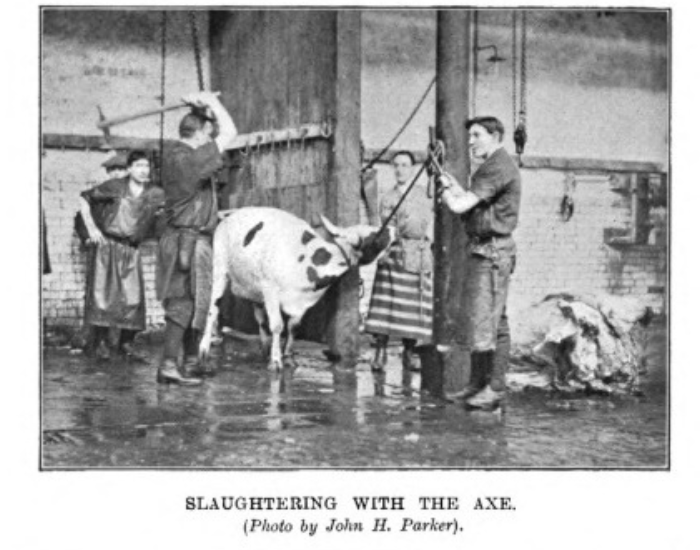
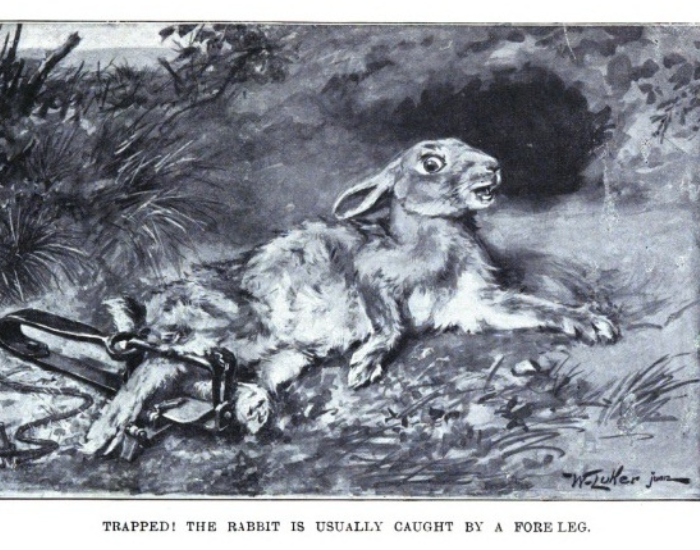
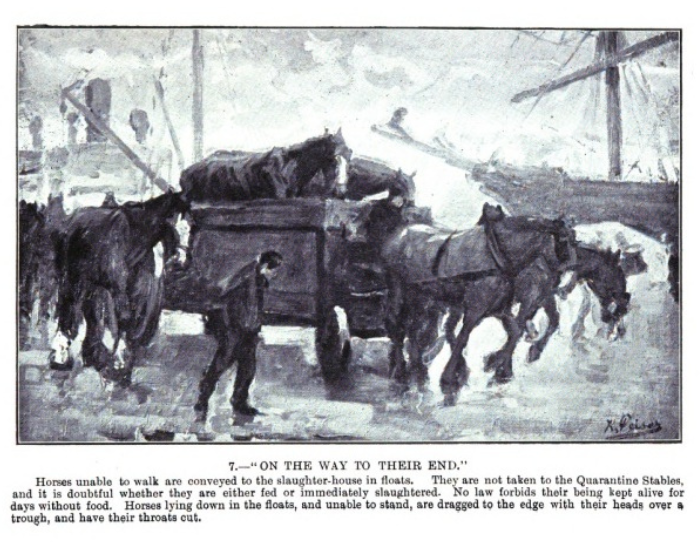
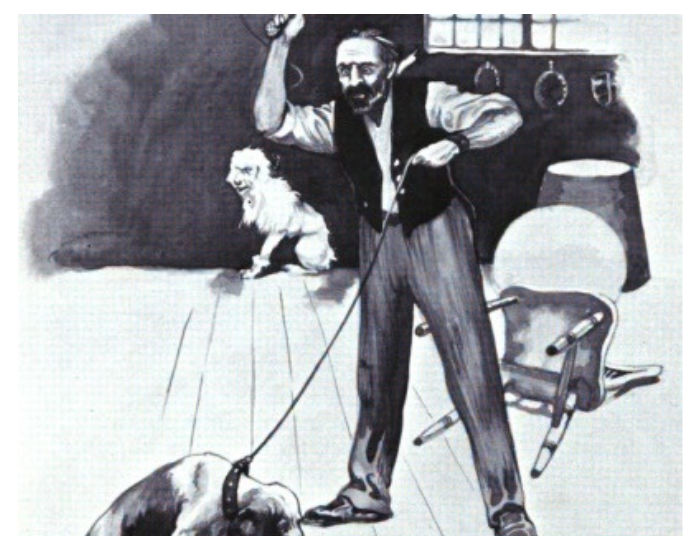
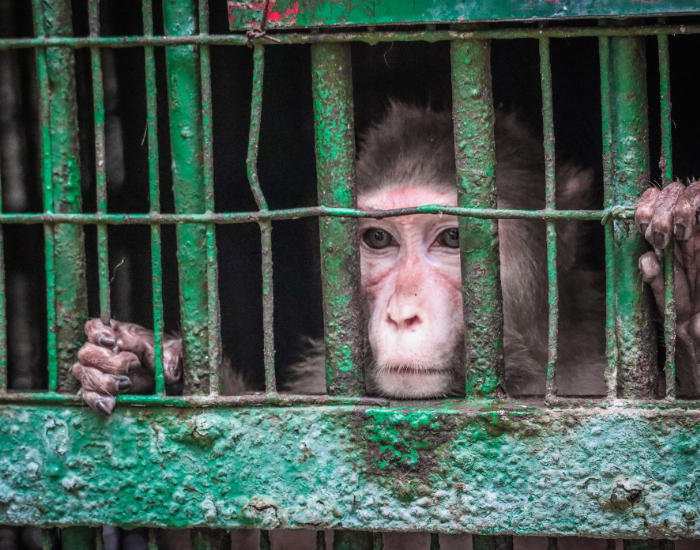
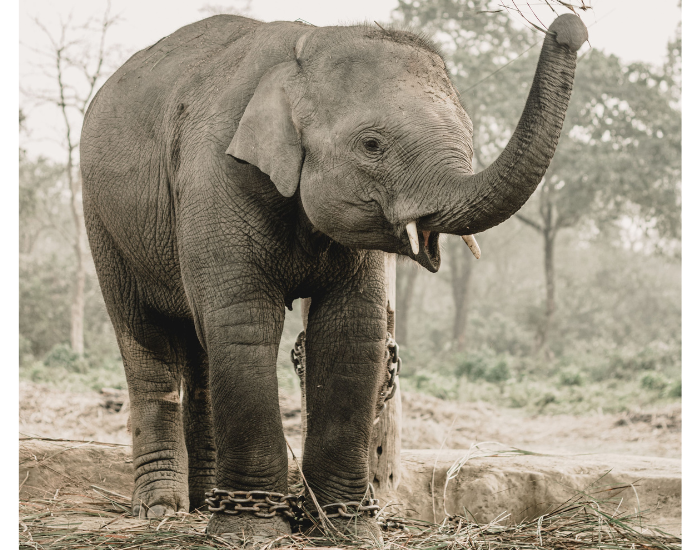
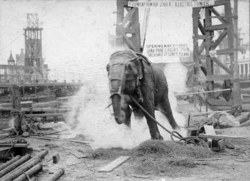
William H. Drummond, The Rights of Animals, and Man’s Obligations to Treat Them with Humanity (London: J. Mardon, 1838), pp. 1-14. The lead image is from: https://en.wikipedia.org/wiki/Topsy_(elephant). Images on the top row of the lower section can be found on pages 100, 166, 15, and 111 in Sidney Trist, ed., The Under Dog: A Series of Papers by Various Authors on the Wrongs Suffered by Animals at the Hand of Man (London: Animals’ Guardian Office, 1913). The pictures on the bottom row can be found in: https://www.pexels.com/. The photographers are: Quang Nguyen Vinh, lxe00, Pranavsinh232, and Prabinbasnet.
See: https://babel.hathitrust.org/cgi/pt?id=hvd.32044010401362&seq=1